
International Research Journal of Engineering and Technology (IRJET) e-ISSN: 2395-0056
Volume: 12 Issue: 10 | Oct 2025 www.irjet.net p-ISSN: 2395-0072
International Research Journal of Engineering and Technology (IRJET) e-ISSN: 2395-0056
Volume: 12 Issue: 10 | Oct 2025 www.irjet.net p-ISSN: 2395-0072
Adhyay Mahesh Deshmukh1
1Student, Department of Electrical Engineering, Dr. Babasaheb Ambedkar Technological University, Lonere, Maharashtra, India.
Abstract - In this paper, we present the use of Artificial Intelligence (AI) and Deep Learning (DL) for predicting maintenance of underground power cables. Traditional diagnostic methods, like Partial Discharge (PD) analysis, are common for finding insulation defects. However, these methods rely heavily on experts’ interpretations, making them slow and less effective in real-time situations. To tackle these problems, we use advanced DL models, such as Convolutional Neural Networks (CNNs), Recurrent NeuralNetworks (RNNs), and Long Short-Term Memory (LSTM) models. These models automatically extract features from PD waveforms and Phase Resolved Partial Discharge (PRPD) patterns. Theyshowhigher accuracy, can adapt to noisy signals, and generalize better than traditional methods. This allows for better classification of fault types and more accurate estimationofdefect locations. Field trials and studies using reflectometry underline their ability to cut downtime, improve maintenance schedules, and prolong the lifespan of power assets. Overall, using DL in PD diagnostics is a significant shift from reactive to predictive maintenance, helping to support reliable and cost-efficient underground power systems.
Key Words: ArtificialIntelligence,DeepLearning,Predictive Maintenance,UndergroundPowerCables,PartialDischarge, Convolutional Neural Network (CNN), Recurrent Neural Network (RNN), Long Short-Term Memory (LSTM), ConditionMonitoring,FaultDiagnosis.
Undergroundpowercablesareessentialformodernurban and industrial power distribution systems. They offer aesthetic, safety, and space-saving benefits compared to overhead lines. Despite these advantages, cable networks can develop hidden insulation defects over time due to manufacturingflaws,mechanicalstress,moistureingress,or electrical aging. These defects often show up as partial discharges (PD), which are transient localized ionization eventsthatcanleadtosevereinsulationfailures.Therefore, finding PD activity early and accurately is crucial for preventing unplanned outages, cutting repair costs, and prolongingassetlife.
Traditional PD diagnostic methods, such as time-domain pulse analysis, phase-resolved partial discharge (PRPD) patterns,andreflectometry,havebeeneffectiveinlabsand real-world scenarios. However, they usually need expert
interpretation, manual feature extraction, and extensive post-processing.Thesedrawbackslimitscalabilityandrealtimeuse,especiallyinlarge-scaledistributionnetworksthat require quick, automated decision-making. Recent studies haveappliedclassicalmachinelearningtoPDclassification, butthesemodelsarestillsensitivetonoise,dataimbalance, andmanuallydesignedfeatures.
This paper explores how to integrate deep learning (DL) models,particularlyConvolutionalNeuralNetworks(CNNs), RecurrentNeuralNetworks(RNNs),andLongShort-Term Memory(LSTM)networks,intoaframeworkforpredictive maintenanceofundergroundcables.Bylearninghierarchical representationsfromrawPDwaveformsandPRPDimages, DL methodscanlessenrelianceonmanual preprocessing, increase robustness against noisy environments, and generalize across various defect types. We present a methodology for data acquisition, preprocessing, model design,andevaluation,andwevalidateourapproachusing reflectometry-based localization and representative fieldlikedatasets.
In this paper, we tackle the important issue of localized insulation defects in underground power cables. These defectsleadtopartialdischarges(PD),whichoftenhappen beforecostly,unplannedfailures.TraditionalPDdiagnostics relyonexpertinterpretationandmanualfeatureextraction. This limits scalability and reliability in noisy, real-world conditions.
Althoughdeeplearning(DL)methodshaveshownpromise for automated PD classification, practical use is still held backbyalackoflabeledfielddata,classimbalance,sensor quality issues, and placement sensitivity. There are also challenges with interpretability and inconsistent performanceacrossdifferentcabletypesandenvironments.
ThisworkpresentsacompleteframeworkthatmergesDLbased PD detection and classification with reflectometrybased localization and data enhancement strategies. Our approachaimstoimproveearlyfaultdetectionaccuracyand providereliablespatiallocalizationfortargetedrepairs.It reducestheneedforhumanexpertsandincreasesresilience to noise and changing cable conditions, all while keeping computationalandexplainabilityconcernsinmind.
Volume: 12 Issue: 10 | Oct 2025 www.irjet.net p-ISSN: 2395-0072
In this paper, the goals are to examine the role of partial discharge in insulation breakdown and identify shortcomingsintraditionalPDmethods.Weaimtodesign and implement a practical data acquisition plan that capturestimedomainPDwaveformsandPRPDpatternsin noisy field conditions. We will develop and compare deep learning models, including CNN, LSTM, and hybrid CNN LSTM,forautomatedPDdetection andfaultclassification. Additionally, we will create data augmentation and preprocessing strategies to address class imbalance and enhance the model's ability to handle noise and different cableconditions.Wewillalsointegratedeeplearning-based classificationwithreflectometrytimingforaccuratespatial localization and measure localization error. We plan to evaluate model performance using standard classification andlocalizationmetricsandtesthowwellitworksacross various cable types and sensing setups. Finally, we will assessdeploymentfeasibilitybymeasuringcomputational latency and memory usage and exploring techniques to improveexplainabilityandincreaseoperatortrust.
In this paper, the methodology starts with gathering data usingHighFrequencyCurrentTransformers(HFCT),Ultra HighFrequency(UHF)sensors,andTransientEarthVoltage (TEV)sensorstocapturePartialDischarge(PD)signalsas time-domain waveforms and Phase Resolved Partial Discharge(PRPD)patterns.Thecollectedsignalsgothrough preprocessingsteps,includingnoisefiltering,normalization, windowing,andgeneratingspectrogramsusingShort-Time FourierTransform(STFT).Dataaugmentationisalsodone tobalancerarePDtypes.
For feature extraction and classification, Deep Neural Networks(DNNs)areused.ConvolutionalNeuralNetworks (CNNs)processspectrogramandPRPDimages.Recurrent Neural Networks (RNNs) and Long Short-Term Memory (LSTM)modelsanalyzesequentialwaveforms.HybridCNNLSTM structures manage multi-modal inputs. Training employstheAdamoptimizer,dropout,classweighting,and early stopping to minimize overfitting. Generative Adversarial Networks (GANs) may be applied to expand datasets.
Partial Discharge(PD)classificationisvital foridentifying thetypeandseverityofinsulationdefectsinunderground cables. Traditional methods require manual feature extraction from PD waveforms or Phase Resolved Partial Discharge (PRPD) patterns. They then use statistical or machinelearning classifiers like Support Vector Machines (SVMs)orArtificialNeuralNetworks(ANNs).Thesemethods often face challenges with noisy signals, overlapping dischargesources,andscalabilityissues.DeepLearning(DL)
addressestheseproblemsbylearningfeaturesdirectlyfrom raworpre-processedPDdata.
ConvolutionalNeuralNetworks(CNNs)arecommonlyused to classify PRPD images and spectrograms created from Short-TimeFourierTransform(STFT)ofPDsignals.CNNs canautomaticallyidentifyspatialpatterns,suchasintensity clustersandtextures,whichrelatetodifferentdefecttypes likevoids,corona,orsurfacedischarges.RecurrentNeural Networks (RNNs), especially Long Short-Term Memory (LSTM)models,effectivelyclassifyPDwhentreatedastimeseries pulses. They capture temporal dependencies and repetitivedischargesignatures.HybridCNN-LSTMmodels combine spatial and temporal learning, leading to higher accuracyinvaryingfieldconditions.Autoencoders(AEs)are alsousedforunsupervisedfeaturelearning.Theycompress PRPD or waveform data into low-dimensional representationsbeforeclassification.GenerativeAdversarial Networks(GANs)helpbygeneratingsyntheticPDsignals, whichbalancedatasetsandenhancemodelrobustness.
Comparative studies reveal that CNNs perform better for image-based PRPD classification, while LSTMs excel with noisy sequential waveforms. Hybrid models consistently outperformsinglemodels,achievingaccuracyabove95%in experimental studies. These models not only classify PD typesbutalsoenableseveritygrading.Thissetsafoundation forpredictivemaintenancestrategiesinundergroundpower cablenetworks.
The figure shows a typical partial discharge (PD) pulse voltagemeasuredovertime.Thesharpspikeneartimezero indicatesasuddenreleaseofenergyfromlocalizeddielectric breakdown in the cable insulation. The pulse reaches a maximumamplitudeof8.21Vandthenquicklydecayswith damped oscillations before stabilizing close to zero. This waveformreflectsthetransientandhigh-frequencynature ofPDactivity.Itsamplitude,polarity,anddecaypatternare important indicators for identifying defect types and evaluating insulation condition in underground power cables.
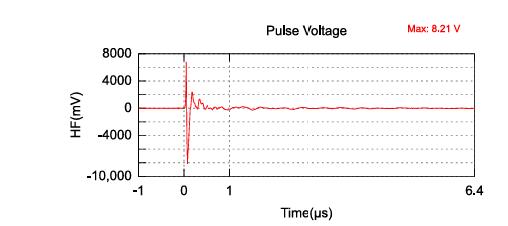
Fig -1: PartialDischargewaveformintime-domain.[2]
Such waveforms are essential for both traditional and AIbaseddiagnosticmethods.Inconventionalanalysis,features
International Research Journal of Engineering and Technology (IRJET) e-ISSN: 2395-0056
Volume: 12 Issue: 10 | Oct 2025 www.irjet.net p-ISSN: 2395-0072
likepeak amplitude,risetime,pulse width,andrepetition ratearetakenfromthesesignalstoevaluatetheseverityand typeofdefect.However,differencesinnoiselevels,sensor placement, and cable conditions often make manual interpretationdifficult.Indeeplearningframeworks,rawPD waveforms are fed directly into models like Recurrent Neural Networks (RNNs) or Long Short-Term Memory (LSTM)networks,whichautomaticallylearnthetemporal dependencies in the signal. This removes the need for extensivemanualfeatureengineeringandallowsforhigher classificationaccuracyinreal-worldoperatingconditions.
3.2 Convolutional Neural Network Architecture for Partial Discharge classification
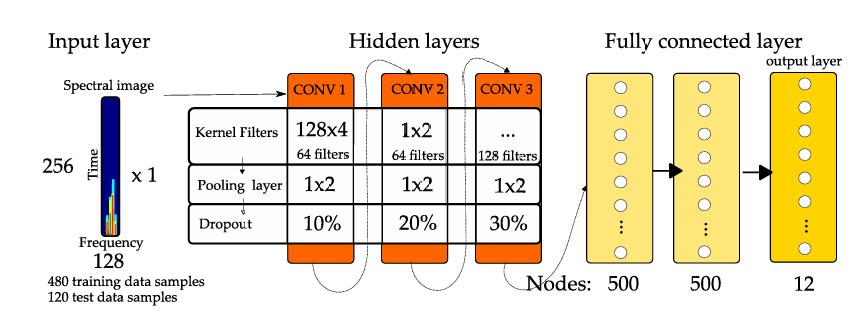
Fig -2:CNNstructureproposedbyusedtoclassifyPD spectrograms [2]
The figure shows a Convolutional Neural Network (CNN) modelcreatedtoclassifypartialdischarge(PD)signalsusing spectral images as input. The input layer takes a twodimensional spectral representation of PD data that measures256(time)×128(frequency).Thislayerincludesa datasetof480trainingsamplesand120testsamples.The hidden layers have three convolutional blocks: CONV 1, CONV 2, and CONV 3. Each block uses kernel filters of different sizes, followed by pooling layers that lower dimensionality and dropout layers set at 10%, 20%, and 30% to avoid overfitting. The convolutional layers learn more complex spatial and temporal features from the PD spectralimages.
The features extracted then go to fully connected layers, whichincludetwohiddenlayerswith500nodeseach,before reaching the output layer with 12 nodes. These nodes represent classification into 12 different PD types or categories.ThisfeaturelearningstructureallowstheCNNto automatically recognize complex patterns in PD data. It provides greater accuracy and reliability compared to traditionalmachinelearningmethodsthatrelyonmanual featureextraction.
The table compares the performance of different Partial Discharge (PD) detection methods based on three main parameters: detection rate, recognition accuracy, and detection time cost. The Convolutional Neural Network (CNN) method shows the best performance, with a PD
detectionrateof95.73%,recognitionaccuracyof95.58%, andareduceddetectiontimeof12seconds.Thismakesita strongchoiceforreal-timeapplications.Thepulsecurrent method has a similar detection rate of 95.36% but lower accuracy at 90.81%, and it takes more than 30 minutes, which makes it less practical for quick diagnostics. Ultrasonicdetectionhasmoderateaccuracyat85.73%but thelowestdetectionrateat48.10%.Thisshowsitslimited effectivenessforPDclassification,eventhoughithasafaster timecostofabout5minutes.TheexistingTransientEarth Voltage(TEV)methodachievesadetectionrateof80.68% and recognition accuracy of 80.90%, with a time cost of around10minutes,butitstilldoesnotmatchtheCNN-based detection. In summary, this comparison shows that CNNbased models provide higher accuracy and more reliable detectionwhilesignificantlycuttingdownthetimeneeded, proving their value for predictive maintenance of undergroundcables.
Table -1: ResultscomparisonbetweenCNNand traditionalmethod.[2]
4.1 Pros
AutomatedFeatureExtraction:Deeplearningremoves theneedformanualfeatureengineering,whichlessens relianceonexperts.
High Accuracy: Models like CNN, LSTM, and hybrids reach 96 to 100% accuracy in PD classification, surpassingtraditionalmethods.
Scalability: These models can manage large real-time datasets and adjust to various cable systems and settings.
Early Fault Prediction: They allow for predictive maintenance by spotting PD activity before failures occur,whichenhancesreliabilityandcutsdowntime.
4.2 Cons
High Data Requirement: It needs large amounts of labeledPDdata,whichiscostlyandtakesalotoftimeto gather.
International Research Journal of Engineering and Technology (IRJET) e-ISSN: 2395-0056
Volume: 12 Issue: 10 | Oct 2025 www.irjet.net p-ISSN: 2395-0072
Computational Cost:Trainingdeepnetworksrequires powerful hardware, like GPU or TPU, and a lot of memory.
BlackBoxNature:Thelimitedinterpretabilitymakesit harderforoperatorstounderstanddecision-making.
GeneralizationLimits:Modelsmightnotworkwellwith differentcabletypesunlesstheyareretrained.
DataImbalance:RarePDtypescanskewmodelsunless theyarecarefullybalanced.
Sensor Dependence: Accuracy depends on the right sensor type, placement, and calibration. Poor data capturecanlowerperformance.
Noise Robustness: These models deal with complex, noisy,andoverlappingPDsignalsmoreeffectivelythan standardtechniques.
ThereviewshowsthatusingArtificialIntelligence(AI)and DeepLearning(DL)forPartialDischarge(PD)diagnostics provides a new way for predictive maintenance of undergroundpowercables.Traditionaldiagnosticmethods arereliablebutdependonmanualinterpretation.Theyalso have slow response times and are affected by noise. In contrast, deep learning models like Convolutional Neural Networks(CNNs),RecurrentNeuralNetworks(RNNs),and Long Short-Term Memory (LSTM) networks significantly improve automated feature extraction, classification accuracy, and resistance to complex, noisy signals. ExperimentalresultsandcomparisonsshowthatDL-based methods achieve higher detection rates and reduce diagnostic time. This makes them suitable for real-time applications.
However,adoptingDL in thisfieldcomes withchallenges. High data needs, computational demands, limited interpretability, and reliance on sensor quality must be resolvedfor practical use in the field.Future work should aimtobuildlarge,balanceddatasets,createexplainableAI modelstoboostoperatortrust,andimprovearchitectures forquicker,moreefficientimplementation.Combiningthese methodswithreflectometryalsoenhancesthepotentialby allowingforfaultdetectionandpreciselocalization,which supportstargetedmaintenancestrategies.
Inconclusion,usingDLinPDdiagnosticsmarksashiftfrom reactivetoproactivecablemaintenance.Asdatahandling, modeldesign,andexplainabilitycontinuetoimprove,these methodscouldsetanewstandardforreliable,cost-effective, andsmartmonitoringofundergroundpowerinfrastructure.
[1] SteffenZiegler,Member,IEEE,ShishirShekhar,Senior Member, IEEE, Daniel Scherle, P.E., Member, IEEE, MalaquiasPena,Member,IEEE,“DeepLearningSignal Waveform Characterization of Partial Discharge for UndergroundPowerCableConditions”,2023,IEEE
[2] Sonia Barrios, David Buldain, María Paz Comech, Ian GilbertandIñakiOrue,“PartialDischargeClassification Using Deep Learning Methods Survey of Recent Progress”,2019,MDPI
[3] Matthew S. Mashikian, Life Fellow, IEEE, “Partial Discharge Location as a Diagnostic Tool for Power Cables”,2000,IEEE
[4] IEEE 400 Guide for Field Testing and Evaluation of InsulationofShieldedPowerCableSystemsRated5kV andabove,IEEE,Piscataway,NJ,Jun.5,2012
[5] Montanari, G.C.; Cavallini, A. Partial discharge diagnostics: from apparatus monitoring to smart grid assessment.IEEEElectr.Insul.Mag.2013,29,8-17
[6] J. McBride, V. Harper, L. Coffeen, F. Stanley, H. Ng, "ExaminationandLocationofPDSitesinSeverelyAged UndergroundDistributionCables",IEEETransactionson PowerDelivery.,Vol.9,No.2,April1994