
International Research Journal of Engineering and Technology (IRJET) e-ISSN: 2395-0056
Volume: 12 Issue: 11 | Nov 2025 www.irjet.net p-ISSN: 2395-0072
International Research Journal of Engineering and Technology (IRJET) e-ISSN: 2395-0056
Volume: 12 Issue: 11 | Nov 2025 www.irjet.net p-ISSN: 2395-0072
Prof. Puneeth S P 1, Akash G V2 , C R Ajjaiah3 , Hemalata S Shedad4 , Manohar H Koppad5
1Assistant Professor, Information Science and Engineering, Bapuji Institute of Engineering and Technology, Karnataka, India
2,3,4,5 Bachelor of Engineering, Information Science and Engineering, Bapuji Institute of Engineering and Technology, Karnataka, India ***
Abstract - An Agriculture in India remains highly vulnerable to unpredictable market prices and inconsistent soil fertility conditions. Farmers often rely on experiencebased decisions rather than data-driven insights, resulting in economic losses and reduced productivity. AgroAdvisor is an intelligent web-based system designed to support farmers through two key capabilities: crop price forecasting and fertility-based crop recommendation. The system uses deep learning and machine learning techniques to analyze historical market data, soil nutrient levels (N, P, K), pH, and regional climatic conditions. Forecasting models predict future crop prices using time-series patterns, while classification models recommend suitable crops based on soil fertility and environmental factors. The platform also offers a simple and accessible user interface for farmers to input soil parameters, view insights, and make informed cultivation decisions. AgroAdvisor aims to bridge the technological gap in agriculture by providing personalized, intelligent, and actionable guidance, ultimately improving farmers’ productivity and profitability.
Key Words: Machine Learning, Crop Recommendation, Price Forecasting, Soil Fertility, Agriculture, Deep Learning, Time-Series Analysis, Smart Farming.
AgricultureisoneofthemostcriticalsectorsoftheIndian economy, yet farmers continue to face challenges such as uncertain market prices, poor soil knowledge, and unpredictable climatic conditions. Traditional methods of crop selection often depend on experience or generalized advisory services, which fail to provide personalized guidance. With advancements in machine learning and data analytics, there is an increasing opportunity to support farmers through intelligent decision-support systems. AgroAdvisor is a smart agricultural assistant designed to enhance the decision-making process by combining soil fertility analysis with crop price forecasting. By taking soil nutrient parameters such as Nitrogen (N), Phosphorus (P), Potassium (K), and pH, alongwith climaticfactorsandhistorical pricetrends,the system provides actionable insights to farmers. It helps
themchoosesuitablecropsandplantheirmarketstrategy effectively.
The AgroAdvisor system uses a trained Decision Tree classifier to analyze soil nutrient values such as Nitrogen, Phosphorus,Potassium,andpH.Bylearningpatternsfrom agricultural datasets, it identifies the crops that match specific soil profiles. This model not only evaluates raw valuesbutalsointerpretsnutrientbalance,deficiency,and soilaciditybeforesuggestingcrops.
AgroAdvisor focuses heavily on soil fertility as the foundation for decision-making. The system evaluates the nutrient levels provided by the user and determines whether the soil conditions are optimal for particular crops. It reduces the chances of nutrient mismatch, which can negatively affect crop growth. By understanding soil fertility, the platform encourages farmers to grow crops best suited to their land rather than following traditional butunsuitablepractices.
ThepriceforecastingcomponentispoweredbyRandom Forest Regression, which analyzes historical mandi price data.Itidentifiesseasonal trends,marketfluctuations,and growth patterns over time. This helps predict future crop prices with considerable accuracy. Farmers can plan cultivation cycles, choose profitable crops, and decide the right time to sell their produce. The forecasting model reduces reliance on middlemen who often manipulate price. It empowers farmers with data-driven insights, helpingthemmakeinformedfinancialdecisions.
The platform features an intuitive and simple interface designedforfarmerswithminimaltechnicalknowledge.It allows users to enter soil values easilyand receive instant recommendations. The dashboard is visually appealing, with charts, graphs, and color-coded indicators for better
International Research Journal of Engineering and Technology (IRJET) e-ISSN: 2395-0056
Volume: 12 Issue: 11 | Nov 2025 www.irjet.net p-ISSN: 2395-0072
understanding. This ensures that farmers do not need specializedtrainingtousethesystem.Themobile-friendly layout improves accessibility in rural areas where smartphonesarecommon.
AgroAdvisorintegratesmultipledatasourcestoprovide comprehensive recommendations. Soil nutrient values, climatic information, and historical price datasets are analyzed together to generate insights. This multidimensional approach increases accuracy and practicality. It ensures thatthe recommended crop is not only suitable for the soil but also profitable in the upcoming season. Integrating weather conditions helps farmers avoid climate-incompatible crop selections. Market price data ensures economic gain, while soil data ensures agronomic suitability.Thisholisticintegrationmakesthesystemmore reliablethansolutionsthatconsideronlyonetypeofdata. Itenablesfarmerstomakedecisionsbackedbyscienceand economicssimultaneously.
Chart -1:AgroAdvisorSystemOverview.
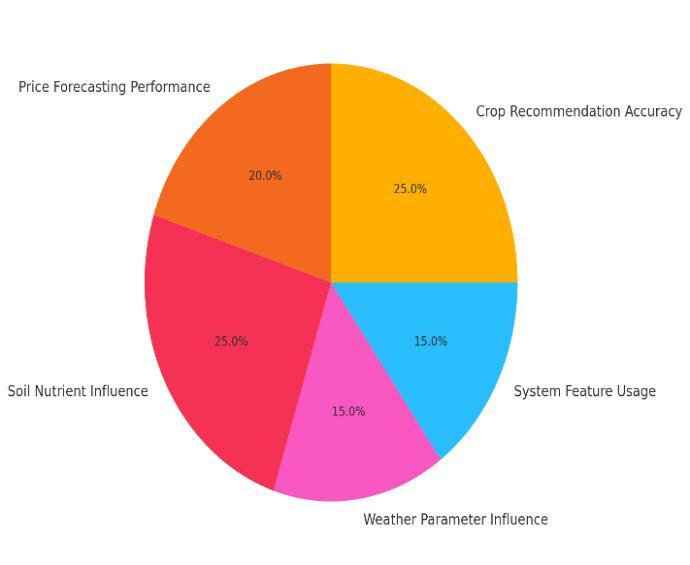
Table -1: Characteristics of AgroAdvisor
Characteristic Explanation
Intelligent Decision making Uses machine learning algorithms to analyse soil and market data for accuraterecommendations.
Real-Time Recommendations Provides instant crop suggestions and price predictionsafteruserinput.
Multi-Source dataIntegration Combines soil, weather, and historical price datasets for holistic decisionsupport.
HighAccuracyModels Utilizes Decision Tree and Random Forest algorithms forreliableoutputs.
ScalableArchitecture Designed with modular componentstoallowfuture systemexpansion.
User-FriendlyInterface Simple dashboard designed tobeeasilyusedbyfarmers with minimal technical knowledge.
DataSecurity Ensures secure login and protects user information fromunauthorizedaccess.
1. Data Collection:
AgroAdvisor begins with collecting data from multiple credible sources to build a strong foundation for prediction. Soil nutrient values suchasNitrogen(N),Phosphorus (P),Potassium (K), and pH are obtained from farmer inputs or sample soil reports. Historical mandi price datasets are collected from Agmarknet to train the price forecasting model. Weather data including temperature, rainfall, and humidity is fetched through API services. Additionally, agricultural crop datasets containing soil–crop mappings are used as references. This comprehensive data ensures accurate, real-time, andregion-specificoutputs.
2. Data Preprocessing:
Raw data often contains inconsistencies, missing values, and noise, so preprocessing is essential. Missing values are handled using imputation techniques to ensure model stability. Soil and weather attributes are normalized to maintain uniform scale across inputs. Duplicate records and outliers from price datasets are removed to avoid misleading predictions. Categorical entries are encoded numerically for ML compatibility. This step ensures clean, structured, and highqualitydataformodeltraining.
International Research Journal of Engineering and Technology (IRJET) e-ISSN: 2395-0056
Volume: 12 Issue: 11 | Nov 2025 www.irjet.net p-ISSN: 2395-0072
3. Feature Engineering:
Feature engineering enhances the predictive capabilityofthesystembygeneratingmeaningful features. Nutrient ratios such as N:P:K are computed to better understand soil fertility patterns. Seasonal indicators are derived from date-wisepricedatatocapturemonthlyoryearly trends. Weather-based crop growth factors are constructed to improve recommendation accuracy. Additional features like moving averages and price volatility strengthen timeseriesforecasting.Theseengineeredfeatureshelp the models learn deeper relationships within the data.
4. Machine Learning Model Development:
Two machine learning models are developed for AgroAdvisor: a Decision Tree classifier for crop recommendationanda RandomForestregressor for price forecasting. The Decision Tree analyzes soil nutrients and climate inputs to classify the mostcompatiblecrop.TheRandomForestmodel learns from historical price patterns to predict future market prices. Hyperparameter tuning is performed to enhance accuracy and reduce errors. The models are trained, validated, and optimized through iterative testing. This stage buildsthecoreintelligenceofthesystem.
5. System Integration:
Once the models are trained, they are integrated into a web-based application for user access. Frontendtechnologiesdisplayinputfields,charts, and prediction results in a clean interface. Backend logic connects the ML models through APIs,enablingreal-timeprocessingofuserinputs. Soil and weather values entered by farmers are immediatelypassedtothemodels,andresultsare sent back to the UI. Data visualization tools such asgraphsandtablespresentinsightsclearly.This integration ensures seamless communication betweendata,models,anduserinteraction.
6. Model Evaluation & Testing:
Thesystemundergoesextensivetestingtoensure accuracy, reliability, and robustness. Crop recommendation accuracy is measured using classification metrics such as Accuracy Score and Confusion Matrix. Price forecasting is evaluated usingR²ScoreandMeanSquaredError(MSE)to validate prediction quality. Cross-validation ensuresthatmodelsperformwellacrossdifferent data samples. Unit testing verifies individual components, while integration testing ensures smooth interaction between modules. The final
evaluationconfirmsthereadinessofAgroAdvisor forreal-worlddeployment.
3. PROS and CONS:
3.1 PROS
1. Data-Driven Crop Recommendations
AgroAdvisor eliminates guesswork by using machine learning techniques to recommend crops based on soil nutrients, weather conditions, and regional patterns. This ensures scientifically accurateandpersonalizedcropselection.
2. Accurate Price Forecasting
The system predicts future crop prices using historical mandi datasets, enabling farmers to plan cultivation and selling strategies more profitably. This helps reduce financial risks and enhances incomestability.
3. Improved Resource Utilization
By aligning crop choices with soil fertility, AgroAdvisor supports efficient use of fertilizers, water, and land. Farmers avoid growing crops unsuitable for their soil, improving overall soil healthandsustainability.
4. User-Friendly Interface
The platform provides a simple and interactive dashboard, making it easy for farmers including those with limited technical knowledge to input soildataandinterpretresultsquickly.
5. Multi-Source Data Integration
The system intelligently merges soil, weather, and market price data, allowing farmers to make decisions that consider both biological and economicfactorssimultaneously.
6. Supports Sustainable Agriculture
By recommending crops that match the soil’s natural fertility, AgroAdvisor reduces excessive fertilizer use and promotes eco-friendly farming practices.
7. Reduces Dependency on Middlemen
Farmers gain direct access to market price trends and future price predictions, reducing their reliance on external agents who may manipulate information.
3.2 CONS
1. Dependence on Internet Connectivity
Since AgroAdvisor is an online platform, farmers in remote orlow-network areas mayface
International Research Journal of Engineering and Technology (IRJET) e-ISSN: 2395-0056
Volume: 12 Issue: 11 | Nov 2025 www.irjet.net p-ISSN: 2395-0072
difficulties accessing the system, affecting realtimedataretrievalandpredictions.
2. Data Quality Sensitivity
The accuracy of recommendations heavily dependsoncorrectsoilinputsandreliabledataset sources. Incorrect nutrient values or inconsistent marketdatacanreducepredictionperformance
3. Limited to Trained Crops
The system can only recommend crops included in its training dataset. Uncommon or regionally specific crops may not appear in suggestions,limitingflexibilityforcertainfarmers.
4. Requires Basic Technical Literacy
Although designed to be simple, farmers unfamiliar with smartphones or web applications may still find it challenging to use the system withoutinitialguidance.
5. Weather Variability Impact
Sudden climate changes or unpredicted rainfall patterns can affect the practicality of recommendations, as no model can fully capture real-timeenvironmentalunpredictability.
6. Computational Requirements
Running ML models and updating datasets requires backend computational resources, making the system dependent on server availabilityandmaintenance.
7. No Real-Time Soil Sensor Integration
SinceAgroadvisor relies onmanuallyentered soil values, inconsistent sampling or human error canaffectresults.IntegrationwithIoTsoilsensors would increase precision but is not yet implemented.
AgroAdvisor provides a comprehensive, intelligent, and user-friendly decision-support system aimed at improving agricultural planning and profitability for farmers. By integrating soil nutrient analysis, climatic data, and historical market trends, theplatformoffers accuratecrop recommendationsandreliablepriceforecasting.Theuseof machine learning techniques such as Decision Tree Classification and Random Forest Regression significantly enhances prediction accuracy and reduces dependency on traditional guesswork-based decisions. The system also helps farmers make informed choices that optimize soil fertility, reduce cultivation risks, and promote sustainable farmingpractices.Withitssimpleinterfaceanddata-driven insights, AgroAdvisor demonstrates strong potential for large-scale adoption among rural farming communities.
Future enhancements, including IoT soil sensors, multilingual support, and expanded crop datasets, can further improve the system’s accuracy and usability, making Agro Advisor a valuable contribution to modern precisionagriculture.
We would like to express our sincere gratitude to our guide, Prof. Puneeth S. P., for his continuous guidance, insightful suggestions, and unwavering encouragement throughout the development of our project AgroAdvisor His expertise and mentorship were instrumental in helpingusunderstandkeymachinelearningconceptsand applythemeffectivelywithintheagriculturaldomain.
Wealsoextendourheartfeltthankstothe Department of Information Science and Engineering, BIET Davangere, for providing the essential resources, facilities, and support that enabled us to carry out this work successfully.
[1] S. Ramesh, P. Varghese, and K. Kumar, “Machine LearningTechniquesforCropRecommendationUsing Soil and Climatic Factors,” International Journal of ComputerApplications,vol.179,no.20,2021,pp.1–6.
[2] A. Bansal and N. Kumar, “A Decision Tree Approach for Predicting Suitable Crops Based on Soil Parameters,” International Journal of Advanced Research in Computer Science, vol. 11, no. 4, 2020, pp. 45–50.
[3] R. Sharma and K. Mehta, “Fertilizer and Crop Recommendation Using Random Forest Classifier,” IRJET,vol.8,issue6,2021,pp.1425–1430.
[4] S. Desai, R. Patil, and V. Patankar, “Crop Price Prediction Using Machine Learning Algorithms,” International Journal of Engineering Research & Technology,vol.9,issue3,2020,pp.687–692.
[5] R.JainandA.Agrawal,“AgriculturalPriceForecasting Using Time-Series Analysis and Machine Learning,” Journal of Agricultural Informatics,vol.12,no.2,2021, pp.22–32.
[6] Government of India, “Agmarknet: Agricultural Marketing Information System.” Available at: https://agmarknet.gov.in
[7] Open-Meteo API Documentation, “Weather and Climate Data for Forecasting,” Available: https://open-meteo.com
[8] L.Breiman,“RandomForests,” MachineLearning, vol. 45,2001,pp.5–32.