
International Research Journal of Engineering and Technology (IRJET) e-ISSN: 2395-0056
Volume: 12 Issue: 08 | Aug 2025 www.irjet.net p-ISSN: 2395-0072
International Research Journal of Engineering and Technology (IRJET) e-ISSN: 2395-0056
Volume: 12 Issue: 08 | Aug 2025 www.irjet.net p-ISSN: 2395-0072
Maneesha Yoga1 , Dr. S. Vijaya2 , Mary Bhagya Jyothi J3
1A postgraduate student, Dr. Ambedkar institute of technology, Bangalore, Karnataka, India.
2 Professor, Dept. of Civil Engineering, Dr. Ambedkar institute of technology, Bangalore, Karnataka, India.
3Assistant Professor, Dept. of Civil Engineering, Dr. Ambedkar institute of technology, Bangalore, Karnataka, India.
Abstract - Increased urban development has resulted in the increase in demand for high rise building, which get hit by wind forces more often. This research analyses the performance of G+21 residential building with rectangular andsquare floor plans under wind conditions. It identifies the micro and macro changes to enhance how the structure performs in response to wind. With the help of ETABS software, various 3D models were generated that comprised both micro alterations such as corner cuts, recessions, roundness, and fins, and macro alteration such as setbacks. These models were investigated under wind loads as per IS 875 (Part-3) and investigated such key parameters as storey displacement, storey drift, and storey shear. The findings indicate that aerodynamic adjustments, particularly vertical fins,minimizedtopstoreydisplacementssubstantially byas much as 30% in the X direction for rectangular forms while setbacksuniformlyreducedallparameters.Squarestructures, due to their symmetrical form, inherently had smaller wind responses but still gained with some aerodynamic modifications. This research underlines how optimizing building form can enhance wind resistance, minimize structural movement, and provide greater comfort to occupants. These results provide architects and structural engineers with valuable design information on how to make tallbuildings more robust andsustainableintheface ofwind.
Key Words: Micro modifications, Macro modifications, ETABS, Wind performance, High-rise buildings, IS 875 (Part 3)
Theconsistenturbanizationanddwindlingsupplyofland tobebuiltuponhavecompelledconstructiontrendstoward upwardgrowth.Skyscrapersarefastbecomingasolutionto spatialconstraintsincities,butwithincreasedheightcomes increased susceptibility to environmental stresses most notably,wind.Tallerandmoreslenderbuildingsaremore likelytosway,vibrate,andbesubjecttodynamicpressures thatcaninfluenceboththeirlong-termperformanceandthe comfort of occupants within them. This necessitates that wind effects should be addressed from the very earliest stagesofdesign.
In India, the process of wind resistance design is accordingtoIS875(Part3):2015guidelines.Thestandard prescribesafundamentalwindspeedforeachofsixzonesin the country. These are further adjusted to suit site
conditionsbyemployingthreeparameters:riskcoefficient (k₁),terrain-heightfactor(k₂),andtopographyfactor(k₃). Proper utilization of these corrections is important to establish true wind pressures and safe but economic construction.
A proven strategy for increasing wind performance is aerodynamicshapeoptimization alteringabuilding'sform so it deflects or disrupts airflow naturally. Macro changes involve large-scale modifications, such as tapering the silhouette,addingsetbacks,ortwistingtheshapetodisrupt wind flows. Micro changes such as rounding edges or creating recessed corners also decrease the intensity of vortices. These techniques have been used effectively in buildingssuchastheBurjKhalifainDubai,whichemploys spiralsetbackstobreakupvortexcreation,andtheImperial TowersinMumbai,wheretaperingdecreasesoverallwind pressure.
In addition to decreasing wind forces, aerodynamic shapingprovidesseveraladvantages.Itenhancesstructural efficiency, reduces material and construction expenses, beautifiesthearchitecturalaspect,andachievescompliance with safety requirements. Performance can also be augmentedwithdevicessuchasdampingsystems,porous façades, or strategically located openings that permit controlledairflow.
Engineersusuallytestwindperformancebymonitoring storey displacement (total floor movement at each floor), storey drift (relative floor movement), and storey shear. Maintaining these amounts within secure parameters guarantees stability, reduces non-structural damage, and ensures occupant comfort. The most effective high-rise structures integrate aerodynamic techniques with good structuralengineering,resultinginbuildingsthatarenotjust safe and economical but also aesthetically unique and resilient.
Storeydisplacementisthesidewaysmovementofa particular floor level when the building is hit by lateral forces such as wind or earthquakes. This movement is measured from the floor’s original positionandhelpsengineersunderstandhowmuch thebuilding“sways.”Ifthedisplacementistoohigh, it can affect stability, make occupants
International Research Journal of Engineering and Technology (IRJET) e-ISSN: 2395-0056
Volume: 12 Issue: 08 | Aug 2025 www.irjet.net p-ISSN: 2395-0072
uncomfortable, and damage non-structural parts likewalls,glasspanels,andpartitions.
B. StoreyDrift
Storey drift measures how much one floor moves sidewayscomparedtothefloordirectlybelowit.It is essentially the difference in displacement between two consecutive floors, divided by the height of that storey. Controlling storey drift is crucial because excessive relative movement can crack walls, damage cladding, or disrupt building services.Designcodeslike IS1893(Part1):2016 set limits to ensure buildings remain safe, comfortable,andserviceable.
C. StoreyShear
Storeyshearisthetotalsidewaysforceafloormust resist,causedbywindorearthquakeloadsonthat floor and all the floors above it. Lower floors typicallyexperiencehigherstoreyshearsincethey carry the combined effect of the entire building above. Understanding thishelps engineersdesign strongcolumns,beams,and shearwalls,ensuring thebuildingcansafelytransfertheseforcestothe foundation while meeting the requirements of IS 1893(Part1):2016andIS875(Part3):2015.
D. ForcesinAerodynamics
Lift:Theforcethatactsperpendiculartotheairflow, typicallyseeninobjectslikeairplanewings.
Drag: The resistive force opposing an object’s motionthroughtheair.
Thrust: A force that moves an object forward (commonlyseeninengines).
Weight: The gravitational force pulling an object downward.
Pressure Distribution: When air flows around a body,pressuredifferencesarecreated.
Lowerpressureononesidecangeneratelift,while higherpressurecanincreasedrag.
E. WindLoadEffects
Alongwindload-
Along wind load acts in the same direction as the wind flow, pushing directly against the building and producing bending and shear effects. This load, often called a drag force, arises from pressure differences between the windward face (the side facing the wind) andtheleewardface(theoppositeside).Thebuilding’s
response to this force, known as the along-wind response, determines how it sways and how internal forcesaredistributed.Accurateassessmentofalongwind effectsis essential for ensuringstructural stability and occupantcomfort.
Acrosswindload-
Across wind load acts perpendicular to the wind direction and is mainly caused by vortex shedding. As windflowspastthebuilding,itformsalternatingvortices on either side, producing side-to-side forces. In many modern tall buildings, the across-wind response can be morecriticalthanthealong-windresponse,especiallyfor slender structures. This motion occurs in a plane transverse to the wind and can significantly influence structuralperformanceandoccupantcomfort.
TorsionalLoad-
Torsional load arises when wind pressure is distributedunevenlyaroundabuilding,causingrotational forces.Asymmetricalbuildingshapesorunevenopenings can lead to twisting of the structure, which adds complexitytoitsoveralllateralresponse.Accountingfor torsional effects is vital in tall buildings to prevent excessiverotationandmaintainstructuralintegrity.
Vortex-SheddingPhenomenon-
Vortex shedding is a fluid dynamics effect that occurs when wind separates alternately around a building, creating swirling vortices in its wake. These vorticesexertfluctuatinglateralforcesperpendicularto thewinddirection.Ifthevortexsheddingfrequencyaligns with the building’s natural frequency, resonance can occur,amplifyingvibrations.Aerodynamicmeasureslike tapering,twisting,orroundingcornersareoftenapplied todisruptvortexformationandreducetheseoscillations.
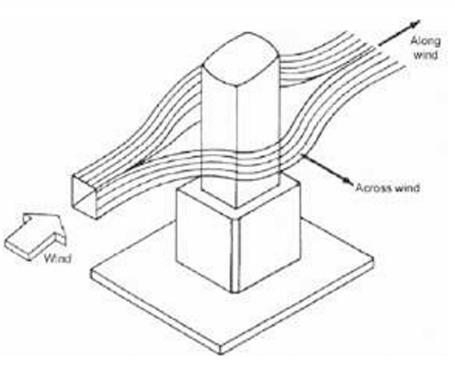
Fig-1: 2-Dflowofwindshowingalongwindandacross windmotion
F. Aerodynamicmodifications
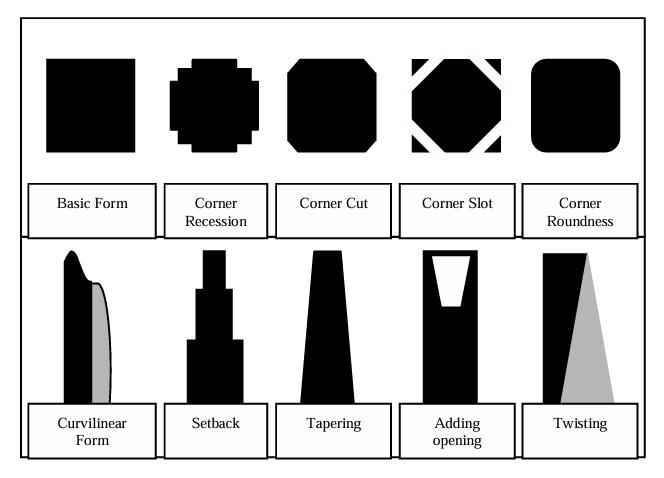
a. Micro modifications include corner roundness, corner cut, fins and corner recession. All corner
International Research Journal of Engineering and Technology (IRJET) e-ISSN: 2395-0056
Volume: 12 Issue: 08 | Aug 2025 www.irjet.net p-ISSN: 2395-0072
modificationssuchasroundedandrecessedcorners, which have no effect on the main concept of the shapeandtheformoftallbuildings,areconsidered micromodification.
b. Macro modifications include setback, tapering, twisting and openings. Macro modifications have major effects on the main architectural concept of the shape and form of tall buildings. Using these aerodynamic modifications can maximize the structuralperformanceofbuildingsandthereduce wind-inducedeffects.
1.1 Literature Review
This literature review examines existing studies on the aerodynamic performance of high-rise buildings, highlightingdifferentoptimizationapproaches,windtunnel experiments, and numerical simulations used in the field. Thereviewalsoexplorestheimpactofshapemodifications on structural design and sustainability. By analysing past research, this study aims to identify gaps in the literature and establish a foundation for further advancements in aerodynamicshapeoptimizationforhigh-risestructures.
Matin Alaghmandan, Farid Abdolhossein-Pour & Jamshid Mohammadi, 2013 [1] an innovative computational approach has been proposed to optimize wind effects on tall buildings by integrating both architecturalandstructuralstrategies.Thestudyemphasizes that while aerodynamic modifications like tapering, setbacks, twisting, and corner treatments can passively reducewindloads,structuralsystemssuchasbracedtubes, diagrids, and outriggers actively enhance stability. Importantly,theresearchhighlightsthatthebestoutcomes come from combining these two approaches rather than applyingthemseparately.Byusingparametricdesign,CFD simulations, structural analysis in ETABS, and genetic algorithms for optimization, the method ensures efficient building forms with reduced wind impact and minimized structural weight. This collaborative, iterative framework bridgesthegapbetweenarchitectsandengineers,leadingto
designs that are both aerodynamically efficient and structurallyeconomical.
MeghaKalra,PurnimaBajpai & DilpreetSingh,2016 [2] investigatedthatWindplaysadecisiveroleinthestabilityof high-risebuildings,andtheoverallshapeofastructurecan greatlyinfluenceitsresponse.Astudyon50-storeybuildings withdifferentplans rectangular,L,U,T,I,plus,andnonuniform showed that irregular shapes generally experiencedhigherdriftandjointdisplacementcomparedto more compact or symmetric ones. Among the models, the Plus-shaped and non-uniform structures proved to be the moststableunderwindloads,whileL-andU-shapedplans performed the worst. The research emphasized that as height increases, drift and displacement also rise, making shape optimization a vital consideration in tall building design.
Sushmitha H O & Chetan gonni S, 2022 [3] analysesusing ETABS highlighting how aerodynamic modifications can effectivelyimprovethewindperformanceoftallbuildings. Inacomparativestudyona40-storeysquaretower,minor changessuchasrounded andrecessedcorners,as well as major modifications like tapering and setbacks, were analysedagainstabasicsquaremodel.Theresultsshowed that corner treatments significantly reduced story displacement, drift, and base shear, while tapered and setbackmodelsprovidedmoderateimprovements.Among the tested shapes, recessed corners performed best in minimizingwind-inducedeffects,demonstratingthateven relativelysimplegeometricchangescanmaketallbuildings safer,morestable,andmoreserviceableunderstrongwinds.
Nikhil Gaura, Ritu Raj, 2022 [4] showed that Minor modificationslikecorner-cuttingmayleadtoreductionsin drag force by 25% when compared with no corner cut. Cornermodificationshowedbetterperformanceupto12–15%modificationsinsection.
Mokhtari et al.,2023[5] researchshowsthatsimpledesign changes like rounding or chamfering corners, adding setbacks, tapering, or twisting the building form can reduce wind pressures by disrupting vortex formation. Studies also highlight that openings at higher levels help reduce wind excitation by allowing air to pass through, though their effectiveness depends on placement. Recent work emphasizes the dual benefits of such aerodynamic modifications: improving comfort and safety while also offering economic advantages by lowering structural demands. CFD and wind tunnel studies remain essential tools,withCFDusefulforearlydesigncomparisonsandwind tunneltestsservingasvalidation.Somestudiesevenexplore usingshapemodificationstoharnesswindenergy,showing thatroundedorcircularplanscanboostlocalwindspeeds for potential energy generation. Overall, the literature consistentlyunderlinesthatthoughtfulaerodynamicshaping isapracticalandcost-effectivewaytooptimizetallbuilding performance.
International Research Journal of Engineering and Technology (IRJET) e-ISSN: 2395-0056
Volume: 12 Issue: 08 | Aug 2025 www.irjet.net p-ISSN: 2395-0072
ETABS(ExtendedThree-DimensionalAnalysisofBuilding Systems) is a powerful and widely adopted tool for structuralanalysisanddesign,extensivelyusedforprojects rangingfromskyscrapersandparkingstructurestosteeland concrete buildings, both low-rise and high-rise, as well as portal frames.Itswidespreaduseisattributedtoitsuserfriendlyinterface,adherencetoIndianStandard(IS)codes, versatility in modelling varied structural forms, and high precisioninanalysisresults.
Inthepresentstudy,areinforcedconcrete(R.C.C.)highrisebuildingismodelledandanalysedinETABStoexamine its structural performance. Structural analysis involves defining the geometry, dimensions, and load-bearing capacity of a building to ensure it can safely fulfill its intendedpurposethroughoutitslifespan.Theinvestigation particularlyfocusesonthebuilding’sresponsetowindloads, withanemphasisonevaluatingtheeffectofmodifications on rectangular and square building to improve lateral stiffnessandwindresistance.
A. Objective -
To analyse the impact of wind loads on high-rise buildingsondifferentmodifiedstructuresusing IS875(Part3)andETABS.
Tooptimizebuildingshapesbyidentifyingthemost effectivedesignforreducingstoreydisplacement, storeydrift,andstoreyshear.
Perform comparative analysis between baseline andoptimizeddesignstoquantifyimprovements.
B. Methodology -
Objective→ ETABSModel Generation→ Analyzing the Buildings for Different Cases → Presentation and comparisonofresultsintheformofgraphsandtables→ ResultsandConclusion.
1.4 Modelling
The modelling of the models was carried out in ETABS software.Modeldescriptionandparametersweretabulated below.Initiallytwobasemodelsi.e.,rectangularandsquare modelsweremodelledaccordingtothebelowdescriptions and then the micro, macro modifications were in cooperated.
Table-1:Buildingdetailsforthemodels
BuildingShape Rectangle Square
BuildingDimension 24mx20m 24mx24m
TotalStorey G+21 G+21
Total Height of Building 66m 66m
GradeofConcrete ForBEAM, SLAB: M35N/mm2 ForCOLUMN: M40N/mm2 ForBEAM, SLAB: M35N/mm2 For COLUMN: M 40N/mm2
GradeofSteel Fe500N/mm2 Fe500N/mm2
Nominal cover of Structuralelements Beam–25mm, Slab–25mm, Column-60mm. Beam–25mm, Slab–25mm, Column-60mm.
BeamDimensions B1230x600mm B2230x230mm B1230x600mm B2230x230mm
ColumnDimensions C1450x450 mm
C2450x1200 mm
C3500x1200 mm C1450x450 mm C2450x1200mm C3500x1200 mm SlabThickness
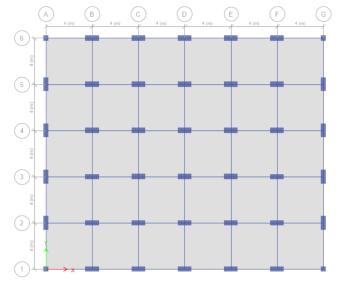
Fig-3:Planviewof Rectangularbasemodel
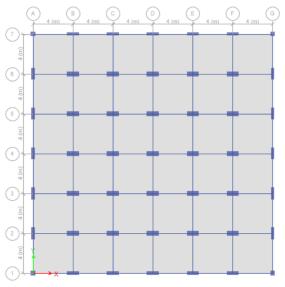
Fig-4:PlanviewofSquare basemodel
International Research Journal of Engineering and Technology (IRJET) e-ISSN: 2395-0056
Volume: 12 Issue: 08 | Aug 2025 www.irjet.net p-ISSN: 2395-0072
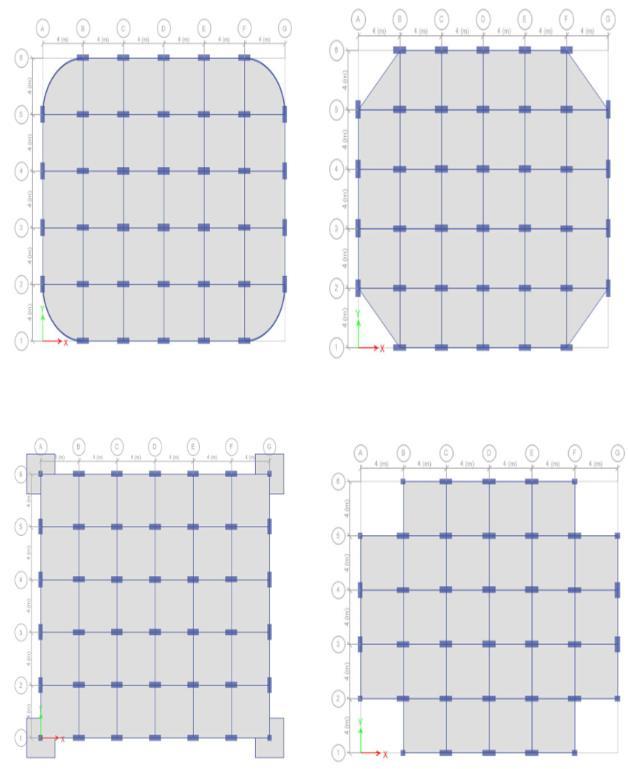
Fig-5: Planviewofcornerroundness,corner cut,finsandcornerrecession,modifications respectivelyforrectangularmodel-Micro modification
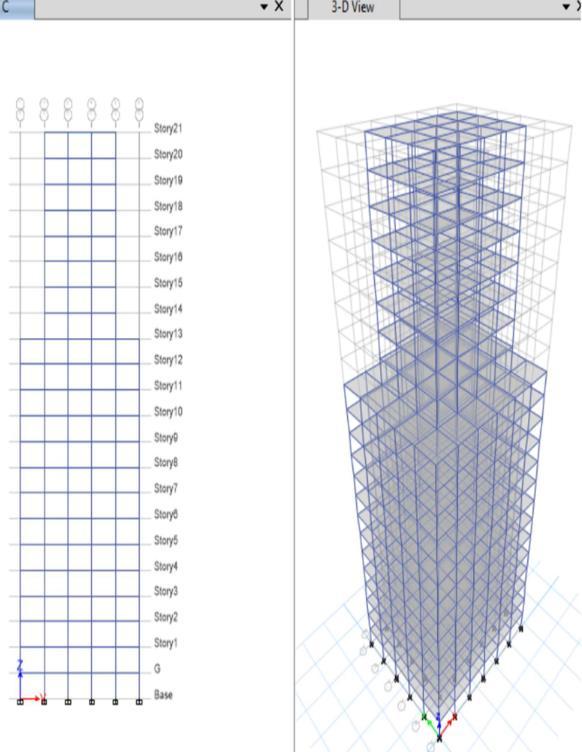
Fig-6:Elevationand3-Dviewofsingle setback
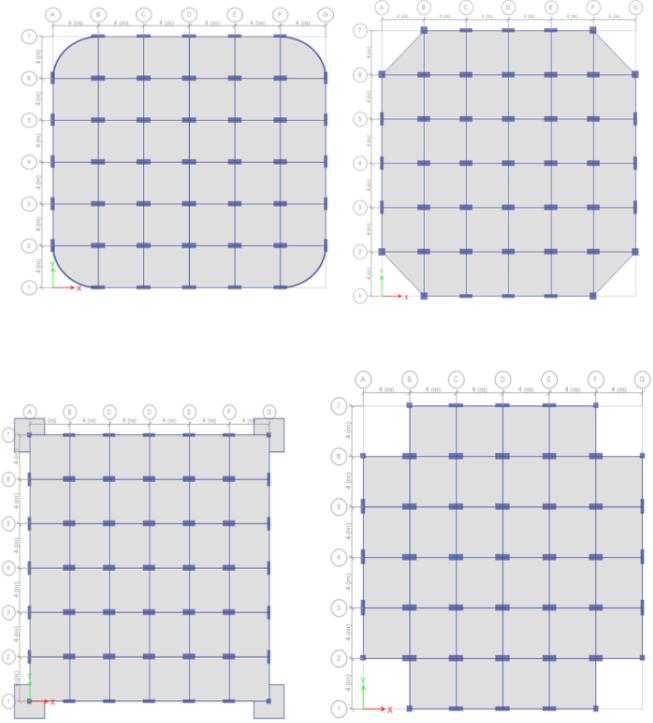
Fig-7: Planviewofcornerroundness,cornercut, finsandcornerrecession,modifications respectivelyforsquaremodel-Micro modification
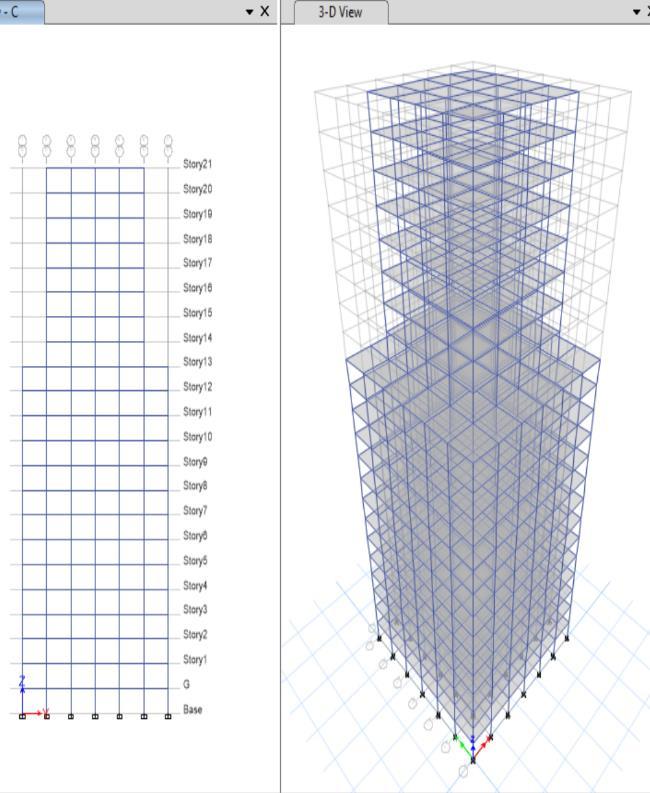
Fig-8:Elevationand3-Dviewofsinglesetback modificationforsquaremodel–Macro modification.
Volume: 12 Issue: 08 | Aug 2025 www.irjet.net p-ISSN: 2395-0072
ByusingETABS22softwaretheG+21structuremodelsare done and analysed for rectangular and square model for loadslikegravityloadandwindload.Byconsideringsame properties for all the model, the model is checked and analysed for different modifications and compared the storeydisplacements,storeydriftandstoreyshearwithand withoutmodifications.Allthebelowvaluesingrapharefor loadcaseofwind.
Inthebelowgraphs, RX representtherectangularmodelin X-direction, RY represent the rectangular model in Ydirection. Whereas, SX represent the square model in Xdirection and SY represent the square model in Ydirection.
A. Comparison of Maximum Storey displacement for rectangular building and square buildings
a. MicroModification
The single setback modification reduced storey displacement in all models compared to the base case. Theimprovementwasmost notableintherectangular model(Y-direction),wheredisplacementdroppedfrom 14.87mmto12.72mm.Thesquaremodel,alreadymore stable, also showed reductions but to a lesser extent. Overall,setbacksprovideabalancedandeffectivewayto controldisplacementintallbuildings.
Table 2: ComparisonofMaximumStoreydisplacement forrectangularbuildingandsquarebuildingsofMicro Modification
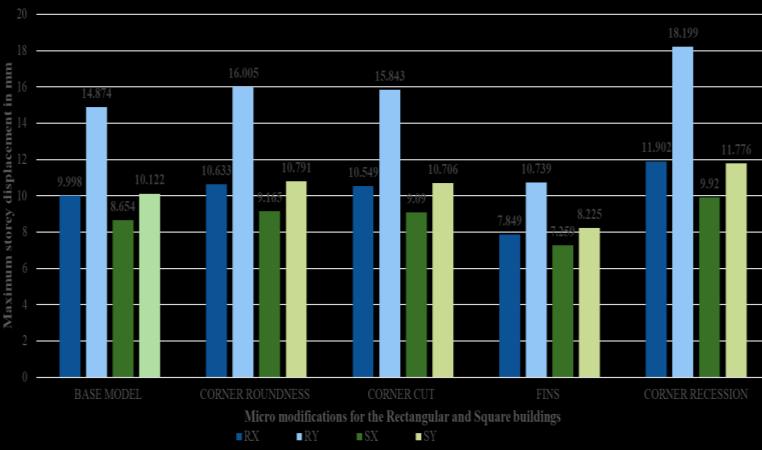
Chart -1:ComparisonofMaximumStoreydisplacement forrectangularbuildingandsquarebuildingsofMicro Modification
b. MacroModification
The single setback modification lowered displacementinbothrectangularandsquarebuildings. TheeffectwasstrongestintherectangularY-direction, whilethesquaremodelshowedsmallerbutconsistent reductions.Overall,setbacksofferasimpleandeffective waytoimprovewindperformance
Table 3: ComparisonofMaximumStoreydisplacementfor rectangularbuildingandsquarebuildingsofMacro Modification
Displacement in
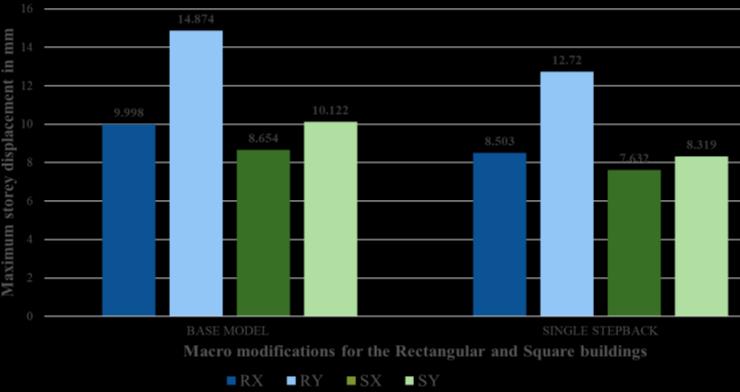
Chart -2:ComparisonofMaximumStoreydisplacement forrectangularbuildingandsquarebuildingsofMacro Modification
International Research Journal of Engineering and Technology (IRJET) e-ISSN: 2395-0056
Volume: 12 Issue: 08 | Aug 2025 www.irjet.net p-ISSN: 2395-0072
B. Comparison of Maximum Storey drift for rectangular building and square buildings
a. MicroModification
Fins gave the best performance, reducing drift in both rectangular and square buildings, with the largest improvement in the rectangular Y-direction. Corner roundness and corner cuts slightly increased drift, while cornerrecessionshowedthepoorestresultswiththehighest values.Overall,finsarethemosteffectivemodificationfor driftcontrol.
Table-4: ComparisonofMaximumStoreydriftfor rectangularbuildingandsquarebuildingsforMicro Modification
drift
Model 0.000229 0.000342 0.000194 0.000231
Corner Roundness 0.000244 0.000369 0.000205 0.000246 CornerCut 0.000242 0.000365 0.000203 0.000243 Fins 0.000187 0.000262 0.000169 0.000197
Corner Recession 0.000268 0.00041 0.000219 0.000265
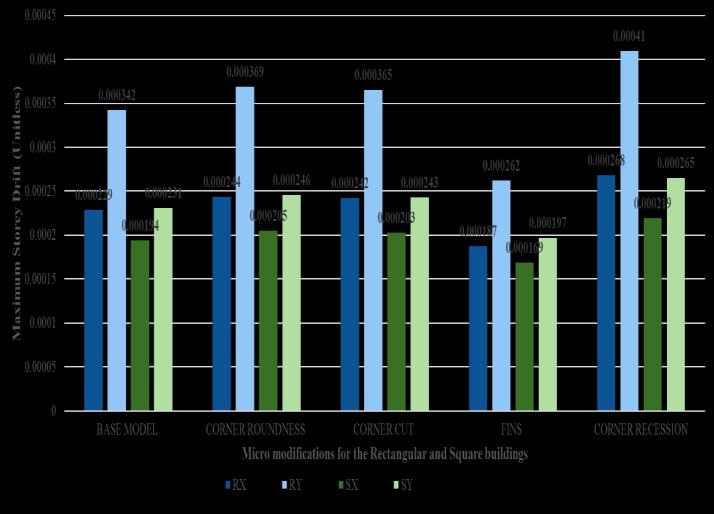
Chart-3:ComparisonofMaximumStoreydriftfor rectangularbuildingandsquarebuildingsforMicro Modification
b. MacroModification
The single setback reduced drift in all models, with the largest improvement in the rectangular Y-direction. The squaremodel,alreadymorestable,alsoshowedsmallerbut consistent reductions. Overall, setbacks are effective in controllingdrift.
Table-5: ComparisonofMaximumStoreydriftfor rectangularbuildingandsquarebuildingsforMacro Modification
Storeydrift is Unitless
Model 0.000229 0.000342 0.000194 0.000231 Single Step back 0.000191 0.000276 0.000169 0.000185
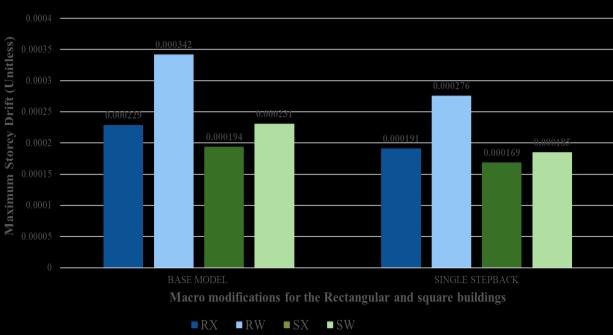
Chart-4:ComparisonofMaximumStoreydriftfor rectangularbuildingandsquarebuildingsforMacro Modification
C. Comparison of Maximum Storey shear for rectangular building and square buildings
a. MicroModification
Storeyshearincreasednoticeablywithfins,showing the highest values in both rectangular and square models. Corner roundness, corner cut, and corner recessionproducedalmostnochangecomparedtothe base model. Overall, while fins effectively reduce displacementanddrift,theycomewiththetrade-offof higherstoreyshear.
Table-6: ComparisonofMaximumStoreyshearfor rectangularbuildingandsquarebuildingsforMicro Modification
Storey shear inkN
International Research Journal of Engineering and Technology (IRJET) e-ISSN: 2395-0056
Volume: 12 Issue: 08 | Aug 2025 www.irjet.net p-ISSN: 2395-0072
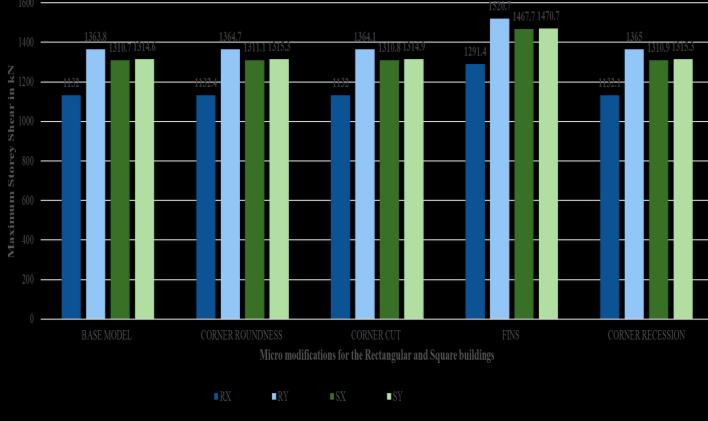
Chart-5:ComparisonofMaximumStoreyshearfor rectangularbuildingandsquarebuildingsforMicro Modification
b. MacroModification
Thesinglesetbackreducedstoreyshearinallcases compared to the base model. The reduction was most significant in the rectangular Y-direction. Overall, setbacksprovideabalancedwaytolowershearforces alongwithdisplacementanddrift.
Table-7: ComparisonofMaximumStoreyshearfor rectangularbuildingandsquarebuildingsforMicro Modification
shear in
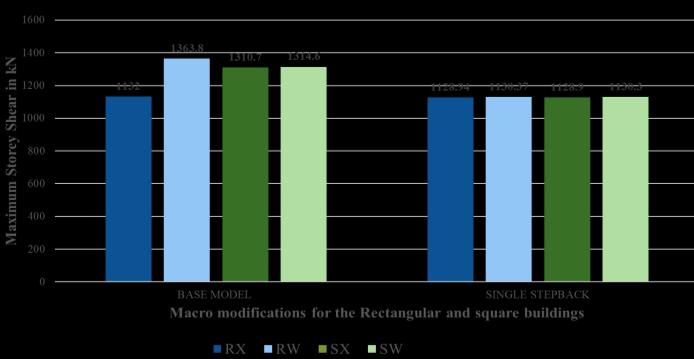
Chart-6:ComparisonofMaximumStoreyshearfor rectangularbuildingandsquarebuildingsforMacro Modification
3. CONCLUSIONS
Thestudycomparedsquareandrectangular G+21 storeybuildings withdifferentaerodynamicshape changesusingETABS.
Among the micro changes, fins worked best, cuttingdowndisplacementanddriftbyaround 25–30%,thoughtheyslightlyincreasedstoreyshear.
Corner recessions werenotveryeffectiveand,in some cases, even increased responses due to irregularstiffness.
The setbackmodification (macrochange)gavethe mostbalancedresults,reducingdisplacement,drift, andshear,especiallyintherectangularmodel.
Thesquareplanalreadyhadbetterstability,butstill showedimprovementswithmodifications.
Overall, aerodynamic shaping is a practical and effective way toimprovethewindresistanceoftall buildings, supporting safer and more sustainable urbandesign.
[1] Alaghmandan,M.,Abdolhossein-Pour,F.,&Mohammadi, J.(2013).Innovativedesignmethodoftallbuildings:A computational-basedapproachinoptimizingthewind effectsontallbuildings.InM.A.Schnabel(Ed.), Cutting Edge: 47th International Conference of the Architectural Science Association (pp. 525–534). The Architectural ScienceAssociation(ANZAScA),Australia.
[2] Kalra,M.,Bajpai,P.,&Singh,D.(2016).Effectofwindon multi-storeybuildingsofdifferentshapes. IndianJournal of Science and Technology, 9(48),1–8
[3] Sushmitha,H.O.,&Goni,C.S.(2022).Comparativestudy on tall structures with different aerodynamic modifications subjected to wind load using ETABS. International Journal of Innovative Research in Science, Engineering and Technology (IJIRSET), 11(9), 12300–12305.
[4] Nikhil Gaura, Ritu Raj, “Aerodynamic Mitigation by CornerModificationonSquareModelUnderWindLoads Employing Cfd and Wind Tunnel”, Ain Shams EngineeringJournal13(2022)101521
[5] Mokhtari, M., et al. (2023). The impact of high-rise buildingshapesonwindflowcharacteristicsandenergy potential. InternationalJournalofStructuralEngineering, 12(2),145–160.
[6] Ilgın, H. E., & Günel, M. H. (2007). The role of aerodynamicmodificationsintheformoftallbuildings againstwindexcitation. METU Journal of the Faculty of Architecture (JFA),24(2),17–25.
[7] Bureau of Indian Standards. (2015). IS 875 (Part 3):2015. Code of practice for design loads (other than earthquake) forbuildings andstructures Part 3:Wind loads. NewDelhi:BIS.