
International Research Journal of Engineering and Technology (IRJET) e-ISSN:2395-0056
Volume: 12 Issue: 04 | Apr 2025 www.irjet.net p-ISSN:2395-0072
International Research Journal of Engineering and Technology (IRJET) e-ISSN:2395-0056
Volume: 12 Issue: 04 | Apr 2025 www.irjet.net p-ISSN:2395-0072
Mustafa Latif Çobankaya1*, Alaaeldeen Elrouby2
1 Secretariat of Defence Industries, Ankara, Turkey;
2 Department of Electrical and Electronics Engineering, Ankara Yildirim Beyazit University, Turkey;
Abstract: Radar system studies are mostly done on the development and optimization of specific components. While investigating and improving specific parts, interactions among the components of radar systems have been receivinglessfocus.Thus,morewholisticapproachesforthemodelingandanalysisofend-to-endradarsystemplatforms represent valuable contributions to fill in this gap. For this aim, a universal platform for modeling and analyzing end-to-end multitarget tracking (MTT) radar systems is proposed in this study. In the proposed platform, radar system properties, scanning parameter settings, target parameters, and MTT algorithms are configurable in a flexible and seamless manner. The paper also presents a case study which is developed on the platform, providing a performance comparison of three dominant MTT algorithms: Global Nearest Neighbor (GNN), Joint Probabilistic Data Association (JPDA),andMultipleHypothesisTracking(MHT).ThescenariointhecasestudycomprisesMTTof8highlymaneuvering targetsincloseproximity.Thethreealgorithmsarecomparedbasedontheirperformanceandcomputationalcomplexity levels,measuredbytheOptimalSub-PatternAssignment(OSPA) distanceandcomputationaltime,respectively.Thecase study configuration demonstrates the flexibility of the proposed radar system platform for modeling and analyzing MTT radar systems. The results indicate that the JPDA algorithm emerges as the best choice for MTT of highly maneuvering targetsincloseproximity.
Keywords: Multitarget tracking algorithms; radar system simulation; performance comparison; target motion scenario;OSPAmetric
Radarsystemsandmultitargettracking(MTT)havebeenstudiedformanyyearsthatwecanfindover100yearsof historyaboutradarsystems[1],[2].Theclassificationofradarsystemshasseveralapproachessuchas:accordingtotheir base (ground-based, airborne radars), their frequency band (L-band, C-band, millimeter wave radars), antenna type (phasedarray,AESAradars),orwaveform(continuouswave,pulsedradars),andevenaccordingtotheirfunctionalityor mission (weather, fire control, early warning radars) etc. This wide variation is a result of long immense efforts and massivenumberofresearch,design,anddevelopmentstudiesinthisarea.
In the literature, most of MTT radar system studies aim at increasing the efficiencies of certain radar system components. They focus on optimizing or finding new solutions for specific parts of radar systems in specific cases. For example,in[3],adynamicmulti-objectiveparticleswarmoptimization(DMOPSO)withtheassistanceofaKalmanfiltering predictionstrategywasproposed.Theyincreasedtheperformanceofantennadeploymentforspecialcasesofdistributed multi-staticradarsinmultiplesurveillanceregionsina dynamicenvironment.DMOPSOmethodisanoptimizationofthe classical multi-objective particle swarm optimization (MOPSO) method. On the other hand, since during the numerical tests,orafterthem,theDMOPSOstrategywasnottestedviaasimulationofacomprehensiveradarsystemcase,ifthereis any extra side effect to a certain radar system part, it could not be revealed. In another study, an adaptive beam burden management, named adaptive beam and pulse number scheduling (ABPNS) strategy, was developed to increase the performance of MTT for special situations of distributed radar networks with limited beam resources [4]. On the other hand, constant velocity model was preferred for the targets in the study. Other target model types like constant acceleration or maneuvering targets were not studied and they may have extra unexpected effects on the results. Also, sincethesimulationswerenotdoneonawholeradarsystem,theeffectofABPNSonotherpartsofradarsystemcouldnot beinvestigated.
Development of a low probability of intercept-based power resource allocation (LPI-PRA) scheme was presented for the application of distributed multiple-input multiple-output (MIMO) dual-function radar communication (DFRC) systems in [5]. They tried to minimize the total power consumption of the overall system by optimizing the transmit powerallocationwiththeirapproach.Ontheotherhand,thesimulationswerenotdoneonacompleteradarsystem.Thus,
International Research Journal of Engineering and Technology (IRJET) e-ISSN:2395-0056
Volume: 12 Issue: 04 | Apr 2025 www.irjet.net p-ISSN:2395-0072
still there may be an unexpected and unrevealed side effect on another radar component or radar performance. In [6], optimizingthedesignoftransmitbeampatternwithconstantmodulus(CM)constraintinMultiple-InputMultiple-Output (MIMO) radar systems was studied to achieve a good trade-off between the performance and the complexity. Together withthesuperiorresultstotheexistingones,awholeradarsystemwasnotoperatedorsimulatedduringthestudy.Thus, anybadsideeffect,ifexists,remainsunrevealed.
Like the given examples, many more studies focus on the optimization and development of specific parts of the radar systems or become valid for special cases, special radar types and for specific scenarios. On the other hand, in a holistic approach, mutual interactions of subsystems should be also considered, and various conditions and scenarios shouldbetestedforvalidity.
From this aspect, while specialized studies are valuable for increasing performance of individual components, a comprehensiveunderstandingofhowsubsystemsinteractandperformundervariousconditionsisalsoessential.Onthe otherhand,comprehensiveend-to-end(akaholistic)studiesonradarsystemshavereceivedlimitedfocusinthepublished research literature [7]. Furthermore, most MTT studies are conducted by adding various levels of artificial noise to the motion trajectories of targets, and end-to-end radar system designs are not used during simulations [8]–[12]. Thus, the availability of a comprehensive system model for MTT radar systems would be of a high value for research in the area. Developing such a system model opens the door to explore numerous “what-if?” scenarios and facilitates performance enhancement fromtheperspectivesofMTTalgorithms,radarwaveforms,signalprocessing,andoptimization. Moreover, itenablestheinvestigationofproblemsrelatedtotheintegrationofradarsystemcomponentsandprovidesguidancefor theirsolutions.Thisstudyaimstofillthatgapbyintroducinganend-to-endplatformformodelingMTTradarsystemsand presentsacasestudyforitsperformanceassessment.Othertargetedfeaturesfortheproposedplatformareflexibilityin studyingvariousaspectsofMTTradarsystems,anditsseamlessnessinchangingtheplatformparametersandsettings.
The problem of MTT holds significant importance in various military and civilian applications, including air and groundtrafficmonitoringandcontrol,harborandunderwatersurveillance,maritimetrafficcontrolandtargetrecognition, oceanography,videocommunication, military applications,autonomous driving, microbiology,investigatinganimal lives, satellitesystems,electronicwarfare,robotics,andvarioussurveillanceapplications[13]–[17].
Multitarget tracking involves the extraction and estimation of the number of targets, their states, and trajectories from noisy antenna or sensor measurements. As basic examples from daily life, humans perform target detection and trackingwhiledrivingacar,walkingthroughstreets,duringshopping,andwhenlookingforsomething.ThegoalofMTTis to estimate the number of targets and their trajectories based on the collected data and accurately associate the data duringestimations.Indataassociation,themainquestionis,“Whichmeasuredpointscorrespondtowhichtargets?”.With the wide range of applications for the MTT, different algorithms have been suggested, used, analyzed, and compared in performance and accuracy [18], [19]. Among those algorithms, we believe that the following three algorithms are the dominantinrealtimeapplications:
The Global Nearest Neighbor (GNN) algorithm associates each target with the closest measurement in the target space[20].GNNmakesdecisionsbasedonlyonthelastmeasurementvalueanddoesnotconsideranyhistory,meaningit doesnotuse,save,orrestorepreviousestimationvalues.Asaresult,anymis-associationcannotbecorrected.GNNhasthe lowest computational complexity but is generally considered to have the worst accuracy and performance among MTT algorithms.Nevertheless,itiscommonlyusedinradarapplicationsduetoitssimplicitywherefewtargetsareonthescene [21].
The Joint Probabilistic Data Association (JPDA) algorithm calculates the probabilities of targets being at the measured points at each association step. Over time, some probabilities decrease to very small values and are subsequently discarded. The remaining high probabilities undergo the same pruning process at each association step, resulting in weighted sums of all association steps [22]. This method, which incorporates the history of target probabilities,allowsJPDAtoachievebetteraccuracythantheGNNalgorithm.Bythismeans,JPDAdifferentiatesitselffrom GNNbymaintainingahistoryofprobabilitiesandmakingdecisionsbasedonthathistory.
International Research Journal of Engineering and Technology (IRJET) e-ISSN:2395-0056
Volume: 12 Issue: 04 | Apr 2025 www.irjet.net p-ISSN:2395-0072
JPDA does not save and store hypotheses but only instantaneous probabilities. The remaining information about hypotheses is solely represented by their probability values. This approach significantly reduces the complexity of the association procedure, while decisions are made using historical values. In contrast, the GNN algorithm associates each targetwiththeclosestmeasurementinthetargetspacedisregardinghistoriesoftargetmotions.However,thisoperation can miss some feasible and potential associations. In this regard, JPDA appears more appealing as it eliminates and discardsinfeasiblehypothesesateachestimationstep[23].
TheMultipleHypothesisTracking(MHT)algorithmisthemostcomplexoneamongthethreealgorithmswhileitis an old one [24]. MHT keeps tracks of all the possible association hypotheses over time. However, the number of association hypotheses grows exponentially, leading to potentially high numbers within a few estimation steps. For example,the numberofhypothesescanincreasefroma singledigittoa three-digit numberwithinonlythree estimation steps during track of a few targets. Therefore, generally additional pruning methods are necessary to reduce computationalcomplexity[19],[25].
When a hypothesis probability value reaches the “track confirmation” region in MHT, it is accepted as the true association result. Conversely, if a hypothesis falls below the threshold of “unlikely track” region, it is pruned away or deleted[26]topreventtheproliferationofhypotheses.
AlltheseMTTalgorithmsmayemployvariousgatingtechniquestoenhancetheirperformance[27].
Most of the studies in the MTT publications focus on linearly moving targets for comparison and performance evaluation [28], [29]. However, the case study of this paper differs as it focuses on highly maneuvering targets in close proximitytofulfilltheneedsformoremodernandcomplexscenariosliketrackingdronesoragiletargets.Moreover,this study simulates an end-to-end radar system and uses its data during MTT analysis, providing an additional contribution whereasmostsimulationstudiesemployentirelyartificialmotiondata[30].
Asashowcasefortheflexibilityandcapabilityoftheproposeduniversalplatform,thethreeMTTalgorithms,GNN, JPDAandMHT,arecomparedbasedontheirperformanceandcomputationalcomplexitybyapplyingthemonatestcase includingtrajectoriesofmaneuveringtargetswithmultiplecloseproximitycases.Therearesomecomparisonstudiesfor linearly moving or slowly rotating targets in the literature, but comparison of highly maneuvering targets in proximity casesneedstobefurtherinvestigated.
Thecontributionsofthispaperareasfollows:
• A universal radar system modeling and simulation platform is proposed and applied on various types of MTT algorithms.Thisplatformoffersaholisticapproachtoradarsysteminvestigations,allowingfortheanalysisofindividual componentsaswellastheirmutualeffectsontheoverallsystemperformance.
• A comparison study of three dominant MTT algorithms -GNN, JPDA, and MHT- is conducted on a scenario comprising close proximity cases of 8 maneuvering targets. The study presents and discusses estimation results and OptimalSub-PatternAssignment(OSPA)valuesaswellascomputationalcomplexityresultsoftheMTTalgorithms.
Inthefollowingsections,thecomponentsoftheuniversalradarplatformareexplained.Section2providesdetailed explanations of the main sub-blocks of the proposed platform: waveform generation, transmitter and receiver, environment and targets, signal processing, and MTT algorithm. In Section 3, the case study, and its functional structure together with the values of the parameters of the radar components are presented. The results of the case study are analyzedinSection4.Theconclusionsarediscussedinthefinalsection.
The proposed universal platform for MTT radar system represents the end-to-end system, starting from radar waveformgenerationandextendingtotheMTTalgorithm,withseveralsub-blocksinbetween.Theplatformisdeveloped andimplementedintheMATLABenvironment.
International Research Journal of Engineering and Technology (IRJET) e-ISSN:2395-0056
Volume: 12 Issue: 04 | Apr 2025 www.irjet.net p-ISSN:2395-0072
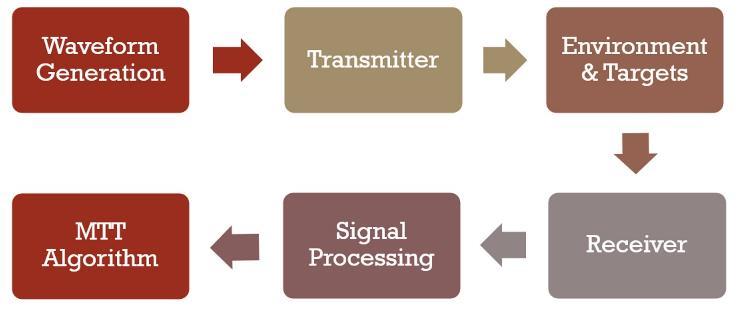
The proposed platform contains six main sub-blocks: Waveform Generation, Transmitter, Environment & Targets, Receiver, Signal Processing, and MTT Algorithm as illustrated in Figure 1. The radar system scans, detects, and tracks targets within its range for a specified time duration. The sub-blocks of the universal platform with their respective parametersaredescribedinthefollowingsubsections.
This sub-block is responsible for generating the radar waveform, which can be configured as either an FMCW or pulse waveform, with the possibility of other types as well, depending on the specific needs and applications. The parametersthatcontrolthebehaviorofthissub-blockdependonthechosenwaveformtype.
In pulse radars, the main parameters are peak power, operating frequency, pulse width, and pulse repetition frequency. The latter two parameters play a crucial role in determining the maximum unambiguous range, range resolutionandminimumrangeforthepulsedradar.Peakpoweraffectstheradarrangewhereastheoperatingfrequency haseffectsonbothresolutionandrangeinpulseradars.
InFMCWradars,thekeyparametersaretheoperatingfrequency,sweeptime,andsweepbandwidth.Theoperating frequencyisacommonparameter,whereasthesweeptimeandbandwidtharespecifictoFMCWradars.Thesweeptime andbandwidthplaya crucial roleindeterminingtherange, rangeresolution,and maximum targetspeed. The frequency modulation can take various forms, such as triangular, sawtooth, sinusoidal, or others. Once the waveform signal is generated,itistransmittedtothetransmittertobelaunchedintotheairoranyothermediumasanelectromagneticwave.
2.2.
The Tx and Rx sub-blocks represent the output power amplifier and antenna of the transmitter, as well as the low-noise amplifier (LNA) and antenna of the receiver. The parameters that control the behavior of this sub-block are transmitterpeakpower,transmittergain,antennaaperture,antennagain,receivergain,noisefigure,andradarspeed.
Transmitter peak power refers to the peak power value of the signal reaching the antenna. The power amplifier amplifies the signal with the value of transmitter gain and sends it to the antenna. The antenna behavior is mainly determinedbyitsgain,bandwidth,radiationpattern,andbeamwidth.Additionalparametersorfeaturesmaybeincluded dependingonthescenario.
The receiver module amplifies the received signal with its gain value whereas also introducing additional noise indicated by noise figure, resulting in a degradation of the signal-to-noise ratio (SNR). Therefore, the noise figure and receivergainaretwofundamentalparametersforthereceiver.
Radar speed is added to the platform for scenarios involving airborne radar. In such scenarios, the radar speed is non-zeroandinfluencesthebehaviorsofthetransmitter,receiver,andsignalprocessingsub-blocks.
2.3.
This sub-block determines the parameters and features of the environment and targets. The environment can be free space, water, or any other specificmedium. The mainfactor which environmentaffects isthe powerofthe received signalandSNR.Asaresult,theenvironmenthasastrongimpactontherangeoftheradar.
International Research Journal of Engineering and Technology (IRJET) e-ISSN:2395-0056
Volume: 12 Issue: 04 | Apr 2025 www.irjet.net p-ISSN:2395-0072
Thegeneralradarrangeequationusedinthesimulationplatformisgivenbelow:
) ( ) )
where,Ptistransmittedpeakpower,τispulsewidth,frispulserepetitionfrequency(PRF),Tiisthedwellinterval in continuous wave radars, Gt and Gr are the transmitter and receiver antenna gain, λ is wavelength, σ is target cross section,kisBoltzman’sconstant,T0isthetemperatureinKelvin,Fisnoisefigure,Listhetotaloflossesinthesystem,and (SNR)0istheminimumSNRrequiredfordetection.Ptτfrtermisusedinpulseradars,anditisreplacedwithPCWwhichis average continuous wave (CW) power in CW-based radars. Similarly, Ti denotes the time on target in pulse radars (Mahafza,2013).
The target types can vary in dimension and include airplanes, UAVs, drones, rockets, warships, submarines, and more, depending on the specific scenario of interest. The primary target parameter of concern is the radar cross section (RCS).TheRCSvaluesmayvarybasedonfactorssuchasthetargettype,dimensions,coatings,directions,andshapes[32], [33].
In the proposed platform, targets are added to the system using a function, named as Add_Targets. This function determines the routes of the targets using the waypointTrajectory function, which is a MATLAB function that builds trajectoriesbasedonspecifiedwaypoints.Byprovidingpositionsandcorrespondingtimes(e.g.,ifthetargetisatlocation P1attimeT1andatlocationP2attimeT2),thewaypointTrajectoryfunctiongeneratesintermediatelocationswithinthe giventimeintervals.
The position array of targets is constructed using parameters such as the initial and the final times of targets, positionsbetweenthem,andtimeincrement.Theinitialtimeisthetimeinstantofthestartofatarget’smotion.Thefinal timeofa targetdeterminesthetimeinstantatwhichitsmotionends.Thetimeincrementrepresentstheincrementation valueof time in the output ofthe targettrajectory building function. Consequently, a smaller timeincrement resultsin a highernumberofpositionsalongwiththeircorrespondingtimevaluesintheoutput.
Thefinaltimeparameterdeterminesthetotalactivetimedurationoftheradarsystem.Itrepresentsthe maximum timeuptowhichtargetscanhaveamotiontrajectory.Iftargetsexistthroughouttheentirescanprocess,theyfollowtheir trajectoriesfromthebeginninguntilthefinaltimeofthesimulation.
The signal processing sub-block is developed for scanning and measuring the states of targets, including the detection process. Target detection is done during the scanning process with the scanning parameters which are measurementinterval,finaltime,radarscanningangle,andscanspeed.
Themeasurementintervalparameterservestwopurposesinthedesign:itdeterminestherateofmeasurementand setstheantennabeamwidthindegrees.Forinstance,ifthemeasurementintervalissetto10°,measurementsaretakenat every 10° interval, resulting in an antenna beamwidth of 10° in the azimuth direction. As depicted in Figure 2, the measurement interval equals to the difference between θa and θb, which also represents the antenna beamwidth in the design.
International Research Journal of Engineering and Technology (IRJET) e-ISSN:2395-0056
Volume: 12 Issue: 04 | Apr 2025 www.irjet.net p-ISSN:2395-0072
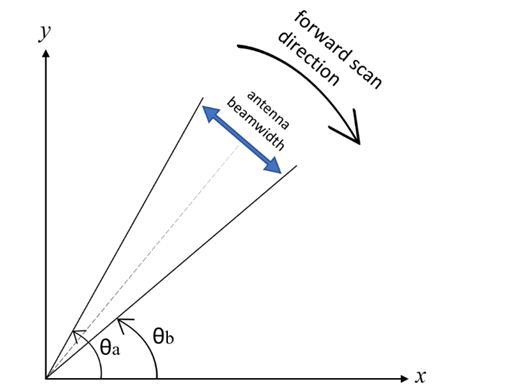
The radar scanning angle parameter represents the total scanned area of the radar in degrees. Scan speed is the rotation speed of the antenna in rounds per minute. In the platform, the scanning process begins from the y-axis and continues in clockwise direction (forward scanning) until it reaches the specified radar scanning angle. Afterwards, it reversesdirectionandscansback (counterclockwise)fromthefinal angleuntil itreturnstothey-axisforsectoral scans. Forfullscan,itstartsfromy-axisandcontinuesthroughclockwisedirection.Consequently,theforwardscandirectionis clockwise,startingatthey-axiswith0°,whereasthebackwardscanfollowstheoppositedirectionasshowninFİGURE2. Theplatformoffersflexibility,allowingfortheconfigurationofalternativescanningapproaches.
Using these parameters and their respective values, the platform performs both forward and backward scans, recordingmeasurementsin anarray.Aftercompletionofthe scanningprocess,thearrayservesastheinputdataforthe MTTalgorithm.
In the developed platform, the MTT sub-block can be configured to implement different algorithms such as GNN, JPDA, MHT, or other algorithms.Thesethree algorithmsare preferred in this study since they are the most usedones in real-timestudies[34,35].
InadditiontotheMTTalgorithms,filtersshouldbeusedtosuccessfullytracktargets.Forfiltering,theKalmanFilter and its variants can be used in this sub-block of the platform, including the Extended Kalman Filter (EKF), Unscented Kalman Filter (UKF), and Cubature Kalman Filter (CKF). The Kalman filter (KF) is a powerful recursive algorithm commonly used for estimating the state of a linear dynamic system. It assumes that the system dynamics and measurement model are both linear and that the system noise and measurement noise are Gaussian and additive. However, when dealing with nonlinear motions or nonlinear systems as in our case study, the basic Kalman filter is not appropriatefortwobasicreasons:Linearityassumptionandnon-Gaussiannoise.TheKFreliesontheassumptionthatthe system dynamics and measurement model are linear. Thus, the linear approximation used in the KF leads to inaccurate estimates in nonlinear systems. Also, in nonlinear systems or motions, the noise statistics can deviate significantly from Gaussian,makingtheKFlesseffective.Non-GaussiannoisecancausetheKFtoproducebiasedorsuboptimalestimates.As a result,since targets often exhibit nonlinear motion in real-lifescenarios,it ispreferabletousetheEKF,UKF, orCKF in cases involving realistic target motion modeling [36, 37]. Thus, the type of filter is a parameter along with the type and specificationsoftheMTTalgorithm.
Two important parameters for the operation of this sub-block are the confirmation and deletion thresholds of a target. A tentative track is confirmed as a true track when it has at least M1 detections in N1 sequential measurements. Conversely, a tentative track is deleted if it has fewer than M2 detections in N2 sequential measurements. For example, with a confirmation threshold of [3 4], a target is confirmed when it is detected at least M1 = 3 times out of N1 = 4 measurements.Similarly,withadeletionthresholdof[56],atargetisdeletedifitdisappearsatleastM2=5timesoutof N2=6measurements.
International Research Journal of Engineering and Technology (IRJET) e-ISSN:2395-0056
Volume: 12 Issue: 04 | Apr 2025 www.irjet.net p-ISSN:2395-0072
Another important parameter is the assignment threshold, which determines the maximum distance at which a measuredstatecanbeassignedtoatarget.Inotherwords,assumingPn-1isthepositionofthetargetTmatthestepSn-1, the measured position Pn at the current step Sn is assigned to target Tm only if the distance between Pn and Pn-1 is smaller than the assignment threshold. Targets with distances greater than this threshold cannot be assigned to their respective tracks. In addition, the assignment threshold interacts with the gating technique. Only measurements falling withinthegatingregionareeligibleforassignmenttothecorrespondingtrack.
Number of sensors, maximum number of targets, detection probability, measurement noise, maximum number of tracks, maximum number of sensors are among the other configurable parameters for the MTT algorithm sub-block operationintheproposedplatform.
Those mentioned parameters are independent of the type of MTT algorithm, whereas some others are algorithm dependent. For example, maximum number of hypotheses is a parameter in the MHT tracker. It limits the number of hypothesesgenerated,ensuringthatthealgorithmdoesnotbecomeoverlycomplex.Consequently,lesslikelyhypotheses areprunedtopreventexceedingthemaximumnumberofhypotheses.AnotherparameterinMHTistheminimumbranch probability.Iftheprobabilityofabranchdropsbelowthevalueofit,thatbranchispruned.Themaximumnumberofscan historyisanotherspecialparameterinMHT.
TheconfigurationofanMTTalgorithmanditsparametersenablesthestudyofavarietyofscenariosandfacilitates detailedinvestigation.
Inthecase study, a 77 GHz frequency-modulatedcontinuous-wave(FMCW) radar wasmodeled andsimulated for MTTof8maneuveringdroneswithinashortrangeof600mandascannedareaof90°angle.IntheMTTsub-block,GNN, JPDA and MHT algorithms were employed for comparison. The motion trajectories of the drones were designed accordinglytoensurecloseproximitytoeachother.
The operating frequency was chosen as 77 GHz since it is a free bandwidth in the spectrum suitable for real time developments. Additionally, 77 GHz is widely used in automotive radars [38, 39]. Thus, the universal platform provides compatibility,notonlylimited to,butalsoinclusiveofresearchstudiesintheautomotiveindustry.Thisproposeddesign can be utilized in also short-range radar (SRR) network studies [40] and can be suitable for dynamic radar networks of UAVs[41]withadditionaldevelopments.
The six sub-blocks of the universal radar platform were configured and operated accordingly. Figure 3 shows the functionalstructureoftheFMCWradarsystemdevelopedontheuniversalplatformforthecasestudy.Thenamesofthe functionsusedareprovidedineachsub-block,andtheirdutiesareexplainedinthefollowingparagraphs.
International Research Journal of Engineering and Technology (IRJET) e-ISSN:2395-0056
Volume: 12 Issue: 04 | Apr 2025 www.irjet.net p-ISSN:2395-0072
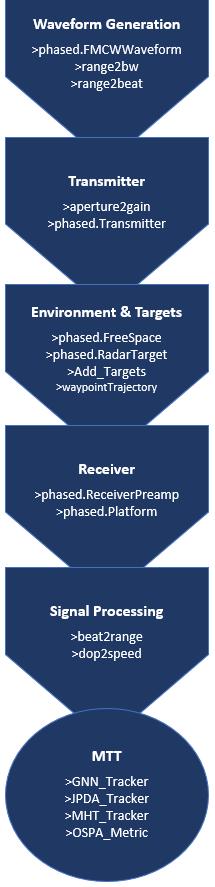
Inthe waveformgeneration sub-block,the “phased.FMCWWaveform” functiongenerates the FMCW signal used in theradar.Ittakesparameterssuchascarrierfrequency,sweeptime,sweepbandwidth,andsweepdirectionasinputs.The “range2bw” function calculates the required sweep bandwidth, ∆f, of the FMCW signal based on the desired range resolution and the speed of signal propagation, which is speed of the light in the case study. Equation (2) describes this below: (2)
where,cisthespeedoflight,and∆Ristherangeresolution[42].
The“range2beat”functiondeterminesthe maximumbeatfrequency,fb,correspondingtothemaximumrangeand thesweepslopeasdescribedin(3)below:
( ) (3)
International Research Journal of Engineering and Technology (IRJET) e-ISSN:2395-0056
Volume: 12 Issue: 04 | Apr 2025 www.irjet.net p-ISSN:2395-0072
where, Rmax is the maximum range, ∆f is the sweep bandwidth and ∆t is the sweep time of the generated FMCW signal[31].
In the transmitter sub-block, “aperture2gain” function calculates the antenna gain in dB (G_dB) based on the antennaaperture(A)andthewavelengthofthecarriersignal(λ),asshownin(4)below[43]:
( ) (4)
The “phased.Transmitter” generates the transmitted signal using the parameters of transmitter gain, peak power andlossfactor,togetherwiththegeneratedFMCWsignal
The environment & targets sub-block includes the “phased.FreeSpace” function, whichcalculatesthe signal power attenuation of the transmitted signal in the atmosphere using the general radar equation. The “phased.RadarTarget” simulatesthe behavior of targetsand calculatesthe effectof the targets on the reflected signal using RCS of them,signal propagation speed and carrier frequency. The “Add_Targets” function determines the ground truth states and their corresponding times for all the targets. It can also generate random motion trajectories if the waypoints are generated randomly. In the motion scenario of the case study, target trajectories are generated in a way that they exhibit maneuveringmotionwithcloseproximitytoeachother.
Inthe receiversub-block, the “phased.ReceiverPreamp” function input parametersare receiver gain, loss factor of receiver, noise figure, reference temperature, and sample rate. This function amplifies the received signal. The “phased.Platform”functionaddstheeffectofradarplatformmotionintothereceivedsignalcharacteristicsiftheradarhas a motion during the scan. Byincorporating the platformmotion, the function ensures that the received signal accurately representsthereal-worldscenarioandaccountsforanychangesordisturbancescausedbytheradarplatform'smotion.
In the signal processing sub-block, two functions are utilized: "beat2range" and "dop2speed". The "beat2range" functioncalculatestherangeofatargetbyutilizingthebeatfrequencyofthereceivedsignalandthesweepslopevalue.By processingtheseinputs,thefunctiondeterminestherangeordistancebetweentheradarandthetargetbasedonthebeat frequencyobservedinthereceivedsignal.Ontheotherhand,the"dop2speed"functionisresponsiblefordeterminingthe radialspeedofatargetusingtheDopplershift.Byanalyzingthechangeinfrequencyofthereceivedsignalcausedbythe motion of the target relative to the radar, the function calculates the radial velocity of the target. This information is valuablefortrackingandanalyzingthetarget'sspeed.Withthehelpofthesefunctions,themeasuredpositionsandradial speedsoftargetsareextractedinsignalprocessingsub-block.
MTT sub-block estimates the number of targets and their states using MTT algorithm functions “GNN_Tracker”, “JPDA_Tracker”, “MHT_Tracker”, or other similar functions. These three functions were developed specifically for the purpose of performancecomparisoninthis casestudy. Eachtracker function operatesindependently on thesameinput, whichconsistsofthemeasuredtargetstatesandrelatedtimes;andconductstheMTToftargetsinthescenarioseparately. Additionally,allthefunctionsutilizetheExtendedKalmanFilter(EKF)andInteractingMultipleModels(IMM)forfiltering. The“OSPA_Metric”functionisaddedtothissub-blockforperformanceevaluations.
Thecasestudywasconductedbasedonthisstructureoffunctions,allowingforacomparisonoftheperformanceof the three MTT algorithms in the radar system. The FMCW radar system main parameters in the case study and their numericalvaluesaregiveninTable1below:
Table 1. FMCWRadarSystemParameterValues
International Research Journal of Engineering and Technology (IRJET) e-ISSN:2395-0056
Volume: 12 Issue: 04 | Apr 2025 www.irjet.net p-ISSN:2395-0072
During waveform generation, an up-sweep linear (sawtooth) FMCW signal was used. FMCW was chosen for its simple architecture and low cost encompassing the expenses associated with the equipment and power consumption. Rangeresolutionwassetto2m.Consequently,thesweeptimeofthesignalis18.3µs,andthesweepbandwidthisfound as75MHzusing(2).Maximumbeatfrequencyissetto13.64MHzusing(3)andTable1.
Thetransmitterinthedesignhasagainof39dB,andthereceiverhas33dBincluding theantennagain,whichare compatiblevalueswiththeindustry.Thereceivernoisefigurewassetto4.5dBtobeconsistentwithreal-lifeproductsand scenarios [44, 45]. The environment is assumed to be free space channel since the radar system is considered as ground-basedradaroperatingintheEarth’satmosphere.TheradarRCSoftargetsisassumedtobe0.1m2
Drones werechosen astargetsin thisscenario because theyare becoming increasinglyprevalentin dailylife,and thereisa growing need for developedradarsystemsto control,supervise,andregulatetheiroperationsin both military andcivilianapplications.Themaximumvelocityofthetargetsissetto230km/hwhichisahighvaluefordronetargets.
Inthecasestudy,asectorwith90°anglewasscannedin2-D.Scanspeedwaschosenas180°/s,whichisapplicable in real time scanning. In every singlesecond,a forwardscanning and a backward scanning is completedfor thescanned area.Thus,during20secondsofsimulationtime,thesectorwasscanned40timesintotalasformulatedin(5):
Errorcalculations were performed in the case study to evaluate the accuracyof the MTTalgorithms. OSPA metric was utilized for error calculations since it is a commonly used metric in performance assessment of MTT algorithms [46-48]. A lower OSPA distance value indicates better tracking performance. OSPA can determine the differences in cardinality and individual elements between two finite sets, which are the true states and estimated states in the case study.The differenceincardinalityisfoundbycomparingthenumberofelementsintwo sets, whereasthedifferencein individual elements gives the distance between the corresponding elements of the two sets. For arbitrary finite subsets X={x_1,…,x_m}andY={y_1,…,y_n},wherem≤n,theOSPAdistancebetweenXandYisdefinedasin(6): ( )( ) * ( ∑ ( )( ( )) ( ))+
whered(c)(x,y) □( =min(c,d(x,y)))denotesthedistancebetweenx,y W,c(c>0)iscutoffparameter,p(1≤p<∞) is the order, ∏n is the set of permutations on {1,2, ,n}. The cut off parameter determines the ratio of penalization of cardinalityerrorsoverlocalizationerrors.Aspincreases,whilecremainingfixed,OSPAmetricgivesmorepenaltiestothe estimationsthatareawayfromalltargetsofthegroundtruth[47].
International Research Journal of Engineering and Technology (IRJET) e-ISSN:2395-0056
Volume: 12 Issue: 04 | Apr 2025 www.irjet.net p-ISSN:2395-0072
The cut-off parameter wasset to 100, and the order was chosen as1 in the OSPA metric. The labeling errorvalue represents the penalty assigned when mis-associations occur between targets and tracks, and it was also determined as 100.Thecasestudywasconductedwiththementionedspecifications.Theresultsaregiveninthefollowingsection.
Theresultsofthecasestudyweredividedintotwoparts.Firstly,thegroundtruthstates,andestimatedpositionsof the targets were compared for the evaluation of accuracy of the algorithms. This analysis aimed to assess how well the radarsystemwasabletotrackandestimatethepositionsofthetargets.Errorsintrackingandassociationweredetailed throughOSPAmetric,knownforitscommonusageinsimilarstudies.
Secondly,forcomplexityevaluation,thealgorithmswereexecuted100timesforthesamescenario,andtheirmean computationaltimeswerecalculatedandrecorded.Thisassessment aimstounderstandthecomputationalrequirements ofeachalgorithmandcomparetheirperformanceintermsoftimeconsumption. Whiletherearestudieson reductionof computationalcomplexity,inthispaperonlythecomparisonamongthethreealgorithmsweredone[49].
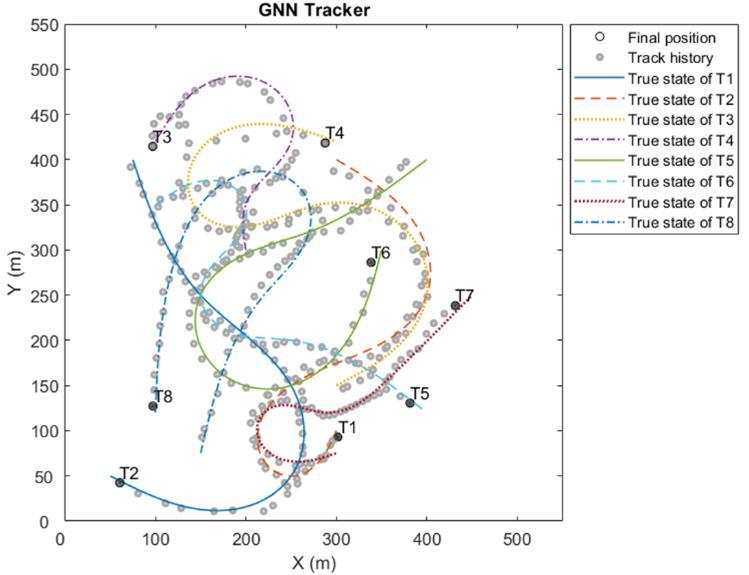
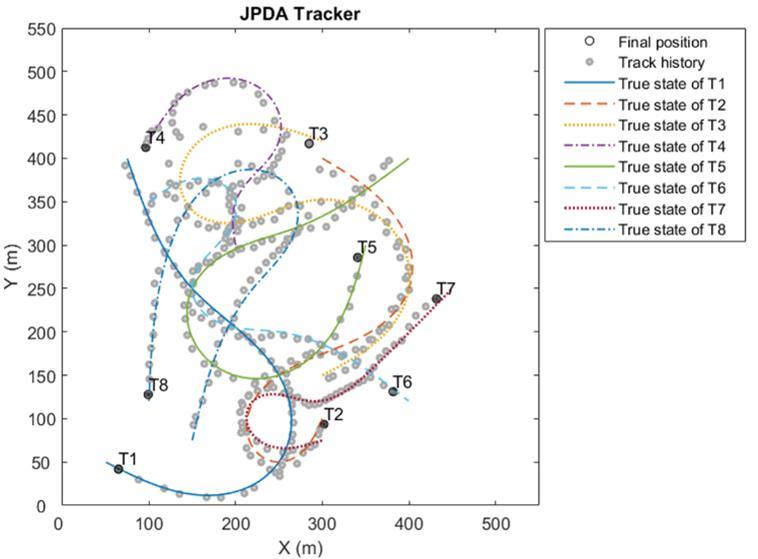
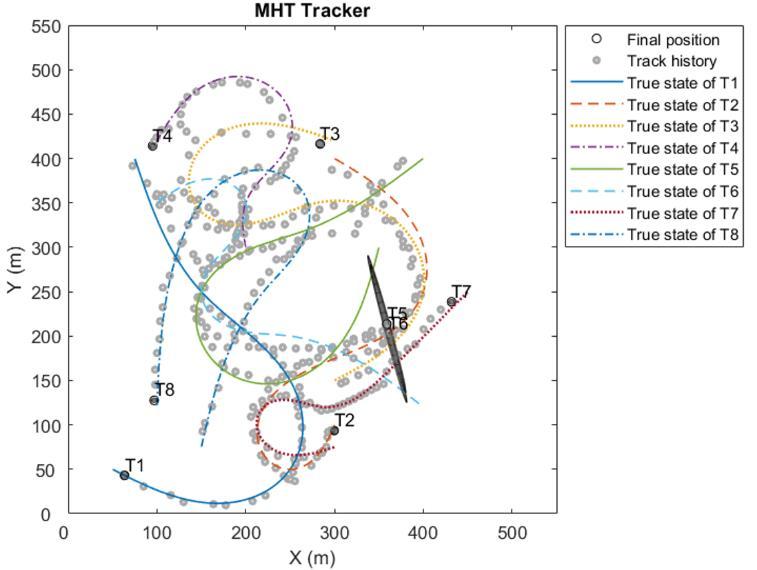
Figure 4, Figure 5, and Figure 6 illustrate the tracking results of GNN, JPDA and MHT algorithms with 8 targets, respectively, in x-y coordinates. The same motion scenario was used for all the algorithms for fair comparison. The proximity conditions can be seen on the figures. The colored lines represent true states of the targets and gray circles show track estimation results. The final estimated positions of the targets are denoted by black circles with their correspondinglabels(T1,T2,etc.).
40 measurements were done in the scenario. 550 m length of x-axis and y-axis were sufficient to show the trajectories of targets. Motion types of the targets included maneuvering and partially linear motions. In all cases, MTT algorithmsoperatedtogetherwithEKFandIMMfilters.
InFigure4,whencomparedtotheothertwofigures,GNNalgorithmhasseverallabelingerrors.T1andT2,T3and T4,T5andT6aremis-associatedmutually.JPDAtrackerandMHTtrackershavenoerroronlabeling.
International Research Journal of Engineering and Technology (IRJET) e-ISSN:2395-0056
Volume: 12 Issue: 04 | Apr 2025 www.irjet.net p-ISSN:2395-0072
MHT algorithm showed some performance on tracks of T5 and T6 at last steps without losing track of them as depictedinFigure6.Nevertheless,MHTalgorithmmanagedtodistinguishthetracksofT5andT6.Thecoalescenceeffect is a phenomenon where multiple targets are erroneously merged into a single track by a tracking algorithm. This phenomenon occurs when the algorithm incorrectly associates measurements from multiple targets as coming from a singletarget,leadingtothelossofindividualtargetidentities[50,51].
International Research Journal of Engineering and Technology (IRJET) e-ISSN:2395-0056
Volume: 12 Issue: 04 | Apr 2025 www.irjet.net p-ISSN:2395-0072
OSPAdistanceresultsoforderp=1andcutoffc=100foreverytargetwerecalculatedandgivenin Figure7,Figure 8, and Figure 9, respectively for GNN, JPDA and MHT algorithms. The graphs are estimation step vs OSPA distance. The labelingerrorpenaltywaschosenas100nottogohighervaluesandlosedetailsofsmallvaluesinthegraphs.
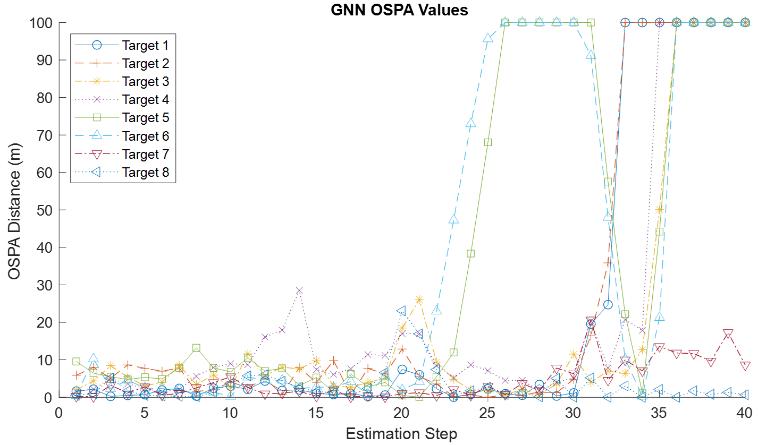
In Figure 7, GNN algorithm’s bad performance with respect to target labeling is seen. T1 and T2 are mis-labeled startingfrom33rdstep.T3andT4aremis-labeledstartingfrom35thstep.T5andT6aremis-labeledataround25thstep but, interestingly, after some steps their OSPA distance again decreases to small values, and then they are mis-labeled againduringlast5steps.Thus,forcrucialapplicationslikedefensesystems,GNNisnotappropriateifthereisapossibility ofcloseproximityortargetclusterconditions.
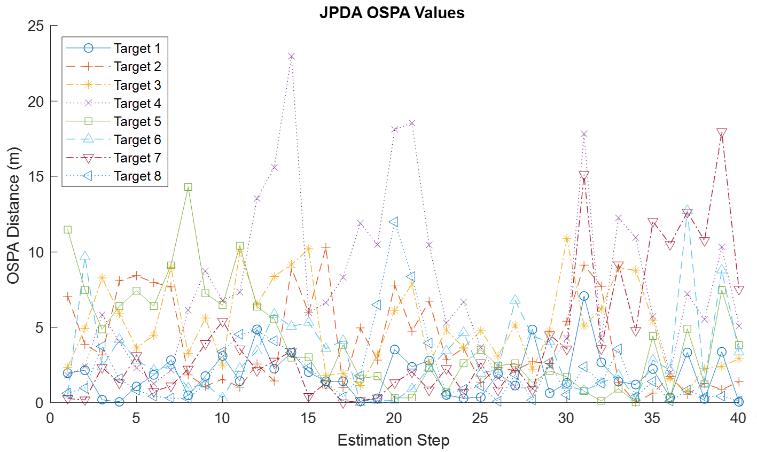
JPDAOSPAdistancevalues shownin Figure8seemto besimilartoGNN distance valuestillstep22.Startingfrom step 22, JPDA values becomes prominent with respect to having good performance, i.e., having smaller OSPA distance values.Even beforestep 22, the maximum OSPAdistanceof JPDA algorithm isaround23m whereasGNN’s maximum is around30m.MHTalgorithmhasalsothemaximumOSPAdistancemorethan30masseeninFigure9.Thus,JPDAhasthe bestperformancelookingatthemaximaofthreegraphs.Also,JPDAhasonly1pointwhichhashigherthan20mofOSPA
© 2025, IRJET | Impact Factor value: 8.315 | ISO 9001:2008 Certified Journal | Page1581
International Research Journal of Engineering and Technology (IRJET) e-ISSN:2395-0056
Volume: 12 Issue: 04 | Apr 2025 www.irjet.net p-ISSN:2395-0072
distance,whereasMHThas3targetsstatesasshowninFigure9,andGNNhas4OSPAvalueshigherthan20m,lookingat onlyfirst22stepsinFigure7.
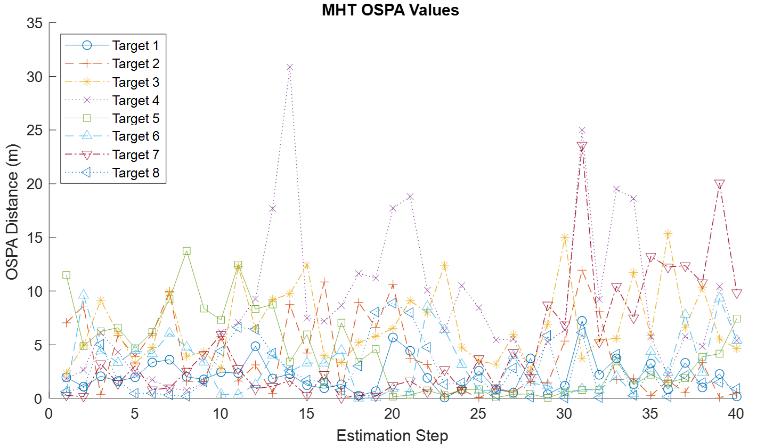
InallOSPAgraphs,themaximumdistancevalues,excludingmis-labelingcases,occuronT4at14thstep.Themain reasonmaybethatT4hasalinearmotiontill13thstep,butthemotiontypechangesfromlineartomaneuveringstarting from13thstep.Duetothischange,theusedfiltershaveadditionaldifficultyonadaptingthetrajectoryofT4,andtheMTT algorithmsreachesmaximumvalueofOSPAdistanceat14thstep,i.e.,somelevelofdecreaseoccursinperformanceofall algorithms.
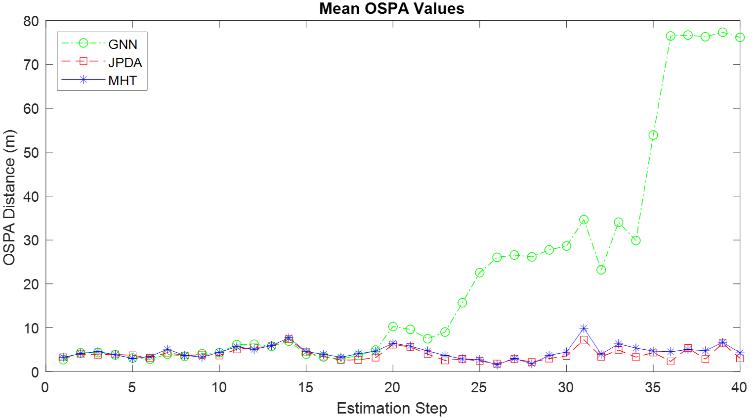
MaximaofOSPAerrorgraphsmaynotbesufficienttodecideaboutthegeneralperformancesofthealgorithms.Itis also necessary to look at their mean OSPA distance values which are depicted in Figure 10. During the first half of the graphinthefigure,thereisnotanimportantdifferenceamongthethreealgorithms.Ontheotherhand,inthesecondhalf, GNN algorithm’s high OSPA error values based on labeling mistakes are obviously seen. It reaches 30 m after 25th step whereas JPDA and MHT remains less than 5. After 35th step, GNN algorithm confuses 6 out of 8 targets and it reaches almost80mofOSPAdistance,notingthatthemaximumdistancevalueis100asstatedpreviously.
© 2025, IRJET | Impact Factor value: 8.315 | ISO 9001:2008 Certified Journal | Page1582
International Research Journal of Engineering and Technology (IRJET) e-ISSN:2395-0056
Volume: 12 Issue: 04 | Apr 2025 www.irjet.net p-ISSN:2395-0072
Whereas the worst algorithm in accuracy can be decided easily from Figure 10, deciding for the best one with respecttoOSPAdistancesisnoteasybecauseJPDAandMHThavenearsmallvaluestoeachother.Itseemsthatduringthe steps16to19,29to36,and38JPDAhasbetterperformancethanMHT.
Table 2. MeanOSPAErrorValuesandComplexity
When deciding the best among the three considered algorithms for MTT applications with close proximity, complexity is another important parameter to consider along with performance [52]. Thus, complexity values are also measured and provided in Table 2. They are indicated by mean computational time values which are the averages of runningeachalgorithm100times.TheprocessorusedinthesimulationrunisIntelCorei7-6700HQCPU@2.60GHzwith 16GBRAM
Whereas the mean OSPA distance values of JPDA and MHT are very near to each other in Table 2, GNN’s mean distance is around five times the other two with the value 21.2, as expected due to mis-labeling. Therefore, the GNN algorithm can be accepted as the worst algorithm among three. On the other hand, mean computational time values of GNNandJPDAareneartoeachotherasbeing10.1and8.8,whereasMHThasamuchhighervalueof31.9sec.Thus,MHT becomes the worst with respect to computational complexity. As a result, JPDA algorithm is the best algorithm for MTT applications with maneuvering targets in proximity when the two criteria (performance and computational complexity) areconsideredtogether.
A universal platform for modeling and analysis of end-to-end MTT radar systems together with a comparison of threeMTTalgorithmsonthescenarioconsistingofmaneuveringtargetsincloseproximitywasproposedinthispaper.
Theplatformconsistsofsixmainsub-blockswhicharewaveformgeneration,transmitter,environmentandtargets, receiver,signalprocessing,andmultitargettracking.Itallowsforthemodelingandanalysisofallaspectsofaradarsystem that affect performance within a single integrated environment. It also enables the analysis and optimization of radar system sub-blocks, including their interdependency and facilitates the study of a wide range of what-if analyses. Additionally,itmaybepreferredduetoitsuseofmorenaturallygenerateddataratherthanartificialdatageneration.
Ontheproposedplatform,acasestudyforMTTofmaneuveringtargetsincloseproximitywasconductedtogether with a performance comparison of GNN, JPDA and MHT algorithms. Based on the performance and the computational complexitycriteria,theresultssuggestthattheJPDAalgorithmisthebestchoiceamongthethreestudiedalgorithmsfor MTTofmaneuveringtargetswithproximity.
Author Contributions: Author contributions are as follows: “Conceptualization, M.L.C. and A.E.; methodology, M.L.C.andA.E.;software,M.L.C.;validation,M.L.C.andA.E.;formalanalysis,M.L.C.andA.E.;investigation, M.L.C.andA.E.; resources, M.L.C.; data curation, M.L.C. and A.E.; writing original draft preparation, M.L.C.; writing review and editing, A.E.; visualization, M.L.C. and A.E.; supervision, A.E. All authors have read and agreed to the published version of the manuscript.
Funding: Thisresearchreceivednoexternalfunding
Data Availability Statement: The data and codes presented in this study are available on request from the correspondingauthor.
Conflicts of Interest: Theauthorsdeclarenoconflictsofinterest.
International Research Journal of Engineering and Technology (IRJET) e-ISSN:2395-0056
Volume: 12 Issue: 04 | Apr 2025 www.irjet.net p-ISSN:2395-0072
References
1. M. Guarnieri, “The early history of radar,” in IEEE Industrial Electronics Magazine, Sep. 2010. doi: 10.1109/MIE.2010.937936.
2. T. K. Sarkar and M. Salazar Palma, “A history of the evolution of RADAR,” in European Microwave Week 2014: Connecting the Future, EuMW 2014 - Conference Proceedings; EuMC 2014: 44th European Microwave Conference, InstituteofElectricalandElectronicsEngineersInc.,Dec.2014,pp.734–737.doi:10.1109/EuMC.2014.6986539.
3. X. Li, Y. Han, Z. Wang, T. Zhang, Y. Yang, and L. Kong, “Fast antenna de-ployment method for multistatic radar with multipledynamicsurveillanceregions,”SignalProcessing,vol.170,May2020,doi:10.1016/j.sigpro.2019.107419.
4. X. Lu, W. Yi, and Y. Wang, “Adaptive Beam Burden Management for Mul-ti-target Tracking in Distributed Radar Network,”SignalProcessing,p.108667,Nov.2022,doi:10.1016/j.sigpro.2022.108667.
5. C.Shi,Y.Wang,F.Wang,S.Salous,andJ.Zhou,“PowerresourceallocationschemefordistributedMIMOdual-function radar-communicationsystembasedonlowprobabilityofintercept,”DigitalSignalProcessing:AReviewJournal,vol. 106,Nov.2020,doi:10.1016/j.dsp.2020.102850.
6. K.Zhong,J. Hu,C. Pan, X.Yu,andX.Li,“MIMORadarBeampatternDesignBased on ManifoldOptimizationMethod,” IEEECommunicationsLetters,vol.26,no.5,pp.1086–1090,May2022,doi:10.1109/LCOMM.2022.3149909.
7. J. Kannanthara, D. Griffiths, M. Jahangir, J. M. Jones, C. J. Baker, M. Anto-niou, ... & Y. Singh, "Whole system radar modelling: Simulation and validation," IET Radar, Sonar & Navigation, vol. 17, pp. 1050-1060, 2023, doi: 10.1049/rsn2.12399
8. M. Beard, B. T. Vo, and B. N. Vo, “A Solution for Large-Scale Multi-Object Tracking,” IEEE Transactions on Signal Processing,vol.68,pp.2754–2769,2020,doi:10.1109/TSP.2020.2986136.
9. Z.X.Liu,J.Gan,J.S.Li,andM.Wu,“Adaptiveδ-GeneralizedLabeledMul-ti-BernoulliFilterforMulti-ObjectDetection andTracking,”IEEEAccess,vol.9,pp.2100–2109,2021,doi:10.1109/ACCESS.2020.3047802.
10. P.Gu,Z.Jing,andL.Wu,“Anoveladaptiveδ-generalisedlabelledmul-ti-Bernoullifilterformulti-targettrackingwith heavy-tailednoise,”IETRadar,SonarandNavigation,Mar.2022,doi:10.1049/rsn2.12351.
11. F. Goodall and B. I. A. Aveillant, “Adaptation of Multi-target Tracker Using Neural Networks in Drone Surveillance Radar,”in2023IEEERadarConference(Ra-darConf23),IEEE,May2023,pp.1–6.
12. L. Ding, C. Shi, and J. Zhou, “Collaborative route optimization and resource management strategy for multi-target tracking in airborne radar system,” Digital Sig-nal Processing: A Review Journal, vol. 138, Jun. 2023, doi: 10.1016/j.dsp.2023.104051.
13. J.Luo,Y.Han,andL.Fan,“Underwateracoustictargettracking:Areview,”Sensors(Switzerland),vol.18,no.1.MDPI AG,Jan.02,2018.doi:10.3390/s18010112.
14. S. Kamkar, F. Ghezloo, H. A. Moghaddam, A. Borji, and R. Lashgari, “Mul-tiple-target tracking in human and machine vision,” PLoS Computational Biology, vol. 16, no. 4. Public Library of Science, Apr. 01, 2020. doi: 10.1371/journal.pcbi.1007698.
15. C.Gouveia,J.Vieira,andP.Pinho,“Areviewonmethodsforrandommo-tiondetectionandcompensationinbio-radar systems,”Sensors(Switzerland),vol.19,no.3.MDPIAG,Feb.01,2019.doi:10.3390/s19030604.
16. B. Bati and N. Duru, “Maritime automatic target recognition for ground-based scanning radars by using sequential range profiles,” Turkish Journal of Electrical Engineering and Computer Sciences, vol. 29, no. 2, pp. 929–943, 2021, doi:10.3906/ELK-2004-143.
17. E. Ho, A. Rajagopalan, A. Skvortsov, S. Arulampalam, and M. Piraveenan, “Game Theory in Defence Applications: A Review,”Sensors,vol.22,no.3.MDPI,Feb.01,2022.doi:10.3390/s22031032.
International Research Journal of Engineering and Technology (IRJET) e-ISSN:2395-0056
Volume: 12 Issue: 04 | Apr 2025 www.irjet.net p-ISSN:2395-0072
18. L. Rakai, H. Song, S. J. Sun, W. Zhang, and Y. Yang, “Data association in multiple object tracking: A survey of recent techniques,” Expert Systems with Applica-tions, vol. 192. Elsevier Ltd, Apr. 15, 2022. doi: 10.1016/j.eswa.2021.116300.
19. S. Liu, H. Pan, L. Xiao, and B. Zhang, “Multi-hypothesis Data Association for Multiple Target Tracking,” in IEEE Conference on Telecommunications, Optics and Computer Science (TOCS), Institute of Electrical and Electronics Engineers(IEEE),Jan.2022,pp.231–236.doi:10.1109/tocs56154.2022.10016172.
20. Y. Bar‐Shalom, T. E. Fortmann, and P. G. Cable, “Tracking and Data Asso-ciation,” J Acoust Soc Am, vol. 87, no. 2, pp. 918–919,Feb.1990,doi:10.1121/1.398863.
21. J.Liu,L.Bai,Y.Xia,T.Huang,andB.Zhu,“GNN-PMB:ASimplebutEffec-tiveOnline3DMulti-ObjectTrackerwithout BellsandWhistles,”IEEETransactionsonIntelligentVehicles,Feb.2022,doi:10.1109/TIV.2022.3217490.
22. M. K. Kalandros, L. Trailovic, L. Y. Pao, and Y. Bar-Shalom, “Tutorial on multisensor management and fusion algorithms for target tracking,” Institute of Elec-trical and Electronics Engineers (IEEE), May 2004, pp. 4734–4748 vol.5.doi:10.23919/acc.2004.1384060.
23. J. Vermaak, S. J. Godsill, and P. Pérez, “Monte Carlo filtering for mul-ti-target tracking and data association,” IEEE TransAerospElectronSyst,vol.41,no.1,pp.309–332,Jan.2005,doi:10.1109/TAES.2005.1413764.
24. D.B.Reid,“AnAlgorithmforTrackingMultipleTargets,”IEEETransAu-tomatContr,vol.24,no.6,pp.843–854,1979, doi:10.1109/TAC.1979.1102177.
25. C.Kim,F.Li,A.Ciptadi,andJ.M.Rehg,“MultipleHypothesisTrackingRe-visited,”2015.
26. L.S.Jong,“ReducinghypothesesinMHTwheneverythingmight,butnothinghappens,”Thesis,EindhovenUniversity of Technology, Eindhoven, 2021. [Online]. Available: http://www.tue.nl/en/university/about-the-university/integrity/scientific-integrity/
27. J.ParkandC.G.Park,“Multi-targetTrackingBasedonGaussianMixtureLabeledMulti-BernoulliFilterwithAdaptive Gating,” Seoul: First International Sym-posium on Instrumentation, Control, Artificial Intelligence, and Robotics (ICA-SYMP),2019.
28. J. Smith, F. Particke, M. Hiller, and J. Thielecke, “Systematic Analysis of the PMBM, PHD, JPDA and GNN Multi-Target Tracking Filters,” in 22nd International Conference on Information Fusion, Ottawa, Canada: International Society of Infor-mationFusion,Jun.2019.
29. C.Qu,Y.Zhang,X.Zhang,andY.Yang,“Reinforcementlearning-baseddataassociationformultipletargettrackingin clutter,”Sensors(Switzerland),vol.20,no.22,pp.1–29,Nov.2020,doi:10.3390/s20226595.
30. P. K. Sharma, “Data association algorithms for multi target tracking in a probabilistic framework,”, M.S. thesis, EindhovenUniversityofTechnology,Eindho-ven,2021.
31. B.R.Mahafza,“RadarSystemsAnalysisandDesignUsingMatlab”,3rdEdition.Alabama,USA:CRCPress,2013.
32. J.S.Patel,F.Fioranelli,andD.Anderson,“ReviewofradarclassificationandRCScharacterisationtechniquesforsmall UAVsordrones,”IETRadar,SonarandNavigation,vol.12,no.9.InstitutionofEngineeringandTechnology,pp. 911–919,Sep.01,2018.doi:10.1049/iet-rsn.2018.0020.
33. V.Semkinetal.,“Analyzing RadarCrossSectionSignaturesofDiverseDroneModelsatmmWaveFrequencies,”IEEE Access,vol.8,pp.48958–48969,2020,doi:10.1109/ACCESS.2020.2979339.
34. T. Thomas and S. Sreeja, “Comparison of Nearest Neighbor and Probabilis-tic Data Association Filters for Target Tracking in Cluttered Environment,” in 2021 IEEE 6th International Conference on Computing, Communication and Automation, ICCCA 2021, Institute of Electrical and Electronics Engineers Inc., 2021, pp. 272–277. doi: 10.1109/ICCCA52192.2021.9666392.
International Research Journal of Engineering and Technology (IRJET) e-ISSN:2395-0056
Volume: 12 Issue: 04 | Apr 2025 www.irjet.net p-ISSN:2395-0072
35. S. He, H. S. Shin, and A. Tsourdos, “Trajectory optimization for multitarget tracking using joint probabilistic data association filter,” Journal of Guidance, Control, and Dynamics, vol. 43, no. 1, pp. 170–178, 2020, doi: 10.2514/1.G004249.
36. Q. Li, R. Li, K. Ji, and W. Dai, “Kalman filter and its application,” in Pro-ceedings - 8th International Conference on IntelligentNetworksandIntelligentSys-tems,ICINIS2015,InstituteofElectricalandElectronicsEngineersInc.,Aug. 2016,pp.74–77.doi:10.1109/ICINIS.2015.35.
37. M. Khodarahmi and V. Maihami, “A Review on Kalman Filter Models,” Archives of Computational Methods in Engineering, vol. 30, no. 1. Springer Science and Business Media B.V., pp. 727–747, Jan. 01, 2023. doi: 10.1007/s11831-022-09815-7.
38. G. Hakobyan and B. Yang, “High-Performance Automotive Radar: A re-view of signal processing algorithms and modulationschemes,”IEEESignalProcessMag,vol.36,no.5,pp.32–44,Sep.2019,doi:10.1109/MSP.2019.2911722.
39. S.Arumugam,S.Manoharan,V.Bhaskar,andP.SandeepKumar,“ACom-prehensiveReviewonAutomotiveAntennas for Short Range Radar Communications,” Wirel Pers Commun, vol. 127, no. 3, pp. 2667–2694, Dec. 2022, doi: 10.1007/s11277-022-09890-w.
40. S.H.JavadiandA.Farina,“Radarnetworks:Areviewoffeaturesandchallenges,”InformationFusion,vol.61,pp.48–55,Sep.2020,doi:10.1016/j.inffus.2020.03.005.
41. A. Guerra, D. Dardari, and P. M. Djuric, “Dynamic Radar Networks of UAVs: A Tutorial Overview and Tracking Performance Comparison withTerrestrial RadarNetworks,”IEEEVehicularTechnologyMagazine,vol.15, no. 2,pp. 113–120,Jun.2020,doi:10.1109/MVT.2020.2979698.
42. M.Jankiraman,FMCWRadarDesign.ArtechHouse,2018.
43. M. A. Richards, “Fundamentals of Radar Signal Processing, Second Edition (McGraw-Hill Professional Engineering),” 2014.
44. “https://www.miwv.com/standard-gain-horn-antennas/,”MillimeterWaveProductsInc.
45. S. Li, M. Cui, L. Szilagyi, C. Carta, and F. Ellinger, “A 79 GHz reconfigurable highly linear Low-Noise Amplifier for Civil-AutomotiveShort-Range-Radarsin22-nmFD-SOICMOS,”in202217thEuropeanMicrowaveIntegratedCircuits Conference, EuMIC 2022, Institute of Electrical and Electronics Engineers Inc., 2022, pp. 248–251. doi: 10.23919/EuMIC54520.2022.9922964.
46. B. Ristic, B. N. Vo, D. Clark, and B. T. Vo, “A metric for performance evaluation of multi-target tracking algorithms,” IEEETransactionsonSignalProcessing,vol.59,no.7,pp.3452–3457,Jul.2011,doi:10.1109/TSP.2011.2140111.
47. D.Schuhmacher,B.T.Vo,andB.N.Vo, “Aconsistentmetricforperformanceevaluationofmulti-objectfilters,”IEEE TransactionsonSignalProcessing,vol.56,no.8I,pp.3447–3457,Aug.2008,doi:10.1109/TSP.2008.920469.
48. Y. Song, Z. Hu, T. Li, and H. Fan, “Performance Evaluation Metrics and Approaches for Target Tracking: A Survey,” Sensors,vol.22,no.3.MDPI,Feb.01,2022.doi:10.3390/s22030793.
49. M.L.CobankayaandA.B.Elrouby."SectoringApproachforPerformanceEnhancementofMTTandItsApplicationon JPDAAlgorithm.",IEEEAccess,April2025,doi:10.1109/ACCESS.2025.3560601
50. R.D.Palkki,A.D.Lanterman,andW.D.Blair,“AddressingTrackHypothesisCoalescenceinSequentialK-BestMultiple HypothesisTracking,”IEEETransactionsonAerospaceandElectronicSystem,2011.
51. T.Kropfreiter,F.Meyer,S.Coraluppi,C.Carthel,R.Mendrzik,andP.Willett,“TrackCoalescenceandRepulsion:MHT, JPDA, and BP,” in IEEE 24th International Conference on Information Fusion (FUSION), IEEE, Sep. 2021. [Online]. Available:http://arxiv.org/abs/2109.01523
52. Z. Wei, Z. Duan, Y. Han, and M. Mallick, “A New Coarse Gating Strategy Driven Multidimensional Assignment for Two-Stage MHT of Bearings-Only Multisen-sor-Multitarget Tracking,” Sensors, vol. 22, no. 5, Mar. 2022, doi: 10.3390/s22051802.