
International Research Journal of Engineering and Technology (IRJET) e-ISSN: 2395-0056
Volume: 12 Issue: 12 | Dec 2025 www.irjet.net p-ISSN: 2395-0072
International Research Journal of Engineering and Technology (IRJET) e-ISSN: 2395-0056
Volume: 12 Issue: 12 | Dec 2025 www.irjet.net p-ISSN: 2395-0072
Kesavdarshan M1, Velmurugan C2, Akash S3, Kamalika M4
1,3,4 UG Scholar, Department of Mechanical Engineering, Kumaraguru College of Technology, Coimbatore, India
2 Professor, Department of Mechanical Engineering, Kumaraguru College of Technology, Coimbatore, India
Abstract - Conventional CNC tool holders are typically overdesigned, leading to unnecessary weight, higher spindle loads, and reduced energy efficiency. This study focuses on the design and optimization of a BT40–ER32 CNC tool holder assembly through topology optimization and Design for Additive Manufacturing (DFAM) strategies to achieve lightweighting while preserving mechanical integrity. A redesigned collet nut incorporating a groove for chip deflector integration and dualwrench operation was developed using SOLIDWORKS and structurally analyzed in ANSYS Workbench. Finite Element Analysis (FEA) was performed under realistic loading conditions comprising preload, axial, radial, and tangential forces to evaluate stress distribution, deformation, and safety factors. The optimized model achieved a 5.6% mass reduction relative to the conventional design, maintaining a safety factor above 2.2. A prototype was fabricated using Fused Deposition Modelling (FDM) to assess fit, functionality, and manufacturability. The outcomes demonstrate that targeted material removal and functional redesign can significantly improve performance, energy efficiency, and production sustainability. This research validates a complete digital workflow consistent with Industry 4.0 principles and sustainable manufacturing practices
Key Words: CNC Tool Holder, Topology Optimization, FEA, Lightweight Design, BT40-ER32
ComputerNumericalControl(CNC)machinesrepresent acornerstoneofmodernmanufacturing,offeringautomatedand precise control over machining operations through pre-programmed computer commands. Compared to conventional manuallyoperated machines,CNCsystems deliver superior accuracy,repeatability, andproductivityin material removal processes.Operatingtypicallyalongthreetofiveaxes,thesemachinesarecapableofproducingcomplexgeometrieswith minimal human intervention [1-4]. In CNC milling, a rotating multi-point cutting tool removes material from the work piece as it follows programmed tool paths, enabling high-precision face milling, slotting, contouring, and pocketing operations. Similarly, CNC drilling employs rotating single-point tools to produce accurately positioned holes. Advanced process control features such as adaptive feed rate adjustment, spindle speed modulation, and optimized tool paths further enhance cutting efficiency while ensuring dimensional precision [5-7]. The performance and reliability of these machining operations depend significantly on the rigidity, concentricity, and balance of the tool-holding assembly. Even minor deviations in tool alignment or excessive vibration can lead to poor surface finish, accelerated tool wear, and geometric inaccuracies [8-10]. Consequently, the design of the tool holder and collet nut assembly plays a crucial role in ensuring smooth force transmission between the spindle and the cutting tool, thereby maintaining dynamic stability during high-speed machining [11-13]. Within the framework of Industry 4.0, CNCmachining has evolved toward greater integrationofoptimization,automation,anddigitaltwintechnologiestoimproveprocessreliability,energy efficiency,and material utilization. Recent research efforts have increasingly focused on developing lightweight, high-stiffness, and dynamically stable tool holders using computational analysis and topology optimization techniques. Such advancements contribute to sustainable manufacturing by enhancing performance while minimizing energy consumption and material waste[14,15].Amongthevariousstandards,theBT40toolholderisoneofthemostwidelyusedconfigurationsinmodern CNC machining centres due to its balanced design and suitability for high-speed operations. When combined with the ER32 collet system, it offers versatile clamping capabilities across a range of tool diameters while maintaining high concentricity and stability. Optimization of this tool holder assembly particularly through topology optimization and additive design presents a promising pathway for improving machining accuracy, extending tool life, and achieving overall process efficiency in advanced manufacturing environments [16,17]. In conventional CNC tool holders, excess material in non-critical zones leads to unnecessary weight, resulting in higher rotational inertia that negatively impacts spindleacceleration,dynamicbalance,andoverallenergyefficiency.Forhigh-speedmachiningapplications,achievingan optimalstiffness-to-weightratioisessentialtominimizevibrationanddeflectionduringoperation.ByapplyingDesignfor AdditiveManufacturing(DFAM)principlesincombinationwithtopologyoptimization,toolholders canbere-engineered toremovelow-stressregionswhilemaintainingtherequiredstructural integrity[18,19].TheoptimizedBT40–ER32tool
International Research Journal of Engineering and Technology (IRJET) e-ISSN: 2395-0056
Volume: 12 Issue: 12 | Dec 2025 www.irjet.net p-ISSN: 2395-0072
holder, characterized by reduced mass and enhanced rigidity, contributes to improved machine dynamics, lower energy consumption,andincreasedoverallproductivity.
This research focuses on improving the efficiency of CNC machining by optimizing a BT40–ER32 tool holder using topology optimization and FEA techniques to achieve weight reduction, enhanced stiffness, and energy efficiency while maintainingstructuralintegrityandfunctionalperformanceunderrealmachiningconditions.Themainobjectivesare
To develop and optimize a BT40–ER32 CNC tool holder aimed at achieving significant weight reduction through topologyoptimizationtechniques.
ToconductcomprehensiveFiniteElementAnalysis(FEA)underrealisticoperatingconditions,includingpreload, axial,radial,andtangentialloadingscenarios.
To analyze and compare the stress distribution, deformation behavior, and factor of safety between the conventionalandoptimizedtoolholdermodels.
To propose design enhancements that minimize material usage while preserving structural stiffness and functionalintegrity.
To incorporate a groove-based feature for chip deflector integration, improving chip evacuation efficiency and enhancingtoolsafetyduringmachiningoperations.
3.1 Creation of Standard Design
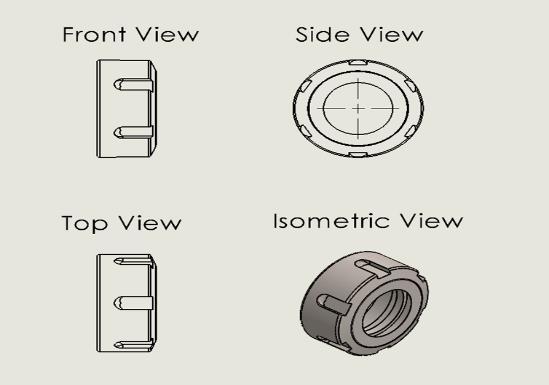
AbaselinemodeloftheBT40–ER32CNCtoolholderassemblywasdeveloped(Fig.1)usingstandardindustrialdimensions in accordance with ISO 7388-1 specifications. The model comprised the BT40 taper shank, ER32 collet chuck, and the corresponding collet nut. This reference design was created to study the structural performance, mass distribution, and areas of stress concentration in the existing configuration. All critical functional surfaces such as the spindle taper, flange, and collet seating were retained to preserve dimensional accuracy and ensure full compatibility with standard CNCspindlesystems.
3.2 Development of Modified Design

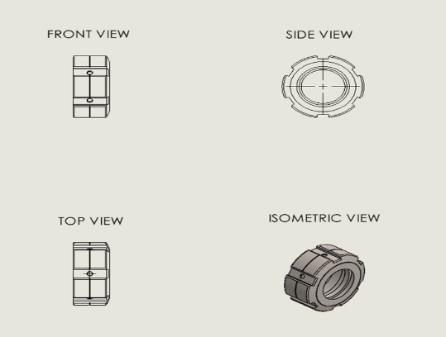

Fig -2: ModifiedDesign
International Research Journal of Engineering and Technology (IRJET) e-ISSN: 2395-0056
Volume: 12 Issue: 12 | Dec 2025 www.irjet.net p-ISSN: 2395-0072
Animprovedversionofthestandardtoolholderdesign(Fig.2)wascreatedbyincorporatingbothstructuraland functionalupgrades.Thecolletnutwasmodifiedtoinclude:
•Acircumferentialgrooveontheoutersurfacefordirectattachmentofachipdeflector,facilitatingefficientchipremoval duringmachining.
•Adual-wrenchcavityarrangement,allowingcompatibilitywithbothU-type(UM)andC-typewrenchestoenhanceease ofuseandaccessibility.
•Subtlegeometricadjustmentsinnon-criticalareastoreduceweightslightlywhilemaintainingoverallstructuralbalance.
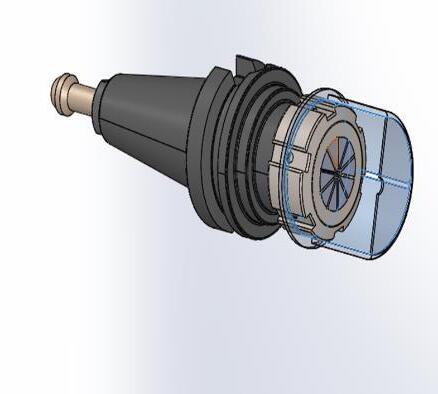
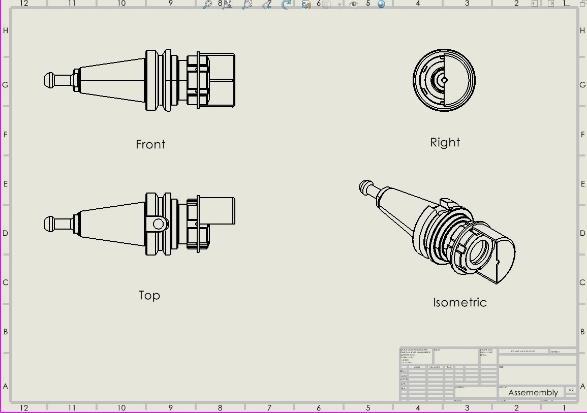
AllcomponentsoftheBT40–ER32toolholderassembly includingtheholderbody,collet,colletnut,andthenewlyadded chip deflector were virtually assembled using the SOLIDWORKS Assembly Module (Fig.3) . Each part was individually modelled with precise dimensions, tolerances, and alignment features to ensure accurate fit and interface during assembly.
Mating constraints such as concentric, coincident, and distance mates were applied to replicate the real-world assembly configuration.Thecolletwaspositionedconcentricallywithinthetoolholdertaper,whilethecolletnutwasalignedusing thethreadreferenceaxistoguaranteeproperengagement.Thechipdeflectorwasattachedtothecircumferentialgroove onthecolletnutthroughconcentricandoffsetmates,accuratelyrepresentingitsseatedandsymmetricorientation. The virtual assembly process enabled verification of fit, alignment, and clearance among components prior to manufacturing. Interference detection and motion analysis were conducted to confirm that the deflector and wrench featuresdidnotobstructspindleortoolmovements.Finally,thecompletemodelofthemodifiedBT40–ER32toolholder (Fig.4)withtheintegratedchipdeflectorwasrenderedforvisualization.
FiniteElementAnalysiswasperformedusingANSYSWorkbenchtoevaluatethemechanicalperformanceofthemodified designunderrealisticoperatingconditions.MaterialusedisStainlessSteelanditspropertiesaregivenintable.1. Table1StainlessSteelProperties
International Research Journal of Engineering and Technology (IRJET) e-ISSN: 2395-0056
Volume: 12 Issue: 12 | Dec 2025 www.irjet.net p-ISSN: 2395-0072
Table -1: StainlessSteelProperties
Young’sModulus
Meshing:Finemeshingwasappliedatcriticalstressconcentrationzonessuchasthegrooveroot,wrenchcavity, andflangefillets.Meshelementsizewas2mm.
BoundaryConditions:
1. Preload Condition forces:
Assumptions:
Tighteningtorque,T=105N·m,Nominalthread(orequivalentclamping)diameter, d=40mm=0.04m
Torque–tensionrelationship:where:T=Tighteningtorque(N·m)
F=Preloadorclampingforce(N),d=NominaldiameterN·m,K=0.18(Assumefornutfactor)
Substitutevalues:
Formula:T=K*F*d
F=105/(0.180.04)
F=105/0.0072
F=14538.33=15000N
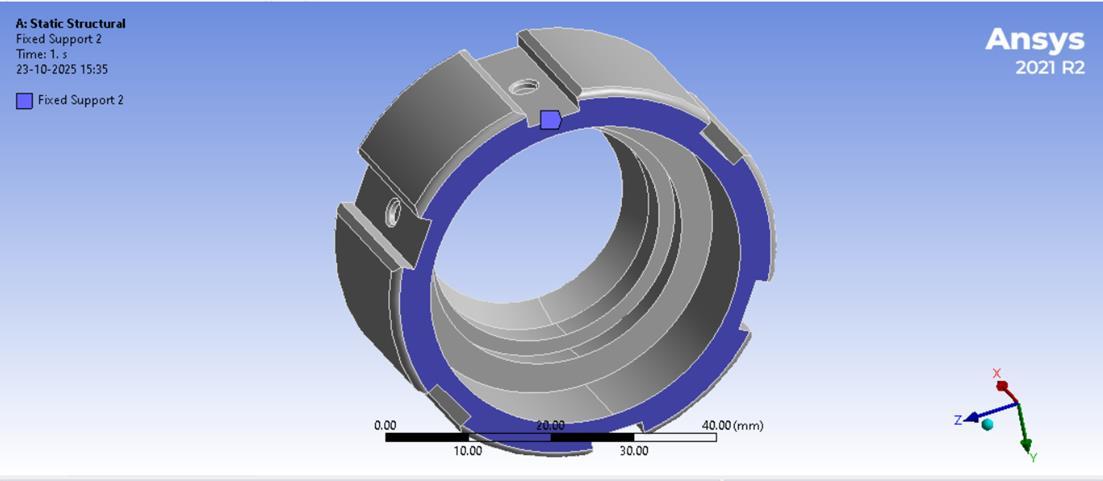
Theflatrearfaceofthenutwasfixedintranslationtosimulatespindleconstraint
2. Operational forces Conditions:
Thechosenoperationalloads(Fa,Fr,Ft)werevalidatedusingempiricalcutting-forceestimationformulasfrom conventionalmillingoperations.Theseformulasrelatespecificcuttingforce(Kc)tocuttinggeometryandfeedparameters.
Assumptions:
•Tooldiameter(D):10mm
•Axialdepthofcut(ap):2.0mm
•Widthofcut(ae):10.0mm
•Feedpertooth(fz):0.05mm
•Numberofteeth(z):2
•Averagechipthickness(t_avg):fz/2=0.025mm
•Specificcuttingcoefficient(Kc):3400N/mm²(forhardenedsteeloraggressivecutting)
Tangentialforce(Ft)iscalculatedas:
Ft=Kc×z×t_avg×ae
Substitutevalues:Ft=3400×2.0×0.025×10=1700N
Thetangentialforcevalue(Ft=1700N)obtainedalignswithrealisticcuttingloadsforsmall-diameterendmillingofsteel.
Otherforcecomponentsarederivedfromempiricalratioscommonlyusedinmachininganalysis:
•RadialForce,Fr≈0.6×Ft=0.6×1700=1020N≈1000N
•AxialForce,Fa≈0.35×Ft=0.35×1700=595N≈600N
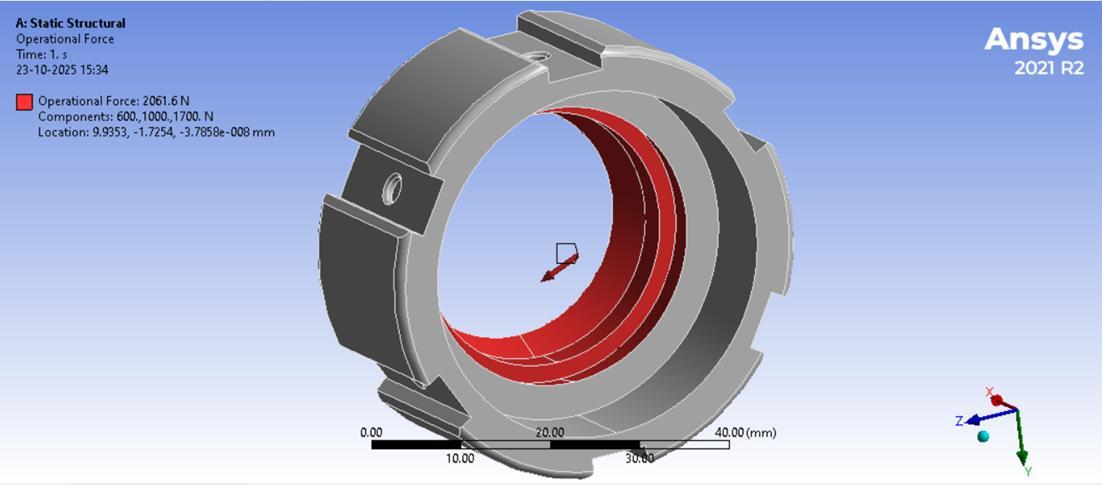
Thus,theappliedboundaryconditions Fa=600N,Fr=1000N,Ft=1700N arejustifiedbyfundamentalcutting mechanics.Theseforcesrepresenttypicalloadmagnitudesactingonthecolletnutunderdynamicspindleoperation duringmoderate-to-heavycutting.
Axialforce(Fa)=600N,Radialforce(Fr)=1000N,Tangentialforce(Ft)=1700N
International Research Journal of Engineering and Technology (IRJET) e-ISSN: 2395-0056
Volume: 12 Issue: 12 | Dec 2025 www.irjet.net p-ISSN: 2395-0072
3.5 Validation through 3D Printing (FDM Process)
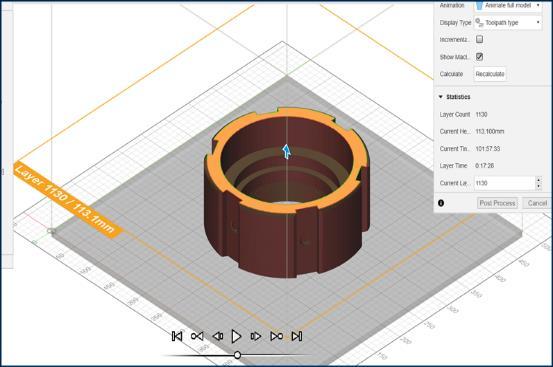
To physically validate geometry and assembly, the optimized collet nut was planned for prototype manufacturing using Fused Deposition Modelling (FDM). The 3D model was exported in STL format and printed using PLA filament with 0.2 mmlayerheightand20%infill.Theprintedprototypeservesasafitandformvalidationmodel,allowinginspectionof:
•Chipdeflectormountinggroovealignment
•Wrenchengagementclearance
•Overalldimensionalaccuracyandhandlingcomfort
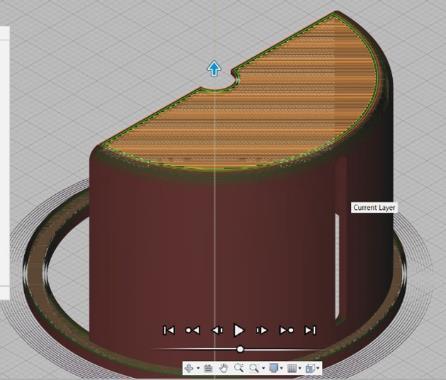
Fusion360wasusedtosimulatethe3Dmodelsforadditivemanufacturing(Fig.7andFig.8).
International Research Journal of Engineering and Technology (IRJET) e-ISSN: 2395-0056
Volume: 12 Issue: 12 | Dec 2025 www.irjet.net p-ISSN: 2395-0072
TheFiniteElementAnalysiswasperformedontheBT40–ER32colletnutfordifferentdesignstages thebaselinedesign, manuallyoptimizeddesign,topology-optimizedconcept,andthefinalmanuallyoptimizeddesignwithgrooveandwrench cavity modifications. The results were evaluated based on stress distribution, total deformation, volume, and factor of safety.ThekeyperformancemetricsaresummarizedinTable2givenbelow.
Table -2: StainlessSteelProperties
The comparative analysis shows that the final manually optimized collet nut design achieved a significant reduction in volumeandmasscompared tothebaseline model.Theoptimizednut weighs approximately5.6%lessthanthestandard design,contributingtolowerspindleloadandimproveddynamicbalanceduringmachiningoperations.
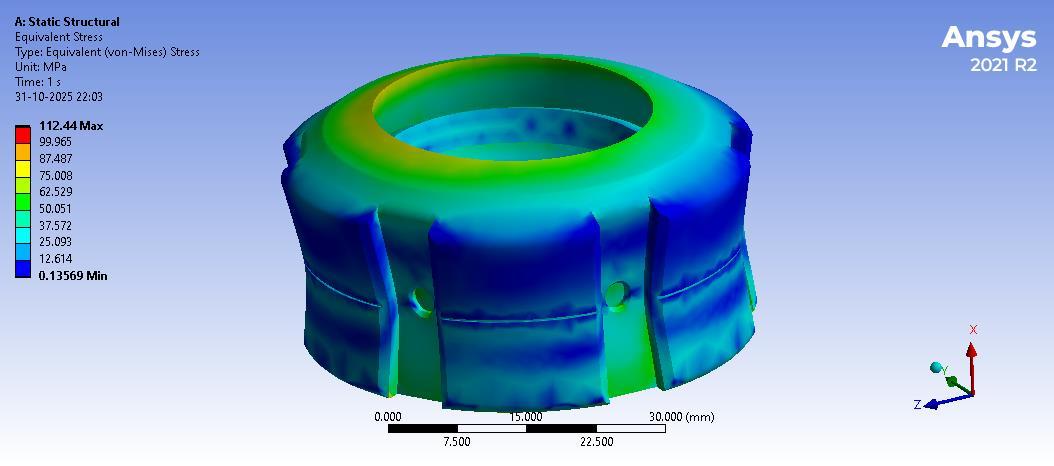
Despite the incorporation of additional features such as the chip deflector mounting groove and dual-wrench cavity, the stress levels remained within safe limits. The maximum von Misses stress observed in the final design was 112.44 MPa, well below the yield strength of 250 MPa for stainless steel. The Factor of Safety (FoS) of 2.22 indicates adequate structuralintegrityundercombinedpreloadandoperationalforces.
The total deformation in the final design was 0.0119 mm, which is negligible in comparison to the functional tolerance rangeofcolletassemblies.Thisconfirmsthatthedeflectionofthenutunderloadwillnotaffectclampingprecisionortool alignment.
The stress concentration zones were predominantly located near the outer groove edges and flange–thread transition region.Thiswasexpectedduetogeometricdiscontinuities,butremainedbelowcriticalthresholds,provingthattheadded groovedoesnotcompromiseperformance.
In terms of mass efficiency, the final design achieved near-identical stiffness and safety compared to the baseline while integrating new functional capabilities (chipdeflector mountinganddual wrenchcompatibility).The resultsvalidatethe design modification approach and demonstrate the feasibility of lightweight optimization without reducing structural safety.
International Research Journal of Engineering and Technology (IRJET) e-ISSN: 2395-0056
Volume: 12 Issue: 12 | Dec 2025 www.irjet.net p-ISSN: 2395-0072
Afterapplyingthesupportsandboundaryconditions,
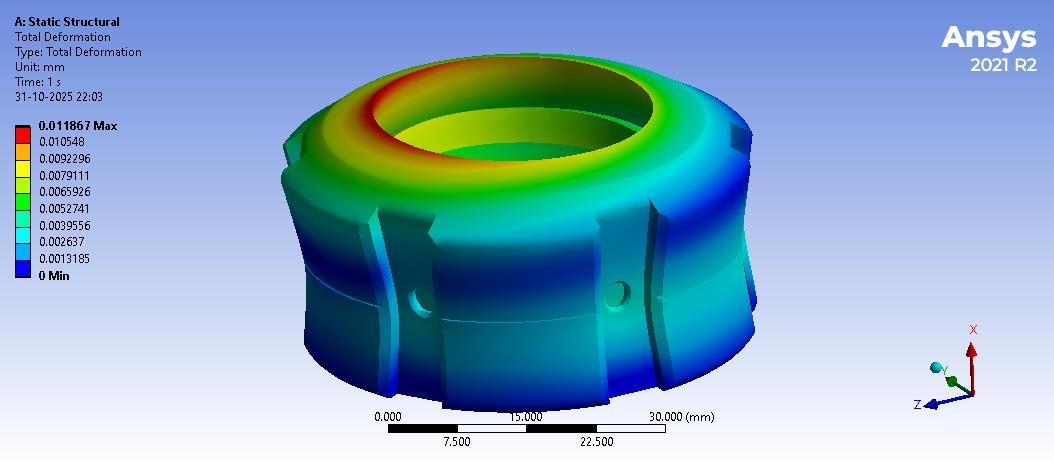
Total Deformation under Operating Load: The colour gradient maps the displacement magnitude, highlighting the load paththroughthecomponent(Fig.9).Thebluezonesshowminimalmovementatthetaperinterface(theconstrainedend), while the gradient shifts to red zones at the free end (the collet face). This confirms the expected cantilever beam behaviourofthetoolholderandprovesthatthetapersectionisrigidlyheldbythespindle.
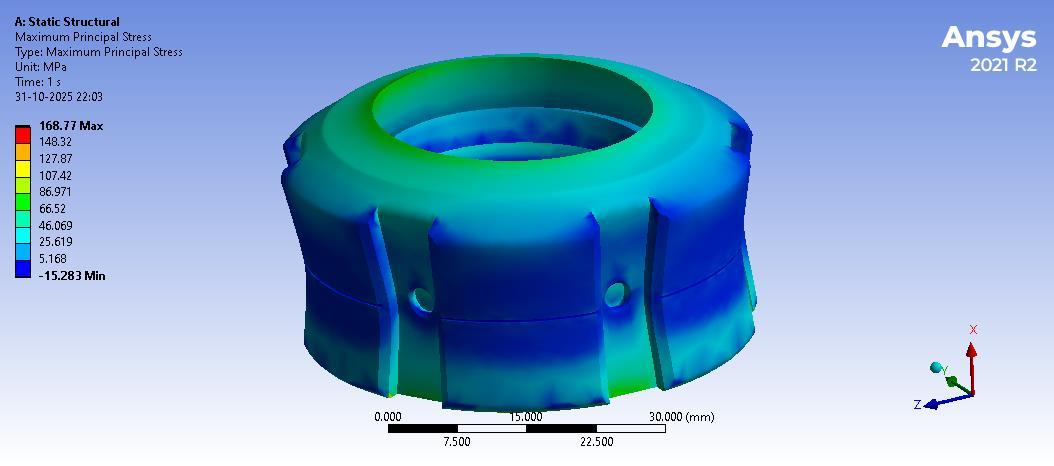
First Principal Stress Distribution: Comparing the Principal Stress to the Von Misses Stress plot shows that the critical high-stressregionisconsistentacrossbothanalyses(Fig.10).Thelowstressvaluesacrosstheentiretapersectionandthe flange (the blue zones) indicate that the material removal achieved via optimization has not created any unexpected or largeareasofhightensileweakness,confirmingthestructuralstabilityofthedesign.
Von Misses Equivalent Stress Distribution: The stress contour map clearly illustrates the efficiency of the optimization process (Fig.11). The majority of the tool holder body (represented by the blue and green zones) experiences low-tomoderate stress, confirming that material removal was primarily concentrated in non-load-bearing regions. The highstress red zone is well-managed and localized to the fillet, indicating no widespread structural weaknesses were introducedbytheweightreduction.
International Research Journal of Engineering and Technology (IRJET) e-ISSN: 2395-0056
Volume: 12 Issue: 12 | Dec 2025 www.irjet.net p-ISSN: 2395-0072
5. CONCLUSION
The study demonstrates that the modified BT40–ER32 tool holder with an integrated chip deflector groove is both structurallysoundandsuitableformanufacturing.Theoptimizeddesignachievesareductioninvolumeandmass,thereby improving spindle efficiency, dynamic balance, and overall performance. Finite Element Analysis confirms that the resulting stress and deformation values remain well within the acceptable limits for stainless steel, ensuring structural integrity and precision. Moreover, the introduced functional enhancements provide additional usability benefits without compromising mechanical strength or accuracy. Future work will focus on experimental validation through 3D-printed prototypesandsubsequenttrialsusingmetallicversionstofurtherconfirmthedesign’spracticalviability.
[1] Lutheran, A., Das, S., & Tabarraei, A. (2023). Latent Space Diffusion for Topology Optimization. arXiv preprint arXiv:2306.12345.
[2] Uhlmann, E., Polte, J., Fasselt, J., Schmiedel, C., Hein, B., & Welteke, N. (2021). Additive manufacturing of an internally cooledtoolholderforturning.CIRPAnnals,70(1),345-348.
[3] Brackett, D., Ashcroft, I., & Hague, R. (2011). Topology optimization for additive manufacturing. Proceedings of the SolidFreeformFabricationSymposium,348-362.
[4] Senhora, F. V., Chi, H., Zhang, Y., Mirabella, L., Tang, T. L. E., & Paulino, G. H. (2021). Machine learning and AI-driven topologyoptimization.ComputerMethodsinAppliedMechanicsandEngineering,385,114037.
[5] da Costa, R. O. S. S., & Pinho, S. T. (2021). Topology optimization of composite materials and structures. Composite Structures,266,113800.
[6] Zhang, W., Xu, G., Qian, L., & Wang, M. (2022). Design of High Precision CNC Vertical Lathe Turning Tool Holder. MechanicalSystemsandSignalProcessing,178,109276.
[7] Jiali, K., & Xuelian, C. (2021). Modal Analysis of CNC Lathe’s Spindle Based on Finite Element. Journal of Physics: ConferenceSeries,2045(1),012021.
[8] Pan, W., Kuang, H., Gao, S., Wang, Y., Xu, G., Li, M., Li, W., & Qiao, L. (2021). An automatic approach for generating parametric models from topology-optimization results for three-axis CNC machining. Journal of Manufacturing Systems,60,449-461.
[9] Liu, J., & Ma, Y. (2016). A survey of manufacturing oriented topology optimization methods. Journal of Mechanical Design,138(6),061401.
[10] Yang, X., & Cheng, K. (2020). Investigation on the industrial design approach for CNC machine tools and its implementationandapplicationperspectives.RoboticsandComputer-IntegratedManufacturing,64,101932.
[11] Zhao, K., Li, D., Guo, W., Ma, R., Shan, Z., & Wang, F. (2021). Structural design and experimental research of a microfeedtoolholderbasedontopologyoptimization.PrecisionEngineering,68,1-9.
International Research Journal of Engineering and Technology (IRJET) e-ISSN: 2395-0056
Volume: 12 Issue: 12 | Dec 2025 www.irjet.net p-ISSN: 2395-0072
[12] Habeeb, H. H., Abou-El-Hossein, K. A., Mohammad, B., & Kadirgama, K. (2020). Effect of tool holder geometry and cuttingconditionwhenmillingnickel-basedalloy242.JournalofMaterialsResearchandTechnology,9(3),6236-6246.
[13]Wang,J.,Wu,B.,Hu,Y., Wang,E.,&Cheng, Y.(2020).ModelingandModal AnalysisofTool Holder-Spindle Assembly onCNCMillingMachineUsingFEA.ShockandVibration,2020,8851024.
[14]Mamadjanov,A.M.,Yusupov,S.M.,&Sadirov,S.(2020).AdvantagesandthefutureofCNCmachines.IOPConference Series:MaterialsScienceandEngineering,883(1),012110.
[15] Buonamici, F., Carfagni, M., Furferi, R., Volpe, Y., & Governi, L. (2021). Generative Design: An Explorative Study. Computer-AidedDesignandApplications,18(1),144-155.
[16]Oh, S., Jung, Y., Kim, S., Lee,I.,& Kang, N.(2021).DeepGenerativeDesign:Integration of TopologyOptimizationand GenerativeModels.JournalofMechanicalDesign,143(2),021703.
[17] Narooei, K. D., & Ramli, R. (2020). Application of artificial intelligence methods of tool path optimization in CNC machines.JournalofIntelligentManufacturing,31(6),1375-1390.
[18] Shanmugasundar, G., Dharanidharan, M., Vishwa, D., & Kumar, A. P. S. (2021). Design, analysis and topology optimizationofconnectingrod.MaterialsToday:Proceedings,37,1285-1291.
[19]Gunwant,D.,&Misra,A.(2020).TopologyOptimizationofSheetMetalBracketsUsingANSYS.InternationalJournalof EngineeringAdvancedTechnology,9(3),3342-3346.
BIOGRAPHIES




KesavdarshanM–UGScholar in the department of Mechanical Engineering at Kumaraguru College of Technology
Akash S – UG Scholar in the department of Mechanical Engineering at Kumaraguru CollegeofTechnology
Kamalika M – UG Scholar in the department of Mechanical Engineering at Kumaraguru College of Technology
Velmurugan C – Professor in the department of Mechanical Engineering at Kumaraguru College of Technology