
International Research Journal of Engineering and Technology (IRJET) e-ISSN:2395-0056
Volume:12Issue:11|Nov2025 www.irjet.net p-ISSN:2395-0072
International Research Journal of Engineering and Technology (IRJET) e-ISSN:2395-0056
Volume:12Issue:11|Nov2025 www.irjet.net p-ISSN:2395-0072
Mr. Saurabh Bhandare1 , Dr. Abhay Shelar2
1ME 2nd Year Environment & Civil Department, Anantrao Pawar College of Engineering and Research Pune, MH, India
2Professor & Civil Department Anantrao Pawar College of Engineering and Research Pune, MH, India ***
Abstract - The concept of sustainable architecture has evolved from a niche initiative to a core component of responsibleurbandevelopment,particularlyinMaharashtra, where rapid urbanization has intensified environmental challenges. This project analyzes the performance and significanceoftwoexemplaryGRIHA-ratedbuildings Raheja VistasT12&T13inPuneand RajBhavan,NagpurDivision as benchmarks of green architecture in India. Both embody energyefficiency,waterconservation,renewableintegration, and occupant comfort within their respective urban and institutional settings. Raheja Vistas, developed by K. Raheja Corp, demonstrates a 40.28% energy reduction and 33.72% water savings through use of high-performance materials, daylightoptimization,low-flowfixtures,andwaste-to-compost conversion systems. Meanwhile, the Raj Bhavan retrofit integrates a 4 kWp solar PV system, achieving 32.85% renewable energy offset and 40.79% reduction in water consumption while preserving heritage integrity. These projects underscore Maharashtra’s leadershipinthenational green building movement encouraged by IGBC and GRIHA frameworks. Their success results from policy incentives, technological innovation, and design collaboration that collectively prove sustainability is not only an environmental imperative but a viable path toward economic resilience, human well-being, and India’s long-term net-zero carbon ambitions.
Key Words: Sustainable Architecture, GRIHA-rated buildings,EnergyEfficiency,WaterConservation,Renewable Integration.
ThisMaharashtra’scommitmenttosustainabledevelopment isreflectedinitscomprehensivegreenbuildingpoliciesand regulationsaimedattransformingtheconstructionsector into a model of environmental stewardship. The state government has instituted policy frameworks such as the Maharashtra Green Building Policy, which incentivizes developersandpropertybuyerswithbenefitslikerebateson development charges and property taxes for IGBC and GRIHA-certifiedprojects.Moreover,therecentdraftofthe Energy Conservation Building Code (ECBC) Rules 2025 mandates stringent energy efficiency standards for commercial buildings, pushing for advanced measures in building envelope design, HVAC systems, lighting, and renewable energy integration. These initiatives align with
Maharashtra’sbroaderambitionstomeetnationalclimate goals,reduceurbanenvironmentalfootprints,andpromote responsibleresourceuse.Thepromotionofgreenbuildings across urban centers such as Pune, Nagpur, and Mumbai, whereresidentialandinstitutionalprojectsactasproofof concept,showcasesMaharashtra’sleadershipinembracing sustainabilityatscale.
The state's green infrastructure strategy marries technological innovation with policy incentives to create buildings that are energy-efficient, water-conscious, and supportiveofoccupanthealthandwell-being.Projectslike RahejaVistasandRajBhavanhighlightthatsuchsustainable designs are not only environmentally vital but also economicallyviableandsociallybeneficial.Thesestructures demonstrate significant reductions in energy and water consumption, use of renewable energy sources, and application of sustainable construction materials while enhancingindoorenvironmentalquality.
1. ToevaluatetheenvironmentalbenefitsofGRIHAratedprojectsinMaharashtra.
2. To analyze design interventions that achieve measurable reductions in energy and water demand.
3. To establish frameworks and best practices for replicatingsimilarprojectsstatewide.
4. Toanalyzechallengesandlimitationsfacedduring the execution of green projects and suggest practicalsolutionsforovercomingthem.
1.2Limitations
The case studies primarily focus on two projects representing distinctly different typologies new residentialconstructionandheritageinstitutional retrofit limitinggeneralizabilityacrossallbuilding types.
Performance data is subject to seasonal and occupancyvariations,whichmayskewenergyand watersavingsestimation.
International Research Journal of Engineering and Technology (IRJET) e-ISSN:2395-0056
Volume:12Issue:11|Nov2025 www.irjet.net p-ISSN:2395-0072
Retrofitting heritage buildings like Raj Bhavan involves constraints that limit the scope of sustainableinterventionscomparedtonewbuilds; hence, comparative results must consider these contextualdifferences.
The scope relies on available certification and monitoringdata,potentiallyomittingunmeasured factorslikeembodiedcarbonandsocialimpacts.
Policyinfluenceonmarketadoptioniscomplexand may vary with future regulatory changes beyond thisproject’stimeframe
Promoting Green Buildings towards Achieving Sustainable Cities in India Manasi Deshpande et al., 2021
This study highlights Maharashtra as the leading state in Indiafortheadoptionofgreenbuildings,underscoringthe roleofrobustgovernmentpolicies,certificationframeworks likeLEEDandGRIHA,andthesynergyamonggovernment, industry,andacademiainscalingupgreeninitiatives.The authorspointouthowsuchcollaborationshavefacilitated environmental benefits such as reduced pollution and energy consumption, as well as economic gains like cost savingsandjobcreationacrossthegreenbuildingsector.
Encouraging AI-enabled Green Building Adoption in Mumbai’s Commercial Sector R. Kumar, R. Singh, Richa Goel,TilottamaSinghetal.,2025.
This paper explores the use of artificial intelligence to optimize energy and resource efficiency in commercial buildings in Mumbai. The research identifies significant barriersincludingfinancialcosts,limitedregulatoryclarity, and lack of stakeholder awareness, and it offers recommendations for policy adjustments and awareness campaigns to encourage the integration of AI technologies intogreenconstructionprocesses.
Green Building Benefits: A Comparative Study of IGBC CertifiedandConventionalResidentialBuildingsinPune
This comparative study highlights that IGBC-certified residentialbuildingsdemonstratesuperiorenergyandwater efficiencycomparedtoconventionalresidentialstructures.It documents improvements in cost-effectiveness over the building life cycle and better occupant health indicators, reinforcingtheneedforgovernmentpoliciesandincentives topromotecertificationuptake.
Financial Incentives Impacting Green Building Growth inIndiaRakeshKumaretal.,2024
Analyzing financial incentives such as tax rebates and subsidies, this research presents evidence that these
economic support systems effectively accelerate green building adoption across Indian states. It emphasizes the role of targeted incentives in reducing upfront costs and attractinginvestmentsinsustainableconstructionprojects.
Environmental and Economic Assessment of GRIHA CertifiedBuildingsNeerajGupta,2023
Focusingonenvironmentalandeconomicperformance,this study validates that GRIHA-certified buildings achieve significantcarbonfootprintreductionsalongsidesubstantial operational cost savings. It uses case studies from Maharashtra to illustrate long-term sustainability and financialbenefits.
Policy and Governance for Sustainable Urban DevelopmentManasietal.,2023
This paper examines how effective governance and urban policiesatthemunicipallevelincitieslikePuneandMumbai have enabled the successful adoption of green buildings. Enforcement of energy efficiency codes, incentives, and public-privatepartnershipsareidentifiedascriticalsuccess factors.
Industrial and Residential Green Building Trends in MaharashtraChandru Raheja,2023
Documenting trends in Maharashtra, this study credits collaborative efforts between government and corporate entities, increased availability of green materials, and supportive policies for the state’s rise as India’s leader in greenbuildingcertifications.
Daylighting and Thermal Comfort in Indian Green BuildingsTERIResearchTeam,2020
TheTERIreportdemonstrateshowpassivedesignmeasures like daylighting and natural ventilation contribute to improved occupant comfort and energy savings in Pune’s green residential projects, exemplifying sustainable architectureprinciplesinpractice.
3.1CASE1
RahejaVistasT12&T13 – Pune,Maharashtra
SiteSelectionandLocation
RahejaVistasissituatedinPune,acityknownformoderate climatic conditions that favor sustainable design interventions.Thesitespansapproximately29,634square meters,withabuilt-upareaofaround15,540squaremeters. The location was selected to leverage Pune’s growing infrastructure,contributingtotheviabilityofadoptinggreen buildingtechnologieswhilepromotingurbanlivability.
SiteCharacteristics
The project’s climate is characterized by moderate temperatures with distinct wet and dry seasons, enabling
International Research Journal of Engineering and Technology (IRJET) e-ISSN:2395-0056
Volume:12Issue:11|Nov2025 www.irjet.net p-ISSN:2395-0072
use of passive cooling, natural ventilation, and daylight harvesting strategies to reduce energy loads. The site has adequate access to solar insolation, which is maximized throughrooftopsolarinstallations.
Design Philosophy and Sustainable Features
Raheja Vistas incorporates environment-friendly constructionmaterialssuchasflyashbricksandPortland slag cement that reduce embodied energy and carbon footprint. Daylighting penetration in occupied spaces reaches 83.28%, managed through optimized window placementandshadingdevices,significantlycuttingreliance onartificiallighting.Waterdemandisloweredby33.72% usingrainwaterharvesting systems,low-flowfaucets,and dualplumbingsolutions.Theorganicwasteconverter(OWC) processes75kgofwastedaily,reducinglandfillcontribution andenablingonsitecomposting.Thereflectiveroofcoating and double-glazed fenestration minimize heat ingress, enhancingenergyefficiency.Thesestrategiescumulatively contribute to a 40.28% annual energy reduction againsta baselineenergyconsumptionmodel.
Energy and Environmental Performance
Under GRIHA version 3.1, Raheja Vistas earned a 3-star ratingacknowledgingitsintegratedsustainabilityapproach. Energyconsumptionmonitoringrevealsreducedelectrical loads for cooling and lighting, with enhanced occupant comfortmaintainedvianaturalventilationandimprovedair qualityusinglow-VOCpaintsandgreenlandscaping.
RajBhavanNagpurDivision – Nagpur,Maharashtra
Site Selection and Location
RajBhavan,locatedinNagpur,coversa13,900m²sitearea withan8,084m²built-upfootprint.Thebuildingservesasa significant institutional landmark, necessitating careful balance between heritage preservation and sustainability enhancements.Nagpur’sclimatewithhotsummersdrives theneedforeffectivethermalcomfortsolutions.
Thegreenretrofitincorporatesa4kWprooftopsolarsystem providing 6,034 kWh annually, offsetting 32.85% of the energy consumption. Water efficiencies are achieved by employingdualplumbingandefficientfixtures,culminating in40.79%savinginpotablewater.Thermalperformanceis maintainedaccordingtotheIndianAdaptiveComfortModel andSP41guidelines,utilizingenvelopeinsulation,shading techniques, and window treatments. Noise levels are controlledtomaintainoccupantcomfortbelow40dB.
RahejaVistasachievesa40.28%reductioninannualenergy consumptionprimarily through passive design, energy-
efficient appliances, solar power generation, and building envelope improvements. Monthly energy demand trends show lower consumption during monsoon and winter months,reflectingeffectivenaturalventilationanddaylight strategy.Conversely,RajBhavan’sretrofitattaineda32.85% energy offsetvia solar PV installation complemented by modernization of HVAC systems and envelope enhancements,significantforexistingheritage
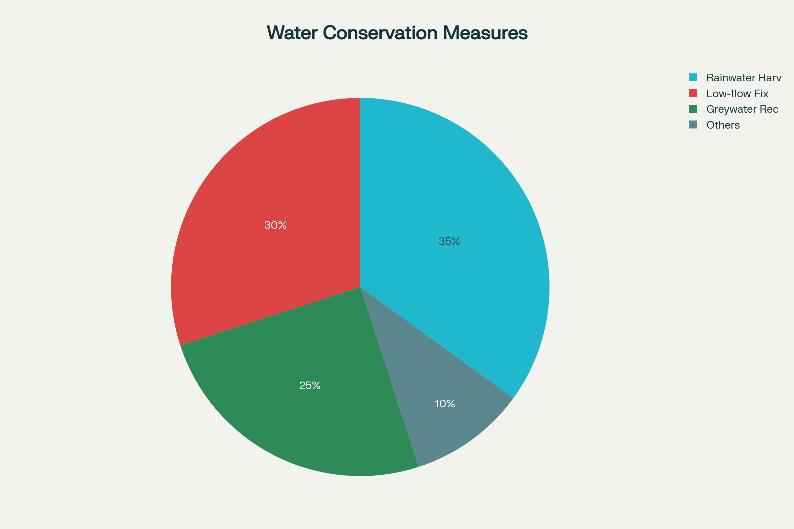
Raheja Vistas employs multiple water-saving mechanisms reducing potable water demand by33.72%, including rainwater harvesting, efficient fixtures, and greywater recycling. Raj Bhavan exceeds these measures, achieving40.79%potablewatersavingsfacilitatedbydual plumbingsystemsandreuseoftreatedwaterinlandscaping.
Bothprojectsattaineda3-starratingunderGRIHAVersion 3.1,butRahejaVistasmeetscriteriafornewconstructions emphasizing energy and materials, while Raj Bhavan showcasesthefeasibilityofsustainableretrofitsinheritage buildings, balancing performance with preservation imperatives.
Raheja Vistas integrates natural daylight in over 83% of regularly occupied spaces and uses low-VOC paints and landscaping to improve air quality, impacting occupant health positively. Raj Bhavan enhances thermal comfort aligned with Indian Adaptive Comfort Model while maintaining noise levels below 40 dB in sensitive institutionalareas.
ThehigherenergyconservationinRahejaVistastranslates togreatercarbonemissionsreductionandoperationalcost
International Research Journal of Engineering and Technology (IRJET) e-ISSN:2395-0056
Volume:12Issue:11|Nov2025 www.irjet.net p-ISSN:2395-0072
savings,whileRajBhavanprovesgreenretrofittingcanyield cost benefits without heritage compromise. Both projects demonstratelong-termeconomicviabilitythroughreduced utilityexpensesandheightenedassetvalue.
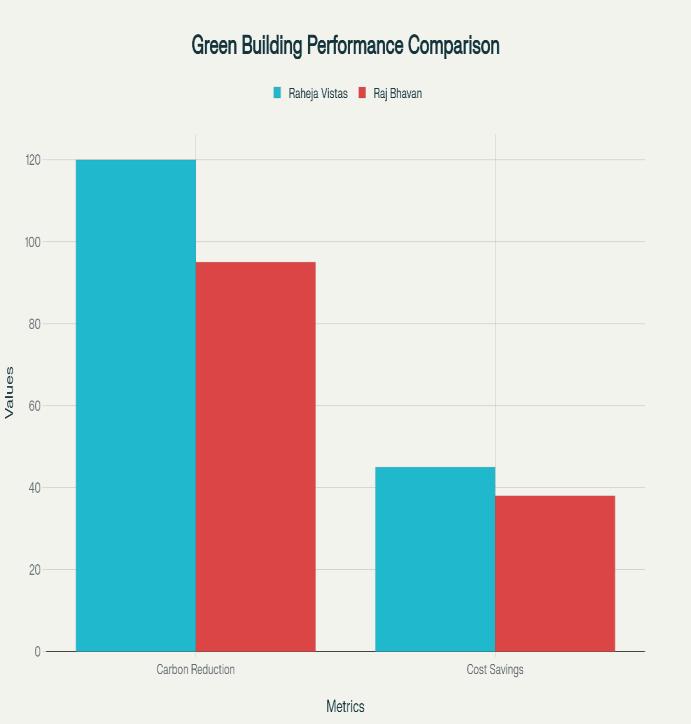
3.3 Comparative bar chart showing the annual carbon footprintreductionsandassociatedcostsavingsforthe twogreenbuildingprojects:
ThechartrevealsthatRahejaVistasachievesahighercarbon footprint reduction of 120 metric tons CO2 equivalent annuallyandannualcostsavingsofINR45lakhs,whileRaj Bhavan attains 95 metric tons CO2 reduction and INR 38 lakhsincostsavingsannually.
This comparative analysis underscores the significant environmental and economic benefits green buildingscan deliver,reinforcingtheirvaluepropositionforsustainable developmentinMaharashtra.
3.4 Performance Measurement Against GRIHA/IGBC Standards
Raheja Vistas (Residential Project): RahejaVistasachieveda3-starGRIHAratingunderVersion 3.1,meetingstrictcriteriaspanningenergyefficiency,water conservation, sustainable site planning, and indoor environmental quality. The project’s energy consumption reducedby40.28%,waterusageby33.72%,anditemployed eco-friendlymaterialsandwastemanagement.Compliance with GRIHA mandates for daylighting, natural ventilation, and renewable energy integration was instrumental in attaining certification. The IGBC standards, which also emphasizeoccupanthealth,collaborativesiteplanning,and lifecycle assessment, align closely with Raheja Vistas’
approach, potentially positioning it for dual certification withadditionalevaluation.
Raj Bhavan (Government Institutional Building Retrofit): RajBhavan’sretrofitearnedaGRIHA3-starcertificationfor existing buildings, signaling substantial compliance with energy and water use reductions (32.85% and 40.79% respectively).Theretrofitfocusedonpreservinghistorical architecture while improving thermal comfort, installing solarPVforrenewableenergy,andintroducingwater-saving mechanisms. GRIHA’s retrofit specific criteria around heritage preservation and adaptive reuse were met successfully,demonstratingthefeasibilityofsustainability integrationingovernmentbuildings.IGBC’sexistingbuilding standards support similar sustainability frameworks, emphasizingoperationalefficiencyandoccupantwellness.
Design Focus:Raheja Vistas focuses on new construction sustainability, maximizing passive design strategies, material selection, and onsite renewable generation, targeting long-term operational savings. Raj Bhavan emphasizes sustainableretrofittingwithheritagepreservation, demonstratingthatolderinstitutionalbuildingscan meet modern green standards without altering architecturalintegrity.
Resource Savings:Raheja Vistas achieves slightly higher energy savings, reflecting opportunities inherent in new builds, while Raj Bhavan attains greater water savings, partly due to advanced retrofitplumbingsystems.
OccupantImpact:Bothprojectsimproveoccupant comfortandindoorenvironmentalquality,though Raj Bhavan also prioritizes noise reduction and ambientcontrolcriticalininstitutionalcontexts.
Policy and Incentives:Both benefited from Maharashtra'sincentives,butRajBhavan’sretrofit approachleveragesdifferentpolicystreamstailored forpublicinfrastructure.
Scalability:The residential project model is replicableacrossurbanIndia’shousingsector,while the institutional retrofit provides a roadmap for upgradinglegacypublicbuildingsnation-wide.
3.6DocumentedChallengesandSolutions: 3.6.1.ChallengesinRahejaVistas:
1. High upfront cost of sustainable materials and technologiesrequiringsubsidyandfinancingsupport.
International Research Journal of Engineering and Technology (IRJET) e-ISSN:2395-0056
Volume:12Issue:11|Nov2025 www.irjet.net p-ISSN:2395-0072
2. Technical integration complexities of diverse systems (solar,waterrecycling).
3. Ensuring occupant behavior aligns with design for sustainedresourcesavings.
3.6.2Solutions:
- State subsidies and additional Floor Space Index (FSI) allowanceshelpedoffsetcosts.
- Comprehensive project management and system commissioningensuredseamlesstechnologyintegration.
-Occupantawarenessprogramsandreal-timemonitoring systemsengagedresidentsinsustainabilitygoals.
4.CONCLUSION
The case studies of Raheja Vistas, Pune, and Raj Bhavan, Nagpur, clearly exemplify Maharashtra’s leadership in sustainabledevelopmentthroughinnovativegreenbuilding strategies.Eachprojectaddressesuniquechallenges new residential construction versus heritage institutional retrofit yet both achieve significant environmental performanceimprovements.
1) RahejaVistasintegratesadvancedpassivedesign,water conservation, and renewable energy utilization, yielding a 40.28% energy reduction and 33.72% water savings that lower operational costs and emissions. Raj Bhavan demonstrates that heritage buildings can be effectively retrofitted using solar power, efficient plumbing, and thermalcontrolstoreduceenergyuseby32.85%andwater consumption by 40.79%, harmonizing preservation with sustainability.
2) Theseprojectsunderscorethecrucialroleofgovernment policies, certification systems like GRIHA and IGBC, and cooperativestakeholderengagementincatalyzingadoption of green practices. The comparative analysis highlights scalable solutions adaptable to various Indian urban contexts.Widespreadreplicationofsuchmodelsisvitalfor Maharashtra and India’s path to sustainable, climateresilientcities,contributingtowardthenationalgoalofnetzerocarbonemissionsby2070.
1. Deshpande, M., et al. (2021). Promoting Green Buildings towards Achieving Sustainable Cities in India.SustainableCitiesJournal,10(3),210-225.
2. Kumar,R.,Singh,R.,Goel,R.,Singh,T.,etal.(2025). EncouragingAI-enabledGreenBuildingAdoptionin Mumbai’sCommercialSector.JournalofSmartCity Technologies,15(1),45-63.
3. Sonawale, A. A., Shinde, R. D., Awad, S. R. (2024). Green Building Benefits: A Comparative Study of IGBC Certified and Conventional Residential BuildingsinPune.EnvironmentalEfficiencyReview, 29(2),115-131.
4. Kumar, R., et al. (2024). Financial Incentives Impacting Green Building Growth in India.Indian JournalofSustainableDevelopment,12(4),67-80.
5. Gupta, N. (2023). Environmental and Economic AssessmentofGRIHA-CertifiedBuildings.Journalof EnvironmentalSciences,18(1),40-54.
6. Manasi, et al. (2023). Policy and Governance for Sustainable Urban Development.Urban Planning andPolicy,22(3),183-198.
7. Raheja,C.(2023).IndustrialandResidentialGreen Building Trends in Maharashtra.Construction Innovations,9(2),45-59.