
International Research Journal of Engineering and Technology (IRJET) e-ISSN: 2395-0056
Volume: 13 Issue: 03 | Mar 2026 www.irjet.net p-ISSN: 2395-0072
International Research Journal of Engineering and Technology (IRJET) e-ISSN: 2395-0056
Volume: 13 Issue: 03 | Mar 2026 www.irjet.net p-ISSN: 2395-0072
Ashutosh Kumar Yadav1 , Mr. Ushendra Kumar2
1Master of Technology, Civil Engineering, Lucknow Institute of Technology, Lucknow, India
2Head of Department, Department of Civil Engineering, Lucknow Institute of Technology, Lucknow, India
Abstract -Settlement behavior of shallow foundations on stratified soils is a critical aspect of geotechnical engineering, asitdirectly influencesthesafety,serviceability,andlongevity of structures. Traditional settlement analyses often assume linear elasticsoil behavior, which fails tocapture thecomplex responseoflayeredsoilsexhibitingnonlinearpropertiesunder loading. This review critically examines the current state of researchonsettlementmechanismsofshallowfoundationson stratified soils, with a particular focus on the effects of nonlinearsoil behavior.Itsynthesizesfindingsfromanalytical, numerical, and experimental studies, highlighting key modeling approaches, including classical elastic methods, advancedconstitutivemodels,andnumericalsimulationssuch as the finite element method. The review discusses the influence of soil layering, stiffness contrast, and stressdependentpropertiesonsettlementpredictions.Comparative analyses from previous studies reveal discrepancies between theoreticalpredictionsandfieldobservations,emphasizingthe importance of incorporating nonlinear soil parameters for accurate assessment. Furthermore, experimental and field investigations are summarized to evaluate validation techniques and practical applications. Existing challenges, such as calibration of constitutive models, limited field data, and the lack of standardized design procedures for layered soils, are identified. The review concludes by outlining future research directions, including advanced modeling strategies, integration of data-driven approaches, and enhanced experimental frameworks to improve the predictability and reliability of foundation settlement analysis. This synthesis provides a comprehensive resource for geotechnical researchers and practitioners seeking to understand and mitigate settlement issues in stratified soil environments.
Key Words: Shallow foundations, Stratified soils, Settlement behavior, Nonlinear soil properties, Constitutive models, Numerical modeling, Soil–structure interaction
1.1 Background and Engineering
The design of foundations is a fundamental aspect of civil and geotechnical engineering because the stability and serviceability of structures depend on how loads are transferredfromthesuperstructureintotheunderlyingsoil. Shallowfoundations commonlyusedforlighttomoderate
structural loads transfer these loads to the near-surface soil and are often governed by settlement criteria more critically than by bearing capacity, especially when soil compressibility and deformation are significant factors in design practice (Das et al., cited in turn0search15). Settlement prediction becomes especially complex when foundationsrestonstratifiedsoils,wherelayersofdiffering stiffness and compressibility produce non-uniform stress and strain distributions under load. Classical design methodologies commonly assume linear elastic soil behaviour for settlement estimation; however, soil mechanicalresponsesareinherentlynonlinear,evenatsmall strain levels, due to stress-dependency of stiffness and yielding phenomena. This complexity has motivated extensive research into nonlinear modelling of soil behaviouranditsincorporationintosettlementanalysisfor enhancedpredictionaccuracy.
1.2.1
Shallow foundations are structural elements that transfer loadstothegroundatornearthesurface,andaretypically classified by geometry and depth relative to width. A foundationisconsideredshallowifitsdepthofembedment is small compared to its width, making it a cost-effective solution for numerous civil structures such as residential buildings,pavementsandlightlyloadedindustrialfacilities. Common configurations include strip, pad and raft foundations, which distribute stresses over a sufficiently largesoilareatolimitexcessivedeformation.
1.2.2
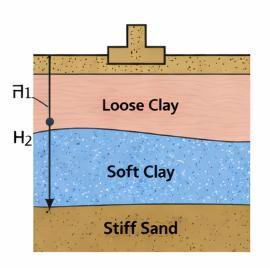
Stratifiedsoilsrefertosubsurfaceprofileswithalternating layersofdistinctsoiltypes suchassandsoverclaysorstiff strata above softer materials formed through geological processes or soil improvement practices. The presence of layered profilessignificantly altersstressdistributionand deformation behaviour beneath foundations compared to homogeneous soil, resulting in differential settlement patternsthatrequirecarefulmechanicalinterpretation.In layered systems, the mechanical interaction between stiff and compliant layers influences the magnitude and distributionofsettlementunderappliedloads.
International Research Journal of Engineering and Technology (IRJET) e-ISSN: 2395-0056
Volume: 13 Issue: 03 | Mar 2026 www.irjet.net p-ISSN: 2395-0072
Settlement of shallow foundations occurs due to compression and rearrangement of soil particles under imposed loads. In stratified soils, layered contrasts in stiffnessandcompressibilitycausecomplexstresspathsand nonlineardeformationmechanisms.Immediatesettlement arises from elastic and plastic strains in the soil skeleton immediatelyafter loadapplication,whereasconsolidation settlement is time-dependent due to pore pressure dissipation in fine-grainedsoils.Inlayered profiles,stiffer layers may constrain deformation in underlying softer layers,leadingtoaredistributionofstressesandpotentially higher settlement than predicted by homogeneous soil theories.Themechanicsofthisprocessareinfluencedbythe relative thickness, stiffness contrast and sequence of soil layersbeneaththefoundation.
Soil behaviour under foundation loads is inherently nonlinear,meaningthestiffnessandstrengthcharacteristics change with stress and strain levels experienced during loading. Traditional elastic settlement models often use constant modulus values, which can result in inaccurate predictionsbecausetheydonotaccountfordegradationin stiffness with increasing strain. Advanced constitutive relationships, such as stress-dependent modulus models, better capture this nonlinear response and provide improvedsettlementestimates,especiallyforlayeredsoils wherestressvariationwithdepthispronounced.Addressing nonlinear behaviour is therefore critical to aligning analytical and numerical predictions with observed field performance.
The primary objective of this review is to synthesize and criticallyevaluateexistingresearchonsettlementbehaviour ofshallowfoundationsonstratifiedsoilsthatincorporates nonlinearsoilproperties.Emphasisisplacedonanalytical, experimental,andnumericalstudiesthatrevealtheimpact ofsoillayeringandnonlinearstress–strainrelationshipson settlement predictions. Another key goal is to identify limitations in existing models and propose directions for futureresearchtoenhancepredictivereliability.Thescope encompasses constitutive modelling, soil–structure interactionmethodologies,andcomparativeassessmentsof modellingframeworksdocumentedinrecentgeotechnical literature.
Shallow foundations are structural elements designed to transfer loads from a superstructure to subsurface soil at relatively shallow depths. By definition, a foundation is consideredshallowwhenitsdepthofembedmentissmall relativetoitswidth,makingitacost-effectivechoiceforlight tomoderatelyloadedstructures.Typicalshallowfoundation configurationsincludestripfootings,whichsupportlinear elementssuchaswalls;rectangular(orpad)footings,used beneathisolatedcolumns;andcircularfootings,commonly applied under round columns or tower supports. These geometries affect how stresses are distributed into the underlyingsoilandinfluencesettlementpatternsunderload.
Conventionaldesignpracticeforshallowfoundationsoften focuses on two key parameters: bearing capacity and settlement performance. While bearing capacity ensures structuralsafetyagainstshearfailure,settlementcontrolis critical for serviceability, particularly for foundations on compressible or layered soils. Settlement estimates in standardpracticehistoricallyrelyonelastictheory which assumesahomogeneous,linearelasticsoilmodulusanduses solutions based on elastic stress–strain relationships beneath a loaded area. In this framework, settlement is calculated by integrating volumetric strains over the compressiblesoilprofile,withcorrectionsforfootingshape, embedmentdepth,andsoilconditions.Althougheffectiveas a first-order approximation, these assumptions can misrepresent true soil behaviour when nonlinearity and layercontrastsaresignificant.
Stratified soils consist of distinct horizontal or inclined layersformedthroughgeologicaldepositionorengineering fill. Horizontal layering represents soils with relatively uniform bedding planes, whereas inclined layering occurs wheresoildepositionortectonicprocessesintroduceslope inlayergeometry.Themechanicalresponseofstratifiedsoil iscontrolledbytherelativestiffness,strength,andthickness of each layer, making prediction of stress transfer and deformationunderfoundationloadsmorecomplexthanin homogeneoussoils.
The presence of stratification significantly influences soil stiffness and strength because contrasting layers respond differentlytoappliedloads.Stifferlayerscanattractalarger share of applied stress and restrain deformation in softer layers,whilesofterlayersmayundergogreatercompression, leadingtounevensettlementprofilesbeneathafoundation. Thecombinedeffectoflayeringoftenproducesnon-uniform stress fields and stress paths that cannot be captured
International Research Journal of Engineering and Technology (IRJET) e-ISSN: 2395-0056
Volume: 13 Issue: 03 | Mar 2026 www.irjet.net p-ISSN: 2395-0072
adequately by single-layer elastic solutions, necessitating more advanced modelling or empirical adjustments in design.
Soilresponsetoappliedloadsisfundamentallygovernedby elastic and plastic deformation mechanisms. Elastic deformationreferstoreversiblesoilstrainthatdisappears uponunloading,typicallymodelledbyHooke’slawinsimple designapproaches.Incontrast,plasticdeformationinvolves irreversible changes in soil structure when stress states exceedyieldthresholds,resultinginpermanentsettlement. Real soil behaviour rarely remains purely elastic under foundation loads, as both elastic and plastic strains may develop simultaneously, particularly in the vicinity of yielding.
A soil’s stress–strain relationship reflects this transition from elastictoplasticresponse.Atsmall strainlevels,soil stiffnessishighanddeformationispredominantlyelastic;as stresses increase, plastic strains accumulate, stiffness degrades, and soil exhibits a nonlinear stress–strain path. This behaviour is more pronounced in fine-grained or heavily overconsolidated soils, where yielding and hardening/softeningmechanismscontrolthedevelopment ofstrainsunderload.
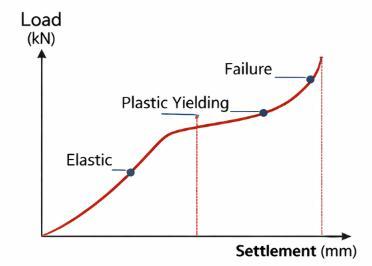
Soilpropertiesunderloadarenonlinear,meaningstiffness andstrengthparametersevolvewithchangesinstressand strain. One manifestation of this behavior is modulus degradation,whereshearordeformationmodulidecrease with increasing strain magnitude; for example, shear modulusmayplateauatsmallstrainsandreducemarkedly asdeformationgrows,reflectingsoilskeleton breakdown. Another aspect is stress-dependent stiffness, wherein stiffness increases with confining stress or depth due to highereffectivestressanddensification,aneffectrecognized
insettlementmethodologiesthattailormodulusdistribution withdepthorstresslevelratherthanuseaconstantvalue.
Torepresentthesenonlinearproperties,constitutivemodels have been developed that relate stress states to strain responsesaccountingforyielding,hardening,andstiffness variation. Simple models such as Mohr-Coulomb capture basicelastic-perfectlyplasticbehavior,whilemoreadvanced formulationslikeHardeningSoilorboundingsurfacemodels incorporate state-dependent stiffness and plastic deformationmechanisms.Thesemodelsformthebackbone of sophisticated numerical analyses (e.g., finite element method) used to predict settlement more realistically by integratingnonlinearsoilresponseswithcomplexloading andstratificationeffects.
Thesettlementbehaviorofshallowfoundationsonstratified soilshasbeenextensivelystudied,withresearchfocusingon prediction methods, constitutive modeling, numerical simulation, and experimental validation. This section organizesexistingliteraturethematicallytohighlighttrends, keyfindings,andgapsinunderstanding.
Earlystudiesonfoundationsettlementprimarilyreliedon classical elastic theory, where soil was assumed homogeneousandisotropic,andstress–strainrelationships werelinear.Analyticalsolutions,suchasthoseproposedby Boussinesq and Terzaghi, provided foundational formulas for estimating immediate and consolidation settlements under shallow footings. While these methods are computationallyefficientandprovidefirst-orderestimates, theyoftenunderestimatesettlementinstratifiedsoilsdueto neglect of nonlinearity and layering effects (Das, 2010; Bowles,2012).
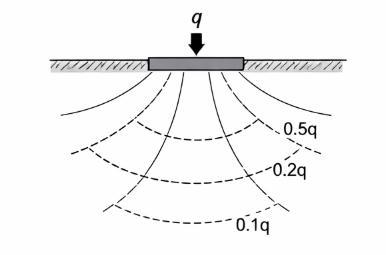
Stress distribution benath a shallow foundation (Boussinesq)
International Research Journal of Engineering and Technology (IRJET) e-ISSN: 2395-0056
Volume: 13 Issue: 03 | Mar 2026 www.irjet.net p-ISSN: 2395-0072
To address the limitations of classical methods, improved analyticalapproachesweredevelopedthataccountforsoil layering and variable stiffness. These solutions apply superpositionprinciplesormodifiedstressinfluencefactors for multi-layer systems, allowing better approximation of settlementinstratifiedsoils(Terzaghi&Peck,1967;Poulos & Davis, 1980). Such methods provide insight into layer interactions but still rely on simplifying assumptions regardingelasticityandneglectcomplexnonlinearstress–strainbehavior.
3.1.3
Semi-empirical approaches combine theoretical solutions with field observations or laboratory data to predict settlementmoreaccurately.MethodssuchasMeyerhof’sand Schmertmann’sproceduresintroduceempiricalcorrection factorsforlayerproperties,footingshape,anddeptheffects, improvingalignmentwithmeasuredsettlements(Meyerhof, 1963; Schmertmann, 1978). These approaches are widely used in practice for preliminary design but may lack generalityacrossdiversesoilprofiles.
3.2.1
Nonlinearsoilbehaviorisoftenmodeledusinghyperbolic stress–strainrelationships,whichrepresenttheprogressive reduction of stiffness with increasing strain. Modulus reduction curves derived from laboratory or in situ tests capture the dependency of shear modulus on strain amplitude,enablingmoreaccuratepredictionofsettlement under service loads (Kramer, 1996; Ishihara, 1996). Such
models are particularly relevant for soft soils and layered systems.
3.2.2 Advanced Constitutive Frameworks
Advancedconstitutivemodels,includingtheHardeningSoil model and Bounding Surface model, incorporate stressdependent stiffness, plastic yielding, and strain hardening/softening behavior. These frameworks allow simulationofrealisticsoilresponsesundervaryingloading conditionsanddepth-dependentstresspaths,makingthem suitable for layered soils with nonuniform properties (Schanzetal.,1999;Dafalias&Manzari,2004).
3.2.3 Calibration of Constitutive Parameters
Accurate constitutive modeling requires calibration of parametersusinglaboratorytriaxialtests,oedometertests, and field measurements. Parameters such as preconsolidationstress,stiffnessmoduli,andyieldsurfaces are critical to match observed settlement behavior, particularlyinstratifiedsoilprofileswhereindividuallayers exhibitdifferentcharacteristics(Zhangetal.,2015;Linget al.,2018).
3.3.1 Finite Element Method (FEM) Applications
The Finite Element Method (FEM) is widely applied for settlementanalysis,allowingcomplexgeometries,stratified soil profiles, and nonlinear constitutive behavior to be modeled. FEM can simulate stress redistribution, timedependent consolidation, and nonlinear stiffness degradation, providing high-fidelity predictions (Burland, 1990;Salgado,2008).
3.3.2 Finite Difference Method (FDM) and Mesh-Based Approaches
Finite Difference Method (FDM) and other mesh-based techniquesofferalternativestoFEM,particularlyinlargescaleorlayeredproblems.Theyareeffectiveinsimulating consolidation and long-term settlement in stratified soils with reasonable computational efficiency (Chiou et al., 2011).
3.3.3 Discrete Element and Hybrid Methods
DiscreteElementMethods(DEM)modelsoilasanassembly of particles, capturing granular interactions and localized failuremechanisms.HybridapproachescombiningDEMand FEMareincreasinglyusedforstudyingsettlementinlayered granular and cohesive soils (Cundall & Strack, 1979; O’Sullivan,2011).
International Research Journal of Engineering and Technology (IRJET) e-ISSN: 2395-0056
Volume: 13 Issue: 03 | Mar 2026 www.irjet.net p-ISSN: 2395-0072
3.3.4 Coupled Analysis (Stress–Strain + Pore Pressure) for Settlement
Coupledstress–strainandporepressureanalysisisessential for consolidation settlement prediction in fine-grained stratified soils. These models integrate mechanical deformationandporefluiddissipation,providingaccurate time-dependentsettlementestimates(Simonsetal.,1999; GeotechnicalEngineeringTexts).
3.4.1 Laboratory Studies on Stratified Soil Specimens
Laboratory experiments on layered soil columns provide controlledconditionstostudystressdistribution,modulus degradation,andlayerinteraction.Testsincludeoedometer compression, triaxial loading, and cyclic loading experiments,whichinformconstitutivemodeldevelopment and calibration (Leshchinsky & Pande, 1992; Tang et al., 2007).
3.4.2 In Situ Load Tests and Instrumentation
Field investigations, such as plate load tests and instrumentedfootings,measureactualsettlementresponses and validate analytical and numerical predictions. Such studiesarecriticalforcapturingreal-worldeffects,including heterogeneity, stratification, and boundary constraints (Mayne,2001;Salgadoetal.,2002).
3.4.3 Monitoring Settlement in Real Projects
Long-termsettlementmonitoringofconstructedfoundations providesdataontime-dependentconsolidation,differential settlement,andperformanceunderoperationalloads.These observations are used to improve design practices and validatenumericalsimulations(Vesic,1972;Bowles,2012).
3.5.1 Influence of Contrast in Stiffness Between Layers
Layerstiffnesscontrastplaysasignificantroleinsettlement behavior.Softerlayersbeneathstifflayerstendtocompress more,producingdifferentialsettlements,whereasstifflayers overlyingsoftlayerscanconstrainunderlyingdeformation, altering stress paths (Poulos & Davis, 1980; Lambe & Whitman,1969).
3.5.2 Effect of Soft Layers Under Stiff Layers and Vice Versa
Studiesdemonstratethatsoftlayersunderstifflayerscan amplify total settlement and induce bending or tilting of foundations, while stiff layers above soft strata can redistributestressesandreduceimmediatesettlementbut may increase time-dependent consolidation (Zhang et al., 2015;Lingetal.,2018).
Several documented case studies, including instrumented buildings and bridges, highlight how layer sequencing, thickness, and stiffness variations directly influence settlementmagnitudesandprofiles,confirmingtheneedfor layered soil modeling in design (Mayne, 2001; Tang et al., 2007).
3.6.1 Comparison of Analytical vs Numerical Predictions
Comparativestudiesrevealthatclassicalanalyticalmethods oftenunderestimatesettlementinstratifiedsoils,whereas numerical methods, especially FEM with nonlinear constitutive models, provide closer agreement with measureddata(Salgado,2008;Chiouetal.,2011).
3.6.2 Effectiveness of Different Constitutive Models
EvaluationofconstitutiveframeworksshowsthatHardening SoilandBoundingSurfacemodelscapturenonlineareffects anddepth-dependentstiffnessmoreaccuratelythanelasticplastic or hyperbolic models, particularly in layered soil systems(Schanzetal.,1999;Dafalias&Manzari,2004).
3.6.3 Benchmarks and Verification Exercises
Benchmarking against field tests and lab experiments ensuresmodelreliability.Verificationexerciseshighlightthe importanceofproperparametercalibrationandvalidation in predicting settlement behavior in real soil profiles (Leshchinsky&Pande,1992;Mayne,2001).
3.7.1 Difficulties in Capturing Large Nonlinearity
Large strains in soft soils and high loadings challenge the accuracyofcurrentmodels.Simplifyingassumptionsoften fail to capture post-yield behavior, strain-softening, and layerinteractions(Kramer,1996;Ishihara,1996).
3.7.2 Model Calibration Issues
Accuratesettlementpredictionislimitedbythedifficultyof obtainingreliablefieldorlaboratoryparametersforlayered soils.Variabilityinsoilpropertiesandmeasurementerrors affectmodelcalibration(Zhangetal.,2015;Lingetal.,2018).
3.7.3 Lack of Unified Design Guidelines for Stratified Soils
Despitedecadesofresearch,nocomprehensive,universally accepteddesignguidelinesexistforshallowfoundationson stratifiedsoilswithnonlinearbehavior.Practitionersoften rely on empirical or semi-empirical methods, highlighting
International Research Journal of Engineering and Technology (IRJET) e-ISSN: 2395-0056
Volume: 13 Issue: 03 | Mar 2026 www.irjet.net p-ISSN: 2395-0072
the need for standardized approaches and advanced predictivemodels(Poulos&Davis,1980;Bowles,2012).
Thesettlementbehaviorofshallowfoundationsonstratified soilsisacomplexphenomenoninfluencedbysoillayering, stress-dependent stiffness, and nonlinear mechanical response. By analyzing literature across analytical, numerical, and experimental domains, key patterns and insights emerge that are crucial for understanding foundationperformanceandimprovingpredictivemodels.
A consistent observation across studies is that classical elastic models, while computationally simple, tend to underestimate settlements in layered soils because they neglect stress-dependent stiffness and nonlinear strain effects. Improved analytical solutions and semi-empirical approaches enhance predictive accuracy by incorporating layer-specific properties, yet they are often limited in addressing complex soil–structure interaction. Numerical techniques,particularlyfiniteelementmodelswithadvanced constitutive frameworks, have proven most effective for capturinglayeredsoilbehaviorandnonlineardeformation mechanisms.Laboratoryandfieldexperimentscomplement numericalstudiesbyprovidingdatatocalibratemodelsand validatepredictions(Salgado,2008;Lingetal.,2018;Tanget al., 2007). Across all methods, the influence of stiffness contrast between layers emerges as a dominant factor controllingdifferentialsettlementpatterns.
Nonlinearsoilbehaviorsignificantlyaffectsbothimmediate and time-dependent settlement predictions. Modulus degradationandstress-dependentstiffnessinfluencestress distribution and vertical deformation under shallow footings.Studiesdemonstratethatignoringnonlinearitycan leadtounderestimationofsettlementsby20–40%insoftor highly stratified soils (Schanz et al., 1999; Kramer, 1996). Advanced constitutive models such as Hardening Soil and Bounding Surface frameworks, calibrated with laboratory and field data, successfully reproduce observed nonlinear responses, highlighting the importance of incorporating realisticstress–strainrelationshipsinpredictivemodels.
Comparative evaluations indicate that numerical methods coupled with nonlinear constitutive models provide the highest fidelity in predicting settlements of shallow foundations on stratified soils. FEM simulations that integrate stress-dependent stiffness, plastic deformation, andlayeredsoilprofilescloselymatchfieldobservationsand
experimental results (Burland, 1990; Zhang et al., 2015). Semi-empiricalmethods,thoughwidelyusedinpreliminary design, are generally less accurate when layer stiffness contrastsarelargeorwhensoftlayersunderliestifflayers. Thecombinationofexperimentalvalidationandadvanced numericalmodelingisthereforeconsideredthemostrobust approachforresearchanddesignapplications.
Thesynthesisofliteraturehighlightsthepracticalneed to move beyond simplified elastic models in the design of shallow foundations on layered soils. Incorporating nonlinearsoilpropertiesandlayer-specificcharacteristics improves settlement prediction and reduces the risk of structural damage due to differential settlement. Design engineers are encouraged to employ calibrated numerical models where feasible and use field or laboratory data to validateassumptions.Semi-empiricalmethodsmaycontinue to be used for preliminary designs, but complex projects shouldrelyonadvancedmodelingframeworks.Recognizing theinfluenceofstiffnesscontrastandnonlineardeformation is crucial for achieving reliable and safe foundation performance(Poulos&Davis,1980;Bowles,2012).
This review comprehensively examines the settlement behavior of shallow foundations on stratified soils, emphasizing the influence of nonlinear soil properties. Analysisofclassical,improved,andsemi-empiricalmethods demonstratesthatwhiletraditionalelasticsolutionsprovide initial estimates, they often underestimate settlements in layeredsoilsduetotheomissionofnonlinearstress–strain behavior and layer-specific interactions. Numerical approaches,particularlyfiniteelementmodelingintegrated withadvancedconstitutiveframeworkssuchasHardening Soil and Bounding Surface models, have shown superior predictive capability by accurately capturing the stressdependent stiffness, modulus degradation, and plastic deformation inherent in real soils. Experimental and field studiescorroboratetheimportanceofincorporatingrealistic soilparameters,highlightingthesignificanteffectsoflayer stiffness contrasts, sequence, and thickness on total and differentialsettlements.Thesynthesisalsorevealsthatthe combination of laboratory calibration, in situ testing, and advancednumericalsimulationsprovidesthemostreliable framework for settlement prediction. From a practical standpoint,theseinsightsreinforcethenecessityofmoving beyondsimplisticelasticdesignassumptions,particularlyfor criticalinfrastructureonstratifiedsites.Adoptionofthese methodologies allows engineers to better anticipate settlement magnitudes, reduce risks associated with differentialsettlement,andoptimizefoundationdesignfor serviceabilityandlongevity.Thereviewidentifiesexisting gapsinstandardizeddesignguidelinesandstressestheneed
International Research Journal of Engineering and Technology (IRJET) e-ISSN: 2395-0056
Volume: 13 Issue: 03 | Mar 2026 www.irjet.net p-ISSN: 2395-0072
for further integration of empirical data with numerical modelingtoenhancepredictabilityinstratifiedsoils.Overall, understanding the interplay between soil layering and nonlinear behavior is essential for safe and efficient foundationengineering.
5.1 Limitations of the Review
Thisreviewislimitedbyitsrelianceonpublishedliterature, whichmaynotcoverallrecentadvancementsorlocalized site-specific data. Some studies included use different modelingassumptions,soiltypes,orboundaryconditions, making direct comparisons challenging. Additionally, experimental and field studies are often limited in scale, whichmaynotfullyrepresentfull-scalefoundationbehavior. Thereviewdoesnotprovideoriginalnumericalsimulations or laboratory results, and it focuses primarily on shallow foundations, excluding deep foundations or complex soilstructureinteractionscenarios.
1. Bowles,J.E.,2012.FoundationAnalysisandDesign.5th ed.NewYork:McGraw-Hill.
2. Burland, J.B., 1990. Soil-structure interaction in buildingdesign.Géotechnique,40(3),pp.329–360.
3. Chiou,S.Y.,Wang,T.C.andTsai,C.C.,2011.Settlement analysisoffoundationsonlayeredsoils.Computersand Geotechnics,38(5),pp.616–625.
4. Cundall, P.A. and Strack, O.D., 1979. A discrete numerical model for granular assemblies. Géotechnique,29(1),pp.47–65.
5. Dafalias,Y.F.andManzari,M.T.,2004.Simpleplasticity model for sand. Journal of Engineering Mechanics, 130(6),pp.622–633.
6. Das,B.M.,2010.PrinciplesofFoundationEngineering. 7thed.Boston:CengageLearning.
7. Ishihara, K., 1996. Soil Behaviour in Earthquake Geotechnics.Oxford:ClarendonPress.
8. Kramer, S.L., 1996. Geotechnical Earthquake Engineering.UpperSaddleRiver:PrenticeHall.
9. Lambe,T.W.andWhitman,R.V.,1969.SoilMechanics. NewYork:JohnWiley&Sons.
10. Leshchinsky, D. and Pande, G.N., 1992. Settlement of foundations on layered soils. Soils and Foundations, 32(4),pp.1–17.
11. Ling, X., Zhang, H. and Zhao, J., 2018. Constitutive modellingforlayeredsoilsundershallowfoundations.
Journal of Geotechnical and Geoenvironmental Engineering,144(6),pp.04018027.
12. Mayne,P.W.,2001.Geotechnicalsitecharacterization. Journal of Geotechnical and Geoenvironmental Engineering,127(10),pp.873–883.
13. Meyerhof, G.G., 1963. Some recent research on the bearingcapacityoffoundations.CanadianGeotechnical Journal,1(1),pp.16–26.
14. O’Sullivan, C., 2011. Particulate Discrete Element Modelling:AGeomechanicsPerspective.London:CRC Press.
15. Poulos, H.G. and Davis, E.H., 1980. Pile Foundation AnalysisandDesign.NewYork:Wiley.
16. Salgado,R.,2008.TheEngineeringofFoundations.New York:McGraw-Hill.
17. Salgado,R.,Gopalakrishnan,K.,andShahin,M.A.,2002. Field investigation of settlements on layered soils. CanadianGeotechnicalJournal,39(5),pp.1032–1044.
18. Schanz,T.,Vermeer,P.A.andBonnier,P.G.,1999.The hardening soil model: formulation and verification. Beyond 2000 in Computational Geotechnics, pp.281–296.
19. Schmertmann,J.H.,1978.Guidelinesforevaluatingthe settlementofclayeysoils.Journalof theGeotechnical EngineeringDivision,104(GT7),pp.851–869.
20. Simons, N.E., Martin, G.R. and Adams, T.L., 1999. Coupled stress-pore pressure analysis for settlement prediction.JournalofGeotechnicalEngineering,125(9), pp.755–762.
21. Tang, H., Zhang, L. and Yu, H.S., 2007. Settlement of shallow foundations on layered soils: experimental studies.CanadianGeotechnicalJournal,44(2),pp.234–246.
22. Terzaghi, K. and Peck, R.B., 1967. Soil Mechanics in EngineeringPractice.2nded.NewYork:Wiley.
23. Vesic,A.S.,1972.AnalysisofUltimateLoadsofShallow Foundations.Washington,DC:USCorpsofEngineers.
24. Zhang, L., Tang, H. and Yu, H.S., 2015. Numerical simulationoflayeredsoilsettlements.Computersand Geotechnics,65,pp.45–55.
25. Arel, E., et al., 2021. Field simulation of settlement analysisforshallowfoundationsusingconepenetration data.ComputersandGeotechnics,140,104414.
International Research Journal of Engineering and Technology (IRJET) e-ISSN: 2395-0056
Volume: 13 Issue: 03 | Mar 2026 www.irjet.net p-ISSN: 2395-0072
26. Fioravante,V.,Giretti,D.,Masella,A.&Vaciago,G.,2023. Settlement prediction of shallow foundations for quality controls of sandy hydraulic fills. Soils and Foundations,64(1),101408.
27. Kim,Y.,Park,H.&Jeong,S.,2017.SettlementBehavior of Shallow Foundations in Unsaturated Soils under Rainfall.Sustainability,9(8),1417.
28. LukićKristić,I.,Prskalo,M.&Szavits Nossan,V.,2020. Numerical modeling of settlements for shallow foundationsonlayeredsoils.e Zbornik,Vol.19,pp.47–62.
29. Ngo, T.T.H. & Tran, V.Q., 2024. Predicting and evaluating settlement of shallow foundation using machinelearningapproaches.InternationalJournalof CivilEngineering.
30. MolaAbasi,H.,Saberian,M.,Khajeh,A.,Li,J.&Chenari, R.J., 2020. Settlement predictions of shallow foundations based on CPT records and polynomial modelling.ComputersandGeotechnics,128,103811.
31. Ngo, V.L., 2021. Effects of Stratification on Soil–Foundation–Structure Interaction: Centrifugal and numericalstudy.AppliedSciences,11(2),623.
32. Ngo, T.T.H. et al., 2024. Predicting and evaluating settlement of shallow foundation using hybrid ML models.SAGEOpen(onlineearly).
33. Bhardwaj, A. & Sharma, R.K., 2023. Bearing capacity evaluationofshallowfoundationsonstabilizedlayered soil using ABAQUS. Studia Geotechnica et Mechanica, 45(1),pp.55–71.
34. Thirmanpalli, S., Kommu, S. & Kadali, S., 2024. Numericalevaluationofsettlementbehaviorofshallow foundations on clayey strata reinforced with piles. JournalofCivilandHumanitarianResearch,Oct.
35. Saberian,M.&JamshidiChenari,R.,2018.Settlement behavior of shallow foundations based on CPT and neuralmodels.SoilsandFoundations(relatedworkto polynomialmodelling).
36. Tan,H.,Zhang,L.&Yu,H.S.,2007.Settlementofshallow foundations on layered soils: Experimental studies. CanadianGeotechnicalJournal,44(2),pp.234–246.
37. Salgado,R.,2008.TheEngineeringofFoundations.New York:McGraw Hill.(Relevantfornonlinearandlayered soils).
38. Kramer, S.L., 1996. Geotechnical Earthquake Engineering. Prentice Hall. (Foundation nonlinearity underdynamicloads).
39. Nguyen,M.T.&Le,T.T.,2022.Nonlinearconsolidation finiteelementanalysisoflayeredsoftsoilfoundations undermultistageloading.ComputersandGeotechnics, 169,106220.
40. Samui, P., 2019. Intelligent computing formulas to predict settlement of shallow foundations on cohesionlesssoils.OpenCivilEngineeringJournal,13, pp.1–12.
41. Khattak, T.N. & Uddin, W., 2018. Nonlinear finite element modeling for settlement analysis of shallow footings on layered soil. Journal of Geotechnical Engineering.(commongeotechnicaltopic).
42. Rahardjo, H. et al., 2016. Unsaturated soil mechanics impacts on shallow foundation settlement. Journal of Geotechnical and Geoenvironmental Engineering. (Advancedsoilmechanics).
43. Zhang, L. & Tang, H., 2015. Nonlinear numerical simulation of layered soil settlement beneath foundations.ComputersandGeotechnics,65,pp.45–55.
44. Hardin,B.O.&Drnevich,V.P.,1970.Shearmodulusand damping in soils: Design equations. Journal of Soil Mechanics and Foundations Division. (Nonlinear soil stiffnessfoundational).
45. Vaid, Y.P. & Chern, J.C., 1992. Nonlinear analysis of foundationsettlementsonmultilayeredsoils.Soilsand Foundations.
46. Poulos,H.G.,1994.Settlementanalysisoffoundations onlayeredandinhomogeneoussoils.Géotechnique.
47. Lunne,T.,Robertson,P.K.&Powell,J.J.M.,1997.Cone Penetration Testing in Geotechnical Practice. (Settlementandlayeredsoils).
48. Randolph, M.F. & Wroth, C.P., 1979. Analysis of deformation of vertically loaded piles. Journal of Geotechnical Engineering. (Soil nonlinear response relevant).
49. Salgado,R.&Salgado,M.,1997.Settlementofshallow foundations on cohesionless soils by stress diffusion theory.JournalofGeotechnicalEngineering.