
International Research Journal of Engineering and Technology (IRJET) e-ISSN: 2395-0056
Volume: 13 Issue: 03 | Mar 2026 www.irjet.net p-ISSN: 2395-0072
International Research Journal of Engineering and Technology (IRJET) e-ISSN: 2395-0056
Volume: 13 Issue: 03 | Mar 2026 www.irjet.net p-ISSN: 2395-0072
Pranjal Tripathi1 , Mr. Ushendra Kumar2
1Master of Technology, Civil Engineering, Lucknow Institute of Technology, Lucknow, India
2Head of Department, Department of Civil Engineering, Lucknow Institute of Technology, Lucknow, India
Abstract Low-risebuildingsconstituteasignificantportion of global residential and light commercial infrastructure, wherestructuralframingelementsmustsatisfyserviceability and safety requirements under routine loading conditions. This reviewsynthesizes existing research onthe performance assessment of primary structural framing elements beams, columns,slabs,shearwalls,andconnections usedinlow-rise construction under service loads. Emphasis is placed on serviceability limit states, including deflection control, cracking behavior, vibration response, creep and shrinkage effects, and durability-related performance. The review critically evaluates experimental investigations, analytical formulations,andnumerical modelingapproachesappliedto reinforced concrete, structural steel, composite, and timber framing systems. Comparative discussion of major design standards such as IS codes, Eurocodes, ACI, and ASCE provisions is also presented to highlight differences in service load evaluation criteria. The synthesis identifies prevailing assessment methodologies, key influencing parameters (e.g., span-to-depth ratio, reinforcement ratio, slenderness, and material properties), and recurring limitations in current research. Gaps are observed in long-term performance monitoring, probabilistic serviceability assessment, and integratedperformance-basedevaluationframeworksforlowrise buildings. The findings aim to provide a consolidated technical reference for researchers and practicing engineers while outlining future research directions for improving service load performance assessment methodologies.
Key Words: Structural framing elements; Service loads; Serviceability limit state; Low-rise buildings; Performance assessment; Durability performance
1. INTRODUCTION
1.1 Background
Structural framing elements constitute the primary loadresisting system in low-rise buildings, ensuring stability, serviceability,andsafetyunderroutineloadingconditions. In typical low-rise construction (generally one to four storeys), gravity load–bearing members such as beams, slabs, and columns are complemented by lateral loadresisting components including shear walls or braced frames. While ultimate limit state (ULS) design governs collapse prevention, serviceability limit state (SLS)
performance often controls member sizing in low-rise systems due to deflection, cracking, and vibration constraints. Modern design standards such as American ConcreteInstitute(ACI318)andBureauofIndianStandards (IS 456) emphasize service load verification to ensure functional performance throughout the structure’s design life (ACI, 2019; BIS, 2000). With increasing use of diverse material systems reinforced concrete, structural steel, engineered timber, and composite framing performance assessment methodologies have evolved from simplified elasticcheckstoadvancenonlinearnumericalsimulations andlong-termmonitoringapproaches.
Performance assessment under service loads is critical becausemoststructuralelementsoperatewithinelasticor near-elastic ranges during their lifespan. Excessive deflection may impair non-structural components; uncontrolled cracking can accelerate durability deterioration; and perceptible vibrations may reduce occupant comfort. According to American Society of Civil Engineers (ASCE 7), service load combinations are formulatedtoreflectrealisticoperationalconditionsrather than extreme events. Research demonstrates that serviceabilityfailuresfrequentlyprecedestructuralfailure and significantly influence lifecycle costs (MacGregor and Wight,2012).Moreover,durability-relatedphenomenasuch ascreep,shrinkage,andfatigueprogressivelyaffectstiffness andloadredistribution,particularlyinreinforcedconcrete and steel systems (Neville, 2011). Therefore, systematic assessment ensureslong-termfunctionalityandeconomic efficiency.
This review synthesizes existing literature concerning the performance evaluation of structural framing elements in low-rise buildings under service loads. It covers experimental investigations, analytical models, and numericalsimulationsaddressingdeflectionbehavior,crack development,vibrationresponse,stiffnessdegradation,and durability performance. Comparative discussion of internationalstandards,includingEuropeanCommitteefor Standardization(Eurocode2andEurocode3),isincludedto
International Research Journal of Engineering and Technology (IRJET) e-ISSN: 2395-0056
Volume: 13 Issue: 03 | Mar 2026 www.irjet.net p-ISSN: 2395-0072
highlight methodological differences in serviceability verification. The objective is to identify prevailing assessment techniques, key influencing parameters, limitationsinexistingstudies,andresearchgapsrequiring further investigation. The paper does not present new experimentaldatabutcriticallyevaluatespublishedfindings toprovideaconsolidatedknowledgeframework.
Serviceloadsrefertoloadsexpectedduringnormalusage conditionsofastructure.Deadloadsconsistofpermanent structuralandnon-structuralcomponents,whileliveloads arisefromoccupancyandmovableelements.Environmental actionssuchaswindloads,definedinAmericanSocietyof CivilEngineers(ASCE7),areconsideredatreducedintensity for serviceability checks. In low-rise buildings, seismic actionsaretypicallyevaluatedunderquasi-staticorservicelevel earthquake scenarios to control drift and cracking ratherthancollapseresistance.Temperaturevariationsand shrinkage-inducedstressesalsocontributetoservice-level effects(EN1990,2002).Accuratecharacterizationofthese loads is essential for realistic performance prediction, particularly when assessing long-term deflection and vibrationsensitivity.
Low-rise buildings represent the majority of global residentialandsmallcommercialinfrastructure,especially in developing regions. Their structural systems are often simplified,makingserviceabilityperformanceagoverning designcriterionratherthanstrengthcapacity.Unlikehighrisestructures,lateraldriftdemandsaretypicallymodest; however,floorvibration,cracking,anddurabilityconcerns aremorepronouncedduetocost-drivendesignandmaterial variability.Additionally,localbuildingcodessuchasthose issuedbytheBureauofIndianStandardsprovidesimplified empiricaldeflectionlimitstailoredtolow-riseconstruction, necessitating critical evaluation against contemporary research findings. Concentrating on low-rise systems enables targeted synthesis of practical performance assessment methods relevant to common construction practiceandemergingsustainability-orientedmaterials.
2.1 Search Strategy
2.1.1
The literature survey was conducted using major peerreviewed academic databases to ensure comprehensive coverageandhigh-qualitysources.Indexedjournalarticles wereprimarilyretrievedfromScopus andWebofScience due to their extensive coverage of structural engineering publications.Supplementarysearcheswereperformedusing
Google Scholar to capture conference proceedings and recentlypublishedarticlesnotyetindexed.Domain-specific publications were accessed through the ASCE Library to include journals focused on structural performance, materials,andconstructionengineering.Thismulti-database approach minimizes publication bias and enhances reproducibility, consistent with systematic review recommendations(KitchenhamandCharters,2007).
2.1.2
SearchquerieswerestructuredusingBooleanoperatorsto refine relevance. Core keywords included: “structural framing elements,” “low-rise buildings,” “service loads,” “serviceabilitylimitstate,”“deflection,”“cracking,”“vibration performance,” and “durability under service conditions.” Boolean combinations such as (“low-rise buildings” AND “serviceability”)and(“reinforcedconcretebeams”OR“steel frames”)AND(“deflection”OR“crackwidth”)wereapplied. Truncation techniques and phrase searching ensured retrieval of variations in terminology. The search process emphasized transparency and repeatability, aligning with established systematic review protocols in engineering research(Tranfield,DenyerandSmart,2003).
2.2.1
Thereviewprimarilyconsideredpublicationsfrom2000to 2025 to reflect contemporary design practices and code developments, whileseminal earlier works wereincluded where foundational concepts were necessary. Eligible studies comprised experimental investigations, analytical formulations, numerical simulations (e.g., finite element modelling), and code-based comparative analyses. Purely conceptual papers without quantitative evaluation were excluded unless they contributed significantly to serviceabilitytheory.Thisapproachensuresmethodological rigorandrelevancetocurrentengineeringpractice(Snyder, 2019).
Only studies explicitly addressing structural performance underservice-levelloadingconditionswereincluded.Papers focusing exclusively on ultimate load capacity, collapse mechanisms, or extreme event performance (e.g., progressive collapse under blast loading) were excluded unless they contained serviceability-related findings. Additional screening ensured that reviewed studies examined measurable performance indicators such as deflection limits, crack width control, vibration response, creepeffects,orstiffnessdegradation.Thisrelevance-based filtering enhances the specificity of conclusions related to serviceabilityassessment.
International Research Journal of Engineering and Technology (IRJET) e-ISSN: 2395-0056
Volume: 13 Issue: 03 | Mar 2026 www.irjet.net p-ISSN: 2395-0072
2.3.1 Categorization of Literature
The selected literature was organized into thematic categories to facilitate structured synthesis. Studies were first classified by material system: reinforced concrete, structural steel, composite framing, and timber systems. Withineachmaterialcategory,furthersubdivisionwasmade basedonloadingtype(gravityloads,environmentalloads, long-term effects) and performance metric (deflection, cracking, vibration, durability). Such hierarchical categorizationimprovesanalyticalclarityandallowscrosscomparisonofmethodologiesandfindingsacrossmaterials andperformanceindicators(DenyerandTranfield,2009). This framework ensures that the review moves beyond descriptive summarization toward critical synthesis and identificationofresearchgaps.
3.1 Definition and Classification
Structuralframingelementsinlow-risebuildingsconstitute the primary load-resisting skeleton that transfers gravity andlateralactionssafelytothefoundation.Theseelements aregenerallycategorizedintoflexuralmembers(beamsand slabs), axial members (columns), lateral load-resisting components(shearwallsorbracedframes),andstructural connections.Inlow-risesystems,framingistypicallyregular and orthogonal, facilitating predictable load transfer mechanismsandsimplifiedanalysisprocedures(MacGregor andWight,2012).
3.1.1 Beams and Slabs
Beamsarehorizontal flexural membersdesigned to resist bendingmomentsandshearforcesinducedbygravityloads, while slabs distribute floor loads to supporting beams or directlytocolumnsinflatplatesystems.Underserviceloads, performance is governed by deflection limits, crack width control, and vibration response. Excessive mid-span deflection can impair non-structural components and serviceability performance, particularly in longer spans (Nilson,DarwinandDolan,2010).
3.1.2
Columnsareprimarilycompressionmemberstransmitting vertical loads from beams and slabs to the foundation. In low-rise construction, columns typically experience moderateaxialloadscombinedwithbendingduetoframe action. Service-level concerns include slenderness effects, creep-inducedshorteninginconcretecolumns,andsecondorder (P–Δ) effects that influence stiffness and long-term alignment(ChenandLui,2005).
Shearwallsprovidelateralstiffnessandcontroldriftunder windorminorseismicactions.Althoughlow-risebuildings generallyexperiencelimitedlateraldemand,serviceability drift limits ensure crack control and occupant comfort. Connections whetherwelded,bolted,ormonolithic are critical in maintaining structural integrity and stiffness continuity,particularlyinsteelandcompositeframes(Segui, 2013).
3.2.1
Reinforced concrete (RC) remains the most prevalent materialsysteminlow-riseconstructionduetodurability, availability,andcostefficiency.Serviceabilityassessmentin RCframes primarilyaddressesdeflection,cracking, creep, and shrinkage effects. Long-term deflection prediction modelsareincorporatedincodessuchasAmericanConcrete Institute(ACI318),whichprovidesmodificationfactorsfor sustained loads (ACI, 2019). Crack width control is particularly significant to ensure durability and corrosion protection.
Structuralsteelframesofferhighstrength-to-weightratios and rapid construction advantages. In low-rise buildings, steelframingperformanceunderserviceloadsisgoverned byelasticdeflection,vibrationsensitivity,andlocalbuckling stability. Design provisions such as those in American Institute of Steel Construction (AISC 360) specify serviceability deflection limits and stiffness requirements (AISC,2016).Steel’selasticbehaviorsimplifiesservice-level analysisbutnecessitatescarefulvibrationcontrol.
Compositeframingsystemsintegratesteelandconcreteto optimizestiffnessandstrength.Steelbeamswithconcrete slabsconnectedviashearstudsenhanceflexuralrigidityand reduce deflections under service loads. Composite action alsoimprovesvibrationperformanceandloaddistribution efficiency.DesignmethodologiesareaddressedinEuropean CommitteeforStandardization(Eurocode4),whichprovides serviceability verification procedures for composite members(EN1994-1-1,2004).
Timberandengineeredwoodproducts,suchasglulamand cross-laminated timber (CLT), are increasingly used in sustainablelow-riseconstruction.Serviceabilityconcernsin timber systems include creep deformation, moistureinduced swelling or shrinkage, and floor vibration. Due to lowermodulusofelasticitycomparedtosteelandconcrete,
International Research Journal of Engineering and Technology (IRJET) e-ISSN: 2395-0056
Volume: 13 Issue: 03 | Mar 2026 www.irjet.net p-ISSN: 2395-0072
deflectioncontroloftengovernsdesign(GereandGoodno, 2012).
3.3.1
Deadloadsconsistofself-weightofstructuralmembersand permanent fixtures. In low-rise buildings, dead load distributionfollowsaverticalloadpathfromslabstobeams, beams to columns, and columns to foundations. Accurate estimationofdeadloadsisessentialforpredictinglong-term deflection,especiallyinreinforcedconcretesystemswhere sustainedloadinginfluencescreepbehavior(Neville,2011).
3.3.2
Liveloadsrepresentoccupancy-inducedandmovableloads, varyingaccordingtobuildingfunction.Residentialbuildings typically experience lower live loads compared to commercial structures. Serviceability checks use characteristic live loads defined in standards such as AmericanSocietyofCivilEngineers(ASCE7),oftenreduced through combination factors when assessing long-term performance(ASCE,2022).Variabilityinliveloadintensity directlyaffectsdeflectionandvibrationassessment.
3.3.3 Environmental Load Considerations (Wind and Temperature)
Environmental loads, including wind and thermal effects, influenceservice-levelbehavior.Inlow-risebuildings,wind loads primarily induce lateral deflection and minor drift, while temperature variations cause expansion and contraction stresses, particularly in steel and composite systems. Eurocode provisions outline serviceability drift limitsandthermalactionconsiderationstopreventcracking andjointdistress(EN1991-1-4,2005).Properevaluationof these actions ensures structural durability and occupant comfortwithoutapproachingultimatecapacitylimits.
4.1
Serviceability limit states (SLS) govern the functional performanceofstructuralframingelementsunderroutine operating conditions. Unlike ultimate limit states, which address collapse prevention, SLS criteria ensure usability, comfort,aestheticacceptability,anddurabilitythroughout the design life. For low-rise buildings, serviceability considerationsfrequentlycontrolmembersizingduetospan limitations and stiffness requirements (MacGregor and Wight,2012).
Deflection control is one of the primary serviceability criteriainbeamsandslabs.Excessiveverticaldeflectionmay
causecrackingofpartitions, misalignmentoffinishes,and ponding effects on roofs. Design codes prescribe span-todepth limits or explicit deflection limits, such as those provided in American ConcreteInstitute(ACI318), which incorporates modification factors for long-term deflection duetosustainedloads(ACI,2019).Insteelstructures,elastic deflection limits are typically expressed as span/250 or span/360dependingonoccupancy(Segui,2013).Accurate predictionrequiresconsiderationofcrackedsectionstiffness inreinforcedconcreteandcompositeactioneffectswhere applicable.
Vibration performance is critical for occupant comfort, particularly in lightweight steel or timber floor systems. Service-level vibrations are influenced by floor stiffness, dampingratio,andfundamentalnaturalfrequency.Guidance fromAmericanInstituteofSteelConstruction(AISCDesign Guide 11) provides evaluation methods based on accelerationlimitsandfrequencycriteria(Murray,Allenand Ungar, 2016). In low-rise residential buildings, vibration rarely leads to structural damage but may produce perceptiblediscomfort,necessitatingstiffnessenhancement ordampingmeasures.
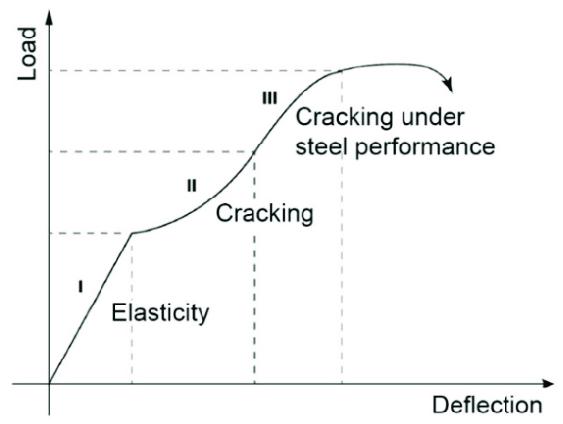
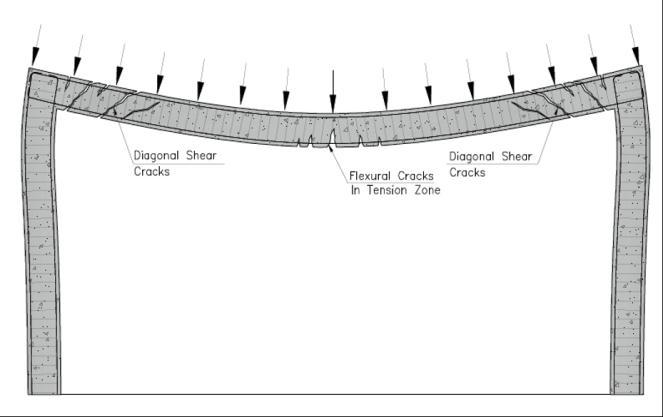
Crackcontrolinreinforcedconcretemembersisessentialto maintaindurabilityandaestheticperformance.Service-level tensilestressesinduceflexuralcracks,whosewidthdepends on reinforcement ratio, bar spacing, and concrete cover. Excessivecrackingcanacceleratereinforcementcorrosion. Eurocode 2, issued by European Committee for Standardization,specifiesmaximumallowablecrackwidths under service loads (EN 1992-1-1, 2004). Proper crack control ensures structural integrity without overconservativereinforcementprovision.
International Research Journal of Engineering and Technology (IRJET) e-ISSN: 2395-0056
Volume: 13 Issue: 03 | Mar 2026 www.irjet.net p-ISSN: 2395-0072
Although this review focuses on service loads, strength verificationremainsindirectlyrelevantbecauseservice-level performancemustnotcompromiseultimatecapacity.
4.2.1
Modern structural design adopts a limit state philosophy basedonloadandresistancefactordesign(LRFD).Service loadsarecombinedwithappropriatepartialsafetyfactorsto ensure reliability. The framework outlined in American SocietyofCivil Engineers(ASCE 7)differentiatesbetween service-level and strength-level load combinations (ASCE, 2022).Reliability-basedcalibrationofloadfactorsensures adequate safety margins while maintaining economic efficiency(NowakandCollins,2012).
4.2.2
Columnsandbeam-columnsinlow-risebuildingsfrequently experience combined axial load and bending. Interaction diagrams or equations are used to verify safety under combinedstressstates.Forsteelmembers,theinteraction provisionsinAmericanInstituteofSteelConstruction(AISC 360)accountforstabilityeffectsandsecond-orderbehavior (AISC,2016).Inreinforcedconcretecolumns,moment–axial force interaction curves ensure compatibility between serviceandultimateperformancedemands.
Long-termstructuralperformanceisstronglyinfluencedby time-dependent and environmental effects that manifest undersustainedserviceloading.
4.3.1
Fatigue refers to progressive material degradation under repeatedcyclicloading.Whilemorecriticalinbridgesand industrial structures, fatigue may influence steel framing elements subjected to repetitive occupancy or machinery loads.Fatigueevaluationmethodsconsiderstressrangeand
numberofcycles,asoutlinedin international steel design standards(Fisheretal.,1998).Inlow-risebuildings,fatigue generally remains within elastic limits but warrants assessmentinspecializedapplications.
In reinforced concrete members, creep and shrinkage significantly affect long-term deflection and stress redistribution. Sustained service loads increase curvature overtimeduetocreep,whileshrinkageinducesadditional tensile stresses and cracking. Predictive models incorporated in ACI and Eurocode provisions assist in estimating time-dependent deformations (Neville, 2011). Accurate consideration of these effects is essential for maintaining serviceability throughout the structure’s lifespan.
Corrosionofreinforcementorsteelmembersreducescrosssectionalareaandstiffness,therebyinfluencingservice-level performancebeforeultimatefailureoccurs.Environmental exposureconditions,crackwidth,andprotectivemeasures determine corrosion progression. Durability design recommendations in Bureau of Indian Standards (IS 456) emphasizecoverrequirementsandcrackwidthcontrol to mitigatecorrosion risks(BIS,2000).Preventivestrategies enhancestructurallongevityunderserviceconditions.
Comparative analysis of international codes reveals variationsinserviceabilitycriteriaandsafetyphilosophies. Indianstandards(IS456andIS800)adoptempiricalspanto-depth ratios and crack control guidelines. Eurocodes applypartialsafetyfactorsandexplicitdeformationchecks withinaunifiedlimitstateframework(EN1990,2002).ACI 318 emphasizes deflection multipliers and crack control reinforcement,whileASCE7providesloadcombinationsfor both service and strength levels. Differences arise in load factors, deflection limits, and vibration assessment procedures,reflectingregionalcalibrationtoenvironmental and construction practices. Such comparative evaluation highlights the need for harmonized performance-based approaches, particularly for low-rise buildings where serviceabilityoftengovernsdesigndecisions.
5.1
Reinforced concrete (RC) frames have been extensively investigated with respect to serviceability behaviour, particularlydeflectioncontrol,crackdevelopment,andlongterm deformation. The majority of studies indicate that serviceloadperformanceisstronglyinfluencedbymaterial nonlinearityandtime-dependenteffects,evenwhenstresses
International Research Journal of Engineering and Technology (IRJET) e-ISSN: 2395-0056
Volume: 13 Issue: 03 | Mar 2026 www.irjet.net p-ISSN: 2395-0072
remain within elastic limits (Nilson, Darwin and Dolan, 2010).
5.1.1
Experimental investigations on RC beams and frames typically involve simply supported or continuous beam specimenssubjectedtosustainedgravityloadingtosimulate serviceconditions.Instrumentationcommonlyincludesdial gaugesorLVDTsformid-spandeflectionmeasurementand crack-widthgaugesformonitoringflexuralcracking.Longtermtestsoftenincorporatesustainedloadapplicationover monthstoevaluatecreep-induceddeflectionamplification. Results consistently demonstrate that actual deflections frequentlyexceedshort-termelasticpredictionsduetocreep andtensionstiffeningdegradation(Branson,1977).Crack spacing and width are observed to correlate with reinforcement ratio and bar diameter, confirming the importance of reinforcement detailing in service performance.
5.1.2
Analyticalapproachesinitiallyreliedoneffectivemomentof inertia formulations to approximate cracked section stiffness. Subsequently, finite element modelling (FEM) techniques have enabled nonlinear material modelling, incorporatingconcretecracking,bond-slip behaviour,and time-dependentcreep–shrinkageeffects.Parametricstudies have examined span-to-depth ratios, reinforcement percentages,andloadingdurationtoquantifytheirimpact on serviceability. Advanced nonlinear simulations show improved accuracy in long-term deflection prediction compared to simplified code-based multipliers (Gilbert, 2010).
The literature indicates that reinforcement ratio, span-todepthratio,sustainedloadpercentage,andenvironmental exposure conditions are the dominant influencing parameters.Higherreinforcementratiosreducecrackwidth but may not proportionally decrease long-term deflection due to creep effects. Increasing span-to-depth ratio significantlyamplifiesservice-leveldeflection,particularlyin lightly reinforced slabs. Recent trends emphasize performance-based serviceability assessment integrating probabilistic approaches for more realistic prediction of long-termbehaviour(BažantandJirásek,2018).
Steelframesgenerallyexhibitlinearelasticbehaviourunder service loads, simplifying analytical prediction; however, vibrationsensitivityandstabilityremaincriticalconcernsin low-riseapplications.
Experimental research on steel beams and beam-columns under service-level loads primarily evaluates elastic deflection,lateral-torsionalbucklinginitiation,andvibration response.Laboratorytestingtypicallyemploysmonotonic loading within elastic limits, combined with dynamic excitation tests to determine natural frequencies and dampingratios.Observationsconfirmthatserviceabilityis rarelygovernedbyyielding butby excessivedeflection or perceptiblevibrationinlightweightfloorsystems(Trahairet al.,2008).
Analytical models for steel framing rely on elastic beam theorycombinedwithstabilitychecksforlocal andglobal buckling. Numerical approaches incorporate geometric nonlinearitytocapturesecond-order(P–Δ)effectsinslender columns. Vibration analyses are conducted using modal superpositionmethodsorfiniteelementeigenvalueanalysis to determine fundamental frequency limits for occupant comfort (Chen and Lui, 2005). These approaches enable accurate prediction of service-level deformation without resortingtocomplexmaterialmodels.
Composite systems combine structural steel beams with reinforced concrete slabs to enhance stiffness and loadcarryingcapacity.
Experimental studies demonstrate that shear connectors enable effective composite action, significantly reducing deflectioncomparedtonon-compositesteelbeams.Service loadtestingindicatesimprovedvibrationperformanceand crack control due to increased flexural rigidity (Johnson, 2018).
5.3.2
Finiteelementsimulationsofcompositebeamsincorporate slip modelling at the steel–concrete interface to assess partial interaction effects. Parametric analyses show that connectorspacing,slabthickness,andsteelbeamstiffness arecriticalvariablesaffectingserviceabilityresponse.Longterm performance models also integrate creep of the concrete slab, which may reduce composite stiffness over time.
Despite substantial research, limited long-term field monitoringdataareavailableforlow-risecompositeframes. Furthermore, probabilistic serviceability evaluation and sustainability-driven material optimization remain underexploredareas.
International Research Journal of Engineering and Technology (IRJET) e-ISSN: 2395-0056
Volume: 13 Issue: 03 | Mar 2026 www.irjet.net p-ISSN: 2395-0072
5.4.1 Overview of Literature
Timberframing,includingengineeredwoodproductssuch as glulam and CLT, has gained prominence in sustainable low-rise construction. Research primarily focuses on serviceabilityduetolowermodulusofelasticityrelativeto steelandconcrete(GereandGoodno,2012).
5.4.2 Serviceability Evaluations
Studiesemphasizecreepdeformationundersustainedloads, moisture-induced dimensional changes, and vibration performance of lightweight timber floors. Experimental testing reveals that long-term creep coefficients in timber maysignificantlyinfluencedeflectionbeyondinitialelastic predictions. Dynamic analyses indicate that timber floors requirefrequencycheckstosatisfycomfortcriteria.
5.4.3 Identified Challenges
Majorchallengesincludevariabilityinmaterialproperties, moisturesensitivity,andlimitedpredictivemodelsforlongtermserviceability.Standardizedperformanceassessment methodologiesarestillevolvingcomparedtoconcreteand steelsystems.
5.5 Comparative Synthesis
5.5.1 Cross-Material Performance Trends
Comparative evaluation across materials reveals that reinforcedconcreteframesareprimarilygovernedbycreepinduced deflection and crack control, steel systems by vibration and elastic deflection, composite systems by interface behaviour and long-term interaction effects, and timber systems by creep and moisture sensitivity. Serviceability often governs design in low-rise buildings irrespectiveofmaterialtype.
5.5.2 Synthesis Through Metrics and Meta-Analysis
Severalstudiescompiledeflectionratios,crackwidthlimits, andvibrationfrequencythresholdstocompareperformance benchmarks. Where meta-analytical data are available, pooled results indicate that span-to-depth ratio and stiffness-to-massratioareuniversalparametersinfluencing service-level response across material systems. However, variability in testing conditions limits direct quantitative comparison, emphasizing the need for standardized evaluationframeworks.
6. CONCLUSION
Thisreviewcriticallysynthesizesexistingliteratureonthe performanceassessmentofstructuralframingelementsin low-rise buildings under service loads. The analysis demonstrates that serviceability limit states frequently
govern the design and long-term functionality of beams, slabs, columns, shear walls, and connections across reinforcedconcrete,structuralsteel,composite,andtimber systems. Reinforced concrete frames are predominantly influenced by creep, shrinkage, and cracking behaviour, whichsignificantlyaffectlong-termdeflectionpredictions. Steel framing systems generally satisfy strength requirementsunderserviceloadsbutareoftencontrolledby vibration performance and elastic deflection limits. Compositesystemsexhibitenhancedstiffnessandimproved serviceperformance;however,long-terminteractioneffects and partial shear connection behaviour remain important considerations.Timberandengineeredwoodframes,while sustainableandefficientforlow-riseconstruction,require rigorous evaluation of creep deformation and vibration sensitivity.
Across material systems, span-to-depth ratio, stiffness characteristics,reinforcementdetailing,andsustainedload levelsemergeasdominantparametersinfluencingservicelevelperformance.Comparativeevaluationofinternational standards reveals variations in deflection limits, crack control provisions, and load combination philosophies, highlighting the need for harmonized performance-based frameworks.Although analytical andnumerical modelling techniques have advanced considerably, discrepancies remain between simplified code-based predictions and observed long-term behaviour. Overall, this review underscores the importance of integrating experimental evidence, refined modelling approaches, and durability considerationstoensurereliableserviceloadperformance inlow-risestructuralsystems.
This review is limited to published peer-reviewed studies and standard design provisions, potentially excluding relevantindustry reportsor unpublished fieldmonitoring data.Theanalysisemphasizesservice-levelbehaviourand doesnotextensivelyaddressultimatelimitstateinteractions unless directly related to serviceability. Variability in experimental setups, material properties, environmental conditions, and analytical assumptions across studies restrictsdirectquantitativecomparison.Furthermore,metaanalytical statistical synthesis was constrained by inconsistent reporting of performance metrics in the reviewedliterature.
1. ACI(2019)BuildingCodeRequirementsforStructural Concrete(ACI318-19).FarmingtonHills,MI:American ConcreteInstitute.
2. AISC(2016)SpecificationforStructuralSteelBuildings (AISC360-16).Chicago,IL:AmericanInstituteofSteel Construction.
International Research Journal of Engineering and Technology (IRJET) e-ISSN: 2395-0056
Volume: 13 Issue: 03 | Mar 2026 www.irjet.net p-ISSN: 2395-0072
3. ASCE (2022) Minimum Design Loads and Associated CriteriaforBuildingsandOtherStructures(ASCE7-22). Reston,VA:AmericanSocietyofCivilEngineers.
4. Bažant, Z.P. and Jirásek, M. (2018) Creep and Hygrothermal Effects in Concrete Structures. Dordrecht:Springer.
5. BIS (2000) IS 456: Plain and Reinforced Concrete –Code of Practice. New Delhi: Bureau of Indian Standards.
6. Branson, D.E. (1977) ‘Deformation of concrete structures’,JournaloftheStructuralDivision,103(9), pp.1835–1851.
7. Chen,W.F.andLui,E.M.(2005)StabilityDesignofSteel Frames.BocaRaton,FL:CRCPress.
8. Denyer, D. and Tranfield, D. (2009) ‘Producing a systematicreview’,inBuchanan, D.A.andBryman,A. (eds.)TheSageHandbookofOrganizationalResearch Methods.London:Sage,pp.671–689.
9. EN1990(2002)Eurocode:BasisofStructuralDesign. Brussels:CEN.
10. EN1991-1-4(2005)Eurocode1:ActionsonStructures –WindActions.Brussels:CEN.
11. EN 1992-1-1 (2004) Eurocode 2: Design of Concrete Structures.Brussels:CEN.
12. EN1994-1-1(2004)Eurocode4:DesignofComposite SteelandConcreteStructures.Brussels:CEN.
13. Fisher, J.W., Kulak, G.L. and Smith, I.F.C. (1998) A FatiguePrimerforStructuralEngineers.Washington, DC:NationalSteelBridgeAlliance.
14. Gere, J.M. and Goodno, B.J. (2012) Mechanics of Materials.8thedn.Stamford,CT:CengageLearning.
15. Gilbert, R.I. (2010) ‘Time-dependent deflection of reinforced concrete slabs’, Journal of Structural Engineering,136(9),pp.1095–1103.
16. Johnson,R.P.(2018)CompositeStructuresofSteeland Concrete.4thedn.Oxford:Wiley-Blackwell.
17. Kitchenham,B.andCharters,S.(2007)Guidelinesfor PerformingSystematicLiteratureReviewsinSoftware Engineering.EBSETechnicalReport.
18. MacGregor, J.G. and Wight, J.K. (2012) Reinforced Concrete:MechanicsandDesign.6thedn.Boston,MA: Pearson.
19. Murray,T.M.,Allen,D.E.andUngar,E.E.(2016)Floor VibrationsDuetoHumanActivity.AISCDesignGuide
11. Chicago, IL: American Institute of Steel Construction.
20. Neville, A.M. (2011) Properties of Concrete. 5th edn. Harlow:PearsonEducation.
21. Nilson,A.H.,Darwin,D.andDolan,C.W.(2010)Design ofConcreteStructures.14thedn.NewYork:McGrawHill.
22. Nowak, A.S. and Collins, K.R. (2012) Reliability of Structures.2ndedn.BocaRaton,FL:CRCPress.
23. Segui,W.T.(2013)SteelDesign.5thedn.Stamford,CT: CengageLearning.
24. Snyder, H. (2019) ‘Literature review as a research methodology:Anoverviewandguidelines’,Journalof BusinessResearch,104,pp.333–339.
25. Trahair, N.S., Bradford, M.A., Nethercot, D.A. and Gardner,L.(2008)TheBehaviourandDesignofSteel StructurestoEC3.4thedn.London:Taylor&Francis.
26. Tranfield,D.,Denyer,D.andSmart,P.(2003)‘Towards a methodology for developing evidence-informed management knowledge by means of systematic review’,BritishJournalofManagement,14(3),pp.207–222.
27. Performance-basedslendernesslimitsfordeformations and crack control of reinforced concrete flexural members,Eng.Struct.,187,pp.267–279.
28. Xie,W.(2024)StructuralVibrationComfort:AReview ofRecentDevelopments,Buildings,14(6),1592.
29. On the Reliability of Serviceability Calculations for Flexural Cracked Reinforced Concrete Beams, Structures,13,pp.201–212.
30. Honfi, D. (2013) Design for Serviceability – A probabilisticapproach.
31. StructuralandServicePerformanceofCompositeSlabs withHighRecycledAggregateConcreteContents,Eng. Sci.,27,1021.
32. Shrinkage,CrackingandDeflection-TheServiceability ofConcreteStructures,Proc.Eng.(overview).
33. Cheraghi-Shirazi,N.etal.(2022)ReviewofVibration Assessment Methods for Steel–Timber Composite Floors,Buildings,12(12),2061.
34. Vibrationserviceabilityevaluationoflightweightcoldformed steel floor systems, Structures, 38, pp.1368–1379.
International Research Journal of Engineering and Technology (IRJET) e-ISSN: 2395-0056
Volume: 13 Issue: 03 | Mar 2026 www.irjet.net p-ISSN: 2395-0072
35. Vibration serviceability of lightweight steel modular floors:Experimentaltestandassessment,Eng.Struct., 343,121253.
36. Aloisio, A. et al. (2023) Vibration issues in timber structures:Astate-of-the-artreview,Structures.
37. Eldeib, M. et al. (2025) Structural behaviour of steeltimbercompositeelements:anoverview,Low-carbon MaterialsandGreenConstruction,3:4.
38. Otero-Chans, D. et al. (2025) Experimental and numerical analysis of a full-scale timber-concrete compositebeam,arXiv.
39. Assessmentofcracking,creepandshrinkageeffectsin indeterminate steel-concrete composite flexural membersatserviceload,Structures,70,107663.
40. Serviceability failure, Wikipedia (general review of serviceabilitylimitstateconcepts).
41. Serviceability (structure), Wikipedia (definitions of serviceabilitycriteria).
42. Serviceability criteria for buildings(SR014),Building ResearchAssociation(guidefordeflectionlimits).
43. InternationalIRJET(2023)Limitstateofserviceability overview.
44. Limit State of Serviceability design, Study Material notes.
45. Serviceabilitylimitstatedesignofunbracedsemi-rigid steelframes,TheStructuralEngineer,89(19).
46. Studyonshrinkage,crackinganddeflectionmodelling for concrete members, Aust. J. Struct. Eng. (related overview).
47. Serviceabilitytargetreliabilityforconcretestructures, Struct.Reliability,2024.
48. StudyoncrackbehaviourinRCbeams:Experimental updates,Appl.Sci.(MDPIarticle).