
International Research Journal of Engineering and Technology (IRJET) e-ISSN: 2395-0056
Volume: 13 Issue: 02 | Feb 2026 www.irjet.net p-ISSN: 2395-0072
A REVIEW OF PARAMETRIC STUDY ON THE EFFECT OF BUILDING PLAN GEOMETRY ON DYNAMIC RESPONSE OF RC STRUCTURES MODELED IN ETABS
Tarun Kumar Chauhan1 , Mr. Ushendra Kumar2
1Master of Technology, Civil Engineering, Lucknow Institute of Technology, Lucknow, India
2Head of Department, Department of Civil Engineering, Lucknow Institute of Technology, Lucknow, India
Abstract -The dynamicresponseofreinforcedconcrete(RC) buildings is significantly influenced by plan geometry, particularly under seismicexcitation. Variations ingeometric configuration alter stiffness distribution, mass eccentricity, torsional behavior, and modal characteristics, thereby affecting overall structural performance. In recent years, parametric studies using ETABS have become a dominant approach for evaluatingthe influence ofplanirregularitieson dynamic behavior. This review critically synthesizes existing research on the effect of building plan geometry including regular and irregular configurations, aspect ratio variations, re-entrant corners, setbacks, andplandiscontinuities onkey dynamic response parameters such as natural period, mode shapes, base shear, story displacement, inter-storey drift, and torsional irregularity.
The paper systematically categorizes prior studies based on geometrytype,modelingassumptions,seismicanalysismethod (response spectrum and time-history analysis), and reported performance indicators. Trends across the literature indicate that plan irregularities consistently amplify torsional effects and drift concentration, while aspect ratio variations significantly modify fundamental time periods and mode participation factors. However, inconsistencies arise due to differences in seismic codes, modeling strategies, and boundary conditions.
This reviewidentifies criticalresearchgaps,includingtheneed for standardized parametric frameworks and integration of soil–structure interaction effects. The findings provide a consolidated reference for researchers and practicing engineers engaged inseismicanalysisanddesignoptimization of RC structures.
Key Words: Building Plan Geometry, Dynamic Response, Reinforced Concrete Structures, ETABS Modeling, Seismic Analysis, Parametric Study
1. INTRODUCTION
1.1 Background of RC Structural Analysis in Earthquake Engineering
Reinforced concrete (RC) structures constitute a major proportionofurbanbuildingstockworldwideduetotheir durability, constructability, and economic efficiency. In
seismic regions, the structural safety of RC buildings is governed by their ability to dissipate energy through controlled inelastic behavior while maintaining overall stability. Classical earthquake engineering principles establish that structural response depends primarily on mass distribution, stiffness characteristics, damping properties, and the dynamic properties of ground motion (Chopra, 2017). Modern seismic codes such as Bureau of IndianStandardsthroughIS1893(BIS,2016)andguidelines from American Society of Civil Engineers (ASCE 7-16) emphasizedynamicanalysisformulti-storeyRCbuildings, particularlywhenirregularitiesarepresent.
Advances in finite element modelling have significantly enhanced the precision of structural analysis. Software platformssuchasETABSallowdetailedmodellingofthreedimensional RC frames, incorporating nonlinear material behavior,modalanalysis,responsespectrumanalysis,and time-history analysis. As a result, parametric studies evaluating seismic performance under varying geometric configurationshavebecomeincreasinglyprevalent.
1.2 Importance of Dynamic Response Evaluation
Dynamic response evaluation is central to seismic performance assessment because earthquake loads are inertia-driven and time-dependent. Unlike static gravity loads, seismic forces arise from structural acceleration, which is directly related to mass and modal properties (Clough and Penzien, 2003). Parameters such as natural period,modeshapes,modalparticipationfactors,baseshear, andinter-storeydriftdeterminewhetherastructuremeets serviceabilityandultimatelimitstatecriteria.
Irregular distributions of stiffness and mass alter modal coupling and torsional amplification, leading to localized driftconcentrationsandpotentialsoft-storeymechanisms (PaulayandPriestley,1992).Researchconsistentlyshows that even moderate plan asymmetry can significantly increasetorsionaldemands,therebyaffectingcolumnshear forcesandbeam–columnjointbehavior(TsoandMoghadam, 1998).Therefore,dynamicanalysisisindispensablewhen investigating the influence of geometric variations in RC buildings.
International Research Journal of Engineering and Technology (IRJET) e-ISSN: 2395-0056
Volume: 13 Issue: 02 | Feb 2026 www.irjet.net p-ISSN: 2395-0072
1.3 Relevance of Plan Geometry in Structural Behavior
1.3.1 Regularity and
Symmetry
Plan geometry directly governs the spatial distribution of stiffness and mass. Regular and symmetric plans typically exhibit uniform lateral load distribution and predictable modalbehavior.Incontrast,asymmetricorirregularplans introduceeccentricitybetweenthecenterofmassandcenter of rigidity, generating torsional response under seismic excitation (Chopra, 2017). Codes such as IS 1893 classify suchconfigurationsastorsionallyirregularwhenspecified driftlimitsareexceeded(BIS,2016).
1.3.2
Aspect Ratio and Plan Dimensions
Theratioofplanlengthtowidthsignificantlyaffectslateral stiffnessinorthogonaldirections.Buildingswithelongated plans often display distinct modal participation in longitudinalandtransversedirections,alteringfundamental periodsandresponsespectrumdemand(GoelandChopra, 1997). Parametric investigations indicate that increasing aspect ratio may amplify displacement demand in the weakerdirectionduetoreducedlateralstiffness.
1.3.3
Torsional Irregularity, Setbacks, and Openings
Re-entrantcorners,setbacks,andlargeplanopeningscreate stress concentration zones and discontinuities in load transferpaths.Thesegeometricfeaturesintensifytorsional effectsandmodifydynamiccharacteristics(Moehle,2014). Verticalsetbackscanfurtherintroducestiffnessirregularity across storeys, influencing higher-mode participation and driftdistributionpatterns.
1.4 Motivation for the Review
Although numerous parametric studies have examined geometricirregularitiesinRCbuildings,thefindingsremain fragmented.Differencesinmodelingassumptions,seismic inputselection,dampingratios,andcodeprovisionsoften yield inconsistent conclusions regarding the magnitude of dynamic amplification. Some studies emphasize the dominanceoftorsionalresponse,whileothershighlightdrift concentration or base shear variation as the primary concern.
Moreover, comparative synthesis across different plan configurations such as rectangular, L-shaped, T-shaped, and U-shaped buildings has not been systematically consolidated. A comprehensive review is therefore necessary to integrate existing findings, identify methodologicallimitations,andclarifyconsensustrendsin theliterature.
1.5 Objective and Scope of the Review
The primary objective of this review is to critically synthesize parametric studies investigating the effect of building plan geometry on the dynamic response of RC structures.Thereviewfocusesonkeygeometricparameters includingplanregularity,aspectratio,torsionalirregularity, re-entrant corners, vertical setbacks, and plan discontinuitiessuchasopenings.
The scope is restricted to numerical studies that evaluate seismicresponsemetricssuchasnaturalperiod,baseshear, storey displacement, inter-storey drift, and torsional response parameters. Emphasis is placed on multi-storey framedRCbuildingsanalyzedunderresponsespectrumand time-history methods consistent with prevailing seismic codes.
1.6 Rationale for Focusing on Studies Using ETABS
The selection of ETABS as a focal modelling platform is justified by its widespread acceptance in both academic research and professional practice. Developed specifically for building systems, ETABS integrates three-dimensional modelling, dynamic analysis capabilities, code-based load generation,anddetailedoutputinterpretation.Itsabilityto simulate modal participation, diaphragm behavior, and accidental eccentricity makes it particularly suitable for parametricevaluationofplanirregularities.
Furthermore, a significant proportion of published parametric studies on RC buildings employ ETABS as the primary analysis tool, enabling meaningful comparison of modelling approaches and outcomes. Concentrating on ETABS-based studies enhances consistency in methodologicalevaluationandfacilitatesclearersynthesisof trendsacrosstheliterature.
2. REVIEW METHODOLOGY
A rigorous and transparent methodology is essential in review-basedresearchtoensurereproducibility,minimize selectionbias,andenhanceacademiccredibility.Thepresent review adopts a structured literature survey approach consistentwithsystematicreviewprinciplescommonlyused in engineering research. The procedure includes database searching, screening based on predefined criteria, and thematic categorization of relevant studies. The methodological framework is informed by established review protocols emphasizing clarity in identification, screening, eligibility, and inclusion stages (Kitchenham, 2004;Tranfield,DenyerandSmart,2003).
2.1 Search Strategy
2.1.1
Databases Consulted
The literature survey was conducted using major indexed academic databases to ensure quality and reliability of
International Research Journal of Engineering and Technology (IRJET) e-ISSN: 2395-0056
Volume: 13 Issue: 02 | Feb 2026 www.irjet.net p-ISSN: 2395-0072
sources. The primary databases included Scopus, Web of Science,andGoogleScholar.Theseplatformswereselected duetotheirextensivecoverageofpeer-reviewedjournalsin structural engineering, earthquake engineering, and computationalmodelling.
Scopus and Web of Science were prioritized for sourcing high-impactSCI/SCIE-indexedjournalarticles,whileGoogle Scholar was used as a supplementary tool to identify conference papers and citation trails that supported thematiccontinuity.
2.1.2 Keywords and Boolean Combinations
Searchstringswereformulatedtocapturestudiesfocusing on geometric irregularities and dynamic response of RC buildings. Core keywords included: “building plan geometry”, “RC structures”, “dynamic response”, “seismic analysis”,“parametricstudy”,and“ETABSmodelling”.
Booleanoperators(AND,OR)weresystematicallyappliedto refinesearchoutputs.Forexample:
“RCbuildings”AND“planirregularity”AND“dynamic analysis”
“ETABS” AND “parametric study” AND “seismic response”
“aspect ratio” OR “torsional irregularity” AND “reinforcedconcrete”
Thisstructuredsearchensuredcomprehensiveretrievalof relevant studies while limiting unrelated structural modellingresearch.
2.2 Inclusion and Exclusion Criteria
2.2.1
Time Frame and Publication Quality
To capture contemporary analytical practices and codebased design evolution, the review considered studies publishedbetween2000and2025.Thistimeframereflects theperiodduringwhichadvancedfiniteelementsoftware andmodernseismiccodesbecamewidelyadopted.
Only peer-reviewed journal articles indexed in SCI/SCIE databases were included to ensure methodological robustness and academic credibility. Conference papers were considered selectively when they provided foundationalorwidelycitedcontributions.
2.2.2
Study Type and Analytical Scope
The review included studies that performed parametric investigations of building plan geometry using numerical modelling techniques, particularly finite element-based software such as ETABS. Research addressing response spectrum analysis, time-history analysis, or ambient vibrationanalysisofmulti-storeyRCbuildingswasretained.
Studieswereexcludedifthey:
Focused solely on material-level behaviour without globaldynamicanalysis,
Examinednon-RCstructuralsystemsexclusively(e.g., steel-onlysystems),
Didnotevaluategeometricparametersexplicitly,or
Provided purely theoretical derivations without modellingvalidation.
These criteria ensured thematic consistency with the objectivesofthereview.
2.3 Data Extraction and Categorization
Following screening, relevant studies were systematically analysedandcategorizedtoenablecomparativesynthesis.
2.3.1 Type of Study
Each article was classified as numerical, experimental, or hybrid(combinedanalytical–experimental).Themajorityof studies employed three-dimensional finite element modelling, reflecting the dominance of computational parametric research in this domain. Experimental investigationswerecomparativelylimitedduetopractical constraintsinfull-scaleseismictesting.
2.3.2 Building Typology
Studieswerefurthercategorizedbasedonstructuralheight classification:
Low-rise(1–5storeys)
Mid-rise(6–15storeys)
High-rise(>15storeys)
Buildingheightinfluencesmodalparticipationandhighermode effects, making typology classification essential for interpretingdynamicresponsevariations(Chopra,2017).
2.3.3
Plan Geometry Parameters Evaluated
The extracted data included the type of geometric irregularityassessed,suchas:
Symmetricvsasymmetricplans
L-,T-,U-,andH-shapedconfigurations
Aspectratiovariations
Re-entrantcorners
Setbacksandplandiscontinuities
International Research Journal of Engineering and Technology (IRJET) e-ISSN: 2395-0056
Volume: 13 Issue: 02 | Feb 2026 www.irjet.net p-ISSN: 2395-0072
Presenceofopenings
This categorization enabled comparative mapping of geometry-specific effects on natural period, base shear, storeydrift,andtorsionalresponse.
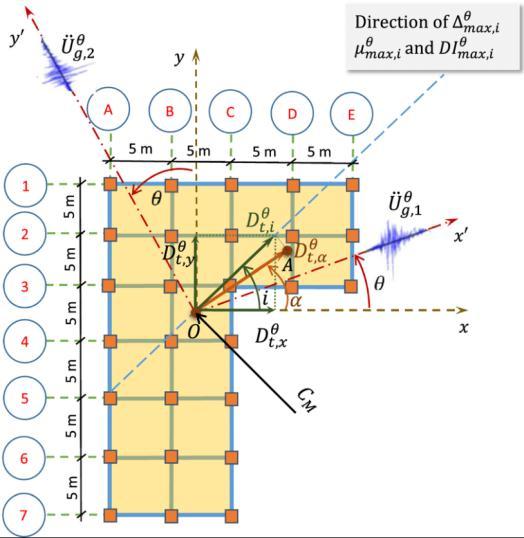
Figure-1: Re-entrant corners
2.3.4 Seismic Codes and Ground Motion Inputs
Thereviewalsodocumentedtheseismiccodesreferenced (e.g.,IS1893,ASCE7,Eurocode8)andthetypeofground motion input adopted (design response spectrum or recordedaccelerograms).Variationsincodeprovisionsand damping assumptions significantly influence reported response parameters, necessitating explicit classification duringsynthesis(PaulayandPriestley,1992).
3. FUNDAMENTAL CONCEPTS
Thissectionoutlinesthetheoreticalfoundationsnecessary to understand how building plan geometry influences the dynamicbehaviourofreinforcedconcrete(RC)structures. The discussion is limited to established principles in structural dynamics and seismic analysis, without introducingoriginalanalyticalresults.
3.1 Dynamic Response of RC Structures
The seismic behaviour of RC buildings is fundamentally governed by structural dynamics. When subjected to earthquake excitation, inertia forces are generated due to groundacceleration,andtheresultingstructuralresponse dependsonmass,stiffness,anddampingcharacteristics.The dynamicequilibriumofamulti-degree-of-freedom(MDOF) system can be expressed through matrix formulations involving mass, damping, and stiffness matrices, which collectivelydefinemodalcharacteristics(Chopra,2017).
3.1.1 Natural Frequencies and Mode Shapes
Natural frequencies represent the inherent vibration characteristics of a structure when disturbed from equilibrium.Eachfrequencycorrespondstoaspecificmode shapethatdescribesdeformationpatterns.Inmulti-storey RCbuildings,thefirstfewmodestypicallydominateseismic response, particularly in regular structures. However, irregularplanconfigurationsmayactivatetorsionalmodes and higher-mode participation, significantly altering displacement and drift distribution (Clough and Penzien, 2003).
Thefundamentaltimeperiod,whichistheinverseofthefirst naturalfrequency,isparticularlyimportantbecauseseismic demand from response spectra is strongly perioddependent.Variationsinstiffnessandmassdistribution oftencausedbygeometricirregularities directlyinfluence modalproperties.
3.1.2 Response Spectrum and Time-History Analysis
Responsespectrumanalysisisalineardynamicprocedure widely adopted in seismic design. It estimates peak structural responses by combining modal contributions usingpredefineddesignspectraderivedfromseismiccodes. This method is computationally efficient and suitable for parametric studies of multiple geometric configurations (Moehle,2014).
Time-history analysis, in contrast, involves step-by-step integration of the dynamic equilibrium equation under recordedorsimulatedgroundmotions.Itcapturestemporal variations in response and is capable of representing nonlinear behaviour when required. Although computationallymoreintensive,itprovidesdetailedinsight into torsional amplification and higher-mode effects in irregularbuildings.
3.2 Building Plan Geometry Characteristics
Buildingplangeometrysignificantlyinfluenceslateralloadresisting behaviour by modifying stiffness and mass distribution across the structure. Geometric configuration determines how seismic forces are transferred through beams,columns,anddiaphragmstothefoundation.
3.2.1 Regular versus Irregular Configurations
Abuildingisconsideredplan-regularwhenitsstiffnessand massaresymmetricallydistributed,minimizingeccentricity betweenthecentreofmassandcentreofrigidity.Seismic design codes define torsional irregularity based on drift ratios and eccentricity limits; for instance, IS 1893 (BIS, 2016) specifies threshold values for identifying irregular configurations.
Irregularbuildings,suchasL-shaped,T-shaped,orU-shaped plans, exhibit inherent eccentricity that induces torsional
International Research Journal of Engineering and Technology (IRJET) e-ISSN: 2395-0056
Volume: 13 Issue: 02 | Feb 2026 www.irjet.net p-ISSN: 2395-0072
momentsduringseismicexcitation.Thesetorsionaleffects increase lateral displacement demand in peripheral elementsandmayleadtostressconcentration.
3.2.2
Geometric Parameters
Several geometric parameters are critical in evaluating dynamicresponse:
Aspect Ratio: The ratio of plan length to width affects directional stiffness. Elongated buildings tend to have differing fundamental periods in orthogonal directions, influencingmodaldominance.
Symmetry: Symmetriclayoutsgenerallyproduceuniform driftpatterns,whileasymmetriclayoutsamplifytorsion.
Openings: Largeflooropeningsoratriumsalterdiaphragm stiffnessandmodifyloadpaths.
Setbacks: Suddenreductionsinplanareaathigherstoreys createstiffnessdiscontinuities.
Re-entrant Corners: Sharp internal corners concentrate stressesandinducelocalizedtorsionaleffects.
Thesefeaturescollectivelymodifyglobalstiffnessmatrices and mass eccentricity, directly influencing modal characteristicsandseismicresponse(PaulayandPriestley, 1992).
3.2.3
Influence on Stiffness and Mass Distribution
Planirregularitiesalterthedistributionoflateralstiffness among structural elements. When stiffness is unevenly distributed,thecentreofrigidityshiftsrelativetothecentre of mass, generating accidental or inherent torsion. This imbalance increases rotation about the vertical axis and causesdifferentialdisplacementacrossthefloordiaphragm. Consequently,structuralmemberslocatedatextremeedges experience amplified forces and drift demands. Such redistributioneffectsareespeciallycriticalinmulti-storey RC frames where diaphragm rigidity assumptions significantlyinfluencedynamicbehaviour.
3.3 Modelling RC Structures in ETABS
Finiteelementmodellingplaysacentralroleinevaluating the dynamic characteristics of RC buildings. ETABS is a widely adopted structural analysis platform specifically developed for building systems. It integrates modelling, analysis, and design functionalities within a unified environment, enabling efficient simulation of multi-storey RCframes.
3.3.1 ETABS Capabilities in Dynamic Analysis
ETABS facilitates three-dimensional modelling of beams, columns,slabs,shearwalls,anddiaphragms.Itautomatically generates mass matrices based on assigned loads and
materialproperties,allowingaccuratecomputationofmodal properties. The software also incorporates code-based seismic load definitions, damping assumptions, and accidentaleccentricityconsiderations.
Its parametric modelling flexibility makes it particularly suitablefor evaluating multipleplan configurationsunder identical loading conditions, thereby supporting comparativestudiesofgeometricvariations.
3.3.2 Modal, Response Spectrum, and Time-History Procedures
ETABSperformseigenvalue analysistodetermine natural frequencies and mode shapes. Modal participation factors andcumulativemassparticipationratiosareautomatically calculated,enablingverificationofdynamiccompleteness.
For response spectrum analysis, ETABS applies modal superposition methods such as SRSS and CQC to combine modaleffects.Intime-historyanalysis,thesoftwareconducts directintegrationusinguser-definedgroundmotionrecords. Thesecapabilitiesallowdetailedevaluationofdisplacement, drift, base shear, torsional response, and storey forces, makingETABSapreferredtoolforparametricinvestigation ofplangeometryeffects.
4. LITERATURE REVIEW
Thissectionsynthesizespriorresearchontheinfluenceof building plan geometry on the dynamic response of reinforcedconcrete(RC)structures.Thereviewisorganized thematically to enable systematic comparison of findings across different geometric parameters and modelling approaches.
4.1 Early Studies on Geometry and Dynamic Behaviour
4.1.1 Pioneering Work and Foundational Concepts
Early investigations into the seismic behaviour of asymmetric and irregular buildings established the theoretical link between plan geometry and torsional response.Analyticalstudiesdemonstratedthateccentricity betweenthecentreof massandcentreof rigidityleads to coupled translational–torsional vibration modes, significantly increasing edge displacements (Tso and Moghadam, 1998). These foundational works emphasized thatevenslightplanasymmetrycanamplifyseismicdemand beyondthatpredictedbysimplifiedstaticmethods.
Subsequent analytical research incorporated modal superpositiontechniquestoquantifydynamicamplification in multi-storey frames, highlighting the importance of higher-modeeffectsinirregularbuildings(GoelandChopra, 1997).
4.1.2
International Research Journal of Engineering and Technology (IRJET) e-ISSN: 2395-0056
Volume: 13 Issue: 02 | Feb 2026 www.irjet.net p-ISSN: 2395-0072
Key Findings and Limitations
While early studies established conceptual clarity, many reliedonsimplifiedlumped-massmodelsandlinearelastic assumptions. Material nonlinearity, diaphragm flexibility, andsoil–structureinteractionwereoftenneglected.
4.2 Plan Regularity versus Irregularity
4.2.1
Regular Geometry Studies
Researchonregularrectangularbuildingsgenerallyreports predictable modal participation and uniform drift distribution. The fundamental mode often dominates response,withminimaltorsionalcouplingundersymmetric loading. Such configurations are frequently used as benchmark models for comparison against irregular geometries(Chopra,2017).
These studies provide baseline dynamic characteristics, enablingquantificationofamplificationeffectsintroducedby irregularplans.
4.2.2
Irregular Plan Geometries
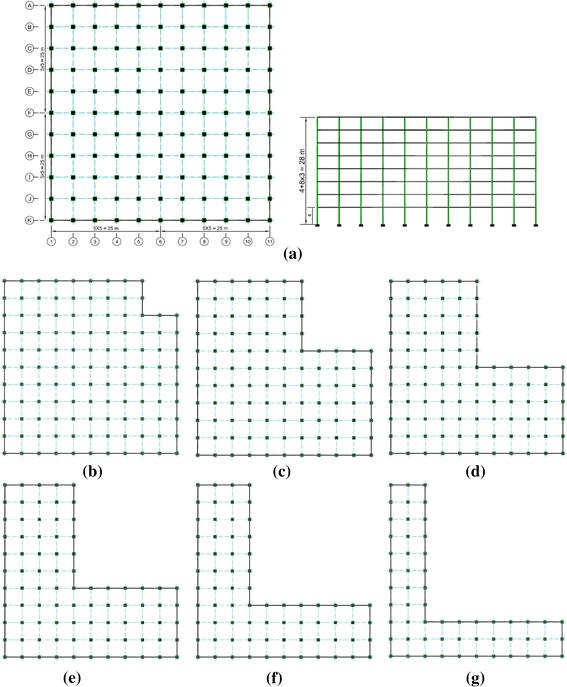
Irregular plan configurations including L-, T-, U-, and Hshapedlayouts havebeenwidelyexaminedinparametric analyses. Studies consistently indicate increased torsional rotation, drift concentration at re-entrant corners, and uneven force distribution across columns (Moehle, 2014). Offsets and plan asymmetry shift the centre of rigidity, generatingamplifiedshearforcesatextremeedges.
Re-entrantcorners,inparticular,createstressconcentration zones and discontinuities in load paths. Comparative simulationsreveal thatsuchbuildingsoften exhibitlarger inter-storey drifts than their regular counterparts under identicalseismicinput.
4.2.3 Summary Comparisons
Across multiple investigations, irregular buildings demonstrate greater dynamic amplification factors and higher torsional irregularity indices than regular configurations. However, the magnitude of amplification varies depending on stiffness modelling assumptions, diaphragmrigidity,andselectedseismicspectra.
4.3 Influence of Aspect Ratio and Mass Distribution
4.3.1
Studies Investigating Length-to-Width (l/b) Effects
The aspect ratio (length-to-width ratio) significantly influencesdirectionalstiffness.Parametricstudiesvarying l/b ratios show that elongated buildings tend to exhibit increasedflexibilityalongtheweakeraxis,resultinginlarger lateral displacements and altered modal participation patterns(ReddyandJangid,2012).
Changes in plan proportions also affect base shear distribution, particularly when mass irregularities are present.
4.3.2
Mode Shape Changes and Fundamental Period Shifts
Increasingaspectratiogenerallylengthensthefundamental period in the weaker direction due to reduced lateral stiffness.Thisshiftmaymovethestructureclosertopeak spectral acceleration regions, thereby increasing seismic demand. Several studies report higher participation of torsional and higher modes in buildings with significant masseccentricity,indicatingcomplexmodalcouplingeffects.
4.4 Effect of Openings and Plan Discontinuities
4.4.1
Large Openings and Courtyard Effects
Large floor openings, atriums, and courtyard-type configurationsalterdiaphragmactionandreducein-plane stiffness.Analyticalmodelsindicatethatdiscontinuitiesin slab geometry can modify lateral load paths and increase torsionalsensitivity(PaulayandPriestley,1992).
Courtyard buildings often behave similarly to re-entrant cornerstructures,exhibitingstressconcentrationatinternal edgesandincreasedrotationaldemand.
4.4.2
Influence on Stiffness and Torsion
Reductionindiaphragmstiffnessduetoopeningscanshift thecentreofrigidity,intensifyingaccidentaltorsion.Studies showthatpartialdiaphragmflexibilityincreasesdifferential displacementacrossfloorlevels,especiallyinmid-tohighriseRCframes.
International Research Journal of Engineering and Technology (IRJET) e-ISSN: 2395-0056
Volume: 13 Issue: 02 | Feb 2026 www.irjet.net p-ISSN: 2395-0072
4.5 Setbacks and Vertical Irregularities
4.5.1 Plan Setbacks at Multiple Levels
Vertical geometric irregularities such as setbacks create abruptchangesinstiffnessandmassdistributionalongthe buildingheight.Researchindicatesthatthesediscontinuities modify mode shapes and introduce localized drift concentrationnearsetbacklevels(KhanandParvez,2014).
Multi-level setbacks often activate higher-mode effects, increasingsheardemandinintermediatestoreys.
4.5.2 Impact on Dynamic Amplification and Mode Coupling
Setbackbuildingsexhibitsignificantmodecouplingdueto non-uniform stiffness distribution. Dynamic amplification factors in such configurations are typically greater than those in uniform-height structures. Numerical analyses revealincreasedsensitivitytogroundmotioncharacteristics, particularlynearresonanceconditions.
4.6 Seismic Response Metrics Reported
4.6.1 Natural Period Shifts
Manystudiesevaluatechangesinfundamentalperiodasa primaryindicatorofgeometricinfluence.Planirregularity generally increases flexibility, leading to longer periods comparedwithregularbenchmarks.
4.6.2 Base Shear and Drift Parameters
Baseshear,storeydisplacement,andinter-storeydriftare themostcommonlyreportedresponseparameters.Irregular buildings frequently show uneven drift distribution, with maximumvaluesconcentratedatcornersordiscontinuity zones(Chopra,2017).
4.6.3 Torsional Response
Measures
Torsionalirregularityratios,edgedisplacementdifferences, androtationalmodeparticipationareoftenusedtoquantify torsional effects. Comparative findings consistently demonstratethatasymmetricplansproducehighertorsional amplificationthansymmetriclayouts.
4.7 Parametric Techniques and Sensitivity Analysis
4.7.1 Approaches Used
Parametricstudiescommonlyvaryonegeometricparameter while holding others constant. Some researchers employ DesignofExperiments(DOE)frameworkstosystematically exploremulti-parameterinteractions.Sensitivityplotsand regression-basedmodelsareoccasionallyusedtoestablish correlations between geometry and response metrics (Montgomery,2017).
4.7.2
Common Findings
Sensitivityanalysesgenerallyidentifytorsionaleccentricity and aspect ratio as dominant contributors to drift amplification. However, the relative influence of each parameter depends on building height and stiffness configuration.
4.8 Trends in Modelling Practices
4.8.1
Static versus Dynamic Analysis Preferences
Earlier investigations often relied on equivalent static methods for simplicity. However, contemporary research predominantly adopts response spectrum or time-history analysis due to the complex modal behaviour of irregular buildings.Dynamicanalysisiswidelyrecognizedasessential for capturing torsional coupling and higher-mode effects (CloughandPenzien,2003).
6.8.2
Use of ETABS Modelling Features
Recent studies frequently employ ETABS for threedimensional modelling. Common modelling assumptions include rigid diaphragm constraints, lumped mass representation at floor levels, and code-based damping ratios. Mesh density in slab modelling and accidental eccentricityconsiderationsvaryacrossstudies,contributing todifferencesinreportedresults.
Overall, modelling sophistication has increased over time, yet standardization in parametric frameworks remains limited, reinforcing the need for consolidated review and methodologicalharmonization.
5. SYNTHESIS OF FINDINGS
This section integrates the reviewed literature to identify overarching patterns, inconsistencies, and methodological limitations in studies examining the influence of building plan geometry on the dynamic response of reinforced concrete(RC)structures.Ratherthanreiteratingindividual investigations, the discussion consolidates evidence into thematic conclusions relevant to seismic performance assessment.
5.1 Consensus in the Literature
5.1.1 Geometric Parameters
Consistently Affecting Dynamic Behaviour
Acrossthereviewedstudies,severalgeometricparameters emerge as consistently influential in modifying dynamic response. Plan irregularity particularly torsional eccentricity has been widely recognized as a primary driverofamplifiedrotationalresponseanddifferentialedge displacement (Tso and Moghadam, 1998). Buildings exhibiting re-entrant corners or asymmetric layouts
International Research Journal of Engineering and Technology (IRJET) e-ISSN: 2395-0056
Volume: 13 Issue: 02 | Feb 2026 www.irjet.net p-ISSN: 2395-0072
generally demonstrate increased torsional coupling and higherinter-storeydriftatperipheralcolumns.
Aspect ratio (length-to-width ratio) is another parameter repeatedlyshowntoaffectmodalcharacteristics.Elongated plans tend to increase flexibility along the weaker axis, leading to longer fundamental periods and directional amplification effects (Goel and Chopra, 1997). Similarly, vertical setbacks and discontinuities alter stiffness distribution along the height, influencing higher-mode participation.
5.1.2
Generalised Trends Reported
Theliteraturebroadlyagreesthatirregularplangeometries increaseseismicdemandcomparedwithregularrectangular configurations.Commonlyobservedtrendsinclude:
Increasedtorsionalrotationinasymmetricbuildings.
Driftconcentrationnearre-entrantcornersorsetback levels.
Period elongation associated with reduced lateral stiffness.
Greater sensitivity to accidental eccentricity in taller structures.
These findings align with fundamental dynamic theory, whichlinksmass–stiffnessimbalancetomodalcouplingand amplified response (Chopra, 2017). Overall, regularity in plan geometry is consistently associated with more predictableanduniformresponsepatterns.
5.2 Conflicting Results
5.2.1
Areas of Disagreement
Despitebroadconsensusonqualitativetrends,quantitative resultsvarysignificantlyacrossstudies.Forexample,some investigationsreportsubstantialincreasesinbasesheardue to irregularity, while others observe marginal differences whendynamicanalysismethodsareapplied.Discrepancies alsoexistregardingthemagnitudeoftorsionalamplification forsimilargeometricconfigurations.
In certain parametric studies, aspect ratio variation produced pronounced changesin natural period, whereas otheranalysesreportedminimalimpactwhenstiffnesswas proportionallyadjusted.
5.2.2
Reasons for Variability
Several factors contribute to these inconsistencies. Differencesinseismicdesigncodes suchasIS1893,ASCE 7,orEurocode8 introducevariationinresponsespectra, dampingassumptions,andloadcombinations(Paulayand Priestley, 1992). Ground motion selection in time-history
analysisfurtherinfluencesdynamicamplification,especially whenresonanceeffectsoccur.
Modellingassumptionsalsovaryconsiderably.Somestudies assume rigid diaphragms, while others model semi-rigid behaviour; mass modelling approaches (lumped versus distributed) and boundary conditions differ as well. Furthermore, the choice of modal combination method (SRSS vs. CQC) can alter response estimates. These methodologicaldisparitiescomplicatedirectcomparisonof reportednumericaloutcomes.
5.3 Critical Observations
5.3.1
Limitations in Existing Literature
Arecurringlimitationintheliteratureisthenarrowscopeof geometricvariationconsideredinindividualstudies.Many parametric analyses examine only one irregular configuration at a time, limiting generalizability. Additionally,interactioneffectsbetweenmultiplegeometric parameters such as combined aspect ratio change and setbackirregularity arerarelyexploredsystematically.
5.3.2 Limited Sample Diversity
Numerous studies focus on a small number of plan types, often restricted to rectangular, L-shaped, or T-shaped configurations. Broader architectural variations, including complexhybridlayouts,remainunderexplored.Moreover, most research considers idealized building models rather thanrealisticstructuralsystemsincorporatingnonstructural componentsorirregularmassdistribution.
5.3.3
Lack of Experimental Validation and Tool Dependence
Experimentalvalidationofnumericalfindingsislimiteddue to practical constraints in large-scale seismic testing. Consequently,themajorityofconclusionsarederivedfrom computational simulations. Overreliance on a single modelling platform frequently ETABS may introduce systematic bias associated with embedded modelling assumptionsanddefaultparameters.Comparativestudies using alternative finite element platforms are relatively scarce.
In summary, while strong qualitative agreement exists regardingthedetrimentalinfluenceofplanirregularityon dynamic performance, quantitative variability and methodological limitations highlight the need for standardizedparametricframeworksandbroadervalidation approaches.
6. CONCLUSION
Thisreviewconsolidatesexistingresearchontheinfluence of building plan geometry on the dynamic response of reinforced concrete (RC) structures, with particular
International Research Journal of Engineering and Technology (IRJET) e-ISSN: 2395-0056
Volume: 13 Issue: 02 | Feb 2026 www.irjet.net p-ISSN: 2395-0072
emphasisonparametricstudiesconductedusingETABS.The synthesis of literature demonstrates that geometric configuration plays a decisive role in governing seismic behaviour.Planirregularitiessuchasasymmetry,re-entrant corners, setbacks, and large openings consistently induce torsionalamplification,driftconcentration,andunevenforce distribution. Aspect ratio variations significantly modify directionalstiffnessandfundamentaltimeperiods,thereby influencingspectraldemandandmodalparticipation.
Across studies, regular rectangular configurations exhibit moreuniformdisplacementprofilesandreducedtorsional sensitivity compared with irregular layouts. Dynamic analysismethods,particularlyresponsespectrumandtimehistory analysis, are shown to provide more reliable assessmentofsucheffectsthanequivalentstaticprocedures. However, quantitative differences in reported results highlighttheimpactofmodellingassumptions,seismiccode provisions,andgroundmotionselection.
Overall, the literature establishes a clear qualitative consensus:increasedgeometricirregularitygenerallyleads tohigherseismicvulnerability.Nevertheless,inconsistencies in parametric frameworks and modelling practices limit directcomparabilityacrossstudies.Thefindingsunderscore the necessity for standardized analytical procedures and integratedevaluationofmultiplegeometricparametersto improve predictive accuracy and support seismic design optimizationofRCbuildings.
6.1. Limitations of the Review
Thisreviewissubjecttoseverallimitations.First,itfocuses primarily on numerical parametric studies, with limited incorporation of experimental investigations due to their scarcity in the literature. Second, the analysis emphasizes research employing ETABS-based modelling; therefore, findings may reflect software-specific assumptions and default analytical procedures. Third, only peer-reviewed journalarticlespublishedwithinadefinedtimeframewere considered, potentially excluding relevant conference proceedingsorregionalstudies.
Additionally, variations in seismic codes, ground motion records, damping assumptions, and diaphragm modelling acrossstudiesrestrictprecisequantitativecomparison.The review synthesizes reported trends rather than reevaluating raw numerical data, which may mask subtle contextualdifferencesamonginvestigations.
REFERENCES
1. BIS (2016) IS 1893 (Part 1): Criteria for Earthquake Resistant Design of Structures. New Delhi: Bureau of IndianStandards.
2. Chopra, A.K. (2017) Dynamics of Structures: Theory andApplicationstoEarthquakeEngineering.5thedn. Boston:Pearson.
3. Clough, R.W. and Penzien, J. (2003) Dynamics of Structures.3rdedn.Berkeley:Computers&Structures Inc.
4. Goel,R.K.andChopra,A.K.(1997)‘Periodformulasfor moment-resisting frame buildings’, Journal of StructuralEngineering,123(11),pp.1454–1461.
5. Khan,R.A.andParvez,I.A.(2014)‘Seismicanalysisof RCbuildingswithverticalirregularities’,International Journal of Civil and Structural Engineering, 5(2), pp. 145–152.
6. Kitchenham, B. (2004) ‘Procedures for performing systematicreviews’,KeeleUniversityTechnicalReport, TR/SE-0401.
7. Moehle, J. (2014) Seismic Design of Reinforced ConcreteBuildings.NewYork:McGraw-HillEducation.
8. Montgomery, D.C. (2017) Design and Analysis of Experiments.9thedn.NewYork:Wiley.
9. Paulay,T.andPriestley,M.J.N.(1992)SeismicDesignof ReinforcedConcreteandMasonryBuildings.NewYork: JohnWiley&Sons.
10. Reddy,G.R.andJangid,R.S.(2012)‘Dynamicbehaviour of asymmetric buildings’, Engineering Structures, 34, pp.326–336.
11. Tranfield,D.,Denyer,D.andSmart,P.(2003)‘Towards a methodology for developing evidence-informed management knowledge by means of systematic review’,BritishJournalofManagement,14(3),pp.207–222.
12. Tso,W.K.andMoghadam,A.S.(1998)‘Seismicresponse of asymmetric buildings’, Journal of Structural Engineering,124(4),pp.451–459.
13. Md. N. Haque, Md. Basir Zisan, Md. Golam Kibria and Ayan Kumar Dey (2021) ‘Influence of planar irregularities on seismic responses of RC building’, AsianJournalofCivilEngineering,Springer.
14. K.Pranava(2025)‘Seismicperformanceoftorsionally irregular multistorey RC buildings with optimised shearwallconfigurations’,Buildings,MDPI.
15. X. Zhang (2024) ‘Design optimization of torsional irregularity coefficients for planar irregular RC structures’,EngineeringStructures,Elsevier.
16. Y. Hu (2024) ‘New behavioural trends of planasymmetric buildings under seismic drift demand’, StructuralControl&HealthMonitoring.
International Research Journal of Engineering and Technology (IRJET) e-ISSN: 2395-0056
Volume: 13 Issue: 02 | Feb 2026 www.irjet.net p-ISSN: 2395-0072
17. MSJ Patil (2025) ‘Effect of horizontal geometric irregularityonhigh-riseRCseismicperformance’,Civil EngineeringJournal.
18. J. Suthar (2023) ‘Seismic behaviour of re-entrant dominantRCframebuildings’,Journal ofResearchin Engineering&AppliedSciences.
19. NB Saif (2023) ‘Comparative study on seismic performance of regular and irregular reinforced structures’,AIPConferenceProceedings.
20. Ragi Krishnan and V. Lakshmi Sivakumar (2023) ‘Geometry and shear wall location effects on RC structures’,IndianJournalofScienceandTechnology.
21. Md. Pravalika and K.D. Chowdary (2025) ‘Seismic performanceofmassirregularRCframedstructures’, IJRASET.
22. Mohd Abdul Aqib and Jagadeesh Bommisetty (2019) ‘SeismicanalysisofmultistoriedRCCbuildingsregular andirregularinplan’,IJERT.
23. YogeshLadiyaetal.(2026)‘AnalysisofRCCirregular and setback building under dynamic loading using ETABS’,IJRASET.
24. Md.VishalYadavandA.Rana(2025)‘StudyofRCframe structures with plan irregularities using response spectrummethod’,IJRASET.
25. S. Sindhu Nachiar, S. Prabhu Booshan and S. Anandh (2017) ‘Comparative analytical study of vertically irregularRCstructures’,InternationalJournalofCivil EngineeringandTechnology.
26. Vishal Sapate and Mahesh R. Chincholkar (2023) ‘TorsionaleffectinverticallymassirregularRCframes’, IJRASET.
27. Md. Raihan Mukhlis and T.B. Sajed (2021) ‘Effects of planaspectratioonseismicresponsesofRCbuildings usingtimehistoryanalysis’,ResearchGatepublication.
28. A. Ouazir (2024) ‘Effect of seismic torsional components on nonlinear RC building behaviour’, JournalofKoreaScience.
29. ienceDirectstudy(2020)‘Seismicelasticperformance of L-shaped building frames through plan irregularities’,Structures,Elsevier.
30. ResearchGate publication on L-shaped shear wall optimization(2025).
31. EvaluationofseismictorsionalresponseofRCbuildings withsoftfirststory(2021),Structures,Elsevier.
32. Sanjay Sabu and S. Raghavu (2022) ‘Analysis of irregularstructuresusingETABSsoftware’,IJERT.
33. Sanjay Sapkota et al. (2022) ‘Dynamic analysis of regularandirregularbuildingusingETABS’,IJERT.
34. Jwala S Manoj and R. Varghese (2022) ‘Analysis of irregularbuildingusingRSAinETABS’,IJERT.
35. Pramod Kumar et al. (2025) ‘Nonlinear response analysisofplanandverticalasymmetricRCbuildings’, ScientificReports,Nature.
36. SeismicperformanceofirregularRCframedstructures with combined mass/stiffness irregularity (2025) Springertypeanalysis.
37. Influenceofdiaphragmflexibilityonseismicresponse ofbuildingswithre-entrantcorners(2025),Structures.