
International Research Journal of Engineering and Technology (IRJET) e-ISSN: 2395-0056
Volume: 13 Issue: 02 | Feb 2026 www.irjet.net p-ISSN: 2395-0072
International Research Journal of Engineering and Technology (IRJET) e-ISSN: 2395-0056
Volume: 13 Issue: 02 | Feb 2026 www.irjet.net p-ISSN: 2395-0072
Shikha Singh1, Dr. Imran Khan2
1Master of Technology, Electrical Engineering (Power System), Azad Institute of Engineering and Technology, Lucknow, India
2Professor, Department Electrical Engineering (Power System), Azad Institute of Engineering and Technology, Lucknow, India
Abstract - Theincreasingpenetrationofrenewableenergy sources (RES) such as solar photovoltaic and wind power has significantly transformed microgrid operation, necessitating advanced energy management strategies. Optimization of Microgrid Energy Management Systems (EMS) has become essentialtoensureeconomic efficiency,operationalreliability, and environmental sustainability under the inherent variability and uncertainty of renewable generation. This review paper presents a comprehensive analysis of optimization approaches for microgrid energy management that explicitly incorporate renewable energy forecasting and demand response (DR) mechanisms. The study systematically examines deterministic, stochastic, robust, and metaheuristic optimization techniques applied in recent literature. Special emphasis is placed on forecasting methodologies including statistical, machine learning, and hybrid models and their influence on scheduling accuracy and system performance. Furthermore, various demand response schemes, including price-based and incentive-based programs, are critically evaluated inthecontextofloadflexibilityandpeakreduction. Theinterrelationshipbetweenforecastingaccuracy,demandside participation, and optimization performance is analyzed to highlight integrated frameworks that enhance microgrid resilience and cost-effectiveness. Key challenges such as forecasting uncertainty,computationalcomplexity,real-time implementation, and scalability are discussed. Finally, emergingresearchdirections involvingartificialintelligencedriven optimization and adaptive control architectures are identified to guide future developments in sustainable microgrid energy management.
Key Words: Microgrid Energy Management; Optimization Techniques; Renewable Energy Forecasting; Demand Response; Stochastic Optimization; Distributed Energy Resources
1.1 Background on Microgrids and Energy Management Systems
Microgridsarelocalizedenergysystemscapableofoperating either in grid-connected or islanded modes, integrating distributed energy resources (DERs) such as photovoltaic (PV)systems,windturbines,dieselgenerators,andenergy
storage systems. A microgrid enhances system resilience, reduces transmission losses, and facilitates renewable penetration at the distribution level. According to U.S. Department of Energy (DOE, 2014), microgrids improve reliabilityandenableflexiblepowermanagementinmodern power systems. The Energy Management System (EMS) serves as the supervisory control layer responsible for optimalscheduling,dispatch,andcoordinationofgeneration units, storage devices, and controllable loads. It operates across multiple time horizons day-ahead, intra-day, and real-time to ensure economic and secure operation (Lasseter, 2002). With increasing renewable penetration, EMSdesignhasshiftedfromrule-basedschedulingtodatadrivenandoptimization-basedframeworks.
OptimizationplaysacriticalroleinmicrogridEMStoachieve cost minimization, emission reduction, and reliability enhancement under operational constraints. Traditional dispatch strategies are insufficient due to nonlinear cost functions,unitcommitmentconstraints,andintermittencyof renewables.Mathematicalprogrammingtechniquessuchas mixed-integer linear programming (MILP), nonlinear programming(NLP),andstochasticoptimizationhavebeen widelyadopted to model microgrid operation (Carli etal., 2015). Moreover, multi-objective optimization enables simultaneousconsiderationofeconomicandenvironmental objectives(Mohammadietal.,2018).Withoutoptimization, inefficient dispatch can increase operational cost and compromise voltage and frequency stability. Therefore, optimization-based EMS is fundamental for reliable and economicallysustainablemicrogridoperation.
Renewable energy sources such as solar and wind exhibit inherent variability and uncertainty, which significantly affect scheduling decisions. Accurate forecasting of renewable generation improves day-ahead planning and reduces reliance on costly reserve units. Forecasting techniques range from statistical time-series models (e.g., ARIMA) to machine learning approaches such as artificial neuralnetworks(ANN)andsupportvectormachines(SVM) (Zhang et al., 2014). Forecast uncertainty, if not properly
International Research Journal of Engineering and Technology (IRJET) e-ISSN: 2395-0056
Volume: 13 Issue: 02 | Feb 2026 www.irjet.net p-ISSN: 2395-0072
incorporated,mayresultinsuboptimalorinfeasibledispatch solutions.Consequently,stochasticandrobustoptimization frameworkshavebeenintroducedtoexplicitlyaccountfor forecast errors (Zhang and Li, 2019). Integration of highaccuracyforecasting models withinEMS enhancessystem stabilityandreducesoperationalrisks.
Demand Response (DR) refers to load modification by consumers in response to price signals or incentive mechanisms.DR improvessystemflexibilitybyshiftingor curtailing demand during peak periods, thereby reducing generation cost and enhancing reliability. Price-based DR programs,suchastime-of-use(TOU)andreal-timepricing (RTP), encourage behavioral adaptation, while incentivebased programs directly compensate consumers for load reduction(AlbadiandEl-Saadany,2008).Inmicrogrids,DR contributes to balancing renewable intermittency and minimizing peak demand charges (Palensky and Dietrich, 2011). The integration of DR within EMS introduces additional decision variables but significantly improves operationalefficiencyandresilience.
This review focuses on optimization techniques for microgrid energy management that explicitly incorporate renewableforecastinganddemandresponsemechanisms. The objectives are threefold: (i) to classify optimization methodologies applied in EMS, (ii) to evaluate forecasting approaches and their integration into scheduling models, and (iii) to analyze DR strategies within optimization frameworks. The paper synthesizes literature from deterministic, stochastic, and intelligent optimization perspectivesandhighlightscomparativetrends,challenges, and future directions. The subsequent sections present fundamentals of microgrid EMS, detailed literature synthesis, critical discussion, and prospective research opportunities.
2.1
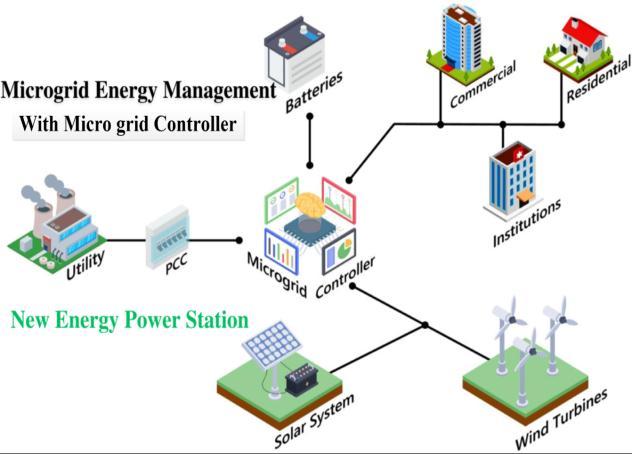
Microgrid Energy Management refers to the coordinated control and optimization of distributed energy resources (DERs), storage systems, and controllable loads within a localizedelectricalnetwork.Amicrogridistypicallydefined as a group of interconnected loads and DERs acting as a singlecontrollableentitythatcanoperateingrid-connected orislandedmode(Lasseter,2002).TheU.S.Departmentof Energy describes a microgrid as a resilient subsystem capableofself-sustainedoperationduringgriddisturbances (DOE,2014).Energymanagementinsuchsystemsinvolves optimal power dispatch, load scheduling, state-of-charge regulationofstorage,andeconomiccoordinationwiththe
main grid. Unlike conventional distribution networks, microgrids emphasize decentralization, renewable integration, and bidirectional power flow. Consequently, EMSfunctionsextendbeyondsimpledispatchtopredictive schedulingandadaptivecontrolunderuncertainty.
TheprincipalobjectivesofmicrogridEMSincludeeconomic optimization,reliabilityenhancement,emissionreduction, andpowerqualitymaintenance.Costminimizationgenerally involves reducing fuel consumption, start-up/shutdown costs, and grid import expenses (Guerrero et al., 2013). Environmentalobjectivesfocusonloweringgreenhousegas emissions through renewable prioritization. Reliability objectives address voltage stability, frequency regulation, andresilienceduringislandedoperation.Theseobjectives are often conflicting, necessitating multi-objective optimizationframeworks.
AnEMSina microgridarchitecturecomprisesmonitoring units, forecasting modules, optimization engines, and supervisorycontrolinterfaces.Themonitoringlayergathers real-time data from smart meters, phasor measurement units, and sensors. The forecasting module predicts renewablegenerationandloaddemandusingstatisticalor artificial intelligence-based techniques. The optimization enginedeterminesoptimalschedulingdecisionssubjectto technicalandeconomicconstraints.Finally,thesupervisory controllerexecutesdispatchcommandsthroughdistributed controllers.
Energy storage systems (ESS) constitute a critical EMS component, enabling energy arbitrage, peak shaving, and frequencysupport.Communicationinfrastructure,typically implemented through advanced metering infrastructure (AMI), ensures reliable data exchange. The integration of
International Research Journal of Engineering and Technology (IRJET) e-ISSN: 2395-0056
Volume: 13 Issue: 02 | Feb 2026 www.irjet.net p-ISSN: 2395-0072
these components forms a cyber-physical framework that enables intelligent microgrid operation (Olivares et al., 2014).
Microgrid control is generally structured into hierarchical layers: primary, secondary, and tertiary control. Primary controlensuresimmediatevoltageandfrequencystability usinglocaldroopcharacteristics.Secondarycontrolrestores systemparameterstonominalvaluesandcompensatesfor steady-state deviations. Tertiary control focuses on economicdispatchandpowerexchangewiththemaingrid (Guerreroetal.,2011).
Fromatemporalperspective,EMSdecisionsoperateacross multiple timescales. Day-ahead scheduling addresses unit commitment and energy trading. Intra-day or hour-ahead scheduling updates dispatch based on revised forecasts. Real-time control handles short-term fluctuations and disturbances.Thecoordinationacrosstheselayersensures operational flexibility and stability. Hierarchical coordination becomes increasingly complex with high renewablepenetrationanddistributedstorageintegration.
Highpenetrationofrenewableenergysources(RES)suchas solar and wind introduces variability, intermittency, and forecasting uncertainty into microgrid operation. Unlike conventional synchronous generators, inverter-based RES contribute limited inertia, potentially affecting frequency stability. Forecast errors can lead to imbalance costs or reliance on expensive reserve units (Hatziargyriou et al., 2007). Additionally, bidirectional power flow and voltage rise issues in distribution feeders complicate operational management.
Anothersignificantchallengeisthestochasticnatureofboth renewablegenerationandloaddemand,requiringrobustor stochastic optimization frameworks. Computational complexity increases with higher DER penetration and inclusion of demand response variables. Furthermore, cybersecurity and communication reliability are critical concernsindigitallycontrolledmicrogrids.Addressingthese challenges necessitates advanced optimization, accurate forecastingintegration,andadaptiveEMSarchitectures.
3.1
Accurate forecasting of renewable energy generation is fundamental for optimal microgrid energy management. Solar photovoltaic (PV) and wind power outputs are inherently variable due to meteorological dependencies,
makingpredictivemodelingessentialforscheduling,reserve allocation, and economic dispatch. Forecasting techniques have evolved from conventional statistical approaches to advanced artificial intelligence (AI)-driven models and hybrid frameworks that combine multiple methodologies. The choice of forecasting model significantly affects scheduling accuracy and operational cost in microgrids (Zhangetal.,2014).
3.1.1
Statistical forecasting techniques rely on historical data patterns and probabilistic modeling. Common approaches include Auto-Regressive Integrated Moving Average (ARIMA), exponential smoothing, and regression-based models.Thesetechniquesarecomputationallyefficientand suitable for short-term forecasting where temporal correlationsdominate.Forexample,time-seriesmodelshave demonstratedreliableshort-horizonwindpowerprediction understableweatherconditions(Boxetal.,2015).However, purely statistical models may struggle with nonlinearities andabruptweatherchanges,limitingtheiraccuracyunder highlydynamicclimaticconditions.
Machinelearning(ML)techniqueshavegainedprominence due to their ability to capture nonlinear relationships between meteorological inputs and renewable outputs. ArtificialNeuralNetworks(ANN),SupportVectorMachines (SVM), Random Forests, and deep learning architectures such as Long Short-Term Memory (LSTM) networks are widelyappliedforsolarandwindforecasting.Thesemodels canprocesslargedatasets,integrateweathervariables,and adapt to complex patterns (Voyant et al., 2017). Deep learning approaches, in particular, provide improved accuracyforhighlyvolatilegenerationprofilesbutrequire substantialtrainingdataandcomputationalresources.
Hybridforecastingmodelsintegratestatisticalandmachine learningtechniquestoleveragecomplementarystrengths. Forinstance,decomposition-basedmethodscombinedwith neural networks can improve prediction accuracy by separatingtrendandfluctuationcomponents.Hybridmodels often reduce forecasting error compared to standalone approaches,especiallyformid-termhorizons(Wangetal., 2019).Suchintegratedtechniquesareincreasinglyadopted inmicrogridEMStoenhancerobustnessandreliability.
Forecasting performance is typically evaluated using quantitative error metrics such as Mean Absolute Error (MAE), Root Mean Square Error (RMSE), Mean Absolute Percentage Error (MAPE), and Normalized RMSE. These
International Research Journal of Engineering and Technology (IRJET) e-ISSN: 2395-0056
Volume: 13 Issue: 02 | Feb 2026 www.irjet.net p-ISSN: 2395-0072
indicatorsmeasuredeviationbetweenpredictedandactual generation values. RMSE is particularly sensitive to large errors, making it useful for assessing extreme forecast deviations, while MAPE provides normalized comparison across different capacities (Hyndman and Koehler, 2006). Probabilisticforecastingmethodsalsoemploymetricssuch as Prediction Interval Coverage Probability (PICP) and Continuous Ranked Probability Score (CRPS) to evaluate uncertainty representation. Proper metric selection is critical, as EMS optimization performance is directly influencedbyforecastingerrormagnitudeanddistribution.
Forecasting in micro grids is categorized according to decision-makinghorizons.Short-termforecasting(minutes tohoursahead)supportsreal-timedispatchandfrequency regulation.Mid-termforecasting(day-aheadtoweek-ahead) facilitates unit commitment and energy trading decisions. Long-termforecasting(monthstoyears)assistsincapacity planning and investment analysis. Short-term models prioritize high temporal resolution and real-time adaptability, whereas long-term forecasts emphasize seasonaltrendsandclimaticpatterns(Giebeletal.,2011). TheintegrationofappropriateforecastinghorizonsintoEMS ensurescoordinatedplanningacrossoperationallayers.
Forecast uncertainty significantly affects microgrid schedulingoutcomes.Inaccuraterenewablepredictionsmay cause power imbalance, increased reserve requirements, and higher operational costs. Deterministic optimization frameworks often assume perfect forecasts, leading to suboptimal dispatch under real-world variability. To mitigate this issue, stochastic and robust optimization methodsexplicitlyincorporateforecastuncertaintythrough scenario-basedmodelingoruncertaintysets(ZhangandLi, 2019).Probabilisticforecastingfurtherenablesrisk-aware scheduling by quantifying confidence intervals. Effective uncertaintymodelingenhancessystemresilience,reduces imbalance penalties, and improves overall microgrid reliability.
4.1 Definitions and Types of
Demand Response (DR) refers to the intentional modification of electricity consumption patterns by endusers in response to price signals, incentives, or grid reliability requirements. It is a demand-side management strategyaimedatimprovingsystemflexibility,reducingpeak demand, and enhancing grid stability. The Federal Energy Regulatory Commission defines DR as changes in electric
usagebyend-usecustomersfromtheirnormalconsumption patternsinresponsetoelectricitypricechangesorincentive payments(FERC,2018).Inmicrogrids,DRplaysastrategic roleinbalancinglocalgenerationanddemand,particularly under high renewable penetration. DR can involve load shifting, load curtailment, peak shaving, valley filling, or flexible appliance scheduling. These actions help mitigate generation variability and reduce reliance on expensive backupgenerators.
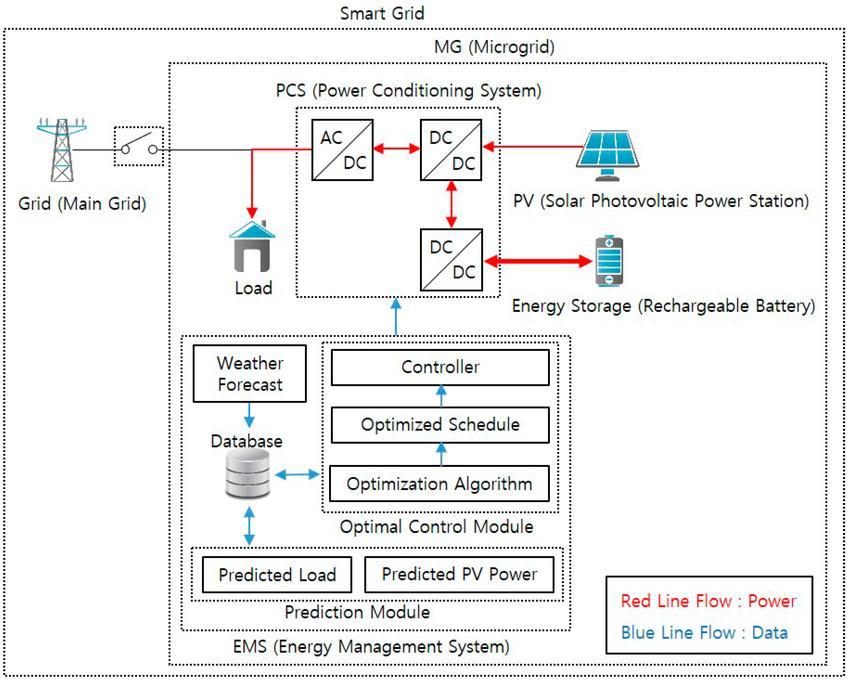
Figure-2: Energy Management System (EMS) Control/Optimization Flow (Wang et al., 2019)
4.2 Classification: Price-based vs Incentive-based
Demandresponseprogramsarebroadlyclassifiedintopricebased and incentive-based mechanisms. Price-based DR includesTime-of-Use(TOU),Real-TimePricing(RTP),and Critical Peak Pricing (CPP), where consumers adjust consumption according to dynamic tariffs. These mechanisms rely on economic signals to encourage voluntaryparticipationandbehavioralchange(Albadiand El-Saadany,2008).Incontrast,incentive-basedDRprograms provide direct compensation to consumers for load reduction during peak events or system contingencies. Examplesincludedirectloadcontrolandinterruptibleload contracts. Incentive-based programs are typically more reliable for emergency demand reduction but require contractual agreements and advanced communication infrastructure. The selection of DR type depends on regulatory frameworks, consumer flexibility, and technologicalreadiness.
In micro grids, DR mechanisms are integrated within the EnergyManagementSystem(EMS)toenhanceoperational flexibility. Load shifting allows deferrable loads such as electricvehiclechargingorindustrialprocesses tooperate duringoff-peakorhigh-renewableperiods.Loadcurtailment
International Research Journal of Engineering and Technology (IRJET) e-ISSN: 2395-0056
Volume: 13 Issue: 02 | Feb 2026 www.irjet.net p-ISSN: 2395-0072
reduces consumption temporarily to maintain balance during supply shortages. Automated Demand Response (ADR) systems use smart meters and control devices to execute real-time load adjustments without manual intervention (Palensky and Dietrich, 2011). In islanded mode, DR becomes particularly valuable for maintaining frequency stability and minimizing load shedding. Optimization-based EMS frameworks treat DR as a controllable resource, incorporating consumer flexibility intodispatchdecisions.
Consumer participation in DR depends on behavioral, economic, and technological factors. Participation models rangefromvoluntaryengagementunderdynamicpricingto aggregator-based frameworks where third-party entities coordinatedistributedloads.Game-theoreticandincentivebased models are increasingly used to model rational consumerbehaviorandmaximizeparticipationrates(Saad etal.,2012).Inresidentialmicrogrids,smarthomeenergy management systems enable appliance-level scheduling based on user preferences and comfort constraints. Industrialconsumersoftenparticipatethroughinterruptible loadcontractsduetohigherflexibilityandpredictableload profiles. Accurate modeling of consumer response is essentialforrealisticEMSoptimization.
While DR offers substantial benefits, its integration into microgridEMSpresentsseveralchallenges.Theseinclude uncertaintyinconsumerresponse,communicationdelays, cyber security risks, and privacy concerns. Modeling consumerelasticityaccuratelyremainscomplex,particularly in heterogeneous load environments. Additionally, regulatory and market frameworks influence DR implementation feasibility. Despite these challenges, DR significantlyreducespeakdemand,lowersoperationalcosts, enhances renewable utilization, and improves system reliability (Strbac, 2008). By incorporating DR within optimizationframeworks,microgridscanachieveimproved economic dispatch and resilience under renewable variability.
5.1
Optimization of micro grid energy management systems (EMS) is fundamentally driven by objective functions that mathematicallyrepresentoperationalgoalsundertechnical and economic constraints. These objectives are typically formulatedassingleormultiplecriteriafunctionssubjectto power balance, generator limits, storage dynamics, and network constraints. In modern microgrids with high renewable penetration, objective functions are no longer
limitedtoeconomicdispatchbutextendtoenvironmental and reliability considerations (Olivares et al., 2014). The formulation of appropriate objective functions directly influences scheduling performance and system sustainability.
Costminimizationisthemostwidelyadoptedobjectivein microgridoptimization.Itincludesfuelcostsofconventional generators, start-up and shut-down costs, operation and maintenancecosts,batterydegradationcosts,andelectricity import/exporttariffs.Ingrid-connectedmode,time-varying electricitypricessignificantlyinfluencedispatchdecisions. Mathematical programming models such as economic dispatchandunitcommitmentarecommonlyemployedto minimize total operating cost while satisfying system constraints(Conejoetal.,2010). Incorporatingrenewable forecasting into cost-based optimization reduces reserve requirementsandimproveseconomicefficiency.
Withincreasingenvironmentalconcerns,emissionreduction hasbecomeacriticaloptimizationobjective.MicrogridEMS may include carbon emission costs or explicit emission minimization terms in the objective function. Pollutant emissionsfromdieselgeneratorsandgasturbinesareoften modeled as nonlinear functions of power output. Environmentaldispatchformulationsattempttobalancefuel costandemissionpenaltiestoachievesustainableoperation (Abido,2003).Integrationofrenewableenergysourcesand demandresponseprogramsfurthercontributestolowering greenhouse gas emissions by reducing reliance on fossilfuel-basedgeneration.
Reliability-orientedobjectivesensuresecurepowersupply undernormalandcontingencyconditions.Reliabilitymetrics mayincludelossofloadprobability(LOLP),expectedenergy not supplied (EENS), voltage deviation, and frequency stabilityindices.Inislandedmicrogrids,maintainingsystem resilience during disturbances is particularly important. Optimizationmodelsmayincorporatereliabilityconstraints orpenaltytermstoenhancerobustnessagainstrenewable variabilityandloaduncertainty(Hatziargyriouetal.,2007). Inclusion of resilience metrics supports sustainable and securemicrogridoperation.
Deterministic optimization assumes perfect knowledge of systemparameters,includingloaddemandandrenewable generation forecasts. These models are computationally efficient and widely applied in day-ahead scheduling. However,theymayyieldsuboptimalsolutionswhenforecast errors are significant. To address uncertainty, stochastic
International Research Journal of Engineering and Technology (IRJET) e-ISSN: 2395-0056
Volume: 13 Issue: 02 | Feb 2026 www.irjet.net p-ISSN: 2395-0072
optimization incorporates probabilistic scenarios representingrenewableandloadvariations.Scenario-based stochastic programming minimizes expected cost across multiple realizations, while robust optimization seeks solutionsthatremainfeasibleunderworst-caseuncertainty bounds (Zhang and Li, 2019). Compared to deterministic models, stochastic approaches improve reliability but increasecomputationalcomplexity.
ThecomplexityofmicrogridEMSoptimizationhasledtothe adoption of diverse mathematical and heuristic solution algorithms. The selection of algorithm depends on model linearity,convexity,scale,andcomputationalrequirements.
5.3.1
Linear Programming (LP) and Nonlinear Programming (NLP) are foundational optimization techniques used in energy management. LP is applicable when objective functionsandconstraintsarelinear,offeringcomputational efficiency and guaranteed convergence. NLP is employed whencostcurves,emissionfunctions,orbatterydynamics exhibitnonlinearcharacteristics.Advancedsolversenable large-scale convex optimization for microgrid scheduling (BoydandVandenberghe,2004).
5.3.2
Mixed Integer Linear Programming (MILP) and Mixed IntegerNonlinearProgramming(MINLP)arewidelyusedfor unit commitment problems involving binary decision variables such as generator on/off status and demand response activation. MILP formulations provide high modeling flexibility and precise representation of operational constraints. They are particularly suitable for day-ahead scheduling and grid-interactive microgrids (Morais et al., 2010). However, computational burden increases significantly with system size and scenario complexity.
5.3.3
Metaheuristic algorithms are employed to solve complex, nonlinear, and multi-modal optimization problems where classical methods struggle. Techniques such as Genetic Algorithms(GA),ParticleSwarmOptimization(PSO),Firefly Algorithm, and Ant Colony Optimization are frequently appliedinmicrogridEMS.Thesealgorithmsprovidenearoptimal solutions with flexible search capabilities and reduced modeling restrictions (Kennedy and Eberhart, 1995).Althoughcomputationallyintensive,theyareeffective formulti-objectiveandnon-convexproblems.
Artificialintelligence-basedoptimizationintegratesmachine learning with decision-making processes. Reinforcement Learning (RL), Deep Q-Networks (DQN), and adaptive control algorithms enable real-time energy management withoutexplicitmathematicalmodelingofuncertainties.AIdriven EMS can learn optimal dispatch policies from historicaldataandcontinuouslyadapttochangingsystem conditions(Francois-Lavetetal.,2016).Theseapproaches are increasingly explored for dynamic and decentralized microgridcontrol.
Microgrid energy management inherently involves conflicting objectives such as cost minimization, emission reduction, and reliability enhancement. Multi-objective optimization(MOO)frameworksaddressthesetrade-offsby generating Pareto-optimal solutions. Weighted sum methods,ε-constraint techniques, and evolutionary multiobjective algorithms such as NSGA-II are commonly employed(Debetal.,2002).MOOenablesdecision-makers toselectoptimaltrade-offsaccordingtopolicyprioritiesor operational preferences. In integrated frameworks combining renewable forecasting and demand response, multi-objective optimization provides balanced and sustainableschedulingstrategies.
This section synthesizes and critically analyses prior researchonoptimizationofmicrogridenergymanagement systems (EMS) considering renewable forecasting and demand response (DR). Rather than presenting isolated studies, the literature is organized according to methodological focus, modeling assumptions, and architectural structures to reveal prevailing trends and researchgaps.
Existingresearchcanbesystematicallyclassifiedbasedon the integration level of renewable forecasting, demand response,uncertaintymodeling,andreal-timeadaptability withinEMSoptimizationframeworks.
Severalstudiesfocusexclusivelyonincorporatingrenewable generation forecasting into microgrid scheduling without explicitlymodelingDR.Theseworkstypicallyemploydayaheadoptimizationusingpredictedsolarorwindoutputsto minimize operational cost. For example, scenario-based scheduling models incorporate forecasted renewable profiles to reduce reserve margins and fuel consumption (Morais et al., 2010). While such approaches improve
International Research Journal of Engineering and Technology (IRJET) e-ISSN: 2395-0056
Volume: 13 Issue: 02 | Feb 2026 www.irjet.net p-ISSN: 2395-0072
economicdispatchaccuracy,theyoftenneglectdemand-side flexibility,limitingoverallsystemadaptability.
Anotherbodyofliteratureemphasizesdemandresponseas the primary flexibility resource while assuming deterministicorperfectlyknowngenerationprofiles.Priceresponsiveloadschedulingandpeakshavingstrategieshave demonstratedsignificantcostreductionandloadflattening (AlbadiandEl-Saadany,2008).However,thesestudiesmay underestimaterenewablevariability,resultingindispatch strategies that are insufficient under high uncertainty conditions.
Morerecentresearchintegratesrenewableforecastingand DR within unified optimization frameworks. Such models treat both supply-side uncertainty and demand-side flexibilityasco-optimizedvariables.Integratedframeworks demonstrateimprovedcostsavingsandemissionreduction compared to isolated approaches (Zhang and Li, 2019). Thesestudiesindicatethatcoordinatedschedulingenhances renewable utilization and reduces curtailment, yet computationalcomplexityoftenincreasessubstantially.
Uncertainty-awareoptimizationincorporatesprobabilistic renewable forecasts or robust uncertainty sets. Stochastic programming methods generate multiple scenarios to captureforecastvariability,minimizingexpectedcostwhile satisfyingreliabilityconstraints(Conejoetal.,2010).Robust optimization frameworks, in contrast, seek solutions resilientagainstworst-caseforecasterrors.Althoughthese models enhance reliability, they may lead to conservative dispatchstrategiesandincreasedcomputationalburden.
AdaptiveEMSstrategiesutilizerollinghorizonoptimization or model predictive control (MPC) to update scheduling decisionsasnewforecastdatabecomesavailable.Real-time strategies improve operational flexibility and mitigate forecast errors. Emerging reinforcement learning-based controllers further enable adaptive policy learning in dynamic environments (Francois-Lavet et al., 2016). Nevertheless,practicaldeploymentremainslimiteddueto dataandvalidationconstraints.
6.2.1
Deterministic optimization assumes perfect knowledge of load and renewable generation. Mixed Integer Linear
Programming(MILP)iswidelyappliedforunitcommitment andeconomicdispatchingrid-connectedmicrogrids.These approachesoffercomputationalefficiencyandguaranteed convergence under convex formulations. However, deterministicmodelsmayleadtoinfeasiblesolutionsunder significantforecastdeviations(Olivaresetal.,2014).
Stochastic programming models renewable output as random variables with known probability distributions. Scenario generation techniques are used to represent uncertainty, enhancing dispatch reliability. Robust optimization, on the other hand, avoids reliance on probability distributions by defining uncertainty bounds. Whilestochasticmethodsgenerallyachievelowerexpected cost,robust formulations provide higher security margins underworst-caseconditions(ZhangandLi,2019).
AI-driven optimization methods, including reinforcement learning and deep neural networks, enable data-driven decision-making without explicit mathematical system models. These approaches adapt to changing operational patternsandareparticularlyusefulinreal-timescheduling. However,issuesrelatedtotrainingstability,interpretability, and convergence guarantees remain under investigation (Voyantetal.,2017).
6.3.1
Time-seriestechniquessuchasARIMAandregression-based models have been integrated into EMS for short-term renewableprediction.Thesemethodsarecomputationally efficientandsuitableforstructureddatasets.However,their linear assumptions may limit accuracy under highly nonlinear weather-dependent generation patterns (HyndmanandKoehler,2006).
Machinelearning-basedforecastingmethods,includingANN and LSTM networks, have shown superior accuracy in capturing nonlinear renewable generation behavior. Integration of ML forecasts into optimization models enhanceseconomicperformancebutintroduceschallenges relatedtomodelgeneralizationandcomputationaloverhead (Wangetal.,2019).
International Research Journal of Engineering and Technology (IRJET) e-ISSN: 2395-0056
Volume: 13 Issue: 02 | Feb 2026 www.irjet.net p-ISSN: 2395-0072
6.4.1
Price-based DR models incorporate dynamic tariffs into objective functions to influence consumer load profiles. Time-of-Use and Real-Time Pricing mechanisms have demonstratedeffectivepeakreductionandcostsavingsin simulation-basedmicrogridstudies(Strbac,2008).However, participationuncertaintycanaffectschedulingpredictability.
6.4.2
Incentive-based DR relies on contractual agreements and direct compensation mechanisms for load curtailment. Optimization models treat DR capacity as dispatchable resources, improving reliability during peak conditions. Nevertheless, implementation depends on regulatory structuresandadvancedcommunicationinfrastructure.
6.5
EMS architectures significantly influence optimization implementation. Centralized systems rely on a single supervisory controller with complete system information, offering global optimality but reduced scalability. Decentralized schemes allow local controllers to make independent decisions with limited coordination. Distributed architectures employ cooperative algorithms suchasconsensus-basedoptimization,enhancingscalability and resilience (Guerrero et al., 2011). While centralized systemsareprevalentinacademicresearch,distributedEMS architectures are gaining importance for practical deployments.
6.6.1
LiteratureindicatesthatMILP-baseddeterministicmodels primarily target cost minimization, while stochastic and robust models incorporate reliability constraints. Multiobjective evolutionary algorithms address cost-emission trade-offs. AI-based approaches increasingly combine economicandresilienceobjectives.
6.6.2 Forecasting Techniques
Statistical models provide computational efficiency for short-termhorizons,whereasmachinelearningmodelsyield improved accuracy at the expense of training complexity. Hybridmodelsdemonstrate balanced performanceacross varyingforecasthorizons.
6.6.3
Price-based DR enhances voluntary participation but introduces behavioral uncertainty. Incentive-based DR
ensurespredictableloadreductionbutrequirescontractual and infrastructural support. Aggregator-based models improvescalabilityindistributedmicrogrids.
6.7.1
Recenttrendsindicateincreasingintegrationofrenewable forecastingandDRwithinunifiedoptimizationframeworks. There is growing adoption of stochastic and AI-driven approaches,reflectingtheneedforuncertainty-awareand adaptivescheduling.
6.7.2 Gaps, Contradictions, and Limitations
Despitemethodologicaladvancements,severalgapspersist. Many studies rely on simulation-based validation without realmicrogriddeployment.Computationalcomplexitylimits scalability of stochastic and multi-objective models. Furthermore, consumer behavior modeling remains simplifiedinmanyDR-integratedframeworks.
6.7.3 Application Domains
Most reviewed works are validated through simulation platformssuchasMATLABorGAMS,withlimitedhardwarein-the-loop or field implementation studies. Real-world demonstrations remain scarce, highlighting the need for experimentalvalidationandpracticalfeasibilityassessment.
Thissectionsynthesizestheanalyticalinsightsderivedfrom the reviewed literature and critically examines the interrelationships among renewable forecasting, demand response (DR), and optimization techniques within microgridenergymanagementsystems(EMS).
Acomprehensivereviewofexistingstudiesrevealsseveral consistent patterns. First, cost minimization remains the dominantobjectiveinmostoptimizationframeworks,often complemented by emission reduction and reliability constraints. Deterministic Mixed Integer Linear Programming (MILP) models are widely adopted due to their modeling precision and solver maturity. However, increasing renewable penetration has shifted research attentiontowarduncertainty-awareoptimizationstrategies. Second, forecasting accuracy significantly influences schedulingperformance,particularlyinday-aheadandhouraheaddispatch.Third,DRisprogressivelybeingtreatedasa dispatchableflexibilityresourceratherthanmerelyaload adjustmentmechanism.Despitetheseadvancements,most studiesremainsimulation-based,withlimitedexperimental validation(Olivaresetal.,2014).Theliteraturealsoindicates
International Research Journal of Engineering and Technology (IRJET) e-ISSN: 2395-0056
Volume: 13 Issue: 02 | Feb 2026 www.irjet.net p-ISSN: 2395-0072
atransitionfromcentralizedcontroltowarddistributedand data-drivenarchitectures.
The integration of renewable forecasting and DR within a unified optimization framework produces synergistic benefits.Accurateforecastingreducesreservemarginsand enhancesschedulingprecision,whileDRprovidesdemandsideflexibilitytocompensateforforecastdeviations.When both elements are co-optimized, microgrids achieve improved renewable utilization, reduced curtailment, and lower operational costs. Scenario-based stochastic optimization models demonstrate that incorporating DR significantly mitigates the economic impact of renewable uncertainty(Conejoetal.,2010).Moreover,adaptivepricing mechanismsalignedwithforecastedrenewableavailability encourage load shifting toward high-generation periods. This coordinated interaction enhances both economic efficiency and system resilience, particularly in islanded operation.
Despite notable progress, several technical and practical challengesremaininimplementingintegratedoptimization frameworks.
Renewable generation forecasting is inherently imperfect due to meteorological variability. Even advanced machine learning models cannot eliminate forecast error entirely. Uncertaintypropagationintooptimizationmodelsmaylead toinfeasibleschedulesorincreasedbalancingcosts.Robust optimization techniques improve reliability but often produceconservativesolutionsthatelevateoperatingcost (Zhang and Li, 2019). Balancing economic optimality and reliability under uncertainty remains a critical research challenge.
Real-timeenergymanagementrequiresrapidcomputation and continuous data acquisition. Rolling horizon optimization and model predictive control (MPC) frameworks enable periodic schedule updates; however, computational complexity increases with system size and scenario depth. Communication delays and cybersecurity vulnerabilitiesfurthercomplicatereal-timeimplementation. Reinforcement learning-based controllers offer adaptive capabilities but require extensive training and validation before deployment (Francois-Lavet et al., 2016). Ensuring stabilityandconvergenceinreal-timeapplicationsremainsa significantconcern.
As microgrids incorporate more distributed energy resources (DERs), storage units, and flexible loads, optimization problems grow in dimensionality. Scenariobased stochastic programming and multi-objective evolutionary algorithms may become computationally intensive. Distributed optimization techniques have been proposedtoimprovescalability,butcoordinationoverhead and convergence speed require further improvement. Efficient decomposition methods and parallel computing strategiesarenecessaryforlarge-scalepracticaldeployment
Based on the literature, several best practices emerge for effectivemicrogridenergymanagementoptimization.First, integratingprobabilisticrenewableforecastswithstochastic or robust optimization enhances reliability without excessive conservatism. Second, incorporating DR as a controllable decision variable improves flexibility and reduces peak demand stress. Third, hierarchical control architectures combining tertiary economic optimization with secondary and primary stability control ensure operational coordination (Guerrero et al., 2011). Fourth, hybrid forecasting models combined with adaptive optimization techniques provide improved scheduling performanceunderdynamicconditions.Finally,distributed EMS architectures enhance scalability and resilience, particularlyinmulti-microgridsystems.
This review comprehensively examined optimization strategiesformicrogridenergymanagementsystems(EMS) withexplicitconsiderationofrenewableenergyforecasting anddemandresponse(DR).Theanalysisdemonstratesthat traditional deterministic optimization models, although computationallyefficient,areincreasinglyinsufficientunder highrenewablepenetrationduetoforecastinguncertainty and load variability. Stochastic and robust optimization approaches provide enhanced reliability by incorporating uncertainty modeling, while multi-objective formulations enable balanced trade-offs among cost, emissions, and reliability. The review further highlights that accurate renewable forecasting significantly improves scheduling precision and reduces reserve requirements, whereas DR serves as an effective flexibility mechanism to mitigate supply–demandimbalance.Integratedframeworksthatcooptimizeforecastingoutputsanddemand-sideparticipation yield superior economic and operational performance compared to isolated approaches. Additionally, emerging artificial intelligence-based optimization and adaptive control strategies show strong potential for real-time and decentralized microgrid applications. However, practical deploymentchallengessuchascomputational complexity, scalability, and communication reliability remain critical concerns.Overall,theliteratureindicatesacleartransition
International Research Journal of Engineering and Technology (IRJET) e-ISSN: 2395-0056
Volume: 13 Issue: 02 | Feb 2026 www.irjet.net p-ISSN: 2395-0072
towarduncertainty-aware,data-driven,anddistributedEMS architectures. Future research should emphasize experimentally validated, scalable, and adaptive optimization frameworks capable of supporting high renewable penetration while ensuring economic viability andgridresilienceinmodernpowersystems.
Despite its comprehensive scope, this review has certain limitations. First, the analysis primarily focuses on optimization methodologies reported in peer-reviewed journal articles, potentially excluding relevant industrial reports and emerging pilot projects. Second, while renewable forecasting and DR integration are critically assessed, quantitative performance comparison across different case studies is limited due to heterogeneous modeling assumptions and system configurations. Third, mostreviewedworksaresimulation-based,whichrestricts evaluation of practical deployment constraints such as hardwarelimitationsandregulatorybarriers.Additionally, rapidadvancementsinartificialintelligenceanddistributed control mayrendersomediscussedapproachessubjectto ongoingevolution.Futurereviewsincorporatingreal-world demonstration data and standardized benchmarking frameworks would further strengthen comparative evaluationandpracticalapplicabilityinsights.
1. Abido, M.A., 2003. Environmental/economic power dispatchusingmultiobjectiveevolutionaryalgorithms. IEEETransactionsonPowerSystems,18(4),pp.1529–1537.
2. Albadi,M.H.andEl-Saadany,E.F.,2008.Asummaryof demandresponseinelectricitymarkets.ElectricPower SystemsResearch,78(11),pp.1989–1996.
3. Box,G.E.P.,Jenkins,G.M.,Reinsel,G.C.andLjung,G.M., 2015. Time Series Analysis: Forecasting and Control. 5thed.Hoboken:Wiley.
4. Boyd, S. and Vandenberghe, L., 2004. Convex Optimization.Cambridge:CambridgeUniversityPress.
5. Conejo, A.J., Carrión, M. and Morales, J.M., 2010. Decision Making Under Uncertainty in Electricity Markets.NewYork:Springer.
6. Deb,K.,Pratap,A.,Agarwal,S.andMeyarivan,T.,2002. A fast and elitist multiobjective genetic algorithm: NSGA-II. IEEE Transactions on Evolutionary Computation,6(2),pp.182–197.
7. FERC, 2018. Assessment of Demand Response and Advanced Metering. Washington, DC: Federal Energy RegulatoryCommission.
8. Francois-Lavet,V.,Taralla,D.,Ernst,D.andFonteneau, R., 2016. Deep reinforcement learning solutions for energymicrogridsmanagement.EuropeanWorkshop onReinforcementLearning.
9. Giebel,G.,Brownsword,R.,Kariniotakis,G.,Denhard,M. andDraxl,C.,2011.TheState-of-the-ArtinShort-Term PredictionofWindPower.2nded.Roskilde:DTUWind Energy.
10. Guerrero, J.M., Vasquez, J.C., Matas, J., De Vicuña, L.G. and Castilla, M., 2011. Hierarchical control of droopcontrolledACandDCmicrogrids.IEEETransactionson IndustrialElectronics,58(1),pp.158–172.
11. Guerrero,J.M.,Loh,P.C.,Lee,T.L.andChandorkar,M., 2013. Advanced control architectures for intelligent microgrids.IEEETransactionsonIndustrialElectronics, 60(4),pp.1254–1262.
12. Hatziargyriou,N.,Asano,H.,Iravani,R.andMarnay,C., 2007. Microgrids. IEEE Power and Energy Magazine, 5(4),pp.78–94.
13. Hyndman,R.J.andKoehler,A.B.,2006.Anotherlookat measuresofforecastaccuracy.InternationalJournalof Forecasting,22(4),pp.679–688.
14. Kennedy, J. and Eberhart, R., 1995. Particle swarm optimization. Proceedings of IEEE International ConferenceonNeuralNetworks,pp.1942–1948.
15. Lasseter, R.H., 2002. Microgrids. IEEE Power EngineeringSocietyWinterMeeting,pp.305–308.
16. Morais, H., Kádár, P., Faria, P., Vale, Z. and Khodr, H., 2010.Optimalschedulingofarenewablemicrogridin an isolated load area using mixed-integer linear programming.RenewableEnergy,35(1),pp.151–156.
17. Mohammadi,S.,Mozafari,B.,Solimani,S.andNiknam, T., 2018. An adaptive modified firefly optimisation algorithm based on Hong’s point estimate method to optimaloperationmanagementinamicrogrid.Energy, 154,pp.1–16.
18. Olivares,D.E.,Mehrizi-Sani,A.,Etemadi,A.H.,Cañizares, C.A.,Iravani,R.,Kazerani,M.,Hajimiragha,A.H.,GomisBellmunt, O., Saeedifard, M., Palma-Behnke, R. and Jiménez-Estévez, G.A., 2014. Trends in microgrid control. IEEE Transactions on Smart Grid, 5(4), pp.1905–1919.
19. Palensky, P. and Dietrich, D., 2011. Demand side management: Demand response, intelligent energy systems, and smart loads. IEEE Transactions on IndustrialInformatics,7(3),pp.381–388.
International Research Journal of Engineering and Technology (IRJET) e-ISSN: 2395-0056
Volume: 13 Issue: 02 | Feb 2026 www.irjet.net p-ISSN: 2395-0072
20. Saad,W.,Han,Z.,Poor,H.V.andBaşar,T.,2012.Gametheoretic methods for the smart grid. IEEE Signal ProcessingMagazine,29(5),pp.86–105.
21. Strbac, G., 2008. Demand side management: Benefits andchallenges.EnergyPolicy,36(12),pp.4419–4426.
22. U.S. Department of Energy (DOE), 2014. Microgrid Definition and Classification. Washington, DC: U.S. DepartmentofEnergy.
23. Voyant,C.,Notton,G.,Kalogirou,S.,Nivet,M.L.,Paoli,C., Motte, F. and Fouilloy, A., 2017. Machine learning methods for solar radiation forecasting: A review. RenewableEnergy,105,pp.569–582.
24. Wang,H.,Lei,Z.,Zhang,X.,Zhou,B.andPeng,J.,2019.A review of deep learning for renewable energy forecasting.EnergyConversionandManagement,198, 111799.
25. Zhang,J.,Florita,A.,Hodge,B.M.,Lu,S.,Hamann,H.F., Banunarayanan,V.andBrockway,A.M.,2014.Asuiteof metrics for assessing solar power forecasting. Solar Energy,111,pp.157–175.
26. Zhang, Y. and Li, G., 2019. Robust optimization for microgridenergymanagementwithrenewableenergy uncertainty.AppliedEnergy,238,pp.1473–1484.
27. Yang, L., Wu, L. & Li, G., 2024. Enhanced energy management in smart microgrids using hybrid optimization and demand response strategies, International Journal of Electrical Power & Energy Systems,110421.
28. Chatuanramtharnghaka,B.,Deb,S.,Singh,K.R.,Ustun, T.S.&Kalam,A.,2024.Reviewingdemandresponsefor energymanagementwithconsiderationofrenewable energy sources and electric vehicles, World Electric VehicleJournal,15(9),412.
29. Singh,A.R.etal.,2024.Machinelearning-basedenergy managementandpowerforecastingingrid-connected microgrids with multiple distributed energy sources, ScientificReports,14,19207.
30. Practicalsolutionsformicrogridenergymanagement: Integratingsolarforecastingandcorrectionalgorithms, EnergyReports,2024.
31. Resilient day-ahead microgrid energy management withuncertaindemand,EVs,storage,andrenewables, CleanEnergy,2024,100763.
32. Meng,Q.etal.,2025.Day-aheadeconomicdispatchof wind-integratedmicrogridsusingcoordinatedenergy storage and hybrid demand response strategies, ScientificReports,15,26579.
33. Onteru,R.R.&Sandeep,V.,2024.Anintelligentmodel for efficient load forecasting and sustainable energy management in sustainable microgrids, Discover Sustainability,5,170.
34. Microgrid system energy management with demand responseprogramforcleanandeconomicaloperation, AppliedEnergy,2023,120717.
35. Chen, B. et al., 2025. Robust optimization for smart demand-sidemanagementinmicrogridsusingRPAand greywolfoptimizer,ScientificReports,15,19440.
36. Moazzen, F., 2025. Energy management under uncertainty for hybrid microgrids, IET Renewable PowerGeneration.
37. A Comprehensive Review of Hybrid Renewable Microgrids: Key design parameters, optimization techniques,anddemandresponse,Energies,2025,18, 5154.
38. Review of optimization strategies for energy management in microgrids, Energies, 2025, 18(13), 3245.
39. Zhao,F.,2024.Optimizingmicrogridmanagementwith intelligent planning integrating DR, Computers & ElectricalEngineering.
40. Zheng,X.,Chen,H.&Jin,T.,2023.Anewoptimization approachconsideringdemandresponseandmultistage storage,RenewableEnergy,220,119621.
41. Nassereddine, K. et al., 2025. Simulation of energy managementsystemusingmodelpredictivecontrolin AC/DCmicrogrid,ScientificReports,15,5388.
42. Benavides,D.etal.,2025.Smartmeter-baseddemand forecasting for energy management using supercapacitors, Frontiers in Energy Research, 13, 1681139.
43. Sam Moses Babu, K.V. et al., 2025. Demand response optimization MILP framework for microgrids with DERs,arXivpreprint.
44. Cao, T. & Xu, Y., 2025. An end-to-end approach for microgrid probabilistic forecasting and robust operation,arXivpreprint.
45. Babayomi, O. & Kim, D.-S., 2025. Uncertainty-aware federatedlearningforcyber-resilientmicrogridenergy management,arXivpreprint.
46. Liu, C. et al., 2025. Approximate model predictive controlformicrogridenergymanagementviaimitation learning,arXivpreprint.
International Research Journal of Engineering and Technology (IRJET) e-ISSN: 2395-0056
Volume: 13 Issue: 02 | Feb 2026 www.irjet.net p-ISSN: 2395-0072
47. Yao, F. et al., 2024. A holistic power optimization approach for microgrid control based on deep reinforcementlearning,arXivpreprint.
48. Reviewing demand response optimization for smart gridintegratedbuildings,Energy&Buildings,2025.
49. Castañeda-Arias, N., 2025. Energy management in microgridsystems optimizationEMSreview,MDPI EnergySystems.
50. “A Comprehensive Review of Hybrid Renewable Microgrids”, Preprints, 2025 evaluation of stochastic andmulti-objectiveoptimization.
51. Optionalsupportingsurvey:Astate-of-the-artreview onenergymanagementtechniquesandoptimizationin microgrids,CogentEngineering,2024.