
International Research Journal of Engineering and Technology (IRJET) e-ISSN: 2395-0056
Volume: 13 Issue: 03 | Mar 2026 www.irjet.net p-ISSN: 2395-0072
A REVIEW OF HEIGHT-DEPENDENT WIND RESPONSE
CHARACTERIZATION OF REINFORCED CONCRETE VERTICAL BUILDING SYSTEMS
Suraj
Kumar Gupta1 , Mr. Ushendra Kumar2
1Master of Technology, Civil Engineering, Lucknow Institute of Technology, Lucknow, India
2Head of Department, Department of Civil Engineering, Lucknow Institute of Technology, Lucknow, India
Abstract - Rapid vertical urbanization has led to the proliferation of reinforced concrete (RC) high-rise buildings, making accurate characterization of height-dependent wind response a critical concern in structural engineering. Wind loading on tall buildingsvariessignificantlywithelevationdue to changes in mean wind speed profile, turbulence intensity, and aerodynamic interaction effects. These variations induce complex static and dynamic responses, including base shear amplification, overturning moments, inter-story drift, and occupant-level acceleration. This review synthesizes existing research on the characterization ofwind-inducedresponsesin RC vertical building systems with specific emphasis on heightdependent behavior. The paper critically examines analytical formulations, code-based procedures, numerical simulations, wind tunnel experiments, and full-scale monitoring studies. Particular attention is given to the evolution of dynamic analysis methods, the influence of stiffness and mass distribution along height, and discrepancies between code predictions and measured performance. Comparative assessments reveal limitations in simplified gust factor approaches and highlight the growing role of computational fluid dynamics and performance-based design frameworks. Furthermore, the review identifies research gaps related to aeroelastic coupling, nonlinearity in RC systems, and the need for long-term field data for calibration of design provisions. The study provides an integrated understanding of current knowledge and outlines future directions for improving windresilient design of tall RC structures.
Key Words: Height-dependent wind response; Reinforced concretehigh-risebuildings;Wind–structure interaction; Dynamic amplification; Atmospheric boundary layer; Structural drift and acceleration.
1. INTRODUCTION
1.1 Overview and Importance
1.1.1 Wind Loading and Structural Safety of Tall RC Buildings
The rapid expansion of vertical urban infrastructure has significantly increased the construction of reinforced concrete (RC) high-rise buildings. As building height increases,windeffectsoftengovernstructuraldesigndueto amplifiedlateralforcesanddynamicexcitations.Unlikelow-
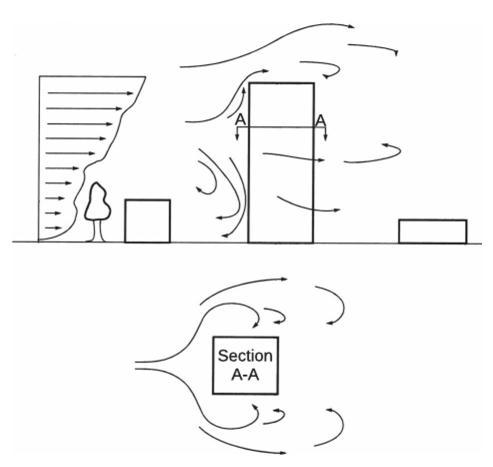
rise buildings where wind loads may be treated predominantly as static actions, tall RC buildings exhibit pronounceddynamicsensitivity,particularlyinthealongwindandacross-winddirections.Theatmosphericboundary layercauseswindspeedtoincreasewithheight,producing non-uniform pressure distributions and elevated overturning moments at upper levels (Davenport, 1967). Additionally, the flexibility of tall RC systems, especially moment-resistingframesandshearwall–frameinteractions, increasessusceptibilitytovibration-inducedserviceability issues such as excessive drift and occupant discomfort (Kareem, 1982). Current international standards such as ASCE7andIS875Part3incorporateheight-dependentwind profiles; however, these provisions rely on simplified assumptionsthatmaynotfullycapturecomplexaeroelastic behavior.
1.1.2 Societal and Engineering Impacts
Wind-inducedresponsesinfluencenotonlystructuralsafety butalsoeconomicandsocietalresilience.Excessivelateral displacements can lead to non-structural damage, façade failures,andserviceinterruptions.Morecritically,occupant comfort criteria related to acceleration thresholds have become decisive in high-rise residential and office towers (Melbourne,1980).Failuresorserviceabilitydeficienciesin
International Research Journal of Engineering and Technology (IRJET) e-ISSN: 2395-0056
Volume: 13 Issue: 03 | Mar 2026 www.irjet.net p-ISSN: 2395-0072
tall buildings can undermine public confidence in urban infrastructure. Therefore, accurate wind response characterizationisintegraltosustainableandresilientcity development,particularlyinrapidlyurbanizingregions.
1.2 Challenges in Wind Response Characterization
1.2.1
Height Effects and Atmospheric Turbulence
Oneoftheprimarycomplexitiesinwindengineeringisthe verticalvariationofwindcharacteristics.Meanwindspeed typically follows a logarithmic or power-law profile with height,whileturbulenceintensitydecreaseswithelevation. Thesegradientssignificantlyaffectaerodynamicloadingand dynamic excitation (Simiu and Scanlan, 1996). In tall RC buildings, the upper stories experience higher wind velocities and fluctuating pressures, intensifying bending moments and drift demands. Furthermore, terrain roughness, topography, and urban interference modify boundary layer characteristics, complicating generalized modelingapproaches.
1.2.2
Dynamic Amplification and Aeroelastic Interaction
Dynamicamplificationariseswhenthefrequencycontentof windturbulenceapproachesthenaturalfrequenciesofthe structure. Flexible RC systems with long fundamental periodsareparticularlyvulnerabletoresonantamplification effects. The gust factor method, widely adopted in design codes,attemptstoaccountforthisphenomenonbutoften underestimates cross-wind and torsional responses in slender configurations (Kijewski and Kareem, 1998). Additionally,aeroelasticcoupling wherestructuralmotion altersaerodynamicforces introducesnonlinearfeedback mechanisms that are difficult to represent in simplified analyticalframeworks.
1.3 Objective of the Review
This review aims to systematically synthesize existing knowledge on height-dependent wind response characterizationofRCverticalbuildingsystems.Specifically, ittracestheevolutionofanalyticalformulations,numerical modelingstrategies,experimentalinvestigations,andcodebasedprocedures.Byintegratingtheoreticaldevelopments with empirical observations, the review seeks to identify prevailingtrends,methodologicalstrengthsandlimitations, andareasrequiringfurtherinvestigation.Emphasisisplaced on understanding how structural configuration, stiffness distribution, and height influence wind-induced demand parameters.
1.4 Organization of the Paper
Thepaperisstructuredtoprovideacoherentprogression from fundamental concepts to advanced research developments. Following this introduction, Section 4
outlines theoretical foundations of atmospheric boundary layer wind and RC structural systems. Section 5 reviews relevant international wind design standards and their height-dependentprovisions.Section6discussesanalytical, numerical, and experimental methodologies for wind response characterization. Section 7 presents a comprehensive thematic literature review. Section 8 synthesizesmajorfindingsandcontrastscompetingmodels, while Section 9 discusses practical implications and limitations. Finally, Section 10 outlines future research directions,followedbyconcludingremarks.
2. BACKGROUND FUNDAMENTALS
2.1 Wind Characteristics Relevant to Structures
2.1.1 Wind Profile Variation with Height
Windflowwithintheatmosphericboundarylayerexhibitsa systematicincreaseinmeanvelocitywithelevationdueto reduced surface friction effects. This vertical variation is typically represented using logarithmic or power-law expressions,whichrelatewindspeedtoterrainroughness and reference height. The logarithmic profile model is grounded in boundary layer theory, while the power-law approximation is commonly adopted in structural design practiceduetoitssimplicity(SimiuandScanlan,1996).As building height increases, the upper portions of tall structuresaresubjectedtosignificantlyhighermeanwind speeds,resultinginamplifiedlateralpressuresandbending demands. This height-dependent gradient is explicitly incorporated in design provisions such as ASCE 7 and Eurocode 1, where exposure categories define terraindependent velocity variation. However, real atmospheric flowsareinfluencedbytopography,urbaninterference,and thermalstratification,introducingdeviationsfromidealized profiles.
2.1.2 Turbulence Intensity and Spectral Characteristics
In addition to mean wind speed, fluctuating wind components play a critical role in structural excitation. Turbulence intensity, defined as the ratio of standard deviation of wind speed fluctuations to mean velocity, generallydecreaseswithheightbutremainssignificant in urbanterrains.Thesefluctuationscontainenergydistributed across a range of frequencies described by turbulence spectra,suchastheKaimalorvonKármánmodels(Kaimal et al., 1972). When the dominant frequencies of wind turbulence align with a structure’s natural frequencies, resonant amplification may occur. Therefore, accurate spectral representation is essential in dynamic wind analysis, particularly for flexible tall buildings where response is highly sensitive to low-frequency turbulence components.
International Research Journal of Engineering and Technology (IRJET) e-ISSN: 2395-0056
Volume: 13 Issue: 03 | Mar 2026 www.irjet.net p-ISSN: 2395-0072
2.2 Reinforced Concrete Vertical Building Systems
2.2.1
Typical RC High-Rise Structural Configurations
Reinforced concrete high-rise buildings employ various lateral load–resisting systems to control wind-induced effects. Common configurations include moment-resisting frames, shear wall systems, coupled shear walls, tube-intubesystems,andcore–outriggerarrangements.Shearwall andcoresystemsprovidesubstantiallateralstiffnessandare widelyusedinresidentialtowers,whileoutriggersystems enhance overturning resistance by mobilizing perimeter columns(Taranath,2016).Theselectionofstructuralsystem significantly influences dynamic properties such as fundamental period,modeshapes,anddampingratios.As height increases, structural slenderness becomes a governingparameter,requiringoptimizedstructurallayouts tobalancestiffnessandmaterialefficiency.
2.2.2 Stiffness, Mass Distribution, and Wind Performance
Thedistributionofstiffnessandmassalongtheheightofan RC building critically affects its wind-induced response. Uniform stiffness distribution may not be optimal for controlling inter-story drift at upper levels, where wind demands are higher. Variations in floor mass, stiffness degradation due to cracking, and nonlinear material behaviorfurthercomplicateresponseprediction.Research indicates that higher mode effects become increasingly important in tall RC systems, influencing acceleration and driftpatterns(Chopra,2017).Moreover,inherentdamping inRCstructures arisingfrommaterialhysteresisandnonstructuralcomponents playsasignificantroleinlimiting dynamicamplification.
2.3 Key Response Metrics
2.3.1
Base Shear and Overturning Moment
Base shear and overturning moment are primary global response parameters used in wind-resistant design. Base shearrepresentsthecumulativelateralforcetransferredto the foundation, while overturning moment reflects the rotationaldemandgeneratedbyheight-dependentpressure distribution.Theseforcesincreasenonlinearlywithbuilding heightduetothecombinedeffectofelevatedwindspeeds and larger lever arms. Accurate estimation of these parameters is essential for foundation design and overall structuralstability(Holmes,2015).
2.3.2 Drift and Acceleration
Inter-story drift and peak acceleration are critical serviceability criteria in tall buildings. Excessive drift can causedamagetocladding,partitions,andglazingsystems, whilehighaccelerationsmayleadtooccupantdiscomfort.
International guidelines, including International Organization for Standardization standards on human exposure to vibration, provide threshold limits for acceptable acceleration levels. Unlike base shear, acceleration response is strongly influenced by dynamic characteristicssuchasdampingratioandnaturalfrequency. Consequently,performance-basedwinddesignincreasingly emphasizes acceleration control in addition to strength requirements.
3. WIND LOAD CODES & STANDARDS
3.1 International and Regional Standards
3.1.1
Overview of Key Wind Load Standards
Wind-resistant design of tall buildings is guided by internationallyrecognizedcodesandstandardsthatprovide methodologies for estimating design wind forces and dynamic responses. Prominent standards include ASCE 7, whichiswidelyusedintheUnitedStates,andEurocode1, whichgovernsstructuraldesignacrossEurope.InIndia,the relevantprovisionisIS875Part3
4. METHODOLOGIES FOR WIND RESPONSE CHARACTERIZATION
4.1 Analytical / Deterministic Approaches
4.1.1 Simplified Formulas and Closed-Form Solutions
Analytical or deterministic methods have historically provided the first means to estimate wind-induced responses in tall buildings. Simplified formulas, often derivedfromstaticwindpressureequationscombinedwith empirical gust factors, allow for rapid assessment of base shear,overturningmoments,andstorydrift.Forexample, slope–driftrelationscorrelatewindspeedatagivenheight to the corresponding lateral displacement, providing an approximatemeasureofinter-storydrift(SimiuandScanlan, 1996).Closed-formsolutions,basedonbeamorcantilever models of the building, incorporate fundamental mode shapes and effective height-dependent stiffness to predict lateral response. These approaches are computationally efficientandprovideinitialdesignguidance.
4.1.2 Strengths and Limitations
The main strength of analytical approaches lies in their simplicityandeaseofimplementationinearlydesignstages. Theyareparticularlyusefulforparametricstudiesandcodechecking calculations. However, they have inherent limitations:theyoftenassumelinearelasticbehavior,neglect higher-modeeffects,andoversimplifycomplexaerodynamic interactionssuchastorsionorvortexshedding.Asaresult, deterministic formulas may underestimate dynamic
International Research Journal of Engineering and Technology (IRJET) e-ISSN: 2395-0056
Volume: 13 Issue: 03 | Mar 2026 www.irjet.net p-ISSN: 2395-0072
amplificationinflexibleorirregularRChigh-risebuildings (Holmes,2015).
4.2 Numerical Simulation Strategies
4.2.1
Computational Fluid Dynamics (CFD)
CFD techniques provide detailed simulation of wind flow aroundstructures,allowingthepredictionoflocalpressure distributionsandturbulenceeffects.Largeeddysimulation (LES) models capture time-dependent, three-dimensional eddies, which are crucial for representing gustiness and turbulentfluctuationsintheatmosphericboundarylayer.By coupling CFD-generated wind pressures with structural models, engineers can study the dynamic response of RC buildingsunderrealisticwindconditions(Blocken,2014).
4.2.2 Finite Element Structural Models
Finiteelementanalysis(FEA)enablesdetailedmodelingof structuralbehavior,includingmaterialnonlinearity,stiffness variations, and modal interactions. Modal analysis can identifythebuilding’snaturalfrequenciesandmodeshapes, while coupled wind–structure interaction studies incorporatefeedbackeffectsbetweenstructuralmotionand aerodynamicforces.Thisapproachisparticularlyimportant for tall, flexible RC structures where higher modes significantly influence acceleration and drift response (Chopra,2017).
4.3 Experimental Techniques
4.3.1
Wind Tunnel Testing
Wind tunnel experiments remain a cornerstone of wind engineeringresearch.Scaledmodelsofbuildingsaretested undercontrolledatmosphericboundarylayerconditionsto replicatereal-worldwindprofiles.Measurementtechniques includepressuretaps,forcebalances,andmotionsensors, enablingdeterminationofbaseshear,overturningmoments, and local pressures (Melbourne, 1980). Wind tunnels are essentialforvalidatinganalyticalandnumericalmodelsand for assessing aerodynamic phenomena such as vortex sheddingandinterferenceeffectsinurbanenvironments.
4.3.2
Field Measurements
Full-scale instrumentation provides invaluable data for calibratingandvalidatingdesignmethods.Modernhigh-rise buildings are often equipped with anemometers, accelerometers, and displacement sensors at multiple elevations. These measurements capture wind speed, dynamic pressures, and structural accelerations, offering insights into actual building performance under natural windconditions.Fielddatacomplementexperimentaland numerical methods and highlight discrepancies between predictedandobservedresponses,particularlyforirregular
RCsystemsincomplexurbansettings(SimiuandScanlan, 1996).
5 LITERATURE REVIEW
5.1 Early Studies
5.1.1 Pioneering Work on Wind Effects on Tall Buildings
Earlyresearchonwindeffectsfocusedonunderstandingthe fundamental behavior of tall structures under lateral loading. Davenport (1967) introduced the concept of gust loadingfactors,whichformedthebasisforestimatingwindinduced forces and base shear in tall buildings. These pioneering studies primarily employed simplified linear models, treating the building as a cantilevered beam subjected to uniform or quasi-static wind pressures. Experimentaldatafromscalemodelsinboundarylayerwind tunnels provided initial validation for these formulas, althoughturbulenceeffectsandhigher-modecontributions were often neglected (Melbourne, 1980). Despite their simplicity,thesestudieslaidthegroundworkforsystematic assessmentofwindloadsandinfluencedthedevelopmentof nationalandinternationalwindcodes.
5.1.2 Simplistic Models and Early Measured Data
Simplisticmodels,suchassingle-degree-of-freedom(SDOF) representations, were widely used to approximate interstorydriftandacceleration.Thesemodelsassumeduniform mass and stiffness distribution along building height and oftenignoredtorsionalorcoupledmodes.Earlywindtunnel measurementsofferedvaluableinsightintotherelationship between mean wind profiles, pressure distributions, and lateraldisplacements,albeitwithlimitedspatialresolution and scale effects (Simiu and Scanlan, 1996). These initial investigations highlighted the need for more refined methodsthatcouldcaptureheight-dependentwindeffects anddynamicamplificationintallRCbuildings.
5.2 Height-Dependent Wind Profiles
5.2.1
Vertical Wind Gradient Effects
Height-dependent wind behavior arises from the atmospheric boundary layer, where mean wind speed increaseslogarithmicallyoraccordingtoapowerlawwith elevation. Several studies emphasized that neglecting this gradientleadstounderestimationoftop-levelpressuresand base shear, particularly for buildings over 50 meters in height (Holmes, 2015). Researchers demonstrated that incorporating height-specific wind speeds into structural models significantly improves the accuracy of predicted lateralforcesandoverturningmoments.
International Research Journal of Engineering and Technology (IRJET) e-ISSN: 2395-0056
Volume: 13 Issue: 03 | Mar 2026 www.irjet.net p-ISSN: 2395-0072
5.2.2 Turbulence Intensity Variation with Height
Inadditiontomeanspeed,turbulence intensitydecreases with height but remains a critical factor for dynamic response.High-frequencyturbulencenearthelowerstories affects fatigue and serviceability, while low-frequency turbulence at upper stories excites fundamental modes, amplifying drift and acceleration (Blocken, 2014). Studies employing Kaimal and von Kármán spectra provided a realisticrepresentationofturbulentwindforcesalongthe buildingheight,improvingdynamicloadpredictions.
5.3 Dynamic Response of RC Vertical Systems
5.3.1
Modal Characteristics versus Height
ThedynamicresponseofRChigh-risebuildingsisstrongly influenced by their height-dependent modal properties. Fundamental periods increase with building height, while higher modes contribute increasingly to acceleration and driftinflexiblestructures(Chopra,2017).Modeshapesare affected by stiffness distribution, material properties, and architectural irregularities, necessitating multi-degree-offreedom(MDOF)analysestocapturerealisticbehavior.
5.3.2
Coupling Between Structural Dynamics and Wind Forces
Dynamicwindanalysishighlightstheinteractionbetween structural motion and fluctuating aerodynamic loads. Aeroelasticcouplingcanresultinvortexsheddingoralongwindresonance,particularlyinslenderRCtowers.Research usingcoupledwind–structuresimulationsandwindtunnel tests confirmed that ignoring these interactions underestimates critical responses at the upper levels (Holmes,2015;Blocken,2014).
5.4 Code Versus Research Observations
5.4.1 Discrepancies Between Code Predictions and Research Findings
Comparisons of code-based gust factor methods with research data reveal systematic discrepancies. Simplified assumptions, such as uniform exposure or linear gust factors,oftenunderestimateaccelerationsandhigher-mode contributions,especiallyintallorirregularRCbuildings(IS 875 Part 3, 2015). Studies demonstrated that dynamic amplification and torsional effects are inadequately addressedinprescriptivecodeformulas.
5.4.2
Empirical Evidence from Full-Scale Monitoring
Field measurements from instrumented high-rise RC buildingsprovidedirectevidenceofheight-dependentwind responses. Data collected from accelerometers and anemometersshowsignificantvariationininter-storydrift
and acceleration along height, often exceeding code predictions. Such empirical findings emphasize the importance of performance-based design approaches that integrate experimental and numerical insights (Simiu and Scanlan,1996).
5.5 Comparative Studies
5.5.1
Influence of Structural Systems and Geographic Wind Climates
ComparativeanalyseshighlightthatRC,steel,andcomposite structuresresponddifferentlytowinddependingonheight, stiffness,andmassdistribution.RCbuildings,duetohigher dampingandstiffness,generallyexhibitloweraccelerations than equivalent steel towers but may experience larger inter-story drifts at mid-heights (Taranath, 2016). Geographicvariationsinwindclimate,includingmonsoon regions or coastal zones, further influence design considerations,necessitatinglocation-specificstudies.
5.5.2 RC versus Steel/Infill Systems
Studies indicate that RC shear wall systems demonstrate superiorlateralstiffnesscomparedwithsteelframesorinfill wall systems, leading to reduced drift. However, complex infillorcore–outriggersystemscanintroducehighermode participation and torsion, especially at taller heights. Comparative research underlines that structural configurationsignificantlyaffectstheheight-dependentwind responseprofile.
5.6 Critical Themes from Literature
5.6.1
Influence of Stiffness Distribution with Height
Uniform versus non-uniform stiffness distribution alters modalparticipationanddriftpatterns.Literatureshowsthat strategicallyvaryingstiffnesscanreducepeakacceleration andupper-storydriftwhilemaintainingstructuralefficiency (Chopra,2017).
5.6.2 Aeroelastic Effects in Tall RC Buildings
Height-dependentwindresponseisstronglyinfluencedby aeroelastic phenomena, including vortex shedding and dynamiccouplingbetweenstructureandwind.Accounting for these effects is critical for accurate prediction of serviceabilityandsafetymargins(Blocken,2014).
5.6.3 Height-Based Amplification of Wind Effects
Overall, research consistently demonstrates that windinduced forces, drift, and acceleration are amplified with height due to increasing wind velocity, reduced damping influence,andhighermodalparticipation.Thisamplification necessitatesrefinedmodeling,experimentalvalidation,and
International Research Journal of Engineering and Technology (IRJET) e-ISSN: 2395-0056
Volume: 13 Issue: 03 | Mar 2026 www.irjet.net p-ISSN: 2395-0072
performance-based design strategies to ensure tall RC buildings maintain both safety and occupant comfort (Holmes,2015).
6. CONCLUSION
Thisreviewsystematicallyanalyzedtheheight-dependent windresponseofreinforcedconcrete(RC)verticalbuilding systems,integratinginsightsfromanalytical,numerical,and experimentalstudies.Itisevidentthatwindcharacteristics, includingmeanvelocityprofiles,turbulenceintensity,and spectral distribution, vary significantly with height, profoundly influencing lateral forces, inter-story drift, overturning moments, and structural accelerations. Analytical approaches, such as simplified formulas and closed-formsolutions,provideefficientpreliminarydesign guidancebutarelimitedincapturinghigher-modeeffects, torsion, and aeroelastic coupling. Numerical simulations, particularlycomputationalfluiddynamics(CFD)andfinite element-basedmodalanalyses,enabledetailedinvestigation ofcomplexwind–structureinteractions,whilewindtunnel and full-scale field studies validate these models and highlight discrepancies with code-based predictions. ComparativestudiesdemonstratethatRCsystemsgenerally exhibit higher damping and lower acceleration than steel structures,yetstiffnessdistribution,buildingconfiguration, and geographic wind climate play critical roles in heightdependent response. Literature consistently shows that wind effects amplify with height due to increased wind velocities,reduceddampinginfluence,andsignificantmodal participation.Overall,thereviewemphasizesthenecessity of integrating height-specific wind profiles, dynamic amplification,andaeroelasticeffectsintoperformance-based designframeworks.Bysynthesizingexistingknowledge,this studyidentifiesgapsinmodeling,experimentalvalidation, andcodeprovisions,providingafoundationforimproving the wind resilience, safety, and serviceability of tall RC buildings.
7. LIMITATIONS OF THE REVIEW
This review is constrained by several factors. First, it primarily focuses on reinforced concrete high-rise structures,excludingdetailedanalysisofsteel,composite,or hybrid systems, which limits generalizability. Second, the synthesis relies on published literature and experimental data,whichmaybeunevenincoverageacross geographic regions and wind climates. Third, while it discusses numericalandexperimentalmethodologies,thereviewdoes notprovidequantitativemeta-analysisduetoheterogeneity in study parameters, modeling assumptions, and scale effects. Finally, rapidly evolving computational and measurement techniques, such as real-time structural monitoring and high-fidelity CFD simulations, may not be fullyrepresented,potentiallyomittingcutting-edgeresearch developments.
REFERENCES
1. Blocken, B. (2014) ‘50 years of Computational Wind Engineering:Past,presentandfuture’,JournalofWind EngineeringandIndustrialAerodynamics,129,pp.69–102.
2. Chopra, A.K. (2017) Dynamics of Structures: Theory andApplicationstoEarthquakeEngineering.5thedn. Boston:Pearson.
3. Davenport,A.G.(1967)‘Gustloadingfactors’,Journalof theStructuralDivision,ASCE,93(ST3),pp.11–34.
4. Holmes, J.D. (2015) Wind Loading of Structures. 3rd edn.BocaRaton:CRCPress.
5. IS875Part3(2015)CodeofPracticeforDesignLoads (OtherthanEarthquake)forBuildingsandStructures–Part 3: Wind Loads. New Delhi: Bureau of Indian Standards.
6. Kaimal, J.C., Wyngaard, J.C., Izumi, Y. and Coté, O.R. (1972) ‘Spectral characteristics of surface-layer turbulence’, Quarterly Journal of the Royal MeteorologicalSociety,98(417),pp.563–589.
7. Melbourne,W.H.(1980)‘Comparisonofmeasurements ontheCAARCstandardtallbuildingmodelinsimulated model wind flows’, Journal of Wind Engineering and IndustrialAerodynamics,6(1–2),pp.73–88.
8. Simiu, E. and Scanlan, R.H. (1996) Wind Effects on Structures:FundamentalsandApplicationstoDesign. 3rdedn.NewYork:Wiley.
9. Taranath,B.S.(2016)StructuralAnalysisandDesignof TallBuildings:SteelandCompositeConstruction.Boca Raton:CRCPress.
10. Hou, F. (2020) ‘Investigation approaches to quantify wind induced load and response of tall buildings: A review’,SustainableCitiesandSociety,62,102376.
11. Singh, A., Kontoni, D.P.N. and Mandal, S. (2024) ‘Wind induced torsional loads and responses of tall buildings’, Research in Engineering Structures and Materials,10(3),pp.1281–1300.
12. Shanthi, S., Vidjeapriya, R. and Jaya, K.P. (2024) ‘Influenceofacross windonrectangulartallbuildings’ , Buildings,14(12),3902.
13. Yadav, H. and Roy, A.K. (2024) ‘Wind induced aerodynamic responses of triangular high rise buildings withvarying cross sectionarea’,Buildings, 14(9),2722.
International Research Journal of Engineering and Technology (IRJET) e-ISSN: 2395-0056
Volume: 13 Issue: 03 | Mar 2026 www.irjet.net p-ISSN: 2395-0072
14. Xu, Z. and Yin, J. (2023) ‘The influence of aeroelastic effectsonwindloadandwind inducedresponseofa super tallbuilding:Anexperimentalstudy’,Buildings, 13(7),1871.
15. Ricci,M.(2018)‘Windloadsassessmentonahigh rise building’, Journal of WindEngineeringandIndustrial Aerodynamics.
16. Park,S.etal.(2019)‘Windeffectsonatallbuildingwith square cross section and mid side base columns: Database assisted design approach’, Journal of StructuralEngineering.
17. Hickey, J. et al. (2022) ‘Mitigation of wind induced accelerations in tall modular buildings’, Structures, (17),pp.21–32.
18. (2021) ‘Analysis of wind induced response of tall reinforced concrete building based on GPS and inclination sensor data’, IOP Conference Series: MaterialsScienceandEngineering,1025(1):012030.
19. Mrkonja,I.etal.(2025)‘Evaluationofwindandseismic load modelling in high rise concrete structures: A literaturereview’,InżynieriaMineralna,2(2).
20. Pagare,P.N.andKute,S.Y.(2023)‘Reviewofstudieson the effects of various wind load parameters on tall buildingswithirregulargeometries’,JournalofHarbin EngineeringUniversity.
21. Mazarakou, P. and Papalou, A. (2025) ‘Effect of structural forms on wind induced response of tall buildings:Afiniteelementapproach’,Eng,6(6):131.
22. Zhang, X., Zheng, X.Y. and Lin, K. (2024) ‘Structural responseanalysisandcomfortevaluationofresidential buildings:AcombinedwindtunnelandFEMapproach’, Buildings,14(9),3025.
23. FadiAlkhatibetal.(2022)‘Wind resistantstructural optimizationofirregulartallbuildingsusingCFDand geneticalgorithms’,FrontiersinEnergyResearch.
24. Tschanz, U. and Davenport, A.G. (1983) ‘High FrequencyForceBalancemethodforwindload measurements’, Journal of Wind Engineering and IndustrialAerodynamics.
25. Kwok,K.C.S.etal.(2013)‘Wind inducedmotionoftall buildings–designingforhabitability’,(PDF).
26. Bezabeh,M.(2020)‘Performance basedwinddesignof tallbuildings’,UBCOpenCollectionsThesis.
27. Windandtallbuildings,IAWEProceedings(historical overview).
28. Researchtopiccompilation:Wind inducedresponses oftallbuildings(topicpage).
29. Abdo, A. (2025) Comparative study on reinforced concrete,steelandcompositetallbuildingwindeffects (citedwithinEngpaper).
30. Ali,A.S.andMoon,K.S.(2012)Evolutionoftallbuilding structuralsystems(citedwithinEngpaper).
31. Meena,A.K. etal.(2024)CFDfor regularvs irregular tall buildingaerodynamicresponse(citedwithinEng paper).
32. Htun, T. (2016) Simplified dynamic wind response approachfortallbuildings(citedwithinEngpaper).
33. 4. Code, Case History & Foundational Engineering Sources
34. Irwin,P.A.(2009)Windengineeringchallengesofthe newgenerationofsuper tallbuildings,JournalofWind Engineering and Industrial Aerodynamics (historical review).
35. Park, S. et al. (2019) Structural response to wind direction and forces in tall buildings, Journal of StructuralEngineering.