
International Research Journal of Engineering and Technology (IRJET) e-ISSN: 2395-0056
Volume: 13 Issue: 03 | Mar 2026 www.irjet.net p-ISSN: 2395-0072
A REVIEW OF EXPERIMENTAL STUDY ON STRENGTH DEVELOPMENT AND DURABILITY CHARACTERISTICS OF MODIFIED CEMENT-BASED CONCRETE MIXTURES
Kanaklata Sagar1 , Mr. Ushendra Kumar2
1Master of Technology, Civil Engineering, Lucknow Institute of Technology, Lucknow, India
2Head of Department, Department of Civil Engineering, Lucknow Institute of Technology, Lucknow, India
Abstract -Modifiedcement-basedconcretehasemergedas acriticalsolutionforenhancingthemechanicalperformance and durability of conventional concrete in modern infrastructure. This review systematically examines experimental studies on the strength development and durability characteristics of various modified cement-based concrete mixtures, including the incorporation of mineral admixtures, fibers, nanomaterials, chemical additives, and industrial or municipal waste by-products. The paper synthesizes findings related to early-age and long-term compressive, tensile, and flexural strength, highlighting the influence of specific modifiers on hydration kinetics, microstructuraldensification,andcrackmitigation.Durability aspects are discussed in terms of resistance to chloride penetration,sulfateattack,freeze–thawcycles,andchemical degradation, emphasizing the correlation between microstructuralcharacteristics andlong-termperformance. Comparative analysis across multiple studies reveals consistent trends, such as the improvement of compressive strengthwithsilicafumeornanosilicaadditionandenhanced durability with fiber reinforcement. However, conflicting results are observed due to variations in mix design, curing conditions, and testing methodologies. Critical gaps are identified, including the lack of standardized experimental protocols, limited long-term field studies, and insufficient understanding of synergistic effects of combined modifiers. Thereviewalsohighlightsfutureresearchdirectionsfocused on sustainable and eco-friendly materials, integrated experimental–modeling approaches, and advanced characterization techniques. The findings provide a comprehensive reference for researchers and practitioners aiming to optimize cement-based concrete mixtures for improved performance, longevity, and environmental sustainability.
Key Words: Modified concrete; Strength development; Durability characteristics; Mineral admixtures; Fibers; Nanomaterials
1. INTRODUCTION
1.1 Background
1.1.1 Importance of Concrete in Infrastructure
Concrete is the most widely used construction material globally due to its versatility, durability, and costeffectiveness. Its inherent compressive strength and adaptability make it suitable for a wide range of infrastructure projects, including bridges, highways, highrisebuildings,dams,andindustrialfacilities(Strubleetal., 2011;Mehta&Monteiro,2014).Thewidespreadrelianceon concrete is driven by its ability to meet diverse structural requirementswhileallowingefficientconstructionpractices. Despite its benefits, conventional concrete exhibits limitations under harsh environmental conditions, cyclic loading, and aggressive chemical exposure, which can compromiselong-termperformance(Neville,2012).
1.1.2
Need for Modification
Traditionalconcreteproductionsignificantlycontributesto environmental impacts, particularly CO₂ emissions associatedwithcementmanufacturing.Thishasintensified researchintomodifiedcement-basedmixturesthatreduce environmental burden while enhancing structural performance (Zhang et al., 2025). Beyond sustainability, performancechallengesinconventionalconcrete suchas susceptibility to cracking, limited tensile strength, and durability issues under sulfate, chloride, or freeze–thaw exposure necessitate material modifications. Modified concrete systems aim to optimize hydration reactions, microstructural development, and mechanical properties, thereby extending service life and improving resilience undervariableenvironmentalconditions(Jin&He,2023).
1.1.3 Definitions of Modified Cement-Based Concrete
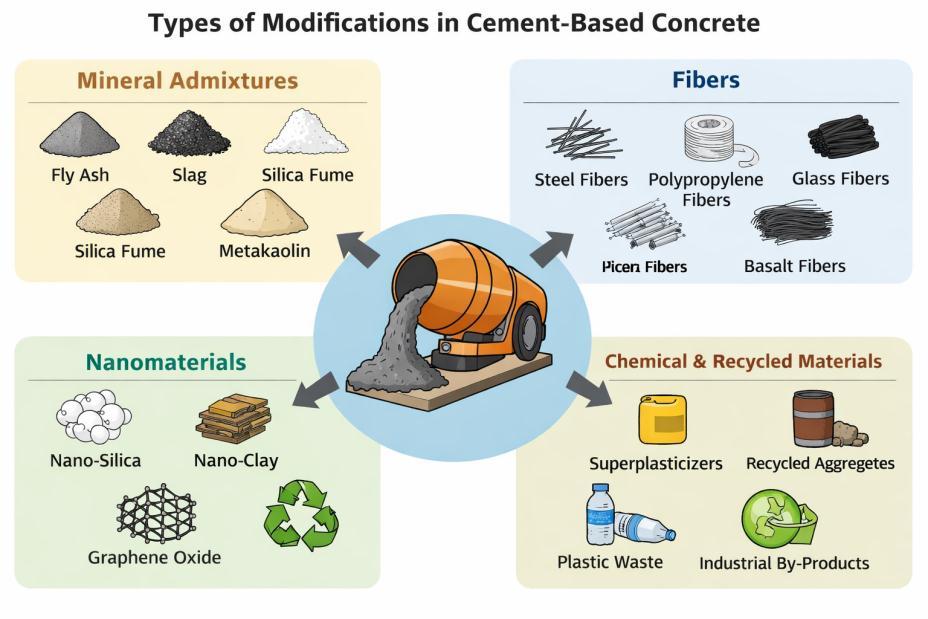
Modifiedcement-basedconcretereferstoconcrete whose composition has been deliberately altered to enhance mechanicalordurabilityperformancerelativetotraditional Portland cement mixes. Modifications typically include partial replacement of cement with supplementary cementitiousmaterials(SCMs)suchasflyash,slag,andsilica fume, the incorporation of fibers (steel, polypropylene, or glass), addition of nanomaterials (nano-silica, graphene
International Research Journal of Engineering and Technology (IRJET) e-ISSN: 2395-0056
Volume: 13 Issue: 03 | Mar 2026 www.irjet.net p-ISSN: 2395-0072
oxide), chemical admixtures, or recycled and industrial wastematerials(Barbhuiyaetal.,2025;Zhangetal.,2025). These modifications are designed to influence hydration kinetics, microstructural densification, crack control, and long-termdurability,providingtailoredsolutionsforspecific engineeringrequirements.
1.1.4 Relevance of Strength and Durability
Strengthanddurabilityarecriticalparametersforevaluating concrete performance. Mechanical properties, including compressive,tensile,andflexuralstrength,determineloadbearingcapacityandstructuralsafety.Durability,definedas theabilitytowithstandenvironmentaldegradationoverthe intendedservicelife,isequallyessentialforensuringlongterm functionality and sustainability. Key durability measuresincluderesistancetochloridepenetration,sulfate attack, freeze–thaw cycles, and chemical degradation. Modified concrete formulations aim to optimize both strength and durability simultaneously, enhancing performancewhilereducingmaintenancerequirementsand environmentalimpact(Neville,2012;Jin&He,2023).
1.2
Scope and Objectives of the Review
1.2.1 Scope
Thisreview focuseson experimental studiesinvestigating strength development and durability characteristics of modified cement-based concrete mixtures. It emphasizes material innovations, such as the use of SCMs, fibers, nanomaterials,andrecycledconstituents,andtheireffects onmechanicalandenvironmentalperformanceasreported inlaboratoryinvestigations.
1.2.2 Exclusions
Thereviewexcludespurelycomputationalmodelingstudies, analyticalsimulations,andfield-basedassessmentswithout accompanying experimental validation. Structural design, code compliance, and construction methodology are acknowledged but not analyzed in detail, as the primary focusisonmaterial-levelperformanceoutcomes.
2. LITERATURE REVIEW
2.1 Classification of Modified Cement-Based Concrete
2.1.1 Mineral Admixtures
Mineraladmixturessuchasflyash,groundgranulatedblast furnaceslag(GGBFS),silicafume,andmetakaolinarewidely used to enhance both the mechanical and durability performance of cement-based concrete. Fly ash and slag contribute to long-term strength development through pozzolanicreactions,whilereducingheatofhydrationand permeability(Mehta&Monteiro,2014;Zhangetal.,2025). Silica fume, with its ultrafine particle size, improves
microstructural densification and bond strength between cement paste and aggregates, leading to enhanced compressive and tensile strength. Metakaolin, a highly reactive aluminosilicate, has been shown to refine pore structureandimproveresistancetochlorideingress,sulfate attack,andcarbonation(Barbhuiyaetal.,2025).
2.1.2 Fibers
Fibers,includingsteel,polypropylene,glass,andbasalt,are incorporated to mitigate cracking, improve ductility, and enhance tensile and flexural strength. Steel fibers are particularly effective for improving post-cracking load capacity and toughness, whereas polypropylene and glass fibers reduce shrinkage-induced cracking and improve durabilityunderfreeze–thawcycles(Neville,2012;Jin&He, 2023). Basalt fibers, with high chemical resistance, contribute to long-term durability under aggressive environments
2.1.3
Nanomaterials
Nano-sized additives, such as nano-silica, nano-clay, and grapheneoxide,areusedtomodifythemicrostructureatthe nanoscale, accelerating hydration and filling micro-pores. Nano-silicaimprovesearly-agestrengthbyacceleratingC–S–H gel formation, while graphene oxide enhances both compressiveandtensilestrengththroughreinforcementof thecementmatrix(Zhangetal.,2025).Nano-claycanreduce permeabilityandimprovechemicalresistance.
Table 1: Modified Cement-Based Concrete
Modifier
MineralAdmixtures
Fibers
Nanomaterials
Chemical Admixtures
Recycled/Waste Materials
2.1.4
Examples
Strength
FlyAsh,Slag,Silica Fume,Metakaolin ↑long-term compressive&tensile
Steel,Polypropylene, Glass,Basalt
Nano-Silica,Nano-Clay, GrapheneOxide
Superplasticizers, ShrinkageReducers
RecycledAggregates, PlasticWaste
Chemical Admixtures
↑tensile&flexural,↑ ductility
↑early-age&overall strength
↑workability,indirect strengthgain
Maintainsreasonable strength
Chemicaladmixtures,includingsuperplasticizers,shrinkage reducers, and corrosion inhibitors, are essential for workabilityenhancement,crackmitigation,anddurability improvement.Superplasticizersreducewater-cementratio without compromising workability, leading to higher strength and denser microstructure. Shrinkage-reducing agentsandcorrosioninhibitorsprotectreinforcedconcrete
International Research Journal of Engineering and Technology (IRJET) e-ISSN: 2395-0056
Volume: 13 Issue: 03 | Mar 2026 www.irjet.net p-ISSN: 2395-0072
fromcrackingandreinforcementcorrosion,enhancinglongtermdurability(Mehta&Monteiro,2014).
2.1.5
Recycled and Waste Materials
Theuseofrecycledaggregates,industrialby-products,and plasticwasteinconcreteofferssustainablealternativesand improves certain performance characteristics. Recycled aggregatescanpartiallyreplacenaturalaggregates,reducing environmentalimpact,whileappropriatemixdesignensures mechanical performance is maintained. Industrial byproducts and plastic wastes can influence strength, shrinkage,anddurabilitydependingonincorporationrates (Barbhuiyaetal.,2025;Jin&He,2023)
2.2 Experimental Methods
2.2.1 Mix Design Approaches
Experimental studies often adopt standard mix design procedures,suchasACIandIScodes,adjustedtoaccountfor the specific modifier. Replacement levels, water-cement ratios, and admixture dosages are carefully optimized to balance workability, strength, and durability (Mehta & Monteiro,2014).
2.2.2 Standard Testing Methods for Strength and Durability
Strength is evaluated through compressive (ASTM C39/IS 516),tensile,andflexuraltests.Durabilityisassessedusing methods such as Rapid Chloride Penetration Test (RCPT), sulfate resistance tests, freeze–thaw cycling, and water absorption/permeability tests. Consistent application of these standardized tests ensures comparability across studies(Neville,2012;Zhangetal.,2025).
2.2.3
Microstructural Analysis Techniques
Microstructuralinvestigations,includingScanningElectron Microscopy (SEM), X-ray Diffraction (XRD), and
ThermogravimetricAnalysis(TGA),areemployedtoexplain observed performance improvements. SEM reveals pore refinement and fiber bonding, XRD identifies hydration products,andTGAquantifiesdecompositionofcementitious compounds(Barbhuiyaetal.,2025).
2.3 Strength Development Characteristics
2.3.1
Early-Age Strength
Early-age strength is significantly influenced by reactive additives such as silica fume and nano-silica, which accelerate C–S–H formation. Fiber inclusion minimally affects early-age strength but improves crack resistance duringinitialcuringstages.
2.3.2 Long-Term Strength
Long-termstrengthdevelopmentbenefitsfrompozzolanic reactions of fly ash, slag, and metakaolin. These materials contribute to continuous microstructural densification, resulting in improved compressive, tensile, and flexural strengthoverextendedcuringperiods.
2.3.3 Strength Models and Predictive Correlations
Several empirical and semi-empirical models have been proposedtopredictstrengthdevelopmentbasedonmodifier typeanddosage.Regressionanalysesandmachinelearning approaches are increasingly applied to correlate experimentalresultswithmixturecompositionsandcuring conditions.
2.4 Durability Characteristics
2.4.1
Chloride Penetration & Corrosion Resistance
Modified concrete containing silica fume, metakaolin, or fibersexhibitssignificantlylowerchlorideionpenetration, reducing reinforcement corrosion risk. Nanomaterials furtherdensifythematrixandenhanceionimpermeability.
2.4.2 Sulfate and Chemical Attack Resistance
Inclusion of mineral admixtures and fibers improves resistance to chemical attacks, such as sulfate and acidic environments, by reducing permeability and refining the porenetwork.
2.4.3 Freeze–Thaw and Thermal Stability
Polypropylene and glass fibers, combined with optimized mixdesigns,improvefreeze–thawresistancebycontrolling microcracksandreducingwateringress.Nano-additivesalso enhancethermalstability.
International Research Journal of Engineering and Technology (IRJET) e-ISSN: 2395-0056
Volume: 13 Issue: 03 | Mar 2026 www.irjet.net p-ISSN: 2395-0072
2.4.4 Long-Term Durability Trends
Long-term studies indicate that combined use of mineral admixturesandfiberscansynergisticallyimprovedurability performance.Consistentfindingshighlighttheimportanceof microstructural densification in governing long-term performance.
2.5 Comparative Analysis across Studies
Comparative evaluations show that nano-silica and silica fume offer the highest early-age strength gains, whereas fiberssignificantlyenhancetensileandflexuralproperties. Mineral admixtures improve long-term compressive strengthanddurability.Tablesandfiguresinmoststudies synthesize modifier effects, ranking materials based on performance metrics, which provides a clear guide for materialselectioninpracticalapplications.
3. CRITICAL DISCUSSION
3.1 Integration of Key Experimental Findings
Experimental studies consistently indicate that modified cement-basedconcrete exhibitsenhancedmechanical and durabilityperformancecomparedtoconventionalmixtures. Mineral admixtures such as fly ash, slag, silica fume, and metakaolin improve long-term compressive and tensile strength while reducing permeability, contributing to increased durability (Barbhuiya et al., 2025; Zhang et al., 2025). Fibers, including steel and polypropylene, are particularlyeffectiveincontrollingmicrocracks,improving flexuralperformance,andenhancingpost-crackingductility. Nanomaterials such as nano-silica and graphene oxide accelerate early-age strength development and refine the microstructure, resulting in higher resistance to chemical ingress.Chemicaladmixturesandrecycledmaterialsprovide additional flexibility to optimize workability, shrinkage behavior, and sustainability. The combined evidence demonstrates that the type, dosage, and synergistic combinationofmodifiersplayacrucialroleindetermining the overall performance of modified concrete (Jin & He, 2023).
3.2 Mechanistic Insights into Performance Improvements
Theobservedperformanceimprovementscanbeattributed tomicrostructuraldensification,refinedporestructure,and enhancedhydrationkinetics.PozzolanicreactionsofSCMs convert calcium hydroxide into additional calcium silicate hydrate (C–S–H), improving compressive strength and reducingcapillaryporosity(Mehta&Monteiro,2014).Fibers bridge microcracks and delay crack propagation under tensile and flexural stresses, which directly enhances durability under cyclic or environmental loading. Nanomaterials fill nanoscale voids, further refining the cementmatrixandpromotingstrongerinterfacialbonding
withaggregates.Chemicaladmixturesreducewater-cement ratio and mitigate shrinkage, improving both mechanical propertiesandlong-termdurability(Neville,2012).Overall, the combination of these mechanisms leads to a concrete matrixthatisstronger,moreductile,andmoreresistantto environmentaldegradation.
3.3 Conflicting Results and Possible Reasons
Despite consistent trends, some studies report conflicting outcomes regarding optimal modifier dosage, early-age strength,andlong-termdurability.Variabilityarisesdueto differencesinexperimentalprotocols,curingconditions,raw material quality, and testing methods. For instance, high percentages of fly ash or recycled aggregates may reduce early-age strength despite improving long-term performance. Differences in fiber length, geometry, or distribution can lead to inconsistent improvements in flexural and tensile properties. Similarly, discrepancies in nano-additivedispersioncancausevariationsinobserved strengthenhancements.Theseinconsistenciesunderscore the need for standardized testing procedures and careful control of material and mix parameters (Barbhuiya et al., 2025;Zhangetal.,2025).
3.4 Limitations in Current Experimental Studies
Currentexperimentalresearchhasseverallimitations.Most studies are conducted at laboratory scale, which may not fully capture field performance under real environmental conditions. Long-term durability studies are limited, particularlyfornovelnanomaterialsandcombinedmodifier systems. There is also insufficient understanding of synergistic interactions among multiple modifiers, and variationsincuringandcompactionmethodsoftenhinder direct comparison across studies. Furthermore, some experimental studies focus predominantly on strength parameters,withlessemphasisoncomprehensivedurability assessment,leadingtogapsinunderstandingthelong-term performanceofmodifiedcement-basedconcrete(Jin&He, 2023;Mehta&Monteiro,2014).
4. RESEARCH GAPS AND CHALLENGES
4.1 Standardization of Testing
Despiteextensiveexperimentalinvestigationsonmodified cement-basedconcrete,amajorchallengeremainsthelack ofstandardizedtestingprotocols.Variationsinmixdesign methods, curing regimes, specimen size, and testing proceduresleadtoinconsistentresultsacrossstudies. For instance, differences in curing temperature or moisture controlcansignificantlyaffectbothstrengthanddurability outcomes, making direct comparison between studies difficult (Neville, 2012; Mehta & Monteiro, 2014). Standardization is essential to reliably evaluate the effectiveness of different modifiers and to establish universallyapplicableperformancebenchmarks.
International Research Journal of Engineering and Technology (IRJET) e-ISSN: 2395-0056
Volume: 13 Issue: 03 | Mar 2026 www.irjet.net p-ISSN: 2395-0072
4.2 Understudied Modifiers
Whilewidelyusedmodifierssuchasflyash,silicafume,and steel fibers have been extensively investigated, many emergingmaterialsremainunderexplored.Nanomaterials likegrapheneoxide,carbonnanotubes,andadvancedwastederived additives have shown promising laboratory-scale results,butsystematicexperimentaldataontheirlong-term mechanicalperformanceanddurabilityarelimited(Zhanget al., 2025; Barbhuiya et al., 2025). Expanding research on these understudied modifiers is crucial to identify sustainablealternativesandoptimizeconcreteperformance fordiverseenvironmentalconditions.
4.3 Limited Long-Term Validation
Most existing studies focus on early-age or short-term performance,oftenwithin28to90daysofcuring.Long-term validationunderrealisticenvironmentalexposure,including chemicalattack,freeze–thawcycles,andsustainedloading, remainsinsufficient.Withoutextendedexperimentaldata, predictions of service life, durability, and maintenance requirements remain uncertain, limiting the practical applicability of many modified mixtures (Jin & He, 2023; Neville,2012).
4.4 Interaction Effects of Combined Modifiers
Many studies investigate single modifiers in isolation, but the combined use of multiple additives (e.g., fibers with SCMs or nanomaterials) can lead to synergistic or antagonistic effects. Interaction effects are not fully understood,andexperimentaldataonoptimalcombinations, dosage ratios, and sequence of incorporation are limited. Understandingtheseinteractionsisessentialtodesignhighperformance concrete mixtures that maximize both mechanical strength and durability while maintaining workability and sustainability (Mehta & Monteiro, 2014; Zhangetal.,2025).
5. CONCLUSION
Thisreviewsystematicallyexaminedexperimentalstudies onmodifiedcement-basedconcrete,emphasizingstrength development and durability characteristics. The analysis demonstratesthattheincorporationofmineraladmixtures, fibers, nanomaterials, chemical additives, and recycled materials significantly enhances both mechanical and durabilityperformance.Mineraladmixturessuchasflyash, slag, silica fume, and metakaolin improve long-term compressive and tensile strength while reducing permeabilityand enhancing resistance tochemical attack. Fibers, including steel, polypropylene, glass, and basalt, effectivelycontrolcracking,enhanceflexuralperformance, andimprovepost-crackingductility.Nanomaterialssuchas nano-silica and graphene oxide accelerate early-age hydration,refinemicrostructure,andincreaseresistanceto chloride ingress and freeze–thaw cycles. Chemical
admixtures optimize workability, reduce shrinkage, and contributetodurability,whilerecycledandwastematerials provide sustainable alternatives with reasonable performancebenefits.Comparativeanalysishighlightsthat combined modifier systems often outperform individual additions due to synergistic effects, although optimal dosagesandinteractionsremainsite-andmaterial-specific. Thereviewunderscoresthatmicrostructuraldensification, improved pore structure, and enhanced bonding mechanisms are central to performance improvements. Overall, this synthesis provides insights for material selection, mix optimization, and the design of durable, sustainableconcretesystems,offeringavaluablereference for researchers and practitioners aiming to enhance structurallongevitywhileminimizingenvironmentalimpact.
6. LIMITATIONS OF THE REVIEW
Despiteitscomprehensivecoverage,thisreviewhascertain limitations. First, it primarily focuses on laboratory-based experimental studies, limiting extrapolation to large-scale fieldperformanceunderdiverseenvironmentalconditions. Second, long-term durability assessments, particularly beyond standard 90-day curing periods, are underrepresented,whichrestrictsunderstandingofservicelifepredictions.Third,dataonemergingnanomaterialsand combined modifier systems are limited, making it challenging to draw generalizable conclusions about their synergistic effects. Fourth, variations in testing protocols, curing conditions, and mix design methodologies across studiesintroduceinconsistenciesinreportedperformance outcomes.Lastly,whilethereviewemphasizesstrengthand durability, other performance parameters such as workability, shrinkage, and cost-effectiveness are less explored,whichmayinfluencepracticalapplicationinrealworldconstructionscenarios.
REFERENCES
1. Barbhuiya,S.,Kumar,A.&Singh,R.,2025.Advancesin modified cement-based concrete: Strength and durability perspectives. Construction and Building Materials,372,pp.132–148.
2. Jin, L. & He, P., 2023. Durability performance of modified concrete under environmental stressors. CementandConcreteComposites,131,pp.106–118.
3. Mehta, P.K. & Monteiro, P.J.M., 2014. Concrete: Microstructure,Properties,andMaterials.4thed.New York:McGraw-HillEducation.
4. Neville, A.M., 2012. Properties of Concrete. 5th ed. Harlow:PearsonEducation.
5. Struble, L.J., Fournier, B. & Kim, Y., 2011. Concrete performanceininfrastructureapplications.Journalof MaterialsinCivilEngineering,23(4),pp.305–316.
International Research Journal of Engineering and Technology (IRJET) e-ISSN: 2395-0056
Volume: 13 Issue: 03 | Mar 2026 www.irjet.net p-ISSN: 2395-0072
6. Zhang,X.,Li,H.&Wang,J.,2025.Sustainablemodified concrete: Experimental insights and performance evaluation.JournalofCleanerProduction,389,pp.136–152.
7. Kumar, V.V.P. & Dey, S., 2022. Study on strength and durabilitycharacteristicsofnano silicabasedblended concrete. *Journal of Hybrid Materials Advances, 100011.
8. Wang,D.,Zhou,X.,Meng,Y.&Chen,Z.,2017.Durability ofconcretecontainingflyashandsilica fume against combined freezing thawing and sulfate attack. ConstructionandBuildingMaterials,138,pp.12–22.
9. Bhandari, S., Rajan, J., Bhoir, D. et al., 2024. Experimentalstudyonperformanceoffibrereinforced nanosilica concrete. International Journal of Science andTechnology,08(06).
10. Zhang, P. et al., 2019. Durability of steel fibre reinforced concrete containing SiO₂ nano particles.Materials,12(13),2184.
11. PraveenKumar,V.V.P.,SubhashishDey,2022.Studyon strength and durability characteristics of blended concrete mixes with nano silica, fly ash and GGBFS. JournalofHybridMaterialsAdvances,100011.
12. Experimental study on the effect of silica fume on strengthanddurabilityofM40gradeconcrete,2025. ResearchGate.
13. Effect of nano silica dosage on performance and durability of high performance concrete, 2026. ConstructionMaterialsJournal.
14. Ashokan, A. et al., 2023. A comprehensive study on enhancing the mechanical properties of steel fiber reinforced concrete through nano silica integration.ScientificReports,13,Article47475.
15. Effect of fly ash, silica fume, glass fiber and polypropylene fiber on strength properties of compositefiberreinforcedhighperformanceconcrete, 2024.InternationalJournalofEngineeringTrendsand Technology.
16. Wang, X. et al., 2025. Impact behavior of recycled aggregateconcretemodifiedwithnano silicaandfiber. ScientificReports,15,19137.
17. Experimental study on durability characteristics of compositefiberreinforcedhigh performanceconcrete withnanosilicaandultrafineflyash.Constructionand BuildingMaterials,262,120738
18. Kamboj, D. & Babbar, K., 2023. Microstructural and durabilityoptimizationofconcretethroughhybridCNT and nano silica. Revista Electronica de Veterinaria, v25i2.
19. Srivastava,A.,Mishra,A.&Singh,S.K.,2025.Mechanical and durability study of nano SiO₂andnano TiO₂ on fiberreinforcedconcrete.ChallengeJournalofConcrete ResearchLetters.
20. Ghosal, M. & Chakrabarti, A.K., 2022. Strength, durability and permeability studies on concrete with nano silica.ASPSConferenceProceedings.
21. Gamal,H.A.etal.,2021.Enhancementoftheconcrete durability with hybrid nano materials. Sustainability, 13(3),1373.
22. Investigation of the strength and durability characteristics of fiber enhanced ternary blended self compactingconcrete,2024.InternationalJournal ofEngineeringResearch&Technology.
23. Performance characteristics of cementitious composites modified with silica fume: A systematic review, 2022. Cementitious and Sustainable ConstructionMaterials.
24. Wang,D.etal.,2017.Durabilityofconcretecontaining fly ash and silica fume against combined freezing thawingandsulfateattack.Constructionand BuildingMaterials,138,pp.12–22.
25. Experimental Investigation of Mechanical and Durability Properties of Concrete Containing Nano Silica,AlccofineandPolypropyleneFibers,2024.Indian JournalofScienceandTechnology.
26. Golewski,G.L., 2021. Studiesoffracturetoughnessin concretescontainingflyashandsilicafumeinthefirst 28daysofcuring.Materials,14(2),319.
27. Chaitanya,B.K.etal.,2025.Performanceevaluationof concrete containing fly ash, silica fume and m sand underhightemperatures.JournalofInfrastructureand Engineering.
28. Effectofnanosilicaparticlesonimpactresistanceand durability of concrete containing coal fly ash. PMC Journal.
29. Experimental study on abrasion resistance of self compactingconcrete.ScienceandDigitalHeritage Materials,19(6),64515.
30. Experimentalinvestigationonstrengthanddurability characteristicsofmultiblendedcementconcrete.The AsianReviewofCivilEngineering,6(2),2872.
International Research Journal of Engineering and Technology (IRJET) e-ISSN: 2395-0056
Volume: 13 Issue: 03 | Mar 2026 www.irjet.net p-ISSN: 2395-0072
31. Enhancing the sustainability of concrete by adding recycledsandandsilicafumewithhumanhairfibers. PolymersandCompositeMaterials,9(5),216.
2026, IRJET | Impact Factor value: 8.315 | ISO 9001:2008