
International Research Journal of Engineering and Technology (IRJET) e-ISSN: 2395-0056
Volume: 12 Issue: 05 | May 2025 www.irjet.net p-ISSN: 2395-0072
International Research Journal of Engineering and Technology (IRJET) e-ISSN: 2395-0056
Volume: 12 Issue: 05 | May 2025 www.irjet.net p-ISSN: 2395-0072
Keerthi Kumar K J
Undergraduate Student, Electronics and Communication Engineering Department, KPR Institute of Engineering and Technology, Tamil Nadu, India
Abstract – This paper presents the design and partial implementationofaninnovativemosquitoeradicationsystem that combines a multi-component attractant paste, UV light stimulation, and a high-voltage electrified grid powered by a rechargeable battery. The system aims to provide a sustainable, non-toxic solution to mosquito control by simulating human odor and breath to lure mosquitoes and eliminating them through a custom-designed high-voltage circuit. The attractant paste includes a synergistic blend of lactic acid, octenol, hexanal, ethanol, and controlled carbon dioxideemissionthroughbiochemicalandchemicalreactions. Thecircuitoperatesonageneral-purposerechargeablepower source. Initial prototype tests demonstrated reliable circuit performance, with visible spark activity confirming voltage output. This work contributes a novel, integrated approach toward effective mosquito management that is suitable for residential applications
Key Words: Mosquito Eradication, High-Voltage Circuit, AttractantPaste,UVLightTrap,RechargeableSystem,Insect ControlDevice,SustainableMosquitoKiller
Diseasestransmittedbymosquitoes likemalaria,dengue, and Zika remain a major health concern worldwide, especiallyintropicalandsubtropicalclimates.Conventional mosquito control methods, including insecticide sprays, coils,andbasicelectriczappers,haveshownlimitedefficacy and may introduce environmental or health risks [1]. Furthermore,increasingresistancetochemicalinsecticides hasreducedtheirlong-termviability.
In response to these limitations, this research proposes a novel,integratedmosquitoeradicationsystemthatcombines chemical,electrical,andoptical componentsintoa unified solution. The objective is to enhance mosquito attraction through biomimicry of human breath and sweat while delivering an energy-efficient and high-impact electrical elimination.Thesystemisdesignedwithsustainabilityand safetyaskeyfeatures,makingitapplicabletoresidentialand low-resourcesettings.
This section outlines the core components and working principles of the proposed mosquito eradication system,
which integrates chemical, optical, and electrical technologies into a single, efficient device. The system is built with a focus on ease of use, operational safety, and multi-channel mosquito luring to improve eradication performance.
UVLightSource:Thesystemusesahigh-power365nm UVLEDtosimulatethevisualstimulimosquitoesnaturally seekduringnocturnalactivity[2].TheUVLED servesasa primarylure,particularlyeffectiveinlow-lightconditions, directingmosquitoestowardthecoreeliminationzone.
Multi-ComponentAttractantPaste:Theinnovativeattractant paste is formulated to mimic human breath and sweat, integrating both biochemical and oxidative methods to generatecarbondioxide(CO₂)andodormimics.
CO₂ReleaseStrategy:Thesystememploysmultiple reaction methods to generate carbon dioxide, including fermentation using sugar and yeast, a citricacid–bakingsodareaction,andthehydration ofcalciumoxideforextendedemissionphases.
OdorComponents:Lacticacid,octenol,hexanal,and ethanolsimulatesweatandskinvolatiles[3].
Supplementary Oxidation: Carbon dust and potassiumpermanganate(KMnO₄)reacttorelease additionalCO₂.
Theattractantpasteisdesignedforslow,controlledrelease over2–3days,enhancinglong-termlureeffectiveness.
OscillatorCircuit:Abasicdriversetupgeneratespulsesto activatethetransformer,enablingvoltageamplificationin thesystem.Theoutputofthetransformerisconnectedtoa basicvoltagemultiplyingstagetogeneratetherequiredhigh voltageneededformosquitoelimination.
ElectrifiedMeshGrid:Astainlesssteelorcopperwiremesh with 1–2mm spacing receives the high-voltage output. Mosquitoes that come into contact with the mesh are instantlyneutralizedbythehigh-voltagedischarge.
International Research Journal of Engineering and Technology (IRJET) e-ISSN: 2395-0056
Volume: 12 Issue: 05 | May 2025 www.irjet.net p-ISSN: 2395-0072
High-voltage insulated wires prevent leakage and accidentalcontact.
Ahigh-resistancelimitingresistorensurescurrent remainslowforsafety.
Thesystemisenclosedinaprotectivecasingwith appropriateventilationandwarninglabels.
Thedeviceispoweredbyasinglerechargeablebattery, offeringasimpleandreusableenergysolution.Chargingis doneusinganexternalDCadapter,whichpowersthebattery and enables reuse after discharge. This simple setup is designedtobecost-effectiveandeasytomaintainforbasic fielduse.
Thephysicalprototypeoftheproposedsystemconsistsofa compact enclosure featuring a hollow central chamber designedtohousethemulti-componentattractantpaste.The topcoverofthedeviceincorporatestheelectrifiedmeshgrid and a strategically positioned UV LED. This arrangement ensuresthatoncethepasteisplacedinsideandthesystemis poweredon,mosquitoesattractedtotheUVlightandodor cues enter through the top section and come into contact withtheelectrifiedgrid.
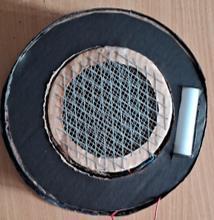
Initialcircuitintegrationeffortssuccessfullydemonstrated high-voltage generation through a basic zapper circuit, visibly confirmed by spark generation across the grid. Althoughafinalizedprintedcircuitboardorenclosurewas notdevelopedatthisstage,theworkingprototypevalidates thesystem'seliminationcapability.
Additionally,fieldobservationsconfirmedtheeffectiveness of the attractant paste alone. Samples of the paste were deployedatvariousoutdoorlocationsaroundthecampus. Within a few hours, visible groups of mosquitoes were successfullydrawntothepasteandbecametrappedwithin it. Photographic evidence was collected to support these findings.
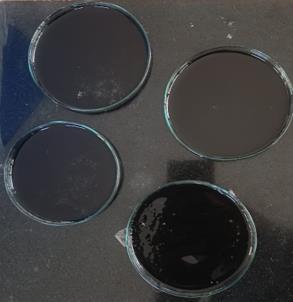
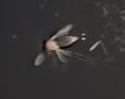
These results, while early-stage, demonstrate both componentsofthesystemfunctioningasintended:effective mosquitoattractionandconfirmedelectrocutionviahighvoltagedischarge.Furthertestingwithanenclosedcircuit andlong-termdeploymentisplannedasfuturework.
International Research Journal of Engineering and Technology (IRJET) e-ISSN: 2395-0056
Volume: 12 Issue: 05 | May 2025 www.irjet.net p-ISSN: 2395-0072
The development of this mosquito eradication system addresses key limitations found in traditional control methodsbyintegratingmultipleattractionmechanismsand a robust high-voltage elimination module. Integrating UV illumination with a chemically active attractant enhances boththereachandtargetingefficiencyofthemosquitolure system. Moreover, the high-voltage discharge mechanism ensures rapid elimination without the use of harmful chemicals.
The use of a general-purpose rechargeable power system and a simple oscillator-based circuit makes the design practical,economical,andeasilydeployable.Thesefeatures make the device particularly suitable for everyday use in low-resourceenvironments.
Challengesremain,particularlyregardingtheoptimizationof componentdurability,attractantpastelongevity,andlongterm circuit reliability. The prototype's success in initial attraction and electrocution tests justifies further developmenttowardafullyintegratedandmanufacturable solution.
Thisstudyintroducesanovelmosquitoeradicationdevice that combines biochemical and electrical mechanisms to attract and eliminate mosquitoes in a safe, sustainable manner. Through its integration of UV light, a multicomponent attractant paste, and a general high-voltage circuit, the system demonstrates promising functionality duringearly-stagetesting.Whileafullyenclosedandlongtermdeployableprototypeisstillinprogress,initialresults validate the system's conceptual integrity and practical potential.
Futureimprovementswillfocusonrefiningthemechanical enclosure, improving the attractant's stability in diverse climates, and automating activation mechanisms. With further development and large-scale testing, this device couldserveasanefficientalternativetotraditionalmosquito control methods, especially in high-risk and underserved regions.
[1] WHO, "Vector-borne diseases," World Health Organization, May 2024. [Online]. Available: https://www.who.int/news-room/factsheets/detail/vector-borne-diseases.
[Accessed:May2024].
[2] E.P.Mwanga,H.S.Ngowo,S.A.Mapua,A.S.Mmbando, E.W.Kaindoa,K.Kifungo,andF.O.Okumu,"Evaluation of an ultraviolet LED trap for catching Anopheles and
Culexmosquitoesinsouth-easternTanzania,"*Parasites & Vectors*, vol. 12, no. 1, p. 3673, 2019. [Online]. Available: https://parasitesandvectors.biomedcentral.com/article s/10.1186/s13071-019-3673-7
[Accessed:May2025].
[3] B.D.Sumner,B.Amos,J.Bello,andR.T.Cardé,"L-lactic and 2-ketoglutaric Acids, Odors from Human Skin, GovernAttractionandLandinginHost-SeekingFemale AedesaegyptiMosquitoes,"*J.Med.Entomol.*,vol.58, no. 2, pp. 123–135, 2024. [Online]. Available: https://ouci.dntb.gov.ua/en/works/4wda6DGl/.
[Accessed:May2025].
[4] Y.Li,X.Su,G.Zhou,H.Zhang,S.Puthiyakunnon,S.Shuai, S.Cai,J.Gu,X.Zhou,G.Yan,andX.-G.Chen,"Comparative evaluationoftheefficiencyoftheBG-Sentineltrap,CDC light trap and Mosquito-oviposition trap for the surveillance of vector mosquitoes," *Parasites & Vectors*,vol.9,no.1,p.1724,2016.[Online].Available: https://link.springer.com/article/10.1186/s13071-0161724-x.
[Accessed:May2025].