
International Research Journal of Engineering and Technology (IRJET) e-ISSN: 2395-0056
Volume: 12 Issue: 10 | Oct 2025 www.irjet.net p-ISSN: 2395-0072
International Research Journal of Engineering and Technology (IRJET) e-ISSN: 2395-0056
Volume: 12 Issue: 10 | Oct 2025 www.irjet.net p-ISSN: 2395-0072
Dr.G.Arutjothi1, Dr.K.Geetha2
1 Assistant Professor, Dept. of Computer Applications, Sona College of Arts and Science,Tamil Nadu, India
2Lecturer, Dept. of Computer Applications, Government Arts College (Autonomous),Tamil Nadu, India
Abstract - This paper aims to develop a crop recommendationsystemusingmachinelearningtechniques with Python, designedto assist farmers inchoosing the best crops for their fields. The system analyzes essential soil and environmentalparameterssuchasNitrogen(N),phosphorus (P), and Potassium (K) content in the soil, temperature, humidity, soil pH level, and rainfall. These parameters are utilizedtotrainvariousmachinelearningmodels,including Logistic Regression, Support Vector Machine(SVM), KNearest Neighbor, Decision Tree, Random Forest, Bagging, and Gradient Boosting classifiers. The Random Forest Classifierwasidentifiedasthemostaccuratemodelthrough extensiveevaluation.Thesystemhasbeenimplementedasa user-friendly website to support agricultural officers in providingfarmerswithreal-timedataanalysisforinformed decision-making. This system strives to enhance farming efficiency,optimizeresourceusage,andimprovecropyields by offering tailored crop recommendations. This paper represents a significant advancement in smart agriculture, leveraging technology to support sustainable farming practices andachieve better outcomes.
Keywords: Machine Learning, RecommendationSystem, Random Forest Classifier, Accuracy, Environmental Factors
The Crop Recommendation System is an innovative initiative aimed at revolutionizing traditional farming methods by integrating advanced machine learning technologies.Itsprimaryobjectiveistoassistfarmersin making informed, data-driven decisions regarding crop selection, which is essential for maximizing agricultural productivity and promoting sustainable practices. By utilizingmachinelearning,thesystemevaluatesintricate datasetsthatincludekeysoil andenvironmental factors, providing customized crop recommendations tailored to specific farm conditions. These parameters include soil nutrients such as Nitrogen (N), phosphorus (P), and Potassium(K),alongwithtemperature,humidity,soilpH levels,and rainfall.Theprojectemploys Python, a highly adaptableprogramminglanguage,tobuildandexecutethe machine-learning algorithms necessary for crop recommendation.LeveragingPython'spowerfullibraries, including scikit-learn, pandas, and numpy, the system efficientlyhandlesdataanalysisandmodeldevelopment.
Several machine learning models, such as Logistic Regression,SupportVectorClassifier(SVC),K-Neighbors Classifier, Decision Tree Classifier, Extra Tree Classifier, RandomForestClassifier,BaggingClassifier,andGradient Boosting Classifier, were trained and assessed based on performance metrics. Among these, the Random Forest Classifierstoodoutforitsaccuracyandrobustness,making ittheidealchoiceforimplementation.
Toenhanceaccessibility,thesystemispresented as an intuitive web application developed using Visual Studio.Theplatformallowsagriculturalprofessionalsand farmerstoinputreal-timedataandreceiveimmediatecrop recommendations. Features such as user-friendly data input forms, interactive visualizations, and detailed crop analysisreportsensurethatuserscaneasilynavigateand utilizethesystemwithoutrequiringtechnicalexpertise.
TheCropRecommendationSystemprojectoffers recommendationsforvariouscrops,cateringtodifferent regionsandclimaticconditions.Utilizingmachinelearning and a user-friendly website, it provides data-driven insights for farmers, enabling informed decision-making andimprovedcropyields.Thisprojectdemonstratesthe potential of technology in transforming agriculture, supportingsustainablefarmingpractices,andcontributing to food security and economic stability.This study representsacrucialadvancementinpromotingsustainable agriculture, enabling well-informeddecision-makingand contributing to enhanced crop yields and environmental conservationwithinthefarmingindustry.
Grasslands, the world’s largest terrestrial ecosystem,areavitalfeedsourceforlivestock.Addressing the growing global demand for meat and dairy products sustainably poses significant challenges. Technological advancementssuchastheGlobalPositioningSystem(GPS) andground-basedsensorsshowpromiseforgrasslandand herdmanagement.Additionally,theincreasingavailabilityof spaceborne remote sensing data highlights the need to refine methods for exploiting such imagery. Biophysical parameter retrieval for grasslands has progressed from classicalregressionanalysistomoresophisticatedmodeling techniques,thoughhigh-qualitycalibrationandvalidation data remain critical. The development of hyperspectral
International Research Journal of Engineering and Technology (IRJET) e-ISSN: 2395-0056
Volume: 12 Issue: 10 | Oct 2025 www.irjet.net p-ISSN: 2395-0072
satelliteinstrumentsandanalyticalmethodscouldimprove habitatdiscriminationandend-useroperations,facilitating sustainableresourcemanagement[1].
Agriculture, a cornerstone of human livelihoods, must adapt to challenges such as environmental sustainability,climatechange,andpopulationgrowthwhile continuingtoprovideessentialresourceslikefood,fibers, andrawmaterials.Remotesensingoffersapowerfultoolfor monitoring crop status at varying scales, supporting applicationssuchascropbreeding,landuseanalysis,yield forecasting, and ecosystem services evaluation. Recent advancements in techniques and research enhance the applicabilityofremotesensingforagriculturalapplications, strengthening its role in providing efficient, long-term solutions[11].
India,rankingsecondgloballyinagriculture,faces challenges related to irrigation, fertilization, and crop rotation. To address these, the ACRIS system integrates InternetofThings(IoT)andmachinelearningtechnologies to improve crop yield. It features three key modules: the ARVRecommendationSystem,whichidentifiesagricultural factors,andtheAIMSystem,whichpredictsirrigationneeds based on soil moisture, temperature, and humidity. This system supports precision farming by optimizing waterresource utilization and enabling effective monitoring of large-scalecropfields[7].
Foodshortagesdrivenbyclimatecrises,wars,and the COVID-19 pandemic emphasize the need for efficient farmland management. Machine learning is increasingly applied to soil analysis, incorporating factors such as climate, soil chemistry, nutrients, and geolocations. Advancedsystemscombiningsoilanalysiswithdata-driven models, satellite data, and remote sensors enable smart farmingpractices,promotingsustainabilityandhighercrop yields [5]. Feder et al. propose a machine learning-based crop recommendation system to enhance sustainable agricultural practices. By analyzing parameters such as nitrogen,phosphorus,potassium,andhumidity,algorithms like K-Nearest Neighbor (KNN), Decision Tree, Random Forest,andSupportVectorMachine(SVM)predictsuitable crops. This system aids farmers, researchers, and policymakersindecision-making,promotingincreasedcrop productivity[4].Therisingglobalpopulationunderscores theimportanceofhealthycropproduction,whichdirectly impacts economic stability. IoT, cloud computing, and machinelearninghaverevolutionizedvariousagricultural stages, from crop selection to harvest. The IoTSNA-CR model,anIoT-enabledsoilnutrientclassificationandcrop recommendationsystem,aimstoreducefertilizerusewhile maximizingproductivity.ThissystemcollectsdataviaIoT sensors, stores it in cloud memory, and applies machine learning techniques for analysis. By integrating hybrid algorithms,themodelachieveshighaccuracy(97.3%)and supports efficient soil management, reducing costs while boostingproductivity[8].Despitetheirpotentialtoenhance agricultural productivity, technological innovations face
barrierstoadoptioninlessdevelopedcountries.Challenges such as limited access to credit, information, and infrastructure,coupledwithaversiontoriskandsmallfarm sizes, hinder widespread implementation. Development initiatives focusing on credit provision, information dissemination,andinfrastructureinvestmenthaveseenonly partial success. Uniform adoption of these innovations remainsasignificantchallenge[3].
Machinelearningisincreasinglyappliedtosolve agriculturalproblems,particularlyincroprecommendation and yield prediction. Reddy et al. propose a three-tiered framework comprising data preprocessing, classification, and performance evaluation. Techniques like correlation analysis,ensembling,andmajorityvotingareutilized,with the Naïve Bayes classifier achieving a high accuracy of 99.54%, outperforming ensemble methods. The study highlights future research directions and challenges in implementingmachinelearningforagriculture[6].Similarly, Stormetal.analyzemachinelearningapproachesfroman economist's perspective, discussing limitations like inflexiblefunctionalformsandcomplexsimulationmodels, and suggesting solutions to address these issues [10]. Sheykhmousaetal.conductameta-analysisof251journal paperstoreviewtheperformanceofRandomForest(RF) and Support Vector Machines (SVM) in remote sensing image classification. The study evaluates factors such as spatial resolution, feature engineering, and data types, providing recommendations and identifying challengesto guidefutureresearchefforts[9].
Ftomthisliteratureservaywehavefindtheagricultural sectorfaceschallengessuchascropselectionbasedonsoil andclimaticconditions,climatechangevariability,andlack of a systematic, data-driven approach to crop recommendation. Traditional methods often rely on intuition and historical practices, leading to suboptimal yieldsandfinanciallosses.Climatechangealsocomplicates crop selection, with changes in temperature, rainfall, and humidity affecting crop growth and yield. The lack of comprehensivedataandtoolsforfarmersalsocontributes toinefficientresourceuse,increasingcostsandaffectingsoil health and biodiversity. A machine learning-based crop recommendation system can help farmers make more informed decisions, leading to better yields, efficient resource use, and sustainable agricultural practices. This project aims to address these issues by developing a machinelearning-basedsystem.
TheproposedCropRecommendationSystemaimsto addressthelimitationsoftheexistingsystembyleveraging advanced technologies, particularly machine learning, to providedata-drivencroprecommendations.Theproposed
International Research Journal of Engineering and Technology (IRJET) e-ISSN: 2395-0056
Volume: 12 Issue: 10 | Oct 2025 www.irjet.net p-ISSN: 2395-0072
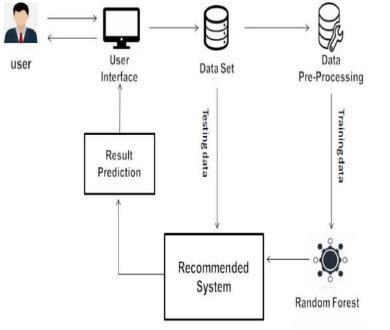
system utilizes extensive data collection from various sources, including soil nutrient sensors, environmental sensors,andweatherstations.Thisdataisusedtocreatea comprehensive profile of the soil and environmental conditions.Machinelearningmodelsaretrainedonthisdata toidentifypatternsandmakeaccuratepredictionsaboutthe most suitable crops for a given piece of land. This datadrivenapproachensuresthatrecommendationsarebased on empirical evidence rather than anecdotal knowledge. Several machine learning models, including Logistic Regression, Support Vector Classifier (SVC), K-Neighbors Classifier, Decision Tree Classifier, Gradient Boosting Classifier, are evaluated to determine the most accurate model.TheRandomForestClassifierischosenforitshigh accuracyandrobustnessinhandlingvariousdatatypes.This model uses ensemble learning to improve predictive performance by combining multiple decision trees. The proposedarchitectureisgiveninfigure1.
The proposed system is designed to be adaptive and responsive to changing environmental conditions. It continuouslyupdatesitsrecommendationsbasedonrealtime data from sensors and weather stations. This adaptabilitymakesthesystemmoreresilienttotheeffects of climate change, helping farmers select crops that are morelikelytothriveundervariableconditions.
Crop Recommendation System focuses on capturing essential soil and environmental parameters fromtheuser.TheseparametersincludeNitrogen(N)ratio, Phosphorous(P)ratio,Potassium(K)ratio,temperature, humidity,soilpH,andrainfallarecollectedfromsensors and agricultural datasets. This work collected sample datasetbyKaggle[12].Thisdatasetcontain2200instances and7attributesfromthisdataset80%dataisfortraning and 20% data is for testing. The data is cleaned and preprocessed using normalization and transformation
techniques. The attributes are mentiones in the below table.
Table1: SoilDatasetattributes
Attribute Name Description
nitrogen
phosphorous
potassium
temperature
humidity
pH
Rainfall
RatioofNitrogencontent(%)
RatioofPhosphorouscontent(%)
RatioofPotassiumcontent(%)
TemperatureindegreesCelsius
Relativehumidity(%)
SoilpHvalue
Rainfallinmm
This section presents the findings and model accuracy comparisons.The preprocessed data fed into various machine learning models were trained and evaluated,includingLogisticRegression,SVC,K-Neighbors, Decision Tree, Extra Tree, Random Forest, Bagging, and GradientBoostingClassifiers.TheRandomForestClassifier wasselectedforitssuperioraccuracy.ThePythonlanguage is used to implement the models. Table2 contains the accuraciesofvariousmodels.
Table2: Results
Table: Model Accuracies
Model Accuracy
LogisticRegression 0.9636
SVC 0.9682
K-NeighborsClassifie 0.9591
DecisionTreeClassifier 0.9886
ExtraTreeClassifier 0.8977
RandomForestClassifier 0.9932
BaggingClassifier 0.9886
GradientBoostingClassifier0.9818
ThebelowBarcharttoshowtheseaccuraciesvisually.
International Research Journal of Engineering and Technology (IRJET) e-ISSN: 2395-0056
Volume: 12 Issue: 10 | Oct 2025 www.irjet.net p-ISSN: 2395-0072
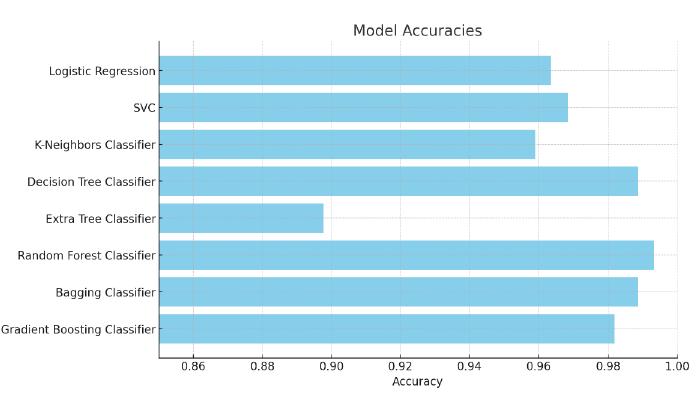
Figure 2: Comparisionof ClassifierAccuracy
The table2 and bar chart(figure2) demonstrate that Random Forest achieved the highest accuracy among all tested models, making it the best choice for crop recommendation. Due to its ability to provide precise predictionsbycombiningmultipledecisiontrees,Random Forest was selected to ensure reliable crop recommendations.
The Crop Recommendation System effectively integratesadvancedmachinelearningmodelswithauserfriendly interface to assist farmers in selecting the most suitablecrops.Thisprojecthighlightsthepotentialofdatadrivenapproachestoenhanceagriculturalproductivityand sustainability. The Random Forest Classifier obtained 99.3%ofaccuracy,whichishigherthantheothermachine learningmodels.Sothatthisisthesuitablemodelforcrop recommandationsystems. Inconclusion,thisresearchnot onlydemonstratestheeffectiveuseofmachinelearningin agriculture but also highlights the importance of usercentric design and real-time data analysis. The Crop RecommendationSystemisavaluabletoolthatsupports farmersinoptimizingtheiragriculturalpractices,leading to better yields, efficient resource use, and sustainable farming. In future, this research will focuses on to implementing Artificial Intelligence(AI) based crop recommandationsystem.
[1] Ali,I.,Cawkwell,F.,Dwyer,E.,Barrett,B.,&Green, S.(2016).Satelliteremotesensingofgrasslands: fromobservationtomanagement. JournalofPlant Ecology, 9(6), 649–671. https://doi.org/10.1093/jpe/rtw005
[2] Breiman, L. (2001). Random forests. Machine Learning
[3] Feder, G., Just, R. E., & Zilberman, D. (1985). Adoption of Agricultural Innovations in Developing Countries: A Survey. Economic Development and Cultural Change, 33(2), 255–298.https://doi.org/10.1086/451461
[4] Gupta, V., & Kumar, M. (2023). Crop Recommendation System Using Random Forest Algorithm. IEEE Xplore
[5] Huang,Y.,Srivastava,R.,Ngo,C.,Gao,J.,Wu,J.,& Chiao, S. (2023). Data-Driven Soil Analysis and Evaluation for Smart Farming Using Machine Learning Approaches. Agriculture, 13(9), 1777. https://doi.org/10.3390/agriculture13091777
[6] Reddy, L., & Nair, P. (2022). Smart Crop RecommenderSystem. IEEE Xplore
[7] Saleh,A.R.B.M.,Venkatasubramanian,S.,Paul,N. R. R., Maulana, F. I., Effendy, F., & Sharma, D. K. (2022). Real-time Monitoring System in IoT for AchievingSustainabilityintheAgriculturalField. 2022InternationalConferenceonEdgeComputing and Applications (ICECAA). https://doi.org/10.1109/icecaa55415.2022.9936 103
[8] Senapaty,M.K.,Ray,A.,&Padhy,N. (2023).IoTEnabled Soil Nutrient Analysis and Crop Recommendation Model for Precision Agriculture. Computers, 12(3), 61.https://doi.org/10.3390/computers12030061
[9] Sheykhmousa,M.,Mahdianpari,M., Ghanbari,H., Mohammadimanesh,F.,Ghamisi,P.,&Homayouni, S.(2020).SupportVectorMachineVersusRandom ForestforRemoteSensingImageClassification:A Meta-Analysis and Systematic Review. IEEE Journal of Selected Topics in Applied Earth Observations and Remote Sensing, 13, 6308–6325.https://doi.org/10.1109/jstars.2020.30267 24
[10] Storm,H.,Baylis,K.,&Heckelei,T.(2019). Machine learning in agricultural and applied economics. European Review of Agricultural Economics, 47(3), 849–892.https://doi.org/10.1093/erae/jbz033
[11] Weiss,M.,Jacob,F.,&Duveiller,G.(2019). Remote sensing for agricultural applications: A meta-review. RemoteSensingofEnvironment, 236, 111402.https://doi.org/10.1016/j.rse.2019.1114 02
International Research Journal of Engineering and Technology (IRJET) e-ISSN: 2395-0056
Volume: 12 Issue: 10 | Oct 2025 www.irjet.net p-ISSN: 2395-0072
[12] Kaggle: Python and machine learning datasetshttps://www.kaggle.com/learn/overview

Dr.G.Arutjothi,M.Sc.,Ph.D.,isan AssistantProfessorintheDepartment of Computer Applications atSona College ofArts and Science,Salem, TamilNadu. SheearnedherPh.D.in
Computer Science from Periyar University, Salem, in 2024.WithexpertiseinDataMining,BigDataAnalytics, Cloud Computing, and Artificial Intelligence, she has publishedmorethan12researchpapersininternational journals and conferences. Dr. Arutjothi has over five yearsofteachingexperienceandeightyearsofresearch experience,withastrongbackgroundinprogramming languages such as Python, C, C++, and Java. She has activelyparticipatedinfacultydevelopmentprograms, organizedinternationalconferences,andcontributedas a reviewer for reputed journals. Her commitment to advancingcomputerscienceeducationandresearchis evident through her involvement in academic and professionalactivities.

Dr.K.Geetha completed herMCAin PeriyarUniversityandM.PhilinPRIST University, Thanjavur andreceived Doctoratefrom Periyar Universityin 2025. She is doing her service as a faculty in Government Arts College (Autonomous), Salem-7 for the past 12 years along with 10 years of Research experience. She published more 10 papers throughconferencesandJournels.WhichincludesIEEE and SCOPUS that are available in online. Her research contribution is for Data Deduplication, Big data Analytics, SocialNetworkanalysis, AIandML.