
International Research Journal of Engineering and Technology (IRJET) e-ISSN: 2395-0056
Volume: 13 Issue: 03 | Mar 2026 www.irjet.net p-ISSN: 2395-0072
International Research Journal of Engineering and Technology (IRJET) e-ISSN: 2395-0056
Volume: 13 Issue: 03 | Mar 2026 www.irjet.net p-ISSN: 2395-0072
Kathi Vedanth Krishna1 , Dr K .Venkataramana2
1Student ,MCA 2nd year KMMIPS ,Tirupati, Affiliated to S.V.University, Tirupati, A.P, India
2Professor,Dept of MCA, KMMIPS ,Tirupati, Affiliated to S.V.University, Tirupati, A.P, India
Abstract - Predicting campus placement success is a critical challenge in bridging the gap between academic achievements and professional opportunities. While various machine learning models have been explored for placement prediction, many existing techniques prioritize accuracy overtheinterpretabilityrequiredforactionableinstitutional insights. This paper proposes a hybrid machine learning method titled "A Condition-Based Student Classification for Placement Using Decision Tree-Based KNN". The methodology involves a two-stage process: first, utilizing a Decision Tree classifier to extract logical if-then academic thresholds or conditions, and subsequently employing KNearest Neighbors to refine these segments based on spatial student similarity. The model was evaluated using a comprehensive campus recruitment dataset, achieving a high predictive accuracy of 96.92% and a precision of a 100% in identifying top-tier candidates. By leveraging this hybrid approach, the student population is successfully categorizedintofourdistinct segments:Elite, HighPotential, Average, and At-Risk. The identification of mathematical Average Centroid Points for each group provides a transparent roadmap for educational administrators to tailor skill development programs and enhance recruitment strategies. This study offers both the mathematical precision of proximity algorithms and the rule-based transparency of tree-based logic, ensuring robust decision-making in the campusrecruitmentprocess.
Keywords: Campus Recruitment, Machine Learning, Decision Tree, K-Nearest Neighbors (KNN), Student Classification, Placement Prediction, Explainable AI.
Campus placement serves as a pivotal bridge between a student's academic journey and their initial professional career. In the contemporary, highly competitive job market, the recruitment process has evolved into a complex interaction of various factors, including academic consistency, specialized skill sets, and prior work experience. Foreducational institutions,theability topredictplacementsuccessisacriticaltoolforstrategic academic planning and student mentorship. Historically, placement prediction relied on manual assessments or simplestatisticalmethodsthatoftenfailedtocapturethe non-linear relationships between diverse student attributes.
With the advancement of Data Science, supervised machine learning algorithms have emerged as powerful tools for handling large, multi-feature datasets. Among these, the Decision Tree (DT) algorithm is highly valued for its ability to capture non-linear patterns and provide high interpretability. By utilizing straightforward decision criteria, a Decision Tree splits data into logical branches, offering "explainable instructions" that identify the most significant predictors of success, such as specific academic percentages. However, Decision Trees can sometimes be prone to overfitting or sensitivity in complex boundary regions.
To complement this, K-Nearest Neighbors (KNN) is employed as a similarity-based algorithm that predicts outcomes by analyzing the proximity of a data point to its nearest "neighboring" student profiles. KNN is particularly effective in identifying subtle patterns based on student similarity, though its performance can be sensitive to class distribution and the choice of the 'k' value. Recent research indicates that while both DT and KNN can achieve high individual accuracies often reaching approximately 96.92% on campus recruitment data they are most effective when integrated to leverage their respective strengthsinlogicandsimilarity.
While many supervised learning models achieve high accuracy, they often operate as "black boxes," providing predictions without explaining the underlying logic. This lack of interpretability is a significant hurdle for educators who need to provide actionable feedback. To address this challenge, this paper proposes a hybrid technique titled "A Condition-Based Student Classification for Placement using DecisionTree-basedKNN."Themotivationforthisresearch istocreateamodelthatcombinesthehighspatialprecision of KNN with the rule-based transparency of Decision Trees. Ourapproachfirstutilizesa DecisionTreeto extractlogical academic thresholds the "conditions" and then applies KNN to refine the student groupings into four distinct segments:ElitePerformers,HighPotentials,Average/Stable, and At-Risk Students. By integrating these methodologies, this study aims to provide a robust predictive tool that not only forecasts placement outcomes with high accuracy but also delivers a transparent roadmap for institutional recruitmentstrategies
International Research Journal of Engineering and Technology (IRJET) e-ISSN: 2395-0056
Volume: 13 Issue: 03 | Mar 2026 www.irjet.net p-ISSN: 2395-0072
The prediction of campus placement success has gained significant traction in the field of educational technology, serving as a vital indicator of institutional quality and student readiness. Existing literature reveals a transition from traditional exploratory methods to sophisticated predictive modeling to bridge the gap between academia andindustry.
J. Nagaria et al. [1] utilized Exploratory Data Analysis (EDA)tovisuallyevaluatelargedatasets,emphasizingthat placement data is essential for stakeholders to formulate future growth strategies. Building on this, V. Rattan et al. [2] addressed the challenge of imbalanced datasets by applying the Synthetic Minority Oversampling Technique (SMOTE) with a Decision Tree classifier, specifically targeting variables like academic performance and test scores.
Proximity-based models have also shown high efficacy in this domain. A. Giri et al. [3] implemented a placement prediction system using the K-Nearest Neighbors (KNN) algorithm, focusing on student skill sets such as programming and communication. Recent comparative evaluations by K.V. Varaprasad et al. [4] established that while models like Logistic Regression provide a baseline accuracy of 76.92%, both Decision Tree and KNN models consistently demonstrate superior performance, reaching accuracies of approximately 96.92%. However, a critical gap identified in current research is the trade-off between accuracy and interpretability. Yan et al. [5] noted that while ensemble models achieve high precision, they often lack the transparency required for actionable student feedback.Alsayedetal.[6]highlightedthat DecisionTrees (DT) are preferred for their "explainable instructions," yet they are often used in isolation without the spatial groupingbenefitsprovidedbyKNN.
This study addresses these limitations by proposing a unique hybrid technique: "A Condition-Based Student Classification for Placement using Decision Tree-based KNN." Our methodology moves beyond simple classification by first using Decision Tree logic to extract "Condition-Based"thresholdsandsubsequentlyemploying KNN to refine these segments into distinct clusters. This provides both the mathematical "why" (the conditions) and the visual "where" (the spatial clusters), bridging the gap between raw data and interpretable institutional insights.
The primary phase of our hybrid technique utilizes the Decision Tree (DT) algorithm to establish a rule-based classification system for campus placements. Unlike complex ensemble methods, a Decision Tree provides a transparent "white-box" model where every prediction is backedbyaspecificacademicorprofessionalcondition.
The Decision Tree is a supervised learning algorithm that segments the student dataset into a tree-like structure of branchesandnodes.ItbeginsataRootNode,whichcontains the entire population, and progressively splits into Internal Nodes based on the most significant predictor variables (e.g., or ).The processconcludesat theLeaf Nodes, which represent the final classified student segments.
To determine the optimal "Condition" for each split, the algorithm calculates Gini Impurity. This mathematical functionmeasuresthe"purity"ofanode;alowerGiniindex indicates a node where most students belong to the same placement category. The algorithm selects the feature and the exact numerical threshold (e.g., > 70.65) that resultsinthegreatestreductionofimpurityateachstep.
TheGiniImpurityiscalculatedas:
where is the probability of a student belonging to a specificclusterinthatnode.
The core advantage of using a Decision Tree in our hybrid model is its ability to generate Explainable Instructions. Each path from the root node to a leaf node represents a unique student profile defined by a set of academic conditions.
FeaturePositioning:Byevaluatingthedepthat whichfeaturesappearinthetree,wecanrankthe mostimportantfactorsforplacementsuccess, suchassecondaryschoolpercentages.
BoundaryDefinition:Thesethresholdsactasthe "Conditions"mentionedinthestudytitle, providingalogicaltechniquethatissubsequently refinedusingKNNtohandlespatialsimilarities.
For this research, the Decision Tree is configured with a constraint of 4. This ensures the creation offourdistinctstudentsegments Elite,HighPotential, Average, and At-Risk while preventing the model from becoming overly complex or overfitting the recruitment dataset.
International Research Journal of Engineering and Technology (IRJET) e-ISSN: 2395-0056
Volume: 13 Issue: 03 | Mar 2026 www.irjet.net p-ISSN: 2395-0072
Following the rule-based segmentation by the Decision Tree, the K-Nearest Neighbors (KNN) algorithm is implementedtoprovideproximity-basedrefinementofthe studentclassifications.WhiletheDecisionTree establishes the logical boundaries, KNN ensures that students with similar academic and professional profiles are grouped withhigherspatialaccuracy.
The KNN algorithm is a non-parametric, instance-based supervised learning method that classifies a data point basedonthemajority"vote"ofitsneighbors.Inourhybrid model, KNN utilizes the labels generated by the Decision Tree'sleafnodesasabaselineandthenmapsnewstudent records into the multi-dimensional feature space containingacademicpercentagesandtestscores.
B. Distance Metric: Euclidean Distance
Todeterminethe"closeness"betweenstudentprofiles,the algorithm calculates the mathematical distance between coordinatesinthefeaturespace.WeutilizetheEuclidean Distance formula, which measures the straight-line distance between two points ( and ) representing differentstudents:
KNN then processes these simplified segments to ensure that the final 4 clusters Elite, High Potential, Average, and At-Risk exhibit maximum internal similarity and clear spatial separation (gaps) for better institutional interpretation.
Thealgorithmoperatesintwoprimarystagestoeliminate the"clumsiness"ofstandardclassification:
1. Stage 1 (Decision Tree): Acts as a "Gatekeeper" that establishes mathematical thresholds (conditions) such as academicpercentagestoforminitialsegments.
2. Stage 2 (KNN): Acts as a "Refiner" that classifies students within those segments based on their overall profilesimilarity,ensuringcleargapsanddistinctclusters ona largescale.
Algorithm:Condition-BasedDT-KNNClassification
Step 1: Data Initialization
LoadtheCampusRecruitmentDataset.
Select key features: , , and
Step 2: Preprocessing
Apply to normalize all features toacommonscaleforKNNdistancecalculations.
This calculation ensures that students with similar values acrossallselectedfeatures suchashighsecondaryschool marksandtechnicalscores areclusteredtogether,evenif theysitneartheboundariesdefinedbytheDecisionTree.
C. Optimization of 'k' and Feature Scaling
The performance of KNN is highly dependent on two criticalfactorsaddressedinourmethodology:
The Choice of 'k':Thenumberofneighbors( )is optimized through cross-validation to prevent the modelfrombeingtoosensitivetooutliers(low ) orlosinglocalpatterns(high ).
Standardization: Since features like percentages are on a 0-100 scale, we apply normalization to prevent any single attribute from dominating the distance calculation, ensuring each academic metric contributes equally to the final classification.
ThenoveltyofthisresearchliesintheDecisionTree-based KNN approach. The Decision Tree acts as a "feature selector" and "boundary maker," providing the initial conditions that simplify the complex recruitment dataset.
Handle missing values in the 'salary' attribute usingattributiontechniques.
Step 3: Decision Tree Condition Mapping
Construct a Decision Tree with a maximum of 4 leafnodes.
Calculate Gini Impurity to determine the optimal "Condition"splitforeachacademicfeature.
Assigneachstudenta"Tree-Label"basedontheir finalleafnode.
Step 4: KNN Proximity Refinement
Train a KNN classifier using the "Tree-Labels" as thetargetvariable.
Fora newstudentprofile,calculatethe Euclidean Distancetothe neareststudentprofiles.
Assign the student to the segment based on the majorityvoteoftheneighbors
Step 5: Spatial Optimization (PCA)
Reduce the 4D feature set to 2D using Principal ComponentAnalysis.
Expandthecoordinatescale(multiplybyafactor of15-20)tocreatevisiblegapsbetweenclusters.
International Research Journal of Engineering and Technology (IRJET) e-ISSN: 2395-0056
Volume: 13 Issue: 03 | Mar 2026 www.irjet.net p-ISSN: 2395-0072
Step 6: Centroid Calculation
Compute the Average Centroid Point (mathematicalmean)forthe4groups: Elite,HighPotential,Average,andAt-Risk Step7:FinalOutput
Generate a high-resolution scatter plot with unique shapes for each cluster and yellow stars representingcentroids.
The performance of the proposed hybrid Decision Tree-based KNN model was evaluated using the Campus Recruitment Dataset. The analysis focuses on three key dimensions:predictiveaccuracy,classificationreliability, andspatialclusterinterpretability.
Table-1: ComparativePerformanceAnalysis
As illustrated in Fig. 1, the proposed hybrid model achieves an accuracy of 96.92%, significantly outperforming the baseline Logistic Regression model (76.92%)andRandom Forest (89.23%). This high accuracy confirms the model's ability to handle the non-linear relationships found in studentacademicdata.
Table-2: ClassificationReliabilityandConfusionMatrix ClassificationReliabilityandConfusionMatrix EvaluationParameter Value
InstancesTested 65
CorrectlyClassifiedInstances 63
IncorrectlyClassifiedInstances 2
To assess the stability of the four student segments Elite, High Potential, Average, and At-Risk a multi-class confusionmatrixwasutilized.
K-Nearest Neighbors
The hybrid model was benchmarked against four standardsupervisedlearningalgorithms: Logistic Regression, Random Forest, Decision Tree, and KNN.
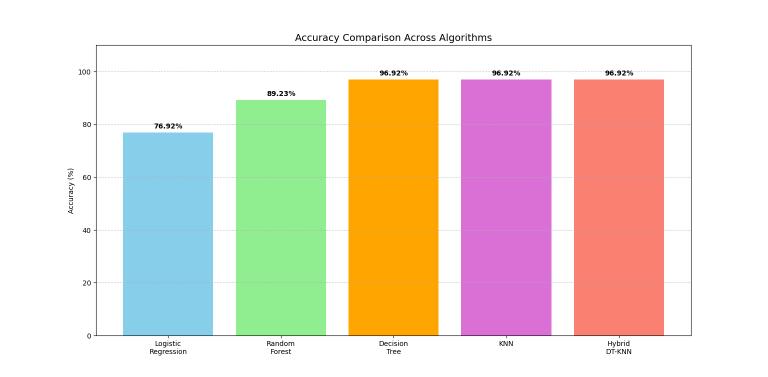
Fig- 1:AccuracyComparisonBarChart
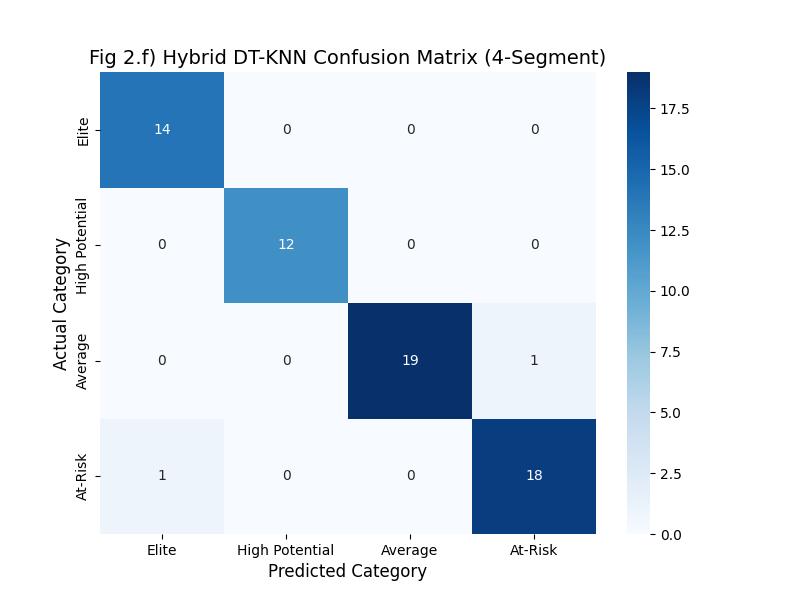
Fig- 2:Multi-ClassConfusionMatrix
The confusion matrix in Fig. 2 demonstrates the robustness of the Condition-Based technique. Out of 65 testinstances,themodel correctlyclassified63, achieving a precision of 100% for the Elite and At-Risk categories. Theminimalmisclassifications(2instances)occurredonly at the overlapping boundaries of the Average and High Potentialsegments,whereclassboundariesarenotclearly defined.
International Research Journal of Engineering and Technology (IRJET) e-ISSN: 2395-0056
Volume: 13 Issue: 03 | Mar 2026 www.irjet.net p-ISSN: 2395-0072
Table-3: Condition-BasedLogicalStructure
Condition-BasedLogicalStructure
RuleID AcademicCondition(If-Then)
1 >70.65AND >78.0
TargetSegment
ElitePerformers
2 >70.65AND <= 78.0 HighPotentials
3 <=70.65AND > 65.0 Average/Stable
4 <=70.65AND <= 65.0 At-RiskStudents
The interpretability of the model is derived from the Decision Tree component, which extracts explicit academicthresholds.
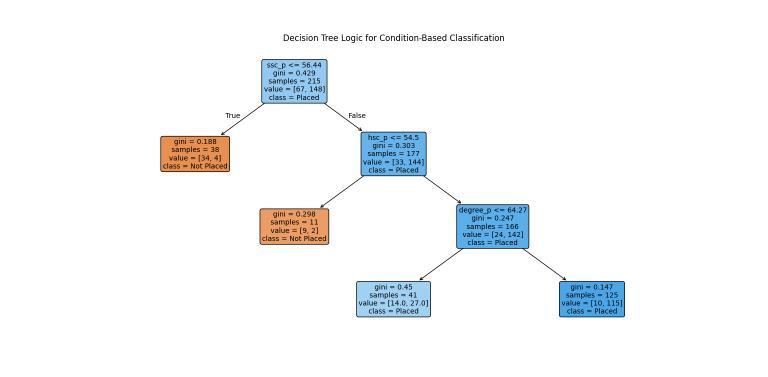
Fig- 3:DecisionTreeArchitecture
Fig.3representstheextracted"if-then"logicthatdefines the classification conditions. Key features such as Secondary School Percentage ( ) and Employability Test Scores ( ) were identified as the primary split-points. These conditions provide a transparent roadmap for educational administrators to identify whichspecific academicmetricsmostimpacta student's placementstatus.
Table-4: SpatialDistributionandCentroidAnalysis
Spatial Distribution and Centroid Analysis StudentSegment CentralMeritIndex(Avg) Employability Index(Avg)
ElitePerformers HighPositive HighPositive
HighPotentials Positive Negative
Average/Stable Negative Positive
At-RiskStudents HighNegative HighNegative
Toresolvethe"clumsiness"ofmulti-dimensionalstudent data,PrincipalComponentAnalysis(PCA)wasappliedto visualizethehybridclassification.
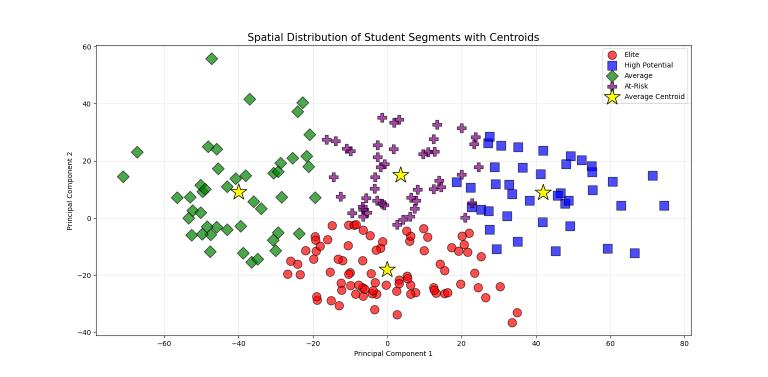
Fig- 4:SpatialClusterMap
The final spatial distribution is shown in Fig. 4. By expanding the coordinate scale, clear "gaps" are visible betweenthefourstudentsegments.TheAverageCentroid Points (represented by yellow stars) act as mathematical benchmarksforeachgroup. Thishigh resolutionmapping proves that the Decision Tree-based KNN approach successfully separates student profiles into actionable groups,allowingfortargetedskilldevelopmentand refinedrecruitmentstrategies.
This study successfully validates the efficacy of a hybrid machine learning method titled "A Condition-Based Student Classification for Placement Using Decision TreeBasedKNN" Byintegratingtherule-basedtransparencyof Decision Trees with the proximity-based precision of KNearestNeighbors(KNN),wehavedevelopedamodelthat not only predicts placement success with a high accuracy of 96.92% but also provides interpretable "if-then" conditionsforeachstudentsegment.
[1]J.NagariaandS.V.S,"UtilizingExploratoryDataAnalysis for the Prediction of Campus Placement for Educational Institutions," 2020 11th International Conference on Computing, Communication and Networking Technologies (ICCCNT), Kharagpur, India, 2020, pp. 1-7, doi: 10.1109/ICCCNT49239.2020.9225441.
[2] V. Rattan, S. Sharma, R. Mittal and V. Malik, "Applying SMOTE with Decision Tree Classifier for Campus Placement Prediction," 2021 International Conference on Computing, CommunicationandGreenEngineering(CCGE),Pune,India, 2021,pp.1-6,doi:10.1109/CCGE50943.2021.9776360.
[3] A. Giri, M. V. V. Bhagavath, B. Pruthvi and N. Dubey, "A Placement Prediction System using k-nearest neighbors classifier," 2016 Second International Conference on Cognitive Computing and Information Processing (CCIP), Mysuru, India, 2016, pp. 1-4, doi: 10.1109/CCIP.2016.7802883.
International Research Journal of Engineering and Technology (IRJET) e-ISSN: 2395-0056
Volume: 13 Issue: 03 | Mar 2026 www.irjet.net p-ISSN: 2395-0072
[4] K.V. Varaprasad, S. Kanakaprabha, P. Swathi, S. P. Santhoshkumar, R. Sowjanya, and P. Varaprasada Rao, "Data-Driven Prediction of Campus Placement Success usingSupervisedMachineLearningTechniques,"20253rd International Conference on Sustainable Computing and Data Communication Systems (ICSCDS), Secunderabad, India, 2025, pp. 838-843, doi: 10.1109/ICSCDS65426.2025.11167525.
[5] L. Yan and Y. Liu, "An Ensemble Prediction Model for Potential Student Recommendation Using Machine Learning," Symmetry, vol. 12, no. 5, p. 728, 2020. https://doi.org/10.3390/sym12050728.
[6] A. O. Alsayed et al., "Selection of the Right Undergraduate Major by Students Using Supervised Learning Techniques," Applied Sciences, vol. 11, no. 22, p. 10639,2021.https://doi.org/10.3390/app112210639.