
International Research Journal of Engineering and Technology (IRJET) e-ISSN: 2395-0056
Volume: 12 Issue: 11 | Nov 2025 www.irjet.net p-ISSN: 2395-0072
International Research Journal of Engineering and Technology (IRJET) e-ISSN: 2395-0056
Volume: 12 Issue: 11 | Nov 2025 www.irjet.net p-ISSN: 2395-0072
1Head of Dept., Dept of Electronics and Telecommunication, KDK College of Engineering, Maharashtra, India 23456UG student, Dept of Electronics and Telecommunication, KDK College of Engineering, Maharashtra, India
Abstract - The inefficiency of parking in the cities is one of the greatest problems in the contemporary citiesthatresultin traffic congestion, fuel wastage, and frustrationbythedrivers. This paper includes the design and implementation of an AIbased Smart Parking Framework that will utilize real-time slot detection and availability analysis to optimize the use of parking space and allow a better user experience. The proposed system incorporates computer vision algorithms, IoT-based sensing, and edge computingtodetectvacancyslots correctly and predict future availability according to the occupancy patterns. A user-focused interface will have realtime updates that will decrease the time taken to conduct a search, decongesting traffic. The efficacy of the framework is experimentally validated using the improvement of the detection accuracy, reduction of latency, and scalabilityofthe implementation in the environment of the smart city. This paper illustrates that artificial intelligence and IoT convergence can be applied to convert the conventional parking system into an intelligent and data-driven approach to sustainable urban mobility.
Key Words: Smart Parking, Artificial Intelligence & Machine Learning, Internet of Things (IoT), Real-Time Slot Detection, Availability Analysis
1.INTRODUCTION
City traffic's becoming a real headache these days. With morefolksmovinginandvehiclespilingup,parkingsetups can'tkeepup.Whenspotsaren'thandledwell,streetsclog up-fuelgetsburnedfornothing,fumesincrease,driversget frustrated.Itmesseswitheverydayroutines-notonlythat, itdragsdowncommunities,wallets,andnaturealike.Fixing howwemanageparkingplaysabigroleifwewantcleaner, sharperurbanareas.
Theresponsetotheseproblemsincludedtechforsmarter parking. At first, systems tried spotting open spots with cameras; but they usually failed when light changed or something got in the way. Rather than just using video, updated models added sensors along with internetconnectedtoolsforbetterresults.Eventhoughthosedidfine whenthingsstayedpredictable,freshchallengespoppeduplikelag,highcoststoinstall,andconstantmaintenance.
Rightnow, tasksare handlednearer to wheredata comes from-thankstoedgeorhybridsetups.Thisslasheslag,uses lessnetworkspace,yetmakesreactionsquickerandmore dependable. Meanwhile, advanced neural nets do a better
job spotting vehicles and empty parking spaces across variousconditions,makingresultssteadier.Still,thesesmart systemsaskforheavycomputingpower,whichmightblock their use on low-end gadgets, so you’ve got to weigh accuracyagainstperformance.Freshforecastingmethodssay,reinforcementlearningorpredictivealgorithms-help look ahead by guessing how things will be used and preppingresourcesearly.Buttheyneedsteady,cleardatato workwell,fallingapartfastifusagespikesoutofnowhere.
Despite improvements, today’s smart parking tech keeps runningintoproblems.Whenjustonepartcrashes,there's nofallback option available.Cloud-run modelstend to lag and eat up lots of bandwidth. Merging different systems remainstricky,pluscity-widescalingoftenfallsshort.That means we need a unified setup - able to blend multiple sources,makequickcallsusingon-sitecomputing,butalso predictchangestostayadaptable.
This research fills current holes by launching a clever parking setup powered by AI, mixing camera tech with connecteddevicesforsteady,breakdown-proofsensing.But ratherthanleanonlyondistantservers,itrunssmallAIbits right inside gadgets - spurring fast reactions and space to expand.Predictivefeaturesbringsomeadaptability;still,the mainleapliesinpracticaledgecomputingpairedwithfused sensor-and-camera data. So, this linked strategy lifts reliability,cutslag,yetkeepscity-widedeploymentsimple.
The study makes a difference in two ways. First, it boosts academic talks by mixing solid parts from old techniques into a single setup - fixing ongoing problems like lag in detectionandscalingupsystems.Second,itgivesapractical frameworkbuiltforrealcitysettings,particularlyintelligent parkingspots,linkingideastoreal-worldaction.Insteadof aiming for small tweaks, the method focuses on building stronger foundations. That way, urban parking gets more dependable,lessharmfultonature,whilestayingeasierto use
Therestofthispaperunfoldslikethis.Thenextsectiongives acloselookattoday'ssmartparkingoptions,butalsochecks their strengths alongside weaknesses. After that comes a partrevealinggapsinearlierresearchaswellasexplaining whythenewsetuplooksthewayitdoes..
International Research Journal of Engineering and Technology (IRJET) e-ISSN: 2395-0056
Volume: 12 Issue: 11 | Nov 2025 www.irjet.net p-ISSN: 2395-0072
a) Shoup (2011) - The High Cost of free Parking The work byShoupwasbasedontheanalysisoftheeconomic andenvironmentalaspectsofunproductiveparkingsystems, specificallyonthefactofcruisingaroundtofindaparking spaceandlow-pricedcurbparking.Inhisstudy,heidentified the issue of poor management of the supply of parking as beingacauseofcongestion,fuelwastage,andhighemissions. Whatisstrongaboutthisworkisthatitexplicitlydefinedthe socioeconomicreasonsbehindtheuseofintelligentparking systemsasaprovisiontoprovideaquantifiabletargetwhich wouldminimizecruisingandmispricingonthepartofthe policymakersandengineers.Thisdrawbackthoughisthatit failedtooffertechnicalsolutionsanddidnotlookatthereal timedetectionandmanagementhencelaterresearchcanfill thegapbyofferingtechnologicaladvancestodoso.
b) Haripriya R et al. (2016) - carparkingslotdetection Usingcomputervision.Ascenariointroducedbyauthorand others introduced an Open CV system to identify vacant parkingslotsbytheuseoffixedsurveillancecameras.They used the technique of background subtraction and edge detection, which were consistent over controlled light conditions.Thebenefitofthisworkwasthatitwaslowcost, had an interpretable methodology that was simple to implement with the help of commodity cameras. The disadvantage was however that it is sensitive to shadows, occlusions and dynamic environments hence limiting scalability. This is the restriction that prompted the subsequentstudiestoconsiderusingdeeplearningmodels capable of managing intricate city situations with more robustnessandflexibility.
C) Al Turjman et al. (2020) – Smart Parking in IoTenabledCities:A Survey Inone of thestudies,Al Turjman presented IoT enabled parking based on wireless sensor networkstoprovideoccupancyinformationtocloudservers. Theirsystemprovedtosavemajortimeandtrafficjamsin search,justifyingtheapplicationofIoTasaplatformofsmart parking. This work had the benefit of high accuracy and strength,sincetheworkingofsensorswasnotinfluencedby visual occlusions. The disadvantage though was latency caused by processing usingclouds alone and maintenance that was required on sensorhardware suchas batterylife and cost of infrastructure. In spite of such constraints, the researchisstillpowerfultodemonstratethewaytheIoTcan transformthestationaryparkinglotsintothedynamicones fullofdata.
d) Zhang et al. (2019) - P2P Network Based Smart ParkingSystemUsingEdgeComputing Tosolvetheproblem of computing delay, Zhang and colleagues are considering cloudcomputingandincludingIoTsensorstodistributethe computing devices on the gateways to minimize the wait times and the bandwidth consumption. According to their findings,theywererespondingdramaticallyascomparedto cloudonlysystemsandreducedtheresponsivenessto0.35
secondsascomparedto1.2seconds.Thisworkwasbetter becauseithadbeenseenasadvantageousduetoitsabilityto run in real time and its resiliency, which made it suitable whenusedonlargescale.Thedisadvantagewasthatitwas noteasytohandletheedgedevicesofheterogeneousnature and security in distributed nodes. However, this paper emphasized the role played by edge intelligence when helpingAIinference,whichislowlatency,todetectparking slots.
e) Li et al. (2022) - Visual Detection and Image ProcessingofParkingSpaceBasedonDeepLearning.Lietal. utilizedconvolutionalneuralnetworkstodetectparkingslots especiallyinvaryingconditionsandtheirdetectionaccuracy isover95%.Anotherdirectiontheyexaminedwastheability tousetransferlearninginordertoadjustthemodelstonew settingswiththeminimumofretraining.Thebenefitwiththis workwasitsstrengthandhighdegreeofaccuracy,regardless ofthelightingandweatherconditions.Itsdisadvantagewas thecalculationcostofCNNsthatlimitedthepossibilityofreal time implementation of such libraries in resource constrained systems. This prompted the search of light models like the Mobile Net and YOLO, which found a compromise between the accuracy and performance to implementaneffectivesmartparkingsystem.
f) Krish Nayyar et al. (2024) - PredictiveAnalyticsand Built-in Frameworks. Nayyar proposed a smart parking system that is holistic or multi-tiered (a combination of computervision,IoTsensorsandpredictiveanalytics).Their systemwasabletodetectpresenceofanyoccupancybutwas also able to predict demand patterns based on machine learningmodelsthatweretrainedinthepastusinghistorical data.Itsproactivefunctionalitywasabenefitthatallowedit to perform dynamic pricing and traffic, decreasing the congestionby18percentinsimulations.Itsdisadvantagewas that it used centralized cloud analytics, which created a questionofscalabilityandpossiblebottlenecks.Thisbeing thecase,theresearchpaperdepictstheincreasingpopularity of multi layered designs that incorporate detection, prediction,andoptimizationofurbanmobility.
g) Ahmed et al. (2019)-SmartParkingCloudandMobile Apps. Ahmed suggested cloud based parking management systemthatiscombinedwithmobileapplicationsinwhich driverscouldmakereservationsandgetrealtimeupdates. The positive positive aspect of this work was that it was highlyadoptedbytheusersanditwasconvenientbecause mobile applications allowed an interactive system. The disadvantage was waiting time and reliance on cloud infrastructure that restricted the offline adaptability and created threats of single points of failure. Although it is effectiveinshowinguserfacingbenefits,thestudysupported the necessity of edge computing in supplementing cloud systemsinthenextgenerationframeworks.
h) Santosh Nagulan et al. (2025) -AIPoweredVehicle Recognition. Author has concentrated his attention on the vehicle recognition in the case of automated parking
International Research Journal of Engineering and Technology (IRJET) e-ISSN: 2395-0056
Volume: 12 Issue: 11 | Nov 2025 www.irjet.net p-ISSN: 2395-0072
enforcement through deep learning models. Their system supportedcomplianceandoperationalefficiencybecauseits systemwashighlyaccurateinlicenseplatesrecognitionand slotoccupancyamongothers.Thestrengthwasitscapability tolessencompletehandenforcementaswellasmaximization of compliance to policies. Its disadvantage was the lack of privacyandlossofaccuracyinlowqualityimageslikemotion blurandlowqualityfeeds.Nevertheless,theresearchproved the ability of AI to benefit operational efficiency and complianceofsmartparkingecosystem
i) Cuong Pham-Quoc et al. (2025) Edge AI-Enabled Smart Parking Systems. Author examined the use of lightweight AI models, including YOLO and Mobile Net, in parking slots detection, and prediction on the edge. The benefitwasactualtimeresponsivenessandscalability;thus, itwaseasytodeployinalargescale.Thedisadvantagewas thatithadlittlecomputeheadroomtohandlelarger,more complexmodelsinfutureandthat,heterogenoushardware wasdifficulttohandle.Thecurrentresearchisinlinewith theobjectivesofAIenabledsmartparkingsystems,whichare basedonsustainability,scale,andliveresponsiveness.
j) S. S. Thorat et al. (2017) IoT Based Smart Parking SystemUsingRFID RFIDbasedslotmonitoringofferedby author included IoT gateways, enhancing precision in the identification of slots and minimizing human intervention. Deterministic identification and high auditability was the benefit, particularly in encircled plants. This was disadvantaous in that cost of infrastructure was high and couldnotbeusedinopenstreetconditions.Althoughitisnot asscalableasthevisionbasedsystems,thisworkshowedthe ability of RFID to supplement IoT in structured parking environments.
k) M. W. Al Azad et al. (2021) Hybrid Framework which is based on Cloud Edge parking. In an attempt to accomplish this, Author presented a hybrid model that is cloud analytics plus edge inferences thus trying to find a balancebetweenscalabilityandlowlatency.Theirmodelhas shown the possibilities of hybrid designs to address the drawbacksofeithercloudoredge-onlymodels.Itsstrength was that it could be orchestrated efficiently and has fault isolation, and the weakness was that it was complex to coordinatevariousdevicesandenforceversioncontrol.This publication demonstrated the relevance of scalable smart parkingsystemsintheformatofhybridmodels.
l) Ratko Grbić et al. (2022) VisionBasedParkingSlot Mapping. Author concentrated on automated mapping of parking slots with the help of aerial images and deep learning.Theirsystemwasveryaccurateinurbansettings, makingimplementationprocessendearingandminimizing thenumberoferrorsduringtheprocess.Scalabilityandlow set up costs was the advantage and the disadvantage was relianceonhighqualityimageryanddecreaseinaccuracyon nonstandardlayouts.Thispaperhasshownthatvisionbased mappingcouldbeusedtospeeduptheimplementationof smartparking.
Predictingthepatternsofparkingdemand,Dasusedthe timeseriesforecastingmodels,includingARIMAandLSTM. Theirsolutionenhancedprecisioninpeak-hourforecasting, which allowed them to make decisions about traffic to manage and make optimal use of slots. The merit was enhancedreadinesstodemandbursts,whereasthedemerit wasvulnerabilitytothequalityofdataandinabilitytocope with any unexpected event driven change. The articles strengthened the relevance of predictive analytics in intelligentparkingsystems.
Itgoeswithoutsayingthattheintelligentparkingsystems haveevolvedtremendously.Scholarshaveresearchedallthe aspects of comprehending the economic and social dimensionsuptocreatingtrulysophisticatedAIsystems.We have quickly realized at an early stage how vital it was to reduce the number of cars rambling around in search ofa parking place and correct unfair prices. Then, such technologies as vision-based cameras and IoT devices demonstrated us that it was completely possible to detect andmonitorparkingautomatically.
Subsequently, these systems were made very fast and responsivebyedgecomputingandcustomdesignedhybrid systems. The use of deep learning models provided other levels of reliability, and predictive analytics enabled us to managethedemandactivelyandnotmerelyreactively.
However despite all this they still have some nagging problemsthatcontinuetoarise.Instead,systemsthatdepend ononlyonekindoftechnologyareusuallybroughttotheir knees after circumstances alter (think bad weather or the changeinlight).Thecloudsystemsmaybecentralizedand sluggish,consumingmuchbandwidth.And,intheattemptto makeallthesedisparatetechnologiesco-ordinateeffectively, it usually causes massive operational heartaches. Our potentiallygoodpredictormodelsalsocaneasilybetoomuch dependent on the past and fail when things change dramatically.
Thesegapsactuallypointtosomefundamentalnecessity:we shouldhaveaunifiedsystem.Asolutionthatunitescomputer visionandIoTincaseofthebackup,employsedgecomputing toprovidethespeedneededinreal-timeandcanadd-ontoit predictiveanalytics.Bydoingthiswewillbeabletocreate systems that are actually deployable, robust and scalable enoughtobeusedinanyurbanenvironment.
Thefunctionalityoftheproposedmethodologyisaimedat theconstructionoftheAI-basedintelligentparkingsystem through which the occupancy of parking slots can be detected in real-time and support users within a single platform.Thissystemiscomprisedofcomputervision,IoT sensing, and edge computing such that it is accurate, fast, and scalable to various environmental conditions. The
International Research Journal of Engineering and Technology (IRJET) e-ISSN: 2395-0056
Volume: 12 Issue: 11 | Nov 2025 www.irjet.net p-ISSN: 2395-0072
methodologyisalsodevelopedintoanumberofstagesthat will be working towards the comprehension of the entire performanceoftheframework.
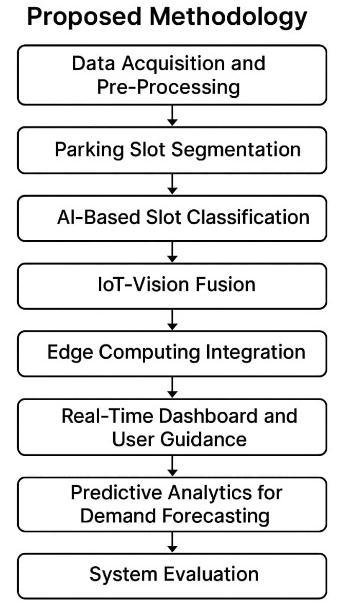
1 ProposedMethodologyshowsworkingmechanism
A. Data Collection and Pre-processing
Video footage from parking areas is collected using fixed CCTV or IP cameras. Frames are extracted at regular time intervals and prepared for analysis. To ensure good detection quality, the images are pre-processed using brightness and contrast adjustment, noise and shadow reduction,resizing,andnormalization.Parkingslotsarethen annotated so that the AI model can clearly distinguish betweenoccupiedandvacantspaces.Thesepre-processed andlabeledframesformthetrainingandtestingdatasetfor thesystem.
B. Parking Slot Identification
Before detecting vehicles, the system identifies the boundaries of each parking slot. This can be done using manualRegionofInterest(ROI)marking,whereeachslotis marked once and reused throughout the process, or by automated slot mapping, where a lightweight algorithm analyzestheparkinglayoutandautomaticallydetectsslot shapesandboundaries.Thisstepensuresthateachslotis isolatedproperlyforfurtherclassification.
C. AI-Based Slot Classification
Thecoreoftheframeworkusesdeeplearningmodelssuch as YOLOv8 or lightweight Convolutional Neural Networks (CNNs)toclassifyeachsegmentedparkingslotas“occupied” or “empty.” The model is trained using the annotated dataset, with image augmentation techniques such as rotationandbrightnessvariationtoimproverobustness.The modelisthenoptimizedtorunonlow-poweredgedevices, enabling real-time inference even in challenging lighting, weather,orpartialocclusionconditions.
D. Fusion of IoT Sensors and Vision Data
To improve reliability in cases where camera views are unclear,thesystemcanadditionallyuseIoTsensorssuchas ultrasonic or infrared modules. Sensor readings are combined with camera-based AI predictions to make the final decision on slot occupancy. This multimodal fusion helps to reduce false positives and false negatives and improvesconsistencyinenvironmentswithheavyshadows, night-timelighting,orcamerablindspots.
E. Edge Computing for Real-Time Processing
Insteadofdependingentirelyonremotecloudservers,the proposed system deploys the AI models on edge devices suchasRaspberryPiorNVIDIAJetsonNano.Processingdata attheedgelowersdetectionlatency,reducesnetworkload, and allows continuous operation even when internet connectivity is unstable. It also improves privacy because rawvideostreamsdonotneedtobesentoutsidethelocal network.
A user interface is developed using platforms such as Streamlit or React to provide real-time visualization of parkingavailability.Thedashboarddisplayswhichslotsare emptyoroccupied,theconfidencelevel ofdetections,slot identifiers,overalloccupancypercentage,andbasicanalytics such as hourly or daily usage trends. This interface helps driversquicklylocatefreeslotsandsupportsadministrators inmonitoringandmanagingparkingspacesmoreefficiently.
Oncesufficienthistoricaldataiscollected,machinelearning models such as ARIMA or LSTM are used to predict peak hours,futureslotavailability,andlong-termusagepatterns. These predictions support smarter traffic and parking managementandcanbeextendedtodynamicallocationor pricingstrategy.
Citiesareexpandingfastyetspotstoparkaren’tkeepingup. As populations rise, vehicles pile up, while available bays stayscarce.Thatgap,combinedwithpoorlayout,leadsto traffic jams, fuel waste, higher emissions, plus frustrated driversloopingaroundinsearch.Shoup’sinitialstudiesgave real stats on this mess, revealing hours and cash lost citywide due to endless space hunts. Lately, attention’s startedmovingelsewhere.Scientistswentfromonegadget toanother,tryinganythingthatmightwork.Cameraslooked promising at first; still, problems popped up whenever vehiclesgotinthewayorlightingmessedthingsup.Sensors gave steadier data, though delays showed up, along with never-endingmaintenanceandtangledwireseverywhere. Processinginfoclosertothesourcespedstuffup,skipping slowtripstodistantservers.Smartalgorithmsgotbetterat findingemptyspaces,evenso,thosesystemssuckedbattery life dry on modest hardware. After that come prediction
International Research Journal of Engineering and Technology (IRJET) e-ISSN: 2395-0056
Volume: 12 Issue: 11 | Nov 2025 www.irjet.net p-ISSN: 2395-0072
toolsalongwithtrial-and-errormethods,whichcouldgive you an edge - though only when supplied with reliable, steadyinformation.Despitesuchadvances,familiarissues still show up now and then. Setups built around a single sourcefailfastunderpressure.Onlinesystemsslowdown oncetrafficspikes.Connectingseparatetechpiecesfeelslike untanglingwires,whilesolutionsthrivinginonetownmay flop somewhere else. This is what the project tackles. It combinescameratechwithconnecteddevices-onestepsin whentheotherfalters.Smallmodelsoperatedirectlyon-site, making responses quick. Forecasting tools add room to adjustassituationsshift.Handlingtrust,speed,andgrowth togethermeansit'smorethantheory-itrunslive,delivering apracticalparkingfixfortoday’surbanareas.
[1] Donald C. Shoup ,The High Cost of free Parking,2011, https://doi.org/10.4324/9781351179782
[2] HaripriyaR,carparkingslotdetectionusingcomputer vision,2016,IJARIIE-ISSN(O)-2395-4396
[3] AlTurjmanetal,SmartParkinginIoT-enabledCities:A Survey May 2019Sustainable Cities and Society 49(August):101608DOI:10.1016/j.scs.2019.101608
[4] Zhangetal.,P2PNetworkBasedSmartParkingSystem Using Edge Computing, Volume25,pages 2226–2239, (2020)
[5] SabbirAhmed etal.,ABlockchain-basedArchitecture forIntegratedSmartParkingSystems,2019
[6] Li et al. , Visual Detection and Image Processing of Parking Space Based on Deep Learning,2022, https://doi.org/10.3390/s22176672
[7] Krish Nayyar et al. IoT: Based Smart City Parking SystemswithPredictiveAnalytise,2024
[8] Santhosh Nagulan et al., Smart Parking Revolution: Integrating AI and IoT for Autonomous Management, 2025ISSN:1001-4055Vol.46No.2(2025)
[9] EdgeAI-EnabledSmartParkingSystems,)CuongPhamQuoc et al. (2025), DOI:10.1109/ATC63255.2024.10908301
[10] S.S.Thoratetal.,2017,IoTBasedSmartParkingSystem UsingRFID,eISSN:2349-7084
[11] M. W. Al Azad et al., CLEDGE: A Hybrid Cloud-Edge Computing Framework over Information Centric Networking," 2021 IEEE 46th Conference on Local Computer Networks (LCN), Edmonton, AB, Canada, 2021, pp. 589-596, Doi: 10.1109/LCN52139.2021.9525006.
[12] Ratko Grbić et al., Parking guidance information Automatic Vision-Based Parking Slot Detection and OccupancyClassification,2023
[13] DevasenanS.etal.,SmartPark-APredictiveandUser CentricParkingPlatform,ISSNNo:-2456-2165