
International Research Journal of Engineering and Technology (IRJET) e-ISSN: 2395-0056
Volume: 13 Issue: 02 | Feb 2026 www.irjet.net p-ISSN: 2395-0072
International Research Journal of Engineering and Technology (IRJET) e-ISSN: 2395-0056
Volume: 13 Issue: 02 | Feb 2026 www.irjet.net p-ISSN: 2395-0072
Arpan Chakraborty1
1 Student, Department of Computer Science and Engineering
Abstract—This paper presents a comprehensive performance comparison between Spring Boot and Quarkus, two widely used Java backend frameworks. Identical REST APIs were built in both frameworks, including a database-connected /users POST endpoint using H2 in-memory storage. Load testing was conducted using Apache JMeter across multiple concurrency levels (10, 50, 100, and 200 concurrent users), while heap memory consumption was measured using VisualVM. Both frameworks were also containerized using Docker to compare startup time under standard JVM and Docker deployment modes. For the simple /hello endpoint, both frameworks achieved 1 ms average response time, with Quarkus showing slightly higher throughput. Both frameworks maintained 0% error rate across all load levels. In production mode, Quarkus consumed only 17 MB of heap memory compared to Spring Boot’s 20 MB. In Docker mode, Quarkus started in 4.275 seconds compared to Spring Boot’s 11.234 seconds, demonstrating a significant startup time advantage. Results indicate that framework selection should be driven by workload characteristics and deployment requirements.
Index Terms Spring Boot, Quarkus, REST API, Performance, Java, Microservices, Throughput, JMeter, VisualVM, Docker, Concurrency
Java backend development has grown significantly over the past decade, with Spring Boot becoming the dominant framework for building REST APIs. Recently, Quarkus emerged as a modern alternative designed for cloud-native and microservices environments. Quarkus claims to offer faster startup times and lower memory consumption compared to Spring Boot, which raises an important question: does Quarkus actually perform better under real load conditions and containerizeddeployments?
To answer this question, identical REST APIs were designed and implemented in both frameworks, and their performance was measured using industry-standard tools. This study evaluates both frameworks under multiple concurrency levels, database-connected endpoints, and Docker containerized deployments, which reflect real-world microservices behavior more accurately. Apache JMeter was used for load simulation, VisualVM for heap memory monitoring, and Docker for containerized startup time benchmarking. The goal is to provide practical, data-driven guidancefordeveloperschoosingbetweenthesetwoframeworks.
Several researchers have examined Java framework performance from different angles. Pereira et al. [1] analyzed energy efficiency across Java collection frameworks and found that framework-level design choices significantly impact resource consumption. Seo et al. [2] studied energy behavior in pervasive Java systems, noting that runtime overhead varies considerably depending on execution context. Taibi et al. [5] conducted a survey on microservices adoption in practiceandidentifiedperformanceandresourceefficiencyasprimaryselectioncriteriaforbackendframeworks.Dragoni etal.[6]providedacomprehensiveoverviewofmicroservicesarchitectureevolution,highlightingthegrowingimportance oflightweightandfast-startingframeworksincloud-nativedeployments.
While these works establish that framework internals affect performance, they do not directly compare Spring Boot and Quarkus under concurrent HTTP load or containerized deployments. Other online benchmarks suggest Quarkus has advantages in startup time and native compilation, but few studies examine standard JVM mode database performance under varying concurrency levels with Docker deployment comparison. This gap in the literature motivated the present study,whichfocusesonmeasurableruntimebehaviorundercontrolled,scalable,andcontainerizedloadconditions.
International Research Journal of Engineering and Technology (IRJET) e-ISSN: 2395-0056
Volume: 13 Issue: 02 | Feb 2026 www.irjet.net p-ISSN: 2395-0072
TwoRESTAPIsweredevelopedfromscratch,oneusingSpringBootversion3.2.0andanotherusingQuarkusversion 3.9.1.BothAPIswereimplementedinJava17andexposedtwoendpoints:asimple/helloGETendpointreturninga text message, and a /users endpoint supporting both GET and POST operations connected to an H2 in-memory database. SpringBootusedSpringDataJPAfordatabaseaccess,whileQuarkususedHibernateORMwithPanache[4],[3].
Bothapplicationsweredeployedonthesame Windows machinetoeliminatenetwork-relatedvariables. Spring Boot ran on port 8080 and Quarkus ran on port 8081. Quarkus was packaged in production mode using mvn package and executed with java -jar. Both frameworks were also containerized using Docker with an eclipse-temurin:17-jdk-alpine baseimagetomeasurestartuptimeundercontainerdeployment.
For the /hello endpoint, Apache JMeter 5.6.3 was configured with 100 concurrent users, 10 second ramp-up, and 10 iterations.Forthemulti-levelconcurrencyanalysisonthe/usersPOSTendpoint,fourseparatetestrunswereconducted:
• 10threads,ramp-up5s,loop10
• 50threads,ramp-up10s,loop10
• 100threads,ramp-up20s,loop10
• 200threads,ramp-up30s,loop10
An HTTP Header Manager was configured with Content-Type: application/json for all POST requests. Heap memory was measured using VisualVM during idle state after startup for both frameworks in production mode. Docker startup timewasmeasuredfromcontainerlaunchtothefirstreadylogmessage.
TableIpresentstheperformanceresultsforthe/helloendpoint.TableIIpresentsthemulti-levelconcurrencyresults forthe/usersPOSTendpoint.TableIIIpresentsthestartuptimecomparison.Figures1,2,and3visualizetheresults.
International Research Journal of Engineering and Technology (IRJET) e-ISSN: 2395-0056
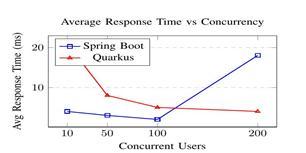
Fig. 1. ResponseTimeunderincreasingconcurrency TABLE II
MULTI-LEVEL CONCURRENCY: /USERS POST ENDPOINT
SB = Spring Boot, Q = Quarkus, TP = Throughput (req/sec), Error rate = 0.00% for all tests
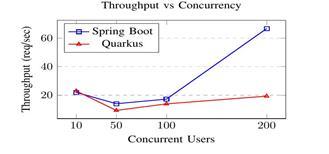
Fig. 2. Throughputunderincreasingconcurrency
Forthe/helloendpoint,bothframeworksachievedidenticalaverageresponsetimesof1ms.Quarkusshowedslightly higherthroughputat9.6req/seccomparedtoSpringBootat8.7req/sec.Inproductionmode,Quarkus consumedonly17 MBofheapmemorycomparedtoSpringBoot’s20MB.
Forthemulti-levelconcurrencytestonthe/usersPOSTendpoint,bothframeworksmaintained0%errorrateacross allloadlevels.Atlowerconcurrency(10threads),SpringBootachievedfasterresponsetimeat4mscomparedtoQuarkus at 21 ms. As concurrency increased to 200 threads, Quarkus demonstrated better response time at 4 ms versus Spring Boot’s18ms,indicatingthatQuarkushandleshighconcurrencymoreefficientlyintermsof latency.SpringBootachieved significantlyhigherthroughputat200threads(66.7req/sec)comparedtoQuarkus(19.4req/sec).
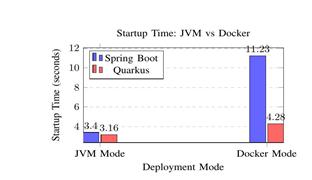
For startup time, both frameworks performed similarly in JVM mode at approximately 3 seconds. However, under Docker containerized deployment, Quarkus started in 4.275 seconds compared to Spring Boot’s 11.234 seconds,
Volume: 13 Issue: 02 | Feb 2026 www.irjet.net p-ISSN: 2395-0072 © 2026, IRJET | Impact Factor value: 8.315 | ISO 9001:2008
International Research Journal of Engineering and Technology (IRJET) e-ISSN: 2395-0056
demonstrating that Quarkus is approximately 2.6 times faster to start in a containerized environment. Figure 3 clearly illustratesthisstartuptimedifference.
TABLE III STARTUP TIME COMPARISON: JVM VS DOCKER
Severalpotentialthreatstothevalidity ofthisstudymustbeacknowledged.First,allexperimentswereconductedon a single Windows machine, which may not reflect performance characteristics observed in production server environments or cloud infrastructure. Hardware-specific factors such as CPU cache behavior, memory bandwidth, and operatingsystemschedulingmayinfluenceresults.
Second,bothAPIsusedanH2in-memorydatabaseratherthananexternalproductiondatabasesuchasPostgreSQLor MySQL. Real-world applications typically interact with network-attached databases, which introduce additional latency andconnectionoverheadnotcapturedinthisstudy.
Third, JVM-based applications are subject to warmup effects, where the Just-In-Time compiler optimizes frequently executed code paths over time. Early test iterations may exhibit higher latency than steady-state performance. Although multipletestrunswereconducted,JVMwarmupbehaviormaystillinfluenceresults.
Fourth, Docker startup time measurements represent a single observation per framework. Variability due to system load,Dockerlayercaching, andcontainerinitialization overheadmayaffectreproducibility.Futurestudiesshouldrepeat startupmeasurementsmultipletimesandreportmeanandstandarddeviation.
This study compared Spring Boot and Quarkus REST APIs across multiple concurrency levels, endpoint types, and deployment modes. For lightweight endpoints, both frameworks performed equally in response time, with Quarkus showingaslightthroughputadvantage. Inproductionmode,Quarkusdemonstratedlowerheapmemoryconsumptionat 17MBcomparedtoSpringBoot’s20MB.
Under increasing concurrency, Quarkus maintained lower response times at higher load levels, while Spring Boot achieved significantly higher throughput at 200 concurrent users. In Docker containerized deployment, Quarkus
Volume: 13 Issue: 02 | Feb 2026 www.irjet.net p-ISSN: 2395-0072 © 2026, IRJET | Impact Factor value: 8.315 | ISO 9001:2008 Certified Journal | Page 1068
International Research Journal of Engineering and Technology (IRJET) e-ISSN: 2395-0056
Volume: 13 Issue: 02 | Feb 2026 www.irjet.net p-ISSN: 2395-0072
demonstrated a significant startup time advantage, starting approximately 2.6 times faster than Spring Boot (4.275s vs 11.234s).Bothframeworksmaintained0%errorrateacrossalltestconfigurations.
These findings confirm that Quarkus is well-suited for cloud-native and microservices deployments where fast container startup, low memory footprint, and latency efficiency under high concurrency are priorities. Spring Boot remains a strong choice for applications requiring high raw throughput. Future work should include testing Quarkus in nativecompilationmodeusingGraalVM,comparingCPUutilizationunderload,andevaluatingperformancewithexternal productiondatabasessuchasPostgreSQL.
[1]R. Pereira et al., “The Influence of the Java Collection Framework on Overall Energy Consumption,” IEEE/ACM 5th InternationalWorkshoponGreenandSustainableSoftware,2016.
[2]C.Seoetal.,“EstimatingtheEnergyConsumptioninPervasiveJava-BasedSystems,”IEEEPerCom,2008.
[3]E.DeandreaandM.Mandrone,“QuarkusCookbook:Kubernetes-OptimizedJavaSolutions,”O’ReillyMedia,2020.
[4]C.Walls,“SpringBootinAction,”ManningPublications,2022.
[5]D.Taibietal.,“MicroservicesinPractice:ASurveyStudy,”IEEEAccess,vol.7,2019.
[6]N. Dragoni et al., “Microservices: Yesterday, Today, and Tomorrow,” Present and Ulterior Software Engineering, Springer,2017.
BIOGRAPHIES

Arpan Chakraborty isa2ndyearB.TechstudentintheDepartment ofComputerScienceandEngineering. HisresearchinterestsincludeJavabackenddevelopment, microservicesarchitecture,andcloud-nativetechnologies. Heispassionateaboutperformancebenchmarking ofmodernJavaframeworks.