
International Research Journal of Engineering and Technology (IRJET) e-ISSN:2395-0056
Volume: 12 Issue: 09 | Sep 2025 www.irjet.net p-ISSN:2395-0072
International Research Journal of Engineering and Technology (IRJET) e-ISSN:2395-0056
Volume: 12 Issue: 09 | Sep 2025 www.irjet.net p-ISSN:2395-0072
Rifat Perween1, Nisha Kumari Singh2
12Department of Computer Science & Technology
Usha Mittal Institute of Technology, Shreemati Nathibai Damodar Thackersay Women’s University, Mumbai, India. ***
Abstract - Credit card fraud refers to the physical loss of credit card or loss of sensitive credit card information. Many machine learning algorithms can be used for detection. This research shows several algorithms that can be used for classifying transactions as fraud or genuine ones. Credit Card Fraud Detection dataset was used in the research. Because the dataset was highly imbalanced, to solve the issue of class imbalance, we re-sampled the dataset using the Synthetic Minority over-sampling Technique (SMOTE). This framework was evaluated using several machine learning (ML) methods, including Logistic Regression (LR), Random Forest (RF), Extreme Gradient Boosting (XGBoost), Decision Tree (DT), and Adaptive Boosting (AdaBoost). The models were evaluated using the accuracy, the recall, and the precision. The proposed model can be used for the detection of other irregularities.
Key Words: Fraud detection, Applications of Machine Learning,XGBoost,DecisionTree,RandomForest
A credit card is typically issued to customers, enabling them to buy goods or services within a credit limit or withdrawcashinadvance.Itoffersuserstheadvantageof time, allowing them to repay later within a specified timeframe,oftenextendingtothenextbillingcycle.Credit card frauds are susceptible and attractive targets. Perpetrators can withdraw a significant amount swiftly and without the owner’s awareness. The challenge in detectingfraudarisesfromfraudstersattemptingtomake their activities seem legitimate, adding complexity to the task of identifying fraudulent transactions. Web payment gateways have recently become popular for card-notpresent transactions in credit card operations. “The numberofreportsofidentitytheftclimbedby113percent between 2019 and 2020, while the number of reports of identity theft using credit cards rose by 44.6 percent. Of the almost 1.4 million instances of identity theft in 2020, 393,207involvedcreditcardfraud.Asaresult,creditcard fraud surpassed government documents and benefits fraud as the second most frequent identity theft recorded crime for the year. Machine learning is the solution for detecting the issues on large databases which are impossibleforhumans.
With the exponential growth in digital transactions, credit card fraud has become a pressing concern for financial institutions worldwide. Fraudulent activities not only result in significant financial losses for both consumers and banks but also undermine trust in digital payment systems. Traditional fraud detection systems often rely on rule-based algorithms that can no longer cope with the dynamic and sophisticated nature of modern fraud. Therefore, there is a critical need for an advanced fraud detection system that leverages machine learningtoidentifyandpreventfraudulenttransactionsin real time. The challenge of addressing the highly imbalanced nature of Credit Card Fraud Detection datasets. Firstly, the dynamic nature of fraudulent activitiesnecessitatesamodelthatisnotonlyaccuratebut also effective. Fraudsters continuously innovate their strategies to evade detection, which means the model mustbecapableoflearningfromnewdatainreal-timeor near-real-time to stay effective. Selection of appropriate machine learning algorithms for credit card fraud detection. It’s important to identify the most suitable algorithm that demonstrates high accuracy. The Synthetic Minority Over-sampling Technique (SMOTE) is employed. This framework was evaluated with various models such asLogisticRegression(LR),RandomForest(RF),Extreme Gradient Boosting (XGBoost), and Decision Tree (DT), coupled with Adaptive Boosting (AdaBoost), to ensure highaccuracyindetectingfraudulenttransactions.
Several studies have explored machine learning and ensemble-based approaches for credit card fraud detection, addressing challenges such as class imbalance, evolving fraud patterns, and the need for real-time performance. Researchers have experimented with traditional classifiers, ensemble models, and advanced neural networks to improve detection accuracy and adaptability. Techniques like oversampling, feature engineering,andhybridmethodshavealsobeenemployed to enhance model robustness. The following review discusses key contributions from existing literature and theirfindings.
Volume: 12 Issue: 09 | Sep 2025 www.irjet.net p-ISSN:2395-0072
In [1], AdaBoost and Majority Voting were used as hybrid approaches along with Random Forest to detect fraudulent credit card transactions. The study tested robustnessbyaddingnoiseintodatasetsandshowedthat majority voting achieved high accuracy. The limitation highlightedwasthatmoretrainingdataimprovesRandom Forest but slows down testing, indicating a trade-off betweenspeedandaccuracy.
In [2], the authors addressed challenges of strong class imbalance, concept drift, and handling streaming transaction data. They clustered customers based on spending patterns and applied a sliding-window strategy to extract behavioral features. Different classifiers were tested, followed by a feedback mechanism to adapt to changingfraudpatterns.SyntheticMinorityOversampling Technique (SMOTE) was applied to balance skewed data. The study emphasized that conventional classifiers fail under imbalance and concept drift, requiring adaptive methods.
In [3], supervised learning models such as Logistic Regression, Naïve Bayes, and Random Forest were implemented on an imbalanced dataset. Boosting techniques were applied to improve classification. The study compared models based on accuracy, precision, recall, F1-score, and confusion matrix. It concluded that ensemble methods like boosting outperform standalone classifiers.Thereviewalsodiscusseduncertaintiesinrealtime fraud detection and surveyed multiple approaches including SVM, ANN, Bayesian Networks, Hidden Markov Models, and Fuzzy Logic, highlighting their strengths and weaknesses.
In [4], machine learning algorithms including Logistic Regression, Naïve Bayes, Decision Tree, Random Forest, and Artificial Neural Networks (ANN) were evaluated. ANN achieved the best performance with 98.69% accuracy, surpassing traditional ML models. The paper highlighted that training large models is resourceintensive and adapting to new fraud patterns remains difficult. Hybrid approaches and deep learning showed potential to handle complex fraud detection challenges betterthanclassicalML.
In [5], Logistic Regression, Decision Trees, and Random Forest were compared for fraud detection. Oversampling techniques were used to balance the highly imbalanced dataset.ThestudyfoundthatRandomForestachievedthe highest accuracy (95.5%), followed by Decision Trees (94.3%) and Logistic Regression (90%). The analysis showed that sampling strategies, feature selection, and choice of algorithms greatly affect fraud detection performance. Random Forest was recommended as the mosteffectiveamongthetestedmodels.
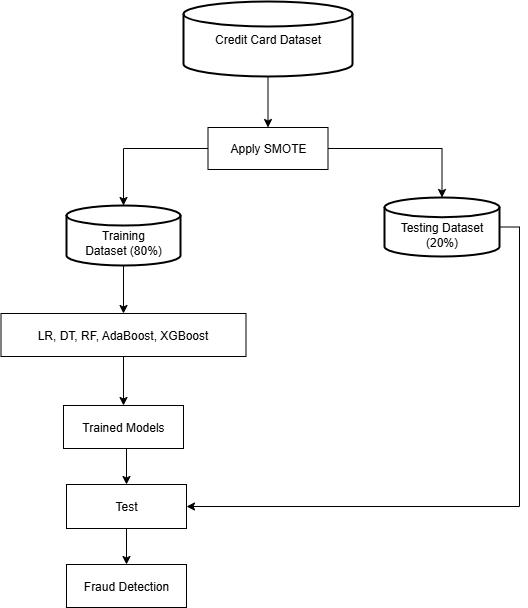
Figure 3.1:SystemArchitecture
Dataset: In this paper credit card fraud detection dataset was used, which can be downloaded from Kaggle. This datasetcontainstransactions, occurredintwodays, made in September 2013 by European cardholders. The dataset contains 31 numerical features. Since some of the input variables contain financial information, the PCA transformationoftheseinputvariableswereperformedin order to keep these data anonymous. Three of the given features weren’t transformed. Feature "Time" shows the time between the first transaction and every other transactioninthedataset.Feature"Amount"istheamount of the transactions made by credit card. Feature "Class" represents the label and takes only 2 values: value 1 in caseoffraudtransactionand0otherwise.
The dataset used in this study is highly imbalanced, as fraudulenttransactionsarefarfewerthanlegitimateones. Toaddressthisissue,theSyntheticMinorityOversampling Technique (SMOTE) was applied to generate synthetic fraudsamplesand balancethedataset. Thisimprovedthe learning process of the classifiers and enhanced their abilitytodetectfraudulenttransactions.
Divide the dataset: The dataset is divided into a trained data set and test data set. 80% of the data set is under trainingandtheremaining 20%isundertesting.Here we are using some supervised machine learning algorithms. ThealgorithmsareXGB,DT,RF,LR,AdaBoost.
Logistic Regression: The Logistic Regression model achieved an accuracy of 99.56%, demonstrating strong International Research Journal of Engineering and Technology (IRJET) e-ISSN:2395-0056
International Research Journal of Engineering and Technology (IRJET) e-ISSN:2395-0056
Volume: 12 Issue: 09 | Sep 2025 www.irjet.net p-ISSN:2395-0072
performance for legitimate transactions. However, due to the highly imbalanced dataset, the model showed poor recall for fraudulent transactions. The ROC-AUC score of 67.6%furtherindicatesitslimitedcapabilityineffectively distinguishingfraudcases,makingitlessreliableforcredit cardfrauddetection.
DecisionTree(Entropycriterion):TheDecisionTreewith theEntropycriterion,achievedanaccuracyof99.89%and a ROC-AUC score of 85.2%. This version demonstrated significantlyimprovedfrauddetectioncapability,thoughit stilllaggedbehindadvancedensemblemethods.
Random Forest: The Random Forest model achieved an impressiveaccuracyof 99.93%andaROC-AUCof 94.3%. It demonstrated much better recall for fraudulent transactions at 65%, making it a strong performer among traditional ensemble methods, though still outperformed byboostingalgorithms.
XGBoost: XGBoost proved to be the most effective model, achieving the highest accuracy of 99.95% and a ROC-AUC score of 97.5%. With precision of 0.97, recall of 0.76, and an F1-score of 0.85, XGBoost successfully balanced all performance metrics. Its superior capability to identify fraudulent cases established it as the best-performing algorithminthisstudy.
AdaBoost: The AdaBoost classifier also performed strongly, reaching an accuracy of 99.91% and a ROC-AUC of97.3%.Itmaintainedagoodbalanceacrossmetricsand showed competitive fraud detection performance, althoughslightlybelowXGBoost.
AlgorithmstepsforfindingtheBestalgorithm:
Step1:Importthedataset.
Step2:Convertthedatasetintoadataframeformat.
Step3:Performrandomsamplingtoensurebalanced datadistribution.
Step4:Splitthedatasetintotrainingandtesting subsets.
Step5:Allocate80%ofthedatafortraining&20%for testing.
Step6:Traintheselectedmodelsusingthetraining dataset.
Step 7: Apply the chosen algorithms (Logistic Regression, Decision Trees, Random Forest, and XGBoost)tobuildpredictivemodels.
Step8:Generatepredictionsonthetestingdatasetfor eachalgorithm.
Step9:Evaluatemodelperformanceusingtheconfusion matrixtocalculateaccuracy.
Test data: The trained models are applied to the testing datasettoevaluatetheirperformance.
Fig.4.1showstheuserinterfacefortestingdatasets.Users can upload a CSV file and optionally provide a file name anddescription.Thisstepensuresthatthedataisproperly preparedbeforeanalysis.
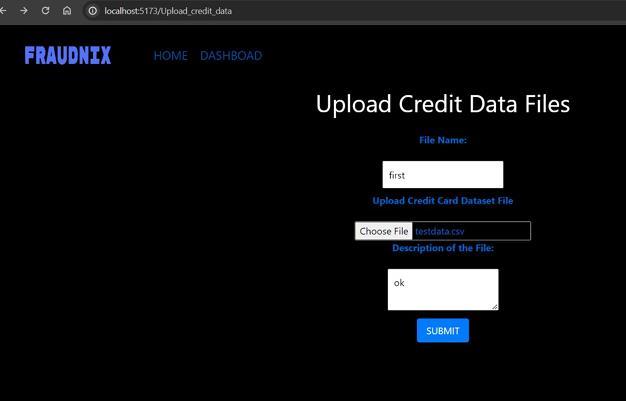
Fig. 4.3 and 4.4 illustrate dataset management. After uploading,userscanviewthedataset withintheinterface or delete the file if needed. Figure B provides an example where thecontentsoftestdata.csvaredisplayed,allowing userstoverifytheuploadeddata.
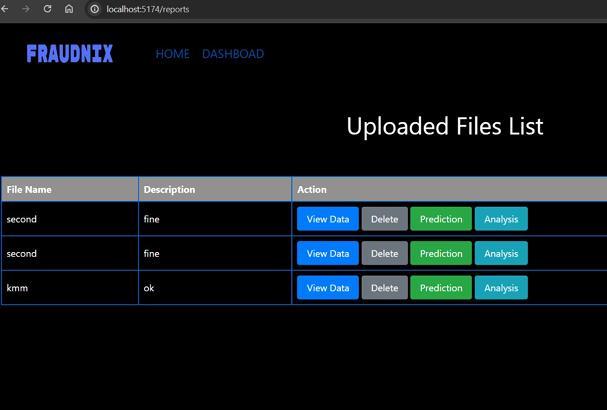
4.2:UploadedFileList
International Research Journal of Engineering and Technology (IRJET) e-ISSN:2395-0056
Volume: 12 Issue: 09 | Sep 2025 www.irjet.net p-ISSN:2395-0072
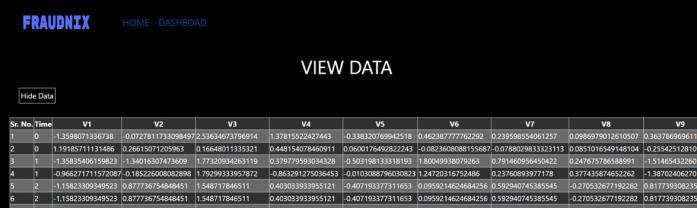
4.3:ViewData
Fig.4.4 demonstratesthepredictionprocess.Thebackend model,alreadytrainedwithamachinelearningalgorithm, generates results after the Predict button is clicked. The output is shown in a new window as binary values: 1 for fraudulentand0fornon-fraudulenttransactions.
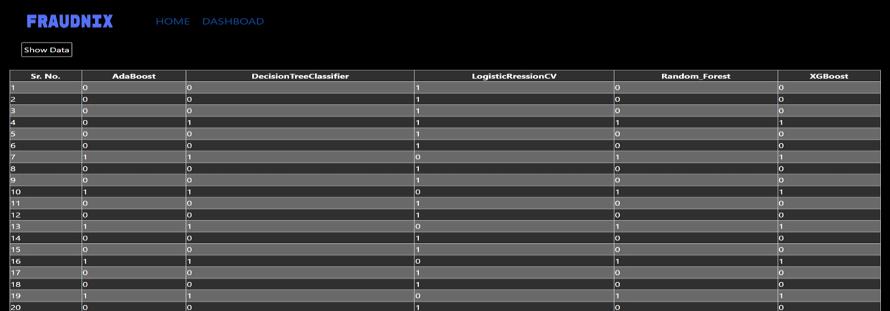
4.4:Detectionoffraudornormaltransaction
1)Confusion matrix for Logistic regression Algorithm:
Fig. 4.5 represents the confusion matrix for the Logistic Regression algorithm, which contains True Positive, True Negative, False Positive, and False Negative values. The modelfailstodetectfraudulentcases(TP=0),resultingin a high False Negative value (98). This indicates that fraudulent cases are not being identified at all, although non-fraudulent cases are detected well. For the Logistic Regression algorithm, the accuracy, recall, and precision achievedare99.56,0.0,and0.0respectively.
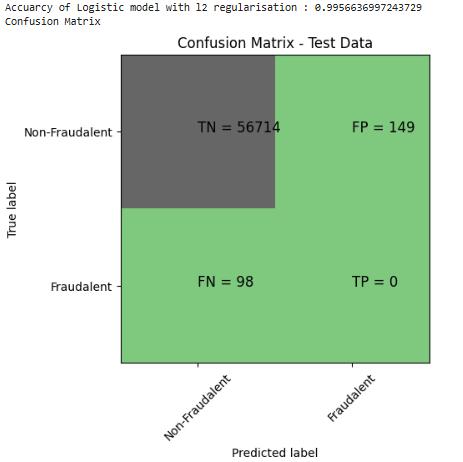
2)Confusion matrix for Decision Tree (entropy) Algorithm:
Fig. 4.6 represents the confusion matrix for the Decision Tree algorithm, which contains True Positive, True Negative, False Positive, and False Negative values. The False Positive value (30) is very low, indicating that nonfraudulent cases are rarely misclassified as fraud. The False Negative value (29) is also relatively low, ensuring thatmostfraudulentcasesareeffectivelydetected.Forthe Decision Tree algorithm, the accuracy, recall, and precision achieved are 99.89, 70.41, and 69.70 respectively.
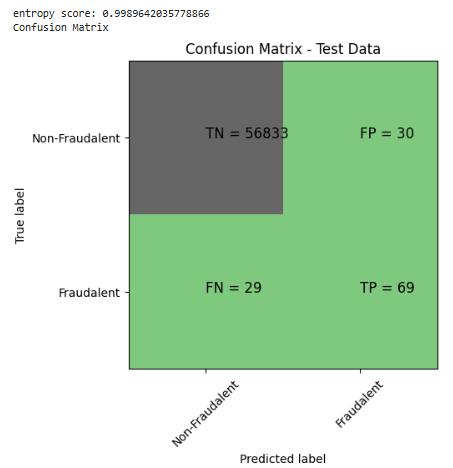
4.6:ConfusionmatrixforDecisionTree(entropy)
3)ConfusionmatrixforRandomForestAlgorithm:
Fig. 4.7 represents the confusion matrix for the Random Forest algorithm, which contains True Positive, True Negative, False Positive, and False Negative values. The False Positive value (3) is extremely low, showing that non-fraudulent cases are almost never misclassified as fraud.TheFalseNegativevalue(34)isalsorelativelylow, indicating that the model is effective at detecting fraudulent cases. For the Random Forest algorithm, the accuracy, recall, and precision achieved are 99.93, 65.33, and95.52respectively.
International Research Journal of Engineering and Technology (IRJET)
Volume: 12 Issue: 09 | Sep 2025 www.irjet.net p-ISSN:2395-0072
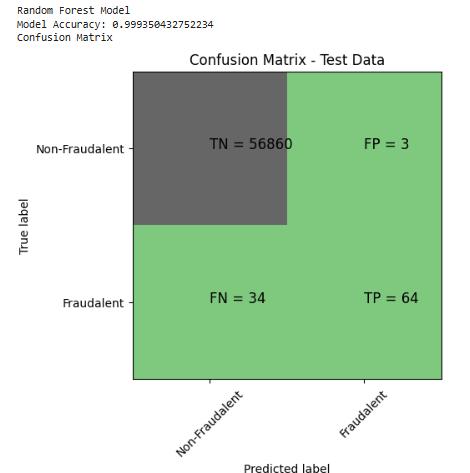
4)ConfusionmatrixforXGBoostAlgorithm:
Fig. 4.8 represents the confusion matrix for the XGBoost algorithm, which contains True Positive, True Negative, False Positive, and False Negative values. The False Positive value is extremely low, indicating that nonfraudulent cases are rarely misclassified as fraud. The False Negative value is also minimal, which ensures that fraudulent cases are detected effectively. For the XGBoost algorithm,theaccuracy,recall,andprecisionachievedare 99.95,75.51,and97.37respectively.
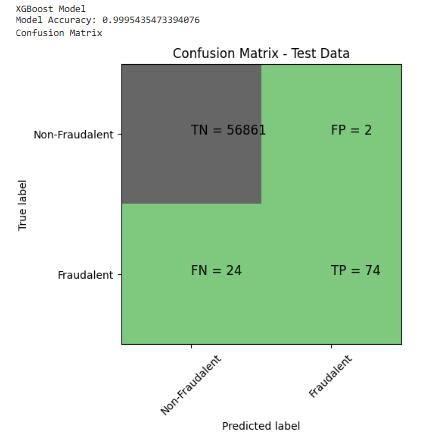
5)ConfusionmatrixforAdaBoostAlgorithm:
Fig. 4.9 represents the confusion matrix for the AdaBoost model, which contains True Positive, True Negative, False Positive, and False Negative values. The False Positive value is very low, which indicates that non-fraudulent casesarerarelymisclassifiedasfraud.Similarly,theFalse
Negative value is also minimal, ensuring that fraudulent casesareeffectivelydetected.FortheAdaBoostalgorithm, the accuracy, recall, and precision achieved are 99.91, 73.47,and76.59respectively.
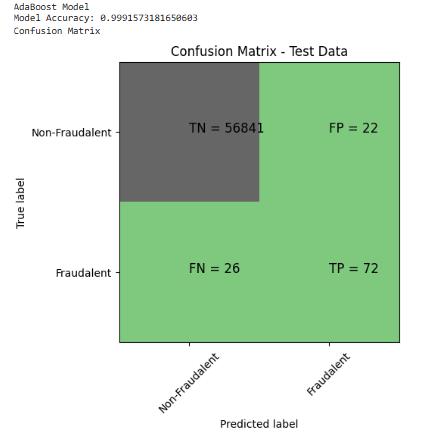
Comparisonofalgorithms:
Table 7.1 represents the comparison table made using results obtained from simulation. Factors compared are accuracy, precision, and recall. From the table, we can conclude that the XGBoost Algorithm has the best accuracy,precision,andrecall.Achievementofaccuracyis done using different algorithms, and the XGBoost Algorithm gives the best performance. The confusion matrix provides visualization of results in the form of a table,andaminimumfalsepositiverateisobservedacross all algorithms, which is required to achieve the objective. Finally, by providing the numerical data, fraudulent and non-fraudulent cases can be effectively detected using a basicuserinterfacedesign.
Logistic Regression 9956 000 000
DecisionTree 9998 6970 7041
RandomForest 9993 9552 6533
AdaBoost 9991 7659 7347
XGBoost 9995 9737 7551
Table 4.1:Accuracy,precision,recallcomparisontablefor differentMLalgorithms
International Research Journal of Engineering and Technology (IRJET) e-ISSN:2395-0056
Volume: 12 Issue: 09 | Sep 2025 www.irjet.net p-ISSN:2395-0072
Theevaluationresultsindicatethatthemachinelearning models,includingLogisticRegression,DecisionTreewith entropy criteria, Random Forest, and XGBoost, achieved highlevelsofaccuracy,rangingfromapproximately99.51 percent to 99.97 percent. Among this model XGboost exhibited the highest accuracy of 99.95 percent. Additionally, all models indicated their ability to distinguish between fraudulent and non-fraudulent transactions effectively. The threshold values varied acrossthemodels,reflectingthedecisionboundariesused for classification. Overall, these findings underscore the effectivenessofmachinelearningalgorithmsincreditcard frauddetectionandhighlighttheimportanceofemploying diverse models to enhance detection accuracy and robustness.
[1] PhanindraShivaji,BindhuMadhavi,NagaLakshmi,Sri Chakradhar Kishan and Pavan Kuma, “Credit Card FraudDetectionusingAdaBoostandMajorityVoting,” International Research Journal of Modernization in Engineering Technology and Science, vol. 06, June 2022.
[2] Vaishnavi Nath Dornadula and Geetha S, “Credit Card Fraud Detection using Machine Learning Algorithms”, International Conference on Recent Trends in AdvancedComputing2019.
[3] K.Ratna Sree Valli, P.Jyothi, G.Varun Sai, and R.Rohith SaiSubash“CreditcardfrauddetectionusingMachine learning algorithms”, Quest Journal of Research in Humanities and Social Science Volume 8, Issue 02, 2020
[4] Varun Kumar K S, Vijaya Kumar V G, Vijay Shankar A and Pratibha K, “Credit Card Fraud Detection using Machine Learning Algorithms”, International Journal ofEngineeringResearch&Technology Vol.9Issue07, July-2020
[5] LakshmiSVSSand SelvaniDeepthiKavila “Machine Learning For Credit Card Fraud Detection System”, InternationalJournalofAppliedEngineeringResearch Vol.13.


Rifat Perween, is a Bachelor of Technology graduate in Computer Science from SNDT women’s university. Herresearchinterestslie at the intersection of Machine Learning, Cryptography, and Software engineering. Currently, working as a developer at Deloitte. She is aiming to pursue postgraduate studies in the field of AI,computerscienceandresearch.
Nisha Kumari Singh,isaBachelorof Technology graduate in Computer Science from SNDT women’s university. Herresearchinterestslie at Machine Learning and AI. Currently, working as a Business AnalystatDigitide.