
International Research Journal of Engineering and Technology (IRJET) e-ISSN:2395-0056
Volume: 12 Issue: 09 | Sep 2025 www.irjet.net p-ISSN:2395-0072
International Research Journal of Engineering and Technology (IRJET) e-ISSN:2395-0056
Volume: 12 Issue: 09 | Sep 2025 www.irjet.net p-ISSN:2395-0072
1Edward E. Osakue & 1Rasoul Saneifard
1Department of Engineering, Texas Southern University, Houston, Texas, USA ***
Abstract
A reversed Lewis root bending stress capacity model for bevel gearsispresented.Themodelisdevelopedfromfirstprinciple based on the Tredgold’s approximation of a bevel gear. The approximation conceptually transforms a bevel gear into a spurgear. The load distributionof the bevel gearfacewidthis assumed to be triangular so that the stress at the gear is constant over the facewidth. Six design cases of root bending stress computations from different references are done using thenewandAGMAmodels. Thestressestimatesfrom the new and AGMA models were compared. The stress deviations associated with the pinions in the gearsets for the design problem examples vary between -14 to -4%, approximately. Based on the values of the deviations for the pinion stresses, the new root bending stress model verification may be said to be favorable when compared with AGMA stress values. However,therootbendingstresspredictionsarerelativelyless conservativeinvalues.
Keywords: Bending,fatigue failure,nominalhelixangle, base helixangle,virtualplane,Lewisstressfactor
1.0 Introduction
Abevelgearhasteethcutonaconicalpitchsurface,making thetoothtovaryinthicknessandheightfromthefrontend or toe to the back end or heel A bevel gearset consists of a pinion (smaller gear) and a ring gear (larger gear). The common types of bevel gears are straight and helical gears. The teeth of straight bevel gears are straight on the conical disksurface.Helicalbevelgearshavecurvedteethonconical disk surfaces and include skew, spiral, zerol, and hypoid bevelgears[1,2].Skewbevelgearshaveaconstantnominal helix angle like helical cylindrical gears, while spiral and zerol gears have variable helix angle. The nominal helix angle of spiral bevel is taken as the mean spiral angle defined at the mid-facewidth of the gear. The most popular helixangleforspiralbevelgearsis35o [3],butnominalhelix angles of 20o to 45o may be used with the same tooth proportions as for 35o. Though spiral bevel gears resemble helicalgears,theyhowever,donothaveatruehelicalspiral [4, 5]. Zerol bevel gears have nominal helix angle of zero degree Hypoid gears are spiral bevel gears with nonintersectingaxes.Theoffsetallowsformorecompactdesign and efficient power transmission at greater angles than
straight bevel gears. The pressure angles in use for bevel gearscanvaryfrom14.5o to25o Pressureanglesof20o and higher are often used to avoid interference [1]. However, 22.5o and25o pressureanglesareusedmainlyinheavy-duty drives [6]. In North America, the most popular pressure angleis20o.TheInternationalStandardizationOrganization (ISO) has adopted 20o pressure angle as the standard pressure angle, which makes it more attractive for internationalcollaborationandcommerce.
A gear tooth in a mesh during operation acts like a loaded cantileverbeamasitresiststheforcestransmitted.In1892, Wilfred Lewis developed a gear root bending stress model [7].Hemodeledageartoothasashortcantileverbeamona rigid base with the transmitted load applied near the tip of the gear tooth. The maximum tensile stress occurs at the root radiuson the loadedsideof the geartooth. Atthe gear root, the involute profile merges with a root fillet [8] which creates some stress concentration. Due to the repeated loadingofageartooth,thisregionbecomesthepreferential siteforinitiation offatigue crack. Themodel ofLewisisthe basis of national and international gear beam strength standards. These include American Gear Manufacturers Association (AGMA), International Standardization Organization (ISO), Deutsches Institut Normung (DIN), and Japanese Industrial Standard (JIS), which have introduced modificationfactorsintotheoriginalLewismodel.
Bending fatigue failure is one of the two most prominent modes of gear failure. Factors that can influence gear failures include transmission error, design error, manufacturing error and assembly error. Generally, severe surface wear-out in gears, which can accelerates bending fatigue failure, may be caused by thin lubrication film between two mating surfaces and the presence of debris in the lubricant. Bending fatigue failure of straight bevel pinions is the main failure mode in engineering machinery [9]. AreviewofbevelgearfailuresbyJoshiandKothari[10] concludedthatbevelgearscommonlyfailbytoothbreakage or fatigue. Such failures are largely caused by overloading, shaft misalignment, material and metallurgical deficiencies. Mohan Raj and Jayaraj [11] performed studies using distributedandconcentratedloadsappliedatthepitchpoint onabevelgear.Theyfoundthatthestressesatthetoeofthe tooth were higher than those at the heel. Irsel [12] showed
International Research Journal of Engineering and Technology (IRJET) e-ISSN:2395-0056
Volume: 12 Issue: 09 | Sep 2025 www.irjet.net p-ISSN:2395-0072
thatestimatesofbevel gear root bendingstressesfrom ISO, AGMA, DIN, and Finite Element Method (FEM) models can be significantly different in values for the same loading. Generally, ISO, DIN, and FEM root bending stress values in the study tended to be higher than AGMA values. Implementation of ISO, DIN, and AGMA in KISSsoft commercialsoftwareyieldedthesametrendinrootbending stressvalues.Irsel[12]notedthatFEMstudiesusuallyapply static load, not dynamic load to gear teeth. Mieth, Ulrich1, and Schlecht1 [13] formulated a solution for bevel gear contact and root bending stresses using FEM influence. The method enables the calculation of full stress tensors at any desired location in the gear and takes account of the influence of local stiffness variations. AGMA bevel gear root bendingstressmodelestimatesareconsideredconservative [3,5].Thereforetheothermodelestimatesmentionedabove appeartobeevenmoreconservativethanAGMA.
Estimating root bending stress in bevel gears has been a challengeasthestudy ofIrsel indicates. Likebendingstress estimates,permissiblebendingfatiguestressestimatesfrom the different standards can be significantly different too. This situation may be attributed to the geometric complexities of bevel gears which make their design calculationsmorecomplicatedcomparedtocylindricalgears [14].Theconicalshapeofthegear[14]andthefactthatthe spiral angle in helical bevel gears is not a true helix appear to greatly complicate the stress estimate. The lack of good correlation between the root bending stress estimates from the different standards seems to suggest a strong need for new root bending stress models for bevel gears. This study presents a new mathematical formulation for the beam strength capacity of bevel gears using first principles. The developed bending stress model appears to be reasonably accurate,butslightlylessconservativewhencomparedwith AGMA model. It will minimize design efforts and analysis whendefininginitialbevelgearsizes,oftenneededformore detail study using FEM. The model can therefore, help to shorten design and development times, as well as reduce bevelgeardesignprojectcosts.
Bevel gears have teeth cut on the frustum of a cone and for twoconestorollwithoutsliding;theymusthaveacommon apex. This ensures that the pitch surfaces of two meshing bevel gears are proportional to the distance from the common apex and allow pure rolling of the meshing bevel gears. Therefore, proper bevel gear meshing must be considered in pairs because the cone pitch angles of the gears are restricted by the gear ratio and shaft angle [15]. Theanglebetweenthecenterlinesoftheshaftscarryingthe bevel gears is called the shaft angle. Generally, shaft angles
between 30o and 150o[2] are usually permissible subject to some gear ratio limitations. A shaft angle of 90o is the most popular in use but other angles are sometimes used.. In conventionalconfigurationofbevelgearsets,theshaftangle is:
Thepitchangleofabevelgearistheanglebetweentheface of the pitch surface and the shaft axis. When 090 o conepitchanglesareobtainedasinEq.(2)[2].
o o (2)
Please, observe that there are two expressions in Eq. (2), whichshouldbereferredtoasEq.(2a)andEq.(2b)fromleft to right. All other equations with multiple expressions shouldbeinterpretedsimilarly.Thedefinitionofparameters inequationsareintheNomenclature.
then[23]:
Note that equations (1) to (3) do not apply to bevel crown gearswhere
Bevelgearsaregenerallyanalyzedbasedonequivalentspur gears defined by the Tredgold’s approximation. The Octoid tooth profile is often used for implementing the Tredgold’s approximation [14]. Due to the spherical nature of bevel gears,a crowngear(circularrack ofstraightflanks) is used togeneratebevelgeartoothprofile.Theshapegeneratedby the circular rack is called "octoid" and is very similar to an involute, but not exactly. The octoid provides a constant ratio and makes the gears insensitive to displacements perpendiculartothe pitchline. Theoctoidtechniqueallows easymanufacture[14]ofbevelgearsbygenerativemethod. Some gear generators require pinion pitch angle above 5o [16].
The concept of equivalent spur gear for other gear types is commonlyused due to the relativesimplicityofa spur gear geometrycomparedtotheothergeartypes.Bevelgearteeth are cut on conical surfaces and have a spherical geometry. Hence, the involute tooth profile should be developed on a spherical surface to ensure conjugate action. Developing gearteethona spherical surfaceisa verydifficulttask.Ina
International Research Journal of Engineering and Technology (IRJET) e-ISSN:2395-0056
Volume: 12 Issue: 09 | Sep 2025 www.irjet.net p-ISSN:2395-0072
planenormaltothepitchconeangleorcontactline,meshing physical bevel gears appear to be similar to those of spur gears [15]. Therefore, the “Tredgold’s approximation” is almost universally accepted. It uses the cone tangent to the sphere at the pitch point on the backend of the physical bevel gear to define the pitch radius of an equivalent spur gear. The back-cone radius of the bevel gear then becomes theradiusofanimaginaryspurgearwithteethandpressure angle corresponding to the bevel gear The Tredgold’s approximation is accurate enough for practical purposes as longasthebevelgearhas8ormoreteeth,[14,17,18,19].It is standard practice in bevel gear technology to define the size and shape of the tooth profile at the back end [14] perhaps based on Tredgold’s approximation. The manufacturing dimensions of a bevel gear are based on the backend module, which is largely standardized. Fig. 1a showstheaxialplaneofastraightbevelgearwhileFig.1b
shows the transverse plane at the back end. The basic physical gear size parameters are shown in these figures, exceptthemodule.

a)Axialplane
b)Transverseplane Fig.1:PhysicalbevelGear
The geometric relationships between backend dimensions ofa straightbevel gearandthe Tredgold’svirtual spur gear aregivenbelow.
Thegearratioandspeedratioforbevelgearsarerelatedas expressedinEq.(8)
The parameter bK is based on bevel geometry and differentiatesbevelgearsfromcylindricalgears.
© 2025, IRJET | Impact Factor value: 8.315 | ISO 9001:2008
Journal | Page327
International Research Journal of Engineering and Technology (IRJET)
Volume: 12 Issue: 09 | Sep 2025 www.irjet.net
ThevirtualgearratioforstraightbevelgearsisgivenbyEq. (9)
(8)
Figs.2aand2bshowtheTredgold’s-spurgearisaspurgear thatisgeometricallyequivalenttoastraightbevelgear.The tooth profile of a regular spur gear lies in the transverse planeandiscoincidentwiththenormalplane.Similarly,the tooth profile of the Tredgold’s virtual spur gear lies in the transverseplaneandiscoincidentwiththenormalplane.
Thebasicdimensionsofthe Tredgold’svirtualspurgearfor a straight bevel gear is summarized by Eq. (9). Eq.(9b) is given for completeness. The proof is shown later in section 5.1
The development of an equivalent spur gear for a helical bevel gear is based on two assumptions: Tredgold’s approximation and helical cylindrical gear analogy. This approach results in a bi-equivalent spur gear for a helical bevel gear. The Tredgold’s approximation gives the first equivalentspurgearforastraightbevelgear Ahelicalbevel gear is obtained a Tredgold’s-spur gear as a second approximation.Inthisapproach,thenominalhelixangleofa bevel gear is defined as the mean spiral angle which is measuredatthemid-facewidthofthegeartooth. Astraight bevel gear can be considered as a helical bevel gear with a nominal helix angle of zero. The basic parameters for the helical bevel gears are the normal module, nominal helix angle,pitchdiameter,andnominalfacewidth.
(10)
The two parameters which relate a helical gear to its equivalent spur gear are the transverse pressure angle and thebasehelixangle[20].Whenthenormalpressureangleis standardized,then:
According to Maitra [17], the base helix angle gives a more accurateestimateoftheinstantaneousradiusofcurvatureof the equivalent spur gear for a helical gear. Therefore, the plane defined by the base helix angle will be called the virtualplaneonwhichthepitchdiameterofthevirtualspur gearforahelicalgearlies
Thevirtualorequivalentgearratioofahelicalbevelgearset basedonEq.(6)is: (13)
The basic dimensions of the bi-equivalent virtual spur gear forahelicalbevelgearissummarizedbyEq.(14).


a)Transverseplane b)Axialplane
Fig.2:EquivalentTredgold’sspurgearofabevelgear
The average number of gear teeth pairs in simultaneous engagement during operation is called contact ratio. The contact ratio of a bevel gearset is evaluated on the virtual plane defined by the base helix angle. The contact ratio factorforthepinionisexpressedinEq.(15a).
ThecontactratiofactorfortheringgearisexpressedinEq. (15b).
The expression for thecontactratioonthevirtual planefor standardprofilegearsetsisgivenbyEq.(16).
Eq.(16)yields t ,thevalueforstraightbevelgearswhen vz isequalto t
International Research Journal of Engineering and Technology (IRJET) e-ISSN:2395-0056
Volume: 12 Issue: 09 | Sep 2025 www.irjet.net p-ISSN:2395-0072
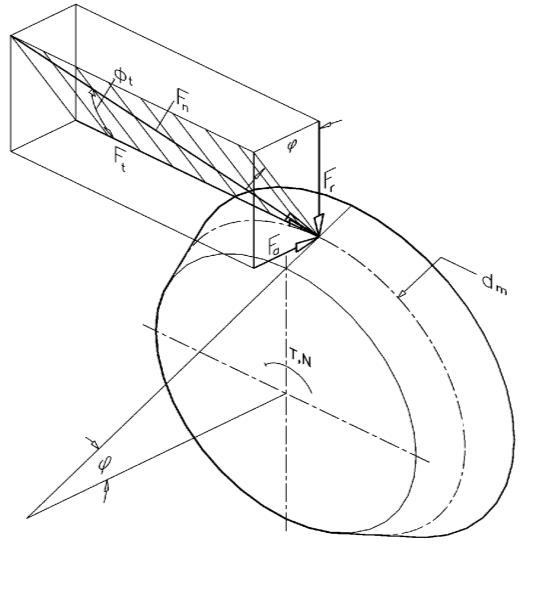
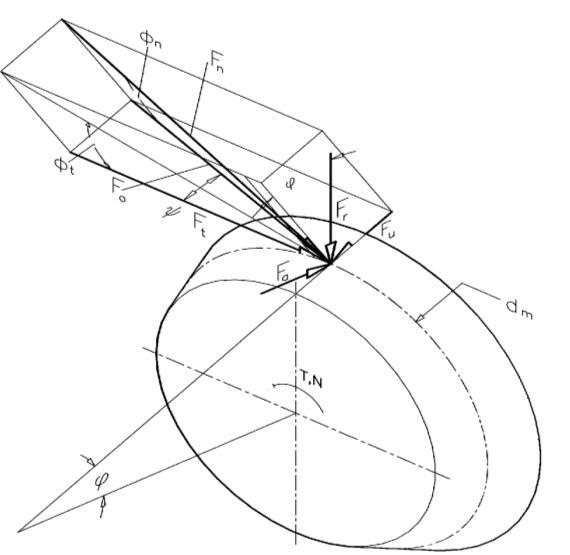
In the design analysis of bevel gears, the load is commonly assumed to be applied at the mid-face width. The resultant force acts somewhere between the midpoint and the back end of the tooth width [1, 5, 9, 17]. This means the force components used in design analysis are slightly conservative. It is to be noted that the complexities of the tooth profile of bevel gears make precise analysis rather very complicated and such a conservative approach is justified.Fig.3depictsthreecomponentsofthecontactforce shownatthemid-planepitchpointonastraightbevelgear. These forces are the tangential, tF ;radial, rF ; and axial, aF components of the contact force. aF is parallel to the shaft axis, while tF and rF are mutually perpendicular to each otherand aF .Thenormalforce, nF isshowninFig.3andFig. 4. It acts normal to the gear tooth in space. The tangential force is the driving force, the radial and axial forces are generatedduetothegearpressureangleandtheconepitch angle for the bevel gears. The transmitted power, torque, and tangential force are related as expressed in Eq. (17) to Eq.(18).
The parameter bK in Eq. (18), transfers the point of load application from the mid-width plane to the backend plane of the actual bevel gear where the Tredgold’s spur gear is defined
The radial and axial force components for a straight bevel gearsareobtainedfromEq.(19).
(19)
These force components are modified by the nominal helix angleinhelicalbevelgears
Helicalbevelgearsareanalogoustocylindricalhelicalgears andtheforcesonabevelhelicalgearpaironthenormaland transverse plane are shown in Fig. 4. o F acts normal to the geartoothand u F actsparalleltothepitchangle.
(20)
ThenormalcontactforceisgivenbyEq.(21).
International Research Journal of Engineering and Technology (IRJET) e-ISSN:2395-0056
Volume: 12 Issue: 09 | Sep 2025 www.irjet.net p-ISSN:2395-0072
Theradialandaxialforcecomponentsofaspiralbevel gear aregiveninEq.(22a)andEq.(22b)[6]whentheshaftangle is900
Andtheaxialforcecomponentfactoris:
Straight bevel gears are symmetrical in the lengthwise directionwhichmakesfor equalstressesonthefacesofthe gear.However,spiralbevelgearsarenotsymmetricalinthe lengthwisedirectionsothatstressesinducedintheconcave andconvexsidesofatoothcanbedifferent[3,6].Twocases can be associated with the operative forces in spiral bevel gears and they are Case I and Case II [6]. The direction of rotationofthepinionisobservedfromtheapexpointofthe pitchconesofthegearset.
Case I: Left-handed pinion spiral rotates counterclockwise orright-handedpinionspiralrotatesclockwise. Inthiscase, thenegativesignappliesinEq.(22a)fortheradialforceand positive sign applies in Eq. (22b) for axial force The signs arereversedineachcaseforthegear.
CaseII:Left-handedpinionspiralrotatesclockwiseorrighthanded pinion spiral rotates counterclockwise. In this case, thepositivesignappliesinEq.(22a)fortheradialforceand negative sign applies in Eq. (22b) for axial force. The signs arereversedineachcaseforthepinion.
BasedonEq.(22)axialandradialforcecomponentsmaybe defined for bevel gears. When a pinion convex face mates with the gear concave face in Case I, the radial force factor forthepinionfaceis:
Andtheaxialforcecomponentfactoris:
(22b) (23a)
Theforcecomponentfactorsforthegearareobtainedfrom Eq. (23a) by changing the (+) to (-) as in Eq. (23c) and Eq. (23b)bychangingthe(-)to(+)asinEq.(23d).
When a pinion concave face mates with a gear convex face, inCaseII,theradialforcefactorforthepinionfaceis:
Theforcecomponentfactorsforthegearareobtainedfrom Eq. (23c) by changing the (-) to (+) as in Eq. (23a) and Eq. (23d) by changing the (+) to (-) as in Eq. (23b). The factors for straight bevel gears are obtained in Eq. (23) when the nominalhelixangleiszero.
For spiral bevel gearsets loaded in two directions, stresses on both concave and convex faces are necessary [21] A positive a valueforbothpinionandgearindicatesthat the axialforceisdirectedawayfromtheconeapexandthuswill prevent jamming of the gear pair during operation. This is thepreferredconfigurationofbevelgearsetinanassembly
Theobjectiveindesignverificationistoassesstheadequacy of a design. After initial dimensions are estimated, performancecapacitiesofacomponentorassemblycanbe evaluatedandjudgedforacceptabilitybasedonaminimum design factor or reliability target. If the evaluated design factor or reliability level for a failure mode is smaller or lower than the minimum value, the design is deemed inadequateotherwiseitisaccepted.Acommonperformance capacityforgearsisbendingfatigueresistancewhichisone of the two prominent modes of gear failure [8, 14, 22]. Bending fatigue resistance is the capacity of a gear tooth to withstand bending load imposed by the transmitted force and its associated derivatives. Both the tangential and axial loads induce bending moment, therefore bending stresses, onastraightbevelgeartoothinadditiontothedirectshear stressestheycause.
Fig. 5a shows an element of a tooth assumed to be transmittingtorqueaboutthegearaxisOC.Wewillfornow consider the bending stress from only tangential force, that fromtheaxialloadwithbetreatedlatter.Theradialdistance topointBandgeartoothprofileinthetransverseplaneisa linearfunctionofthedistancefromthegearapexatpointO.
© 2025, IRJET | Impact Factor value: 8.315 | ISO 9001:2008 Certified Journal | Page330
International Research Journal of Engineering and Technology (IRJET) e-ISSN:2395-0056
Volume: 12 Issue: 09 | Sep 2025 www.irjet.net p-ISSN:2395-0072

a) Axialplane
b) Transverseplane
Fig.5:Straightbevelgearbendingmodel
FromsimilartrianglesOABandOCDofFig.5a:
Thatis:
Bythedefinitionofgearmodule:
SubstituteEq.(24b)intoEq.(25)toobtain:
(26)
The bending stress analysis of straight bevel gears can be simplified by assuming that the stress is the same at any section at the root of the gear. This may be justified when the load distribution along the tooth width is assumed triangular with anapex coincident withthe pitchcone apex of the bevel gear [23]. Considering only the tangential force for now, and referring to Fig. 5b and Eq. (26), the resisting elementalforceagainstthetransmittedloadis:
In Fig. 5b, the resisting elemental torque against the transmittedloadis:
design parameters in Eq. (27). The transmitted toque is obtainedbyintegratingEq.(27)asindicatedbelow.
Whenthelimitsofintegrationareappliedandsimplification doneEq.(29)isobtained.
Themultiplier103 isusedtoconvertthetransmittedtorque fromNmtoNmmforconsistencyofdimensionalunitsofthe
By comparison of the bracketed term of Eq. (29) and Eq. (30a),itmaybeassumedthat:
The error in the approximation above is
Generally, 3
eL b inbevelgeardesignandtherelativeerrorin the approximation is about 1.32% and is quite negligible. FromEq.(29)andEq.(31):
International Research Journal of Engineering and Technology (IRJET) e-ISSN:2395-0056
Volume: 12 Issue: 09 | Sep 2025 www.irjet.net p-ISSN:2395-0072
The original Lewis and AGMA [24] root bending stress models are based on the tangential force, not the torque transmitted as shown in Eq. (32). Eq. (32b) can be transformedintoaforce-basedversionas:
(33)
Aspurgearhasaconstantmodulealongthegearfacewidth but a bevel gear has a variable module over the facewidth. Therefore, the parameter tb is the equivalent nominal facewidth of a straight bevel gear when treated as a spur according to Tredgold’s model. Since the parameter bK is greaterthanunity, tb isalwayssmallerthanthefacewidthof a spur gear of the same nominal width size. Consequently, the load capacity of a bevel of the same nominal width size as that a spur gear will be less. The parameter bK is in this regardisa geometricscalingfactorand helpstocompletely definethesizeoftheequivalentspurofastraightbevelgear.
Eq. (32b) gives the Lewis root bending stress of a straight bevel gear tooth induced by only the tangential force component without consideration of a stress concentration factor. In Lewis days, the concept and relevance of stress concentrationwasunknown.Forobjectsunderfatigueload, stress concentration cannot be ignored, especially for steel and plastic materials that are sensitive to stress concentration effects. Since the consideration for now is limitedtotangentialbending,Eq.(32b)canbemodifiedwith the normal or bending stress concentration factor. Also, a modifiedLewisformfactorcalledLewisstressfactorcanbe
introduced in Eq. (32b). Consequently, Eq. (34) gives a modifiedLewisrootbendingstressmodelforstraightbevel gears.
TheLewisstressfactorisgivenbyEq.(35).
TheLewisstressfactor bY isadoptedfromaJIS[15,25]gear design standard and the values can be read from a graph givenintheAppendix.
The above analysis focuses only on the tangential force and theradial forcewhichcausescompressionofthegear tooth through the AGMA J-factor [24] but not the axial force, explicitly Alsoignoredaretheshearstressescausedbyboth tangential and axial forces. These stresses are now considered next. Consider Fig. 6 where the gear tooth is treatedasacantileverbeamwithtangentialandaxialforces actingonit.Theloadsareassumedtobeappliedatthetipof thegeartoothlocatedbythemomentarm cl .Theaxialforce creates additional bending stress at the gear root as indicated in Fig. 6b. Hence the bending stress contribution fromtheaxialloadneedsconsideration.

a)Transverseloading
b)Axialloading
Fig.6:Cantilevermodelsofgeartoothinbending
International Research Journal of Engineering and Technology (IRJET) e-ISSN:2395-0056
Volume: 12 Issue: 09 | Sep 2025 www.irjet.net p-ISSN:2395-0072
From Fig. 6a, the bending stress from the tangential load componentis:
From Fig. 6b, the bending stress from the axial load componentis:
Equivalenttensilestressmaybe basedondistortionenergy theory for ductile materials [14, 27]. Most gears are made fromductilematerials,sotheequivalenttensilestressatthe tooth root may be estimated by applying the distortion energy theory. For a plane stress situation, the equivalent tensilestressisgivenbyEq.(44a).SubstitutingEq.(39)and Eq.(43)intoEq.(44a),Eq.(44b)isobtained.
SubstitutingEq.(9)inEq.(10),wehave:
Becauseoftherectangularshapeofthegeartoothsectionat the root, the total bending stress from the tangential and axialforcesis[26]:
The tangential and axial force components create direct shear stresses also. To account for these stresses, we will considertheequivalentspurgearofabeveltobeloadedby tangential and axial forces, though actual spur gears do not experience axial loads.Stressconcentration is expected due to the geometric discontinuity caused by the root fillet; therefore, a stress concentration factor should be included in the model. It should be noted that shear stresses are assumeduniformoverthesectionbutmodifiedbythestress concentrationfactor. The directshearstressinduced by the tangentialloadis:
Theparameter
shearstressesfromaxialandtangentialloads. Thedirectshearstressfromtheaxialloadis:
Theresultantshearstressis:
Substitutefor equationofEq.(xxx):
Thegearrootthicknessmaybeestimated[26]as: (46)
Amethodforestimating is described in [28] and it has a value of 1.8321 for JIS involute spur gears of 200 standard pressure angle and whole depth of 2.25m.In involute gear design, all contact between two gears occurs in the same fixed plane during meshing.
SubstitutingEq.(46a)inEq.(45),then: (46)
Whenloadsharingistakenintoaccount,Eq.(44b)becomes: (47)
When the tangential force is replaced with the transmitted torqueinEq.(47),then: (48)
Eq.(48)istherevisedLewisrootbendingstressmodelfora straightbevelgearbasedontheTredgold’sapproximation.
5.4
Eq. (48) is associated with the transverse plane of the straight bevel gear. In helical bevel gears, the analysis is done on the virtual plane of the bioequivalent virtual spur gear. Using applicable normal module and virtual contact ratio,therootbendingstressonthevirtualplaneforhelical bevelisthen:
International Research Journal of Engineering and Technology (IRJET) e-ISSN:2395-0056
Volume: 12 Issue: 09 | Sep 2025 www.irjet.net p-ISSN:2395-0072
(49)
In helical bevel gears, the normal bending force o F and tF are related by the expression of Eq. (20a). Fig. 7 shows the force components on a gear at its tip in the normal and transverseplanes.

a)Normalplane b)Transverseplane
Fig.7:Geartoothloadingintwodifferentplanes
Thestresson thetransverseplane in Fig.7bis given by Eq. (50a). The normal module and transverse module are similarlyrelatedasindicatebyEq.(50b).
(50)
Assuming the stress at the gear root on the virtual plane is approximately equal to the stress at the gear root on the normalplane,then:
(51)
CombiningEq.(49),Eq.(50b),andEq.(51),then:
(52)
5.5 Developed Facewidth of Helical Bevel Gears
Fig. 8a shows two dimensions of an arc which are the straight distance between points A and B (cord length) and thearclengthbetweenpointsAB.Thecord lengthis1.6971 mm and the arc length is 1.9902 mm and the arc length is larger than the cord length. When a gear tooth has a curvature, as it is in spiral bevel gears, the effective contact length becomes the length of an arc which is slightly larger thanthegearnominalfacewidth.

a)Arclength b)Developedlength
Fig.8:Developingthelengthofspiralarc
Toaccountfortheinfluenceofthespiralcurvatureinspiral bevelgears,theeffectivefacewidthofabevelgearincontact duringtransmissionmaybeexpressedasinEq.(53).
(53)
Physically, Eq. (53a) may be interpreted as the developed facewidthofaspiralbevelgearparalleltothelinetangentto thespiralatmid-widthpointofthefacewidth.Basedonthis interpretation, converts the contact arc into a straight line as indicated in Fig. 8b. The lengthwise curvature of spiral bevel gears gives the teeth a considerable amount of overlap,providingincreasedfacecontactratio,toothrigidity andadjustabilitytoloadinduceddeflection[30].
Fig.8bshowsthecaseofaspiralbevelgearfacewidthanda nominal helix angle. The arc length of the spiral is the distance AB. The distance A/B/ is assumed to be the stretched out or developed length of the arc length AB. The spiral facewidth factor in Eq. (53a) is at least equal to unityandaccountsforthedevelopedlengthofthespiralarc. The spiral facewidth factor captures the effect of the lengthwise toothcurvature ofspiral bevel gears onthe root bendingstress.AGMA[21]providesaspiralfacewidthfactor expression which is based on the works of Gleason, a USA specialistmanufacturerofbevelgears.TheAGMA[21]spiral facewidth factor expression may be approximated by Eq. (54)[3,6,8].
The cutter radius in Eq. (54b) is chosen with Eq. (55a) as a guide [21, 29]. Eq. (55b) is obtained by substituting Eq. (55a)inEq.(54b).
sin 11 m c L R
© 2025, IRJET | Impact Factor value: 8.315 | ISO 9001:2008
(55)
Journal | Page334
International Research Journal of Engineering and Technology (IRJET) e-ISSN:2395-0056
Table1:SpiralAngleFactor
Table1showsvaluesofsomeselectednominal helixangles and spiral angle factor. Note that has higher values for lower nominal helix angles and slightly lower values for cutterradiusgreaterthantheassumedvalueinEq.(55a).In general, the nominal helix angle tolerance is largely dependent on applications, but typically, the helix angle toleranceis ±0.5°[31].Itis suggested that Y maybe taken as1.185forzerolbevelgears,assumingatoleranceof±0.5o for the nominal helix angle, Y is unity for straight and skewbevelgears[3].
5.6 Service Load Factor (Ks)
Experienceshowsthattheforcesactingondevicesinservice aregenerallyhigherthantheratedornominalvaluesingear drives[5,17,28,32].Practically,thedesignorserviceloadis oftenestimatedbymultiplyingtheratedloadwithaservice loadfactorwhichaccountsforloadincreasesduringnormal operations of gearsets. It does not account for peak or momentary overload. The service load factor is a load magnification factor and in gear design it may be evaluated byamultiplicativemodelasexpressedinEq.(56)[2,26,33, 34]:
Theserviceloadfactorcomponents aK , vK , mK ,and rK are asdefinedinAGMAstandardswithsimilarbutnotidentical equivalents in ISO standards. They are evaluated in this study using AGMA methods which are somewhat simpler than those of ISO. The profile shift load factor p K [34] accounts for the influence of addendum modification or centerdistanceadjustmentontheloadcapacityofgears.Itis
Volume: 12 Issue: 09 | Sep 2025 www.irjet.net p-ISSN:2395-0072 © 2025, IRJET | Impact Factor value: 8.315 |
a geometric parameter and is included in the service load factor because it affects both contact and bending stresses. Thefrictionloadfactor f K [26]accountsforadditionalload due to the presence of mesh friction. More information about the selection of aK and the evaluation of vK , mK ,and rK can be found in [2, 26, 28], and AGMA documents[33].
Eq. (52) incorporates a bending stress concentration factor ( k )andEq.(46)incorporatesbothnormal( k )andshear stress( k )concentrationfactors.Stressconcentrationgives rise to unusually high stresses near a stress raiser while muchlowerstressvalues existon the remainderof a crosssection. Practically, some factors tend to limit stress concentration effects, and these include local plastic deformation, residual stresses, notch radius, component size,andloadtype[26,28].Theeffectivebendingornormal stress concentrator factor k was estimated to be in the rangeof1.25to1.67[35] forcylindrical steel gears withan average of 1.46, but a value of 1.45 adopted. It is assumed thatthevalueof k forsteelbevelgearsisaboutthesameas thatforsteelcylindricalgears.Henceavalueof1.45for k is adopted for bevel steel gears in this study. The shear stress concentration factor k is in general a function of material and geometry like the normal stress concentration factor. Thevalueof k willbetakenas2forbevelgears[35,36].
Bevel gears are different from cylindrical gears in some aspects.Forinstance,theshapeof bevel gearsgeneratedby a circular rack is called "octoid" and is very similar to an involute, but not exactly. Hence the tooth profile of a generated bevel gear is not a true involute curve. Now, a spur gear has a constant module along the gear facewidth but a bevel gear has a variable module over the facewidth. Consequently, the backend module is larger than the frontend module, resulting in a smaller tooth thickness at the frontend. Therefore, the stress at the frontend of the tooth is likely to be higher than the value at the backend of the tooth. The smaller module at the toe gives rise to a smallerfilletradiuswhichincreasesthestressconcentration at the toe area. In the light of these differences with cylindrical gears, the values of the Lewis stress factor for bevel gears is expected to be different from those of cylindrical gears. The chart of Fig. A1 [15, 37] in the
International Research Journal of Engineering and Technology (IRJET) e-ISSN:2395-0056
Volume: 12 Issue: 09 | Sep 2025 www.irjet.net p-ISSN:2395-0072
Appendix A provides values of the Lewis stress factors for straightbevelgears.
5.9 Revised Lewis Root Bending Stress Capacity
Accounting for the developed facewidth and service load factor,therootbendingstressestimateofEq.(52)forbevel gearsismodifiedintoEq.(57).
Eq. (57) incorporates the Tredgold’s approximation, Octoid approximation of involute, triangular load distribution on the bevel gear facewidth, and the integral approximation of Eq.(31).Iftheloaddistributiononthebevelgearfacewidth is not triangular but constant or nearly constant, the bending stress distribution will vary over the gear facewidth.Higherstressvalueshouldbeexpectedatthetoe end since the module is smaller at that section than the other sections behind it. It should be noted that the root
bending stress is evaluated separately for the pinion and ringgear.
The bending stress capacity model of Eq. (57) was used to estimate the root bending stresses of six gear design examples taken from different references The formulas for thebendingstressestimatesfortheAGMA(AppendixB)and new models were coded into Microsoft Excel. The root bending stresses for the pinion and gear in a gearset were evaluated separately. The values of k and k used in the stressestimatesare1.45and2.0,respectively. Theproblem data for the design examples are provided in Table 2. Table 3 gives some intermediate data for evaluating the root bending stresses for the design examples. Table 4 gives the evaluatedrootbendingstressesforthe spiralbevelgearsin the examples. A comparison of the root bending stress estimatesfromthetwomodelsismadeinTable3.
Table3:SomeIntermediateParametersforNumericalExamples
International Research Journal of Engineering and Technology (IRJET) e-ISSN:2395-0056
Volume: 12 Issue: 09 | Sep 2025 www.irjet.net p-ISSN:2395-0072
*Spiralbevelgear
Table4:SpiralBevelGearRootBendingStresses
Table5:RootBendingStressComparisons
*Maximumstressesinpinionandgear
7.0 DISCUSSION
As mentioned earlier, the gear design problems were taken from different references and the root bending stress estimates were made using Eq. (57) and AGMA model (Eq. (B1)) The examples consist of four straight bevel gearsets and two spiral bevel gearsets. The two spiral bevel gears have spiral angles of 35o and 25o . For the verification of predictions from Eq. (57); the results are compared with those of AGMA model [21, 24]. AGMA model is chosen for comparison because of its popular acceptance in gear technology and industry. In addition, the findings by Irsel [12] indicate that the root bending stresses of AGMA model were lower than those of ISO and FEM stresses. But AGMA
bevel gear stress models are said to provide conservative estimates of bending and contact stresses for straight, zero, andspiralbevelgears[3].
The design problem data for the examples considered are shown in Table 2. Examples 1 to 4 are for straight bevel gears, while examples 5 and 6 are for spiral bevel gears. Thesegearparametervalueswereusedastheinputdatafor the evaluation of the root bending stresses for the gearsets. Table 3 provides some intermediate data on the design problem examples. In the table, the virtual contact ratio is observed to be between 1.7 and 1.76 and the service load factor is between 1.35 to 2.35. Each component of the serviceloadfactorisalsoprovided.Thefrictionalloadfactor
International Research Journal of Engineering and Technology (IRJET) e-ISSN:2395-0056
Volume: 12 Issue: 09 | Sep 2025 www.irjet.net p-ISSN:2395-0072
is between about 1.05 to 1.13. Hence, the frictional load factor increased the root bending stress estimates by about 5 to 13%. AGMA model does not consider this factor but it appearstobequiterelevant.
A satisfactory gearset design ensures that both pinion and gear can safely transmit the intended load. Straight bevel gearsaresymmetricalinthelengthwisedirection,therefore equal stresses are expected on the faces of the gears. Since the pinions in the gearsets have fewer number of teeth, the Lewis stress factors are higher than those of the ring gears. ConsequentlyfromEq.(57),theyareexpectedtoexperience higher root bending stresses than the ring gears in operations.However,spiralbevelgearsarenotsymmetrical in the lengthwise direction and the stresses induced on the concaveandconvexsidesofageartoothcanbedifferent[3]. When a spiral gearset is under reversed fatigue or bidirectional loading, the stresses on both sides of the gear teethmustbeevaluatedtoascertainthegreaterone.
Table4givesspiralbevelgearrootbendingstressesforboth CaseIandCaseIIandcomparestheestimatesfromthenew andAGMAmodels.CaseIrepresentsuni-directionalloading, whileCaseIIrepresentsbi-directionalloading.
In the spiral bevel gears, the pinion stresses of the new model in Case I compare very favorably with the pinion stresses of the AGMA estimates buy very slightly lower in values.ButthestressesinthegearsinCASEIfromthe new model are significantly lower than the AGMA values. The gear stresses of the new model in Case II compare better with the gear stresses of the AGMA estimates, but still significantly lower The pinion stresses in CASE II are also significantly lower than the AGMA values. When the maximumstressesfromCaseIandCaseIIforthenewmodel estimates are compared with AGMA estimates on the last tworowsof Table4,itisobservedthestressdeviations are now lower or more favorable, but the new model estimates are still less conservative. It appears that AGMA model values are based on the maximum stresses in either the pinionorthegear. Therefore,itisthussuggestedthat both Case I and Case II conditions should be investigated for spiral bevel gears at the design phase. This will ensure that the gear design is safe if the direction of gears in operation areaccidentallyreversed.ThespiralbevelgeardatainTable 5isbasedonthisapproach.
Table 5 gives the comparison of stress value predictions form the new and AGMA models. The stress deviations associated with the pinions in the gearsets for the design problemexamplesvarybetween-14to-4%,approximately.
The stress deviation for the gears are relatively larger than those for the pinions, but are not critical for uni-direction loadingofbothstraightandspiralbevelgears.Generally,the stressvaluesfrom thenew model arerelativelylowerthan those from AGMA model. Hence, the model is slightly less conservative than AGMA model, which has been described as being somewhat conservative [3]. The new model therefore,seemsquiterealistic.
Based on the values of the stress deviations for straight bevel gears and the stress deviations for the maximum stresses for spiral bevel gears in Table 5, the new root bending stress model verification can be said to be very favorable. However, the stress values predicted are slightly lessconservativeinvalues.Dudley[5]observedthatcurrent bevelgeardesignpracticeintheUnitedStatestendtooften outperform expectations. This appears to suggests that current United States models probably over-estimate bevel gear stresses. Similar sentiments are expressed by Childs [3]. Since the new root bending stress model appears to be less conservative than the AGMA model, it may be very attractiveforapplications.
The virtual plane in the model presented is based on the basehelixangleforhelical bevel gears.Thisisdifferent and distinct from that of the normal plane which is defined by the nominal helix angle. The Tredgold’s spur gear is a geometrical construct which is used to define a spur equivalence for a bevel gear. The forces on a physical bevel geararetransferredtotheTredgold’sspurgearforbending stress analysis by means of the bevel gear factor. Consequently, the bending stress on the Tredgold’s spur is being used to predict or simulate the bending stress on the physical bevel gear. Straight bevel gears become Tredgold’s spur gears by one transformation, while helical bevel gears become Tredgold’s helical spur gears by a double transformation.
Current AGMA, JIS, and ISO models generally use different designchartsforstraight bevelgearsandspiralbevelgears, with a different chart required for each spiral angle. Thus a large number of charts would be needed in practice for several spiral angles. This may be one of the reasons why a spiral angle of 35o is most popular. The Lewis stress factor fromFig.A1isforstraightbevelgears.However,itwasused in the new model for spiral bevel gears also. In the new model, the stress combination factor effectively accommodatesanyspiralangleforbevelgears.Therefore,a separatechartisnotrequiredforeachspiralangle.Thus,the use of the stress combination factor of Eq. (46) combined withtheLewisstressfactor valuesfromFig.A1 reduces the
International Research Journal of Engineering and Technology (IRJET) e-ISSN:2395-0056
Volume: 12 Issue: 09 | Sep 2025 www.irjet.net p-ISSN:2395-0072
number of design charts for bevel gear design analysis to just one chart for all types of bevel gears. The is a great benefitfromthenewbevelgearrootbendingstressmodel.
The new bevel gear root bending stress model accommodatesbothaxialandshearstressesexplicitlyinthe stress combination factor, something lacking in current bevel gear design standards Incorporated in the stress combination factor of Eq. (46) is the shear stress concentration factor. This is entirely new in gear bending stress analysis and makes the new model an improvement on the current available bevel gear root bending stress models. Itshouldbenoted thatthebasehelixangleis used in the estimation of the virtual number of gear teeth in Eq. (12b)orEq.(A1b).Currentbevelgeardesignstandardsuse the nominal helix or spiral angle for the estimation of the virtual number of gear teeth. According to Maitra [17], the basehelixanglegivesamoreaccurateestimateofthevirtual diameterofhelical gearsandhence should alsogiveamore accuratenumberofthevirtualnumberofgearteeth.
Eq. (33c) gives the equivalent facewidth of the Tredgold’s spurgear.InTable3,thebevelgearfactor, bK isintherange of 1.152 to 1.20 with an average of 1.184.The parameter is usually greater than unity, indicating that tb will always be smaller than the facewidth of a spur gear of the same nominalsize.Consequently,theloadcapacityofabevelgear of the same nominal facewidth size as a spur gear will be less for the same bending stress. In order to transmit the same tangential load, the facewidth of a straight bevel gear will be approximately that of a spur gear multiplied by bK . According to experimental data, the load-carrying capacity ofbevelgeardrivesamountstoabout85%ofthatspurgear drives [23, p. 159]. Theload capacityof bevel gears isoften statedasbeingabout85%ofaspurgear[15,36,37].Forthe average bK of 1.184 in Table 3, the reciprocal is 0.845. Therefore, for the examples studied, the load capacity of a bevelgearispredictedtobeabout84.5%ofthataspurgear of the same nominal size, on the average. This prediction is veryclosetotheexperimentalvalueof85%.Thisappearsto be an indirect verification of the new root bending stress model.
A reversed Lewis root bending stress capacity model for bevel gears is presented. It incorporates the Tredgold’s approximation and the Octoid approximation of involute. It alsoassumesatriangularloaddistributiononthebevelgear facewidth, and an integral approximation of Eq. (31). If the load distribution on the bevel gear facewidth is not triangular but constant or nearly constant, the bending
stressdistributionwill varyoverthegearfacewidth.Higher stress value would be expected at the toe end since the module is smaller at that section than the other sections behindit.Therootbendingstressisevaluatedseparatelyfor thepinionandringgear.
Six design cases of bending stress computations from different references are done using the new and AGMA models. Thevalues of k and k usedinthestress estimates are1.45and2.0,respectively.Thestressestimatesfromthe new and AGMA models were compared, noting the deviations of the new model estimates from AGMA values. The stress deviations associated with the pinions in the gearsetsforthedesignproblemexamplesvarybetween -14 to-4%,approximately.Generally,thestressvaluesfrom the new models are relatively lower than those from AGMA model. The spiral bevel gear stress estimates appear to the about the same as those of AGMA models. Based on the valuesofthedeviationsforthepinionstresses,thenewroot bending stress model verification can be said to be in favorable comparison with AGMA stress values. However, theyarelessconservativeinvalues.
AccordingtoDudley[5,p.3.87],stressesestimatedusingthe generalpracticedevelopedintheU.S.forbevelgearspredict quick failure but such gears are known to be satisfactory in service. According to him “This is a serious problem.” This seems to suggest that current U.S. rating practice of bevel gears may be quite conservative. Therefore, the new root bendingstressmodelforbevelgearspresentedinthispaper seems toaddressthisserious problem byproviding slightly lessconservativestressestimates.
Nomenclature
Subscripts:1forpinion;2forringgear
b nominalfacewidth(mm)
eb effectivefacewidth(mm)
tb Tredgold’sspurgearfacewidth(mm)
vb virtualgearfacewidth(mm)
ed backendpitchdiameter(mm)
md meanpitchdiameter(mm)
td Tredgold’spitchdiameter(mm)
vd virtualhelicalspurgeardiameter(mm)
dx elementalfacewidththickness(mm)
tF transmittedortangentialforce(N)
rF radialforcecomponent(N)
International Research Journal of Engineering and Technology (IRJET) e-ISSN:2395-0056
aF axialforcecomponent(N)
nF normalforcecomponent(N)
oF bendingforcecomponentinnormalplane(N)
uF pitchangleforcecomponent(N)
tdF elementaltangentialforcecomponent(N)
() f functionof
J AGMAmodifiedLewisformfactor
bK bevelgearfactor
aK loadapplicationfactor
f K frictionalloadfactor
mK meshoverloadfactor
p K profileshiftloadfactor
rK rigidityloadfactor
vK internaloverloadloadfactor
sK serviceloadfactor
tk stresscombinationfactor
k tensileornormalstressconcentrationfactor
k shearstressconcentrationfactor
cl bendingmomentarm(mm)
L meanconedistanceofgear
eL backendconedistanceofgear
nm normalmodule(mm)
em backendmodule(mm)
1N rotationalspeedofpinion(rpm)
1P powertransmittedbypinion(kW)
er backendpitchradius(mm)
mr meanpitchradius(mm)
xr elementalfacewidthpitchradius(mm)
tr Tredgold’spitchradius(mm)
cR cutterradius
rt gearrootthickness(mm)
1T torquetransmittedbypinion(Nm)
tV tangentialmeshspeed(m/s)
x elementalfacewidthpitchdistance(mm)
x spiralangleexponent
Volume: 12 Issue: 09 | Sep 2025 www.irjet.net p-ISSN:2395-0072 © 2025, IRJET | Impact Factor value: 8.315 |
nx profileshiftfactoronnormalplane
Y modifiedLewisformfactorforspurgear
bY LewisstressfactorfromJIS
z numberofphysicalteethongear
tz Tredgold’snumberofgearteeth
vz numberofvirtualteethofgear
a axialforcecomponentfactor
r radialforcecomponentfactor
spiralfacewidthfactor
n normalpressureangle(deg.)
t transversepressureangle(deg.)
nominalhelixangle
b basehelixangle
o shaftangle
pitchangle
gearorspeedratio
t Tredgold’sgearratio
v virtualgearratio
virtualcontactratiofactor
toothrootthicknessfactor
s combineddirectshearstress(MPa)
sa axialdirectshearstress(MPa)
st tangentialdirectshearstress(MPa)
m meshfrictionfactor
a bendingmomentarmfactor
r effectiveradialloadcomponentfactor
v virtualcontactratio
t Tredgold’scontactratio
b combinedrootbendingstress(MPa)
bt tangentialrootbendingstress(MPa)
ba axialrootbendingstress(MPa)
n normalplanetensilerootbendingstress(MPa)
t effectivetensilerootbendingstress(MPa)
v virtualplanetensilerootbendingstress(MPa)
International Research Journal of Engineering and Technology (IRJET) e-ISSN:2395-0056
References
[1] Mott, R. L. Machine Elements in Mechanical Design, 4th ed. SI, Pearson Prentice Hall, New York. 2004, p. 333.
[2] Osakue, Edward E.; Anetor, Lucky; and Harris, Kendall, Contact Stress In Helical Bevel Gears, (2021). https://digitalscholarship.tsu.edu/facpubs/38.
[3] Childs, P. R. N., Bevel Gears, Mechanical Design Engineering Handbook, Butterworth Heinemann Elsevier,Boston,Chap.10,2014.
[4] Stadtfeld, H. J., The Basics of Spiral Bevel Gears, Gear Technology,pp.31–38,2001.
[5] Dudley,D.W., HandbookofPracticalGearDesign,CRC Press,2004.
[6] Shigley, J. E and Mischke, C. R. (Chief Editors), Standard Handbook of Machine Design, McGraw-Hill, NewYork,1996,Chap.34.16.
[7] Bommisetty,V.S.N.K, FiniteElementAnalysisofSpur Gear Set, Masters’ Thesis, Mechanical Engineering Department,ClevelandStateUniversity,2012.
[8] Schmid, S. R., Hamrock, B. J. and Jacobson, B. O., Fundamentals of Machine Elements, 3rd ed., CRC Press,NewYork,2014,Chap.14.p.396.
[9] Deng Songi, Hua Lin, Han Xing-hui, and Huang Songi, FiniteElementAnalysisofContactandBendingFatigue ofaTheoreticalAssemblingStraightBevelGearPair, J. Cent. South Univ., 20, 279 – 292, 2013. DOI: 10:1007/s11771-013-1486y.
[10] Joshi,H. D.&Kothari,K.D., Modeandcauseoffailure of a Bevel gear-A review, Int’l Journal of Advance Engineering and Research Development (IJAERD) Volume 1 Issue 2, March 2014, e-ISSN: pp. 2348 –4470,2014.
[11] Mohan Raj, N., Jayaraj, M, Design of Contact Stress AnalysisinStraightBevelGear,InternationalJournalof Computational Engineering Research, Vol-03, Issue-4, 2013.
[12] Irsel,G., Bevel Gear Strength Calculations: Comparison of ISO, AGMA, DIN, KISSsoft and FEM Methods,Journal of the Chinese Society of Mechanical Engineers, Vol. 42,No.3,pp.315–323,2021.
Volume: 12 Issue: 09 | Sep 2025 www.irjet.net p-ISSN:2395-0072 © 2025, IRJET | Impact Factor value: 8.315 | ISO 9001:2008 Certified Journal | Page341
[13] Mieth1,F.,Ulrich1,C.,Schlecht1,B., StressCalculations on Bevel Gears with FEM Influence Factors, Forsch Ingenieurwes 86:491–501,(2022); https://doi.org/10.1007/s10010-021-00550-2
[14] Collins,J.A.,Busby,H.,Staab,G.H., MechanicalDesign of Machine Elements and Machines: A Failure Prevention Perspective, 2nd Edition, John Wiley and Sons,NewYork,2010.
[15] KHK, Technical Reference, https://khkgears.net/new/gear_knowledge/gear_tec hnical_reference/bending-strength-of-spur-andhelical-gears.html.
[16] CrosherW.P.,(2012), Bevelgears,pressureanglesand their relationship, https://gearsolutions.com/media/uploads/uploads/ assets/PDF/Articles/Dec_12/1212_ToothTips.pdf.
[17] Maitra, G. M., Fundamentals of Toothed Gearing: Handbook of Gear Design, 2nd Edition, McGraw Hill, NewDelhi,2013.
[18] Abdoli,H.A., FiniteElementApproachtoSpur,Straight Bevel and Hypoid Gear Design, Research Report in Mechanics,UniversityofOslo,2005.
[19] ShigleyJ.E.andUicker,Jr,J.J., Theoryofmachinesand mechanisms, McGraw-Hill, 1995. Khurmi and Gupta, (2015).
[20] Osakue, E. E. and Anetor, L., Helical Gear Contact Fatigue Design by Spur Gear Equivalency, Int’l Journal of Research in Engineering and Technology, Vol. 06, Issue02,2017.
[21] 21- ANSI/AGMA 2005-D03, Design Manual for Bevel Gears, pp. 40 - 41, http://allaboutmetallurgy.com/wp/wpcontent/uploads/2016/12/Design-Manual-for-BevelGears.pdf,2005.AccessedMarch20,2021).
[22] Bergseth, E. Influence of Gear Surface Roughness, Lubricant Viscosity and Quality Level on ISO 6336 Calculation of Surface Durability, Technical Report, Department of Machine Design, Royal Institute of Technology, Stockholm, https://www.divaportal.org/smash/get/diva2:489751/FULLTEXT01.p df,2009.
[23] Petrov, M., Chernilevsky, D., Berezovsky, Y. Machine Design,MIR,Moscow,1988,p.158
International Research Journal of Engineering and Technology (IRJET) e-ISSN:2395-0056
Volume: 12 Issue: 09 | Sep 2025 www.irjet.net p-ISSN:2395-0072
[24] ANSI/AGMA 2003-B97, https://www.agma.org/standards/ansi-agma-2003b97/.
[25] JISB0003:89,JISB17755:99.www.eng-tips.com,
[26] Edward E. Osakue, Anetor, L. and Harris, K., A Parametric Study of Frictional Load Influence in Spur Gear Bending Resistance, FME Transactions journal,(2020)48,294–306.
[27] Osakue, E. E. and Anetor, L., Helical Gear Bending Fatigue Design, Int’l Journal of Research in EngineeringandTechnology,Vol.06,Issue04,2017
[28] Edward E. Osakue and Anetor, L., Revised Lewis Bending Stress Capacity Model for Cylindrical Gears, The Open Mechanical Engineering Journal, 2020, Vol. 14,pp.3-16.
[29] Rortbart, H. A. & Brown, T. H. (2006), Mechanical DesignHandbook,2nded.,McGraw-Hill,NewYork.
[30] Stadtfeld, H., Tribology Aspects in Angular Transmission Systems, Part VII, Gear Technology, 2011,
[31] Helix Angle Tolerance; https://www.practicalmachinist.com/vb/general/cro ssed-helical-gears-helix-angle-tolerance-309404/
[32] Edward E. Osakue, Simplified Spur Gear Design, Proceedings of International Mechanical Engineering CongressandExposition2016IMECE,PaperNumber IMECE2016-65426, Phoenix Arizona, USA November 11-17,2016,.
[33] AGMA, Fundamental Rating Factors and Calculation Methods for Involute Spur and Helical Gear Teeth, ANSI/AGMA2004-D04.
[34] Osakue, E. E. and Anetor, L A Comparative Study of Contact Stress from Different Standards for Some Theoretical Straight Bevel Gear Pairs, IJRET: International Journal of Research in Engineering and Technology, https://doi.org/10.15623/ijret.2018.0708019,2018.
[35] Osakue, E. E, Extending Revised Lewis Gear Root Bending Stress Model to Addendum Modified Cylindrical Gears, International Research Journal of Engineering and Technology(IRJET), 2025, Vol.12,Iss.7,pp.254–271.
[36] Chernilevsky,D., APracticalCourseinMachineDesign, MIR,Moscow,1990,p.93.
[37] SDP/SI, Elements of Metric Gear Technology, https://www.sdp-si.com/resources/elements-ofmetric-gear-technology.
[38] Budynas,R.G.andNissbett,J.K.,Shigley’s Mechanical Engineering Design, 9th ed., McGraw Hill Education, Delhi,2010.
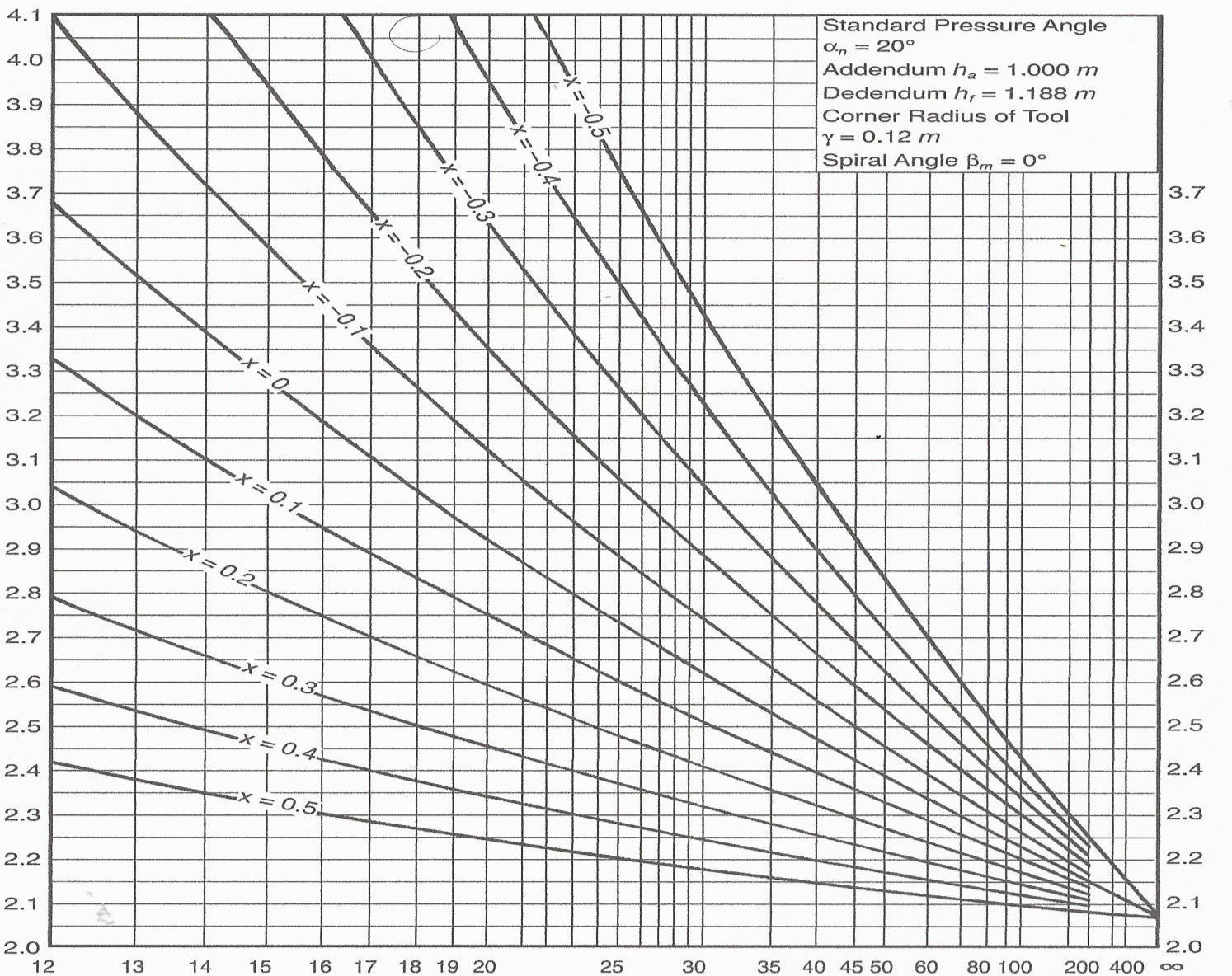
Eq. (57) incorporates the parameter bY , a modified form of thefamousLewisformfactor.Itis adoptedfroma Japanese Industrial Standard (JIS) for Gear design [15, 37]. bY is similar to the reciprocal of the AGMA J-factor but is independentofstressconcentrationfactorandloadsharing. bY is based on a tool corner radius of 0.12m, gear tooth wholeheightof2.118m,andstandardpressureangleof20o These specifications are nearly identical to those of the Gleasonstandardsforbevelgears.Fig.A1showsaplotof bY fordifferentvaluesofprofileshiftfactorsintherange-0.5to 0.5,againstthevirtualnumberofteethona bevelgear.Itis a function of the virtual number of teeth for a gear and the profile-shiftfactor. ThissummarizedbyEq.(A1).
The values of bY for profiled shifted and standard profile gears can be obtained from Fig. A1. This chart is different from that used for spur gears and provides values of bY slightly higher than those for spur gears for the same profileshiftcoefficientandvirtualnumberofteeth.
APPENDIX B: MODIFIED AGMA BENDING STRESS CAPACITY MODEL FOR BEVEL GEARS
BasedonANSI/AGMA2003-B97standard[xxx],thebending stress capacity model of bevel gears may be rendered as in Eq.(B1).
The J -value for bevel gears accommodates load sharing [Childs-HB], inertia ratio with gears low contact ratio, and pointofloadapplication.NotethatEq.(B1)isevaluatedThe sizefactor xk is appliedto the bendingstressasindicated in
© 2025, IRJET | Impact Factor value: 8.315 | ISO 9001:2008 Certified Journal | Page342
International Research Journal of Engineering and Technology (IRJET) e-ISSN:2395-0056
Volume: 12 Issue: 09 | Sep 2025 www.irjet.net p-ISSN:2395-0072
Eq. (B1). However, it may be assumed as unity in Eq. (B1) andusedtomodifythefatiguestrengthofthegearmaterial, instead. This is the usual practice with cylindrical gears. It wasassumedasunityinusingEq.(B1)inthisstudy.
TheserviceloadfactorinAGMAmodelisobtainedas:
Normal pressure angle, 020 n
Addendum factor, ha =1.00m
Dedendum factor, hf = 1.118m
Tool corner radius = 0.12m

Virtual gear teeth number ( vz )
Fig. 2: Lewis stress factor for straight bevel gears [15, 37]
© 2025, IRJET | Impact Factor value: 8.315 | ISO 9001:2008 Certified Journal | Page343