
International Research Journal of Engineering and Technology (IRJET) e-ISSN: 2395-0056
Volume: 12 Issue: 08 | August 2025 www.irjet.net p-ISSN: 2395-0072
“INVESTIGATION OF MECHANICAL PROPERTIES OF CONCRETE BY PARTIAL REPLACEMENT OF METAKAOLIN BY CEMENT AND COPPER SLAG BY FINE AGGREGATE USING POLYPROPYLENE FIBERS’’
Sanjay G M1 , Ashwin C A2 , Vallabha C D3 , Pavan4
1 PG Student (MTech) in Structural Engineering, Dr. Ambedkar Institute of Technology, Bangalore, Karnataka, India
2Assistant Professor ,Department of Civil Engineering,Dr. Ambedkar Institute of Technology, Bangalore, Karnataka, India
3 PG Student (MTech) in Structural Engineering, Dr. Ambedkar Institute of Technology, Bangalore, Karnataka, India
4 PG Student (MTech) in Structural Engineering, Dr. Ambedkar Institute of Technology, Bangalore, Karnataka, India
Abstract - This experimental work examines the performance of M30 grade concrete produced by partially replacing cement with metakaolin and fine aggregate with copper slag, along with the addition of polypropylene fibres. Basic material tests confirmed the suitability of the constituents: the specific gravity of cement was 3.12, fine aggregate 2.46, coarse aggregate 2.73, metakaolin 2.40, and copper slag 3.74. The fineness of cement was measured as 6 percent, while the standard consistency was found to be 32 percent. Water absorption values were 0.1 percent for fine aggregate and 0.5 percent for coarse aggregate, all within permissible limits. Concrete mixes were prepared with a water–cement ratio of 0.40, cementitious content of 394 kg/m³, fine aggregate 791 kg/m³, coarse aggregate 1068 kg/m³, and admixture content of 1.1 percent by weight of cement. Various mix design was done by partially replacing with copper slag as fine aggregate by a percentage of 40,50,60,70 percent with constant replacement of 10% metakaolin as cement and additionally using polypropylene fibersof0.8%.Compressivestrengthandsplittensilestrength wasdeterminedatcuringperiodsof28days.Resultsindicated steady strength development with age, and the optimum mix incorporating metakaolin, copper slag, and polypropylene fibres was also added to the mix achieved a 28-day compressive strength of 35.33 MPa compared to the control mixaverageof29.83MPaandthesplittensilestrengthvaried from 2.78(control mix) to 3.2 MPa (50% copper slag,10 metakaolin,0.8% polypropylene fibers) . The study concludes that the combined use of metakaolin, copper slag, and polypropylenefibresimprovescompressivestrength andsplit tensile strength and provides a sustainable alternative to conventional concrete mixtures.
1.INTRODUCTION
Concrete is the most widely used material in the construction industry due to its strength, versatility, and adaptability. However, the production of cement, its key
binding component, generates a large amount of carbon dioxide, contributing significantly to environmental pollution.Toovercomethisissue,researchershaveexplored the use of supplementary cementitious materials and industrial by-products to partially replace cement and natural aggregates, thereby improving performance and promotingsustainability.
Metakaolin,obtainedthroughcalcinationofkaoliniticclay,is a highly reactive pozzolanic material that enhances the compressivestrength,durability,andchemicalresistanceof concrete.Itreducesporosity,shrinkage,andpermeability, whilepromotingtheformationofadditionalcalciumsilicate hydrate. Copper slag, a by-product of the copper smelting industry, provides another sustainable alternative by replacing natural sand. With its high specific gravity and angularparticles,copperslagimprovesdensity,workability, and strength, while simultaneously addressing waste disposal problems. In addition, polypropylene fibres are widely used to reduce plastic shrinkage cracks, improve toughness,and enhancedurability.Eveninsmall dosages, theysignificantlyimprovethecrackresistanceofconcrete.
Inthisstudy,M30gradeconcretewaspreparedbyreplacing cement with 10 percent metakaolin, fine aggregate with copper slag at 40, 50, 60, and 70 percent, and by incorporating 0.8 percent polypropylene fibres. Basic material tests such as specific gravity, fineness, water absorption,andconsistencywereperformedtoensurethe qualityoftheingredients.Concretecubeswerethencastand testedforcompressivestrengthat 28daystoevaluatethe effectofthesemodificationsonstrengthdevelopment.
Theaimofthisworkistodevelopandevaluateasustainable concretemixbypartiallyreplacingcementwithmetakaolin and sand with copper slag, along with the addition of polypropylene fibres, in order to enhance compressive strengthandimprovetheoverallperformanceofM30grade concrete
International Research Journal of Engineering and Technology (IRJET) e-ISSN: 2395-0056
Volume: 12 Issue: 08 | August 2025 www.irjet.net p-ISSN: 2395-0072
2. LITERATURE REVIEW
Itikela Durga Saikiran et al. (2021) carried out an investigation on high-strength concrete using metakaolin, alccofine,andcopperslagaspartialsubstitutesforcement and fine aggregate. Their work concluded that the combination of 15% metakaolin, 10% alccofine, and 60% copperslagproducedthemostfavorableresultsintermsof mechanicalstrengthandworkability.
Balgourinijad et al. (2022) studied lightweight concrete incorporating polypropylene fibres and metakaolin when exposedtohightemperaturesrangingfrom200°Cto600°C. The results revealed that 0.8% polypropylene fibres with 10%metakaolinprovidedbettercrackresistance,reduced waterabsorption,andimprovedimpactenergyabsorption, makingthemixmoredurableunderthermalconditions.
Vijayaprabha Chakrawarthi et al. (2021) examined concretereinforcedwithpolypropylenefibresandpartially replaced fine aggregate with copper slag. Their research highlightedthata40%replacementofsandwithcopperslag andtheadditionof0.6%polypropylenefibressignificantly enhancedimpactresistanceandenergyabsorptioncapacity comparedtoconventionalconcrete.
Naveen Kundargi et al. (2023) exploredtheperformance of self-curing concrete prepared with metakaolin, copper slag, and polyethylene glycol (PEG-400). Their findings indicated that replacing cement with 10–20% metakaolin andsandwith40–60%copperslagimprovedcompressive and tensile strength, showing the potential of integrating self-curingagentswithmineraladmixtures.
Shaik Fazlur et al. (2019) investigated concrete with partial replacement of cement by metakaolin and coarse aggregatebyblastfurnaceslag.Thestudyshowedthatthe addition of 10% metakaolin and gradual substitution of coarse aggregate enhanced compressive and tensile strength, demonstrating the usefulness of industrial byproductsinconcrete.
Shakil Khan et al. (2021) workedonM30gradeconcrete byintroducingmetakaolinandpolypropylenefibres,while naturalsandwasreplacedwithRobosandatvaryinglevels. Theirresultsindicatedthatmixeswith10%metakaolinand 40–50%Robosanddeliveredsuperiorstrengthperformance comparedwiththecontrolmix.
Prasad et al. (2021) analyzedconcretemixesincorporating metakaolin, glass powder, and silica fume as cement replacements.ForM40gradeconcrete,theresultsshowed notableimprovementsincompressive,tensile,andflexural strength, particularlyat28 days ofcuring,comparedwith conventionalmixes.
Sina et al. (2017) investigated self-compacting concrete madewithmetakaolin,groundgranulatedblastfurnaceslag,
andflyash.Theyfoundthat20%metakaolinreplacement improved early-age strength, workability, and microstructure due to enhanced pozzolanic activity and betterformationofC–S–Hgelinthecementmatrix.
3. EXPERIMENTAL PROGRAM
Thisinvestigationwasdesignedtoevaluatetheperformance ofM30gradeconcretebyincorporatingmetakaolin,copper slag, and polypropylene fibres. The program involved material testing, mix design, preparation of specimens, curing,andcompressivestrengthassessment.
3.1 Materials
Ordinary Portland Cement of 53 grade was used as the primarybindingmaterial.Thecementhadaspecificgravity of3.12andastandardconsistencyof32%.Metakaolin,with a specific gravity of 2.40, was used as a supplementary cementitiousmaterial,replacing10%ofcementbyweight. Thefineaggregateusedhadaspecificgravityof2.46anda water absorption of 0.1%. Copper slag, obtained as a byproductfromthecopperindustry,hadaspecificgravityof 3.74 and was used to replace fine aggregate in varying proportions. Coarse aggregate of 20 mm maximum size, having a specific gravity of 2.73 and water absorption of 0.5%,wasemployed.Polypropylenefibresof12mmlength wereaddedatadosageof0.8%byvolumeofconcrete.To enhanceworkability,asuperplasticizerwasaddedat1.1%of the weight of cement. Potable water was used for both mixingandcuring.
3.2 Mix Proportions
ThemixproportionforM30gradeconcretewasdeveloped inaccordancewiththeguidelinesofIS10262:2019,usinga water–cementratioof0.40.Inthecontrolmix,thequantities ofconstituentspercubicmetreofconcretewere394kgof cement, 791 kg of fine aggregate, 1068 kg of coarse aggregate, and 157.6 kg of water. In the modified mixes, cement was replaced by 10% metakaolin, polypropylene fibreswereaddedat0.8%,andcopperslagwasincorporated asafineaggregatereplacementat40%,50%,60%,and70%.
Table -1: MixProportion
Research
Volume: 12 Issue: 08 | August 2025 www.irjet.net p-ISSN: 2395-0072
3.3 Casting and Curing of Specimens
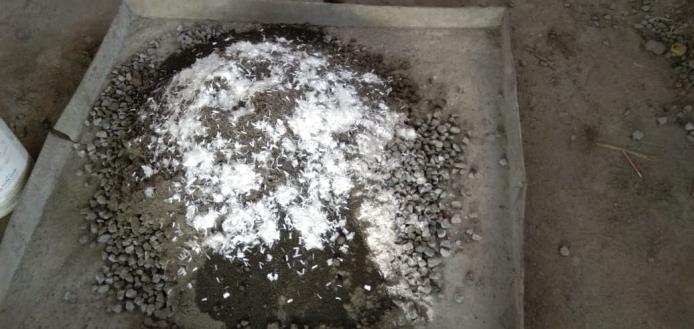
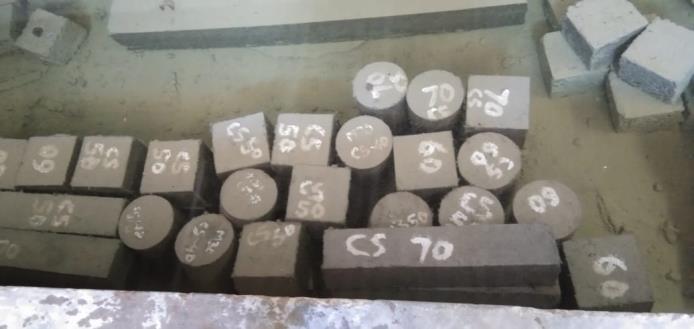
Foreachmix,cubespecimensofsize150×150×150mm werepreparedandcylinderof150mmx300mmwasalso casted.Theconcretewasplacedinmouldsinthreelayers, each compacted using a tamping rod to remove air voids. Thespecimenwerecuredincuringtank.Oncedemoulded, thecubesandcylinderwerecuredincleanwateratroom temperatureuntiltherespectivetestingagesof28days.
3.4 Testing of Concrete
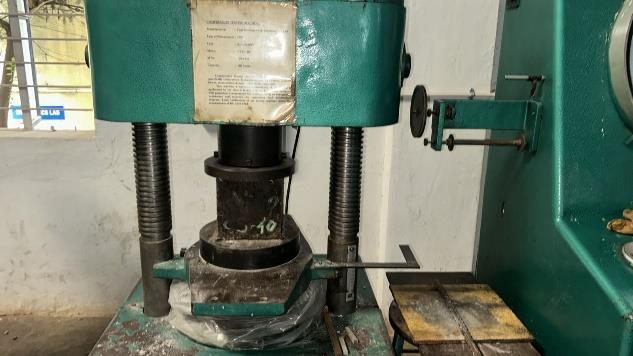
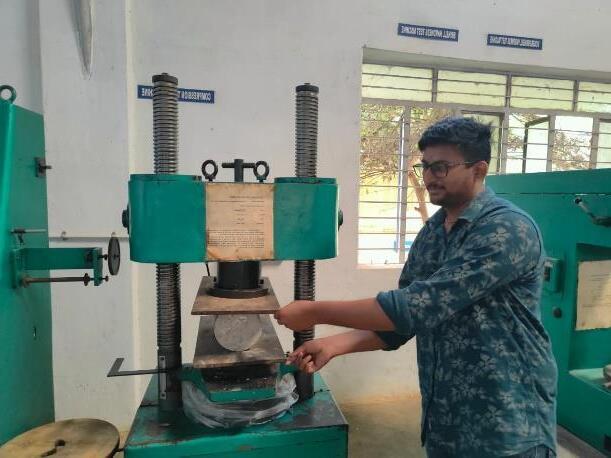
Preliminarytestswereconductedoncement,fineaggregate, coarse aggregate, metakaolin, and copper slag to confirm theirsuitabilityforuseinconcrete.Theseincludedspecific gravity, fineness, consistency, and water absorption tests. The main mechanical property studied was compressive strengthandsplittensilestrength,determinedbytestingthe cube specimens at 28 days using a compression testing machineandsplittensiletestmachine
4. RESULTS AND DISCUSSION
4.1 Compressive Strength at 28 Days
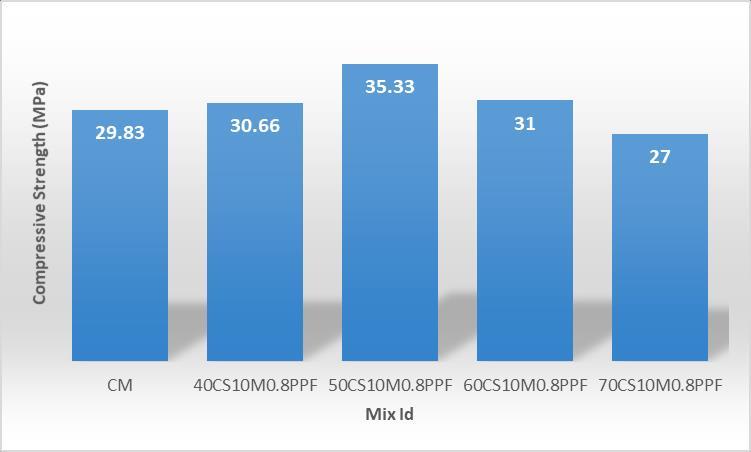
The compressive strength results obtained at 28 days are presentedinTable5.10andFigure5.2.Thecontrolconcrete made with 100% fine aggregate achieved an average strengthof29.83MPa.Withtheadditionof10%metakaolin and0.8%polypropylenefibres,andvaryingcopperslagasa partial replacement of fine aggregate, noticeable improvements were observed. The mix with 40% copper slagrecorded30.66MPa,whichwasmarginallyhigherthan the control. A significant improvement was seen at 50% copperslagreplacement, wherethemaximumstrength of 35.33MPawasachieved,representinganincreaseofnearly 18% compared with the control. When the fine aggregate was substituted with 60% copper slag, the compressive strength reduced to 31.0 MPa, which is lower than the optimum mix but still higher than the control. A further increaseinreplacementto70%resultedinastrengthof27.0 MPa, indicating a clear reduction below the control mix performance.Theresultsindicatethat50%replacementof fine aggregate with copper slag is the optimum level for compressive strength enhancement. The improvement is mainlyduetothedenserpackingofparticles,reducedvoids, and additional C–S–H gel formation from the pozzolanic reactionofmetakaolin.However,beyond50%replacement, excessive copper slag leads to reduced bonding and increasedfreewater,resultinginlowerstrength.
International Research Journal of Engineering and Technology (IRJET) e-ISSN: 2395-0056
Volume: 12 Issue: 08 | August 2025 www.irjet.net p-ISSN: 2395-0072
4.2 Split Tensile Strength at 28 Days
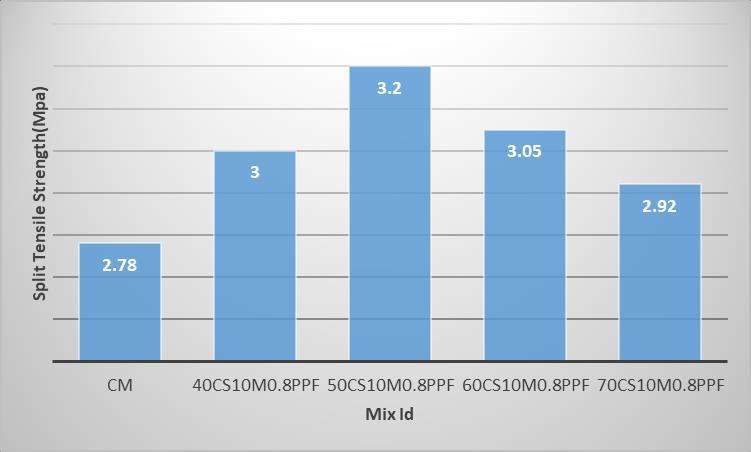
Thesplittensilestrengthvaluesat28daysaregiveninTable 5.11andFigure5.3.Thecontrolconcreteshowedanaverage tensile strength of 2.786 N/mm². The incorporation of copperslagimprovedtensilestrengthacrossallreplacement levelsuptotheoptimum.At40%copperslag,thevaluewas 2.90 N/mm². At 50% copper slag, the highest strength of 3.20N/mm²wasobtained,whichisabout15%higherthan thecontrol.Themixwith60%copperslagrecordedasplit tensilestrengthof3.122N/mm²,which,althoughmarginally lowerthantheoptimumvalue,remainedhigherthanthatof the control specimen. When the replacement level was increased to 70%, the strength reduced further to 2.92 N/mm²,whichwasnearlyequivalenttothecontrolmix.The improvement in tensile strength can be attributed to the fibrebridgingeffectofpolypropylenefibres,whichhelpsin controllingcrackdevelopment,andtotheimprovedparticle distributionduetocopperslagandmetakaolin.Thedecline beyond 50% replacement is related to weaker paste–aggregatebondingandsegregationissues.
4.3 Discussion
From the results, it is evident that the use of metakaolin, copper slag, and polypropylene fibres together leads to a
marked improvement in mechanical performance of concrete, with both compressive and tensile strength showingmaximumvaluesat50%copperslagreplacement. Metakaolin contributed by enhancing the microstructure through its pozzolanic reaction, copper slag improved the density of the matrix, and polypropylene fibres acted as crack arresters. However, when copper slag exceeded the optimum level, the drawbacks of excess fines and weaker bonding outweighed the benefits, leading to reduced strength.Overall,thecombinationof10%metakaolin,0.8% polypropylenefibres,and50%copperslagreplacementcan be considered as the most effective mix proportion for achievingimprovedstrengthanddurabilityinM30concrete.
5. CONCLUSION
The experimental investigation demonstrated that the incorporationofmetakaolin,copperslag,andpolypropylene fibressignificantlyinfluencesthestrengthpropertiesofM30 gradeconcrete.Theresultsconfirmedthatthecontrolmix attained a compressive strength of 29.83 MPa at 28 days, whereas the mixes with partial replacement of fine aggregatebycopperslagshowednoticeableimprovements. The optimum compressive strength of 35.33 MPa was achievedat50percentcopperslagreplacementcombined with10percentmetakaolinand0.8percentpolypropylene fibres, which represents an enhancement of nearly 18 percent over conventional concrete. Beyond this level, furtheradditionofcopperslagresultedinreducedstrength duetopoorbondingandexcessivefinesinthemix.Thesplit tensile strength followed a similar trend, with the control mixachieving2.786N/mm²andtheoptimummixreaching 3.20 N/mm², indicating an improvement of about 15 percent.Theimprovementinperformanceisattributedto the pozzolanic action of metakaolin, which produces additional calcium silicate hydrate, the dense particle packing effect of copper slag, and the fibre bridging mechanism of polypropylene fibres that restricts microcrackpropagation.Thefindingsconfirmthattheblendof10 percentmetakaolin,0.8percentpolypropylenefibres,and50 percentcopperslagreplacementprovidesthemosteffective andsustainableproportionforachievinghighercompressive andtensilestrength.Thisstudyhighlightsthepotential of utilizing industrial by-products such as copper slag and mineral admixtures like metakaolin in combination with synthetic fibres to produce eco-friendly, durable, and structurally efficient concrete suitable for construction applications.
REFERENCES
[1] Itikela Durga Saikiran, Ch. Srinivasa Rao (2021), “Performanceof High StrengthConcreteConsistingof Alccofine and Metakaolin as a Partial Replacement of Cement and Copper Slag,” International Journal of Innovative Research in Science, Engineering and Technology(IJIRSET),Vol.10,Issue5,pp.11234–11242.
International Research Journal of Engineering and Technology (IRJET) e-ISSN: 2395-0056
Volume: 12 Issue: 08 | August 2025 www.irjet.net p-ISSN: 2395-0072
[2] NiloofarBalgourinijad(2022),“ExperimentalStudyon Mechanical Properties and Microstructure of Lightweight Concrete Incorporating Polypropylene Fiber and Metakaolin at High Temperature,” Construction and Building Materials,Vol.325,pp.126–138.
[3] Vijayaprabha Chakrawarthi et al. (2021), “Impact Resistance of Polypropylene Fibre-Reinforced Alkali–Activated Copper Slag Concrete,” Journal of Building Engineering,Vol.43,pp.103210.
[4] NaveenKundargi,S.A.Kambali(2023),“Experimental Study on Partial Replacement of Cement and Fine AggregatewithMetakaolinandCopperSlagwithSelfCuring Agent,” International Research Journal of EngineeringandTechnology(IRJET),Vol.10,Issue3,pp. 1425–1433.
[5] Shaik Fazlur, K. Chandrakala (2019), “Experimental Study on Partial Replacement of Cement with Metakaolin and Coarse Aggregate with Blast Furnace Slag,” International Journal of Engineering Research & Technology (IJERT),Vol.8,Issue7,pp.554–559.
[6] ShakilKhan,TinuKhandale,ShahrukhKureshi,Harshal Gaidhane(2021),“EvaluationofStrengthPropertiesof Concrete Using Metakaolin, Polypropylene Fiber, and RoboSand,” International Journal of Recent Technology and Engineering (IJRTE),Vol.10,Issue1,pp.221–227.
[7] B.Prasad,N.V.N.Ravali,Md.JaveedPasha(2021),“An ExperimentalStudyonConcretebyPartialReplacement of Cement with Metakaolin, Glass Powder and Silica Fume,” International Journal of Engineering and Advanced Technology (IJEAT),Vol.10,Issue5,pp.456–462.
[8] Sina,Jiping(2017),“StudyonSelf-CompactingConcrete with Metakaolin, GGBS, and Fly Ash as Partial Replacement of Cement,” Cement and Concrete Composites,Vol.82,pp.202–212.