
International Research Journal of Engineering and Technology (IRJET) e-ISSN: 2395-0056
Volume: 12 Issue: 10 | Oct 2025 www.irjet.net p-ISSN: 2395-0072
International Research Journal of Engineering and Technology (IRJET) e-ISSN: 2395-0056
Volume: 12 Issue: 10 | Oct 2025 www.irjet.net p-ISSN: 2395-0072
Parth B. Potdar1 , Kaushal B. Patil2 , Aryan N. Mhetre3 , Anurag M. Rokade4, Bipin P. Patil5
1,2,3,4Student of B. Tech in Civil Engineering at Walchand Institute of Technology, Solapur, Maharashtra, India –413006.
5M. Tech (Structural Engineering) Professor, Dept. of Civil Engineering, Walchand Institute of Technology, Solapur, Maharashtra, India – 413006. ***
Abstract - As transportation infrastructure networks continue to age, bridges have become important parts that need regular monitoring to ensure safety and functionality. Inspections and Structural Health Monitoring (SHM) are crucial for helping decision-makers maintain structural integrity. Drones are increasingly used for bridge inspections because they provide greater safety, efficiency, and cost savingscomparedtotraditionalmethods.Thisprojectoffersa detailed review of existing research on drone-based bridge monitoring. It looks at equipment, inspection procedures, outcomes, the Internet of Drones (IoD), and related communication technologies while exploring current limitations,future directions,andpotentialimprovements.In thenearfuture,computervisiontechniquesappliedtoimages capturedbydroneswilllikelyenhanceautomateddetectionof surfacedamageandextractionofdynamicstructuralfeatures. The main challenges are integrating with IoD and standardizingtheprocedures.Thisworkaimstosupportfully automated drone-assisted inspections.
Key Words: Drone,UnmannedaerialvehicleUAV,Structural healthmonitoringSHM,Computervision,Internetofdrones IoD,Surfacedamagedetection,Modalidentification,Bridge inspection.
Infrastructure networks around the world face serious challengesduetoaging.Thismakescontinuousmonitoring of assets like bridges essential for safety and reliable function. Traditionally, assessing bridges depends on periodicvisualinspectionsbytrainedpersonnel,oftenalong withnon-destructiveordestructivetesting.However,these traditional methods have significant drawbacks. These include poor access to hard-to-reach or dangerous areas, subjectivity in the inspector's judgment, high costs, and safety risks for workers, especially on large structures. Inspectionsoccuratfixedintervals,whichmightnotmatch theactualonsetofdamage,resultingindelaysinaddressing issues.
To improve or replace these methods, Structural Health Monitoring(SHM)systemsweredeveloped.Thesesystems use contact-type sensors and data collection hardware to providecontinuous,automaticinformation.Still,theyhave
their own issues, such as high installation costs, limited reusabilityacrossdifferentstructures,andproblemsduring extremeevents.
Recently, the use of drones (Unmanned Aerial Vehicles or UAVs) has grown as a strong solution to address the limitationsoftraditionalmonitoring.Dronesofferaflexible, efficient, and cost-effective way to collect data. They can performdetailedinspections,detectsuperficialdamage,and assess dynamic structural conditions. The mobility and modularityofdronesystemsallowforquickdeploymentand reuse over entire infrastructure networks. Importantly, usingdronesreducessafety risksforworkersbyallowing inspections of hard-to-reach and hazardous spots. Most dronemonitoringstrategiesfocusonanalyzinghigh-quality imagesandvideoswithcomputervisiontechniques.These approaches mainly concentrate on two areas: automated surface damage detection (like cracks and spalling) and vision-basedmonitoringforextractingmodalparameters. Furthermore, the growing use of Internet of Drones (IoD) architecture, combined with modern communication technologieslike5Gand6G,offersbetteroperationandrealtimedatasharingforgroupsofdronesoverlargeareas.This paper presents a detailed review of the current methods, technological tools, operational practices, communication needs, and inspection results of drone-based bridge monitoring. It also examines the challenges and future directions needed to move toward fully automated and standardizeddrone-assistedinfrastructuremanagement.
Themaingoalofthisprojectistoprovideanupdatedreview of the key aspects related to using drones for bridge monitoring.Thisincludescurrenttechnology,methods,and notablecasestudies.
Thespecificobjectivesofthispaperare:
• Multi-faceted Review: To present a detailed review of existing research on drone-based bridge monitoring. This covers equipment, inspection procedures, outcomes, the Internet of Drones (IoD), and related communication technologies.
International Research Journal of Engineering and Technology (IRJET) e-ISSN: 2395-0056
Volume: 12 Issue: 10 | Oct 2025 www.irjet.net p-ISSN: 2395-0072
•DamageIdentificationand DataIntegration: Todiscuss thelatestdevelopmentsindamageidentificationmethods, specificallysurfaceandmodal-basedapproaches.Theseuse computer vision techniques applied to data collected by moving cameras. The project also aims to explore how drone-collected data can be integrated with Bridge ManagementSystems(BMS).Thiswillhighlighthowinsights from drone inspections can guide maintenance strategies andprioritizerepairs.
•Communication Technology: Toexaminetheintegration ofcommunicationtechnologythatcanenhancetheefficiency of individual drones and drone swarms for bridge monitoring. This includes exploring new communication standardslike6G.
• Addressing Gaps: To fill the gaps identified in the literature by focusing specifically on drone-based bridge monitoring.Thisisinsteadofaddressingdronesasaminor aspectofawiderdiscussiononroboticsystems.Thereview will cover the different phases of monitoring, leading to decision-making: data acquisition, transmission, and processing.
• Highlighting Future Directions: To investigatecurrent limitations,futuredirections,andpotentialimprovementsin the field. This aims to pave the way for fully automated drone-assistedinspections.
Areviewof the literatures consulted for thestudyis includedinthissection.
Xhesika Hasa. (2024) [1] TheresearcherusedaPhantom4 RTKdronetosurveyasectionofthePristina-GjilanHighway inKosovofromtheair.Themaingoaloftheprojectwasto monitortheconstructionworkandcomparethecurrentstate ofthehighwaywiththeoriginalprojectplans.Aftertaking aerialphotos,theresearcherprocessedthedatawithAgisoft MetashapeProfessionaltocreatea3Dmodel,orthophotos, anddigitalsurfacemodels.Then,theyanalyzedtheseoutputs usingArcMapdesktop10.5tofindanddocumentchangesin featuressuchasdrainagechannels,protectivegabionwalls, andabridge.Thefindingsshoweddifferencesbetweenthe designandtheactualconstruction.
Bhivraj Suthar, Rajesh Mahadeva, Saurav Dixit, Vinay Kumar, K. Arun, Rishab Arora, Suniana Ahuja. (2023) [2]
The research paper looks at the progress, challenges, and futurepossibilitiesofroboticdronearmsusedforinspecting civilstructures.Itcoversdifferenttypesofdronearms,such asarticulated,telescopic,andsnake-like.Thesearmsareused to inspect bridges, building facades, and underground infrastructure. The paper also points out challenges like powerefficiency,theabilitytohandlecomplexshapes,and safety concerns. It wraps up by discussing future developments,includingimprovedautonomy,collaboration amongmultiplerobots,andtheuseofbio-inspiredrobotics.
M.R. Freeman, M.M. Kashani, P.J. Vardanega. (2021) [3]
Theresearchpaperreviewshowaerialrobotictechnologyis usedincivilengineering.Itgroupstheseusesintothreemain categories:monitoringandinspection,sitemanagementand construction,andpost-disasterresponse.Thepaperaimsto summarize how this technology can help gather data to improvetheassessmentofcivilinfrastructureoveritsservice life. The authors also categorize different uses as "established"or"emerging."Theydiscussreasonsforusing thistechnology,includingcostsavings,bettermeasurements, andincreasedsafety.
Mr. Sanket Ravindra Chaudhari, Mr. Atharva Sanjay Bhavsar, Mr. Harshwardhan Pradeep Ranjwan, Mr. Pravin Suresh Yadav, Mr. S. S. Shaikh. (2022) [4] The researcherscarriedoutaqualitativestudytoseehowdrones and immersive technologies can digitize the construction industry. They worked with a company called 'Droneium AerialSolutions'foratestflightonKhandobaHillstocollect topographic data. By using drones, they made a 3D visualization and gathered information like contours and slopes,whichwasprocessedwithPix4DMapper.Theyalso lookedatothercasestudiestoshowpracticaluses,including miningandsolarfarminspections.
Tahreer M Fayyad, Su Taylor Kun Feng, Felix Kin Peng Hui. (2024) [5] Theresearchersconductedascientometric analysisandasystematicliteraturereviewofdrone-based StructuralHealthMonitoring(SHM).Theirprojectidentified fourmainresearchclustersinthefield.Thepaperhighlights a trend of using new technologies like AI and robotics to automateSHManddiscussesareasforfutureresearch.The studyalsotrackedpublicationsbycountryandyear,showing anoverallincreaseinpublicationssince2010.
Srijeet Halder, Kereshmeh Afsari. (2023) [6] The researcherreviewed269papersonusingrobotstoinspect andmonitorthebuiltenvironment.Thestudyidentifiednine typesofroboticsystems.UnmannedAerialVehicles(UAVs) were the most common, followed by Unmanned Ground Vehicles(UGVs).Thepaperalsofoundfiveapplicationareas: maintenance inspection, construction quality inspection, construction progress monitoring, as-built modeling, and safetyinspection.Itdiscussescommonresearchtopicsand highlightsgapsforfutureresearch.
Alberto Villarino, Hugo Valenzuela, Natividad Anton, Manuel Dominguez, Ximena Celia Mendez Cubillos. (2025) [7] TheauthorsconductedaliteraturereviewonUAV applicationsformonitoringandmanagingcivilinfrastructure. Theylookedatthetechnologicaldevelopmentofdronesand the sensors used, such as RGB, multispectral, and hyperspectral cameras. They also examined practical applicationsinareaslikebuildings,bridges,andpowerlines. Thestudyhighlightsthebenefitsofusingdrones,including improvedsafety,efficiency,andreducedcosts.Itdiscusses how new technologies, such as AI, are enhancing these applications.
International Research Journal of Engineering and Technology (IRJET) e-ISSN: 2395-0056
Volume: 12 Issue: 10 | Oct 2025 www.irjet.net p-ISSN: 2395-0072
Shien Ri, Jiaxing Ye, Nobuyuki Toyama, Norihiko Ogura. (2023) [8] The project introduces a new way to measure bridge displacement with high precision using a drone camera. The method uses a bio-inspired technique called active balancing compensation (ABC) to separate real structuralmovementfromcameramotion.Itcombinesthe phase-basedsamplingmoirétechniquewithfourdegreesof freedom in geometric modelling to reach sub-millimetre accuracy.Fieldtestsona110-meter-longbridgeconfirmed thatthemethodworkswellandispractical.
Lanh V. Nguyen, Trung H. Le, Ignacio Torres Herrera, Ngai M. Kwok, Quang P. Ha. (2024) [9] Thepaperdetailsa project on intelligent path planning for multi-rotor aerial vehicles (MAVs) to inspect civil infrastructure. The researchersdevelopedalgorithmsforhigh-levelMAVcontrol andusedadigitaltwinco-simulationframeworktovalidate theapproachinvirtualscenarios.Real-worldexperimentson amonorailbridgeconfirmedthemethodology'seffectiveness forbothsingleandmultipledrones.
Emre Girgin, Arda Taha Candan, Coskun Anıl Zaman. (2025) [10] Thepaperdescribesaprojectfocusedonanew drone-based surveillance system that uses Edge-AI for autonomous operations on construction sites. The researcherscreatedacustomhexacopterwithalow-power microcontroller to detect humans. The drone sends this informationtoacentralcoordinator,whichplanssafepaths forotherautonomousvehicles,suchasanexcavatoranda UGV.Fieldexperimentswerecarriedouttoconfirmthatthe systemworkseffectively.
Thissectionlooksatthehistoryandtechnologyofdrones.It providesanoverviewoftheiroriginsandthedevelopments thathaveinfluencedthistechnology.Asummarytableshows different drone models used in the studies reviewed. This highlights the range of drones used in various inspection situations.Thesectionalsodiscussesthemainphysicalparts of drones, focusing on the sensors and data collection systems that are crucial for inspection tasks. It further outlinestheimportantfeaturesandminimumstandardsthat a drone needs to meet for effective bridge inspections, ensuringreliability,accuracy,andsafetyduringoperation.
Droneshavealonghistorythatgoesbackto1849.During the Austro-Italian War, Austrian soldiers used unmanned balloons filled with explosives to attack Venice. However, large-scaledroneusestartedduringWorldWarI.In1916, Britaincreatedthefirstwingedaircraftdrone,the“Ruston ProctorAerialTarget.”Thiswasfollowedin1918bytheU.S. “KetteringBug,”anexperimentalaerialsystemwithaflying bomb. The 1940s saw the first companies in the United Statesbegintomass-producedrones.
Themoderndroneerastartedinthe1960s.BoththeUnited States and the Soviet Union developed drones mainly for militaryuse.TheUSmilitaryuseddronesforreconnaissance during the Vietnam War. Meanwhile, the Israeli military employed them for surveillance and target practice in the 1980s.Bythe early2000s,companieslikeDJITechnology andParrotmadedronesavailableforcommercialuse.They changedtheindustrybyreleasingaquadcopterin2010.The 12thCongressFAAModernizationandReformAct(2011–2012),initiatedbytheSenateandHouseofRepresentatives of the United States, further helped integrate drones into airspace.
While military uses have fueled drone research for many years,dronesarenowutilizedinvariousfieldsaroundthe world.Theseincludeagriculture,environmentalmonitoring and conservation, public safety and security, emergency response,mediaandentertainment,logisticsanddelivery, realestate,energy,andscientificresearch.Theuseofdrones incivilengineering,especiallyforinspections,isincreasing significantly.
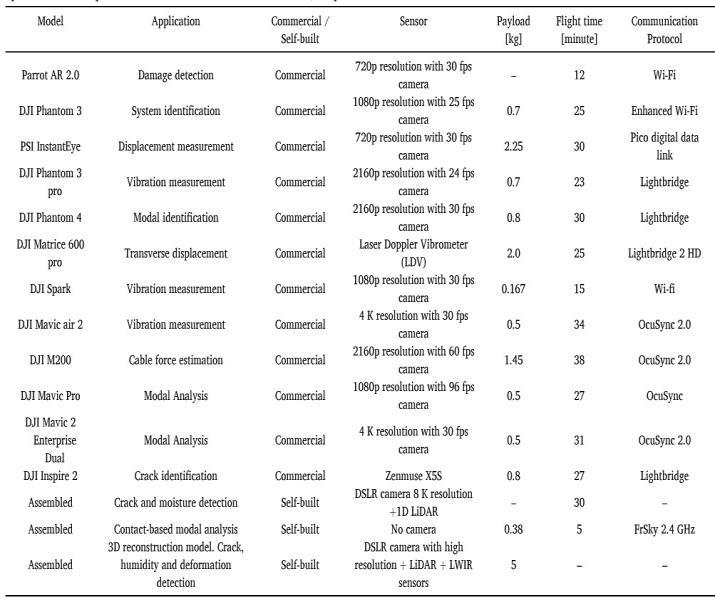
Table 1 summarizes the diverse uses of drones in bridge monitoring. It includes different drone models both commerciallyavailableandcustom-builtthatwerefeatured inthestudiesreviewed.Itprovidesdetailedinformationon theirsensorcapabilities,payloadcapacities,flightdurations, andcommunicationprotocols.Section3.2elaboratesonthe specificcharacteristicsofdroneequipment,suchassensors, payloadlimits,andflighttimes.Sections3and5discussthe various monitoring applications and their outcomes. Notably, the column on Communication Protocols shows that,despitedifferentnamesgivenbymanufacturers,these protocols fundamentally rely on the Wi-Fi standard and operate within similar bandwidths and frequencies. For a deeper look at drone communication technologies, see Section4ofthispaper.
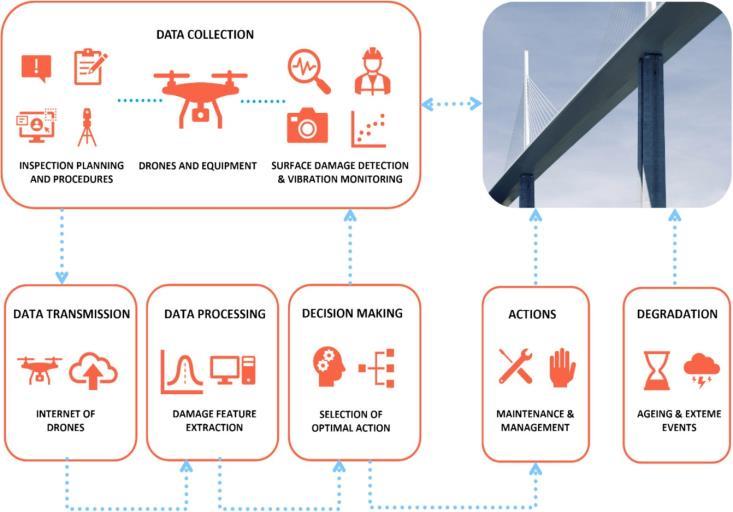
Fig -1: Drone-Based Bridge Monitoring.
International Research Journal of Engineering and Technology (IRJET) e-ISSN: 2395-0056
Volume: 12 Issue: 10 | Oct 2025 www.irjet.net p-ISSN: 2395-0072
Table - 1: Specifications of representative commercial and self-built drones
The Drones are aircraft that can fly on their own or be controlledbysomeoneontheground.Theycomeindifferent types based on their functions, size, weight, number of propellers,flightmechanics,range,equipment,andcameras. Theyuserotatingbrushlessmotors,whichallowforvertical take-offandlanding,hovering,andcarryingheavierloads. Dronescanbecommerciallymadeorbuiltbyindividuals. The main parts of drones, as shown in Fig. 2, include the airframe, propulsion system, communication system, navigationsystem,powersystem,andvarioussensors.The airframeisusuallymadeofcarbonorrigidplastic.Itneeds toabsorbanddissipatevibrationsfromthepropellersand motors while being tough enough to handle impacts. The propulsionsystemhasmotorsandpropellers,withfouror more motors providing the thrust needed for lift and maneuvering. These motors can change their speeds independently. Propellers generate lift and thrust, which greatly affect flight performance and efficiency. The communication system allows real-time control and data sharing between the quadcopter and the ground station through a radio-video transmitter and receiver. The navigation system includes the flight control unit that processes sensor data and pilot inputs for stable and responsive flight, the Global Navigation Satellite System (GNSS)forlocationdatathatenablesautonomouspathsand position holding, and an Inertial Measurement Unit (IMU) with accelerometers and gyroscopes for maintaining stabilityandcontrol.Thepowersystemconsistsofabattery, powerdistributionboard,andElectronicSpeedControllers (ESCs).Additionally,varioussensorslikeultrasonicsensors, barometers, and optical flow sensors improve the quadcopter’sstability,altitudehold,andobstacleavoidance. Indevelopingdrones,thegoalistointegratevariousdevices without sacrificing flight time or the ability to perform differenttasks.Dronescancarryarangeofdatacollection devicesto enhancetheirinspectioncapabilities.Somekey devicesinclude:
- RGB Image And Video Cameras. Thesedevicesarecrucial fordronesastheycapturedigitalimagesandvideosusing visionsensors.Theirlightweightandcompactdesignmakes them easy to attach, which is ideal for tasks like surface damage detection. Advanced models, known as RGB-D sensors, can also record pixel depth information, which helpscreate3Dreconstructionsofstructures.(FigNo.3.3a)
- LiDAR (Light Detection and Ranging) Sensors. Theyuse laser pulses to measure distances from single points very quickly,oftenscanningthousandstomillionsofpointsper second. This fast data collection creates detailed 3D point clouds that can reveal surface damage like cracks and delaminationinconcrete.(FigNo.3.3b)
- Thermal Cameras. Thesecamerasuseinfraredsensorsto detect variations in surface temperature, exposing hidden issueslikeinsulationproblemsorwaterleaks.(FigNo.3.3c)
- NIR (Near Infrared) Sensors. Although expensive and usedlessfrequently,NIRsensorscombineRGBimageswith infrareddata.Byanalyzingdifferentwavelengths,theycan findsurfacedamagesuchasmoistureinfiltrationorconcrete spalling,makingthemusefulforspecializedinspections. Whenthinkingabouttheminimumrequirementsfordrones in bridge inspection, it is important to balance competing needs. The weight of the drone is a key factor that affects flighttime becauseheavier drones flyforshorter periods. Ideally,dronesshouldhaveaflighttimeofatleast20to30 minutes per battery charge to perform inspections effectively.Alighterdronedesigncanextendflighttimesand lowerthechanceofoverheatinginmotorsandelectronics. However,heavierdronesgenerallyhandlemoderatewind conditionsbetter,needingtoendurewindspeedsofatleast 10 m/s to minimize vibrations and sudden movements causedbyturbulence.InEurope,dronesweighingunder249 g can be flown without a license, which also improves operational efficiency.Perez Jimeno etal.usedfourdrone batteriesforatotalof60minutestocapture536photosfora photogrammetricreconstructionofa28mlongbridge.The payload,includingcameras,sensors,andothermonitoring tools, adds weight and reduces flight time. Nonetheless, having a high-quality camera is vital for vision-based monitoring.Thedroneshouldhaveahigh-resolutioncamera withatleast2.7kto4kqualityandzoomfunctionality.Zoom capability is also crucial for inspecting structural features closely and detecting small defects from a distance. High resolution is especially important for recording small displacementsthatarenecessaryforvisualmodalanalysis. Inadditiontoagoodcamera,anactivegimbalisstandardin mostdronesandisessentialforstabilizingthecamera.The gimbal isolates the camera from the drone's vibrations, which is vital for capturing smooth, clear videos. It often allowsthecameratorotateupward.Thecameraandgimbal setupisevenmoreeffectivewithanavigationsystem.This system should provide precise stabilization with minimal vibrations, ensuring the drone can hold a steady position during inspections. Additionally, the navigation system should have obstacle avoidance and support autonomous
International Research Journal of Engineering and Technology (IRJET) e-ISSN: 2395-0056
Volume: 12 Issue: 10 | Oct 2025 www.irjet.net p-ISSN: 2395-0072
movement to specific points of interest, making data collectionefficientandsafe,evenincomplexenvironments.
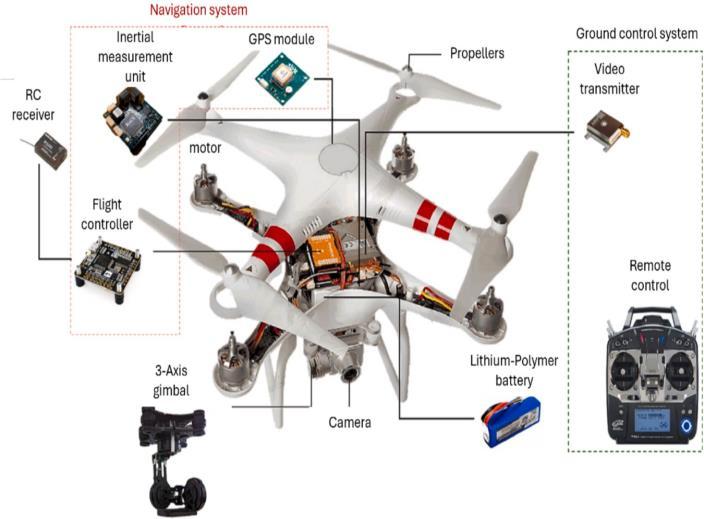
-2: Representative Drone Equipped with Different Components.
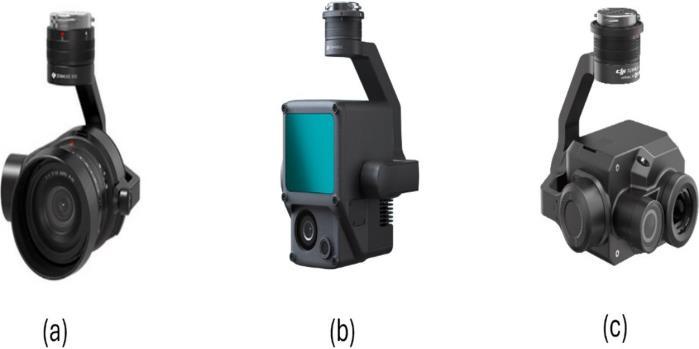
Fig -3: Variety of Data Acquisition Devices. a) DJI Zenmuse x5s Camera b) DJI Zenmuse L1 LIDAR Sensor c) DJI Zenmuse XT2 Infrared Sensor.
In this section, we discuss how drones are used for monitoring bridges. Table 1 shows applications from academic literature and does not aim to represent drones availableforpurchase.Thus,recentlydevelopeddroneslike theDJIMINI4PROorPOTENSICATOMSEarenotincluded, astheyhavenotyetbeenmentionedinpublishedstudies. However, the authors believe that lightweight drones like these will be important for drone-based inspection. They offer a low-cost and easy-to-use solution for bridge monitoring.
Additionally, the drone industry is making progress with heavy-liftdrones.Thesedronescancarryheavierpayloads, which will allow for the use of more advanced sensing devices.Asaresult,newdevelopmentsinthedroneindustry, particularlyregardingpayloadcapacity,flighttime,remote control, and hovering stability, are expected to provide bridgeinspectorswithmanytools.However,sincethedrone industry is dynamic and constantly changing, it is hard to
predictthespeedandmarketimpactoftheseadvancements inthenearfuture.Theregulatoryprocessalsoplaysakey role in promoting practical applications of innovations in thisfield.
Thissectionlooksatdroneinspectionprocedures,divided into two main parts. The first part reviews the phases of droneinspectionsfoundintheliterature.Itaimstocreatea clearguidelineforgatheringimportantparametersacross varioussurveymethods.Thisanalysisoffersa methodical waytoconductdroneinspectionseffectively.
The second part addresses important issues and points raised by different authors in their studies. These include optimizing flight paths, maintaining the right distance betweenthedroneandthetarget,flightspeed,timingofthe flight,andcheckingbatterylevelandcondition.Bybringing thesetopicstogether,thissectionshowsthechallengesand bestpracticesrelatedtodrone-basedinspections.
TheProceduresfordroneinspectionsusuallydifferbasedon factors like the type of structure being monitored, the specificdronemodelused,thecomponentsbeinganalyzed, andthemethodsapplied.Kimetal.describeadrone-based bridgeinspectionproceduredividedintothree phases:(i) Pre-Inspection Phase, (ii) Main Inspection Phase, and (iii) Post-Inspection Phase. Each phase includes specific steps covering all tasks to be done before, during, and after the inspection.Thedetailsofthesephasesarelistedbelowand alsoreflectsimilarproceduresfoundinvariousotherstudies reviewedforthispaper.
The Pre-Inspection Phase consistsofathoroughreviewof targetbridgeinformation,includingallpastinspectionsand existing reports. The knowledge gained during this stage allowsthepilottodevelopflightstrategies,especiallywhen bridge access is limited. If there is no prior information, a preliminary flight may be conducted to create a 2D/3D modelofthestructure.Anon-siteriskassessmentmustalso becarriedout,andcurrentrestrictionsintheareashouldbe confirmedusingauthorizedairtrafficmaps.Inspectingthe droneandcamerasettingsbeforethefirstflightisessential. Finally,theinspectionprogramandflightpathareplanned.
The Main Inspection Phase involvestheon-siteinspection using drones. To detect surface damage, it is best to first capture an overview of the entire bridge, followed by detailedinformationoneachstructuralandnon-structural component. The inspection can be done automatically or manually,dependingonwhetheritfollowstheinitialflight planorreliesontheoperator'scontrol.Tofindthenatural frequenciesandvibrationmodes,thedronemusthoverat
Volume: 12 Issue: 10 | Oct 2025 www.irjet.net p-ISSN: 2395-0072
specific points and distances from the bridge. The drone should remainstableandholditspositionthroughoutthe survey, which may last a few minutes. During the drone operation,attentionshouldbepaidtoweatherconditions, especially wind, as it can negatively affect drone performance. At the end of this phase, all collected inspectiondataisstoredforlaterprocessing.
The Post-Inspection Phase coverseverythingthathappens aftertheMainInspectionPhase.Tocreateahigh-quality3D modelofthestructureusingphotogrammetry,thecollected images and data are processed for visualization, damage assessment, or modal analysis. For damage detection, assessing the image quality first is necessary. Several commercial software packages like Agisoft Photoscan and Pix4Dmapper,aswellasopen-sourceoptionslikeCOLMAP andWebODM,areavailablefor3Dstructurereconstruction. The next step is to identify damages through localization, classification, and quantification. To speed up damage detection, training a deep learning algorithm and using artificialintelligencecanhelpmanageandprocessthelarge volume of image data and identify defects. For modal analysis,thecollectedvideosareprocessedusingspecialized algorithms that identify and track the displacement time seriesofthemeasuredpointsonthebridge.Someofthese algorithmsincludeKanade-Lucas-Tomasi(KLT)andDigital Image Correlation (DIC). It is possible to counteract the drone’soscillationsbyapplyingstabilizationmethodslike fixed-point tracking, inertial compensation, or high-pass filtering. Once the displacement time series are obtained, classicalOperationalModalAnalysis(OMA)techniquescan beusedtoextractfrequenciesandmodalshapes.
Finally, when damage is found on bridges, a detailed conditionassessmentofstructuralmembersisconducted.
Given the short flight times of drones, improving data collection is important. This improvement includes (i) identifyingPointsofInterest(POI) wheresensorreadings areneededand(ii)planninganefficientrouteforthedrone toreduceoverallflighttimewhileextendingbatterylife.
Whenplanningthedrone'sflightpath,severalkeycriteria mustbeconsidered.Theseincludeensuringacollision-free flight, achieving full coverage of the structure, capturing high-quality images for 3D reconstruction and feature detection, minimizing the number of images, and creating efficient flight routes. Additionally, depending on the monitoringobjective,it'scrucialtothinkaboutthedistance betweenthedroneandthetarget,thebestflightspeedfor good resolution, the percentage of image overlap, and the timing of the flight. This timing means assessing the ideal environmentalconditionsthroughouttheday.Theanalysis of existing literature reveals different methods for optimizingflightpathsandrelatedtopics.
Atypicalmethodforflightpathoptimizationinvolvesflying thedroneinverticalorhorizontalstrips,movinginazig-zag patternacrosstheareaofinterestwhileavoidingobstacles. This method is often called “the strip method.” Research showsthathorizontalstripsaremoreeffective,especiallyat low flight speeds. In contrast, some studies support using Archimedeanspiralstoimproveflightplans.
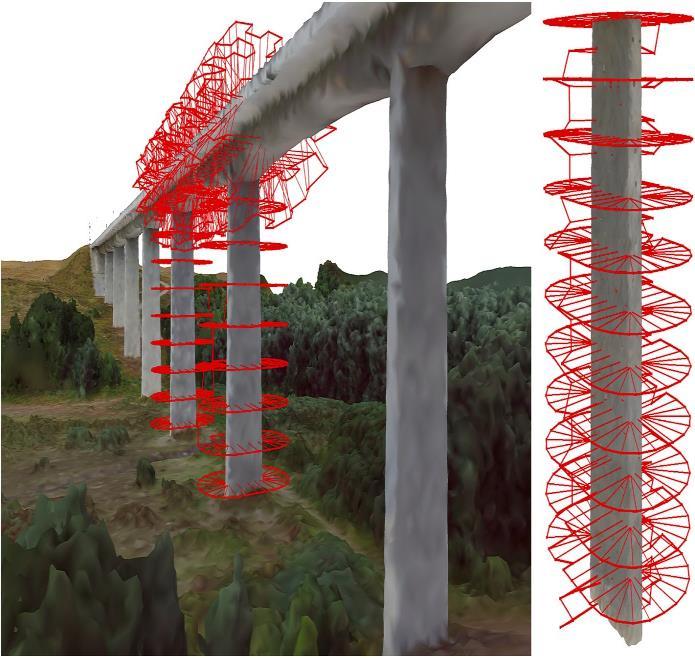
Smaoui et al. focus on optimizing Coverage Path Planning (CPP)fordrones.Theyproposeaback-and-forthmethodto ensure thorough image coverage of the Region of Interest (ROI)whilereducingtimeandenergyuse.Effectivemission management relies on data from positioning systems like GNSS. Morgenthal et al. introduce a method for creating flight paths for automatic image acquisition to aid photogrammetric 3D reconstruction. Using software like Pix4D Capture, they generate virtual models of structures basedoninitialdronesurveysorexistingdata.Viewpoints are located within an offset area around the virtual structure,andanoptimalpathconnectingtheseviewpoints isidentifiedusingtheLin-Kernighan-Helsgaun(LKH)solver algorithm, allowing for autonomous operation through onboardnavigationsystems.Anexampleofthegenerated pathappearsinFig.4Bologninietal.suggestasystemthat separates the identification of POIs from the creation of efficientdronepaths.TheydeterminePOIlocationsbasedon adetailedmeshmodelofabuilding,clusterthemforeasier trajectoryplanning,andsolveaCapacitatedVehicleRouting Problem (CVRP) to ensure efficient navigation while consideringbatterylimits.Zhaoetal.useageneticalgorithm tooptimizethepath,focusingonensuringfull coverageof thebridge.
Anotherkeyfactoristheidealdistancebetweenthedrone and the target. Depending on the monitoring type and purpose, the drone can operate at various distances. For instance, thermal imaging shows that the measured temperatureofanobjectdecreasesasthedistancefromthe cameraincreases.Distancesfrom30mto10marecommon whenscanningandreconstructinga3Dmodeloftheentire structure. Smaller distances are necessary for damage detection. For example, Morgenthal et al. used a constant viewing distance of 4.50 m, resulting in a mean object resolutionof0.6mm/pixelandaspatialaccuracyof±1.70 mm.Duqueetal.demonstratedthatusingahigh-resolution cameracouldallowthedetectionofacrackwithathickness of0.75mmfrom3.00maway.Closerdistancesareneeded formonitoringdisplacements,frequencies,andconducting modalanalysis.
Table 2 provides a summary of case studies from the literature,listingthedistancesmaintainedbetweendrones andtargetsfordifferentinspectionpurposes.Thisdistance alsodependsonlightingconditions.Researchquantifiedthe maximumcrack-to-camera distanceforidentifyingfatigue cracksonsteelspecimensas0.30munderpoorlightingand
International Research Journal of Engineering and Technology (IRJET) e-ISSN: 2395-0056
Volume: 12 Issue: 10 | Oct 2025 www.irjet.net p-ISSN: 2395-0072
up to 1.10 m under good lighting. Furthermore, a safety distancemustbeconsideredtoavoidobstaclesandcomply with regulations. For example, the Federal Railroad Administrationrequiresmaintainingasafedistanceof4.60 mfromrailroadbridges.
Optimal flight speed is another crucial factor. The drone mustbalanceflyingquicklyenoughtosavebatterybutslow enoughtoensurehigh-qualityimagecollection.Threemain factorsmustbeconsideredwhenusingadroneforcapturing images. First, the interval between consecutive images is vital;thedrone'sspeedmustmatchthecamera'sabilityto capture images at the set intervals. This interval is influencedbytherequiredoverlapbetweenimages,which shouldrangefrom60%to90%,accordingtovariousstudies. Second,thecamera’sphotointerval,orthetimeittakesto save captured images, is significant. During this time, the cameracannottakemorepictures,soflyingtoofastcould lead to lost data. Lastly, exposure time is important, especiallyfordaytimephotography,whereshortexposure timesarecommon.Thecamera’sshutterspeedisaffectedby daylightsettings,andanymovementduringanopenshutter cancauseblurredimagesduetocapturingtoomuchlight.
Timingtheflightisalsocrucial.Shadowocclusion,daylight, and solar radiation can cause overexposure during image acquisition. This can affect the emissivity of materials, resulting in false positives or exaggerated readings. Some researcherstookimagesbeforesunriseandaftersunsetto avoid false positives from direct radiation. Others recommend carrying out exterior inspections at night to reduce the effects of solar heat on building materials. Conducting test flights between 9:00 am and 11:00 am ensuredconsistentsolarilluminationduringdatacollection.
Lowbatterylevelscanbecomeanissueaswell.Inthiscase, thedronemaynotfinishitsscheduledmission.Thiscould happen due to unexpected battery drain or insufficient charging before the flight. To protect the drone from damage, a failsafe mechanism activates when the battery voltage drops below a specific level. The battery level is alwaysmonitoredduringthemission,andifitreachesthe threshold, the drone automatically returns to its starting point.Ifthedroneistoofarfromitsoriginallocationandthe batteryiscriticallylow,itwilllandimmediately.
This section concludes by stressing the key role of the planning phase in bridge inspections. Effective planning includesnotjustpathplanning,butalsocarefulattentionto timing, environmental conditions, safety and regulatory requirements, the data to be collected, and how it will be storedandshared.Totackletheseissueswell,threemain points come up. First, bridge inspectors need thorough trainingthatgivesthemastronggraspofbridgeSHM,drone
operation,anddatamanagement.Second,academicresearch shouldteamupwithindustryprofessionalstobuildaclearer frameworkandstandardguidelines.Third,researchcould work on more complete flight planning algorithms to improvedatacollectionandbatteryuse.Theseeffortswould simplifyproceduresandoutputs,ensuringinspectionsare high-quality,objective,andconsistent.Thesestepsarevital for increasing the reliability and effectiveness of dronebased bridge inspections and for better infrastructure management.
Data collected by drones must be transmitted to support decision-making.Whennetworksofdronesmonitorbridge networks, the Internet of Drones (IoD) environment can significantlyimprovetheirperformance.Thissectionaimsto give insight into the IoD environment, which is seen as a networkframeworkconnectingdronesandvariousgroundbased network entities. The IoD has gained considerable attentioninrecentliteraturebecauseoftheflexibilityand adaptabilityofdronenetworksindifferentscenarios.Italso shows the ability to improve the performance of other network frameworks in terms of connectivity, load distribution,anddataloss.
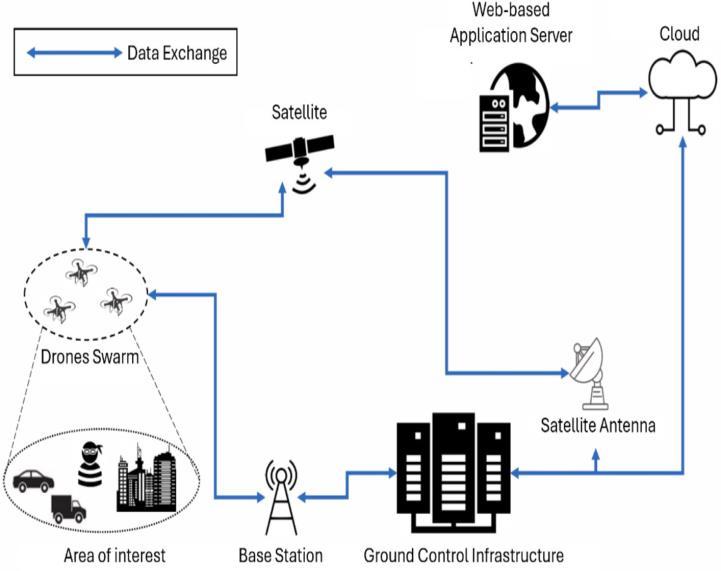
DataThespreadandconnectionofdronesmadeitnecessary tostandardizecommunicationwithindronenetworks.The InternetofDrones(IoD)isanetworkframeworkdesignedto supportcommunicationbetweendronesandGroundControl Stations (GCS) and to coordinate access to regulated airspace.Figure5 illustratesthestructureoftheIoDandthe standards for drone interoperability. These include communication protocols, flight procedures in controlled
International Research Journal of Engineering and Technology (IRJET) e-ISSN: 2395-0056
Volume: 12 Issue: 10 | Oct 2025 www.irjet.net p-ISSN: 2395-0072
airspace,andresourcemanagement,particularlyregarding energyandbandwidthusage.
In the IoD, drones are seen as intelligent objects that can communicate with each other and with the GCS to share mission-related data. The GCS serves as the hardware for remote control. It oversees the airspace and tracks the positions of the drones. Typically, the GCS has a high processing capacity because it manages the information received from the drones and transmits it to end users withoutaffectingthelimitedresourcesofthedrones.
KeyissuesintheIoDenvironmentinclude:(i)Inter-drone conflicts,(ii)Flightduration,(iii)Communicationchannel, (iv) Routingprotocols,and (v) Securityconcernsin drone communication.
Inter-drone conflicts occur in multi-drone systems, also knownasswarms.Dronesworktogethertoaccomplishone ormoremissions,andthenumberofdronesinvolvedcan rangefromtwotohundredsbasedonthetask.Intheevent of a conflict, drones can adjust their routes selectively to optimizeenergyuse.
Flight duration is limited by battery life, particularly for missionsoverlargeareas.Thisissueisalsoprevalentinthe Internet of Things (IoT). Some proposed solutions for extending drone autonomy include efficient battery management, implementing wireless charging stations, replacingbatteries,ormaintainingdrones.Othersolutions involveaddingsolarpanelstothedrone’swingsandusing MachineLearning(ML)forcommunicationimprovements.
Dronesusewireless media for communication,allowing for high mobility and lower costs compared to wired networks.However,wirelesscommunicationhasinherent issues, mainly due to the medium's unreliability and the challengesposedbyphysicalobstaclesliketrees,mountains, and buildings. Communication in the IoD should meet the following requirements: an efficient data link, long-range operation,two-waycommunication,lowlatency,highflight autonomy, and reliable communication. To avoid interference, the most effective transmission techniques commonlyoperateinthe2.4GHzband.
Routing protocols function at the network layer to determine the best path for packet routing. Most routing protocolsindronenetworksareadaptationsofthoseusedin Mobile Ad-hoc Networks (MANET). Metrics for evaluating paths include end-to-end delay, total traffic received, data loss, and throughput. No single routing protocol is universallysuitablefordronenetworks,asitseffectiveness varies with the number of nodes and the speeds of the drones. Someprotocolscan enhancetheir performance in termsofpacketdeliveryratesandend-to-enddelaybutmay struggletoadapttofrequentchangesindroneformation.
Security issues in drone communication require lightweightsecurityprotocolsbecauseofthedrones'limited resources. Yet, standard encryption methods often need significantcomputationalpowerandresourceuse.Several testsondroneprototypeshavedemonstratedvulnerability tocyber-attacks,withsuccessratesbetween48%and64%. This underscores the need for more efficient security protocols.Secretkeyscanensuretheconfidentialityofdata sent from drones to ground stations and improve throughput performance. Additionally, blockchain technology can facilitate secure communication with minimalcomputationaldemands.Researchonblockchainbased systems has explored creating decentralized registries.
Thechoiceofwirelesstechnologyfordronecommunication at the physical layer is crucial for optimizing network performance.Severalfactorsinfluencethischoice,including the type of drone tasks, their duration, the environment, drone mobility, communication range, and limitations on datatransmissionorenergyuse.Forinstance,technologies like cellular networks and satellite communications can cover large areas and offer high speed and reliable connectivity;however,theyrequireconsiderableenergyand canintroducedelays.Conversely,technologieslikeBluetooth andZigbeeconsumeverylittlepowerandhavelowlatency but also provide limited transmission bandwidth and are moresusceptibletointerferencefromobstacles.
Giventhesefactors,thefollowingsectionsdiscussthemost relevant technologies for Internet of Drones (IoD) communication.
International Research Journal of Engineering and Technology (IRJET) e-ISSN: 2395-0056
Volume: 12 Issue: 10 | Oct 2025 www.irjet.net p-ISSN: 2395-0072
Wi-Fi Communication. WidelyknownWi-Fichannelsinthe 2.4GHzand5.8GHz bands areusedtocontrol drones via Radio Control (RC) devices like smartphones and tablets. Using Wi-Fi provides the advantage of real-time data and imagetransmissionathighspeeds.However,transmitting flightcommandsoverWi-Fiispronetointerferencebecause it operates in the unlicensed Industrial, Scientific, and Medical(ISM)band,whichmanydevicesalsouse.Therefore, RCsystemsoperatingonfrequencybandsdifferentfromWiFimaybeavalidoption.
mmWave Communication. mmWave technology is appealing for IoD due to its high frequency, increased bandwidth,andbeamformingcapabilitiesthankstotheshort wavelength. However, it also faces challenges, such as attenuationduetofreespacepropagationandblockageby obstacles.
Current research explores various aspects of mmWave technology, including channel propagation, beamforming techniquestoaddresschannelvariations,theDopplereffect caused by drone movement, and spatial-division multiple access to enhance network capacity. This technology not only serves access networks but can also be used for backhaul links in drone-assisted networks, where drones function as relay nodes. Additionally, mmWave can work with the latest cellular networks (5G) to ensure reliable connectivityamongdronesandinbackhaullinks.TheAir-toGround (A2G) channel can utilize mmWave data transmission across different frequency bands in various environments,suchasurban,suburban,rural,andremote areas.
However, mmWave communication has significant issues that must be addressed for reliable connectivity. A line of sight(LoS)pathbetweenadroneandagroundstation,or another drone, is necessary for high-rate, low-latency transmission. Obstacles like buildings, vegetation, and variations in ground height can disrupt the LoS channel, degrading mmWave communication performance. Thus, usingmmWavetechnologyfordronecommunicationismost viableinspecificscenarios,suchashigh-qualitymultimedia transmission in LoS coverage. An alternative to this is the use of 3D antenna arrays implementing Multiple Input MultipleOutput(MIMO)techniquesforbeamforming.
Machine-Type Communication. Machine-Type Communication(MTC)canbebeneficialfordronenetworks andapplications,suchaspublicsafety.Therearetwotypes of MTC communications based on range: wide and short. Wide-rangecommunicationscoverlargeareasandinclude cellular,WiMAX,andsatellitecommunications.Incontrast, short-range communications cater to smaller areas and includetechnologieslikeZigbeeandBluetooth.Wide-range technologiesaresuitableforcontrollingdronesflyingathigh altitudes and long distances, making modern cellular networks particularly attractive for reliable drone
connectivity in data collection, processing, and video streamingapplications.
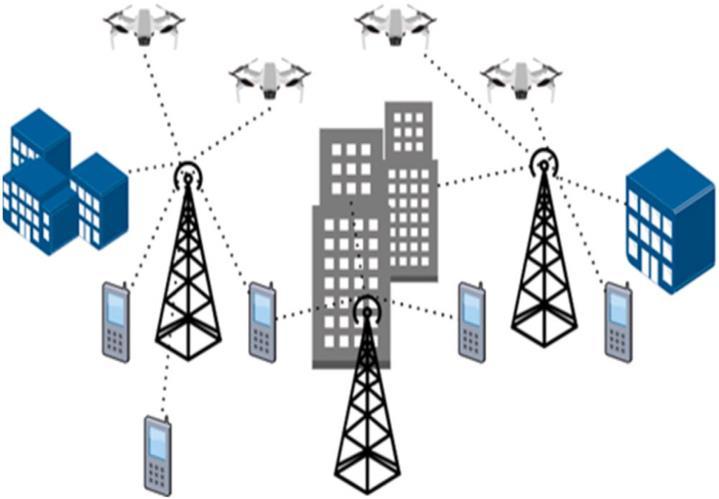
Cellular Technology. Dronesoftenneedcontrolbeyondline of sight in various scenarios. This can be achieved by integrating with cellular networks, where each cell is managedbyaBaseStation(BS)thatprovidesradiocoverage overa definedarea,ensuringongoingconnectivityforthe User Equipments (UEs). The presence of multiple BSs enhances coverage area and increases capacity and redundancy. Cellular networks can address limited bandwidth and coverage issues found in the ISM band by offering wide coverage, high throughput, and low-power devicesthatfacilitatedroneconnectivity.Invideostreaming scenarios,4Gnetworkscanenhancethroughput,reduceloss rates, and minimize delay when combined with drones, despitechallengeslikemultipathpropagation,shadowing, and fading that affect wireless channels. Efficient video transmissionalsobenefitsfromhighencodingefficiency.A combinationofindoorfemtocellsandoutdoormacro-cells representsaparticularlyeffectivenetworkarchitecture.
Recently,therapidgrowthof5G-and-Beyond(5GB)cellular networks has opened new opportunities for drones. Specifically, drone swarms can leverage 5GB networks to transferlargevolumesofdata,likehigh-qualityvideosand images,inmonitoringandsurveillanceactivities.Dronescan serveasBSs,providingwirelessconnectivityinareaswith poorornonexistentgroundcellularinfrastructure,suchas rural areas, and can also offer temporary coverage for limited-time events, lowering network deployment costs. Drones serving as BSs can relay data to other networks, reducing the burden on land-based networks, saving resources,andminimizinginterferencewithadjacentcells.
Thecurrentcellularnetworksusingdronesutilizevarious technologies to achieve this goal, including D2D communications, small-cell networks, and mmWave communications.
WiMAX Technology. WiMAXisanenablingtechnologyfor providingbroadbandaccessoverlargerareas.Comparedto themorecommonWi-Fi,itcancovergreaterdistancesata lowercost,reachingatheoreticaldatarateofabout75Mb/s for the fixed portion of the network and 30 Mb/s for the mobileportion.WiMAXcanbeappliedinscenariosinvolving dronenetworks,suchasrescueandemergencyoperations, where drones can communicate via WiMAX due to its features, including support for mesh networks, different traffic types, security (authentication and encryption), throughput, coverage, mobility, low cost, and easy installation.SeveralstudiesindicatethatWiMAXcanalsobe usedfordronecommandandcontrolduetoitslowRound Trip Time (RTT) and jitter. The unique ability of mobile WiMAXtodefinedifferentQualityofService(QoS)classes for varying data rate and delay requirements makes it suitable for transmitting control information for fleets of
Volume: 12 Issue: 10 | Oct 2025 www.irjet.net p-ISSN: 2395-0072
drones,suchasflightroutesandtelemetry,underdifferent environmentalconditions.
Satellite Communication Technology. Insituationswhere dronescannotdirectlytransmitdatatootherdronesorthe groundstation,satellitecommunications(SATCOM)canbe crucial for maintaining communication. SATCOM is also essentialformission-criticalcommunications.Itcanbeused for drone communication or as a relay for A2G communication. Additionally, due to the high channel capacityofsatellitelinks,SATCOMcanfacilitatemultimedia data transmission, such as live photos and videos from drones,althoughtheend-to-enddelaymaybelongerthanin ground network scenarios. The performance of satellite relays depends on factors like drone transmission power, datarate,andsatellitetransmissionpower.Thissolutioncan serveasavalidalternativefornetworkswheredronesactas relaynodes,thankstogreaterrangeandhigherstabilityand data rates offered by satellite links, especially when transmittinglargevolumesofdata,likehigh-qualityimages overlongdistances.
Bluetooth Technology. Bluetooth (IEEE 802.15.1) is a standardizedshort-rangeprotocolwithamaximumrangeof 100 m and low power consumption. It has three versions thatdifferinoperatingdatarates,withamaximumrateof 24 Mbps. While Bluetooth can be used in flying drone networks, it is best integrated with other wireless technologies due to its limited range. Bluetooth supports distributedsensingandcontroloperationsfordronesflying autonomously and completing various tasks with low computationalpowerandreliablecommunication.Research showsthatreal-worldimplementationsofthistechnology, such as collision avoidance, obstacle avoidance, and coordinatedflightfortaskcompletion,arefeasible.
Zigbee Technology. Zigbee(IEEE802.15.4)isalow-power standardized protocol suite, which includes security features,designedforlowdataratecommunicationswhere energy efficiency is crucial. When used in mesh network configurations,itcanachievelargercoverageranges.Atthe physical layer, Zigbee offers increased resistance to interference,butitsdataratesarerelativelylow,reachingup to 250 kbps at a frequency of 2.4 GHz. It is primarily employedforintermittentdatatransmissioninInternetof Things(IoT)applicationsinvolvingsensors.Itsuseextends to monitoring, control applications, and home or factory automation. Applications of Zigbee in drone networks are mainlylimitedtoindoorenvironmentsforlocalizationorfor communicationandpositionestimationduringlanding.
Other Communication Technologies. Cognitive Radio (CR) technology presents a promising solution for addressing spectrum utilization challenges found in other wireless technologies for drone applications. CR enables opportunistic access to the spectrum through advanced sensingtechniquesandallowsdatatransmissionoverbands unused by other transmissions. It facilitates simultaneous spectrum use by multiple users without exceeding interferencelimits.Opticalwirelesscommunicationhasbeen exploredforFreeSpaceOptical(FSO)systems,whichutilize opticalsignalsforhighdataratecommunicationsoverlong distances.InFSOsystems,dronescanfunctionasrelays.
Indronenetworks,Long-TermEvolution-Unlicensed(LTEU) technology can support communication among drones actingasBSs,increasingthroughputbyutilizingunlicensed spectrum.Incriticalscenarios,drone-BSscanuseLTE-Uto fill gaps in coverage caused by damaged infrastructure relyingonotherwirelesstechnologies.
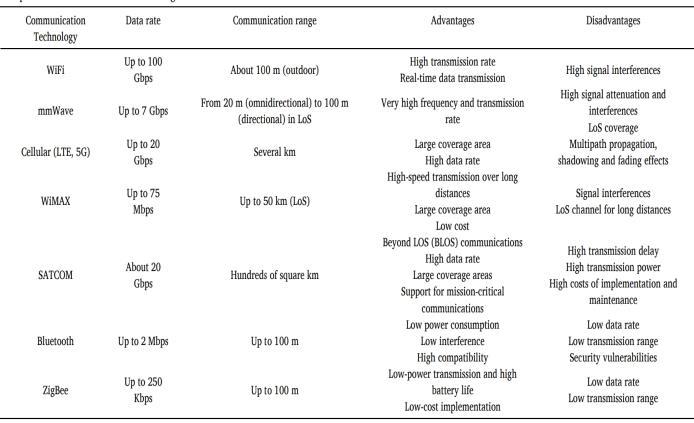
Table 2 provides an overview of the most relevant communication technologies for IoD, outlining their data transmissionrequirements,communicationranges,andkey advantagesanddisadvantages.
Although the IoD paradigm is not fully utilized in bridge inspectionyet,itcanbeeffectivelyusedinurbanareas.In thesesettings,datafromvarioussourcesarecollectedand processed, often in real-time, for purposes such as traffic monitoring,eventdetection,rescueoperations,emergency management, and public safety. The general framework includesanetworkofdronesthatgatherdatafromsensors mounted on them and also receive data from ground sensors.Thetypesofsensorsvarydependingonwhatneeds
International Research Journal of Engineering and Technology (IRJET) e-ISSN: 2395-0056
Volume: 12 Issue: 10 | Oct 2025 www.irjet.net p-ISSN: 2395-0072
to be monitored, including video, sound, air quality, temperature, pressure, and noise. Due to the limited processing power of drones, all collected data are sent to dedicatedserversforprocessing,whichcanbelocatedatthe edgeofthenetworkorintheCloud.
Table - 2: Comparison of Communication Technologies For IoD
Dronescanperformvarioustasksdependingonthespecific applications in urban environments. One significant applicationofIoDisthereal-timemonitoringofurbanlife aspects, such as air quality, noise pollution, and waste detection.IoDcanalsoimprovetrafficconditions.Sensors placedacrossthecityoronthedronescanprovidevaluable traffic information, including congestion levels, accident detection, and assessment of road conditions. A drone networkcansupportothernetworksindisasterscenarios, large events (like sports events and concerts), and IoT applications.
Theurbanlandscapeisfilledwithobstaclesandreflective surfaces that can interfere with signals. This makes communicationtechnologycrucialforensuringreliableand fast data transfer. Therefore, research in IoD focuses on developing algorithms for data routing and position optimization to reduce signal reflections and losses. Furthermore, the optimal routes determined by advanced routingandpathplanningalgorithmsaimtominimizethe drones'energyuse.
TotransferdatafromsensorstothenetworkedgeorCloud, the IoD network is linked with other networks, such as vehicular,cellular,andIoTnetworks.Thisintegrationhelps toconnectvehiclesandlowerslatencyanddatalosswhen sharing information about disasters, severe weather, and accidents. Air quality monitoring relies heavily on IoT devices,whichoftenhavelimitedtransmissioncapacity.Asa result, drones are used to extend transmission range and coverage. In this setup, drones can first travel to the IoT devicelocationstocollectdataandthensendthatdatatoa ground station for further processing and analysis. Path
planningalgorithmsareagaincrucialfortheseoperations forthereasonsmentionedearlier.
Drones can gather and transmit various types of data, including images, videos, their position and speed, and sensorreadings.Someofthisdatacanbesensitiveorlifethreatening,makingsecurityandprivacyessentialconcerns. Currently,thereisnostandardizedmethodtoensurethese features in IoD. The approach taken is to implement cryptographic measures and authentication methods adapted from traditional Internet scenarios. However, all existing security algorithms are not designed for devices withlimitedresourceslikedrones.Thisindicatesaneedfor further research to simplify cryptographic and authenticationmethodswhilemaintainingstrongprotection againstattacksandbreaches.Privacymustalsobeensured, making drones more "privacy-focused." One potential solutionistoemploymachinelearningtechniquesthatcan beintegratedintobothIoDandIoTnetworks.
Basedonthesesuccessfulapplicationexamples,theauthor believes that IoD will make data management and transmission more affordable and secure for bridge inspections in complex environments. A more detailed discussionofcurrentresearchtrendsisinSection5.4.
TheInternetofDrones(IoD)isanintriguingsubjectbecause itcanadapttomanydifferentsituations.Itallowsforflexible networkformationandconfiguration,connectswithground networksfordataexchange,andenablesdronestooperate andcoordinateontheirownorwithminimalhumaninput. Atthephysicallayer,recentliteratureconfirmsthatvarious technologiescanfacilitatecommunicationamongdronesand between drones and ground infrastructure. The most suitabletechnologiesareselectedbasedondifferentneeds, suchasimprovingcoverageperformance,allocatingchannel resources, enhancing path reliability, and optimizing positions. The main challenges here relate to real-world conditions, like non-line-of-sight (NLoS) scenarios and obstacles.Choosingtherightcommunicationtechnologyto fit specific application needs is a practical solution, dependingonfactorsliketheenvironment,communication range among drones and ground nodes, and energy use. Additionally, connectivity can be improved through modulationtechniquesdesignedfordronenetworksandby creatingaccuratechannelmodels.Thesemodelshelpstudy coverageperformance,resourceallocation,reliabilityindata routing,pathplanning,andpositionoptimizationfordrones. Currentresearchismovingtowarddevelopingoptimization algorithmsforresourceallocationandpathplanning,which are crucial to the IoD. Recent studies focus on: i) path planningalgorithmsthatfactorinenergyuseandsafety,ii) mathematicalmodelsforoptimizingpathplanning,iii)route planninginsmartcities,andiv)simulationtoolsforrealIoD applications. The main challenges include ensuring that
International Research Journal of Engineering and Technology (IRJET) e-ISSN: 2395-0056
Volume: 12 Issue: 10 | Oct 2025 www.irjet.net p-ISSN: 2395-0072
dronepathplanningalgorithmsoperateinreal-time,which requiressignificantcomputationalpowerandenergytofind optimalsolutions.Thisposesaseriousdrawbackforbatterypowered drones with limited computing resources. Other challenges involve effectively integrating drones with groundnodes,especiallyformonitoringandcontrollingIoD applications, as well as developing accurate tools that considerinteractionsamongmultipledrones.
AnotherimportantissueistheIoD'sintegrationwithground networks. Research has focused on creating innovative networks that link drone swarms with other terrestrial infrastructures, such as Vehicular Ad-hoc Networks (VANETs), Public Transportation Systems (PTNs), cellular networks, and IoT networks. This integration needs to be smart. It should account for the unique characteristics of each network. The IoD is responsible for bridging these terrestrial networks while considering aspects like connectivity,energyconsumption,networkresilience,and various application scenarios. The challenges in this area include: i) managing diverse data to prevent unnecessary overload from unsynchronized networks, ii) integrating networks with different energy and capacity limits, iii) implementingspecialroutingprotocolsthataccommodate IoD and other mixed networks, iv) optimizing existing applications for reliability, and v) ensuring secure cooperationandinteroperabilityamongdifferentnetworks to protect privacy and security in many applications and services. To address these issues, research is developing cooperativeframeworkstoboostcommunicationefficiency andlowerdataoverheadandlosses,aswellasscheduling methodsthatdeterminewhichnodetransmitsinformation, when,andhowoften.Thisrequireseffectivesynchronization betweendronesandvariousnetworks.
EnergyefficiencyiscriticalintheIoDandisamajorfocusof recentresearch.InmostIoDapplications,dronesgatherand sharedatathatneedprocessing.However,processingcannot happen onboard due to limited computational resources. Instead, it should be handled by centralized systems with ampleprocessingpowerandmemory.Themaingoalisto optimizetheabilityofdronestooffload,improvingmetrics like drone power consumption, ground network use, processing efficiency, and the distance drones travel to offload data. Solutions have been proposed that use Fog computingwithCloudserverstofulfilltheseneeds.Research showsthatenergyefficiencyisinfluencedbyseveralfactors, includingdronespeed,paths,theplacementofrelaynodesin groundnetworks,communicationtechnology(asdiscussed in Section 5.2), resource allocation, data transmission scheduling, drone cooperation, and computational offloading.However,optimizingthesemetricsofteninvolves complex multi-objective algorithms. Another challenge comesfromthefrequentchangesindronenetworktopology duetotheirhighmobility.Thisrequiresconstantlyupdating stateinformationaboutdrones, suchastheirpositionand
speed,leadingtomorecontroldataexchangesamongdrones andgroundnodes.
TheIoDhassignificantpotentialtosimplifyandautomate operationsacrossvariousapplicationscenarios.However, sensitivedatacaneasilybe sharedovertheopenwireless medium, raising significant security concerns. Current research on IoD deeply examines these issues. Drones typicallycollectandsharedata,likevideosandimages,along with other information, such as GPS coordinates and timestamps, gathered from onboard sensors. This information is often crucial and should never be compromised.Securityneedsregardingdataconfidentiality, integrity,availability,authenticity,andprivacyarevitalfor the IoD. Recent studies have made strides in developing robust security mechanisms that can be supported by the limitedresourcesofdronestocounterthreatsandsecurity breaches. Proposed security solutions in the literature include authentication mechanisms, intrusion detection strategies,andprivacyprotectionmethods.Authentication in the IoD relies on biometric approaches, hashing, cryptographicmethods,predictivetechniques,lightweight cryptosystems,AuthenticationKeyAgreementschemes,and blockchain-basedsolutions.IntrusiondetectionfortheIoD incorporatesneuralnetworksandbigdataanalytics.Privacy protection mainly uses policy-based or technique-based strategies. Some challenges need to be addressed for effectivesecurityintheIoD.Themainissueisbalancingthe need for robust schemes with low computational and communication costs. Lightweight systems can be less secure, while strong solutions may demand high computationalandtransmissionresources.Findingthebest compromisebetweenefficiencyandcostiscrucial.Thereare also regulatory concerns when drones are used. Privacy issues emerge whenever data is transmitted, like when drones capture images or videos containing private information.Theresponsestotheseissues,likecensoringor deletingsensitivematerial,relyonregulatorylawsthatvary bycountryanddependonlocalregulations.Ideally,uniform global regulations for IoD activities would be beneficial, though achieving this goal will be challenging in the foreseeablefuture.
Thissectionpresentstwomainapplicationsofdrone-based inspections.Thefirstlooksatusingdrone-mountedcameras fordetectingsurfacedamageandhowtointegratethisdata withBridgeInformationModels(BrIM).Thesecondexplores drone-based techniques for Structural Health Monitoring (SHM),emphasizingthedynamiccharacterizationofbridges andnon-destructivetesting.
International Research Journal of Engineering and Technology (IRJET) e-ISSN: 2395-0056
Volume: 12 Issue: 10 | Oct 2025 www.irjet.net p-ISSN: 2395-0072
Dronesgivebridgeinspectorsquickandsafeaccesstohardto-reachareaswithoutneedingexpensiveequipment.They also allow for relatively short data collection times. Inspectors can use the data right on site since images are availabletotheoperatorforimmediatevisualassessmentof thebridge'scondition.Additionally,datacanbeprocessed latertogetquantitativeinformationfromlargedatasets.For example, computer vision techniques help assess the conditionofbridgeelementsbyanalyzingimagestakenfrom the drone, counting and measuring the width of cracks acrosshundredsofimages.Dronescanalsocreate3Dpoint cloudsthatprovideclearinformationaboutsurfacedamage. Finally,integratingwithBrIMisessentialforgivingobjective estimatesofbridgewearovertime.
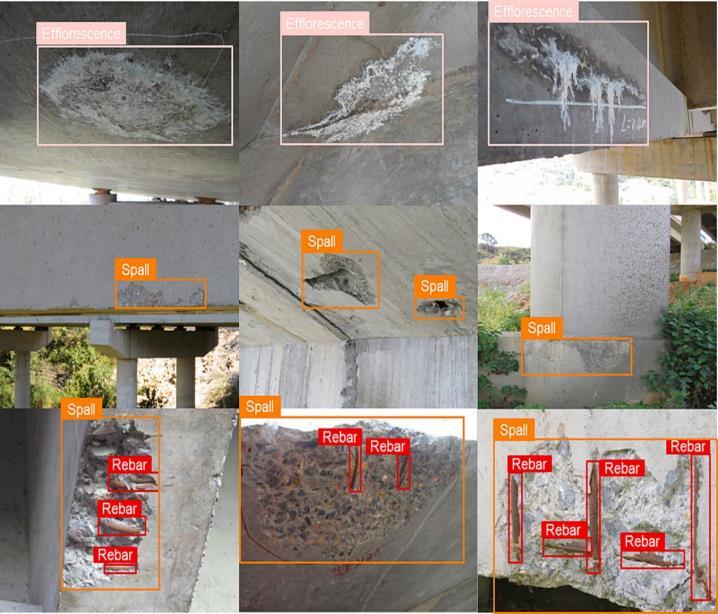
Automatedsurfacedamagedetectionusesmachinelearning algorithmstoidentifycommondamagepatternsonsurfaces. Typically, the input consists of images, which can be standard RGB pictures taken by smartphone cameras or imagesfromspecializedcameraslikethoseusedininfrared thermography.Commonanomaliesincludecracks,exposed and rusted reinforcement bars, surface defects such as efflorescence, and vegetation. Many studies in computer vision utilize various algorithms for surface damage detection,especiallyforcrackdetection,sincecracksarea frequent type of surface damage. The output of crack detection can include the number, length, and width of cracks.Forinstance,Perryetal.proposedanalgorithmthat identifies commondamageslikecracksandspalling.They used the OpenCV library to correct the colored image, changing it to grayscale. A canny edge detector is then appliedtoidentifycracks,allowingforthedeterminationof the number of cracks and their length, though it does not measuretheirwidth.
Other research focuses on identifying different types of damage. For example, Belcore et al. presented an objectoriented supervised machine learning method that uses segmentationtoclustersimilarpixelsintoobjectsandthen classifies those objects into categories, such as areas with unwantedwaterdrainageoroxidizedrebars.
Inbothcrackdetectionanddamagerecognition,imagescan undergo pre-processing or post-processing to improve results.Duqueetal.differentiatedbetweenhigh-qualityand low-quality images by evaluating sharpness and entropy. Imagesarethenprocessedusingpixel-basedmeasurement software like ImageJ or through a photogrammetric approach.Theycompareresultsbasedonoutputqualityand computationtime.Jeongetal.suggestedaprocedurewhere, after using machine learning for damage detection, they enhancethequalityofimagesshowingdamagetosimplify
processingandmeasurement.Theirimprovementsfocuson contrast, brightness, and sharpness. They used a ConvolutionalNeuralNetwork(CNN)todetectvarioustypes ofdamageincludingsplits,cracks,weatheringtimber,and paintfailure.
Some algorithms are specifically designed for quick processing to enable real-time crack detection, guiding dronestocriticalareas.Yangetal.implementedareal-time damage detection algorithm integrated with drone flight. Thestudypointedoutthatdependingonagroundserverfor real-time processing of videos captured by drones is not ideal, as it can introduce delays from video encoding, streaming, and interruptions due to connection problems, obstacles, or bad weather. These delays can slow down response times. To tackle these issues, the researchers propose creating a lightweight, energy-efficient, real-time damagedetectionalgorithmthatcanrundirectlyondrones, reducing the need for heavy data transfers with external servers. S. Jiang et al. developed a real-time detection method using the YOLO (You Only Look Once) neural networks, which are excellent for fast and precise object classification. In this case, the drone has enough computational power for damage detection onboard. A vision-inertialfusionpositioningsystemaidsinguidingthe drone,whichalsofeaturesanautomaticdamagelocalization process.
Anothermethodfordetectingsurfacedamageinvolvesusing infraredimages.Damagedareasofconcrete,likethosewith delamination, emit electromagnetic waves with different intensity and wavelength distributions compared to undamagedconcrete.Basedonthesevariations,itispossible tocategorizebridgesurfacesbytheirdamagelevel.
International Research Journal of Engineering and Technology (IRJET) e-ISSN: 2395-0056
Volume: 12 Issue: 10 | Oct 2025 www.irjet.net p-ISSN: 2395-0072
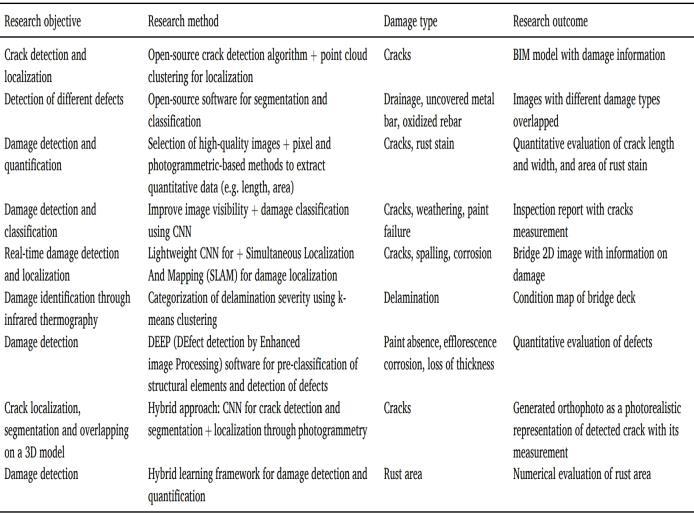
Therearemanyapproachestoextractinginformationabout surface damage from datasets. Each method varies in its approachandthekindofoutputdata,asshowninTable3. However, common issues need attention, such as image quality, resolution, the number of images, pre-processing andpre-selection,computationaldemands,trainingneeds, real-time usability, result quality, and considerations for missed objects, falsepositives,and size estimates. Li et al. provide useful recommendations for gathering effective images:
-Usehigh-resolutioncameras.Sincedetectingcracksrelies heavily on image clarity, high-resolution cameras are essentialforaccuratesizemeasurements,bothmanuallyand throughimageprocessing.
- Provide adequate lighting. Capturing imagesofcracksin low light makes it difficult to see details. Incorporating lightingequipmentimprovesaccuracybyhelpingtoidentify crackedges.
- Capture from various angles. Crack edges in areas of concreteerosioncanbehardtosee.Takingmultipleimages from different angles helps reduce uncertainty in edge identificationandimprovesmeasurementprecision.
- Shorten the distance between the drone and the bridge. Bringingthedronecloserduringimagecaptureallowsfor higher-resolution,close-upimages.Toensuresafety,using safety gear is crucial. This strategy enhances image resolution, leading to more detailed and precise crack assessments.
3D point clouds are effective for detecting damage by creating compact, realistic 3D models of bridges where surface defects are easy to identify. Drones create these models using two main methods: photogrammetric reconstruction and LiDAR scanning. These models can be exportedintoBrIMsystemstoimprovebridgemanagement.
Forexample,Khalooetal.completeda3Dphotogrammetric reconstructionofatimberbridgewithenoughdetailtospot timberdamage.However,evenwithhighaccuracy,finding smallcrackswithmillimeter-wideopeningscanbedifficult. Toaddressthis,Mirzazadeetal.combineda3Dpointcloud withaCNNtoidentifyandsegmentcracksfrom2Dimages, thenmappedthemontothe3Dmodelforlocalization.
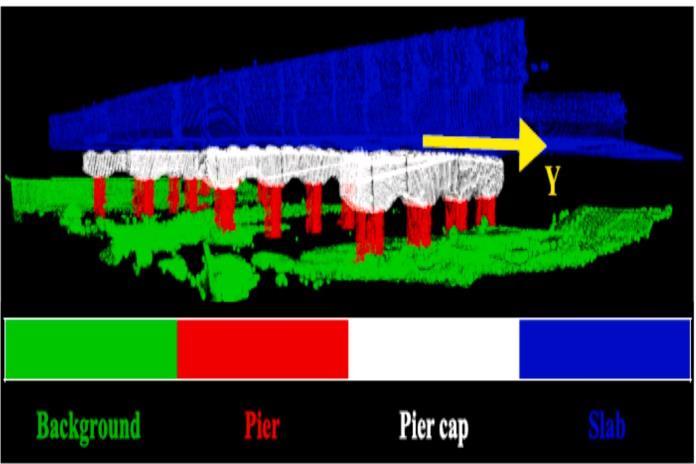
Bridge segmentation is another important area. It gives decision-makersaclearviewofwhichspecificbridgeparts aredamaged.H.Kimetal.performedsemanticsegmentation ofbridgecomponentslikedecksandpiersfroma3Dcloud generated by a drone. Perry et al. successfully combined damage detection with localization on a 3D point cloud,
creating a BrIM model rich with detailed information on cracksforeachcomponent.
Inspecting a standard bridge on-site usually takes 1 to 4 hours, followed by 10 to 20 hours of computer time to extract the 3D point cloud. The resulting files are large, between 1 to 10 GB. However, 2D orthomosaics can be createdtosavestoragespace.
A study by Perez Jimeno et al. compared traditional and drone-assistedinspections.Theyfoundthatdronemethods cutfieldworkfrom240minutestojust60minutes.Drones also provided full access to 100% of the bridge, while traditional methods only covered 80%. Drones showed betteraccuracyinspottingdamageinhard-to-reachareas.
Table - 3: Comparison of Methods Employing Drones For Surface Damage Detection.
Volume: 12 Issue: 10 | Oct 2025 www.irjet.net p-ISSN: 2395-0072
OMA techniques help identify the dynamic traits of a structure based on its response to operational loads or environmentalfactors.Thesemethodscanworkineitherthe frequency or time domain. They aim to find dynamic properties like modal shapes, natural frequencies, and dampingparameters.Theidentifiedmodalparameterscan serve multiple purposes. When creating a Finite Element modelofastructure,parameterssuchaselasticmodulusor cableprestressingforcecanbeadjustedtomatchthemodel withthedynamicbehavior observedin the real structure. Additionally, performing OMA throughout the structure’s lifespan,alongwithdamageidentificationalgorithms,gives insightsintothestructure’shealth.Forexample,changesin naturalfrequencies,whethergradualorsudden,cansuggest possibledamage,suchasareductioninstiffness,indicating changesinthestructuralresponse.
UsingdronespresentspromisingoptionsforOMA,withtwo mainapproaches. The first, knownascontact-basedOMA, involves using the drone as a mobile accelerometer. The second approach, called vision-based OMA, uses a drone fittedwithacameratomonitorbridgedisplacements,which canyieldmodalinformation.Whiletherearestillchallenges relatedtoprecision,bothmethodshaveakeybenefit:they allow access to all parts of the bridge, including the underside and pillars, without risking the safety of the operator.
In contact-based OMA, drones can serve as mobile accelerometersbyflyingtoandattachingtovariouspartsof abridge.EachdronehasanInertialMeasuringUnit(IMU) withbuilt-inaccelerometers,allowingevenlow-costdrones totakeaccelerometricmeasurementsthroughdirectcontact. Therearetwomainwaysforthedronetomakecontactwith thebridge:
•Thedronecanlandonthebridge,andmeasurementsare takenwhenthepropulsionsystemisturnedoff.
•Thedronecanhoveragainstthebridge’sunderside,with thepropulsionsystemstillon.Theceilingeffectreducesthe neededthrustandensuresstablecontact,asshowninFig.9.
Both methods for contact-based OMA require careful consideration of how the drone's structure affects the recorded frequency content. Aspects such as the contact areas,thesuspensionsystem,anddampingcharacteristics need to be examined to ensure accurate measurements. Furthermore,whilehovering,therotationofthebladescan
add extra dynamics, possibly affecting the recorded information.Landingformeasurementsisrelativelysimple for data collection but can pose challenges such as partial trafficrestrictionsandregulatoryissues,especiallyinareas with strict drone operation rules. In contrast, measuring whileincontactwiththeundersideavoidsdisturbingbridge traffic, offering a significant advantage in operational feasibility.
Despiteitspotential,theapplicationofcontact-basedmodal analysis is still not fully explored in existing literature, indicating a need for more research to improve these methods and address the associated issues. To ensure propercontactduringcontact-basedOMA,Sanchez-Cuevas et al. utilize the ceiling effect, where the airflow from the drone’srotorscreatesastabilizingforcewhenclosetothe bridge surface. To maintain stable contact, a 3D-printed fairing is attached to the drone. Operating drones under bridges involves several obstacles. One major issue is the lackofGNSSsignal,whichmakestraditionalpositioningand navigationmethodsineffective.Additionally,steelrebarin thebridgecandisruptthedrone’smagnetometer,causing inaccurate altitude readings. To tackle these challenges, techniqueslikeopticalfloworvisualodometrycanbeused fornavigation,providingreliablepositioningwithoutGNSS. In the experiment, the drone also has a reflecting prism, allowing precise tracking with a total station for accurate navigationandpositioningdespitetheselimitations.
Mohammedetal.explorevariouscontact-basedmethodsfor usingdronestotrackaccelerationandassessvehicleweights onbridges.Theirresearchintroducesaperchingsystemthat usesdouble-sidedre-stickabletabsormagneticsolenoidsto createmechanicalsurfacecontact.Adronefittedwiththese tabswassuccessfullyattachedtoacleanwoodenbridge,and accelerometric data from the drone's sensors were compared with readings from a fixed accelerometer. The findingsrevealedconsistencyinthefirstnaturalfrequency at 14.57 Hz and a general alignment in higher frequency ranges, showcasing the feasibility of using drones for contact-basedmodalanalysis.
However,severalquestionsaboutthelong-termreliability and accuracy of these methods remain. For example, the contactpadsinthestudycanonlybeusedtwicebeforethey need to be replaced, and their effectiveness on rough concretesurfacesmaybequestionable.Moreover,whilethe experimentwasdonewiththedrone’spropulsionsystemoff, usingitwhileactivemightintroducenoisefromtheceiling effect, which could affect data accuracy. Additionally, the performanceofdrone-mountedIMUsshouldbecompared systematically with that of traditional accelerometers commonlyusedinSHMforthoroughvalidation.
International Research Journal of Engineering and Technology (IRJET) e-ISSN: 2395-0056
Volume: 12 Issue: 10 | Oct 2025 www.irjet.net p-ISSN: 2395-0072
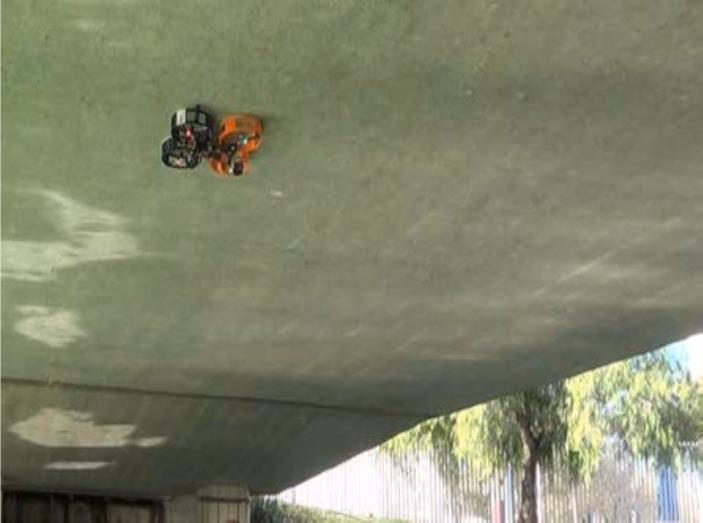
In another study, Mohammed et al. describe a bridge inspectionprocessusingaswarmofdronesforbothcontactbasedmonitoringandvisualcrackdetection.Inthismethod, contact is made through a small lift-suction solenoid electromagnet that can hold up to 0.5 kg. While this mechanismshowspromise,ithasonlybeentestedontraffic lightcolumns.
To the authors’ knowledge, no other studies have directly tackledcontact-basedbridgemodalanalysis.Thecoupling effectbetweenthedroneandthebridgestructureremains anareaworthexploring,particularlyregardingitsimpacton measured frequencies. An example of using autonomous vehiclestosupportmovingaccelerometerscanbefoundin. Another related research area involves using drones as manipulators to deploy and retrieve sensors that detach fromthedroneandactliketraditionalaccelerometersonce incontactwiththebridge.Here,theimprovedaccuracyof fixed accelerometric measurements is offset by the complexityofthedeploymentprocess.
Mostcurrentmethodsforvision-basedOMAusecamerasto assess bridge displacements. They track pixel movements across video frames with specialized algorithms. After gathering the displacement time history, system identification methods extract the modal parameters. However,thismethodcanproduceerrorsfromunintended dronemovementsandvibrations.Totackletheseproblems, techniqueslikefixed-pointtracking,inertialcompensation, orhigh-passfilteringcanhelpreducedisturbances.
So far, most studies in this area have concentrated on laboratory-scale mock-ups or small pedestrian bridges. Thesestructuresareusuallymoreflexibleandshowgreater displacements than medium-span reinforced concrete
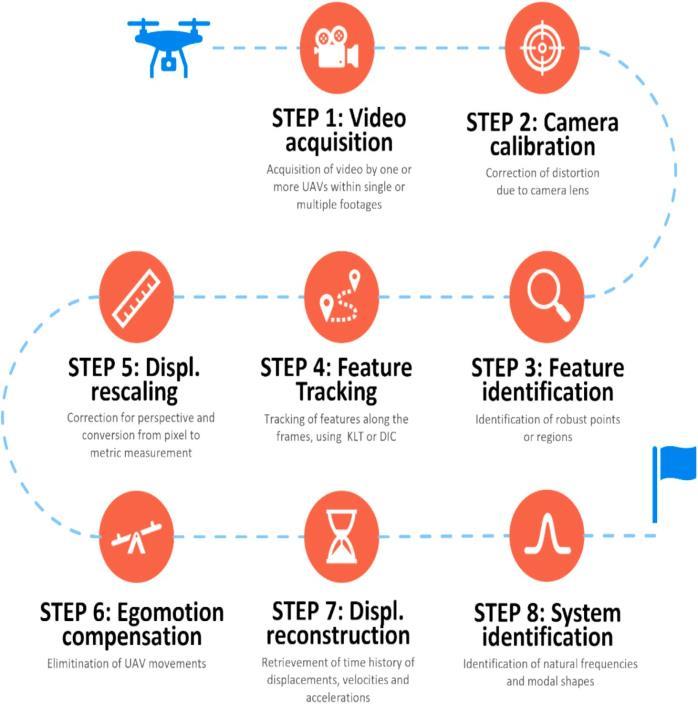
bridges. Environmental factors also greatly affect the performance of point tracking in vision-based OMA. For instance,windcanincreasedronevibrations,disruptingthe stabilityneededforaccuratemeasurements.Similarly,low lightconditionscanlowerimagequalityandhindertracking accuracy. The research has mainly focused on laboratory mock-ups or small pedestrian bridges, limiting the application of findings to more rigid structures. To the authors’ knowledge, no field tests have been done using drones for vision-based OMA on medium-span reinforced concretebridges.Figure10showsthestandardprocessfor obtainingmodal parameters,whichinvolvesseveral steps thatcanbeapproachedwithdifferentmethods.Eachstepis explainedindetailbelowforbetterunderstanding.
Theinputvideoforvision-based OMAisusuallycapturedwithcamerasmountedondrones. These cameras are typically those provided by the drone manufacturer,withresolutionsfrom1280×720to4096× 2160pixelsandframeratesbetween24and90framesper second.However,theeffectofdifferentcameraresolutions ontheaccuracyofmodalparameterextractionhasnotbeen fullystudiedintheliterature.Aboutframerate,itiscrucial to remember that the maximum trackable frequency (NyquistFrequency)iscappedathalfthesamplingrate.This highlights the need to choose an appropriate frame rate based on the expected frequency range of the monitored structure. The distance between the drone and the target reflects a balance between capturing displacement accuratelyandcoveringalargerareaofthebridge.Typically, thedistancesbetweenthecameraandthetargetrangefrom 1to5meters.Bologninietal.proposesynchronizingvideos capturedatthesametimebymultipledrones,eachcovering overlappingareasofthestructure.Thistechniqueallowsfor accurate displacement measurements over a larger area withoutchangingthecamera-to-targetdistance,leadingto more reliable and detailed extraction of modal shapes. Similarly,Hoskereetal.useasingledronetocapturevideos of different bridge sections at different times. They then combinetheinformationfromtheserecordingstocreatea comprehensiveanalysisofthestructure.
STEP 2: Camera calibration. Cameracalibrationremoves possible lens distortion induced by the wide-angle lenses typicallyusedforconsumer-gradecameras.Yoneyamaetal. calibrated the camera using a checkerboard pattern with known dimensions. The calibration follows the process described by Zhang. Usually, the Pinhole Camera Model is employed. The parameters of the pinhole camera are represented in a 3-by-4 matrix called the camera matrix. Thismatrixenablesconversionfrom2Dcameracoordinates to 3D world coordinates and vice versa. Calibrating the matrix involves detecting three types of parameters: extrinsic(rotationandtranslation),intrinsic(camerafocal lengthandopticalcenter),anddistortion(tocorrectimage curvature).
International Research Journal of Engineering and Technology (IRJET) e-ISSN: 2395-0056
Volume: 12 Issue: 10 | Oct 2025 www.irjet.net p-ISSN: 2395-0072
STEP 3: Feature identification. The first task is to track specific points to estimate displacement. One commonly used algorithm is the KLT tracking algorithm. It tracks selectedfeaturesofanimageacrossseveraltimeinstances byleveragingspatialintensity.First,itisnecessarytochoose theproperfeaturestotrack.Bologninietal.andHoskereet al. use the Harris corner detection algorithm, which identifies a tracking point wherever a corner appears. Anothermethod,followedbyWengetal.,usesbinaryrobust invariant scalable keypoints (BRISK), introduced by Leuteneggeretal.
STEP 4: Feature tracking. Afteridentifyingthekeypoints,a patchsurroundingthekeypointisselected.TheKLTtracking algorithmestimatesthepatch'sdisplacementovertimeby calculatingamotionvector.Themotionvectorindicateshow much the selected patch should shift to minimize the differencesbetweenthebrightnessofpointsintheoriginal andshiftedpatches.Thisminimizationoccursthroughleastsquaresestimation.
Forfeaturetracking,somestudiesusefiducialmarkers,such asArUcomarkers.AnArUcomarkerconsistsofalternating blacksquaresandwhitespaces,withthepositionofblack squares determining its identifier like QR codes. Fiducial markers can assist in detecting invariant features by the Harris detection algorithm, especially when the structure lacks easy-to-detect features like defects, joints, or weld points. As shown by Bolognini et al., comparing fiducial markers with “natural” markers reveals no significant difference.
As an alternative to KLT tracking in Step 4, DIC can be utilized.DICprovidesasolidopticalmethodfortrackingand image registration. It offers accurate 2D and 3D measurements of changes in images by using crosscorrelation techniques between successive images. This method is recognized for its capability to capture strain distribution.Forvibrationalmonitoringtasks,DICisoften used to estimate the displacement vector. This process involvesminimizingthecorrelationcoefficientbetweentwo imageframes.
Using different tracking algorithms comes with tradeoffs between accuracy and computational demands. The KLT tracker is efficient for real-time tracking in controlled environments,makingitsuitableforbasicdisplacementand frequency analysis, but it is sensitive to noise, changes in lighting,andlargedeformations.DICprovideshighprecision forfull-fielddisplacementandstrainmeasurements,making it ideal for detailed structural monitoring; however, its computational intensity limits its real-time applicability. Zernike moments are reliable for shape recognition and resistant to noise but are less precise for displacement analysis, with their efficiency varying based on implementation.Ingeneral,KLTisbestforspeed,DICexcels inprecisionfordeformationdetection,andZernikemoments workwellforrobustshapetrackinginnoisyconditions.
STEP 5: Displacement rescaling. The result of the KLT trackingorDICisatimehistoryofdisplacementforselected points,showninpixels.Youcaneasilyconvertthismeasure to millimeters using a scale factor, which you can get by comparingittoaknowndimension,likeaboltonthebridge, orbycalculatingthedistancefromthedronetothebridge andusingtrigonometry.
STEP 6: Egomotion compensation. Next, you need to compensate for the drone's movements, often called egomotion.Althoughcamerasaresomewhatseparatedfrom the drones with a gimbal, they still feel the effects of the drone’s movements. Consequently, the time history of displacements is influenced by the camera's relative movement. Several methods have been suggested to compensateforthis.
• Visual-based. Yoon et al. performed natural feature tracking to estimate the displacement of the targets and compensated for egomotion by estimating it for fixed reference points in the background. Similar procedures, whichusereferencepointsforcompensation,alsoexist.Wu etal.accountedforcamerarotationusingthetechniqueof homography.Vision-basedcompensationmethodsrequire trackingtheundeformedpartsofthestructureinthevideo frame,whichcanbechallengingifthepixelresolutionislow. Additionally,youneedtoselectthepointsforcompensation and accurately measure the distances from them to the drone,whichcanbecomplexandtime-consuming.
International Research Journal of Engineering and Technology (IRJET) e-ISSN: 2395-0056
Volume: 12 Issue: 10 | Oct 2025 www.irjet.net p-ISSN: 2395-0072
• Inertial-based. Wengetal.usedtheIMUtocompensate for camera movements by subtracting the relative component from the measured displacements. Relative camera movements include camera rotation, evaluated through a combination of accelerometer and gyroscopic measurements, and camera translation. In their experimental setup, this approach has shown effective performance at frequencies below 1 Hz. However, this methoddependsontheaccuracyoftheaccelerometricdata, whichcandriftandmaynotbeveryreliable,especiallyin low-costdrones.Moreover,somecommercialdronesdonot allowuserstoaccesstheaccelerometricdata.
• Frequency-based. Hoskereetal.andBologninietal.used frequency filtering to handle egomotion in drone-based modal analysis. Their method assumes that the natural frequencies of the bridge do not overlap with the main spectralcomponentsrelatedtothecamera'sdisplacement. Byseparatingthesemotiontypesthroughfrequencydomain filtering, the accuracy of the analysis improves. This assumptionoftenholdstrueformanycivilstructures.Drone oscillations caused by wind or stabilization issues usually happenatlowfrequencies(below2Hz),whilenoisefrom the drone’s blade rotation occurs at much higher frequencies,around80Hz.Thenaturalfrequenciesofmost bridges fall between these two ranges, allowing for the isolationofstructuralvibrationsusingband-passfilteringon thedisplacementdata.Thismethodissimpleandeffective forremovingnoiseassociatedwithegomotion;however,it has its drawbacks. It cannot reliably capture natural frequenciesbelow1-2Hz,whichiscommonforslenderor flexiblebridges.
STEP 7: Displacementreconstruction. Finally,therescaled andcompensateddisplacementtimehistoriesarecompiled, startingfromtherescaledresultsfromStep5andremoving the egomotion effect identified in Step 6. If displacement historiesareobtainedsimultaneouslyfromdifferentdrones, theyshouldalsobesynchronized.
STEP 8: System identification. OMAtechniquesareapplied to extract frequencies and modal shapes. Some studies identifynaturalfrequenciesusingpeak-pickingbutdonot extract modal shapes. Other studies use time-domain identification methods to derive modal shapes from the observed displacement data. For example, Hoskere et al. analyze displacement series from multiple points along a bridge, collected through various acquisitions, to extract localmodalshapesusingtheNaturalExcitationTechnique fortheEigen-SystemRealizationAlgorithm(NeXTERA).The local modal shapes obtained from different points are combined using the decentralized modal analysis method proposedbySimetal.ArelatedstudybyHaciefendiogluet al.exploresthereconstructionofmodalshapesincomputer vision,usingafixedcamerainsteadofadrone.Theirmethod employsspectralanalysistoolssuchastheAutoregressive
Moving Average (ARMA) model and Enhanced Frequency DomainDecomposition(EFDD).
Inprinciple,oncenaturalfrequenciesareobtained,youcan apply damage identification algorithms. However, current drone applications mainly focus on extracting modal parametersandhavenotyetincludeddamageidentification algorithms.
Table4summarizestheliteratureonvision-basedmethods for tracking displacements using drones. Several observations emerge from this summary. First, many methodshavebeentestedinlaboratoryorcontrolledindoor settings, where environmental factorslikestrongsunlight andwindareminimized.Second,outdoorexperimentsoften involve slender structures, like pedestrian bridges, where displacementsaretypicallyafewtensofmillimetres.
In-depthanalysesarenecessarytoassessthefeasibilityof real-scale outdoor tests on actual structures, checking whether the frequencies and displacement values are compatiblewiththelimitsofcurrentmethods.Itwouldalso be helpful to conduct direct comparisons within the same experimental setup to examine the impact of factors like samplingduration,cameraresolution,distancetothetarget, and the effectiveness of various tracking and stabilization methods.
You should also consider whether using drones for displacement detection is practical. Data from full-scale bridgesindicatesthatdisplacementsareoftenbelow10mm. Insuchcases,dronesusingvision-basedmethodsmayfindit hard to detect these small displacements, limiting their usefulness for OMA. If dynamic displacements are undetectable, the only measurable parameter may be the staticdeflectionwhena heavyvehicleortraincrossesthe bridge. Although static deflection is influenced more by externalfactors,likevehicleweightandtemperature,than themodalparametersobtainedthroughOMA,itremainsa usefulindicatorofstructuralhealth.Comparingnormalized deflectionswithintheframeworkoflinearelasticitycanhelp indicate potential damage. For example, an increase in normalized deflection over time may suggest structural deterioration.
Since bridge decks are often too stiff for drone-based computervisiontechniques,thesemethodsmightbemore effectiveinmonitoringslenderelements,suchascablesin cable-stayedbridges.Vision-basedtechniquescanmeasure the dynamic behaviour of individual cables, allowing an indirectassessmentoftheirtension.
International Research Journal of Engineering and Technology (IRJET) e-ISSN: 2395-0056
Volume: 12 Issue: 10 | Oct 2025 www.irjet.net p-ISSN: 2395-0072
Table - 4: Comparison of Vision – based Vibrational Monitoring Techniques Employing Drones.
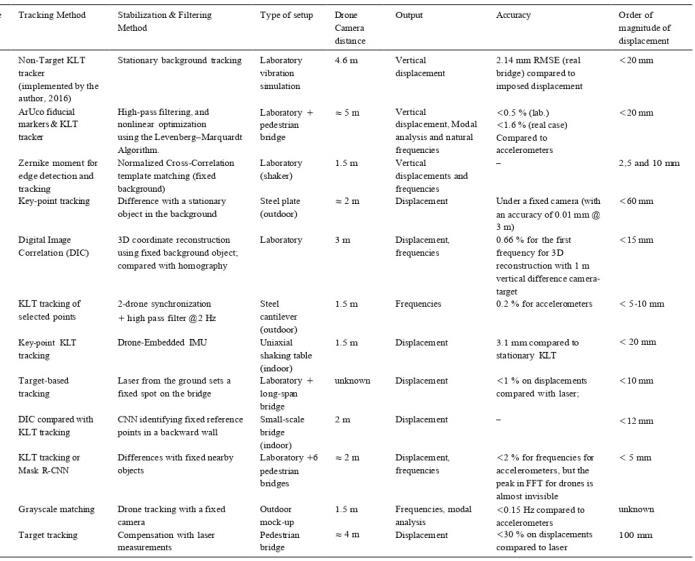
The flexibility of drones allows them to carry various sensors, enabling a broad range of non-destructive inspections, both contact-based and non-contact. While Sections6.2.1and6.2.2focusedoncontact-basedandvisionbased OMA, this section looks at different methods for conductingnon-destructiveinspections.
Integrating drones with Non-Destructive Testing (NDT) sensors combines robotics with monitoring technologies. Multiple studies concentrate on creating drone platforms andproceduresfordifferenttypesofNDT.Marcellinietal. suggestasemi-autonomoussetupforNDTinspectionsusing atiltingaerialplatformequippedwithanocta-rotordrone andaroboticarm.Zhouetal.introduceawall-stickingdrone designedforNDTinspectionsofangledsurfaces.Duetotheir easeofuse,ultrasonicsensorsaretestedinseveralstudies forintegrationwithdrones.Mattar&KalaiandDahlstrom presentawall-stickingdronecarryinganultrasonicsensor thatmeasurescoatingthicknessindirectcontactwiththe targetsurface.
Scheweetal.andGargetal.mixdroneswithLDVtechnology to gather data on transverse displacement and vibration, respectively.InGargetal.,thedronedirectlycarriestheLDV equipment,allowingittocollectvibrationdataclosetothe target structure. In contrast, Schewe et al. use a different method:theLDVstaysonthegroundwhilethedronecarries a mirror to steer the optical beam. This arrangement improves the precision of the LDV measurements by directingthebeammoreaccurately,eveninchallengingor hard-to-accessareas.
Computer vision can help gather structural information beyondjustvibrationmonitoring.Rietal.usevision-based techniqueswithadronetomeasurebridgedisplacementsby analyzing phase information. Similarly, Zhuge et al. and Ellenbergetal.measureverticaldeflectionofbridges,while Jalinoosetal.expandthiscapabilitytoincludedeflections androtations.
Kumarapuetal.applyDICtoobtainstrainfieldsfromimages captured by drones. It is essential to recognize that displacement and strain magnitudes under operational conditionsmaybebelowtheresolutionofthesetechniques, especiallyforstiffbridges.
Combining drones with non-destructive testing (NDT) sensors offers considerable potential to enhance the frequencyandefficiencyofNDTinspections,particularlyin hard-to-reachareas.Tounlockthispotential,dronesmust become multifunctional robotic tools that can support standardizedinspectionsacrossvariousbridgecomponents usingawiderangeofNDTtools.Furthermore,itiscrucialto tackle the interaction between drones and their attached sensors.Drone-relateddisturbances,suchasvibrationsor positioninstability,canaffectmeasurementaccuracy.Future research should focus on developing strategies to reduce these effects, taking cues from egomotion compensation techniquesusedinvision-basedOMA.
Forclarity,someexampleresultsinvision-basedvibrational monitoringarepresented,basedonfindingsfromBolognini et al. and Yan et al., shown in Fig. 11, Fig. 12, and Fig. 13. Theseresultshighlightseveralcommonphenomenaseenin drone-basedmodalanalysis.First,bothstudiesconducted experiments under controlled conditions using scaled structures with relatively high displacement ranges. They applied external excitation, like a hammer impact, to producemeasurablestructuralresponses.
Second,theunfilteredtimehistoriesfromtheexperiments, showninFig.12(a)andFig.13(b),displaylow-frequency oscillations due to drone dynamics. These oscillations overlap with the higher-frequency vibrations of the structure,whichoccurinresponsetotheexternalexcitation. Additionally,theFFTplotinFig.12(b)showsdistinctpeaks thatcorrespondtothestructure’snaturalfrequencies.These peaksstandoutdespitethenoisefromdronedisturbances. In contrast, Fig. 13 (b) demonstrates how well egomotion compensation works in isolating the true structural vibrationtimehistory.Thecompensationprocessremoves drone-related disturbances, leaving the resulting signal (identified as IMF 1) clearly showing the structural vibrations.
International Research Journal of Engineering and Technology (IRJET) e-ISSN: 2395-0056
Volume: 12 Issue: 10 | Oct 2025 www.irjet.net p-ISSN: 2395-0072
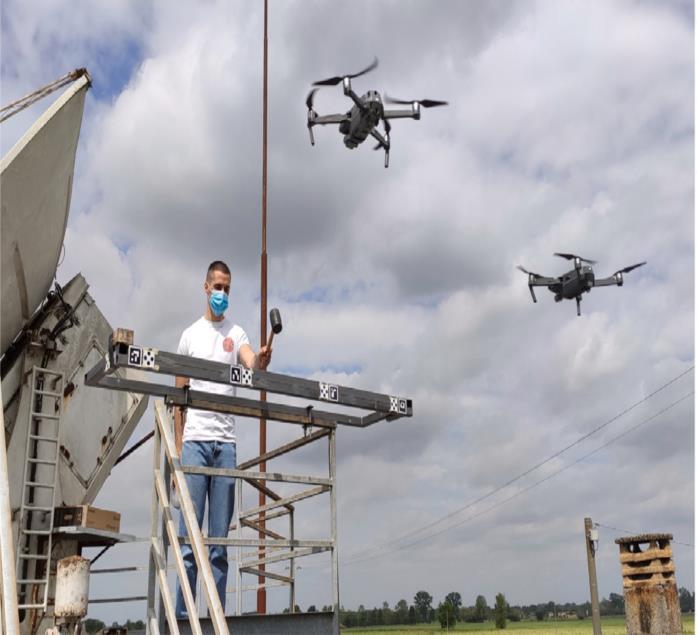
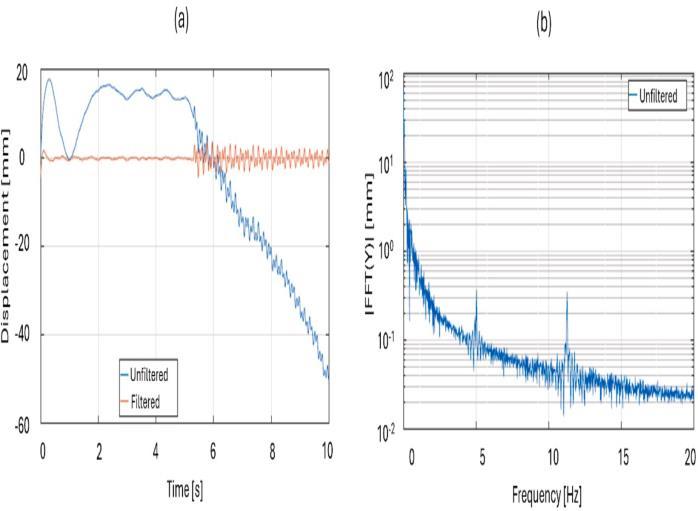
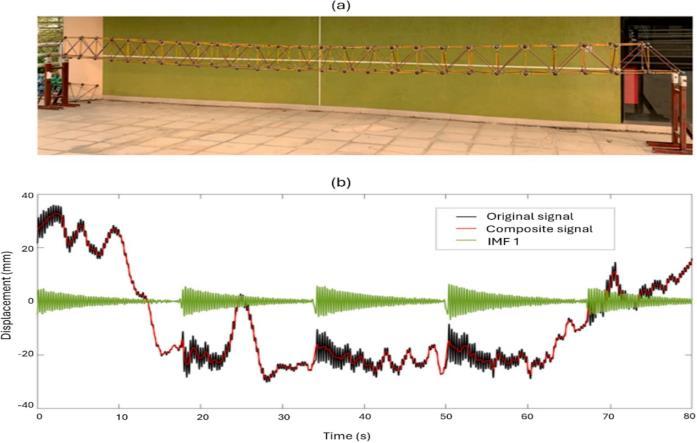
The use of drones for bridge damage detection has significant untapped potential. As hardware and software continuetoimprove,newacademicapproachesarelikelyto become standard inspection practices. Advancements in dronetechnology,suchaslonger-lastingbatteries,willallow formoredetailedinspectionsortheabilitytocoverlarger structures in a single flight. A more accurate positioning systemandbetterinertialmeasurementswillleadtostable flight,enhancingthequalityofvideosandphotostakenby thedrone,especiallywhenpairedwithhigh-qualitycamera lenses.Thisshouldresultinmorereliableinformationfrom visual sensors, whether for detecting surface damage or conductingvision-basedmodalanalysis.
Moreover,increasingautomationwilllikelyleadtodrones acting as aerial manipulators. This would enable the integration of non-destructive testing (NDT) sensors and allowrobotstoreplacehumansindangeroustasks,suchas installing sensors underneath bridges. In terms of information technology, we need to improve artificial intelligence (AI) and computer vision (CV) algorithms to boostcomputationalefficiency;thesehavemultipleusesin imageprocessingandfeatureidentification.Advancements in this area will facilitate the creation of detailed 3D photogrammetric point clouds with surface damage informationdetectedbymachinelearning(ML)algorithms analyzing2Dimages.Additionally,pathplanningalgorithms will be vital for selecting the most effective flight paths within the limits of flight autonomy. Lastly, onboard realtime damage detection algorithms will offer effective solutions for further investigation during inspections. Integrating these technologies with virtual reality environments provides another opportunity to enhance inspections
The application of drones for automated surface damage detection is a promising area that will gain importance as hardware and procedures advance. The benefits of using dronesforinspectionsincludeeasyaccesstohard-to-reach areas, the rapid collection of many images, and improved safetyforoperators.However,limitationsexist,mainlydue to regulatory issues, as drones often cannot fly over restricted zones where they could pose risks, such as highways. Future challenges include improving surface damagedetectionalgorithmstobetteridentifyawiderrange ofdefectswhilereducingcomputationaldemands.
Additionally, weshould focus on vision-based operational modal analysis (OMA). First, attention must turn to egomotioncompensationforvibrationalmonitoringusingvisual data. Beyond the methods already mentioned, future researchshouldlookintohybridapproachesthatcombine various techniques, which have potential for better egomotion compensation. For example, merging inertial and
Volume: 12 Issue: 10 | Oct 2025 www.irjet.net p-ISSN: 2395-0072
visual data known as sensor fusion can leverage the strengthsofbothtypesofdatatoimproveaccuracy.Inertial sensors likeaccelerometers andgyroscopes providehighfrequencymotiondatabutcandriftovertime.Visualdata haslessdriftbutcanbeaffected byenvironmentalfactors like lighting, motion blur, or obstructions. By combining these two data types, we can lessen their weaknesses, leadingtomoreaccuratecameramotionestimation.Sensor fusion techniques could include Kalman filtering, which integratesdatainrealtime,aswellasadvancedmethodslike nonlinearoptimizationandfactorgraphapproaches.These techniques can help estimate pose and compensate for motionaccurately,evenindifficultenvironments.Moreover, visual-inertialodometryhasproveneffectiveinapplications likeautonomousnavigationandrobotics,andadaptingitfor structural monitoring could offer significant advantages. Deeplearningapproachesinvision-basedandinertial-based compensation have also shown promise in motion estimation for fields like autonomous driving and video stabilization. Neural networks can be taught to recognize complexmotionpatternsanddifferentiatebetweencamera movementandstructuralvibrations,whichcouldeliminate the need for explicit motion modeling. For instance, convolutional neural networks (CNNs) could predict egomotionfromsequencesofvisualandinertialdata,providing adaptivecompensationinvaryingconditions.
Second, we must evaluate the applicability of drone technology for medium and long-span bridges. Improving motion compensation procedures might also aid in accuratelyextractingnaturalfrequencieswhendisplacement rangesarelimited.However,factorslikethedrone'sdistance fromthebridge,cameraresolution,trackingmethods,and videodurationneedthoroughdiscussionintheliterature. Anotherissueisextractingmodalshapes,whichmayrequire multiplesimultaneousvideos.Usingswarmsofdronescould be essential for this purpose. In addition to vision-based OMA,exploringcontact-basedOMAmethodsusingdrones remainsapromisingresearcharea.UnliketraditionalOMA approacheswithfixedsensorsthatcontinuouslycollectdata, droneswouldtypicallysamplemodalinformationonlyafew timesayear,allowingthesensorstobereusedforvarious structures. This would lower both economic and environmentalcostsofstructuralhealthmonitoring(SHM) by reducing the use of non-renewable resources and minimizing electronic waste. To address infrequent data sampling,weneedfurtherresearchondamagedetectionand eliminatingenvironmentaleffectswithalimitednumberof observations. A broader topic involves using the damage informationwegathertoassistdecision-makersinplanning maintenancefortheinfrastructurenetwork.Theeconomic aspectsofdrone-basedinspectionsshouldalsobeexamined, weighing inspection costs against benefits based on the valueoftheinformationgatheredbythedrones.
This final section summarizes the key findings from the reviewondrone-basedbridgemonitoring.Ithighlightsthe currentstateofthetechnology,importantareasforfuture development, and its potential to change infrastructure management.
The literature review shows that we have not yet fully unlocked the benefits of drone operations in bridge management.Therearesignificantopportunitiesforfuture progress.
• Visual Inspection Maturity: Drone-assisted visual inspectiontechnologieshavedevelopedsignificantly.They already offer considerable benefits, such as easier image capture,improvedsafetyforoperators,andbetterinspection results. We expect further advancements mainly in information technology, leading to fully automated inspections using Artificial Intelligence (AI) for damage recognition.
• Role of Communication and IoD: Thesuccessofremote drone-basedbridgemonitoringdependsonhavingareliable, high-bandwidth communication network. This network musthandlethetransmissionoflargeamountsofdata,like images and video streams, to distant locations. Important studiesareworkingonimprovingnetworkreliabilitywithin the Internet of Drones (IoD). They are using advanced communication technologies, such as the latest cellular networks, and integrating drone swarms. This involves tackling challenges like inter-drone communication, ensuringreliableair-to-air(A2A)andair-to-ground(A2G) communicationchannels,protectingdataconfidentialityand security,andmanagingthehighmobilityofdronesthatoften changesnetworklayouts.
• Vision-Based Modal Analysis Potential: Drone-assisted visual modal analysis is a promising area for research. It offers a cost-effective and efficient way to gather modal parametersthatassessstructuralconditions.However,we still have questions about how well current drone monitoring technologies interact with the structural behaviors being studied. Additionally, more research is neededtorefineegomotioncompensation.
• Inspection Planning Cruciality: Effective inspection planning is essential for ensuring the cost-effectiveness, efficiency,andqualityofthecollecteddata.
International Research Journal of Engineering and Technology (IRJET) e-ISSN: 2395-0056
Volume: 12 Issue: 10 | Oct 2025 www.irjet.net p-ISSN: 2395-0072
Improvementsinhardwareandcommunicationtechnologies arelikelytobroadentheapplicationsofdrones:
• Hardware Improvements: Better batteries and lighter equipment,alongwithimprovedtransmissionandremotecontrolfunctions,willmakemissionsmoreeffective.
•ManipulatingCapabilities: Addingmanipulatingfeatures to drones will increase the potential for contact-based inspections.
• Centralized Operations: Thesedevelopmentswill pave the way for fully remote, centralized operations. This approachofferssignificantbenefitsincost,accuracy,quality, and the amount of data collected. It marks a major step forward compared to traditional methods that rely on humanworkersorfixedcontactsensors.Thishighlightshow drone technology can transform bridge inspection and management.
• Damage Information Integration: Moreinvestigationis neededonhowtousethedamageinformationgatheredby dronestohelpdecision-makersinplanningmaintenancefor infrastructure networks. This includes evaluating the economicvalueoftheinformationcollected.
[1] Xhesika Hasa 1, Drone Usage in Civil Engineering - A Case Study of the Pristina-Gjilan Highway. 1Assistant Professor,DepartmentofGeodesyEngineering,Kosovo EnergyCorporation,Obiliq,Kosovo.
[2] M. Bhivraj Suthar1, Rajesh Mahadeva2, Saurav Dixit3 , VinayKumar4,K.Arun5,RishabArora6,SunianaAhuja7 , Robotic Drone Arm for civil structures inspection: ChallengesandFutureDirections.1KhalifaUniversityof Science and Technology, Abu Dhabi, 127788, United Arab Emirates, 2Division of Research & Innovation, Uttaranchal University, Dehradun, 248007, India, 3Khalifa University of Science and Technology, Abu Dhabi,127788,UnitedArabEmirates, 4PetertheGreat St.PetersburgPolytechnicUniversity,SaintPertersburg, 195251, Russian Federation, 5Gokaraju Rangaraju Institute of Engineering and Technology, Bachupally, Telangana, 500090, India, 6K R Mangalam University, Gurgaon,122103,India,7LovelyProfessionalUniversity, PhagwaraPanjab,144001,India
[3] M.R. Freeman1, M.M. Kashani2, P.J. Vardanega3, Aerial robotic technologies for civil engineering: established andemergingpractice.1AtkinsGlobal,BristolBS324RZ, UK; Formerly Department of Civil Engineering, University of Bristol, 2Faculty of Engineering and Environment,UniversityofSouthampton,Southampton
SO17 1BJ, UK, 3Department of Civil Engineering, UniversityofBristol,BristolBS81TR,UK.
[4] Mr. Sanket Ravindra Chaudhari1, Mr. Atharva Sanjay Bhavsar2, Mr. Harshwardhan Pradeep Ranjwan3, Mr. PravinSureshYadav4,Mr.S.S.Shaikh5,UtilizingDrone Technology in Civil Engineering. 1,2,3,4,5Assistant Professors Department of Civil Engineering Sinhgad InstituteofTechnologyandScience,Pune,Maharashtra, India.
[5] TahreerMFayyad1,SuTaylorKunFeng2,FelixKinPeng Hui3,Ascientometricanalysisofdrone-basedstructural health monitoring and new technologies. 1Intelligent andSustainableInfrastructureGroup,SchoolofNatural and Built Environment, Queen’s University Belfast, Belfast, UK, 2School of Mechanical and Aerospace Engineering, Queen’s University Belfast, Belfast, UK, 3Engineering Management Group, Department of Infrastructure Engineering, University of Melbourne, Melbourne,VIC,Australia.
[6] SrijeetHalder1,KereshmehAfsari2,RobotsinInspection and Monitoring of Buildings and Infrastructure: A Systematic Review. 1,2Myers-Lawson School of Construction,VirginiaTech,Blacksburg,VA24061,USA.
[7] AlbertoVillarino1,HugoValenzuela2,NatividadAnton3 , Manuel Dominguez4, Ximena Celia Mendez Cubillos5 , UAV Applications for Monitoring and Management of CivilInfrastructures. 1DepartmentofConstructionand Agronomy, Construction Engineering Area, High Polytechnic School of Ávila, University of Salamanca, 05003 Ávila, Spain, 2Escuela de Ingeniería Mecánica, Pontificia Universidad Católica de Valparaíso, Quilpué 2430167,Chile;hugo.valenzuela@pucv.cl,3Department of Construction and Agronomy, Materials Science and MetallurgicalEngineeringArea,HighPolytechnicSchool of Zamora, University of Salamanca, 49002 Zamora, Spain, 4Department of Mechanical Engineering, High PolytechnicSchoolofZamora,UniversityofSalamanca, 49002Zamora,Spain,5OpencaddAdvancedTechnology, Av.Brig.FariaLima,4055-Jardins,SãoPaulo04538-133, Brazil;ximena.cubillos@opencadd.eng.br
[8] Shien Ri1, Jiaxing Ye2, Nobuyuki Toyama3, Norihiko Ogura4, Drone-based displacement measurement of infrastructures utilizing phase information. 1Research Institute for Measurement and Analytical Instrumentation, National Institute of Advanced IndustrialScienceandTechnology(AIST),Central2,1-11Umezono, Tsukuba,Ibaraki305-8568, Japan, 2CORE Institute of Technology Corporation, 3-8-5 Asakusabashi,Taitou-ku,Tokyo111-0053,Japan, 3,4iTi Laboratory, Department of Civil and Earth Resources Engineering, Graduate School of Engineering, Kyoto
International Research Journal of Engineering and Technology (IRJET) e-ISSN: 2395-0056
Volume: 12 Issue: 10 | Oct 2025 www.irjet.net p-ISSN: 2395-0072
University,Goryoohara,Nishikyo-Ku,Kyoto615-8245, Japan.
[9] LanhV.Nguyen1,TrungH.Le2,IgnacioTorresHerrera3 , NgaiM.Kwok4,QuangP.Ha5,Intelligentpathplanning forcivilinfrastructureinspectionwithmulti‑rotoraerial vehicles. 1,2,3,5SchoolofElectricalandDataEngineering, UniversityofTechnologySydney(UTS),15Broadway, Ultimo2007,Australia, 4SchoolofEngineering,Design and Built Environment, Western Sydney University (WSU),Penrith,NSW2751,Australia.
[10] EmreGirgin1,ArdaTahaCandan2,CoskunAnılZaman3 , EdgeAI Drone for Autonomous Construction Site Demonstrator. 1Faculty of Engineering, Aerospace Engineering, Embry-Riddle Aeronautical University, Daytona Beach, Florida 32124, USA (Author was a researcher at TUBITAK BILGEM during the project period.),2,3RoboticsandAutonomousSystemsDivision, TUBITAKBILGEM,Gebze41400,T¨urkiye.
BIOGRAPHIES



Mr. Parth B. Potdar
Student of B. Tech in Civil Engineering at Walchand InstituteofTechnology,Solapur, Maharashtra,India


Mr. Anurag M. Rokade
Student of B. Tech in Civil Engineering at Walchand InstituteofTechnology,Solapur, Maharashtra,India.
Mr. Bipin P. Patil
M.Tech(StructuralEngineering), AssistantProfessor,Department of Civil Engineering, Walchand InstituteofTechnology,Solapur, Maharashtra, India, with more than 13 years of teaching experience.
Mr. Kaushal B. Patil
Student of B. Tech in Civil Engineering at Walchand InstituteofTechnology,Solapur, Maharashtra,India
Mr. Aryan N. Mhetre
Student of B. Tech in Civil Engineering at Walchand InstituteofTechnology,Solapur, Maharashtra,India.