
International Research Journal of Engineering and Technology (IRJET) e-ISSN: 2395-0056
Volume: 13 Issue: 03 | Mar 2026 www.irjet.net p-ISSN: 2395-0072
“COMPARATIVE
STUDY ON THE INFLUENCE OF POLYPROPYLENE AND BRASS COATED MICRO STEEL FIBERS ON FRESH,MECHANICAL, DURABILITY, AND MICROSTRUCTURAL BEHAVIOR OF MINERAL ADMIXTURES-BASED SELF-COMPACTING CONCRETE”
1
Anusha K
, S Bhavanishankar2
1M-Tech Dept of Civil Engineering, UVCE, Bengaluru, Karnataka, India-560056
2Associate Professor, Dept. of Civil Engineering, UVCE Bengaluru, Karnataka, India-560056 *** -
Abstract - Self-Compacting Concrete (SCC) is a high- performance concrete that flows and consolidates under its own weight without the need for external vibration. This study investigates the influence of incorporating of Brass coated micro steel fiber and Polypropylene fiber with supplementary cementitious materials (SCM’S) on fresh, mechanical, and durability properties of SCC and microstructure analysis of SCC. In this study, the mineral admixtures such as silica fume, fly ash and GGBS were incorporated as partial replacement of cement which improves workability, stability, durability, and long- term strength of SCC with fibers. The high-range water-reducing admixtures (superplasticizers) which is known as chemical admixture, also incorporated in the SCC mixes with fibers. A total eight concrete mixes were developed with varying compositions of SCM’s and with optimum dosage of brass coated micro steel and polypropylene fibers with constant water to cement ratio of 0.2%. The first four mixes with PPF of 0.2% using quaternary blends of Ordinary Portland Cement (OPC 53), Silica fume, Fly ash, and GGBS and the other four mixes of same blend composition with 0.5% of brass coated micro steel fiber. The control mix was prepared using 100% Ordinary Portland Cement. In the remaining mixes, 60% of OPC was replaced with mineral admixtures, such as silica fume (SF) of 10% which is fixed for all the eight mixes, but the fly ash (FA) and ground granulated blast furnace(GGBS) were varied at replacement levels of 20%,30% and 25%.In this study, the fresh properties test such as Slump, JRing, V-Funnel and L-box tests were conducted to determine the workability of SCC mixes and also mechanical properties tests such as compressive strength, split tensile strength and flexural strength tests were conducted to determine mechanical properties of SCC mixes. Durability performance was also evaluated using sulphate attack test. The SEM-EDX test was conducted to examine the microstructure, hydration products, fiber–matrix interaction, and elemental composition of SCC at the microscopic level. The comparative study of both fibers concludes that brass-coated micro steel fibers exhibited significant enhancement in split tensile strength and flexural strength, along with marginal improvement in compressive strength as compared to polypropylene fiber.
Key Words: Self-Compacting Concrete (SCC), Polypropylene Fiber (PPF), Brass Coated Micro Steel Fiber (BCMSF), Sulphate Attack, SEM-EDX Test.
1. INTRODUCTION
Self-CompactingConcrete(SCC)isanadvancedformofconcretecharacterized by its ability to flow under its own weight, completely fill formwork, and pass through congested reinforcement without the need for mechanical vibration. This unique property makes SCC a highly efficient and reliable construction material, particularly in complex and heavily reinforcedstructuralapplications.
ThewidespreadadoptionofSCCintheconstructionindustryhasbeensupported by advancementsin chemical admixtures andmixdesigntechniques,allowingSCCtoachievehighstrengthanddurabilitywhilemaintainingworkability.Theuseof supplementary cementitious materials such as fly ash,silica fume, and slag further enhances performance and promotes sustainable construction by reducing cement consumption and carbon emissions. Fiber incorporation in SCC improves crack controlacrossdifferentstagesofconcretebehaviour.Fibersactasmicro-reinforcementsthat bridgecracks,restrict their initiation, and delay crack propagation. Durability is one of the most important performance requirements of SelfCompacting Concrete (SCC), especially when it is exposed to aggressive environmental conditions. SEM-EDX which is carriedouttovisualize,analyze,andquantifythemicrostructural andelemental changesinSCC.Therefore,thisresearch focuses on evaluating the mechanical, durability and microstructure behavior of SCC containing mineral admixtures and fibers.
International Research Journal of Engineering and Technology (IRJET) e-ISSN: 2395-0056
Volume: 13 Issue: 03 | Mar 2026 www.irjet.net p-ISSN: 2395-0072
2. OBJECTIVES
1. TodesignanddevelopSelf-CompactingConcrete(SCC)mixesincorporatingmicrosteelfibers(MSF)and polypropylenefibers(PPF)atintroduceddosageswhile satisfyingfreshpropertyrequirementsaccordancewith EFNARCoraccordingtoOkamuramixdesign.
2. To evaluate the effect of MSF and PPF on the mechanical properties of SCC, such as compressive strength, split tensilestrengthandflexuralstrengthtest.
3. TostudytheresistanceofSCCcontainingtwotypesoffiberstomagnesiumsulphateattack.
4. To analyse and study about the elemental composition and fiber matrix interaction of SCC containing polypropyleneandmicrosteelfibersbyperformingSEM-EDXtest.
5. To compare the overall performance of polypropylene and micro-steel fibers in SCC in terms of strength and durabilityproperties.
3. MATERIALS AND MATERIAL PROPERTIES
Cement: Cement is a fundamental component of concrete, acting as the primary binder that imparts strength and durabilitybybondingtheconstituentmaterials.Inthepresentstudy,OrdinaryPortlandCement(OPC)of53grade(Dalmia), conformingtoIS:12269:2013wasemployed.Thephysicalandchemical properties ofthe cementplaya significantrolein governingthemechanicalperformanceanddurabilityofconcrete.
Fine Aggregate: Fineaggregateconsistsofsmallparticlesthatfillthevoidsbetweencoarseaggregatesandplayanimportant roleinimprovingtheworkabilityandstrengthofconcrete.Inthepresentstudy,manufacturedsand(M-sand)wasusedas the fine aggregate. M-sand is produced by mechanically crushing hard rocks under controlled conditions, followed by washing and grading to obtain a uniform and well-defined particle size distribution. The M-sand used in this study falls under Grading Zone II, which is considered suitable for producing a stable and well-proportioned Self-Compacting Concrete(SCC)mix.
Coarse aggregate: Coarseaggregateplaysanimportantroleinproviding strength, stability, and dimensional resistance to concrete.Inself-compactingconcrete,wherehighflowabilitywithouttheneedforvibrationisessential,properselectionof coarse aggregates becomes particularly important. In this study, crushed granite aggregates of 20 mm and 12.5 mm (down)sizeswereused.TheaggregateswerelocallysourcedandconformtothespecificationsofIS:383–2016.
Water: Water is an essential component of concrete, as it initiates cement hydration and governs workability and uniformityofthemix.Inself-compactingconcrete,thequalityofwatersignificantlyinfluencesthestrength,durability,and longtermperformanceofconcrete;therefore,potablewaterfreefromharmfulimpuritieswasusedinthisstudy.
Admixtures: Admixtures are materials added to concrete in addition to cement, water, and aggregates to modify and enhance its properties. They play an important role in improving workability, strength, durability, settingcharacteristics, and resistance to environmental effects, thereby increasing the versatility of concrete for various construction applications. Admixtures are generally classified into two categories: mineral admixtures and chemical admixtures.
Mineral Admixtures: Mineral admixtures are finely divided inorganic materials incorporated into concrete either as partial replacements for cement or as supplementary components. In the presence of water, these materials react with calciumhydroxidereleasedduringcementhydrationtoformadditionalcementitiouscompounds.Althoughtheydonotact as primary binding agents, their pozzolanic or hydraulic activity enhances the strength, durability, and resistance of concretetochemicalattack.
Silica Fume: Silicafume,alsoreferredtoasmicrosilicaorcondensed silicafume,isahighlyreactivepozzolanicmaterial widelyusedasamineraladmixtureinconcrete.Itisabyproductgeneratedduringthemanufactureofsiliconorferrosilicon alloys in electric arc furnaces. During this process, silica is released as oxidized vapor, which subsequently cools, condenses,andiscollectedusingfiltrationsystemsbeforebeingprocessedtocontrolimpuritiesandparticlesize.Silicafume consistspredominantlyofamorphoussilicondioxide(SiO₂)andischaracterizedbyanextremelyfineparticlesize,typically lessthan1µm,makingitsignificantlyfinerthancement.Owingtoitshighsurfaceareaandstrongpozzolanicactivity,silica fume refines the pore structure of concrete, resulting in improved microstructural density and enhanced performance characteristics.
Fly ash: Flyashisafine,powderyby-productobtainedfromthecombustionofpulverizedcoalinthermalpowerplants.Itis captured from flue gases using electrostatic precipitators or other dust collection systems before release into the
International Research Journal of Engineering and Technology (IRJET) e-ISSN: 2395-0056
Volume: 13 Issue: 03 | Mar 2026 www.irjet.net p-ISSN: 2395-0072
atmosphere.Richinsilicaandalumina,flyashisawidelyusedpozzolanicmaterialinconcrete.Itsspherical,fineparticles improveworkability,packingdensity,andcohesion,enhancingtheflowabilityofself-compactingconcrete(SCC).Through pozzolanicreactionswithcalciumhydroxidegeneratedduringcementhydration,flyashformsadditionalcalciumsilicate hydrate(C–S–H),whichstrengthenstheconcreteandreducespermeabilityovertime.
Ground Granulated Blast-Furnace Slag (GGBS): Ground Granulated Blast-Furnace Slag (GGBS) is a supplementary cementitious material obtained as a by-product of iron production. During the manufacturing process, molten slag is rapidlycooled,dried,andfinelygroundinto a powder. Its chemicalcomposition, richinsilica,alumina,lime,andmagnesia, promotes latent hydraulic reactions that produce calcium silicatehydrate(C–S–H),enhancingbothstrengthanddurability. When incorporated into self-compacting concrete (SCC), GGBS improves workability,lowers permeability,andreduces the heatofhydration.
Chemical admixtures:
Superplasticizer: Superplasticizers, also referred to as high range water-reducing admixtures, are an advanced class of plasticizing agents used in concrete technology. Theseadmixturesaretypicallyorganiccompounds,commonlybased on polycarboxylate ether, which enable a substantial reduction in water content while maintaining the desired level of workability, or alternatively, enhance workability at a constant water–cement ratio. Suitable for the production of selfcompacting concrete (SCC), which has high flowability, adequate cohesion, and resistance to segregation. In this project, commerciallyavailablesuperplasticizerPC-300,manufacturedbyAaradhyaChemicals,isused.
Polypropylene fiber: Polypropylenefibersaresyntheticfibers manufactured from thermoplastic polymers and are widely usedassecondaryreinforcementinself-compactingconcrete(SCC).Owingtotheirhightensilestrength,chemicalinertness, andlowdensity,thesefiberscontributetoimproved performanceofconcreteinboththefreshandhardenedstates.When incorporatedintoself-compactingconcrete(SCC),polypropylenefibersReductioninplasticshrinkagecracking,Decreasein drying shrinkage, Improved durability, particularly in aggressive environments In this study, RECRON-3S polypropylene fibers are used. These fibers have a nominal lengthof12mmanddiameterrangingfrom0.025to0.04mm, contributing effectivelytothecrack-bridgingmechanismandmatrixintegrity.
Micro Steel Fiber: Micro steel fibers are short, discrete steel filaments added to concrete to enhance its mechanical performance, crack control, and durability. They are widely used in Self-Compacting Concrete (SCC), high-performance concrete, and fiber-reinforced concrete applications. Micro steel fibers typicallyhavea small diameter(0.1–0.3 mm) and short length (6–20 mm), which allows them to be easily dispersed even in highly flowable SCC mixes when proper mix designandchemicaladmixturesareused.Inthisstudy,thebrasscoatedmicrosteel fiberoflength12mm(straight)and diameterof0.2mmwithspecificgravityof7850kg/m3 wasused.Brass-coatedmicrosteelfibersaresteelfiberscoatedwith athinlayerofcopper–zincalloy(brass)toimproveinterfacial bonding, corrosion resistance, and durability performance whenembeddedincementitiousmatricessuchasSCC.
4. MIX DESIGN APPROACH
The mix design was developed following established principles to produce a stable self-compacting concrete (SCC) with sufficientflowabilityandstrength.Thekeyconsiderationsinthemixdesignprocessincluded:
Coarse aggregate content: Particles larger than 4.75 mm up to themaximum nominal sizewere maintained at 50–60%ofthetotalsolidvolume,roughly700–900kgpercubicmeterofconcrete.
Fineaggregatecontent:Particlesbetween0.125mmand4.75mmwerefixedat40–50%ofthetotalmortarvolume.
Water-to-powderratio:Thiswasassumedtorangebetween0.9and1.0byvolume,dependingonthe propertiesof thepowdermaterials,includingcementandfillerswithparticlesizessmallerthan0.125mm.
Superplasticizer dosage and final water-to-powder ratio: These were optimized through a series of trial mixes to achievethedesiredself-compactability,asassessedusingU-flow,slump-flow,andV-funneltests.
MIX VARIATIONS
AtotalofeightdistinctSCCmixturesweredesigned,dividedintotwogroups:
Fiber-ReinforcedSCCMixes(With0.2%PPF):Fourmixesincorporate0.2%polypropylenefibers(PPF)byweightof
International Research Journal of Engineering and Technology (IRJET) e-ISSN: 2395-0056
Fiber-ReinforcedSCCMixes(With0.5%Brass-CoatedMicroSteelFibers):Theremainingfourmixesinclude0.5%brasscoatedmicrosteelfibers(BCMSF)byvolumeofconcretetoenhancestrength,toughness,anddurabilityoftheconcrete.
Table -1: TypicalRangeofSCCMixComposition[asperEFNARC2005]
Constituent
Typical range by mass (kg/m³)
Powder 380-600
Paste
Typical range by volume (liters/m³)
300-380
Water 150-210 150-210
Coarseaggregate 750-1000 270-360
Fineaggregate (sand)
Typically,48–55%oftotalaggregate weight Water/Powder ratio ByVolume
5. MAGNESIUM SULPHATE ATTACK TEST
The Magnesium Sulfate (MgSO₄) test is a durability evaluation method used to determine the resistance of SelfCompacting Concrete (SCC) against sulphate attack under aggressive environmentalconditions.Itrepresentstheabilityof concretetowithstandchemicaldeteriorationcausedbythepenetrationandreaction of sulphate ions (SO₄²⁻) with cement hydrationproducts,whichcanleadtoexpansion,cracking,massloss,andreductioninstrength.Amongvariousdurability threats, sulphate attack is considered a major cause of deterioration in concrete structures. In SCC, the incorporation of supplementary cementitious materials (SCMs) such as fly ash, Ground Granulated Blast Furnace Slag (GGBS), and silica fume plays a significant role in improving sulphate resistance. These materials refine the pore structure, reduce permeability, and decrease calcium hydroxide content through pozzolanicreactions, thereby enhancing durability. Furthermore, the addition of fibers such as brass coated micro steel fibers (BCMSF) and polypropylene fibers (PPF) improvescrackresistanceandstructuralintegrity.
Methodology for Sulphate Attack Test:
ThemagnesiumsulphateattacktestwasconductedtoevaluatethedurabilityperformanceofSelf-CompactingConcrete(SCC) specimensundersulphateexposure.Thestudyaimedtoassessmassvariation,visualdeterioration,andcompressivestrength retentionafterexposuretoa5%magnesiumsulphatesolution.TheprocedurewasconductedinaccordancewithASTMC267. Inthepresentinvestigation,concretespecimenswereexposedtoacontrolledacidicenvironmentafter28daysofstandard watercuringtosimulateaggressiveserviceconditions.This exposurewasintendedtoassesstheresistanceoftheconcrete tochemical deteriorationandto evaluateits durability performanceintermsofmassvariation,surfacedegradation,and strengthretention.
A 5% sodium sulphate (MgSO₄) solution was prepared to simulate a sulphate-rich aggressive environment. The cured specimens were completely immersed in the sulphate solution and maintained under continuous exposure for a predetermined period. The concentration of the sulphate solution was kept constant throughout the test duration to ensureuniformchemicalexposure.Duringtheexposureperiod,thespecimenswereperiodicallyobservedforvisiblesignsof deteriorationsuchassurfacecracking,scaling,ordiscoloration.Attheendoftheexposureperiod,thespecimenswereremoved fromthesolution,cleaned, and weighed to determinemass variation.Compressivestrengthtestswerethenconducted toevaluatethereductioninstrengthcausedbysulphateattack.
Volume: 13 Issue: 03 | Mar 2026 www.irjet.net p-ISSN: 2395-0072 © 2026, IRJET | Impact Factor value: 8.315 | ISO 9001:2008 Certified Journal | Page693 bindertoimprovedurability,crackresistance,andoverallperformance.
International Research Journal of Engineering and Technology (IRJET) e-ISSN: 2395-0056
Volume: 13 Issue: 03 | Mar 2026 www.irjet.net p-ISSN: 2395-0072
6. SEM-EDX TEST
Scanning Electron Microscopy (SEM) is a high-resolution imaging technique that uses a focused beam of electrons to examine the surface morphology and microstructural features of materials at magnifications far beyond the capability of opticalmicroscopes.SEMprovidesdetailedinformationaboutmicrocracks,porosity,hydrationproducts,andfiber-matrix interactionsinconcrete.EnergyDispersiveX-raySpectroscopy(EDXorEDS)isoftencoupledwithSEMtoprovidequalitative andsemi-quantitativeelementalanalysisofthespecimen.BydetectingcharacteristicX-raysemittedfromthematerial,EDX identifies the presence and relative abundance of elements such ascalcium,silicon,aluminium,sulphur,andmagnesium, whicharecriticalinunderstandingchemicalreactions,includingsulfateattack,incementitioussystems.
SEM-EDX which is carried out to visualize, analyze, and quantify the microstructural and elemental changes in SCC, thereby providing a comprehensive understanding of how fibers, hydration products, and chemical exposure affect the performanceanddurabilityofconcrete.
7. RESULTS AND DISCUSSIONS
7.1.
Fresh Properties of Self-Compacting Concrete:
FreshpropertiesofSelf-CompactingConcrete(SCC)refertothecharacteristicsofSCCinitsplasticorunhardenedstatethat enable it to flow under its own weight, completely fill formwork, pass through congested reinforcement, and remain homogeneous without segregation or bleeding, all without the application of external vibration. These properties are mainlyexpressed interms offillingability,passingability,andsegregationresistance, whichcollectivelyensuretheselfcompactingbehaviourandworkabilityofSCCduringmixing,transportation,placement,andfinishing.
The fresh properties of SCC are significantly influenced by mix design parameters such as powder content, water-topowder ratio, type and dosage of superplasticizers, viscosity-modifying admixtures, and the shape, size, and grading of aggregates. The inclusion of fibers, such as micro steel fibers or polypropylene fibers, further affects the rheological behaviourofSCC.ThefreshpropertytestresultsforMix-1toMix-4containingpolypropylenefibers(PPF)andMix-1toMix4containingbrasscoatedmicrosteelfibers(BCMSF)inQuaternaryBlended Self- Compacting Concrete (QBSCC) showed clear differences in workability. The tests conducted wereslumpflow diameter,T₅₀₀ flow time, V-funnel flow time, L-box blockingratio,and J-ringslumpflowand J-ringheightdifferences. Thesetestshelpto checkfillingability,passingability, andresistancetosegregationofSCC.
International Research Journal of Engineering and Technology (IRJET) e-ISSN: 2395-0056
Volume: 13 Issue: 03 | Mar 2026 www.irjet.net p-ISSN: 2395-0072
Slump Flow and T500 flow time: The slump flow and T₅₀₀ results indicate that polypropylene fiber (PPF) mixes consistently showed better workability than brass-coated micro steel fiber (BCMSF) mixes. In MIX-1 (100% OPC), PPF achievedhigherslumpflow andlower T₅₀₀ time,indicating betterflowability.MIX-2recordedthelowest workabilityfor bothfibersduetohighGGBScontentincreasingviscosityandinternal friction.InMIX-3,increasedflyashimprovedflow, particularlyforPPF.MIX-4exhibitedthebestoverallperformance,withthehighestslumpflowandlowestT₅₀₀time,dueto balanced fly ash and GGBS content enhancing paste volume and lubrication. Overall, PPF provided superior fresh propertiescomparedtoBCMSF.
J-Ring Test: The J-ring results indicate that all SCC mixes achieved satisfactory passing ability under simulated reinforcement conditions. MIX-1 showed good flow with a small height difference, while the BCMSF variant exhibited slightlyhigherblockingduetoincreasedinternalfrictionfromsteel fibers. MIX-2 recorded reduced J-ring flow because of higherpowdercontentandviscosityfrommineraladmixtures,withBCMSFshowingslightlygreaterblockingtendency.MIX-3 demonstrated improved performance due to higher fly ash content enhancing lubrication and paste quality. MIX-4 exhibited the best overall J-ring performance, asbalanced flyashand GGBScontent improvedflowability and minimized fiber-inducedblocking.AllmixessatisfiedSCCpermissiblelimits.
V-Funnel Test : TheV-funneltestwasconductedtoevaluatetheflowabilityandviscosityofself-compactingconcretemixes containingpolypropylenefibers(PPF)andbrasscoatedmicrosteel fibers(BCMSF). The measuredflowtime indicatesthe abilityofconcretetoflowunderitsownweightandreflectsthecohesivenessandinternal resistanceofthemix.PPFmixes generallyshowedlowerflowtimescomparedtoBCMSF mixes, indicating relatively better flowability. In contrast, BCMSF mixes exhibitedslightlyhigherflowtimesduetothestiffnessandhigherinternal friction ofsteel fibers, whichincreased viscosity.However,allmixessatisfiedtherecommendedlimitsofEFNARC,confirmingthatbothPPFandBCMSFreinforced concretesmeettherequirementsforself-compactingconcrete.
L-Box Test: TheL-boxresultsshowthatPPFmixesconsistentlyachievedhigherpassingabilitythanBCMSFmixes.InMIX-1, PPF(0.89)performedbetterthanBCMSF(0.84)duetolowerinternalresistance.MIX-2recordedthelowestratios(0.84for PPF and 0.82 for BCMSF) because higher GGBS content increased viscosity and blocking tendency. MIX-3 demonstrated improved performance with higher fly ash content enhancing lubrication. MIX-4 showed the best results, with PPF achieving the highest ratio (0.94) and BCMSF 0.85. Overall, all mixes exceeded 0.8, indicating acceptable SCC passing abilitydespiteslightlyreducedflowinBCMSFmixes.
7.2. Mechanical Properties of Self-Compacting Concrete Compressive Strength Test:
The compressive strength of SCC mixes incorporating polypropylene fibers (PPF) and brass coated micro steel fibers (BCMSF)wasevaluatedat7,28,and56daystostudybothearly-ageandlong-termstrengthdevelopment.Theresultsshow thatthetypeoffiberandthecompositionofthebinder(OPC,flyash,silicafume,andGGBS)hadasignificantinfluenceonthe overall strength performance of the concrete. BCMSF mixes showed higher compressive strength than PPF mixes at all ages due to better bonding and crack resistance. MIX-2 had lower early strength because high GGBS slowed hydration. MIX-4achievedthehigheststrengthduetobalancedflyashandGGBS.Overall,BCMSFimprovedstrengthmoreeffectively thanPPF.
International Research Journal of Engineering and Technology (IRJET) e-ISSN: 2395-0056
Volume: 13 Issue: 03 | Mar 2026 www.irjet.net p-ISSN: 2395-0072
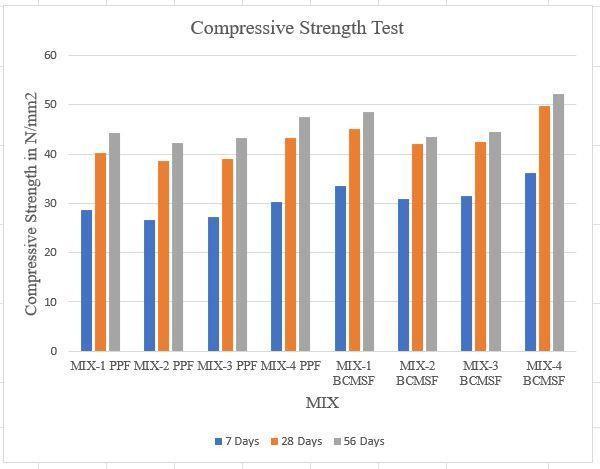
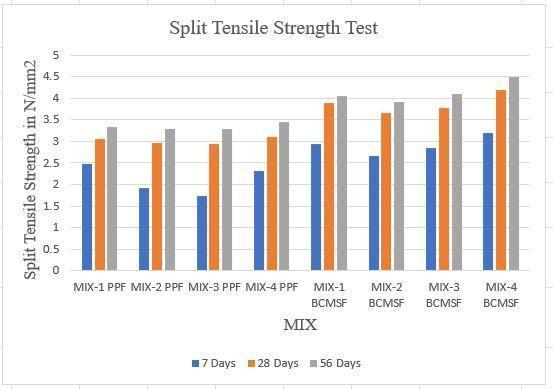
Split Tensile Strength Test: The split tensile strength results indicate that BCMSF mixes consistently performed better thanPPFmixesat7,28,and56daysduetohigherstiffness,strongerbonding,andsuperiorcrack-bridgingcapacityofsteel fibers.MIX-2andMIX-3showedslightlylowerearlystrengthbecausehigherGGBSandflyashcontentsdelayedhydration. However, strength improved at later ages due to pozzolanic reactions and improved microstructure. MIX-4 achieved the highest tensile strength for both fibers, owing to balanced fly ash and GGBS proportions enhancing matrix density and bonding.Overall,BCMSFsignificantlyimprovedtensileresistanceandcrackcontrolcomparedtoPPFmixes.
Flexural Strength Test: The flexural strength test was conducted at 7, 28, and 56 days to evaluate the post-cracking behaviourandload-carryingcapacityofSCCmixesreinforcedwithpolypropylenefibers(PPF)andbrasscoatedmicrosteel fibers(BCMSF).Flexuralperformanceisstronglyinfluencedbyfiber stiffness, the quality of fiber–matrix bonding, and the crack-bridgingefficiencyofthefiberswithintheconcretematrix.
The flexural strength results show that BCMSF mixes consistently achievedhighervaluesthanPPFmixesatallcuringages due to superior stiffness and crack-bridging ability of steel fibers. MIX-2 and MIX-3 showed moderate performance, with slight variations influenced by GGBS and fly ash content affecting early hydration and matrix stiffness. MIX-4 demonstratedthebestoverall flexural performancefor bothfibers,owingtobalancedflyashandGGBSproportionsthat improved matrix density and bonding. BCMSF significantly enhanced bending resistanceandpost-crackingloadcapacity comparedtoPPF.Overall,steelfibersprovidedbetterflexuralstrengthandcrackcontrolthanpolypropylenefibers.
International Research Journal of Engineering and Technology (IRJET) e-ISSN: 2395-0056
Volume: 13 Issue: 03 | Mar 2026 www.irjet.net p-ISSN: 2395-0072
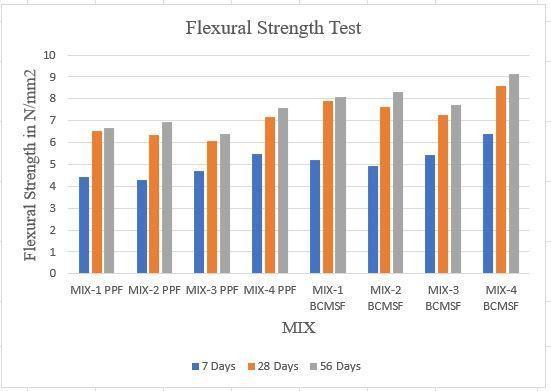
Chart-3: Flexural Strength
7.3.
Durability Test
Sulphate Attack Test: The sulphate attack test using magnesium sulphate (MgSO₄) solution was conducted to evaluate the durability performance of SCC mixes reinforced with polypropylene fibers (PPF) and brass coated micro steel fibers (BCMSF). The residual compressive strength after 56 days of MgSO₄ exposure was taken as the indicator of sulphate resistance.Higherretainedcompressivestrengthindicatesbetterresistancetosulphateattackandreduceddeteriorationof theconcretematrixunderaggressiveenvironmentalconditions After56daysofMgSO₄exposure,BCMSFmixesconsistently retained higher compressive strength than PPF mixes, indicating superior sulphate resistance.. Among all mixes, MIX-4 demonstratedthebestperformancebecauseofitsbalancedbindercomposition,producingadensemicrostructure.BCMSF furtherenhancedretainedstrengthbyresistingcrackwideningunderexpansivereactions.Overall,BCMSFprovidedbetter durabilityandstructuralintegrityundersulphateattackcomparedtoPPFmixes.
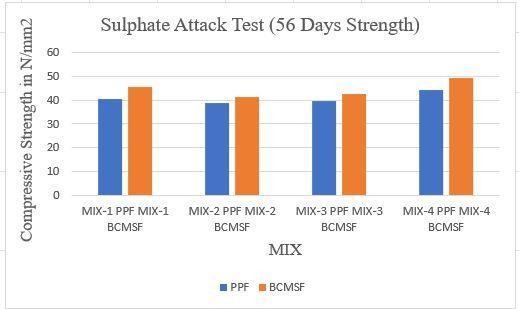
Chart-4: Sulphate Attack Test
Theresultsindicatethatallmixesexperiencedstrengthlossafter56daysofMgSO₄exposureduetosulphateattack,which causes expansion, microcracking, and deterioration of the cementmatrix.However,BCMSFmixesshowedlowerstrength loss (3.8–6.39%) compared to PPF mixes (7.14–8.57%), demonstrating better sulphate resistance. Sulphate ions react with calcium hydroxide and aluminates to form expansive products such as gypsum and ettringite, leading to internal stressandcracking.PPFhelpscontrolmicrocracksbuthaslowerstiffnessandbondingcapacity.Incontrast,BCMSFprovides strongercrack-bridging,betterstressdistribution,andreducedpermeability,limitingsulphateingress.
Amongallmixes,MIX-4showedtheleaststrengthlossoverall,indicatingthatbalancedflyashandGGBSimprovedmatrix densificationanddurability.Overall,BCMSFenhancedresistancetosulphateattackmoreeffectivelythanPPF.
International Research Journal of Engineering and Technology (IRJET) e-ISSN: 2395-0056
Volume: 13 Issue: 03 | Mar 2026 www.irjet.net p-ISSN: 2395-0072
A comparison of the two sulphate solutions clearly shows that magnesium sulphate (MgSO₄) caused greater strength reductionthansodiumsulphate(Na₂SO₄)inmostmixes,especiallyinMix-1PPFandMix-3PPF.ThisisbecauseMgSO₄is more aggressive in nature. In addition to forming gypsum andettringite,magnesiumsulphatereactswithcalciumsilicate hydrate (C–S–H) gel and converts it into non-cementitious magnesiumsilicatehydrate(M–S–H).This process weakensthe bindingstructureofconcreteandreducesoverallstrength.
7.4 SEM-EDX ANALYSIS
Microstructural and elemental analyses are important for understanding the internal structure and performance of PPFbasedSCC mixes. ScanningElectronMicroscopy(SEM) helps in examining pore structure, fiber distribution, fiber–matrix bonding,andthepresenceofmicrocracks.EnergyDispersiveX-rayAnalysis(EDX/EDAX)providesinformationaboutthe elemental composition and hydration products, such as calcium, silica, and alumina, which influence strength and durability.
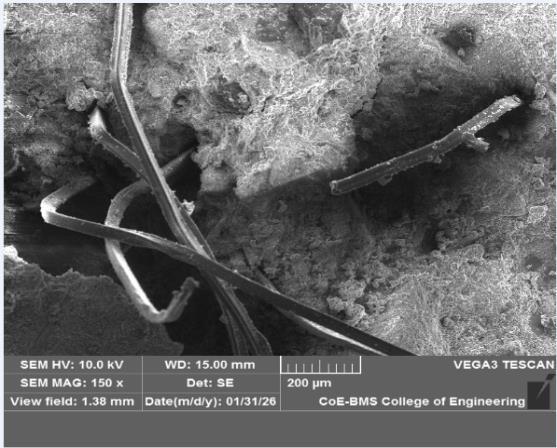
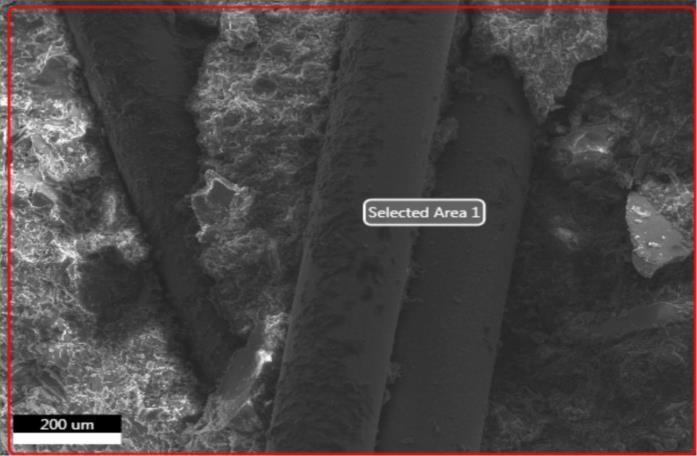
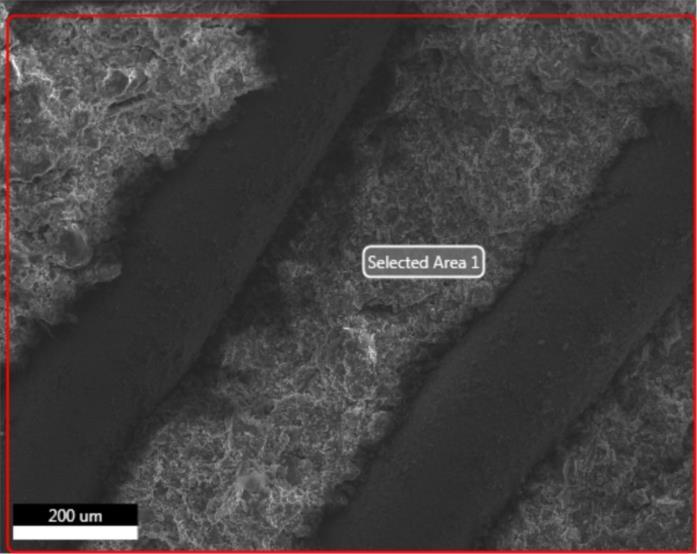
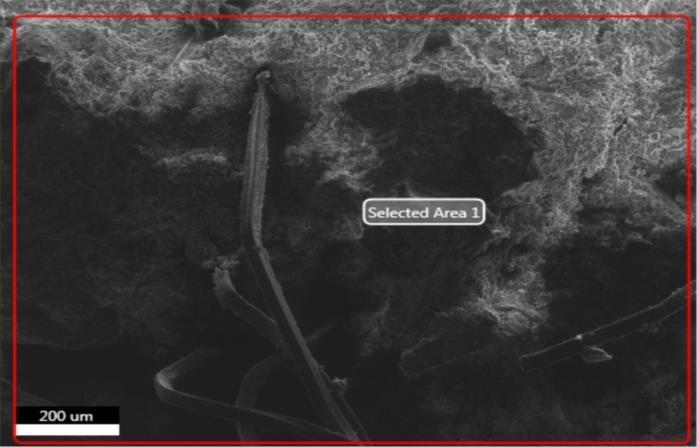
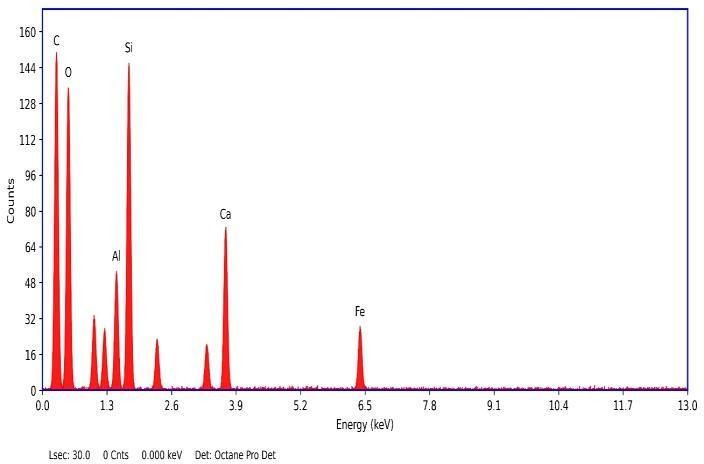
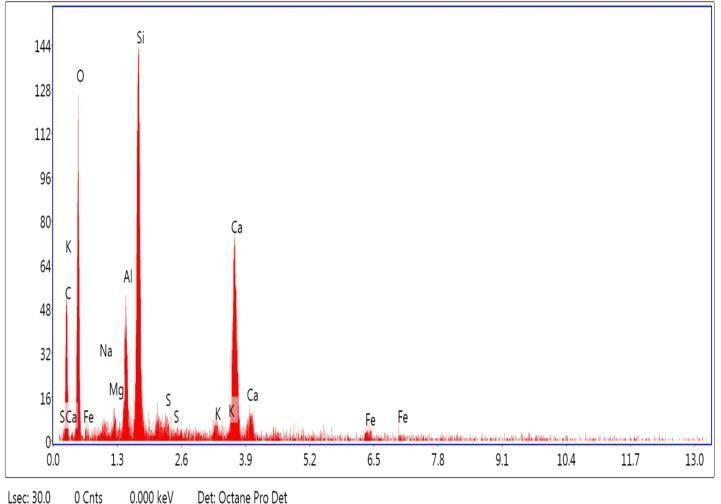
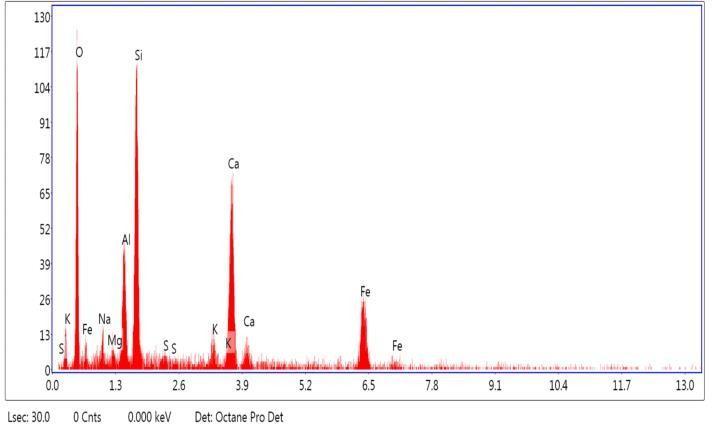
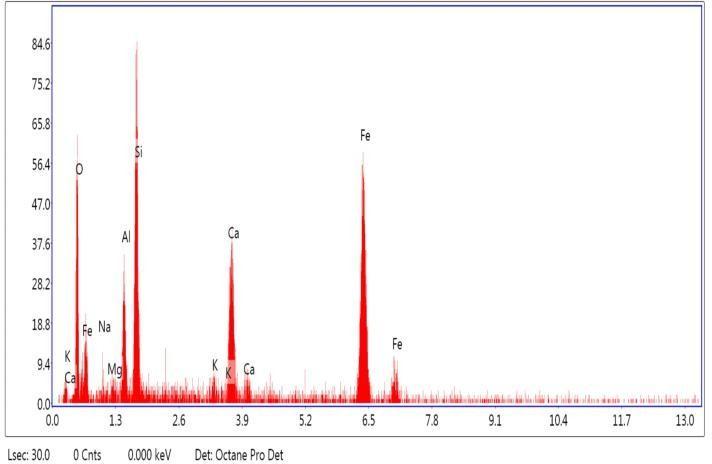
TheSEManalysisofMIX-1with0.2%PPFshowsarelativelydense cementitious matrix with uniformly dispersed fibers. Fiber pull-out rather than breakage is observed, indicatingenergyabsorptionandimprovedtoughness.Minorporesare visible,butnomajorcracksaredetected.EDXconfirmshighcarboncontentduetopolypropylenefibers,alongwithSiand CapeaksindicatingproperC–S–Hformationandhydration.Incontrast,MIX-1with0.5%BCMSFexhibitsstrongerfiber anchorageandimprovedmechanicalinterlocking.SEMimagesshowwell-embeddedmetallicfiberswithminimalinterfacial gaps. EDX results reveal higher Fe₂O₃ content along withsignificantSiO₂andCaO,confirmingthepresenceofhydration products and metallic phases.Overall, while PPF improvesductilitythroughfiberpull-outmechanisms,BCMSFprovides superiorbonding,crack-bridgingefficiency,andloadtransfercapacity, resulting in comparatively better microstructural stabilityandmechanicalperformance.
The SEM–EDX comparison of MIX-4 with PPF and BCMSF shows clear differences in microstructure and bonding characteristics.InthePPF-basedmix,theSEMimagerevealsamoderatelydensematrixwithvisiblepores,microvoids,and smallinterfacialgapsaroundfibers,indicatingonlymoderatefiber–matrixbonding.Limitedporerefinementisobserveddue totheabsenceofsupplementarycementitiousmaterials.EDXresultsshowhighercalciumcontentandahigherCa/Siratio, suggestingdominantOPChydrationwithsignificantcalciumhydroxidepresenceandpartialcarbonation.BCMSFperforms betterdueto higherstiffness, stronger bonding, and superior crack-bridging capacity, while PPF has lower stiffness and weakerbonding,resultinginreducedstresstransfer.
International Research Journal of Engineering and Technology (IRJET) e-ISSN: 2395-0056
Volume: 13 Issue: 03 | Mar 2026 www.irjet.net p-ISSN: 2395-0072
International Research Journal of Engineering and Technology (IRJET) e-ISSN: 2395-0056
Volume: 13 Issue: 03 | Mar 2026 www.irjet.net p-ISSN: 2395-0072
International Research Journal of Engineering and Technology (IRJET) e-ISSN: 2395-0056
Volume: 13 Issue: 03 | Mar 2026 www.irjet.net p-ISSN: 2395-0072
CONCLUSIONS
Thisstudyinvestigatedtheperformanceofself-compactingconcrete(SCC)incorporatingmineraladmixturesand acomparativestudyofpolypropylenefiber(PF)andbrasscoatedmicrosteelfiber(BCMSF).
The incorporation of fibers significantly influenced the performance of self-compacting concrete (SCC). PPF mixes exhibited better flowability and workability due to their low density and smooth surface, whereas BCMSF mixes slightly reduced workability but still satisfied EFNARC requirements for SCC. In terms of mechanical properties, BCMSF-reinforcedSCCshowedhighercompressive,split tensile, and flexural strengths becauseofstrongerfiber–matrixbondingandeffectivecrack-bridgingaction.
DurabilityresultsunderMgSO₄exposureindicatedthatBCMSFmixesexperiencedlowerstrengthlossandreduced permeability compared to PPF mixes, demonstrating better sulphate resistance. PPF mainly contributed to microcrack control, shrinkage resistance, and improved matrix uniformity, while BCMSF provided greater structuralreinforcement.
Additionally, the comparison shows that MgSO₄ is more aggressive than Na₂SO₄ because it damages both the cementmatrixandC–S–Hgel,causinggreaterstrengthloss.MixeswithhighOPCwere morevulnerable,while fly ashandGGBSblendsimprovedsulphateresistancebyreducingpermeabilityandcalciumhydroxidecontent.
SEM-EDXanalysisfurtherconfirmedthatBCMSFmixesdevelopedadenserandmorecompactmicrostructurewith fewerporesandmicrocrackscomparedtoPPFmixes,leadingtoimprovedoverallstrength.
Amongallmixes,Mix-4with0.5%Brasscoatedmicrosteelfiberachievedthebestoverallbalanceofworkability, strength,resistancetosulphateattack,andbettermicrostructuralstability.
REFERENCES
[1] Okamura, H., & Ouchi, M. “Self-Compacting Concrete”.Journal of Advanced Concrete Technology, 1(1), 5– 15. https://doi.org/10.3151/jact.1.5 (2003)
[2] Shah, S. M. I., Ganesh, G. M., & Santhi, A. S. (Year). “Behaviour of Self-Compacting Concrete Using Micro Steel Fiber”. JournalName,Volume(Issue),Pa. https://doi.org/xxxxx (2015)
[3] Das, K., Goswami, B., Chattaraj, S., & Mukherjee, B. “A Study on the Effect of Mineral Admixtures on Self-Compacting Concrete”.InternationalResearchJournalofEngineeringandTechnology(IRJET),4(4),Apr-2017
[4] A. Alalwany, N. Mohamad, A. A. A. Samad, and W. I.Goh,“Mechanical and Fresh State Properties of Medium Strength Self-CompactingConcrete(SCC)ContainingPolypropyleneFibres,”MATECWebofConferences,vol.103,Art. no. 01011,pp.1–8,2017.DOI:https://doi.org/10.1051/matecconf/201710301011
[5] E. Oztekin, C. Kina, and K. Turk,“Effect of Micro Fiber Content on Workability of Self-Compacting Concrete,” Proceedingsofthe13thInternationalCongressonAdvancesinCivilEngineering(ACE2018),İzmir,Turkey,2018.
International Research Journal of Engineering and Technology (IRJET) e-ISSN: 2395-0056
Volume: 13 Issue: 03 | Mar 2026 www.irjet.net p-ISSN: 2395-0072
[6] AMohan,K.M.Mini“StrengthanddurabilitystudiesofSCCincorporatingsilicafumeandultrafineGGBS,”Construction andBuildingMaterials, vol.171,pp.919–928,2018.DOI:https://doi.org/10.1016/j.conbuildmat.2018.03.104
[7] A.F.A.Manaf, S.Shahidan, M. F.N.Mazlan, S.Ramasamy,S.S.M.Zuki,M.A.M.Azmi,N.Ali,M.H. WanIbrahim, andM. Abdul Rahim, “Strength Capacity of Concrete Using Micro Steel Fiber: A Review,” IOP Conference Series: Materials ScienceandEngineering,vol.712,no.1,Art.no.012040,2020. doi: https://doi.org/10.1088/1757899X/712/1/012040
[8] A.Dalvand,E.Sharififard,andF.Omidinasab,“ExperimentalInvestigationofMechanicalandDynamicImpactProperties ofHighStrengthCementitiousCompositeContainingMicroSteelandPPFibers,”ConstructionandBuildingMaterials, vol.242,Art.no.118079,2020.doi: https://doi.org/10.1016/j.conbuildmat.2020.118079
[9] M. S. Shetty and P. Dinakar, “Effect of Silica Fume and Super-Plasticizer on Mechanical Properties of SelfCompactingConcrete:AReview,”InternationalJournalofEngineeringResearch&Technology(IJERT),vol.4,no.07,pp. [10]518–522,2015.Available:https://www.ijert.org/effect-of-silica-fume-and-super-plasticizer-on-mechanical-propertiesof-self-compacting-concrete-a-review
[11]S.Ramasamy,S.Shahidan,A.N.H.Rosdi,A.F.A.Manaf,S.S. M.Zuki,M.A.M.Azmi,S.-M.Shamsuddin,S.R.Abdullah,and N. Ali, “Evaluation on Strength Concrete Containing Micro Steel Fiber: A Review,” IOP Conference Series: Materials ScienceandEngineering,vol.271,no.1,Art.no.012067,2017.doi: https://doi.org/10.1088/1757899X/271/1/012067
[12]M. Tariq, M. Sattar, and M. Aleem, “The Effect of Polypropylene Fibers on Tensile Strength of Self Compacting Concrete,” Technical Journal, University of Engineering and Technology (UET) Taxila, vol. 22, no. 4, pp. 53–59,2017.Available:https://www.uettaxila.edu.pk/technical-journal
[13]Y.Bhagwat,G.Nayak,P.Pandit,andA.Lakshmi,“Effectofpolypropylenefibres onstrengthandurabilityperformanceof M-sand self compacting concrete,” Materials Today: Proceedings, vol. 43, pp. 1601–1607, 2021. doi: https://doi.org/10.1016/j.matpr.2020.09.661Available: https://www.sciencedirect.com/science/article/pii/S2 214785320374090
[14]A. H. Awrahman, N. A. Eren, A. Çevik, and A. A. Mohammed, “Experimental Study on Direct Shear Strength of Fiber ReinforcedSelfCompactingConcreteunderAcidandSulfateAttack,”Constructionand BuildingMaterials,vol.232,Art. no.117210,2020.doi:https://doi.org/10.1016/j.conbuildmat.2019.117210.A vailable:https://www.sciencedirect.com/science/article/pii/S0950061819325404
[15]M.M.AlRifaie,K.S.Sikora,andM.N.S.Hadi,“Effectofmicrosteelfibersvolumefractiononbehaviorofhigh-strength self-compacting concrete,” Construction and Building Materials, vol 260, Art. no. 120455, 2020. doi: https://doi.org/10.1016/j.conbuildmat.2020.120455.Availble:https://www.sciencedirect.com/science/article/pii/S09 50061820324592
[16]L.A.G.Zghair,H.H.Hamad,M.Z.Yousif,andR.Kh.S.Al Hamd, “Development of eco-friendly binder using waste cement powder, silica fume and micro steel fibres,” CaseStudies in Construction Materials, vol. 19, Art. no. e02225,2023.doi:https://doi.org/10.1016/j.cscm.2023.e02225.Available:https://www.sciencedirect.com/science/artic le/pii/S221450952300235X
2026, IRJET | Impact Factor value: 8.315 | ISO 9001:2008