
International Research Journal of Engineering and Technology (IRJET) e-ISSN: 2395-0056
Volume: 12 Issue: 09 | Sep 2025 www.irjet.net p-ISSN: 2395-0072
International Research Journal of Engineering and Technology (IRJET) e-ISSN: 2395-0056
Volume: 12 Issue: 09 | Sep 2025 www.irjet.net p-ISSN: 2395-0072
Sayeda Uruba Samrin Inamdar1, Shradha Hiremath2
1Post graduate student, Dept of civil Engineering, SGBIT college, Belagavi, Karnataka, India
2Assistant professor, Dept of civil Engineering, SGBIT college, Belagavi, Karnataka, India ***
Abstract - The integrationofBuildingInformationModelling (BIM) with structural analysis software has improved the accuracy and efficiency of modern building design. This study focuses on a G+4 multi-storied reinforced concrete (RCC) building, modeled in Autodesk Revit and analyzedusingRobot Structural Analysis and ETABS. The primary objective is to compare the results obtained from these software platforms with manual calculations performed as per IS 456:2000. The structural model was first developed in Revit, providing coordinated architectural and structural details, and then exported to Robot for analysis. A parallel model was analyzed in ETABS to verify consistency. Key parameters including bending moments, shear forces and axial loads were compared across all three approaches. The findings indicate close agreement between software results and IS 456 manual design, with minor variations due to algorithmic differences. This study demonstrates the effectiveness of BIM-integrated workflows while emphasizing the continued importance of manual IS code validation for ensuring structural safety and compliance.
Key Words: Building Information Modelling (BIM), Revit, Robot Structural Analysis, ETABS, Multi-storied RCC Building, IS 456 Manual Design
Building Information Modelling (BIM) has emerged as a transformative approach in the architecture, engineering, and construction (AEC) industry by integrating design, visualization,andanalysisintoasingleframework.Among theavailableBIMplatforms,AutodeskRevitplaysakeyrole in developing coordinated architectural and structural modelsofmulti-storiedbuildings.Itsinteroperabilityallows direct export of structural models to analysis software, enablingaccurateassessmentofstructuralbehaviourunder variousloadingconditions.
In this study, a G+4 reinforced concrete (RCC) building is modelledinRevittoestablishaBIM-basedframeworkfor designandanalysis.Thestructuralmodelisanalysedusing Robot Structural Analysis, which is well-suited for integration with Revit, and also using ETABS, a widely adopted software for multi-storied building analysis and design. By evaluating the same structure across both platforms, differences in results due to variations in
computational approaches and assumptions can be identified.
Toensurereliability,theresultsofbendingmoments,shear forces,axial loads,anddeflectionsfrombothsoftwareare validatedagainstmanualdesigncalculationsperformedas per IS 456:2000. Manual design not only serves as a benchmark but also ensures compliance with codal provisions,whichremainessentialforstructuralsafety.
ThiscomparativestudyhighlightstheeffectivenessofBIMenabled workflows while demonstrating the continued significance of manual code-based validation in structural engineeringpractice.
BuildingInformationModelling(BIM)isincreasinglyusedfor structuraldesignduetoitsintegrationofarchitecturaland analytical models. Ahmed et al. (2024) demonstrated BIM applicationthroughRevitandRobotStructuralAnalysisfora G+5 RCC building, improving accuracy and sustainability. Sampaio et al. (2019) highlighted BIM’s capability in generatinganalyticalmodelsandreinforcementdetailsbut notedinteroperabilitylimitationsbetweenRevitandRobot. Jebur (2020) modelled and analysed a G+5 building with Revit–Robot integration, emphasizing efficiency and validatingresultswithIS456:2000.
OtherstudiescomparedsoftwarelikeETABS,STAAD.Pro,and Robot,showingvariationsinbendingmoments,shearforces, anddeflectionsduetocomputationaldifferences.However, all confirmed close agreement with IS code-based manual design,reinforcingthenecessityofmanualchecks.Research onseismicbehaviourofmulti-storiedRCCstructuresfurther demonstratedETABSasareliabletoolfordynamicanalysis. Overall,literatureindicatesthatBIM-integratedworkflows enhanceaccuracyandproductivity,whilemanualvalidation remainscriticalforsafetyandcompliance.
To model a G+4 multi-storied RCC building in Revit usingBIM.
ToanalyzethestructureusingRobotStructuralAnalysis andETABS.
International Research Journal of Engineering and Technology (IRJET) e-ISSN: 2395-0056
Volume: 12 Issue: 09 | Sep 2025 www.irjet.net p-ISSN: 2395-0072
To validate and compare the results with manual calculationsasperIS456:2000.
The study focuses on a G+4 multi-storied RCC building, modeled in Autodesk Revit to integrate architectural and structural elements in a coordinated 3D framework. The Revit model serves as the base for structural analysis in Robot Structural Analysis and ETABS, where bending moments, shear forces, axial loads, and deflections are evaluatedunderstandardloadconditions.
The Robot analysis leverages Revit’s BIM data for precise evaluation,whileETABSprovidesaparallelverificationof thestructuralbehavior.Toensureaccuracyandcompliance, manualcalculationsareperformedfollowingIS456:2000, servingasabenchmarkforvalidatingsoftwareoutputs.
Resultsfromthethreeapproachesarecomparedtoassess consistency,reliability,anddiscrepancies,highlightingthe efficiencyofBIM-integratedworkflowswhileemphasizing thecontinuedimportanceofmanualcode-basedvalidation forstructuralsafetyandadherencetostandards.
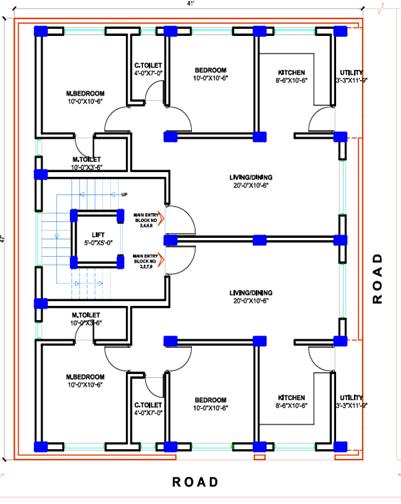
-1:Planofthebuilding
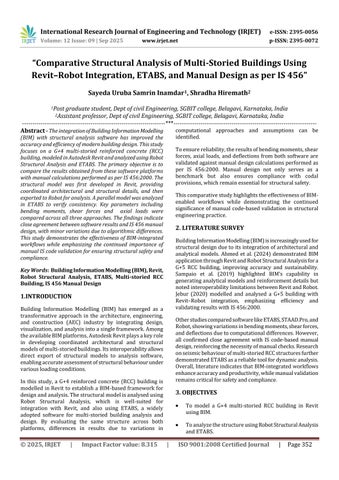
TheG+4multi-storiedRCCbuildingishavingaplotareaof 179.02 m²withabuilt-upareaof152.59 m².Eachfloorhasa height of 3.0 m, foundation depth is 1.50 m, and parapet height is 1.20 m. The main wall thickness is 0.230 m, partitionwallsare0.150 m, andslabthicknessis0.125 m. Columns are 230×380 mm for regular frames and 150×300 mmfortheliftcore,whilebeamsare230×380 mm. ThestructureusesM25concreteandFe500steel.
5.1. Structural modelling in Revit
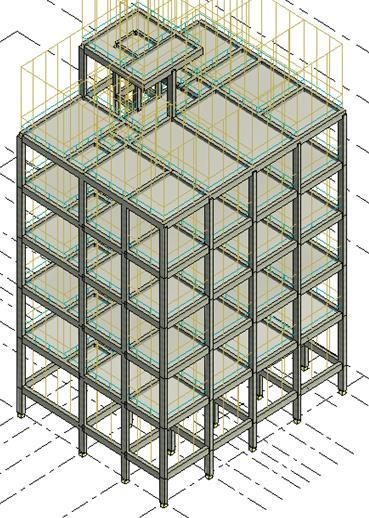
-2:3DmodelingRevit
5.2. Structural analysis in Robot
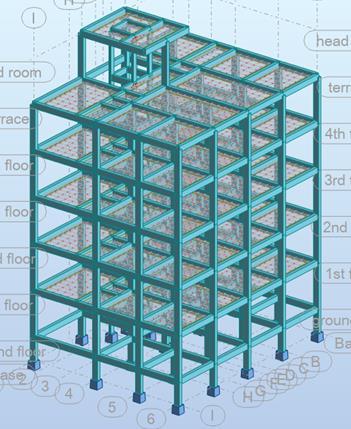
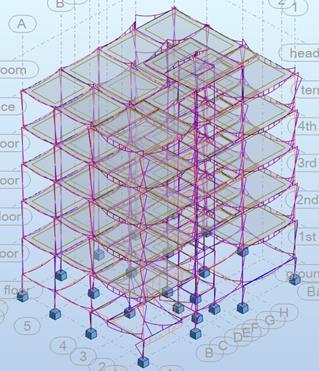
Fig -4:Bendingmomentofwholestructure
International Research Journal of Engineering and Technology (IRJET)
Volume: 12 Issue: 09 | Sep 2025 www.irjet.net
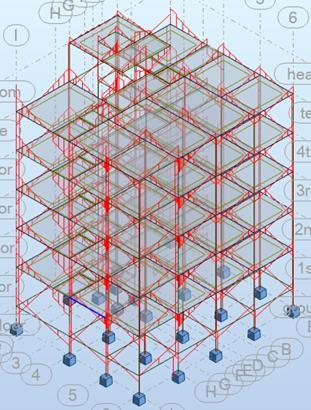
Fig -5:Shearforceofwholestructure
The maximum axial force and bending moment for the columnis1700kNand25kNmrespectivelyand9barsof 16mm diameter is provided as reinforcement for this column.
Thebendingmomentandshearforceofbeamis32kNmand 64kNrespectivelyand2barsof16mmdiameterisprovided asbottomreinforcement
5.3. Structural analysis ETABS
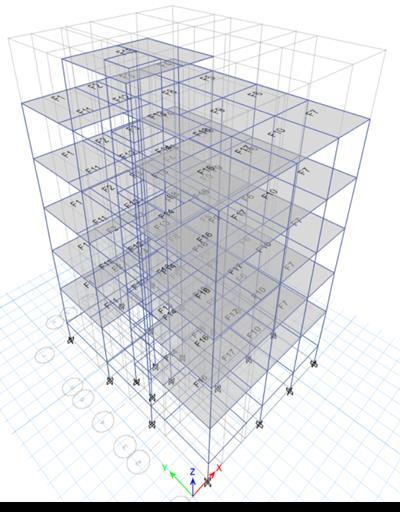
-6:3DmodelinETABS
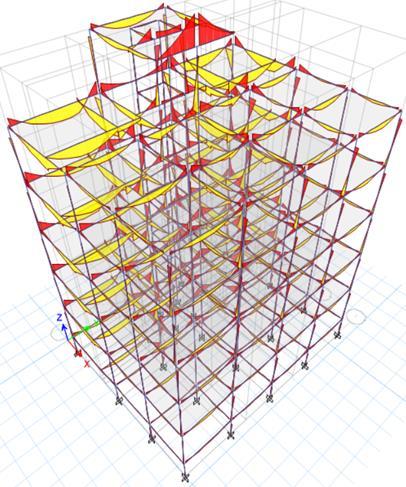
Fig -7:Bendingmomentofwholestructure
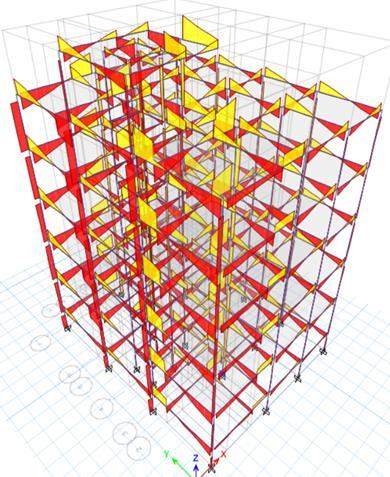
Fig -8:Shearforceofwholestructure
The maximum axial force and bending moment for the columnis1740kNand31kNmrespectivelyand4460mm2 providedasreinforcementforthiscolumn.
Thebendingmomentandshearforceofbeamis37kNmand 55 kN respectively and 382mm2 is provided as bottom reinforcement.
Table -1: Comparisonresultsofbeam
for beam
International Research Journal of Engineering and Technology (IRJET) e-ISSN: 2395-0056
Volume: 12 Issue: 09 | Sep 2025 www.irjet.net p-ISSN: 2395-0072
Table -2: Comparisonresultsofcolumn
AG+4multi-storiedRCCbuildingwasmodelledinRevitand analysedusingRobotStructuralAnalysis andETABS,with resultscomparedtomanualcalculationsasperIS456:2000. BeamanalysisshowedETABSresultswereclosertomanual values, while Robot gave lower bending moment and reinforcement requirements. For columns, axial forces matchedcloselyacrossallmethods,thoughreinforcement demandvaried,withETABSpredictinghighervalues.
The comparison confirms that BIM-integrated workflows enhanceefficiencyandaccuracyinstructuralanalysis,but manual design remains essential for validation and code compliance.Combiningsoftware-basedanalysiswithIS456 checksensuresreliabilityandsafetyinthedesignofmultistoriedbuildings.
Isincerelythankmyguide,Ms.ShradhaHiremath,Assistant Professor,DepartmentofCivilEngineering,S.G.Balekundri Institute of Technology, for her constant guidance and supportthroughoutthisprojectreport.Iamalsogratefulto Mr. Parasharam Sawant, PG Coordinator, and Dr. Santosh Chikkabagewadi, Head of Department, for their valuable suggestionsandencouragement.MyheartfeltthankstoDr. B. R. Patagundi, Principal, for his continuous motivation. I also acknowledge the support of my friends, faculty members,andmyparentsfortheirencouragementduring thisprojectwork.
[1] FaizanAhmedetal(2024):“AnalysisandDesignofG+5 ResidentialBuildingUsingBIM”InternationalJournalof ResearchandAnalyticalReviews
[2] Alcinia Z. Sampaio (2019): “Analysis of BIM ImplementationStructuralProjects”
[3] Mr. Hamzah Sabah Jebur (2020): “Modelling, Analysis andDesignofaMulti-StoryBuildingbyUsingBuilding
InformationModelling(BIM)Approach.”International ResearchJournalofEngineeringandTechnology(IRJET)
[4] BediluHabte(2021):“ApplicationofBIMForStructural Engineering:ACaseStudyUsingRevitandCustomary Structural Analysis and Design Software” Journal of InformationTechnologyinConstruction
[5] IS456:2000,IndianStandardCodeforpracticeofplain and reinforced concrete (Fourth revision), Bureau of Indianstandards,NewDelhi,July2000.
[6] IS 875(Part 2), Indian Standard Code for practice for designloads(otherthanearthquake)forbuildingsand structures,Imposedload(Secondrevision),Bureauof Indianstandards,NewDelhi,1989.