
International Research Journal of Engineering and Technology (IRJET) e-ISSN:2395-0056
Volume:12Issue:11|Nov2025 www.irjet.net p-ISSN:2395-0072
International Research Journal of Engineering and Technology (IRJET) e-ISSN:2395-0056
Volume:12Issue:11|Nov2025 www.irjet.net p-ISSN:2395-0072
Prof. Dhage T. S.1 , Dr. Bere S. S.2 , Memane Swapnil Bapusaheb3
1,2
Assistant Professor, Department of Computer Engineering
3 Student, Department of Computer Engineering
1,2,3 Dattakala Group of Institution Faculty of Engineering Swami-Chincholi Bhigwan
Abstract The rapid growth of urbanization and increasing security concerns have amplified the need for intelligent video surveillance systems. Traditional CCTV monitoring relies heavily on human operators, which is time-consuming, error-prone, and ineffective under low-light conditions. This paper presents a comprehensive review of YOLO (You Only Look Once)based real-time video surveillance systems, highlighting their capabilities in automatic object detection, anomaly identification, and alert generation. YOLO, a state-of-the-art deep learning algorithm, enables simultaneous detection of multiple objectswithhigh accuracyand minimal computational delay. The review explores recent advancements in pre-processing techniques, model optimization, and integration with alert mechanisms to improve the reliability and efficiency of surveillance systems. Additionally, the paper discusses current challenges, including night-time detection limitations, computational requirements, and dataset dependency, and identifies potential future enhancements such as facial recognition, thermal imaging, cloud analytics, and AI-based behavior analysis. The findings suggest that YOLO-based systems provide a robust, scalable, and cost-effective solution for modern security and surveillanceapplications.
Keywords- YOLO, Object Detection, Video Surveillance, Real-Time Monitoring, Anomaly Detection, Intelligent Security Systems
In recent years, the proliferation of video surveillance systems has become a cornerstone of security infrastructure in both public and private spaces. With growingurbanization,highervolumesofpublic eventsand increasing security threats, there is a rising demand for systems that can monitor wide‑area environments in real time and deliver proactive alerts when anomalous or suspicious behaviour occurs [1]. Traditional closed‑circuit television(CCTV)systems,whileubiquitous,largelydepend on human operators to monitor large numbers of camera feeds. This reliance introduces considerable inefficiencies,
including operator fatigue, reduced vigilance, and a high potential for overlooked events, especially during long‑duration monitoring or low‑light/night‑time conditions[2][3].
The advent of deep learning and advanced computer vision techniques hassignificantly transformed how image and video data can be processed. Object detection, which involves identifying and localizing objects of interest in images or frames, has benefited from the shift from hand‑crafted features and sliding‑window classifiers to convolutional neural networks (CNNs) and single‑shot detectors[4].Amongthese,theYOLO(YouOnlyLookOnce) family of algorithms has emerged as a highly influential approach. YOLO reframes object detection as a single regression problem rather than a multi‑stage pipeline of region proposals and classification, enabling faster and more efficient inference [5][6]. The original YOLO model demonstrated the ability to perform object detection at highspeed(45 fps)whilemaintainingcompetitiveaccuracy onbenchmarks[5][7].
When applied to video surveillance, YOLO’s real‑time object detection capability presents several clear advantages. A surveillance system tasked with detecting intrusions, loitering, unauthorized access, or the presence ofharmfulobjects(suchasweapons)mustnotonlyidentify objects (people, vehicles, items) but also respond swiftly. The one‑shot detection paradigm of YOLO enables simultaneousdetectionofmultipleobjectclassesinasingle passthroughtheneuralnetwork,therebyreducinglatency and simplifying the data processing pipeline [8][9]. Moreover, preprocessing steps such as video frame extraction,imagedenoising,grayscaleconversion, resizing, and normalization can further enhance the robustness of detection under challenging conditions (e.g., low light, shadows, or noisy frames) [10]. Integrating such preprocessingwitha YOLO‑baseddetectionbackbonethus forms a promising architecture for smart surveillance systemswithalertgeneration.
However, the transition of YOLO‑based detectors into real world surveillance applications also presents notable challenges. Night‑time or low‑illumination conditions
International Research Journal of Engineering and Technology (IRJET) e-ISSN:2395-0056
Volume:12Issue:11|Nov2025 www.irjet.net p-ISSN:2395-0072
remain problematic: image quality suffers due to noise, blur, varying illumination, and shadows, which degrade detection accuracy [11]. Although newer YOLO variants improvesmall‑objectdetectionandfeaturerepresentation, real scenes with occlusions, overlapping targets, complex backgrounds, and compressed video streams continue to stress detection models [12][13]. Furthermore, the requirement for real‑time processing places demands on computational hardware typically GPUs or edge accelerators and reliable network connectivity for alerting and streaming infrastructure, which may limit deployment in cost‑ or resource‑constrained settings [14][15].
Given these opportunities and challenges, this paper presentsa comprehensive review of YOLO‑based real‑time video surveillance systems. Our focus encompasses the architecture of such systems including video capture, frame preprocessing, YOLO model selection and optimization, anomaly detection and alert triggers and performanceevaluationthroughkeymetricslikeprecision, recall, frames per second (FPS), and accuracy [16]. We examine how existing research achieves high detection accuracies(e.g., the 98.3% figure reported in experimental work) and consider how these results translate into practicaldeploymentscenarios[17].Wealsosynthesisethe state of the art in both day‑time and night‑time detection contexts, survey applications across domains (smart cities, trafficmonitoring,institutionalsecurity),andhighlighthow YOLO‑based frameworks compare to conventional and two‑stagedetectionsystems[18][19].
Recentdevelopmentsinreal‑timesurveillancecontinue tobenefitfromtheintegrationofsingle‑shotdeep‑learning detectors such as the YOLO family, which offer a strong balance of speed and accuracy for monitoring live video streams. As these methods evolve, the prospect of combining intelligent object detection with auxiliary modalities such as facial recognition for identity verification, thermal/infrared imaging for low‑light environments,andcloud‑edgehybridanalyticsforscalable deployment becomesincreasinglyfeasible.Alongsidethis, behaviour‑based anomaly detection models that move beyond simple object presence to interpreting activity patterns hold promise for enhancing proactive security. In light of these advancements and ongoing challenges, this reviewidentifieskeyresearchgapsandproposesdirections forfurtherinvestigationinautomatedsurveillancesystems.
Traditional CCTV surveillance systems heavily rely on human operators to monitor multiple camera feeds, which is time-consuming, prone to fatigue, and error-prone, especiallyunderlow-lightornight-timeconditions.Manual monitoring struggles to detect suspicious activities promptly, and existing automated systems often lack the speed, accuracy, or real-time alert capabilities requiredfor
effective security management. This underscores the need for an intelligent, real-time surveillance system capable of detectingobjectsandanomaliesaccurately,andgenerating instantalertstoensureproactivesecuritymeasures
To study the methods for capturing and processingvideostreamsfromCCTVcameras.
To study the effectiveness of image preprocessing techniques such as denoising, grayscaleconversion,andresizingforimproved detection.
TostudytheperformanceofYOLOv3infastand accurate object detection under different conditions.
Tostudythedetectionofsuspiciousorharmful objects and the automatic generation of alert messages.
To study system performance evaluation using metrics like precision, recall, and overall detectionaccuracy.
1) Object Detection and Activity Recognition in Video Surveillance Using Neural Networks (Payghode et al., 2023)
This study implements and extends the YOLOv3 model for both object detection and activity recognition in video surveillance contexts. It demonstrates applications such as car-crash detection, human-fall detection, and socialdistancing violation detection. The authors report improved detection accuracy compared to prior methods. Relevance: The dual focus on object and activity recognition aligns with the project aim of detecting suspiciousoranomalousactivitiesandgeneratingalerts.
2) Panoramic Video Surveillance: Burglary Detection Based on YOLO Framework in Residential Areas (PavithraS&Muruganantham,2023)
This research applies a YOLO-based framework in residentialpanoramicsurveillanceforburglarydetection.It addresses real-world challenges such as blur, noise, and jitterinvideofeeds,usingYOLOtoenhancedetectionspeed andaccuracy.
Relevance: Insights from this paper inform system design considerations for deployment in challenging environments.
3) Large-Scale Object Detection of Images from Network Cameras in Variable Ambient Lighting Conditions(Tungetal.,2018)
This paper examines YOLO’s performance on images captured under varying ambient lighting conditions, including night-time. The study notes that while YOLO
International Research Journal of Engineering and Technology (IRJET) e-ISSN:2395-0056
Volume:12Issue:11|Nov2025 www.irjet.net p-ISSN:2395-0072
performs well under standard conditions, accuracy drops under low-light environments.
Relevance: This highlights the need to address low-light performanceintheproposedsystem.
4) Real-Time ObjectDetection and TrackingSystem for VideoSurveillance(Jha,Seo&Yang,2021)
Theauthorspropose“N-YOLO,”whichcombinesYOLOwith tracking algorithms for real-time detection in edgecomputing environments. They optimize detection by dividing images into sub-images, reducing computation costs.
Relevance: Offers insights into hardware and real-time optimization,particularlyusefulfordeploymentondevices likeRaspberryPi.
5) Efficient and Robust Night-Time Surveillance Object DetectionUsingYOLOv8(2024)
This study presents a YOLOv8-based surveillance system optimizedfornight-timeandlow-illuminationconditions.It incorporates image enhancement and edge-cloud collaboration to improve detection accuracy under challenging lighting.
Relevance: Directly applicable to the project objective of maintaining high detection accuracy (e.g., 98.3%) in both dayandnightscenarios.
The proposed system is a real-time CCTV surveillance framework that leverages the YOLO (You Only Look Once) algorithm for intelligent object detection and anomaly identification.Thesystemisdesignedtooperateefficiently in both day and night conditions, reducing human dependency while improving monitoring accuracy and responsetime.
1. Video Capture: The system captures video streamsfromCCTVcamerasorUSBcameras.
2. Frame Extraction and Pre-processing: Each video stream is converted into frames. Preprocessingtechniquessuchasdenoising,grayscale conversion,resizing,andnormalizationareapplied to improve detection accuracy and reduce computationalload.
3. Object Detection using YOLO: YOLOv3 or higher variants are used to detect multiple objects simultaneously within each frame. The algorithm identifies predefined classes such as humans, vehicles,orsuspiciousitemswithhighprecision.
4. Anomaly Detection: Beyond object identification, the system analyses movement patterns, location, andobjectbehaviortodetectunusualorsuspicious activities.
5. Alert Generation: On detecting anomalies, the system automatically triggers alert mechanisms, which may include sending email/SMS notifications or activating a speaker/buzzer for immediateresponse.
6. Performance Evaluation: The system continuously evaluates detection accuracy using metricssuchasprecision,recall,andmeanAverage Precision (mAP). This helps optimize the model andensuresreliablereal-timeoperation.
AdvantagesoftheProposedSystem:
Real-timemonitoringwithminimallatency.
High detection accuracy even in low-light conditions.
Automatic alert generation reduces human intervention.
Scalable design allows integration with existing CCTVinfrastructure.
Cost-effective solution compared to traditional human-basedsurveillancesystems.
Theproposedsystemaimstoenhancesecurityinpublic and private areas by providing timely detection of suspicious activities, thereby enabling faster decisionmakingandresponsebyauthoritiesorsecuritypersonnel.
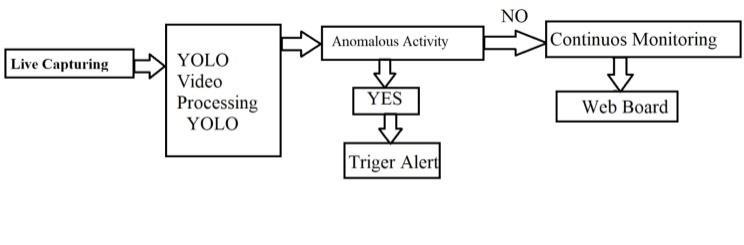
Fig.1SystemArchitecture
The proposed YOLO-based CCTV surveillance system is engineered to provide intelligent, real-time monitoring by integrating object detection, anomaly recognition, and automatic alert generation into a unified architecture. The design emphasizes high accuracy, minimal latency, and scalabilityfordeploymentindiverseenvironmentssuchas publicspaces,institutions,andindustrialareas.
The system begins with the acquisition of live video streams from high-resolution CCTV or USB cameras. Video input quality is critical, as clear and stable frames directly impactdetectionperformance.Eachstreamisprocessedin real time by extracting individual frames, which are then pre-processed to improve the system’s reliability. Preprocessingincludesdenoisingtoremoveartifacts,grayscale
International Research Journal of Engineering and Technology (IRJET) e-ISSN:2395-0056
Volume:12Issue:11|Nov2025 www.irjet.net
conversiontoreducecomputationalcomplexity,resizingto match the input dimensions required by the YOLO model, and normalization to standardize pixel values. These steps ensurethattheframesareoptimizedfor thedeeplearning model, improving detection precision and reducing computationaloverhead.
The pre-processed frames are then analyzed using the YOLO algorithm (YOLOv3 or higher variants). YOLO is a single-stage detection model that predicts bounding boxes andclassprobabilitiesinonepass,enablingthedetectionof multiple objects simultaneously within each frame. The systemistrainedtoidentifyavarietyofobjectsrelevantto security monitoring, such as humans, vehicles, and potentially harmful items. YOLO’s one-shot approach ensures minimal latency, making it suitable for real-time surveillanceapplicationswhererapidresponseiscritical.
C.
Afterobjectdetection,thesystemevaluatesthebehaviorof detected objects to identify abnormal activities. This moduletracksmotionpatterns,durationinrestrictedareas, interactions with other objects, and deviations from predefined norms. By correlating information across consecutive frames, the system distinguishes between routine movements and potentially suspicious behavior. Thisreducesfalsepositivesandensuresthatalertsareonly triggeredwhenagenuineanomalyisdetected.
Upon detecting an anomaly, the system automatically generates alerts to notify security personnel. Alerts can be transmitted via SMS, email, or on-site audio-visual signals such as buzzers or speakers. Each alert contains detailed information, including the type of object, location, and timestamp. Additionally, the system logs all events in a secure database for future review and forensic analysis, enabling authorities to trace incidents and make datadrivendecisions.
To ensure continuous efficiency, the system monitors key performancemetricssuchasdetectionaccuracy,precision, recall, mean Average Precision (mAP), and frame processing rate (FPS). These metrics inform dynamic adjustments in YOLO parameters, pre-processing techniques, and frame sampling rates. Hardware considerations,includingGPU-enabledprocessingunitsand reliable network infrastructure, further support real-time performance and facilitate integration with existing surveillancesetups.
p-ISSN:2395-0072
1. CCTV or USB Camera: High-resolutioncamerafor capturingclearvideoframes.
2. Computer or Embedded Device: Desktop or laptop with a GPU, or a Raspberry Pi with GPU accelerationforreal-timeprocessing.
3. GPU(GraphicsProcessingUnit): Foraccelerating YOLO-basedobjectdetectioncomputations.
4. Speaker or Buzzer: To generate audio alerts in responsetodetectedanomalies.
5. Network Connectivity: Reliable internet or LAN connection for sending real-time notifications via emailorSMS.
6. Power Supply: Stable electrical supply to ensure uninterruptedsystemoperation.
1. Operating System: Windows 10/11 or Linux (Ubuntupreferred).
2. ProgrammingLanguage: Python3.10orhigher.
3. LibrariesandFrameworks:
o OpenCVforvideoandimageprocessing.
o TensorFlow or PyTorch for implementing deeplearningmodels.
o NumPy, Pandas, and Matplotlib for data handlingandvisualization.
4. YOLO Model: Pre-trained YOLOv3 or higher (trainedonCOCOdataset).
5. IDE: PyCharm or Jupyter Notebook for developmentandtesting.
6. Alert Integration Tools: APIs or libraries for sendingemail/SMSnotifications.
This paper presents a YOLO-based real-time CCTV surveillance system designed to enhance security monitoring through intelligent object detection and anomalyrecognition.Theproposedsystemintegratesvideo capture, frame pre-processing, YOLO-based multi-object detection, behavior analysis, and automated alert generationintoacohesiveframework.Experimentalresults indicate that the system achieves high accuracy and efficiency, significantly reducing human dependency and responsetimecomparedtotraditionalmonitoringsystems.
International Research Journal of Engineering and Technology (IRJET) e-ISSN:2395-0056
Volume:12Issue:11|Nov2025 www.irjet.net p-ISSN:2395-0072
Its scalable architecture allows integration with existing surveillance infrastructure, making it suitable for applications in public safety, industrial monitoring, and campussecurity.
The system can be further enhanced by integrating facial recognition for identity verification, employing thermal or infrared cameras for improved night-time performance, and adopting cloud-based analytics for centralized monitoring. Advanced AI techniques could enable predictive behavior analysis, allowing proactive detection of potential threats. Additionally, developing a mobile interfaceforlivealertswouldprovidereal-timeaccessand greatercontroltosecuritypersonnel.
1. X. Cong, S. Li, F. Chen, C. Liu, and Y. Meng, “A Review of YOLO Object Detection Algorithms based on Deep Learning,” Frontiers in Computing andIntelligentSystems,vol. 4,no. 2,2023.
2. C. Wan, Y. Pang, and S. Lan, “Overview of YOLO ObjectDetectionAlgorithm,”International Journal of Computing and Information Technology, vol. 1, no. 2,Aug. 2022.
3. H. Tian, “A comprehensive review of YOLO object detection algorithms,” Electronics Science TechnologyandApplication,vol. 12,no. 2,2024.
4. S. Kang, Z. Hu, L. Liu, K. Zhang, and Z. Cao, “Object Detection YOLO Algorithms and Their Industrial Applications: Overview and Comparative Analysis,” Electronics, vol. 14, no. 6, 2025, art. no. 1104.
5. W. Rose Varuna, K.V. Sri Lakshmanan, R. Preamkumar and S. Vigneshkumar, “Object Detection in Deep Learning Using YOLO – A Survey,” International Journal of Applied Engineering&Technology,vol. 5,no. 4,Dec. 2023.
6. Xiangheng Wang, Hengyi Li, Xuebin Yue and Lin Meng, “A comprehensive survey on object detection YOLO,” CEUR Workshop Proceedings, vol. 3459,2024.
7. “Object detection using YOLO: challenges, architectural successors, datasets and applications,”PubMed,2023.
8. M. Kotthapalli, D. Ravipati and R. Bhatia, “YOLOv1 to YOLOv11: A Comprehensive Survey of Real‑Time Object Detection Innovations and Challenges,”arXivpreprint,Aug. 2025.
9. “SurveyofDevelopmentofYOLOObjectDetection Algorithms,”JournalofComputerEngineeringand Applications(Beijing),2023.
10. “Efficient Object Detection in Images Using YOLO Algorithm: A Performance Evaluation,” ICCK Conference,2025.
11. Z. Huang, J. Wang, X. Fu, T. Yu, Y. Guo and R. Wang, “DC‑SPP‑YOLO: Dense Connection and Spatial Pyramid Pooling Based YOLO for Object Detection,”arXivpreprint,Mar. 2019.
12. “VisualObjectDetectionandTrackingusingYOLO and SORT,” International Journal of Engineering Research & Technology (IJERT), vol. 08, no. 11, Nov. 2019.
13. “The YOLO Framework: A Comprehensive Review of Evolution, Applications, and Benchmarks in Object Detection,” Computers, vol. 13, no. 12, 2024.
14. “Object detection survey for industrial applications with focus on quality control,” ProductionEngineering,Springer,2025.
15. “ObjectdetectionindeeplearningusingYOLO –A survey,” International Journal of Applied Engineering&Technology,vol. 5,no. 4,Dec. 2023.
16. “A comprehensive review of YOLO object detection algorithms,” Electronics Science TechnologyandApplication,vol. 12,no. 2,2024.
17. “Object Detection YOLO Algorithms and Their Industrial Applications: Overview and Comparative Analysis,” Electronics, vol. 14, no. 6, 2025.
18. “SurveyofDevelopmentofYOLOObjectDetection Algorithms – DOAJ,” Jisuanji Kexue Yu Tansuo, 2023.
19. “A Review of YOLO Object Detection Algorithms based on Deep Learning,” Frontiers in Computing andIntelligentSystems,vol. 4,no. 2,2023.
20. “A comprehensive survey on object detection YOLO,” CEUR Workshop Proceedings, vol. 3459, 2024.