
International Research Journal of Engineering and Technology (IRJET) e-ISSN:2395-0056
Volume: 12 Issue: 10 | Oct 2025 www.irjet.net p-ISSN:2395-0072
International Research Journal of Engineering and Technology (IRJET) e-ISSN:2395-0056
Volume: 12 Issue: 10 | Oct 2025 www.irjet.net p-ISSN:2395-0072
Artham Gupta
Abstract
Moststudiesoffishbehaviorrelyonsingle-view2Dtracking, which obscures depth and biases motion metrics. I built a simple 3D pipeline using twoorthogonal cameras(front and side) and OpenCV-based markerless centroid tracking to reconstruct per-frame (X, Y, Z) positions of a single fish. From the fused trajectory I computed 3D speed, rolling mean speed, speed autocorrelation, 3D voxel occupancy (3×3×3), normalizedspatialentropy,andpathtortuosity(straightness index and turning-angle statistics). In a clean-water baseline the fish showed broad occupancy (entropy = 0.936 on a 0–1 scale) and a right-skewed speed distribution (mean = 1157 px/s; median = 273 px/s). A first comparison in aged water (same fish, same setup) showed higher central tendency of speed(median=696px/s;+155%)butlowerspatialentropy (0.698;−25%),suggestingsteadiercruisingwithinareduced spatial envelope. Turning-angle histograms indicated more 60–90° reorientations and fewer extreme U-turns in aged water; straightness index remained low in both conditions. These are pilot results (n = 1 per condition, pixel units), but the code and parameters are transparent and reproducible. Thepipelinesupportsfuturemulti-sessionstatistics,calibration to cm/s, and hypothesis tests on speed, occupancy, entropy,tortuosity,andautocorrelation.
Key Words: fish behavior, water quality, 3D tracking, OpenCV,two-viewfusion,entropy,tortuosity
Fish are often used as bio-indicators of aquatic environmental conditions due to noticeable changes in their movement patterns and activity levels with changes in water quality [1][2].Forexample,thedepletion ofdissolvedoxygen orthe buildup of common pollutants such as ammonia can lead to observable shifts in how fish swim, feed, or the areas of the tankwithinwhichtheyspendtheirtime[3][4].Therefore,researchershavefoundanaccuratelinkbetweenfishbehavior andreal-time waterquality. Specifically,a reductionin overall activity and feeding, or displays of stressful behavior in poorwaterconditionsmakefishnatural"monitors"ofwater quality [4][5]. This is significant because early detection of suboptimal water conditions through motion and behavior
analysis could benefit aquaculture by allowing quick intervention[1][6].
Forthisresearch'spurpose wedefinecleanwaterasdechlorinated tap water with TDS levels under 300, whereas aged waterreferstooriginallyclean waterwhichhasdegradedin quality through natural accumulation of metabolic waste products(likeammonia or nitrite)overtime.Although aged, cycled water contains beneficial bacteria, it may have lower dissolvedoxygenlevelsandhigherwastethatstressesfishif not well-maintained [7]. We clarify that in this study "aged" waterhas been ina tank through one full cycleandcontains natural wastes to safe levels, as confirmed through frequent multi-facetedwaterqualitytests.
Existingliteratureemphasizesthatevenminoralterationsin thequalityofwatercanaffectthebehavioroffish.Moststudies focus on extreme cases that show high pollution or poor waterconditionscancausefishtobelethargic,feedless,and evenavoidcertainareas[6].Forexample,elevatedammonia concentrations can damage fish gills, increase lethargy, and reduce feeding activity [3][4]. Moreover, increased turbidity (cloudiness) of water due to suspended particles can impair visual sensing in fish, which can further contribute towards increasing foraging time and reducing feeding success rates [8][9].Additionally,evenlowtomoderateturbidityinaquariumshasshowntochangeschoolpatternsandpredatoryescapesincefishrelyheavilyonvisiontocoordinateandavoid threat [10], with one study showing that turbidity above ~9 NTUsignificantlydecreasedthepreycapturesuccessofdace and significantly affected energy expenditure while feeding [8]. While this is true for many species, some can tolerate moderate levels of turbidity without an immediate breakdowninbehavior.Forexample,sticklebackshoalshavebeen observedtoremaincohesiveintheirgroupsevenundercertain turbid conditions [11], which indicates that the effect of turbidity can vary by species and context. Overall, however, mostliteraturesuggeststhatsmallfishareparticularlysensitive to water quality, and exhibit reduced activity as well as altered spatial preference under poor water conditions [6]. Whilemoststudieshavefocusedonextremepollutants,there is a relative knowledge gap in studies of how an individual small fish's behavior changes due to moderate alterations of water quality, which are more realistic for artificial aquariums[6].
Volume: 12 Issue: 10 | Oct 2025 www.irjet.net
Single-view 2D tracking can misrepresent aquatic behavior by flattening depth and introducing projection bias. Recent advancesincomputervisionanddeeplearninghaveenabled us totrack animal movement without attaching any physical markers[12][13].DeepLabCututilizesdeeplearningthrough neural networks for pose estimation across frames [12], achieving near human tracking accuracy across diverse species with minimal training data. This technology has several advantages:it'snon-invasive,requiresregularvideo,andcan eventracksmall-scalemovements[14].Inourparticularcontext,DeepLabCutandsimilarmethodshavesuccessfullyanalyzedlocomotionandpostureinfish.Forexample,astudyby Wuetal.usedDeepLabCuttoanalyzethedetailedkinematics offishwhileswimming,demonstratingthatthetoolcouldreliably extract swim speeds and fin movements [15]. Another projectcombinedDeepLabCutwithothertrackingalgorithms to follow multiple zebrafish and quantify their behavior and anxiety-induced responses. Together, these applications highlightmodernpose-tracking'spotentialforaquaticanalysis even in complex scenes [16]. Furthermore, DeepLabCut's multi-animal extensionallowsthe user to maintain the identity of individual fish in groups and even handle infrequent occlusions, a crucial aspect in studying social behavior [16]. Additionally, techniques like optical flow integration can improvetrackingstabilityinvideoswithnoiseorpoorvisibility [17].
This work presents a minimal two-camera, OpenCV-only pipeline to reconstruct 3D trajectories of a single fish in an aquarium, establish a clean-water baseline, and provide a firstcomparisoninagedwater.Thegoalisreproduciblemetricsratherthanexhaustivemodeling;allcomputationsarein pixelunitswithclearlimitationsnoted.
Two orthogonal cameras recorded the same fish simultaneously (front and side). Per-frame centroids were extracted with OpenCV, temporally aligned, and fused under an orthographicassumptiontoyield(X,Y,Z)positionsinpixels.
OpenCVcentroidofthelargestmovingblobperframe(background-subtraction+morphology).Framerate:30fps.Views were synchronized with a fixed offset; axis mapping and required flips are documented in code. Fusion used per-frame timestamps;whenbothviewswerevalid,XandYcamefrom thefrontviewandZfromthesideview.Notemporalsmoothing was applied. Videos were segmented into 5-minute chunks for time-resolved summaries. We did not use DeepLabCutforthisstudy;alltrackingusedOpenCVcentroid detection;DLCiscitedasrelatedwork.
Metrics: (i) speed (3D) and 30-s rolling mean; (ii) unbiased autocorrelation ofspeed up to5 slag;(iii) 3×3×3 occupancy
p-ISSN:2395-0072
+ normalized spatial entropy; (iv) tortuosity via 60-s straightnessindex(displacement/pathlength)and3Dturningangleswitha10%minimum-speedthreshold.
Ethics: Non-invasive observation of a single aquarium fish under routine husbandry; no stimuli or handling during trials;educationalsettingwithmentoroversight.
3.1 Clean-water baseline (single session)
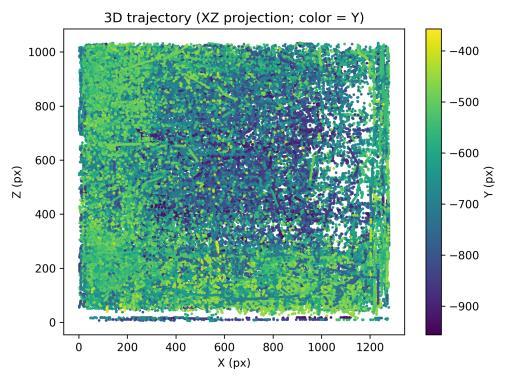
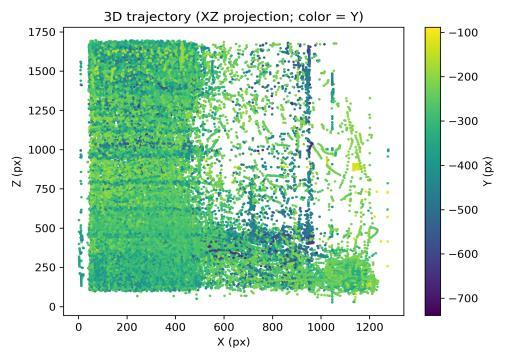
The clean-water baseline established characteristic patterns of exploratory behavior across multiple 3D metrics. The 3D trajectory (Fig. 1) showed broad spatial coverage with repeated wall passes and extensive depth usage, consistent withhealthytankexploration.Colorvariationacrossthepath indicated frequent vertical transitions throughout the session.
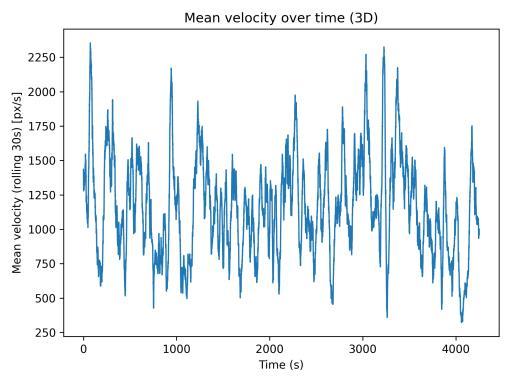
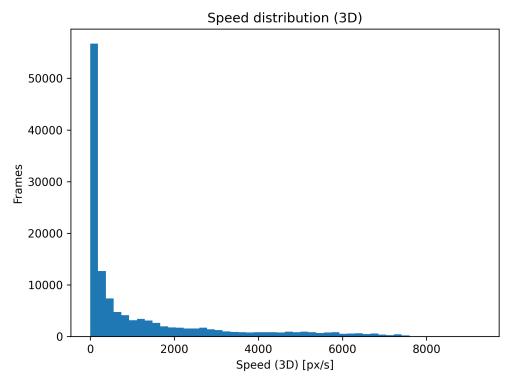
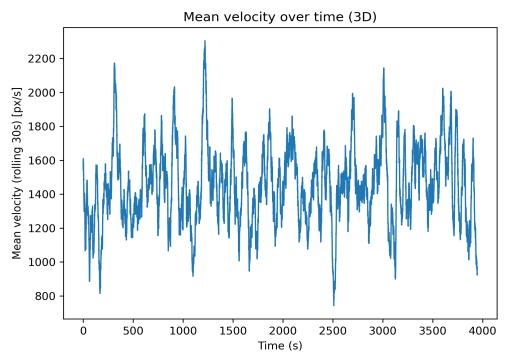
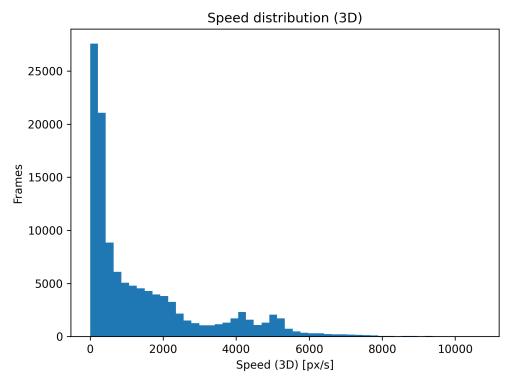
Mean velocity over time (Fig. 2) exhibited cyclical patterns with peaks marking brief burst movements separated by slower cruising phases. The 30-s rolling window effectively smoothed frame-level noise while preserving multi-minute trends. The speed distribution (Fig. 3) was strongly rightskewed, with mean speed of 1157.3 px/s, median of 272.5 px/s,and95thpercentileof5385.6px/s.Thisdistributionreflects characteristic stop-and-go swimming behavior with manylow-speedframesandoccasionalhigh-speedbursts.
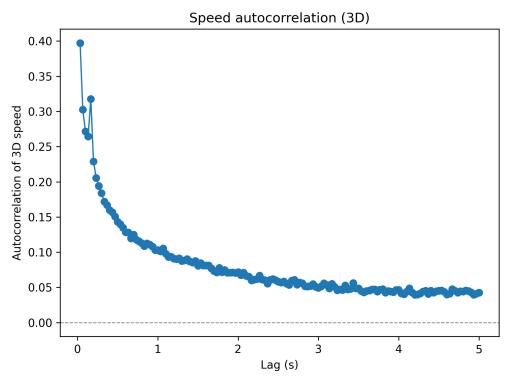
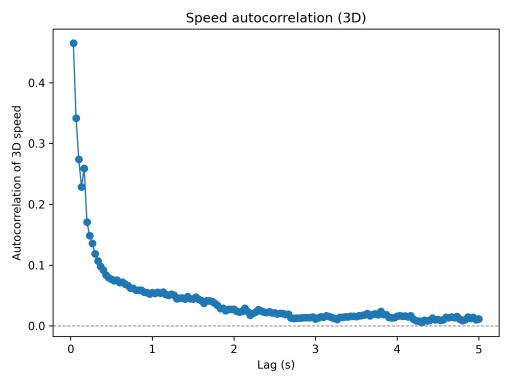
Speed autocorrelation analysis (Fig. 4) revealed short-term temporal structure: positive correlation at brief lags indicated that once the fish accelerated, it maintained elevated speed for several hundred milliseconds before decelerating. Correlation decayed toward zero by approximately 3–5 seconds, suggesting limited long-range periodicity in the baselinecondition.
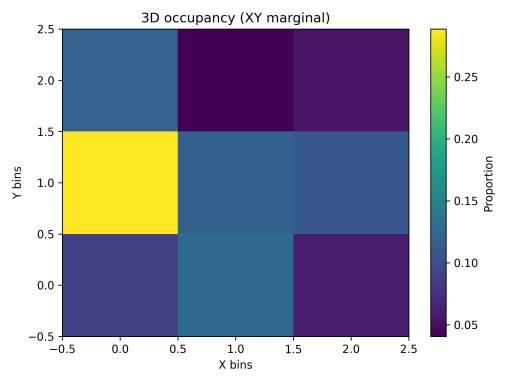
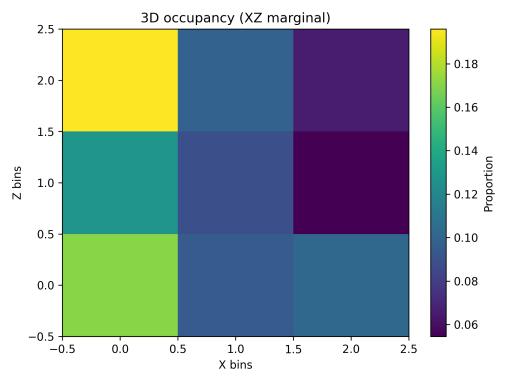
Spatialoccupancyanalysisusinga3×3×3voxelgrid(Figs.5–7) demonstrated non-uniform but broad coverage patterns. TheXYmarginalhighlightedpreferredlateral-vertical zones; XZ revealed sustained wall-following behavior; and YZ indicatedmid-depthpreferencewithsecondaryusageofshallow anddeeperregions.Overall3Dspatialentropyreached0.936 ona0–1scale(Fig.8),indicatingextensiveexplorationrather than confinement. Per-chunk entropy values ranged from 0.68 to 0.91, confirming consistent spatial distribution throughoutthesession.
Tortuosity analysis revealed highly meandering movement patterns. The rolling straightness index (Fig. 9) remained near zero (≈0.01–0.05) across the entire session, indicating that within most 60-second windows, the fish traveled long pathlengthsbutendednearitsstartingposition.Thispattern
International Research Journal of Engineering and Technology (IRJET) e-ISSN:2395-0056
Volume: 12 Issue: 10 | Oct 2025 www.irjet.net
isconsistentwithwall-followingloopsandfrequentboundary reversals. The turning-angle distribution (Fig. 10) was heavily concentrated at small values (0–10°) representing straightcruisingsegments,withasecondarypeak near 170–180° indicating frequent near-U-turns at boundaries. Perchunk straightness values (Fig. 11) remained consistently low across all 5-minute segments, confirming that tortuous movementcharacterizedtheentirebaselinesession.
p-ISSN:2395-0072
International Research Journal of Engineering and Technology (IRJET) e-ISSN:2395-0056
Volume: 12 Issue: 10 | Oct 2025 www.irjet.net
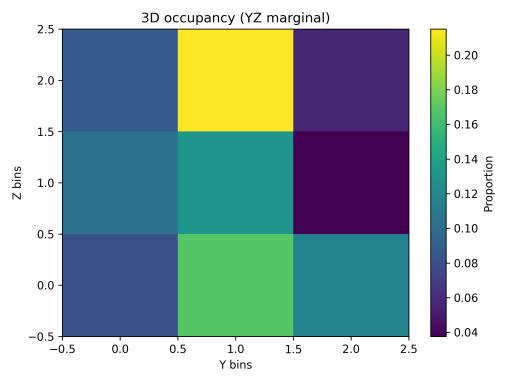
Fig. 7. 3D occupancy heatmap (YZ marginal).
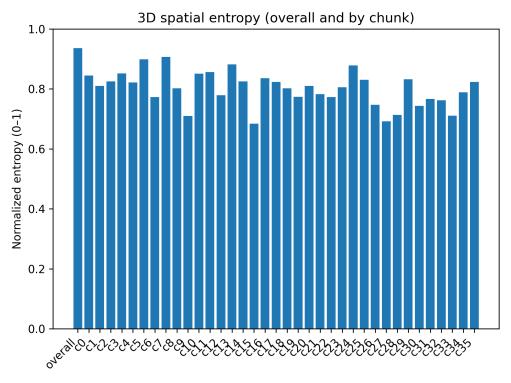
Fig. 8. Normalized spatial entropy overall and per 5-min chunk (overall = 0.936).
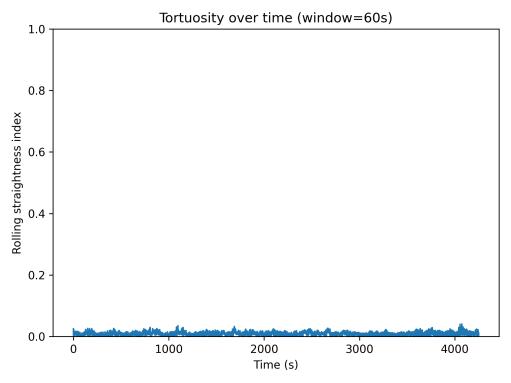
9. Rolling straightness index (60-s window).
p-ISSN:2395-0072
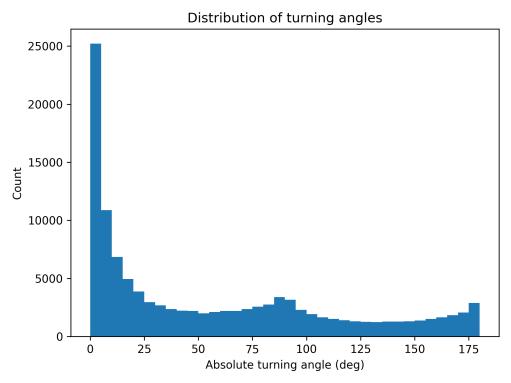
10. Distribution of absolute turning angles (3D).
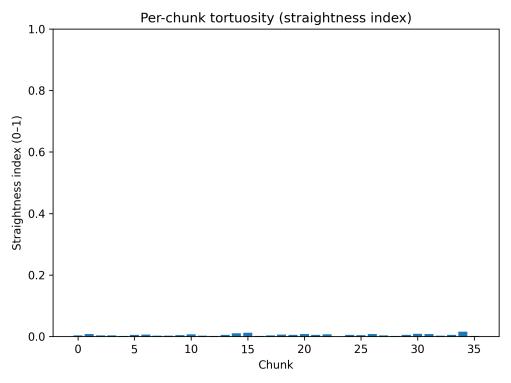
Fig. 11. Tortuosity per 5 min chunk.
3.2 Aged-Water Comparison (Same Fish, Same Setup)
The aged-water condition produced notable shifts in movementpatternsrelativetotheclean-waterbaseline,particularly in spatial distribution and speed characteristics while maintainingsimilartortuosityprofiles.
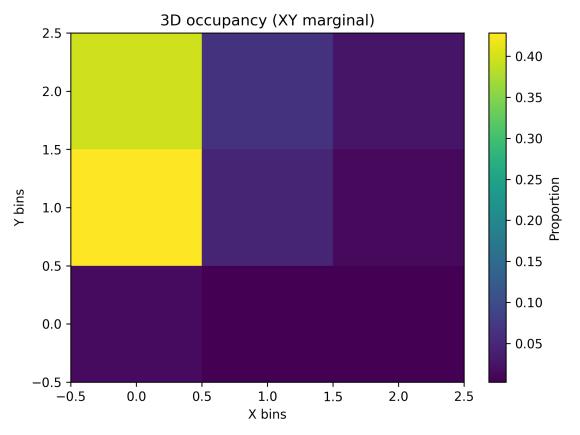
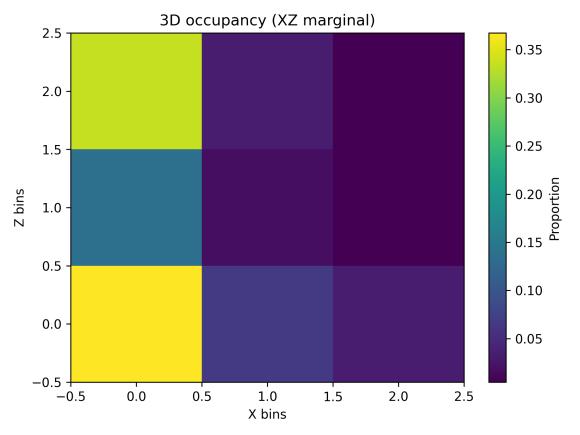
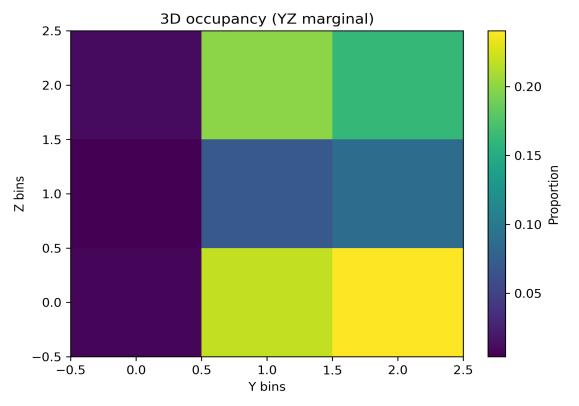
The3D trajectoryinagedwater(Fig.2,aged)showed markedly reduced spatial extent compared to clean water. Visual inspectionrevealedmoreconcentratedmovementinspecific regions rather than the broad tank-wide coverage observed in clean conditions. This spatial restriction was quantified through occupancy analysis: hexbin density plots (Figs. 3–5, aged) showed stronger localization with distinct "hotspots" of high occupancy, contrasting sharply with the more uniformdistributionincleanwater.
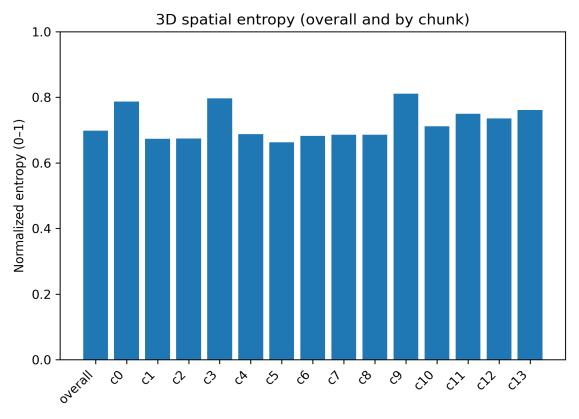
Spatial entropy decreased substantially in aged water to 0.698 (−25.4% relative to clean water's 0.936), confirming thevisualimpressionof reducedspatialexploration(Fig.12, aged). Thiscompressionof thespatial envelopesuggeststhe fish restricted movement to preferred zones under suboptimalwaterconditions.
International Research Journal of Engineering and Technology (IRJET) e-ISSN:2395-0056
Volume: 12 Issue: 10 | Oct 2025 www.irjet.net
Speed dynamics showed a paradoxical pattern: while spatial usage decreased, central speed tendency increased. The aged-water median speed was 696 px/s (+155% relative to clean water's 273 px/s), indicating faster sustained movement within the reduced spatial range. Mean velocity over time(Fig.6,aged)showedelevatedbaselinespeedswithcontinued burst behavior. The speed distribution (Fig. 7, aged) retained its right-skewed character but with a shift toward higher central values and a distinct secondary mode around 4000–5000px/s,suggestingmorefrequentmoderate-to-high speedswimming.
Speedautocorrelationpatterns(Fig.8,aged)remainedqualitatively similar to clean water, with rapid initial decay indicatingpreservedshort-termtemporalstructureinmovement despitethechangedwaterconditions.
The most striking contrast emerged in vertical distribution. While clean-water occupancy showed mid-depth preference with substantial usage of all depth zones, aged-water occupancy (Figs. 9–11, aged) revealed strong concentration in upper regions (higher Z bins in XZ marginal, upper-middle bins in YZ marginal). The XY marginal showed pronounced asymmetry with dominant occupancy in the left-front quadrant. This vertical shift and horizontal localization together producedthesubstantialentropyreduction.
p-ISSN:2395-0072
International Research Journal of Engineering and Technology (IRJET) e-ISSN:2395-0056
Volume: 12 Issue: 10 | Oct 2025 www.irjet.net p-ISSN:2395-0072
3.3 Tortuosity and Turning Behavior: Condition Comparison
Despite marked differences in speed and space use, tortuosity metrics remained remarkably consistent across condi-
tions.Rollingstraightnessindextimeseries(Fig.14)overlaid for both conditions showed nearly identical patterns, with both remaining near zero throughout their respective sessions.Per-chunkstraightnessvalues(Fig.15)showednosystematic difference between clean and aged water, with both conditions maintaining consistently low values (< 0.02 for mostchunks).
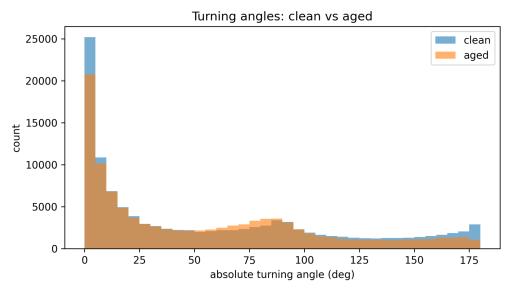
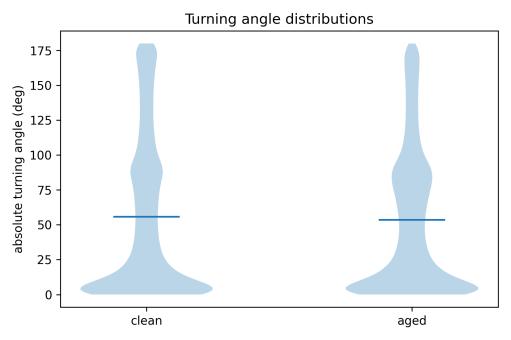
Turning-angle distributions provided nuanced insights into this preserved tortuosity (Figs. 12–13, comparison). Both conditions showed the characteristic bimodal pattern with peaksatsmallangles(0–10°)andnear180°.However,subtle shiftswereevident:thestackedhistogram(Fig.17)revealed thatagedwaterproducedrelativelymoreturnsinthe60–90° range and fewer extreme U-turns (170–180°) compared to clean water. The violin plot comparison (Fig. 18) confirmed similar median turning angles (≈50–55°) but showed aged water had a slightly compressed distribution in the highanglerange.
Theseresultsindicatethatwhileagedwatersubstantiallyaltered where and how fast the fish moved, it did not fundamentally change the tortuous, loop-based character of movement. The fish continued to execute meandering paths with frequentdirectional changesin both conditions,though withmodifiedturning-anglecompositioninagedwater.
International Research Journal of Engineering and Technology (IRJET) e-ISSN:2395-0056
Volume: 12 Issue: 10 | Oct 2025 www.irjet.net p-ISSN:2395-0072
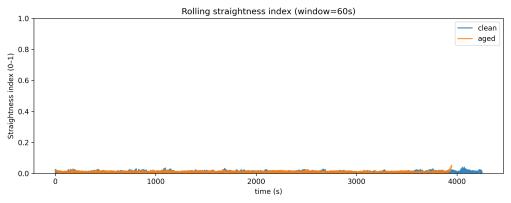
Fig. 22. Rolling straightness index over time: clean vs aged.
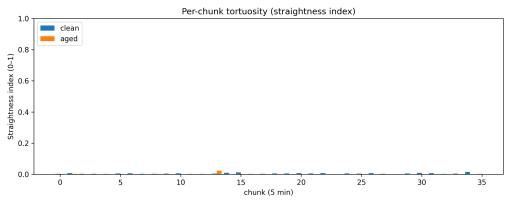
Fig. 23. Per-chunk straightness index by 5-min chunk: clean vs aged.
4.1 Principal findings (clean vs. aged)
Thisstudyestablisheda3D,two-view,OpenCV-onlybaseline forasingleguppyincleanwaterandthenrepeatedthesame protocolinagedwater.Threerobustpatternsemerged:
Higher central speed but reduced space use in aged water. Median3Dspeedincreasedfrom 272.5px/s(clean)to695.7 px/s (aged; +155%), while normalized 3D spatial entropy droppedfrom 0.936to0.698( 25%).Meanspeed rosefrom 1157.3 to 1451.9 px/s (+25%), total distance from 4.94×10⁶ to5.73×10⁶px(+16%),andthe95th-percentilespeedslightly decreased ( 5.7%).
Interpretation: the fish cruised faster but within a narrower spatial envelope (Figs. 12–19 vs. Figs. 1–8)Temporal structure remained short-range. Speed autocorrelation decayed within ~3–5 s in both conditions (Figs. 4 and 15), indicating brief“memory”inswimmingspeedwithnolong-periodoscillation.
Tortuosity stayed low in both conditions. The straightness index(SI;displacement/pathlength) was nearzerothroughout (Figs. 22–23), indicating loop-rich, meandering paths. Turning-angle statistics kept the familiar bimodal shape (many small turns; some near-U-turns), with aged water showing relatively more 60–90° reorientations and fewer 170–180°flips(Figs.20–21).
Together,theseresultssuggestthatagedwatershifted where and how steadily the fish moved, but not the movement style: pathsremainedtortuousandburst-and-cruisedynamicspersisted.
Theentropyreductioninagedwateralignswithreportsthat sub-optimalqualitycanconstrainexplorationandalterverticaldistribution[1],[6].Theincreaseinmedianspeediscompatible with two non-exclusive mechanisms noted in the literature:(i)surface-seekingorlocalizedcruisingunderlower dissolvedoxygenormildirritants(fastermovementwithina smaller volume) [1], [7], and (ii) stress-linked hyperactivity without long, tank-spanning traversals [6]. Our occupancy maps and voxel entropy (Figs. 16–19) show exactly that compression of space use, while the 95th-percentile speed did not rise hinting that the fish cruised more rather than dashed faster. Because we did not log chemistry in this pilot, these mechanisms remain hypotheses to be tested, not conclusions.
The short-lag autocorrelation mirrors typical stop-and-go patterns reportedinanimal trackingstudies,where momentum carries across several hundred milliseconds but dissipates rapidly thereafter. The finding that tortuosity and SI profiles were unchanged is consistent with a movement strategy dominated by wall-following loops in a rectangular tank behavior that persists even as the spatial envelope shrinks.
A key contribution is the two-camera, 3D fusion with no deep-learning pose model. By constructing a per-frame (X,Y,Z) trajectory via synchronized front/side centroids, we avoid depth-projection artifacts that can inflate speed and distort occupancy in 2D. The differences we observe (higher medianspeedbutlowerentropyinagedwater)aretherefore less likely to be analysis artifacts and more likely to reflect realvolumetricbehavior.Thismakesthemetrics(speeddistribution, voxel occupancy/entropy, turning-angle statistics, SI) suitable candidates for condition-classification in future datasets.
n = 1 per condition; single species and individual. These are pilot effects; inferential statistics would be inappropriate at thisstage.
Pixelunitsandorthographicassumption.Withoutcalibration to cm and a refraction model, absolute kinematics are approximate. Still, within-setup comparisons (clean vs. aged) remainmeaningful.
Nowaterchemistrylogs.Wecannottiebehaviortodissolved oxygen,ammonia,nitrite/nitrate,orturbidity.Thisisthebiggestblockertomechanisticclaims.
International Research Journal of Engineering and Technology (IRJET) e-ISSN:2395-0056
Volume: 12 Issue: 10 | Oct 2025 www.irjet.net
Trackingbiases.OpenCVcentroidtrackingcanbeaffectedby reflections, air bubbles, and background changes. We mitigated this with morphology and consistent lighting, but subtlebiasispossible.
Time-of-day/activitystate.Althoughsessionsweresimilarin length,circadianstateorfeedinghistorycouldconfoundcentraltendencyofspeed.
This study demonstrates a minimal, transparent two-view OpenCV pipeline for 3D markerless tracking of a single aquariumfishandappliesit toa clean-waterbaseline witha firstcomparisonin aged water. Bysynchronizingorthogonal viewsunderanorthographicassumptionandcomputingvolumetric metrics 3D speed (and rolling mean), speed autocorrelation,3×3×3voxeloccupancywithnormalizedentropy, straightness index, and 3D turning angles we obtain interpretable summaries of locomotion that avoid the projection biasesof2Danalyses.
In the clean-water session the fish exhibited broad volumetric use (entropy 0.936), a right-skewed speed distribution (mean1157px/s,median273px/s),short-lagspeedmemory (autocorrelation decaying within ~3–5 s), and highly tortuous paths (low straightness). In the aged-water session (same fish, same setup) the central tendency of speed increased (median +155%, mean +25%) while spatial entropy decreased (−25%), and turning-angle structure shifted toward more 60–90° reorientations with fewer near-180° reversals. Together, these patterns suggest a behavioral signatureofagedwatercharacterizedbysteadiercruisingwithina reducedspatialenvelope,ratherthanfastersprintsorbroaderexploration.
The approach is practical for classroom and low-resource labs:itrunsoncommodityhardware,exposesallparameters, and produces figures that map cleanly onto biological questionsaboutwhere,howfast,andhowanimalsmovein3D.At thesametime,conclusions are necessarilycautious:n=1per condition,pixelunits(nocmcalibration),orthographicfusion without refraction modeling, and no concurrent waterchemistrylogs.Thesearethekeythreatstogeneralization.
Nextstepsareclearandactionable:(i)replicate(≥3sessions per condition, counterbalanced timing); (ii) calibrate to cm (and report speeds in cm/s or body-lengths/s); (iii) log chemistry (DO, temperature, pH, ammonia/nitrite/nitrate, turbidity) to anchor mechanisms; (iv) pre-register primary endpoints (median speed, voxel entropy, SI, angle-band proportions,ACFdecay)andstatisticaltests;and(v)runrobustnesschecks(alternatevoxelgrids,speed-thresholdsensitivi-
p-ISSN:2395-0072
ty, ACF normalization). With these additions, the same 3D pipeline can deliver statistically supported, mechanistic insights into how routine water-quality changes reshape individualfishbehavior.
Theauthorthanksthementorforguidanceandtheschoolfor supportingtheeducationalresearchsetting.
[1]I. Kuklina,A. Kouba, and P. Kozák,"Real-timemonitoring of water quality using fish and crayfish as bio-indicators: A review,"EnvironmentalMonitoringandAssessment,vol.185, no.6,pp.5043–5053,2013.DOI:10.1007/s10661-012-29242
[2] Y. Huang, R. Pang, X. Li, W. Li, Z. Yang, D. Wang, and K. Dong, "Ecology health evaluation system based on fish movement behavior response," Water, vol. 15, no. 23, p. 4066,2023.DOI:10.3390/w15234066
[3]D. J. Randall andT. K. N.Tsui,"Ammonia toxicityin fish," Marine Pollution Bulletin, vol. 45, no. 1-12, pp. 17–23, 2002. DOI:10.1016/S0025-326X(02)00227-8
[4] P. Soler, M. Faria, C. Barata, E. García-Galea, B. Lorente, andD.Vinyoles,"Improvingwaterqualitydoesnotguarantee fishhealth:Effectsofammoniapollutiononthebehaviourof wild-caught pre-exposed fish," PLoS ONE, vol. 16, no. 8, e0243404,2021.DOI:10.1371/journal.pone.0243404
[5]A.S.Abangan,D.Kopp,andR.Faillettaz,"Artificialintelligence for fish behavior recognition may unlock fishing gear selectivity," Frontiers in Marine Science, vol. 10, p. 1010761, 2023.DOI:10.3389/fmars.2023.1010761
[6] K. Zhang, Z. Ye, M. Qi, W. Cai, J. L. Saraiva, Y. Wen, et al., "Waterqualityimpactonfishbehavior:Areviewfromanaquacultureperspective,"ReviewsinAquaculture,vol.17,no.1, pp.1–27,2024.DOI:10.1111/raq.12985
[7]E.SandersandS.C.Farmer,"Aquaticmodels:waterqualityand stability and other environmental factors,"ILAR Journal, vol. 60, no. 2, pp. 141–149, 2019. DOI: 10.1093/ilar/ilaa008
[8]R.M.ZamorandG.D.Grossman,"Turbidityaffectsforaging success of drift-feeding rosyside dace (Clinostomus funduloides)," Transactions of the American Fisheries Society, vol.136,no.1,pp.167–176,2007.DOI:10.1577/T05-301.1
International Research Journal of Engineering and Technology (IRJET) e-ISSN:2395-0056
Volume: 12 Issue: 10 | Oct 2025 www.irjet.net p-ISSN:2395-0072
[9] G. S. Bilotta and R. E. Brazier, "Understanding the influenceofsuspendedsolidsonwaterqualityandaquaticbiota," Water Research, vol. 42, no. 12, pp. 2849–2861, 2008. DOI: 10.1016/j.watres.2008.03.018
[10] B. R. S. Figueiredo, R. V. Granzotti, L. F. Fiori, C. L. Nieman,E.Benedito,andP.A.Piana,"Cascadingeffectsofpredationriskunderhighorganicandinorganicturbidity:Impacts on individuals and shoals of a mesopredator fish," Aquatic Ecology, vol. 54, no. 3, pp. 855–868, 2020. DOI: 10.1007/s10452-020-09787-0
[11] H. E. A. MacGregor and C. C. Ioannou, "Shoaling behaviour in response to turbidity in three‐spined sticklebacks," Ecology and Evolution, vol. 13, no. 6, e10134, 2023. DOI: 10.1002/ece3.10134
[12]A.Mathis,P.Mamidanna,K.M.Cury,T.Abe,V.N.Murthy, and M. W. Mathis, "DeepLabCut: markerless pose estimation of user-defined body parts with deep learning," Nature Neuroscience, vol. 21, no. 9, pp. 1281–1289, 2018. DOI: 10.1038/s41593-018-0209-y
[13]T.D.Pereira,D.E.Aldarondo,L.Willmore,M.Kislin,S.S. Wang, M. Murthy, and J. W. Shaevitz, "Fast animal pose estimation using deep neural networks," Nature Methods, vol. 16, no. 1, pp. 117–125, 2019. DOI: 10.1038/s41592-0180234-5
[14]K.WeiandK.P.Kording,"Behavioraltrackinggetsreal," Nature Neuroscience, vol. 21, no. 9, pp. 1146–1147, 2018. DOI:10.1038/s41593-018-0215-0
[15]X.Wu,S.Yang,Z.Cai,R.Song,andS.Fan,"Measurement offishmotionparametersbasedonDeepLabCut,"inProceedingsofthe2024IEEE19thConferenceonIndustrialElectronics and Applications (ICIEA), 2024, pp. 970–975. DOI: 10.1109/ICIEA61579.2024.10664666
[16] J. Lauer, M. Zhou, S. Ye, W. Menegas, S. Schneider, T. Nath,et al.,"Multi-animal pose estimation, identificationand tracking with DeepLabCut," Nature Methods, vol. 19, no. 4, pp.496–504,2022.DOI:10.1038/s41592-022-01443-0
[17] X. Liu, T. Yu, X. Zhao, Z. Wang, G. Tien, and J. Zhao, "OptiFlex: Multi-frame animal pose estimation combining deeplearningwithopticalflow,"FrontiersinCellularNeuroscience, vol. 15, p. 621252, 2021. DOI: 10.3389/fncel.2021.621252