Reflection
The day Arleen and her boys had to be out was cold. . . . She would be given two options: truck or curb. “Truck” would mean that her things would be loaded into an eighteen-footer and later checked into bonded storage. She could get everything back after paying $350. Arlene didn’t have $350, so she would have opted for “curb,” which would mean watching the movers pile everything onto the sidewalk. Her mattresses. . . . Her nice glass dining table and the lace tablecloth that fit just-so. Silk plants. Bibles. . . . Jafaris’s asthma machine.
Arlene took her sons—Jori was thirteen, Jafaris was five—to a homeless shelter, which everyone called the Lodge so you could tell your kids, “We’re staying at the Lodge tonight,” like it was a motel. . . . Arlene stayed in the 120-bed shelter until April, when she found a house on Nineteenth and Hampton. . . . There was often no water in the house, and Jori had to bucket out what was in the toilet. But Arlene loved that it was spacious and set apart from other houses. “It was quiet,” she remembered, “And five-twenty-five for a whole house, two bedrooms upstairs and two bedrooms downstairs. It was my favorite place.”
After a few weeks, the city found Arleen’s favorite place “unfit for human habitation,” and removed her. . . . Arlene moved Jori and Jafaris into a drab apartment complex deeper in the inner city, on Atkinson Ave, which she soon learned was a haven for drug dealers. . . .
Arleen endured four summer months on Atkinson before moving into a bottom duplex unit on Thirteenth Street and Keefe, a mile away. . . . There was a fist-sized hole in a living-room window, the front door had to be locked with an ugly wooden plank dropped into metal brackets, and the carpet was filthy and ground in. But the kitchen was spacious and the living room well lit. Arleen stuffed a piece of clothing into the window hole and hung ivory curtains.
The rent was $550 a month, utilities not included. . . . Arleen couldn’t find a cheaper place, at least not one fit for human habitation. . . . The rent would take 88 percent of Arleen’s $628-a-month welfare check.
—From Evicted: Poverty and Profit in the American City, by Matthew Desmond (Broadway Books, 2016)
n What details from Arleen’s story stay with you? What does it mean that this level of instability is ordinary for millions of families in the United States? Does this challenge how you think about housing access at all?
n Arleen defines her favorite home not by its condition—there’s no running water—but by its quiet and space. What does home mean to you spiritually: Sanctuary? Belonging? Stability? How does sitting with her favorite space challenge or expand yours?
n Catholic social teaching holds that housing is not a commodity but a human right tied to dignity and the common good. Where do you see that teaching honored or violated in your own city or neighborhood?
n What is one concrete step you or your parish could take—whether that’s advocacy, accompaniment, or direct service—to stand with families like Arleen’s? Who is already doing this work in your area that you could support or join?

LOOKING BACK
Town Hall & Advocacy Summit
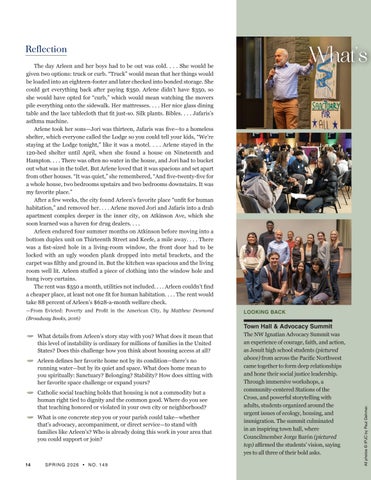
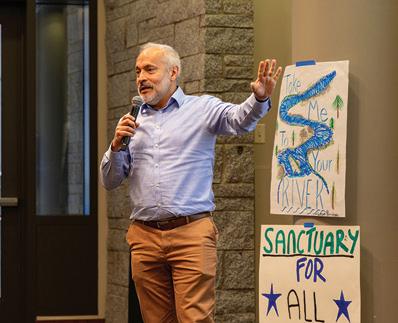
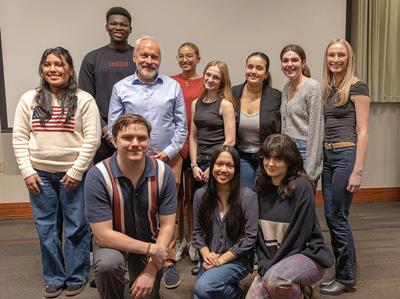
The NW Ignatian Advocacy Summit was an experience of courage, faith, and action, as Jesuit high school students (pictured above) from across the Pacific Northwest came together to form deep relationships and hone their social justice leadership. Through immersive workshops, a community-centered Stations of the Cross, and powerful storytelling with adults, students organized around the urgent issues of ecology, housing, and immigration. The summit culminated in an inspiring town hall, where Councilmember Jorge Barón (pictured top) affirmed the students’ vision, saying yes to all three of their bold asks.