“Jesus put his own body, his own life, on the line for the poor and for the marginalized and people who had less power than empire and systems…”
From the Editor
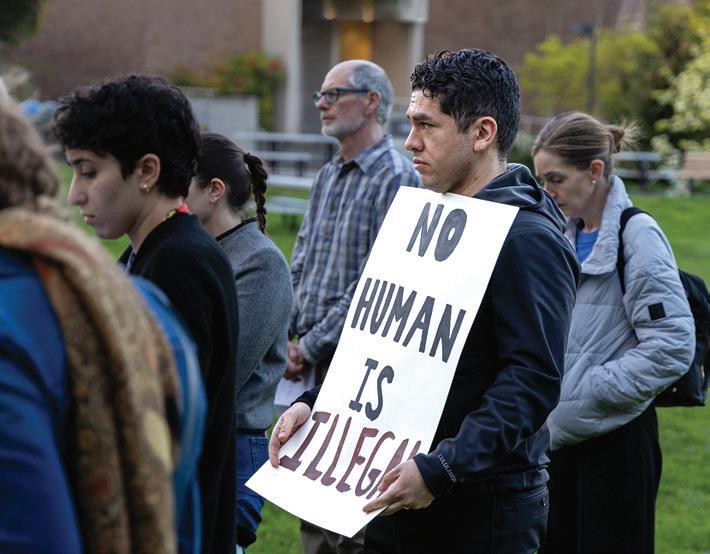
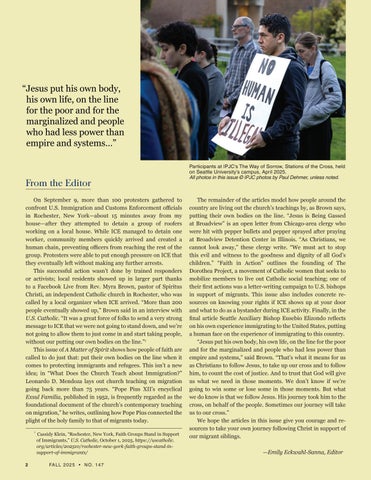
On September 9, more than 100 protesters gathered to confront U.S. Immigration and Customs Enforcement officials in Rochester, New York—about 15 minutes away from my house—after they attempted to detain a group of roofers working on a local house. While ICE managed to detain one worker, community members quickly arrived and created a human chain, preventing officers from reaching the rest of the group. Protesters were able to put enough pressure on ICE that they eventually left without making any further arrests.
This successful action wasn’t done by trained responders or activists; local residents showed up in larger part thanks to a Facebook Live from Rev. Myra Brown, pastor of Spiritus Christi, an independent Catholic church in Rochester, who was called by a local organizer when ICE arrived. “More than 200 people eventually showed up,” Brown said in an interview with U.S. Catholic. “It was a great force of folks to send a very strong message to ICE that we were not going to stand down, and we’re not going to allow them to just come in and start taking people, without our putting our own bodies on the line.”1
This issue of A Matter of Spirit shows how people of faith are called to do just that: put their own bodies on the line when it comes to protecting immigrants and refugees. This isn’t a new idea; in “What Does the Church Teach about Immigration?”
Leonardo D. Mendoza lays out church teaching on migration going back more than 75 years. “Pope Pius XII’s encyclical Exsul Familia, published in 1952, is frequently regarded as the foundational document of the church’s contemporary teaching on migration,” he writes, outlining how Pope Pius connected the plight of the holy family to that of migrants today.
1 Cassidy Klein, “Rochester, New York, Faith Groups Stand in Support of Immigrants,” U.S. Catholic, October 1, 2025, https://uscatholic. org/articles/202510/rochester-new-york-faith-groups-stand-insupport-of-immigrants/
The remainder of the articles model how people around the country are living out the church’s teachings by, as Brown says, putting their own bodies on the line. “Jesus is Being Gassed at Broadview” is an open letter from Chicago-area clergy who were hit with pepper bullets and pepper sprayed after praying at Broadview Detention Center in Illinois. “As Christians, we cannot look away,” these clergy write. “We must act to stop this evil and witness to the goodness and dignity of all God’s children.” “Faith in Action” outlines the founding of The Dorothea Project, a movement of Catholic women that seeks to mobilize members to live out Catholic social teaching; one of their first actions was a letter-writing campaign to U.S. bishops in support of migrants. This issue also includes concrete resources on knowing your rights if ICE shows up at your door and what to do as a bystander during ICE activity. Finally, in the final article Seattle Auxiliary Bishop Eusebio Elizondo reflects on his own experience immigrating to the United States, putting a human face on the experience of immigrating to this country.
“Jesus put his own body, his own life, on the line for the poor and for the marginalized and people who had less power than empire and systems,” said Brown. “That’s what it means for us as Christians to follow Jesus, to take up our cross and to follow him, to count the cost of justice. And to trust that God will give us what we need in those moments. We don’t know if we’re going to win some or lose some in those moments. But what we do know is that we follow Jesus. His journey took him to the cross, on behalf of the people. Sometimes our journey will take us to our cross.”
We hope the articles in this issue give you courage and resources to take your own journey following Christ in support of our migrant siblings.
—Emily Eckwahl-Sanna, Editor