insightnews.com
Insight News • June 22, 2026 - June 28, 2026 • Page 1
Insight News
INSIGHT NEWS WON THE MESSENGER AWARDS 2024 F OR THIRD PLACE IN WEBSITE EXCELLENCE, THIRD PLACE IN LAYOUT & DESIGN AND FIRS T PLACE F OR NEWSLETTER EXCELLENCE.
June 22, 2026 - June 28, 2026
Vol. 53 No. 25 • The Journal For Community News, Business & The Arts • insightnews.com
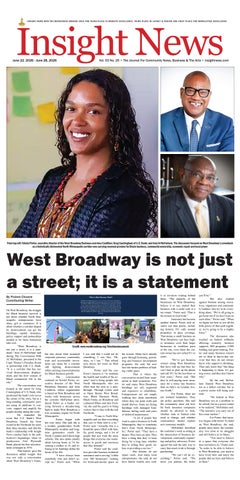
From top left: Kristel Porter, executive director of the West Broadway Business and Area Coalition; Greg Cunningham of U.S. Bank; and host Al McFarlane. The discussion focused on West Broadway’s comeback as a historically disinvested North Minneapolis corridor now carrying renewed promise for Black business, community ownership, economic repair and local power
West Broadway is not just a street; it is a statement By Pulane Choane Contributing Writer On West Broadway, the struggle for Black business survival is not about whether North Minneapolis entrepreneurs have ideas, grit or customers. It is about whether a corridor shaped by disinvestment can get the buildings, capital, insurance, policy support and partnerships needed to let those businesses take root. “West Broadway is not just a street, it is a statement,” host Al McFarlane said during The Conversation With Al McFarlane, presented at the Capri Theater’s Paradise Room in partnership with U.S. Bank. “It is a corridor that has survived disinvestment, displacement, and the slow erasure of Black commercial life in the city.” The conversation was framed at the outset by Greg Cunningham of U.S. Bank, who positioned the bank’s role not as the center of the story, but as a long-standing community partner using its platform to convene, support and amplify the people already doing the work. He reminded the room that U.S. Bank’s West Broadway branch has been rooted in the Northside for more than three decades, and that the bank’s relationship with Insight News reaches back to the publication’s beginnings, when its predecessor, First Plymouth Bank, placed the first advertisement in Insight in 1974. That history gave the discussion added weight: this was not only a conversation about West Broadway’s future,
Credit: www.westbroadway.org/blackbusinessweek but also about what sustained corporate presence, community trust and accountable investment can mean for a corridor still fighting disinvestment while carrying renewed promise for Black business growth. The conversation centered on Kristel Porter, executive director of the West Broadway Business and Area Coalition, whose organization is based on West Broadway and works with businesses across the corridor. McFarlane introduced Porter as a leader carrying forward a decades-long fight to make West Broadway a true economic engine for North Minneapolis. Porter began with her own story. She said she is a mother, grandmother, North Minneapolis resident and longtime gymnastics coach for North, Camden and Edison high schools. She also spoke plainly about leaving home at 14, becoming a mother at 14, and refusing to let hardship define the limits of her life. “I have always been somebody who just didn’t accept no,” Porter said. “When
I was told that I could not do something, I was like, ‘Oh, okay, so I can.’” That refusal now drives her work on West Broadway. Porter said the coalition’s mission is “to maintain the health and wealth of the avenue” and to bring people into North Minneapolis who too often treat the area as a passthrough. Through events such as Open Streets West Broadway, Black Business Week, Black Friday on Broadway and a planned Blues and Jazz Festival, she said the goal is to bring visitors face to face with the real Northside. “Come to North Minneapolis and see that everything that you’ve been told is a lie,” Porter said. “Actually, this is a beautiful space filled with family, good energy, and a lot of people that just want the same things that everyone else wants: access to goods and resources that they demand.” Porter said the coalition provides business technical assistance and is serving “a little over 300 businesses” looking for brick-and-mortar space on
the avenue. Many have already gone through licensing, permitting and business development programs, she said, but now face the harder problem of finding viable space. That is where the conversation turned from inspiration to hard economics. Porter said many West Broadway buildings are old, neglected and expensive to rehabilitate. Entrepreneurs are not simply walking into clean storefronts where they can paint walls and install shelves. Some are facing buildings with damaged foundations, failing roofs and years of deferred maintenance. “A lot of people that want to open a business in North Minneapolis, they’re somebody that’s from North Minneapolis,” Porter said. “They have a dream. They have an idea. They have a thing that they’ve been doing for a long time, whether they’re selling their goods online or providing a service.” But dreams do not repair roofs. And many local entrepreneurs, she said, do not have family wealth, easy cred-
it or investors waiting behind them. “The majority of the businesses on West Broadway, believe it or not, started their business with a credit card or a tax return,” Porter said. “That is the honest-to-God truth.” Insurance has become another barrier. Porter said insurers use data points, including historic 911 calls around properties, to price coverage. That means a small business on West Broadway can face higher insurance costs than larger businesses in wealthier parts of the city, even when the current owner has not called 911 in years. “We’ve got business owners along West Broadway that have told me that they haven’t had to pick up the phone and call 911 for the last three or four years,” Porter said. “But they’re still paying more insurance for a teeny tiny business than an Aldi’s on Lyndale Avenue South.” For Porter, these are not isolated headaches. They are policy questions. She said the community must ask how far back insurance companies should be allowed to look, whether state or federal rules need to change, and whether communities should explore new insurance models. McFarlane described the coalition’s work as sitting at the intersection of business development, community organizing and policy advocacy. Porter agreed but said the only way to carry that much work is through partnership. “We can’t all do everything,” Porter said. “The more you partner, the better
you’ll be.” She also warned against burnout among executives, organizers and community builders who try to do everything alone. “We’re all going to get burnt out if we don’t lean on each other,” Porter said. “When we figure out how to sew all the little pieces of that quilt together, we’re going to be a mighty force.” The discussion also touched on federal rollbacks affecting minority business supports, DEI programs, CDFI funding and grant making. Porter said many business owners are so deep in day-to-day survival that they do not always know why support is shrinking. They only know that “this thing is happening to them, it’s getting worse, and they don’t know why.” By the end, McFarlane framed West Broadway not as a deficit corridor, but as a power center still being realized. “We looked at West Broadway not as a problem to be solved, but as a power center to be realized,” McFarlane said. “The narrative you carry out of this room matters.” For Porter, that narrative begins with belief. To build on West Broadway, she said, people must know the community, live close to its struggles and still believe in its future. “You need to believe in a space that everyone else does not believe in,” Porter said. “In order to be able to believe in West Broadway, you need to have lived here and know the people that are here and believe in them.”