insightnews.com
Insight News • June 1, 2026 - June 7, 2026 • Page 1
Insight News
INSIGHT NEWS WON THE MESSENGER AWARDS 2024 F OR THIRD PLACE IN WEBSITE EXCELLENCE, THIRD PLACE IN LAYOUT & DESIGN AND FIRS T PLACE F OR NEWSLETTER EXCELLENCE.
June 1, 2026 - June 7, 2026
Vol. 53 No. 22 • The Journal For Community News, Business & The Arts • insightnews.com
Credit: Uzoma Obasi
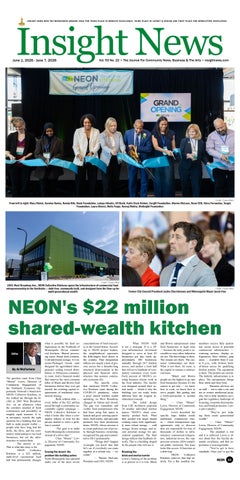
From left to right: Mary Stoick, Sunrise Banks, Ramla Bile, Bush Foundation, Lataya Allseits, US Bank, Katie Clark Sieben, Cargill Foundation, Warren McLean, Neon CEO, Kiera Fernandez, Target Foundation, Laura Oberst, Wells Fargo, Neeraj Mehta, McKnight Foundation
Credit: Uzoma Obasi
2041 West Broadway Ave., NEON Collective Kitchens opens the infrastructure of commercial food entrepreneurship to the Northside — debt-free, community-built, and designed from the floor up for multi-generational wealth
Credit: Uzoma Obasi
Former City Council President Jackie Cherryhomes and Minneapolis Mayor Jacob Frey
NEON's $22 million shared-wealth kitchen Editor
By Al McFarlane The question came from Clara “Missie” Lewis, Director of Community Engagement of the Northside Economic Opportunity Network’s brand-new NEON Collective Kitchens, as she walked me through the facility at 2041 West Broadway Ave. on an afternoon when the corridors smelled of fresh construction and possibility in roughly equal measure. It is, in retrospect, exactly the right question for a building that was built to make people visible — people who have long had the skills, the drive, and the community relationships to run food businesses, but not the infrastructure to sustain them. The answer is yes. That is what this story is for. NEON Collective Kitchens is a $22 million, multi-level commercial food hub that permanently changes
what is possible for food entrepreneurs on the Northside of Minneapolis. Eleven commercial kitchens. Shared processing zones. Retail food counters. Cold and frozen storage. A Consumer-Packaged Goods suite designed for agricultural entrepreneurs scaling toward distribution. A 104-person community room. And a financial model that removes the most common killer of Black and Brown food businesses before they ever get started: the crushing capital requirements of traditional commercial leasing. Built without debt — every dollar of the $22 million raised through a community-accountable capital campaign — NEON Collective Kitchens is what it looks like when a community refuses to wait for the private market to solve a problem it created. “The goal is to make North Minneapolis a destination instead of a drive-thru.” Clara “Missie” Lewis, Director of Community Engagement, NEON
Erasing the desert: the problem this building solves
North Minneapolis has operated under one of the most severe
concentrations of food insecurity in the United States. According to NEON project leaders, the neighborhood represents the fifth-largest food desert in the country. That designation reflects not simply a lack of grocery access but a decades-long structural disinvestment in the physical and financial infrastructure that sustains community economic life. The specific crisis that catalyzed NEON Collective Kitchens came during the COVID-19 pandemic, when a prior shared kitchen model operating on West Broadway changed its format and closed. The gap was immediate and visible: food entrepreneurs who had been using that space to launch and grow catering operations, food trucks, and specialty products lost their production home. NEON, whose mission is to create pathways out of poverty through business ownership, recognized the gap and committed to fill it permanently. “Things don’t happen overnight, you know that. But let’s see if everybody can come together in a certain way — we could.” — Warren McLean, President and CEO, NEON
What NEON built is not a stop-gap. It is a 30year infrastructure investment designed to serve at least 85 businesses per day, reach approximately 300 businesses annually through 24/7 kitchen access, and anchor a food hall that will serve hundreds of community customers every week. Forty percent of NEON’s existing business clients work in the food industry. The facility was designed around their actual needs — which is why the building you see today looks different from the original architectural concept. The initial design from LSE Architects proposed 24 smaller individual kitchen spaces. NEON’s client community pushed back. What they needed was larger shared cooking zones with significantly more robust storage — cold storage, frozen storage, and secure personal storage for specialized equipment. The final design reflects that feedback directly. This is a building shaped by the people who will use it.
Breaking the brick-and-mortar barrier
Lewis’s framing of the problem is as precise as it is true. Black
and Brown entrepreneurs enter food businesses at high rates — because the entry point is accessible in ways other industries are not. The knowledge is there. The recipes are there. The customer relationships are there. What is not there, for most, is the capital to sustain a commercial lease. “Black and Brown people are the highest to go into food businesses because it’s the easiest to get into — we know how to cook, we know how to serve people. But getting into a brick-and-mortar is another thing.” — Clara “Missie” Lewis, Director of Community Engagement, NEON Lewis described the specific traps hidden inside traditional commercial leases — where entrepreneurs sign agreements only to discover they are responsible for tens of thousands of dollars in infrastructure: commercial refrigerators, industrial stoves, fire suppression systems, ADA-compliant public restrooms. The lease looks like access. It functions as a debt trap. NEON Collective Kitchens removes that trap entirely. For a flat monthly fee,
members receive fully permitted, secure access to premium commercial infrastructure — warming stations, display refrigeration, blast chillers, prep areas — available from 8 a.m. to 8 p.m., with 24-hour backof-house access for qualifying kitchen tenants. The equipment is there. The permits are current. The liability infrastructure is in place. The entrepreneur brings their talent and their food. Business advisors are on staff — not to take a cut, and not to extract intellectual property, but to help members navigate the regulatory landscape of licensing, corporate documentation, and brand protection. Lewis put it plainly: “They’re just helping them create generational wealth.” — Clara “Missie” Lewis, Director of Community Engagement, NEON The standard is real and it is enforced. Lewis is direct about this: the facility demands excellence, and that expectation is non-negotiable. “You’ve got to have standards. Once you’ve got the
NEON 10