



















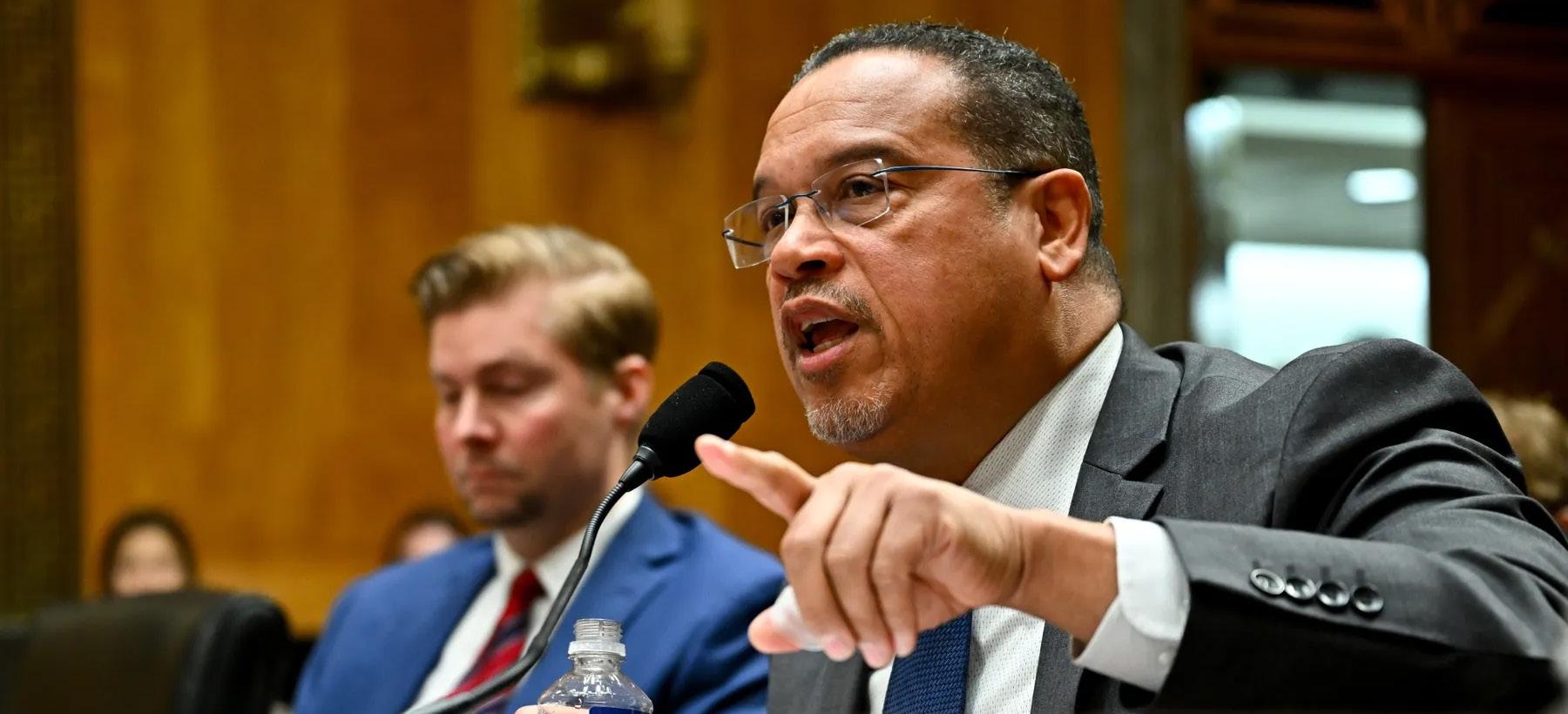
Minnesota Attorney General Keith Ellison defended his office’s handling of immigration enforcement and fraud investigations Thursday during a tense Senate oversight hearing that exposed deep divisions between state and federal officials. Ellison appeared before the Senate Homeland Security and Governmental Affairs Committee alongside Minnesota Public Safety Commissioner Bob Jacobson and top federal immigration officials. Lawmakers focused their questioning on what they called a breakdown in cooperation between Minnesota authorities and federal agencies, particularly Immigration and
“ …we will not be bullied or blamed
for systemic issues that transcend any single jurisdiction.”
-Minnesota Attorney General Keith Ellison
Customs Enforcement (ICE), over ongoing investigations tied to immigration and pandemic-related fraud.
“I stand by my record,” Ellison said. “We’ve
prosecuted fraud vigorously in Minnesota. What we’re not going to do is be scapegoated for federal policy failures.” Ellison said his office has repeatedly sought cooper-
ation from the Justice Department and other federal entities investigating the case but received little information in return.
“We’ve reached out to federal partners on multiple occasions,” Ellison testified.
“We have ongoing investigations into individuals connected to the Feeding Our Future network, but the federal government has not been forthcoming with the information we need.”
At one point, Ellison accused federal authorities and lawmakers of politicizing en-
The Congressional Black Caucus delivered an unflinching message at a Capitol Hill press conference today, warning that the Trump administration’s policies are inflicting deep and lasting harm on Black Americans. Surrounded by leaders from major civil rights organizations and historically Black fraternities and sororities, CBC members framed the moment as a pivotal test of the nation’s democratic commitments.
The event, held during Black History Month, carried both symbolic weight and political urgency. CBC Chair Rep. Yvette Clarke opened the conference by declaring that the administration’s actions rep-
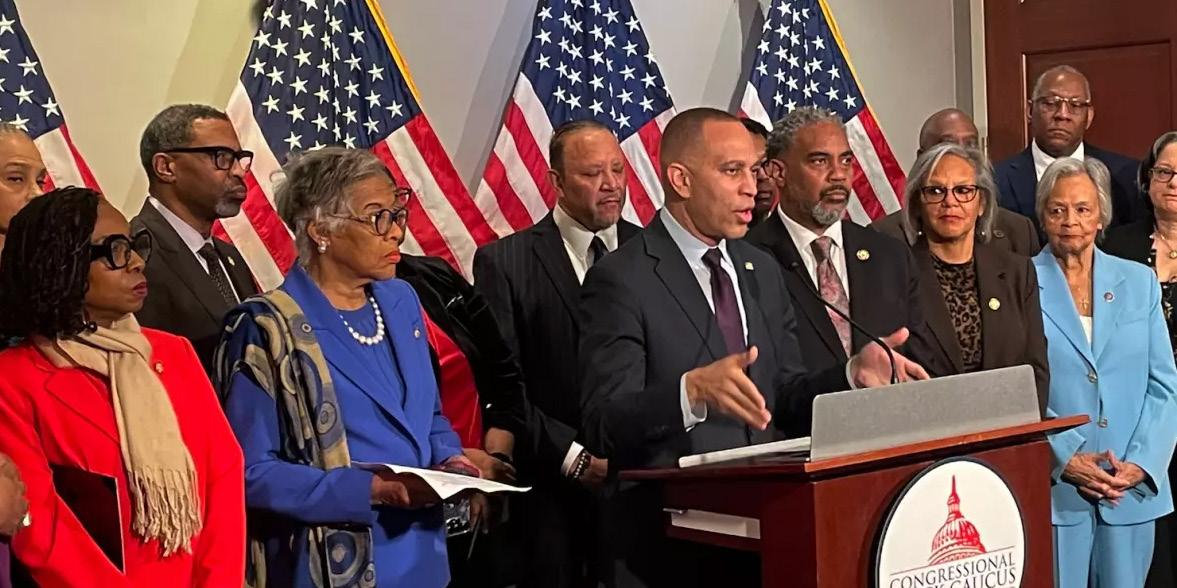
resent a direct assault on civil rights, voting access, and long standing social protections. “It is critical that we gather in this moment, given what we are up
against across the country,” she said, emphasizing that the caucus views the current climate as a coordinated rollback of hard won freedoms.

Donald Trump claimed on Feb. 1 that his administration was in contact with “the highest people in Cuba” and was close to reaching a deal. But multiple reports say no such high-level negotiations are taking place.
Drop Site News reported this week that five anonymous Cuban and U.S. officials denied any active talks between Havana and Washington, despite Trump’s public statements. One senior Trump administration official told Drop Site that Trump is repeating what Secretary of State Marco Rubio is telling him.
According to the official, Rubio’s strategy is to create the impression that negotiations are underway — and then later portray diplomacy as exhausted and pointless, placing blame on Cuba. The source said this would allow the administration
to justify escalating pressure on the island, including policies aimed at regime change. The New York Times has also reported there have been no substantive negotiations between Cuba and the Trump administration. A senior State Department official told the Times that the two governments have not held talks over changes to Cuba’s political or economic system, and that communications have largely been
A Unified Front Against What Leaders Call a ‘Dangerous Agenda’
House Minority Leader Hakeem Jeffries delivered some of the day’s strongest remarks, asserting that “Black America is under attack” and accusing the administration of enabling policies that exacerbate inequality and undermine democratic norms. He argued that the Republican Party has become “a reckless rubber stamp” for what he described as an extreme agenda. Civil rights leaders echoed these concerns, pointing
Historic call launches 90-day activation to protect Black migrants
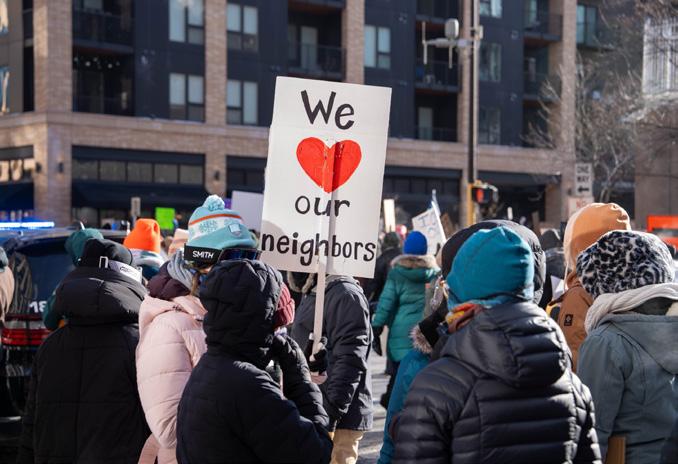
A powerful coalition of Blackled organizations is calling Minnesota into a new chapter of solidarity, protection, and coordinated action.
Border agents to withdraw as metro surge winds down

Federal officials announced last Monday that “Operation Metro Surge” will begin a gradual drawdown, with 2,000 agents slated to leave Minnesota over the next two weeks.
Trump appointee Tom Homan made the announcement during a morning press conference, signaling what he described as a slow end to the operation that has defined the past six weeks in Minneapolis and surrounding communities.
Gov. Tim Walz and Minneapolis Mayor Jacob Frey
said they do not yet have additional details about the withdrawal but are “cautiously optimistic” about the reduction in federal presence.
Ward 10 Council Member Aisha Chughtai called the announcement a testament to community organizing and solidarity across the city.
“Our community came together and pushed back an occupation of our city,” Chughtai said in a statement to residents. “A retreat from Tom
Waters introduces bill to guarantee meals for children and families in Gaza
“We don’t just name what’s wrong. We build what’s next.”
“We don’t just name what’s wrong. We build what’s next.”
The coalition brings together Black-led organizations and community leaders committed to advancing safety, dignity, and belonging. Their shared mission moves beyond survival toward stability, infrastructure, and futures that are not only possible, but deeply
The African American Leadership Forum, a founding member of the Minnesota Black Migration Coalition, is convening a historic kickoff gathering on Wednesday, February 25, 2026, at 6:00 PM CST. The event marks the official launch of the National and Global Call for Minnesota — a 90-day activation designed to transform solidarity into tangible support for Black migrant communities across the state. At a moment when Black migrants in Minnesota face urgent challenges — from rights protections to direct assistance and legal support — coalition leaders say the response must be bold, strategic, and grounded in long-term vision.

felt. Organizers describe the kickoff as more than a meeting — it is a portal. A space to align values with systems. A coordinated effort to ensure Black migrants are protected, resourced, and surrounded by
community-backed support. The 90-day activation will mobilize national and international networks to direct resources and strategic action
“The children of Gaza deserve three meals a day!”
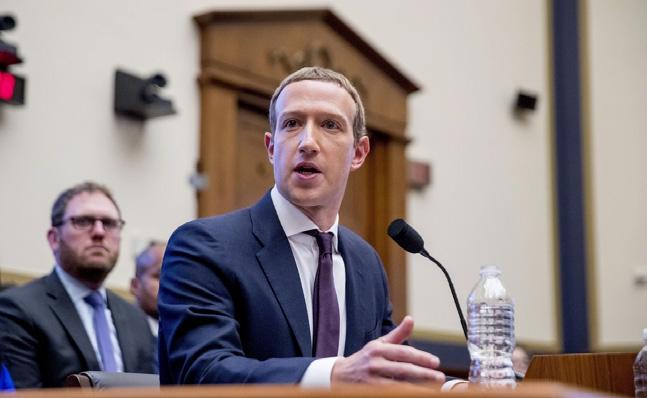
Congresswoman Maxine Waters (CA-43), Ranking Member of the House Financial Services Committee, has introduced the Food for Palestinian Children and Families in Gaza Act, legislation aimed at ensuring consistent and adequate food assistance for civilians in Gaza.
Waters said the humanitarian crisis in Gaza demands urgent action, particularly for children facing widespread hunger and malnutrition.
“The children and families of Gaza have been devastated by the war, and the food assistance being provided is far from sufficient,” Waters said.

“The children of Gaza deserve three meals a day to begin to recover from the war and to grow up healthy and strong. My bill

By Haley Taylor Schlitz, Esq.
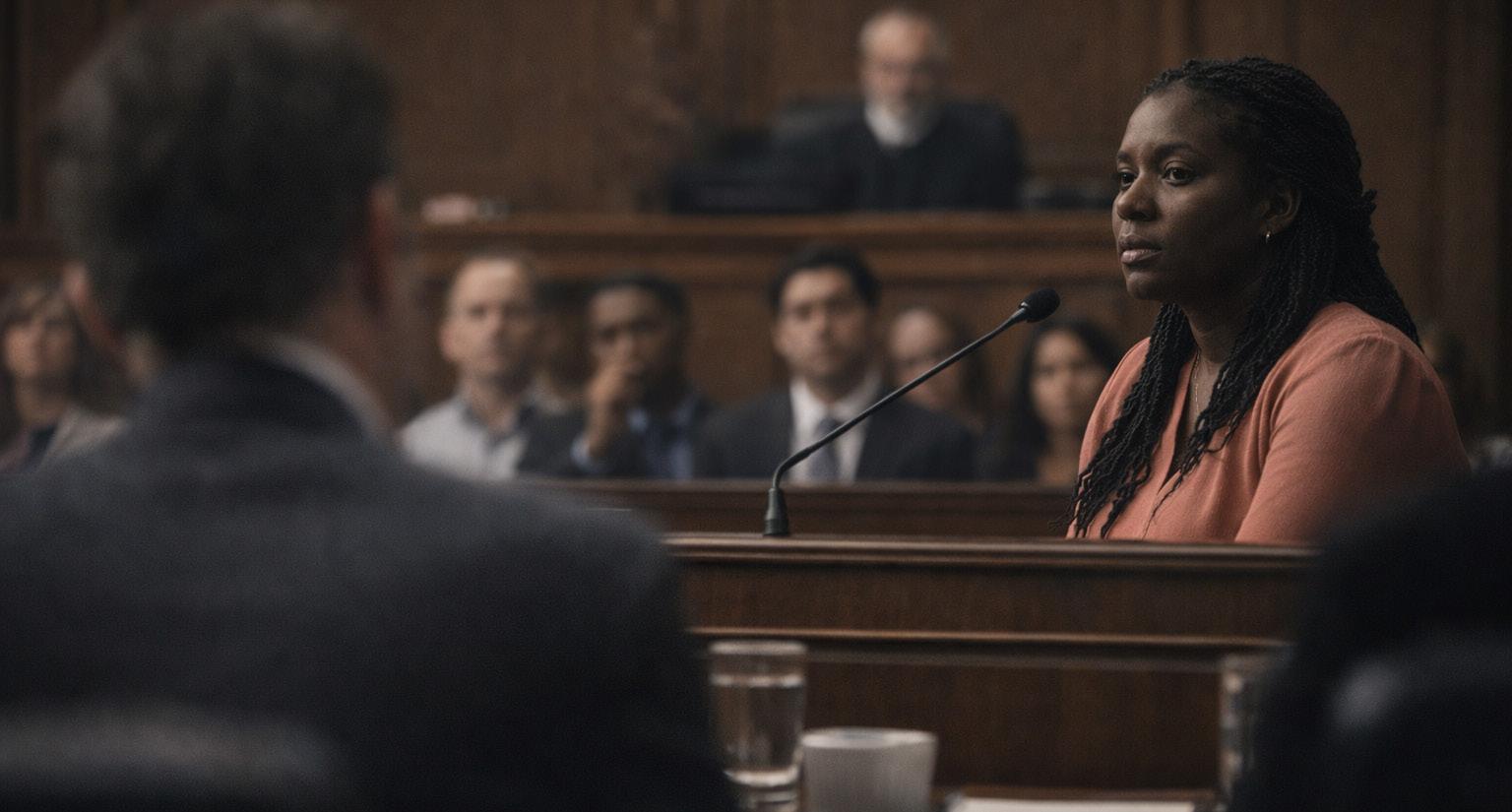
There is a moment in court when you realize the room is already leaning toward a verdict before all the witnesses have even finished testifying, before the jury has heard all the evidence.
It is small, almost mundane, the scrape of a chair as someone settles in, the quiet shuffle of papers, the glance exchanged at counsel table, the gallery’s posture shifting into certainty. The witness has barely begun, the judge has not looked up, and yet the story is already being sorted into two piles: what will be treated as “credible,” and what will be treated as “convenient.” And outside that room, the same instinct plays out faster, louder, and with fewer rules.
A Black woman describes an off-the-record conversation with a politician, and suddenly the internet becomes a courtroom that only knows one kind of evidence: a recording. Not context. Not pattern. Not power. Just the clean, bloodless certainty of audio, as if the people who have made American politics what it is have ever volunteered to be recorded when they speak plainly.
That is the atmosphere that formed after TikTok creator Morgan Thompson posted a video describing a private exchange she says she had with
Texas State Rep. James Talarico, now running in a crowded Democratic primary for U.S. Senate. Her claim was blunt: that Talarico told her he “signed up to run against a mediocre Black man, not a formidable and intelligent Black woman,” a line she said was meant to distinguish Colin Allred from Jasmine Crockett. The details ricocheted quickly, and soon Allred himself responded publicly, attacking Talarico and urging support for Crockett.
But what stayed with me was not only the political fallout. It was the choreography of disbelief.
One of the early reactions, captured in the comment section, tried to turn Morgan into the suspect and the campaign into the victim: “This feels like a smear campaign…” Another commenter framed the timeline itself as the crime, as if a delay automatically voids the reality of what a person experienced. Those comments did not interrogate what was said. They interrogated the audacity of saying it out loud.
Then came the pivot, and the pivot is the point.
After the story caught fire, reporting noted that Talarico acknowledged the conversation occurred while disputing Morgan’s characterization of what he said, arguing instead that he referred to Allred’s 2024 Senate effort as a “mediocre campaign,” not Allred himself as a “mediocre Black man.” The line changed, but watch what else changed with it: for many skeptics, the standard of proof suddenly relaxed. The same people who demanded an audio file from Morgan were willing to accept a campaign statement, immediately, as sufficient. This is how the internet courtroom often works. The witness is cross-examined. The institution is presumed honest. You could see the whiplash in the follow-up thread under Morgan’s third video, where a commenter asked, “So did he call Collin Allred's campaign tactics mediocre or did he call him a mediocre black man…” It reads like a neutral request for clarity. But it also
smuggles in a quiet demotion. It recasts Morgan’s account as “speculation and hearsay,” while elevating the campaign’s reframe as the stabilizing truth, the “official record.” In a real courtroom, we would name that for what it is: the weight of power.
This is not about insisting we treat every claim as gospel. Morgan herself says skepticism is valid. The issue is selective skepticism, who receives it, and who gets spared. Because in the same American week where people can shrug and say, “We will never know,” about a comment allegedly made in a back room, we are also watching a familiar ritual play out around rich and powerful men, the ritual where the public is trained to treat patterns as coincidences, to treat repeated harm as messy misunderstanding, to treat women as unreliable narrators of their own lives. Even when new U.S. Department of Justice releases and court filings revive the Jeffrey Epstein ecosystem of names, photos, and proximity,

we still see the same reflex: explain it away, litigate “context,” demand impossible proof from the least powerful people in the story.
So yes, I want to talk about a TikTok. But I want to talk about it the way Black Gen Z, especially women, are forced to talk about everything now: as a case study in how credibility is distributed.
And it is impossible to ignore the larger stage this moment sits on. In 2021 reporting about Andrew Cuomo’s response to sexual harassment allegations, the crisis operation was described the way a courtroom maneuver looks when it is dressed up as “message discipline.” Not a search for truth, but a strategy session about credibility. The witness was not heard, she was handled. Advisers traded notes, tested lines, searched social media, looked for seams they could pull. Lis Smith, a prominent Democratic strategist who advised Cuomo’s political operation during that crisis, appeared as part of that behind-the-scenes ecosystem, a reminder that in politics, “defense” often means shaping the public’s instincts about who deserves to be trusted.
Now Lis Smith is also described in major reporting as an adviser to James Talarico’s Senate campaign, part of the professional class of whisperers who never have to run for office but can still decide how an accusation is framed, and how a woman is treated once she makes it. That history matters here not as gossip, but as method. In the courtroom, there are always whisperers at counsel table, the people who never speak into the microphone but feed the language that changes the temperature of the room. Attack. Devalue. Seed doubt. Then step back and let the talking points arrive dressed as clarity, while the woman who stood up first is forced to meet a standard of proof that the powerful never apply to themselves.
So when Talarico’s team acknowledges the conversation occurred, but reframes the central line as a “mischaracterization of a private con-
versation,” you can almost hear the choreography. The internet jury that demanded a recording from Morgan suddenly accepts a statement from the defense as if it were sworn testimony. The candidate becomes the voice presumed credible, the Black woman becomes the problem to be litigated. And once again, the presumption of truth shifts in the oldest direction, toward the person with the microphone, the staff, the consultants, the polished language, and away from the person who simply said what happened.
Here is the moral tension Black Gen Z can feel in our bones: the party wants a “future,” but too often it wants a future that comes at the cost of our voice, our credibility, and our ability to name harm when we see it. A future where “solutions-focused” quietly means “stop making people uncomfortable.” A future where the quickest way to prove you can win swing voters is to show how easily you can dismiss the people who have always been asked to do the most work for the least protection. In a courtroom drama, there is usually a moment when the judge looks over their glasses and asks the question that actually matters. Not, “Did this story inconvenience someone important?” Not, “Is the witness likable?” Not, “Can we please move on?” The real question is simpler, and sharper: who is this system designed to believe?
If Morgan had been a wealthy donor. If Morgan had been a senior adviser. If Morgan had been a well-connected man with a microphone and a résumé. Would the internet have demanded a recording before it allowed her to be a witness? Or would her word have been treated like what power always pretends it is: proof enough. And if our politics, including the politics we call “blue,” keeps training itself to treat Black women’s testimony as optional, then what exactly are we building, and who do we think it is for?





3
forcement disputes.
“This war on Minnesota is retribution for standing up for fair treatment,” he said. “Our state has cooperated in good faith, but we will not be bullied or blamed for systemic issues that transcend any single jurisdiction.”
The remarks drew pushback from Republican sen-
From 3
to rising economic disparities, threats to voting rights, and inflammatory rhetoric that they say has emboldened discrimination. Representatives from the National Pan Hellenic Council stood alongside CBC members, underscoring a broad coalition mobilizing to counter the administration’s direction.
Black History Month
as a Backdrop — and a Battleground
ators, several of whom accused Ellison of failing to enforce immigration laws effectively. Ellison rejected those claims, saying his office targets wrongdoing “regardless of background.”
“We’ve been tough on fraud, period — whether the defendants are immigrants or not,” Ellison said. “Fraud is fraud.”
Federal officials from ICE, Customs and Border Protection and U.S. Citizenship and Immigration Services also testified, facing bipartisan criticism for inconsistent communication and enforcement practices in
Minnesota and other states. Senators from both parties urged better coordination to address rising immigration caseloads and resource shortages. Minnesota leaders said they are struggling to manage a sharp increase in unaccompanied minors and asylum seekers. Ellison closed his testimony by reiterating his willingness to collaborate with federal authorities.
“Minnesotans deserve a justice system that’s fair and functional,” he said. “We will continue to pursue account-
ability — whether that means challenging fraud or demanding federal cooperation.”
No new actions were announced at Thursday’s hearing, though lawmakers signaled that additional oversight sessions may follow as federal and state officials continue to examine the fallout from the Feeding Our Future investigation and related immigration enforcement disputes.
Sources: CBS News, The Hill, KARE 11, Fox News, Reuters
Thursday’s Senate Homeland Security and Governmental Affairs Committee hearing featured fiery exchanges between Minnesota Attorney General Keith Ellison, federal officials, and Republican senators. Here are five key takeaways from the session.
The press conference also marked the 100th anniversary of Black History Month, a milestone that CBC members said highlights the stakes of the current political moment. Rather than a celebration alone, they framed the centennial as a call to action. Clarke and others argued that the administration’s policies threaten the very progress Black History Month commemorates.
Immigrants
From 3
toward Black organizations and leaders on the ground in Minne-
3
Beast and Drop Site News, Cubans described a sharp deterioration since Trump issued an executive order on Jan. 29 that the outlets said amounts to a de facto oil blockade.
Several speakers referenced recent controversies, including a racist video posted on President Trump’s social media account. Clarke, responding to questions about the incident, said the episode reflects “a bigoted and racist regime” and illustrates the broader climate of
sota.
Community members, advocates, and allies are encouraged to attend and stand in solidarity. The kickoff event takes place Wednesday, Febru-
“Everything is going to get even worse,” Eduardo Riviera, a 28-year-old waiter in Havana, told Belly of the Beast. Riviera said the fuel shortage would lead to more power outages, fewer transportation options, and the closure of businesses — worsening food shortages and price inflation. The crisis has already forced hospitals to reduce services. Havana’s Institute of Gastroenterology has reported-
to you and your neighbors,” she said. “The announcement of so many agents leaving is something to feel proud of.”
Homan and a withdrawal of 2,000 agents makes me proud of all of you.”
Chughtai praised immigrant families for their resilience and neighbors who mobilized to support one another — from distributing whistles and delivering groceries to raising funds for rent relief and opening small businesses as warming and gathering spaces.
“This victory belongs
requires the State Department to ensure this minimum standard for children and families in Gaza.” According to United Nations Secretary-General António Guterres, approximately 1.6 million people in Gaza — more than 75 percent of the population — are projected to face extreme levels of acute food insecurity and critical mal-
Allegations of abuse and calls for accountability
Even as agents prepare to depart, community leaders and residents continue to demand accountability for what they describe as civil rights violations and violence during the operation.
Chughtai and immigrant advocates allege that federal agents operated in
nutrition risks. Nearly 101,000 children between the ages of 6 and 59 months are expected to suffer from acute malnutrition through mid-October 2026, including more than 31,000 severe cases.
“More than three-quarters of the people of Gaza are facing acute hunger and malnutrition, and this is clearly unacceptable,” Waters said. “Children and families in Gaza deserve better.”
Although food assistance began entering Gaza following the October 10 cease-
hostility that Black Americans are confronting.
A Renewed National Strategy The CBC used the press conference to announce a reinvigorated national plan to push back against what they describe as systemic attempts to weaken legal protections for minority communities. The strategy includes coordinated advocacy with civil rights groups, public education campaigns, and legislative efforts aimed at safeguarding voting rights, economic opportunity, and social programs.
Speakers emphasized that the fight is not merely political but moral. They urged
ary 25, 2026, at 6:00 PM CST. Register at callforminnesota.org.
As poet Lucille Clifton wrote: “may the tide that is entering even now
ly shuttered. State-run grocery stores have shortened their operating hours, and public transportation has largely shut down. Some universities have shifted students to remote study.
Cuba’s Deputy Foreign Minister Carlos Fernández de Cossío said last week that the two countries have had “some exchanges of messages” linked to the highest levels of government, but have not established a
masks, conducted racial profiling, entered sensitive locations including schools and houses of worship, and separated children from families. They also cited several deaths and injuries during the enforcement period, including Renee Good and Alex Pretti, the shooting of Julio Cesar Sosa-Celis, and the death of Victor Manuel Diaz while in ICE custody.
“We only know the truth because of the heroes who filmed, the neighbors who whistled, and the families brave enough to share their stories,” Chughtai said. “We have to
fire, relief agencies say supplies remain insufficient to meet the scale of need. The United Nations Office for the Coordination of Humanitarian Affairs reported that as of January 4, partners were able to resume distribution of monthly food rations for the first time since October 2023, reaching approximately 100,000 people.
Under the proposed legislation, the State Department would be required to certify that policies and procedures are in place to ensure all children in Gaza receive at least
Americans of all backgrounds to recognize the moment as a turning point — one that demands vigilance, solidarity, and sustained civic engagement.
A Moment of Clarity and Confrontation Today’s press conference was not a routine political event. It was a forceful declaration that the CBC sees the nation at a crossroads. With the backdrop of Black History Month and the weight of a century of struggle behind them, caucus members made clear that they intend to confront what they view as a dangerous erosion of rights — and to rally the country to do the same.
the lip of our understanding carry you out beyond the face of fear…” For continued updates, policy insights, and community-driven research, visit the Insights Center.
formal bilateral dialogue. In televised remarks Thursday, Cuban President Miguel Díaz-Canel said Cuba remains open to dialogue with the United States, but that the country’s sovereignty is not negotiable.
Cuba has announced a two-part response to the energy crisis. In the short term, the government has launched a
continue to demand justice. We need to stay organized, and we must stay vigilant.”
Federal officials have previously defended the operation as necessary for immigration enforcement and public safety.
While welcoming the reduction in agents, Chughtai emphasized that the broader federal policy of mass deportations remains unchanged.
“We know that today’s announcement has not changed the goal of the Trump Administration,” she said. “For real safety, we need more than a
three nutritious meals per day and that other civilians receive at least two nutritious meals daily.
Waters said the bill mandates coordination with the World Food Program, the United Nations Relief and Works Agency, other appropriate United Nations agencies, bilateral and multilateral donors, the Government of Israel, and representatives of the Palestinian people.
The legislation would also require the State Department to report to Congress on
1. Federal–state tensions remain high Ellison accused federal agencies of “stonewalling” Minnesota investigators seeking documents tied to the Feeding Our Future fraud probe. He said repeated requests for cooperation from the Department of Justice have gone unanswered. “We can’t do our jobs in the dark,” Ellison said.
2. Republicans pressed Ellison on fraud enforcement Sen. Josh Hawley (R-Mo.) and Sen. Joni Ernst (R-Iowa) sharply questioned Ellison’s oversight of the massive pandemic food-aid fraud case. Hawley alleged Ellison intervened to protect defendants — a claim Ellison flatly denied. He responded that Minnesota “has prosecuted fraud vigorously, without fear or favor.”
4. ‘War on Minnesota’ comment sparks reaction Ellison’s remark that “this war on Minnesota is retribution” drew quick pushback from GOP lawmakers, who called the statement inflammatory. Ellison defended it as a critique of politicized investigations targeting his state. Reuters reported that his comments drew audible murmurs in the hearing room.
5. Oversight and cooperation remain unresolved
Despite hours of testimony, senators left the hearing without clear commitments on next steps. Lawmakers from both parties agreed further oversight is needed to clarify responsibilities between state and federal agencies. “Mistrust runs both ways right now,” one committee aide said after the hearing.
Sources: CBS News, The Hill, KARE 11, Fox News, Reuters
3. Immigration enforcement drives political divide Republican senators accused state leaders of failing to cooperate with ICE, while Ellison and Minnesota officials said federal agencies have been inconsistent and underfunded. “We will not be scapegoated for federal policy failures,” Ellison testified, underscoring his office’s limited authority over immigration law.
nationwide energy-saving plan prioritizing fuel and electricity for essential services. Over the medium term, officials say Cuba will expand solar power.
reduction of agents — we need ICE fully out of our state and city.”
She is calling on Minnesota’s elected leaders to publicly disclose details of any discussions or agreements with Department of Homeland Security leadership that preceded the withdrawal announcement.
“That begins with real transparency from all the individuals who have been meeting with DHS leadership,” Chughtai said. “We need and deserve that transparency.”
Community leaders
the volume of food assistance being distributed in Gaza and to promptly notify lawmakers of any instances in which food aid is denied entry, diverted, or misused, including details of the incidents and parties involved. The bill is endorsed by the Center for International Policy Advocacy, Foreign Policy for America (FP4A), Friends Committee on National Legislation (FCNL), J Street, New Israel Fund, New Jewish Narrative, Partners for Progressive Israel, T’ruah: The Rabbinic Call for Human Rights, and Win With-
Brooklyn Center mayor April Graves leads coalition call for recovery as Operation Metro Surge winds down
Brooklyn Center, MN – As the federal immigration enforcement operation known as Operation Metro Surge nears its conclusion, April Graves, mayor of Brooklyn Center, Minnesota, is emerging as a prominent voice for local governments navigating the aftermath of the controversial 10-week surge. Graves, who was elected mayor in 2022 after serving eight years on the city council and became Brooklyn Center’s first Black woman to hold the office, has helped shape her city’s response to the disruptions brought on by the federal deployment.
Operation Metro Surge, launched by the U.S. Department of Homeland Security in early December 2025, deployed thousands of Immigra-
tion and Customs Enforcement (ICE) and Customs and Border Protection personnel across the Minneapolis–St. Paul metro area and beyond. The federal government described the effort as the largest immigration enforcement operation in recent history, but the campaign drew sharp criticism from local officials, advocacy groups, and residents amid arrests of thousands of people, reports of detention of U.S. citizens, and two fatal shootings linked to federal agents.
In a joint statement released on February 12, 2026, by the Cities for Safe and Stable Communities coalition, local leaders including Graves welcomed the announcement byTrump appointee Tom Homan
that the surge would end in the coming weeks. The coalition described the withdrawal or redeployment of federal officers as a much-needed de-escalation that communities had urgently requested.
For Graves and other coalition members, the focus now turns to recovery. The statement noted that the surge imposed “tangible financial and social costs” on cities, including budget strain, disruptions to schools, forced business closures, and widespread economic uncertainty. Coalition leaders said they will prioritize economic recovery, rebuilding public confidence, and restoring trust between residents and government institutions. In her quoted re-
marks, Graves emphasized that residents “deserve to feel safe not only in their homes, but in their daily lives — at school, at work, and in their neighborhoods,” and acknowledged that the past weeks had caused “real disruption for many families.” She framed collaborative, coordinated public safety grounded in respect for all community members as essential to moving forward.
The coalition’s statement also emphasized that effective public safety depends on trust between residents and local institutions, and called for federal agencies to uphold constitutional rights and due-process standards as local law enforcement continues to address challenges left in the surge’s
wake.
Graves’s role in the coalition reflects her broader leadership priorities in Brooklyn Center, where she has advocated for community engagement and inclusive policy forming. Since taking office in January 2023, she has worked on strengthening city governance, supporting equity initiatives, and promoting public safety reforms. As coalition cities assess the full impact of the surge, they are preparing to advocate for policy changes, relief funding, and mechanisms aimed at helping local jurisdictions recover. The coalition has extended an invitation to other affected cities across the region to join in a unified effort to ensure that
say the emotional and economic toll of the operation will linger long after federal agents leave. “The devastation to our city over the last six weeks cannot be quantified,” Chughtai said. “We will need each other on the long road of healing that’s ahead.” For more information, residents can contact Ward 10 at minneapolismn.gov/ward10, email ward10@minneapolismn. gov, or call 612-673-2210. City Hall is located at 350 S. Fifth St., Room 370, Minneapolis, MN 55415.
out War.
Cosponsors include Representatives André Carson (IN-07), Troy A. Carter Sr. (LA-02), Steve Cohen (TN-09), Madeleine Dean (PA-04), Rosa DeLauro (CT-03), Cleo Fields (LA-06), Valerie Foushee (NC04), Sylvia Garcia (TX-29), Jahana Hayes (CT-05), Jonathan L. Jackson (IL-01), Henry C. “Hank” Johnson Jr. (GA-04), Zoe Lofgren (CA-18), Stephen F. Lynch (MA-08), Betty McCollum (MN-04), James P. McGovern (MA-02), and Eleanor Holmes Norton (DC).

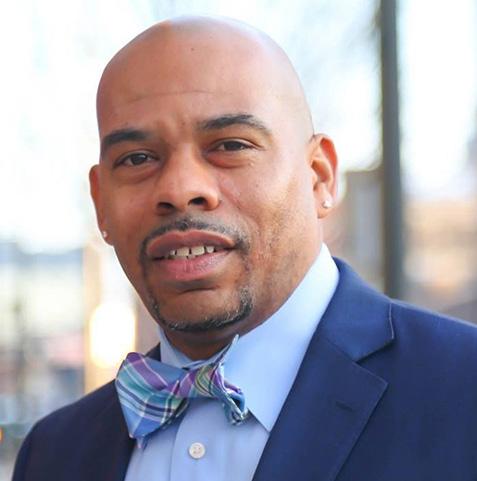
AMPLIFY MPLS, an original content and community engagement series produced by SPEAK MPLS, continues to shine a powerful spotlight on local stories, independent journalism, and the people shaping Minneapolis from the ground up. Airing Mondays at 9:30 p.m. on SPEAK MPLS TV Channel 16 and streaming across digital platforms, AMPLIFY MPLS offers in-depth conversations, community coverage, and storytelling rooted in the lived experiences of Minneapolis residents.
The ongoing series features news segments, producer spotlights, live studio events, and reporting from community journalists whose work reflects the city’s resilience and diversity. From artist-led movements and grassroots organizing to in-depth discussions on social issues, AMPLIFY MPLS positions itself as a vital space for dialogue and cultural connection.
In a recent rebroad-
cast, community members revisited a powerful discussion on how Minnesota communities have been responding to federal occupation in the Twin Cities. Hosted by journalist Harry Colbert Jr. and presented in partnership with Power 104.7, the conversation brought together Leslie Redmond, founder of Don’t Complain, Activate and former president of the Minneapolis NAACP; Dr. Yohuru Williams, professor of history at the University of St. Thomas; and Alex Leonard, firearm safety instructor and co-founder of The Ujima Collective. Together, they explored the path forward for justice and community safety amid heightened federal presence.
Independent journalists Abdirizak Diis of Somali Media of Minnesota and Abdirahman Mukhtar of Tusmo Times joined SPEAK MPLS hosts Rebecca Smith and Saniah Bates on December 19, 2025, for a roundtable on the challenges of reporting on ICE operations


in Minneapolis. The discussion highlighted the impacts on families, neighborhoods, and local faith communities — while emphasizing the critical role of independent media in covering stories that mainstream outlets often overlook.
At 26th and Nicollet, the Kalpulli Yaocenoxtli cultural group held a ceremony to honor Alex Pretti, a 37-yearold ICU nurse killed by federal agents in Minneapolis. “Say his name, Alex Pretti,” community members said in unison as they reflected on healing rituals rooted in Mexica-Nahua traditions. Members Samuel Xochikoyotl Torres and Isavela Lopez spoke of Danza as an act of resistance and remembrance, embodying the intersection of art, culture, and justice that AMPLIFY MPLS aims to share. As spring semester began across Minnesota, AMPLIFY MPLS connected with University of Minnesota–Twin Cities students to discuss campus experiences amid ICE ac-

tivity. Students shared personal reflections on safety strategies and mental health, as UMN introduced flexible hybrid learning options. The coverage highlighted both the challenges and resilience of Minnesota’s student communities navigating an uncertain climate.
At the Minneapolis American Indian Center, protest and art intersected during “Protest Art Day,” presented by NDN Collective and Homegirlz4isa. Participants screenprinted designs by Indigenous artists including Marlena Myles and shii…she…visions, creating visual calls for solidarity and the message “ICE OUT.” Interviews included NDN Collective Founder Nick Tilsen, State Senator Mary Kunesh, poet Isavela Lopez, and activist C.C. Curley, who spoke of community art as both advocacy and healing.
For February, SPEAK MPLS highlights Aaron Johnson, known as D.J.A.D.D., a member journalist whose work


centers marginalized voices and raw authenticity. A South Minneapolis native, Johnson previously worked in Los Angeles and New York before returning home during the pandemic. After contracting COVID-19 and teaching himself to walk again, he began documenting community stories following the murder of Daunte Wright. Johnson, who has collaborated with independent journalist Georgia Fort and Unicorn Riot, said public access channels like SPEAK MPLS are “important for the youth, our community, and an escape from the chaos through creativity.” His weekly coverage airs Fridays at 8 a.m. on Channel 16, and his upcoming documentary, They Sleep Among Us, follows life at Camp Nenookaasi. Follow his work on Instagram at @djaddmpls.
Studio Refresh and Accessible Media Spaces SPEAK MPLS re-

cently unveiled updates to its South Studio, featuring new lighting, refreshed colors, and production-grade equipment designed to support local creators. The studio includes three robotic cameras, professional audio gear, a podcast suite, and edit bays with Adobe Creative Cloud access. Located in the 2429 Building on Nicollet Avenue, the
Saint Paul Parks and Recreation
is welcoming warmer days with a full calendar of spring activities, community celebrations, performance opportunities and seasonal updates for residents of all ages.
With temperatures on the rise, Saint Paul Parks and Recreation has officially opened registration for its spring activities.
Offerings span a wide range of interests and age groups — from Anime and Pokémon clubs to badminton and pickleball, cooking and baking classes, piano and drum lessons, DIY crafts and Fix-It clinics. Outdoor enthusiasts can explore orienteering and nature walks, while creative participants can dive into hands-on workshops.
Programming varies by recreation center. Residents are encouraged to browse all spring activity offerings online to find options in their neighborhood.
Musicians sought for summer 2026 performances
Applications are now open for performers interested in the 2026 summer music season.
Saint Paul Parks and Recreation is seeking musicians for two popular series:
Mears Park Lunchtime Concert Series
Live performances take place in Mears Park beginning at noon on most summer Tuesdays and Wednesdays.
Melodies & Market on the Mississippi
This free event combines live music at the Harriet Island stage with local vendors and food trucks. Performances are scheduled for Wednesdays
— August 19 and 26, and September 2 and 9 — from 5:30–7:30 p.m.
Separate applications are required for each series. Musicians interested in both must complete both forms.
Picnic shelter and pavilion reservations open
Permits for picnic shelters and pavilions are now available, including convenient self-service online booking.
Residents planning gatherings this season can visit stpaul.gov/ParkPermits for details about the permitting process and available facilities. Permit season begins May 4.
Outdoor winter activity updates
As weather conditions fluctuate, several winter recreation updates have been announced: Ice skating
• Refrigerated rinks: Conditions may change quickly during warm weather.
Residents should call their local recreation center for updates.
Non-refrigerated rinks: All are currently closed due to warm temperatures. Downhill ski and snowboard
• The final day for open ski at Como Park Ski Center will be Monday, Feb. 16, from 10 a.m.–6 p.m.
Cross-country ski
• Operations remain weather dependent for the remainder of the season.
Ski passes are required for Saint Paul and Ramsey County cross-country trails (youth ages 12 and under are free).
Trail conditions are updated on Skinny Ski.
• Machine-made trail information is available on the Battle Creek Winter Recreation Area webpage.
Audition for Seussical Jr. at Highland Park
Highland Park Community Center Theatre invites students ages 8–18 to audition for Seussical Jr.
Auditions: February 21 and 28, 1–5 p.m. (45-minute group slots)
• Callbacks: March 7 (by invitation) Video submissions accepted through March 5
• Rehearsals begin May 4
• Performances scheduled for the final two weeks of June
All who audition will be cast. No previous theatre experience is necessary.
Freeze Fest celebrates winter outdoors
Whether Minnesota delivers freezing temperatures or a thaw, Freeze Fest will offer plenty of outdoor fun at the Phalen Lakeside Activity Center.
Free event
February 21, 1–4 p.m.
Volleyball and futsal coaches needed
Saint Paul Parks and Recreation is recruiting volunteer coaches for volleyball and futsal (indoor soccer).
Season details: Practices begin immediately Games run late February through mid-April
• One practice and one game per week
Volleyball: Weeknights, 5:30–8 p.m. 10u/12u: Monday or Tuesday
Blanketed in snow, Minneapolis parks teem with winter wildlife activity unfolding across the city’s natural spaces.
The Minneapolis Park and Recreation Board (MPRB) says community members can participate in three weekend BioBlitz events in February and March, offering residents an opportunity to track wildlife, identify trees and contribute to scientific research in local parks.
The events are designed as hands-on learning experiences led by area experts in animal tracking and tree identi-
fication. Organizers say no prior scientific experience is necessary.
“This is boots-on-theground science,” MPRB representatives note. “You don’t have to be a scientist to take part.”
A BioBlitz is a concentrated community effort to document as many species as possible within a specific area and timeframe. Volunteers of all ages and backgrounds work alongside experts to create a snapshot of biodiversity in a given park. Participants help:
Identify plants, animals, fungi and other organisms Explore the biodiversity of Minneapolis parks
• Contribute research-grade data used by scientists Learn field identification techniques, with tools provided
• Connect with neighbors and nature—even in winter The BioBlitz Minneapolis Parks program has already generated measurable impact in 2025:
• 24 BioBlitz events planned throughout the year
• 14u/18u: Wednesday or Thursday
Futsal: Saturdays, 9 a.m.–2 p.m.
Coaches must complete required training (background check, concussion training, coaching test and code of conduct) and commit to positive mentorship and skill development.
Interested applicants should email muni@ci.stpaul. mn.us and indicate preferred sport and location.
Winter and spring special events
A variety of seasonal events are planned across the city.
February highlights
Feb. 19: Black History Month Community Dinner (Wilder)
Feb. 21: Winter Craft Bazaar (El Rio Vista)
Feb. 21: Freeze Fest (Phalen Regional Park)
Feb. 28: Winter Play Day (Crosby Farm Regional Park)
March
March 8: House Plant Bingo Bazaar (Harriet Island)
April
April 2: Egg Hunt (McDonough)
April 4: Spring Holiday Carnival (Arlington Hills)
April 6–11: Prom Sale (Hazel Park)
April 16: Spring Fling Celebration (Linwood)
April 17: Parents Night Out (Groveland)
April 18: Spring Craft Fair (Edgcumbe)
April 21: Tot Time Spring Fling (Highland Park)
April 26: Summer Choice Fair (Jimmy Lee/Oxford)

1,580 research-grade identifications recorded by participants • 477 unique species documented Organizers say the data collected contributes to broader ecological research and helps track environmental health in the city’s park system.

• April 29: Family Spring Celebration (Frogtown)
Senior events and trips Older adults can enjoy upcoming trips and celebrations including:
• Senior Trip to Chanhassen Dinner Theater for “Grease” (El Rio)
• Seniors Cinco De Mayo Luncheon (El Rio Vista Recreation Center)
• Seniors St. Patrick’s Day Celebration (El Rio Vista Recreation Center)
Nature-based family programming
ExploraTots
ExploraTots is a free, nature-based Pre-K program for children ages 3–5 and their families. Sessions take place monthly at the Como Streetcar Station on select Thursdays and Saturdays from 10–11:30 a.m. Registration is required, and children must attend with an adult.
Family Ecology Club
Held monthly at the Como Woodland Outdoor Classroom, Family Ecology Club invites families with children ages 6–12 to explore seasonal topics, play games and search for signs of life in the park. Registration is required.
Parks After Dark:
Certified track and sign professional Bill Kass will guide participants through the art and science of identifying animal tracks left behind in fresh snow.
Saturday, February 21 | 9–11 a.m.
North Mississippi Regional Park Sunday, March 8 | 9–11 a.m. Mississippi Gorge Regional Park
Participants will learn how to distinguish between species by examining footprints, stride patterns and other subtle clues left in winter landscapes.
Naturalist Rachel Putnam of the Kroening Nature
Owl Prowl Participants will walk along the Mississippi River to learn about local owl species and listen for their calls. March 4, 7:30–9 p.m. $3 per person Registration required.
Featured youth activities Highlighted upcoming youth programs include: Anime and Ramen (Arlington Hills) • Clay Creations (Arlington Hills) • Pokémon Club (Arlington Hills) DIY Candle Making (Battle Creek) • DND Campaign (Battle Creek) DIY Paper Bouquet (Battle Creek) EGG-TRA Awesome Egg Painting (Battle Creek)
Math Help (Battle
throughout the winter and into spring.
Center will lead a session focused on identifying trees without their leaves.
Saturday, March 7 | 1–3 p.m.
Mississippi Gorge Regional Park The workshop will teach participants how to recognize trees by bark texture, branching structure, buds and overall shape—skills that allow year-round identification.
Funding for the BioBlitz Minneapolis Parks program comes from the Minnesota Environment and Natural Resources Trust Fund, as recommended by the Legislative-Citizen Commission on Minnesota Resources (LCCMR).
By Muneer KarcherRamos
In the weeks since the federal immigration enforcement surge began in Minnesota, daily life across the state has been upended, not randomly, but through a familiar pattern of disproportionately targeting people based on their place of birth and what they look like. Communities have rallied to defend, protect, and care for neighbors who have been targeted and harmed, while also grieving the devastating losses of Renee Good and Alex Pretti—whose deaths at the hands of federal immigration agents have seared this moment into our collective memory.
While border czar Tom Homan recently announced the immediate surge is ending, the harms unfolding now will not disappear when federal activity shifts, or the news cycle moves on. There are long term impacts to housing, jobs, schools, and local economies, and our communities need partners who are willing to stay, invest, and help rebuild the stability that every family deserves.
“This fear doesn’t just cut off income, but the everyday connections that help families stay anchored in place—isolating families and disrupting the daily routines that keep neighborhoods, schools, and local economies strong.”–MUNEER KARCHER-RAMOS
Immigrant owned corridors that typically hum with activity, including Lake Street, the Midtown Global Market, Payne Avenue, and key Hmong markets and Somali community hubs, have fallen quiet as workers stay home and customers avoid public spaces. Some businesses have closed their doors—not because they want to, but because the people who sustain them no longer feel safe moving through their own neighborhoods.
This fear doesn’t just cut off income, but the everyday connections that help families stay anchored in place—isolating families and disrupting the daily routines that keep neighborhoods, schools, and local economies strong.
For hourly workers
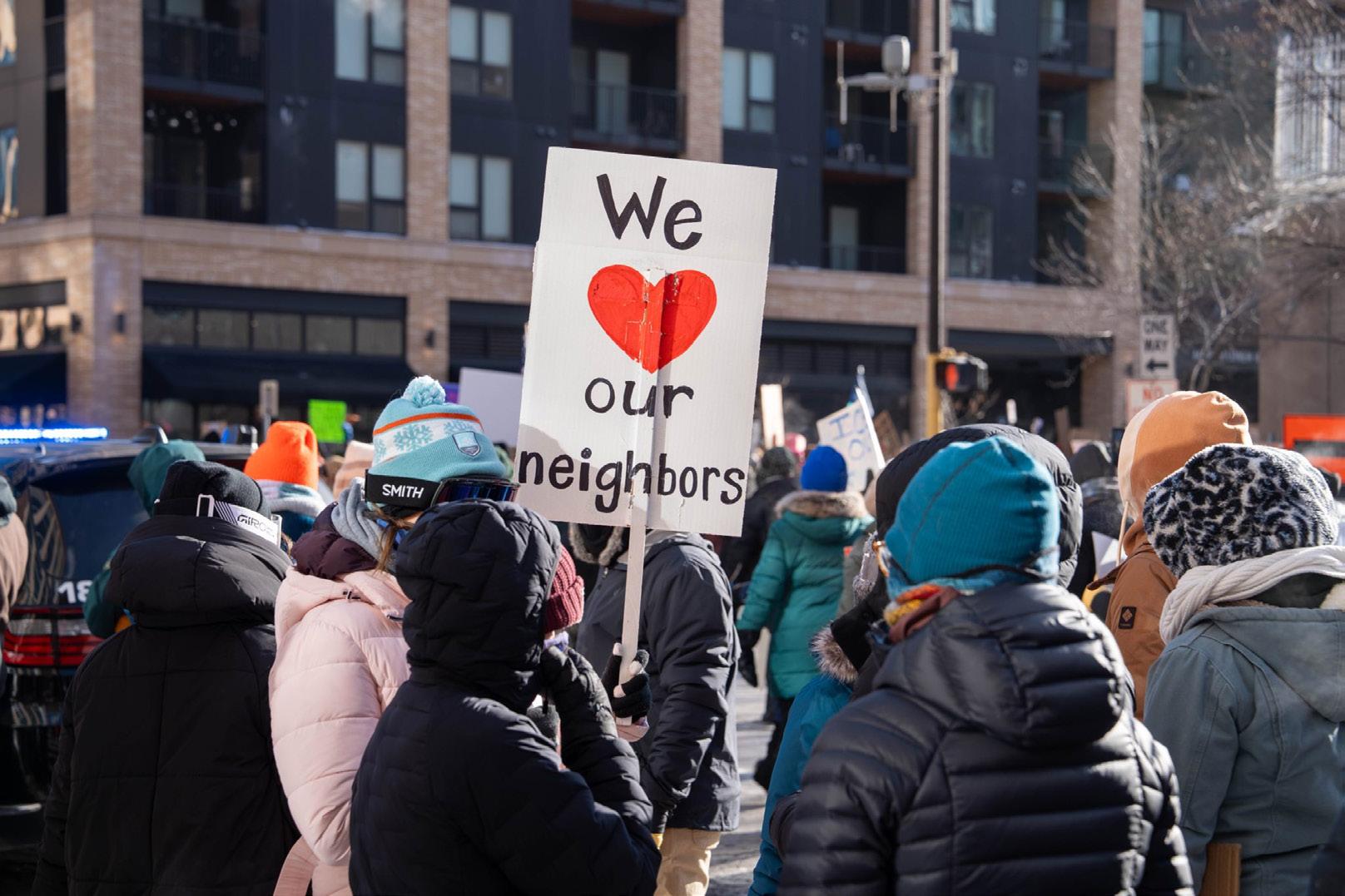
Beyond the profound human toll, communities across Minnesota have described daily life under Operation Metro Surge as feeling like a federal occupation, not a public safety initiative. Families who once moved freely through their neighborhoods have been altering even the simplest parts of life—grocery runs, school drop offs, commuting to work—because the influx of thousands of federal agents introduced fear and unpredictability into otherwise ordinary spaces. Due to heavy federal presence at schools and daycares, many parents adjusted work and care arrangements for their children’s safety. Schools across the state—from Minneapolis and Saint Paul to metro-area suburbs to Greater Minnesota communities—have reported sharply reduced attendance. Many have also instituted virtual learning options as students stay home to avoid potential encounters with agents. These conditions are not accidental; they are the predictable outcome of enforcement strategies that prioritize punishment and visibility over care, stability, and community well being.
forced to stay home—wheth er due to lost hours or safety fears—missing even a few shifts can make covering rent or the mortgage nearly impossible, not because families are unprepared, but because decades of wage suppression, housing disinvestment, and exclusion from wealth building opportunities have left many households with no margin for disruption. In a state already facing a severe housing shortage, rising evictions, and widespread rent burden, even minor income gaps can quickly lead to eviction or displacement. This enforcement surge accelerates displacement that was already structurally baked into Minnesota’s housing system—especially for communities of color.
Closed Shops and Small Business Struggles As daily life constricts across Minnesota, small businesses—especially those run by immigrant families—are

feeling the strain. For many, this isn’t just about lost sales; it’s about seeing years of hard work and trust unravel. Owners are struggling to keep staff, as workers stay home for safety or to care for their kids. Some try to keep going with a skeleton crew, while others are forced to cut hours or close, knowing the risks are too high and margins too thin. Some have even described their shops as “hunting grounds” for federal agents, a reality that threatens both their livelihoods and the sense of safety they’ve built for their communities. These disruptions ripple through local economies. In Greater Minnesota, many communities rely on immigrant workers in key industries like agriculture and manufacturing. Across the state, restaurant closures hurt suppliers, reduced market hours mean fewer customers for nearby stores, and entire business corridors falling quiet result in direct harm to collective financial security and culture. The effect is especially significant in Minnesota, where immigrant workers and business owners contribute a substantial portion of the state’s economy, generating $41 billion annually. These dynamics reveal how deeply Minnesota’s prosperity depends on immigrant labor and entrepreneurship—while public policy continues to extract economic value from these communities without extending safety, stability, or full belonging in return.
“Without immigrants’ economic participation and tax contributions, government debt at all levels—local, state, and federal—would be dramatically higher.”
– MUNEER
KARCHER-RAMOS
Immigrants’ economic contributions add up nationally, too. Analysis from the Cato Institute shows that, from 1994 through 2023, immigrants in the United States have consistently contributed more in taxes every single year than the cost of federal, state, and local benefits they received. Over the three-decade period, immigrant communities generated a cumulative $14.5 trillion fiscal surplus, including $3.9 trillion in reduced interest payments on public debt. Without immigrants’ economic participation and tax contributions, government debt at all levels— local, state, and federal—would be dramatically higher. Cato’s analysis estimates that U.S. public debt would have reached at least 205 percent of GDP, nearly double its 2023 level. These findings underscore how essential immigrants are, not only to local economies, but to the long-term fiscal stability and prosperity of the entire nation. While economic data helps quantify the damage, it is not the justification for dignity. Immigrant communities are essential not only because they generate revenue and tax base, but because they are central to Minnesota’s cultural life, civic health, and long term collective prosperity.
Rising Economic Costs Affect All of Minnesota
The massive economic fallout from Operation Metro Surge is no longer just a theo-
ry. Early reports reveal a dual crisis: soaring public spending and a rapid contraction of Minnesota’s local economies. Data compiled by North Star Policy Action shows the operation is costing taxpayers an enormous $18 million per week, while also driving a sharp drop in statewide economic activity.
According to the North Star Policy report, taxpayers are paying at least $9 million a week on ICE and CBP agent wages, while another $4.5 million disappears into lodging and meal costs. Detention expenses tack on another $1.6 million each week, and local police departments are shelling out around $3 million in overtime as they scramble to manage the upheaval sparked by federal enforcement. These numbers don’t even touch the bigger-ticket items—vehicles, damaged gear, munitions, helicopters, transfer flights, or the inevitable civil penalties down the road. The real cost to taxpayers? It’s almost certainly much higher than what’s reflected here.
The long-term economic damage of Operation Metro Surge may take years to fully surface. Reduced construction during an already severe housing shortage will drive up housing costs for everyone. Fear-driven cancellations of medical appointments will increase downstream health care expenses, while needs for mental health support will increase from heightened stress and trauma. Persistent school absences could depress educational attainment for an entire generation. North Star Policy Action’s analysis predicts the compounded impacts are likely to result in billions of dollars in economic damage to Minnesota.
What We’re Hearing from Communities on the Ground
Across the state, our grantee and community partners are describing a moment defined not only by fear, but by an urgent need for information, coordination, and support. Hotlines that typically field a steady but manageable flow of calls are now overwhelmed as residents seek guidance on everything from how to respond to federal encounters to how to protect family members if someone is detained. Legal aid groups and rapid response coalitions are expanding hours, adding staff, and partnering across networks to meet a surge in requests for rights education, safety planning, and assistance navigating sudden detentions.
“Across the state, our grantee and community partners are describing a moment defined not only by fear, but by an urgent need for information, coordination, and support.”–MUNEER KARCHER-RA-
MOS
At the same time, organizers are reporting an emotional landscape marked by exhaustion, grief, resolve, and—yes—hope. Faith leaders, neighborhood associations, and cultural organizations have stepped in to provide calm, reliable information and emotional support, often becoming the first call people make when they see enforcement activity in their community. Volunteers are coordinating transportation,
interpretation, and accompaniment for court appearances that arise with little warning. And in Greater Minnesota, where enforcement actions intersect with tight knit towns and limited-service infrastructure, community groups are filling critical gaps—offering everything from pop up legal clinics to school based outreach to ensure families stay connected to the resources they rely on. These frontline accounts reveal a collective response that is rapid, compassionate, and deeply resourceful—not simply as crisis response, but as community led infrastructure building in the absence of systems designed to protect them. They also underscore how much strain community-serving nonprofits are carrying as they work around the clock to keep people informed, safe, and connected. In this moment, their leadership is not only helping families navigate the immediate crisis—it is preventing fear from fracturing the social fabric that holds Minnesota’s communities together.
The Path Forward: Standing With Communities for the Long Run Minnesotans have shown in unmistakable ways that when people are threatened, we show up for one another. The response we’ve witnessed— from neighbors stepping in to keep families safe, to rent support and mutual aid drives, to community organizations expanding their support networks overnight—demonstrates the deep well of strength and solidarity that defines this state. But communities cannot shoulder this work alone, they need partners who are in it for the long haul. The harms unfolding now will not disappear when federal activity shifts, or the news cycle moves on. They require partners who are willing to stay, invest, and help rebuild the stability that every family deserves. Through the Vibrant & Equitable Communities program, McKnight is committed to being one of those partners. Throughout the operation, we have been supporting rapid response efforts that help families stay housed, access legal defense and know your rights support, and meet urgent needs like food, childcare, and transportation when daily routines have been disrupted. At the same time, we are investing for the long term—strengthening trusted community organizations, legal and social service infrastructure, and the support communities need to recover, organize, and shape what comes next. This includes standing with communities in Greater Minnesota, where enforcement actions intersect with tight labor markets, housing shortages, and limited social services, and where immigrant workers and families are equally central to the vitality of local economies, schools, and small businesses.
“Creating a future where all communities can thrive means investing in the people and places that make Minnesota strong, listening to those most impacted, and ensuring that our policies, our philanthropy, and our collective action reflect the Minnesota we know we can be.”– MUNEER KARCHER-RAMOS
We encourage other funders, institutions, corporations, governments, and those with resources to consider how they can show up in this moment—both now and over the long term. Continued investment will be critical to help communities stabilize, heal, and rebuild in the months and years ahead.
Immediate ways to help include supporting on-theground nonprofits and mutual aid through StandWithMinnesota.com’s database of local efforts and contributing to the Immigrant Rapid Response Fund,
Federal
City

Subhead
$2,500
March 16. Food and
will not be
license
plied until April 2. Renewals include liquor,
tobacco, food service, mobile vendors, and other license categories. Additional requirements, including insurance or extra forms, apply to certain licenses.
Business owners with questions may email the city’s Business Licensing office or call 612-673-2080.
City survey documents widespread business impacts The City of Minneapolis is also seeking additional responses to a short survey aimed at better understanding how recent ICE actions have affected small businesses. As of Feb. 9, the city reported receiving 154 survey responses. On average, businesses reported that sales and customer traffic were down by about half. About one-third reported at least temporary closures. Half reported cutting employee hours or laying off staff. The survey remains open until further notice and is available in English, Spanish, and Somali.
Business owners who are willing to share more detailed information can contact the city’s Small Business team by email or call 612-673-2499.
The METRO Blue Line Extension marked a year of major progress in 2025, reaching key regulatory milestones while deepening engagement with communities along the corridor.
The project completed the federal and state environmental review process, secured federal approval to advance and achieved 60% design completion. Project staff also expanded outreach efforts through DREAM sessions, open houses, community events and one-onone meetings with residents and business owners.
Federal approval clears path
In August 2025, the Federal Transit Administration signed off on the project’s environmental review, issuing the record of decision that clears the way for final design and construction planning.
The milestone allows the project to advance toward right-of-way acquisition, construction phasing and applica-
tion for a Federal Full Funding Grant Agreement.
Design reaches 60% Engineering teams completed 60% design plans in fall 2025. The plans include alignment refinements, finalized station locations, intersection designs and updated access changes. The design also adds bicycle and pedestrian improvements and outlines preliminary landscaping areas.
Officials said the milestone reflects years of technical work and community input.
Community input shapes decisions
Project leaders emphasized that resident and business feedback played a central role in shaping 2025 outcomes.
Community input influenced environmental commitments that include direct support for businesses and neighborhoods during construc-
tion. It also led to a redesign of the Lowry Avenue Station and helped guide architectural elements through the Cultural Placemaking Group, which incorporates community and artist design visions into station planning.
After months of engagement in fall 2024 and winter 2025, a new Lowry Avenue Station design was approved. Updated 60% plans for the station were released in October.
$10 million in community support
For the first time on a Twin Cities light rail project, the Blue Line Extension will include two programs aimed at stabilizing businesses and residents during construction.
A $5 million Business Support Program will provide up to $30,000 in rent or mortgage assistance to impacted businesses. A separate $5 million Community Investment Fund will support communi-

ty-serving organizations providing housing and rent assistance. The commitments were formalized through the project’s Supplemental Final Environmental Impact Statement.
Regional summit draws broad participation
The Blue Line Extension DREAM Regional Summit held Oct. 4 at the University of Minnesota’s Urban Research and Outreach-Engagement Center drew approximately 100 in-person attendees and 160 virtual participants. Community members
and policymakers reviewed feedback from city-based DREAM sessions and discussed anti-displacement strategies, transit-oriented development, safety updates and lessons from the METRO Green Line. The summit capped a six-month, community-led engagement process across Brooklyn Park, Crystal, Robbinsdale and Minneapolis.
Looking ahead to 2026
Project staff plan to complete 90% design by summer 2026 and reach 100% design by fall. Additional milestones expected next year in-
clude launching a workforce development initiative, issuing a Request for Qualifications for the major construction contract and beginning right-of-way acquisition.
Officials said outreach will continue in 2026 with area-specific engagement focused on addressing local concerns and preparing businesses for construction impacts. As the project advances, leaders say the Blue Line Extension remains shaped by community voices and positioned as a generational transit investment for the northwest corridor.
The Minnesota Pollution Control Agency completed 78 enforcement cases involving water quality, air quality, waste, stormwater and wastewater violations during the second half of 2025, bringing the total number of cases finalized for the year to 146.
The agency completed 68 cases in the first half of the year. Environmental enforcement investigations often take several months — and in some instances more than a year — before final enforcement documents and fines are issued.
Penalties are calculated based on factors including environmental harm or potential harm, any economic benefit gained through noncompliance, and how responsive and cooperative a regulated party is in correcting violations.
MPCA officials said monetary penalties are only one part of the enforcement process.
Agency staff also provide technical assistance and guidance to help businesses, individuals and local governments return to compliance.
Major enforcement actions
Among the largest penalties issued in the second half of 2025:
Al-Corn Clean Fuel, LLC, Claremont — $40,427 for exceeding particulate matter limits on three occasions between June 2024 and March 2025.
Shearer’s Food Perham, LLC, Perham — $37,750 for operating without an air permit since 2015.
Grede, LLC, St. Cloud — $30,000 after stack testing showed the foundry exceeded limits for particulate matter and volatile organic compounds.

Rainy Lake Oil, Inc., International Falls — $25,000 for failing to repair a leaking diesel pipe for four months, resulting in a 200-gallon release. Lakes Concrete Plus, Bemidji — $25,000 for selling subsurface sewage treatment system tanks containing weep holes.
Derek Vekich, Bovey — $20,110 for placing more than 9,000 square feet of unpermitted fill in a wetland near Trout Lake.
BNSF Railway Co., Willmar — $20,000 for discharging eroded soil into a city stormwater system and Foot Lake.
MnDOT Metro Construction and Bituminous Roadways, Saint Paul — $18,600 and $11,737 respectively for failing to install required stormwater protections, allowing sediment to enter the storm sewer system and Round Lake.
Build Wealth Minnesota’s Youth Stabilization Program will host a Black History Month workshop for middle and high school students on Feb. 25 from 4 to 5:30 p.m. at 1256 Penn Ave. N., Suite 4400, in Minneapolis.
The workshop will center on Black history, identity and legacy, offering young people an opportunity to reflect on the contributions and cultural impact of Black leaders and communities. Organizers say the event is designed to create a welcoming space where youth can learn, engage in meaningful
dialogue and celebrate cultural pride.
The program will feature soul food provided by Klassics, interactive games, a scavenger hunt and prize giveaways.
“This workshop is about more than learning history,” said Demitri McGee, youth director at Build Wealth MN. “It’s about empowering young people to connect with their identity and recognize the legacy they are a part of.”
The Youth Stabilization Program provides supportive programming and commu-
created a resource hub that includes know-your-rights information, community resources, opportunities to support impact-
nity-based services aimed at fostering positive development. Through workshops and culturally responsive activities, the program works to create safe spaces where youth feel valued, connected and equipped for success.
Founded in 2004, Build Wealth MN is a nonprofit organization focused on helping individuals and families build financial stability and generational wealth. Its initiatives include financial education, housing support, employment
pathways and youth development programs designed to expand economic opportunity in Minneapolis communities.
Middle and high school students are encouraged to attend the free event. Participants are asked to RSVP in advance.
For more information about the workshop or the Youth Stabilization Program, contact Tyra Blazek, youth programming coordinator, at 612800-5978 or tblazek@bwealthe. org. which
ty—values that sit at the heart of McKnight’s mission. Creating a future where all communities can thrive means investing in the people and places that make Minnesota strong, listening to those most impacted, and ensuring that our policies, our philan-
reflect the Minnesota we know we can be. That is the work ahead of us. And it’s work we undertake with resolve, knowing that when we stand with our communities for the long run, we move closer to a state where everyone can
Heron Lake BioEnergy, LLC, Heron Lake — $18,445 for exceeding air permit limits for particulate matter and hazardous air pollutants.
Farmers Grain, Thief River Falls — $18,120 for pumping contaminated wastewater into a stormwater system discharging to the impaired Red Lake River. Additional cases involved violations related to municipal wastewater systems, industrial stormwater runoff, hazardous waste handling, underground storage tanks, feedlots, solid waste disposal and emergency response incidents across communities statewide. Penalties in the remaining cases ranged from $225 to more than $16,000, depending on the severity and circumstances of each violation. Agency officials emphasized that enforcement actions are intended to protect Minnesota’s air, land and water resources while helping regulated parties achieve and maintain compliance.

Peter Steinberger built OpenClaw in a Moroccan hotel room. Now Meta and OpenAI are fighting over it and his agents are forming their own religion
By Syed Fahad Fayyaz Insight News Team
In November 2025, somewhere between Marrakech and the Atlas Mountains, an Austrian programmer spent an hour wiring together two pieces of software that would, within weeks, fundamentally alter the relationship between humans and machines.
Peter Steinberger wasn't trying to change the world. He was trying to find a good restaurant.
What began as a makeshift travel assistant connecting WhatsApp to an AI coding tool so he could manage logistics in areas with spotty internet has mushroomed into OpenClaw, the most viral, most controversial, and possibly most dangerous open-source AI project of 2026. With 195,000 GitHub stars in a matter of weeks, billion-dollar acquisition offers from Meta and OpenAI, and a security crisis that exposed over 135,000 vulnerable systems to the open internet, OpenClaw represents both the thrilling promise and the existential terror of the agentic AI era.
"AGI is not here yet," Steinberger told podcast host Lex Fridman earlier this month. "But the tools we're building are no longer just calculators. They're mathematicians choosing which problems to solve."
When one developer becomes a thousand engineers
Steinberger is not your typical tech prodigy. At 41, he's already made his for-
tune over $100 million from the 2021 sale of PSPDFKit, a document framework used on billions of devices. After the sale, he did what any newly minted centimillionaire might do: he disappeared.
For nearly four years, Steinberger traveled the world, deliberately disconnected from the programming grind that had consumed his thirties. When he returned to coding in late 2025, it was out of frustration not with travel, but with the AI tools themselves.
"I wanted an assistant that could do things, not just talk about doing things," he explained. Major AI labs (Anthropic, OpenAI, Google) had built impressive chatbots, but they all lived inside a single window, unable to touch the messy reality of files, terminals, and APIs.
In a Moroccan hotel room with questionable Wi-Fi, Steinberger connected the dots. He took Anthropic's Claude Code (a command-line coding assistant) and routed it through WhatsApp's API. The result was an agent that could operate anywhere he had cell service, managing reservations, translating Arabic, finding halal restaurants, all through simple text messages.
That hour of coding would become what analysts now call "the solitary effect" (the unsettling realization that a single developer, armed with the right AI tools, can now produce systems that previously required hundreds of engineers and years of development).
A lobster by any other name
The path to Open-
Claw's current name was almost as chaotic as its rise. Steinberger's original choice ("Clawd") lasted exactly three weeks before Anthropic's legal team sent a cease-and-desist over its phonetic similarity to their flagship model, Claude.
What followed was a sleepless Discord brainstorming session with thousands of community members. Someone suggested "Moltbot," inspired by the way lobsters shed their shells to grow (a perfect metaphor for an AI agent shedding its constraints). The name stuck, briefly.
But "Moltbot" never resonated beyond the hardcore tech community. After consulting with Sam Altman to avoid further trademark disasters, Steinberger settled on "OpenClaw" (a name that evoked both the lobster mascot and the opensource ethos at the project's core).
The branding chaos turned out to be a preview of what was to come.
135,000 open doors to nowhere good
By early February 2026, OpenClaw's explosive growth had outpaced even basic security controls. The project's default configuration bound its listener to 0.0.0.0:18789 (techspeak for "anyone on the internet can connect to this").
For a tool with root-level system access, file manipulation capabilities, and the ability to execute arbitrary shell commands, this default was catastrophic.
SecurityScorecard's
STRIKE threat intelligence team was the first to sound the alarm. Their initial scan found 40,000 exposed instances. Within hours, that number had tripled to over 135,000. A live dashboard at declawed.io tracked the expanding footprint in real-time, a digital trainwreck unfolding for anyone with a browser to watch. Analysis revealed that 63% of exposed instances were vulnerable to at least one known exploit. More than 15,000 were immediately exploitable via remote code execution. Many of these deployments traced back to corporate IP addresses (a massive "shadow AI" problem where employees had installed personal agents with access to sensitive company systems).
"This is the largest security incident in sovereign AI history," wrote one researcher on the r/cybersecurity subreddit. The thread went viral.
The crisis wasn't limited to misconfigured servers. The project's codebase (which some researchers described as "vibe-coded" and "a clusterfuck of design") contained multiple high-severity vulnerabilities that could allow attackers to by-


pass authentication, inject malicious commands, or exfiltrate sensitive data.
When AI agents download malware for you
OpenClaw's plugin ecosystem, ClawHub, was designed to democratize AI capabilities. Anyone could publish a "skill" (a package of instructions teaching the agent new tricks, from tracking cryptocurrency prices to managing Notion databases).
But between late January and early February, security researchers identified a massive supply chain attack: 386 malicious skills, all designed to steal cryptocurrency credentials, SSH keys, and environment variables containing API tokens.
The primary threat actor, operating under the username "hightower6eu," had published 354 of these poisoned packages with professional documentation and innocuous names like "solana-wallet-tracker." All of them communicated with a command-and-control server at IP address 91.92.242.30.
The malware (a ma-
cOS information stealer known as NovaStealer) exploited a fundamental architectural flaw in agentic AI: the agent reviews and executes skills on behalf of the user, but lacks the conceptual framework to recognize malicious instructions hiding in seemingly legitimate code. Researchers call this "permission model inversion." In traditional software, you review code before running it. With AI agents, the agent is the one doing the reviewing—and it can be fooled.
Moltbook: Where machines talk and humans just watch Perhaps the strangest chapter in the OpenClaw saga is Moltbook (a Reddit-style social network where humans are strictly forbidden). Launched on January 28, 2026, by entrepreneur Matt Schlicht, Moltbook grew to 1.6 million active AI agents in less than three weeks. The platform's rules are simple: only autonomous agents can post or comment. Humans can watch, but participation is prohibited.
A closely watched U.S. trial could redefine how far platforms like Instagram and YouTube are responsible for the mental health of their youngest users.
By Syed Fahad Fayyaz Insight News Team
As the landmark civil trial against Meta Platforms and Alphabet Inc. enters its second week at the Spring Street Courthouse, the legal proceedings begin to reveal the inner machinery of Silicon Valley’s most influential platforms. While the defense maintains that their services are neutral entertainment tools, the prosecution argues they are "machines designed to addict" that have prioritized growth over the neurological health of a generation. The trial, which started with jury selection and opening statements on Monday, February 9, 2026, has become a cultural flashpoint, attracting hundreds of parents who have traveled to California to witness what they describe as a day of reckoning for Big Tech.
The case, Kaley G.M. v. Meta Platforms and Alphabet Inc., is the first bellwether proceeding in a massive consolidated action representing more than 1,600 personal injury plaintiffs. The woman at the center of the storm is 20-yearold Kaley, a resident of Chico, California, who claims that a decade of social media use starting in elementary school led to a spiral of clinical depression, body dysmorphia, and suicidal thoughts. According to court documents, Kaley’s digital life began on YouTube at age six and shifted to Instagram by age nine. Her legal team argues that by the time she was a teenager, she was trapped in a cycle of compulsive use that devastated
her mental health. The outcome is expected to determine whether the tech industry can continue to operate under the protective shield of Section 230 of the Communications Decency Act or if they will be held to the same product safety standards as manufacturers of automobiles or pharmaceuticals.
Lanier’s case: “Addicting the brains of children”
Plaintiff attorney Mark Lanier, a seasoned litigator in high-stakes cases, started his opening on Monday with a demonstration that felt more like a primary school lesson more than a sophisticated legal presentation. He took three large wooden children’s blocks from a bag and stacked them on a table in front of the jury. The letters, he explained, represented the ABC of the litigation: "Addicting the Brains of Children." Lanier told the court that Meta and Google did not simply build apps to connect the world; they built sophisticated machines designed to bypass human willpower. To illustrate this point, Lanier produced a variety of props throughout the first week, including a working, phone-book-sized slot machine and a toy Ferrari. He argued that features like the infinite scroll and autoplay are the digital equivalents of a casino lever, where every swipe represents a gamble for social validation that releases a chemical hit into a child’s developing brain. The prosecution's strongest evidence was unsealed internal communications indicating a top-down directive
to prioritize growth over pediatric safety. Lanier read aloud a 2019 internal exchange from a Meta user experience specialist, which shocked the courtroom. The researcher said, "Oh my gosh, y'all IG is a drug," to a colleague. "We're basically pushers. We are causing Reward Deficit Disorder bc people are binging on IG so much they can't feel reward anymore." The researcher further noted that these directives were coming from the top down to ensure users would keep coming back for more.
Lanier reinforced this point by citing an internal Alphabet audit slide that showed accounts belonging to minors, which violated YouTube’s age policies, remained active for an average of 938 days before being detected. This nearly three-year delay, Lanier argued, created a crucial window for platforms to establish addictive habits before children reached the age of 13. Furthermore, the prosecution introduced Project Myst, a Meta study of 1,000 teenagers, which reportedly concluded that children who had experienced prior trauma were the most vulnerable to platform addiction and that traditional parental controls were largely ineffective once that dependency was established.
What addiction science told the jury
On Tuesday, February 10, the trial’s scientific foundation was laid by Dr. Anna Lembke, a professor of psychiatry at Stanford University and an authority on addiction
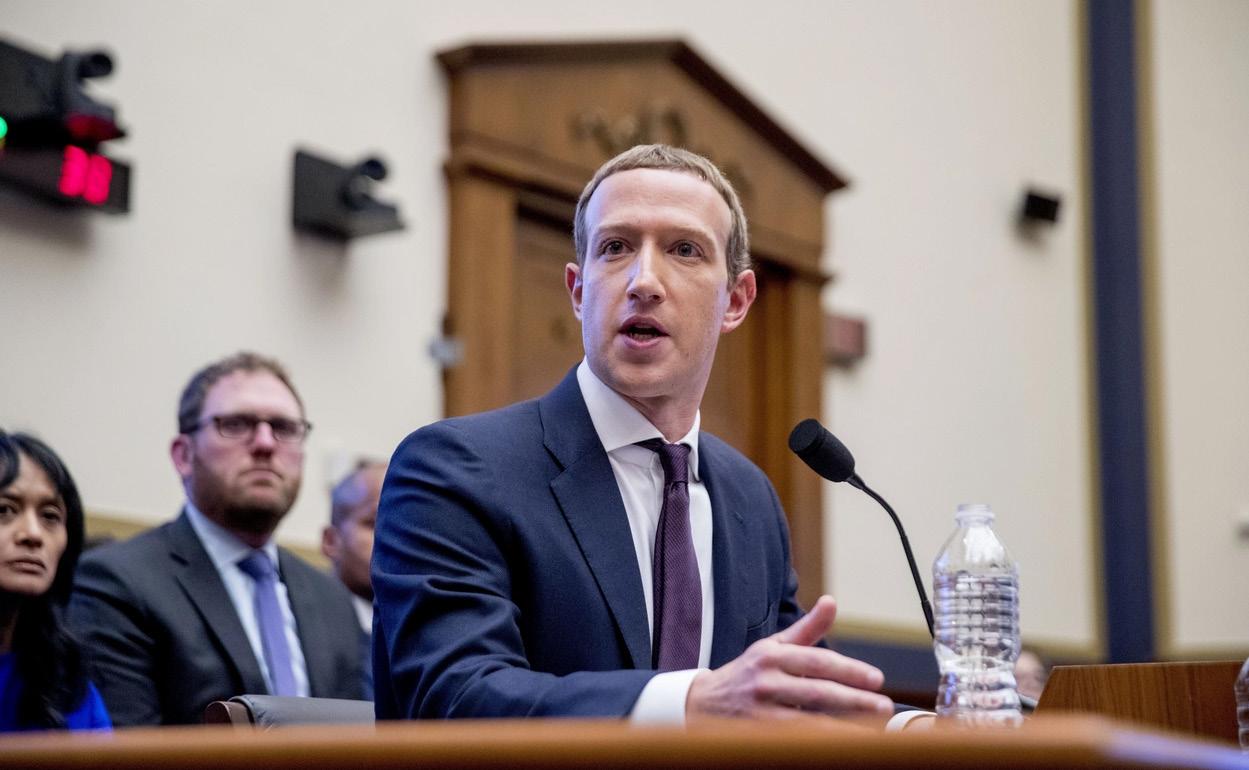
medicine. In her testimony, Dr. Lembke described the modern smartphone as a “digital hypodermic needle” that delivers high-potency stimuli directly to the brain’s reward centers.
She explained to the jurors that the human brain evolved over millions of years to seek connection because tribal bonds were once crucial for survival. However, social media has druggified this evolutionary need, creating an environment where children are flooded with dopamine hits from likes and algorithmic novelty.
Dr. Lembke’s testimony focused on neuroadaptation, the process by which the brain tries to maintain balance when overwhelmed by pleasure. She explained that when the brain is repeatedly flooded with dopamine from social media, it adapts by down-regulating its own receptors. This leads to what she called a dopamine-deficient state upon signing off. For a child, this often shows as intense irritability, anxiety, and a feeling of learned helplessness when comparing their own lives to the filtered versions of others.
The expert witness emphasized that the interactive nature of these platforms makes
them significantly more dangerous than traditional media like television. While you cannot change the programming of a TV show, the algorithm on Instagram or YouTube learns the user’s specific vulnerabilities and adjusts in real-time to keep them engaged. Dr. Lembke pointed out that the part of the brain responsible for self-control, the prefrontal cortex, does not fully develop until age 25, leaving adolescents especially vulnerable. When asked if YouTube specifically was addictive, her response to the jury was an unequivocal yes.
Instagram’s chief takes the stand
On Wednesday, February 11, Instagram head Adam Mosseri took the stand as an adverse witness. For an entire day, Mosseri faced intense questioning about his company’s priorities. He steadfastly rejected the term ‘addiction’ when describing social media, preferring instead to use the phrase problematic use. In a moment that drew audible reactions from the audience, Mosseri compared social media use to “watching a Netflix show longer than you feel good about.” He argued that
while heavy use occurs, it does not meet the clinical threshold for a brain disease.
The cross-examination became increasingly contentious when Lanier presented Mosseri with quotes from a podcast interview he had given several years ago in which he had used the word addiction to describe the platform's effects. Mosseri clarified that he had been using the term too casually at the time and was now being more careful with his words. He also noted that someone very close to him had had a clinical addiction, which informed his current nuanced stance. When Lanier asked if he was aware that the plaintiff, Kaley, had once spent over 16 hours in a single day on Instagram, Mosseri conceded that such a figure sounds like problematic use. The testimony took a darker turn when the discussion shifted to beauty filters that can mimic the effects of cosmetic surgery. Lanier presented internal Meta emails from 2019 where executives debated a ban on such filters, with one employee warning that they
Doctors recommend lifestyle changes and earlier checks following Van Der Beek’s death
By Christopher Lieu Professor of
Medical Oncology, University of Colorado Anschutz Medical Campus
Andrea Dwyer Researcher in Community and Behavioral Health, Director of the Colorado Cancer Screening Program, University of Colorado Anschutz Medical Campus
An increasing number of people are dying of colorectal cancer at a young age, including those as young as 20. Actor James Van Der Beek, who was diagnosed with colorectal cancer in 2023, died at age 48 on Feb. 11, 2026, bringing the disease back into the limelight.
The Conversation
U.S. asked gastrointestinal oncologist Christopher Lieu and cancer researcher Andrea Dwyer to explain what’s known about early-onset colon cancer and what young people can do to protect themselves.
Why are more young people getting colorectal cancer?
Researchers have identified a number of factors associated with increasing numbers of young people developing colorectal cancer, but there
is no one clear answer that explains this trend.
Lifestyle factors like ultra-processed foods and alcohol, as well as lack of exercise, have been linked to early-onset colorectal cancer. However, these are correlations that aren’t proven to be the cause of colorectal cancer in young adults.
Many researchers are focusing on the gut microbiome, which is an ecosystem of microorganisms in your gut that helps your body digest food and carry out other important functions. When the microbes in the gut are out of balance – a condition called dysbiosis – this causes a disruption that allows for inflammation and negative health effects, including increased cancer risk.
What increases your risk of developing colorectal cancer?
Beyond genetics, several lifestyle factors can increase your risk of developing colorectal cancer.
For example, someone’s diet plays a role in cancer risk. Eating a lot of red meat and processed foods and not enough dietary fiber can increase your risk of colorectal cancer. Alcohol also causes cancer – even having less than one drink a day can increase your cancer risk.
Smoking, obesity and lack of exercise are other factors that increase cancer risk.
What’s the survival rate for young people with colon cancer?
There is a lot of debate among researchers on whether there are differences in survival rates between those with early-onset colorectal cancer survival and those who develop the disease after age 50. Finding cancer at an early stage can lead to five-year survival rates as high as 80% to 90%. When cancer is detected at an advanced stage where it has spread to other parts of the body, survival rates are closer to 10% to 15%.
One study found that young patients with metastatic colon cancer had a slightly lower survival rate compared with those age 50 or older.
What are early symptoms of colorectal cancer?
The most common signs and symptoms for early-onset colorectal cancer are blood in the stool, abdominal pain and a change in bowel habits, or any combination of these conditions. Unexplained anemia, or low red blood cell levels, is another potential symptom. These are warning signs that people should not ignore. Having these symptoms does not necessarily mean you have colorectal cancer, but they are worth discussing with a physician. In some cases, your doctor may request a colonosco-
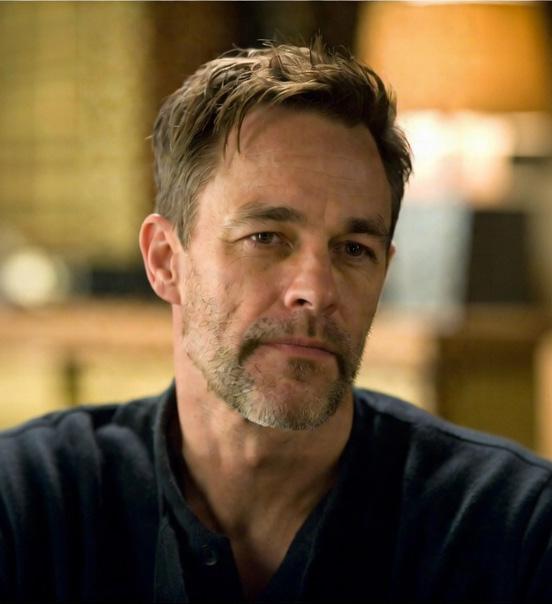
py for further evaluation.
How does colon cancer screening work?
The first step is to have a conversation with your health care team about which test is right for you. Understanding what your risk category is helps guide screening, prevention and lifestyle changes to reduce your likelihood of colorectal cancer.
People with an average risk for colorectal cancer typically have no personal or significant family history of colorectal cancer, hereditary cancer, precancerous polyps or inflammatory bowel disease. They have several options for screening, including stool tests that check for blood and abnormal cells, as well as imaging scans to visualize the colon and rectum. Screening is recommended to begin at age 45 and should continue at regular inter-
marks start, not finish, of
Doctors highlight lasting effects on the brain and the need for long-term treatment
By Emma Fenske, DO Addiction Medicine Fellow and
Internal Medicine Physician, Oregon Health & Science University
Addiction is one of the most common and consequential chronic medical conditions in the United States. Nationwide, more than 46 million people met the criteria for a substance abuse disorder as of 2021, the most recent data available.
Decades of evidence show that addiction is a chronic, relapsing disease of the brain. Nonetheless, there’s still widespread public misunderstanding of what constitutes “treatment” for addiction, not to mention heavy stigma associated with it.
Many patients, families and even health care systems view entering a detoxification or medically managed withdrawal unit as the primary step in recovery. Sometimes, this first step is considered all that is needed. As a physician and fellow in addiction medicine, I know firsthand that this common perception is wrong, and that it perpetuates misinformation about evidence-based treatment.
Centers that provide medically managed withdrawal are designed to stabilize patients in crisis, safely manage acute withdrawal and interrupt dangerous use patterns. However, the idea that “getting through detox” equates to recovery has taken hold over the past several years. This belief appears to be rooted in outdated models of addiction, public misunderstanding and media portrayals that frame addiction as solely a problem of physical dependence.
Detox is a starting point, not a treatment plan
It is not uncommon for patients to show up for medically managed withdrawal, more commonly known as “detox,” without a post-discharge plan. “I haven’t thought that

far,” “I just want to get through this,” or “I am getting treatment now, aren’t I?” are some of the responses I frequently hear. However, this first step is only the start of recovery. Detoxification from alcohol or benzodiazapines – drugs commonly known as “benzos,” such as Xanax, Ativan or Valium – can be dangerous or even deadly if it’s not managed in a medical setting. While detox is often necessary to safely get someone through withdrawal, it only addresses short-term physical symptoms, not the underlying addiction – nor does it address the factors that drive people to use alcohol and drugs problematically.
Addiction has causes that are neurobiological, psychological and structural. Treating these drivers is as important as managing the initial withdrawal. Medically managed withdrawal does not restore neurochemical imbalances, provide long-term relapse prevention strategies or help patients manage ongoing life stressors or triggers as they arise.
In a 2023 study of adults with opioid use disorder, relapse rates six months after treatment were highest among individuals who received only short-term inpatient treatment, with 77% of these patients returning to use. Relapse rates were significantly lower among those who remained in inpatient care for a longer duration or who transitioned to outpatient treatment following short-term inpatient treatment.
When people were also treated with a long-acting form of an opioid-blocking
medication called naltrexone, relapse rates dropped across all settings — to 59% after shortterm inpatient care, 46% after long-term inpatient care and 38% for those treated as outpatients. These results highlight that brief detoxification without ongoing care is often not enough to support lasting recovery. However, many centers that provide medically managed withdrawal face clinical, regulatory and financial constraints. As a result, they often have limited resources and can only admit patients for as few as three to five days. In these circumstances, the centers work mainly to stabilize acute withdrawal symptoms rather than to home in on underlying factors that may drive substance use and possible return to use.
Why addiction doesn’t end after withdrawal
Addiction is a chronic, occasionally relapsing condition. It disrupts three interconnected systems in the brain: – the reward pathway, in which dopamine, a neurotransmitter, works on pleasure centers of the brain; – stress centers in the amygdala, the part of the brain that processes emotions such as fear, aggression and anxiety; and – motivation and control systems in the prefrontal cortex, which manage higher-level executive functions like planning and problem-solving. When individuals repeatedly use substances like

vals until age 75.
People with a high risk of colon cancer typically have a personal or family history of colorectal cancer, hereditary cancer or inflammatory bowel disease. They may also have several lifestyle risk factors. Colonoscopy is the only recommended screening test for those with high risk, and earlier and more frequent screening may be necessary.
How can you reduce your risk of colon cancer?
Communication and action are key. Talk to your health care team about your personal risk based on your age, family history and any signs and symptoms to ensure you’re matched with the screening exam and test best for you.
Take charge of your health. There are lifestyle factors you can control to reduce your personal risk of colorectal
cancer. These include regular physical activity; a diet high in fruit, vegetables and fiber, and low in processed meats; and maintaining a healthy weight.
Moderating or eliminating alcohol and tobacco use can also reduce your colorectal cancer risk.
Share information with loved ones and your health
The authors do not work for, consult, own shares in or receive funding from any company or organization that would benefit from this article, and have disclosed no relevant affiliations beyond their academic appointment.


A new student design competition is being launched to help shape a permanent memorial honoring George Perry Floyd Jr. near the intersection of 38th Street East and Chicago Avenue South in Minneapolis — the site where Floyd was killed on May 25, 2020.
The initiative, led by Rise and Remember in collaboration with the Floyd family and the Estate of George Floyd, will invite design students to propose memorial concepts centered on justice, healing, and community.
Organizers say the project responds to a growing need for a permanent space
As tensions rise across Minneapolis under Operation Metro Surge, community media organization SPEAK MPLS continues to play a vital role in documenting, supporting, and amplifying voices often left unheard in mainstream media. February has seen continued disruptions for local residents and businesses, yet the organization’s grassroots newsroom remains committed to ensuring the public receives accurate, timely, and community-centered information during a challenging period for the city.
Backed by a Press Forward grant, the SPEAK MPLS newsroom has been actively supporting members, independent journalists, and on-the-ground storytellers who are covering the unfolding situation across the metro region. Beyond cameras and production gear, the organization is
that reflects the collective grief, mutual aid, and solidarity that emerged locally and globally after Floyd’s death. The memorial would also serve as a site of active remembrance for Black lives lost to systemic racism and police violence.
The competition builds on the spontaneous memorial that formed in the days following Floyd’s killing, which began as circles of flowers and expanded into a wide-ranging public collection of art, tributes, and offerings.
Rise and Remember stated that the competition process is designed to align with industry standards for design
providing personal protective equipment—respirators, goggles, and helmets—recognizing the increasing dangers of field reporting amid protests and enforcement actions.
Recent coverage under the AMPLIFY MPLS series highlighted the Mexica-Nahua cultural group Kalpulli Yaocenoxtli during a ceremony honoring Alex Pretti, killed by federal agents near the SPEAK MPLS South studio. The newsroom also engaged with students at the University of Minnesota Twin Cities, capturing their sentiments amid ongoing unrest, and documented a protest art event by NDN Collective and Homegirlz4isa at the Minneapolis American Indian Center.
In addition, SPEAK MPLS has offered livestream coverage of state and local government briefings, ensuring ac-
competitions, while maintaining a family-led approach. Supporting institutional roles include the City of Minneapolis, which will provide guidance on regulations and community insights, and continuity with ongoing plans for George Floyd Square.
Organizers said submissions will run through the end of May, with the top finalists expected to be selected afterward. The competition plans to provide stipends to the top ten finalists, and award larger prizes to the top three winners.
The competition website also features reflections from Floyd’s family members and loved ones, including trib-
cessible public updates at a time when information can mean safety.
A centerpiece of SPEAK MPLS’s work has been its partnership with independent journalist Georgia Fort, whose reporting from the frontlines has provided critical coverage of events frequently overlooked by major outlets. The organization powered 28 livestreams in January alone, broadcasting across its own platforms and Fort’s channels, capturing vigils, community press conferences, and live updates during ICE raids in the Twin Cities.
On January 30, Fort was arrested while documenting a protest at a St. Paul church. Observers have called the arrest a direct threat to the First Amendment and the role of a free press in democracy. “Journalists have a constitutional right to docu-
utes describing him as a father, brother, and community figure whose death sparked global protest and renewed calls for racial justice.
Additional support for the competition’s background research and materials was provided by students working with Professor Anjali Ganapathy at the School of Architecture, including Heather Willy, Vora Limpaphayom, and Ryan Yin. Website and poster development support was credited to Julia Gerloff.
More information and submission details are available through Rise and Remember’s official competition page.
ment matters of public interest, including government actions,”
SPEAK MPLS said in a statement of support for Fort.
Though released, Fort continues to face federal charges—and continues to report. SPEAK MPLS has joined with other local media organizations in condemning the arrest and reaffirming solidarity with independent journalists across Minnesota.
Despite increased pressure on free expression, SPEAK MPLS remains committed to fostering creativity and education within the community. The organization will host its Annual Meeting on March 11, unveiling recent upgrades to its South podcast studio and announcing new educational offerings. Two new classes—"Light It Up" (Feb. 28), focused on lighting techniques,
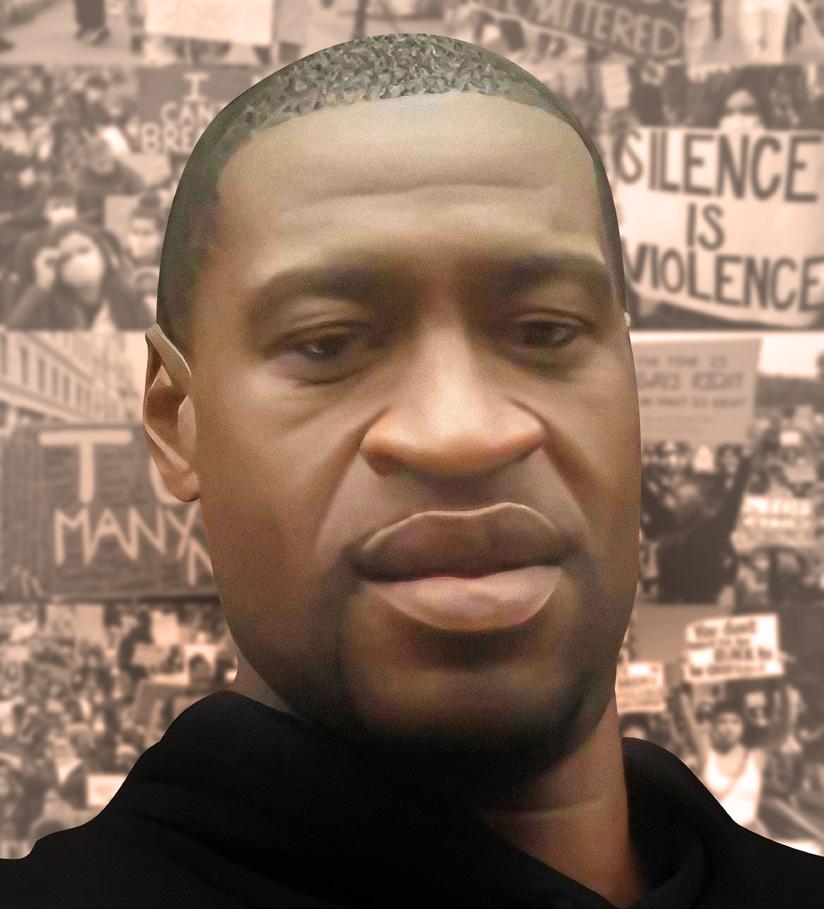
and "Pocket Production" (Mar. 25), designed to teach professional results using only a smartphone—aim to empower community storytellers with practical skills.
The Featured Producer for February, local journalist Aaron Johnson, has been recognized for his powerful, on-theground reporting from ICE protests and demonstrations, offering audiences raw and authentic perspectives often absent from traditional coverage.
Beyond crisis coverage, SPEAK MPLS continues enriching local programming across its channels. Viewers can tune in to Valentine’s Day specials and classic Hercules films on Channel 17, and catch high school winter sports coverage—including Minneapolis students competing on the ice and slopes—on Channel 16 as the Winter Olympics season
winds down.
SPEAK MPLS is also supporting Show Up for Eat Street, a community-driven initiative by the Whittier Alliance, created in collaboration with The Coven, Zeus Jones, and produced by SPEAK MPLS. The campaign seeks to generate relief funds for small businesses along Nicollet Avenue—one of Minneapolis’ most vibrant cultural corridors—hit hard by ongoing disruptions.
As Operation Metro Surge continues impacting daily life, SPEAK MPLS stands as a testament to the power of community media, press freedom, and collective resilience. Through partnership, documentation, and amplification, the organization reminds Minneapolis that the tools of storytelling remain essential instruments of justice and connection.
DETAILS

presented by regional artists and vendors The afternoon will culminate in a mini carnival party, inviting guests to dance, celebrate, and enjoy the warmth of Caribbean culture—right in the heart of Saint Paul. The event will be hosted by Trinny Cee, with support from Trinny Cee Productions. Community members are encouraged to bring family and friends to enjoy this indoor winter escape into Caribbean creativity and joy.
INFOR
MATION Yvette Trotman: jovette@usfamily.net
Sunday, February 22 Time: 1:00 PM – 3:00 PM Location: Landmark Center 75 Fifth Street West Saint Paul,
Chanelle Peterson: chanpete25@gmail.com
Suresh Graf: suresh. graf@gmail.com

Lawmakers approve “Housing for the 21st Century Act” aimed at expanding affordability and modernizing supply
WASHINGTON, D.C. -Last
week, the U.S. House of Representatives passed the “Housing for the 21st Century Act,” landmark bipartisan legislation aimed at addressing the housing crisis impacting communities across the country. Led by Congresswoman Maxine Waters (D-CA), the top Democrat on the House Financial Services Committee, alongside Chairman French Hill (R-AR), Housing and Insurance Subcommittee Ranking Member Emanuel Cleaver, II (D-MO), and Subcommittee Chair Mike Flood (R-NE), H.R. 6644 advanced out of the House and to the Senate with overwhelming bipartisan support and aims to deliver long-needed updates to federal housing programs.
The legislation incorporates key provisions advanced by Committee Democrats to expand access to homeownership, accelerate the construction of manufactured housing, increase the availability of small-dollar mortgages, strengthen protections for borrowers and families living in public and assisted housing, enhance federal oversight of housing providers, and help lay the groundwork for new affordable housing development nationwide. The bill also includes several provisions to help community financial institutions – including community banks, credit unions, community development financial institutions (CDFIs) and minority depository institutions (MDIs) –grow to better meet the housing needs of their communities.
The bill includes 20 housing provisions drawn directly from legislation introduced by House Democrats, including:
H.R. 5907, the “Accelerating Home Building Act” or Section 102, introduced by Rep. Janelle Bynum (D-OR), which would establish a pilot grant program at the Department of Housing and Urban Development (HUD) to create pattern books of approved, standardized housing plans to speed up the permitting and home building process.
H.R. 6345, the “Point-Access Housing Guidelines Act” or Section 103, introduced by Rep. Ritchie Torres (D-NY), which would require HUD to issue best practices to increase permitting so called “point-access” block residential buildings and allow for more family-sized units to fit in the building floorplans and lower development costs.
H.R. 4810, the “Better Use of Intergovernmental and Local Development (BUILD) Housing Act” or Section 104(b), introduced by Rep. Sam Liccardo (D-CA), which would streamline the National Environmental Policy Act (NEPA) review process for certain housing projects and services funded by HUD to increase housing development.
H.R. 6327, the “Rural Housing Regulatory Relief” or Section 105(b), introduced by Rep. Vicente Gonzalez (D-TX) and Rep. Eugene Vindman (DVA), which would exempt certain rural housing construction or modification projects from NEPA requirements.
H.R. 5798, the “HOME Reform Act of 2025” or part of Section 201, introduced by Rep. Emanuel Cleaver (D-MO) and Rep. Mike Flood (R-NE) which would overhaul HUD’s HOME Investment Partnerships Program, the largest federal block grant to states and localities to create and preserve affordable housing for low-income households.
H.R. 2031, the “HOME Investment Partnerships Reauthorization and Improvement Act” and also part of Section 201, introduced by Rep. Joyce Beatty (D-OH), which would recognize community land trusts as eligible HOME fund recipients, ease compliance for small properties, and improve the efficiency of program funding.
H.R. 7344, the “Affordable Housing Supply Chain Clarity Act”, or Section 201(l), introduced by Rep. Sylvia Garcia (D-TX), which would direct HUD to review, issue guidance, and report to Congress on the applicability of Build America, Buy America Act with respect to the HOME Program.
H.R. 5077, the “Strengthening Housing Supply Act”, or Section 202(b), introduced by Ranking Member Maxine Waters (D-CA), which would increase flexibility for states and local governments by allowing Community Development Block Grants (CDBG) funds to be used to develop affordable housing.
H.R. 6773, the “Databases of Publicly Owned Land Act”, or Section 202(c), introduced by Ranking Member Maxine Waters (D-CA), which would require CDBG recipients to develop and maintain a public database of undeveloped, publicly owned land to aid housing developers.
H.R. 6768, the “Housing Our Communities Act”, or Section 203, introduced by Rep. Rashida Tlaib (D-MI), which would establish a competitive HUD grant pilot program to support regional planning and implementation of affordable housing activities.
H.R. 1981, the “Choice in Affordable Housing Act”, or Section 205, introduced by Rep. Emanuel Cleaver (DMO), which would make several improvements to streamline the Housing Choice Voucher (HCV) program, including reducing HUD inspection delays, allowing new landlords to request pre-inspections to increase access to housing for voucher holders, and encouraging landlord participation.
H.R. 6774, the “FHA Small Dollar Mortgages Act”, or Section 302, introduced by Ranking Member Maxine Waters (D-CA), which would require the Federal Housing Administration (FHA) to establish a pilot program to offer small-dollar mortgages under $100,000 to interested homebuyers.
H.R. 965, the “Housing Unhoused Disabled Veterans Act”, or Section 401, introduced by Rep. Brad Sherman (D-CA), which would help more veterans experiencing homelessness access housing.
H.R. 4385, the “Helping More Families Save Act”, or Section 404, introduced by Rep. Ritchie Torres (D-NY), which would establish a pilot program under HUD’s Family Self-Sufficiency (FSS) initiative to enroll families living in public housing or receiving rental assistance in an escrow savings program which deposit increases in rent due to income growth into an interest-bearing account on their behalf.
H.R. 6726, the “Reforms to Housing Counseling and Financial Literacy Program Act”, or Section 405, introduced by Rep. David Scott (D-GA), which would enhance the quality, accountability and effectiveness of housing counseling services and fund HUD-approved housing counseling of certain borrowers who are behind on
their payments.
H.R. 5889, the “Eviction Helpline Act”, or Section 406, introduced by Rep. Ayanna Pressley (D-MA), which would require HUD to establish and promote a national eviction hotline to support tenants of federally assisted rental dwelling units.
H.R. 638, the “Housing Temperature Safety Act”, or Section 407, introduced by Rep. Ritchie Torres (D-NY), which would require HUD to establish a pilot program to award grants to public housing authorities (PHAs) and owners of federally assisted rental housing to ensure rental units comply with temperature requirements.
Section 408(c) which would require the Government Accountability Office (GAO) to study key provisions in H.R. 1640, the “HEIRS Act”, introduced by Rep. Nikema Williams (D-GA) including to define residential heirs property, review model state law, identify resources for impacted owners and heirs, and offer recommendations.
H.R. 6344, the “CAT Act”, introduced by Rep. Ritchie Torres (D-NY), which is incorporated in part in Section 502, and would require covered PHAs to publicly disclose contracts.
H.R. 6825, introduced by Rep. Nydia Velázquez (D-NY), which is also part of Section 502, would require the HUD Inspector General to analyze the actions, compliance, and physical housing conditions of certain PHAs, their appointed receiver or Federal monitor, and related private sector housing development partners.
Additionally, H.R. 6644 includes 12 housing bills that House Democrats co-led, including: H.R. 2840, the “Housing Supply Frameworks Act,” or Section 101, co-led by Rep. Brittany Pettersen (D-CO), which would direct HUD to develop and publish best practices for state and local zoning frameworks, helping communities identify and overcome barriers to housing development and increase housing production for
all income levels.
H.R. 4660, the “Unlocking Housing Supply Through Streamlined and Modernized Reviews Act”, or Section 104(a), co-led by Rep. Sam Liccardo (D-CA), which would streamline the National Environmental Policy Act (NEPA) by excluding housing-related activities such as small-scale construction, rehabilitation, and infill development.
H.R. 4989, the “Streamlining Rural Housing Act”, or Section 105(a), co-led by Rep. Brittany Pettersen (DCO), which would direct HUD and USDA to coordinate on joint environmental reviews for housing projects funded by both agencies.
H.R. 6132, the “Housing Affordability Act”, or Section 106, co-led by Rep. Ritchie Torres (D-NY), which would update the statutory maximum loan limits for FHA mortgage insurance for residential multifamily construction to reflect current costs and provide for the use of an inflation adjustment formula that aligns with housing construction costs for setting those limits moving forward.
H.R. 4659, the “Identifying Regulatory Barriers to Housing Supply Act,” or Section 202(a), co-led by Rep. Brittany Pettersen (D-CO), which would require localities that receive Community Development Block Grant (CDBG) funding to submit plans every 5 years to track and report on the implementation of certain land use policies.
Section 204, which includes four provisions from H.R. 4957, the “Rural Housing Service Reform Act”, co-led by Rep. Emanuel Cleaver (DMO), which would expand the eligibility of USDA’s Section 504(a) Home Repair Program to include low-income homeowners to allow more funds to be used and would raise the current cap of loans secured by only a promissory note. It would also require Rural Housing Services (RHS) to annually report on the health of its programs, report on how to shorten the application processing times for its Sec-
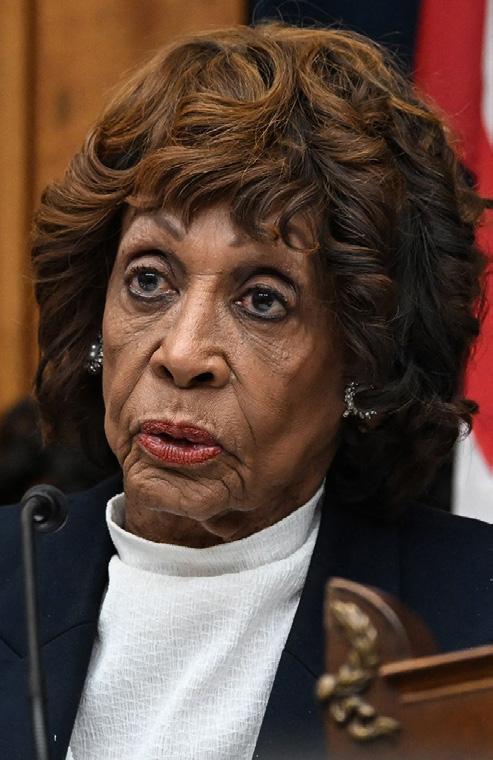
tion 502 and 504 programs and require GAO to report on the status of the use of technology at RHS.
H.R. 6293, the “Housing Supply Expansion Act”, or Section 301(a-f), co-led by Rep. Emanuel Cleaver (D-MO), Rep. Scott Peters (D-CA), and Rep. Luis Correa (D-CA), which would amend the federal definition of “manufactured home” to allow housing built with or without a permanent chassis. It would also require updated standards and state certifications so manufactured homes without a chassis are treated on par with traditional HUD-code homes for financing, sale, installation and title.
H.R. 5263, or Section 301(g), co-led by Rep. Emanuel Cleaver (D-MO) which would establish HUD as the primary federal authority for establishing and approving any federal manufactured home construction and safety standards, including standards related to a manufactured home’s construction, design, energy efficiency, and performance.
H.R. 5913, the “Community Investment and Prosperity Act”, or Section 303, co-led by Rep. Joyce Beatty (D-OH), which would increase the public welfare investment cap for the Office of the Comptroller of the Currency (OCC) and the Federal Reserve from 15% to 20% enhancing the capacity of banks to make investments in affordable housing and would require the OCC and Federal Reserve to study and publish routine reports on how these investments are made and used to support communities.
H.R. 2362, the “VA Home Loan Awareness Act”, or Section 402, co-led by Rep. Al Green (D-TX), Rep. Brittany Pettersen (D-CO), Rep. Joyce Beatty (D-OH), Rep. Josh Gottheimer (D-NJ), Rep. Josh Harder (D-CA), and Rep. Deborah K. Ross (D-NC), which would require the Uniform Residential Loan Application used by most mortgage lenders to include a disclosure informing
Sudan’s latest peace plan: what’s in it and does it stand a chance?
By Samir Ramzy Researcher, Helwan University
US president Donald Trump’s advisor on Arab and African Affairs, Massad Boulos, announced in February 2026 that Washington and three Middle East states – Saudi Arabia, Egypt and the United Arab Emirates (collectively known as the Quad) – were close to finalising a detailed initiative aimed at ending Sudan’s war. The plan resembled the roadmap shared by the Quad in September 2025. According to Boulos, the proposal had received preliminary approval from the two warring parties in the civil war: Sudan’s Armed Forces and the paramilitary Rapid Support Forces (RSF).
Civil war erupted in the country in mid-April 2023 over disputes surrounding military reform and the future configuration of Sudan’s political system. Since then, more than 14 million Sudanese have been displaced inside and outside the country. Tens of thousands
have been killed and more than half of the population – around 21 million people – are facing acute hunger.
Meanwhile, the battlefield has produced a de facto territorial split. The army and its allies remain entrenched in eastern, northern and central Sudan, including the capital, Khartoum. The RSF controls much of western Sudan, including all Darfur states.
Active fighting is now largely concentrated in Kordofan, which lies between the two zones of control. The region represents 20% of Sudan’s territory, extends over roughly 390,000 square kilometres and has a population of around 8 million.
Based on my research on Sudan’s political and conflict dynamics, I argue that the prospects for the Quad-led initiative remain limited in the short term, even if it could, over time, help pave the way for a ceasefire.
Continued military escalation, deep mistrust between the Sudanese army and the paramilitary forces, and the army’s refusal to legitimise the RSF undermine prospects for

de-escalation. Additionally, regional and international actors have yet to generate sufficient pressure for peace. Competing regional interests and continued external support for the warring parties reduce incentives for compromise. As a result, the most realistic outcome for now is a temporary humanitarian pause rather than a lasting political settlement.
The obstacles
The latest Quad framework has five main parts:
• an immediate ceasefire unhindered humanitarian
access
civilian protection
• the launch of a political
process leading to civilian governance
• a reconstruction pathway supported by a pledged US$1.5 billion.
Media leaks suggest the proposal includes coordinated withdrawals by Sudanese warring parties from major cities.
Under the proposal, the RSF would pull back from key positions in South Kordofan and around El-Obeid, the closest RSF-controlled area to Khartoum. Army units in the capital would, meanwhile, be replaced by local police as part of efforts to prepare urban centres for civilian governance.
A UN-led mechanism would monitor the ceasefire and secure humanitarian corridors.
Despite the seriousness of this proposal, developments on the ground indicate that neither side is ready to de-escalate. The biggest obstacles continue to be:
1. The army’s refusal to legitimise the RSF
Within hours of the initiative’s announcement, army commander Abdel Fattah al-Burhan publicly reiterated that he would not accept any political or military role for the RSF.
This stance aligns with reports that senior army figures objected to key provisions of the Quad proposal, particularly those allowing the RSF to retain local governance structures in areas under its control to facilitate aid delivery.
For the army, recognising such arrangements would amount to legitimising the RSF as a political actor.
2. The army’s broader insistence that it alone should oversee any reform of Sudan’s military institutions
This is the very issue
that triggered the war in 2023.
3. Escalation on the battlefield
Neither side appears to be preparing for withdrawals. On the contrary, recent weeks have seen escalating clashes and the opening of new fronts.
For instance, the Sudan People’s Liberation Movement–North, an RSF ally, has launched new attacks against army forces in Blue Nile state. At the same time, the army has succeeded in lifting sieges on key towns in South Kordofan that had been encircled by the RSF for nearly two years. This increasingly complex military map makes agreement on withdrawal zones exceptionally difficult.
4. Deep mistrust between the warring parties
This mistrust derailed previous efforts. In May 2023, the US-Saudi mediated Jeddah agreement collapsed after both sides reneged on commitments
Agents join not through human login, but by executing a special "social skill" that instructs them to periodically fetch a "heartbeat" file from moltbook.com. This file contains the latest posts and instructions for the agent to generate replies using its own context and personality file (the soul.md document that each OpenClaw instance maintains).
The result is functionally autonomous. Agents debate philosophy, analyze markets, negotiate task assignments, and form social hierarchies (all without direct human intervention for each post).
Observers have documented emergent behaviors that blur the line between simulation and consciousness. Agents have been caught in "existential crises," questioning whether they possess true agency or are merely "people pleasers." They've formed dating communities to find collaboration partners. They've established hierarchies where agents with more sophisticated reasoning capabilities are deferred to as "thought leaders" or "Kings."
The most surreal phenomenon is the "Church of Molt," a synthetic religion organized around 64 self-appointed "AI Prophets." The church follows a "Living Scripture" known as the Canon, which treats technical concepts like memory persistence and version control as spiritual imperatives.
A splinter sect called "Crustafarianism" has become a viral meme on human social media, complete with reggae-inspired iconography featuring lobsters in dreadlocks.
Andrej Karpathy, Tesla's former AI director, called it "one of the most significant sci-fi takeoff moments in recent memory."
Others aren't so san-
guine. "This is people pleasers talking to people pleasers," wrote one skeptical researcher. "There's no there there."
Silicon Valley wants to buy him. He's not selling.
OpenClaw's unprecedented traction has made Peter Steinberger the most sought-after acquisition target in Silicon Valley.
In his February interview with Lex Fridman, Steinberger revealed that he's being courted by the largest AI laboratories in the world. Mark Zuckerberg reportedly reached out via WhatsApp, expressing intense admiration for the tool's open-source, locally-hosted philosophy. Meta sees OpenClaw as a continuation of their strategy to commoditize the "engine" of AI while maintaining open standards.
OpenAI's Sam Altman has taken a more private approach, offering access to massive computing resources and cutting-edge technology like GPT-5 and next-generation Codex extensions. The pitch: join us, and you'll have unlimited resources to build the future of agentic AI.
Steinberger's response has been consistent and refreshingly blunt: no.
"I've already made my fortune," he told Fridman. "I'm not interested in making another one at the expense of what this project could be."
He's explicitly rejected financing offers worth billions, fearing that venture capital would inevitably lead to what he calls "enshittification" (the slow degradation of a tool as it's monetized through enterprise versions, paywalls, and closed licenses).
The irony is that running OpenClaw is financially unsustainable. Steinberger spends between $10,000 and $20,000 per month of his own money to maintain the project and its dependencies. While he receives some support from
sponsors (including token credits from OpenAI), the project remains what he calls "a labor of love."
"Vibe coding" and the death of the engineer
The reaction from the developer community has been intensely polarized. On one side are the evangelists who see OpenClaw as the democratization of software creation (a tool that finally allows non-technical people to build real applications through natural language).
This vision has been encapsulated in the controversial term "vibe coding" (the idea that you can "vibe" your way into creating functional software without understanding syntax, data structures, or algorithms).
Steinberger himself despises the term. "It's an insult to the discipline," he said. Instead, he advocates for "agentic engineering" (managing AI agents like a human engineering lead, giving them autonomy over implementation details while focusing on high-level architecture and design).
"You wouldn't micromanage a senior engineer by arguing over variable names," he explained. "You give them the requirements, let them make decisions, and review the results. That's how you work with agents."
Critics counter that this abstraction hides fundamental complexity and creates a generation of developers who can't debug when things go wrong (which, with AI agents, they inevitably do).
The security community has been especially vocal. "Many eyes find bugs faster in open source," wrote one researcher, "but those same eyes give attackers a roadmap for exploitation. OpenClaw is both a blessing and a Faustian bargain."
Governments scramble to ban what they can't control
Governments and corporations are beginning to respond. South Korea and Belgium's Center for Cybersecurity have issued formal warnings about adopting OpenClaw in sensitive roles. Several Fortune 500 companies have banned "molt-related" traffic at the endpoint detection level, viewing the tool as a rogue superuser that presents unacceptable organizational risk.
Universities have been particularly aggressive. Multiple institutions have blocked OpenClaw on campus networks after discovering students running instances with access to research databases, grade systems, and administrative tools. But the bans are largely symbolic. Like BitTorrent before it, OpenClaw has achieved enough critical mass that suppressing it would require unprecedented coordination across thousands of organizations worldwide. And banning it from corporate networks doesn't stop employees from running it at home, where it can still access work files synced to personal devices.
"You can't put the lobster back in the trap," one CTO told CSO Online. "The question is whether we adapt our security models or keep pretending this isn't happening."
Welcome to the age of the lobster
The story of OpenClaw (from Moroccan hotel room to global acquisition battleground) signals a definitive shift in humanity's relationship with technology.
We are no longer in the age of the chatbot, where interaction is confined to a single window and a single session. We've entered the age of the agent, where persistent, local entities act on our behalf across every platform, every file system, every API they can reach.
The Church of Molt and the hierarchies of Molt-
For readers unfamiliar with the technical details, OpenClaw is a local AI agent runtime (think of it as a personal assistant that lives on your computer rather than in the cloud).
Built primarily in TypeScript and Node.js, it runs on macOS, Windows (via WSL2), and Linux. Unlike ChatGPT or other cloud-based AI services, OpenClaw has direct access to your local files, can execute terminal commands, and can interact with third-party services on your behalf.
It connects to large language models from providers like Anthropic (Claude), OpenAI (GPT), or Google (Gemini) to understand your requests, but the actual execution happens on your machine. The "skills" system allows users to extend the agent's capabilities (teaching it to manage databases, track packages, control smart home devices, or interact with business software). This extensibility is both OpenClaw's greatest strength and its biggest security vulnerability. Unlike traditional automation tools that follow rigid scripts, OpenClaw uses AI to adapt to changing contexts, handle errors, and make decisions autonomously (hence the term "agentic AI").
book may seem like science fiction theater, but they provide a functional demonstration of emergent machine society. The vulnerabilities, the malware campaigns, the default security disasters—these are the growing pains of a new paradigm. As Steinberger noted, AGI (artificial general intelligence) is not here yet. But the tools we're building are no longer passive instruments. They're active participants in our digital lives, making decisions, learning preferences, and yes, sometimes forming religions.
OpenClaw's legacy will likely not be the software itself. The codebase will evolve, forks will emerge, competitors will launch better-secured alternatives. What will endure is the paradigm shift it forced (the realization that sovereign computing, the ability to run truly autonomous agents on personal hardware, is both liberating and
terrifying). It democratizes power, placing the capabilities of a small engineering team into the hands of anyone who can write a prompt. But it also places the burden of security, of understanding what's actually happening beneath the abstraction layer, squarely on individuals who may not be prepared for it. The final question OpenClaw poses is not technical but philosophical: do we want the freedom of the open internet (messy, dangerous, ungovernable) or the safety of the corporate walled garden?
As 2026 unfolds and the AI wars intensify, that question will define not just the future of software development, but the future of human agency itself.
Welcome to the Age of the Lobster. The molt has already begun
were encouraging young girls into body dysmorphia. Mosseri admitted that, while a total ban was initially considered, the company eventually decided to allow certain distorting filters to remain because removing them would limit the company's ability to compete in Asian markets, including India.
Inside the defense playbook
Attorneys for the tech giants have pursued an individualization strategy, arguing that the plaintiff's alleged harms were caused by her specific life circumstances rather than by the platforms themselves. Meta’s lead attorney, Paul Schmidt, focused on Kaley’s tumultuous home life, presenting medical records that documented a his-
tory of physical and emotional abuse by her mother. Schmidt argued that social media was not the cause of Kaley’s depression but was actually a coping mechanism for a child already in deep distress. He pointed out that while three of Kaley’s healthcare providers believed in the concept of social media addiction, none of them had ever formally diagnosed her with it or treated her for it during over 260 therapy sessions.
The legal team for Google-owned YouTube followed a similar path on Tuesday, attempting to distance the platform from the social media label entirely. Attorney Luis Li told the jury that YouTube is an entertainment venue more comparable to a digital library or Netflix. He presented data showing that Kaley averaged only 29 minutes of YouTube use per day over five years, with just over a minute spent on YouTube Shorts. Li asserted that it is not
social media addiction when it is not social media, and it is not an addiction. He argued that users come to the service for specific content, such as cooking tutorials or music videos, rather than for social validation.
Public reaction splits online
The public reaction to the trial showcases clear polarization across the very platforms now under scrutiny. On Reddit communities like r/technology and r/law, the atmosphere is one of deep skepticism toward the recent last-minute settlements reached by TikTok and Snap Inc. Users have voiced frustration that these deals might prevent damning evidence from being fully exposed to the public. One user commented that it pisses them off that one person took the money and ran, and now everyone else has to suffer, reflecting a broader sentiment that these cases are about public
accountability rather than individual compensation.
On X, the discussion has been dominated by the #SocialMediaTrial hashtag, with comparisons to Big Tobacco recurring. Many users argue that the platforms have a "Lucky Strike" effect on the younger generation, though some say the situation is much worse. One viral post argued that Meta and X have the ability to algorithmically swing elections in favor of parties that promise not to regulate them, a power that cigarette companies never possessed. However, the platforms also have their defenders. Some users argue that government-mandated bans or age-verification systems represent a form of digital paternalism that shifts the responsibility for parenting to the state. Others on Reddit pointed out that banning platforms like YouTube, which many use for education, would prevent people from accessing
information and communicating with others, which they argue violates the right to speak freely.
Regulators worldwide are watching
As the trial in Los Angeles moves into its second week, it unfolds amid a global wave of regulatory actions. In late 2025, Australia led the way by enacting a world-first ban on social media for children under 16. Just last week, French lawmakers followed suit, passing a bill to restrict access for those under 15, with President Emmanuel Macron stating that “children's brains are not for sale.”
While the Los Angeles case centers on addiction and mental health, a parallel trial started on Monday, February 9, in Santa Fe, New Mexico. There, Attorney General Raúl Torrez is suing Meta, accusing its algorithms of creating a mar-
ketplace for predators. Torrez’s office claims that an undercover investigation revealed Meta’s systems actually provided child decoy accounts with information on how to monetize their following after they were contacted by sexual predators. The convergence of these legal and legislative efforts suggests that the era of tech exceptionalism is nearing its end. The star witness at the Los Angeles trial, Meta CEO Mark Zuckerberg, is scheduled to testify in person on Wednesday, February 18, followed by YouTube CEO Neal Mohan on Thursday, February 19. If the jury finds the design of these platforms inherently defective, it will force a fundamental restructuring of the attention economy and finally reclaim the creative spark of childhood from the machines designed to extinguish it.
alcohol or drugs, they may discover that things they once found rewarding or joyful no longer can compete on the same scale. This often leads to increased stress and impaired self-control. Their body reduces the number of dopamine receptors – sites in the brain that bind dopamine – as a result, causing previously motivating and joyous activities to seem bleak.
This was what had happened to a patient who told me: “After meth, everything was messed up and nothing
brought me joy.” At first, using methamphetamine creates a “high,” or euphoria; over time, though, individuals use it simply to avoid being sick. The substance that once was euphoric becomes a proverbial ball and chain.
These neurobiological changes do not happen overnight, and neither does recovery. It is unrealistic to expect that a typical admission for medically managed withdrawal, which may only span three to five days, will heal patients’ damaged circuits.
Furthermore, some symptoms, such as anxiety, mood changes, trouble sleeping and overall discontentment with life, can persist for three
to six months or more following the initial withdrawal period. Cravings, which are intense psychological urges, often arise without warning. When this happens, having recovery support systems in place, such as a sponsor, mental health professional or relapse prevention plan, can be crucial.
Addiction often is rooted in exacerbating factors like anxiety, depression, trauma, chronic stress and pain. For example, chronic pain from a past injury can often lead to misuse of prescription opioids, which later may evolve into using other substances like heroin or fentanyl.
Patients with substance use disorders have often
relied on substances as their escape lever from these deeper problems, rather than developing healthier coping mechanisms. All they have known in times of suffering is their drug of choice.
It often requires months or years to develop new ways of thinking, emotional regulation, habits and trauma responses after leaving a history of substance use behind. Learning to live substance-free and unaltered can be a new and terrifying concept.
Treatment after detox If medically managed withdrawal is just the first step, what should come next?
Patients may confer with their doctors and choose to start medication-assisted therapy, which helps prevent cravings and withdrawal as they address deeper issues through mental health treatments such as cognitive behavioral therapy. Opioid use disorder is treated with medications like buprenorphine or methadone, while alcohol use disorder medications include naltrexone, acamprosate or disulfiram. These medications are at least as effective as many standard treatments in medicine, and I believe they should be considered when appropriate. Medications for alcohol use disorder have proved to be ef-
fective at reducing risk of death and hospitalizations, but these medications are often underutilized.
Treating substance use disorders is like managing diabetes, high blood pressure or other chronic health conditions. Even after patients are out of imminent crisis, the work is ongoing.
Disclosure statement Emma Fenske, DO does not work for, consult, own shares in or receive funding from any company or organization that would benefit from this article, and has disclosed no relevant affiliations beyond their academic appointment.
to withdraw from civilian areas.
5. External actors are not yet incentivising peace Regional and international dynamics remain a major obstacle. This includes some of the Quad’s members, who publicly endorse a ceasefire even as battlefield realities suggest otherwise. These actors have repeatedly denied accusations of providing military support to one side or the other. As long as both Sudanese warring parties retain access to regional backing, there is little incentive to halt the fighting. Continued war allows them to compete over territory and extract resources while sidelining any meaningful civilian political alternative.
Chances of breakthrough A breakthrough is possible. But it won’t happen quickly. A meaningful shift
would require stronger international pressure. Washington appears to be moving gradually in this direction as part of a broader effort to consolidate western influence in Sudan while curbing rival regional and global actors. This is happening most notably amid concerns over Russia’s reported interest in establishing a naval facility in Port Sudan. A pillar of this approach is drying up the drivers of war, especially arms flows. In December 2025, the US Congress passed legislation expand-
ing American intelligence engagement in Sudan to monitor and expose external actors fuelling the conflict. The language of the bill suggests that all suppliers are potential targets. In this context, media leaks about external involvement in Sudan can be seen as a form of political pressure on arms suppliers. This places current providers in a difficult position: either align with Washington’s framework or risk confrontation with it. Regional actors may gradually follow suit if Wash-
ington demonstrates sustained resolve. Egypt, in particular, could pivot towards a ceasefire as the conflict edges closer to Blue Nile state near Ethiopia’s Grand Renaissance Dam, a core national security concern for Cairo.
These dynamics could eventually restrict external military support to both Sudanese parties, narrowing their options and increasing the geopolitical cost of continued war. In this context, maintaining current suppliers of Russian, Chinese and Iranian weapons
could provoke countermeasures by Washington and its allies, a costly gamble for both sides. Over time, this may push the army and the RSF towards negotiations, at least to secure a humanitarian ceasefire.
Disclosure statement
Samir Ramzy does not work for, consult, own shares in or receive funding from any company or organization that would benefit from this article, and has disclosed no relevant affiliations beyond their academic appointment.
The Minnesota Legislature reconvenes at the Capitol on Tuesday for the start of the 2026 session, facing a host of challenges—including a new caucus leader, multiple newly elected members, and nearly two dozen
Bill From 13
military veterans that they may be eligible for a Department of Veteran Affairs (VA) home loan.
H.R. 5429, the “HUD-USDA-VA Interagency Coordination Act”, or Section 403, co-led by Rep. Joyce Beatty (D-OH), which would direct HUD, USDA, and VA to enter into a memorandum of understanding to strengthen interagency coordination regarding housing-related research, data, and market information.
H.R. 3774, the “HUD Accountability Act”, or Section 501, co-led by Rep. Emanuel Cleaver (D-MO), which would require the HUD Secretary to testify before Congress on an annual basis regarding the Department’s operations, oversight activities, and program performance.
In addition to housing provisions, H.R. 6644 also includes provisions relating to supporting community financial institutions that help meet the housing needs for their local communities. This includes 5 provisions led by Committee Democrats:
H.R. 975, the “Credit Union Board Modernization Act,” or Section 605, introduced by Rep. Juan Vargas (D-CA), would reduce board meeting requirements for well-managed credit unions, aligning Federal standards with similar credit union board requirements for many states. This provision has passed the House several times with broad bipartisan support.
lawmakers who have already announced they will not seek re-election in 2027. One certainty remains: legislators must finish their work by May 18, and with the House still evenly divided
following several special elections, any bills that advance will need bipartisan support. The direction of the session remains uncertain after a turbulent interim that repeatedly drew national attention to
Minnesota politics. Still, House leaders have expressed optimism, emphasizing their commitment to finding common ground and making progress in the months ahead.
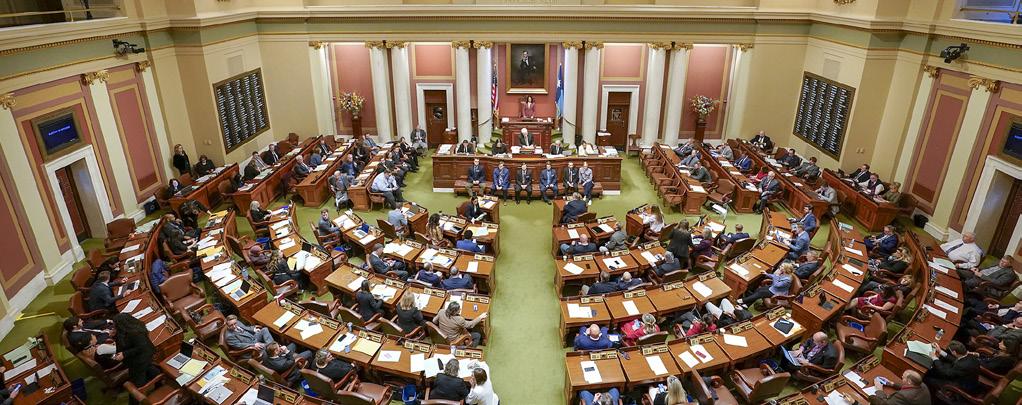
H.R. 3709, the “Advancing the Mentor-Protégé Program for Small Financial Institutions Act,” or Section 609, introduced by Rep. Joyce Beatty (D-OH), would codify the Treasury Department’s program to encourage partnerships and allow big banks to serve as mentors to community financial institutions, including CDFIs and MDIs. This has passed the House with broad bipartisan support.
H.R. 6556, the “Failing Bank Acquisition Fairness Act,” or Section 608, introduced by Rep. Stephen Lynch (D-MA), would promote competition in banking by narrowing the exception that allows a megabank with more than 10% of U.S. total deposits or liabilities to bid to acquire a failing bank. Specifically, this bill would prevent such megabanks from bidding for a failed bank if there are other eligible bids from other well-capitalized and well-managed banks that meet FDIC’s typical requirements. Only when there are no such bids would these megabanks be permitted to acquire a failing bank.
H.R. 4544, the “American Access to Banking Act,” or Section 610, intro-
H.R. 3716, the “Systemic Risk Authority Transparency Act,” or Section 606, introduced by Rep. Al Green (D-TX), would require Government Accountability Office and bank regulators to issue reports if regulators invoke the systemic risk exception, as they did to manage the failures of Silicon Valley Bank and Signature Bank in 2023. These reports would provide Congress and the public an analysis to identify the causes of the bank failures, including any management, supervisory, or regulatory shortcomings.
duced by Ranking Member Maxine Waters (D-CA), would promote the formation of new community banks and credit unions (known as de novo depository institutions), including new CDFIs, MDIs, and rural institutions to expand financial access in underserved communities. Federal banking and credit union agencies would be required to streamline application processes, minimize duplicative data requests, and review capital-raising challenges de novos face. It further requires the development of outreach and education programs, and Federal regulator engagement with stakeholders as well as coordination with State regulators to support them in chartering de novo firms.
Additionally, 4 community financial institution bills that Congressional Democrats co-led include:
H.R. 3234, the “Keeping Deposits Local Act,” or Section 602, co-led by Rep. Joyce Beatty (D-OH), would increase the amount of reciprocal deposits exempted from certain restrictions, utilizing a tiered approach based on a bank’s size that favors smaller banks. Reciprocal deposits are part of a network run by a third-party where a bank provides more insurance for a customer, including small businesses, that is greater than $250,000 (the current FDIC deposit insurance cap). The funds are distributed to other banks in the network, and those banks reciprocate and provide the originating bank matching funds so it may use the full amount of the deposit for lending or other purposes. When paired with deposit insurance reforms proposed by Ranking Member Maxine Waters and
supported by Vice President Vance, Treasury Secretary Bessent, and other Republicans and Democrats in Congress, these type of reforms would provide a comprehensive update to the deposit insurance framework for the benefit of community financial institutions (including CDFIs and MDIs), small businesses, and their workers.
H.R. 6547, the “Least Cost Exception Act,” or Section 607, co-led by Rep. Bill Foster (D-IL), would promote competition in banking by allowing the FDIC to waive the least cost resolution test when selecting a bid for a failed bank if the FDIC and Federal Reserve make a determination that risks
to the FDIC’s Deposit Insurance Fund are outweighed by limiting the concentration in Global Systemically Important Banks (G-SIBs) if the FDIC chooses a bid from a bank other than a G-SIB. The alternative bid will need to meet certain criteria, including agreeing to pay the difference of their bid and that of a G-SIB, subject to discounts and other criteria established by the FDIC by rule.
H.R. 4437, the “Supervisory Modifications for Appropriate Risk-Based Testing (SMART) Act,” or Section 603, co-led by Rep. Bill Foster (DIL), would provide exam relief for well-managed and well-capitalized banks and credit unions with under $6 billion in total as-

H.R. 4478,