OECC FEB26 Center Pages

Page 1


Ouachita Electric Cooperative Summary of Bylaws

Article III: Meetings of Members

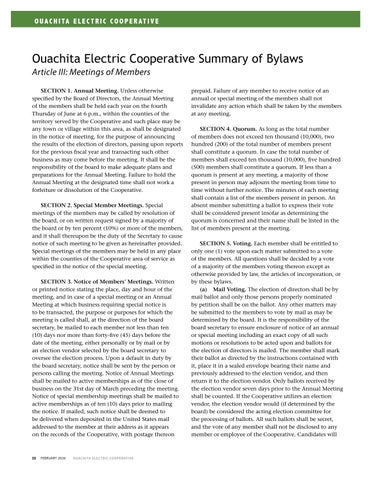
SECTION 1. Annual Meeting. Unless otherwise specified by the Board of Directors, the Annual Meeting of the members shall be held each year on the fourth Thursday of June at 6 p.m., within the counties of the territory served by the Cooperative and such place may be any town or village within this area, as shall be designated in the notice of meeting, for the purpose of announcing the results of the election of directors, passing upon reports for the previous fiscal year and transacting such other business as may come before the meeting. It shall be the responsibility of the board to make adequate plans and preparations for the Annual Meeting. Failure to hold the Annual Meeting at the designated time shall not work a forfeiture or dissolution of the Cooperative.

SECTION 2. Special Member Meetings. Special meetings of the members may be called by resolution of the board, or on written request signed by a majority of the board or by ten percent (10%) or more of the members, and it shall thereupon be the duty of the Secretary to cause notice of such meeting to be given as hereinafter provided. Special meetings of the members may be held in any place within the counties of the Cooperative area of service as specified in the notice of the special meeting.

SECTION 3. Notice of Members’ Meetings. Written or printed notice stating the place, day and hour of the meeting, and in case of a special meeting or an Annual Meeting at which business requiring special notice is to be transacted, the purpose or purposes for which the meeting is called shall, at the direction of the board secretary, be mailed to each member not less than ten (10) days nor more than forty-five (45) days before the date of the meeting, either personally or by mail or by an election vendor selected by the board secretary to oversee the election process. Upon a default in duty by the board secretary, notice shall be sent by the person or persons calling the meeting. Notice of Annual Meetings shall be mailed to active memberships as of the close of business on the 31st day of March preceding the meeting. Notice of special membership meetings shall be mailed to active memberships as of ten (10) days prior to mailing the notice. If mailed, such notice shall be deemed to be delivered when deposited in the United States mail addressed to the member at their address as it appears on the records of the Cooperative, with postage thereon

prepaid. Failure of any member to receive notice of an annual or special meeting of the members shall not invalidate any action which shall be taken by the members at any meeting.

SECTION 4. Quorum. As long as the total number of members does not exceed ten thousand (10,000), two hundred (200) of the total number of members present shall constitute a quorum. In case the total number of members shall exceed ten thousand (10,000), five hundred (500) members shall constitute a quorum. If less than a quorum is present at any meeting, a majority of those present in person may adjourn the meeting from time to time without further notice. The minutes of each meeting shall contain a list of the members present in person. An absent member submitting a ballot to express their vote shall be considered present insofar as determining the quorum is concerned and their name shall be listed in the list of members present at the meeting.

SECTION 5. Voting. Each member shall be entitled to only one (1) vote upon each matter submitted to a vote of the members. All questions shall be decided by a vote of a majority of the members voting thereon except as otherwise provided by law, the articles of incorporation, or by these bylaws.

(a) Mail Voting. The election of directors shall be by mail ballot and only those persons properly nominated by petition shall be on the ballot. Any other matters may be submitted to the members to vote by mail as may be determined by the board. It is the responsibility of the board secretary to ensure enclosure of notice of an annual or special meeting including an exact copy of all such motions or resolutions to be acted upon and ballots for the election of directors is mailed. The member shall mark their ballot as directed by the instructions contained with it, place it in a sealed envelope bearing their name and previously addressed to the election vendor, and then return it to the election vendor. Only ballots received by the election vendor seven days prior to the Annual Meeting shall be counted. If the Cooperative utilizes an election vendor, the election vendor would (if determined by the board) be considered the acting election committee for the processing of ballots. All such ballots shall be secret, and the vote of any member shall not be disclosed to any member or employee of the Cooperative. Candidates will

be notified immediately after counting is complete. The result of the election of directors shall be announced at the Annual Meeting. The failure of any member to receive a copy of any such ballot shall not invalidate any action which may be taken by the members. Ballots shall be retained for one year after the election and then destroyed by the election vendor.

(b)Proxies. There shall be no voting by proxy.

(c)Majority. Majority as used in Article III shall mean the highest number of votes cast on any issue or for any person even though fifty (50%) percent or less.

(d)Member Proposals. No motion or resolution shall be voted upon at any meeting except in the manner provided in Subsection (a) of this Section 5. The members may submit a proposal to the meeting by petition signed by not less than ten (10%) percent of the total number of members submitting a copy of such proposal to the board secretary not less than sixty (60) days prior to the meeting, and the board secretary shall cause such proposal to be placed on the ballot, together with such other matters to be voted upon; provided, however, that any proposal to sell, lease, or otherwise dispose of all or any substantial portion of the Cooperative’s property, as provided in Article VIII, must be submitted in the same manner but not less than 120 days prior to the meeting. The Board of Directors shall establish procedures by which both proponents and opponents shall be able to submit to the members a short statement of reasons for or against a proposal, along with other election information.

SECTION 6. Order of Business. The order of business at the Annual Meeting of the members and, so far as possible, at all other meetings of the members, shall be essentially as follows, except as otherwise determined by the members at such meeting:

1. Report on the number of members present in person or by having mailed a ballot in order to determine the existence of a quorum;

2. Reading of the notice of the meeting and proof of the due publication or mailing thereof, or the waiver or waivers of notice of the meeting, as the case may be;

3. Reading of unapproved minutes of previous meetings of the members and the taking of necessary action thereon;

4. Presentation and consideration of reports of officers, directors and committees;

5. Report of the election of directors and swearing in of newly elected directors;

6. Unfinished business;

7. New business;

8. Adjournment.

Congratulations to the following Ouachita Electric Cooperative employees on their years of service milestones

2025 YEARS OF SERVICE AWARDS

5 years .......... Justin Horstkamp and Valorie Stringfellow

10 years ........ Stephanie Butler and Billy Harper

15 years ........ Chad Sloan

20 years ........ Troy Carter

25 years ........ Alan Ferguson and Chad Stanberry

Our offices will be closed on Feb. 16 for Presidents Day.

MAKE YOUR MARK

Apply now for Arkansas Youth Tour

Every year, a select group of Arkansas high school juniors trades their textbooks for a frontrow seat to history. Ouachita Electric is looking for outstanding students to join the Electric Cooperatives of Arkansas Youth Tour, an all-expenses-paid, weeklong leadership experience in our nation’s capital.

From June 13-19, delegates will join more than 1,800 students from across America for a life-changing journey. This isn’t just a sightseeing trip; it is an opportunity for young leaders to discover their voices, develop leadership skills and begin shaping the legacy they will leave behind.

• Meet Your Leaders: Tour the U.S. Capitol and engage with Arkansas’ Congressional delegation.

• Explore World-Class Museums: Visit the Smithsonian Institution and the U.S. Holocaust Memorial Museum.

• Walk Through History: Pay respects at Arlington National Cemetery and visit historic sites like Mount Vernon and the Lincoln Memorial.

• Build Lasting Bonds: Develop lifelong friendships with peers from across the state and the country.

Beyond the experiences in D.C., students selected for the program will have the chance to earn a $5,000 scholarship.

Apply today to make your mark! For more information or to apply, visit oecc.com/youth-tour The deadline is Feb. 27.

Adverse Weather, Degree Days and Your Electric Bill

From time to time, when talking about the weather’s impact (cold or hot) upon your electric bill, you may hear someone mention “degree days.” What is a degree day? And what do degree days have to do with your electric bill?

A degree day is a calculated measure of how cold or hot a location/place is on a given day. A degree day compares the average temperature (the average of the high and the low temperatures of a given day and location) to a standard temperature of 65 degrees. The difference (the deviation from the standard of 65 degrees) is a degree day, which measures the coldness or hotness for the day. Individual degree days can be sequentially added together and used to assess the weather conditions (coldness or warmness) for a period of days and weeks, and correlations can be made on an electric bill.

More specifically, there are heating degree days (HDDs) and cooling degree days (CDDs).

• HDDs are a measure of how cold the temperature was during a period of days. For example, a day with a mean temperature of 40 degrees has 25 HDDs. Two such cold days in a row have 50 HDDs for the two-day period.

• CDDs are a measure of how hot the temperature was during a period of days. A day with a mean temperature of 80 degrees has 15 CDDs. If the next day has a mean temperature of 83 degrees, it has 18 CDDs. The total CDDs for the two days is 33 CDDs.

In closing, there is a direct correlation between the daily fluctuations of the outdoor temperatures and your electric bill. Your electricity use for heating (if electric) and air conditioning rises with the number of degree days.

The more extreme the outside temperature (whether cold or hot), the cumulative degree days will be higher — resulting in higher energy use because heating and cooling equipment must work harder. If your bill shows higher usage in January (many HDDs) and July (many CDDs), degree days help explain why, as these periods require more energy to maintain comfortable indoor temperatures.

In essence, degree days quantify the weather’s impact, providing a standard measure of heating or cooling demand that directly influences your energy consumption and costs. For more information on degree days please visit eia.gov/energyexplained/units-and-calculators/degree-days.php

Turn static files into dynamic content formats.

Create a flipbook
Issuu converts static files into: digital portfolios, online yearbooks, online catalogs, digital photo albums and more. Sign up and create your flipbook.