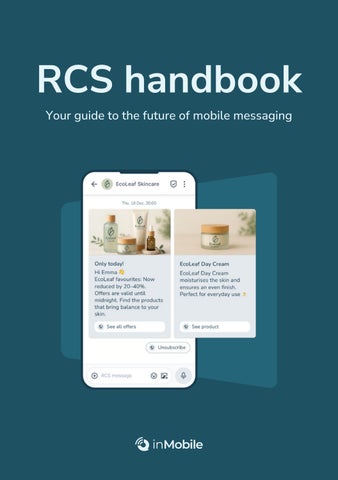
RCS handbook
Your guide to the future of mobile messaging
Written by Julie M. Nielsen
Layout by Henriette
inMobile ApS
Published: January 2026 1st edition
L. Andersen
Preface
Mobile communication is evolving.
After more than 30 years in which SMS has been the standard for direct and personal communication, we are now standing on the threshold of a new chapter: RCS – Rich Communication Services.
While SMS has given us direct contact, RCS introduces a richer, more visual experience.
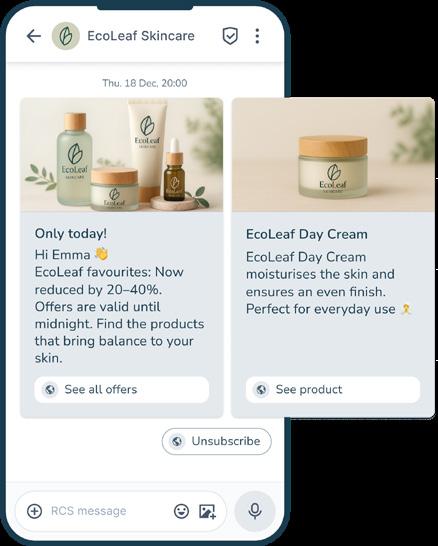
With images, video, buttons and branded senders, businesses can send messages that are not only read, but also actively engaged with.
RCS brings communication to life making it measurable and personal without requiring new apps or logins. Everything takes place within the recipient’s existing messaging app on their phone.
This handbook is written for those working with marketing or e-commerce who want to understand how RCS can become a valuable part of their marketing mix.
Sit back and join us on the journey from text to experience.
Welcome to RCS – the future of messaging.
01 Chapter
Introduction to RCS: From text to experience
The mobile phone is a central touchpoint between brands and customers. With RCS, you can create more creative, visual and dialogue-driven messages. In this chapter, we introduce RCS.
What is RCS
RCS stands for Rich Communication Services and represents the next generation of mobile communication. While SMS is limited to text, RCS allows you to combine text with images, video, GIFs, carousels, buttons and much more in a single message on mobile.
RCS is designed to create better messaging experiences for all mobile users – across both Android and iOS devices.
Think of it as an upgraded SMS experience, with high-resolution images and videos, as well as read receipts, typing indicators and reactions built directly into the message. Much like modern chat apps – but all within the phone’s existing messaging app.
RCS technology
RCS has been developed as a shared global communication standard by the GSM Association (GSMA) – an international organisation representing mobile network operators worldwide.
Today, RCS is supported by Android devices and a wide range of mobile operators worldwide. In 2024, Apple also joined the ecosystem, meaning that RCS is now set to become universally supported across both Android and iOS devices.
RCS for Business
RCS for Business makes RCS technology available to businesses – but that is not all.
While standard RCS is used for person-to-person communication, RCS for Business enables companies to send branded, verified and more advanced messages directly to the customer’s messaging app.
The difference is simple:
• Person-to-person RCS is about creating a better messaging experience between mobile users across devices and operating systems.
• RCS for Business is about providing companies with a more professional, secure and interactive format for customer communication.
When businesses send RCS messages, they do so via a verified RCS agent rather than a standard phone number or sender ID. This means recipients can clearly see who the message is from and that the sender has been verified, creating both credibility and trust.
For the sake of clarity: When we refer to RCS in this book, we are referring to RCS for Business.
Function Standard RCS RCS for Business
Primary use Person to person. Business to person.
Verified sender Not possible. Yes, verified RCS agent.
Branding Limited. Brand name, logo and profile colours.
Interactive elements Photos, video and reactions. + carousels, buttons, quick replies and more
Safety Like SMS. Enhanced with verified senders.
72 % 74 % 35 x
are more likely to make an online purchase if they can ask questions in real time.
are more likely to engage with a brand through RCS. more likely to read RCS messages than emails.
Why now?
RCS is not a new technology. Its development began as early as 2008, but for many years it lacked both widespread adoption and industry support. This changed in 2019, when RCS was rolled out as a standard feature in Google Messages.
Today, RCS is enabled by default on most Android phones, and in 2024 a decisive milestone was reached: Apple joined RCS.
This means that RCS is becoming a shared messaging standard across both Android and iOS devices. With both Google and Apple supporting the same format, businesses gain a unique opportunity to reach virtually all customers on mobile through a single, unified messaging experience.
In other words, this is the moment when RCS truly becomes relevant and compelling as a marketing channel.
And the traffic is already there. According to Google more than one billion RCS messages are sent every day globally, with adoption accelerating as Apple and additional mobile operators continue to roll out support for the technology.
For e-commerce and marketing teams, this means access to a messaging channel that combines the reach of SMS with the rich, immersive experiences typically associated with social media and apps – without requiring recipients to install anything at all.
Consumers expect more from their digital experiences than ever before – and they judge brands based on the entire experience, not just the product. RCS elevates the customer experience to a new level.
Customer expectations are rising 73 % 80 % 79 %
of customers expect better personalisation as technology continues to evolve.
of customers believe that the experience a company delivers is just as important as the product or service itself.
of customers expect a consistent experience across departments – yet 55% report that they are communicating with multiple different departments. Source: Salesforce, State of
RCS vs SMS: What is the difference?
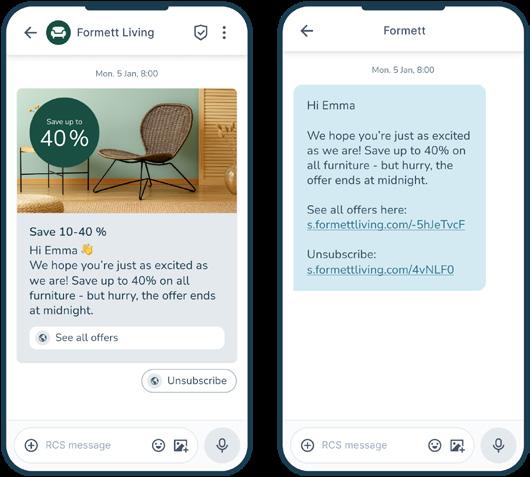
SMS is one of the most effective communication channels because it is simple, familiar and reaches almost everyone. However, the format is limited to text – and this is where RCS stands out.
RCS allows you to send messages that do more than tell – they show. By using visual elements directly within the message thread, recipients can quickly understand your message and respond immediately.
In addition, you gain access to richer data. RCS provides real-time insight into opens, clicks, interactions and recipient behaviour, enabling you to optimise your campaigns and flows over time.
Introduction to RCS: From text to experience
Function SMS RCS
Network type
Mobile network. IP based (WiFi / mobile data).
Max text length 160 characters per message. 3072 characters for a basic RCS (UTF-8).
Photos and video Not possible. Fully supported.
Interactive elements No. Yes, rich media.
Branding Only sender name. Verified agent, logo and profile.
Delivery status Yes (via network). Yes, including read and delivery indicators.
Two-way communication
Possible via a virtual number. Yes, built in.
App installation required No. No.
Device compatibility All devices. Requires RCS support.
Tracking events Limited. Opens, clicks and interactions.
RCS restores trust
Security and trust matter more than ever in digital communication. Customers are exposed to spam and fraud attempts across most channels, which is why it is crucial that they can clearly see who a message is from.
This is where RCS stands out once again.
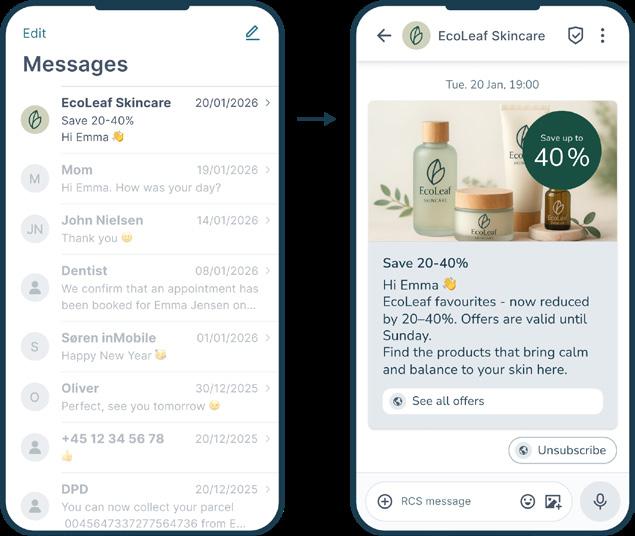
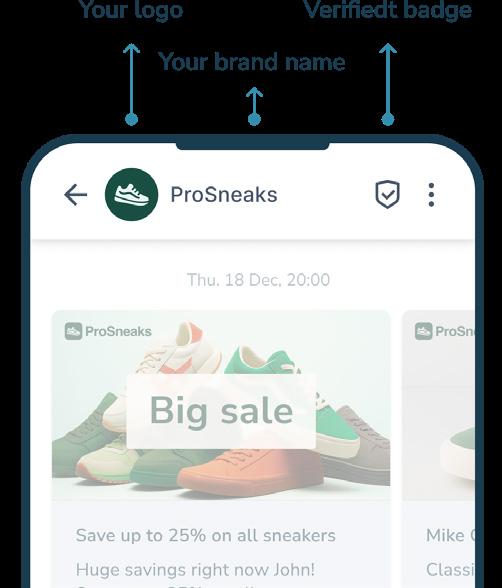
When you send RCS messages, they are delivered via a verified RCS agent, where your brand name, logo and a verified badge are displayed within the message thread. This removes any doubt for the recipient about the authenticity of the message and provides a high level of trust and reassurance.
For businesses, this means more than just security. It means:
• higher engagement, as customers feel confident interacting
• more clicks, as the message feels legitimate
• greater willingness to act, as the experience feels personal and trustworthy.
When recipients can clearly see that a message comes from you, it increases both the credibility and the overall effectiveness of your communication.
Who can use RCS?
RCS is not just for the biggest brands.
It is a channel that creates value for any business that communicates directly with its customers – whether for marketing, sales, service or relationship building.
For e-commerce, RCS makes it possible to bring the entire conversation together in one place. A campaign message can showcase products with images and prices, include a CTA button, and allow customers to ask questions directly within the message thread. This makes both the purchase journey and the customer experience shorter and more seamless.
RCS is just as relevant in other parts of the customer journey, such as:
• order confirmations and delivery updates
• reminders, appointments and service bookings
• loyalty programmes and member communication
• customer service and two-way communication
In other words, RCS provides a format that can inform, engage and address concrete needs within a single channel. It is a channel for businesses that want to get closer to their customers without adding complexity to their communication.
If you can answer yes to the following, you should take a closer look at RCS.
• You want a more visual complement to SMS.
• You want to strengthen the brand experience through interactive messages.
• You want to increase credibility with a verified sender.
• You have customers who respond well to direct communication.
• You want to test new formats without investing in new apps or workflows.
RCS in Denmark and globally
At the time of writing (Q1 2026), RCS has been rolled out in more than 60 countries and is available to over one billion users worldwide. The technology is supported by Android, iOS (in selected markets) and the majority of the world’s major mobile operators – with adoption growing rapidly as more operators enable the format.
In Denmark, RCS is still in its early stages, but progress is underway. Once both Apple and all Danish mobile operators enable RCS, the technology will achieve full reach in the local market.
Follow the current status of RCS here.
From text to experience: RCS changes the game
SMS remains highly effective because it is simple and reaches everyone. However, the format is limited to text – and this is where RCS removes that limitation.
With the visual capabilities of RCS, messages become small, interactive experiences that can both inspire and drive action. You shorten the journey from interest to purchase and gain the ability to deliver messages that feel relevant, modern and personal.
For businesses, this represents a shift in how we think about mobile communication. RCS moves messaging from being “something that is read” to “something the recipient can interact with”.
When communication feels like a conversation – rather than just a notification – engagement increases, relationships are strengthened, and results improve across campaigns and automated flows.
RCS is not just about sending messages. It is about creating positive experiences.
In the next chapter, we look at how your business can prepare for RCS – strategically, technically and practically.
02 Chapter
Ready for RCS: How to get started
Get off to a strong start with RCS. Before sending your first message, there are a few essential foundations that need to be in place. Here, we outline the most important preparations for a strong starting point.
Before you get started
Before getting started with RCS, there are a few fundamental elements that should be in place. This is not about heavy technical setup, but about ensuring that your data, processes and objectives are clear, so you can get the most out of the channel from the very beginning.
1. Consent
2. Purpose
3. Omnichannel strategy
4. Tech stack
5. Sender approval
Consent 1
The first thing you need to have in place is consent. RCS falls under the permission marketing umbrella and follows the same rules as SMS and email: you must have the customer’s explicit consent to send them messages. This means the recipient must have clearly opted in to hearing from you on their mobile number.
If you already have SMS permissions in place, you are well on your way – if not, this is the natural first step.
You can collect consent at multiple touchpoints throughout the customer journey – for example at checkout, via pop-ups, through your loyalty programme, in competitions or via forms on your website.
Note: This book is intended as guidance only and does not replace legal advice. If you are unsure about the rules in your specific situation, you should always consult the applicable marketing legislation or seek advice from a qualified legal professional.
Purpose
Next, it is important to be clear about how you want to use RCS. The channel can enhance several aspects of your marketing efforts, but its impact depends on how it is applied.
Is the goal to drive sales? Engage members of your loyalty programme? Support customer service and dialogue? A clear purpose makes it easier to build your first campaigns and flows and ensures that RCS is used where it creates the most value.
A clear purpose helps you decide:
• which campaigns to start with
• which visual elements to use
• how your flows should be structured
• which KPIs you should measure.
Once you have a clear purpose, it becomes much easier to build your first RCS campaigns.
For marketing and e-commerce teams, the purpose will typically fall into one of the following categories.
Campaigns and sales
Use RCS for sales, promotions, launches and VIP events where the goal is to drive immediate action. With a clear offer and a strong focus on what the recipient should do next, you can increase both click-through rates and sales.
Automations and customer journeys
Enhance welcome flows, win-back messages and abandoned cart journeys with images, product cards and clickable CTAs. RCS flows create a more seamless customer journey by supporting customers exactly where they are in the purchase process.
Customer dialogue before, during and after the sale
Use RCS for two-way communication. Answer questions, guide customers through the purchase journey and follow up after the sale. This reduces friction, builds confidence and strengthens loyalty through personal dialogue.
Omnichannel
RCS works best when used as part of your overall marketing strategy. It is not about replacing SMS, email or push notifications – but about adding a format with a unique strength: creating visual, clickable and engaging messages on mobile.
Where email allows for depth and advertising captures attention, RCS can drive action shortly after delivery. This makes RCS well suited for campaigns, product updates, VIP activities and automations where speed and engagement matter.
RCS can be a strong addition to existing flows.
You can, for example:
• launch a campaign with RCS and follow up via email
• use RCS for abandoned carts and email for follow-up
• let ads drive awareness and RCS drive action.
When you think of RCS as part of your omnichannel strategy, you create a more cohesive and effective communication. And the clearer you are on when each channel performs best, the stronger your customer journey becomes.
Tech stack
Your tech stack needs to support RCS. That said, you don’t need a complex or technically heavy setup to get started with RCS.
In practice, all you really need is access to a platform that can send RCS messages to mobile numbers – ideally with SMS as a fallback for recipients who don’t yet support RCS.
With inMobile, you can choose whether to build and send your RCS messages using inMobile’s RCS editor, or integrate RCS into your existing system via an API or a partner integration.
Most companies can reuse large parts of their existing setup and simply layer RCS on top.
All you need to make sure of is:
• that your mobile numbers are available in inMobile
• that you have a verified RCS agent
• that you have the data you need for segmentation and personalization.
Once you have that in place, you’re technically ready to send RCS.
RCS agent 5
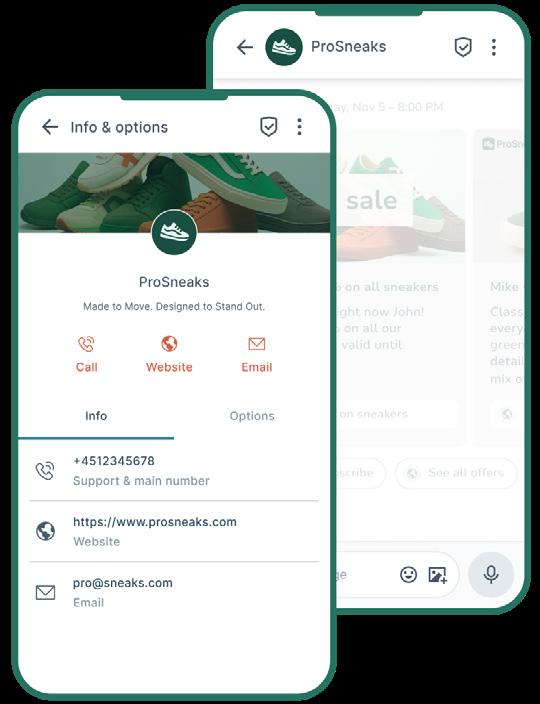
When your business sends RCS messages, they are always delivered through your verified sender profile – known as an RCS agent. This is your company’s official RCS identity, which customers see directly in their messaging app.
The agent includes your brand name, logo, and a verified badge.
Verification acts as an additional security layer, protecting both you and your customers against misuse, spoofing, and fraudulent mobile messages. Recipients can clearly see that the message comes from a verified sender.
For recipients, this means a clear and trustworthy sender – and the confidence to safely interact with buttons and links within the message.
For your business, it ensures that your communication appears credible and professional from the very first message, reducing the risk of your messages being perceived as spam.
To get an RCS agent, your business must go through an approval process where operators verify your company. Once approved, your visual identity becomes a consistent part of the messaging experience, helping you build a high and lasting level of trust across your communications.
Are you ready for RCS?
Here’s your checklist:
You have valid consent for mobile communication.
You have defined a clear purpose for your RCS channel.
RCS is integrated as part of your omnichannel strategy.
Your platform can send and receive RCS (with SMS as a fallback).
You have a verified RCS agent.
Get off to a strong start
Once you have consent, purpose, your tech stack, and your RCS agent in place, you’ve built a solid foundation. That means you can focus on what really creates value: building messages that make a difference for your customers – and your sales.
Start simple. The most important thing isn’t getting the perfect setup from day one, but getting the technology into your hands so you can build your own experience with what works.
Also remember that RCS shouldn’t stand alone.
The format works best as a complement to the channels you already use. When RCS is given a clear role in your marketing mix, both the customer experience and your results become stronger.
In the next chapter, we’ll look at how to build an RCS strategy – and how to measure, test, and optimize your efforts to get maximum impact from every message.
03 Chapter
Your RCS strategy: Walk - Run - Fly
A clear strategy is essential to succeeding with RCS. In this chapter, we’ll look at how to plan, prioritize, and build your RCS efforts to drive both engagement and action.
Walk
Start simple
When getting started with RCS, you can keep things simple. RCS offers many new possibilities, but you don’t need to use them all from day one. In fact, some of the most valuable insights often come from simple tests – where you take something you already know works and elevate it to the RCS format.
In the beginning, it’s about getting to know the format, understanding how your customers respond, and building a sense of what works in practice. You do this best by keeping the sender, content, and CTA clear, focused, and familiar.
In the walk phase, you should therefore focus on three things:
1. Choose a campaign type you know works and elevate it to RCS.
2. Keep your RCS messages simple and easy to follow.
3. Measure campaign performance from day one.
The goal isn’t to use the full range of RCS capabilities just yet.
The goal is to get started – and to do so in a way that gives you fast, actionable insights you can build on. When you start with something familiar, it becomes much easier to see the impact of moving from text to visual communication.
1
Choose a campaign you know works
A great way to get started with RCS is to build on something you already know works. This could be a campaign that has traditionally performed well for you – such as a sale, a product launch, a VIP event, or a seasonal campaign.
When you use a campaign with proven performance, it becomes easier to measure the impact of converting it to RCS. You know the baseline, you know the audience, and you know which messages have driven response in the past.
2
Keep it simple
When sending your first RCS messages, you should keep them relatively simple. You don’t need carousels, multiple buttons, or advanced layouts to see results.
In fact, a clear structure often performs best in the early stages. It gives your recipients time to get used to the new format.
A strong base message typically consists of three elements: This makes the message easy to understand and easy for the recipient to act on.
• An image or another visual element.
• A short, clear message.
• One primary CTA.
Measure performance
Once you’ve sent your first RCS message, the next step is to measure how it performs.
In the walk phase, it’s not about advanced dashboards, but about getting a basic sense of how your customers respond to the format.
Focus on three things:
• Opens: Are recipients seeing the message?
• Clicks: Are they engaging with your message?
• Actions: Does it lead to the desired outcome, such as traffic or sales?
By comparing these metrics with your corresponding SMS or email results over time, you’ll gain clear insight into where RCS delivers the most value.
That insight is exactly what forms the foundation for how you continue to build your RCS strategy.
Run
Expand and optimise
Once you’ve sent your first RCS messages and gained a sense of how the format works and performs, you’re ready for the next step: expanding and optimising. At this stage, it’s no longer about testing the format itself, but about using RCS in a more strategic and targeted way.
In the run phase, you can start working with segmentation, richer visual content, and greater variation across your campaigns.
You move from “one message to everyone” to “the right message to the right recipients” – which typically leads to a significant lift in engagement and conversion.
This is also where you can begin using more message elements (such as carousels, GIFs, multiple CTAs, or quick replies), whenever it makes sense for the content.
Data also becomes a key part of the process. Use what you’ve learned to adjust copy, visuals, and CTAs, so you can start to see clearer patterns in what your customers respond to.
Use segmentation
In the run phase, segmentation becomes one of the most effective ways to improve the performance of your RCS messages. By using the customer data you have available, you can send messages that match the recipient’s behavior, interests, and relationship with your brand – increasing both engagement and conversion.
Start simple and use the segments you already work with, such as:
• new vs. existing customers
• active vs. inactive customers
• previous buyers
• VIP customers
• interests or product categories
• customer club members.
You don’t need advanced data models to get started. Strong results often come from simple segments, where recipients receive messages that feel relevant to them.
Use more RCS elements
As you move from walk to run, you can begin exploring the many visual and interactive possibilities of RCS. You should still keep things simple – but feel free to test additional elements.
It’s not about packing the message with everything that’s possible. It’s about choosing the elements that best support your message.
For example:
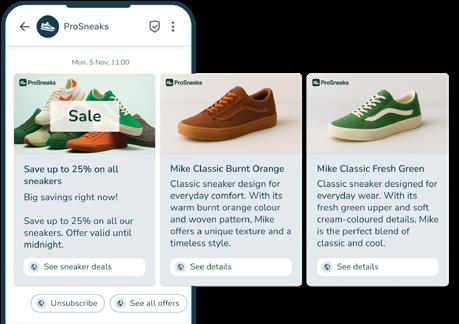
• Carousels: Showcase multiple products or options at once.
• Multiple CTAs: Let customers choose between different actions.
• Quick replies: Make it easy for recipients to respond.
• Video or GIF: Elevate the mood and inspire even more.
Use different rich media elements when they enhance the experience – and continuously learn from the results. What do your customers respond positively to? As you start varying your content, you’ll get a sense of whether, for example, carousels outperform single images, or whether video drives more clicks than static visuals.
Test and iterate
In the run phase, testing becomes one of your most valuable tools. This is where you start varying your content and exploring what drives the highest engagement and sales.
Start with simple variations, such as:
• short vs. slightly longer copy
• one primary CTA vs. an alternative CTA
• carousel vs. single image
• video vs. static visual.
You don’t need an advanced setup to get started. Test one thing at a time so you can clearly see the impact – and repeat what works.
Fly Turn RCS into an experience
In the fly phase, you move from sending campaigns to creating full experiences. Here, RCS becomes a natural part of your marketing engine, where data, personalisation, and timing work together across channels.
This is where RCS truly shows its potential.
In this phase, you can, for example:
• build more advanced marketing flows
• personalise content based on customer behavior
• use multiple visual and interactive elements within the same message
• combine RCS with other channels for maximum impact
• work systematically with A/B testing and optimisation.
You don’t need to use all of these elements to succeed with RCS. In fact, simple RCS campaigns a couple of times a month can deliver very strong results. But if you want to maximize the potential, it’s absolutely possible to work with RCS in a more advanced way.
Personalisation
Personalisation is one of the most powerful ways to make RCS deliver real impact. When the content reflects a customer’s behaviour, interests, or history, the message is perceived as more relevant.
When it comes to personalisation, you can go a long way with the data you likely already have in your shop or CRM system – and may already be using across other channels.
For example:
• Show products based on what the customer previously purchased.
• Tailor messages based on the customer’s loyalty level.
• Send offers based on the most visited pages, products, or categories.
The most important thing is that personalisation feels meaningful to the recipient. When customers experience a message as “just for me”, RCS becomes more than just another channel – it becomes a natural part of the overall purchase journey.
If you want to take RCS a step further, you can work with automated flows where messages are triggered by customer behaviour. This makes your communication both relevant and timely – and it’s where RCS can truly lift performance across the customer journey.
You don’t need to start from scratch. Many e-commerce teams achieve strong results by replacing or upgrading existing automations that already perform well today. For example:
Automation Welcome
Abandoned cart Back-in-stock
Browse abandonment
Win back
Post purchase
Order confirmations and delivery updates
Cross sell
Automated RCS messages work especially well when timing is critical. A message with a relevant product or a clear CTA, sent at the exact moment a customer shows interest or reaches a specific stage in the purchase journey, typically drives strong engagement.
Working with other channels
RCS is powerful on its own, but the impact becomes even clearer when you use the channel alongside your other touchpoints.
When your marketing channels support each other, customers get a more holistic and cohesive experience.
In the fly phase, it’s therefore about orchestrating messages across your marketing mix, so each channel does what it does best.
• RCS is strong at visual and engaging communication.
• SMS is strong at fast and reliable delivery.
• Email is strong at in-depth and explanatory communication.
By combining RCS, SMS, and email, you can leverage the strengths of each channel and ensure your message lands at the right time and in the right context.
This creates a more effective interplay, where communication feels relevant, coordinated, and easy for customers to act on.
RCS use cases
RCS can enhance almost every part of your marketing efforts. It’s about taking familiar marketing activities and giving them a more visual, interactive, and personalised expression.
In the following section, you’ll find 13 concrete use cases showing how RCS can be used across the customer journey – from first contact to repeat purchase and loyalty. Use these examples as inspiration, and consider where RCS can naturally support the flows and campaigns you’re already working with today.
Sales & offers
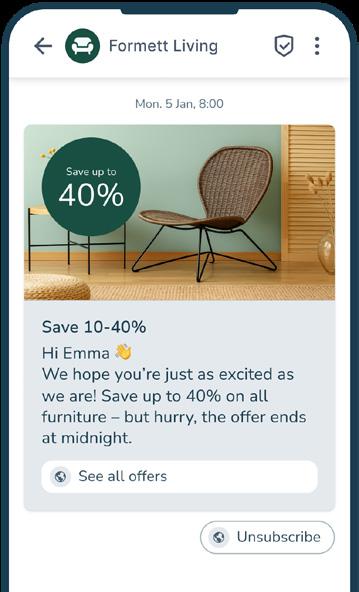
RCS is ideal for sales, as customers can quickly understand your offers and respond directly within the message. Showcase your best deals with a strong visual, concise copy, and a clear CTA. This works especially well for campaign launches, flash sales, or segmented offers.
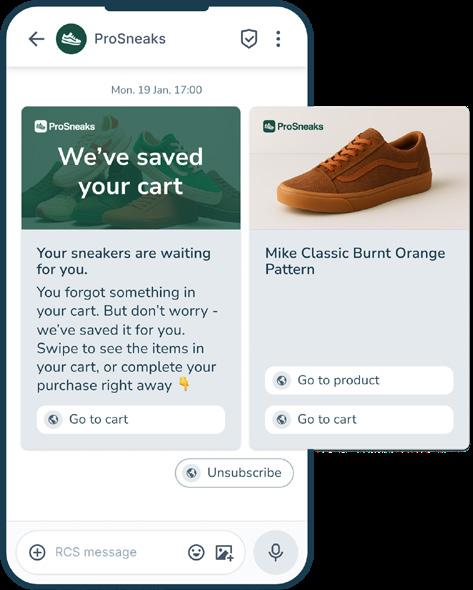
Abandoned cart
When a customer abandons their basket, a visual reminder of the product can be exactly what brings them back. With RCS, you can showcase the item directly in the message and make it easy to complete the purchase with a single click. A short, friendly reminder and a clear CTA provide a natural nudge towards checkout.
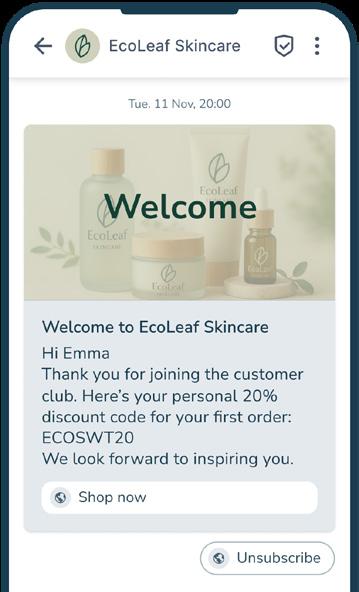
Welcome
A welcome message is your opportunity to give new customers a personal first impression of your brand and get the relationship off to a strong start. With RCS, you can easily present your brand visually, highlight a few selected products, and guide the customer onwards to your website.
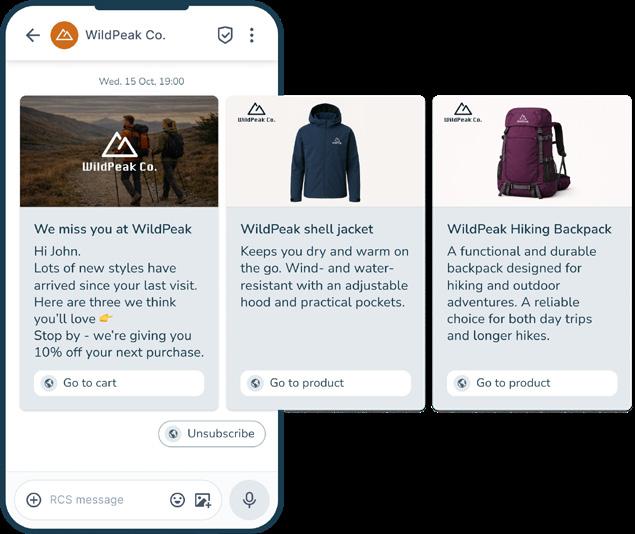
Win-back messages are about re-igniting interest among previous customers who haven’t purchased for a while. RCS makes this easier by allowing you to showcase new products, relevant categories, or personalised recommendations. This gives customers a clear sense of what they’re missing – and makes it easy for them to return.
Win-back
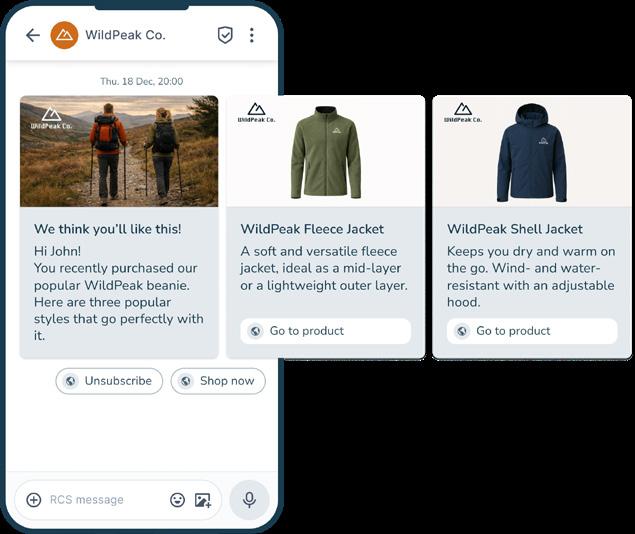
Cross-sell
Cross-sell messages work especially well in RCS, as you can showcase products that complement a customer’s recent purchase in a visual and easy-to-digest format. This makes it simple for customers to discover matching styles or accessories – and even easier to add them to their basket.
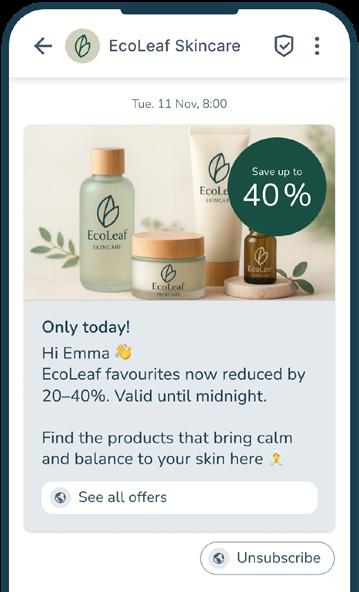
Limited offers
Limited-time offers require fast action, and this is where RCS is particularly effective. When customers can clearly see the offer and feel that time or availability is limited, it accelerates the decision-making process. Mobile messaging is perfectly suited to these types of campaigns, where timing is absolutely critical.
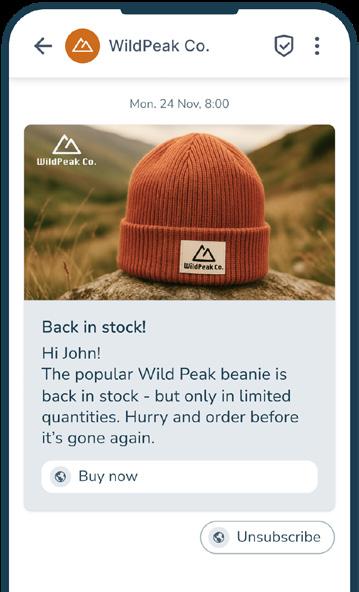
Back in stock
Back-in-stock messages perform extremely well because they reach customers at the exact moment they can once again purchase something they’ve already shown interest in.
With RCS, you can remind customers of the product in a way that creates both recognition and urgency.
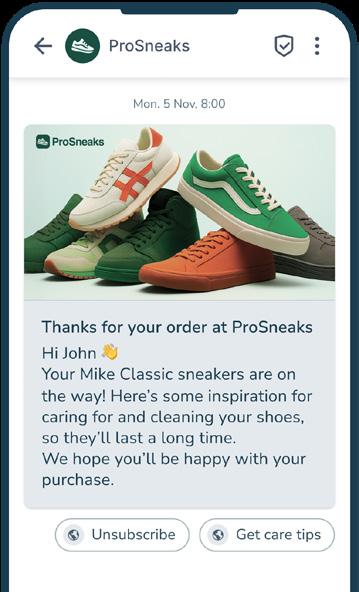
Post purchase
Post-purchase messages strengthen the relationship and help customers move confidently forward after their purchase. With RCS, you can, for example, send a thank-you message, share useful product information, or show how the item is used. This builds confidence, reduces returns, and increases the likelihood of repeat purchases.
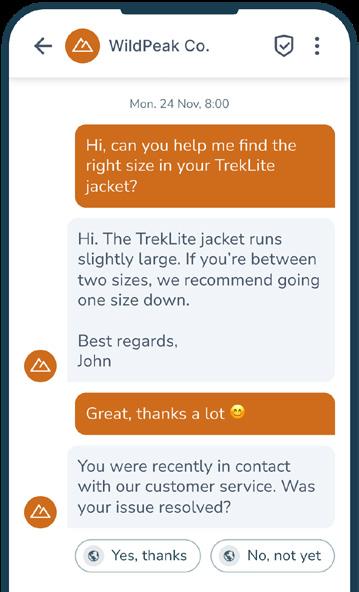
Customer dialogue
RCS makes it easy to have real conversations with your customers. When recipients can ask questions directly in the message thread and receive immediate responses – either via quick replies or through real dialogue with customer service – the experience becomes faster and more personal, both before, during, and after the purchase.
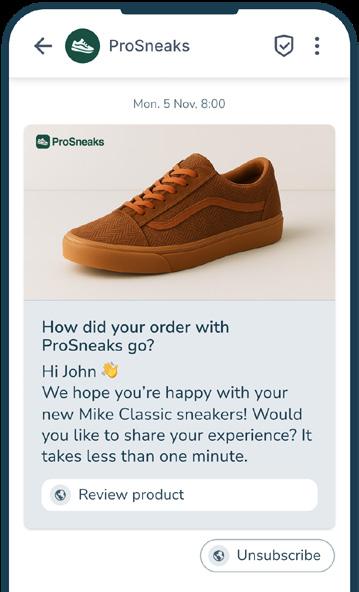
Review
Positive reviews are important for your brand, and RCS makes it easy for customers to share their experience while the purchase is still fresh in their minds. With RCS, you can increase the number of reviews without asking much of the customer. Send a link to your review page – or let customers rate their experience directly within the message.
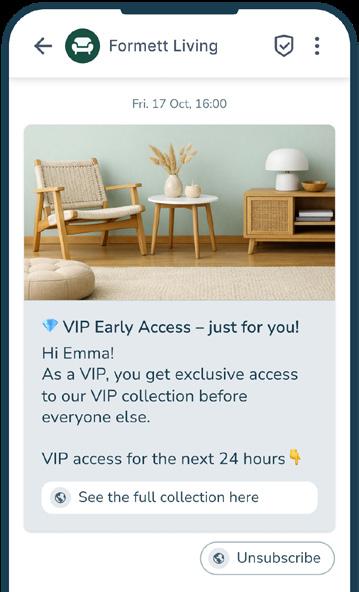
VIP messages
Few things boost loyalty like an exclusive offer or event –reserved for your best customers. Use RCS to send engaging and inspiring messages exclusively to your VIP segment. This could include customers who purchase frequently or spend above a certain threshold.
Browse abandonment
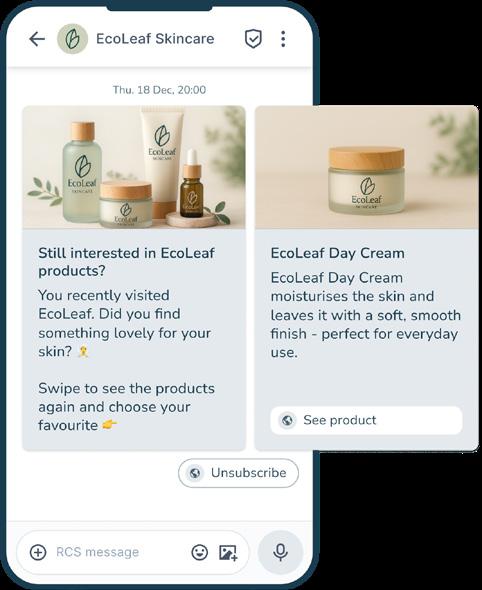
Capture customers who have shown interest but haven’t yet added anything to their basket. With RCS, you can pick up the thread by reminding them of the products or categories they’ve browsed. A visual cue and a friendly reminder can be enough to bring customers back while their interest is still fresh.
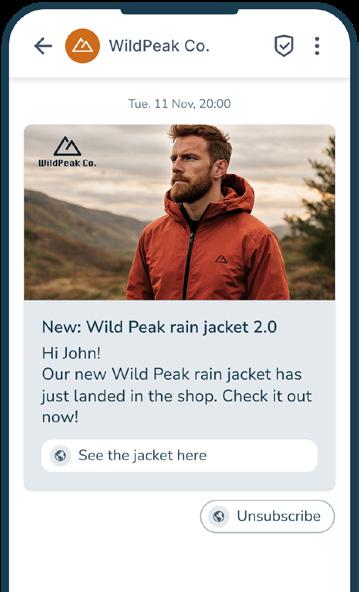
Product launches
RCS works particularly well for product launches, as customers can experience the new product visually – increasing curiosity and interest. An image, a short video, or a product carousel combined with descriptive copy and a clear CTA makes it easy for customers to explore the product directly within the messaging app.
Measure your RCS success
When you send RCS messages, you gain access to data that makes it easier to understand how customers respond to your communication. These metrics give you a clear picture of what works – and what needs adjusting.
Start with the basics: open rates, click-through rates, and interactions. These show whether the message is relevant and whether its structure works in practice.
Opt-outs are also an important indicator. Not because the number should be zero, but because it tells you whether you’ve struck the right balance between frequency and relevance.
As you work more actively with RCS, it makes sense to connect your RCS data with your webshop data. This is where you can see which campaigns actually drive revenue – and where in the customer journey RCS contributes the most.
Over time, you’ll begin to see patterns: which visuals convert best, what timing works, and how many touchpoints are needed before a customer takes action.
The most important KPIs for RCS
The goal isn’t to measure everything, but to measure what actually matters to your business. Here are some of the data points you can track to understand whether your messages are being seen, understood, and acted upon.
Open rates
How many people actually open your RCS messages? This is key insight that gives you a strong starting point for assessing the relevance and timing of your RCS communication.
Click-through rates
How many people click on your links or buttons? This tells if your message resonates with your audience and drives action.
Interactions
Quick replies, carousel swipes, and responses within the conversation add an extra layer of engagement that you don’t get with traditional messaging formats.
Unsubscribes
This shows how relevant your messages are perceived to be. A rising opt-out rate is a sign that you need to adjust your messaging, frequency, or segmentation.
Conversions
Do the clicks in your RCS messages actually drive sales or other actions? This is where you measure the final impact.
Benchmarks
It can be very useful to measure and compare your results with others.
However, RCS is still so new that there are no established benchmarks for metrics like click-through rates, open rates, or engagement. Instead, you should track your own performance from the start and monitor it continuously. Over time, this will give you a clear understanding of what “good numbers” look like for your specific business.
In practice, this is your strongest benchmark. Results vary widely across industries, products, and audiences – which is why your own historical data is far more accurate and actionable than general averages.
Common pitfalls – and how to avoid them
RCS opens up many new possibilities, which can make it challenging to get everything right from the start. However, most “mistakes” aren’t about the technology itself, but about structure, relevance, and focus. Here are the most common pitfalls we see – so you can avoid them.
One of the most common mistakes is trying to include “everything” in a single message. RCS offers many possibilities, but using too many elements at once can make the message overwhelming.
Your recipients should be able to understand the message quickly. Choose only the elements that genuinely strengthen your core point.
2
Unclear purpose
An RCS message should have one clear purpose. If a message tries to inform, inspire, sell, and guide all at the same time, you risk the recipient not understanding why they’re receiving the message – or what they’re supposed to do.
Start by asking the question: “What should the customer do now?” Keep both copy and layout focused on that goal.
3
Lack of segmentation
Broad campaigns can certainly work. However, for many e-commerce businesses, a more targeted approach delivers better results. By segmenting based on behaviour, purchases, interests, or loyalty, you increase relevance – and with it, both engagement and ROAS.
4
No testing
Small mistakes can easily creep in during a busy day – an image in the wrong format, a CTA that doesn’t work, or copy that gets cut off. If you send without testing first, you risk creating a poor experience for the recipient.
Send a test to yourself before going live. It only takes a few minutes and ensures that both content and layout work as intended.
Missing fallback
Not everyone can receive RCS yet. If you forget to include SMS as a fallback, you risk part of your audience not receiving the message at all. That means lost reach – and lost potential revenue.
Make sure your RCS campaigns include a reliable SMS fallback, so your message is always delivered, regardless of the recipient’s device or operator.
No optimisation
RCS provides you with strong data – but it only creates value if you actively use it. If you keep sending the same messages over and over without making adjustments, valuable insights may be lost.
Review your results regularly, compare them against your selected KPIs, and use those learnings to improve your content, audience targeting, and segmentation.
Chapter
RCS in practice
With RCS, your messages become more than just information. In this chapter, we’ll look at how to work with design, content, and structure so your messages naturally guide recipients towards the desired action.
RCS best practice
As we’ve established by now, RCS offers many new possibilities within the messaging app. But that doesn’t automatically mean your messages become better.
Effective RCS messages are about choosing the right elements, keeping the structure simple, and creating an experience that makes it easy for customers to understand your message and take the next step.
In this chapter, we’ll walk through the key principles for rich media, interactive elements, copy, and design – so you can build messages that not only look strong, but also drive action.
Rich Media
Images, videos, and other rich media elements are central to RCS, as they help recipients quickly understand the message.
Many people skim first and read later, which means the right visuals can make a message more inspiring and easier to act on. However, too many or overly heavy elements can also make the message feel cluttered or unclear.
Rich media typically performs best when your visual:
• has a clear connection to the purpose of the message
• supports (rather than overpowers) the CTA
• is easy to understand within a few seconds.
Each visual should serve a clear purpose within the message – for example, showcasing a product, highlighting an offer, or reinforcing the message. When used this way, visuals can elevate the entire messaging experience.
Interactive elements
Interactive elements such as buttons, quick replies, and carousels are what make RCS particularly compelling. But precisely because there are so many options, using them effectively requires careful consideration.
Interactions work best when they:
• clearly guide the recipient forward
• offer few, clear choices
• align naturally with the purpose of the message.
If there are too many choices, you risk the customer pausing instead of taking action. That doesn’t mean you shouldn’t experiment with multiple buttons or options – it simply means that each interaction should have a clear purpose and help guide the recipient in the right direction.
Copy
When writing copy for your RCS messages, many of the same principles apply as with SMS: keep it relatively short, simple, and easy to understand.
Even though RCS allows for far more characters than SMS, the message still appears in the same place on the phone – the messaging app. And here, shorter, easy-to-read copy simply works best.
At the same time, the RCS format draws much of its strength from visuals and interactive elements that support and enhance the message conveyed by the copy.
This doesn’t mean you should never use longer copy. Simply that the text and visuals in the message should support each other, rather than compete for attention.
RCS copy typically works best when it:
• is short, clear, and focused, and offers few, clear choices
• clearly communicates value for the customer
• supports (rather than simply repeats) the visual elements in the message.
Visuals and interactive elements tell much of the story. Use the copy to make the message concrete and clearly communicate what you want recipients to do next.
Design
The design of an RCS message is about creating an experience that is both visually strong and easy to understand. The format is consumed quickly – often within seconds – which is why it works best when the layout is simple, focused, and structured around one clear action.
Contrast, colour, whitespace, and hierarchy play an important role in RCS, as the screen is small and recipients tend to skim. Colours and brand identity can also enhance recognition – as long as they’re used thoughtfully and don’t distract from the message.
Design typically works best when you:
• keep the layout spacious and use brand colours
• let visuals and copy work together to convey the message
• ensure sufficient contrast so the message is easy to read in both light and dark mode.
The role of design isn’t just to impress, but to clarify the message. When the visual expression supports your brand identity, recipients experience the message as professional and trustworthy.
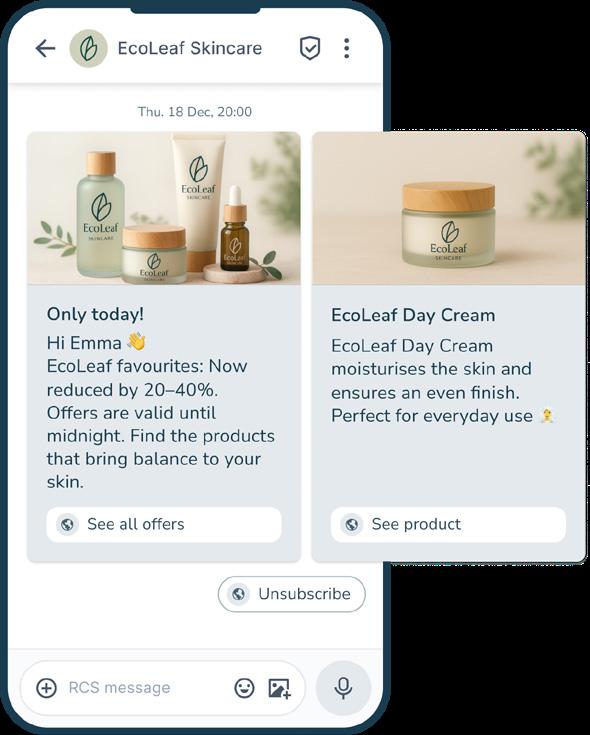
From idea to finished RCS message
A strong RCS message doesn’t start in the editor, but with its purpose. The clearer you are on what the message should achieve, the easier it becomes to choose the right visuals, CTAs, copy, and layout.
Here’s a simple process you can follow – whether it’s your first or your fiftieth RCS message.
1
Define the purpose
Start by being completely clear on what the message is meant to achieve. Should the customer purchase, reply, read more, participate or something else entirely? A clear purpose helps shape the rest of your message and makes it easier to measure effectiveness. If you’re unsure about the purpose, the recipient likely will be too.
2
Choose a visual element
Your visual is often the first thing the recipient notices, which is why it should be chosen carefully. A strong image, a short video, or a carousel can communicate a lot.
Consider what best conveys the value: is it the product, the mood, the offer or something else entirely?
3
4
Your CTA (call to action) is the action you want the customer to take. It should be clear, specific, and closely aligned with the purpose of the message. Always choose one primary CTA, such as “Buy now”, “See what’s new”, or “Read more”. A secondary CTA can be used if it adds value.
The copy should make your visual and CTA even easier to understand. Keep the focus on value: what do customers gain by taking action? What’s the most important thing they need to know right now? Think in clear, concrete points. The visual sets the first impression. The copy should support and build on the message, and invite action. Choose a CTA Write the copy
5
Test on mobile
Before sending your RCS message, test it. Check that the copy isn’t cut off, visuals are sized correctly, CTAs are clear, and the message looks good in both light and dark mode.
Small details can change the entire experience. Spend two minutes testing – it can save you from many avoidable mistakes.
6
Read the data – and optimise
After the message has been sent, the results are ready: opens, clicks, interactions, and opt-outs. Use this data actively. How many people read the message? Clicked? Responded? Converted? Use these insights to understand whether the message worked as intended and why.
RCS checklist
Clear CTA
The recipient clearly understands how you want them to act on your message.
Visual works
Your visual is relevant, high quality, and supports the message.
Sharp copy
Your copy includes only what’s necessary, and the message is clear and appears early in the text.
Layout has been tested
The message has been tested on mobile and looks good in light and dark mode. It’s easy to scan and understand.
Buttons and links work
CTAs, quick replies, and links have been tested and lead to the correct destination.
Unsubscribe is correctly set up
The recipient can opt out directly within the message (a legal requirement for marketing messages).
05 Chapter
Compliance and trust
Trust is essential when communicating on mobile. In this chapter, we’ll walk through the key principles for consent and opt-outs, so your RCS communication is both responsible and trustworthy.
Legal considerations
When using RCS as a marketing channel, it’s important to have a clear understanding of the legal framework. Not only because marketing legislation requires it, but also because mobile communication is built on trust – and that trust is created, in part, by collecting permissions correctly and ensuring your communication complies with applicable regulations.
This chapter provides a brief overview of the rules you should be aware of before sending RCS messages.
Please note: at inMobile, we are not legal advisers, and regulations may change over time. You should therefore always ensure that you stay up to date with the applicable rules, or consult a legal professional if you are in doubt.
GDPR
GDPR is fundamentally about taking proper care of the personal data you work with and ensuring that customers understand how their data is used. When sending RCS messages, this primarily means that you may only use data for which you have a lawful basis, and that you store and handle it securely.
If you want to explore GDPR in more detail, you can read more on the Danish Data Protection Agency’s website, where the rules are explained and kept up to date.
The Marketing Act
The Marketing Act governs how you may contact customers with commercial messages. For RCS, this means you must have the recipient’s active consent before sending marketing messages to their mobile number.
The legislation also requires a clear opt-out option and transparent communication about the purpose of the message.
You can read more about the applicable rules for unsolicited communications and consent on the Danish Consumer Ombudsman’s website or directly in the Danish Marketing Practices Act
Consent and unsubscribing
RCS marketing is built on the same consent and opt-out principles as SMS and email: recipients must actively opt in to hear from you, and they must always be able to opt out again. Clear consent and an equally clear opt-out option are therefore the foundation of all RCS marketing.
Consent
Consent is the foundation of all RCS marketing. Without valid consent – or permissions – you have no audience to send RCS messages to. That’s why this part of your permission marketing strategy is critically important.
Some of the most common ways to collect mobile consent include checkout flows, customer clubs, ads, forms, competitions, or website pop-ups. What matters most is that customers clearly understand what they are consenting to.
You can find more inspiration for collecting permissions in the article: How to collect permissions for SMS and RCS.
Unsubscribe
Recipients must always have a simple and clear way to opt out of your RCS marketing messages. In short, it should be just as easy to say no thank you as it was to say yes.
The most common method is an “Unsubscribe” button or opt-out link directly within the message, allowing users to withdraw their consent with a single tap.
This is important both for compliance and for maintaining customer trust. A clear opt-out option shows that you respect your recipients’ preferences. It also ensures you don’t waste resources sending messages to people who aren’t interested anyway.
06 Chapter
The messaging format of the future
RCS offers a more experience-driven approach to mobile communication. In this chapter, we’ll look at where the format is heading and how you can use RCS strategically going forward.
Where is RCS heading?
RCS is still in its early stages, but development is moving quickly, and everything points towards the format becoming a permanent part of the digital marketing toolkit.
With both Google and Apple on board, RCS has its first real opportunity to become a universal standard enabling businesses to reach a larger share of their audience through a single, unified messaging experience.
In the coming years, we expect to see significant development in how RCS is used. This will include more advanced use cases, deeper e-commerce integrations, stronger personalisation, and smarter automation.
Not because the format itself will necessarily change dramatically –but because marketing teams will become better at understanding RCS and making the most of its capabilities.
In other words, RCS is moving from being “new and exciting” to becoming a channel with a much clearer and more strategic role in the marketing mix.
RCS + AI = The future of communication?
AI is playing an increasingly important role in marketing, but no one can say exactly how the technology will evolve. The same is true for RCS.
What we can say with reasonable confidence is that AI can already support teams in their work today – especially when it comes to analysing data, identifying patterns, and producing content variations.
In practice, this means that AI can, for example, help marketing teams:
• understand which RCS messages perform best
• identify trends in customer behaviour
• suggest segments or targeting
• generate test variants of copy or visuals
• structure customer dialogue and data, making it easier for customer service teams to gain an overview.
This doesn’t change RCS as a format, nor does it remove the need for human judgement. But AI can act as a tool that makes working with RCS easier, faster, and more data-driven – without dictating direction.
How AI and RCS will work together in the long term is still too early to say. But it’s likely that AI will become a support function, helping marketing teams get even more out of the possibilities RCS already offers.
Get ready – now
In the coming years, RCS will become a larger part of direct communication with your customers. You don’t need to overhaul your entire marketing strategy to get started – but the earlier you gain experience with the format, the easier it will be to take advantage of its opportunities as RCS reaches full adoption.
The most important step is to start. Begin with a message, campaign, or flow you already know works, and build from there. That way, you’ll learn how your customers respond, which visuals perform best, and where RCS creates the most value for your business.
Once you have consent, your RCS agent, and your core data in place, you have everything you need to take the first steps. From there, it’s about testing, refining, and finding the approach that works best for your business.
RCS doesn’t need to be big or complex to deliver results. But by getting started now, you’ll be better positioned when the format becomes a natural part of customer expectations and digital customer journeys.
Closing: From text to experience
RCS marks a shift in the way we communicate on mobile. Where mobile messages have traditionally been text-only, RCS makes it possible to create small, visual experiences for customers. It’s not about making messages more complex but about making them more engaging.
When you work with RCS, you’re not just working with a new format – you’re working with a more modern, customer-centric way of communicating. It’s about being relevant in the moment, making it easy to act, and meeting customers where they already are: on their mobile phones.
You don’t need to master everything from the start – quite the opposite. Start small, learn from your results, and build gradually. Over time, you’ll see how RCS can elevate both the customer journey and your performance when the format is used strategically and thoughtfully.
RCS isn’t the future in some distant sense. It’s already here. And now you have everything you need to take the first steps and turn your messages into experiences.
More about RCS
Visit inMobile’s knowledge hub
Learn more about RCS, SMS, and value-driven communication through inMobile’s comprehensive knowledge hub.
Go to inMobile’s articles >
Go to inMobile’s library >
Guides
Find guides on campaigns, automations, link tracking, auto-blacklisting, and much more. In short, guides to all the possibilities available in inMobile.
Go to inMobile’s guides >
Contact inMobile
Contact us by email or phone to learn more about your possibilities with RCS marketing.
Contact inMobile >
RCS handbook
Your guide to the future of mobile messaging
By Julie M. Nielsen
Mobile communication is evolving, and RCS is set to become one of the most exciting new formats in marketing. With visual messages, buttons, and branded senders, RCS opens up new ways to create experiences that are both engaging and easy to act on – directly within the customer’s messaging app.
In this book, you’ll get a practical, hands-on introduction to RCS as a marketing channel. You’ll learn how the format works, how to build effective campaigns, and how to work strategically with data, design, and personalisation.
The purpose is simple: to give you a solid foundation so you can get started quickly, test and learn, and gradually develop your RCS efforts in a way that creates value for both you and your customers.
Whether you’re curious about the first steps or ready to think more advanced, this RCS handbook is designed as your guide to elevating mobile communication from text to experience.