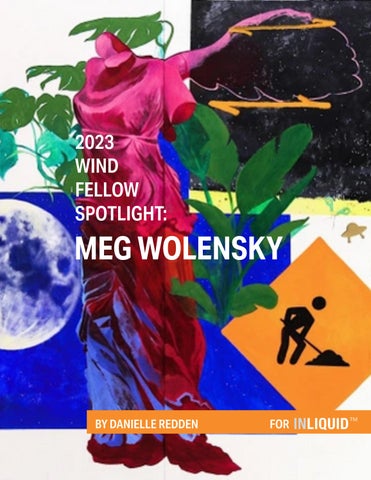
MEG WOLENSKY
BY DANIELLE REDDEN FOR
2023 WIND FELLOW SPOTLIGHT:

MEG WOLENSKY
 BY DANIELLE REDDEN
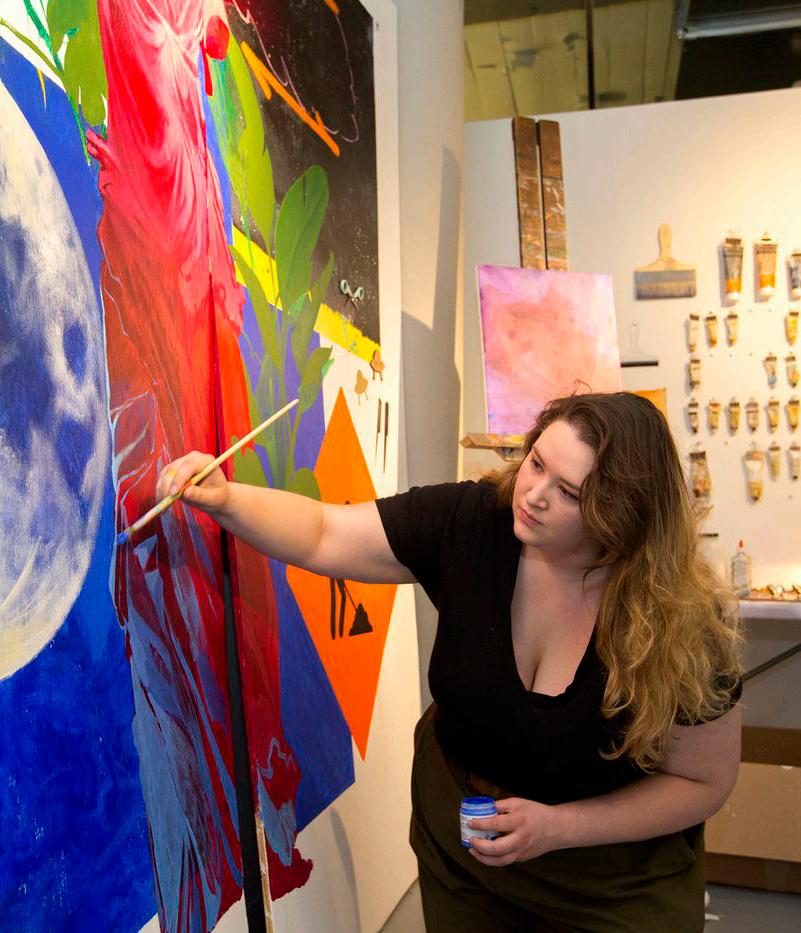
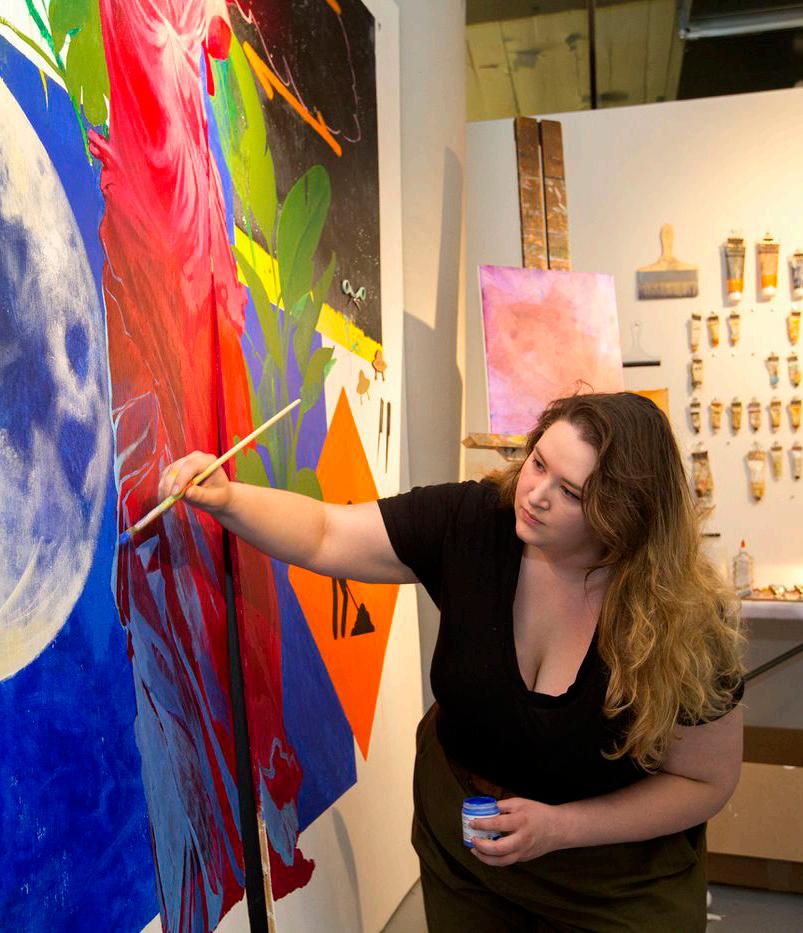
Meg Wolensky is a painter who uses bold colors and objects to visually process the complex nature of memory, identity, and formation of self. Wolensky takes a profoundly personal approach to figurative and still life painting, which are treated as snapshots within the framework of Wolensky’s life narrative. As
a result, their paintings carry an emotional charge, conveying the anxiety, pain, hope, and freedom within experiences of relationships, sexual identity, personal trauma, and global upheaval. Rubbing against Barthes’ 20th-century concept of “Death of the Author”, Wolensky’s history and story are fundamental to their work’s meaning.

Art History Corner
In the influential 20th-century essay Death of the Author, French theorist Roland Barthes argues that neither an author’s life nor their intentions should hold any particular weight in explaining their work’s meaning. Adopted by theorists of art history to discuss the authority of authorship in artworks, “Death of the Author” postulates the viewer and particularities of the work as the essential factors for interpretation. Opposing Barthes, Wolensk boldly claims,
am the key.”
An avid writer, Wolensky responded to interview questions with beautifully articulated responses that tapped into the heart and soul of their work. In line with Wolensky’s statements about the personal nature of the works, the text below combines art historical background and critical analysis with Wolensky’s own words to answer this author’s questions.
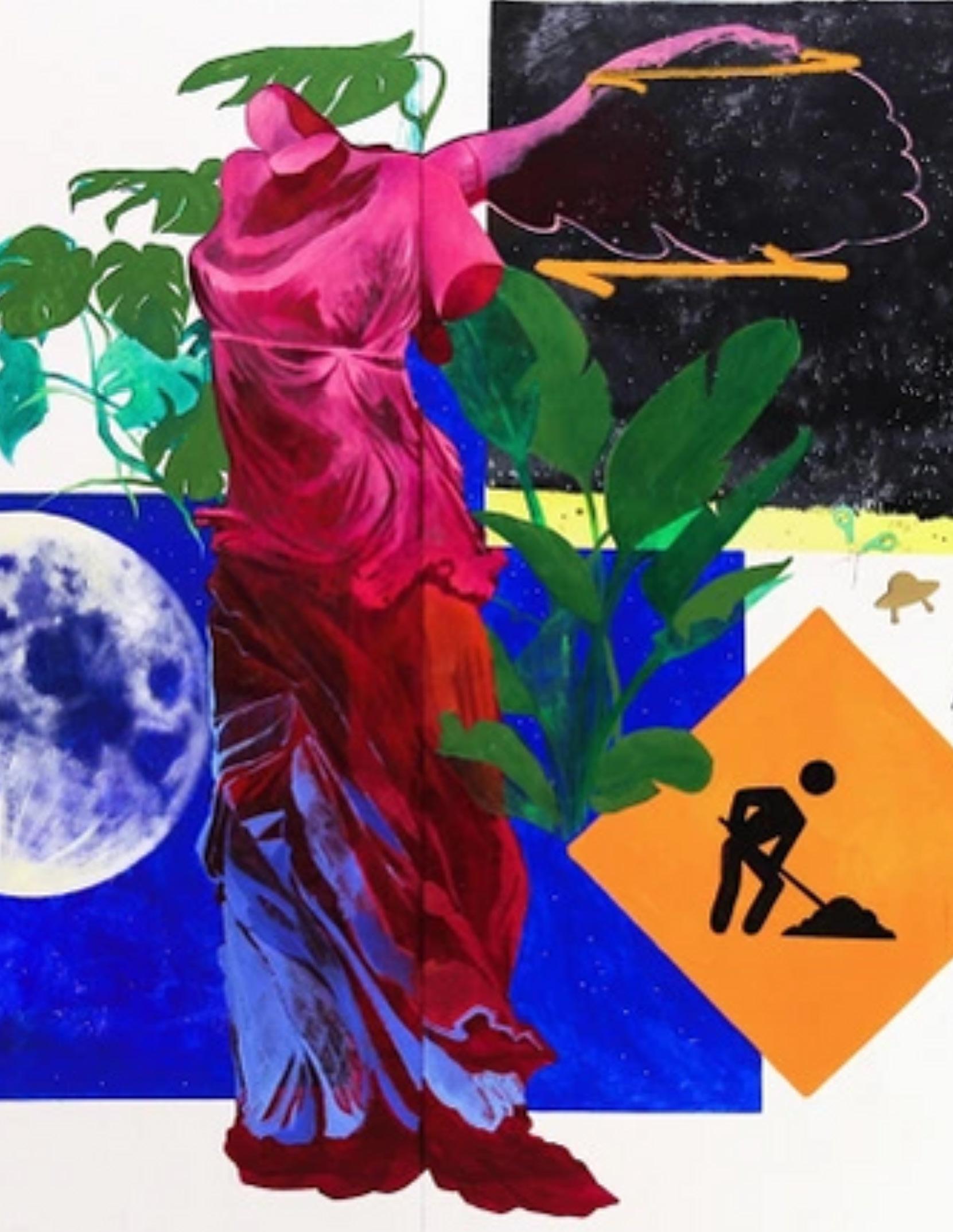
Right Image
Meg Wolensky
Winged Victory (Work in Progress), (detail), 2019
Acrylic and Oil on board
“I
10 x 10 ft
DR: What role does color play in your paintings?
MW: My paintings are alchemical tinctures that capture the movement of queerness—fluxing between various identities, genders, and states of being. I’m constantly reimagining what healing looks like as I grow — always moving, never stagnant. 221
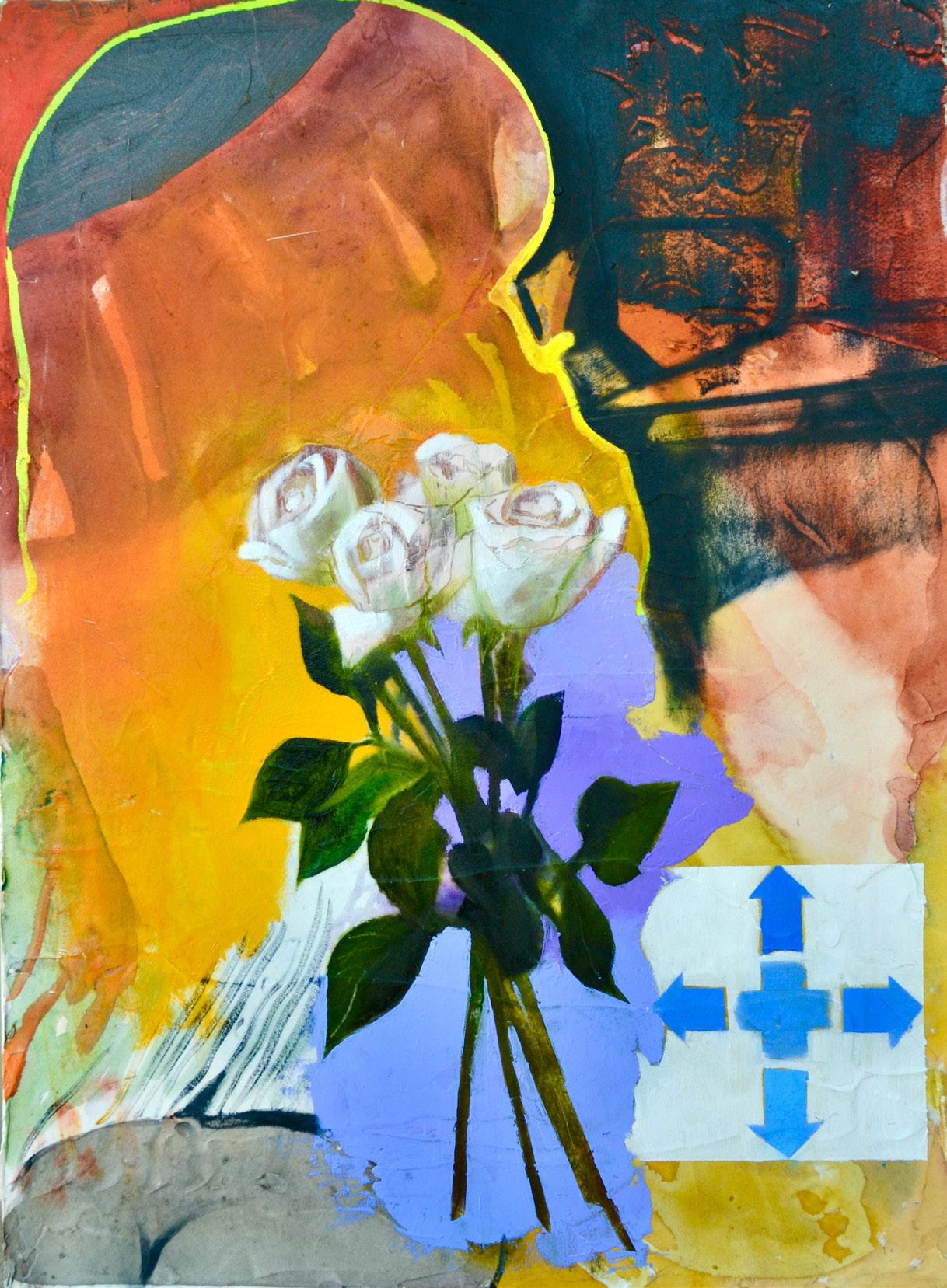
As a result, the shapes and compositions often take on abstract forms that can be interpreted in multiple ways. My process is about reclaiming joy from pain, so I use color to express my passion for life and abstraction of Pride with a capital “P”. By combining unique textures and materials, I create works of art that are alive with movement and energy.
I find joy, release, and even pride (in a queer sense) when using unexpected color combinations, intentional texture, and layers to document stories of my experiences. I view color as a form of nourishment and expression — something that has the power to center and ground me while exploring narrative wrought of instability. I’m particularly drawn to shades of blue, which act as a bridge between a heaven that I would be accepted into and earth — offering both guidance and refuge. I’m also constantly renegotiating my relationship with hot pink, which has been a process of deconstructing and reassembling femininity.
“I use color to express my passion for life and abstraction of Pride with a capital “P”. -MW
Art History Corner
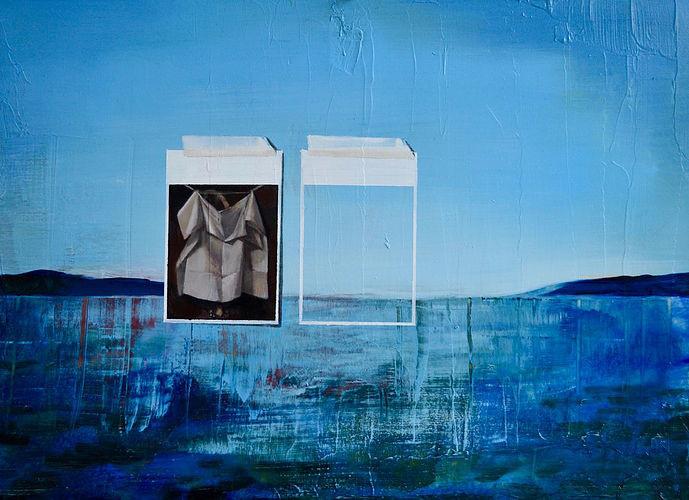
Wolensky’s paintings feature rich, fantastical colors that dictate the mood. The dynamic layers of burnt sienna, goldenrod, coral, saffron, and tawney in In Your Car (2018) give the painting an energetic and cautious feel, while the dark blues and smooth sky in the landscaped Mariana Trench (2019) convey a subdued thought-provoking tone. Wolensky’s compositions and hues reflect the bright colors and gestural mark-making of Fauvism and German expressionism. Analogous to these movements, Wolensky’s work gives precedence to communicating personal experience over a naturalistic treatment of the subject matter.
 ~D. Redden
Left Image Meg Wolensky In Your Car, 2018 Oil and acrylic on board 18 x 24.5”
Right Image Meg Wolensky Marina Trench, 2019 Oil on board 20 x 24”
~D. Redden
Left Image Meg Wolensky In Your Car, 2018 Oil and acrylic on board 18 x 24.5”
Right Image Meg Wolensky Marina Trench, 2019 Oil on board 20 x 24”
Art History Corner: PINK
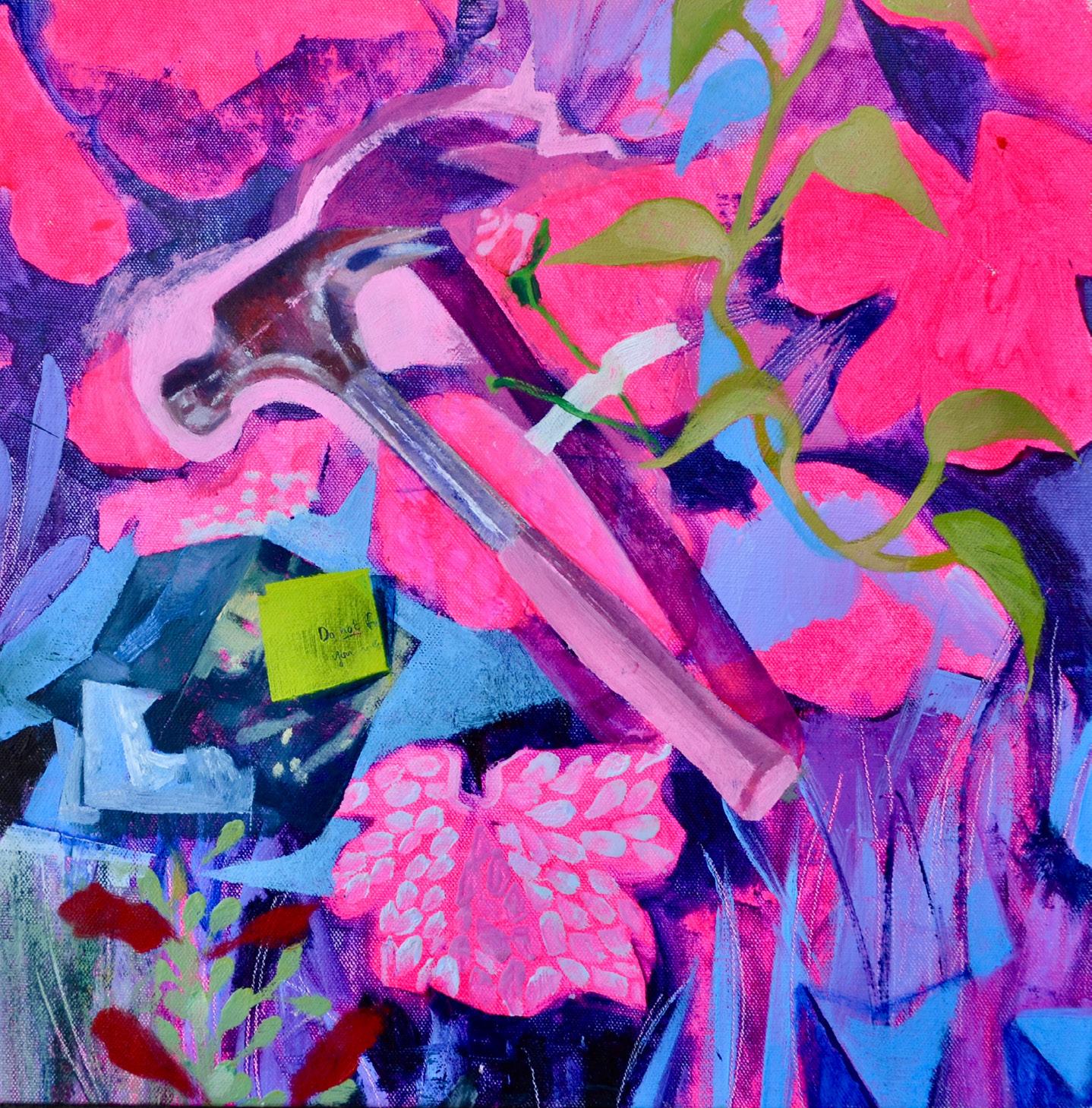
Onedistinct color used by Wolensky is pink. Fixing What’s Not Broken (2017) shows a light pink handled hammer on a busy fragmented surface of hot pink, blues, and purples. In the same vein, Wolensky’s Halo Breaking (2022) consists of a background saturated with red and hot pink. The presence of pink throughout Western art history has fluctuated in prominence and meaning. Not often found in nature, “pink” wasn’t referenced as the color we know today until the late seventeenth century in the Oxford English Dictionary. The color was popularized in the eighteenth century by rococo artists such as
Jean-Honore Fragonard and used sparingly and abundantly into the 20th century by artists such as Matisse in The Pink Studio (1911).
Although the color is primarily associated with women and girls today, pink was considered a neutral or masculine color until the second half of the twentieth century. After World War II, it was rebranded as delicately feminine and used in magazine advertisements in an effort to remove women from the workforce. However, during the second half of the twentieth century, hot pink (also referred to as “shocking pink”) became popular as the color of choice “for women who wanted to be both seen and heard.” Wolensky’s journey with pink contributes to the discourse surrounding its gendered history that continues into the twenty-first century. ~D. Redden
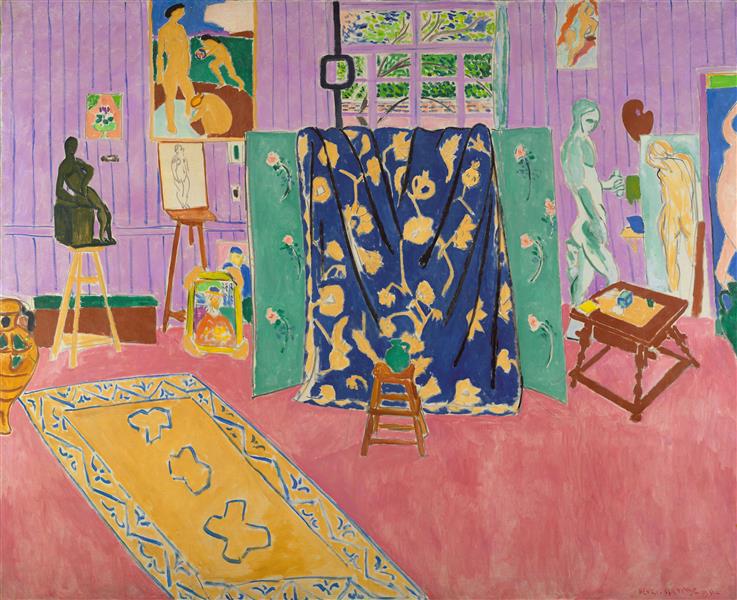
“I’m also constantly renegotiating my relationship with hot pink, has been a process of deconstructing and reassembling femininity.”
right image
Henri Matisse
The Pink Studio, 1911
Oil on canvas
71.2 x 87 “
left Image
Meg Wolensky
Fixing What’s Not Broken, 2017
Oil on canvas
16 x 16”
Bottom Image
Meg Wolensky
Halo Breaking, 2022
Oil on canvas
25 x 46”
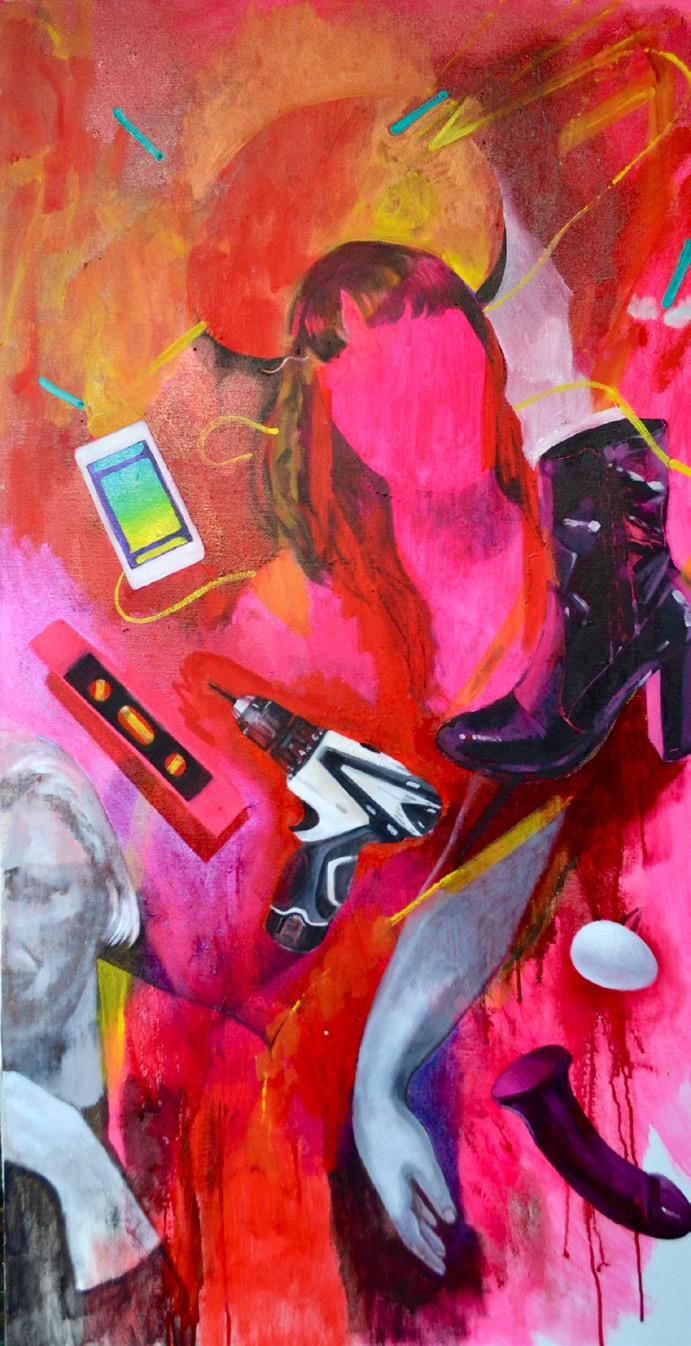
renegotiating pink, which deconstructing femininity.” -MW
DR: Describe your relationship to Symbolism and Still Life
MW: Symbolism also plays an important role in my practice; it allows me to explore the liminal space between dissonance and harmony, combining disparate elements into new dialogues. In recoiling from traditional figurative painting, I prefer exploring abstract forms and engaging the Vanitas of still life objects as an expression of my everdynamic existence. Still life provides an opportunity to further engage with themes of transformation — situating personal objects within a larger narrative while providing insight into their shifting meanings over time. I’m obsessed with still life and Trompel’œil, or highly realistic optical illusion of three-dimensional space and objects on a two-dimensional surface.
Trompe l’oeil, which is most often associated with painting, tricks the viewer into perceiving painted objects or spaces as real. My memory is like a sandstorm and the happy queer and authentic life I’m trying to focus on is the oasis in the middle of it all. Sometimes, the stars align while a paintbrush is in my hand and I can visually communicate everything that has ever happened to me, and then hours or even moments later, it’s too painful to remember anything. I’m just like… “did that happen to me?” It’s easier to imagine it didn’t and trick myself into thinking I’ve been in the oasis all along. The paintings reply, “yes, it really happened.” Trompe-l’œil aligns nicely with the way my memory works – always asking “what’s real?”
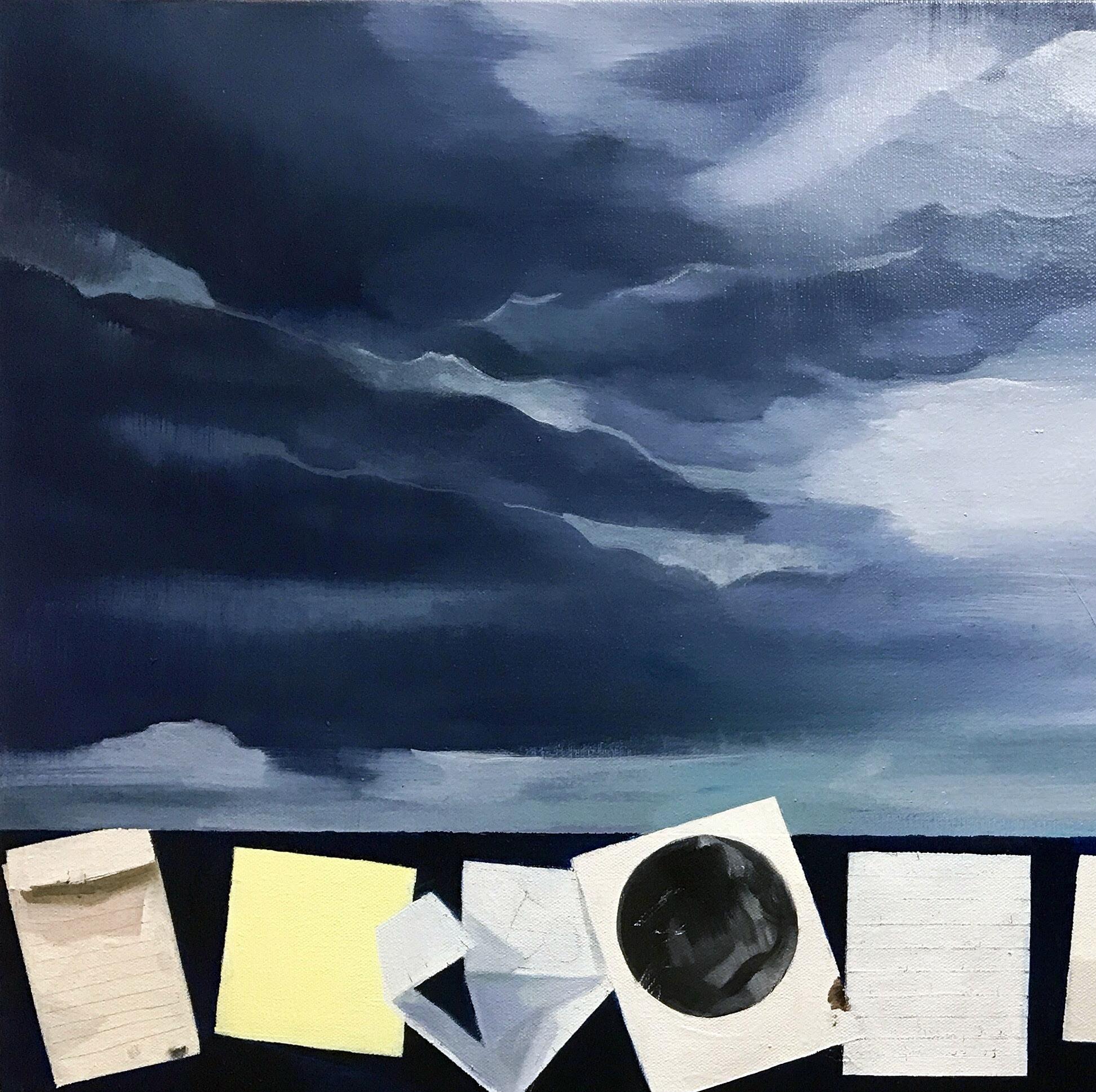
I often think of my work through the lens of this excerpt from Still Life by David Masello, published in The Gay & Lesbian Review on September 23rd 2021:
“I have long wanted to live with a split pomegranate or raw oyster on the half shell, even a partially peeled lemon, whose rind corkscrews about the stem of a goblet of wine. I now live instead with yet another coveted element from that imaginary table of still-life objects typical of the Dutch Golden Age—a framed image of two golden-russet-colored pears, one whose stem remains affixed with leaves, as if the fruit has just been picked and left to ripen further. However, spots on the greenery indicate approaching decay.
Most of the elements arrayed on a tabletop in a Dutch still life carry a symbolic charge. Oysters and pomegranates and phalluses of dangling rinds connote sex, desire, fertility, while a skull
or fly alit on a slice of mincemeat pie suggest mortality. Lobsters, wheels of gouda, gleaming pewter cutlery speak of the owner’s wealth. Pears might connote the sweet yet fragile nature of life and the bounty the earth provides. A pear spoils quickly, so enjoy the fruit once it has ripened; the sweetness that life often offers us is ultimately ephemeral.”
Masello goes on to describe personal intimate encounters before leaving us with this:
“(…) A still life fools the viewer into thinking it is solely a visual presentation. But every (familiar) item in a still life has a (full sensory experience)—of the sea, of the earth, of the vine, of the field. And, so, to detect (the sensory experience) of someone for whom you feel desire is a kind of infection. You are affected by that infection, even if the source of it is not present. That (viscerality) becomes a memory. My friend’s scent is now in me.”
Meg Wolensky Premonition, 2018 Oil on canvas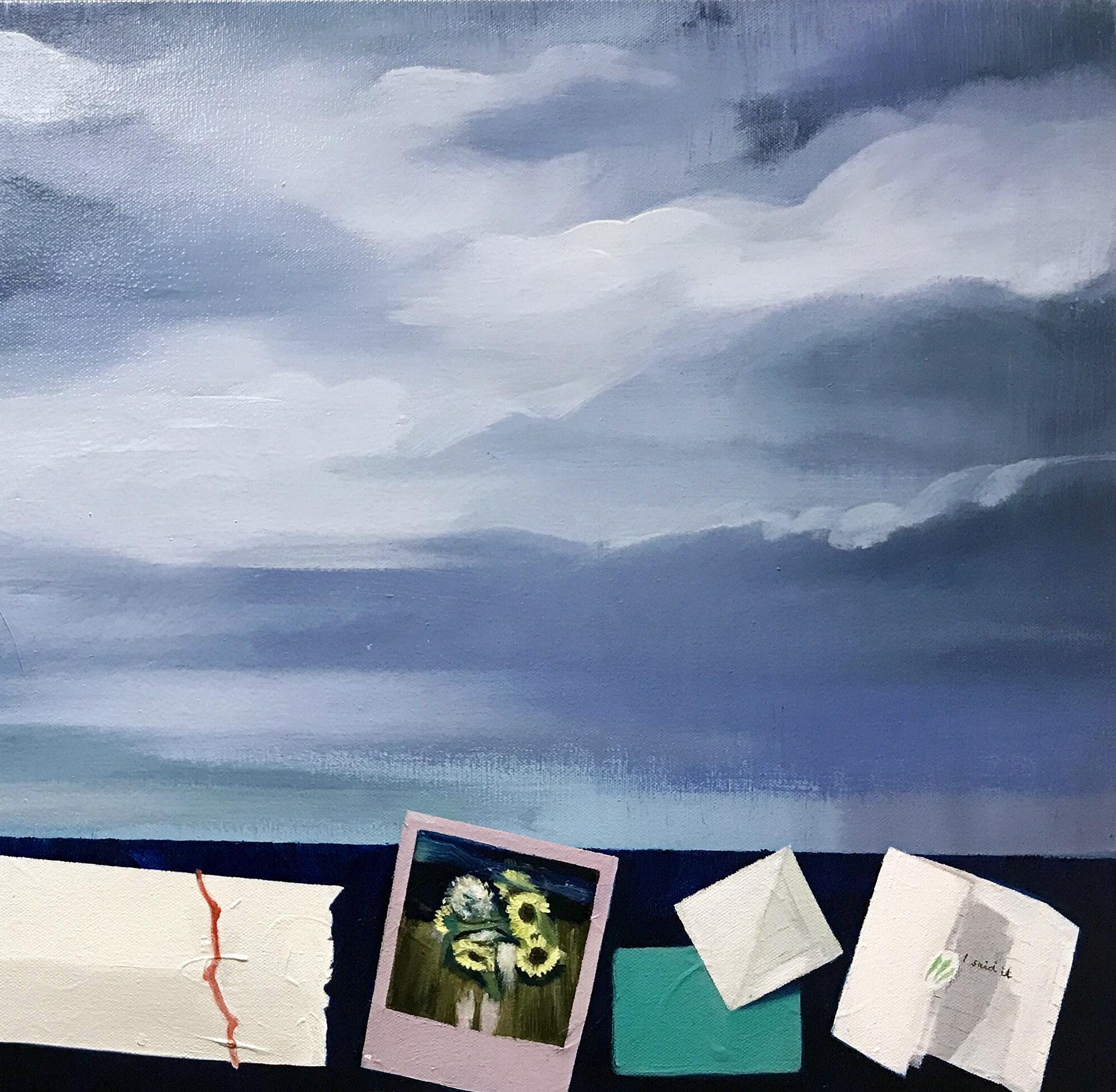
18 x 36”
Art History Corner: Still Life
Stilllife” is a genre of artwork that centers on inanimate objects: man-made or from the natural world. While the genre spans art history, most still lifes fall into the following four categories: flowers, food (usually fruit), dead game, and symbolic. Wolensky’s compositions move outside the conventional elements of still life in regard to background, placement and type of object. Where in traditional still lifes, objects are positioned on a flat surface against cloth or a toned background, Wolensky suspends objects in the center of the picture plane and manipulates
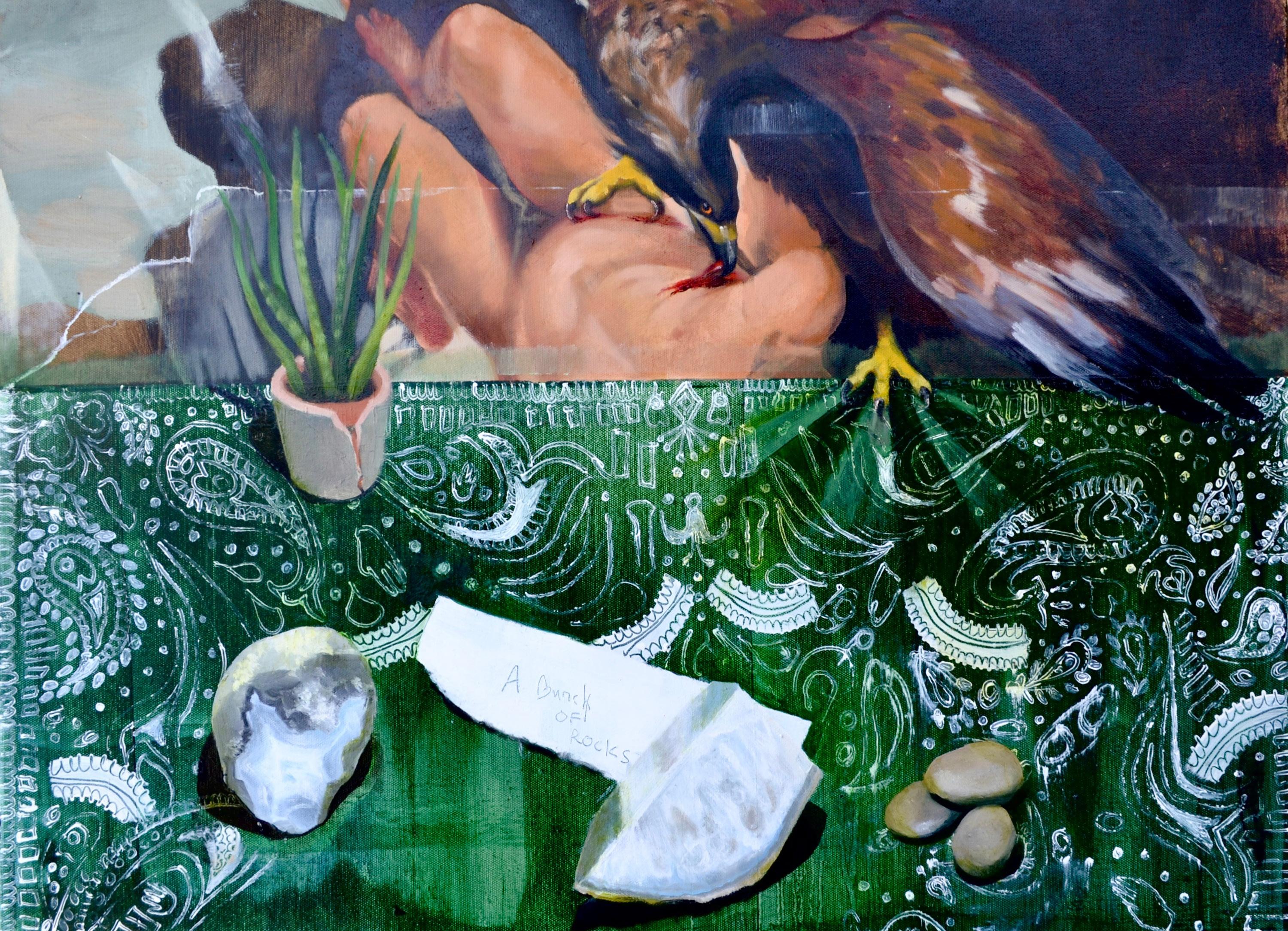
backgrounds to incorporate multicolored backdrops [In Your Car (2018)], landscapes [Mariana Trench (2019)] and art historical references [Rubens Prometheus Bound (1618) as the background of Fever Dream (2018)]. These aspects of Wolenky’s composi tions carry a surrealist quality, reminiscent of Salvador Dali’s portrayal of objects in Living Still Life (1956). With these choices, questions of Wolensky’s relationship to symbolism come into play. Though the objects themselves are not manipulated, and while Dali’s surrealist project often sought to
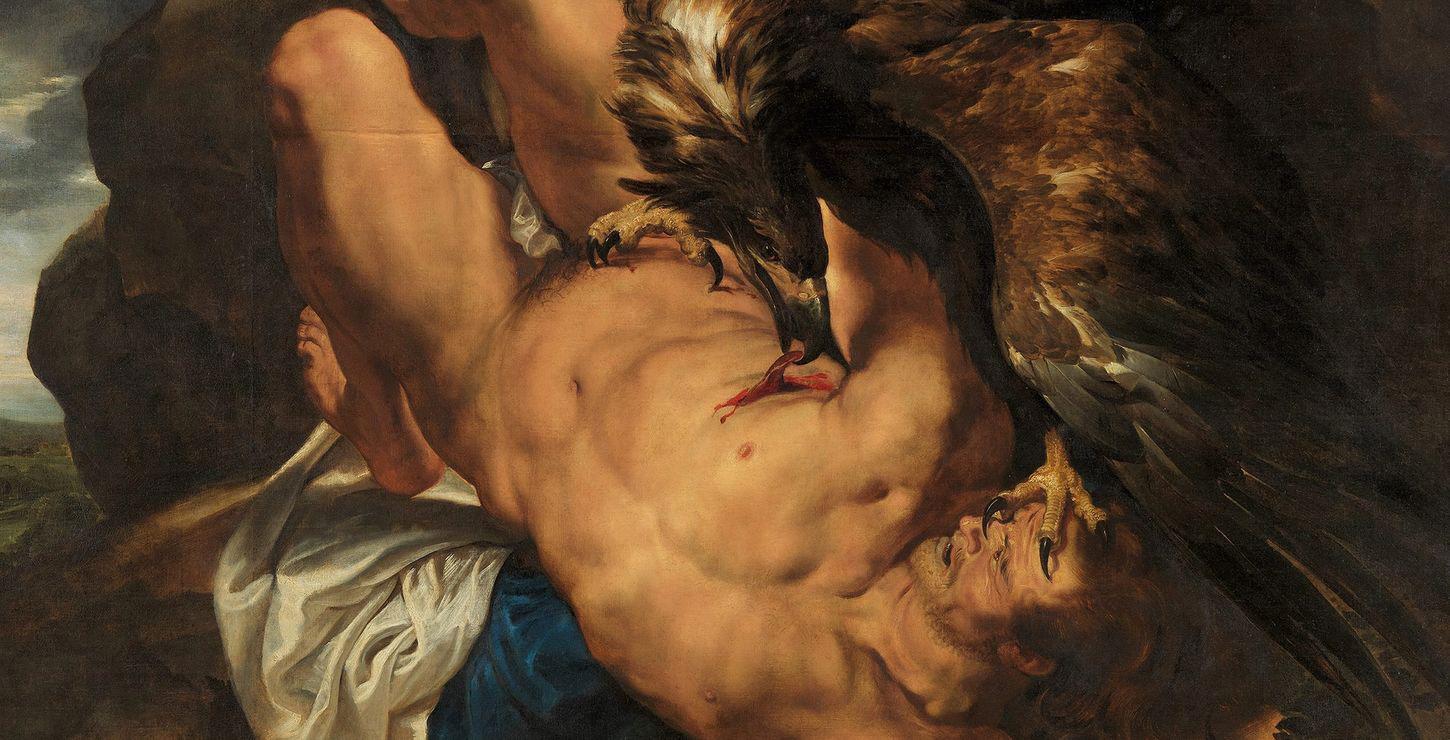
interrogate notions of the psyche, Wolensky’s choice in subject is much more personal. Premonition (2018) is described by Wolensky as “Love-bombing letters received in my first queer relationship. These items acted as ports in a storm of shame and secrecy.” In this way, Wolensky’s still lifes contain a personal narrative where objects are treated as pieces of a larger story.
 ~D. Redden
Left Image
Peter Paul Rubens
Prometheus Bound, 1618
Oil on canvas
95.5 x 82.5 “
Right Image
Meg Wolensky
Fever Dream, 2018
Oil on canvas 24 x 30”
~D. Redden
Left Image
Peter Paul Rubens
Prometheus Bound, 1618
Oil on canvas
95.5 x 82.5 “
Right Image
Meg Wolensky
Fever Dream, 2018
Oil on canvas 24 x 30”
DR: What does your creative process look like?
MW: I start with written word in the Notes app on my phone. Usually I’m alone, walking around the city at night, on a bus or trolley, or in the back of an Uber. All of a sudden, my subconscious bursts through the white picket fence of the mundane. It’s this strong, unwavering creative voice that delivers inspiration. For example, I’m crossing the JFK Memorial Bridge and, suddenly:
to access those memories, review creative writing, pull from iPhone and film photography, even dream some of the visuals, do watercolor texture and color experiments, try to live my life in the present, and finally arrive at painting. I go into a multi-part creative fugue state – tapping into all of those sources and pushing them flush on the canvas against experiences that live in my subconscious.
What does it mean if every dyke’s got a secret Life in the arms of a lover
I’m a different gender when I’m with her The sleeping adoration of a quieted cough
Emergency consumes me like wildfire
Pulling taught at the threads of my seam
Sublime hollyhock
And highway wildflowers brush back against the wind Of cars as yours passes me into endless Night
From there, I follow an intentionally nonlinear, un-rushed, multi-media creative process that aims to make sense of it all in a way that is kind and forgiving to myself. The practice is many years in the making and includes up to ten years of writing, old paintings, photographs, and sketches. I’m meditating on the complexities of queer identity amid trauma recovery as time marches forward, and it’s all connected. I perform somatics with attention to the Vagus Nerve, allow myself
It’s an embodied nature versus nurture and every mark made contains a meditation. Each individual piece is unique; when grouped together, they become a quilt or constellation of memory: a gallery for me to rehome my history. By allowing myself this practice I honor the constant evolution of self; further welcoming transformation within an unyielding world. For me, it’s essential that viewers have a multi-faceted approach when engaging with the work; being able to decipher the material choices, composition. Through this process, I’m aiming to extend beyond traditional notions of art-making to reimagine what healing looks like — always moving.
Second Swing (Blue Hammer), 2021
Oil, spray paint, and acrylic on canvas
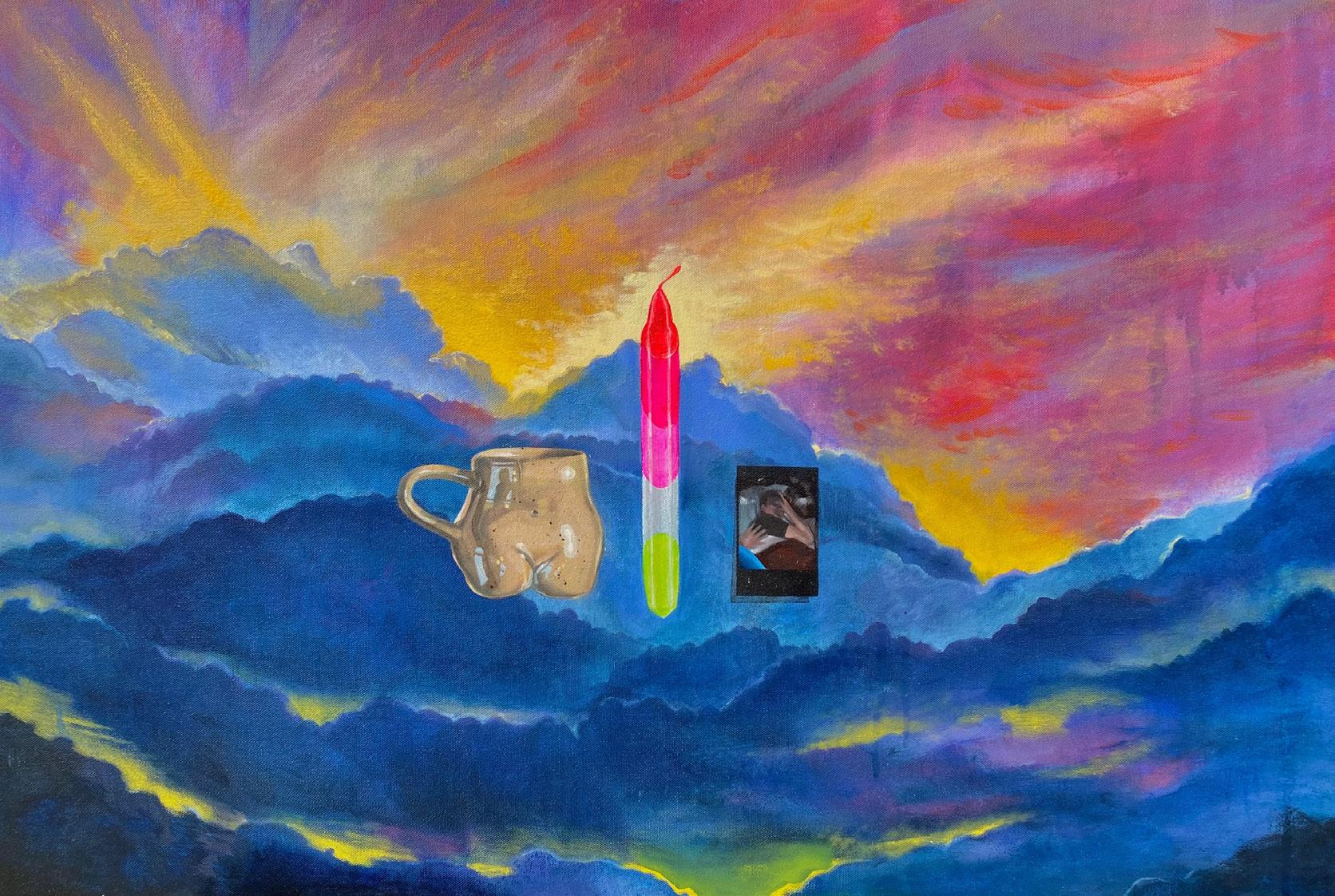
21 x 24”
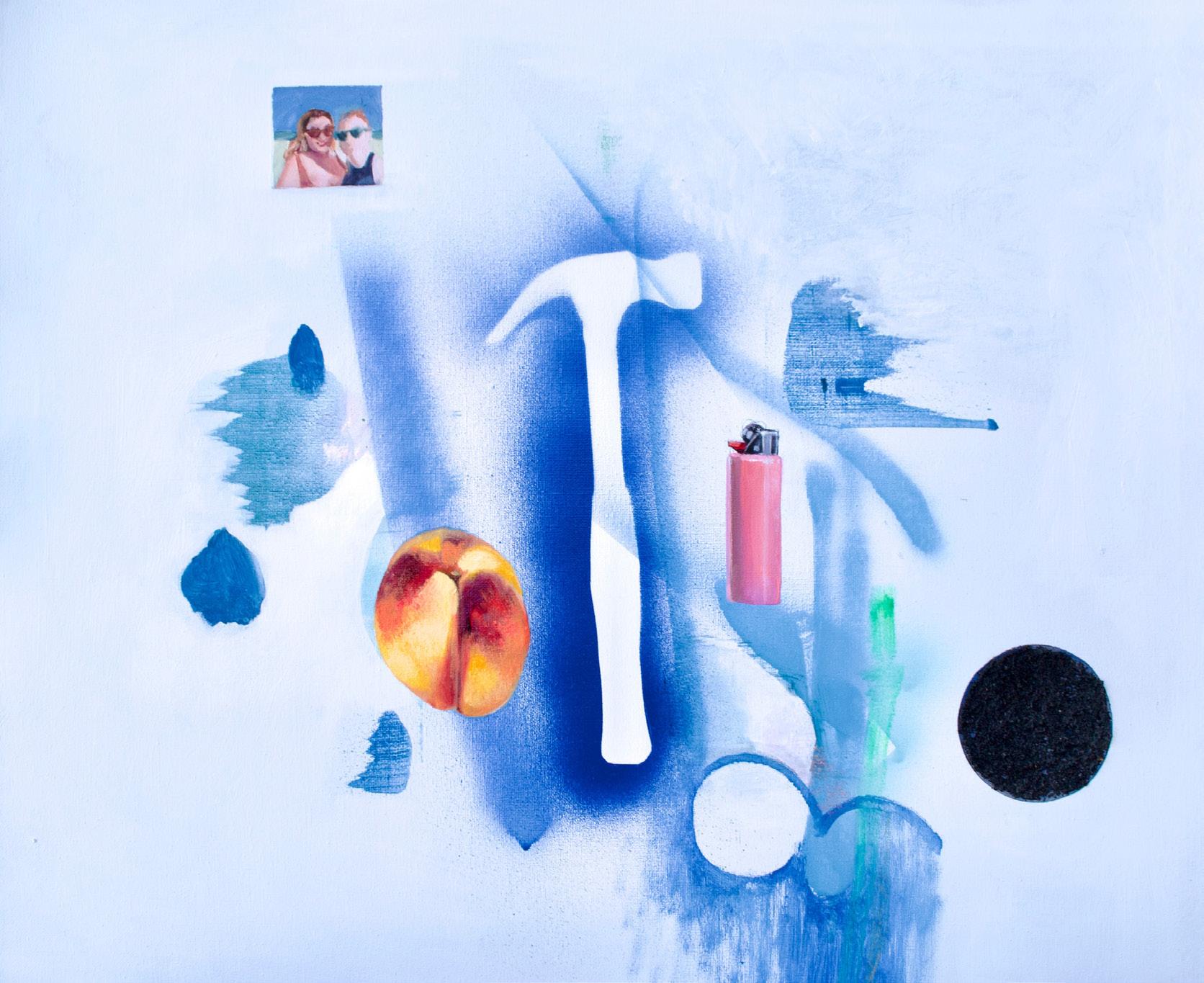
Vigil: Dip Dye, 2022
Oil on canvas 30 x 36”
Top Image Meg Wolensky Bottom Image Meg WolenskyDR: When you talk about your work, you reference your personal history with trauma and your identity as key aspects of the work and understanding it. Out of respect to your story, would you be comfortable writing about these things in reference to your work?
MW: I paint as a healing practice to explore reconciliation of trauma as it stands opposed to the freedom and joy of queer autonomy. I am a queer nonbinary artist living with ComplexPost Traumatic Stress Disorder (C-PTSD). I weave together research on the impact of intergenerational trauma and studies of somatics with my lived experience to create works that invite viewers into contemplative emotion. The pieces I produce will linger in a space of thoughtfulness and quiet intimacy. I hope they create a suspension between pasts and presents, honoring both personal stories and collective histories. I’ll strive to embed my work with nuance, knowing that each part reflects the whole.
C-PTSD occurs in response to a series of traumatic events with little or no chance of escape, and particularly where the exposure is prolonged or repetitive. C-PTSD is commonly associated with adverse childhood experiences such as chronic sexual,
-MW psychological, and physical abuse or neglect. It can also develop as the result of chronic intimate partner violence, kidnapping and hostage situations, defectors from authoritarian religions and cults, and other dire circumstances. Due to a combination of my lived experiences, I meet the diagnosis requirements for C-PTSD. Some folks might say to just get over it, but this is something that changes the composition of your mind and body. My basic attachment and emotional regulation have been impacted, but I’ve also experienced impacts on a biological level; such as sensoryintegration difficulties, somatization, and increased medical problems. Like grief, you learn to live with it or you
“Through paint, my past, present, dreams, and memories live in one cohesive whole. Through paint, I reconstruct a home in which my whole identity – even what’s broken - is welcome.”
don’t live. My work affirms my identities and addresses the unfurling aftermath of my diagnosis. I believe art-making can act as an alchemical process of healing and self-discovery. I use my work to explore themes such as identity, memory, and the boundaries between the physical and emotional worlds. This is particularly relevant for me in terms of understanding my relationship with trauma — it’s a space where I feel safe to investigate my journey of growth, vulnerability, and resilience. My artwork is also a way for me to connect to my true self and reclaim joy from pain. I draw together chromatic hope and contrasting devastation by dulling shards of traumatic memory and retrofitting them to my kaleidoscope of affirming present-day experiences. Through paint, my past, present, dreams, and memories live in one cohesive whole. Through paint, I reconstruct a home in which my whole identity – even what’s broken - is welcome. I build cryptic still lives, secret little love notes, nestled into chromatic elements that hold the whole thing together.
I’m dedicated to inspiring viewers to unpack the complexities of their own stories through engaging deeply with my artwork – an experience that encourages selfdiscovery, introspection and ultimately healing.
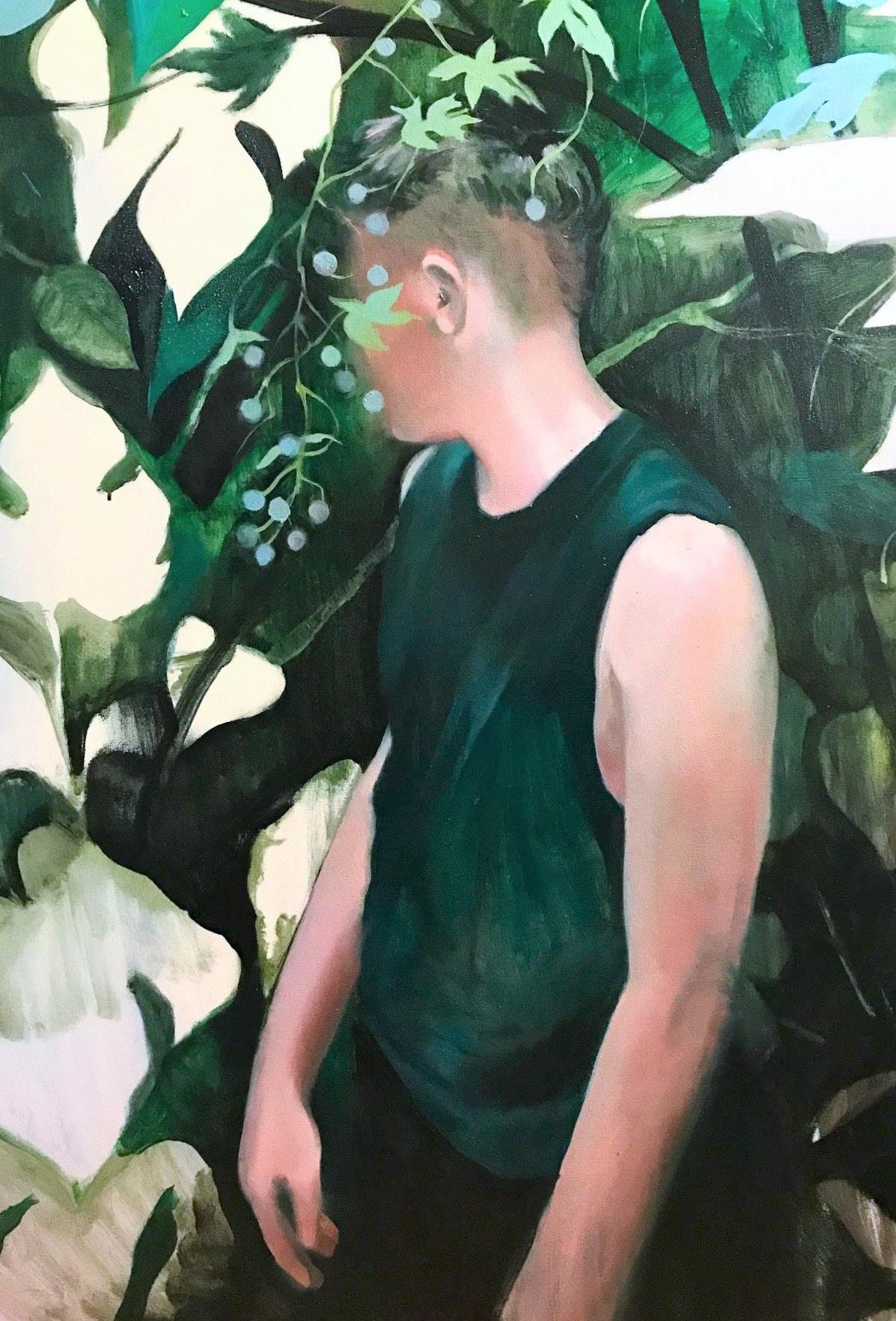
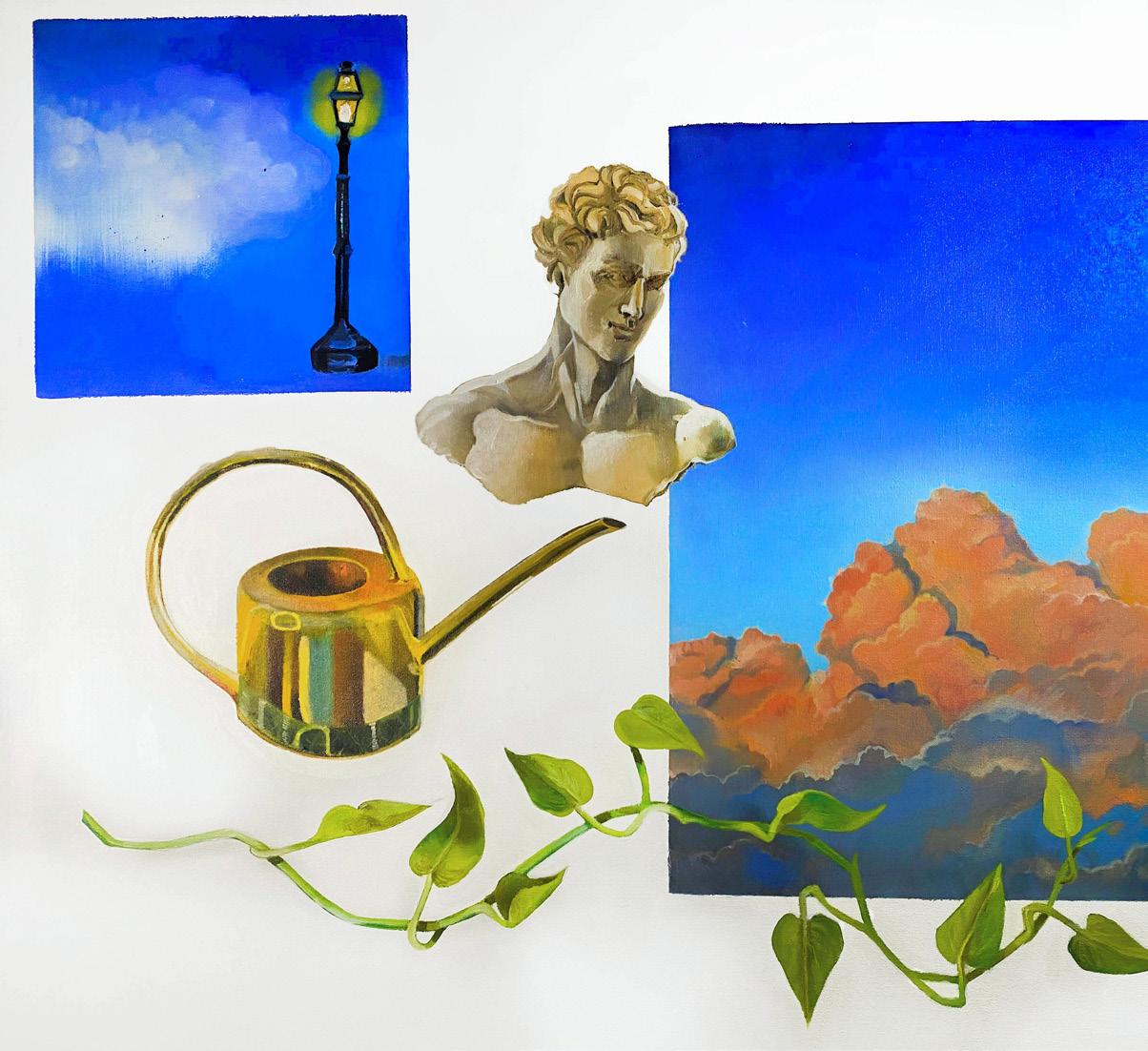
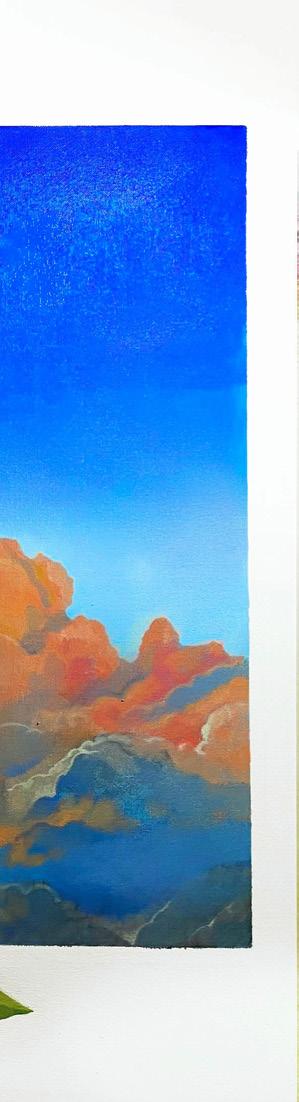 Left Image Meg Wolensky
Vigil: Watering Can, 2021 Oil on canvas
36 x 48”
Right Image Meg Wolensky
Vine, 2019
Oil on canvas 36 x 48”
Left Image Meg Wolensky
Vigil: Watering Can, 2021 Oil on canvas
36 x 48”
Right Image Meg Wolensky
Vine, 2019
Oil on canvas 36 x 48”
DR: How, if any, does your current work within arts administration influence your art?
MW: Today, I’m the Managing Director of Continuing Education at Moore College of Art & Design, which is the only historically women’s art college in the country. My path to Moore started when my middle school art teacher gave me a scholarship to attend Saturday art classes in the city. It changed my whole life. When I came to Moore, I could be safe and really access a powerful creative voice that kept me afloat through some of the most devastating times in my life.
I work to recreate that safe space for students every day. I work in my field because I authentically believe and have directly experienced the difference art practice and appreciation can make in life. In the end, I’m just a person who has to get up and go to work every day. I just have to keep trying to make things a little better for queer creative youth out there.
“In the end, I’m just a person who has to get up and go to work every day. I just have to keep trying to make things a little better for queer creative youth out there. “ -MW
Wolensky’s practice marries the conceptual with the material, in which specificities of Wolensky’s personal history and perspective on those events become the means of entry to the interpretation of their subjects and compositions. But rather than alienating the viewer, engaging with Wolenky’s paintings is an interaction predicated on vulnerability. Wolenksy’s visual self-disclosure ultimately creates a space that fosters openness and selfcuriosity, enabling those looking at the work to bring their own stories to the forefront.
Is the author dead? This author proposes that additional research be taken into what impact Wolenky’s work has upon the vast discourse written since Barthes’ published essay. Nevertheless, Wolensky’s work invites us to learn of themselves and validates creating and the need to create as more than ‘self-indulgent,’ but perhaps essential.
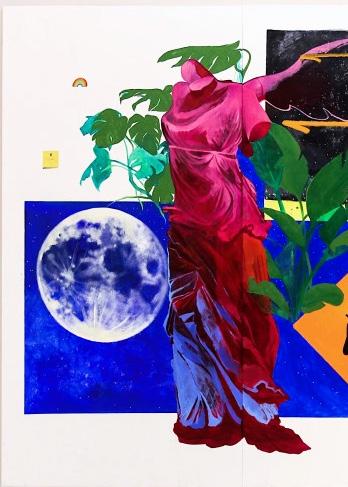
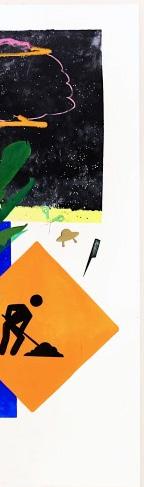
Meg Wolensky
Winged Victory (Work in Progress), 2019
Acrylic and Oil on board 120 x 120”
Barthes, R. (n.d.). Death of the Author. https://writing.upenn. edu/~taransky/Barthes.pdf
Bucknell, A. (2017, November 6). A brief history of the color pink. Artsy. https://www.artsy.net/article/ artsy-editorial-history-pink
Braam, H. van. (2021, December 30). What color is hot pink? meaning, history, hex, RGB & CMYK. Color Psychology. https://www. colorpsychology.org/hot-pink/
Cembalest, R. (2014, February 27). 14 artworks that prove pink is tough. ARTnews.com. https://www. artnews.com/art-news/news/art-thatproves-pink-is-tough-2398/
InLiquid. (2022). Wolensky inliquid member portfolio. Member Portfolio. https://www.inliquid.org/ artist/wolensky-meg
Mauney, A. C. (2022, February 11). The color pink: A cultural history. Art & Object. https://www.artandobject.com/news/color-pink-cultural-history
Migdol, E. (2021, May 10). What is a still life?. Getty. https://www. getty.edu/news/what-is-a-still-life/
Phillips, K. (2023, May 30). The Color Pink. Hunterlab. https://www. hunterlab.com/blog/the-color-pink/
Whitaker, G. (n.d.). Art movements: Symbolism, Fauvism, expressionism. The Flame Tree Blog. https://blog.flametreepublishing.com/art-of-fine-gifts/art-movements-symbolism-fauvism-expressionism