

![]()


you need to know!
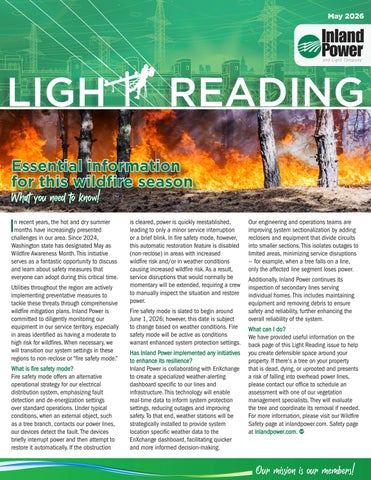
Inrecent years, the hot and dry summer months have increasingly presented challenges in our area. Since 2024, Washington state has designated May as Wildfire Awareness Month. This initiative serves as a fantastic opportunity to discuss and learn about safety measures that everyone can adopt during this critical time. Utilities throughout the region are actively implementing preventative measures to tackle these threats through comprehensive wildfire mitigation plans. Inland Power is committed to diligently monitoring our equipment in our service territory, especially in areas identified as having a moderate to high risk for wildfires. When necessary, we will transition our system settings in these regions to non-reclose or “fire safety mode.”
What is fire safety mode?
Fire safety mode offers an alternative operational strategy for our electrical distribution system, emphasizing fault detection and de-energization settings over standard operations. Under typical conditions, when an external object, such as a tree branch, contacts our power lines, our devices detect the fault. The devices briefly interrupt power and then attempt to restore it automatically. If the obstruction
is cleared, power is quickly reestablished, leading to only a minor service interruption or a brief blink. In fire safety mode, however, this automatic restoration feature is disabled (non-reclose) in areas with increased wildfire risk and/or in weather conditions causing increased wildfire risk. As a result, service disruptions that would normally be momentary will be extended, requiring a crew to manually inspect the situation and restore power.
Fire safety mode is slated to begin around June 1, 2026; however, this date is subject to change based on weather conditions. Fire safety mode will be active as conditions warrant enhanced system protection settings.
Has Inland Power implemented any initiatives to enhance its resilience?
Inland Power is collaborating with EnXchange to create a specialized weather-alerting dashboard specific to our lines and infrastructure. This technology will enable real-time data to inform system protection settings, reducing outages and improving safety. To that end, weather stations will be strategically installed to provide system location specific weather data to the EnXchange dashboard, facilitating quicker and more informed decision-making.
Our engineering and operations teams are improving system sectionalization by adding reclosers and equipment that divide circuits into smaller sections. This isolates outages to limited areas, minimizing service disruptions — for example, when a tree falls on a line, only the affected line segment loses power. Additionally, Inland Power continues its inspection of secondary lines serving individual homes. This includes maintaining equipment and removing debris to ensure safety and reliability, further enhancing the overall reliability of the system.
We have provided useful information on the back page of this Light Reading issue to help you create defensible space around your property. If there's a tree on your property that is dead, dying, or uprooted and presents a risk of falling into overhead power lines, please contact our office to schedule an assessment with one of our vegetation management specialists. They will evaluate the tree and coordinate its removal if needed. For more information, please visit our Wildfire Safety page at inlandpower.com. Safety page at inlandpower.com


Thank you for making our Annual Meeting and Board Election a success!
We had a fantastic turnout at the 2026 Annual Meeting on Saturday, March 28! A huge thank you to our valued IPL members who joined us and participated in the 2026 Board Elections. A special shoutout to our guest speaker, Adam Ratliff, the Armchair Engineer (check out his website at armchairengineer.com), as well as the amazing Northern Quest staff and our own Inland Power team for their incredible efforts before, during, and after the event!

The 2026 Washington State Legislature adjourned in March after a 60-day session driven by fiscal pressure, tax debates, and climate goals. In this second year of the 2025–27 biennium, lawmakers focused on budget adjustments and unresolved policy issues. The session was a sprint, dominated by one key issue.
Lawmakers approved a 9.9% income tax on households earning over $1 million, starting in 2028. Supporters say it addresses Washington’s regressive tax system and funds family tax credits, early learning, and business tax relief. Despite opposition and legal concerns, the measure passed after a historic 24.5-hour debate and was signed by Governor Bob Ferguson.
Our Inland Power delegation took part in a series of crucial face-to-face meetings aimed at advocating for the interests of our membership and all regional utilities. During these discussions with lawmakers, we focused on addressing the ongoing threat to affordable energy, which poses significant challenges to our community. We also emphasized the continuing need for grid infrastructure hardening and enhancement, which are essential steps in ensuring the reliability and sustainability of our energy systems for the future. These efforts highlight our commitment to both protecting our members' interests and supporting the broader regional energy framework.
Additionally, wildfire mitigation was also addressed in our meeting discussion, as our state continues to be significantly affected by persistent dry climate conditions throughout the summer months. These conditions increase the risk of wildfires, making it crucial for us to implement effective strategies to protect our communities and natural resources.
ENERGY SESSION HIGHLIGHTS
• Energy policy remained a key theme, tied to budget and cost of living issues. The Legislature kept Washington’s Climate Commitment Act framework, the cap and invest system for reducing greenhouse
gas emissions. Despite calls for major changes, the session focused on minor adjustments, oversight, and prep for upcoming rulemaking on allowance budgets and market linkage with California and Québec.
Energy affordability was also a key topic in budget talks. Lawmakers focused on protecting ratepayers and providing assistance due to utility cost pressures from carbon compliance and fuel prices. Meanwhile, the capital budget continued funding for grid modernization, clean energy and electrification projects, all supporting the state’s decarbonization goals.

The 2026 session highlighted a Legislature ready to propose new taxes without addressing the state's fiscal imbalance, relying on accounting maneuvers and shortterm fixes, leaving structural sustainability questions unanswered.
Energy policy debates followed a similar pattern. The state reaffirmed its climate framework but stopped short of confronting growing concerns about whether future energy supply will keep pace with electrification, reliability needs and economic growth. Rather than moving decisively toward fiscal discipline or energy certainty, the session postponed hard tradeoffs, setting the stage for more difficult decisions in the next biennium.


These straightforward and manageable tasks can be accomplished over the weekend to improve your home's safety against embers and radiant heat.
Steps to create a defensible space:
• Clear roofs and gutters of leaves, debris, and pine needles.
• Install 1/8 inch metal mesh screening to minimize embers that could enter through vents in the eaves.
• Repair or replace any damaged or loose window screens and broken windows.
• Use wire mesh to screen or box-in areas beneath patios and decks, preventing the accumulation of debris and combustible materials.
• Relocate flammable materials away from wall exteriors, including mulch, flammable plants, leaves, needles, firewood piles, and any highly combustible items.
• Remove any items stored beneath decks or porches.
This information is provided by the National Fire Protection Association (NFPA). To learn more about potential assistance to create defensible space around your home through the NFPA Firewise USA® community, please visit inlandpower.com/wildfire-safety


