


![]()


Czechoslovakian and Hungarian Lamp Designers 1950s-1980s

This is a first: the first-ever publication focusing on Eastern European lamp designers and, notably, the debut publication of Initio Arts & Design. Inevitably, it is also personal as it reflects our taste and instincts, presenting a selection of lamps that spoke the most to us through history. This volume is not exhaustive but carefully curated. It unveils exciting, unusual and often challenging careers of designers who have rarely, if ever, been discussed in design publications before.
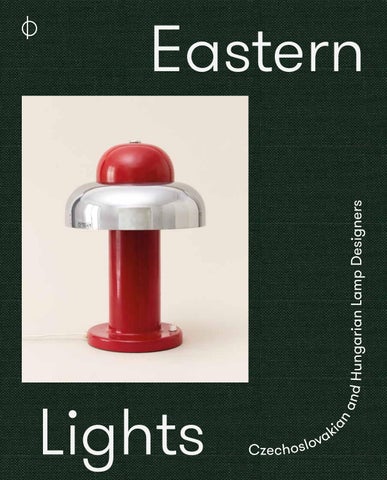
It began with a journey. We started thinking about this book three years ago, following a trip to Prague. At that time, we had just opened our first permanent showroom in Paris, dedicated to art and design. We were seeking something new and different and were immediately captivated by the distinctions and connections between Eastern and Western European design during the post-war period.
Our passage took us through museums, galleries, and the backyards of sometimes friendly, more often dubious antique dealers. We saw fantastic design pieces that had been completely neglected, forgotten, and left behind in vast industrial warehouses. We then travelled to my hometown, Budapest, where we continued to uncover a previously unrecognized and undervalued segment of Eastern European art: post-war design. It was a revelation, and the lamp designs were particularly fascinating. Amidst numerous lower-quality and mass-produced items, we encountered some with vibrant colours, exciting shapes, and elegant, avant-garde forms—nothing like our preconceived notions of socialist Eastern Europe. However, we found extremely little information about these outstanding pieces, and our exploration soon revealed many more surprises.
Although both Hungary and Czechoslovakia were behind the Iron Curtain, their design approaches diverged significantly. Hungarian lamp designers, despite their best efforts, struggled to achieve serial production. Their lamps remained the work of artisans and craftsmen, resulting in slow, limited, and costly production, often made and/or ensembled by the designers themselves. These lamps lacked serial numbers, rarely appeared in product catalogues, and seldom left the country. Distribution meanwhile was controlled by the state firm Iparművészeti Vállalat (Applied Arts Company), adding an over 40% markup to the makers’ price. These factors altogether made Hungarian lamps a rather expensive and luxurious product of their time. Interestingly, this exclusivity also made it easier to identify their designers. These lamps were not advertised by brands or through model numbers but were recognized by the names of their creators.
In contrast, Czechoslovakian designers were almost exclusively employed by or commissioned to larger factories, leading to faster and more cost-efficient lamp production reaching a broader audience. Czechoslovakian lamps were mostly made in an industrialized environment, complete with serial numbers, technical drawings, and even exported beyond the country’s borders. While the designers’ names were rarely mentioned, the factories and model numbers were widely known. Certainly, design served as a crucial tool for the self-representation of the socialist state, with many lamps being showcased internationally at events such as the 1958 Brussels World’s Fair and the renowned Triennale di Milano in the 1960s.
Despite these disparities, both countries shared a spirit of originality and a strong sense of innovation. Czechoslovakian and Hungarian lamp designs from the 1950s to the 1980s reflect a unique blend of artistic innovation, craftsmanship, and the sociopolitical context of the time. These decades were marked by significant historical events, including the Cold War and the turbulent political landscape of Eastern Europe. Against this backdrop, designers in Czechoslovakia and Hungary created lamps that not only served a functional purpose but also embodied the spirit of the era.
We invite the reader to join us on this journey and share our excitement about discovering this selection of Eastern Lights.
5
Bálint Ferenczy & Marie Tourre de Robien Initio Arts & Design

Life in socialist Czechoslovakia in the middle of the 20th century was by no means easy. Unless you created your own world, of course, as Helena Frantová did. Hers was wrought from metal. She kept her hands busy bending, coiling and linking pieces of wire. After she established herself as a leading Czech jewellery designer, few people would have guessed that she had also designed a popular lamp made from metal and parchment. Fame meant nothing to Frantová – she just loved creating.
Artist Helena Frantová (1928–2022) never liked being the centre of attention. At least not according to her niece Lucie Frantová, who we met one sunny afternoon in the café of the Museum of Decorative Arts in Prague. “I would describe my aunt as sassy, ambitious and emancipated. She didn’t let anyone tell her what to do and, above all, she worked the way she saw fit. However, it would be wrong to say that her environment was supportive of her. And she didn’t like to talk about her work either. I remember that she was always busy with something, but I didn’t find out what until I was putting together her estate for donation to the Museum of Decorative Arts, Prague. I’d tried to document at least something during her lifetime, but she usually refused to help me do this. She didn’t even want to be visible, let alone famous,” Lucie Frantová recalls.
It is because of the lack of publications, articles and interviews with Helena Frantová that her personality and work are shrouded in mystery. There’s a lot we can guess, but what do we know for sure about her? She was born into the affluent Franta family in Prague on 28 September 1928. The family’s wealth came from Frantová’s grandfather, Dr Jaroslav Franta, a prominent obstetrician and shareholder in the Podolí Sanatorium. The progressive sanatorium featured a modern maternity ward where many important Czechoslovakian figures came into the world. She grew up on Prague’s Masaryk Embankment, but after her mother’s death in 1991, she moved a bit further away from the centre, to the family house on the embankment in Podolí district. It was here that her grandfather had his gynaecological practice. Her deeper roots show that a creative drive was in her blood. One of her relatives was the prominent architect Kamil Hilbert, the author of the Neo-Gothic completion of Saint Vitus’ Cathedral in Prague Castle and of the family residence in Dobřichovice where Frantová used to spend the summers.
Between 1949 and 1954, Frantová studied sculpture under Professor Bedřich Stefan and metalwork under Associate Professor Jan Nušl at the Academy of Arts and Design (AAAD). It was here that she met her lifelong friend, the sculptor, painter, medallist and, last but not least, jewellery designer Eva Havelková (née Linhartová, 1929-2019), with whom she shared an art studio in Michalská Street for many years.
In 1953, when she was 25, she completed her diploma work at the AAAD: a collection of simple table and wall lamps on a triangular metal base, with a distinctive conical shade which resembled a traditional Chinese hat. Thanks to this particular shape, the lamp soon earned the nickname “Chinese Lamp” in Czechoslovakia. Besides the shape of the shade, the parchment it was made from was also evocative of China. The shade is attached almost naively to a metal hoop by raw cotton stitching, and the body is made of metal with a brushed, polished or brass-plated finish.


Lilla Gollob
Tibor Nádai’s career path shifted by coincidences from crafting furniture to studying and working in interior design to developing his distinctively associative lamps. Our investigation was conducted regarding the work of an enigmatic Hungarian designer about whom we know very little, even though his lamps are wellknown and popular on the art market. One of the unfortunate findings of the research was Tibor Nádai’s recent passing in December 2023. Therefore this present study, in addition to analysing his lamps, serves as a homage to his life.
Tibor Nádai (1941-2023) was born in Budapest, and his active career spanned from the 1960s until the regime change in Hungary in 1989. During this time, he absorbed the rapidly flowing industrial design trends from Western to Eastern Europe, much like a sponge. His associative lamps resembling sombrero hats, apples, and cranes, were probably influenced mostly by the playful, narrative works of Italian designers.2 This design approach, which went beyond pure functionalism, was also characteristic of several of his Hungarian contemporaries, such as of Sándor Borz Kováts’3 or the OPTEAM Group’s creations4
STEP-BY-STEP TO THE LAMPS
During a drawing class in primary school Tibor Nádai’s talent and diligence came to the attention of his art teacher, the painter and graphic artist Béla Komjáti. He persuaded Nádai’s father to enrol him in the Secondary School of Visual Arts, Budapest, where he was teaching as well. As the family were experiencing financial difficulties at the time, he specifically recommended the furniture-crafting course, telling them that “you can make a living out of that.” When Nádai graduated in 1959, someone in his class suggested that they should apply to the College of Applied Arts5 to continue their studies. “As lucky as was, and I had a good portfolio, I got accepted straight away,” Nádai said.6
He started the interior architecture faculty and became engaged in a lively, creative environment, where he did particularly well because of the skills he gained as a furniture craftsman. This expertise later came in handy when he was making lamps, as the molds for the lamps were made from wood.7 “We had a good time, we were making good speed. Our year was a colourful group. Borz8 was there as well, he was the leader. He was the best at almost everything. We learned a lot from him, but also from each other. Borz arranged the ‘10 Experiments’ design exhibition9, which was the cradle of Hungarian design. We first heard the word ‘design’ from him. To be honest, from then on, we went along with that concept. We examined what it meant and began producing in the same spirit right from the early years. The fact that ended up designing lamps was also partly due to the influence of Borz and the realisation that small objects could be manufactured at home” Nádai recalled.10
Nádai considered István Németh and György Szrogh – who was the designer of the famous Körszálló in Budapest – as his masters, and his diploma project was a design concept for a complete hotel and a matching chair in 1964. He was living alone with his mother at the time, on a widow’s pension, so he had to start working as soon as he graduated from college. He applied to and got employed right away by ÁÉTI (General Building Design Company), whose name he happened to come over by chance while riding the tram.


