In Session Newspaper – March 2026

Page 1


Unfinished priorities, dead legislation tee up possible flurry of Special Sessions

If Gov.  Ron DeSantis is a lame duck, he didn’t get the memo.

Several of his priorities remain in limbo in the waning days of the 2026 Legislative Session. That has prompted speculation in some instances, and confidence in others, that lawmakers may be called back

for a Special Session — or several — to address items left on the table after the hankie drops.

One Special Session is already guaranteed, with DeSantis scheduling a meeting for April 20 to address mid-decade redistricting as part of a nationwide push and pull between

The Legislature has officially sent the 2026 Farm Bill to the Governor’s desk.

The House passed SB 290 in a 94-10 vote, clearing the final hurdle for the wide-ranging Agriculture Department priority measure. The bill now heads to Gov. Ron DeSantis

“The Florida Legislature passing the 2026 Florida Farm Bill is a major victory for Florida farmers and Florida families,” said Agriculture Commissioner  Wilton Simpson, adding “the 2026 Florida Farm Bill supports the people who feed our state and our nation while also strengthening public safety and defending our

Republicans and Democrats over control of the U.S. House.

Others are shaping up to be possibilities too, with lawmakers stalled on how best to implement property tax relief for homesteaded residents. DeSantis has long said he favors fully eliminating

lands and natural resources. Together, we’re strengthening the backbone of Florida’s economy and ensuring our state remains a place where freedom, family, and farmers can thrive.”

House sponsor Rep.  Danny Alvarez also offered praise.

property taxes on homeowners’ primary residences. But proposals introduced this Session offered a variety of options, all with protections for the portion of taxes dedicated to public schools and with guarantees that public safety budgets wouldn’t be slashed.

Meanwhile, DeSantis has also been pushing for artificial intelligence reform, with one ally in the Senate offering legislation to safeguard minors and other vulnerable Floridians. The potential for multiple Spe-

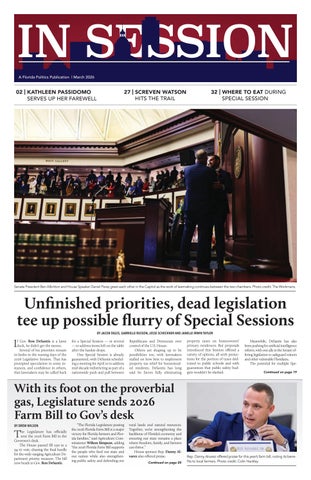
Senate President Ben Albritton and House Speaker Daniel Perez greet each other in the Capitol as the work of lawmaking continues between the two chambers. Photo credit: The Workmans.
A Florida Politics Publication | March 2026
Rep. Danny Alvarez offered praise for this year’s farm bill, noting its benefits to local farmers. Photo credit: Colin Hackley.

farewells FAREWELLS

KATHLEEN PASSIDOMO

A LEGACY OF LIVING LOCAL AND LIVING HEALTHY

M

ost Senate Presidents end up leaving Tallahassee not long after their portrait ends up on the chamber wall. But thanks to a lucky draw in the redistricting process, Sen.  Kathleen Passidomo spent another two years in the Florida Senate after relinquishing the gavel to successor Ben Albritton

Still, term limits mean the Naples Republican’s tenure in Tallahassee now has indeed drawn to a close.

“As far as I know, only three or four former Presidents have stayed, and some haven’t been able to — they left because it was challenging,” Passidomo said. “But I’m lucky, first of all, that Ben and Missy Albritton have been friends of mine for 16 years and we have a personal friendship. Second, President Albritton and I have the same philosophy about governance. We have different styles but have the same political philosophy.”

Albritton considers Passidomo a valuable partner who set a strong example on how to lead the Senate.

“Kathleen and I came into the House together. For the entire time I have known her, regardless of her position, she has always read every single bill, and every single amendment. She has gained the respect of those on both sides of the political aisle by listening to the concerns each Senator brings forward and working to build consensus,” he said.

“She has exhibited sound judgment and a fair-minded, reasonable and thoughtful approach to decision-making that has been a great benefit to the Senate before, during, and after her time as Senate President. Her dedication and keen attention to detail is unmatched. More than any of that, she’s been a trusted confidante, a loyal advisor, and true friend to Missy and me. I love her like a sister and know we will be friends for years to come.”

In her last two Legislative Sessions, Passidomo chaired the Senate Rules Committee, a job that has her touch every bill filed in the chamber.

“I don’t sit in the President’s office and give him advice all the time because I’m busy in my office,” she said. “This Session, for whatever reason, there’s so many bills that I’m reading, and the ones in the House are different than the Senate. It’s taking me so much time that I don’t even have time to meddle.”

Besides, she feels strongly about a legislative legacy largely cemented by her two years as presiding officer. During that time, signature policies like the Live Local Act and Live Healthy Act, both Passidomo priorities, landed in Florida statute. And she had a voice in follow-up tweaks to those laws, some of which have been discussed just this year.

The work has been appreciated tremendously in Southwest Florida.  Kristina Park, President and CEO of the Greater Naples Chamber, praised Passidomo’s “steadfast leadership and service to Collier County,” saying she had been a thoughtful advocate advancing policies that benefited the entire state.

“Access to safe and affordable workforce housing has been a longstanding priority for the Greater Naples Chamber and our members. It is a topic that consistently rises to the top of our policy discussions, from legislative priorities to conversations within our Leadership Collier programs. Employers across all industries understand that housing affordability directly impacts their ability to attract and retain talent, sustain operations and plan for the future,” Park said.

In particular, Park noted many of the policy achievements in the Live Local Act.

“Sen. Passidomo listened to those concerns and took meaningful action. Housing was the central focus during her first term as Senate President, advancing the Live Local Act to expand opportunities for workforce housing statewide. Her leadership elevated the conversation around housing and translated years of dialogue into tangible policy,” she said.

The law forces local jurisdic-

tions to accommodate the need for more housing stock in the region. It’s an approach that proved controversial among home rule supporters, but which Passidomo felt necessary as Florida’s economy morphed and living space became scarce.

She felt the need to take action as she watched commercial corridors in Southwest Florida empty of retail stores amid a shift to online shopping, even as more residents moved into the area. She discussed driving from Naples to Fort Myers on the Tamiami Trail and seeing the commercial landscape change.

“When I moved to Naples in 1979, we had all these cute little mom-and-pop stores, and we obviously, we didn’t have Amazon. So everybody would shop in these little stores in the strip centers,” Passidomo said.

“Well, now, those little momand-pop stores, unfortunately, have gone out of business, and we have all these vacant strip centers, a lot of them. Isn’t that ideal for redevelopment into workforce housing? Because next to that vacant strip center is a bank, a hospital, or an office building, and those are full. Wouldn’t it be great if you live right next door and you can walk to work?”

The Live Healthy Act, meanwhile, aims to bring more medical professionals into the state, hopefully early in their careers so they establish roots in the Sunshine State. Passidomo pushed for more residency slots in the state at

teaching hospitals once students finish medical school.

She credits a strong relationship with former Speaker Paul Renner, her counterpart in the House when she led the Senate, with rapidly advancing her legislative priorities. Both aligned philosophically on many issues, and that made it easy to quickly advance her priority of Live Local as his push for universal school choice moved ahead.

She also enjoyed perhaps the strongest relationship with Gov.  Ron DeSantis  of any Senate President during his eight years in office. She attributes that in large part to a well-timed catastrophe for her community.

Hurricane Ian made landfall in Southwest Florida in September 2022, flooding countless homes, including doing massive damage to her own. But that storm, among the worst disasters to hit Florida in the last eight years, meant the Governor and his team largely stationed in Southwest Florida in the months ahead of her time as Senate President.

“I spent a lot of time with the Governor after the hurricane — a lot of time,” she said, “and I got to know him as a person, not just the Governor. When a community is devastated like that, and you have conversations about impact, it’s not a political discussion, it’s a personal discussion. He and I became friends over that, and we were able to bring significant resources to Southwest Florida.”

The millions Passidomo helped bring home after that storm may be her greatest local legacy.

The Naples Pier had to be rebuilt and relief had to be facilitated to families throughout the region.

But as her time in Tallahassee draws to a close, many wonder what’s next for Passidomo.

“Sen. Passidomo has consistently demonstrated a strong understanding of the issues facing our local business community, Park said. “We appreciate her partnership, accessibility and commitment to advancing solutions that position Collier County and Florida for long-term success. We look forward to continuing to partner with her in her next chapter.”

And Passidomo herself wonders what the next move will be. She has considered local office. But she knows too well not everything can be counted on to go as planned. Her husband, John, unexpectedly died in 2024. The two were married 45 years. Passidomo said she still hasn’t come to terms with his death, but also feels fortunate to have professional savings and community support.

“I won’t have to have my kids take care of me. I know so many widows who, they have nothing, and I don’t need to worry about that,” Passidomo said. “I can decide what I want to do without having  that. I don’t have to work. I probably will do something, probably more volunteer stuff. You know, I’m certainly not going to sit around the Capitol bugging people.”

Former Senate President Kathleen Passidomo’s tenure in the Legislature ends on an unusual note, as one of very few who have wielded the gavel and then served another term without it. Photo credit: The Workmans.

House, Senate buck college tuition increases in higher ed budgets

Neither the House nor the Senate are including tuition increases in their respective proposed budgets, an analysis of each finds.

And the two chambers are close on overall funding for the State University System, with the Senate budget coming in at $4.7 billion and the House at $4.5 billion.

Both chambers’ budgets include $350 million for performance-based funding, with $100 million extra for schools deemed preeminent research universities, which includes Florida State University, the University of Florida and the University of South Florida.

The chambers also align on expanding the state’s Guardian program (HB 757) to state universities, which would allow certain staff to carry firearms on campus once meeting training requirements. Both chambers include $1.8 million to implement the law if it passes, along with another $4.2 million to implement it on college campuses. As of publication, the House had cleared the measure, and it was awaiting Senate action.

While not entirely aligned, the House and the Senate are close to agreement on funding for the Florida College System, with $1.86 billion proposed in the Senate and $1.82 billion in the House, neither with tuition increases contemplated.

Both chambers’ budgets emphasize workforce training as part of higher education, with the Senate proposing more than $787 million and the House coming in about $63 million short of that, at $724 million.

Both chambers are also including funding for faculty recruitment and retention, though the Senate’s initial proposal is far more generous and more specific. Its proposal includes $90 million specifically for those purposes, while the House only includes $30 million in a more general bucket set aside for “additional operating funding” that could be used for faculty recruitment and retention, among other possible uses.

Meanwhile, the Senate is just slightly more generous than the House as it relates to student financial aid, with $1.142 billion included

Cents and sensitivity: Driver privacy bill targeting penny sales to refuel after idling this year

Asweeping proposal to curb Florida’s lucrative sale of driver data died unheard this year, but its House sponsor says it will return next Session stronger and more targeted.

Committee leaders declined to hear HB 357, dubbed the “Driver Privacy Act,” by Highland Beach Republican Rep.  Peggy Gossett-Seidman, who plans to spend the Summer refining it with state agencies and industry stakeholders before reintroducing it in 2027.

“It needs a lot more work and deeper dives,” she told Florida Politics. “Every time I went to research it, it took me further. People talk about rabbit holes. This is like mammoth caves. There are so many people and entities involved.”

which companies pay as little as 1 cent per record access.

Gossett-Seidman said she was told directly by representatives of LexisNexis, one of the nation’s largest data brokers, that the company spent $37 million last year alone on Florida penny records.

A purchase package she reviewed also included Experian and Accenture as big buyers.

Between 2021 and 2023, Florida collected $263 million selling DMV data, with LexisNexis alone spending more than $90 million during that period. Gossett-Seidman said the state has generated more than $490 million from such sales since 2013.

and improperly withheld revenue from DMV crash report sales. The company has also settled class-action cases in other states involving crash report data, including $5.1 million in North Carolina over allegations it improperly sold accident reports to law firms for marketing purposes.

In recalibrating her bill, Gossett-Seidman said she is striving to strike a balance between privacy and legitimate use. Insurance underwriting, accident reporting, vehicle recalls, interstate data exchanges and law enforcement investigations all depend on access to accurate driver records.

in its spending plan, compared to $1.123 billion in the House plan.

Given only limited daylight between the spending plans related to postsecondary education, it’s likely the chambers will be able to quickly reach consensus. But there is one major change that could be a hang-up.

In his proposed budget, Gov.  Ron DeSantis included a property transfer of the University of South Florida’s Sarasota/Manatee campus to New College of Florida. While his proposal didn’t outline a funding transfer as part of the transaction, the House proposal does.

At issue is a House conforming bill (HB 5601) that, if passed, would transfer the USF regional campus to New College, including the land and buildings, and New College would then assume remaining debt. The House budget includes an item, contingent on the bill’s passage, that would also transfer $22.47 million in recurring funds from USF to New College. The Senate doesn’t include similar language.

As Florida Politics previously reported, sources familiar with the facility transfer say the funding shift could sink the entire deal, noting that USF officials are OK with the transfer, but not the funding shift.

“We have been clear that the loss of any funds threatens our priority to protect our people, as they are necessary to pay for a teach-out so current USF Sarasota-Manatee students can finish their degrees on their home campus and for USF Sarasota-Manatee employees’ salaries on another USF campus,” USF Board of Trustees Chair  Will Weatherford said in a statement.

Sources previously told Florida Politics they were confident the House would ultimately align its plan on the transfer with the Senate, which would kill the $22.47 million funding shift.

HB 357 and its upper-chamber companion (SB 942) by Miami Republican Sen.  Alexis Calatayud aimed to expand confidentiality protections for personal information held by state and local Departments of Motor Vehicles (DMV).

The bill would amend Florida’s public records law to bar the sale or sharing of motor vehicle record information, as defined by the federal Driver’s Privacy Protection Act (DPPA), to marketing firms, debt collectors, insurance companies, data brokers, foreign countries of concern and foreign principals.

It would also make confidential email addresses, emergency contact information, secure login credentials, IP addresses, geolocation data and public-facing portal access logs collected by the Department of Highway Safety and Motor Vehicles.

Violations would be punishable as noncriminal infractions carrying fines of up to $2,000 for unauthorized data use.

Central to debate over the legislation and the privacy matters it concerns are so-called “penny sales,” bulk data transactions in

The practice is widespread nationally. InvestigateTV reported in October that 23 states collected at least $282 million from DMV data sales to hundreds of companies.

Georgia led with more than $53 million, followed by California at $49 million, Indiana at $25 million and Ohio at $20 million. Delaware, Wisconsin and Wyoming reported offering consumers limited optout options in certain situations.

The DPPA, enacted in 1994 after actress  Rebecca Schaeffer was murdered by a stalker who obtained her address through California DMV records, restricts public access to driver information. But it contains 14 “permissible use” exceptions that allow insurers, private investigators, debt collectors and others to obtain records under certain conditions.

Gossett-Seidman said those may function as a broad opening through which data can be accessed at scale.

“We have no roadblocks,” she said. “Someone from anywhere can say, ‘For 1 cent each, I’ll take X amount of records. I’ll take 10,000.’”

The issue has also prompted litigation. In 2020, then-Attorney General  Ashley Moody  secured a nearly $10 million settlement with LexisNexis over underreported

“Our data at the DMV, which we require to drive, is necessary to share with certain entities, absolutely,” she said. “But we need to look at the line to third parties. We do not have control of where our stuff goes. That is what we have to rein in.”

She said she has spoken with the Governor’s Office, Senate and House leaders, and officials at the Department of Highway Safety and Motor Vehicles, which has explored filtering mechanisms to screen out bad actors.

A future version of the legislation, she said, should establish clearer stopgaps to prevent downstream resales, limit transfers to foreign principals and create an opt-out option so Floridians can control how their information is used.

“We don’t have an opt-out now,” she said. “People should be able to choose that.”

Despite not seeing a single hearing, HB 357 recorded more than 30 registrations from lobbyists representing data brokers and insurance industry interests, including State Farm and the Consumer Data Industry Association.

Calatayud, who called Gossett-Seidman “the driving force” behind this year’s legislation, said she isn’t sure whether she’ll carry its Senate sequel.

Florida State University students and hopeful students have reason to rejoice this Legislative Session, as tuition increases appear off the table.
Sen. Alexis Calatayud championed a bill this year to implement protections against selling drivers’ data. Photo credit: Colin Hackley

farewells FAREWELLS

PARTY GIANT JOE GRUTERS LEAVES BIG TENT LEGACY

J

oe Gruters 2016 election to the Legislature came after a razor thin GOP House Primary victory he edged out by less than 400 votes. But almost a decade later, he leaves as one of the most powerful political voices in the country.

Gov.  Ron DeSantis won his first race for Governor. He ended up both taking over as Republican Party of Florida Chair that year with DeSantis’ support, and carrying a top priority of the Governor, a sanctuary cities ban requiring law enforcement to cooperate with

“We’ve had a lot of wins, both for the community, and I think I’ve had a lot of wins for the state.” –JOE GRUTERS

Now a Senator wrapping up eight years in the upper chamber, Gruters leaves after helping redefine the national dialogue on immigration, literally reshaping the landscape by undergrounding utilities, and maybe laying the scientific groundwork to contain the threat of red tide.

“We’ve had a lot of wins, both for the community, and I think I’ve had a lot of wins for the state,” the Sarasota Republican said.

After a single term in the Florida House, Gruters jumped to the Senate in 2018, the same year

Immigration and Customs Enforcement.

That legislation proved complicated, requiring buy-in from law enforcement reluctant even in many Republican counties to take on new obligations. But he helped get the bill to the Governor’s desk.

“It was, at the time, the strongest bill that’s ever passed, you know, any legislature in America,” he said.

But Gruters remains most proud of work done for his community and to make the state more resilient during hurricanes and

other weather events. He points to legislation he championed that didn’t generate as many headlines but could help keep the lights on in many homes. A law passed in 2019 expedites the undergrounding of electric lines and other utilities, allowing costs to be passed through to consumers but ensuring reliable service in the event of storms.

“We’ve all experienced the power outages and massive impact that has on communities after these storms, but what we did with that bill is create a path forward for the utility companies to really harden and underground all the utilities in Florida, which makes us a lot more resilient,” he said.

Gruters also landed some important funding wins in the Sarasota-Manatee area. The biggest investment came early in his Senate career when he, along with then-Senate President Bill Galvano, helped secure $18 million at Mote Marine Laboratory for the Florida Red Tide Mitigation and Technology Development Initiative.

That was funding  Michael Crosby, Mote’s President and CEO, said could “change the paradigm” on how scientists limit the impact of red algal blooms on the environment. Crosby also credits Gruters with securing STEM funding and conservation grants helping fund research in the marine environment on the Gulf Coast.

“One of the remarkable things about our oceans and coastal ecosystems is that they know no political or bureaucratic boundaries, with the animals, phytoplankton, water and sand constantly on the move across such boundaries,” Crosby said.

“Like his great-grandfather,

Ringling Circus chief tentmaker William Hobson who moved to Sarasota in 1922, Joe is an inclusive big tent kind of guy who can bring people together.  Sen. Gruters has demonstrated in our legislature that he is a man of focused purpose, strategic vision and unwavering principled independent thinking regarding the vital role of science and education to maintaining a healthy environment and a strong economy.”

That reputation for building bridges seems all the more remarkable with Gruters’ role as a party leader. He was tapped by President Donald Trump as Republican National Committee Chair, which follows stints co-chairing the President’s 2016 campaign in Florida and four years running the state party during a time of historic voter registration growth and the reddening of Florida’s political profile.

But in Tallahassee, Gruters tries to keep positive relationships within the GOP and across the aisle. He has worked on bipartisan bills like a ban on smoking on public beaches, and in 2024 became one of the most prominent GOP supporters of a recreational pot amendment.

He also helped craft bills reworking the way law enforcement investigates human trafficking, working with advocacy groups encouraging the treatment of women drawn into rings as trafficking victims.

“His help has saved so many lives,” said  Monica Rodriguez, lobbyist for Selah Freedom, an advocacy group founded in Sarasota. “Around 50,000 kids have been trained in trafficking prevention and thousands of survivors have received services that allowed them a path to freedom from their

traffickers with the help we got from Gruters. He is one of our guardian angels.”

During his tenure in the Senate, he has led efforts in tourism, commerce and education, and also in the world of accounting. As a certified public accountant himself, he enjoyed a level of expertise and insight into the way regulations impact number crunchers. He found colleagues, most of whom arrive in Tallahassee with law degrees, often deferred to experts among their ranks.

“I’m the only CPA in the Senate. I love being a CPA, so that was rewarding to go to bat for my profession,” Gruters said.  “But I try to represent all professionals. There also are not any architects or engineers, and it seems like there are issues coming up all the time that affect those fields.”

But the top priority, he said, was always giving Sarasota institutions like Marie Selby Botanical Gardens a voice in Tallahassee.

“Sen. Gruters has made so much possible for Selby Gardens, and has truly been a champion for our institution’s advancement. He led the creation and approval of legislation that has been enacted to preserve Florida’s longstanding property tax exemption for nonprofits (called ‘The Selby Law’),” said  Jennifer Rominiecki, President and CEO of Marie Selby Botanical Gardens.

“This safeguarded Selby Gardens, as well as all nonprofit organizations in our state. Senator Gruters also led securing several vital appropriations from the state in support of Selby Gardens’ Master Plan and shoreline resiliency at both of our campuses. All of us at Selby Gardens are deeply grateful to Senator Gruters for his phenomenal leadership and extraordinary service to our community.”

Senate President  Ben Albritton  said he has been excited to serve alongside Gruters and watch his leadership in action.

“It has been remarkable to watch him advance and excel within our national political leadership while at the same time serving his constituents, chairing major Senate committees, and running his accounting practice,” Albritton said.

“With everything he has on his plate, he’s still as down to Earth as the first day I met him. He has a great sense of humor and keen ability to capture the attention of the room, no matter who’s in it. Joe is a tremendous person. I’m proud to know him and can’t wait to see what the future holds.”

Gruters expects to run for office again someday, though he isn’t sure which office. He suspects no job will feel as important.

“Serving in the Senate has been spectacular,” he said. “This is the best political job in the world, and I’m sad it’s coming to a close.”

Arguably one of the most powerful Republicans in Florida, Sen. Joe Gruters’ political career is just beginning as he continues to lead the Republican National Committee as a key President Donald Trump ally. Photo credit: The Workmans

Despite House blessing, Senate’s lack of appetite kills thoroughbred horse racing ‘decoupling’

Abill that would have leveled the playing field among pari-mutuel activities while decoupling thoroughbred horse racing from other gambling activities cleared the House last month, but failed to gain traction in the Senate.

House lawmakers passed a Committee substitute of the measure (HB 881) from Republican Rep.  Adam Anderson on a 77-34 vote largely along party lines, with mostly Democrats in opposition.

The vote sent the measure to the Senate, where a similar bill never even received a Committee hearing, meaning the upper chamber had no appetite to offer its seal of approval to the measure.

And even had the Senate taken up the matter, its fate was murky. Gov.  Ron DeSantis’  veto pen likely posed a fatal threat to the yearslong effort.

Anderson’s bill is similar to a 2025 measure that cleared the House and one Senate Committee. It would have allowed Gulfstream Park in Hallandale Beach to continue operating its on-site casino without requiring it also to operate horse racing. The measure sought to align thoroughbred tracks with

other pari-mutuel facilities, decoupling them from ancillary activities under a 2021 law (SB 2A).

Like the 2025 attempt, the 2026 bill included a long lead-up to venues suspending live racing. It would not have allowed notice of racing suspension until July 1, 2027, and racing would have continued for at least three years after the notice of intent to suspend.

DeSantis made clear last year that he did not support the measure. Speaking to the National Horsemen’s Benevolent and Protective Association last year, he said the legislation would “have the effect of harming the industry.”

His concerns echoed those of other critics, who worry the move would spell the end for horse racing in Florida. According to the American Horse Council, the industry has a $3.24 billion economic impact and supports more than 33,000 jobs. The estimate doesn’t account for the tourism impact from horse racing.

But supporters of the legislation say it is necessary to level the playing field for horse race tracks by giving them the option to maintain certain gambling activities even without live horse races, referred to as “decoupling.” It would make each activity independent.

While the issue is dead for this year, it’s likely to resurface again. And given that this is DeSantis’ final year in office, and that new leadership will helm both the House and the Senate next year, there could still be space to see movement on the issue.

For the second year in a row, the House has cleared a measure to decouple thoroughbred horse racing from certain gambling activities, but the Senate has again stood in the way.

REPUBLICAN HOUSE MAJORITY

2026 CAMPAIGN EMPLOYMENT OPPORTUNITIES

The florida house republican campAIGn committee is now accepting resumes from qualified individuals SEEKING employment on Florida State House campaigns during the 2026 election cycle.

Positions WILL BE available AFTER THE LEGISLATIVE SESSION for trusted field staff and experienced senior staff members.

Applicants should possess prior campaign experience, strong professional references, and a demonstrated commitment to advancing the mission and objectives of the Republican House Majority. must be a proven team player.

Roles require a willingness to travel throughout the state of Florida and the ability to perform in a demanding, fast-paced campaign environment, including LEGENDARILY extended and irregular work hours as necessary. WE SEEK SERIOUS PEOPLE FOR SERIOUS JOBS. A college degree and participation in post-graduate campaign training programs are preferred but not required. solid technical skills welcome. recognize that there is no campaign task we assign that is beneath you. prove your value.

APPLICATION INSTRUCTIONS

farewells FAREWELLS

LORI BERMAN EXITS LEGISLATURE AFTER SHAPING GUN, CUSTODY LAWS

Senate Democratic Leader Lori

Berman is leaving the Florida Legislature after 16 years divided between the House and Senate.

She isn’t the most flamboyant legislator. And with her short stature and quiet voice, she doesn’t come across as a rabblerouser who tries to intimidate people into going along with her on policy.

“I’m not a stone thrower,” said Berman.

Instead, she’s sort of a nerd –in exactly the way you want your elected officials to be nerds.

“I’m kind of a policy wonk. I love to discuss the issues. I made a promise to myself when I first came up here that I would read every bill. It hasn’t been easy,” she said. “It’s important to understand and know the bills so that you can debate them and ask questions and talk about the issues.”

Different legislators have different styles during floor and committee debate. Some are over the top and exaggerate — or way underplay — the significance of legislation before them. Some talk even when they don’t have anything constructive to say, because, well, that’s what they think they should do. Others say they approve or oppose a bill because it’s what God would do. Some find a way to support legislation because — by coincidence, of course — it benefits a major donor. Others take to the floor thinking about the next rung on the political ladder.

Berman is none of the above.  When she goes home to Boca Raton, she doesn’t have plans to return to Tallahassee in an elected role. While she’s very passionate about many issues, she debates in a rational, business-like manner. And all that bill reading leads to lots of questions.

Her hard work is noticed by colleagues in both parties.

“You’ve helped me become a better member,” Republican Sen. Clay Yarborough, who also served with Berman in the House, said before Berman’s farewell address. “I know if I’m not prepared before I stand in front of a committee with Lori Berman on it, there’s probably going to be some issues … Everybody would agree that we’re all better being able to serve with you.”

Politics often attracts people with big egos, people who crave the limelight and the adoration of others. Berman is the antithesis of that. Instead of partying on Adams Street, she spends a lot of time reading bills. Even her role as leader was a fluke. She calls herself the accidental leader be-

“Although this was your day, almost all of your speech was about other people. That’s a big deal and we love you for that. It’s a glimpse into your heart and who you are.”
–BEN ALBRITTON

cause she replaced Sen. Jason Pizzo after he left the party and became an independent.

If she sees problems with other members’ bills, she talks with them face to face instead of behind their back. And in doing so, she often improves legislation and earns the respect of her peers.

When she gave her farewell speech recently, half the chamber rose to say nice things about her — Republicans and Democrats alike. When it came time for her to speak, she went through the list of her colleagues and said something positive about nearly all of them regardless of party. She spent far more time talking about others than talking about her own 16

years in the Legislature.

The tribute to others was noted by Republican Senate President Ben Albritton

“Although this was your day, almost all of your speech was about other people. That’s a big deal and we love you for that,” Albritton said. “It’s a glimpse into your heart and who you are.”

In those 16 years, she proved a Democrat could still move legislation in a state dominated by Republicans.

She said the most impactful moment of her career was the mass shooting at Parkland’s Marjory Stoneman Douglas High School, which killed 17 people.

“People were watching us. And

I loved that we had such activism,” she said.

Amid demonstrations, marches and Parkland student speeches, the Republican-led Legislature did something unheard of: It passed new restrictions on gun purchases and ownership, including a red flag provision that Berman had sought before the shooting.

The law, provisions of which some Republicans have unsuccessfully sought to repeal, allows judges to order guns to be confiscated from people deemed to be a threat to themselves or others.

“Since then, it’s been used 19,000 times,” she said, adding that she believes lives have been saved. “I think we have probably saved some mass shootings. We’ve saved suicides for sure. We’ve saved families.”

She also passed a bill hoping to close a loophole in Florida law after a constituent asked a court to repeal visitation her ex had with their child. The man was threatening to decapitate the woman, and she showed a judge violent emails and messages.

But the judge said he might have been threatening the woman, but not the child, and he didn’t change the father’s visitation rights. Soon after, the woman went to pick up her son at her ex’s to find he fatally shot himself and the child. The bill Berman passed allows judges to consider threats to parents in custody situations.

“We’re trying to make sure that the judges understand how important it is to take those factors into account and make sure children are protected in those situations,” Berman said.

Albritton said that while Berman calls herself the accidental leader, there’s nothing accidental about her leadership skills. He also remarked on her personal rules of debate, or her “Three B’s”: be topical, be brief, be seated.

“I particularly appreciate her 3 B’s — a lesson she has shared from her father,” Albritton said. “It’s a reminder that we should choose our words carefully — mean what we say and say what we mean. That’s a lesson we can all reflect on.”

As Senate Democratic Leader, Lori Berman is leaving office at the top of her legislative game, with a legacy of quietly grinding. Photo credit: The Workmans

Left in the heat: Bills to require air conditioning in prisons stall again as lawsuit advances

Legislation to guarantee air conditioning and basic rights for Florida inmates is once again dying quietly without a single Committee hearing — even as a related lawsuit moves forward.

Substantively identical bills (SB 106, HB 55) by Tamarac Sen. Rosalind Osgood and Tampa Rep.  Dianne Hart-Lowman, both Democrats, have seen no movement in either chamber.

As was the case in five prior Sessions that Hart-Lowman carried the proposal, time is running out this Session, and the legislation is likely to again die unheard.

The bills would establish a statutory “Inmate Bill of Rights,” requiring air conditioning in newly constructed prisons and mandating cooling or ventilation systems in existing facilities. The legislation would also guarantee inmates a minimum of 20 minutes to eat each meal, access to necessary health products and personal protective equipment, and adequate food supplies during emergencies.

The measure, which includes no funding appropriation, would also expand the definition of “permanently incapacitated inmate” for purposes of conditional medi-

cal release and require that incarcerated individuals receive a written copy of their rights.

Hart-Lowman has filed versions of the legislation since her first Session in 2020. A Senate

companion was first introduced in 2023 by former West Palm Beach Democratic Sen.  Bobby Powell, but the chamber has likewise repeatedly declined to take it up.

Other Democratic lawmakers,

including Jacksonville Sen.  Tracie Davis and Rep.  Angie Nixon, have pushed similar air-conditioning proposals in prior years without success.

The stalled legislation comes

amid ongoing litigation over extreme heat in Florida prisons. In late 2024, the Florida Justice Institute filed a federal lawsuit alleging that conditions at Dade Correctional Institution contributed to the deaths of multiple inmates and exposed others, particularly elderly and medically vulnerable individuals, to unconstitutional levels of heat.

The suit argues that the lack of air conditioning and insufficient ventilation violate the Eighth Amendment’s prohibition on cruel and unusual punishment, as well as the Americans with Disabilities Act and the Rehabilitation Act.

In September, a federal Judge certified a class action allowing more than 1,500 inmates to collectively challenge prison heat conditions they say increase the risk of illness and death.

Florida Department of Corrections Secretary Ricky Dixon previously testified that roughly 75% of the state’s prison housing units are not air-conditioned.

It’s a problem of which the Legislature’s budgeters are well aware; last year, lawmakers approved $300,000 for a pilot program to install air conditioning units in dorms at three Miami-Dade correctional facilities.

Gov.  Ron DeSantis  vetoed the funding in 2025.

Florida Politics contacted Osgood by text and Hart-Lowman’s Office by phone and email for comment on this story but did not receive a response by press time.

Rep. Dianne Hart-Lowman doesn’t think inmates should be subjected to sweaty cells, and she’s backing legislation to make sure they don’t. Photo credit: Colin Hackley

farewells FAREWELLS

DARRYL ROUSON LEAVES A LEGACY MARKED BY HELPING OTHERS, BUT HE MAY NOT BE DONE MAKING IT

Democratic Sen.  Darryl Rouson may be saying farewell to the Senate, but that doesn’t mean he won’t be back next Session.

Rouson, a strong advocate for substance abuse and mental health treatment, might seek a return to the House, influenced in part by the desire to work in the Capitol while his son finishes his last two years at Florida A&M.

“I almost wish I had two more years so I can see him graduate and hang out with him till then,” Rouson said.

If so, that would be good news for recovering addicts and those struggling with mental health issues. As someone who beat addiction then committed himself to helping others, Rouson is an inspiration.

“He’s real open about his own personal story, which I think really draws people in. It drew me in because he’s open and honest about it.” –

NEAL MCGARRY

There’s a place for Rouson if he decides he wants to seek it. Democratic Rep.  Michele Rayner  now holds the House seat he’s eyeing, but she’s leaving the House to run for his seat.

Part of Rouson’s legacy in the Legislature if he does leave is passing a bill that allows recovered addicts to get certification to help others who are going through similar struggles.

“In the program they teach us that the therapeutic value of one addict helping another is without parallel, and I truly believe that,” Rouson said. “So I’ve worked hard on encouraging people with lived experiences to give back.”

Neal McGarry, president of the Florida Certification Board, which ensures people who work

in behavioral health and addiction are qualified to do so, praised Rouson for promoting the peerto-peer program.

“He’s real open about his own personal story, which I think really draws people in. It drew me in because he’s open and honest about it,” said McGarry, who has worked with Rouson on legislation related to substance use for

more than a decade. “He’s got that quiet focus and just moves on and gets things done.”

Rouson, a lawyer, was addicted to alcohol and cocaine. It affected his job, led to a divorce and nearly cost him custody of his oldest son. For a brief time, he was homeless.

But once on the road to recovery, he began doing community work. He served as president of

the St. Petersburg NAACP for several years and eventually ran for an open House seat in a March 2008 Special Election.

During one debate, his opponent called him a crackhead, a tax cheat and pointed out Rouson’s two DUI arrests.

Rouson didn’t deny the accusations or provide excuses.

“I stood up and said, ‘Ladies

and gentlemen, everything my opponent said about me is true. It is absolutely true,’” Rouson said during an interview in his office.

He then told the audience that the election was two days after Easter, when Christians celebrate their belief that Jesus Christ rose from the dead three days after his crucifixion.

‘“We’re campaigning, we’re politicking, we’re running through the season of Lent, the season of redemption, the season of resurrection that leads to new life,’” Rouson said he told the crowd. ‘“How dare a man stand up and suggest that another man can’t become something because of what he used to be.’ They gave me a standing ovation.”

Rouson has been sober since 1998, and he’s been sober minded throughout his 18 years as a legislator.

“On March 17th of this year, I will celebrate 28 years without a drink, a drug or a smoke,” Rouson said, adding with dry humor, “And, you know, Tallahassee will make you want a drink.”

Rouson has a quiet, calm, rational, and deliberate style. He’s polite and respectful, but direct. He thoughtfully listens and thoughtfully responds when discussing legislation. A former Republican, he also works closely with members of both parties on issues that concern him.

His style and his personal touch have earned him admiration across party lines.

“Darryl is a remarkable person,” said Republican Senate President  Ben Albritton. “Throughout our service together in the House and Senate, we have bonded over the fact that we are both sinners saved by grace, washed by the blood of our Lord and Savior Jesus Christ … He is truly an icon, wildly revered and deeply respected by each person he meets.”

Even Republican Gov.  Ron DeSantis — who is not known for praising Democrats — insisted that a new University of South Florida addiction and mental health research center be named for Rouson.

“Florida is leading the nation in delivering meaningful solutions to tackle these complex issues and help improve people’s lives,” DeSantis said after a bill signing last year. “As the nation’s largest behavioral health services research institute, the Rouson Center will continue its cutting-edge research to help transform the lives of people struggling with addiction and mental health.”

To be clear, Rouson hasn’t made a decision yet on whether he’ll run for the House. If he does, it’ll upend at least some plans others have. Rayner’s House seat has already attracted  Kyandra Darling,  Upton Fisher and  Wengay Newton, who held the seat briefly before Rayner.

Sen. Darryl Rouson’s time in the Senate is up, but his future in the Legislature may not be as he mulls a return to the House. Photo credit: The Workmans

With Committees closed, claims bills split into winners and washouts

As Sine Die approaches, the window has all but closed in the 2026 Session for claims bills, a niche but often emotionally charged class of measures that ask the Legislature to approve payments to people harmed by government negligence when legal limits prevent full compensation.

As in years past, some proposals cleared The Process, while others fared less successfully.

Claims bills are a special classification of legislation intended to compensate a person or entity for injury or loss due to the negligence or error of a public officer or agency. They arise when the damages a claimant seeks are above the thresholds set in Florida’s sovereign immunity law, which today caps payouts at $200,000 per person and $300,000 per incident.

Lawmakers again advanced legislation by Sen. Jason Brodeur and Rep. Fiona McFarland to increase those caps, though the Legislature had not yet passed the proposal by press time.

As of this writing, two of 14 claims bills filed this Session have passed outright. Another three appear poised for similar success. For the rest, there’s always next year.

One trend stands out: the Department of Children and Families (DCF) is disproportionately targeted. Four claims bills seek payments tied to the agency’s alleged failures to protect children despite abuse warnings, with proposed payouts ranging from $3.8 million to $28 million.

Passed

Two measures have already passed in both chambers.

In one (HB 6515), lawmakers approved a Miami-Dade County payout of $500,000 to Lourdes Latour and her husband, Edward, for a 2017 incident in which a malfunctioning gate arm at the Gables by the Sea community struck her, causing permanent injuries.

The Latours sued Miami-Dade in 2018, and a jury last year found the county fully liable, awarding the couple more than $4.9 million. Sovereign immunity limitations led the parties to later settle for $800,000 — $300,000 paid immediately, with the remainder pending legislative approval.

The House unanimously passed the measure, sponsored by Sen. Joe Gruters and Rep. Demi Busatta. The Senate did so 37-1, with Sen. Don Gaetz casting the sole “no” vote.

A second, already-finished claims bill (HB 6517) involved a catastrophic injury linked to a police transport. Lawmakers unanimously OK’d the measure by Sen. Darryl Rouson and Rep. Kim Berfield, authorizing a $2.3 million payment from the city of St. Petersburg to Heriberto Sanchez-Mayen

The payment would satisfy the unpaid portion of a $2.5 million settlement stemming from a June 2023 arrest in the city, when Sanchez-Mayen was transported in a police van, fell and suffered a severe cervical spinal injury that left him paralyzed and required the amputation of both legs.

Under sovereign-immunity limits, the city paid $200,000. The claims bill fulfills the rest.

Poised

A second tier of bills appears positioned to succeed, having already passed in one chamber and seeing strong progress in the other.

One proposal involves alleged child-welfare failures by DCF and a proposed $3.8 million payment to a minor identified as L.E. for catastrophic injuries suffered after alleged agency failures.

The House has already passed its version of the legislation (HB 6507) by Rep. Chase Tramont, and the Senate version (SB 6) by Sen. Alexis Calatayud moved through all its Senate Committee stops with uniform support.

The claim arises from 2019, when DCF did not remove L.E. from her home despite warning signs and prior reports involving her parents. She suffered catastrophic injuries consistent with shaken baby syndrome, and the parents were later convicted of felony child neglect.

Another measure with strong prospects centers on a Miami-Dade case involving a bus crash and a proposed $4.1 million payout beyond the statutory cap. The Senate already approved the measure (SB 14) by Sen. Ana Maria Rodriguez, while its House companion (HB 6521) by Rep. Omar Blanco cleared both its Committees.

The claimant in the case, Jose Correa, was injured in December 2021 when a county Metrobus struck him, causing lasting physical and emotional harm. Correa sued in July 2022, and the parties reached a March 2024 settlement.

A third likely mover involves a crash attributed to Florida Department of Transportation (FDOT)

negligence. The House passed its bill (HB 6509) by Rep. J.J. Grow, while the Senate version (SB 26) by Sen. Stan McClain was sitting ready for a floor vote as of this writing, after winning approval in all three Senate Committees.

The bill would authorize $2.2 million for the estate of Mark LaGatta, a Levy County man who was catastrophically injured in 2020 when an FDOT employee operating a tractor with a box-blade attachment backed into the opposite lane directly in front of LaGatta’s motorcycle, causing a collision.

LaGatta and his daughter Faith, who was riding with him, both suffered injuries. But he got it worse. He was placed in an induced coma, hospitalized for weeks, underwent seven surgeries and ultimately lost his leg. He died in 2024.

The estate reached a $2.32 million settlement with FDOT: $120,000 has already been paid, and the remaining $2.2 million requires legislative approval.

Stalled

One bill (SB 18, HB 6531) by Sen. Jonathan Martin and Rep. Chip LaMarca made it close to the finish line, but appeared to run out of time. It involved a claim over the wrongful death of a 6-month-old girl identified as M.N., who died from brutal at-home abuse a jury found the Broward County Sheriff’s Office could have prevented.

The measure, which would have authorized roughly $2.6 million to M.N.’s father and grandmother, got held up in the Senate, where a final panel hearing before the Rules Committee never happened. The House version was scheduled for floor consideration in February before being postponed.

Dead

The rest of the claims docket didn’t advance enough to be viable.

There was one for the estate of Danielle Maudsley, a 20-year-old who suffered a traumatic brain injury after a Florida Highway Patrol trooper tased her while she fled from custody in 2011, causing her to fall and strike her head. She remained in a vegetative state until her death in 2013.

The claim would satisfy the $1.75 million remainder of a $1.95 million state settlement. But while the Senate bill (SB 2) by Sen. Shevrin Jones has sat awaiting its final Committee hearing, its House companion (HB 6501) by Rep. Rita Harris went unheard.

DCF-related claims led the “won’t pass” pile in bill counts.

One proposal would have authorized $28 million for L.P., a minor stabbed to death by her mother in June 2015 less than a day after DCF investigated a welfare check and determined there was no imminent danger. The bill (SB 22, HB 6503) by Gruters and Busatta never got a hearing in either chamber.

Neither did a measure (SB 20, HB 6505) by Gruters and Rep. Robbie Brackett seeking $14.9 million for a minor identified as H.H., tied to alleged DCF failures to investigate child-abuse hotline reports before the child suffered catastrophic injuries in July 2017.

Nor did a third DCF-focused claim (SB 4, HB 6529) by Rodriguez and Rep. Taylor Yarkosky seeking $20 million for C.C., a toddler who overdosed on his mother’s methadone in 2016 and suffered permanent brain damage after, the claim alleges, DCF failed to act on repeated abuse reports.

Several non-DCF claims also stalled out.

A repeatedly run Department of Corrections measure seeking $5 million for former Broward Sheriff’s Deputy Maury Hernandez, who was shot and severely injured in August 2007 during a traffic encounter with a parolee who should have been behind bars, never got a hearing.

Rodriguez and Rep. Alex Rizo carried this year’s version of the proposal (SB 10, HB 6511).

Another unheard measure (SB 12, HB 6513) by Sen. Nick DiCeglie and Berfield sought roughly $16 million plus interest for Maximus Giannikos, who was catastrophically injured in 2019 while crossing U.S. 19 at Gulf-to-Bay Boulevard in Clearwater, where the city’s crosswalk system was allegedly inoperable.

One claims bill by Rodriguez and Rep. Dianne Hart-Lowman enjoyed lopsided progress: a measure seeking $627,000 for Patricia Ermini for injuries she sustained when Lee County deputies shot her during a 2012 welfare check at her Fort Myers home. A jury found the Sheriff’s Office 75% at fault.

The House unanimously passed its bill (HB 6527), but the Senate version (SB 8) never moved.

Another bill contemplated a comparatively modest payment — $312,500 — to satisfy a judgment against Lakeland for the police shooting of Reginald Jackson, who was permanently disabled after an officer fired his gun through the man’s windshield.

The Senate bill (SB 28) by Rouson advanced through two of three Committee stops with uniform support. Its House analogue (HB 6525) by Rep. Gallop Franklin received no attention.

Each year lawmakers consider a flurry of claims bills aimed at compensating those wronged by the government, because sovereign immunity laws restrict how much local governments can pay out. Sen. Jason Brodeur, pictured, is among lawmakers who believe limits should be raised. Photo credit: Colin Hackley

Maximize budgets. Reduce risk. Serve communities better.

With Samsara’s AI-powered platform, agencies run safer, more efficient public operations.

not

scheduled for debate.

The measures, filed by Boca Raton Sen.  Tina Scott Polsky and Coral Springs Rep.  Dan Daley — both Democrats — are now all but certain to fail in the GOP-dominated Legislature.

The bills would require the same background checks now mandated for firearm purchases to also apply to ammunition sales in Florida. Current law provides that buyers must pass a background screening to purchase a gun. No such check is required for bullets.

Daley, a graduate of Marjory Stoneman Douglas High School in Parkland, has filed the proposal — dubbed “Jaime’s Law” after 14-yearold  Jaime Guttenberg, one of 17 people killed in the 2018 school shooting — every year since 2019.

“This Legislature doesn’t want to have a serious conversation about even the most reasonable

either,” he said, adding that despite the limited number of bill slots House members have, he intends to keep filing the legislation until the proverbial roadblock lifts or he leaves office.

Polsky called the repeated inaction frustrating.

“It’s not taking away anyone’s guns. It’s not taking away anyone’s ammunition,” she said. “It’s just that ammunition is the deadly part of a gun, so why wouldn’t we regulate it the same way we regulate a gun?”

She pointed to polling showing support for expanded background checks among both gun owners and non-gun owners.

“Gun violence is the No. 1 killer of children, so why don’t we do more to save children?” she asked.

The legislation includes exemptions for concealed carry

permit holders, certain law enforcement officers and some longgun purchases. Related bills (SB 90, HB 43) to shield background check records from public disclosure and require their destruction

within 48 hours, mirroring current firearm rules, also again saw no play this year.

Polsky also pledged to keep filing the measure, which former Davie Democratic Sen.  Lauren

Book carried before her.

“I’ve represented Parkland for the last six years,” Polsky said. “That is an honor and a privilege that I do not take lightly, and I will always continue to fight for them.”

Trusted by 150+ public sector organizations across Florida
Learn more at samsara.com
Sen. Tina Scott Polsky attempted what is almost impossible in the GOP supermajority Legislature — a gun-related regulation bill. While proposed legislation would have impacted ammunition,
actually guns, it still appears dead on arrival. Photo credit: Colin Hackley

farewells FAREWELLS

Rep. Alex Andrade’s time is up later this year in the House, but unlike some term-limited colleagues, he’s not eyeing a seat in the upper chamber … yet. Photo credit: The Workmans

ALEX ANDRADE BRINGING OVERSIGHT MOJO BACK TO THE HOUSE

It’s been quite a final legislative term for Rep.  Alex Andrade After several years often carrying bills considered a priority for Gov.  Ron DeSantis, he ended his tenure in the Legislature as the face of GOP pushback against executive overreach.

That has most clearly been illustrated by the investigation of the Hope Florida Foundation, which started as scrutinizing a settlement with a Medicaid provider. It turned into a probe of how taxpayer funding ended up being

granted to nonprofits who gave like amounts immediately to political campaigns run by now-Attorney General  James Uthmeier. That created frost between the administration and the House Health Care Budget Subcommittee, if not the entire chamber.

But Andrade insists lawmakers were just taking oversight responsibilities seriously, even if such an approach seemed foreign the last few years. He said it only felt foreign after two years under Speaker Paul Renner acquiescing to DeSantis over everything.

“From my perspective, the last Legislative Session should not have felt out of the ordinary. It has always been the Legislature’s job to oversee and investigate the executive branch,” he said. “If anything, last Session could have been far more acrimonious. We could have proceeded with subpoenas or impeachment proceedings. We could be more restrictive and punitive in the budget. We weren’t.”

But he has pushed this year for significant reforms, such as banning the direction of settlement money to any third parties. Meanwhile, a lot of budgeted positions for Hope Florida line operators and navigators have now been eliminated.

Andrade has caught flack for his efforts.

Uthmeier has often directed pointed criticism at Andrade, including attacking him for working for a law firm that has represented Planned Parenthood. Occasionally, former colleagues questioned Andrade’s combative posture, like when former Rep. Joel Rudman at a press conference said Andrade “had a history of fighting conservative Republicans.”

But Andrade also has been

known to rush to the defense of the most controversial members of the chamber. He ended up with a black eye in 2021 when he intervened in a bar fight involving former Rep.  Anthony Sabatini, a Howey-in-theHills Republican who was often at odds with leadership.

Asked if he would still get involved in an altercation today, he paused for a second.

“I’ve never talked about it on the record,” he noted. “If I’m in the same situation, I’d do the same for anyone. I’m comfortable, regardless of who is there, that I’d do the same thing again. It was the right thing to do.”

But Andrade also hopes his greatest legacy after leaving the Legislature will involve work he has completed on behalf of the Panhandle community he represents. Asked about his greatest achievement, he doesn’t immediately go to Hope Florida, but to the reconstruction of the Pensacola Bay Bridge, or the Three Mile Bridge.

After a barge hit the bridge during Hurricane Sally in 2020, the communities of Pensacola Beach and Gulf Breeze were completely  isolated from mainland Pensacola for eight months. In a region reliant on beach tourism, that proved economically devastating.

“The loss of access cost billions of dollars to my local area,” Andrade said.

Moreover, the problem wasn’t completely natural. Andrade was the only local lawmaker pushing for some level of financial accountability for Skanska, a construction company eventually found negligent by federal courts for not stopping the release of barges in the waterways.

“No public official was taking responsibility because Skanska wasn’t taking responsibility,” Andrade recalls. “I was sharing info with DOT (the Department of Transportation) as I got it.”

The bridge did reopen, after months of extended commutes and fatal accidents. It has now been renamed the General Chappie James Memorial Bridge, a late Pensacola veteran who instructed the Tuskegee airmen and became the first Black four-star general.

If there’s another high point in Andrade’s service, it would be the assistance his office delivered to businesses and individuals during the COVID pandemic.

“To this day, I go to restaurants and still have servers in the kitchen say, ‘you helped me with unemployment in the shutdowns,’” he beams.

He’s also proud of the Republican policies in Florida, led chiefly by DeSantis, in re-opening ahead of much of the country. Ultimately, he said that proved to be the sound policy direction, made clear as some Democratic states remained under shutdown protocols for years.

“While not perfect, we were better than the vast majority of

other states,” he said.

That starts a discussion that shows, in many ways, how the Pensacola Republican’s own government philosophy hasn’t wavered as much from DeSantis’ philosophies as one might expect.

“Look, for almost eight years, I have said we have a great Governor who made the right policy decisions a majority of the time. Do I agree with his position of public records? No. I believe they are public property and we should religiously adhere to the Public Records Act. He obviously disagrees,” Andrade said.

“That doesn’t change that regarding his views on specific policy, he is a great legislator. But I have not been shy that he is lacking certain executive administrative skills that would have benefitted his administration over the last eight years.”

Andrade also has spent the last several years working on appropriations, running major transportation packages the last four years. He also worked hard on issues like changing Florida’s defamation laws, again a matter championed by DeSantis in roundtables and town halls.

That sometimes put him at odds with the media, though he insists on holding deep respect for the profession. He didn’t pass a bill but considered the debate generated to be “healthy” and “gratifying.” Meanwhile, he successfully pushed through legislation eliminating diversity, equity and inclusion programs in Florida’s higher education institutions.

“I view that as an attempt to swing the pendulum back to some level of sanity in how we take up issues,” he said. “The actual prohibitions and requirements in that bill simply say every person, regardless of immutable characteristics, has equal dignity and rights under the law.”

So where will the Pensacola Republican head from here?

He’s looking forward right now to an election year when he won’t be on the ballot. He shoots down any question of potentially challenging Uthmeier, but also doesn’t have his eye, like so many House members, on a seat in the Florida Senate.

He supports  Jon Fay, a Gulf Breeze Republican, in the field of candidates running for his seat in the House. But the young father feels ready for the next chapter in life, while remaining proud of his work in the House.

“I was 29 when I was elected, and I came in way more insecure and immature than I realized,” he said. “I developed some calluses and feel fortunate to have gained experience and maturity. But there is no bill I regret voting for, no issue I regret advocating, or help for someone that I regret.”

Education zingers die on the vine this Legislative Session

propriate for children are appearing on the shelves.

Several prominent education bills fell short this Legislative Session, including to rename campus roads after  Charlie Kirk, limit international college students’ enrollment, target books that are “harmful to minors,” and more.

For the second year in a row, the House passed a bill filed by Rep.  Doug Bankson to target “materials harmful to minors” in public school libraries, but the measure failed to gain momentum in the Senate.

House Republicans were pushing for HB 1119 which would ban public schools from considering a book’s literary, artistic, political or scientific value when deciding whether to remove the books.

Bankson, an Apopka Republican, argued his bill would close a loophole from a 2023 law that made it easier for adults to challenge books in school libraries. He warned books that are still inap-

“HB 1119, Materials Harmful to Minors, is a commonsense bill that answers a simple question: Should pornography be available to minors in our schools? The answer is an emphatic ‘no,’” Bankson said on the House floor last month before the full House passed his bill with an 84-28 vote.

But Democrats and First Amendment advocates argued Bankson’s bill would only escalate Florida’s book bans.

Books by coming-of-age author  Judy Blume  and Pulitzer Prize-winning  Toni Morrison are among those titles getting removed. So are books with LGBTQ+ characters or about race and culture, House Democrats said.

“It matters what we do in this chamber. It matters for future generations and book banning is something that I cannot be a part of,” said House Democratic Leader Fentrice Driskell on the House floor.

Rep. Tom Fabricio pushed legislation this year that would have required public school teachers to take an oath pledging nonpartisanship, among other components. But like other controversial education-related bills, it didn’t pass muster. Photo credit: Colin Hackley.

Foundation for Individual Rights and Expression (FIRE) sent a letter to the Senate urging them to kill HB 1119 after the House passage.

“To be clear, not every book is appropriate for every student.”

FIRE’s Public Advocacy Director  Aaron Terr wrote. “Again, FIRE recognizes that school districts have a responsibility to as-

sess whether library materials are appropriate for students of different ages. But any such assessment must be carefully crafted to ensure that students are not broadly denied the opportunity to read age-appropriate works that speak to their particular interests.”

Meanwhile, another bill to make students learn cursive failed to advance this year. If the bill had passed, it would have gone into effect for the 2026-27 school year.

Again for the second year, the House passed a bill to require elementary students to learn cursive and then be tested on their proficiency at the end of fifth grade. If passed into the law, the rules would go into effect ahead of the 2026-27 school year.

House lawmakers supporting the bill said too many adults today don’t know how to sign a check or their mortgage. They want to better prepare young people for the future.

“If our students can’t read cursive, they can’t read the Declaration of Independence, the U.S. Constitution or even a grandparent’s handwritten letter,” said co-sponsor Rep.  Toby Overdorf, a Palm City Republican, during committee.

Playing off the MAGA slogan, Rep. Yvette Benarroch asked him, “Does this bill make cursive great?”

But the Senate was cooler on the cursive requirements.

The House backed HB 127 with a 111-0 vote in early February, but the bill didn’t move through the Senate. An identical bill filed by Sen.  Erin Grall  was referred to three Senate Committees without ever getting called to a vote.

Another bill falling short of the finish line would have required teachers to take an oath.

Rep.  Tom Fabricio’s  HB 147 was referred to two House panels without ever getting called to a vote. Sen.  Clay Yarborough’s similar SB 430 was temporarily postponed at the Senate Education Pre-K Committee in January.

“I do solemnly swear that I will support, protect, and defend the Constitution and Government of the United States and the Constitution and Government of the State of Florida; that I am duly

qualified for employment as a classroom teacher in this state,” part of the nearly 120-word oath said. “I will serve as a positive role model in both conduct and character, so help me God.”

Several higher-education bills also failed to advance.

Rep. Kevin Steele and Sen. Ileana Garcia filed identical bills to require all public universities and state colleges to rename a campus road after the late Kirk.

Kirk, a conservative political activist and Turning Point USA co-founder, was assassinated last year while speaking at Utah Valley University.

Steele and Garcia’s legislation would have renamed Florida State University’s Chieftain Way, the University of Florida’s Stadium Road, the University of Central Florida’s Gemini Boulevard South, and University of South Florida’s USF Alumni Drive along with other schools’ roads.

If schools failed to rename the roadways within 90 days of the bill passing, the state could withhold school funding.

However, Steele’s HB 113 and Garcia’s SB 1428 did not get called to a committee vote during the 2026 Legislative Session.

Similarly, Rep.  Berny Jacques  and Sen. Jonathan Martin’s identical bills (HB 721 and SB 1276) to limit how many international students can enroll at Florida’s state universities and colleges sputtered out and failed to advance through a committee in either chamber.

Under their proposal, schools’ enrollment would be capped at up to 10% of foreign students who are not permanent residents.

International students are also lucrative recruits since they pay higher tuition than in-state students. But Jacques, a Seminole Republican who was born in Haiti, argued the state’s higher education institutions should prioritize educating Floridians and Americans.

“Florida’s public institutions were designed to serve our public, not citizens of nations abroad,” he said in a statement to the Tallahassee Democrat after he filed the bill last year.

BY GABRIELLE RUSSON

Still 21: Senate again blocks postParkland firearm age restriction repeal

AHouse bill seeking to repeal a post-Parkland school shooting law that raised the age consumers could buy firearms has failed to gain momentum this Session.

Its demise means the age at which individuals may purchase any firearm will remain 21.

The House advanced HB 133 with a 74-37 vote following an emotional partisan debate in January, but the Senate, which did not consider a companion bill, did not take up the House measure, meaning it won’t reach the finish line again this year.

The bill has faced the same fate since 2023. Every year, the House passes the measure, but the Senate balks.

Ahead of the 2025 Legislative Session, Senate President  Ben Albritton warned lawmakers must exercise “real caution” if they were to lower the gun-buying age from 21 to 18.

In January, he had been less clear on his intentions when he told reporters it was up to the Committee Chairs and the Senate’s “appetite for such a bill as a whole” on wheth-

er the proposal would get brought up in the upper chamber this year.

Asked for comment, Albritton didn’t have anything new to add, but his spokeswoman reminded Albritton “has previously stated that there is not support in the Senate for this legislation.”

The original legislation was approved in a rare act of bipartisan support.

The Legislature approved the

2018 Marjory Stoneman Douglas High School Public Safety Act and then-Gov.  Rick Scott signed it into law to raise the minimum after a 19-year-old gunman murdered 17 people, including 14 students and three staff, with an AR15 weapon that same year at the Parkland school.

The National Rifle Association (NRA) unsuccessfully challenged Florida’s law in court.

a very, very small minority,” Hunschofsky said on the House floor.

“This bill has stood the test of time. It has stood constitutional challenges. There is no reason that the current law should be rolled back, because it’s working.”

March for Our Lives, the League of Women Voters of Florida and anti-gun violence groups advocated loudly against HB 133.

“President Albritton, we urge

buy a firearm to 2021, but a repeat bill to repeal the law has again failed this Legislative

But as Florida has shifted more toward the right and Republicans who supported the 2018 law have hit term limits and left the Legislature, some conservatives have been pushing to repeal the 2018 law. Most other states set 18 as the minimum age to buy a long gun from a federal firearms licensee, according to House staff analysis for HB 133.

Bill sponsor Rep.  Tyler Sirois called the 2018 law the “wrong public policy for Florida to pursue,” although he contended “the Legislature responded at the time the way that they thought best.”

“I wasn’t a member of the Legislature when that tragedy occurred. My view is this is the correct public policy to pursue to restore the rights of law-abiding 18-year-olds,” the Merritt Island Republican said during committee debate.

Other Second Amendment advocates argued it made sense to lower the gun-buying age especially now that Florida is an open carry state.

“It comes down to a very simple thing,” added Luis Valdes, the Florida State Director for Gun Owners of America during committee debate. “Adults at 18 years old have the right to keep and bear arms.”

But gun advocates and Sirois were met with fierce debate from several lawmakers who served as local officials in Parkland at the time of the shooting.

Rep.  Christine Hunschofsky, the former Parkland Mayor, said repealing the gun-buying age law would be “devastating” and “heartbreaking.”

“I am so incredibly proud of the bipartisan members who voted for the Marjory Stoneman Douglas High School Public Safety Act. It’ll be now almost eight years ago. They showed political courage and did not cower to the loud voices of

you to use your authority as Senate President to prevent HB 133 from becoming law. Remember the promises made after our state’s darkest day. Remember those who buried their loved ones because a teenager could access a gun. Honor the bipartisan commitment lawmakers made in 2018: never again. Refuse to file a companion bill to HB 133, as you have done in previous years,” they wrote in a December letter to the Senate that was signed by 12 different organizations.

The advocates warned allowing 18-year-olds to buy guns could be deadly since young people’s brains aren’t fully developed. That means they could be at risk for dying by suicide or hurting others if they had access to a gun at 18 while still in high school.

U.S. Rep. Jared Moskowitz, who was a state Representative when the Parkland shooting happened in his district, said the age 21 requirement made sense because of how specific the law was written.

“It does not prevent possession, so people’s constitutional rights are not inhibited. A grandparent or parent who wants to go hunting with their 18-year-old, they can. If a parent or grandparent wants to buy their 18-year-old a firearm, they can,” Moskowitz said recently at a press conference as he followed HB 133 through the Florida Legislature. “But a high school student cannot go into a gun store, walk out with two AR-15s, unlimited ammunition, body armor and walk into school on their own. That is what that law has prevented.”

Rep. Tyler Sirois opposes a 2018 law raising the age to
Session. Photo credit: Colin Hackley.

Continued from page 1 - Special Sessions

cial Sessions would ordinarily present a challenge for lawmakers seeking re-election, as they are barred from raising funds or otherwise campaigning during Session. The Senate already has a rule in place that allows lawmakers to participate in campaign activities, so long as they were scheduled before knowing there would be an extended Session or Special Session. Now, the House has implemented a similar rule.

But even if they are able to proceed with some campaign activities they would usually undertake in the Spring and Summer months, the prospect still creates additional time burdens for lawmakers who are otherwise considered part-time civil servants.

Here are three topics likely — or at least possible — to be brought up in Special Session:

DRAWING THE LINE

One Special Session already on the calendar kicks off April 20, when lawmakers convene about congressional redistricting.

Florida remains the largest state yet to redraw its map ahead of the 2026 Midterms, and Republicans in Washington want lawmakers to advance a map that will produce GOP gains in the House to counter pro-Democrat draws in California and other blue states.

DeSantis has banked on a pending U.S. Supreme Court ruling in Louisiana v. Callais upending how race shapes political boundaries under the Civil Rights Act of 1965.

Florida’s Constitution forbids

drawing for partisan gains, creating legal uncertainty. But the Governor secured a victory in February when the Florida Supreme Court — where DeSantis appointed six of seven sitting Justices — dismissed a challenge questioning whether he and Secretary of State  Cord Byrd could arbitrarily declare 2026 a redistricting year, shifting qualification deadlines to June.

As of press time, no draft congressional maps have been released. A source in the White House says President  Donald Trump’s  team has a mapmaker in mind. Meanwhile, DeSantis has said he wants Commerce Secretary Alex Kelly, who drew Florida’s current map, back at the cartography table.

Unlike after the 2020 census, there’s no constitutional requirement that lawmakers pass a map this year. Still, House Speaker Daniel Perez appointed a Committee to tackle the issue before the Midterms.

Rep.  Bruce Antone, ranking Democrat on the House Redistricting Committee, would not hazard a guess as to whether anything pans out. And Senate President  Ben Albritton  has only said he agrees with DeSantis in delaying the process to receive guidance from the U.S. Supreme Court.

HOMESTEAD

PROPERTY TAXES

Florida lawmakers also may return to Tallahassee for further debates on property tax relief that could reshape how local governments fund core services.

Markedly changing his tune

from earlier criticisms of the chamber, DeSantis praised the House for advancing a proposal to phase out homestead property taxes, but suggested the issue requires additional work.

That could come in a to-becalled Special Session for which observers should “stay tuned,” per the Governor.

The House’s main vehicle so far — HJR 203, sponsored by Palm Bay Republican Rep.  Monique Miller  — passed on the House floor 80-30 on Feb. 19 and is the only one of seven proposed constitutional amendments to clear the chamber. If approved by voters, it would allow exemptions for most homestead property taxes beginning in January 2027 while maintaining School District levies and preventing local governments from reducing police, fire and other first responder funding below current levels.

Critics warn the policy would severely strain local government budgets. A recent simulation using state financial data found that 116 Florida municipalities — including Atlantic Beach, Fort Lauderdale, Fort Myers, Key West, Pensacola and Winter Park — would lack sufficient general revenue to cover current public safety costs under a full homestead exemption. Separate analyses estimate cities could lose roughly 38% of ad valorem revenue statewide, forcing potentially steep sales tax hikes and nearly doubled millage rates to avoid service cuts.

Public support for property tax relief nevertheless remains strong. A Sachs Media poll found 65% of

voters favor reducing or eliminating local property taxes, including 31% who support outright elimination. Notably, 87% of respondents acknowledged the move would negatively affect local services, yet only 37% said they would be willing to pay higher fees or taxes to offset the losses.

AI BILL OF RIGHTS SO FAR STALLED, SETTING UP POTENTIAL TAKE 2

DeSantis, a critic of artificial intelligence, isn’t likely to get the reform he has been demanding this Legislative Session. His agenda item is caught up in House and Senate disagreements on how best to handle putting safeguards in place for the emerging technology.

The impasse means DeSantis could call a Special Session to again attempt to get something on the books — though there is certainly no guarantee.

Sen.  Tom Leek carried the bill to create the AI bill of rights, which aims to protect minor children and vulnerable adults.

“It is incumbent on us to protect Floridians from some of its problematic results,” Leek said during the Committee process.

SB 482 would require AI bots to display pop-up disclaimers that the technology is being used, increase parental controls, and more.

Meanwhile, Perez has argued that regulating AI is best left to the federal government.

“I have massive concerns with the states to deal with anything in tech,” he said last month. “The federal government should take first dibs on that and should take

control of AI. I think it’s a national security concern.”

Trump is pushing to limit states’ ability to pass AI reforms, and White House staff have communicated their concerns with Leek’s bill to Perez, according to media reports.

But Leek has urged state lawmakers to act now and insists his bill is narrowly tailored.

“Quite simply, we get a 60-day Session once a year. If we don’t act and Congress doesn’t act, those protections won’t exist for Florida’s children and vulnerable adults,” Leek said last month, defending his bill.

While Leek is correct under normal circumstances, this year looks likely to buck the 60-day Session trend, not just through the scheduling of Special Sessions, but through what is increasingly looking like an extended Regular Session as well.

Thank You James Buchanan

James, as you term out of the House, you leave behind a legacy you proudly continued and strengthened. Your loyalty, work ethic, and integrity earned deep respect and made everyone proud to call you friend.

Congratulations on everything you’ve accomplished and your next chapter!

“When you focus on Florida, freedom, and our farmers, you’re on the right path,

ENDORSED BY ATTORNEY GENERAL JAMES UTHMEIER &

could allow appropriate lands acquired in recent years to return to agricultural production while still limiting future development, a move framed as both protecting rural character and strengthening domestic food supply.

The legislation also includes provisions aimed at limiting high-density development on lands designated as rural, conservation or greenspace in local comprehensive plans, unless unanimously approved by the local government. Backers contend the measure protects small and rural communities from incompatible growth patterns.

The bill also phases out the land application of lower-grade biosolids, eventually limiting use to Class AA material — the highest treatment standard under Florida law — in an effort to reduce the risk of contaminants reaching groundwater and surface waters. Biosolids management has been a recurring flashpoint in Florida’s ongoing water quality debates.

In addition, the bill creates new criminal penalties for cheating on commercial driver license proficiency exams, makes it illegal to possess or use signal jamming devices that can interfere with emergency communications, and establishes a suspended vendor list and administrative penalties for contractors who fail to pay subcontractors or suppliers.

The measure also makes permanent the Farmers Feeding Florida program, which directs fresh agricultural products to food banks, and establishes a loan repayment program of up to $25,000 per year for veterinarians who treat food animals and equine and commit to working in Florida.

Notably absent from the final version is earlier language that would have expanded the state’s agricultural disparagement statute. That proposal was stripped after pushback in Committee over concerns about potential litigation impacts.

If signed, most provisions of SB 290 will take effect July 1.

Agriculture Commissioner Wilton Simpson speaks with students in Gilchrist participating in the 4-H program. He has a lot to celebrate in this year’s Farm Bill.

farewells FAREWELLS

JAMES BUCHANAN EYES SENATE SEAT, SAYS SARASOTA WORK ISN’T DONE

Outgoing North Port Republican state Rep.  James Buchanan says he has “unfinished business” regarding Sarasota County — and he’s asking voters to send him to the Senate to finish what he started.

Term-limited in the House, Buchanan is running to succeed Sarasota Sen. Joe Gruters, arguing that years of experience in the Tallahassee trenches and relationships across both chambers position him to continue delivering results for Sarasota.

“I understand how the legislative process works now, and I feel like there’s no one in a better posi-

tion — and I actually mean it when I say it — to deliver results for our community the way I’ll be able to,” Buchanan said.

“I’m sure procedurally there’s certain things that will be different. But one thing I’ve been proven to be good at is building and developing relationships and advocating for those policy issues and funding-related issues that are most important to the community. My body of work here in the House to date I think reflects that, and I think I’ll be able to build on that in the Senate.”

As Commerce Committee Chair, Buchanan has spent weeks shepherding bills through the House Committee process. Still, he said the work is not done, with

property tax relief among the Session’s marquee issues. Although Gov. Ron DeSantis and the Senate have called for property tax relief, only the House has advanced its own proposal.

Buchanan said the issue remains a top concern for community members back home at town halls and community events.

“One of the first things that’ll be brought up is something around property taxes,” he said. “The House has passed an HJR that addresses and brings a solution forward. Of course, we need to wait for the Senate to offer what they want to see with property taxes moving forward. But the House has answered, I think, that call.”

Buchanan’s political climb started long before his first campaign in 2018.

A Sarasota native and standout Cardinal Mooney High School fullback, Buchanan said sports leadership skills — along with his longtime experience as a real estate broker and business owner — have shaped his approach to leadership in the Legislature and in life.

“I think a lot of what you learn when you play a sport like football at a high level can be applied to so many different aspects of life, including business,” he said.

After graduating from Florida State in 2004, Buchanan entered

the family business before obtaining his real estate license and later earning an MBA from the University of South Florida. He launched his own brokerage in 2010. He said his time in business sharpened the leadership skills first forged on the football field.

“I absolutely do think it allows you to bring a different perspective to what we do in Tallahassee — understanding what it’s like to run a small business, what it’s like to sign the front of a paycheck,” Buchanan said. “Bringing that private-sector experience is helpful when you go into the public sector. I do think it’s helpful in a lot of different ways, and you know everyone gets to bring their own influences from life.”

Fate took a turn in 2006, when Buchanan’s father, U.S. Rep.  Vern Buchanan, ran for Congress. Buchanan helped on the campaign trail, canvassing and attending events.

“My dad got this crazy idea that he wanted to run for Congress, this would have been in 2005 or maybe late 2004 when we had the family talk about it,” Buchanan said. “I did some walking for him, I did some canvassing for him. That was a very highly contested race, and he ultimately ended up winning. We’re largely a private-sector family, so that was my first real exposure to politics.”

The idea of running himself came later, encouraged by Gruters, who was then Sarasota County Republican Party Chair and is now the Senator Buchanan hopes to succeed. While his first exposure to politics came during his father’s congressional campaign, Buchanan said it was Gruters who ultimately “planted the seed.”

“Joe was kind of the one along the way that was encouraging me to do that,” Buchanan said. “I was exposed when my dad ran, and that was a tough race with a large field in the Primary. But Gruters was really, I would say, one of the folks that helped plant the seed. Gruters, actually, he met his wife on the campaign trail. She worked on my dad’s campaign as well.”

Buchanan first ran in 2018 — the same year he and his wife were expecting their first child. Today, the couple has three young children, ages 9, 7 and 4, and Vern Buchanan is retiring from Congress.

“Time really does fly,” he said.

James Buchanan, who received some buzz as a potential replacement for his dad in Congress, said he has no plans to back out of the race for Senate District 22. He prefers to work on state-level legislation that has a more immediate impact close to home.

“I love the idea of being able to actually deliver and see things get done, where it’s a lot more difficult to get and see significant, meaningful results at the federal level,” Buchanan said. “My life is a lot about

timing. I feel like right now the Senate, for me, is where I feel like I would be able to make the biggest impact for our community.”

He describes his approach to political office as methodical. With a finance background, he says he literally tracks his campaign promises to help him follow through on them.

“I put together spreadsheets,” he said.

Buchanan said he’s proud to have delivered on several campaign promises during his House tenure, highlighting expanded school choice, elimination of the business rent tax and more than $10 billion in statewide tax cuts during his time in office.

“School choice is definitely something I ran on in my first election cycle, and continue to, especially as somebody who has three young kids,” Buchanan said. “All kids are different, and so it’s best to put them in an environment where they’ll thrive.”

He added that tax cut measures have helped “people have more money in their pocket.”

His work has also facilitated needed infrastructure, water quality and resiliency projects in Southwest Florida. He highlighted major investments in red tide mitigation and what he describes as a nationally leading resiliency framework that includes recurring funding.

“I’ve had a pretty significant role in putting Florida in a place that, in terms of having a framework and a funding mechanism in place,” Buchanan said. “I chaired the Committee from which a lot of that framework came from.”

Buchanan said his work reflects the needs of the community, and he makes a concerted effort to carry at least one bill pitched by a member of his district during every Legislative Session. This year that’s HB 967, which would require local governments to accept online payments. Buchanan’s bill cleared the House with a 110-0 vote, while its Senate companion (SB 1612) filed by Sen.  Nick DiCeglie has advanced to the Senate floor.

“It was brought to me by a friend of mine from Sarasota who made the suggestion,” Buchanan said.

“He said, ‘You’ve produced just about everything. There’s the ability to make online payments, and yet there’s certain facets in interacting with the government where constituents still don’t have that option.’ That would make a lot of people’s lives easier.”

Buchanan said the Senate race is less about climbing a rung — it’s a short-yardage situation, and he’s ready to carry the ball across the goal line.

“For me it’s about continuing to move the ball, continuing to find ways where we can streamline government, cut through red tape and make the folks’ lives that we represent better,” he said.

Rep. James Buchanan is saying farewell to the Florida House, but he’s hoping to say hello next year to the Florida Senate. Photo credit: The Workmans

farewells FAREWELLS

FENTRICE DRISKELL’S DREAM CAME TRUE, BUT SHE’S NOT DONE

House Democratic Leader Fentrice Driskell’s time in the lower chamber is winding down, and the past nearly eight years have been a meteoric rise from nervous and excited freshman to history-making Leader.

a Democrat leading her caucus through the predicament of legislating amid a GOP supermajority. But even with all of the challenges that presents — the best Democrats can often hope for is not passing marquee legislation, but rather softening GOP legislation the par-

seat to how unions helped those working in a notoriously underpaid profession. And in hearing about the teacher’s union, Driskell also heard about a little place called Tallahassee where, she learned, policies were crafted that affected her mom.

When Driskell told her mom she wanted to be a teacher too, her mother had other plans.

“My mom said, ‘No, baby, I want you in a position where you can help children and the teachers,’” Driskell explained, adding that it was her mom who first got her interested in advocacy.

“I come from very humble beginnings,” Driskell said, noting that she began working at 15 years old, including during her time as an undergraduate student at Harvard. She had a scholarship, but still had

House Democratic Leader Fentrice Driskell’s rise to power was meteoric — and for her, a dream come true — but with a Senate bid ongoing, she’s hopeful it’s not the end of her legislative career.

With her political future still to be determined in this year’s election — she’s running for Senate District 16 to replace outgoing longtime Sen.  Darryl Rouson — Driskell is reflecting on her tenure in Tallahassee as nothing short of what she describes as “a dream come true.”

That’s an interesting view from

ty finds troublesome — Driskell said her service has been the culmination of a lifelong dream.

FROM HUMBLE BEGINNINGS

Driskell didn’t always want to work in politics. At first, she wanted to be a teacher, like her mom. Watching her mother serve as an educator gave Driskell a front-row

to take whatever work she could find to make ends meet.

“I waited tables, I did A/V (audio/ visual), I scrubbed toilets for a minute,” she said, half chuckling. “Whatever it was I had to do, I did it.”

Driskell said she was about 12 when she decided she wanted to work in government in some capacity. By 17, she was able to see the

Florida Supreme Court, which she said left her awestruck. That’s when she decided to study government and eventually go to law school.

Driskell’s coming of age is objectively impressive, even for those who might not agree with her politics. She was the first student at her high school — Lake Gibson High in Polk County — to earn admission to Harvard.

After Harvard, Driskell earned her law degree from Georgetown University Law Center, where she excelled, including through service on the Student Bar Association, Moot Court and the American Constitution Society.

After graduation, she came back home to the Tampa Bay area.

“I wanted to go back to the community that had given me so much,” Driskell told IN SESSION.

At the time, she didn’t know just how much she would give back.

A FRESHMAN IN AWE GROWS INTO A HISTORYMAKING LEADER

Driskell first won election to the House in 2018. She remembered all those years ago when she saw the Florida Supreme Court.

“I got to come to the House for opening session; it was just like a full circle moment,” she said, again describing the experience as a dream come true.

“As a freshman you’re just so awe struck and it’s like drinking from a fire hose.”

She kept her head down, watching members she admired, noting how they carried themselves. She said she was always thoughtful in her debate and determined early on that she would serve as a real stateswoman, “someone who could work across the aisle.”

That was important to the emerging leader, who, despite having some idea of her future in civil service, didn’t really cement her political ambitions until the 2016 Presidential Election.

She saw division boiling over amid the contentious race, with now-President  Donald Trump driving a wedge between political foes once able to set ideological differences aside. She had a reputation for being a consensus builder and said that made her feel like she had something to offer.

Turns out, she was right.

Former Reps.  Bobby DuBose and  Evan Jenne, who served as co-Leaders overseeing the House Democratic caucus in the 2020-22 cycle, recognized Driskell’s leadership potential and asked her to serve as Policy Chair within the caucus under their tenure.

Ask anyone in the Legislature and they will likely tell you that Policy Chair is one of the toughest jobs in Tallahassee.

“It’s one of the most labor-intensive jobs on the leadership team,” Driskell confirmed.

The days were long, but Driskell

said she kept her head down and made sure to lead with that stateswoman mentality she pledged to maintain. Her caucus took notice, and before the term was up, Driskell was already in line to be the next House Democratic Leader.

She is the first Black woman to have led either chamber.

A NATIONAL POINT OF PRIDE

Diskell’s House leadership also took her far from Tallahassee, all the way to the White House.

“Throughout my tenure as Leader, I worked closely with the (Joe) Biden administration, particularly Vice President Kamala Harris, on reproductive freedom,” Driskell said.

That included participating in roundtables at the White House and leading a discussion with local lawmakers when Harris visited Florida as part of a national tour addressing reproductive rights.

“I was also especially honored when EMILY’s List named me its ‘Rising Star’ in 2023. I served as one of the evening’s keynote speakers alongside President Biden, Vice President Harris, and former Speaker  Nancy Pelosi. To win Rising Star, you need people to vote for you online. A big part of my victory came from the support of my caucus,” she said.

“It was an incredible moment to help elevate our fight against the (Ron) DeSantis administration’s extremism in Florida to a national level. It gave me a platform to share our messaging frame, ‘Every Floridian deserves the freedom to be healthy, prosperous, and safe,’ with other Democratic caucuses across the country.”

LEGISLATING

FROM THE MINORITY

As a Democrat in a Legislature with supermajorities in both chambers, it’s inherently difficult to pass priority legislation. And while Driskell certainly doesn’t have as much to note on her legislative CV as some of her Republican colleagues, that ability to reach across the aisle paid off with a number of wins despite the political divide.

In 2021, Driskell, along with then-Republican Rep.  Cord Byrd, carried a police reform bill that responded to many concerns spotlighted in the wake of  George Floyd’s murder in 2020 and subsequent protests nationwide. The now-law (HB 7051) prevents excessive use of force aimed at restoring public trust in law enforcement, including by implementing proportional use of force training, de-escalation training and a duty to inform if one officer witnesses another utilizing excessive force, including chokeholds, which became central to the police force conversation following Floyd’s death.

“I was able to lead the effort for

Photo credit: Colin Hackley
“I am so excited about the prospect of serving in the Senate. I can build on the skills I acquired in the House and have a more expansive impact.”
– FENTRICE DRISKELL

the House Black caucus and Democratic caucus, and negotiate with Republican leadership and other stakeholders to get a bill passed unanimously,” said Driskell, who named the legislation among her top legislative achievements.

Driskell, along with other Democrats in the House and Senate, including former Sen. Janet Cruz, led efforts to protect abandoned African American cemeteries. That push began after a Tampa Bay Times investigation uncovered a lost burial ground where hundreds of Black residents had been buried. The site was eventually sold and the abandoned cemetery sat as the backyard to Robles Park Village, a housing development in Tampa.

While initially unsuccessful, Cruz and Driskell were able to get a bill (HB 37) approved and signed by the Governor in 2021 establishing a task force to study forgotten or abandoned cemeteries across the state. As a result of the legislation, the state in 2023 established a Historic Cemeteries Program within the Florida Department of State’s Division of Historical Resources.

Now, Driskell is carrying legislation to further protect abandoned African American cemeteries by providing the state limited access to private property where there is credible evidence an abandoned cemetery may be present. As of this writing, the measure seemed destined to fall short this Session. But the work she has completed identifying, preserving and raising awareness for such cemeteries is also among Driskell’s top legislative accomplishments.

Driskell also led efforts in the House to secure historic funding for sickle-cell treatment and research — including nearly $4 million to enhance research into the disease, which predominantly impacts people of African descent — and to improve transportation for sickle-cell patients to obtain care.

NAVIGATING ELECTORAL ROADBLOCKS

Driskell was twice responsible for overseeing House Democrats’ campaign arm, once before she assumed her position as House Democratic Leader and again when transitioning from her first term as Leader to her second.

Describing it as “one battle after another,” Driskell said one of the toughest responsibilities she faced was figuring out how to overcome the current political climate. She pointed to historic fundraising in the 2024 election cycle, at $9 million.

“But it wasn’t enough,” she lamented.

Still she said there were wins, including maintaining caucus numbers that year at 35 members.

That didn’t wind up holding after the political cycle was over, with two caucus members — Reps. Hil-

lary Cassel and  Susan Valdés  — ditching the Democratic Party to become Republicans just weeks after they were re-elected to the House as Democrats.

“Of course, that was a challenging time for the caucus,” Driskell said, but she noted it wasn’t necessarily the worst thing in the world.

“I want members who want to be here to fight for Florida,” she said. “At the end of the day, the defectors are not missed and they will have to answer to the voters.”

A PROMISING, IF UNCERTAIN, FUTURE

While Driskell’s time in the House is coming to a close, her time in the Legislature may not be. She’s running in SD 16, where Rouson is facing term limits.

Driskell faces a member of her own caucus in the Democratic Primary: Rep.  Michele Rayner. As of now, it is set to be decided in the Primary, as no Republican has filed. It’s unlikely a credible GOP challenger will surface, though. The deep blue district is all but guaranteed to elect a Democrat.

“I am so excited about the prospect of serving in the Senate,” Driskell said. “I can build on the skills I acquired in the House and have a more expansive impact.”

She’s also excited about the opportunity to expand her constituency. While her current House district is based in Hillsborough County, SD 16 loops in parts of south Pinellas County. That means representing more art institutions, two big downtowns and historically Black neighborhoods on both sides of the Bay, Driskell explained.

Florida Roots. Global Reach.

“I would just love to be a Senator who can bridge both sides of the Bay and continue the tradition of trailblazers in the seat,” she said, with a hat tip to Rouson and former Sen. Arthenia Joyner

Driskell also reveled in the chance at “having a bigger platform to fight for our teachers, environment, Black history, affordable housing.”

Asked if another leadership role is in her future, her response was to never say never. But for now, what she most enjoys about the prospect of being elected to the upper chamber is the chance to rejoin the rank and file.

“When you’re Leader, you’re Leader. There’s a lot on your plate and you don’t get to serve on as many Committees,” Driskell said.

Without the demands of leading a caucus or fundraising for candidates, Driskell said she would have more time to serve her constituents.

So for now, she said she’s looking forward to supporting Sen.  Tracie Davis, the incoming Senate Democratic Leader, and learning the ropes.

“I’ll be there to support the caucus in whatever ways I can.”

KyodoPR JAPAN

Thank You Josie Tomkow

Thank you, Rep. Josie Tomkow for your years of service, leadership, and strength far beyond your years in the Florida

While we celebrate your remarkable accomplishments, this is not a goodbye — it is the start of an even greater chapter in the Florida Senate. We love you!

farewells FAREWELLS

ANNA ESKAMANI LEAVES LEGISLATIVE LEGACY OF HELPING WORKERS

Considered one of the state’s top progressive voices, Rep. Anna Eskamani served Central Florida in the House even as she pursued a Ph.D. Now termed out of her House seat, she’s running for Orlando Mayor in 2027. Photo credit: Colin Hackley

During the COVID pandemic, thousands of laid-off employees found themselves stuck as they navigated the state’s cumbersome and confusing unemployment benefits system.

“It was a moment of fear and chaos for working people in Florida, especially in the tourism and hospitality industry,” said  Ella Wood, the political director for Unite Here Local 737. That union represents thousands of Disney World employees.

“But in that moment, word began to spread around the state that if you needed help fighting the system, there was one thing to do: call Anna Eskamani.”

Eskamani, an Orlando Democrat, said she helped 60,000 Floridians who were not only from her region in House District 42, but from every Florida county

“I want a government that’s responsive, that makes your life better, not harder, and is worth your investment as a taxpayer. And so I tried to model my legislative office like that.” – ANNA ESKAMANI

and every state (because Floridians who moved away still had to access the state system from their previous employer).

Eskamani’s office followed up on people’s stalled claims and emerged as one of the loudest public advocates for workers across the state.

She organized social media town halls to help people navigate the red tape.

“I would host a 7 p.m. Zoom

and it would go until 2 a.m., just answering people’s questions oneby-one for unemployment,” Eskamani said.

Handling the intense demand took a toll on Eskamani personally.

For three semesters, she stopped taking classes for her Ph.D. at the University of Central Florida. That meant she needed to retake the GRE again and reapply to UCF. Ironically, she eventually wrote her dissertation on the state’s broken

unemployment system.

Eskamani is now term-limited out of the House and is running for Orlando Mayor in 2027. Eskamani and others say her efforts to help workers during the pandemic will help define her legacy in Tallahassee.

Eskamani’s tenure has made her a household name in Orlando.

Her blue yard signs are among the most recognizable in her district. She won her final House re-election race in 2024 with 58% of the vote.

“In so many cases when people think about government, it’s not in a positive light. Government is seen as getting in your way. Government is seen as taking all your money, not doing anything with it. Government is seen as being corrupt and corrosive, and we want to counter that,” Eskamani said.

“I want a government that’s responsive, that makes your life better, not harder, and is worth your

investment as a taxpayer. And so I tried to model my legislative office like that.”

Eskamani will be remembered as a fierce advocate while being a “good student of the process,” said House Democratic Leader  Fentrice Driskell

“You never see Rep. Eskamani back down from what she believes is right,” Driskell said, adding that Eskamani focuses on policy instead of going personal in her debates.

Eskamani said she always tries to “operate in good faith” and be as “collegial and collaborative as possible.” She always alerted bill sponsors ahead of time if she planned to file an amendment challenging their bills.

When Eskamani was first elected to the Legislature at age 28, she was the senior director of public affairs and communications at Planned Parenthood. That background made her a leader in the Democratic caucus, especially as Democrats fought against the state’s six-week abortion ban.

“She is absolutely our north star on issues that relate to reproductive freedom,” Driskell added.

Eskamani was also assigned to the House Ways and Means Committee for her entire House tenure, a role she did not ask for, but came to appreciate. She served as the ranking Democrat for six of those years.

“I take a lot of pride in being that voice on a topic that is very wonky and at times feels exclusive, like only a select group of people can understand these issues,” Eskamani said.

She explained that she tries to “talk about it in a way that more people can understand … and to push for policy that really centers consumer needs over corporate needs.”

Eskamani said legislating amid a GOP supermajority has been a lesson in building bridges with Republicans and not quitting, while keeping realistic expectations for what Democrats can do.

“One thing I’ve learned too in my eight years is that incrementalism in the Florida Legislature is just, as a member of the minority caucus, it’s just much more feasible than these big transformational bills,” Eskamani said.

“Obviously I want transformational change and there are so many issues that if I had the bully pulpit and the agenda-setting power, I would pursue those policy goals. But when you’re a member of the minority caucus, you learn over your eight years that there are some dynamics that you have to take into consideration.”

But that never stopped Eskamani from fighting, Wood said.

“Anna’s support for working people is deep in her bones.”

POWER PLAYERS

features

Screven Watson hits the trail: Political strategist embraces Appalachian adventure

Ever want to tell a lobbyist to take a hike?

Well, try that with  Screven Watson and he’ll probably invite you along.

Watson, a longtime fixture in Tallahassee and a respected Democratic political strategist, loves walking through the woods. Not just any woods, but woods with long trails where you’re only distracted by birds, deer and the occasional passing hiker, who generally doesn’t give a crap about what’s happening at the Florida Capitol.

So, after this Session, Watson is going back to a personal goal: hiking the Appalachian Trail (AT) one section at a time. At 63 and working full time, he’s not attempting to do it from start to finish without stopping.

“The AT, it’s not Kilimanjaro, it’s not Everest, but it’s not without challenges,” Watson said. “It’s a wonderful trail and there’s so many people out on it, but you don’t just get off the couch and go unless you’re ready to pay the piper.”

He recently rediscovered a love of hiking, partly because of his love

for good beer.

Watson was in England and heard about Cotswold Way, a 102mile trail through gorgeous farmlands, parks and quaint villages. He walked a 12-mile stretch and enjoyed the village pubs along the way. The hike was a great way to burn off the calories from the pints.

After coming home, he decided to get a small group together and return to hike the entire trail.

Watson began training and he is now down to his lowest weight in years. He’s watching his diet and cutting back on beer. Watson recalled his childhood when his family would often hike together. “I enjoyed it, but I got away from it.”

The return to England turned into an extended pub crawl. Mind you, if you just wanted to go to the U.K. and do a pub crawl, Rose Street in Edinburgh, Scotland, has a dozen pubs in a little more than a half-mile that draws thousands to take the challenge.

Doing it over 100 miles takes a little more effort.

“I just fell in love with it,” Watson said.

Once he returned home, Wat-

son started turning his attention to other trails closer to him, particularly the Appalachian Trail. The focus was on hiking and not so much on any pubs along the way.

Working in The Process in Tallahassee can be stressful. There are a lot of demands, a lot of pressures, a lot of politics. Folks are often dealing with issues that could affect thousands, if not millions of Floridians.

Hiking gives Watson a little escape. It keeps him healthy physically and mentally and he meets a lot of people who have no interest in the Florida budget or whose House or Senate seat is being challenged.

Watson is naturally a social person, saying he gets energy from being around others. While he enjoys meeting other hikers, he has also found an appreciation for the solitude of the trail.

“When I am out in the woods, I am totally content being alone,” he said.

“It’s something new for me. Sometimes I have podcasts, sometimes I have music, but a lot of times I stop and smell the roses — see spider webs and spiders I’ve never stopped to see before.”

Political strategist Screven Watson discovered a love of hiking across the pond, and is now planning to hike the Appalachian Trail one section at a time. Photo credit: The Workmans. Top left: The southernmost point of the Appalachian Trail is in northern Georgia, at Springer Mountain, where Watson’s AT journey begins and takes him well into the mountains of western North Carolina.

From hurricane damage to House campaigns: Sydney Fowler finds her calling

Lobbyist  Sydney Fowler start-

ed working in Rep.  Alex Andrade’s  district office after graduating from the University of West Florida, mostly because she needed a job and not because she was looking to get into politics.

But she liked the work. And she was good at it. So when other opportunities arose in The Process, she took them. She became Rep.  Jayer Williamson’s legislative aide and later worked  with current Speaker Daniel Perez  to coordinate House campaigns in the 2024 election cycle.

The more she did, the more she enjoyed politics. And it wasn’t because she was close to people in power, but rather because she found herself in a place where she could help other people. That was never more important than when Hurricane Michael ravaged her hometown, Panama City, and the surrounding region.

“I may never make that impactful of a difference being one person in this process, but I’ve got to try. I feel like this is where God put me.” – SYDNEY FOWLER

“I can still picture it today, driving across the bridge into Lynn Haven. The absolute destruction. It still brings me to tears today,” Fowler said while sitting in Oak Strategies’ downtown office.

As Williamson’s aide, she worked with Sen.  George Gainer  and Rep.  Jay Trumbull, who represented the affected area. Their work to help the region recover was inspiring.

“Seeing the impact that those legislators had on my community and my family directly, I was like, ‘Stay in politics. You can make a difference on this level,’” Fowler said. “They made a difference for every single one of my family members that live in Panama City during the most horrific moment of my lifetime.”

That sealed her decision to continue working in the legislative process.

“I may never make that impactful of a difference being one person in this process, but I’ve got to try,” she said. “I feel like this is where God put me.”

So when the small lobbying firm, led by former Sen. Rob Bradley  and former Reps.  Travis Cummings and Williamson, was looking to hire, the fit was perfect.

When Cummings was House Appropriations Chair, he got to know Fowler.

“I was impressed by the level of maturity, professionalism and work ethic,” Cummings said.

While many other people in The Process in their early 20s spend a lot of time hitting downtown bars after work, Fowler spent most of her evenings working. Cummings remembers long nights wrangling over contentious budget issues.

“She was always there even af-

Sydney Fowler: What started as simply needing a post-graduation job has turned into a passion, and one it turns out, she’s quite good at. Photo credit: The Workmans.

ter we were,” Cummings said.

At the time, Cummings said he wasn’t thinking of starting a lobbying firm. But once Oak Strategies was up and running, bringing Fowler on board was an easy choice.

“She was really the first person we thought of,” Cummings said. “She had a lot of opportunities out there, not just lobbying and in the campaign world, but in the Speaker’s office. We pursued her pretty aggressively and we’re fortunate she joined our team.”

She joined the firm in December 2024 after helping run the House campaigns.

At UWF, she majored in international relations with a track toward security and diplomacy. She later earned a masters in law enforcement intelligence. She said elements of both degrees have come in handy.

“Gathering intelligence is very important in this industry. That definitely helped in politics, for sure,” Fowler said.

Knowing your audience and building relationships also helps, and she has proven she’s skilled at both.

So while her first job in politics was for a paycheck, she is now in a career where she plans to stay a while.

“I want to do something as long as I’m having a good time, and I am having the best time,” she said.

The Florida Society of Anesthesiologists thanks Senator Kathleen Passidomo for her leadership and commitment to protecting high-quality healthcare for Florida’s patients.

Thank you, Senator Passidomo, for recognizing that physicianled care is the safest and most cost-effective healthcare model for ALL Floridians! Thank you, Senator Passidomo! A champion for safe, effective healthcare in Florida.

© Greg Johnson | Florida Senate

Revolutionary insights into cancer biology and metabolism are driving Moffitt’s work to understand how targeted nutrition can help prevent cancer, enhance treatment effectiveness and reduce toxicity. Because prevention truly starts with nutrition.

Scan to discover how Moffitt is turning meals into medicine.

farewells

CHIP LAMARCA REFLECTS ON TWO DECADES IN PUBLIC SERVICE AS HOUSE TENURE WINDS DOWN

After more than two decades in elected office that began with a small City Commission race in Lighthouse Point, term-limited Republican Rep.  Chip LaMarca is preparing to close out his time in the Florida House — at least for now.

LaMarca, who represents House District 100 along coastal Broward County, was elected to the House in 2018 after eight years serving as a Broward County Commissioner and six years on the Lighthouse Point City Commission.

Although his term in the House is coming to a close, he left the door open for a future return to Tallahassee or his Broward County community in another elected role – but not immediately and only if the right opportunity becomes available. He said that’s part of the beauty of the process.

“It’s a privilege when you get to represent the people of your community and come up here and do it,” LaMarca said. “The beauty of serving in the Florida House and term limits is that you serve for a period of time, then you go back to your career and somebody else gets the opportunity.”

LaMarca said he and his wife first became involved in local politics at the grassroots level by helping a candidate run for City Commission in Lighthouse Point. His interest deepened during Florida’s contentious 2000 presidential recount, when he became more involved in the political process.

Along the way, LaMarca said two figures helped shape his early trajectory: Shane Strum, who later served as Gov. Ron DeSantis’ Chief of Staff, and longtime Broward Republican leader Ed Pozzuoli

Long before entering politics, LaMarca built a 37-year career in the construction and development industry — work he continues today as a business owner and consultant. He said that private-sector experience heavily influenced the policy areas he gravitates toward in Tallahassee.

As Chair of the House Economic Infrastructure Subcommittee, LaMarca has focused on issues ranging from transportation and utilities to energy and economic development.

Those are “all the things that make commerce work,” he said. “As a business guy who builds things, that’s the perfect committee for me. I think how we power

the world, and how we build things and how we develop is going to dictate where Florida is, and the U.S. is, in the world.”

Environmental protection has also been a central focus throughout his legislative career, particularly given the coastal communities he represents.

LaMarca said one of the issues that motivated him to run for the Legislature in the first place was beach renourishment and coastal management. The first bill he successfully passed strengthened policies around protecting Florida’s shoreline.

“That was House Bill 325 back in 2019,” LaMarca said. “If there was one issue that really brought me up here, that was it.”

LaMarca said he has consistently opposed offshore oil drilling near Florida’s coastline while supporting broader American energy

independence.

“We have to protect our beaches, our springs and our waterways,” he said.

LaMarca’s most widely recognized legislative achievements were a bit less deliberate. He filed legislation amending the state’s name, image and likeness (NIL)  law to allow college athletes to profit from their personal brand.

While California passed a similar measure earlier, Florida’s law was the first to take effect, helping launch the nationwide NIL era in college athletics. The legislation, he said, was rooted in a simple principle.

“It’s their name, their image, their likeness,” he said. “They shouldn’t have to give that to somebody else.”

This year, LaMarca also helped lead a proposal to make the flamingo Florida’s official state bird.

Working alongside Key Largo Republican Rep.  Jim Mooney, LaMarca co-sponsored the bill to replace the mockingbird — a bird shared by several other states as the official bird — with the flamingo, an icon long associated with Florida’s culture and environment.

“It’s such an iconic symbol of Florida,” he said, noting the birds’ growing return to parts of the Everglades following environmental restoration efforts. HB 11 would also establish the Scrub-Jay as the official state songbird. The fate of that measure appears in the wind. The Senate counterpart, sponsored by Doral Republican Sen. Ana Maria Rodriguez, cleared its first of three Senate Committees in October, but has not moved in the Senate since the start of Session.

LaMarca noted that not many bills approved by each chamber match, meaning his legislative

work is far from over.

“We’re busy in the House, but we’re seeing less bills matched with the Senate and going through,” he said.

When his term ends, LaMarca plans to return his focus to his family business with his wife, and nonprofit work in Broward County, including involvement with the Museum of Discovery and Science and Friends of Hugh Taylor Birch State Park.

He is not ruling out another chapter in public service in the future, noting positions he’s interested in at the Legislature or in the local community would not become available until 2028.

For now, however, LaMarca says the opportunity to serve — and the relationships built along the way — remain the most meaningful part of his time in office.

“If it works out to come back into public service it’s something I would be interested in,” he said. “I started in 2005, so 21 or 22 years by the time I finish. That’s a lot more time than I thought it was going to be when I just decided to run for the City Commission in a little city like Lighthouse Point.”

Rep. Chip LaMarca doesn’t have plans yet to return to office when his time is up in the House, but he’s not ruling it out either. Photo credit: The Workmans
BY

Check out these dishes during the next Special Session

Too often, visitors and locals underestimate Tallahassee’s dining scene. Sure, we have plenty of places that cater to typical student preferences such as pizza, burgers and wings, to satisfy the FSU crowd. And there’s nothing wrong with those, but we also have a wide array of more captivating fare, much of it from other parts of the world, such as Peru, Venezuela and Africa.

If you’re looking for something different in the capital city, here are our suggestions for a sampling of the best dishes to discover in Tallahassee.

Aji de gallina is a classic Peruvian, must-try dish from chef Martín Araujo Bohorquez at Cafe de Martin. Aji de gallina brings together shredded chicken in a creamy, mild aji amarilo sauce with a slight kick and nutty overtones. It’s served with jasmine rice and potatoes, topped with Parmesan cheese, pecans, sliced hard-boiled eggs and olives. The origin of aji de gallina has been traced back to Spain’s colonization of Peru and reflects the country’s multicultural influences on its cuisine.

Esposito Garden Center, 2743 Capital Circle NE; 850-900-5969

Arepa de Pabellón is a generous serving of shredded beef (or pork), black beans and fried sweet plantains stuffed into a house-made, cornmeal arepa at VeneBites. It’s one of the many arepa choices at the cozy Venezuelan restaurant. The from-scratch fare includes cachitos (a roll usually filled with ham and cheese), tequenos (cheese wrapped in pastry), sancocho (soup), pastichos (Venezuelan style lasagna), paella and Venezuelan drinks and desserts. 217 E. Third Ave.; 850-727-7641

Bubble potatoes are such a fan favorite that the dish is one of the few items that has remained on the vegetable-focused menu at Black Radish since the restaurant opened in 2022. These bubbles are balls of mashed potatoes, fried with a light crisp coating done without breading. Chef-owner Matthew Swezey, with partner/chef  Jesse Edmunds, change the menu seasonally, so look for a lineup of Spring fare. The housemade pastas are also terrific.

1304 N. Monroe St.; 850-825-1973

Chile Relleno at Maria Maria is so delectable, you’ll want to lick the bowl to get every last sip. This aromatic rendition is a taste of family traditions at the Midtown Mexican restaurant. Savor this roasted poblano pepper filled with cheese, carrots, potatoes, and julienned onion with tomato sauce. Choices featuring mole sauce are another highlight.

1304 N. Monroe St. (next to Black Radish); 850-270-9057

The Crab Cake Stack melds flavors from the sea and the land, a top pick on the farm-to-table menu at Backwoods Crossing. The comforting dish layers two blue crab cakes with a corn fritter, avocado and sliced tomatoes, set atop a mayo-mustard based wood sauce. The flavor of seafood and the sweetness of corn jibe nicely. You may have seen the dish featured in an episode of Guy Fieri’s  Diners, Drive-Ins and Dives on the Food Network in 2024. Check out the Gardens Creations menu, which spotlights produce grown on the Backwoods Crossing premises. 6725 Mahan Dr.; 850-765-3753

mascarpone mousse. The Huntsman is known for its game, such as antelope, bison and boar, but the menu also offers vegetarian and vegan dishes.

320 E. Tennessee St.; 850-765-1887

Sunflower-seed crusted trout is one of the many dishes worth trying at Kool Beanz Cafe. The preparation may vary but the trout is al-

ways a treat, served with two sides. The longtime, eclectic restaurant, which will be open 30 years in June, changes up the menu, but look for staples such as linguine, shrimp and tasso ham in a cream sauce or black bean cakes.

921 Thomasville Rd.; 850-224-2466

Wagyu Sliders are just one of the tempting choices on the menu

(often updated) at Clusters & Hops, which also operates a retail wine and cheese shop on premises. If you’re sharing plates, add these burgers to your order. The meat has that buttery, rich Wagyu flavor and texture. It’s served with a balsamic, sweet onion-tomato jam and it’s topped with brie and black truffle aioli. The many duck dishes at Clusters & Hops are among the other winners. Clusters & Hops opened on North Monroe St. in 1999,  but the European-inspired cafe is now located in the plaza across from Whole Foods. 1866 Thomasville Rd.; 850-222-2669

The Monroe Wonderball is a marvel of a dessert, created by pastry chef Anastasia Shine. The dark chocolate ball is filled with a soft chocolate mousse, brownie pieces and cashew praline, and it’s set on a bed of fresh pineapple chunks and mango juice. Add hot chocolate and the magic unfolds. 1320 S. Monroe St.; 448-231-2965

Start your meal at Halisi Africa with a light, crisp Zanzi Pizza, with a crust made from Chapati flatbread. The pizza gets heat from a fiery African peri-peri sauce. It’s paired with cheese and either chicken or jackfruit (the pizza can be made vegan if you leave the cheese off). Move onto stews and entrees such as Senegalese salmon and Ethiopian oxtail. Vanessa Byrd and  Bryant Shaw, the mother-and-son team behind Halisi, cooked their curried goat and Moroccan lamb on Guy Fieri’s show, Diners, Drive-ins and Dives. 62517 Railroad  Square; 850-739-3129

Crispy eggplant, with its savory flavors and light crunch, brings raves at The Huntsman. The slices of eggplant are served with a pearl onion agrodolce, with sweet and sour brightness, and a topping of

The Crab Cake Stack at Backwoods Crossing (pictured) was featured in an episode of Guy Fieri’s Diners, Drive-Ins and Dives, and it’s available right here in Tallahassee. Photo credit: Rochelle Koff

farewells FAREWELLS

FACING TERM LIMITS THIS YEAR, WILL ROBINSON SOAKS IN FINAL DAYS OF SESSION

Bradenton Republican Rep.

Will Robinson has been busy this Session as Chair of the House State Affairs Committee, but even amid packed agendas he couldn’t help but notice the moments he began doing things for the last time after an eight-year run in the House.

Robinson said the reality of term limits has begun to set in as he closes out committee work, reflects on the legislation he’s proudest of and considers what comes next — both personally and politically — after four terms representing Manatee County in Tallahassee.

“It has started to hit me because we’re starting to do things for the last time,” Robinson said.

“I had my last House bill presentation this week. I had my last committee hearing that I would be chairing this week. I’m trying to soak it all in. I actually spent a couple hours last week in the evening in the House chambers, just maybe with a couple other colleagues. There were no lights on except for the lights in the gallery, and we just kind of walked around and reflected and just took in the beautiful august chamber that we have been in for the past eight years.”

Robinson told IN SESSION he does not plan to run for higher office and that he’s ready to return to his private life – although he left the door open for a future return to public service if the right seat becomes available.

“I don’t have any immediate plans,” Robinson said. “I’m very eager to get back home to reconnect with my family and my friends and my real job. At some point I may look at the Florida Senate, if that opportunity presents itself, but I’m just looking forward to some time with some family and friends.”

A Bradenton native, Robinson’s family roots in Manatee County date back to his grandparents, who hailed from Kentucky. Robinson attended local Catholic school and public high school before graduating from Notre Dame in 1997. He then returned to the area to attend law school at Stetson University College of Law in Gulfport and serve a federal clerkship in Ocala.  Robinson returned home to Bradenton in 2001 and joined

the Grimes Galvano law firm, where then-future Senate President  Bill Galvano was a partner and an early mentor. He left the firm in 2003 to join Blalock Walters across town, where he has practiced real estate law for roughly 25 years. Robinson has also served on the Manatee Chamber board, the Downtown Development Authority, and as Chair of Meals on Wheels Plus of Manatee.

Robinson’s political influences began well before his own 2018 campaign. He spent a Summer in Washington while in college interning for former U.S. Rep.  Dan Miller. He also developed a relationship with then-future Senate President John McKay  — whose children he grew up with — who continues to mentor Robinson today. Robinson also worked on Galvano’s first House campaign and eventually worked on campaigns for Sen. Jim Boyd — who succeeded Galvano in the House before Robinson took the mantle — and has remained closely aligned with both lawmakers ever since.

One of Robinson’s earliest mentors, however, was not a lawmaker but a Manatee High School 9th grade teacher who once encouraged him to run for freshman class President.

“I wasn’t going to do it,” he said. “She helped me work on my speech and I won that election in a landslide. She just gave me the confidence to get going and be a leader.”

Robinson first ran for office in 2018, when much of the Gulf Coast was grappling with a severe red tide outbreak. He campaigned on environmental restoration, tax relief and illegal immigration enforcement –noting that immigration was a hot topic even amid President  Donald Trump’s first administration.

“Those were the three big issues of the campaign back in 2018,” he said.

The Robinson family name has long been associated with conservation. His family sold roughly 1,000 acres of land originally slated for development to Manatee County at a steep discount to instead create the Robinson Preserve. Robinson said a prominent photograph of the preserve hangs in his Tallahassee office.

“During the stress of Session,

I sometimes look at that picture, and think about maybe where I want to be instead of in this office,” Robinson said, later adding that sometimes he looks at the picture as a reminder “of what’s really important to folks out there.”

Robinson said environmental protection initiatives he carried through the House are among his proudest legislative accomplishments.

“We’ve passed, in my first couple of years and then renewals later, red tide initiative programs that really helped develop the technologies to allow us to battle red tide all across the state,” Robinson said. “I worked with Sen. Boyd on a seagrass restoration bill that became law that I think will be transformational for seagrass restoration throughout the state.”

That same environmental focus shapes Robinson’s opposition to a developer-proposed cruise port in Manatee County near the mouth of Tampa Bay. Robinson has long supported measures to protect those waters, including efforts to purchase Rattlesnake Key that were approved but ultimately did not come to fruition. He said he “can’t imagine a worse place than the Terra Ceia area for a cruise ship terminal,” and that he plans to fight the proposal “at every step of the way.”

“That area is such pristine boating and fishery and kayaking, and it would be permanently destroyed by a cruise ship terminal,” he said.

“So I’ve been very clear, I will do whatever I can on behalf of my community and my home county to stop that from occurring.”

Robinson also highlighted tax cut packages and House budgets that came in lower than the year prior, along with consumer protection efforts, workforce measures and legislation aimed at combating deed fraud, as key accomplishments.

One measure, though, stands apart for its emotional weight.

Robinson and Boyd carried legislation in 2024 naming a stretch of U.S. 19 in Manatee County after late Army Specialist  Nicholas Panipinto, who died during a military training exercise in 2019.

“I got an opportunity to meet his mother, his father, his family,” Robinson said. “It was a very emotional committee presentation. We did a ceremony where the sign was revealed. It just gives you so much pride as someone that was born in Bradenton that you’re able to impact someone’s life in such a way.”

Robinson also reminisced about an unexpected political battle.

In 2023 he sponsored legislation that prohibited the sale of hemp extract products meant for ingestion or inhalation to anyone under the age of 21, banned packaging that could be attractive to children, and formally classified hemp as a food.

He recalled critics questioning why a real estate attorney was leading hemp regulation, but said even he agreed his involvement

was a shock.

“If you would have told me in a million years that I would have filed a bill on hemp,” Robinson said. “Frankly I have never used those products, and famously someone in one of the committees who was not in favor of the bill said ‘why is a real estate lawyer handling a bill on hemp?’ I kind of chuckled to myself and I thought, ‘you know what, he’s right.’ But that’s what we do in the Legislature, we take on projects that maybe we didn’t expect to take on.”

While his days in the House are winding down, his work is not done. Robinson said the budget remains his top priority as the Legislative Session draws to a close.

“That’s the top and only constitutional requirement we have here,” he reminded.

Big-ticket items such as property tax reform and redistricting are still looming as well, likely at a Special Session unless Legislators come to terms over a tax proposal already approved by the House.

After that, though, Robinson is looking forward to reconnecting with family, returning full time to his law practice and spending more time outdoors – probably even a run at Robinson’s preserve.

“I’m looking forward to some time with my family and friends, getting back outside and doing the things I love, and watching the next generation of legislators step up and take the mantle,” he said.

Rep. Will Robinson entered politics with a lot of passions and priorities, but some of his most impactful legislation was unexpected. Photo credit: Colin Hackley.

The Walrus, the Carpenter, and Florida’s Special Session

Lewis Carroll’s “The Walrus and the Carpenter” tells the story of two well-spoken figures who invite a group of oysters to join them for a pleasant walk along the shore. The invitation is warm. The future sounds promising. The tone is reassuring.

The oysters hesitate, but they follow.

By the end of the stroll, they are dinner.

It is hard not to think of that poem as Florida edges toward a potential Special Session on property taxes. We are told property taxes are too high. That relief is overdue. That something bold must be done. And in the Governor’s words, a “very, very meaningful” plan will emerge sooner or later.

But meaningful to whom?

Property taxes are not a distant abstraction. They are the financial backbone of 411 cities and 67 counties. They fund police officers and firefighters, road maintenance and stormwater systems, libraries, parks, and emergency response.

According to a Florida League of Cities study conducted by Wichita State University, property taxes account for roughly 43% of munic-

ipal general fund revenue and represent the only stable, locally controlled revenue source for many communities. Eliminating or dramatically restructuring that system is not a tweak. It is a structural rewrite of local government finance in America’s third-largest state.

Structural rewrites demand time. A Special Session rarely provides it. Special Sessions are compressed by design. They are focused, and often largely negotiated before the first gavel falls. Rank-and-file members frequently see final language after the framework is already shaped. Committee hearings are abbreviated. Amendments are limited. Stakeholder input is constrained not by relevance, but by the clock. That process may work for emergencies. It does not work for redesigning the primary revenue source of local government.

The House has passed a plan to reduce non-school property taxes by one-tenth per year for 10 years. On its face, that sounds gradual. Measured. Responsible.

But arithmetic does not soften simply because it is stretched over a decade.

One-tenth per year for 10 years is not a trim. It is a decimation.

The word “decimate” comes from the Roman army. When discipline broke down, commanders would execute 1 in every 10 soldiers to restore order. It was systematic. Random. And it permanently weakened the ranks, but it also destroyed morale.

Reducing a primary revenue source by 10% annually for a decade has the same structural or morale effect. By Year 5, cities and counties would be operating with half the revenue base they once relied upon. By Year 10, it would be gone.

That is not reform at the margins. That is a deliberate dismantling of local fiscal architecture.

The Florida League of Cities modeling makes the stakes clear. Full elimination of the homestead property tax would result in roughly a 38% loss in ad valorem revenue and a 14% drop in municipal general fund revenue. To maintain current service levels, millage rates would need to nearly double. Even large fixed-dollar exemptions of $250,000 to $500,000 would produce revenue losses between 25% and 32%, again requiring significant rate increases. Those are not political talking points. They are arithmetic. And math always wins.

Let’s free teachers to spend more time teaching

AFlorida teacher’s day begins before the sun comes up and ends long after the last student has gone home.

Between lesson planning, grading, parent emails, progress reports, and the endless pile of administrative documentation, the typical teacher logs 54 hours a week. Yet, according to a nationally representative survey by Merrimack College and Education Week, less than half of their in-school time is spent actually teaching.

Policymakers who care about teacher retention and improving outcomes for students might want to sit with that for a moment.

Now consider what artificial intelligence is quietly doing about it. According to a major 2025 Walton Family Foundation and Gallup survey, teachers who use AI tools at least weekly save an average of 5.9 hours per week, the equivalent of six full weeks over the course of

a school year.

Those aren’t hours spent doom-scrolling; teachers report reinvesting that time into writing more nuanced student feedback, creating individualized lessons, and, remarkably, getting home at a reasonable hour. Seventy-four percent of teachers using AI for administrative work said it improved the quality of that work. Only 16% said it got worse.

A RAND Corporation survey drawing on responses from more than 9,000 teachers and 3,600 principals found that nearly a quarter of teachers already use AI for classroom tasks, while 60% of principals use it for administrative work like drafting newsletters and amending school policies.

A 2025 systematic review published in Education Sciences found that, across dozens of studies, 60% of researchers identified AI as a meaningful tool for alleviating teacher workload by automating

repetitive tasks like grade management, progress tracking, routine correspondence, and freeing educators to focus on actual pedagogy.

A nationally representative survey from the Institute of Education Sciences found that 69% of public school leaders hold a favorable view of teachers using AI in their professional duties.

Floridians agree. A new James Madison Institute poll of registered Florida voters conducted in February found that 54% view the use of AI tools in education positively. Sixty-two percent support schools teaching students how to safely and responsibly use AI in K-12 settings.

To be clear: The evidence does not yet support sweeping claims about AI’s impact on student achievement in either direction. The research on AI’s effects on test scores and long-term learning outcomes is still developing.

What the data compellingly

Spreading the reduction across 10 years does not eliminate the math. It simply delays the reckoning. When revenue drops by a quarter or more, local governments face hard choices. Services are reduced. Fees rise. Millage increases shift burdens to renters, commercial property owners, and new homeowners. Infrastructure is deferred. Bond ratings are pressured. The same study notes that cities already spend more on public safety than they receive in property tax revenue, meaning even modest losses create structural gaps. Rural communities, with fewer alternative revenue options, face even steeper tradeoffs. Almost any other tax or fee to plug that hole is less steady and far more volatile.

In the end, someone pays.

The only question is whether we acknowledge that before we act. If relief is the goal, there are responsible paths forward. Those include targeted exemptions, income-based relief, state revenue replacement mechanisms and greater local fiscal flexibility. Those options require modeling, transparency and deliberation. They require daylight.

A Special Session is built for urgency. Property tax reform is not

supports is a narrower but more defensible claim: AI is already helping some teachers do their jobs more efficiently, and teachers are driving adoption.

That makes the instinct toward complete and total restriction puzzling. When ChatGPT first emerged, the two largest School Districts in the country moved swiftly to block it. Los Angeles Unified banned it from all school networks and devices in December 2022; New York City followed in January 2023.

Within months, both reversed course. New York’s own Chancellor called the ban a “knee-jerk” reaction that had “overlooked the potential of generative AI to support students and teachers.” Los Angeles similarly shifted toward what its Superintendent described as a more “permissive policy.”

The experience of New York and Los Angeles highlights the reality that blanket bans don’t eliminate AI use; they just drive it underground, stripping away the guidance and oversight that responsible adoption requires, while ensuring teachers lose access to tools their colleagues in less restrictive environments are using freely.

The legislative risk today is more subtle but no less real. Proposed bills across the country have sought to restrict AI use in schools broadly — a reasonable impulse, poorly executed. The problem is

urgent because of a hurricane or fiscal collapse. It is urgent because it is politically attractive. Those are different things.

Carroll’s poem is not really about oysters. It is about persuasion. It is about how pleasant words can mask serious consequences. It is about what happens when participants do not know the destination of the walk.

Before Florida convenes a Special Session to rewrite its primary local revenue system, taxpayers deserve more than reassurance. Citizens deserve more daylight and details. Legislators deserve more than a framework delivered at speed. Cities and counties deserve clarity about how they will fund public safety and infrastructure tomorrow.

The oysters followed because the invitation sounded reasonable. Florida should insist on looking through the looking glass first, before we speak of shoes and ships and sealing-wax. Because once the walk begins, it may be too late to change direction.

Jeff Brandes  is a former Senator and Founder and President of The Florida Policy Project, a nonprofit, nonpartisan research institute dedicated to improving policy outcomes across Florida’s most pressing challenges.

that legislation written to address student academic integrity tends to travel, and a provision designed to prevent AI from replacing a teacher in the classroom has a way of becoming, in practice, a barrier to a teacher using AI to draft a parent newsletter or generate a progress report template.

The two use cases are not the same, and a policy that treats them as such is not caution, it is a category error dressed up as prudence.

Florida has built a national reputation for pragmatic, reform-minded education policy. Extending that reputation to AI means developing clear, commonsense guidance that distinguishes between administrative and instructional uses.

Six weeks. That is what we are talking about giving back to teachers. Not six weeks of scrolling through AI-generated lesson plans. Six weeks of the kind of individualized attention and thoughtful feedback that every education reformer has always said was the point. The technology exists and the teachers are ready. The only thing that can stop it now is a Legislature that mistakes caution for leadership.

Let’s make room for AI to aid teachers with administrative tasks and paperwork burdens. Let’s give teachers more time to teach.

Dr.  Edward Longe  is the director of national strategy and the Center for Technology and Innovation at The James Madison Institute.

Turn static files into dynamic content formats.

Create a flipbook