ELECTROSTATIC POTENTIAL AND CAPACITANCE
Chapter Outline
2.1 Electrostatic Potential
2.2 Potential Due to Discrete Charges
2.3 Potential Due to an Electric Dipole
2.4 Potential Due to Continuous Charge Distribution
2.5 Electrostatic Potential Energy
2.6 Potential Energy in an External Electric Field
2.7 Electrostatics of Conductors
2.8 Dielectrics and Polarisation
2.9 Capacitors and Capacitance
2.10 Effect of Dielectric on Capacitance
2.11 Combination of Capacitors
2.12 Energy Stored in a Capacitor
2.13 Capacitance of a Concentric Spherical Capacitor
2.14 Van de Graaff Generator*
2.15 Atmospheric Electricity
The notion of potential energy was introduced in work power energy and oscillations. When an external force does work in taking a body from a point to another against a force like spring force or gravitational force, the work gets stored as potential energy of the body.
* ThistopicisnotincludedinNEET2025syllabus.
When the external force is removed, the body moves such that it gains kinetic energy and looses an equal amount of potential energy. The sum of kinetic and potential energies is thus conserved. Forces of this kind are called conservative forces. Spring force and gravitational force are examples of conservative forces.
Coulomb force between two (stationary) charges is also a conservative force like the gravitational force. Both obey inverse-square law and differ mainly in the proportionality constants. We can define electrostatic potential energy of a charge in an electro-static field like the potential energy of a mass in a gravitational field. The potential energy of a charge at any point is work done by an external force in bringing the charge from infinity to that point
We can define difference of electric potential energy between two points as the work required to be done by an external force in moving (with constant velocity) charge from one point to another for electric field of any arbitrary charge configuration.
It means that the work done by an electrostatic field in moving a charge from one point to another depends only on the initial and the final points and is independent of the path taken to go from one point to the other which is the fundamental characteristic of a conservative force. The concept of the potential energy would not be meaningful if the work depended on the path.
Capacitor is a device used to store electrical charge in the same way that a tank for storing liquid. The capacity of conductor to hold charge depends on the size, shape
CHAPTER 2: Electrostatic Potential and Capacitance 88
a nd surrounding medium of conductor. A combination of two conductors of any shape placed close to each other constitutes a capacitor condenser. Capacitors are useful devices in storing charge and electrostatic energy which are of special interest in physics and engineering applications.
In this chapter we will discuss about potential, potential energy of a system of charges, capacitance of a capacitor, energy stored in capacitor and effect of dielectrics on capacity and energy of ca pacitor.
2.1 ELECTROSTATIC POTENTIAL
Consider any general static charge configuration. The potential energy of a test charge is the work done on the charge in bringing it from infinity to a point in the field. This work is obviously proportional to the test charge . So it is convenient to divide the work by the amount of charge so that the resulting quantity is independent of test charge. That means the work done or potential energy per unit test charge is characteristic of the electric field associated with the charge configuration. This leads to the idea of electrostatic potential due to a given charge configuration.
Definition:
“The electric potential at a point in an electric field is defined as the work done per unit positive test charge in bringing it from infinity to that point against the electric field.” If an amount of work W is done in bringing a test positive charge q0 from infinity to a point ‘ P’ against the electric field, then the potential at that point is given by
Definition of volt:
The electric potential at a point is said to be one volt, if one joule of work is to be done in bringing one coulomb of positive charge from infinity to that point against the electric field.
1Volt1joule
1coulomb
Potential difference:
Potential difference between two points in an electric field is defined as the work done per unit positive test charge in moving it from one point to the other against the electric field. The potential difference (p.d.) is measured in volt. It is a scalar quantity.
Consider two points B and C in an electric field. Let UB and UC are potential energies , and VB and VC potentials at B and C respectively as shown in figure.
The work done per unit positive test charge in moving a test charge from infinity to C against the field is V C, which is the potential at C . Similarly the work done per unit positive test charge in moving it from infinity to B against the field E is VB which is the potential at B. Therefore, the work done per unit positive test charge from C to B against the field E is VB–VC (Evidently VB>VC). By definition the potential difference between C and B is
Where UP and U ∞ are electrostatic potential energies at the point P and infinity respectively.
In SI, the unit of potential is joule/coulomb (JC–1) or volt (V). Electric potential is a scalar quantity.
Conclusions:
■ VBC will be positive (VB>VC) if we bring a positive test charge from C to B opposite to the direction of the field.
■ In moving a positive charge from B to C we need not do any work. The field does work and the p.d. VCB=VC–VB will be negative.
■ The field produced by a positive charge is directed away from the charge. So, in bringing a positive charge from infinity to any point in this field, we have to do work and hence the potential at any point around a positive charge is positive.
■ A positive charge gives rise to positive potential. A negative charge gives rise to negative potential.
■ The potential difference VB – VC between two points does not depend on the path followed from C to B. This is because the electrostatic field is a conservative field.
■ Work done in moving a charge q through a potential difference V is W = qV.
Key Insights:
■ Th e earth is a huge reservoir of charges. Addition of any amount of charge to the earth or removal of any amount of charge from the earth does not change the electrical status of the earth. So the earth is considered as electrically neutral and the potential of earth is taken as zero. The potentials of all the bodies are measured with respect to the potential of the earth.
■ If a negatively charged conductor is grounded, electrons flow from it to the earth until the potential of the conductor is same as that of the earth, So the initial potential of the negatively charged conductor is lower than that of the earth. Hence it is taken as n egative potential.
Electrons Current ––––––––––––
If a positively charged conductor is grounded, electrons flow from the earth to the conductor, until the potential of the conductor is same as that of the earth, So the initial potential of the positively charged conductor is higher than that of the earth. Hence it is taken as positive potential.
Electrons
2.1.1 Relation between Electrostatic Potential (V) and Electric Intensity (E)
In the diagram shown Lines (1) and (2) are the intersections of two equipotential surfaces with the plane of the figure. E is the electric field at point A normal to the surface. An external agent is slowly moving a test charge Q0 (point positive charge) from A to B where displacement ABr =∆
Force applied by the external agent is F=Q0E. B (2) V+Dv A (1) V a Qo E F
D W = work done by external agent
= F. D r.cos a
= Q0E D rcos( p – q ).
D W = –Q0Ecos q . D r . . .(1)
Also, D W = [(V + D V)Q0 – D V. Q0 ]. . . (2) from (1) and (2), D V = –E D r.cos q cos dV E dr ⇒θ=−
But, Ecos q = E r = component electric field in the direction of displacement.
In general r dV E dr =−
If potential v is a function of x only, x dV E dx =−
If v is a function of both x and y, then
Therefore,
i) The negative sign indicates that the direction of E is always in the direction of decrease of electric potential.
ii) The magnitude of electric field at a point is the change in the magnitude of potential per unit displacement normal to the equipotential surface at the point.
That means electric field at a point is equal to the negative gradient of the electrostatic potential at that point.
Unit of potential gradient: In SI, the unit of potential gradient is volt metre–1 (Vm–1)
iii) The spacing between equipotential surfaces enables to identify regions of strong and weak fields =− dV E dr . So 1 E r ∝ ∆ (if dV is constant). Example: P
Key Insights:
2.1.2 Conservative Nature of Electric Field
A conservative force is that force for which the work done around a closed path is zero and the work done by the force is independent of path. y i l1 l2 rf rf f x +q
Consider a closed path i l1fl2i in the electric field of point charge +q. Let a small test charge +q0 be moved over the closed path.
Then 0 . f if i w Ed q → =−
(along l1) = Vf –Vi and 0 . i fi f w Ed q
(along l2) = Vi –Vf
■ If we choose the potential at initial point ‘i’ as Vi = 0, then potential V at final point f is given by =− ∫
f i VEdr where =−
fi drrr
■ If A and B are two points in an electrostatic field, .where B BABA A VVEdrdrrr −=−=− ∫
■ In the direction of electric field, potential decreases.
■ For uniform electric field the relation between E and V is E = V/d
Where d is distance between two points, having V potential difference.
In other words work done in moving a unit positive test charge over a closed path in electrostatic field is zero. It means electrostatic field is a conservative field and electrostatic forces are conservative.
The line integral of electrostatic field over a closed path in an electric field is zero.
Key Insights:
■ As electrostatic force is conservative, all paths from i to f yield the same result, when the line integral is found.
1. If electric potential V at any point (x,y,z) all in metres in space is given by V = 4 x 2 volt. Calculate the electric field at the point (1 m, 0 m, 2 m).
Sol: As electric field E is related to potential V through the relation =− dV E dr ⇒=−=−=− 2 (4)8 x dVd Exx dxdx
=−=−= 2 (4)0 y dVd Ex dydy
And, =−=−= 2 (4)0 z dVd Ex dzdz
So, =++=− ˆˆ ˆˆ 8 xyz EiEjEkExi
i.e., it has magnitude 8 V/m and is directed along negative x-axis.
Try yourself:
1. Find the potential difference ( V A – V B ) between points A and B in an electric field 1 ˆˆˆ =(2i+3j+4k)NC E
where ˆˆˆ (2)m A rijk =−+ and ˆˆˆ (22)m B rijk =+− .
Ans: –1 volt
TEST YOURSELF
1. Two parallel plates are 0.03 m apart. The electric field intensity between them is 3000 newton per coulomb. Calculate the potential difference between the plates.
(1) 80 V (2) 70 V
(3) 100 V (4) 90 V
2. The electric potential (V) in volts varies with x (in metre) according to the relation V = 5 + 4x2. The force experienced by a negative charge of 2μC located at x = 0.5m is
(1) 2 × 10⁻⁶ N
(2) 4 × 10⁻⁶ N
(3) 6 × 10⁻⁶ N
(4) 8 × 10⁻⁶ N
3. The variation of electric potential with distance d from a fixed point is as shown in the figure. The electric intensity at d = 5m is
(1) 2.5 Vm–1
(2) –2.5 Vm–1
(3) 0.4 Vm–1
(4) –0.4 Vm–1
4. A , B and C are three points in a uniform electric field. The electric potential is:
C
(1) Maximum at B
(2) Maximum at C
(3) Same at all the three points A, B and C
(4) Maximum at A
5. The electric potential decreases uniformly from 120 V to 80 V as one moves on the X-axis from x = –1 cm to x = +1 cm. The electric field at the origin
(1) must be equal to 20 V/cm
(2) may be equal to 20 V/cm
(3) may be greater than 20 V/cm
(4) may be less than 20 V/cm
6. A charge of 5C experiences a force of 5000N when it is moved in a uniform electric field. The potential difference between two points separated by a distance of 1cm is
(1) 10 V
(2) 250 V
(3) 1000 V
(4) 1000 V
Answer Key
(1) 4 (2) 4 (3) 1 (4) 1
(5) 3 (6) 1
2.2 ELECTRIC POTENTIAL DUE TO DISCRETE CHARGES
The electric potential resulting from discrete charges is determined by summing the contributions of each individual charge’s potential.
2.2.1 Electric Potential Due to Point Charge
Consider a point charge +q fixed at a point O in free space. Let us find electric potential at P due to charge +q. Let r be the position vector of P from O, i.e. OP = r.
at ∞
Consider point having position vector r with respect to the point O. The electro static force on unit positive charge or the electric field intensity at that point A is
The electric potential at P is
If q is positive, then potential at P is positive. On the other hand if q is negative, then potential at P is negative. Potential due to a charge at its location is not defined it is infinite.
If an unit positive test charge is moved from A to B, then the amount of work done against the field is () .''' FdrEdrEdr
[since r decreases, () drrdrr =+−
is negative]
Total amount of work done in bringing unit positive test charge from infinity to r is
Variation of potential V with r [ in units of (Q/4p ε 0)m–1] ( cyan curve) and field with r [ in units of (Q/4pε0) m–2] ( magenta curve) for a point charge Q
2. Find the electric potential at a distance of 2 m from a 2 nC point charge. Sol. 9 9 0 1210.910Volt 42 =9Volt.
r × ==×× πε 9 9 0 1210.910Volt 42 =9Volt.
r × ==×× πε = 9 Volt.
Try yourself:
2. If the electric potential at a distance r from a point charge Q is 5 volt, what is the electric potential at a distance 2r from a point charge 3Q?
Ans: 7.5 volt
2.2.2 Potential at
a Point Due to System of Charges
By definition, this work done in bringing unit test charge from infinity to the point P is called electric potential at P.
Electric potential obeys superposition principle. The potential at any point P due to a group of point charges q 1 , q 2 ,........ q n is equal to algebraic sum of the potentials due to q1,q2,........qn at P.
Let V1,V2,V3Vn be the potentials at P due to the charges q1,q2..........qn respectively.
Now, total potential at P is V = V1 + V2
Points of Zero Potential
Point of zero potential exists only for unlike charges both in between and outside the line joining the charges.
Two unlike charges are separated by a distance d. Two zero potential points are obtained on the line joining the two charges. One point between two charges and other outside nearer to smaller charge. –q2 +q1 A d x (d-x) v1 + v2 = 0 (or) v1 = – v
12 00 11 4()4 = π∈π∈+ qq ydy
12 00 11 4()4 = π∈π∈+ qq ydy += 2 1 1 dq yq 2 1 –1 = dq yq = 2 1 1 d y q q
Conclusion:
■ Points of zero potential exists only for unlike charges.
Key Insights:
■ In fact, there will be infinite zero potential points lying on the circle of diameter x+y –q2 q1 x y
3. A charge +q is fixed at each of the points x = x0, x = 3x0, x = 5x0 on the x-axis and a charge –q if fixed at each of the points x = 2x0, x = 4x0 , x = 6x0 , here x o is a positive constant. Then find the potential at the origin due to the above system of charges.
Sol: Potential at origin will be given by
If < 12qq in magnitude zero potential point is obtained outside nearer to q 1 +q1 –q2 B y d
At the point B v1 = – v2
1111 1 4234 oo q x =() π∈ ln2 4 oo q x
Try yourself:
3. Two point charges +6 µC and –2 µC are kept a separation of 30 cm. Find the distance of the point from +6 µC charge where the potential is zero.
Ans: 22.5 cm
TEST YOURSELF
1. Electric potential at a point P due to a point charge of 5 × 10⁻⁹ C is 50V. The distance of P from the point charge is
(1) 0.9 cm (2) 90 cm (3) 3 cm (4) 9 cm
2. Charges 5µC, –2µC, 3µC and –9µC are placed at the corners A , B , C and D of a square ABCD of side 1m. The net electric potential at the centre of the square is
(1) –27 kV (2) 272kV (3) –90 kV (4) zero
3. An infinite number of electric charges each equal to 2 nano coulombs in magnitude are placed along x-axis at x = 1 cm, x = 3 cm, x = 9 cm, x = 27cm ... and so on. In this setup if the consecutive charges have opposite sign, then the electric potential at x = 0 is (1) 1250 V (2) 1350 V (3) 2700 V (4) 2500 V
4. Two charges 8 μC each are placed at the corners A and B of an equilateral triangle of side 0.2 m in air. The electric potential at the third corner C is
(1) 7.2 × 10⁵ V (2) 1.8 × 10⁵ V (3) 3.6 × 10⁵ V (4) 3.6 × 10⁴ V
5. Four identical charges each + Q are at the vertices of a square of side “L”. The electric potential at the center of the square is ‘V’. If one of the charges is reversed in sign, the potential now at the center of the square will be
(1) –V/2 (2) 3V/4 (3) V/2 (4) –3V/4
6. Two electric charges of 9µC and –3µC are placed 0.16 m apart in air. There will be a point P at which electric potential is zero on the line joining the two charges and in between them. The distance of P from 9µC charge is
(1) 0.14 m (2) 0.12 m (3) 0.08 m (4) 0.06 m
7. Figure shows three circular arcs, each of radius R and total charge as indicated. The net electric potential at the centre of curvature is:
R –2q (1) 20 Q R πε (2) 40 Q R πε (3) 0 2Q R πε (4) 0 Q R πε Answer Key
(1) 2 (2) 2 (3) 2 (4) 1 (5) 3 (6) 2 (7) 1
2.3 POTENTIAL DUE TO AN ELECTRIC DIPOLE
An electric dipole consists of two equal and opposite charges separated by a very small distance. If ‘q’ is the charge and 2a is the length of the dipole, then electric dipole moment will be given by p = (2a)q. r1 r r2 q -q p p 2a
Let AB be a dipole whose centre is at ‘ O’ and ‘ P ’ be the point where the potential due to dipole is to be determined. The potential due to the dipole is the sum of potentials due to the charges q and -q
Where r 1 and r 2 are the distances of the point P from q and -q, respectively.
Now, by geometry, =+−θ222 12cos rraar =++θ222 22cos rraar
We take r much greater than a(r>>a) and retain terms only upto the first order in a/r 2 222 12 2cos2cos 11 aaa rrr
2 222 2 2cos2cos 11 aaa rrr rr r
Similarly, 22 2 2cos 1 a rr r
Using the Binomial theorem and retaining terms up to the first order in a/r; we obtain.
4. Find the electric potential at a point P on the axis of a short electric dipole of moment 2 nC–m as shown in figure.
using the above eqs. and p = (2a)q.
πεπε 22 00 2coscos 44 qp a V rr
In vector form,
Special Cases:
■ On the axial line :
For a point on the axial line q = 0°
∴=πε 2 axial0 /4 Vpr volts for a dipole.
■ Point on the equatorial line:
For a point on the equatorial line q = 90°. equitorial0voltV ∴=
Equatorial line is a line where the potential is zero at any point.
Try yourself:
4. An electric dipole of moment p is placed at the origin pointing towards positive x-axis. A is a point in the first quadrant whose coordinates are ( a , a ). Find the electric potential at point A. Ans: 2 082 p a πε
TEST YOURSELF
1. Equal and opposite charges q are placed at points A and B as shown in Fig and P1 and P2 are equidistant points from O. The ratio of potential at P1 and P2 is p1
(1) 1 (2) b : a (3) zero (4) infinity
2. The potential due to the electric dipole (length of dipole = 2 a) at a distance r from the dipole on the axial line (1) 2
(2) Zero
3. The potential due to the electric dipole at a distance ‘r’ from the dipole on the equatorial line is (1) 2
4. A short electric dipole has a dipole moment of 32 × 10–9 cm. he electric potential due to the dipole at a point at a distance of 0.18 m from the centre of the dipole, situated on a line making an angle of 60° with the dipole axis is:
(1) 800 V (2) 200 V (3) zero (4) 400 V
2.4 POTENTIAL DUE TO CONTINUOUS CHARGE DISTRIBUTION
The electric potential arising from a continuous charge distribution is determined by integrating the contributions of infinitesimal charge elements over the distribution.
2.4.1 Equipotential Surfaces
We know that potential is same at every point on equipotential surface in an electric field. In other words, the locus of all points which have the same electric potential is called equipotential surface.
An equipotential surface may be the surface of a material body or a surface drawn in an electric field. The important properties of equipotential surfaces are as given below.
i) As the potential difference between any two points on the equipotential surface is zero, no work is done in taking a charge from one point to another.
ii) The electric field is always perpendicular to an equipotential surface. In other words electric field or lines of force are perpendicular to the equipotential surface.
iii) No two equipotential surfaces intersect. If they intersect like that, at the point of intersection field will have two different directions or at the same point there will be two different potentials which is impossible
iv) At any point on the equipotential surface component of electric field parallel to the surface is zero.
In uniform field , the lines of force are straight and parallel and equipotential surfaces are planes perpendicular to the lines of force as shown in figure
Equipotential surface
The equipotential surfaces are a family of concentric spheres for a uniformly charged sphere or for a point charge as shown in figure
Equipotential surface
v) Equipotential surfaces in electrostatics are similar to wavefronts in optics. The wavefronts in optics are the locus of all points which are in the same phase. Light rays are normal to the wavefronts. On the other hand the equipotential surfaces are perpendicular to the lines of force.
Key Insights:
■ In case of non-uniform electric field, the field lines are not straight, and in that case equipotential surfaces are curved but still perpendicular to the field.
■ Electric potential and potential energy are always defined relative to a reference. In general we take zero reference at infinity. The potential at a point P in an electric field is V if potential at infinity is taken as zero. If potential at infinity is V0, the potential at P is (V + V0).
■ The potential difference is a property of two points and not of the charge q 0 being moved.
2.4.2 E lectric P otential D ue to a L inear C harge D istribution
Consider a thin infinitely long straight line charge having a uniform linear charge density λ placed along YY1. Let P is a point at distance r from the line charge then magnitude of electric field at point P is given by
We know that (). VrEdr
where C is constant of integration and V(r) gives electric potential at a distance r from the linear charge distribution.
5. An infinitely long line of charge has linear charge density of 0.5 nC/m. A and B are two points at distances 2 m and 4 m from the line of charge. Find the potential difference (VA –VB) between A and B.
Try yourself:
5.A and B are two points at distances rA and rB ( r B > r A) from an infinitely line of charge having linear charge density 1 9 nC/m. Find B A r r if potential difference between A and B is 2 volt.
Ans: 2.718
2.4.3 Electric P otential D ue to I nfinite P lane S heet of C harge (Nonconducting)
Consider an infinite thin plane sheet of positive charge having a uniform surface charge density σ of the sheet. By symmetry, it follows that the electric field is perpendicular to the plane sheet of charge and is directed in outward direction.
The electric field intensity is σ = ε 20 E
Electrostatic potential due to an infinite plane sheet of charge at a perpendicular distance r from the sheet is given by (). VrEdrEdr =−=−
0022 drrC where C is constant of integration. Electric potential due to an infinite plane conducting plate at a perpendicular distance r from the plate is given by
(). VrEdrEdr =−=−
where C is constant of integration
6. A and B are two points at distances 3 m and 4 m from a large charged thin sheet having surface charge density ‘ σ ’. If the potential difference between A and B is 2 volt, find σ Sol:
Try yourself:
6.M and N are two large charged sheets having charge densities +2 σ and – σ respectively. Find potential difference between A and B.
The potential (). VrEdrEdr =−=−∫∫
=−=+
2 00 11 44 qqdrC rr
where C is constant of integration If →∞ r , ∞→ ()0 V and C = 0 0 1q V(r)=r>R) 4r πε (
(ii) When point P lies on the surface of spherical shell then r = R.
Electrostatic potential at P on the surface is = π∈0 1 4 Vq R
(iii) For points inside the charged spherical shell (r <R), the electric field E=0
so we can write −= 0 dV dr V is constant and is equal to that on the surface
so, = π∈0 1 4 Vq R for r ≤ R
2.4.4 Electric P otential Due to a C harged S pherical S hell (or C onducting S phere)
Consider a thin spherical shell of radius R and having charge +q on the spherical shell.
Cases:
(i) When point P lies outside the spherical shell. The electric field at the point is = πε 2 0 1 . 4 Eq r (for r> R)
The variation of V with distance r from centre is as shown in the graph. r R V R q 1 4p∈0 E ∝ r 1
Electric field is discontinuous across the surface of a spherical charged shell.
It is zero inside and σ ε 0 outside. Electric potential is continuous across the surface
7. Three concentric spherical metal shells A, B, C of radii a, b, c (c > b > a) have surface charge densities + σ,− σ and +σ respectively.
i) Find the potentials of the three shells?
ii) If the shells A and C are at the same potential, find the relation between a,b and c
Sol: i) Charges on the three shells are qA = + σ4πa2 qB = + σ4πb2 qC = + σ4πc2
ii) If VA = VC, on substitution, we get a + b = c
8. A point charge q is at a distance r from the centre O of an uncharged spherical conducting layer, whose inner and outer radii are equal to a and b respectively. Find the potential at the point O if r<a.
Sol: Equal amount of charge will induce on the inner and outer surface of the conductor. Then each negative charge is at an equal distance a from O, and so potential due to this charge at O,
potential at O + = π∈0 1 4 Vq b
Potential at O due to charge q = π∈ 0 0 1 4 Vq r
Thus total potential V = V o + V –+ V +
Try yourself:
7. Three concentric spherical shells of radii r1, r2 and r3 have charges q1, q2 and q3 respectively. If the central sphere is connected to the earth by a conducting wire now, find the final potentials of the outermost shell. q1 q2 r2 r1 q3 r3 Ans: )(332 2034 qrr r πε
2.4.5 Electric P otential Due to a U niformly C harged N on-conducting S olid S phere
Consider a charged sphere of radius R with total charge q uniformly distributed on it.
Cases:
i) For points Outside the Sphere ( r >R)
The electric field at any point is = πε 2 0 1 4 Eq r (for r > R)
The potential at any point outside the shell is (). VrEdrEdr =−=−
2 00 11 44 qqdrC rr =−=+
where C is constant of integration
Similarly due to positive charge,
If →∞ r , ∞→ ()0 V and C = 0 0 1q V(r)=r>R) 4r πε (
ii) When point P lies on the surface of spherical shell then r = R
The electrostatic potential at P on the surface is
iii) For points Inside the Sphere ( r < R)
The electric field is =
The variation of V with distance r from centre is as shown in the graph.
9. A non-conducting sphere has radius R. The sphere carries some charge distributed uniformly throughout its volume. If potential at its centre is V, what is the potential at a radius distance r = 2R?
Try yourself:
8. A non-conducting solid sphere of radius R is uniformly charged throughout its volume. If potential at a radial distance R/2 is equal to two times the potential at a distance r(> R), find r
Ans: 16 R/11
Application
■ A metal sphere A of radius a is charged to potential V . It is enclosed by a spherical conducting shell B of radius b and the two are connected by a wire. If the charge on sphere of radius a is q , then
Now, when sphere A is enclosed by spherical conductor B and the two are connected by a wire, the charge flows from A to B and charge will reside on outer surface of B. So the potential of B will be,
Now as sphere A is inside B so its potential, == () AB a VVV b [<V as a< b]
■ A charge Q is distributed over two concentric hollow spheres of radii r and R (> r) such that the surface densities are equal. Steps to find the potential at the common centre are given below.
If q 1 and q 2 are the charges on spheres of radii r and R respectively, then in accordance with conservation of charge
q1 + q2 = Q .... (1)
And according to given problem σ 1=σ 2,
i.e., = ππ 12 2244 qq rR or = 2 1 2 2 qr qR .....(2)
So from Eqs. (1) and (2)
+ 2 122() Qr qrR and
qrR ....(3)
Now as potential inside a conducting sphere is equal to that at its surface, so potential at the common centre,
■ Cases:
Substituting the values of q1 and q2 from Eq.(3)
i) If r < a (i.e., for points inside the inner shell)
[ Potential at any point inside is equal to potential on the surface]
ii) If r = a (i.e., for points on the surface of inner shell)
12 0 1 4 Vqq ab
[ The point lies on the surface of the inner shell & inside the outer shell]
iii) If a < r < b (i.e., for points in between shells)
12 0 1 4 Vqq rb
[ The point lies outside inner shell & inside the outer shell]
(iv) If r = b [ie for points on the surface of outer shell]
[ The point lies outside the inner sphere and on the surface & outer sphere]
(v) If r > b [ie for points outside the outer shell]
1212 00 11 44 Vqqqq rrr
■ Two concentric spherical conducting shells of radii a , b ( > a ) have charges q 1 and q 2 respectively. Steps to find the electric intensity and electric potential at a distance ‘ r’ from the common centre ‘ O’ are given below.
TEST YOURSELF
1. Two conducting spheres of radii R1 and R2 are at the same potential. The electric intensities on their surfaces are in the ratio of
(1) 1 : 1 (2) R1 : R2
(3) R2 : R1 (4) R1 2 : R2 2
2. Two concentric metallic shells are of radii r 1 and r 2 ( r 2 > r 1). If charge given to outer sphere is q, and the inner sphere is ground. Then the charge on the inner sphere q1 is
(1) Zero
(2) () () 222 40 qrR rR + π∈+
(3) 0 11 4 q rR + π∈
(4) () () 22 40 qrR rR + π∈+
6. Two spheres A and B of radius 4 cm and 6 cm are given charges of 80 μC and 40 μC respectively. If they are connected by a fine wire, the amount of charge flowing from one to the other is
(1) 20 μC from A to B
(2) 16 μC from A to B
(3) 32 μC from B to A
(1) Zero (2) –q
(3) 1 2 r q r (4) 1 2 r q r
3. Surface charge density of a sphere of a radius 10 cm is 8.85 × 10⁻⁸ C/m2. Potential at the centre of the sphere is
(1) 1000 V
(2) 885 V
(3) 10–3 V
(4) 442.5 V
4. Two concentric spherical shells of radii R and 2R carry charges Q and 2Q respectively. Change in electric potential on the outer shell when both are connected by a conducing wire is 0 1 4 K = πε (1)
(3) KQ
5. A charge ‘q’ is distributed over two concentric hollow conducting sphere of radii r and R (> r ) such that their surface charge densities are equal. The potential at their common centre is
(4) 32 μC from A to B
7. Three concentric metallic shells A, B & C of radii a, b & c (a < b < c) have surface densities σ, –σ & σ respectively. If the shells A and C are at the same potential then the relation between a, b and c is
(1) c = a + b
(2) a = b + c
(3) b = a + c
(4) none
8. Consider the situation of figure. The work done in talking a point charge from P to A is WA, from P to BWB and from P to C is WC C q A B P
(1) WA < WB < WC
(2) WA > WB > WC
(3) WA = WB = WC
(4) None of these
9. Four equipotential curves in an electric field are shown in the figure. A, B and C are three points in the field. If electric intensity at A, B, CEA, EB are EC and respectively, then
2.5 ELECTROSTATIC POTENTIAL ENERGY
We know that potential energy of a system of particles is defined only for conservative fields. Since the electric field is conservative, the electrostatic potential energy in electric field can be defined in two ways
a) interaction energy of charged particles of a system
(1) EA = EB = EC (2) EA > EB > EC
(3) EA < EB < EC (4) EA > EB < EC
10. Electric field in a region is increasing in magnitude along x -direction. The equipotential surfaces associated are
(1) Planes parallel to xy-plane
(2) Planes parallel to yz-plane
(3) Co-axial cylinders around x-axis
(4) All of these
11. The diagrams below show regions of equipotentials
b) self energy of a charged body (we will discuss later)
2.5.1 Electrostatic Interaction Energy:
The external work required to assemble the charged particles of a system by slowly bringing them from infinity to a given configuration is known as electro-static interaction energy of that system.
A positive charge is moved from A to B in each diagram
(1) Maximum work is required to move q in figure (b)
(2) Maximum work is required to move q in figure (c)
(3) In all the four cases the work done is the same.
(4) Minimum work is required to move q in figure (a)
Answer Key
(1) 3 (2) 3 (3) 1 (4) 1
(5) 4 (6) 4 (7) 1 (8) 3
(9) 3 (10) 2 (11) 3
If charged particles are at infinite separation, potential energy of that system is taken as zero as there will be no interaction between them. When these charges are brought closer to form a given configuration, external work is required and energy is supplied to the system. If the force between the charges is repulsive, work is done by external agent and final potential energy of the system will be positive. If the force between the charges is attractive, work will be done by the system and final potential energy of the system is negative.
2.5.2 Electrostatic Potential E nergy of a S ystem of T wo C harges
Consider a system of two point charges q 1 and q2 initially at infinite separation. Let the charges are brought to the points A and B having position vectors 1r and 2r respectively. The work done by external agent in bringing the charges to finite separation is stored as interaction potential energy.
2: Electrostatic Potential and Capacitance 104
When the charge q1 is brought from infinity to the point A having position vector 1r , there is no need of doing work against electric field. Now electric field is produced due to the charge q1.
The electric potential at the point B having position vector 2r due to the charge q1 is =
1 1 012 1 4 Vq r , where r12 is distance
between A and B and is equal to 12
From the definition of potential, work done in bringing charge q 2 from infinity to the point B is equal to q2 times the potential at B due to q1
work done on q2 is =
Since the electrostatic force is conservative, this work is stored as potential energy of the system of two charges q1 and q2.
The potential energy = π∈ 12
Suppose, the charges are initially at separation r1 and their separation is changed to r2 The work done by external agent is equal to change in electric potential energy of the system
So, the work done or the change in potential energy is given by
Key Insights:
■ The potential energy of the system of charges depends essentially on the separation between the charges and is independent of their location in space.
■ For a system of many charged particles q1, q2, q3qn, the interaction potential energy is given by
■ Here, r12 indicates separation between q1 and q2r23 indicates separation between q2 and q3r31 indicates separation between q1 and q3 and so on. We have to consider all possible pairs while finding U. Here charges with their original signs must be used.
■ Potential energy of a system of charges may be positive, negative or even zero.
■ If the separation between two point charges is increased, electrostatic potential energy may increase or decrease.
■ Positive potential energy means that work can be obtained from the system. If two bodies having the same charges are free, they rush away from each other, releasing the stored potential energy as kinetic energy of the charges.
■ Negative potential energy means that external agent would have to do work to separate the charges.
■ As electrostatic force is conservative, work done by external agency is given by W ext = U(final) – U(initial)
■ Work done by the electric field is given by =−()() field WUinitialUfinal
⇒=−=fieldextdUdWdW
■ A positive charge has higher potential energy at higher potential point. A negative charge has lower potential energy at higher potential point.
■ When free to move a positive charge moves from higher potential point to lower potential point; similarly,a negative charge moves from lower potential point to higher potential point.
10. Three point charges +Q, +2Q and –Q are placed at the vertices of an equilateral triangle A, B and C respectively. Length of each side is l. At the mid point D of the side BC, a fourth point charge +Q is placed. Find the potential energy of the system of charges.
Sol:
Try yourself:
9. Two point charges are kept at a separation and potential energy stored in the system is 10 µJ. An external agent slowly increases the separation between the charges to two times its initial value. Find the work done by the external agent.
Ans: 5µJ
TEST YOURSELF
1. If 3 charges are placed at the vertices of an equilateral triangle of charge q each, what is the net potential energy, if the side of equilateral triangle is l cm?
2. The charges –q, Q, –q are placed along x-axis at x = 0, x = a and x = 2a respectively. If the potential energy of the system is zero, then Q : q is
(1) 1 : 2 (2) 2 : 1
(3) 1 : 4 (4) 4 : 1
3. Two charges q1 and q2 are placed 30 cm apart, as shown in the figure. A third charge q3 is moved along the arc of a circle of radius 40 cm from C to D. The change in the potential energy of the system is 3 40 qk πε , where k is
(1) 8q2 (2) 8
(3) 6q2 (4) 6q1
4. 10 C and – 10 C are placed at y = 1 m and y = – 1m on y-axis 1c charge is placed on x -axis at x = +1. Now find the change in PE of system when 1 coulomb is displaced from x = +1m to x = –1 m keeping other two charges as fixed is
(1) 109 J (2) 21 × 109 J (3) 10 × 109 J (4) zero
5. Two positive point charges of 12 μC and 5 μC, are placed 10 cm apart in air. The work needed to bring them 4 cm closer is (1) 2.4 J (2) 3.6 J (3) 4.8 J (4) 6.0 J
6. Two charges each ‘Q’ are released when the distance between is ‘ d ’. Then the velocity of each charge of mass ‘ m ’ each when the distance between them is ‘2 d’ is
(1) 80 Q dm πε (2) 40 Q dm πε
(3) 40 Q dm πε (4) 20 Q dm πε
7. Three charges 1μC, 2μC 3μC are kept at vertices of an equilateral triangle of side 1m. If they are brought nearer, so that they now form an equilateral triangle of side 0.5 m, then the work done in the process is nearly (1) 11 J (2) 1.1 J (3) 0.1 J (4) 19 J
Answer Key
(1) 3 (2) 3 (3) 1 (4) 4 (5) 2 (6) 2 (7) 3
2.6 POTENTIAL ENERGY IN AN EXTERNAL ELECTRIC FIELD
We shall discuss about the potential energy of a charge in an external field which is not produced by the given charges.
The electric field is produced by the sources external to the given charge(s). The external sources may be known or unknown. We assume that the charge q does not significantly affect the sources producing the external field, if the charge q is very small (or) the external sources are held fixed by other unspecified forces. Even if q is finite, its influence on the external sources may still be ignored when very strong sources far away at infinity produce a finite field E . We have to determine the potential energy of a given charge q in the external field but not the potential energy of the sources producing the external electric field.
The external electric field E and the corresponding external potential V may vary from point to point.
2.6.1 Potential E nergy of a S ingle C harge
By definition, the potential V at a point P is the work done in bringing a unit positive charge from infinity to the point P.
The work done in bringing a charge q from infinity to the point P in the external field is qV. This work is stored in the form of potential
energy of charge q. If the point P has position vector r relative to some origin, the potential energy of q at r in an external field, is U = qV(r), where V(r) is the external potential at the point r.
The conventional unit of energy is joule. But this unit is very large for computing nuclear energies, electron energies in atomic physics. So, a smaller and convenient unit called electron-volt is used in such cases.
“The amount of energy gained by an electron when accelerated through a potential difference of one volt is known as electronvolt.”
⇒ 1eV = 1.6 × 10⁻¹⁹ J
Key Insights:
■ Electron volt is a unit of energy. It is not a unit of potential difference or voltage.
■ Electron volt is not a standard SI unit of energy.
■ If an electron is decelerated through a potential difference of one volt, amount of energy lost by it is 1eV.
■ If an α–particle is accelerated by a p.d. of 2 V then the kinetic energy gained by it is 4 eV.
■ Electric field is conservative in an electric field work is path independent and work done in moving a point charge q between two fixed points having a potential difference V is equal to, WAB = –UAB = q(VB – VA)= qV
And hence in moving a charged particle in an electric field work is always done unless the points are at same potential as shown in Fig. below.
■ When a charged particle is accelerated by an electric field (uniform or non - uniform), by Work energy theorem, i.e., DKE=W, we have −= 2211 22mvmuqV (but W = qV) or
22 vuqV m
And if the charged particle is initially at rest, i.e., u = 0 = 2 vqV m
And if the field is uniform, i.e. E = (V/d) = 2 vqEd m
2.6.2 Potential E nergy of a System of Two Charges in an External Field
Consider two charges q 1 and q 2 located at two points A and B having position vectors r 1 and r 2 respectively. Let V 1 and V 2 be the potentials due to external sources at the two points respectively.
The work done in bringing the charge q1 from infinity to the point A is W1 = q1V1.
In bringing charge q2, the work to be done not only against the external field but also against the field due to q1.
The work done in bringing the charge q2 from infinity to the point B is W2 ' = q2V2
The work done on q2 against the field due to q1 is 12 2 012 '1 4 Wqq r = πε where r12 is the distance between q1 and q2.
The total work done in bringing the charge q2 against the two fields from infinity to the point B is =+ πε 12 222 012 1 4 WqVqq r
The total work done in assembling the configuration or the potential energy of the system is
The potential energy is characteristic of the present state of configuration, and not the way the state is achieved.
11. A particle of mass 40 mg and carrying a charge 5 × 10⁻⁹ C is moving directly towards fixed positive point charge of magnitude 10-8 C. When it is at a distance of 10 cm from the fixed point charge it has a velocity of 50 cm/s. At what distance from the fixed point charge will the particle come momentarily to rest ? Is the acceleration constant during motion? Sol: If the particle comes to rest momentarily at a distance r from the fixed charge, then from ‘conservation of energy’ we have += πεπε 2 00 111 244 muQqQq ar
Substituting the given data, we get 6 989 111 4010 222 1 9101051010 r ××××
or, × −== ×× 6 8 1510100 10 95109 r or, =+= 1100190 10 99 m r i.e., r = 4.7 × 10⁻² m As here, = πε 2 0 1 4 FqQ r ; So, =∝ 2 1 F a mr i.e., acceleration is not constant during motion.
Try yourself:
10. Charge q1 is fixed and another point charge q 2 is placed at a distance r 0 from q 1 on a frictionless horizontal surface. Find the velocity of q 2 as a function of separation r between them (treat the charges as point charges and mass of q2 is m)
perpendicular to the field to the given direction.
The potential energy of dipole in an electric field is
=−θ=−θ 0 (cos90cos)cosUpEpE
In vector form UpE =−⋅
If θ = 0°; τ = 0 and U = –pE
If θ = 90°; τ = pE and U = 0
2.6.3 Potential Energy of a Dipole in an External Field
Consider a dipole with charges +q and –q seperated by a distance 2a, placed in a uniform electric field E as shown in fig. +q –q qE qE E 2a sin qq
The dipole experiences no net force, but experiences a torque in a uniform electric field. The torque is given by sin pEpE τ=×=θ
, where 2 pqa =×
is electric dipole moment.
This torque will tend to rotate the dipole (unless p
is parallel or antiparallel to E ). Suppose an external torque is applied in such a manner that it just neutralises this torque and rotates it in the plane of paper from angle θ 1 to θ 2 at an infinitesimal angular speed and without angular acceleration.
The work done by the external torque is
22 11 sin WdpEd
2 112 (cos)(coscos)pEpE
This work is stored as the potential energy of the system.
The potential energy of dipole is the work done in rotating the dipole from a direction
If θ = 180°; τ = 0 and U = pE
So, if p is parallel to E then, potential energy is minimum and torque on the dipole is zero, and the dipole will in stable equilibrium.
If p is anti parallel to E then, potential energy is maximum and again torque is zero, but it is in unstable equilibrium.
Key Insights:
■ Force on dipole in non–uniform electric field: The force on the dipole due to electric field is given by =−∇ FU (Force = negative potential energy gradient).
If the electric field is along r , we can write
() () rr r dUd FepEe drdr d FpEe dr
If and pE
are along the same direction we can write
(cos0) Here,istheunitvectoralong. r r r d FpEe dr dE pe dr er =° =
12. An electric dipole of dipole moment p is kept at a distance r from an infinite long charged wire of linear charge density λ as shown.
Find the force acting on the dipole?
Sol: Field intensity at a distance r from the line of charge is λ = π∈ 20 E r
Potential energy of dipole P2 in the field of P1 is given by U = –P2E1cos180° = 12 3 0 1 4 PP r π∈
Now, force between them is given by 12 3 0 1 4 dUdPP
The potential energy of dipole is =−=−
. UPEPE
The force on the dipole is =−=+ dUdE Fpdrdr
22 0022 pp rr
Here, the net force on dipole due to the wire will be attractive.
Try yourself:
11. An electric dipole of moment () 234 pijkCm =−+µ−
is placed in a uniform electric field () 42V/mEijk =++
Find the potential energy stored in the system. Ans: 31 µJ
2.6.4 Potential Energy and Force between Two Short Dipoles
Consider two short dipoles separated by a distance r. There are two possibilities.
a) If the dipoles are parallel to each other:
As the force is positive, it is repulsive. Similarly if pp12 || , the force is attractive.
b) If the dipoles are on the same axis: r
In this case, 12 213 0 2 cos0 4 PP UPE r =°= π∈
The force between the dipoles is given by 12 3 0 2 4 dUdUPP
Fpp r 1 4 6 0 12 4
As the force is negative, it is attractive.
2.6.5 Electrostatic F ield E nergy (Additional)
Consider a charged particle of mass m and charge q placed in an electric field E. If that particle is released from rest, it starts moving due to the force applied by the electric field on it. As a result, that particle gains some kinetic energy. Here, the electric field is doing work to increase the kinetic energy of that particle. In other words, the electric field has some energy which enables it to do that work.
So, whenever electric field exists, it has energy associated with it. We can find energy density of the electric field as explained below.
2: Electrostatic Potential and Capacitance
Consider a charged conductor as shown. We know that electric field just outside the surface of that conductor at any point is given by σ = ∈0 E
2.6.6 Self Energy (Additional)
The charged body experiences an outward electric pressure given by σ ==∈ ∈ 2 2 0 0 1 22 PE
If we treat the surface of the charged body flexible, due to the outward pressure it expands as shown. Inside the body there will be no field. We know that to expand the charged body work is done by electric forces in the body. This work done in increasing the volume is equal to loss of field energy in the volume dV.
Now we can write dW = PdV
The field energy stored in the volume dV is given by dU = dW = PdV and = dU P dV = dU u dV , which is known as field energy density in the electric field.
===∈ ∈ 2 2 0 0 1 22 uPE
If the electric field is uniform in a region, total field energy stored in a given volume V is given by =∈ 2 0 1 2 UEV
If the electric field is non uniform in a given region, total field energy stored is given by ∫ dU where =∈ 2 0 1 2 dUEdV
In the previous topic we have discussed about interaction potential energy of a system of point charges. Now let us discuss about self energy of a charged body. When a body is charged, all the charge on it must be brought from infinity (the reference taken by us) onto that body. In doing so, work has to be done against the electric field of that body. This work will be stored in that body in the form of potential energy which is known as self energy. “Self energy of a charged body is the total field energy associated with the electric field due to this body in its surrounding”. Let us consider two important cases for which we are going to find self energy.
2.6.7 Self Energy of a Charged Conducting Sphere
Consider a conducting sphere of radius R charged with charge Q on it. In the process of charging, we have to bring charge to the sphere from infinity in steps of elemental charge each dq. While bringing the elemental charge the field produced by the charge on the sphere already accumulated opposes the charge element. At an instant sphere has a charge ‘q’ on it. Due to this charge, potential of the sphere is
0 1 4 Vq R
As we brought charge dq to its surface from infinity, work done by the external agency is dW = V dq = π∈0 1 4 qdq R
Total work done in charging the sphere with final charge Q in it is given by
So self energy of charged conducting sphere is = π∈ 2 80 UQ R
II Method: We can find the self energy from energy density as explained below
We know that energy per unit volume in an electric field is =∈ 2 0 1 2 uE
When the sphere has no charge, there was no electric field in its surroundings. But when the sphere is charged, there exists an electric field in its surroundings from its surface to infinity.
Electric field due to the charged sphere at outer point is given by
2.6.8 Self Energy of a U niformly C harged N onconducting S phere
Consider a non-conducting sphere charged uniformly with a charge Q on it. We know that outside region of that sphere, every point is same as that of conducting sphere of radius R only. So, the field energy in the surrounding of this sphere from its surface to infinity can be given as
Consider an elemental spherical shell of radius r and width dr as shown. The volume enclosed in this shell is =π42 dVrdr
The field energy stored in this volume is
We know that at interior point of this sphere, E ≠ 0. So, field energy exists in the interior region. Consider an elemental shell of radius r and thickness dr as shown. Field energy in the volume of this shell is given as
Total field energy associated with the sphere can be calculated by integrating the above expression from r = R to r = ∞ (no electric field inside the sphere). So, total field energy in the surrounding of the sphere is
Now, total field energy inside the sphere will be given as
So, total self energy of this sphere is given by
Key Insights:
■ Total electrostatic energy of a system of charges is the sum of self energy of all charged bodies and interaction energy of all possible pairs of charged bodies.
=Σ+Σ totalselfinteractionUUU
■ A point charge does not have any self energy. So for a pair of charges there will be interaction energy only.
If q1 and q2 are two point charges separated by a distance r, interaction energy of that system is Ui = q1V2 = q2V1 Here V2 is potential at q1 due to charge q2 and V1 is potential at q2 due to charge q1
13. Two uniformly charged conducting spheres of radii R1 and R2 are charged with charges Q1 and Q2 respectively separated by a distance r Find total electrostatic energy of this system.
Sol: Here =+selfinteraction
If the two spheres are non conducting, in this case,
22 12 self 0102 33 2020 UQQ RR
14. Two concentric shells of radii R 1 and R 2 are charged uniformly with charges Q1 and Q2 respectively. Find the total electrostatic energy of the system.
Sol: =+selfinteractionUUU
22 12 self 010288 UQQ RR
Try yourself:
12. A shell of radius R has a charge Q uniformly distributed over it. A point charge q is placed at the centre of the shell. Find the work done to increase the radius of the shell from R to 2R?
Ans: 0 82
TEST YOURSELF
1. 12 J work should be done in moving 0.01C charge between two points in an electric field. The potential difference between the points (1) 1200 V (2) 100 V (3) 10 V (4) 12 V
2. A molecule with a dipole moment p is placed in electric field of strength E. Initially the dipole is aligned parallel to the field. If the dipole is to be rotated to be anti-parallel to the field, the work required to be done by an external agency is (1) – 2pE (2) – pE (3) pE (4) 2pE
3. A cloud is at a potential of 8 × 10⁶ volt relative to the ground. A charge of 80 coulomb is transferred in lightening stroke between the cloud and the ground. Assuming the potential of the cloud to remain constant, the energy dissipated is (1) 6.4 × 10⁸ joule (2) 6.4 × 10⁵ joule (3) 105 joule (4) 107 joule
4. A pellet carrying a charge of 0.5 coulomb is accelerated through a PD of 2000 volt. It attains a kinetic energy equal to: (1) 1000 erg (2) 1000 joule (3) 1000 kWh (4) 500 erg
Answer Key
(1) 1 (2) 4 (3) 1 (4) 2
2.7 ELECTROSTATICS OF CONDUCTORS
Conductors contain mobile charge carriers, which are electrons. In a metal, the outer (valence) electrons part away from their atoms and are free to move. These electrons are free within the metal but not free to leave the metal. The free electrons form a kind of gas called ‘electron gas’. They collide with each other and with the ions, and move randomly in different directions. In an external electric field, they drift against the direction of the field. The positive ions made up of the nuclei and the bound electrons remain held in their fixed positions. In electrolytic conductors, the charge carriers are both positive and negative ions. The movement of the charge carriers is affected by both the external electric field and the chemical forces.
1) E lectrostatic field is zero inside a conductor:
Consider a neutral or charged conductor in an external electrostatic field. In the static situation, when there is no current inside or on the surface of the conductor, the electric field is zero everywhere inside the conductor. A conductor has free electrons. As long as electric field is not zero, the free charge carriers would experience force and drift. In the static situation, the free charges have distributed themselves so that the electric field is zero everywhere inside. Electrostatic field is zero inside a conductor.
2) At the surface of a charged conductor, electrostatic field must be normal to the surface at every point: If electric field were not normal to the surface, it would have some non-zero component along the surface. Free charges on the surface of the conductor would then experience force and move. In the static situation, the electric field should have no tangential component. Thus electrostatic field at the surface of a charged conductor
must be normal to the surface at every point.
3) The interior of a conductor can have no excess charge in the static situation:
A neutral conductor has equal amounts of positive and negative charges in every small volume or surface element. When the conductor is charged, the excess charge can reside only on the surface in the static situation. This follows from the Gauss’s law. Consider any arbitrary volume element dV inside a conductor. The electrostatic field is zero on the closed surface bounding the volume element dV. Thus the total electric flux through the surface is zero. This means there is no net charge at any point inside the conductor, and any excess charge must reside at the surface.
4) Electrostatic potential is constant throughout the volume of the conductor and has the same value (as inside) on its surface:
Since electric field is zero inside the conductor and has no tangential component on the surface, no work is done in moving a small test charge within the conductor and on its surface. So there is no potential difference between any two points inside or on the surface of the conductor. If the conductor is charged, electric field exists normal to the surface. This means potential will be different for the surface and a point just outside the surface, for any arbitrary size, shape and charge configuration of the conductor.
5) Electric field at the surface of a charged conductor:
Consider a charged conductor having surface charge density σ . Imagine a cylindrical Gaussian surface of cross sectional area dS at a point P on the surface. The electrostatic field is zero just inside the surface and the field is normal to the surface with magnitude E just outside.
The contribution to the total flux through the cylinder comes only from the outside (circular) cross-section and equals to EdS. The field E may be considered constant and E and dS are parallel or antiparallel. The charge enclosed by the Gaussian surface is σ dS.
By Gauss’s law
The electric field
The electric field is normally outwards to the surface, if σ is positive and the field is normally inwards to the surface, if σ is negative.
6) Electrostatic shielding:
Consider a conductor without a cavity then there will be no electric field inside a charged conductor and all the charge resides on its outer surface only. Suppose that charged conductor has a cavity or cavities and there are no charges within the cavity or cavities, even then charge resides on the outer surface of the conductor. There will be no charge on the walls of the cavity or cavities. This can be verified very easily using Gauss’s law by enclosing the cavity with a Gaussian surface.
For the dotted surface q = 0 inside cavity.
From the above result, any cavity in a conductor remains shielded from outside electric influence i.e., the field inside the cavity is always zero. This is known as electrostatic shielding. The effect can be made use of in protecting sensitive instruments from outside electrical influence.
Key Insights:
When metal conductor is kept in an electric field,
■ the field inside the conductor is zero
■ the charge resides only on the outer surface.
■ the field is normal to at every point on the surface
■ the potential is constant at everywhere on the surface and throughout the volume of conductor.
2.8 DIELECTRICS AND POLARISATION
The substances which do not possess free electrons or possess very less number of free electrons to constitute electric current are known as dielectric materials. In such materials the electrons will be tightly bound to the nucleus.
We know that the atom consists of central nucleus with +ve charge surrounded by revolving electrons. The centre of the +ve charge and the centre of the –ve charge are
supposed to be concentrated at a single point in certain molecules only. Such molecules are known as non polar molecules. Non polar molecules will have symmetrical structure of atoms with regards to electrical effect. They have symmetric structure so that the electric dipole moment of the molecule is zero. Examples of such molecules are CO 2, H2, O2, etc.
In the presence of electric field the positive charge centre get displaced in the direction of electric field and negative charge centre get displaced opposite to the field and each molecule get polarized.
No E-field E = 0
= E0
Applied E-field
The centres of positive charge and negative charge of a molecule do not coincide in some molecules. Such molecules are said to be a polar molecules. These polar molecules will have unsymmetric structure and possesses net dipole moment even in the absence of electric filed. Example of such molecules are H2O, HCl.
an electric field, the field gets modified. This effect can be felt by introducing a dielectric slab in an uniform electric field between two unlike charged parallel plates.
No E-field
Applied E-field
In the presence of electric field, each polar molecule experience a torque and the molecules will align into the direction of field and the effect of polar dielectric material in electric field is much more pronounced.
Whenever a dielectric material is placed in
The molecules of dielectric get polarized and every volume element DV of dielectric slab has a dipole moment in the direction of the field. As a result, the induced charges will appear at the outer surfaces of dielectric. The induced positive and negative charges cancel each other inside the volume of dielectric.
Due to the induced surface charges at the surface of the dielectric, there will be an induced electric field E i, developed in a direction opposite to E 0.
Hence, the net electric field inside the dielectric is reduced to E = E 0 – E i . As a consequence, the potential difference V 0 (without the dielectric) will get reduced to V (with the dielectric). But, the charge on the plates remains the same as Q.
The net electric field inside the dielectric is, E = E 0 – Ei , also = 0E E K and = 0V V K
The induced electric field =−=− 0 00 i E EEEE K Ei = E 0
1 1 K . It is opposite to E 0
2.8.1 Dielectric Polarisation
Dielectric polarisation is defined as the dipole moment per unit volume of the dielectric
When a polar or non polar dielectric slab is kept in an uniform electric field between two unlike charged parallel plates, the electric field applied across the plate will displace the centres of negative and positive charges and this displacement causes dipole effect in every atom. If we consider the entire dielectric substance the total dielectric will develop certain dipole moment with all dipoles put together. The dipole moment per unit volume is called polarisation.
For linear isotropic dielectrics, polarisation is directly proportional to the electric field, p ∝ E or peE =χ where χe is a characteristic of dielectric and is known as electric susceptibility of the dielectric medium.
Let us consider a slab of cross-sectional area A and length ‘L’ (for convenience). Then the molecular charges developed on the edge faces of the dielectric are as shown in figure.
density on it. In vector form, σ= ˆ iPn where ˆ n is unit vector along outward normal to the surface.
2.8.2 Induced or Bound Charge
Consider a parallel plate capacitor with charge q on its positive plate and –q on its negative plate. So, electric field between the plates will be
The dipole moment of the total slab = Lq 1 and volume of the slab = LA. By definition, polarisation
When dielectric slab is introduced between the plates, polarisation takes place. Let q ' be the magnitude of induced charge. Due to the induced charges there will be an induced electric field E i. This field opposes the external field E 0. The net electric field will be 0 EEEi =+
Hence, dielectric polarisation ( p ) is numerically equal to induced surface charge
E = E 0 – Ei (as 0E and iE are opposite in direction) where 00 ' i i Eq A σ == ∈∈
But = 0E E K (K is dielectric constant) =− 0 0 i E EE K
2.8.3
Dielectric Strength
If the applied electric field E 0 becomes very high, in such a strong field the electrons of the atoms inside the dielectric get detached from their atoms. In such a situation the
dielectric no longer can behave as an insulator. It behaves just like a conductor. This is known as electrical breakdown or dielectric breakdown. The electric field strength at which the electrical (dielectric) breakdown occurs is called the dielectric strength of the material.
Application
■ If a metal sphere of radius r is charged to hold a maximum charge Q. The dielectric strength of surrounding medium is E.
2. Example to non-polar molecules
(1) O2 & H2 (2) HCl and H2O
(3) O2 & HCl (4) H2 & H2O
3. For metals the value of dielectric constant (K) is
(1) One (2) Infinity (3) Zero (4) Two Answer Key (1) 1 (2) 1 (3) 2
2.9 CAPACITORS AND CAPACITANCE
(The dielectric strength of air is 30,000 V/ cm or × 61310 Vm ).
15. A dielectric plate, having dielectric constant k = 4 is placed in an external uniform electric field of 100 V/m, with its plane normal to the field. Find the induced electric field inside the plate.
Sol:
Try yourself:
13. A large charged non-conducting sheet has a surface charge density of 6 µC/m2. A large dielectric plate, having dielectric constant k = 4 is kept in front of the charged sheet with its plane parallel to the sheet. Find the intensity of electric field inside the dielectric plate.
Ans: 8.47 × 10⁴ Volt/m
TEST YOURSELF
1. If the dielectric constant of substance is 4 3 k = , then its electric susceptibility is (ε 0 permittivity of free space) (1) 0 3
Capacitor is a device which is used to store electrical charge in the same way that a tank is for storing liquid. Different containers with different volumes will have different capacities to hold a liquid, similarly different capacitors will have different capacities to hold electric charge. The capacity of a conductor to hold charge depends on the size, shape and surrounding medium of the conductor. The capacity of a conductor to hold charge is called it’s capacitance or capacity. A given container will have fixed capacity of holding a liquid which does not depend on the quantity to be stored. Similarly capacity of a capacitor does not depend on the charge to be stored.
A combination of two conductors of any shape placed close to each other constitutes a capacitor or condenser. Capacitor can be of any shape, When a capacitor is charged, one of the two conductors will be given a positive charge (+q) and the other is given a negative charge (–q) of same magnitude. The charge on the positive plate is called the charge on the capacitor. The potential difference between the plates of a capacitor is known as potential of the capacitor (V=V + – V – ). Charge on the capacitor does not mean it is same as the total charge of two conductors (total charge is in fact zero). Figure (a) shows two conductors forming a capacitor and figure (b) shows the symbol used to represent a capacitor.
a b fixed fig (b) variable
In either symbol the vertical lines (straight or curved) represent the conductors and the horizontal lines represent wires connected to either conductor. One common way to charge a capacitor is to connect these two wires to opposite terminals of a battery. Once the charges Q and –Q are established on the conductors, the battery is disconnected. This gives a fixed potential difference Vab between the conductors (that is, the potential of the positively charged conductor with respect to the negatively charged conductor) that is just equal to the voltage of the battery.
2.9.1 Capacity of an Isolated Conductor
If the charge on an isolated conductor is gradually increased, its potential also increases. At any instant, the charge Q on the conductor is directly proportional to the potential V of the conductor.
⇒ Q ∝ V (or) Q = CV
The proportionality constant C is called the capacitance of the conductor. It depends on the shape, size, and permittivity of the surrounding medium of the conductor. It does not depend on the charge or potential of the conductor.
So, capacitance, CQ V = ----- (1)
i.e. “The ratio of charge on a conductor to its potential is known as capacitance or capacity of that conductor”. It is numerically equal to the charge to be given to a conductor to raise its potential by one unit. The S.I unit
of capacitance is coulomb/volt which is called farad (Symbol is F)
Farad : The capacity of conductor is said to be 1 farad, if 1 coulomb of charge is given to the conductor to raise its potential by one volt.
i.e = 1 1 1 C F V
Farad is a large unit for practical purpose. So, its sub-multiples are used more frequently like
1 micro farad (1µF)=10 –6F
1 pico farad (1pF)=10 –12F
2.9.2 Capacity of an Isolated Sphere
Let us consider an isolated metal sphere of radius R having a positive charge of +Q . This forms a capacitor with earth as second conductor and air as the dielectric medium between the two conductors. We know that the potential of an isolated charged sphere is V = πε 40 Q R
By definition of capacitance,
=⇒=π∈40 Q CCR V
Key Insights:
■ The capacity of a spherical conductor depends on dimensions of the conductor and nature of the medium in which conductor is placed.
■ The capacity of a spherical conductor is independent of charge on the conductor.
■ In CGS system, the capacity of a spherical conductor is numerically equal to radius of the conductor.
■ For the earth, R = 6.4 × 10⁶ m. The capacity of earth is
16. Two metal spheres of radii in the ratio 4 : 3 are kept in contact and a charge is given to them. Next they are separated wide apart so that there is no electric influence of one on another. Find the ratio of charges on them.
Sol: Charge ()==π∈40 qCVRV
Since they are in contact, potential ‘V’ is same.
∝ qR 1212::4:3qqRR ∴==
Try yourself:
14. Two metal spheres each of radius 10 cm, are carrying +10 µC and –10 µC charges. The spheres are kept at a large separation so that one sphere is not influenced by the electric field of the other. Find the potential difference of the system.
Ans: 18 × 105 Volt
2.9.3 Capacity of a Capacitor
It is a device to store large amount of charge at low potential (or) it is an arrangement of two conductors to increase the capacity of a conductor.
At any instant, the charge Q on the capacitor is directly proportional to the potential difference V between the plates of the capacitor.
⇒ Q ∝ V (or) Q = CV
The proportionality constant C is called the capacitance of the capacitor. It depends on the shape, size, and the nature of medium between the plates of the capacitor. It does not depend on the charge or potential of the capacitor.
So capacitance CQ V = ----- (1)
i.e. “The ratio of charge on a capacitor to its potential is known as capacitance or capacity of that capacitor”.
2.9.4 Parallel Plate C apacitor
A parallel plate capacitor consists of two parallel conducting plates separated by a dielectric material, capable of storing electrical energy when a voltage is applied across them.
Principle
The simplest arrangement of a capacitor is, two parallel metal plates separated by air or a dielectric material as shown. The capacitance of a conductor can be increased by increasing its size. But for a given size, the other way of increasing the capacitance is by lowering the potential without altering the charge on the conductor. This is the principle of a capacitor.
(a)
Consider a metal plate A to which positive charge Q is given. The charge distributes on A as shown in figure (a). Its potential raises to a value V . If C is the capacitance of the conductor, Q = CV. At this potential V, the conductor can not hold charge more than Q. Now, as shown in figure (b), an uncharged metal plate B is kept parallel to A and closer to it. The positive charge on A induces an equal amount of negative charge on inner side of B. As the plate B is uncharged, an equal amount of positive charge is induced on the outer side of B. Here the induced negative charge on B lowers the potential of A, where as the induced positive charge on B increases the potential of A. But as the negative charge on B is nearer to the plate A, its effect will be more. Hence potential of A decreases.
Now, the outer side of plate B is earthed, as shown in figure (c). The induced positive charge on B gets neutralized due to earthing, while the induced negative charge on the inner side of B is held by the attraction of positive charge on A. The negative charge on B lowers the potential of A and so some more charge can be added to A to rise its potential to V It means the capacitance or charge holding ability of plate A is increased. In this case the capacitance can be further increased by filling the space between the plates with a dielectric.
The principle of a capacitor is to increase the capacitance of a conductor by bringing an uncharged conductor nearer to it and earthing the outer surface of the uncharged conductor.
The capacitance of a capacitor depends on:
■ geometry of the plates,
■ separation between the plates,
■ the dielectric medium between the plates.
In a capacitor one plate need not necessarily be earthed. The two plates must have equal and opposite charges
Key Insights:
■ The method for the calculation of capacitance requires integration of the electric field between two conductors or the plates which are separated with a potential difference V
Let the charge on the inner surface of upper plate be +q and the bottom plate earthed. Then there will be –ve charge induced on the side which faces the positively charged plate. As the plates are uniform and parallel the distribution of charge will be uniform throughout its face (one face only). Hence the electric field will be uniform between the two plates.
However, the field will not be uniform at the outer edges of the plates. This is shown by the curved lines of force in figure. This is called ‘fringing’ and can be neglected when d < < A.
The surface charge density σ= q A .
The electric field in the outer region of plates is σσ =−= εε00 0 22 E
But the electric field between the plates is 0000 q E=+== 22A σσσ εεεε
Since the field is uniform, the electric field intensity between the plates is = V E d , where V is potential difference between the plates.
From the above two equations, ε =⇒= ε 0 0 qqA V AdVd
Capacity of Parallel Plate Capacitor
Let us consider a parallel plate capacitor which consists of two parallel plates each of area A, separated by a distance ‘d’ as shown in figure.
But capacity = 0 Cq V
The capacity of air filled parallel plate capacitor is ε = 0 0 A C d
Key Insights:
■ Unit of Permittivity
Unit of permittivity = farad/metre
■ For the values A = 1m 2 and d = 1 mm,
3 8.85101 8.8510 10
×× ==× . If C = 1 F, d = 1 cm,
2.9.5 Charging a C apacitor
Consider a capacitor C connected in a circuit with a battery as shown. Here battery provides the energy and pulls the electrons from plate a and send to plate b as shown. As a result positive charge on plate a and negative charge on plate b start increasing. The potential difference between the plates increases until it equals the applied voltage V between the terminals of the battery. Finally plate a and the terminal of the battery connected to that plate will be at the same potential. There will be no longer an electric field in the conducting wires. Similarly plate b and the terminal of the battery connected to that plate also will be at the same potential and no electric field in the connecting wire between them. As there is no electric field, no further motion of electrons will be there in the connecting wires. Now we say that capacitor is fully charged with a potential difference V and charge Q = CV
The applied voltage ‘ V ’ is such that the electric field between plates becomes equal to dielectric break down then the capacitor cannot be further charged.
17. Charges Q1 and Q2 are given to two identical metal plates. Find the charge distribution on the four surfaces of the plates. Find the potential difference of such arrangement shown in the figure?
(Area of each plate is A and separation between the plates is d. Ignore fringing effect)
Q1 Q2
Sol: Method 1:
Let us assume the charges on the four surfaces of the plates as shown. From the given data,
Q1 = qa + qb; Q2 = qc + qd
At P1, E = 0
qb qa qc qd
∈∈∈∈ 0000 0 2222 abcd qqqq AAAA
qa – qb – qc – qd = 0 ..... (1)
Similarly at P2 also, E = 0 ++−=
∈∈∈∈ 0000 0 2222 abcd qqqq AAAA
qa + qb + qc– qd = 0 ..... (2)
Add (1) and (2),
2(qa – qd) = 0 or qa = qd .... (3)
subtract (1) from (2),
2(qb + qc) = 0 or qb = –qc ..... (4)
But qa +qb = Q1 and qc + qd = Q2 ..... (5)
From equations (3), (4) and (5) + == 12 2 ad QQ qq ; =−= 12 2 bc QQ qq
The charge on inner surface of positive charged plate or the charge of capacitor is 12 2 QQ
2: Electrostatic Potential and Capacitance
Capacitance == 12 () 2 CqQQ VV where V is potential difference between plates of capacitor.
Capacity
∈ = 0 A C d
== ∈ 1212 0 () 22 VQQQQd CA
Method 2:
The charge on the plates is distributed equally on both sides and charges are induced on the plates as shown.
TEST YOURSELF
1. A body is charged to a certain potential. When, an additional charges of 60nc is imparted to it, the rise in potential is found to be 15mv. Find the capacitance of the body (1) 6 μF (2) 8 μF (3) 4 μF (4) 2 μF
2. The capacitance (in F) of a spherical conductor of radius 1m is
(1) 1.1 × 10⁻¹⁰ (2) 10–6 (3) 9 × 10⁻⁹ (4) 10–3
3. The radius of the circular plates of a parallel plate condenser is ‘ r ’. Air is there as the dielectric. The distance between the plates if its capacitance is equal to that of an isolated sphere of radius ‘r’ is
(1) 2 4 r r ′ (2) 2 r r ′ (3) r r ′ (4) 2 4 r
4. A capacitor has a capacitance of 8.5µF . How much charge must be removed to lower the potential difference of its plates by 50 volt
charges
The charge on inner surface of positive charger plate or the charge of capacitor is 12 2 QQ
Capacitance, == 12 () 2 CqQQ VV
where V is potential difference between plates of capacitor.
Capacitance, ∈ = 0 A C d
== ∈ 1212 0 () 22 VQQQQd CA
Try yourself:
15. A capacitor of capacitance C is charged to a potential difference V from a cell and then disconnected from it. Now a charge +q is given to its positive plate. Then find the potential difference across the capacitor . Ans: 2 qV C +
(1) 426 µC (2) 425 µC
(3) 500 µC (4) 425 C
Answer Key
(1) 3 (2) 1 (3) 1 (4) 2
2.10 EFFECT OF DIELECTRIC ON CAPACITANCE
Case I:
Consider a case of parallel plate capacitor in which a medium of dielectric constant K is completely filled as shown in figure. Let Q be the charge on the capacitor plates having surface area A, seperated by a distance ‘ d’. d q + –K
The dielectric is completely polarized by the electric field between the plates of capacitor and charges are induced on the surfaces of dielectric, normal to field. If σ 0 is the charge density on the plates of capacitor and σ i is induced charge density on the surface of dielectric then the electric field σ−σσσ == εεε = 000 00 i k E
The p.d. between the two plates of the capacitor is
Case II:
Let us consider a case of parallel plate capacitor in which a medium of dielectric constant K is partially filled as shown in figure.
Then the field is uniform in air as well as in the medium, but fields will have different values. Let ‘t’ be the thickness of the medium whose relative permittivity is K. The remaining space of (d–t) thickness be occupied by air.
The capacitance of the capacitor with the dielectric is
=== ε =ε 0 0 QQkAA kA VQddd C ;
Here 0ε=ε k is called permittivity of the medium.
If the capacitor is completely filled with dielectric of dielectric constant k, then its capacity is 0 0 εε === AkA CkC dd
Key Insights:
■ 00 / εε == KAA C ddK .
While measuring capacity, the dielectric medium of thickness d is equivalent to d/K in air.
Definition of dielectric constant (In terms of capacity): It is defined as the ratio of capacity of a parallel plate capacitor completely filled with dielectric to the capacity of same parallel plate capacitor without dielectric. = 0 C K C
Since thickness of dielectric medium is t, its equivalent air distance is t / K . The effective distance between the plates of capacitor is d–t + t/K.
The capacity of capacitor is
G auss Method: Imagine a Gaussian surface enclosing the plate, as shown.
If E 0 is the field in air, then from Gauss law =⇒= ∫εε 00 00 qqEdsEA or = ε 0 0 Eq A .... (a)
Similarly by considering a Gaussian surface through the medium, then by Gauss law,
2: Electrostatic Potential and Capacitance
=⇒= ∫εε 00 . qqEdsEA KK where E is a field in the medium
∴= ε 0 Eq AK .... (b)
The p.d. between the two plates of the capacitor is V = E0(d – t) + E.t
0 q V=() A () q dtt AK qt dt AK −+ εε
() A dtt K
Key Insights:
■ The capacity of an air filled parallel plate capacitor is C0. A dielectric slab of thickness t with dielectric constant k is filled between the plates as shown.
Initially, 0 0 ε = A C d after introducing a dielectric, the capacity increases to C. d t
1 (1) εε == −+−− AA C t dtdt kk
To have the capacitance of the arrangement C 0 again the plate separation must be increased by x
If the plate separation is increased by x
When capacitor is partially filled with dielectric the effective distance between the plates decreases by
k . So capacity increases and potential difference across the capacitor decreases. To bring back the potential to its initial value the distance between plates should be increased by
■ On comparison we can conclude that capacitance of capacitor with multiple dielectric media (with no air gap) is given by
■ A number of dielectric plates are inserted between the plates of capacitor with some air gap as shown.
The capacity of capacitor is given by
18. A metal slab of thickness, equal to half the distance between the plates is introduced between the plates of a parallel plate capacitor as shown. Find its capacity.
Try yourself:
16. An air cored parallel plate capacitor has capacitance C 0 and plate separaton d. A dielectric slab of dielectric constant k = 3 is placed in the space between the plates. If the new capacitance is 2C0, find the thickness of the slab. d Ans: 3d/4
TEST YOURSELF
1. The capacity of a parallel plate capacitor formed by the plates of same area A is 0.02µF with air as dielectric. Now one plate is replaced by a plate of area 2A and dielectric (K = 2) is introduced between the plates, the capacity is (1) 0.04 µF (2) 0.08 µF (3) 0.01 µF (4) 2 µF
Sol: When capacitor is partially filled with dielectric capacity
For metal slab of thickness t = d/2,
0
2. A capacitor connected to a 10 V battery collects a charge 40µC with air as dielectric and 100µC with oil as dielectric. The dielectric constant of oil is (1) 2 (2) 2.5 (3) 4 (4) 10
3. A parallel plate capacitor (condenser) has a certain capacitance (capacity). When 2/3rd of the distance between the plates is filled with a dielectric, the (capacity) capacitance is found to be 2.25 times the initial capacitance. The dielectric constant of the dielectric (1) 1 (2) 3 (3) 7 (4) 6
4. The plates of a parallel plate capacitor are charged upto 200 Volts. A dielectric slab of thickness 4 mm is inserted between its plates. Then to maintain the same potential difference between the plates of the capacitor, the distance between the plates is increased by 3.2 mm. The dielectric constant of the dielectric slab is (1) 1 (2) 4 (3) 5 (4) 6
5. For charging the capacitance of given parallel plate capacitor, a dielectric material of dielectric constant K is used, which has the same area as plates of capacitor. The thickness of dielectric slab is 3 4 d , where d is the separation between the plates of parallel plate capacitor. The new capacitance (C‘) in terms of original capacitance (C0) is given by
2.11.1 Capacitors in Series
In series combination, the capacitors are first arranged in a series order such that the second plate of first capacitor is connected to the first plate of second capacitor, the second plate of second capacitor is connected to first plate of third capacitor and so on. And finally the first plate of first capacitor and second plate of last capacitor are connected to opposite terminals of battery.
Let us consider three capacitors of capacities C 1, C 2 and C 3 connected in series across a source of potential difference ‘ V’ as shown in figure.
6. Consider a parallel-plate capacitor of capacitance 10 μF with air filled in the gap between the plates. Now, one half of the space between the plates is filled with a dielectric of dielectric constant 4 as shown in the figure. The capacitance of the capacitor changes to
At the moment, the system is connected to the source, left plate of first condenser acquires positive charge due to conduction. This in turn will produce negative charge of equal magnitude, on the left face of second plate of first condenser due to induction. The process continues for the remaining two condensers. Hence, the charge acquired by all the three capacitors will be same.
As the capacitors are different, the potentials developed across them will be different.
q = C1V1 = C2V2 = C3V3
2.11 COMBINATION OF CAPACITORS
Several capacitors of capacitance C 1, C 2 .... C n can be combined to obtain a system with some effective capacitance C . The effective capacitance depends on the way in which the individual capacitors are combined.
If a single capacitor when connected across the same source draws the same charge, that capacitance is said to be the equivalent capacitance of the three capacitors. If CS is the equivalent capacitance.
=⇒= S S qqCV VC ... (b)
Substituting (b) in (a) =++ 123 S qqqq CCCC
⇒=++ 123 1111 s CCCC ... (c)
In general =∑ 11 Sn CC ... (d)
Key Insights:
■ The resultant capacity of series combination is smaller than the least capacity of the capacitors of the combination.
■ In series, ratio of charges on three capacitors is 1:1:1.
■ The ratio of potential differences across three capacitors is
Let us consider three capacitors of capacities C1, C2 and C3 connected in parallel across a source ‘V’ as shown.
The moment capacitors are connected, charge is drawn from the voltage source and this charge is drawn along three branches and thus gets shared. As all capacitors are connected in parallel, the potential across any of the capacitors is same. Here charge gets shared depending upon their capacitances for maintaining same potential.
■ PD across first capacitor is
2.11.2 Capacitors in P arallel
Capacitors are said to be connected in parallel if the two plates of any capacitor are connected one to positive terminal and the other to negative terminal of the source, then the connection is said to be parallel connection.
(a)
If a single capacitor when connected to the same source draws a charge q then that capacitor is said to be the effective or equivalent capacitor for the three parallel capacitors.
If the effective capacitance is C P, = P Cq V ... (b) from (a) and (b) CP = C1 + C2 + C3
In general, =Σ PnCC --- (4.6)
Key Insights:
■ The resultant capacity of parallel combination is greater than the largest capacity of the capacitors of the combination.
■ In parallel, ratio of PD on three capacitors is 1 : 1 : 1.
■ The ratio of charges on three capacitors is
CHAPTER 2: Electrostatic Potential and Capacitance
■ The charge on first capacitor is = ++ 1 1 123 C QQ CCC
similarly we can find Q2 and Q3.
■ When n identical capacitors each of capacity C are first connected in series and next connected in parallel then the ratio of their effective capacities can be written as == ; sp C CCnC n ; = 2:1 s p C n C
19. The equivalent capacity between A and B in the given circuit is
Sol: Here 12 µ F and 12 µ F are short circuited. Hence they are not charged.
Take only 8 µF and 8 µF parallel combination. C = 8 + 8 = 16 µ F
Try yourself:
17. In the network three identical capacitors are connected as shown. Each of them can withstand to a maximum 100 V potential difference. What is the maximum voltage that can be applied across A and B so that no capacitor gets spoiled ?
■ When the space between the plates of a parallel plate condenser is completely filled with two slabs of dielectric constants K 1 and K2 and each slab having area A/2 and thickness equal to distance of separation d as shown in the figure, the equivalent circuit is as shown. K1 K2
Ans: 150 V
Application
The equivalent circuit is as shown K1 K1 A/2 A/2 d d
Capacity of the left half C 1= K1 ε 0 2 A d
Capacity of the right half C 2 = K2 ε 0 2 A d
C1 and C2 may be supposed to be connected in parallel then effective capacity
C = C1 + C2 ε+ = 012 2 AKK d = C0 + 12 2 KK where C0 is capacity of capacitor without dielectric.
Effective dielectric constant + = 12 2 KK K
■ When the space between the plates of a parallel plate condenser is completely filled with two slabs of dielectric constants K 1 and K 2 and each slab having area A and thickness equal to 2 d as shown in the figure K1 K2
The equivalent circuit is as shown A A K1 K1 d/2 d/2
■ Capacity of the upper half 1 1 2 ε = o KA C d
■ Capacity of the lower half 2 2 2 ε = o KA C d
■ C1 and C2 may be supposed to be connected in series.
■ Effective capacity
12012 12 0 121212 22 AKKCCKK CC CCdKKKK
Here C0 is the capacity of the condenser with air medium.
■ Effective dielectric constant K=
20. A parallel plate capacitor of area A , plate separation d and capacitance C is filled with three different dielectric materials having dielectric constants K1, K2, and , as shown in fig. If a single dielectric material is to be used to have the same effective capacitance as the above combination, then find its dielectric constant K.
C1 and C3 are in series, C2 and C4 are in series and the two combinations are in parallel.
2420323 242323
2420323 242323
The equivalent capacity is given by
The equivalent circuit is as shown in fig.
The dielectric constant K is =+ ++ 1323 1323 KKKK K KKKK
21. Four identical metal plates are located in air at equal distance d from one another. The area of each plate is A. Find the equivalent capacitance of the system between X and Y. 1 X Y 2 3 4
Sol: Let us give numbers to the four plates. Here, X and Y are connected to the positive and negative terminals of the battery (say), then the charge distribution will be as shown. 1 X Y 2 + + ––––––––––––––––+ + + + + + + + + + + + + + 3 4
Here, the arrangement can be represented as the grouping of three identical capacitors, each of capacity 0 ε A d . The arrangement will be as shown.
Now, the equivalent capacitance between X and
Try yourself:
18. A parallel plate capacitor is constructed using three different dielectric materials as shown in the figure. Separation between the plates of the capacitor is d. Find the equivalent capacitance between the plates?
4. Two identical parallel plate capacitors are joined in series to 100 V battery. Now a dielectric with K = 4 is introduced between the plates of second capacitor. The potential difference on capacitors are
(1) 60 V, 40 V
(2) 70 V, 30 V
(3) 75 V, 25 V
(4) 80 V, 20 V
5. In the given figure each capacitor is equal to 45µF then the equivalent capacity between A and B in the given circuit is
(1) 15 µF (2) 10 µF
(3) 40 µF (4) 135 µF
TEST YOURSELF
1. Three parallel connected conductors A, B and C have a total charge of 48µC. The ratio of their capacitances are 1 : 3 : 2. The charges on them individually are
(1) 24 µC, 12 µC, 12 µC
(2) 8 µC, 18 µC, 22 µC
(3) 8 µC, 24 µC, 16 µC
(4) 16 µC, 16 µC, 16 µC
2. Three condensers of capacity 4 mF, 2 mF and 3mF are connected such that 2 mF and 3 mF are in series and 4 mF is parallel to them. The equivalent capacity of the combination is
(1) 9 mF (2) 5.2 mF
(3) 2.6 mF (4) 10 mF
3. The effective capacitance in µF in between A and B will be
6. The equivalent capacitance between A and B is
(1) C/4 (2) 3C/4
(3) C/3 (4) 4C/3
7. Two identical capacitors are connected in series. Charge on each capacitor is q 0 . A dielectric slab is now introduced between the plates of one of the capacitors so as to fill the gap, the battery remaining connected. The charge in each capacitor will now be
(1) 20 1 1 q k + (2) 0 1 1 q k +
(3) 20 1 q k + (4) 0 1 q k +
8. Four plates of the same area of cross section A are joined as shown in figure. The distance between each plate is d . The equivalent capacity across A and B will be
(1) 28/9 (2) 4 (3)
30
9. Given a number of capacitors labelled as C, . Find the minimum number of capacitors needed to get an arrangement equivalent to Cnet, Vnet
10. Two condensers C1 and C2 in a circuit are joined as shown in figure. The potential of a point A is V1 and that of B is V2. The potential of point D will be
Answer Key
(1) 3 (2) 2 (3) 3 (4)
2.12 ENERGY STORED IN A CAPACITOR
The energy of a capacitor is the amount of work done to charge it. Any charged conductor will store electric potential energy in the form of electrostatic field.
Consider two uncharged parallel conducting plates separated by a small distance so that ‘ C ’ is the capacitance of the system. Imagine the process of transferring of charge from plate B to A until plate ‘A’ is positively charged to +Q and plate B is negatively charged to the charge –Q
During process, let ‘q’ be the charge at any instant at an intermediate state. The potential difference between the plates at that instant is Vq C =
11. What would be the voltage across C3?
If ‘dq’ is the small charge transferred from B to A at the intermediate state, the work done against the field to increase charge of A from q to q + dq is
dW = Vdqqdq C = .
Hence, the total work done in transferring the charge +Q to the plate A from B, we have to integrate the above function from 0 to Q.
This work stored as potential energy in the form of electrostatic field.
Application
■ If a battery is used to charge a capacitor, then work done by the battery is W and energy stored in the capacitor is U
Let Q be the charge delivered by the battery to the capacitor. Then work done by the battery is W = VQ and energy stored is
Key Insights:
■ When three capacitors are in series, the ratio of energies is
The remaining energy is W–U = 22 WW W −= = 1 2 QV will be lost as heat energy and light energy.
22. In the arrangement shown, find the energy stored in the 3µF capacitor. 3µF 6µF
■ When three capacitors are in parallel, the ratio of energies is
■ Energy density (u) = energy/volume
It is true for electric field due to any configuration of charges. (Where K in the dielectric constant of medium between the plates)
■ Practically, it is not possible to transfer charge from one plate to another plate directly through the region between the plates. It is practically done by external source like battery.
Try yourself:
19. In the arrangement shown, initial charge on the 3 µF capacitor is 4 µC. Find the energy lost after switch S is closed. 3µF – + S 5
Ans: 5/3 µJ
2.12.1 Force between the Plates of a Capacitor
Consider a parallel plate capacitor with plate area A. Let Q and –Q be the charges on the plates of capacitor. Let F be the force of
attraction between the plates. Let E be the field between the capacitor plates. The expression for the force can be derived by energy method. Let the distance between the plates be x. F x |dx|
So electric field energy between the plates is 2 0 2 0 1() 2 1 2 UEAx dU EA dx =∈ ⇒=∈
By definition, =−=∈ 2 0 1 2 dU FEA dx (Conservative force)
So the force of attraction between the plates is F = ∈ 2 0 1 2 EA
Key Insights:
■ For an isolated charged capacitor = ∈ 2 20 FQ A This force does not depend on the separation between the plates, and so the constant amount of force is needed to change the separation.
■ For a capacitor having constant potential difference across the plates the force ∈ == ∈∈ 22222 0 2 0022 A CVV F AA d
⇒=∈ 2 02 1 2 V FA d
In this case force depends on the separation between the plates. Thus to change the separation variable force is needed.
23. Plates of a parallel plate capacitor are connected to the terminals of a battery. Force of attraction between the plates is F. Find the force between the plates, if the sepratation between them is doubled. Sol: 2 2 1'1 '4 ' 4 Fd F dFd F F
Try yourself:
20. An isolated parallel plate capacitor has a charge Q . Its plate area is A and plate separation is d . Find the work done in increasing the plate separation to 2 d. Ans: 2 02 Qd A ε
2.12.2 Effect of D ielectric on V arious F actors of P arallel P late C apacitor
Consider an air filled capacitor of capacitance
C0. Such that ∈ = 0 0 A C d .
Now, a dielectric slab of dielectric constant K is inserted between the plates completely filling the gap.
Case 1: Introduction of dielectric without disconnecting charging battery: V0 V0 C0 C + + – –
If the capacitor (air filled) is initially connected between the terminals of a battery of emf V0, charge on the capacitor is Q 0 = C 0V 0. If the dielectric is inserted between the plates of the capacitor without disconnecting battery, then its potential remains same . (V = V0) only.
2: Electrostatic Potential and Capacitance
i) In this case capacity changes to ∈ = 0 KA C d ⇒= 0 CKC
ii) potential V = V0.
iii) Now charge on the capacitor is Q = CV
i.e., Q = KC0V0 = KQ0
⇒ Charge on the capacitor increases to K times
iv) Energy stored in the capacitor before
introducing the dielectric is = 2 000 1 UCV 2
After introducing dielectric, energy stored in the capacitor = 12UCV 2
== 2 000 1 KCVKU 2
⇒ Energy stored increases to K times
v) Electric field between the capacitor plates is = 0V E d (as V = V0)
After introducing dielectric, electric field between the plates
== 0VV E dd ⇒ Electric field between the plates does not change.
vi) Additional charge passing through battery is D Q = Q – Qo= Qo(K–1).
viii) Additional work done by the battery W = D Q (Vo) = Q0V0 (K–1).
Case 2: Introduction of dielectric after disconnecting charging battery:
If the air filled capacitor is initially charged to potential V 0 and disconnected from the battery, then charge on it does not change. V0 C + –
Now, if a dielectric is introduced between the plates of capacitors still charge remains same. The charge Q = Q0.
i) In this case the capacity changes to ∈ = 0 KA C d
⇒ C = KC o
ii) Charge Q = Q0 = C0 V0
iii) Now potential of the capacitor is = VQ C is == 00 0 VQV KCK
⇒ Potential of the capacitor reduces to 1/K times.
iv) Energy stored in the capacitor, before introducing dielectric is 2 0 0 0 2 = Q U C
Energy stored in the capacitor, after introducing dielectric is == 22 0 220 UQQ CKC
i.e., == 2 00 20 UQU KCK ⇒ Energy stored in the capacitor reduces to 1 K times.
v) Electric field between the plates of the capacitor is = 0 0 V E d initially.
After introducing dielectric slab
== 0VV E dKd i.e., = 0E E K
⇒ Electric field decreases to 1 K times
24. A parallel plate capacitor of plate area A and separation ‘d ’ its charged to a p.d (V ) and then battery is disconnected. A slab of dielectric constant (K) is inserted to fill the space between the plates. The work done on the system in the process of inserting the slab is
Sol: Let charge q = CV and ε = 0 A C d
Initial energy of the system 2 2 I Uq C =
After inserting slab, C 1 = KC Since charge is constant Final PE 2 2 f Uq KC =
Work done W =
Try yourself:
21. An air cored parallel plate capacitor has capacitance C o . A dielectric slab of dielectric constant K is now introduced in the capacitor such that it completely fills the space between the plates. The plates of the capacitor are now connected to the terminals of a battery of emf V. Now, an external agent slowly removes the dielectric slab from the capacitor. Find the work done by the external agent.
Case 3:
Effect of distance between the plates on various factors of parallel plate capacitor:
1) If the capacitor (air filled) is connected between the terminals of a cell of emf V 0 and the distance between the plates is increased without disconnecting the charging battery:
i) Capacity decreases
ii) Potential is constant
iii) Charge decreases (Q = CV)
iv) Energy decreases
v) Electric field decreases
2) If the capacitor (air filled) is connected between the terminals of a cell of emf V0 and the distance between the plates is
increased after disconnecting the charging battery:
i) Capacity decreases
ii) Charge is constant (Q = Q0)
iii) Potential increases
iv) Energy increases
v) Electric field is constant
2.12.3 Redistribution of C harge
Two capacitors of capacities C 1 and C 2 are charged to potentials V 1 and V 2 separately and they are connected so that charge flows. Here, charge flows from higher potential to lower potential till both capacitors get the same potential.
1) Two capacitors are connected in parallel such that positive plate of one capacitor is connected to positive plate of other capacitor. + + ––
Let V be the common potential
Then Q = Q1 + Q2 (charge conservation)
(C1 + C2) V = C1V1 + C2 V2 + = + 1122 12 CVCV V CC
In this case, there will be loss in energy of the system ifUUU∆=− where =+22 12 11 22 f
2: Electrostatic Potential and Capacitance
=+22 1122 11 22 i UCVCV
∆= + 122 12 12 1() 2() CC UVV CC
2) If positive plate of one capacitor is connected to negative plate of other capacitor, common potential is given by 1122 12 CVCV V CC = +
Here, charge flow takes place if V 1≠V2
In this case, the loss of energy
∆=+ + 122 12 12 1() 2() CC UVV CC
Application
■ Redistribution of charges when two conductors are connected by conducting wire:
When two charged bodies are connected by a conducting wire then charge flows from a conductor at higher potential to that at lower potential until their potentials are equal.
Let the amounts of charge on two conductors A and B are Q 1 and Q 2 their capacities are C1 and C2 and their potentials are V1 and V2 respectively, then Q1 = C1V1 and Q2 = C2V2
Let the amount of charge after the conductors are connected, are Q1 ' and Q2 ' respectively, then Q1 ' = C1V ; Q2 ' = C2V
In case of spherical conductors, C = 4πεor
so, Q1' : Q2 ' = r1: r2
Common potential:
By law of conservation of charge
Q11 + Q21 = Q1 + Q2
C1V + C2V = C1V1 + C2V2 ++ ==
Effective capacity:
When charge flows through the conducting wire then energy is lost on account of Joule’s heating effect, i.e., electrical energy is converted into heat energy. Hence the stored energy of the conductors some what decreases.
Loss in energy of the system:
Charges are redistributed in the ratio of their capacities.
∴ Q1' : Q2 ' = C1 : C2 (since V is same)
If V 1 = V 2, then neither the charge flows nor the energy is lost.
25. Parallel plate capacitor of capacitance C is charged to a potential difference V. Another capacitor of capacitance 2C is charged to a potential difference 2V. The two capacitors are connected in parallel to each other in such a way that the positive terminal of one is connected to negative terminal of the other. The final energy of the configuration is
Sol: Common potential
Final energy = ()() +=22 12 11 3 22 C CCVCV
Uf = 32 2 CV
Try yourself:
22. Two conductors of capacity 8.4 mF each charged to potential 500 V and –500 V are joined by a conducting wire. If the mass of the wire is 500 g and specific heat of the material is 0.1 cal/g/°C, find the rise in the temperature of the wire.
Ans: 10°C
2.12.4 Uses of Capacitors
Capacitors are very useful devices to store charges and electrostatic energy which are of special interest in physics and engineering applications.
1. Capacitors are used to establish desired, uniform and strong electric fields in small space and they serve as useful devices for storing electrical energy.
2. Capacitors are widely used in tuning circuits of radio and T.V. receivers.
3. A capacitor blocks direct current and allows alternating currents. Capacitors are used in filter circuits.
4. Capacitors are used in the generation and detection of oscillating electric fields.
5. To reduce voltage fluctuations in electric power supplies, to transmit pulsed signals and to provide time delays, capacitors are essential.
Application
■ Let n identical charged liquid drops each having radius r, charge q and capacity C are combined to form a big drop.
For big drop,
1) radius, R = n1/3r
2) Charge, Q = nq
3) Capacity, C' = 4π
4) Potential, 2/3
5)
6) Surface charge
Radius r R = n1/3r
Charge q Q = n × q 3. Capacity C C' = n1/3 × C 4. Potential V V' = n2/3 × V
Energy U U' = n5/3 U
Surface charge s σ '=n1/3 σ
TEST YOURSELF
1. A parallel plate condenser has plates of area 200 cm2 and separation 0.05 cm. The space between plates have been filled with a dielectric having K = 8 and then charged to 300 volts. The stored energy
(1) 1.6 × 10⁻⁵ J (2) 2 × 10⁻⁶ J (3) 12.4 × 10⁻⁵ J (4) 1.6 × 64 × 10–5 J
2. A 4 µF capacitor is charged by a 200 V battery. It is then disconnected from the supply and is connected to another uncharged 2 µF capacitor. During the process loss of energy (in J) is
(1) Zero (2) 5.33 × 10⁻² (3) 4 ×10⁻² (4) 2.67 × 10⁻²
3. Two condensers, one of capacity C and the other of capacity C/2, are connected to a V volt battery, as shown. The work done in charging fully both the condensers i
2
4. Two spheres of radii 12 cm and 16 cm have equal charge. The ratio of their energies is (1) 3 : 4 (2) 4 : 3 (3) 1 : 2 (4) 2 : 1
5. Three condensers of same capacity connected in series has effective capacity 2 mF. If they are connected in parallel and charged using a battery of emf 12 V, the total energy stored in the combination is
(1) 1296 mJ (2) 648 mJ (3) 162 mJ (4) 48 mJ
6. The work done in increasing the P.D. across the plates of a capacitor from 4 V to 6 V is W. The further work done in increasing the P.D. from 6V to 8V is
8. The capacity of a parallel plate condenser with air as dielectric is 2 µF. The space between the plates is filled with dielectric slab with K = 5. It is charged to a potential of 200V and disconnected from cell. Work done in removing the slab from the condenser completely
(1) 0.8 J (2) 0.6 J
(3) 1.2 J (4) 1.6 J
9. A fully charged capacitor has a capacitance C. It is discharged through a small coil of resistance wire embedded in a thermally insulated block of specific heat capacity s and mass m. If the temperature of the block is raised by ∆T, the potential difference V across the capacitance is
(1) 2mCT s ∆ (2) mCT s ∆ (3) msT C ∆ (4) 2msT C ∆
Answer Key (1) 3 (2) 4 (3) 3 (4) 2 (5) 1 (6) 3 (7) 4 (8) 1 (9) 4
2.13 CAPACITANCE OF A CONCENTRIC SPHERICAL CAPACITOR
7. A series combination of n 1 capacitors, each of value C 1 is charged by a source of potential difference 4 V . When another parallel combination of n2 capacitors, each of value C2, is charged by a source of potential difference V, it has the same (total) energy stored in it, as the first combination has. The value of C2, in terms of C1 is then
Based on the charge distribution and connection of shells two cases will arise. In one case charge may be given to the inner shell and outer shell is earthed. In the second case charge may be given to outer shell and inner shell is earthed.
When charge is given to the inner shell and outer shell is earthed:
Consider two concentric conducting shells of radii a and b (b > a). Let q be the charge given to the inner shell and its outer surface is earthed. Electric field inside the inner shell is zero. So there will be electric field only between the two shells.
b a -q q +
Electric field at a distance r from the centre of the shells (a < r < b) is = π∈ 2 0 1 4
Now potential differences between the two shells is
Induced charge on the inner shell '. a QQ b =
Potential difference between shells or potential of outer shell, 2
Capacitance of the spherical capacitor = Cq V
40 ab C ba
If there is a medium of dielectric constant K between the two spheres, then we can write
40 ab CK ba
=π∈
If outer shell is given a charge + Q while inner shell is earthed:
The potential at the surface of inner sphere is zero. So if Q is the charge induced on inner sphere, then, 1 0 1'
Capacitance of the system, 2 ' CQ V = 2
26. Three concentric thin spherical shells are of radii r1, r2, r3 (r1 < r2 < r3). The first and third are connected by a conducting wire through a small hole in the second and the second is connected to earth through a small hole in the third. Find the capacity of the condenser so formed.
Sol: Let Q be the charge given to the outermost shell 3, some of the charge will go to the outer surface of the inner-most shell because they are connected together by a wire.
(Q-Q1+Q2)
Charge Q1 on the inner shell will induce a charge – Q 1 on the inner surface of the shell 2 and +Q1 on its outer surface. Shell 3 also induces the charge on shell 2., so that the charges on surfaces of 2 and 3 facing each other are Q 2 and –Q2. Here we can observe three different capacitors between shells 1 –2, 2 – 3 and 3 –∞ denoted by C1, C2, C3
and =π∈ 303 4 Cr
Effective capacity, C = C1 + C2 + C3
Try yourself:
23. The capacity of a spherical capacitor is C1 when inner sphere is charged and outer shell is earthed. C2 is capacity when outer shell is charged and inner sphere is earthed. If a and b are radii of inner sphere and outer shell, what will be the value of 1 2 C C ?
Ans: a/b
2.13.1 Cylindrical Capacitor
It consists of two concentric cylinders of radii a and b (a < b), inner cylinder is given a charge +Q while outer cylinder is earthed. If the common length of the cylinders is , then πε
earthed. Then the equivalent capacitance of the system is -
TEST YOURSELF
1. Two spherical conductors A1 and A2 of radii r1 and r2 (r2 > r1) are placed concentrically in air. A 1 is given a charge + Q while A 2 is
2. A spherical drop of capacitance 1μF is broken into eight drops of equal radius. Capacitance of each small drop is:
(1) 1 8 Fµ (2) 1 4 Fµ (3) 1 2 Fµ (4) 1 16 Fµ
3. A spherical condenser has inner and outer spheres of radii a and b respectively. The space between the two is filled with air. The difference between the capacities of two condensers formed when outer sphere is earthed and when inner sphere is earthed will be
(1) Zero (2) 4πε0a
(3) 4πε0b (4) 40 b a
Answer Key
(1) 1 (2) 3 (3) 3
2.14 VAN de GRAAFF GENERATOR
Van de Graaff generator is used to develop very high charges and intense electric field or very high voltages of order of a few million volts. The resulting large electric fields are used to accelerate charged particles like electrons, protons and ions to high energies.
Principle: Whenever a charge is given to a
metal body it will spread on the outer surface of it. If we put a charged metal body inside the hollow metal body and the two are connected by a wire, whole of the charge of the inner body will flow to the outer surface of the hollow body. No matter how large the charge is on the inner body, it completely transfers to the outer body. This principle is used in Van de Graaff generator.
Theory: Consider a spherical conductor 1 of radius r 1 holding charge q 1 uniformly distributed on it. It is kept inside a hollow conductor 2 of radius r2 which is uncharged
Now, electric potential of inner sphere is
Fig-(I) and (II)
Electric potential of outer shell is
Now, potential difference between the two conductors is
Here the potential difference (V1 – V2) will remain the same for any value of q2
If the two spheres are connected as shown in 2 nd figure above, the charge flows from higher potential to lower potential. Ultimately all the charge resides on the surface of outer sphere.
Construction and working: The figure shows various parts of Van de Graaff generator. It consists of a large spherical metal shell S mounted on two insulating supports. A belt made of insulating material is run at high speed over pulleys P 1 and P 2. The pulley P 1 is in the base of the machine which is run by a motor. The pulley P2 is at the centre of the spherical shell. The metal combs C1 and C2 with sharp ends are mounted on the generator as shown. Comb C1 is called emitter comb and it is held near the lower end of the belt. This is given a high positive potential about 10 4 V with respect to the ground. The other comb C2 is called collector comb and it is placed near the upper end of the belt such that its pointed ends touch the belt. The other end is in contact with the inner surface of the metal spheres.
From this, we can conclude that potential difference in this case depends on q1 only. It does not depend on any charge on the outer shell. Let us check the same as given below. If q2 is the charge on the outer shell, then
As C1 is given high positive potential with respect to the earth, it builds positive ions. These particle charges are sprayed on the belt which carries them to the top. As the positive charges reach C2, they are transferred to the metal sphere. This charge immediately moves to the outer surface of the sphere. Now, the uncharged belt runs down to take positive charge from C1. This process continues and more and more charge builds up on the outer surface of the spherical shell. As the charge on the shell increases, its potential also increases. When the shell is charged to a sufficient potential, the leakage of charge
CHAPTER 2: Electrostatic Potential and Capacitance 142 due to ionization of surrounding air begins. So there is a limiting value of potential (about 6 to 8 millions volts) to which the shell can be charged.
comb(C2)
pulley (P2)
Metal sphere S
comb (C1)
Insulating support
pulley (P1)
2.15 ATMOSPHERIC ELECTRICITY
The electrical behaviour of atmosphere is highly complex. However, following are the electrical properties of atmosphere, on the basis of experimentally observed facts:
■ The conductivity of atmosphere increases with altitude.
■ At ground level, there is a downward vertical electric field of strength 100 V/m. The strength of field decreases with altitude;
CHAPTER REVIEW
Electric Potential
■ If W is the work done in bringing a test charge Qo from infinity to a point, then the potential at that point, is V=W/ Qo
■ Electric potential ( V) is a scalar quantity but potential gradient ( dV/dr) is a vector quantity.
■ Electric potential at a distance r from a point charge Q, is 0 1 4 VQ Er = π
being negligible at a height of 50 km.
■ There us a potential difference of about 4 × 10⁵ V between earth and 50 km high layer of atmosphere; the earth being negative. Most of the potential drop occurs at low altitude where the field strength is high.
■ Since the electric field is acting vertically downward, there is a negative surface density of charge all over the earth.
■ The earth and 50 km layer of atmosphere form a capacitor of capacitance 0.1 F. We can find the potential difference and electric field. The experimentally observed values are 4 × 10⁵ V and 100 V/m respectively. This discrepancy is explained by the fact that, as we go up, conductivity of air increases.
■ There are about 40,000 thunderstorms per day all over the earth. Each storm lasts for about an hour.
■ During each thunderstorm, charged ions separate due to some complex process. The positive charges are carried upward to a height of about 6 km from ground level and negative charges collect at 2–3 km above the ground. Thus the top of thunderstorm has a positive charge and the bottom a negative one.
■ Electric potential at a point due to a system of point charges Q1,Q2,Q3......is
■ 123 0123 1 .... 4 n n VQQQQ rrrr
■ Work done by an external agent in slowly moving a point charge from point A to point B is W = Q (VB –VA)
■ If V A and V B are potential at A and B respectively then
EHT
Emitter
Collector
Idler
Driven
Motor
where E is the electric field and dl is displacement vector.
■ If in a region, potential V = f(x), then dV Ei dx =
■ If in a region, V = f(x, y), then
■ Electric potential at a point on the axis of a thin charged ring of radius R, at a distance x from its centre is
π∈+
Electrostatic Potential Energy
■ Electrostatic potential energy of a system of two point charges Q1 and Q2 separated by a distance r is, 12 o 1 4 UQQ r = π∈
■ Total electrostatic potential energy due to a system of point charges,
■ At point P, electric potential Vp pr 1 402 cos
■ When a dipole is placed in an electric field making an angle θ with the field, potential energy stored in the system is UpEpE .cos when θ is the angle between p and E
■ Work done in rotating a dipole in an electric field is W = Uf – Ui = –pEcos b – (–pEcos a ) = pE (cos a – cos b )
■ Electric potential V
■ Electric potential due to a charged conducting sphere of radius R, carrying a charge Q is and
■ On the surface of a charged metallic object, surface charge density ( σ C/m 2 ) at any point is inversely proportional to the radius of curvature of the surface at the point i.e.,
where, VQ R R s 1 4300 2
Capacitors and Capacitance
■ Capacitor is a device which stores electrostatic energy.
■ Two metallic objects carrying equal and opposite charge, separated by a distance, form a capacitor.
■ Capacitance of a capacitor depends on plate area, plate separation , their relative orientation and the intervening medium.
■ Capacitance of a capacitor does not depend on charge on plate or potential difference between the plates.
CHAPTER 2: Electrostatic Potential and Capacitance
■ Capacitance of an air cored parallel plate capacitor is C 0 =ε 0 A / d and if the space between the plates is filled with a dielectric material of dielectric constant k , then C = ε0 kA/d.
Effect of Dielectric on Capacitance
■ If a dielectric slab of thickness t (t < d) is introduced between the plates of a parallel plate capacitor, then
supplied by the battery is QV. So efficiency of charging is 50%
■ If n number of capacitors are connected in series, then 1/C eq = 1/C1+1/C2+…+1/C n
■ If n number of capacitors are connected in parallel combination, then C eq = C1+C2+…+C n
■ An external agent is introducing a capacitor of dielectric constant k into a capacitor of capacitance C o whose plates are connected to the terminals of a battery of emf V0.
■ If a metal slab of thickness t is introduced between the plates, then, () 0 A C dt ε =
■ If a number of dielectric slabs of thickness t1, t2…..t n and dielectric constants k1, k2….. k n are inserted between the plates, each parallel to plate surface, then,
■ Electric force on each plate of a parallel plate capacitor is,
■ From conversation of energy, W b+ W e = (V f –V i) + Lost energy, where W b = work done by battery = D Q × V 0 , D Q = (k – 1)C0V0 ui= 1 2 o V0 2 , Uf = 1 2 k C o V o 2 , W e = work done by external agent.
■ Energy stored in a capacitor
■ When an uncharged capacitor is charged by a battery of emf V, then energy stored in the capacitor is 21 (or) 22 QQV C but energy
■ After the switch k is closed, Common potential 1122 12 () () CVCV V CC + = + c1, c2, + +v1 v2 K
■ After the switch k is closed,
Common potential 1122 12 () () CVCV V CC = + + ––K + V2 V1 C2, C1, Loss of energy 122 12 12 1() 2 CC VV CC =+ +
For spherecial capacitor shown in figure () 40 ab C ba =πε . +Q a b –Q
■ Outer shell of the spherical capacitor is given charge +Q and the inner shell is earthed () 2 40 b C ba =πε . +Q
b ■ Cylindrical capacitor inner radius a, () 20 / n C ba πε =
Exercises
NEET DRILL
Electrostatic Potential
1. Two parallel plates separated by a distance of 5mm are kept at a potential difference of 50V. A particle of mass 10 –15 kg and charge 10 –11C enters in it with a velocity 10 7m/s. The acceleration of the particle will be (1) 108 m/s2 (2) 5 × 10⁵ m/s2 (3) 105 m/s2 (4) 2 × 10³ m/s2
2. The potential at the origin is zero due to electric field 20–1 30NC ˆˆ Eij =+ .The potential at point P(2m, 2m) is (1) 1 V (2) –100 V (3) 10 V (4) 2 V
3. In a region, the potential is represented by V ( x , y , z) = 6 x – 8 xy + 6 yz , where V is in volts and x, y, z are in metres. The electric force (in N) experienced by a charge of 2 coulomb situated at point (1,1,1) is (1) 65N (2) 30 N (3) 24 N (4) 411
4. Find ( V A – V B ) in an electric field () 1
where
2and22.AB rijkmrijkm =−+=+−
(1) – 2 V (2) – 1 V
(3) – 4 V (4) – 6 V
5. A field of 100 Vm –1 is directed at 30° to positive x -axis. Find ( V A – V B) if OA = 2 m and OB = 4m
(1) ()10032 V (2) ()10023 V ++ (3) ()10023 V (4) ()20023 V +
Electrostatic Potential Due to Discrete Charges
6. An electric charge 10–3 µC is placed at the origin (0, 0) of X-Y coordinate system. Two points A and B are situated at () 2,2 and (2, 0) respectively. The potential difference between the points A and B will be (1) 9 V (2) zero
(3) 2 V (4) 4.5 V
7. Three charges + q , – q and – q are kept at the vertices of an equilateral triangle of 10 cm side. The potential at the mid point in between –q, –q, if q = 5µC.
(1) 103 V (2) 1 V
(3) –12.8 × 10⁵ V (4) 10 V
8. At y = 1 cm, y = 3 cm y = 9 cm, y = 27 cm ... and so on, an infinite number of charges equal to 5C are placed. At x = 1 cm, x = 2 cm, x = 4 cm, x = 8 cm .... and so on, an infinite number of charges equal to – 5C are placed. Find the electric potential at origin in volts
(1) 250 K (2) –250 K
(3) zero (4) 100 K
9. Two point charges 4µC and 9µC are separated by 50 cm. The potential at the point between them where the field has zero strength is
(1) 4.5 × 10⁵ V (2) 9 × 10⁵ V
(3) 9 × 10⁴ V (4) zero
10. Point charges q1 = 2 μC and q2 = –1 μC are kept at points x = 0 and x = 6 respectively.
Electric potential will be zero at the points:
(1) x = 1 and x = 5
(2) x = 2 and x = 9
(3) x = 4 and x = 12
(4) x = –2 and x = 2
11. Three charges 2q, –q, –q are located at the vertices of an equilateral triangle. At the centre of the triangle
(1) the field is zero but potential is non-zero
(2) the potential is zero but field is non-zero
(3) both field and potential are non-zero
(4) both field and potential are zero
12. Two point charges +5 μC and −2 μC are kept at a distance of 1m in free space. The distance between the two zero potential points on the line joining the charges is (1) 2 7 m (2) 2 3 m (3) 22 21
13. Two point charges – q and + q are located at points (0, 0, –α) and (0, 0, α) respectively. The electric potential at a point (0, 0, z ), where z > α is (1) 2
Potential Due to an Electric Dipole
14. An electric dipole is placed as shown in figure. The electric potential (in 102v) at p due to the dipole is
(1)
15. A dipole of dipole moment 34 ˆ 2 ˆˆ pijk =−+ is placed at point A(2, –3, 1). The electric potential due to this dipole at the point B(4, –1, 0) is equal to _______× 109 volts. (All the parameters specified here are in S.I. units) (1) 4 (2) 2 (3) 1 (4) 6
16. A dipole of dipole moment is kept at the centre of a circle of radius r as shown in the figure. The radius of the circle is very large in comparison to the distance between the two charges of the dipole. A & B are two points on the axis and C & D are two points on the equatorial line of the dipole. If VA, VB, VC and VD are potentials at A, B, C and D respectively, then which of the following is CORRECT?
(2) 0,2ABAD VVVVkp r
(3) 22 2 , ABAD kpkpVVVV rr −=−= (4) 22 2 , ABAD kpkpVVVV rr −=−=
17. Two dipoles each of moment 5 × 10–12 Cm form a cross with their axis (– to +) along the coordinate axes. The potential at a point 20cm away in a direction making an angle of 30° with axis is (1) 1.12 V (2) 2.12 V (3) 2.4 V (4) 1.536 V
Potential Due to Continuous Charge Distribution
18. A hollow metal sphere of radius R is given ‘+Q ‘ charge to its outer surface. The electric potential at a distance (R/3) from the centre of the sphere will be
(1) 0 3 4 Q R πε (2) 0 1 43 Q R πε (3) 0 1 4 Q R πε (4) 0 1 49 Q R πε
19. The electric potential at the surface of an atomic nucleus (Z = 50) of radius 9.0 x 10⁻¹⁵ m
(1) 80 volt (2) 8 × 10⁶ volt
(3) 9 volt (4) 9 × 10⁵ volt
20. Initially the spheres A & B are at potential VA and VB. The potential of A when sphere B is earthed is, A B
(1) VA (2) VB (3) VA –VB (4) VA+VB
21. There are three concentric thin spherical shells A , B and C of radii R , 2 R , and 3 R Shells A and C are given charges q and 2q and shell B is earthed. Then which of the given is correct?
(1) charge on inner surface of shell C is 4 3 q
(2) charge on outer surface of shell B is 4 3 q
(3) charge on outer surface of shell C is 2 3 q
(4) all the above
22. A point charge q is at a distance r from the centre O of an uncharged spherical conducting layer, whose inner and outer radii are equal to a and b respectively. The
potential at the point O if r < a is 40 q πε times
(1) 111 rab
(3)
(2)
(4)
23. Two isolated metallic solid spheres of radii R and 2R are charged such that both have same charge density σ. The spheres are then connected by a thin conducting wire. If the new charge density of the bigger sphere is σ. The radio ′ σ σ is:
(1) 9 4 (2) 4 3 (3) 5 6 (4) 5 3
24. Two conducting spheres of radii R1 and R2 are at the same potential. The electric intensities on their surfaces are in the ratio of
(1) 1 : 1 (2) R1 : R2
(3) R2 : R1 (4) R1 2 : R2 2
25. In the electric field of a point charge Q a certain charge is carried from point A to B, C, D and E. Then the work done is (Q is at the centre of the circle)
(1) least along the path AB
(2) least along the path AD
(3) zero along any of the paths AB, AC, AD and AE
(4) least along AE
26. Some equipotential surfaces are shown is figure. The electric field strength is
(1) 100 V/m along x- axis
(2) 100 V/m along y- axis
(3) 400 V/m at an angle 120° with x- axis
(4) 400 V/m 3 at an angle 120° with x- axis
27. What is the angle between electric field and equipotential surface?
(1) 90° always (2) 0° always
(3) 0° to 90° (4) 0° to 180°
28. Figure shows equipotential surfaces concentric at ‘O’ the magnitude of electric field at distance r (in meter) measured from
30. Two equal charges q are placed at a distance of 2 a and a third charge –2 q is placed at the mid-point. The potential energy of the system is
31. Two equal point charges are fixed at x = –a and x = +a on the axis. Another point charge Q is placed at the origin. The change in the electrical potential energy of system, when it is displaced by a small distance x along the X–axis is approximately proportional to (1) x (2) x2 (3) x3 (4) 1/x
32. Identical charges (– q ) are placed at each corner of a cube of side b , then the electrostatic potential energy of charge (+q) placed at the centre of the cube will be (1)
Electrostatic Potential Energy
29. Three charges Q, +q and +q are placed at the vertices of a right-angle isosceles triangle as shown in Fig. The net electrostatic energy of the configuration is zero if Q is equal to:
33. Two identical particles of charge q each are connected by a mass less spring of force constant K . They are placed over a smooth horizontal surface. They are released when the separation between them is r and spring is in its natural length. If maximum extension of the spring is r, the value of K is (neglect gravitational effect)
35. A spherical drop of radius 10 –6 m has absorbed 40 electrons. The energy required to give an additional electron to it is
(1) 9.2 × 10⁻²¹ J (2) 5.7 × 10⁻²¹ J
(3) 9.21 × 10⁻²³ J (4) 5.96 × 1024 J
36. A charged particle q is shot towards another charged particle Q which is fixed, with a speed v . It approaches Q upto a closest distance r and then returns. If q was given a speed 2v, the closest distance of approach would be
(1) r (2) 2r (3) r/2 (4) r/4
Potential Energy in an External Electric Field
34. Two identical thin rings, each of radius R metres, are coaxially placed at a distance R metres apart. If Q1 coulomb and Q2 coulomb are respectively, the charges uniformly spread on the two rings, the work done in moving a charge q from the centre of one ring to that of the other is:
37. Two opposite and equal charges 4 × 10 –8 coulomb when placed 2 × 10⁻² cm away, form a dipole. If this dipole is placed in an external electric field 4 × 10⁸ newton/coulomb, the value of maximum torque and the work done in rotating it through 180° will be
(1) 64 × 10–4 Nm and 64 × 10–4 J
(2) 32 × 10–4 Nm and 32 × 10–4 J
(3) 64 × 10–4 Nm and 32 × 10–4 J
(4) 32 × 10–4 Nm and 64 × 10–4 J
38. An electric dipole has the magnitude of its charge as q and its dipole moment is p. It is placed in a uniform electric field E. If its dipole moment is along the direction of the field, the force on it and its potential energy are respectively.
(1) 2q.E and minimum
(2) qE and pE
(3) Zero and minimum (4) qE and maximum
39. A body of mass 1 gm and carrying a charge 10 –8 C passes from two points P and Q . P and Q are at electric potentials 600 V and 0 V respectively. The velocity of the body at Q is 20 cm s–1. Its velocity in ms–1 at P is
(1) 0.028 (2) 0.056
(3) 0.56 (4) 5.6
40. A charge of –2 C and mass 0.5 kg at infinity is given a speed of 2 m/s, just to reach a point where the potential is 4 V. The work done by the agent is
(1) –8 J (2) +8 J (3) –9 J (4) –7 J
41. A region contains a uniform electric field
1030Vm1 ˆˆ Eij =+ . A and B are two points in the field at (1,2,0) m and (2,1,3) m, respectively. The work done when a charge of 0.8 C moves from A to B in a parabolic path is
(1) 8 J (2) 16 J (3) 40 J (4) 80 J
Dielectric and Polarisation
42. In a uniform electric field of 24000 V/m, a dielectric slab of thickness 10 cm is kept such that the electric field lines are perpendicular to the surface of the slab. If the dielectric constant of the material of the slab is K = 6, the intensity of the induced electric field inside the dielectric is
(1) 4000 V/m (2) zero
(3) 20000 V/m (4) 28000 V/m
43. Example of polar molecules
(1) O2 & H2 (2) HCl and H2O
(3) O2 & HCl (4) H2 & H2O
44. Dielectric constant of pure water is 81. Its permittivity will be
(1) 7.16 × 10⁻¹⁰ MKS units
(2) 8.86 × 10⁻¹² MKS units
(3) 1.02 × 10⁻¹³ MKS units
(4) Cannot be calculated
Capacitors and Capacitance
45. The plates of a parallel plate condenser are being moved away with velocity v . If the plate separation at any instant of time is d then the rate of change of capacity with time is proportional to (1) 1/d (2) 1/d2
(3) d2 (4) d
46. 64 identical mercury drops combine to form one bigger drop. The cap acitance of the
bigger drop, as compared to that of a smaller drop will be
(1) 8 times (2) 64 times (3) 4 times (4) 16 times
47. The time in seconds required to produce a potential difference of 20 V across a capacitor of 1000 μF when it is charged at the steady rate of 200 μC /s is (1) 50 (2) 100 (3) 150 (4) 200
48. Capacitance of a capacitor made by a thin metal foil is 2 µF . If the foil is folded onto itself with a paper of thickness 0.15 mm and dielectric constant of paper is 205, width of paper is 40 mm then length of foil will be (1) 0.34 m (2) 1.33 m (3) 13.4 m (4) 4.13 m
Effect of Dielectric on Capacitance
49. A parallel plate condenser of capacity 5 µF is kept connected to a battery of emf 10 V. If the space between the plates is filled with a medium of dielectric constant 12, then the additional charge taken from the battery is (1) 400 µC (2) 450 µC (3) 500 µC (4) 550 µC
50. A parallel plate capacitor with air between the plates has a capacitance of 9 pF. The separation between its plates is ‘ d ’. The space between the plates is now filled with two dielectrics. One of the dielectrics has dielectric constant k1= 3 and thickness d/3 while the other one has dielectric constant k 2 = 6 and thickness 2 d /3. Capacitance of the capacitor is now (1) 1.8 pF (2) 45 pF (3) 40.5 pF (4) 20.25 pF
51. A parallel plate capacitor is made of two circular plates separated by a distance of 5 mm and with a dielectric of dielectric constant 2.2 between them. When the electric field in the dielectric is 3 × 10⁴ V/m, the charge density of the positive plate will be close to (1) 6 × 10⁻⁷ C/m2 (2) 3 × 10⁻¹ C/m2 (3) 3 × 10⁴ C/m2 (4) 6 × 10⁴ C/m2
2: Electrostatic Potential and Capacitance
52. A dielectric slab of length l, width b, thickness d and dielectric constant K fills the space inside a parallel plate capacitor. At t = 0, the slab begins to be pulled out slowly with speed v. At time t, the capacity of the capacitor is
(1) ()01 b KlKvt d ε
(2) 0b KlKvt d ε ++
(3) ()01 b Klvt d ε +
(4) ()01 b lKvt d ε +−
53. The plates in a parallel plate capacitor are separated by a distance d with air as the medium between the plates. In order to increase the capacity by 66% a dielectric slab of dielectric constant 5 is introduced between the plates. What is the thickness of the dielectric slab.
(1) 4 d (2) 2 d (3) 5 8 d (4) d
54. A parallel plate capacitor of capacitance C (without dielectrics) is filled by dielectric slabs as shown in figure. Then the new capacitance of the capacitor is
system became 24 μF. The value of K will be:
(1) 1.5 (2) 2.5 (3) 1.2 (4) 3
56. Three capacitors each of capacitance C and of breakdown voltage V are joined in series. The capacitance and break down voltage of the combination will be
(1) , 33 CV (2) 3, 3 V C
(3) ,3 3 C V (4) 3C, 3V
57. Four capacitors of equal capacitance have an equivalent capacitance C1 when connected in series and an equivalent capacitance C2 when connected in parallel. The ratio 1 2 C C is (1) 1 4 (2) 1 16 (3) 1 8 (4) 1 12
58. The equivalent capacity between A and B in the given circuit is ( C1 = 4 F, C2 = 12 F, C3 = 8 F C4 = 4 F, C5 = 8 F)
Combination of Capacitors
55. Two capacitors, each having capacitance 40 μF are connected in series. The space between one of the capacitors is filled with dielectric material of dielectric constant K such that the equivalence capacitance of the
(1) 24 µF (2) 36 µF (3) 16 3 Fµ (4) 8 3 Fµ
59. An infinite number of identical capacitors each of capacity 1 mF are connected as shown in the figure. The equivalent capacity between A and B 8 capacitors 16 capacitors A B (1) 1/2 mF (2) 1 mF (3) 2 mF (4) 4 mF
60. A number of capacitors, each of capacitance 1µF and each one of which gets punctured if a potential difference just exceeding 500 V is applied are provided. Then an arrangement suitable for giving a capacitor of capacitance 3 µF across which 2000 V may be applied requires at least (1) 4 component capacitors (2) 96 component capacitors (3) 48 component capacitors (4) 3 component capacitors
61. A capacitor 1mF withstands a maximum voltage of 6 kV while another capacitor 2 mF withstands a maximum voltage of 4 kV. If the capacitors are connected in series, the system will withstand a maximum voltage of (1) 2 kV (2) 4 kV (3) 6 kV (4) 9 kV
62. If in the infinite series circuit, C = 9 µF and C1 = 6 µF then the capacity acro ss AB is
(1) 5 µF (2) 3 µF (3) 4 µF (4) 8 µF
65. Find the effective capacitance between the terminals a and b shown in figure.
4 3
(2) 3
(3) 2 3 C (4) 5 3 C
66. For configuration of media of permittivity between 00 ,, εεε parallel plates each of area A , as shown in the figure the equivalent capacitance is
63. The capacity of each condenser in the following fig. is ‘ C’ . Then the equivalent capacitance across A and B is
(1) C/4 (2) 3 C/4 (3) 4 C/3 (4) 3 C
64. If the equivalent capacity between A and B in the circuit is 12 µF, the capacity C is 6µ F
Energy Stored in a Capacitor
67. If the charge on a body is increased by an amount of 2 C, the energy stored in it increases by 21%. The original charge on the body.
(1) 1 C (2) 10 C (3) 20 C (4) 15 C
68. A capacitor of capacitance 2 µF is charged as shown in the diagram. When the switch S is turned to position 2, the percentage of its stored energy dissipated is
69. Consider the situation shown in the figure. The capacitor A has a charge q on it whereas B is uncharged. The charge appearing on the capacitor B a long time after the switch is closed is:
(1) zero (2) 2 q (3) q (4) 2q
70. Two parallel plate condensers A and B have capacities 1 µF and 5 µF are charged separately to same potential of 100 V. Now the positive plate of A is connected to the negative plate of B and the negative plate of A to the positive of plate of B then (1) final charge on A and B are 2001000 33 CC and µµ
(2) the loss of energy is 1.67 × 10 –2 J
(3) both 1 and 2 are correct
(4) both 1 and 2 are wrong
71. Two circuits (a) and (b) have charged capacitors of capacitance C , 2 C and 3 C with open switches. Charges on each of the capacitor are as shown in the figures. On closing the switches,
(1) No charge flows in (a) but charge flows from L to R in (b)
(2) Charge flows from L to R in (a) but charge flows from R to L in (b)
(3) Charges flow from R to L in (a) and from L to R in (b)
(4) Charges flow from L to R in both (a) and (b)
72. A source of potential difference V is connected to the combination of two identical capacitors as shown in the figure. When key ‘ K ’ is closed, the total energy stored across the combination is E 1. Now key ‘K’ is opened and dielectric of dielectric constant 5 is introduced between the plates of the capacitors. The total energy stored across the combination is now E2. The ratio 1 2 E
73. A capacitor is charged by a battery. The battery is removed and another identical uncharged capacitor is connected in parallel. The total electrostatic energy of resulting system:
(1) Increases by a factor of 2
(2) Increases by a factor of 4
(3) Decreases by a factor of 2
(4) Remains the same
74. Two capacitors of capacity 4 µF and 6 µF are connected in series and a battery is connected to the combination. The energy stored is E1. If they are connected in parallel and if the same battery is connected to this combination the energy stored is E 2. The ratio E1:E2 is
(1) 4 : 9 (2) 9 : 14
(3) 6 : 25 (4) 7 : 12
75. One plate of a capacitor is connected to a spring as shown. Area of both the plate is A and separation is d when capacitor is uncharged. When capacitor is charged, in steady state separation between the plates is 0.8 d. The force constant of the spring is E o
(1) 3 0 23 AE d ε
(2) 2 0 3 65
Capacitance of a Concentric Spherical Capacitor
76. The capacity of an isolated copper sphere increases ‘n’ times, when it is enclosed by an earthed concentric thin copper shell. The ratio of the radius of the outer shell to that of the inner sphere is
(1) 2 (1) n n
(2) (1) n n
(3) (2) (1) n n +
THEORY-BASED QUESTIONS
Single Correct MCQ
1. Some charge is being given to a conductor, then its potential is (1) maximum at surface
(4) (21) (1) n n + +
77. Capacity of a spherical capacitor is C1 when inner sphere is charged and outer sphere is earthed and C2 capacitor when inner sphere is earthed and outer sphere is charged. Then 1 2 C C is (a is radius of inner sphere and b is radius of outer sphere)
(1) 1 (2) a b
(3) b a (4) ab ab +
78. Three conducting spheres A, B and C are as shown in figure. The radii of the spheres are a, b and c respectively. A and B are connected by a conducting wire. The capacity of the system is
(1) 4 p ε 0(a + b + c)
(2) 40 bc cb πε
(3) 0 111 4 abc πε++
(4) 40 abc abbcca πε ++
(2) maximum at centre
(3) same throughout the conductor (4) maximum somewhere between surface and centre
2. The value of electric potential at any point
due to any electric dipole is 0 1 4
3. Out of the two following statements
A) Two like charges can only produce a null point.
B) Due to two opposite charges infinite number of zero potential points are formed
(1) A is correct B is wrong
(2) A is wrong and B is correct
(3) Both A and B are wrong
(4) Both A and B are Correct
4. Out of the following two statements.
A) As we move in the direction of the field potential goes on decreasing
B) If a charged body is moved within the field work must be done by field.
(1) A is correct and B is wrong
(2) A is wrong and B is correct
(3) Both A and B are correct
(4) Both A and B are wrong
5. An electron enters into high potential region V2 from lower potential region V1 then its velocity
(1) Will increase
(2) Will change in direction of field
(3) No change in direction of field
(4) No change in direction perpendicular to field
6. In bringing an electron towards another electron, the electrostatic potential energy of the system
(1) decreases
(2) increases
(3) remains same
(4) becomes zero
7. At each corner of an equilateral triangle identical charges are placed . Then
(1) at the centre of the triangle the resultant electric intensity is zero
(2) at the centre of the triangle the net electric potential is zero
(3) the electrostatic potential energy of the system is zero
(4) the resultant electric intensity at any corner is zero
8. Out of the following statements
A) three charge system can not have zero mutual potential energy
B) the mutual potential energy of a system of charges is only due to positive charges
(1) A is wrong and B is correct
(2) A is correct and B is wrong
(3) Both A and B are correct
(4) Both A and B are wrong
9. Identify the correct increasing order of the gain in kinetic energies in the following cases
a) Alpha particle accelerated through a P.D. of ‘2V’
b) Proton accelerated through a P.D of 2V
c) Deuteron accelerated through a P.D. of 3V
d) Electron accelerated through a P.D. of 5V
(1) b, c, a, d (2) c, d, a, b
(3) d, b, a, c (4) a, c, b, d
10. Read the following statements
a) Non polar molecules have uniform charge distribution
b) Polar molecules have non - uniform charge distribution
c) Molecules are already polarized without electric field in polar molecules
d) Molecules are not already polarized without electric field in Non–polar molecules
(1) only a & b are correct
(2) only c & d are correct
(3) only ‘c’ is wrong
(4) all are correct
11.
List–I List–II
(A) proton and electron (I) gains same velocity in an electric field for same time
(B) proton and positron (II) gains same KE in an electric field for same time
(C) Deuteron and α-particle (III) experience same force in electric field
(D) electron and positron (IV) gains same KE when accelerated by same potential difference.
(A) (B) (C) (D)
(1) IV III I II
(2) IV III II I
(3) III IV I II
(4) I II III IV
12. A capacitor works in
(1) A.C. circuits
(2) D.C. circuits
(3) Both the circuits
(4) Neither in A.C. nor in D.C. circuit
13. The electric field () E between two parallel plates of a capacitor will be uniform if
(1) the plate separation ( d) is equal to area of the plate (A)
(2) the plate separation (d) is greater when compared to area of the plate ( A)
(3) the plate separation ( d ) is less when compared to area of plate ( A)
(4) 2 (or) 3
14. Two conductors when connected by a wire, charge flows if they have
(1) different charges
(2) different potentials
(3) different capacities
(4) different charge densities
15. Figure shows two capacitors connected in series and joined to a cell. The graph shows the variation in potential as one moves from left to right on the branch containing capacitors.
(1) C1 > C2
(2) C1 = C2
(3) C1 < C2
(4) data insufficient to conclude the answer
CHAPTER 2: Electrostatic Potential and Capacitance 158
16. Two thin dielectric slabs of dielectric constants K1 and K2 (K1 < K2) are inserted between the plates of a parallel plate capacitor, as shown in the figure alongside. The variation of electric filed E between the plates with distance d as measured from plate P is correctly shown by
17. An insulator plate is passed between the plates of a capacitor. Then current in external circuit A B
(1) always flows from A to B
(2) always flows from B to A
(3) first flows from A to B and then from B to A
(4) first flows from B to A and then from A to B
18. A parallel plate air capacitor is fully charged and then the battery is removed. A dielectric slab is now put between the plates. Which of the following statements is correct?
(1) The charge on the plates decreases
(2) The charge on the plates does not change, but the potential difference increases
(3) The charge on the plates does not change, the potential difference between the plates decreases and the energy stored also decreases
(4) The charge on the plates does not change, the potential difference between the plates increases and the energy stored also increases
19. In a parallel-plate capacitor, the region between the plates is filled by a dielectric slab. The capacitor is connected to a cell and the slab is taken out
(1) Some charge is drawn from the cell
(2) Some charge is returned to the cell
(3) The potential difference across the capacitor is reduced
(4) No work is done by an external agent in taking the slab out
20. A parallel plate condenser is charged and disconnected from the battery. If the plates of the capacitor are moved further apart by means of insulating handles:
(1) The charge in the capacitor is zero
(2) The capacitance becomes infinite
(3) The charge in the capacitor increases
(4) The voltage across the plates increases
21. A parallel plate capacitor (of capacity C) is charged using a battery of potential V. It is disconnected from the battery and the plates of the capacitor are moved away from each other. Now it is reconnected to the same battery. Then
(1) Charge flows from the capacitor to the battery
(2) Charge flows from the battery to the capacitor
(3) There is no flow of charge
(4) The direction of flow of charge depends on the values of V and C
22. Three identical condensers are connected in different combinations using all three each time arrange the following cases in the increasing order of effective capacity.
i) all in series
ii) all in parallel
iii) two in series and one in parallel
iv) two in parallel and one in series
(1) i, iv, iii, ii (2) i, ii, iii, iv
(3) ii, iii, i, iv (4) iii, ii, iv, i
23. Which of the following statements are correct?
a) When capacitors are connected in parallel the effective capacitance is less than the individual capacitances
b) The capacitances of a parallel plate capacitor can be increased by decreasing the separation plates
c) When capacitors are connected in series the effective capacitance is less than the least of the individual capacities
d) In a parallel plate capacitor the electrostatic energy is stored on the plates
(1) a and b (2) a and c
(3) c and d (4) b and c
24. The electric field intensity at a point between the plates of a charged isolated capacitor is
a) proportional to the square of the charge on the plates
b) proportional to the charge on the plates
c) inversely proportional to the distance between the plates
d) independent of the distance between the plates
(1) a, b and c are correct
(2) b and d are correct
(3) b, c and d are correct
(4) a, b, c and d are correct
25. An uncharged capacitor is connected to a battery. On charging the capacitor
(1) All the energy supplied by the battery is stored in the capacitor
(2) Half the energy supplied by the battery is stored in the capacitor
(3) The energy stored depends upon the capacity of the capacitor only
(4) The energy stored depends upon the time for which the capacitor is charged
26. A capacitor ‘C’ is charged to a potential V by a battery. The e.m.f of the battery is V. It is then disconnected from the battery and again connected with its polarity reversed to the battery. Then
a) The work done by the battery is CV2
b) The total charge that passes through battery is 2 CV
c) The initial and final energy of the capacitor is same
d) The work done by the battery is 2 CV2
(1) only a, c, d are true
(2) only a, b, d are true
(3) only a, d, b are true
(4) only b, c, d are true
Assertion & Reason Type Questions
Directions for following questions (Q.No. 27-40)
In each of the following questions, a statement of Assertion (A) is given, followed by a corresponding statement of Reason (R). Mark the correct answer as
(1) if both (A) and (R) are true and (R) is the correct explanation of (A),
(2) if both (A) and (R) are true but (R) is not the correct explanation of (A),
(3) if (A) is true but (R) is false, (4) if both (A) and (R) are false.
In light of the given statements, choose the correct answer from the options given below
27. (A) : When a proton with certain energy moves from low potential to high potential then its KE decreases.
(R) : The direction of electric field is opposite to the potential gradient.
28. (A) : When charges are shared between two bodies, there occurs no loss of charge, but there does occur a loss of electrical energy.
(R) : In case of sharing of charges law of conservation of energy fails.
29. (A) : Two adjacent spherical conductors, carrying the same positive charge can have a potential difference between them.
(R) : The potential to which a conductor is raised depends upon the charge.
30. (A) : In bringing an electron towards a proton electrostatic potential energy of the system decreases.
(R) : Potential due to proton is positive.
31. (A) : Electric field is in the direction in which the potential decreases steepest.
(R) : In the formula E dV dr = ,–ve sign indicates potential decreases in the opposite direction of the electric field.
32. (A) : A cavity inside a conductor is shielded from outside electrical influences.
(R) : Generally Iron is used for electric and magnetic shielding.
33. (A) : Suppose if we put charges inside cavity, the exterior of the conductor is not shielded from the fields by the inside charges.
(R) : Electric lines of force can pass through a charged conductor.
34. (A) : Electric field is continuous across surface of a spherical charged shell, where as electric potential is discontinuous across the surface.
(R) : The electric field is not zero and the electric potential is zero inside the charged spherical shell
35. (A) : Electric displacement of dielectric medium filled between the plates of parallel plate condenser is D = ε0 E + P Here E is electric field in the medium and P is the dielectric polarisation.
(R) : Electric susceptibility of dielectric medium is zero [K = dielectric constant, ∈ 0 = permitivity of free space.
36. (A) : Two capacitors are connected in parallel to a battery. If a dielectric medium is inserted between the plates of one of the capacitors then the energy stored in the system will increase.
(R) : On inserting dielectric medium between the plates of a capacitor, its capacity increases
37. (A) : If a dielectric is placed in an external field the field inside dielectric will be less than applied field.
(R) : Electric field induce dipole moment opposite to field direction.
38. (A) : Potential at the surface of a solid metallic sphere may be non-zero, even if net charge on the surface is zero.
(R) : If potential at the center of a solid metallic sphere is non-zero, potential at the surface of the sphere is non-zero.
BRAIN TEASERS
1. Charge Q is uniformly distributed on a dielectric rod AB of length 2l. The potential at P shown in the figure is equal to
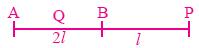
2. An electric field given by () / ˆˆ EyixjNC =+ The work done in moving a 1C charge from ()()
224 ˆˆ AB rijmtorijm =+=+ is
(1) +4 J (2) –4 J (3) +8 J (4) zero
3. The gap between the plates of a parallel–plate capacitor is filled with isotropic dielectric whose relative permittivity K varies linearly from K 1 to K 2 ( K 2>K 1 ) in the direction perpendicular to the plates. The area of each plate equals A, the separation between the plates is equal to d. Then the capacitance of the capacitor will be given by (1) () 21 2 1 ln O KKA dK K −∈
39. (A) : Potential energy of a system of point charges may be zero.
(R) : Potential energy of individual point charges in a system of point charges may be zero.
40. (A) : Force between the plates of an isolated charged capacitor does not depend on distance between the plates.
(R) : Force between the plates can not be calculated using coulomb’s law.
(2) () 21 O KKA d −∈ (3) () 21 2 O KKA d −∈ (4) () 21 2 1 2 ln O KKA dK K −∈
4. Two square plates of side ‘a’ are arranged as shown in the figure. The minimum separation between plates is ‘ d ’ and one of the plate is inclined at small angle ∝ with plane parallel to another plate. The capacitance of capacitor is (given ∝ is very small) a d a
(1) 2 01 2 aa dd ∈α
(3) 2 01 2 aa dd ∈α +
(2) 2 01aa dd
(4) 2 01 4 aa dd
5. Consider the situation shown in figure. The width of each plate is b. The capacitor plates are rigidly clamped in the laboratory and connected to a battery of emf V. All surfaces are frictionless. The value of M for which the dielectric slab will stay in equilibrium is
densities σ, –σ and σ respectively. If VA, VB and V C denote the potentials of the three shell. For c = a + b, we have
(1)
(3) V
7. Find the equivalent capacitance across AB (all capacitances in µF)
6. Three concentric spherical shells have radii a, b and c (a < b < c) and have surface charge
FLASHBACK (Previous NEET Questions)
1. The value of electric potential at a distance of 9 cm from the point charge 4 × 10 –7 C is 92-2 0 1 Given910NmC. 4
(2024–R)
(1) 4 × 10² V (2) 44.4 V (3) 4.4 × 10⁵ V (4) 4 × 10⁴ V
2. When a particle with charge+q is thrown with an initial velocity v towards another stationary charge +Q, it is repelled back after reaching the nearest distance r from +Q. The closest distance that it can reach if it is thrown with initial velocity 2v, is (2022-O)
(1) (r/2) (2) (r/16) (3) (r/8) (4) (r/4)
3. The effective capacitances of two capacitors are 3 µF and 16 µF, when they are connected in series and parallel, respectively. The capacitance of two capacitors are (2022-R)
(1) 10 µF, 6 µF (2) 8 µF, 8 µF (3) 12 µF, 4 µF (4) 1.8 µF, 1.2 µF
(1) 20 3 Fµ (2) 9 F (3) 48 F (4) None
4. Twenty seven drops of same size are charged at 220 V each. They combine to form a bigger drop. Calculate the potential of the bigger drop. (2021)
(1) 1980 V (2) 660 V (3) 1320 V (4) 1520 V
5. A parallel plate capacitor having cross–sectional area A and separation d has air in between the plates. Now, an insulating slab of same area but thickness d/2 is inserted between the plates as shown in the figure, having dielectric constant K(=4). The ratio of new capacitance of its original capacitance will be (2020-II)
:
6. A capacitor is charged by a battery. The battery is removed and another identical uncharged capacitor is connected in parallel. The total electrostatic energy of resulting system(2017)
(1) decreases by a factor of 2
(2) remains the same
(3) increases by a factor of 2
(4) increases by a factor of 4
7. A parallel plate capacitor is to be designed, using a dielectric of dielectric constant 5, so as to have a dielectric strength of 109 Vm-1. If the voltage rating of the capacitor is 12 kV, the minimum area of each plate required to have a capacitance of 80 pF is (2017-R)
(1) 21.7 x 10⁻⁶ m2 (2) 25.0 x 10⁻⁵ m2
(3) 12.5 x 10⁻⁵ m2 (4) 10.5 x 10⁻⁶ m2
8. A parallel-plate capacitor of area A, plate separation d and capacitance C is filled with four dielectric materials having dielectric constants k1, k2, k3 and k4, as shown in the figure. If a single dielectric material is to be used to have the same capacitance C in this capacitor, then its dielectric constant k is given by (2016-II)
CHAPTER TEST
1. ABC is an equilateral triangle of side 2 m. If E = 10 NC–1 then VA – VB is
(1) 1234 kkkk3k =+++
(2) ()1234 2 kkkk2k 3 =+++
(3) 1234 231 kkkkk =+ ++
(4) 1234 11113 kkkk2k =+++
9. A parallel plate air capacitor has capacity C, distance of separation between plates is d, and potential difference V is applied between the plates. Force of attraction between the plates of the parallel plate air capacitor is (2015-R)
(1)
3. Eight charges having the values as shown in fig are arranged symmetrically on a circle of radium 0.1 m in air. Potential at center ‘ O’ will be
(1) 10V (2) – 10V (3) 20V (4) – 20V
2. Electric potential is given by V = 6x – 8xy2 – 8y + 6yz – 4z2, then electric force acting on 2 C point charge placed at origin will be (1) 2 N (2) 6 N (3) 8 N (4) 20 N
(1) 252 × 1010
(2) 252 × 104 V
(3) 252 × 106 V
(4) zero
4. Eight identical point charges each charge q are placed at eight corners of cube of side ‘l’. Then potential at centre of cube is
(1) Zero (2) 0 18 43 q l πε (3) 0 116 23 q l πε (4) 0 116 43 q l πε
5. If the potential at certain distance from a point charge is 600 V and the intensity of electric field is 300 NC–1 The magnitude of the charge in coulomb is ___
(1) 1.33 × 10⁻⁷ (2) 2 × 10⁻⁶
(3) 2 × 10⁻⁷ (4) 33 × 10–6
6. Two electric charges 12 μC and –6 μC are placed 20 cm apart in air. There will be a point P on the line joining these charges and outside the region between them, at which the electric potential is zero. The distance of P from –6 μC charge is
(1) 0.10 m (2) 0.15 m
(3) 0.20 m (4) 0.25 m
7. If the electric potential at a certain distance from a point charge is 900 V and electric intensity is 225 Vm–1. The charge is (1) 4 × 10⁻⁷ C (2) 2 × 10⁻⁷ C
(3) 4 × 10⁻³ C (4) 2 × 10⁻⁵ C
8. Choose the wrong statement
(1) On the perpendicular bisector of electric dipole, intensity of electric field (E) and potential (V) are E = 0,V ≠ 0
(2) Electric lines of force are always perpendicular to equipotential surface
(3) When the proton and an electron moves away from each other then the electrostatic potential energy increases
(4) The dielectric constant of same material will have different values for direct current and alternating current
9.
List–I List–II
(A) Two like charges are brought nearer (P) the force between them decreases
(B) Two unlike charges are brought nearer (Q) potential energy of the system increases
(C) When a third charge of some nature is placed equidistant from two like charges (R) mutual forces are not affected
(D) When a dielectric medium is introduced between two charges (S) potential energy of the system decreases
(A) (B) (C) (D)
(1) IV II III I
(2) II IV II I
(3) IV II I III
(4) III I II IV
10. A proton, a deuteron and an α− particle are accelerated through the same p.d. of V volt. The velocities acquire by them are in the ratio
(1) 1:1:2 (2) 1:2:1
(3) 1 : 1 : 1 (4) 2:1:1
11. An electric dipole of moment p placed in a uniform electric field E has minimum potential energy when the angle between and pE is
(1) zero (2) 2 π
(3) p (4) 3 2 π
12. Given below are two statements. One is labelled as Assertion (A) and the other is labelled as reason (R).
Assertion (A) : When an uncharged conducting plate is brought near a charged conducting plate, the capacity of the system increases as potential decreases.
Reason (R) : Capacity of a conductor depends on its potential.
In the light of the given statements, choose the correct answer from the options given.
(1) Both (A) and (R) are true and (R) is the correct explanation of (A)
(2) Both (A) and (R) are true but (R) is not the correct explanation of (A)
(3) (A) is true but (R) is false
(4) Both (A) and (R) are false
13. A parallel plate capacitor is filled with a dielectric of dielectric constant (relative permittivity) 5 between its plates and is charged to acquire an energy E. Then it is isolated (disconnected from the battery) and the dielectric is replaced by another dielectric of dielectric constant (relative permittivity)
2. The new energy stored in the capacitor is (1) E (2) 2.5 E
(3) 5 E (4) 10 E
14. The force acting upon a charged particle kept between the plates of a charged capacitor is F. If one of the plates is removed then the force acting on the same particle will be (1) F (2) zero (3) 2F (4) F/2
15. Given below are two statements: One is labeled as Assertion A and the other is labeled Reason R.
Assertion (A) : Two metallic spheres are charged to the same potential. One of them is hollow and another is solid, and both have the same radii. Solid sphere
will have lower charge than the hollow one.
Reason (R) : Capacitance of metallic spheres depend on the radii of spheres.
In the light of the above statements choose the correct answer from the options given below.
(1) A is false but R is true.
(2) Both A and R are true and R is the correct explanation of A
(3) A is true but R is false
(4) Both A and R are true but R is not the correct explanation of A
16. What is the area of the plates of a 3 F parallel plate capacitor, if the separation between the plates is 5 mm
(1) 1.694 × 10⁹ m2 (2) 4.529 × 10⁹ m2
(3) 9.281 × 10⁹ m2 (4) 12.981 × 10⁹ m2
17. From the initial point A(1, 2 , 0), to the final point D(3, 2, 0), a charge of 2 C is moved through the points B(2, 2, 0 ) and C (3, 1, 0) along the path ABCD. The electric field in that region is 4 i N/C. The work done by the field is given by (1) 8 J (2) – 8 J (3) 16 J (4) –4 J
18. An electric dipole is along an uniform electric field. For a deflection of 60º, work to be done by an agent is 2 × 10⁻¹⁹ J. Then the extra work to be done by an agent if it is to be deflected by 30º further is
(1) 2.5 × 10⁻¹⁹ J (2) 2 × 10–19 J (3) 4 × 10–19 J (4) 2 × 10–16 J
19. A metal plate of thickness half the separation between the capacitor plates of capacitance C is inserted. The new capacitance is (1) C (2) C/2 (3) zero (4) 2 C
20. The charge on a capacitor is 30 µC. It is connected to another capacitor of half of its capacity in parallel then the charge on the first capacitor is (1) 30 µC (2) 9 µC
(3) 10 µC (4) 20 µC
CHAPTER 2: Electrostatic Potential and Capacitance
21. A 20 F capacitor is charged to 5 V and isolated. It is then connected in parallel with an uncharged 30 F capacitor. The decrease in the energy of the system will be (1) 25 J (2) 100 J (3) 125 J (4) 150 J
22. There are two identical capacitors, the first one is uncharged and filled with a dielectric constant K while the other one is charged to potential V having air between its plates. If two capacitors are joined end to end, the common potential will be
(1) 1 V K (2) 1 KV V + (3) 1 KV K (4) 1 V K +
23. Equivalent capacitance between A and B as shown in the circuit will be 4µ F
25. A dipole is placed in an electric field as shown. In which direction will it move?
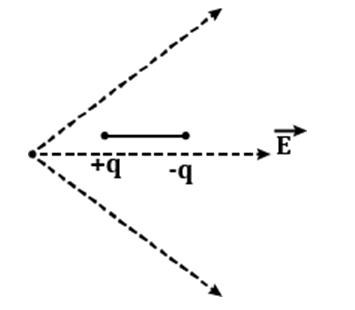
(1) towards the right as its potential energy will increase
(2) towards the left as its potential energy will increase
(3) towards the right as its potential energy will decrease
(4) towards the left as its potential energy will decrease
26. In a hollow conducting charged spherical shell,the potential (V) changes with respect to distance (r) from centre (1)
(1) 1 μF (2) 5 μF (3) 4 μF (4) 3 μF
24. The work done in taking a unit positive charge from C to A is WA and from C to B is WB. Then
(1) WA >
(2) WA < WB
(3) WA = WB
(4) WA + WB=0
27. Plots A and B represents variation of charge with applied P.d. across the combination of two capacitors (series and parallel). The values of capacitance of two capacitors are Q(µC)
(1) 20 μF, 30 μF (2) 40 μF, 10 μF (3) 20 μF, 40 μF (4) 30 μF, 50 μF
28. Surface charge density of a sphere of a radius 20cm is 8.85 × 10⁻⁸ C/m2. The potential at the centre of the sphere is ( ε 0=8.85× 10⁻¹² C2 /N-m2)
(1) 1000 V (2) 2000 V (3) 885 V (4) 442.5 V
29. The variation of electric potential with distance r from a fixed point is as shown in the figure. The electric intensity at r = 1 m, 3 m and 5.5 m are respectively (in V/m) 2 3 4 5.5 (m) V (volt) r 0 4 (1) –2, 1, 8/3 (2) –2, 0, 8/3 (3) 2, 0, –8/3 (4) 8, –1, –4/3
30. Two spheres of radii in the ratio 2 : 3 have charges 2q and 3q. The force between them is F for certain separation. Now they are touched each other and placed at the same separation. The force between them becomes
(1) F (2) 2F (3) 5F (4) 5 3 F
31. A charged sphere is connected to a similar uncharged sphere. Then the percentage loss of energy is (1) 50% (2) 25% (3) 20% (4) 10%
32. The closest distance of approach of an α–particle travelling with a velocity V towards a stationary nucleus is ‘ d ’. For the closest distance to become d/3 towards a stationary nucleus of double the charge, the velocity of projection of the α-particle has to be
(1) 6 V (2) 6V (3) 56 V (4) 4 Q
33. In a certain region of space with volume 0.2 m3, the electric potential is found to be 5V throughout. The magnitude of electric field in this region is:
(1) 0.5 N/C (2) 1 N/C (3) 5 N/C (4) zero
34. The capacity of a condenser is 4 × 10⁻⁶ farad and its potential is 100 volts. The energy released on discharging it fully will be
(1) 0.02 joule (2) 0.04 joule
(3) 0.025 jolue (4) 0.05 jolue
35. Mark the correct statement ( V is electric potential and E is electrostatic field)
(1) If E is zero at a certain point, then V should be zero at that point
(2) If E is not zero at a certain point, then Vshould not be zero at that point
(3) If V is zero at a certain point, then E should be zero at that point
(4) If V is zero at a certain point, then E may or may not be zero
36. In Millikan’s oil drop experiment, an oil drop carrying a charge Q is held stationary by a potential difference of 2400 V between the plates. To keep a drop of half the radius stationary the potential difference had to be made 600 V. What is the charge on the second drop?
(1) 4 Q (2) 2 Q (3) Q (4) 3 2 Q
37. Two charges Q1 C and Q2 C are shown in fig. A third charge Q3 coulomb is moved from point R to S along a circular path with P as centre. Change in potential energy is
38. If radius of a hollow metallic sphere is ‘ R’. If the P.D between it’s surface and a point at a distance 3 R from it’s centre is V then the electric field intensity at a distance 3 R from it’s centre is
(1) 2 V R (2) 3 V R (3) 4 V R (4) 6 V R
39. A solid conducting sphere having a charge ‘Q’ is surrounded by an uncharged concentric conducting hollow spherical shell. Let the P.D between the surface of the solid sphere and that of the outer surface of the hollow shell be V. If the shell is now given a charge of –3Q. The new P.D between the same two surfaces is
(1) V (2) 2 V (3) 4 V (4) –2 V
40. The voltage of clouds is 4 × 10 6 volt with respect to ground. In a lightning strike lasting 100 ms, a charge of 4 coulombs is delivered to the ground. The power of the lightening strike is
(1) 160 MW (2) 80 MW
(3) 20 MW (4) 500 MW
41. Given below are two statements. One is labelled as Assertion (A) and the other is labelled as reason (R).
Assertion (A) : Non–polar material do not have any permanent dipole moment
Reason (R) : When a non polar material is placed in a electric field. The centre of the positive charge distribution of it’s individual atom or molecule coincides with the centre of the negative charge distribution.
In the light of above statements, choose the most appropriate answer from the options given below.
(1) Both (A) and (R) are correct and (R) is the correct explanation of (A).
(2) Both (A) and (R) are correct and (R) is not the correct explanation of (A).
(3) (A) is correct but (R) is not correct.
(4) (A) is not correct but (R) is correct.
42. Given below are two statements. One is labelled as Assertion (A) and the other is labelled as reason (R).
Assertion(A) : A capacitor is connected to an ideal battery. A dielectric slab is slowly inserted into the gap between the plates of capacitor. Work required in the process is positive.
Reason (R) : Force due to capacitor will try to pull dielectric into the capacitor. To slowly insert external force needs to be outward i.e. opposite to displacement.
In the light of above statements, choose the most appropriate answer from the options given below.
(1) Assertion is false but Reason is true.
(2) Both Assertion and Reason are true but Reason is NOT the correct explanation of Assertion
(3) B oth Assertion and Reason are true and Reason is the correct explanation of Assertion.
(4) Assertion is true but Reason is false.
43. When a number of liquid drops each of surface charge density s and energy E combine, a large drop is formed. If the charge density of the large drop is 3 s, its energy is (1) 81 E (2) 3 E (3) 27 E (4) 243 E
44. Two identical metal plates are given positive charges Q1 and Q2(< Q1) respectively. If they are now brought close together to form a parallel plate capacitor with capacitance C,
ANSWER KEY
Brain Teasers
Chapter Test
the potential difference between them is
(1) (Q1 + Q2)/(2C)
(2) (Q1 + Q2)/(C)
(3) (Q1 – Q2)/(C)
(4) (Q1 – Q2)/(2C)
45. An air filled parallel plate capacitor has a capacitance of 10 –12 F. The separation of plates is doubled and wax is inserted between them, which makes capacitance 2 × 10–12 F.
The dielectric constant of wax is (1) 2.0 (2) 3.13 (3) 4.0 (4) 8.0
| CHAPTER 2: Electrostatic Potential and Capacitance 170