NATURE
Valperca or mountain perch Considered a national dish by many Swiss people, 90% of the perch fillets consumed in Switzerland are imported, a situation that the new company Valperca, which farms perch in pure water from the Lötschberg mountain range, is trying to redress. Text Patricia Michaud / Photos Vanina Moreillon
F
ried in butter until golden brown and served appealingly with a fricassee of tomatoes, olives and capers, this method of preparing perch fillets, referred to as « alla Vincentina », is one of the three available all year round on the menu of the Rarnerhof, a restaurant nestled in the Haut-Valais village of Rarogne. The flesh from the large fillets is tender and tasty. « If someone had told me twenty years ago that one day I would be serving local perch in a Valais restaurant, I would have laughed, » chuckles the restaurant’s owner. There isn’t a trace of a lake for miles around, yet around 300 kg of « lake » perch (perca fluviatilis) fillets leave the municipality situated close to the exit of the railway tunnel at the base of the Lötschberg every day. A few hundred metres from the Rarnerhof, close to the former military airfield, two gleaming sheds proudly display the sign « Valperca Premium Eglifilets ». Opened three years ago, this complex is Switzerland’s first closed circuit perch farm. In one of the two buildings, 34 tanks of varying sizes contain fish at different stages of growth. The second shed is given over to filleting and packaging the perch. The fillets are subsequently collected by the refrigerated lorries of wholesalers and supermarkets. Naturally warm water The origins of Valperca date back to 1994, when a biologist from the Percitech perch hatchery in Chavornay (VD) developed a revolutionary technique known as staggered laying, which enables egg production all year round. A first farm was set up on Lake Neuchâtel, but the project had to be abandoned a few years later for technical and political reasons. Another solution soon presented itself to François and Pierre Landolt, the instigators and sponsors of the venture. Since the drilling of the Lötschberg tunnel, spring water has
48
REGARDS PRINTEMPS - ÉTÉ 2013
been drained from the mountain range. The natural temperature of this pure water is 19 degrees. « Perch require water at a temperature of 21 degrees for optimal growth. We jumped at this unique opportunity ! » recalls David Morard, manager of Valperca. Supported by the municipality of Rarogne, which owns this « transparent gold », the company installed a kilometre-long conduit to collect the water from the Lötschberg. This water arrives at the farm site at a constant flow of 160 litres per second, and simply has to be heated slightly and oxygen added before being distributed between the tanks. Every week, 5 gram fry reared at Percitech arrive at the Valais site by lorry. This is the start of a 5-7 month journey which sees the young perch move from one tank to the next until they reach their ideal weight of 135 grams. From the tanks, the fish are transported to the workshop building, where they are filleted then hand-dressed by workers wrapped up warmly from head to foot. « To keep the perch fillets fresh, the room temperature is no more than 6 degrees. They are then put on ice and delivered, » continues David Morard. The appeal of « 100% Swiss » In 2012, 76 tonnes of Valperca fillets landed on the fish counters of the country’s main supermarkets and on restaurant menus. This year, Valperca and Percitech’s 30 employees will produce around 100
« One of the aims of our project is to safeguard Switzerland’s heritage »
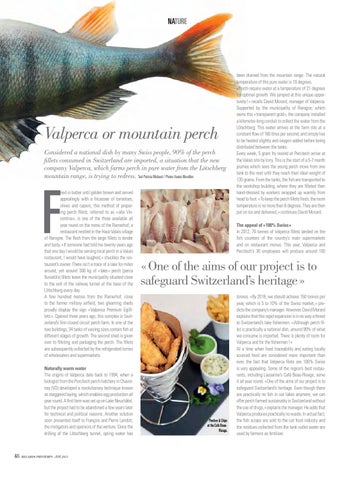
Perches & Chips at the Café BeauRivage.
tonnes. « By 2016, we should achieve 150 tonnes per year, which is 5 to 10% of the Swiss market, » predicts the company’s manager. However, David Morard explains that this rapid expansion is in no way a threat to Switzerland’s lake fishermen. « Although perch fillet is practically a national dish, around 90% of what we consume is imported. There is plenty of room for Valperca and for the fishermen ! » At a time when food traceability and eating locally sourced food are considered more important than ever, the fact that Valperca filets are 100% Swiss is very appealing. Some of the region’s best restaurants, including Lausanne’s Café Beau-Rivage, serve it all year round. « One of the aims of our project is to safeguard Switzerland’s heritage. Even though there are practically no fish in our lakes anymore, we can offer perch farmed sustainably in Switzerland without the use of drugs, » explains the manager. He adds that Valperca produces practically no waste. In actual fact, the fish scraps are sold to the cat food industry and the residues collected from the tank outlet water are used by farmers as fertiliser.