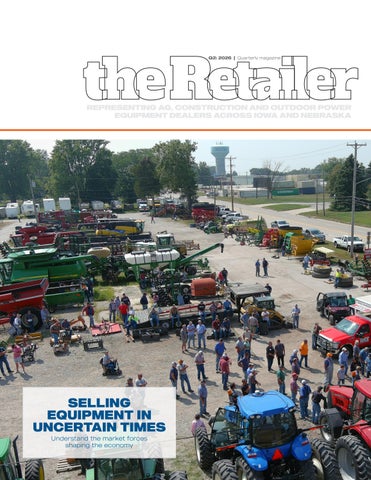
2026 Retailer_Q2

Page 1


REPRESENTING AG, CONSTRUCTION AND OUTDOOR POWER EQUIPMENT DEALERS ACROSS IOWA AND NEBRASKA

RISK MANAGEMENT SOLUTION FOR EQUIPMENT DEALERS

Loading, Unloading, and Transporting Equipment

Ensuring the safety of equipment and people throughout the processes of loading, unloading, and transportation is essential.

When Loading Equipment

Secure cargo: Fasten properly, check load after driving 20-50 miles.

When Unloading Equipment

Inspect equipment: Confirm condition of equipment prior to departing.

This publication is intended to provide general information and recommendations for risk prevention only. The recommendations herein may help reduce the risk of loss but is not a guarantee of the elimination of any risk of loss. This is not provided as a substitute for any regulatory standards that may apply, nor should it be considered legal or other expert advice regarding your unique needs. Qualified counsel should be sought regarding questions specific to your circumstances.

When Loading and Unloading Equipment:

■ Only well-trained employees should load/ unload equipment and avoid customer involvement.

■ Secure the vehicle. Shut off the engine, engage the emergency brake, and chock the wheels.

■ Keep the unloading/loading area clear. Use mechanical aids to assist in unloading/ loading.

■ If manual lifting is necessary, bend at the waist, lift with your legs, and team-lift.

■ Follow all local, state, and federal Department of Transportation (DOT) regulations and guidance on load securement and transportation.

When Transporting Equipment:

■ Practice safe, defensive driving. Avoid any sudden maneuvers if possible.

■ If hauling longer distances, check the load after driving 20-50 miles and resecure if necessary.

Federated is committed to helping clients develop loss prevention strategies, prepare training sessions, and support your organization’s risk management efforts. For assistance or more information, contact the Risk Management Resource Center at 1-888-333-4949.

3

EXECUTIVE INSIGHT

Identify practical steps to navigate the current downturn by understanding the cycle.

6

NEBRASKA LEGISLATURE

Keep up tp date on 2026 Nebraska Legislative Issues of Interest.

INNOVATION AFTER HOURS

Recap on the Iowa Ag Expo’s premier gathering for agricultural innovation.

16

FEATURE TOUGH YEAR TO TURNING POINT

History shows that periods like this often serve as turning points rather than endpoints. Will you be positioned to capitalize when they do?

24

DEALER

LEGACY

From the farm crisis of the 1980s to today’s precision agriculture era, the Helle family has built a dealership legacy rooted in hard work, community, and customer commitment. 11

CAREER EXPLORATION

An event at the Iowa Ag Expo continues to be one of the most effective platforms for dealers to connect with future talent.

OFFICERS:

Kevin Clark Chairman, Lincoln, NE

Dave McCarthy Vice Chairman, Waterloo, NE

Jay Funke Past Chairman, Edgewood, IA

DIRECTORS:

Bruce Bowman Ankeny, IA

Keith Kreps Scottsbluff, NE

Mark Placek Alliance, NE

Paula Radke Alta, IA

Rob Hinton Bancroft, IA

28

MARKETING VIEW

Director of Marketing, Cindy Feldman, walks us through the seven types of posts that consistently engage audiences and help move equipment off the lot.

STAFF:

David Adelman IA Legislative Director

Phil Erdman Dir. of Dealer & Gov’t Rel.

Cindy Feldman Marketing Director

Mark Hennessey President/CEO

Tom Junge Sr. Expo Director

Andy Tank Expo Director

Tim Keigher NE Legislative Director

Cara Jicinsky Administrative Assistant

Jamie Mertz Dir. of Dealer & Gov’t Rel.

Gwen Parks Finance Director

8330 NW 54th Ave. Johnston, IA | 50131-2841 E: info@ineda.com | W: www.ineda.com P: 515.223.5119 | F: 515.223.7832 TF: 800.622.0016.

SUBSCRIPTION INFORMATION:

Individual subscriptions are available without charge to Association members. One-year subscriptions are available to all others for $30.00 (4 issues). Contact INEDA for additional information. This publication is designed to provide accurate and authoritative information in regard to the subject matter covered. It is furnished with the understanding that the Iowa-Nebraska Equipment Dealers Association, the publisher, is not engaged in rendering legal, accounting, or other professional services. Changes in the law may render the information contained in this publication invalid. Legal advice or other expert assistance should be obtained from a competent professional.

Selling Ag Equipment in Uncertain Times

This issue of The Retailer focuses on “Selling Ag Equipment in Uncertain Times” to help our members better understand the market forces shaping today’s equipment economy and identify practical steps to navigate the current downturn.

The agricultural equipment industry has always been cyclical, but the current environment presents a different set of challenges. For equipment dealers, the next several years will not simply be about waiting for the market to rebound. Instead, it will require disciplined management, strategic decision-making, and the ability to adapt to structural changes in global agriculture.

Many industry observers believe the downturn could extend well beyond 2026. While agriculture has experienced difficult cycles before, today’s market dynamics differ from the past.

A Structural Shift in Global Production

In the early 1990s, the U.S. dominated global crop production. In 1993, U.S. soybean production totaled nearly 78 million tons, compared to 23 million tons in Brazil. Today, Brazil’s ability to produce two crops per year has dramatically shifted that balance. By 2025, Brazil produced roughly 180 million tons of soybeans, compared to 118 million tons in the United States

A similar shift has occurred with corn. In 1994, the U.S. produced 269 million tons of corn, while Brazil, China, and Argentina combined produced 160 million tons—over 100 million tons less than the U.S. By 2025, the U.S. produced a record 437 million tons, yet China, Brazil, and Argentina together produced nearly 500 million tons, surpassing U.S. output.

executive insight

These changes reflect a fundamental shift in global supply. As more production comes online around the world, commodity prices are likely to remain under pressure. At the same time, OEMs have expanded aggressively into these international markets, further increasing equipment supply and competition.

Inventory Discipline Will Define Winners

In this environment, inventory management will separate strong dealerships from struggling ones. As the market softened, managing the balance between new and used equipment has become increasingly difficult. Used equipment values remain under pressure, forcing dealers to carefully evaluate trade-ins, pricing strategies, and wholesale decisions. Dealers who manage inventory strategically—rather than reactively—will be best positioned to weather the downturn.

Balance Sheet Strength Matters

Inventory pressures are also affecting dealership balance sheets. In many cases, used equipment book values no longer align with current market prices. This mismatch places additional stress on financial performance and makes cash flow management more critical than ever

Leadership and Alignment

Strong leadership and alignment among ownership, boards, and management teams will be critical in the years ahead. Decisions related to inventory levels, capital investment, staffing, and strategy carry greater consequences during uncertain markets. Dealerships that maintain disciplined strategies, clear communication, and strong internal trust will be better positioned to navigate volatility.

executive insight

Valuation and Ownership Pressure

Weaker market conditions are also affecting dealership valuations. After several years of strong equipment demand and consolidation-driven growth, valuations are now facing downward pressure. For owners or partners considering succession or divestiture, timing has become more complex. Market conditions may not reflect the long-term value of the business, yet waiting for the next upcycle may not always be feasible.

Market Share Expectations Under Strain

OEM market share targets are also becoming more difficult to achieve. Many OEMs set aggressive wholegood market share goals during strong market conditions. As total equipment demand declines, those expectations become increasingly challenging for dealers to meet. This environment is forcing a shift in mindset—from chasing volume to prioritizing profitability, operational discipline, and financial strength

Adapting to the Next Cycle

Despite the challenges, periods of uncertainty also create opportunities. The traditional playbooks that guided previous cycles may no longer be sufficient. Changes in technology, customer expectations, and global competition are reshaping how equipment is sold and supported. We have seen dealers who have strengthened customer relationships, improved inventory analytics, and expanded service become better positioned for success —even during this downturn.

Looking Ahead

The agricultural equipment industry has always demonstrated resilience. Farmers will continue to need reliable equipment to plant, grow, and harvest crops, and eventually the replacement cycle will return. Selling ag equipment in uncertain times requires discipline, adaptability, and strong leadership. Dealers who protect their balance sheets, manage inventory carefully, and stay focused on long-term strategy will be best positioned to succeed when the market turns again. 

Register Today

Legislative Meeting & Golf Outing

This is an incredible opportunity to connect with dealers, hear the latest legislative developments in your state, and have fun golfing all in the same day! Members are able to attend just the meeting and are not required to participate in the golf outing.

NEBRASKA

June 16 | York Country Club – York

IOWA

June 18 | Copper Creek Golf Club – Pleasant Hill

Global to see the big picture.

Local to understand it.

Providing clarity. Building confidence.

GOVERNMENT AFFAIRS

“Inconceivable” An update from the front seat at the Nebraska Legislature

In the movie, The Princess Bride, Vizzini, a selfproclaimed genius, shouts “Inconceivable!” every time his kidnapping plan goes wrong, or someone outsmarts him. The word becomes his catchphrase for this “shouldn’t be happening to me”.

During one of Vizzini outbursts of “Inconceivable!”, his traveling companion, Inigo, responds: “You keep using that word. I do not think it means what you think it means.”

While it is an integral part of the humor of the film, I believe it also reminds us of a subtle philosophical point - something that is seen in politics and policy.

Engaging in and setting public policy for a state

or nation requires input and perspective that is beyond any one person’s understanding. Every time INEDA members interact with and inform policy makers who can impact your business with their decisions, you make them more effective if they are willing to listen by expanding their understanding. While there are always going to be people like Vizzini, they are few and far between in those we interact with. Regardless, your voice is essential when decisions are being made that affect your business

I am grateful for the many voices of dealers who are willing to speak up with their elected officials.

Director

Agriculture Sherry

State Senator Mike Jacobson visits with Ron Regier and Natalie Gunter (Regier Equipment).
State Senator Dan Lonowski and Don Partridge (Bobcat of Omaha).
of
Vinton visits with Murray Fletcher (Bobcat of Omaha)

Nebraska Legislative Breakfast

The Nebraska Legislative Breakfast was held on Thursday, January 15, 2026, at the Cornhusker Hotel in Lincoln, Nebraska. All State Senators were invited to attend and visit with members. 24 State Senators and the Nebraska Director of Agriculture registered to join more than two dozen members for this important event.

Connecting with state leaders and hearing the latest in legislative developments in Nebraska is a valuable opportunity for members. Because of our work to build relationships with State Senators and other state leaders, our efforts to affect public policy in Lincoln are more effective.

2026 Nebraska Legislative Issues of Interest:

The 2026 Nebraska Legislative session is underway. With the help of our advocacy partner at Keigher and Associates, we are in regular conversation with State Senators, the Governor’s office, and other Nebraskans in our efforts to protect and promote your interests.

Here are just a few of those issues:

• Protection of Ag Data. Since the introduction of LB 525 in 2025, INEDA members and staff worked with manufacturers and ag groups to narrow the focus of the bill to prohibit sale of production data from farmers and ranchers unless they agree to the sale and participate in the transaction. While our efforts were able to bring numerous ag groups together, we could not get all our concerns addressed so we testified in a neutral position. Even though the bill as written does not disrupt the agreements customers have

in place with dealers or manufacturers, we think the bill could be more clearly written and will continue to work collaboratively to achieve that end where possible.

• Surplus Parts Legislation INEDA requested the introduction of LB 875 to restore statutory protection for dealers in Nebraska to for annual surplus parts returns. Members submitted written testimony in support and INEDA staff testified in person at the hearing. It was advanced by the Banking, Commerce, and Insurance Committee on February 17 unanimously. LB 875 has been included in a committee priority bill (LB 838) which is working its way through the Legislative without opposition.

• Sales Taxes on Machinery and Parts. LB 1244 would reinstate sales tax on net wrap, twine, and baling wire among other things. LB 1257 would reinstate a sales tax on nearly everything in Nebraska including ag machinery and parts. INEDA staff testified against both bills. The Revenue Committee did not advance either bill. These types of bills will continue to be introduced by Governor Pillen and some in the Legislature as they seek to shift tax burden in Nebraska.

For a complete list of legislative bills we are following in Nebraska, please check out the weekly Legislative Updates emailed each Monday to members in Nebraska by Keigher and Associates. (If you are not receiving those emails, please contact Phil Erdman.) 

This is an incredible opportunity to connect with dealers, hear the latest legislative developments in your state, and have fun golfing all in the same day! Members are able to attend just the meeting and are not required to participate in the golf outing.

Join us for an engaging and informative day designed for equipment dealers and their teams. INEDA Regional Meetings offer a valuable opportunity to connect with peers, share insights, and discuss the key issues impacting our industry today.

This year’s program features experienced industry and leadership experts who will deliver practical insights you can apply immediately—from developing stronger leaders within your organization to managing risk in today’s evolving business environment.

The day will begin at 8:30 a.m. (local time) with coffee and rolls, followed by a full agenda of education and networking. Lunch will be provided at no cost to members. We anticipate adjourning at approximately 3:00 p.m. Advance registration is required.

GOVERNMENT AFFAIRS

2026 Iowa Legislative Update

Legislative activity affecting equipment dealers accelerated quickly during the 2026 Iowa legislative session, with Right to Repair legislation emerging as one of the most significant issues facing the industry. What began as an unexpected bill introduction during the Iowa Ag Expo quickly developed into two separate proposals that could have far-reaching impacts on equipment dealers, manufacturers, farmers, and independent repair shops. INEDA has been actively engaged at the Capitol, working alongside industry partners and member dealers to communicate the potential consequences of these proposals and advocate for practical solutions that protect both farmers and the equipment industry.

Right to Repair legislation is gaining momentum across the country, but many of these proposals overlook the technical, safety, and regulatory realities surrounding modern agricultural equipment.
— Jamie Mertz,

Director of Dealer and Government Relations, Iowa

Legislative Snapshot

• HF2529 – DEF Right to Repair (died in Senate Commerce Committee during funnel, end of session chance to get amended on to another bill, such as Appropriations, etc.)

• HF2709 – Ag Equipment Right to Repair (Assigned to House Ways & Means Committee, subcommittee meeting 4/1/2026)

• INEDA Position – Opposed

• Key Concern – Federal emissions laws still prohibit deleting emissions systems

• Next Step – Continued advocacy with Iowa Senators and lawmakers

This year has been especially active at the Capitol. On the final day of the Iowa Ag Expo, February 5, the Chair of the House Agriculture Committee introduced DEF Right to Repair legislation. Prior conversations with Republican Representatives and Senators had indicated strong opposition to Right to Repair proposals, with many stating they would not support bringing this type of legislation forward. Similar legislation has been introduced by Democrats in previous years. A week later, the Agriculture Committee Chair introduced a second bill addressing Right to Repair for all agricultural equipment.

HF 2529 – DEF Right to Repair Bill. This bill addresses emissions components on agricultural equipment and would require manufacturers to provide emissions-related parts at cost to farmers and independent repair shops, as well as provide diagnostic tools and information at no charge or dealer cost. The legislation focuses specifically on emissions systems used in agricultural equipment.

During the first week of the DEF Right to Repair bill, both the John Deere lobbyist and INEDA worked together to meet with members of the House Agriculture Committee to discuss the potential negative impacts the bill could have on dealers, manufacturers, and farmers. Together, we were able to speak with 20 of the committee’s 23 members. Both organizations testified in the Agriculture Subcommittee meeting, which occurred about an hour and a half before the full Agriculture Committee meeting.

The bill advanced through the subcommittee and moved to the full Agriculture Committee for consideration. The committee ultimately voted 12–11 to advance the bill. During the meeting and in public comments, the Agriculture Committee Chair stated that the intent of the bill was to allow farmers the ability to remove emissions controls from their equipment if they choose to do so.

The bill was later debated on the House floor on March 1, 2026, where it passed by a vote of 57–33, with 10 representatives not voting. Ten Republicans voted against the bill, while three Democrats crossed the aisle to support it. If enacted, the bill could face significant legal challenges because federal law still prohibits the removal of emissions systems from equipment. As a result, farmers, independent repair shops, and dealers could still face potential federal fines if emissions systems are removed. The bill was not heard by the Senate Commerce Committee during funnel, in essence killing this bill for session. However, there is a late session option the House can use to try and get this bill through by amending it to another bill the last week of session. INEDA continues to monitor this bill for a last week move.

HF 2709 – Agricultural Equipment Right to Repair Bill. This proposal covers all agricultural equipment and would require manufacturers

What Dealers Should Know

1.

Two Right to Repair bills are moving in Iowa this session, both affecting how equipment diagnostics, parts, and emissions systems could be accessed and used.

2.

HF2529 focuses on emissions systems, allowing broader access to emissionsrelated parts and diagnostics. The bill passed the House and now awaits action in the Senate.

3.

HF2709 addresses broader equipment diagnostics, requiring manufacturers to provide diagnostic software to farmers and independent repair shops at no charge.

4.

Federal law still prohibits removing emissions systems, meaning conflicts between state and federal regulations could expose farmers, repair shops, and dealers to potential liability.

5.

INEDA continues to advocate on behalf of dealers, working with lawmakers, manufacturers, and industry partners to ensure practical solutions that protect farmers while maintaining equipment safety and compliance.

to provide diagnostic software to farmers and independent repair shops at no charge. The original version of the bill also required manufacturers to provide tools and parts at no cost or at the same price paid by dealers, but that language was later removed through an amendment.

This bill followed a similar legislative path. The subcommittee meeting was held on a Wednesday, where INEDA testified in opposition. The following morning, the full Agriculture Committee considered the bill and advanced it by a vote of 18–5. The removal of the pricing language shortly before the committee meeting shifted several votes and widened the margin of support for advancing the bill. The bill was moved to the House Ways & Means committee a day before funnel ended to keep it alive for the remainder of session. It is scheduled for a subcommittee to be held on 4/1/2026. INEDA along with a few members testified in opposition to this bill.

Dealer engagement has also been strong this session. A Dealer Day at the Capitol was held on February 24, with approximately 30 dealers participating in meetings with Representatives and Senators. That afternoon, John Deere demonstrated its Pro Service tool to lawmakers, showing the level of diagnostic access already available to farmers and independent repair shops.

In addition, a joint letter organized by INEDA, the Association of Equipment Dealers (AED),

and major manufacturers—including John Deere, CNH, and AGCO—was sent to Iowa media outlets and all Iowa legislators on February 27, 2026, outlining industry concerns with both bills. Organizations registered in opposition to the legislation include INEDA, John Deere, the Association of Equipment Manufacturers (AEM), and the Iowa Association of Business and Industry (ABI). Organizations registered in support include the Iowa Cattlemen’s Association, Iowa Pork Producers Association, Iowa Soybean Association, Iowa Corn Growers Association, the Iowa Farmers Union, and the Repair Association.

INEDA’s goal is to defeat these bills either in the House or Senate and continue working toward solutions that protect farmers while preserving the safety, compliance, and service infrastructure that dealers and manufacturers provide. Right to Repair legislation is not limited to Iowa; similar proposals are being introduced across the country. Federal policy discussions surrounding emissions regulations have also contributed to growing momentum for these efforts at the state level. Ultimately, meaningful changes to emissions standards and equipment regulation will require action at the federal level, not a patchwork of state laws. INEDA will continue working with lawmakers, industry partners, and dealers to ensure the voice of equipment dealers remains part of that conversation. 

AROUND IOWA

2026 Iowa Ag Expo Innovation After Hours Event: A Record Setting Celebration of Ag Innovation

On Tuesday, February 3, 2026, we proudly hosted our third annual Innovation After Hours Event, an evening designed to spotlight breakthrough ideas shaping the future of agriculture. This signature program gives emerging agtech startups the unique opportunity to showcase their innovations to a room full of investors, dealers, industry leaders, and peers as they compete for a $10,000 firstplace prize and a $1,000 secondplace award.

A distinguished panel of judges—Myron Stine (Stine Seed), Billi Hunt (America’s Cultivation Corridor), and Matthias Muller (Corteva Catalyst Sr Director)—selected this year’s top performer.

Six standout companies took the stage, each delivering compelling pitches that highlighted bold thinking and practical solutions:

• Scanit (CA) – Introducing the SporeCam™, an autonomous device that uses AI to detect airborne fungal pathogens and help protect crop health.

• AgriBrink (IA) – Showcasing CTIS technology that reduces soil compaction, boosts fuel efficiency by 15%, and extends tire life by 20%.

• Cross Plains Solutions (WI) – Presenting the first GreenScreen Certified Gold™ soybased firefighting foam, backed by U.S. soybean farmers and the United Soybean Board.

• Aerterra (FL) – Offering renewable, cornbased HVAC filters built to cut waste and reliance on fossilplastic materials.

• Agrinet/Renner Ag Solutions (IA) – Debuting an automated binunloading system that removes the need for farmers to enter grain bins during cleanout.

• Terraform Tillage (IA) – Unveiling software that measures and maps soil compaction to support smarter field management.

This year’s top honor went to Cross Plains Solutions, led by CEO Dave Garlie, whose innovative soybased firefighting foam captured both attention and enthusiasm. The crowd also made its voice heard, voting Renner Ag Solutions, represented by CEO Caleb Renner, as the winner of our People’s Choice Award.

With 128 attendees, this year’s event achieved our highest turnout yet, reinforcing its growing reputation

AROUND IOWA

Iowa Ag Expo Recap

Sold-out show floor, rising attendance, and a growing Innovation Hub highlight another successful year for the Midwest’s premier indoor farm show.

Strong attendance, a sold-out show floor, and a growing lineup of ag innovation once again defined the 2026 Iowa Ag Expo. Held February 3–5 in Des Moines, the Expo brought together farmers, equipment dealers, manufacturers, and ag innovators from across the Midwest to explore the latest technologies, products, and market insights shaping agriculture today.

The 2026 Iowa Ag Expo once again sold out its exhibit space, featuring 535 exhibiting companies representing 684 brands. Of those exhibitors, 119 were brand-new to the Iowa Ag Expo, and a strong waiting list of companies continues to seek participation each year.

Attendance reached 19,356, up from 17,043 in 2025. Many exhibitors noted particularly strong attendance during the first two days of the show, especially Wednesday. Attendee demographics were also well balanced: 33% of attendees were under age 40, 36% were between ages 40–60, and 31% were over age 60.

The Expo continues to draw attendees from across the Midwest, with approximately 10% traveling from neighboring states including Minnesota, Missouri, Illinois, Nebraska, and Wisconsin.

A highlight of the Expo continues to be the Innovation Hub. In its third year, 47 companies participated in the Hub, with 30 of those companies new to the Iowa Ag Expo. Featured technologies included the Salin 247 autonomous toolbar; Iowa Mowbotics (Segway, Sunseeker, and Yarbo robotic mowing equipment); nine drone brands; and several imaging and data software companies. Visitors were also able to see eight different copter drones demonstrated in one location.

The Expo continues to deliver for us year over year.
As our company grows, it’s great to see both existing customers and new ones attending.
— Shane Williams, TerraClear

The Innovation Hub and the Innovation After Hours event provide ag start-ups with opportunities to network with fellow innovators, venture capitalists, equipment dealers, and farmers interested in testing emerging technologies.

Additional innovations featured at the Expo included Cross Plains Solutions’ soy-based firefighting foam, Aerterra’s corn-based HVAC air filters, AgriBrink’s on-the-go tire pressure adjustment system, and advanced airborne pathogen detection technologies from Scanit Technology and InnerPlant.

This year’s Ag Expo Talks program focused on the agricultural economy and market outlooks. Sessions included discussions on commodity markets, $4 corn scenarios, grain marketing strategies, succession planning, and long-range weather outlooks.

These comments reflect the long-standing mission of the Iowa Ag Expo: introducing new products, technologies, and ideas to farmers and equipment dealers. While some farm shows have struggled to fill exhibit space since the pandemic, the Iowa Ag Expo remains strong after more than 115 years. Exhibitors continue to bring new technologies, innovations, and equipment to the show floor each year.

As the industry continues to evolve, the Iowa Ag Expo remains a central meeting place where innovation, business relationships, and practical solutions come together. The Expo is hosted by the Iowa-Nebraska Equipment Dealers Association (INEDA). The 2027 Iowa Ag Expo will be held February 2–4 in Des Moines, with the Nebraska Ag Expo scheduled for December 8–10, 2026. 

By the Numbers 2026 Iowa Ag Expo

19,356 attendees

535 exhibiting companies

684 brands represented

119 new exhibitors

47 companies in the innovation hub

30 innovation hub companies new to the expo

9 drone brands showcased

8 copter drones demonstrated

10% of attendees from surrounding states

115+ years of expo history

Top Highlights from the Show Floor

Innovation Hub Expansion – The third edition of the Innovation Hub featured 47 companies, including 30 new to the Iowa Ag Expo, showcasing cutting-edge ag technology and start-up innovation.

Drone Technology on Display – Visitors could compare nine drone brands and see eight copter drones demonstrated in one location—one of the largest drone groupings at a Midwest farm show.

Autonomous & Smart Equipment – From the Salin 247 autonomous toolbar to robotic mowing solutions from Iowa Mowbotics (Segway, Sunseeker, and Yarbo), the show floor highlighted how automation is rapidly entering agriculture.

The Iowa Nebraska Equipment Dealers Association (INEDA) and its members and staff participated in our annual Washington D.C. on March 24-26.

The Washington D.C. Fly-In plays a critical role in the success of INEDA’s legislative agenda and gives INEDA members the opportunity to discuss important topics with their elected representatives and industry officials.

During the Fly-In, members and staff met with Congressmen Mike Flood, Don Bacon, Adrian Smith and US Senators Deb Fischer and staff of Pete Ricketts from Nebraska as well as Representatives Mariannette MillerMeeks, Zach Nunn, Randy Feenstra and US Senators Charles “Chuck” Grassley and Joni Ernst from Iowa. Members also met with Representatives Hariett Hageman of Wyoming, Tracey Mann of Kansas; and staff from Lauren Boebert of Colorado. Members also met with Senior Staff from USDA. INEDA partnered with Associated Equipment Dealers (AED) for the Fly-In.

The goal of the fly-in is to find common sense, resultsoriented solutions to equipment dealer industry issues.

If you are interested in attending the 2027 Washington DC Fly-In, please contact us!

Participants representing Iowa were (L to R): Jamie Mertz, INEDA; Misty Wells, Titan Machinery; Mark Hennessey, INEDA; and Paul Davis, Davis Equipment.

Participants representing Nebraska were (L to R): Elliot Grosshans, Grosshans, Inc.; Dave McCarthy, Titan Machinery; Garon Borkowski, AKRS Equipment; Mat Habrock, AKRS Equipment; and Russ Ball, 21st Century Equipment. (Not pictured Phil Erdman, INEDA)

INEDA members raised five issues during the fly-in:

STRENGTHEN AG & RURAL COMMUNITIES

Pass a comprehensive farm bill and invest in rural infrastructure, biofuels, crop research, and precision technologies to sustain U.S. agriculture and rural economies.

PROMOTE INTERNATIONAL TRADE

The U.S. should advance free and fair trade by reducing harmful tariffs, maintaining key agreements like the USMCA, and improving transparency in tariff exclusion processes

ATTRACT SKILLED, TECHNICAL WORKERS

Expand funding and incentives for technical education, apprenticeships, and skills training to address critical workforce shortages in technical trades.

INVEST IN AMERICA’S INFRASTRUCTURE

Pass a long-term highway reauthorization and infrastructure funding plan that ensures stable financing, accelerates permitting, and supports transportation and broadband systems.

OPPOSE BROAD RIGHT TO REPAIR LAWS

Overly broad right-to-repair policies risk equipment safety, reliability, and compliance, placing unfair liability on dealers and undermining industry standards. 

Congressman Flood (NE) with INEDA Members

From Tough Year to Turning Point

How Equipment Dealership Financial Performance Can Thrive in the Next Ag Cycle

For much of the equipment industry, the past two years have felt like a test of endurance. Margin compression, elevated inventories, shifting tax policy, volatile tariffs, and uncertain producer sentiment have pushed many dealership leadership teams into defensive positions. Cost controls tightened. Capital spending slowed. Forecast horizons shortened.

Yet history shows that periods like this often serve as turning points rather than endpoints. Agricultural cycles rarely reverse overnight, but the early stages of the next cycle are already forming — quietly and unevenly.

The question facing dealership leaders is no longer whether conditions will eventually improve. The real question is which dealerships will be positioned to capitalize when they do.

The Cycle Begins With the Producer

Every equipment dealership forecast ultimately begins with the producer. Dealer demand does not originate in the showroom or service bay — it originates in farm profitability, liquidity, and confidence.

Recent USDA data reflects a complicated environment for producers. Record production levels in major crops such as corn and soybeans have boosted supply, but they have not necessarily strengthened farm balance sheets. High input costs, interest expense, and softer commodity prices continue to pressure working capital.

Regional Federal Reserve reports indicate that some producers have begun selling mid to longterm assets to shore up liquidity and manage debt.

• Dealerships typically see several predictable shifts during these periods:

• Equipment trade cycles lengthen

• Cashtotrade becomes constrained

• Latemodel used equipment supply increases

• Service and parts demand often outperforms whole goods

Recognizing these signals early allows dealers to recalibrate inventory, staffing, and capital strategies before financial pressure intensifies.

Stress Testing Before Forecasting

One of the most common mistakes dealerships make during downturns is projecting forward without fully analyzing the most recent year.

Yearend financial statements should not simply be finalized and archived. Instead, they should be stress tested through multiple scenarios to understand how sensitive earnings, cash flow, and equity truly are.

Key questions to evaluate include:

• How much margin compression can the dealership absorb before fixed costs become unsustainable?

• What happens to cash flow if new equipment turns slow by 15–20 percent?

• How reliant were recent results on one-time tax benefits or timing differences?

• How quickly could inventor y be converted to cash under stressed conditions?

These questions are particularly important as OEM forecasts suggest another potential decline in industry unit volumes following the contraction already experienced in recent years.

MARC JOHNSON CPA, CGMA

Dealerships that stress test their financial statements gain clarity about where their true vulnerabilities lie — and where they still have strategic flexibility.

Tax Policy Brings Rare Planning Certainty

While many aspects of the current environment remain uncertain, tax policy has become one of the few areas offering meaningful stability.

Several provisions affecting dealerships and their owners have been made permanent or extended long enough to support multi-year planning. These include:

• The 20 percent qualified business income (QBI) deduction under Section 199A

• The return of 100 percent bonus depreciation for qualifying purchases

• Increased Section 179 expensing limits

• The restoration of deductibility for research and development expenses

• A return to EBITDA-based business interest limitations under Section 163(j)

At the individual level, tax rates remain stable and estate and gift exemptions have increased significantly.

For dealership ownership groups and boards, this level of tax certainty is unusual. It allows for longer-term decisions around capital investment, ownership transition, and succession planning without the constant uncertainty of pending tax law changes.

The strategic question shifts from “What will Congress do next?” to “How should we deploy capital most effectively?”

Tariffs: The Variable Dealers Can’t Control

If tax policy represents stability, tariffs represent the opposite.

Multiple layers of tariffs currently affect equipment pricing, particularly those tied to steel, aluminum, and imported components. These tariffs can influence OEM pricing decisions and ultimately filter down to dealership margins and customer pricing.

Dealership leaders rarely control tariff outcomes directly, but they still face important strategic decisions:

• Whether tariff impacts should be transparently itemized in pricing

• How trade-in policies adjust as new equipment prices rise

• When to lock pricing versus maintain flexibility

• How much margin volatility the dealership can absorb

The most disciplined dealers are resisting reactive decisions. Instead, they are modeling tariff scenarios into financial forecasts while waiting for pricing signals to stabilize.

Interest Rates: Stabilizing But Still Elevated

Interest rates have moderated from their recent peaks, but they remain a meaningful factor in dealership financial planning.

After several rate cuts in late 2025, the Federal Reserve paused further adjustments in early 2026 while monitoring inflation and economic conditions. Policymakers have emphasized a cautious, meeting-by-meeting approach rather than committing to a rapid rate reduction cycle.

For dealerships, this environment carries several implications:

• Floorplan and operating credit costs remain elevated

• Variable-rate debt continues to present risk

• Interest expense must remain a central component of cash-flow forecasting

In short, interest rates are no longer the emergency they once were — but they are not yet a financial tailwind.

Government Support: Helpful but Temporary Government payments are currently providing some short-term support to producer income.

Programs such as the Farmer Bridge Assistance initiative have delivered billions of dollars in payments intended to stabilize farm balance sheets during a difficult period. Additional farm program funding is expected to flow through federal legislation in the coming years.

While these programs can support near-term service demand and selective equipment purchases, they should not be mistaken for structural improvements in farm profitability. Financial institutions appear to recognize this distinction. Many agricultural lenders have accelerated loan renewals and tightened underwriting expectations, reflecting continued caution despite government support.

For dealerships, the key takeaway is clear: government programs may bridge the cycle, but they will not define it.

Inventory and Cash Flow Will Define the Next Cycle

As the industry moves toward its next phase, inventory management and cash flow discipline will likely separate the strongest dealerships from the rest.

Success will depend less on total inventory levels and more on inventory quality and liquidity.

Dealerships that perform well in the next cycle will likely:

• Maintain realistic expectations for used equipment demand

• Align inventory age with true market absorption rates

• Prioritize cash flow over reported earnings

• Protect equity rather than pursue aggressive top-line growth

These decisions also affect dealership valuation. In uncertain environments, buyers and lenders place greater emphasis on earnings quality and cash conversion, discounting results driven by timing differences or one-time benefits.

Clean, repeatable earnings supported by strong cash flow remain the foundation of long-term dealership value.

Turning Insight Into Strategy

Economic volatility is nothing new in agriculture. What is different today is the volume of available data — and the discipline required to interpret it effectively.

Dealerships that thrive in the next agricultural cycle will intentionally integrate several perspectives into their planning:

• Producer-level economics in forecasting models

• Stress-tested financial statements in strategic decisions

• Tax policy certainty into capital planning

• Conservative assumptions in inventory and cash-flow management

The next agricultural cycle will not simply return the industry to past conditions. Instead, it represents a recalibration of demand, capital, and operational discipline.

For dealerships that prepare intentionally, this period offers more than survival. It offers the opportunity to emerge stronger, more efficient, and better positioned for the next phase of growth. 

About the Author

Marc Johnson, CPA, CGMA, is a principal and market champion for Distribution and Equipment Dealerships at Pinion. He advises dealership owners and boards on financial performance, forecasting, and long-term strategy.

Navigating Margin Pressure and Market Share in a Down Economy

Over the past decade, equipment dealerships have demonstrated remarkable resilience as the industry has evolved through periods of volatility and change. Rapid price increases, higher production expectations from manufacturers, shifting used equipment values, and ongoing technician shortages have become part of the modern dealership landscape. At the same time, consolidation among retailers and a smaller customer base—combined with broader economic pressures—have reshaped competition and profitability across the sector. Yet through these challenges, dealers continue to adapt their strategies, strengthen operations, and find new ways to serve customers and maintain sustainable businesses.

Margins First: A Shift in Dealer Mindset

As farmers grow more selective with their purchasing decisions, dealerships are rethinking what constitutes a “good deal.” The message echoed across the industry is clear: too many low margin deals were accepted in previous years in pursuit of OEM market share targets, sales goals, and the financial consequences now linger. Dealers report a stronger commitment to protecting margins— walking away from deals that don’t meet profitability thresholds, even if it means surrendering volume to competitors.

Strengthening Customer Relationships

Dealers are also doubling down on customer engagement. Building deeper relationships, offering value added support, and serving as trusted partners in farmers’ operations have become central strategies. With fewer customers

in the market and heightened competition for their business, relationship driven growth is more important than ever.

Market Share vs. Margin: A Long-Standing Conflict Reaches a Breaking Point

As a result, more dealers are thoughtfully reassessing how they balance market share expectations with their own financial sustainability. Rather than stocking units solely to meet OEM targets or qualify for volume incentives, many are choosing inventory levels that better align with local demand and overall business health. In today’s tighter economic environment, careful stewardship of wholegoods investment has become essential. This shift is also prompting more open dialogue between dealers and manufacturers, reinforcing the idea that long-term success depends on a shared understanding of each partner’s needs and constraints. Ultimately, both sides benefit when strategies support stable, profitable operations for the entire channel.

Dealers

today are becoming more disciplined—protecting margins, managing inventory carefully, and focusing on the parts, service, and relationships that carry dealerships through economic cycles.

Protecting margin today protects the dealership tomorrow. “ ”

Used Inventory: A Persistent Challenge

Despite progress over the last two years, used inventory remains a pain point. Many multistore groups still hold more equipment than the market is willing to absorb, and much of it remains overvalued relative to today’s softer demand. Auctions have become a necessary tool for getting rid of aging assets, but that comes with steep losses when equipment is still carried too high on the books. Auctions help with cash flow and overhead, but this is not a sustainable long-term strategy.

Short Lines Provide a Bright Spot

While many segments are cooling, shortline equipment continues to outperform. Dealers consistently report stronger margins and steady sales from these lines, offering a vital buffer against declining revenue from major OEM products. In the current downturn, shortline partners are providing both stability and opportunity.

The Rising Importance of Absorption

With market conditions tightening, absorption has become a key survival metric. Dealers are zeroing in on shop efficiency and technician productivity to keep service departments profitable and resilient. This renewed focus reflects a broader push to strengthen the parts and service operations that historically help dealerships weather economic cycles.

Rental Fleet

Dealers with established rental fleets are taking a closer look at how effectively those fleets are being managed. This includes evaluating which units should be stocked based on local demand patterns, how frequently equipment is being cycled through to maintain both reliability and resale value, and whether current marketing efforts are reaching the right customers. Many are analyzing utilization rates, service costs, and rental pricing structures with greater precision to

ensure the rental line contributes meaningfully to profitability.

At the same time, dealers that have never offered rentals before are now seriously exploring the opportunity. With wholegoods sales softening and traditional revenue streams tightening, launching a rental fleet is increasingly viewed as a practical way to diversify income, attract new customers, and fill gaps during economic downturns. For both established and new operators, rentals are becoming a strategic lever to create stability when the market becomes less predictable.

Taken together, these observations from the field highlight an industry that is recalibrating rather than retreating. Dealers are becoming more disciplined in protecting margins, more strategic in managing inventory, and more focused on strengthening the service, parts, and rental operations that provide stability during uncertain cycles. Shortline equipment, deeper customer relationships, and thoughtful inventory management are helping dealerships navigate today’s environment while positioning themselves for future growth. As market conditions continue to evolve, the dealers who remain adaptable, data-driven, and customerfocused will be best positioned to emerge stronger when the next upswing arrives. 

Taking Control: DOL’s Latest Move on Worker Classification

On February 27, 2026, the U.S. Department of Labor (DOL) issued a Notice of Proposed Rulemaking (NPRM) addressing whether a worker is properly classified as an employee or an independent contractor under the Fair Labor Standards Act (FLSA), the Family and Medical Leave Act (FMLA), and the Migrant and Seasonal Agricultural Worker Protection Act (MSPA). The DOL proposes rescinding its 2024 Rule and replacing it with a slightly revised version of the “economic realities” analysis adopted by the agency in 2021.

KEY FEATURES OF THE PROPOSED RULE

If adopted, the proposed rule would revive the “economic realities test” from the DOL’s 2021 Rule that was rescinded by the agency’s “totality of the circumstances” test in its 2024 Rule.

Like the 2021 Rule, this proposed rule outlines two “core” or “primary” factors, which include (i) the nature and degree of employer’s control over the work and (ii) opportunity for profit or loss based on initiative and/or investment. Wage & Hour Div., U.S. Dep’t of Labor, 91 Fed. Reg. 9932, 9950 (Feb. 27, 2026) (proposed § 795.105(d)(1)).

Other factors that are relevant under this proposed rule include (i) the amount of skill required for the work, (ii) the degree of permanence to the work relationship, (iii) whether the work is part of an integrated unit of production, and (iv) potentially “additional factors” if they in “some way indicate whether [a] individual is in business for him- or herself, as opposed to being economically dependent on the potential employer for work.” 91 Fed. Reg. at 9953 (proposed § 795.105(d)(2)).

This proposed rule largely resembles the agency’s 2021 Rule. However, we might see some differences in the final version. For instance, the DOL is considering (and seeking comment on) publishing accompanying agency guidance to further streamline the two core factors analysis. With a streamlined approach, the control factor would be considered first and if it indicates employee status, then the analysis would stop,

and no other factors would be considered. The worker would be classified as an employee at that point. Conversely, if the control factor indicates independent contractor status, or if the control factor is neutral, then the analysis would proceed. Depending on how this notion is received in public comment, this streamlined approach may or may not be incorporated into the final rule or agency guidance.

In addition, the proposed rule also would readopt the 2021 Rule’s provision clarifying that, for purposes of this classification analysis, the parties’ actual practice is more relevant than contractual or theoretical possibilities. 91 Fed. Reg. at 9974 (proposed § 795.110). If adopted, this language reaffirms that, while documents like job descriptions or a written agreements between the parties are relevant, the actual day-to-day realities of the working relationship will carry more weight.

Finally, the NPRM also provides eight fact-specific examples to give employers additional guidance in evaluating worker classifications. While useful guidance, these examples are, by definition, limited to closed-universe fact patterns. As such, INEDA members should be cautious about looking to them alone to make classification decisions without conducting their own audits of the facts unique to their workplaces.

Since the agency’s rulemaking is subject to a 60-day notice and comment period, the window for public comment will remain open on this proposed rule until 11:59 p.m. ET on April 28, 2026.

COSTLY CONSEQUENCES OF MISCLASSIFICATION

Both federal and state penalties for misclassifying employees can be significant. Employers who misclassify employees face liability for unpaid wages owed to employees under the FLSA and any state counterpart laws. In addition, employers may be required to pay liquidated damages in an amount equal to back wages, as well as civil money penalties. Also, employers who misclassify workers as independent contractors will face tax liability, including liability for unpaid payroll taxes, unemployment taxes, as well as tax-related interest and penalties. Employers may also have to pay attorneys’ fees associated with litigation.

If the misclassification practice is sufficiently widespread, employers should understand that such practices can give rise to collective action lawsuits, exposing employers to claims from a large number of employees. For example, in July 2025, in Chavez-Deremer v. Medical Staffing of America, LLC, the Fourth Circuit Court of Appeals upheld a $9.3-million-dollar judgment against a medical staffing company as a result of its misclassification of approximately 1,100 nurses as independent contractors. This case is an excellent example of how an employer’s decision to classify certain employees incorrectly can result in serious financial repercussions once it affects enough employees.

TAKEAWAYS FOR EMPLOYERS

Although the proposed rule has not yet been adopted, it will likely be finalized in substantially the same form after the notice and comment period ends. INEDA members should use this time to conduct careful audits of their worker classifications, evaluating whether workers currently classified as independent contractors would be viewed as “in business for themselves.” If any classifications are uncertain or borderline, employers should consult with your labor and employment attorney.

Editor’s Note: This article is not intended to provide legal advice to our readers.  Rather, this article is intended to alert our readers to new and developing issues and to provide some common sense answers to complex legal questions.  Readers are urged to consult their own legal counsel or the author of this article if the reader wishes to obtain a specific legal opinion regarding how these legal standards may apply to their particular circumstances.  The author of this article, Jerry L. Pigsley, can be contacted at (402) 437-8500, jpigsley@ woodsaitken.com, or at Woods Aitken LLP, 301 S. 13th Street, Suite 500, Lincoln, NE  68508-2578. 

BUILT ON GRIT, FAMILY, AND SERVICE

From the farm crisis of the 1980s to today’s precision agriculture era, the Helle family has built a dealership legacy rooted in hard work, community, and customer commitment.

In the early 1980s, the farm economy was in crisis. Interest rates were high, equipment sales were uncertain, and many dealerships were struggling to stay afloat. It was in the middle of that difficult environment that brothers Paul and Bob Helle decided to take a leap of faith.

The two had spent years in the equipment business at Tauke Implement in Dyersville, Iowa. When the dealership closed in 1983, they faced a choice: walk away from the industry they knew or start something of their own.

They chose the latter.

On November 1, 1983, Helle Farm Equipment was incorporated with Paul serving as President and Bob as Secretary/Treasurer. Their start was modest— three employees, a newly constructed building north of Dyersville, and a loan with an interest rate nearing 17 percent. But what they lacked in resources, they made up for in determination and a belief in taking care of their customers.

“We started small and focused on one thing— taking care of the customer.”

Paul Helle’s introduction to the equipment business began more than two decades earlier. On June 4, 1962, he started working at Greg J. Tauke and Sons in Dyersville, assembling equipment and working in the back shop before moving into the parts department, management, and sales.

Helle Farm Equipment — Dealer for New Holland , New Holland Construction, New Holland Precision Land Management, Massey Ferguson, Gleaner, PTx Trimble, H&S, Brillion, and Art’s-Way.

DEALER FEATURE

LEGACY DEALER:

The Helle Family –

Helle Farm Equipment, Dyersville, Iowa

1962

Paul Helle begins working at Greg J. Tauke & Sons.

1983

Brothers Paul and Bob start Helle Farm Equipment.

1971

Bob Helle begins working at Tauke Implement.

1990

Grand opening of the first dealership building.

1988-91

Second generation joins the business.

2002 Computerized business system implemented.

1990 Major facility expansion.

Today

Second generation continues the dealership legacy.

2005

Major service shop expansion completed.

His brother Bob followed a similar path, beginning work at Tauke Implement in the summer of 1971 at the parts counter.

From the beginning of Helle Farm Equipment, family played a central role. Paul’s three sons— Mike, Randy, and Phil—helped after school wherever they could, starting with washing equipment and cleaning used manure spreaders.

As the dealership grew, so did the business. Building additions in 1984, 1990, and 2005 expanded the facility to accommodate larger equipment and a growing parts and service operation.

Today the dealership represents brands including New Holland, New Holland Construction, Massey Ferguson, Gleaner, PTx Trimble, H&S, Brillion, and Art’s-Way, serving farmers across eastern Iowa.

Over the decades, the equipment industry has changed dramatically. Machines have grown larger, GPS and precision agriculture have transformed farming operations, and handwritten repair tickets have been replaced with computerized dealership systems.

Yet one thing hasn’t changed— customer expectations.

“Equipment keeps getting bigger and technology keeps advancing, but service and trust still matter most.”

The Helle family believes success still comes down to strong service, dependable parts support, and relationships built on trust.

Looking back, the Helles say one of the best decisions they made was bringing the next generation into the dealership, with each son developing strengths in different areas of the business.

For young dealers entering the industry today, their advice is simple: manage inventory carefully, hire strong service technicians, trust your instincts, and always operate with integrity.

For the Helle family, the dealership has always been about more than equipment. It’s about community, relationships, and serving the farmers who depend on them.

And after more than four decades in the business, Paul Helle’s answer to why he still enjoys coming to work remains simple: “What else would I do?”

Helle family involved in the business (l to r): Helle Family involved: Phil Helle, Randy Helle, Paul Helle, Bob Helle, and Mike Helle. Paul and Bob are brothers. And Mike, Randy and Phil are Paul’s sons.

IOWA AG EXPO CAREER EXPLORATION EVENT 2026

The Iowa Ag Expo Career Exploration Event continues to be one of the most effective platforms for dealers to connect with future talent. This year, the event drew 443 students from 30 schools, giving participating dealers rare access to a large, motivated pool of potential future employees. With six dealers serving as tour guides and seven exhibitors delivering careerfocused stops, students experienced the industry through the people who know it best — you.

For many students, this event is their first real introduction to the dealer profession, with some traveling more than three hours to participate — a strong indicator of the interest and opportunity present in Iowa’s rural workforce pipeline.

A High-Demand Event with Measurable Impact

Each October, invitations go to FFA advisors and career educators statewide, and tour slots fill quickly — typically by early December. This consistent demand allows the Expo to accommodate roughly 600 students over three days.

Dealers are intentionally paired with schools from their regions, creating a natural link between students and the employers, who are most likely to hire them. Exhibitors support this effort as careerstop hosts, and DMACC remains a strong partner in reinforcing postsecondary pathways available to your future technicians and employees.

Tours consist of three highimpact stops where booth representatives — or the dealer tour guide when needed — speak directly about real oppor

tunities in dealerships today. This format ensures students leave with a clear understanding of the careers available in your shops, parts departments, sales teams, and service bays.

Strengthening the Talent Pipeline for Your Dealership

At the final stop, students gather for a focused conversation with DMACC and a participating dealer about education programs, workplace expectations, and the type of employees dealerships are seeking. Following this session, students are encouraged to explore the show independently, giving dealers additional opportunities to engage informally on the show floor.

After the event, students’ complete surveys identifying their interest in ag careers. Those who express interest are referred directly to the appropriate dealer or exhibitor for timely followup — creating a meaningful earlystage recruiting pipeline at no cost to your business.

Feedback from exhibitors, dealers, students, and educators remains overwhelmingly positive, reinforcing the program’s value not only for students but for the businesses shaping Iowa’s agricultural workforce. 

MARKETING VIEW

The 7 Social Media Posts That Help Drive Equipment Sales

Dealers often wonder what they should post on social media to help generate leads and sales. While flashy graphics are nice, the content that performs best is simple, authentic, and useful to customers. These seven types of posts consistently engage audiences and help move equipment off the lot.

Walkaround videos of equipment

A short video highlighting key features of a tractor, skid steer, or combine gives potential buyers a quick look at the machine and answers common questions before they ever step onto the lot.

Before-and-after repair jobs

Show the difference your service department makes by sharing photos of a repair or rebuild, demonstrating the expertise and value your technicians provide.

Customer testimonials from local farmers or contractors

A short quote or photo of a satisfied customer with their equipment builds trust and shows how the machine performs in real-world conditions.

Operator tips and productivity hacks

Share quick tips on getting more performance, efficiency, or longevity from equipment—content that customers appreciate and often share with others.

Trade-in or used equipment highlights

Post photos and details of quality trade-ins or used inventory to attract buyers who may be looking for value options during uncertain market conditions.

Technician spotlights

Introduce the skilled people behind the service department by highlighting their experience, certifications, or favorite equipment to work on.

Behind-the-scenes dealership content

Photos or short clips from equipment setup, deliveries, training days, or community events help humanize the dealership and build stronger connections with customers. 

The

most effective dealership social media posts aren’t polished advertisements—they’re simple, authentic glimpses of equipment, expertise, and customer success.

“ ”

3 Quick Social Media Tips for Dealers

Keep videos short and simple

A 20–40 second walkaround video filmed on a phone is often more effective than a polished commercial. Customers want to quickly see the machine and hear what makes it useful.

Show the people behind the dealership

Technicians, salespeople, and delivery drivers help build trust with customers. Featuring your team reminds followers that they’re working with real experts who support them after the sale.

Post consistently, not occasionally

One or two posts per week keeps your dealership visible in customers’ feeds. Consistency matters more than perfection when building awareness and engagement.

At Tax Favored Benefits, we serve as a partner in helping individuals, families and businesses achieve financial success

Our experienced professionals are supported by world-class resources, providing a full suite of financial , investment , and retirement planning services to clients nationwide.

We focus, first and foremost , on helping you achieve your personal financial goals. As fiduciary professionals, we put your best interest first , at all times and in all situations. We succeed when you succeed.

Iowa-Nebraska Equipment Dealers Association

8330 NW 54th Ave.

Johnston, IA 50131-2841

AgDirect innovations make equipment financing easy.

Easy applications and fast credit decisions get the deal done.

AgDirect understands what you need and what your customers want. Along with our easy applications and fast responses, you’ll find a robust mobile app for anytime quotes, plus e-sign for anywhere deals. And our dedicated service is second to none.

Scan to download AgDirect Mobile ***

Here’s what else we offer:

Flexible terms from 2-7 years on most equipment – up to 10-year term on pivots * As low as $0 down *

No prepayment penalties **

Delayed payments up to 15 months *

Learn more by calling 888-525-9805 or visiting agdirect.com.

Turn static files into dynamic content formats.

Create a flipbook