
































































































































4 A note about changes to the INDY's election endorsements. BY KYLE VILLEMAIN
7 State Sen. Sophia Chitlik is defending her seat against former Durham City Council member DeDreana Freeman. BY LENA GELLER
11 The contest for Durham district attorney is a 2022 rematch. What's changed? BY JUSTIN LAIDLAW
13 As the district navigates financial and other challenges, Durham's school board elections could result in a majority new board. BY CHASE PELLEGRINI DE PAUR
16 At-large county commissioner candidates' big ideas for Wake County BY CHLOE COURTNEY BOHL
19 And big ideas from candidates running for at-large seats on the Raleigh city council. BY JANE PORTER
22 Candidates for Wake County district attorney on what they'd do if elected—and how different they would, or wouldn't, be from the current DA. BY JANE PORTER
25 It's time to starting thinking about summer camp for the kiddos. Our camp guide has you covered with plenty of ideas.
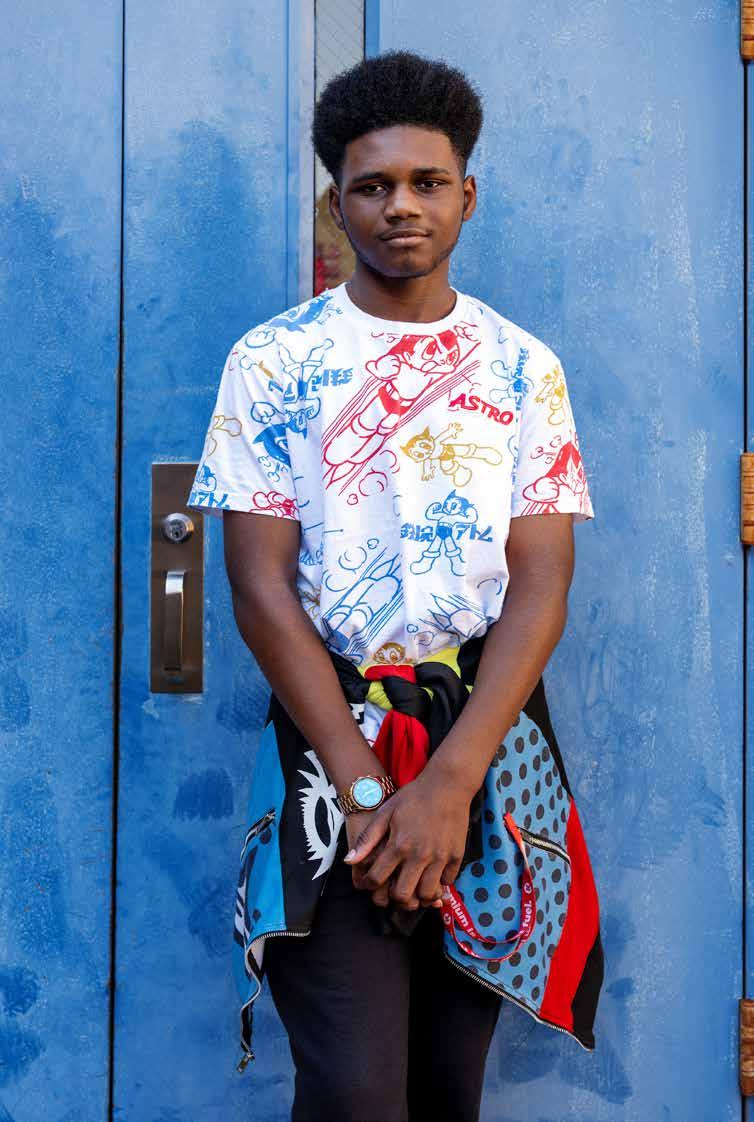
28 Talking with Bill Bamberger about the questions that have driven his decades-long photography project, Boys Will Be Men BY JUSTIN LAIDLAW
30 "We like to think of it as couples therapy," jokes actor Ron Menzel, who will take center stage alongside his partner, Vivienne Benesch, in an upcoming PlayMakers production of Macbeth BY SARAH EDWARDS
32 Resurrection, Send Help, and other intriguing new films coming to theaters around the Triangle. BY GLENN MCDONALD
33 North Carolina was once a forcefield in modernist design. Thanks to committed local preservationists and architects, that legacy lives on in homes across the Triangle. BY SARAH EDWARDS
page 28). PHOTO BY
Publisher John Hurld
Editorial
Editor-in-Chief
Sarah Willets
Wake
Jane Porter
Culture Editor
Sarah Edwards
Lena Geller Justin Laidlaw
Chase Pellegrini de Paur Report For America Corps Reporter
Chloe Courtney Bohl
Contributors
Mariana Fabian, Jasmine Gallup, Desmera Gatewood, Tasso Hartzog, Elliott Harrell, Brian Howe, Jordan Lawrence, Elim Lee, Glenn McDonald, Nick McGregor, Gabi Mendick, Cy Neff, Andrea Richards, Barry Yeoman
Wojciechowska
Pajor
In our last print edition, Chase Pellegrini de Paur took a deep dive into the 4th Congressional District Democratic primary, covering the two front-runners (incumbent Rep. Valerie Foushee and Durham County Commissioner Nida Allam), the big issues motivating voters, and the stakes of the race to represent one of the country’s bluest districts. We received many messages responding to the story, including these:
From reader NATALIE SPRING by email:
In ‘A House District Divided’ the NC4 primary is laid out as a contest between a measured, traditional, establishment politician—and a younger, outspoken candidate happy to be compared to Mamdani.
I am tired of someone playacting civility like it’s the 1990’s. The political moment we face is real and grim, and I, for one, am ready for someone willing to actually fight for all of us. Now is not the time to be measured. Working moms like me are fed up with business as usual politics and hearing and seeing nothing from our representative.
Over the holiday break I received a mailer from our representative and I read it to see if I could figure out what Valerie Foushee is doing in DC, since I never see her in Durham.
I had no idea that Valerie Foushee was protecting reproductive freedom. Where would she suggest someone in North Carolina go for abortion care after 12 weeks?
She’s strengthening voting rights? We have to show ID to vote in NC now, and good luck if you need to get a DMV appointment to renew or acquire a Real ID.
She’s lowering healthcare costs? My premiums and out-of-pocket expenses are so high I almost thought they had repealed Obamacare—to say nothing of friends who have had to travel for medical care for their trans kids or are contemplating moving out of state with their families.
I still do not know what she stands for or what she is actually doing, other than speaking in quiet platitudes and now referencing her “behind the scenes power,” which, in my experience in the PTA, if you brag about, you don’t really have it.
NC 4 will always be a D+23 district. We can do what so many across the country
can only dream of—send a true progressive through the primary to win largely unopposed in the General.
That is why I’m voting for Nida. I want someone representing me with energy, ideas, and the commitment to make real change in DC. I’m tired, y’all. Let’s elect Nida and have one bright spot in our politics.
From Bluesky user JOSEPH FELDBLUM:
Good primer here. No doubt Foushee is a dedicated public servant, but when I call her office and ask, amidst an escalating crisis of democracy, what Foushee is doing *differently* now from what she did during Biden, they offer nothing, and in fact get extremely defensive.
More specifically they’ll point to a couple signed letters and a single rally she attended in January. I think it’s an extremely fair question and a disqualifying set of answers.
From Facebook user MARY PAUL THOMAS:
Quoting from the article: “Why at this time in history—where we will likely lose Black members of Congress—why should this district, Durham, that is very progressive, say we are going to fire a Black woman that is showing up and doing her job?” - NC State Senator Natalie Murdock. There is no reason to displace Rep. Foushee, and I think it was quite disrespectful of Allam, who I would normally fullheartedly support, to challenge her. As a native North Carolinian, I think it’s crucial to reelect and support an experienced incumbent Black woman. There’s a historical context here in the South of those denied access. Foushee has lived experience that Allam does not, and she represents her full constituency in a broader manner.

into two County and the districts. these: progressive largely unop-
Nida. I want energy, ideas, change in and have
into two County the districts. these: progressive unopwant ideas, change in and have
FELDBLUM:
FELDBLUM:
Foushee is a call her crisis of *differBiden, extremely couple attended ques-
Foushee is a I call her escalating crisis of doing *differduring Biden, extremely a couple attended fair quesanswers.
THOMAS:
“Why at this likely lose Congress—why should progressive, woman that NC State no reason think it was I would challenge think it’s experienced historical those denied experience that represents her full
THOMAS: at this likely lose should progressive, woman that NC State reason it was would challenge think it’s experienced historical denied experience that her full

BY KYLE VILLEMAIN backtalk@indyweek.com

DINDY’s identity as a newspaper has many layers. To some, it’s their go-to source of local music, arts, and culture coverage. To others, it’s where they find coverage of town council, their neighbors, and local issues. And many know it as the place to send a letter to the editor to make their voice heard, or where they got their first byline as a young journalist.
For 40 years, INDY has also had another element: influential political endorsements.
There has always been tension between doing great journalism and making endorsements in races. In the past, with other strong outlets around, INDY could stake out a lane that did both. But given the gaping local news void today and our own limited resources, we see our main priority as filling the vast need for original, rigorous reporting on those races.
That’s why, as we’ve talked through our plan for 2026 and beyond, we’ve come to the decision to step away from that role and end political endorsements.
This decision comes with mixed emotions; stepping away from any long-standing tradition is hard. We know readers have relied on the clarity and accessibility of INDY’s endorsements as they navigate local elections and we’re committed to continuing our sharp and clear election analysis.
But making endorsements means taking an institutional position on which candidates we find best, which can under-
mine reader trust in the fairness of our reporting. It also saps our journalists’ time and resources that could be spent on reporting insightful and in-depth news about those races—which we think is the most important work we can do right now when it comes to supporting democracy and informing readers.
We believe there are lots of local political organizations with strong voices. We believe there are far too few local journalism organizations with the capacity and depth to uncover the facts and backstories that keep you informed. Our attention will be focused on providing reporting, analysis and candidate questionnaires that keep readers informed about key elections and help them make the best decisions when they go to the polls.
This change will set us up to do more journalism, convene more conversations, and be a catalyst for nuanced debate about the Triangle’s biggest issues.
Last week we hosted 75 engaged Durham readers for a public conversation about how to make the region’s big job announcements work for every resident in the city, not just new arrivals. In January, we hosted 150 curious folks in Cary for a public launch event of our new 3-time-a-week reporting newsletter for Western Wake County; a new initiative to fill the yawning gap in local news coverage across a complex and interesting swath of the Triangle.
At a time when national outlets like the Washington Post are cutting hundreds of journalists, we’re adding staff. INDY’s
team of full-time editors and reporters is larger than three years ago, when it first joined The Assembly Network—a locally owned group of outlets across North Carolina that focus on in-depth reporting on power and place.
Moving forward, you’ll see us leaning into political reporting, like our definitive piece on the Foushee-Allam congressional primary race, foundational reporting on the race to succeed Lorrin Freeman as Wake DA, and comprehensive work on the contested state Senate primary in Durham and a House swing district in Southern Wake County.
This election cycle, INDY’s team interviewed nearly 50 candidates and is on track to publish about 30 election stories in addition to over 80 candidate questionnaires before Primary Day, in our quest to inform Triangle voters.
We want to hear your thoughts on this change, and our focus moving forward (email us at backtalk@indyweek. com). And we’re excited to do more local reporting that holds power to account and helps make a complicated place easier to understand.
With thanks, Kyle
Kyle Villemain is the founder of The Assembly Network, an independent group of news outlets that includes the INDY as well as statewide and regional teams across North Carolina.
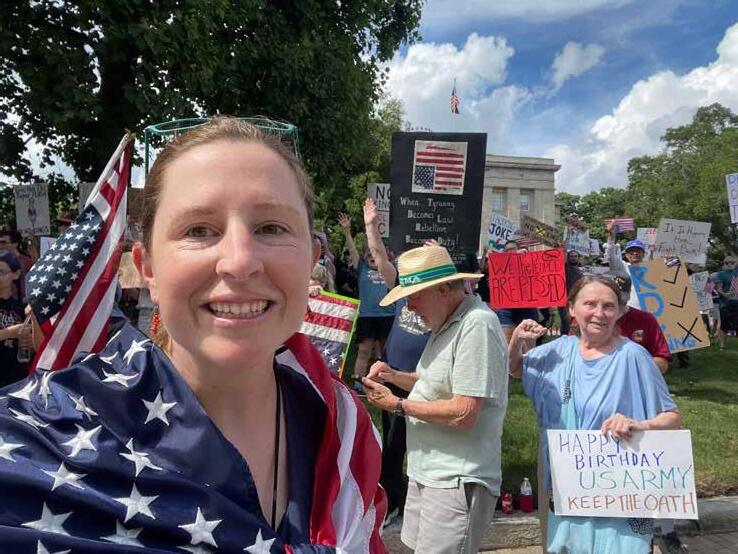
We can shift away from authoritarian control this year, a Raleigh City Council member writes, but voters must show up to the polls en masse for elections.
BY JANE HARRISON backtalk@indyweek.com
The Trump administration is spending billions of dollars on immigration enforcement to target hardworking, law-abiding residents and citizens. Trump’s “Big Beautiful Bill” provides tax cuts to the ultrarich and leaves the rest of us reeling from the excessive costs of health care, housing, and groceries. When our basic needs are out of reach, we suffer. But when government leaders reflect the people they are elected to serve, we have the chance to make things right.
Government oppression causes us to lose hope, but we must not forfeit our rights or dreams in advance. This year, we must show up to the polls en masse and be prepared to engage in a long process to renew the promise of this nation: life, liberty, and justice for all. Those values have always required struggle, and in the 250th year of the United States of America, the fight continues.
I’ve seen how our collective battles show up in the most intimate corners of my life. For years, I dreamed of being a mother. I dealt with infertility and was surprised and excited to get a positive pregnancy test in early December 2022, just a few days before being sworn in as a Raleigh City Council member.
Unfortunately, I suffered a miscarriage. This is a common but often isolating event. One out of four pregnancies meet this fate. The loss strengthened my resolve to try again. I have a condition called polycystic ovarian syndrome, which affects about 10% of women. I tried hormone treatments for months on end, eventual-
intrauterine insemination, but with no luck. This was a long process with no guarantee of success.
Each month of trying and failing required every ounce of faith I could muster, not to mention out-of-pocket medical expenses. It was emotionally and financially taxing. At times, I was miserable.
Too many families relate to this exhaustion. The cost of health care for a middle-class family is increasingly out of reach.
My husband’s Affordable Care Act monthly premium has doubled. For state employees (which is my main gig), retirement coverage is no longer included. Rates for spouses and children are high, and we are losing access to preferred providers. State and federal leaders ignore the real needs of the American public.
But on the other end of the spectrum is the city of Raleigh. My family’s options expanded tremendously with changes to the city’s health care plan. A new provision helps cover in vitro fertilization (IVF), a treatment my doctor recommended early on but I had held off on because of the cost.
In Raleigh, we are committed to ensuring that our essential workers can meet their family’s needs. In the 2026 budget, Raleigh City Council increased pay by 11% for public safety, solid waste, and parks personnel, among other dedicated employees. The city does not run without its workers, and they deserve living wages and benefits in return.
I got pregnant again with the help of IVF and by the time you read this will have welcomed our baby girl. I’m beyond grateful for the fertility doctors and medical staff that
supported me. My husband and I needed their help.
I expect to be the first Raleigh city councilor to give birth while holding office. This is possible because of a local government policy that changed my life.
My pregnancy journey took over five years. This presidential administration may last four terribly long years, but we can shift away from authoritarian control this year. Who we elect to Congress, the North Carolina Supreme Court, and local offices can force the checks and balances we so badly need.
To defeat despair and helplessness requires consistent and deep engagement with one another. For me, that means showing up. I attend community meetings and listen to my neighbors. I strive to represent my constituents as fully as I can, staying in conversation with those I agree and disagree with. I call my U.S. senators and hold our political representatives to account.
I recognize the powers against us—gerrymandered political districts, dark money funding political campaigns, and disagreement over basic facts. But we can overcome these forces when we work together. I feel hopeful with simple acts like a stranger bringing groceries to families in need and volunteer school safety patrols ensuring students get to class. Let’s commit to caring for our community—day after day after day.
The March 3 primary election will determine who moves forward in races for Raleigh City Council, Wake County Board of Commissioners, Wake County district attorney, and the U.S. Congress, among others. I’m not on this ballot, but this is my personal plea to participate in our electoral process. We can’t win if we don’t show up.
The March primary is the first opportunity to weigh in on who will represent us in 2026. Then we must get the vote out for the November election to return accountability and focus to the issues that matter to us all. It will be a long road ahead to change the trajectory of our nation. It always has been. We must fight not just for ourselves but for the generations to come. Our determination to do so and commitment to one another is what will make the difference.
Primaries for Raleigh City Council are being held for the first time this year, with early voting beginning on February 12. At-large and District C races have primaries due to the number of candidates. The top four at-large vote getters move on to November’s general election, while the top two District C vote-getters will be on November’s ballot. You can vote for your favorite candidates in November only if they make it through March’s election.
Jane Harrison is mayor pro tem of the Raleigh City Council and has represented District D since 2022.

It’s time to head back to the polls to cast ballots for a host of local, state, and federal races ahead of the March 3 primary.
Across the Triangle, there are contested races for school boards and municipal governments, state and federal legislative seats, sheriffs, district attorneys, and judges.
In this paper, you’ll find coverage of some of the most interesting races:
• The three-way race for Wake County District Attorney (see page 22). With the longtime incumbent not seeking reelection and no Republican challengers in the race, it’s a wide-open field in the Democratic primary, which will determine Wake’s next DA. In Durham, the incumbent is seeking reelection, challenged by a local defense attorney in a 2022 rematch (see page 11)
• Candidates vying for two newly created seats on the Wake County Board of Commissioners (on page 16) as well as two seats on the Raleigh City Council (on page 19)
• A crowded field of hopefuls seeking four seats on the Durham Public Schools Board of Education. With just one incumbent seeking reelection, the March election will result in three or four new board members being sworn in (on page 13)
• Durham’s only competitive state legislative race, featuring state Sen. Sophia Chitlik who is defending her seat against former Durham City Council member DeDreana Freeman (see page 7).
You’ll notice this year our election edition does not include candidate endorsements—read more about that recent change on page 4. Online you can find more of our reporting on local and state legislative races, as well as candidates’ questionnaire responses in nearly all of the primaries taking place across Durham, Wake, and Orange counties. And let us know what you think of our election coverage by emailing backtalk@indyweek.com.
Not sure which of these races apply to you? Visit the state Board of Elections website, use the voter lookup to search your name. There you can find sample ballots and a list of the jurisdictions applicable to you. Voters registered with a particular party can only vote in that party’s primary, while unaffiliated voters can choose any party’s ballot. Be sure to check your voter registration and make a plan to head to the polls.
Thanks for reading,
Sarah Willets Editor-in-Chief
TUESDAY, MARCH 3
Primary Election Day 2026
TUESDAY, FEBRUARY 17
Absentee ballot request deadline
FEBRUARY 12–28
In-person early voting Voters can register to vote at any early voting site with valid photo ID and proof of current address on a utility bill, bank statement, or paycheck.
6:30 A.M. TO 7:30 P.M. Election Day polling place hours
Donʼt Forget Your Photo ID! North Carolina voters will be asked to show photo ID when they check in to vote.

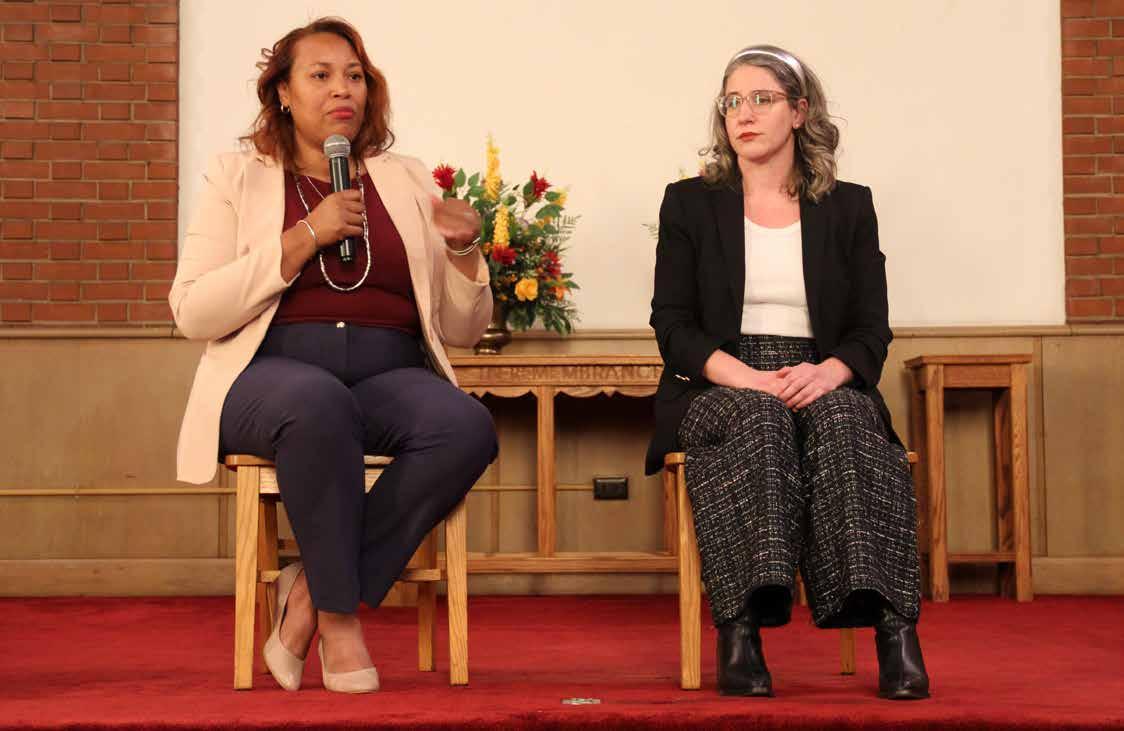
Two candidates bring different tactics, backgrounds, and reputations to the race to represent District 22.
BY LENA GELLER lgeller@indyweek.com
Thirty seconds after DeDreana Freeman parks in the empty lot outside St. Joseph AME Church in Durham, a man in a sedan rolls up and waves her down, complaining that she hasn’t returned his calls.
Freeman walks over and says hi. She knows him—he facilitates a volunteer crime prevention group, and Freeman worked with him during her tenure on Durham City Council. The two chat for a bit, then Freeman says she’ll text him to follow up.
The moment crisply animates what Freeman, now running for state senate, is known for: community ties deep enough to get stopped in parking lots, and a way of operating that prioritizes what’s happening in front of her over the phone in her pocket, sometimes at the cost of clockwork.
She’d be the first to tell you this. Inside St. Joseph, where I’m interviewing her before a candidate forum, she mentions that she often runs late because she likes to “keep the flow of conversation going,” even when she’s got somewhere to be.
“That’s when you get to the real issues,” she says, sliding off her sneakers and swapping them for a pair of beige heels she’s pulled from her bag.
Freeman’s grassroots credibility and nonconformist bent are central to her pitch in the Democratic primary for North Carolina Senate District 22, which covers most of Durham County. It’s a solidly blue seat where the March primary effectively decides the election—and where, this year, Freeman and her opponent, first-term incumbent Sophia Chitlik, share similarly progressive values on most fronts.
But it’s not clear whether Freeman’s record as a community stalwart will be enough to unseat Chitlik, who, while newer to the area—and to local politics—than Freeman, has cultivated her own relationships and goodwill as a freshman senator.
A relatively unknown entity in Durham before she primaried then-state Sen. Mike Woodard in 2024, Chitlik personally responded to more than 500 constituent calls and

over 1,400 constituent emails last year, per a report she released in December. She met with over 100 policy advocates. And she put that relationship-building to practical use: When Tropical Storm Chantal flooded parts of North Durham in July, Chitlik was able to promptly connect relief workers with people in affected neighborhoods because she knew and had built trust with community leaders there, the head of a local relief organization told me.
Freeman, meanwhile, says she has something Chitlik doesn’t: an equity lens forged by lived experience. A Black mother of three, and herself the oldest of 10 children raised by a single mother in subsidized housing, Freeman says she understands what her constituents are going through because she’s been there: stretching SNAP benefits, juggling childcare while pursuing her master’s degree as a first-gen college graduate. It’s a perspective she says Chitlik, an angel investor whose family members have contributed tens of thousands of dollars to support her campaigns, can’t match.
Freeman also points to her longer record of elected service as a distinguishing factor: eight years on city council to Chitlik’s 13 months in the state Senate.
But Freeman enters the race with a few bumpy years behind her. She’s lost her last two local races—her 2023 mayoral bid, in which she placed third, and her council
reelection bid last November, which she lost by a narrow margin. This March, many of the same voters who declined to reelect her to council will be casting ballots again.
Then there’s the incident that’s followed her: three years ago, Freeman was caught on tape cursing out a fellow council member before, by some accounts, taking a swing at him and hitting two other members in the process.
Freeman denies hitting or swinging at anyone and calls the allegations a product of misogynoir—the form of racism directed at Black women that casts strong emotion as aggression. Still, she’s aware of how it’s shaped her image.
Before heading into the forum at St. Joseph, she smooths her blazer and takes a breath.
“Time to go be bubbly,” she says.
I f the narrative dogging Freeman is one of poor conduct, the one trailing Chitlik is that she skipped the line; that she landed her seat without the years of local government service that typically precede a run for state office.
But Chitlik, 36, has been working in and around politics for years, she says. She didn’t have a lifelong plan to become a politician, she tells me, though she was interested in politics from a young age; growing up in Burbank, California, she became a SAG-AFTRA member at 6 and volunteered for John Kerry and Barack Obama’s presidential campaigns
as a teen. By the time she moved to Durham in 2017, her résumé included a political appointment in the Obama administration’s Department of Labor and an executive role at an education nonprofit. Since being in Durham, she’s focused on investing in startups run by and for women and non-binary people.
Chitlik says she spent her career as a “behind-the-scenes operator” focused more on political fundraising and philanthropy until she encountered a problem she couldn’t solve without running for office herself: While trying to help a local midwife launch a network of North Carolina birth centers, she hit roadblocks that reflected a male-dominated legislature that wasn’t prioritizing maternal health, childcare, or reproductive justice. She didn’t think her then-state senator, Woodard, was fighting hard enough against the Republican majority—so she filed to run.
On the 2024 campaign trail, Chitlik laid into Woodard for crossing the aisle to overturn three of then-Gov. Roy Cooper’s vetoes and for taking corporate PAC money, something she’s refused to do.
Chitlik’s own fundraising, though, became part of what created the perception that she circumvented the typical path to office:
ahead of the 2024 primary, she and family members contributed over $60,000 to her campaign, and she drew tens of thousands more from a network of out-of-state donors that included billionaires. Less than half of her funding during that campaign came from North Carolina donors who weren’t her family members.
Campaign finance data from the current cycle was not yet complete at press time, though between the 2024 primary and June 2025, Chitlik and her family have contributed an additional $34,000 to her campaign.
Asked if her financial position distances her from some of the people she represents, Chitlik told me, “We don’t get to choose our circumstances in life,” adding that there are structural barriers that limit who can serve and that she wants to be part of trying to remove them, including by introducing bills on campaign finance reform.
“If you look at my record, you see the ways in which I’ve been fighting relentlessly for working families,” she said.
That’s the case she’s making to voters this time around: she’s been doing the work, and she has the receipts to prove it.
As forecast during her first run, Chitlik,
worked on bipartisan initiatives, including a bill to create a task force on psychedelic medicine for veterans’ treatment, and even had some Republican colleagues over for her Passover seder last year.
Sen. Lisa Grafstein, a Democrat who represents a neighboring district, told me Chitlik met one-on-one with nearly every legislator before last year’s session began.
“When you start your relationship with somebody just sitting across the table talking about your kids or your family, it’s a much different thing than your first exposure being a disagreement in committee,” Grafstein said.
One of Freeman’s first votes as a city council member was a lone dissent.
In January 2018, a month after she was sworn in, the council was tasked with appointing someone to fill the at-large seat that Steve Schewel had left vacant upon being elected mayor. After an initial split between appointing Javiera Caballero and Pilar Rocha-Goldberg, several members switched their votes to Caballero in the second round. Freeman didn’t budge, sticking with Rocha-Goldberg.
It set the tone for her tenure. Freeman wasn’t going to vote a certain way just for the sake of unity optics or political convenience. She thought Rocha-Goldberg was a better candidate; she voted as such.
who has a 3-year-old son, has made childcare a focus in the legislature: she’s co-authored a childcare omnibus bill, passed an amendment on childcare facility regulation that made it into law, and introduced bills to establish paid family leave, require allergy training at childcare centers, and mandate lifeguards at day camps.
Beyond that niche, Chitlik has sponsored dozens of other pieces of legislation, including bills to seal eviction records, expand protections for pregnant workers, and secure funding for Durham’s Pauli Murray Center and Stagville Memorial Project. She’s also co-sponsored several bills on housing, some of which follow what’s sometimes called the “Abundance” approach to housing policy and would override local zoning authority in order to allow denser housing types like accessory dwelling units and duplexes. At the other end of the housing policy spectrum, Chitlik has also co-sponsored a bill that would restore local authority to downzone, a power Republicans stripped last year.
Chitlik has made good on her promise to regularly push back against Republicans, voting against them nearly 40 percent of the time. She says that doesn’t mean she’s shut the door on collaboration. She’s
In coming years, Freeman would be the sole vote against a widely popular affordable housing bond, saying the amount—$95 million—fell far short of what was needed, and the sole vote against a $10,000 pay raise for council members, which she said she would prefer to be coordinated with raises for county and school board officials.
She would also regularly push back on development proposals she believed would harm longtime residents. On development proposals the council split on, Freeman often found herself in the 4-3 minority, at odds with colleagues who prioritized adding housing supply—a divide that echoes, at the state level, in debates over bills like the ones Chitlik has co-sponsored to override local zoning decisions in favor of increased density.
On the whole, Freeman was the council member aggrieved constituents could count on to take up their cause, whether that meant pushing to remove rubber tire mulch from a park or backing city firefighters seeking redress for missed pay.
Taking the side of activists so reliably, even in losing battles, built Freeman a base that treats her like a folk hero. After she was voted out in the fall, supporters piled flowers on the council’s dais to celebrate how she had voted “with the people” in
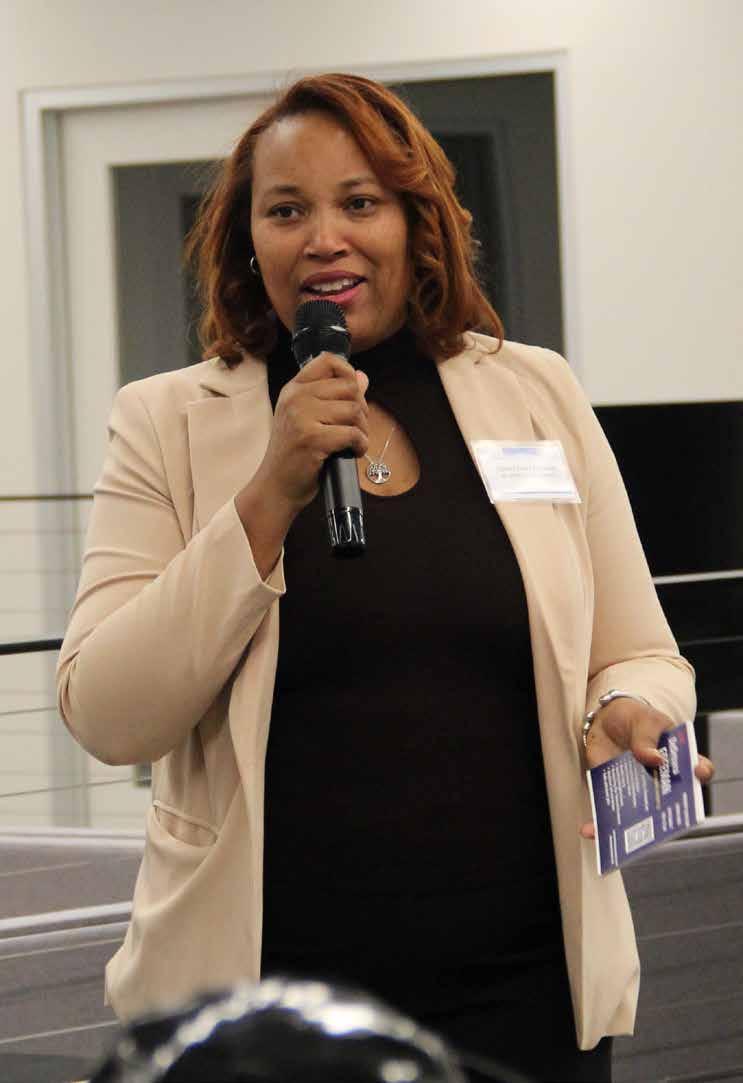
efforts to “stop the sellout of the city to for-profit developers,” per an event flyer.
James Chavis, the man who waved Freeman down in the parking lot, would agree with this characterization.
When I called him to ask whether she really doesn’t return calls, he said she does eventually get back to him. Then he launched into a monologue about how some politicians “plagiarize” the work of community organizers. Freeman doesn’t do that, he said. She’s the real thing.
A native of the Bronx, Freeman, 48, moved to Durham’s Golden Belt neighborhood in the mid-2000s. Soon after,
lik unseated, made the exact jump Freeman is trying to make from Durham City Council to the Senate District 22 seat in 2013. He said the transition can be jolting: You’re suddenly one of 50 senators instead of six council members, many of your colleagues are Republicans, and even the Democratic caucus is far more ideologically diverse than what you’re accustomed to in Durham.
“If you want to go over there and be effective,” Woodard said, “that political game is very, very different.”
Freeman will need allies to accomplish what she tells me is her main goal if elected: securing more resources for Durham. Her state senate platform closely resembles her city council platform, down to the acronym—“S.E.E. Justice,” for social, economic, and environmental justice—and lays out an ambitious vision that includes raising wages and holding polluters accountable.
Freeman isn’t worried about finding common ground in Raleigh. She told me she spent years collaborating with people of wildly different political stripes in the National League of Cities, a nonpartisan organization that lobbies Congress on behalf of some 19,000 municipalities.
“I’ve not had any issues around advocating for the things I believe in, and having conversations with people who have completely different stances, and coming into some agreements,” she said.
Most state senators put that kind of diplomacy toward writing bills. But Freeman says she doesn’t actually plan to author much legislation. Instead, she wants to focus on the budget, making sure Durham, with its large tax base, gets its fair share back from Raleigh.
“I’m not trying to fix laws,” she said. “I’m trying to change the system so that it actually works for more people.”
campaign in Gaza, which many experts have deemed a genocide, Chitlik was not openly critical of the Israeli government and never publicly called for a ceasefire. Some of the criticism of Chitlik on this issue has veered into antisemitic conspiracy territory: She’s Jewish, lived and worked in Israel for a time, and has access to wealth, a combination that has invited ugly insinuations.
But the simple fact that she didn’t speak up amid Israel’s decimation of Gaza matters to a chunk of local progressives who felt it was a moral imperative to do so. It’s also a contrast with Freeman, who voted with four other Durham City Council members to pass a ceasefire resolution in 2024.
In an email Chitlik told me that she has “always been in favor of the release of all hostages and a permanent ceasefire that affords safety and dignity to all people in the region.”
“My faith inspires me to work toward justice—which is what I’ve been striving to do in the General Assembly on the issues that we can impact, including access to maternal health care, childcare, and quality public education,” Chitlik wrote.
Voters have also raised questions about a legal case involving Chitlik’s husband’s company, American Efficient, an energy efficiency aggregator. American Efficient is facing nearly $1 billion in combined penalties and alleged profit disgorgement from the Federal Energy Regulatory Commission, or FERC, for alleged fraud. In response, the company has denied the allegations and made a legal challenge to FERC’s authority that, if successful, could further the Trump administration’s broader effort to weaken independent regulatory agencies. The case, which dates back to 2021, remains ongoing.
she embarked on a years-long effort to get Golden Belt designated as a historic district—in part to protect residents from being displaced by the Durham Rescue Mission, which was planning a campus expansion. She went on to become president of Durham’s Inter-Neighborhood Council, then joined the planning commission before running for city council in 2017, when she unseated a 16-year incumbent. She currently works as a consultant for nonprofits and government agencies. Previously, she held roles at Clean Energy Durham and the East Durham Children’s Initiative. Woodard, the former state senator Chit-
Asked generally about this approach, Woodard cautioned against treating legislation and appropriations as separate tracks. When the legislature passes a budget, he said, there’s the money bill—the line-by-line spreadsheet—but also a policy document that runs hundreds of pages.
“It’s both and,” he said. “You got to pass laws, and you got to get appropriations.”
Sometimes, there isn’t a budget at all.
The General Assembly still hasn’t passed one for the current fiscal year—a symptom of the gridlock that makes the Durham council’s 4-3 votes seem tame.
Several issues have shaped the discourse around Chitlik’s first year and reelection bid that, while not directly related to state policy, some voters see as out of step with her progressive positioning.
During Israel’s recent yearslong military
Asked if there is a conflict of interest between her role as lawmaker and the FERC case, Chitlik wrote in an email that American Efficient is not regulated by the legislature or the North Carolina Utilities Commission and that “federal investigations, including those conducted by FERC, are not influenced by state legislators.”
Floyd McKissick Jr., a former state senator who serves on the state Utilities Commission, echoed that assessment, telling me FERC is “completely independent” and that Chitlik would have “no influence whatsoever” over the proceedings.
For some voters, the 2023 audio recording of Freeman shouting at then-Mayor Pro Tem Mark-Anthony Middleton, and the question of what happened next, has calcified into shorthand for who she is.
During her unsuccessful bid for mayor that year, small signs reading “She’ll FIGHT
for Durham” appeared staked into the ground beneath her official campaign signs around town. Whether they were meant as a dig or a compliment, the allusion seemed clear. (Freeman, for her part, didn’t take them as an insult: “I mean, it’s true. I would fight for my community,” she said.)
The incident between Freeman and Middleton took place after a council work session; not many people were present. That afternoon, WRAL captured audio of Freeman shouting profanities at Middleton, and several weeks later, the INDY broke the story of the alleged physical altercation based on accounts from three anonymous sources. Freeman declined to comment for that story but now tells the INDY she didn’t swing at or strike anyone and that she was arguing with Middleton verbally when Mayor Leonardo Williams, then a council member, physically intervened. Freeman’s response was to push his hands off her, she said.
Williams, one of the people Freeman allegedly struck, declined to comment for this story, as with previous coverage. Former Durham Mayor Elaine O’Neal, the other person Freeman allegedly struck, could not be reached for comment but previously told Bull City Public Investigators that she did not see Freeman “physically assault anybody,” including herself. Middleton, who has not previously gone on the record about the incident, told me in an email that Freeman “absolutely swung around” Williams “in an attempt to strike me.”
“It is a cartoonish-level insult to our intelligence to suggest that [Williams] just happened upon two colleagues arguing and thought it would be a good idea to ‘physically intervene’ and chose his female colleague to restrain,” Middleton wrote. “[Williams] intervened PRECISELY because Councilmember Freeman was advancing towards me with her finger in my chest threatening to ‘F me up.’ I retreated until I was in a corner.”
Even setting aside the allegations of violence, the recording of Freeman’s profanity-laced outburst has prompted questions about her temperament.
Freeman said the argument with Middleton was an outlier and maintains that her anger—spurred by a proposed resolution to censure an ally on council, Monique Holsey-Hyman, over allegations that had not yet been investigated—was justified.
In his email to me, Middleton rejected what he called the “canard” that the council acted improperly against Holsey-Hyman. The same letter from the district attorney that ultimately cleared Holsey-Hyman, he noted, also found no evidence of a coordinated effort against her
by council members.
“I have no ill will towards [Freeman] and wish her nothing but the best,” Middleton wrote. “However, she knows full well what transpired in that hallway and I will not allow my integrity to be sacrificed on the altar of anyone’s political ambition. My Momma taught me to use my words and to keep my hands to myself.”
As the primary looms, both candidates are doing the work of connecting with voters face-to-face.
Chitlik has been co-hosting town halls with neighboring state Sen. Natalie Murdock, walking constituents through the mechanics of the legislature.
The town halls aren’t explicitly campaign events but can function as such. After one in mid-January wrapped up at the Garrett Farms clubhouse, audience member Andrew Silver told me, voice thick with awe, “I don’t know if I’ve ever heard so much information coming at me at such rapid fire.” That morning, he’d looked at his sample ballot and figured he would probably vote for Freeman, whom he’d liked on council.
“I think I’ll stick with Chitlik after tonight,” he said.
Freeman, meanwhile, is working the circuit of community forums and mixers that have long been her milieu. At a recent Committee on the Affairs of Black People event (which Chitlik also attended), I caught Special Dover, a social work student at North Carolina Central University, after she chatted with Freeman for the first time.
“She’s an amazing person, from the little conversation that we had,” Dover said, specifically praising Freeman’s “focus on unity.”
Of course, there’s a cap on how many people you can reach in person.
One of the starkest differences between the two candidates, both in office and on the campaign trail, is their use of digital media. Chitlik posts regularly on Instagram, Threads, and Bluesky, sharing everything from inclement weather updates to straight-to-camera explainer videos and snapshots of parenthood. Recently, she’s been particularly vocal on immigration; when federal immigration agents came to the Triangle in November, she shared community safety resources while patrolling neighborhoods alongside local organizers, and after the January murder of Renee Good, she appeared on local TV news opposite NCGOP communications director Matt Mercer to call ICE “an agent of fascism” while Mercer defended the shooting as self-defense.
Ryan Wang, former president of Durham’s chapter of the statewide Progressive Caucus of the Democratic Party, said other
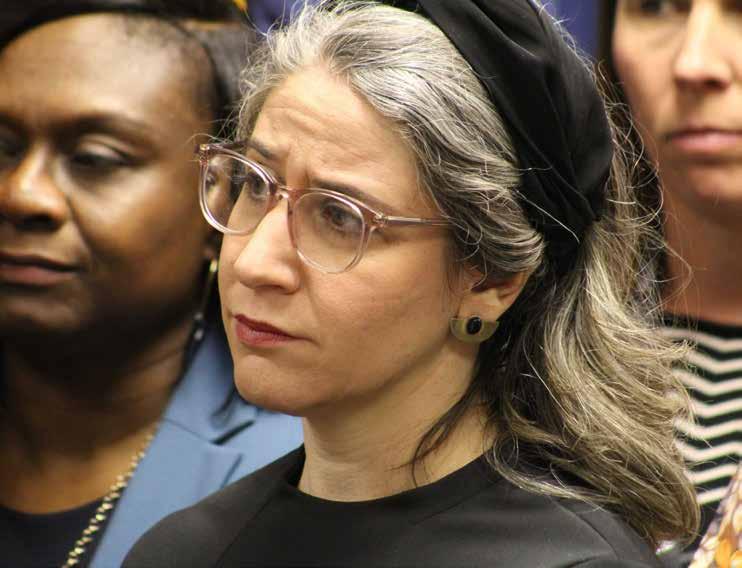
electeds would do well to model Chitlik’s communication style.
“What Democrats are really struggling with, at the local level, is leveraging tools such as the media and social media to bring awareness to the damages that the Republicans are doing in our state,” Wang said.
Freeman has a more limited media presence. She rarely talks to the press, and while she’ll toss up the occasional Instagram story when she’s out and about, she generally views broadcasting her service as performative and unnecessary.
Andrea Muffin Hudson, a local bail fund organizer, appreciates this attribute.
“She’s one of those people who are out there, actually in the community, doing the work, but she doesn’t have her phone out to take pictures,” Hudson said.
A downside to this approach: It can make it harder for the average voter to know that Freeman is running for office. I spoke with several voters who said they admired Freeman’s work on city council but had no idea she’d mounted a state Senate bid.
It can also make it harder for voters to know what she’s doing day to day. Citing Chitlik’s anti-ICE social media posts, I asked Freeman if she’s been engaged with immigration advocacy work recently. She bristled.
“I’ve been doing this work around ICE since 2011, when I first met the families who were being ripped apart by our immigration failures,” she said. “I don’t need to post. I am doing the work in the streets.”
Freeman’s history of community work is what secured her an endorsement from
the fledgling political action committee Durham Black PAC, according to Jessica Murrell-Berryman, a member of the group.
Other endorsements have been harder for Freeman to come by. Chitlik has secured support from groups like Planned Parenthood, the Sunrise Movement, and the AFLCIO—and even the Durham Committee on the Affairs of Black People’s PAC, which backed Freeman in her council reelection bid in the fall.
McKissick Jr., who chairs the Committee, said members “respected” Freeman’s interest in the seat but ultimately felt Chitlik was the stronger choice.
“I don’t think they felt [Freeman] was ready,” McKissick said, “or somebody who would perhaps be the voice that could really get things done at this critical time.”
Without a glut of endorsements, the other lever a candidate can pull is fundraising. In her recent council run, Freeman’s opponent outraised her by more than three to one. Is she doing anything differently this time on that front, I wonder?
She is not. If she’s running to represent working people, she says, she can’t do it by playing the big-money game.
“Coming out of the last election cycle, there was this deflation, that maybe the voice of the people is not heard,” Freeman said. “That makes it more important that I do it this way again.”
Disclaimer: Chitlik’s father-in-law, Adam Abram, is chair of the board of directors for The Assembly, which owns INDY.
Defense attorney Jonathan Wilson is once again challenging Durham County District Attorney Satana Deberry for her seat. Does he have momentum this time?
BY JUSTIN LAIDLAW jlaidlaw@indyweek.com
Durham District Attorney Satana
Deberry is facing off against challenger Jonathan Wilson II in a rematch of the 2022 Democratic primary.
Deberry, who was first elected in 2018, is running because “there is still more to do,” she said, while Wilson said he believes the community wants a new voice inside the DA’s office.
Last election, Deberry dominated, securing 79% of the vote. In the interim, Deberry launched a failed bid for North Carolina attorney general, losing in the 2024 primary to army veteran turned social media influencer, and former congressperson, Jeff Jackson.
Durham voters elected Deberry in 2018 with the expectation that she would implement progressive policies. Deberry and her team faced challenges early, working through the COVID pandemic and the political unrest brought to bear by the murder of George Floyd Jr. at the hands of a police officer in 2020. Both disruptions heralded a reformed approach to criminal justice.
During her eight-year tenure, Deberry has made the DA’s office less punitive for low-level offenders, some of whom are caught up in what amount to crimes of poverty: Folks in need of food or shelter get arrested on purpose because their prospects are better inside the detention center.
Violent crime rates are down nationwide, and the same is true for Durham. Of the

30,000 cases filed to the office per year on average, roughly 10% are labeled serious and violent crimes, said Deberry. The DA’s office does get its fair share of traffic violations, though much to this reporter’s chagrin, parking in the bike lane does not get you hard time.
Even with violent crime declining, Deberry acknowledged there are still issues.
In the last couple of years, downtown Durham business owners have witnessed a flurry of break-ins and other public safety issues, causing disruptions to operations and making employees fearful of walking to and from work. Business owners, even the most progressive on criminal justice, are frustrated when their window is smashed or their product is damaged, Deberry said.
“I try to personally be in those conversations when business owners want to talk about it,” Deberry said, “or neighborhoods and community leaders say, ‘Hey, we’re having this problem.’ ... I live here, too. ... My kids went to public school here. I have a grandchild who’s growing up here. This is my home as well, and I want it to feel safe.”
Deberry has worked with Durham County officials and other organizations on new diversion programs to get people into treatment and receiving services that improve social outcomes. The policy shift is as much about correcting community harm as it is about resource management, Deberry said.
“We spent a lot of time churning through
people who had mental health and substance abuse problems at the expense of the serious and violent crime,” Deberry said, “and so that stuff would take a long time to get done while we were just pummeling people who probably needed more community intervention, and that’s what the people of Durham County asked for.”
Those diversion programs, such as the Mental Health Court Diversion Program (MHC) and Post-Arrest Diversion Program, alleviate the burden on the system by low-level, nonviolent offenders, who Deberry said need health care and services, not jail time, to get them back on track.
Since Deberry first took office, the city of Durham has instituted the HEART program as part of its larger Community Safety Department, adding unarmed social workers and mental health clinicians to the roster of public safety personnel at the city’s disposal. HEART has largely been successful in offering alternatives to policing and providing resources to those in need.
Deberry is a HEART proponent and said her office was involved in early conversations with Community Safety to create a unified vision across the justice system.
Deberry is clear about how prosecutors can support crisis response and diversion programs while acknowledging that it isn’t the DA’s role to manage them.
“My job is prosecution,” Deberry said. “All I have is a hammer. To a hammer, everything
looks like a nail, and some of those people don’t need to be nailed.”
Downtown Durham Inc. also implemented a Downtown Ambassadors program to bolster the number of trained individuals on the ground to monitor activity downtown and also support those in need.
“As a community, we often get focused on what’s wrong and not what’s working,” Deberry said. “And there’s a lot that’s working.”
In addition to the diversion programs, Deberry said she’s most proud of continuing the driver’s license restoration initiative, which started under her predecessor Roger Echols and helps restore driving privileges for justice-involved individuals whose employment potential is limited when they can’t drive.
Additionally, the office has worked alongside local law enforcement to clear Durham’s backlog of sexual assault kits. In 2022, the Durham Police Department had 1,709 untested kits, the largest collection in the state. In two years, Durham became the first municipality in the state to record and test its entire backlog.
Whoever prevails in March—and likely November—will continue to face down a federal justice department that has become increasingly brazen with its operation tactics. The increased presence of federal immigration agents in the Triangle recently caused major disruptions to attendance at workplaces, businesses, schools,
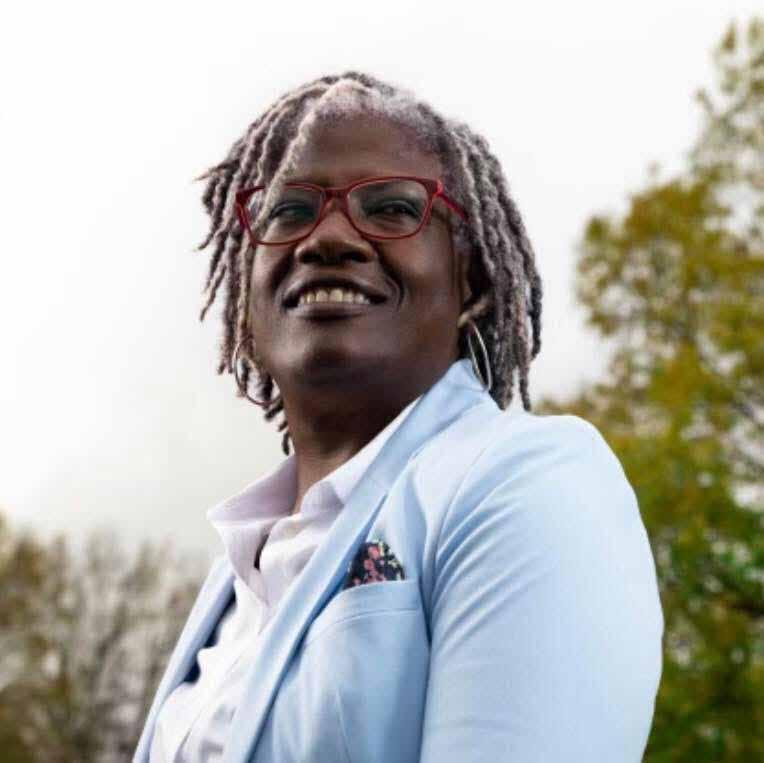
and the courthouse.
Durham Mayor Pro Tem Javiera Caballero said Deberry has been steadfast in establishing strong communication between prosecutors and defense attorneys to ensure residents feel safe showing up to court.
“When we had ICE agents [conducting operations], it was clear that [Deberry] has an understanding and relationship that is vital to immigrants being able to come and have their day and … do their business in the court,” Caballero said.
Caballero, whose family fled Chile during the 1973 military coup, speaks often about the impact of the experience and is an advocate for immigrant communities on the city council. Deberry said her office has worked hard to make immigrants feel comfortable seeking justice in an atmosphere where the federal government is undermining the rule of law “and in a sense operating more like [immigrants] are used to seeing governments operate where they are from.”
“We’ve done a lot of work being culturally competent with immigrant communities, with non-English speakers, especially with Spanish-as-a-first-language speakers,” Deberry said. “We work really hard to create trust.”
Following his 2022 defeat, Wilson said he resolved to increase his involvement in the community. He became chair of the legal redress subcommittee for the Durham Committee on the Affairs of Black People and a Durham County Bar Association board member and joined the Juvenile Crime Prevention Council. Despite Deberry’s poli-
cy victories, Wilson, a defense attorney who oversees an array of case types, said he believes there are enough voters looking for change to produce a favorable outcome in Round 2 of his primary clash.
“I have the experience, the knowledge, the trial skills, and the ability to meet people where they are,” Wilson said.
Wilson has also taken cases across neighboring counties— Wake, Granville, Person, Orange, and Alamance—where he picked up new ideas for how to make the Durham DA’s office more efficient. Too many people are awaiting trial with unresolved cases, Wilson said, due to lack of sufficient evidence and other setbacks that create a burden within the detention center and the courthouse.
While Wilson acknowledged Deberry’s accomplishments, and was reluctant to give a full-throated repudiation of the district attorney, he said he sees an opportunity to refocus the office on pressing matters like juvenile crime.
Chronic absenteeism, defined by a student missing 10% or more of school days, has spiked across the state since 2020. Last year, 37% of traditional Durham public school students met the threshold for chronic absenteeism, compared to 26% statewide, according to MyFutureNC. The rate was 15% in 2018.
“That’s a big jump and it’s scary, because you’ve seen juvenile crime going up,” Wilson said. “I have conversations with my clients and they all have different issues: mental health, drug abuse, poverty, and bad influences. I’m trying to see what we can do to put services in place to help them. I’m not trying to play social worker for everybody, but you want to put these kids and these people in the best position that they can be in.”
Other Deberry critics have taken issue with some elements of her job performance, something Wilson said may give Durham voters pause this time around, even those who supported her in the past.
Last year, WRAL reported that the dis-
trict attorney was only in her office about 50% of the time, according to data from her office key card.
“I’ve had people at my gym that are like, ‘You know, originally, I was in support of her, but I didn’t know that she wasn’t showing up to work like that,’ and that’s a problem,” Wilson said.
Deberry shrugged off the incident, saying she tries to keep outside noise about her office’s work at a distance.
“I try to stay off social media as much as I can, not just because I don’t want to see the haters but because I do not want to be influenced by what popular opinion is,” Deberry said. “I take my job seriously. I take my law license seriously. I really do believe in justice, whether that’s economic justice, social justice, personal liberation, and freedom, that is my core value. That’s the only way that a little girl from Hamlet gets out right? And so I had to believe in it.”
Deberry and Wilson agree that victim services is an area of improvement for the office. The criminal justice system isn’t victim oriented, Deberry said, but set up to hold defendants accountable and protect their constitutional rights.
“When people are upset, it is always because they didn’t feel contacted, respected, taken care of as a victim,” Deberry said. “And that is also another hard balance. ... We work really hard, but [some are] always going to fall through the cracks because of the volume of cases.”
Residents have conveyed this sentiment to Wilson in his work and on the campaign trail.
“There’s got to be better communication and availability,” Wilson said. “Courts are two-sided. You have your defendants and you have your state or the prosecutor, but the prosecutor has victims, and you want to make sure those voices are heard.”
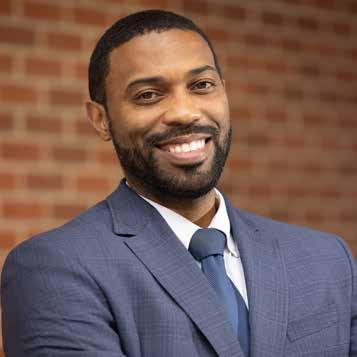
There are early signs that Wilson may have more momentum than he did four
years ago. Deberry and Wilson split the major endorsements—Deberry won the People’s Alliance, while Wilson won the Durham Committee—but Wilson has also racked up endorsements from the Friends of Durham, the Durham Black PAC, and Yes for Durham.
In its endorsement of Deberry, the People’s Alliance wrote that she “brings fairness, community-centered justice, and accountability” to the district attorney’s office and it appreciates “her commitment to humane prosecution, reducing racial disparities, and supporting victims.”
A summary of the endorsements in favor of Wilson call out Deberry for a lack of accountability for in-office time and her inconsistent conviction record.
Dan Jewell, chair of the Friends of Durham PAC, worked in downtown Durham for decades. He said PAC members, including a number of local business owners, attribute the recent spike in robberies and break-ins downtown to an absence of police patrols, and an unwillingness by Deberry to prosecute repeat offenders who cycle in and out of the courthouse.
“We’re missing things like the downtown bike patrol we used to have, and now we’ve got people that just feel like they can get away with stuff with impunity,” Jewell said. “We feel that that all goes back to the culture and the tone that’s being set.”
Friends of Durham also endorsed Wilson during his 2022 campaign. Jewell said Durham residents are ready for a stronger hand inside the DA’s office.
“Smaller crimes just are not being prosecuted, and that is directly attributable to the district attorney,” Jewell says. “People out there say, ‘Well, maybe I’ll get away with it, and even if I get caught, I’ll be back on the street again, and I can do it again.’”
Deberry maintained that she runs a tight ship, that staff excel before leaving for bigger and better opportunities, and that her office serves the people it needs to, inside and out.
“If you talk to the people who work for me, they will say that not only do I run a good and competent office but that I take their careers as seriously as I take mine,” she said. “I’m pretty satisfied with the work that we do. Could we do better? You can always do better. I’m still a human being. I make mistakes all the time. I own up to my mistakes when I make them, and I try to get better from them.”
Disclosure: INDY Editor-in-chief Sarah Willets formerly worked in Durham District Attorney Satana Deberry’s office. She was not involved in the reporting or editing of this story.

Here’s a rundown of the candidates’ experience, priorities, and pitches to voters ahead of the March election to fill four seats on the Durham Public Schools Board of Education.
BY CHASE PELLEGRINI DE PAUR chase@indyweek.com
To be a Durham school board member is to bear a monstrous amount of responsibility—yes, education for 30,000 kids, but also managing a workplace for over 5,000 employees and stewarding the tax dollars of over 340,000 residents—while having almost no power to actually do anything.
Need more money or a new school building? Go beg the county commission to raise taxes even more. Don’t like how the district administration is handling something? Go complain to the superintendent, your one employee, and hope he doesn’t follow a trend of superintendent turnover and leave for another district in a state that actually funds education. Want to take a principled stand
for progressive values like Chapel Hill-Carrboro’s school board chair did? Enjoy getting your ass dragged before a state legislature hell-bent on prosecuting a culture war rather than passing a budget to, say, pay teachers fairly
That’ll be the reality for whichever four candidates win seats on the Durham Public Schools (DPS) Board of Education in the March primary.
Durham is split into four districts, and each board member is elected only by the people in that district, so check your registration to see who will be on your ballot. This is also a nonpartisan general election, not a primary election, so you won’t see these names again in November.
For this election, the Durham Association of Educators
(DAE), the district’s majority-member union, endorsed a slate of candidates early in the campaign season and helped them land the coveted local People’s Alliance endorsement (check out our previous coverage for more information on whom the major PACs have endorsed). All four endorsees have insisted they would be independent decision-makers, but a DAE sweep would certainly give the union some leverage in a nascent meet and confer experiment, which gives the union a seat at the district decision-making table and has often been contentious.
Board members will also have to calculate how much leeway they want to give to the superintendent, who has something of a mixed hiring record so far (CFO Jeremy Teetor has gained acclaim for his work in untangling the district’s messy finances; Deputy Superintendent Tanya Giovanni was recently accused of obstructing justice).
And the board is set to lose at least 23 years of experience—of the four incumbents whose seats are up for election, only one is running for reelection.
Each of the four districts has three candidates, and we spent our January getting to know all 12 of them (in covering local elections, we’ve occasionally encountered candidates who should clearly never be trusted with any kind of power—this does not appear to be one of those elections). We asked them about their priorities, their experience, and how they imagine themselves working with the DAE, administrators, and parents. Here’s our rundown of the 12 DPS candidates. Your move, Durham.
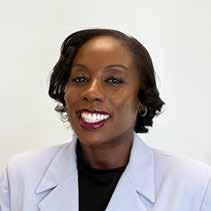
Dilcy Burton is an assistant attorney general for North Carolina’s Department of Justice. She has a list of agenda items she’d bring to the board, including changing the DPS holiday schedule to match the more inclusive New York City school calendar. As a state-certified mediator, Burton says she is qualified to help get all the right people talking about how to fix DPS’s various issues. She’s also pushing for full budget transparency and teacher pay, arguing that DPS needs to fairly compensate its workers if it wants to provide students with the best possible outcomes. She’s particularly interested in, yes, trying to get more money from the state but also in trying to better leverage grants and relationships with private companies in order to get the most possible funding for DPS.
“We want to see DPS successful. We want our students educated so that they have a better tomorrow. We want to do what’s right by the Durham community. So it comes to the fact that you have to be able to listen, reevaluate, and make sure that everyone is operating under that same goal as we move forward.”
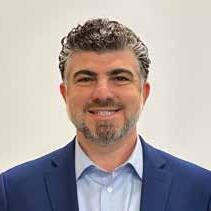
Davit Melikian is a first vice chair of the Durham Democratic Party and the owner of a custom home-building company. He studied operations management and finance and worked in corporate finance before leaving to start his own businesses. While he doesn’t have education experience, he brings a strong understanding of infrastructure, which will be relevant as the board weighs its massive deferred maintenance costs from recent years. He’s also eyeing sites like the soon-
to-be defunct Durham School of the Arts campus for ideas including a trade education program or even renting the property to help DPS find a little more revenue.
“Charter schools aren’t just going to disappear. Private schools aren’t going to disappear. This is a long road, this is a long fight. ... There has to be good communication. If there isn’t good communication on the board, let alone between all these different parts of the governing bodies of the city and the county, it’s going to be very hard, we have to be on the same page.”
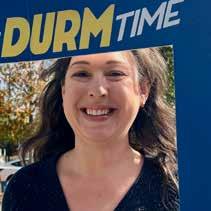
Natalie Bent Kitaif has a background in research and public health. She describes her view of public schools as hubs of community as well as places of learning, which she sees as especially important in 2026. She has been involved in organizing and advocacy around her children’s schools, including a push to bring back the social-emotional learning curriculum, and is interested in bringing more resources and attention to the DPS schools that don’t necessarily have the best reputations or rankings. With strong family ties to labor organizing, she says that she wants to see the meet and confer process continue in good faith from both the union and the administrative sides. She’s also gained endorsements from most of Durham’s major PACs.
“I’m running because I believe that we need to bring transparency to our public schools, especially around our budget. We need to be fighting for student safety and well-being, both their physical and their emotional safety, and I believe we need to be doing the best we can to support and retain our amazing staff.”
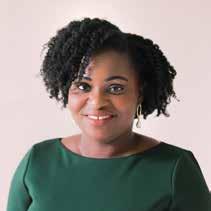
Bettina Umstead is finishing her second full term on the board and is the current chair. She previously served as chair from 2020 to 2024. Umstead previously worked at education nonprofit Student U and at the Equity Collaborative, and was recently appointed to the governor’s advisory council on student safety and well-being. Umstead is highlighting that, in her tenure, the county has consistently increased its financial support of DPS and that she has continued to push for staff raises each year. Umstead will have to convince voters that she is responsible for the positives of her tenure while sidestepping the high-profile messes. She could make a compelling case for experience, given that she is the only one of the four incumbents who has chosen to run again.
“Why I run for the school board and why I love public schools is because I really believe that public school education is transformative for our students. ... It’s our duty and our moral imperative, I would argue, as a public school system, to make sure the Black and brown students in Durham, the students who mostly will be first-generation college students, have that same opportunity. I’ve done this work for over 10 years now, and that’s what I’m fighting for.”
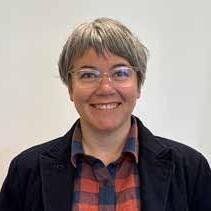
Rachel Waltz is a program manager currently working with Community Solutions. She previously worked at Orange County Housing and Community Development. As a social worker, she says she has a clear understanding of the challenges that students and parents may be having at home that impact how they show up
at school. She says that the best way for DPS to rebuild trust is to actually listen to the community and implement changes based on those suggestions. She’s worked with various levels of government in her day job and says she is prepared to build coalitions, both on the board and off, to respond to the district’s challenges. She’s jumping into the election this year because she was disappointed by the district’s response to federal immigration officials showing up in Durham.
“As I’ve unpacked certain challenges you see at school, I’ve learned that many of these challenges are not specific to our particular school. They’re really indications of a lack of oversight, lack of infrastructure, and a lack of accountability, oftentimes at the central office level and at the board of education level. I really learned that we have 57 loosely affiliated schools, rather than having an actual functional school system with infrastructure.”
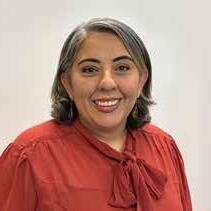
Nadeen Bir is the director of finance and human resources at Press On, a media collective, and a co-founder of Mothers for Ceasefire. She sees her work as directly relevant to the issues that DPS is facing, with budget problems and a recent indictment of several administrators. Bir is running partly because she saw a lack of unity during the recent immigration crackdown, while she would’ve liked to see a uniform stance and training for staff. She is particularly interested in improving teacher pay, as well as meeting some of the stated needs of the DAE (such as biweekly pay instead of monthly pay, which the union and district have recently stalled over).
“I’m a longtime Durham resident community organizer. I’m a mother who has two kids in Durham Public Schools, my husband is a teacher in Durham Public Schools, and I bring a lot of expertise in regards to management, human resources, budgeting. I also am very value centered. I believe in social justice. I believe in equity and transparency, and that’s why I’m running for school board.”
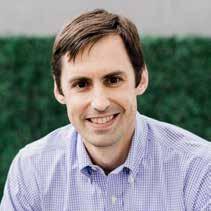
Peter Crawford is a co-founder and head of operations at real estate startup Acre. He has three children currently in DPS schools and has worked as PTA treasurer and served in special operations in the Army. Crawford is arguing that he is equipped to bring board members together to build governance structures to avoid scrambling from crisis to crisis. Like many candidates, Crawford says he was motivated to run after seeing the district fumble a promised 2024 staff pay increase that it then had to walk back. He says that he wants to help steer the board to set achievable goals for the superintendent.
Crawford is not registered with a political party, but his detractors may note that he has voted in Republican primaries over the past 10 years. He says that he was doing his “small part” to try to steer the party away from Trump.
“What I’m bringing is a tremendous amount of experience leading in pretty complicated organizations: building teams and leading teams and going through the budgets and the hard decisions and all that that come with those kinds of organizations.”
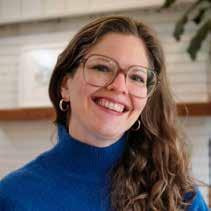
Lauren Sartain is a professor of K-12 education policy at the University of North Carolina at Chapel Hill. She is also an E.K. Powe parent and the former PTA president of that school. In her day job, she has helped districts like Chicago Public Schools navigate some of the same financial and logistical issues that have plagued DPS. She has previously pushed DPS to adopt zero-based budgeting, which rebuilds an annual budget from zero rather than from the previous year’s alloca-
tions. As a self-described policy nerd, she is promising to use her professional experience to chart a data-driven path forward for the district.
Sartain also has a unique reputation in DPS circles: She’s aware that some administrators may not be a fan of her sharp comments at board meetings and in emails to officials, but she says that she’s just not afraid to ask the tough questions.
“I have both these personal experiences firsthand with schools and advocating for students and employees, and then I have my professional expertise where I’ve spent the last 20 years of my career working with school districts to help them solve some of the same problems that we’re facing in Durham. So I feel like it’s a moral obligation for me to raise my hand and throw my hat in the ring to try to improve our schools.”
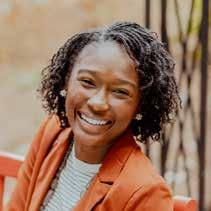
Gabby Rivero is the founder of a therapeutic dance company and she currently serves on the city’s recreation advisory committee. She has been an advocate for children since her undergraduate years, when she built a nonprofit around providing students with access to arts and often mentions her focus on finding “root causes” of behavior and issues.
In her campaign, she described how being a Black mother with half-Puerto Rican children has informed her perspective on DPS’ equity and achievement gap, which countless iterations of the board have struggled to address. She has promised to focus on communicating about DPS’ prestigious magnet programs to Black and Hispanic families that may not know about them. Rivero also called out DPS’ response to increased immigration enforcement last year, arguing that the district should be more outspokenly protective of its students and families.
“I’m not above community. I’m with community. ... We want things to be accessible to people. We don’t want people to have to find more resources to attain the things that they need, and we need to be able to bring things to people so that they have access.”
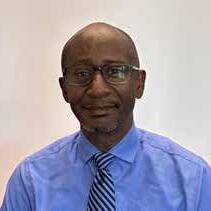
Xavier Cason is a longtime educator and former board member hoping to make a comeback. He was a teacher for decades, working at literally every level of public education from elementary school to university. He was elected to two terms on the board but left at the start of his second term to direct the Bull City Schools Partnership, as it would’ve caused a conflict of interest with his board role. He says that the district has made a lot of quiet progress in getting students caught up after pandemic-era setbacks, but that work has been overshadowed. Cason, along with Bent Kitaif, is also one of the most-endorsed DPS candidates, with backing from Durham’s major groups.
“I’m coming back as an active listener in a way that I thought I was before, but having been on the ground for six years, working in the schools with school leaders, I’ve got some different perspective—a wider perspective—than I had before. ... I‘d love to get another chance to really, really look deeply into the actual staff work to see how we improve implementation so the great ideas that are in our policies can actually come to pass.”
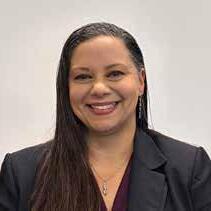
Kristy Moore is a former DPS teacher, former DAE president, and former vice president of the North Carolina Association of Educators. She is promising to bring a keen eye to the budget and says that her experience in education, education policy, and education organizing makes her the best-equipped candidate to deal with the state and national funding uncertainty that DPS is dealing with now. She would like to see the board implement a better communication strategy, especially in presenting options for parents who are being
peeled away from DPS by charter or private schools. Despite her past work running the organization, Moore did not win the endorsement of the DAE; she says that perhaps the organization felt they would not be able to influence her data-driven approach.
“We in Durham Public Schools need someone who’s willing to stand up for what is right, and who will look at data strategically and understand where we need to go, and be able to work with all stakeholders—parents, students, educators, everyone across the gamut, business leaders—and being able to work as a board together.”
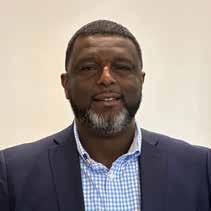
Jerome Leathers is a former principal at Southern High School of Environment and Sustainability and at Jordan High School. He describes his decades of work as an educator as a labor of love for his students, who have given him the nickname “coach.” He says that the district needs to treat all its employees with respect and that the district can attract students back by improving communication about all of the good things that happen in schools, instead of just ending up in the news during crises.
“We have to be transparent to our community. We are public schools, right? There’s no need of trying to conceal information or different things about what may be going on with the school district. ... Things happen, but how much confidence do we have in the board fixing them? Also financially, we’ve gone through a bit of a turn, and it is time to get us straight and steer the ship in the right direction.”


From finding ways to tax wealthier residents to expanding services at county regional centers and regulating large data facilities, here’s what candidates for the growing Board of County Commissioners are bringing to the table.
BY CHLOE COURTNEY BOHL chloe@indyweek.com
As Wake County is growing, so is its board of commissioners: This year, the board will add two at-large seats for a total of nine members. The candidates vying to fill those seats have grand plans for the future of education, housing, taxes, and technology in Wake.
In interviews with the INDY over the last month, seven Democratic candidates running in the March 3 primary diagnosed some of Wake County’s biggest challenges— supporting the state’s largest public school system, which is underfunded at the state level; planning for the county’s projected growth from 1.2 million people today to about 2 million in 2060; and making housing and health care accessible for Wake’s most vulnerable residents—and
offered potential solutions.
(There are also two Republican candidates who will run in the November general election for the at-large seats; we focused on the Democratic primary because the Republican primary is not competitive.)
Of the candidates running, four live in Raleigh, one lives in Morrisville, one lives in Cary, and one lives in unincorporated northern Wake County. We prompted them to think about how they would approach representing all of Wake County, from the 500,000-person capital city to the smaller-but-growing towns at the county’s edges.
Three candidates have already held local elected office. We asked all of them to differentiate themselves from their
peers and explain why they’re prepared for the job. Below, read about the candidates’ backgrounds and their big ideas for Wake County. Voters can check their registration, view sample ballots, and find their polling places on the Wake County Board of Elections website.
Christine Kushner represented Raleigh on the Wake County School Board for 11 years, including two as board chair. She’s currently a member of the Wake County Health and Human Services Board, where she helps set county policy on everything from mental health services and immunizations to Medicaid, SNAP, and WIC. Her professional background is in public health policy.
Between Kushner’s education and health policy expertise, she says she’s prepared to oversee Wake County’s $2.1 billion annual budget—a third of which goes to the public school system, and another 15% of which covers human services.
When Kushner first ran for school board in 2011, the board was dominated by Republicans promoting harmful, “antidiversity” policies, she said. “From 2009 until I was sworn in, I was intensely involved in advocating for integration policies, for socioeconomic diversity, because I feel that is the best way to have fair education for everyone,” Kushner said. “I believe an inclusive public education is a core value of our democracy.”
She said she’s running for similar reasons this time around. “I truly am in this race because I want to protect our local government from the chaos that’s going on nationally, as well as the continued lack of investment from the state,” Kushner said.
Lobby the legislature to overhaul the Opportunity Scholarship program and redirect that money to public schools
According to a 2025 analysis by the Education Law Center, North Carolina ranks second to last among U.S. states for per-pupil public school funding. Within North
Carolina, the Wake County Public School System (WCPSS) ranks 110th out of 115 school districts.
Even as Wake County public schools deal with chronic underinvestment, private schools in the county received $57.5 million in state funding via the Opportunity Scholarship voucher program this school year.
Kushner called the Opportunity Scholarship program “a scam for taxpayers,” pointing out that there is very little accountability for how private schools spend public funds. WUNC reported this summer that some private schools increased their tuition by as much as 40% to take advantage of the Opportunity Scholarship program and make more money. “I will be advocating at the state level to fund our schools more fairly,” Kushner said.
The county operates five regional health and human services centers where residents can go to receive immunizations, food assistance, veterans’ services, children’s and senior services, and other health care. Each center offers a slightly different menu of services; Kushner wants to expand and standardize those menus. She said the county should also provide non-health-related services, like deed registration and marriage licenses, at the regional centers.
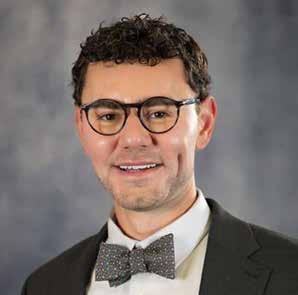
Jonathan Lambert-Melton is a three-term at-large member of the Raleigh City Council and a family law attorney. First elected in 2019, he has consistently advocated for bringing more housing and public transportation to Raleigh and was an early champion for what would become Raleigh CARES (Crisis Alternative Response for Empathy and Support), a set of alternatives to policing for people experiencing homelessness, mental health, or substance use-related crises.
If elected to the county commission, Lambert-Melton would be the only LGBTQ
commissioner and one of the only commissioners with municipal government experience.
“[Wake County’s] growth issues could use some local governance experience,” Lambert-Melton said. “Some of it is directly inside the county commission’s wheelhouse, and some of it is more about ‘How do we cultivate these partnerships and thread the needles through our different municipalities?’ We have a substantial housing deficit in the county, and Raleigh is doing its fair share on land use and zoning reform, but we need the help of some of these other municipalities.”
Lambert-Melton said Wake County has solid plans for how to accommodate its rapid growth— plans for things like longterm land use and bus rapid transit—but the challenge lies in implementing them.
“I want to be there to constantly beat the drum of ‘What is our next benchmark? What progress are we making toward this goal? What needs to be changed?’” he said. “We’re so far behind right now that we’re playing catch-up.”
Repurpose underutilized county-owned land for affordable housing
Raleigh is already doing this: “A few years ago, we made a decision that we were going to move our city-owned land into production for affordable housing, or we would sell it and then take the proceeds and invest in our affordable housing fund,” Lambert-Melton said. “It makes no sense for the city to own vacant property.”
The city has sold land to the Raleigh Area Land Trust (RALT) for the Cottages of Idlewild, an affordably priced cottage court development; has partnered with Southeast Raleigh Promise to build affordable rental homes within walking distance of downtown; and is working with an affordable housing developer to build 160 new housing units on cityowned land near Moore Square, a project that was partially financed by the sale of other city properties.
Wake County also owns a lot of underdeveloped land—including, for instance, a big parking lot next to the Smoky Hollow development in downtown Raleigh.
“That could be used for affordable housing,” Lambert-Melton said. “That could be sold to private development, and the proceeds could be used to fund things like affordable housing or help plug the gap on public education.”
The first step, he said, would be to assess where Wake County’s underutilized property is located and how much is suitable for affordable housing.
Scale Raleigh’s CARES program for the whole county
CARES includes a crisis call diversion line housed within the 911 call center, a police and social worker co-response unit housed within the police department, and a case management team that provides longer-term support for residents in crisis.
“I would love to see the Raleigh CARES program adopted county-wide and scaled,” Lambert-Melton said. “I think we can do that. We will need to get the buy-in from the municipalities, and the county can be the quarterback on it. If we can get everyone on the same page, that could be a fantastic way, county-wide, to care for our residents.”
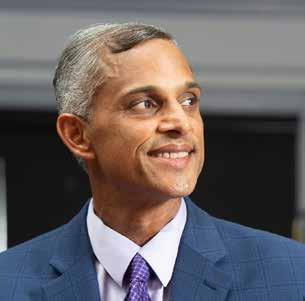
Steve Rao retired from the Morrisville Town Council at the end of 2025 after 14 years as an at-large member. In that time, he helped bring new public schools, infrastructure improvements, affordable housing, and a professional cricket stadium to Morrisville.
“I was the front man, I was the ambassador of Morrisville,” he said. “I worked with the county commissioners, I went to the school board meetings, I worked with [the North Carolina Department of Transportation] to get all of this done.”
As a county commissioner, Rao said he would continue to push for economic development opportunities, housing, and education funding, this time for all of Wake County.
“I don’t believe there’s time for on-thejob training for the commissioners,” he said. “So if I win ... [then] on Day 1, I’ll be ready to lead. I already know who I’m gonna call. I’m not trying to brag, but I’ve got a lot of people in this phone, and that’s how I work.”
Bring Morrisville’s Language Access Plan to all of Wake County
In 2024, Morrisville approved a plan to provide free translation and interpre-
tation services for its diverse, multilingual population. The first step was to translate important town messages and signage into Hindi, the most commonly spoken language in Morrisville after English. Eventually the town plans to offer more resources in Spanish, Vietnamese, and Chinese.
“Given how diverse the county is, that would be a perfect program,” Rao said. “You could replicate it in Cary, you could replicate it in Apex, you could replicate it in Holly Springs.”
Don’t allow new data center construction until we set rigorous standards
Data storage facilities are popping up all around the country to power artificial intelligence. They’re big and energy intensive and create few permanent jobs, galvanizing residents to oppose their construction. Wake County is no exception: a data center proposal in Apex has raised concerns about water and energy use, noise pollution, and rising utility bills.
“Let’s hold off on these massive data centers until we have a better standard set in place by the state, by the county, by Governor Stein’s AI Task Force,” Rao said. “What is the energy strategy? What kind of changes do [we] have to make in the [land use ordinance]? What are the requirements we’re going to impose on these data centers so that they’re using nuclear, they’re using solar, they’re using renewables?”
Rao said Wake County should take the lead on developing a data center strategy—as well as a broader AI strategy—that all the towns can follow.
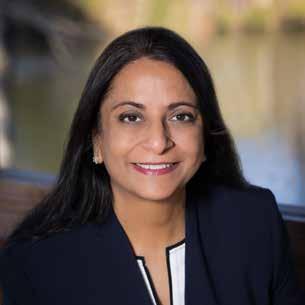
Mona Singh grew up in Delhi, India, where in 1984 she saw fellow Sikhs attacked and killed in a wave of mob violence that targeted the small religious minority, claiming thousands of lives. She immigrated to the U.S. for college in the late 1980s, and later became an American citizen.
“The first thing I did after I was naturalized was go and register to vote,” Singh said.
“The viewpoint that I bring, from being an immigrant and seeing the world, [is that] people take things for granted because they haven’t seen how things can go wrong.”
Singh lives in Cary and works in technology; she has about 130 patents to her name from her contributions to smartphone technology and augmented reality. In her spare time, she volunteers with the Wake County Democratic Party (she is a former precinct chair), teaches English to refugees, and serves on the Town of Cary’s Information Services Advisory Board.
Use smart technology to improve county services and save money
In her professional life, Singh focuses on people-centric design for technology. A lot of her work involves observing how people— from doctors and nurses to car mechanics and J.Crew buyers—work, then designing systems to make that work easier and cheaper. She said Wake County can do the same thing.
“The biggest problem is understanding what the problem is. Once you know that, then you can find a solution,” she said. For Wake, Singh believes a big part of the problem is silos between different county services.
For example: “Why can’t you register to vote when you go to get health care?” she wondered aloud. “Why do you need to create a separate office? When you start observing things with that mindset, you can get a tremendous amount of savings. And it’s not just savings, it makes lives better.”
For Singh, smart technology is a tool for human connection. She imagines a future where Wake County has an Uber-like app to coordinate rideshares on public microtransit. She wants to collect more data on violations of the county’s nondiscrimination ordinance in order to identify patterns and root causes of discrimination. But she’s also cognizant of the risks tech can pose to privacy and people’s jobs.
“We need someone [on the commission] who really understands” artificial intelligence and smart technology, Singh said, “because otherwise we’re not going to have any benefits, and we’ll have all the problems.”
Find creative ways to tax Wake’s wealthiest residents
About 75% of Wake County’s budget comes from property taxes. Singh wants to find ways to generate more tax revenue without burdening low- and middle-income residents who have already seen their tax bills rise in recent years.
“Our hands are tied in a lot of ways,” she
said. “The legislature doesn’t give us the ability to have progressive taxes. They’re getting rid of corporate taxes. Income taxes are coming down, and then we’re giving out [private school] vouchers. That’s the problem.”
In lieu of a progressive property tax, Singh proposes that the county impose an extra tax on certain features of only the biggest, most expensive homes. She wants to “work around our constraints but still generate more tax revenue without hurting people.”
“If you look at the $6 million homes, generally, they’ll have big outdoor kitchens or patios,” Singh explained. “Right now we only tax heated and cooled areas, but what else can we include?”
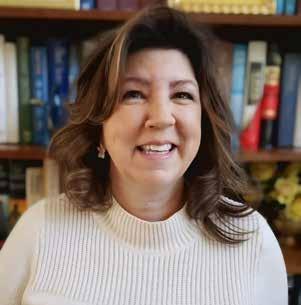
Marguerite Creel runs a tutoring business in Raleigh and lives nearby in an unincorporated part of the county. Before moving to North Carolina 20 years ago, she worked in the Clark County, Nevada, district attorney’s office and the Clark County manager’s office. Creel has taught classes on local government and political science at the UNC School of Government, Peace College, and the University of Nevada, Las Vegas. She ran for NC House District 40 as a Democrat in 2022. According to state voting records, she consistently voted in Republican primaries from 2010 through 2018 and then switched to Democratic primaries in 2020.
Creel has a three-part platform: Take better care of Wake’s senior citizens, secure reliable and sustainable energy sources for the county, and improve Wake County public schools by offering more electives and more online and summer classes and spending less on noncitizens.
Stop charging seniors property taxes
Creel said Wake County’s senior residents should not have to pay property taxes on their primary homes. The county currently has a limited number of property tax relief
options for low-income seniors with disabilities. Creel’s idea, which is much more expansive, would require approval from the General Assembly and could reduce the county’s annual revenue by hundreds of millions of dollars. Asked where she would cut costs or raise new revenue to fill that hole, Creel said the county should pursue more public and private grant opportunities. She said seniors would be inclined to donate money to their most-valued local programs in lieu of paying taxes.
Save money in Wake schools by spending less on
Creel said she thinks the Wake County Public School System should spend less money on noncitizen students in order to slim down its budget. Asked why and how she would do this, Creel said “we are supplanting our kids with foreign students. ... At some point it’s too much.”
It is unclear how WCPSS would be able to target funding cuts to immigrant students when the school district does not track students’ citizenship statuses. Creel said she does not support cutting funding to English as a Second Language instruction. She stressed she is “pro-immigrant” and “pro-culture.”
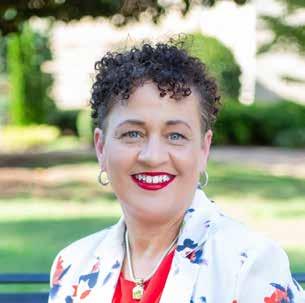
Kimberly McGhee is a small business owner and community advocate who lives in Southeast Raleigh. McGhee does not have experience in local government, which is kind of the point of her campaign: “I’m a learn-it-all leader, not a know-it-all politician,” she said.
McGhee said she wants to bring an activist’s perspective to county government: to spend more time in the community and demystify the commission’s work for residents who don’t understand or feel disconnected from it.
Bring county government to the people through town hall-style events
McGhee would use town hall events to gather resident feedback and crowdsource priorities for the county’s annual budget.
“I am a person that will get out there in the community and listen to what you have to say, even if it’s not pleasant,” she said. “It’s so simple to bring people together to listen and say, ‘What does your town need? How do you feel like the commission office can come and support you all?’”
McGhee especially wants to bring young people and working people to the table who otherwise wouldn’t be engaged in the county’s work.
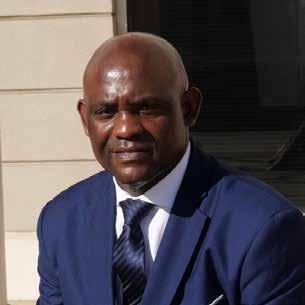
Robert Mitchener is a former Wake County deputy sheriff and current State Capitol Police officer. He said 30 years in law enforcement across different jurisdictions and in the school and criminal justice systems have made him acutely aware of some of the most difficult issues Wake County residents contend with, like the rising cost of living and homelessness.
When it comes to addressing those issues, Mitchener doesn’t have firm goals. He has not held local office before. He said he wants to serve the county at large because “there’s not a street or highway that I have not been on, not a neighborhood that I have not been in,” from his time in the sheriff’s department.
More mental health resources for first responders
Mitchener supports expanding mental health resources for all Wake County residents, but he noted the particular strain on first responders.
“They do a lot of things that the average person does not see or do, and sometimes they are in crisis situations,” Mitchener said. “Ask them, do they want to speak to someone to help them? We need to put something in place where the first responders can get that kind of one-on-one talk when they go through a crisis situation.”

Yes in God’s Backyard, a zonal transit system, MLB to Raleigh—here are the big ideas at-large candidates for Raleigh City Council are bringing to the table.
BY JANE PORTER jporter@indyweek.com
The city of Raleigh has changed how it elects its eight-member city council, and for the first time ever this year, it’s holding a nonpartisan primary election on March 3 for all seats for which more than two candidates have filed to run.
The council’s two at-large seats and District C seat feature competitive primary races. All Raleigh voters will vote for two candidates in the six-candidate at-large race, and District C voters will vote for one of four candidates in that primary. The top four vote-getting candidates will advance to the at-large general election in November, as will the top two vote-getters in District C.
In the general election, the mayor’s seat and all city council seats will appear on the ballot. All of those races
are competitive except District B, where the incumbent, Councilmember Megan Patton, is running unopposed. With at-large council member Jonathan Lambert-Melton leaving the city council to run for one of two new at-large seats on the Wake County Board of Commissioners, Raleigh is guaranteed to have at least one new member on council in 2027.
Going forward, city council members will serve four-year staggered terms, starting in 2027 for the mayor, District A and B council members, and the at-large council candidate who gets the most votes in November, who will serve through 2030. An election in 2028 will see council members elected again in Districts C, D, and E and for the other at-large seat, with terms lasting through 2032.
Over the last month, the INDY spoke with the six candidates running for the two at-large seats about their backgrounds and priorities, what they think sets them apart from the other candidates, and the big ideas they want to bring to the Raleigh City Council.
Voters can check their registration, view sample ballots, and find their polling places on the Wake County Board of Elections website.
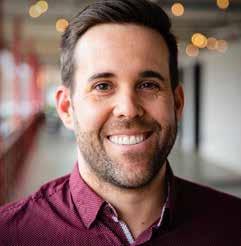
Clark Rinehart, a Miami native and industrial engineer, has lived in Raleigh for 17 years after moving to the Triangle to study theology at Duke Divinity School. A current resident of District C, Rinehart pastored a church in North Raleigh for nearly a decade before holding community-building and social entrepreneurship roles across the Triangle, including with the Loading Dock, Innovate Raleigh, and the Chapel Hill Downtown Partnership.
Rinehart said the intersection of community engagement, community development, and economic development that is a feature of his professional life positions him well to listen and learn from Raleigh’s communities and “figure out how to get folks as many living-wage jobs as possible so that they have the kind of opportunities ... a lot of us dream of for ourselves and our neighbors.”
Council priorities
• Housing affordability
• Public safety
• Infrastructure
• Entrepreneurship culture
BIG IDEA
Work with clergy, elected leaders, and other partners to use church-owned parcels of land for the community’s benefit
According to data he compiled in 2023, faith-based organizations own roughly 150 acres assessed at $500 million inside the Beltline, Rinehart said. But, due to their tax-exempt status, the city isn’t collecting revenue on what often amounts to prime real estate.
“For me, once you start to own parcels of land and then not always utilize them well for community benefit, that’s kind of a double burn on the community,” Rinehart said. “You’re not paying in appropriately, like others do who don’t have that privileged tax class. [And then] Wednesday nights and Sundays are your key days, and otherwise, a lot of these entities are not actively using their space.”
Rinehart said he’s been looking at ways local churches make decisions around land use and how they could use property they own “to “create the kind of affordable and attainable housing that we dream of in our city.”
“I would love to see ‘Yes in God’s Backyard’ become more of how we think about building housing, particularly in the urban core, with some more density,” he said.
Church-owned parking lots, especially, are prime for this kind of redevelopment, as many are already zoned for high-density mixed use, close to affordable parking options downtown, and located along the city’s busiest public transit routes.
“[This] is one of the easiest on-ramps to create housing supply with partners that say they want to be a good neighbor and have a privileged tax class to potentially help get it done,” Rinehart said. “[We should have] a more robust conversation about what a paradigm might look like to involve faith-based entities in the development mix and to look at different ways of public-private partnerships happening in Raleigh.”
and the newest to Raleigh. With a military background, the District D resident has lived and traveled all over the world, and in Raleigh he worked for a stint in the city’s transportation department. Zamot said his work in Raleigh “feels like I’m planting something in soil where it can grow.”
“Everything I’ve tried so far to get going in Raleigh, whether it’s the bike library or a weekly ride or a nonprofit ... has seemed to find roots in some way or another,” Zamot said. “Whereas in other places, I have tried to start things, and it feels like I’m planting something in sand or in rocks. It doesn’t feel like that here.”
Council priorities
• Affordable living and walkable neighborhoods
• Fewer traffic deaths
• Transit “that takes you where you need to go”
• Improved communication among city staff and elected officials
Make UDO text changes to create more diverse, mixed-income neighborhoods
Zamot said simple text changes to the city’s Unified Development Ordinance (UDO) would make it easier to build more densely without relying solely on high-rise buildings. Changing building setbacks and minimum lot sizes in certain zoning districts would allow for greater density, he said, as would allowing quadplexes in more places (then one unit of each new quadplex, he said, could be classified as affordable). Additionally, Zamot said, the city opting into the state-legislated exempt-plat program, as Durham has done, would make it easier to subdivide lots into three parcels for smaller-scale, multi-unit building.
Implement a zonal service transit system
Zamot advocates transitioning from a “hub and spoke” model for Raleigh’s bus service to a zonal service, or “point to point” service system. In the hub-and-spoke model, all transit service is routed through one or a few central hubs—in Raleigh’s case, the GoRaleigh station downtown.
In a zonal service system, the city would be divided into zones, with bus travel within the different zones. Zamot said the city needs to look at moving some services away from the GoRaleigh station, a position he knows is controversial but said would “make the city better.”
car broke down ... doesn’t have to take two separate buses and a 15-minute stop to get to work—then that is the solution.”
In the 26 years she’s lived in Raleigh, Sana Siddiqui has graduated from North Carolina State University, built a product management career in the manufacturing industry, started a small business, was one of the original founders of the First Friday Movie Night and Market that’s now run in partnership with the city of Raleigh, and volunteered on the city’s Hispanic and Immigrant Affairs Board, Environmental Advisory Board, and Human Relations Commission.
“All of that experience,” the North Raleigh resident said, “has given me a good understanding of what it’s like to live in the city, how the city works, where things may get stuck, and where are the challenges, what needs to be done better. ... I’ve worked directly with people across the city from different backgrounds, so I get to see challenges different communities have.”
Council priorities
• Small businesses
• Growth, neighborhoods, and housing
• Support for city staff
• Community engagement
Bring together leaders from different communities
Siddiqui said she wants to find a way— potentially through Raleigh’s restored system of Citizen Advisory Councils (CACs)— to engage leaders from different resident communities and “bring them to the table, get them to care [about city operations and opportunities], so that they can get people within their communities to care.”
no community. I know they’re disconnected overall. They do things together as a community, but there’s a disconnect when it comes to engaging with the city or getting their feedback.”
Siddiqui wants to support small businesses as they grow by improving the city’s permitting processes, strengthening the city’s small business grant programs, and exploring commercial rent incentives or other relief tools as operating costs continue to rise.
Siddiqui said providing businesses with clear timelines and faster approvals for lowrisk permits could help storefronts open faster, and she wants to conduct an audit to identify bottlenecks and make data-driven improvements. She said better communicating grant opportunities to businesses will make those programs more accessible.
While mandating that developers include affordable housing in projects is not legal under state law, Siddiqui advocated taking a more aggressive approach to incentivizing developers to include affordable units. She suggested looking to Chapel Hill, where town leaders have traditionally negotiated for more affordable units by tightly controlling zoning designations and fast-tracking projects with more affordability.
The founder of the Bike Library, a café and bike rental company that opened in July in Boylan Heights, Cameron Zamot is the youngest candidate for the at-large seat
“If we stop dipping every single line into the GoRaleigh station, more people will want to use the bus, and that is what I want,” Zamot said. “I believe that if we move some of them out—and my friend whose
“I’m an immigrant and I am involved with my faith-based community,” Siddiqui said. “I’m involved with my cultural communities, and many of the people are very disconnected. I have a lot of friends from the Lati-
The only self-described socialist and Green Party candidate in the race, Joshua Bradley is a District A resident and frequent public commenter at City Hall, embarking on his fourth run for a Raleigh City Council seat. (In 2024, running at large, Bradley placed sixth out of seven candidates.)
Bradley said he’s motivated by a desire to be a voice for Raleigh’s workers and low-income and unhoused residents.
“There needs to be somebody with a con-
science in there [on the council],” Bradley said. “People say, ‘Well, business needs a seat at the table,’ but business owns the table, right? It’d be nice to have the workers represented, the people that are otherwise, or generally, ignored.”
Council priorities
• Housing justice
• Racial justice and equity
• Workers’ rights
• Environmental justice
• Nondiscrimination and community inclusion
Prioritize building affordable housing on city-owned land and expand housing services
Bradley said it would be cheaper for the city to continue to build housing on the hundreds of acres of land it currently owns than to offer “sweetheart deals” to developers to build units that aren’t far below market rate. (Raleigh is already building affordable housing on land it owns; notable projects include the Cottages of Idlewild, a partnership with the Raleigh Area Land Trust; the affordable rental homes partnership with Southeast Raleigh Promise; and the 160 new units planned for cityowned land near Moore Square.)
Bradley added that reallocating money in the budget to services for low-income and unhoused residents improves public safety.
“Forcing people through the jail system, arresting people for loitering ... is more expensive than actually providing housing, and it does no favors to the people that are victimized,” Bradley said.
Fully fund the Crisis Alternative Response for Empathy and Support (CARES) program
While Raleigh has launched a new crisis diversion call line that operates outside of the police department, the City of Oaks still trails peer cities in terms of alternative response programs. Durham, for instance, has created an entire team separate from the police that works to reduce harm and extend care. Its crisis response unit—the Holistic Empathetic Assistance Response Team (HEART)—is embedded in the 911 center and has responded to more than 40,000 calls with and without first responders.
“[Raleigh] started the referral from 911, which is good, but it needs to be fully funded, because we don’t need police out trying to help people in crisis,” Bradley said. “We, as a society, need to redesign how we do policing. But I think [fully funding] the
alternative crisis response ... would help ... [and police officers] could focus on more traditional policing, stuff that they, in theory, have training for.”
A 20-year veteran of the U.S. Army, James Bledsoe is running for a council seat for the third consecutive election cycle, following a run for the Raleigh District C seat in 2017. In 2024, Bledsoe placed third in a field of seven candidates. While he has run on a conservative platform in the past, Bledsoe is running as a registered Republican for the first time this year. After serving three tours of combat, deploying to both Iraq and Afghanistan, Bledsoe retired from the military last May. He has worked in IT roles for the state of North Carolina for 14 years and is pursuing a bachelor’s degree in criminal justice.
Bledsoe said he wants to fully audit the city’s budget, eliminate wasteful spending—such as spending on art for police and fire stations—and pay off the city’s debt. “I would love to start fixing things around here without raising taxes,” Bledsoe said.
priorities
• Affordability and the housing shortage
• Infrastructure improvements
• Public safety
• Support for first responders and veterans
BIG IDEAS
Work with the U.S. Army Corps of Engineers on infrastructure improvements
Bledsoe proposes using federal grants to improve city infrastructure, such as stormwater and sewer systems.
“After working with Army Corps of Engineers for as long as I have, there are a lot of resources I could tap there, and honestly we could certainly use their help,” Bledsoe said. “It would be good training for them to be able to look at infrastructure development or redevelopment for
Raleigh. It’s not free but ... it’s certainly an avenue worth approaching.”
Lobby the General Assembly for a property tax relief program for longtime homeowners
In North Carolina, 100% permanently disabled veterans are eligible to receive a $45,000 tax exemption on the appraised value of their primary residence. Bledsoe wants to lobby the General Assembly to pilot a program that would extend that tax exemption to homeowners in Raleigh or Wake County who have owned and lived in their homes for 20 years or longer.
“That would help a lot of folks who have sticker shock when we have property tax increases,” Bledsoe said.
Raleigh updated its rules around motor vehicles in parades following a young girl’s death in the city’s Christmas parade in 2022. Since then, the annual Veterans Day parade in November has not happened.
“I want to remove a lot of these requirements for these 70-plus-year-old men that are just trying to drive their own vehicles downtown to have a parade,” Bledsoe said.
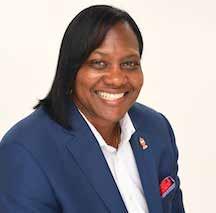
The only incumbent in the race and the top vote-getter in the 2024 at-large election, Stormie Forte has served on the Raleigh City Council since 2020. Forte is a licensed attorney and a principal at a consulting services provider that assists businesses with economic development opportunities. As a guardian ad litem for the state, Forte also provides legal representation to children involved with social services cases.
“I want to convey to folks that I’m happy to serve on the council,” the Raleigh native and current District D resident said. “Being the first Black female to serve on the Raleigh City Council, being a member of
the LGBTQ community as well, provides a diversity of experience, but also diversity of perspective, which is important to have on the council.”
Council priorities
• Affordable housing accessibility
• Efficient public transit
• City infrastructure improvements
• Economic development for small businesses
Bring a Major League Baseball team to Raleigh
Forte is an avid sports fan, but it’s the economic impact of landing an MLB expansion team that she sees as a key opportunity for Raleigh’s future.
“You’re talking about an average of, maybe annually, a $3 billion impact and tax revenues that, I mean, there’s just so much stuff that we could fund if we were able to secure a team,” Forte said.
Money from baseball could pay for affordable housing initiatives, more shelters for unhoused residents, and “certainly being able to fund the ramp-up a little bit more quickly of getting more positions into public safety, the police department, the fire department, but even all of our [city] staff,” Forte said.
While Raleigh’s last budget gave city staff average raises of 9% to 11% without increasing taxes, Forte said having a professional baseball team in town would mean keeping city worker salaries competitive in perpetuity.
“[A team] would also have a reverberating impact on our small business community,” Forte said. “Just the revenue from having that amount of people coming into the city to watch 82 baseball games a year—it would certainly be a game changer for our community if we were able to get that done.”
Forte said she’s optimistic about Raleigh’s chances of pulling it off. It’s a well-run, well-managed city, she emphasized, and doesn’t have some of the same problems as peer cities and neighboring towns. Plus, Raleigh frequently tops lists of best places to live, work, and raise a family.
“We’ve just got to make sure that information gets in front of the people who make the decision about whether we get a team,” Forte said. “Because [compared] to other markets that are under consideration, our numbers are probably a lot better in terms of folks who want to come to the games. ... We’ve just got to put our best foot forward and really showcase Raleigh.”
A three-way primary that will decide who succeeds longtime Wake County District Attorney Lorrin Freeman hinges on experience—and perspective.
BY JANE PORTER jporter@indyweek.com
Much has changed about Wake County—not to mention the state, nation, and world—since incumbent District Attorney Lorrin Freeman was first elected as the county’s chief prosecutor in 2014.
After growing by more than 200,000 people (or about 20%) in the last decade, Wake became the state’s most populous county. The year 2016 saw the rise and election of Donald Trump. A global pandemic followed in 2020, as did widespread civil unrest, the likes of which are playing out again in the streets of cities across the country as stepped-up federal immigration enforcement becomes increasingly violent.
All of these events have impacted the DA’s office, and
it will be a much different place for Freeman’s successor—in all likelihood, one of three Democrats running in the March 3 primary—when they step into it in 2027. (No Republican filed to run.)
Today, the challenges the office faces are manifold: A staggering lack of resources (Wake County, despite being larger, has half as many prosecutors as Mecklenburg) means assistant district attorneys are overburdened with their caseloads, resulting in backlogs, scheduling delays, and an overcrowded jail. Morale among prosecutors is low, local attorneys say, and turnover is high. And whoever comes after Freeman will have to navigate a changing local and national political landscape when it comes to policies
governing everything from public safety to immigration. Then there’s the question of how the office will move forward from Freeman’s three terms at the helm. Criminal justice reform advocates have criticized Freeman for her reticence to go after bad actors in law enforcement—she has never prosecuted an officer for fatal use of force, and many were confused by her ill-fated attempt to prosecute former Attorney General, now Governor, Josh Stein over allegedly lying in a campaign ad.
For the three candidates running, distinguishing themselves from Freeman, or not doing so, is a hallmark of their campaigns. And all three candidates would bring different experiences and perspectives to the role. Wake County voters will have their choice between a veteran of the office in prosecutor Melanie Shekita; a former criminal defense attorney who’s made his career in politics in Wiley Nickel; and an attorney with experience in the public and private sectors in Sherita Walton, who currently advises the Raleigh Police Department (RPD) and is Freeman’s choice to follow in her footsteps.
Campbell Law School graduate Melanie Shekita has worked in the Wake County DA’s office for 27 years. A Raleigh native and mentee of former DA Colon Willoughby, the Cary resident was a founding member of the office’s Special Victims Unit and has led the unit for the past 17 years. In that role, Shekita investigates and prosecutes sexual assault cases against children and adults in nonintimate
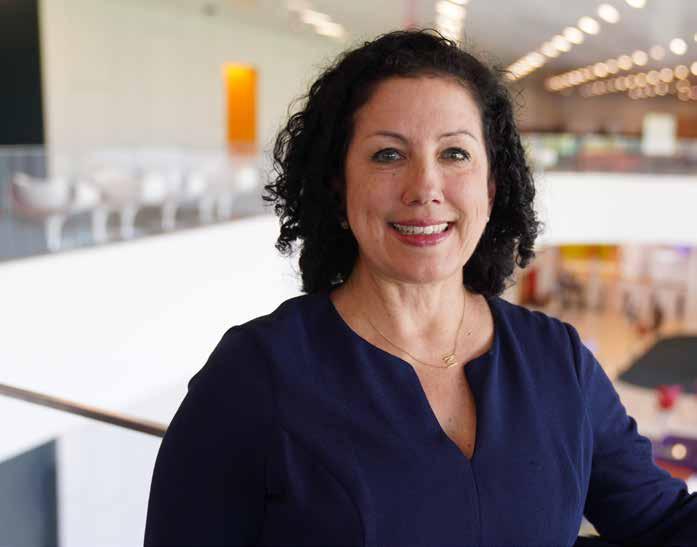
relationships, child exploitation cases, cases involving child sexual abuse material, and homicides.
If elected, Shekita said, her priorities for the office include reducing gun violence and tackling rising rates of juvenile violence through collaboration with law enforcement, the school system, and churches. She wants to fast-track the most serious offenses through the county’s logjammed courts system.
Despite her longevity in the office, Shekita is up front about her differences with Freeman’s management style. A big priority, she said, would be to recruit and retain experienced prosecutors.
“In order to keep the public safe, it takes time and resources to get prosecutors up to speed to be able to prosecute violent and more serious felonies,” Shekita said. “[Right now,] I don’t think people in the office feel valued. ... Sometimes members in our office are treated the same whether they work hard or if they don’t put forth as much effort, so my priority would be to incentivize folks to show initiative, good work ethic, and a commitment to the public.”
Shekita said it’s her years of experience in the courthouse, as well as her service in the greater community, that make her the best candidate for the job. She’s currently the board president of Criminal Justice Alternatives, a local nonprofit aimed at reducing jail populations and offering rehabilitative options via pretrial services and juvenile diversion programs, such as teen court. Shekita has served as a volunteer firefighter
single Republican for political corruption (Freeman has prosecuted multiple Republicans for what could be considered political corruption, including former state Sen. Fletcher Hartsell for campaign finance violations, a felony, and former Wake County Register of Deeds Laura Riddick for embezzlement by a public official.)
“Candidates who seek the office of district attorney should publicly commit that the office will not be used for political purposes,” Freeman said in an email to the INDY. “Failure to do so will undermine their ability to protect the public interest.”
Nickel says there is “a real issue of trust and accountability with that office right now.” He called some of Freeman’s decisions—like the one to investigate Stein— “head-scratchers,” and he said he wants to improve the Wake DA’s office’s relationship with the state attorney general’s.
But it’s not just the state level to do that.” Nickel made a direct connection between the strength of the Wake County district attorney’s office and the ability, at the local level, to stand up to Donald Trump, “who is shredding the Constitution in the Oval Office every day.” He pointed to Minneapolis, where federal agents have killed two people while conducting immigration raids. Nickel said that, right now, an officer convicted at the federal level can count on Trump’s pardon, so any justice for victims would have to come in the form of state charges.
“ICE will not get a free pass in Wake County,” Nickel said. “When I’m district attorney, I’ll use the full weight of my office to hold any federal agent accountable who breaks the law.”
and has “a unique understanding of being a first responder and being on the front lines,” she said. And Shekita was instrumental in opening the SAFEChild Advocacy Center, now located in east Raleigh, 10 years ago. Since then, the center has helped thousands of children involved in open investigations into abuse or neglect.
“I’ve demonstrated my commitment to Wake County and will continue to do so,” she said.
Wiley Nickel, a former criminal defense attorney who spent some time as a prosecutor in California, is no stranger to electoral politics. A former aide to President Obama, Nickel, also a resident of Cary, has since served two terms in the state Senate and one in the U.S. House before his district was redrawn. Nickel announced plans to run for North Carolina’s open U.S. Senate seat in this year’s election before former Gov. Roy Cooper entered the race.
In the Wake County DA primary, Nickel is staking himself as the most progressive candidate in the race, making a point of highlighting how differently he would approach the job from Freeman.
He has pledged to prosecute political corruption cases and go after law enforcement agents—including ICE and Border Patrol agents—who use excessive force. Nickel says the office is uniquely situated, in the capital, to investigate and prosecute corrupt officials. He said he would be more aggressive than Freeman in doing so, though inaccurately claimed she has not prosecuted a
With that posturing, Nickel may find he has a hard time convincing the Republican-controlled legislature to fund more prosecutors’ positions in the office, which currently has 43. Nickel’s solution, he said, is to look to the county and the city of Raleigh for assistance as some other offices have; Charlotte and Mecklenburg County, he noted, pay for 23 of the DA’s office’s 94 prosecutor positions.
“As a former state senator, I have the ability to go to my former Democratic and Republican colleagues to make that case and will continue to do that,” Nickel said. “I’m going to use every ounce of my political capital to get that done at the state level.
Sherita Walton is the one candidate in the race who isn’t purposefully putting much daylight between herself and Freeman. A prosecutor in the Manhattan district attorney’s office for eight years before she moved to North Carolina with her family, Walton joined the Wake County DA’s office in 2016, handling everything from low-level traffic infractions and break-ins to shootings and homicides and mentoring younger DAs.
Following a personal loss and George Floyd’s murder at the hands of police, Walton said she wanted to effect change before criminal cases reached the courthouse and understand the realities of the job for law enforcement. So in 2021, she
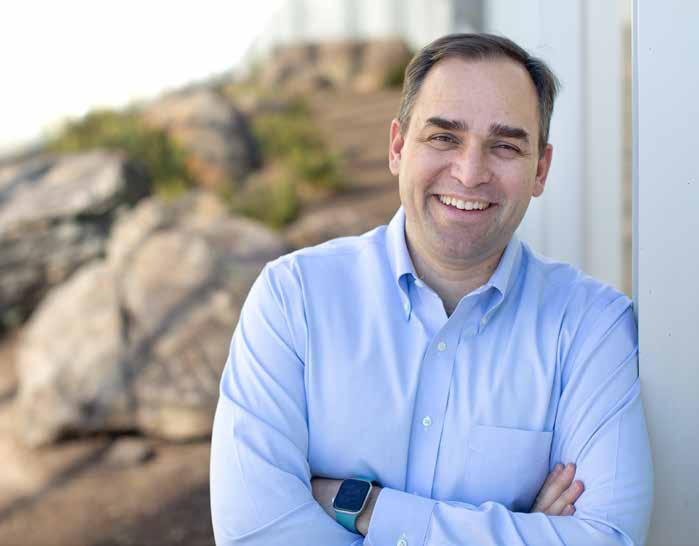
took the advisory role with RPD; there, she teaches recruits and officers on the legal aspects of their jobs while occasionally going on ride-alongs and assisting at crime scenes. Walton also advises the department on criminal law, procedures, and all public-facing matters, from use of force situations and mass shootings to release of body camera footage.
“My ‘why’ is I always like to see people at their best,” Walton said. “Coming from New York especially, growing up as an inner-city kid, I recognize law enforcement is needed, they are important to our ability to be safe as a community, and they need to be supported … internally. I want to provide my perspective from not only being a former prosecutor but from my lens as a person of color. [I want to be] helpful so officers are the best versions of themselves.”
Walton said her dual perspective as a former prosecutor and police adviser informs her public safety-first platform as DA. Out of the three candidates, she is the least concerned with the office’s lack of resources—“Coming from humble beginnings, you tend to make do with what you’ve got,” she said—but plans to fully audit the office’s operations to find ways to ensure violent offenses take priority on the courthouse calendar.
Like Shekita, Walton has suggested creating a specialized unit for violent offenses to get them fast-tracked through the court system so that victims and the accused can get justice more quickly. Also similar to Shekita, she proposed convening what she called a Youth Advisory Council to bring in diverse perspectives on how to tackle juvenile crime. Finally, Walton said, she wants to assign assistant DAs as liaisons to the different law enforcement agencies across Wake County in order to know more about what’s going on in those agencies, identify issues or patterns, and address problems before they become full-blown crises.
“But also it would allow for the ADA to make sure they are doing what they can to support law enforcement agencies’ efforts to keep their respective communities safe,” Walton said. “Things going on in Holly Springs [are] different from Raleigh, and I want each locale to feel like they have a voice in what happens in our courthouse.”
In the last four decades, only two district attorneys have served Wake County: Freeman and Willoughby, her predecessor. No matter what they think of the job Freeman has done over the past decade, local court watchers—activists, defense attorneys, members of the judiciary—seem largely to agree that the next district attor-
ney will need to make sweeping administrative changes.
The turnover—14 of 43 prosecutors quit in 2021, for instance—is a problem. The office has also drawn criticism for a perceived lack of diversity. News reports and courthouse workers suggest new assistant district attorneys need more comprehensive training to evaluate cases and prosecute them swiftly; some prosecutors in the office have been accused of serious malpractice.
Courthouse insiders, for their part, are lining up behind Shekita. She has endorsements from Willoughby, as well as from many former judges.
Jackie Willingham, a local defense attorney who criticized Freeman’s office over its handling of a case Willingham was working on in which a prosecutor was accused of withholding evidence, stopped short of endorsing Shekita but said she would likely be the best choice.
“As a career prosecutor, she’s more aware of the issues actually facing the office,” Willingham said. “Having welltrained prosecutors who can actually move cases would be very important to ensuring our clients’ rights are protected.” Willingham also noted that, having handled “really horrific” cases, Shekita has the perspective to know “what they need to go hard after and what is more of a societal issue, crimes that are charged that don’t harm anybody.”
For Dawn Blagrove, the executive director of Emancipate NC, a nonprofit dedicated to dismantling structural racism and mass incarceration, and an outspoken critic of Freeman, it’s Shekita’s long tenure in the DA’s office that works against her.
“[The Wake DA’s office] is not a place that needs incremental change,” Blagrove said. “It is a place that needs radical transformation. Anyone that has been associated with that office is going to be dubious, in my opinion, about whether or not they have the political will or the desire to create the radical change that I believe is necessary to create a … more just judicial system in Wake County.”
Blagrove and others are also suspicious of Walton’s background with law enforcement. RPD, especially, has come under scrutiny while Freeman has been in office, from officer shootings to the department’s use of a problematic confidential informant and, more recently, a police officer fired for conducting illegal searches and RPD’s handling of the investigation into the highway crash that killed Tyrone Mason.
“[Walton] will have a lot of ground to cover in earning the respect or the trust of the people in her ability to police the
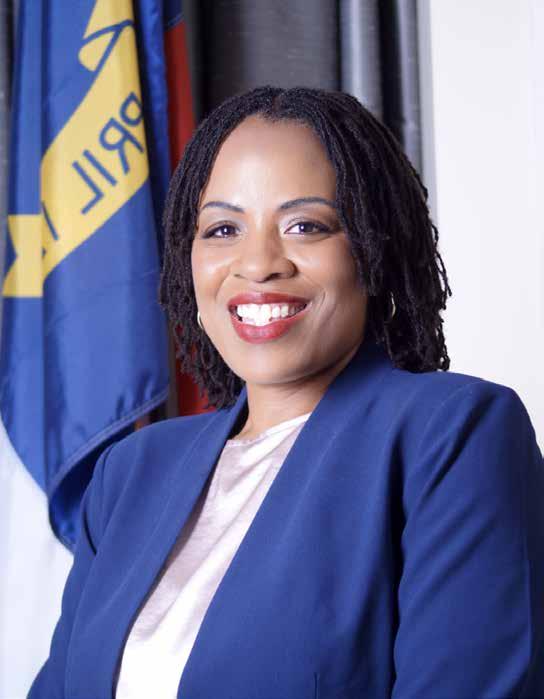
police,” Blagrove said. “She’s not making very strong indications that she is willing to disassociate herself from the time that she spent there, or that she is explaining especially why she would be someone that we should trust in creating accountability for police officers. I just don’t have any trust in that.”
Walton is used to hearing this line of critique. She said the only way she knows to build and maintain trust is through transparency, and when officers’ actions are in question, she is committed to putting as much information out there—such as police reports and body camera footage— for the public to see and decide for itself.
“[There’s a] likelihood of there being some skepticism about the decisions made, especially if I’m the one at the helm,” she said. “I get that, I understand. I’m not asking people just to accept what I say. I want you to see what I see too, and I’m going to explain where I come out on it based on the law and facts. At that point, I’ve provided the information, and it’s going to be up to the community that receives it how it lands on them, but it will not be from a lack of transparency on my end.”
Nickel—with his pledge “to protect the people of Wake County from the federal
government in the form of ICE” and his opposition to using cash bonds to hold people pretrial—”speaks to the fact that he might be a person who understands some of the real harms that these systems create and may have the wherewithal to change them,” Blagrove said. She said that for a candidate, she finds that encouraging.
But the legal community is less sure. Aside from the perception that he’s an independently wealthy outsider whose main interest is in holding an elected position, Nickel has no experience working in the Wake DA’s office.
But Nickel, who likely has the most name recognition in the race, not to mention the most cash on hand from fundraising from prior campaigns, pushes back on that characterization.
“You just have to look at what the job is,” he said. “[It’s] 100,000 cases a year ... running a large office, and most importantly, it’s expanding it. It’s focusing on policy that keeps our community safe. ... My goal is to do things for public safety, to keep our community safe, that we can show the rest of the state they can do, too. That’s how you set policy. ... That’s what the job is, and what my focus will be.”







As a Triangle resident, you have likely been stuck at home with your kids on a few (or a few too many?) occasions of late, with local school districts closing down for days due to recent winter storms. You may be thinking ahead to summer—when schoolʼs out, youʼre still working, and you need to keep the kiddos occupied. Yes, itʼs time to sign up for summer camp.
Our 2026 Summer Camp Guide is here with loads of options for all kinds of kids. Do they like to be outside? Send them to a rowing, horseback riding, or nature camp. Do they enjoy getting creative?
There are cooking, music, and pottery camps. Whatever your childʼs interests, and whatever summer camp your family chooses, you can be sure of this: while learning, playing, and adventuring at camp stay, theyʼll make memories that stick with them for a lifetime.





Artspace Summer Art Program
Artspace
Location: Raleigh
Ages: Rising grades 1-12
Contact: dpena@artspacenc.org artspacenc.org/summer-art-program
Blue Skies of Mapleview Horsemanship Camp
Blue Skies of Mapleview
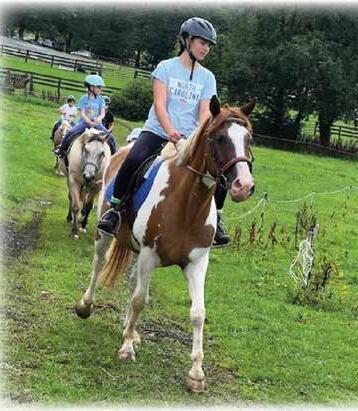
Our focus is on Safety, Fun and Connection!
www.blueskiesmapleview.us dpmblueskies@hotmail.com • 919-933-1444

Location: Hillsborough Ages: 8-18
Contact: cpmblueskies@hotmail.com blueskiesmapleview.us
Camp Riverlea
Camp Riverlea
Location: Bahama
Ages: 5-12
Contact: campersupport@campriverlea.com campriverlea.com
Camp RiverQuest
Camp RiverQuest
Location: Saxapahaw
Ages: 8-16
Contact: admin@hawrivercanoe.com tinyurl.com/campriverquest
Carolina Friends School Summer Programs
Carolina Friends School
Location: Durham Ages: 4-18
Contact: extendedlearning@cfsnc.org cfsnc.org/summer
Chestnut Ridge Summer Camp
Chestnut Ridge Camp and Retreat Center
Location: Efland
Ages: 5-17
Contact: info@campchestnutridge.org campchestnutridge.org
Creative Clay Camp for Kids
Glazed Expectations
Location: Carrboro
Ages: 5-12
Contact: susannah@glazedexpectations.com glazedexpectations.com
Emerson Waldorf School Summer Camps
Emerson Waldorf School
Location: Chapel Hill
Ages: 4-18
Contact: summercamps@emersonwaldorf.org emersonwaldorf.org/summercamps
Learn to Fence! Session 1: July 13-17, 2026
Forge Fencing Academy & Club
Location: Durham
Ages: 7-14
Contact: jeff@forgefencing.com forgefencing.com/summer-fencing-camps
Learn to Fence! Session 2: July 27-31, 2026
Forge Fencing Academy & Club
Location: Durham
Ages: 7-14
Contact: jeff@forgefencing.com forgefencing.com/summer-fencing-camps
Nike Camp with i9 sports
i9 Sports
Location: McDougle Middle School, Chapel Hill
Lowes Grove Middle School, Durham
Ages: 5-12
Contact: nicole.earnest@i9sports.com i9sports.com/programs/chapel-hill-mcdougle-middle-schoolnike-kids-camp-june-2026/177802
Nike Kids Camp
U.S. Sports Camps
Location: Lucas Middle School, Durham Ages: 5-12
Contact: nicole.earnest@i9sports.com i9sports.com/programs/durham-lucas-middle-school-nike-kidscamp-june-2026/177864
Piedmont Wildlife Center Summer Camps
Piedmont Wildlife Center
Location: Durham, Raleigh, and Chapel Hill
Ages: 5-17
Contact: camp@piedmontwildlifecenter.org piedmontwildlifecenter.org/summer-camp
Teen Learn to Row Camp
Triangle Rowing Club
Location: Jordan Lake, Apex and Chapel Hill
Ages: 13-18
Contact: director@jordanlakerowingclub.org jordanlakerowingclub.org




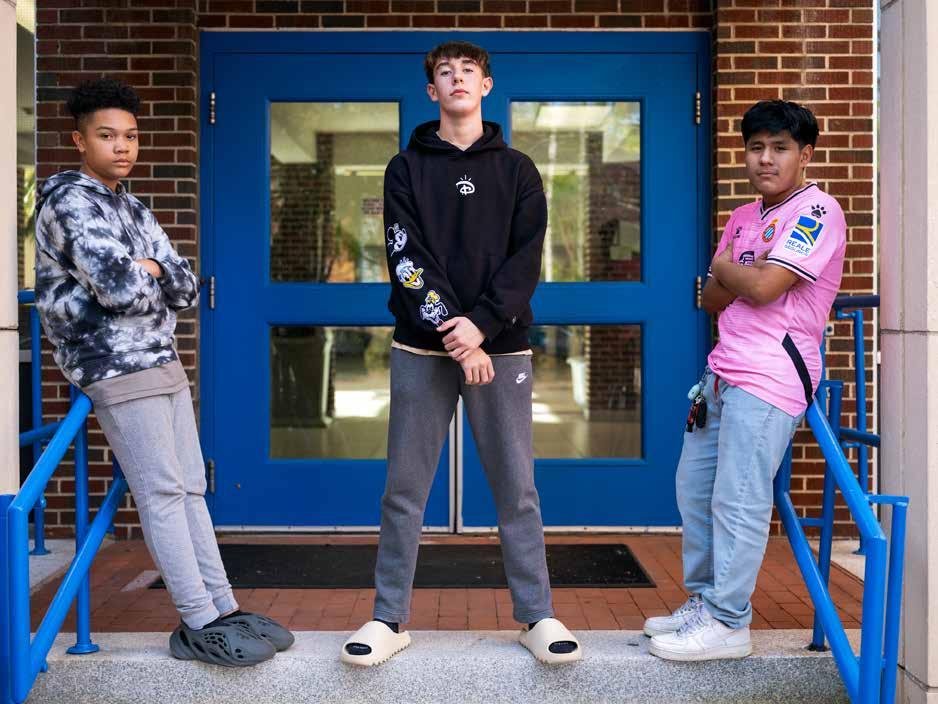
In a new exhibition, photographer Bill Bamberger showcases portraits of students at DSA. It’s the latest installment in his decades-long quest to explore masculinity.
BY JUSTIN LAIDLAW jlaidlaw@indyweek.com
What does it mean to “be a man”? For Durham photographer Bill Bamberger, this is a question that has consumed him since adolescence, when a fractured relationship with his father spurred him to better understand the complexities of masculinity.
Bill Bamberger: Boys Will Be Men, a new exhibit at the Ackland Museum of Art, is one way that Bamberger has explored the question. The project dates back to 1985, when Bamberger began working at Deerfield Academy, an all-male boarding school in Massachusetts, where he began documenting students in what would become an ongoing portrait photography series. In 2000, he picked the series back up at Flint Central High School in Michigan, continuing it again in 2023 at Durham School of the Arts (DSA). This new installment features 42 individual portraits of DSA students. In some, subjects are contrasted against a
jet-black backdrop; in others, students pose throughout campus—sitting on steps, lingering in hallways, and posing on athletic fields. A slideshow of the portraits loops throughout the gallery, playing anonymous audio messages from participating students.
All the portraits were taken by Bamberger’s steady hands, but he is quick to uplift his numerous collaborators. At the Ackland, Director Shalini Le Gall and Associate Curator Lauren Turner worked to commission the exhibit, he said. At DSA, art teacher Jack Watson served as Bamberger’s campus liaison. A crew of DSA students also assisted.
The exhibition took two years to complete. Students helped rehabilitate a dingy basement hallway into a studio and gallery space, where many of the portraits were taken before they made their voyage to the Ackland. Turner says that alongside learning craft techniques, students also
gained a deeper appreciation for their peers.
“[Students] were able to unpack the artistry behind the portraiture and say, ‘How does what this person is presenting compare to what I know of them?’” Turner said during the exhibit’s media preview. “‘Does it seem authentic? Does it seem inauthentic? Do I just not know them very well?’
And when the teachers started describing this to me, I was like, ‘That’s wonderful, because this wasn’t just Bill photographing and interviewing students for two years. It was a two-year dialogue.’”
Finn, a former DSA student who is now at Durham Technical Community College, said that while they initially had low expectations for the experience, it quickly became how they spent much of their free time. Having their portrait displayed, Finn said, helped them process masculinity.
“Because I’m not a cis guy, it was really interesting to hear how [other students] talk about their own masculinity,” Finn said. “How some people seem really insecure or sad sometimes and other people are really content and happy with who they are.”
To mark the exhibition’s opening, the INDY spoke with Bamberger about how the series got started and what the students have taught him along the way. This interview has been edited and condensed for clarity; a longer version is available online.
INDY: What steered you toward this project?
BAMBERGER: When I was a senior in college, my parents’ marriage was coming apart. My dad left home and took the family resources. He had squandered them, and we were left without any money. We lost our home. We had to move around. He was struggling with alcoholism.
I was probably 20, 21, but I was still trying at that age— we still don’t know who we are—and I was trying to figure out the kind of man I wanted to be and what that meant. So that’s what inspired the project—my personal search to understand who I was and what maleness meant to me then and what I could imagine going forward.
Your first project in Deerfield was in 1985. How was an exhibition on masculinity received back then?
In those days, we didn’t even talk about masculinity. Lauren Turner, the curator, asked a former [Deerfield] student, “How did you feel about Bill Bamberger doing his project?” He said, “What project?” I just went there to photograph boys becoming men and didn’t even know I was doing a project.
I think the best images are complicated. You can look at these images and try to imagine who they are, and maybe not really get there. They’re just like a moment in time. Richard Avedon—I love his work, [he’s] a great fashion photographer who’s done some really powerful documentary work, particularly his project in the American West. He says
all images are accurate but none of them are truth. I think that’s interesting. It’s like every one of these in that moment in time is a reflection of how they show themselves, but it doesn’t get to the greater truth of who they really are. It’s less about artistry and fanciness, but more about connecting with human beings.
Who are some of your other inspirations?
Let me talk about August Sander, a German photographer who set out to do a portrait of all of Germany, the people. The Third Reich was gaining power, in the beginning of the oppression and killing of many people. His work was later destroyed. His son was killed in a concentration camp. His images were very controversial, because he didn’t just show the Aryan race, the Germans’ view of what they wanted this country to be. He showed homeless people, he showed artists, he showed homosexuals— that was the word used at the time. He showed people of different races, and that was what was controversial. They did literally destroy a lot of his negatives, though many were smuggled out, and he became acclaimed. His portraits are very direct; I’d say less emotional than mine, evocative, but in some way more archetypal.
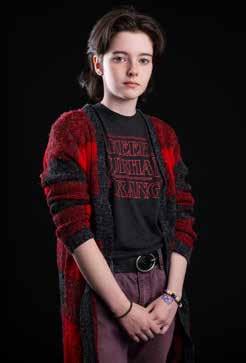
Given how times have changed since your first run of Boys Will Be Men and the spectrum of masculinity is more accepted in some ways, what was the initial pitch like with the subjects at DSA, and how was it received?
Things have changed so much. When I went to Deerfield, the hard part was just getting permission. They wouldn’t have me there unless I would teach. There was an art position that opened. So I went half-time as a teacher and half-time to photograph. I also coached. I helped with lacrosse, a little wrestling, which is my sport, and I helped with the JV football team. I think, because I had been in that world, they felt safe with me.
When I went to Flint, it was a full proposal based on what I had done at Deerfield. It was the largest grant in the history of the National Endowment for the Arts. It was Hillary Clinton’s initiative—called “America Creates for the Millennium” in the year 2000, and they reached out to one artist to place in every state and the six territories to do a project about being connected to the community.
When I went there, I did what I always love to do, which is look around. I had corresponded with Dick Ramsdell, who is still the social studies teacher there—I spoke


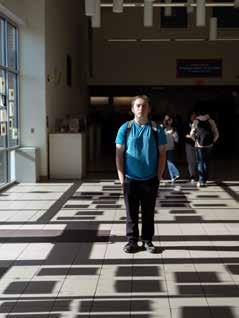
with him last week—he was all in. And then I went to the school to make a trip before I started. And this is after I’d been selected by the Flint Institute of Arts. So I gathered with a group of [Ramsdell’s] students, about 15 or 20, and I told them what I wanted to do. I told them about the book I had done called Closing, about the life and death of an American factory. That’s why Flint picked me, because GM [General Motors] said, “This guy’s going to come in and do something about factories closing.”
The first person to speak up was Robert Wishart. I’ll never forget this. Raises his hand. He says, “Are you going to come in here and do to us what everybody else does? As soon as there’s a story about people getting laid off, they come into Flint. They tell the story of our parents getting fired, of the shocks, the same clichés. We don’t want that, not again. So if that’s your case, go away.” And I thought it was such a great question.
The reason I was so drawn to [DSA] is because it is so diverse. Racially, economically, the educational background of the students, their gender. Some of them are students of old-school Durham parents who teach at Duke. Others are first-generation families to come here. We thought it would push the conversation about masculinity and maleness to a new place.
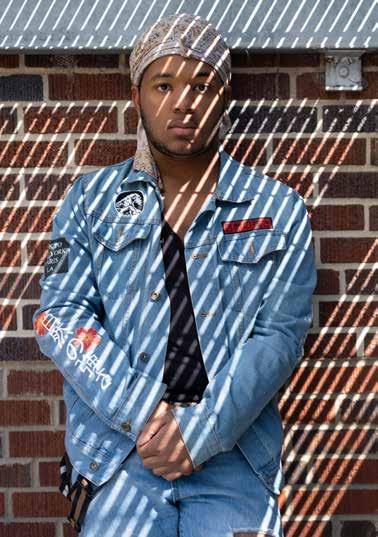
At Flint, we didn’t even use the word “masculinity” so much. We talked about what it is to be a man. The whole title “Boys Will Be Men,” it was my play on when I was coming up, and even up into the years of Flint, when boys would act in a way, when their behavior was out of line, they would say “boys will be boys” as if to suggest it’s OK. And sometimes that was bullying or breaking things or doing really mean things. So the point of the title is, no, they will be men. They will grow up. They will carry forward the good and bad of who they are. A lot of the students have never heard of that phrase, “boys will be boys.” It’s gone from the vernacular.
The first conversation I had was with a couple of faculty members, Holly Loranger, and my host, Jack Watson. They sat down to ask what we were about and what we were doing. And one of the first questions is how we would handle students who presented as female but who identified as male. And the answer was easy to me; we will include them, of course. I mean, I’m not going to ask them to provide documentation as to how they identify. I’m going to include them. That’s part of why we’re here, is to understand the full range of what masculinity is in this community.
You mentioned “boys will be boys” is not really in current vernacular, but the sentiment is still very much in the zeitgeist and has reared back with Joe Rogan and the idea of the Manosphere. Do you feel like there is a timeliness to this exhibit?
There’s no intention to push back. The one thing I push back on, which might be unexpected, is that I think there needs to be a healthier, safe place for young men, or young male-identifying students, to feel really good about being male. It’s easy to talk about all the things that are wrong. It’s easy to talk about toxic masculinity. In fact, a lot of these students are educated in that, and it sort of starts to sound the same. That was something I thought about with the interviews. We know what it is. We know it exists. But I think it’s harder to get at what is essentially unique and special. It’s hard when young people are coming of age. Part of being a progressive, for me, is also accepting others and bringing people in. And so, if people push back because we have students who present as female that identify as males, what’s the harm [in inclusivity]? Who are we to say who someone else is? It’s about inclusion on all levels. And that’s what this community, and I think that’s what I love about DSA, is that it is so inclusive.
MACBETH
Joan H Gillings
Chapel Hill | Wednesday, March 4-Sunday, March 22, various times
Talking with Ron Menzel and Vivienne Benesch, the real-life Chapel Hill couple starring in the upcoming PlayMakers production of Macbeth.
BY SARAH EDWARDS sedwards@indyweek.com
“We like to think of it as couples therapy,” actor Ron Menzel said with a laugh.
Menzel was referencing his upcoming lead role in Macbeth alongside his wife, Vivienne Benesch, who will take the stage as Lady Macbeth during the PlayMakers Repertory Company production’s upcoming run. It is the first time the couple has acted in the same play together.
“A couple sees all sides—the good, the bad, the ugly,” Benesch said over a recent video call, talking about the duo’s Macbeth chemistry. “I feel like we got a head start in understanding how to be intimate with each other, challenge each other, and accept the best and the worst of each other.”
The play also marks the first time that Benesch, who has served as producing artistic director at PlayMakers for a decade, will act in a company production— though as she relayed this information, Menzel was quick to jump in with praise: “I think it is worth mentioning that she’s an Obie Award-winning actor and has performed on Broadway.”
Such gentle rapport suggests that Menzel and Benesch probably are not in great need of couples therapy, and also makes the prospect of seeing them portray literature’s most doomed power couple all the more intriguing. Ahead of the play premiere, the INDY interviewed Menzel and
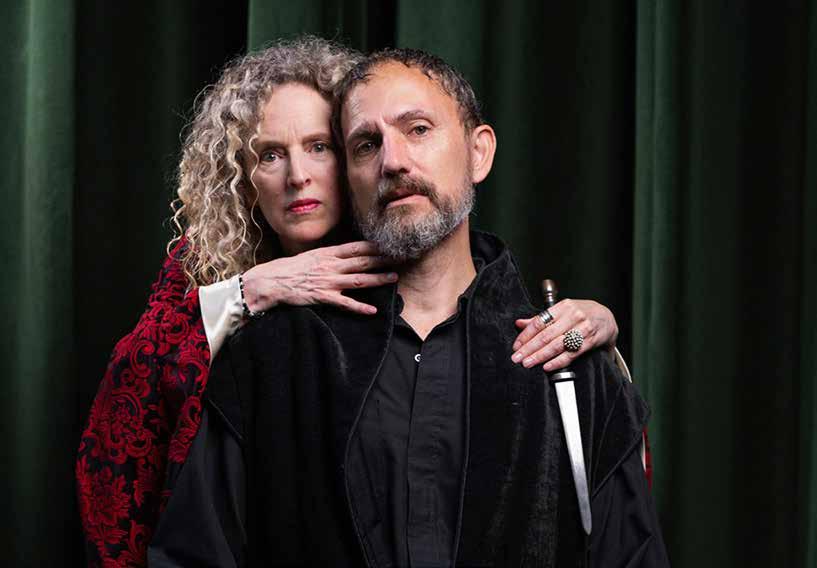
Benesch about Macbeth pillow talk, caring for each other in demanding roles, and how Shakespeare continues to speak to audiences today.
INDY: Can you tell us about the complicated relationship between Lady Macbeth and Macbeth? What is their dynamic?
MENZEL: Because there is a lot of heat in the play, one of the misconceptions that people have is that there’s great acrimony between the couple—when they’re actually, in a strange way, one of Shakespeare’s happiest couples. They certainly passionately argue about the course of this big event, which is the assassination of a leader, but they’re very united and love each other very much.
BENESCH: I would add to that in the very first scene where you meet me, [Macbeth] has written a letter where he calls me his dearest partner of greatness, with this idea of even more greatness promised them. Both Ron and I are really interested in the human quality. That they are not villains—that they come wanting the very, very best for each other. And they have been great partners, which in Shakespeare’s time, with Shakespeare’s couples, is rare. They refer to each other as partners, and I think that’s a beautiful thing. Unfortunately for Lady Anne, part of her journey and
sad trajectory into madness is not only the crime that they commit, and how [her conscience] overwhelms her, but also the loss of their partnership.
How does your own relationship inform your dynamic and chemistry onstage?
BENESCH: This will be the first time we perform together. I guess we’ll let you know!
MENZEL: We’ve worked together now as co-creators on a variety of projects, with Viv as director and me as actor, [or] both of us creating something together. We work really well together, I always feel, with theater. Familiarity is always an advantage. Oftentimes in rehearsal, you spend, like the first week, just trying to break down things— we’re just human beings. With familiarity comes the ability to use shorthand and go deeper, quicker in scenes, and that sort of thing. I’m looking forward to it.
BENESCH: It’s been a funny household here. We’ll be cooking dinner, chopping vegetables, and saying, “Screw your courage to the sticking place!” We’ll run lines all the time in domestic situations.
MENZEL: The other day, I woke up, and I heard her whispering something. I leaned over—she was whispering, and I got really close and heard “the attempt, and not the deed.”
BENESCH: That’s pillow talk. You’re like, “Okay, is there something you want to tell me?”
BENESCH: I’m excited. But—there’s also a darkness to this play, and to the spirit world of this play, and to the forces at work of our conscience and house. Tracy [Bersley], the director, is interested in this idea of how the power of suggestion can take your psyche over. Ron and I also need to take good care of each other during this time, because it’s a lot. This is a huge role he’s embarking on. The demands are some of the biggest, along with Hamlet and Richard III
MENZEL: The play contains a great tragedy of a dissolution, both of the couple and the people themselves. Viv is right that the care is important. Even though the characters have different trajectories, it is an ensemble event—all of us are in a benevolent conspiracy to communicate a strong desire to an audience. We really want you to have this experience.
Speaking of Hamlet, I wanted to ask if you saw Hamnet, and if you feel like there’s been a resurgence of interest and excitement around Shakespeare? Certainly, we’re living in times that feel somewhat Shakespearean.
BENESCH: I’m always hopeful when there’s a great new Shakespeare movie— whether it’s a Shakespeare movie, something based on Shakespeare, anything that can reignite the population’s interest in Shakespeare. I fall in the category that believes that Shakespeare still has everything to offer us, that his scope of understanding the human experience is so vast, generation after generation.
Hamnet is a great example of a film that really investigates that time period and makes you understand his plays from the inside of his and Anne Hathaway’s experience. I always hope that a good Shakespeare production will allow us to see ourselves through that scope of humanity, but at a poetic distance that actually allows us to get closer—if that makes sense? I hope that the poetry never makes people say, “Ah, Shakespeare, oh no, it’s not for me.” At its best, it’s actually an invitation into our souls.
MENZEL: I think that in some ways, with art, it’s got to hang around a while in order for people to say, “Boy, we just keep doing that.” Shakespeare doesn’t need us, we need Shakespeare. There will be people on Mars doing Shakespeare. These plays are going to be around for a long time.
BENESCH: And just to get back to Valentine’s Day—even if this play is not about the romance of falling in love, it still captures a deep joining of souls.
Is there a Shakespearean couple, aside from Lady Macbeth and Macbeth, that you’d like to play?
BENESCH: We did actually get to do this in COVID as a reading, but I think, probably just because I love the play in the role so much—Rosalind and Orlando in As You Like It.
MENZEL: We didn’t get the chance this last time they did it here, but Beatrice and Benedick, of course, in Much Ado About Nothing. It’s nice if we can do witty repartee—that’s good for me, that someone’s writing the lines, because Viv is much more articulate than me.
I would say, based on this interview, that you share a very witty rapport.
BENESCH: I will share, one of the most moving renditions of Juliet I’ve ever seen was by a 75-year old woman. Ever since I saw the great Lisa Harrow do the balcony speech at Chautauqua [Theater Company], I’ve been thinking, “Oh, I want to see a production where people in their 60s-plus play Romeo and Juliet.” So maybe we have that to look forward to. Though, that doesn’t end well, either.









Five nested stories in Resurrection, Rachel McAdams gets revenge in Send Help, and more films coming to local theaters.
BY GLENN MCDONALD arts@indyweek.com
Good news for the ass-end of this terrible winter: February brings a weird little clutch of intriguing films to local theaters, starting with three specimens from science fiction, fantasy, and horror.
Resurrection, from ascendant Chinese filmmaker Bi Gan, is actually five or six movies stitched into one. The premise involves a near-future scenario in which humankind has achieved maximum longevity and efficiency. The trade-off? We’ve lost our ability to dream.
Bi structures his film as an extended chase sequence through the mind of the world’s last rogue dreamer—five nested stories that each evoke a particular style of cinema. The result is a phantasmagoric tour of movies-as-dreams, with astounding imagery and painstaking production design. German expressionism bleeds over into stop-motion animation, or 1940s noir, or what have you. There’s a vampire involved, and Chinese folklore, and a climactic 40-minute single-take scene that everyone is talking about.
Resurrection features location shooting in several Asian and European cities, and it won the Special Jury Prize at last year’s Cannes Film Festival. Find it on a big screen if you can.
In similar spirit, director Gore Verbinski (The Ring) returns with the sci-fi comedy Good Luck, Have Fun, Don’t Die, which

offers another speculative vision to chew on. The inimitable Sam Rockwell headlines as The Man from the Future, a desperate time traveler tasked with averting an AI apocalypse. The trick is that he must assemble a band of heroes from among the customers in a random LA diner.
If the story setup seems familiar, that’s on purpose. Screenwriter Matthew Robinson deliberately splashes about in familiar tropes and movie moments: Bits of Groundhog Day are in here, and the Terminator films, and Everything Everywhere All at Once. Plus: gamer culture, simulation theory, and our accelerating AI anxieties.
The meta storytelling generates a self-aware Möbius strip style of comedy—and quite successfully, according to early reviews.
The cast includes Juno Temple, Zazie Beetz, Michael Peña, and the very funny British comedian Asim Chaudhry. But Rockwell is all you really need to know. He’s always the most interesting guy in whatever movie he’s in.
Finally, from the horror movie aisle, the darkly comic survival thriller Send Help may be the new year’s most thoroughly cathartic movie experience. Rachel McAdams plays a put-upon corporate employee whose boss—a sexist, egotistical, lying, hypocritical bigot—is about to steal away her long-awaited promotion. But when a plane crash deposits the two on a
remote island together, power dynamics get switched up nicely. Who’s the boss now?
The real selling point here (aside from McAdams) is director Sam Raimi, who made his fortune with the Spider-Man movies. But old-school fans will remember the hallucinogenic B-movie energy he brought to early films like the Evil Dead trilogy and Darkman. That’s the vibe he’s riding with Send Help, which is also earning critical points for a very clever script hiding twists within twists.
It’s a solid movie-night pick for anyone who daydreams of vivid justice served upon corrupt and illegitimate authority on the personal, professional, or federal level. Nothing wrong with a feel-good movie now and again.
Margot Robbie and Australian hottie Jacob Elordi play Catherine and Heathcliff in the much-anticipated adaptation of Emily Brontë’s 1847 romance, Wuthering Heights . Corsets! Repressed desire! Breathless passion on the Yorkshire moors!
Several local theaters are holding over the Brazilian political thriller The Secret Agent, set in the 1970s and starring Wagner Moura, since it was nominated for Best Picture at the upcoming Academy Awards.
Falconry enthusiasts will want to be aware of H is for Hawk, the film adaptation of author Helen Macdonald’s acclaimed 2014 memoir about grief and the healing power of nature.
A big hit on the festival circuit, the dark romantic comedy/drama Pillion stars Harry Melling and Alexander Skarsgård in a raunchy-but-tender BDSM love story. Families looking for an alternative kids’ movie may want to check out Arco, a French animated fantasy film with ecological themes and a 10-year-old hero from the year 2932.
Another four-letter family-film option: The animated sports comedy Goat tells the tale of, that’s right, an anthropomorphic goat determined to become the greatest of all time.
The heist thriller Crime 101 follows a jewel thief trying to pull off one last score. Chris Hemsworth plays the lead, which is unfortunate, but the supporting cast includes Halle Berry, Mark Ruffalo, Jennifer Jason Leigh, and—hey, is that Nick Nolte? It is!
The Carolina Theatre in Durham will host the 27th Nevermore Film Festival from February 27 through March 1. Nevermore is an international competition festival specializing in stories from the dark side—horror, science fiction, dark fantasy, animation, and mystery/thrillers.

North Carolina looms large in the history of modernist design. Committed local preservationists help keep the dream alive.
BY SARAH EDWARDS sedwards@indyweek.com
Once upon a time, America fell in love with a house. Built by Argentine architect Eduardo Fernando Catalano in 1954, it had the fundamentals of many other homes across the country: a foundation, floor, walls. What set it apart was its roof, a hulking hyperbolic paraboloid that swooped across the house’s 1,700-square-foot frame. Around Raleigh, people called it the Potato Chip House. Located off Ridge Road, the structure was crowned “House of the Decade” by House and Home magazine in 1956, earning a glamorous, Hollywood-like spread. The usually reticent Frank Lloyd Wright praised the design as “imaginatively and skillfully treated.” The roof, which had more than twice the square footage of the actual house, was a dramatic beacon of mid-century optimism, poised amid suburban pines as if ready to take flight.
But by the time the house was demolished in 2001, Catalano’s crown jewel had passed between hands for decades, eventually succumbing to squatters, rot, and age.
“Even a good dog has to die,” Betty Howard, the wife of famed local engineer T.C. Howard, remarked at the time. Or maybe they don’t. Just ask George Smart.
Smart, 64, a Raleigh native and son of an architect, has become North Carolina’s biggest ambassador for structures like the Potato Chip House. He lives in a modernist house. He hosts a weekly podcast on the topic and drives a red Mini Cooper with a license plate that spells out the word. And as the CEO and founder of the nonprofits NCModernist and USModernist, he’s made preservation and appreciation of this design trend his life’s mission.
The obsession began two decades ago when Smart, a management consultant, was preparing to build his own home in Durham. While researching architecture one night, he stumbled on photos of the Catalano house. He was intrigued but continued scrolling, then went to bed.
“At one in the morning, I wake up and go, ‘I’ve been at this house. My dad took me there when I was 6,’” Smart
said. “All that repressed architecture memory [came] back.”
The fate of Catalano’s home proved a preservation catalyst. Smart got up, took out a legal pad, and began making a list of similar houses.
“My dad had passed away by then, [but] I started visiting some of his 80-year-old buddies. They said, ‘If you just come pick me up, I’ll show you where they all are.’” He spent the next few months driving them around with a camera and taking notes. “Eventually, I get to, like, 50 or 60, and then somebody says, ‘Well, you know, you should get one of those free websites.’”
Smart ended up making two websites: NCModernist in 2007, followed by USModernist in 2015. On these websites, aided by a staff of four and a group of volunteers, Smart has built what he says is the largest open digital archive of mid-century modernist homes in the world. With a weekly newsletter mailing list of 92,000, it’s fair to say that he’s not alone in his appreciation for a style often associated with Mad Men, estate sales, and the opulent lairs of action-movie villains.
For most modernist devotees, though, appreciation extends beyond aesthetics to the principles behind it: Attention to the natural world, a refusal to rely on the past, vernacular fidelity to place and material, and an emphasis on fluid common areas that bring people together. In North Carolina, the height of modernism’s popularity, mid-century, represents a particularly pioneering, progressive chapter—one mostly, but not entirely, bygone.
Here, one of NCModernist’s taglines may be most instructive: “You can’t save something if you don’t know where it is or why it’s important.”
When Catalano arrived in Raleigh for his new job at North Carolina State University’s School of Design in 1951, he was initially taken aback.
“I was shocked when I saw the shack [at] the railroad station, especially after coming from England with their beautiful structures of steel and glass,” Catalano recounted in the book School of Design. No one could fault him for finding it surprising that this, of all places, had become a center of gravity for postwar design visionaries.
Part of the reason, alongside a legacy of nimble Southern craft and the state’s academic prowess, was historical confluence. In the early 1930s, as the Nazi Party gained power, it began to target German cultural institutions— including Bauhaus, the famed neosocialist school where students were taught to design for a better world and embody the adage “form follows function.” In 1933, the
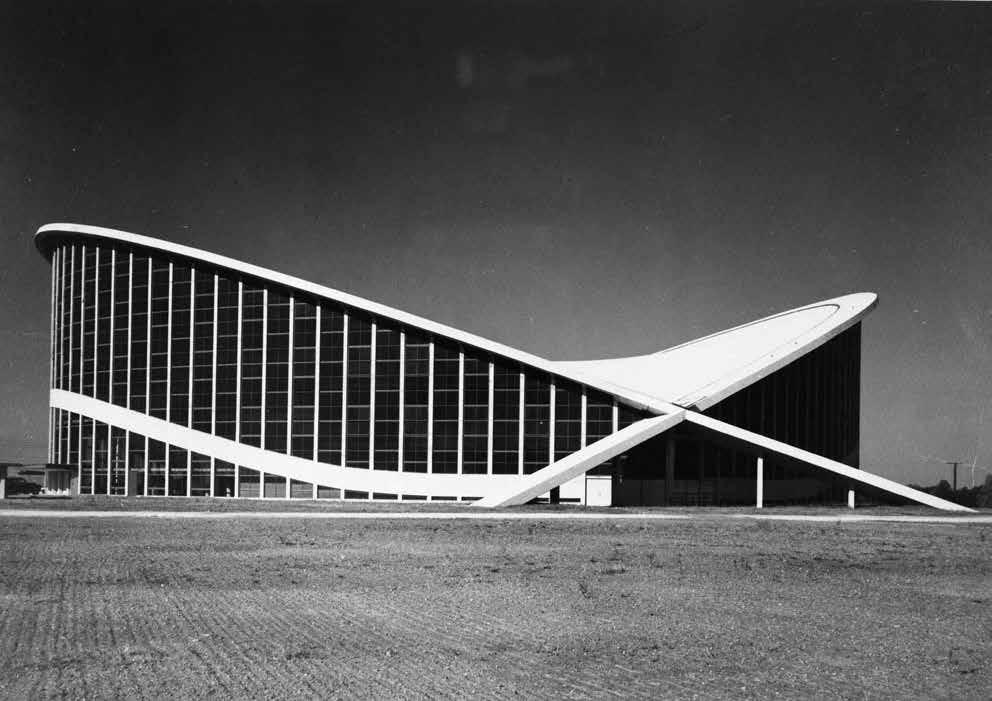
school shuttered under pressure from the regime. Scholars and artists fled.
Several key figures ended up at Black Mountain College, a new, experimental arts school outside of Asheville, founded on the same forward-thinking principles. The school closed in 1957, but not before churning out a who’s who of mid-century artists, like choreographer Merce Cunningham, writer Robert Creeley, musician John Cage, and sculptor Ruth Asawa. Many of them filtered out across the state, shaping how we think, teach, and create to this day.
In 1948, architect Henry Kamphoefner became dean of N.C. State’s newly formed School of Design, a merger of its architectural engineering and landscape architecture programs.
Kamphoefner, a devout modernist, arrived from the University of Oklahoma a passionate, polarizing figure who quickly upended the school’s faculty and curriculum. Two years into the job, he brought in Frank Lloyd Wright, then in his 80s, to deliver a lecture. A flyer for the event touts Wright as a pioneer in organic design who championed “man’s divine potential.” The lecture reportedly drew 5,000—one of the largest audiences that Wright ever addressed (Raleigh’s population at the time, for comparison, was around 65,000). A roster of international design stars would continue to have a presence in the program.
The school’s prominence was on an upward trajectory. In 1952, Polish architect Matthew Nowicki, a faculty member, designed the J.S. Dorton Arena at the State Fairgrounds. The building boasted the world’s first cable-supported roof system, transforming something as ineffably North Carolina as a livestock pavilion into a modernist marvel.
Frank Harmon, a Greensboro-born architect who studied at the school during that period, remembers it as an era of advancement for both the region and the principle of socially responsive design.
“In the 1950s, the North Carolina Museum of Art was founded—the first state-supported art museum in the country,” said Harmon. “The Research Triangle Park was founded, the university system was consolidated under William Friday, and things like the J.S. Dorton Arena were designed by Matthew. It was a very progressive time.”
Even Catalano was won over by the Southern spirit, writing of his students (with a whiff of paternalism): “The majority were from North Carolina, state of farms, of healthy life, of purity of soul. No one had the intellectual pretense of people from large cities, only ears to listen and willing hearts and hands to do hard work.”
Faculty, meanwhile, were encouraged to maintain their architecture practices, boosting the state’s housing stock. Smart estimates that there are 800 modernist homes in the Triangle today, and as many as 5,000 across the state— the largest concentration outside of California and Florida. Because modernist design is meant to reflect regional nuance, and because North Carolina’s geography itself is so dynamic, a dive into the NCModernist archives highlights a range of designs.
“More traditional classical architecture is the same, no matter where you build it,” Harmon said. “One of the principles of modern architecture was an appreciation of where it is—the landscape, the type of materials that are in that region.”
If modernist architecture enjoyed a heyday, it also expe-
rienced a fall. Quality decreased as the style struggled to scale mass postwar housing needs, and as subsequent decades saw increasing social turmoil, optimism faded. When the Pruitt-Igoe public housing complex in St. Louis was demolished in 1972, it was widely considered the symbolic end of modernism. Plenty who felt the style was cold and impersonal were happy to see it go.
Headwinds were shifting in North Carolina, too. The state took a conservative turn with the gubernatorial elections of James E. Holshouser Jr. in 1972 and the U.S. Senate election of Jesse Helms in 1973. Kamphoefner himself retired as dean that year, though he continued teaching throughout the decade. He didn’t love the direction things had gone: The NCModernist website quotes him griping about contemporary design shortly before his death, “Form follows money.”
Postmodernism was in full swing, and the future had turned out to look a bit different than movement founders had envisioned.
“You know,” Smart said, standing in his South Durham kitchen with a cup of coffee, “Star Trek is the world we want, and Star Wars is the world we have.”
In late December 2025, Melinda and Andrew Knowles opened the doors of their new Raleigh house for a tour. More than 400 people showed up.
The home, designed by George Matsumoto and built in 1954, came into the Knowles’ lives as an 11th-hour preservation act after they learned it had been sold for $1.8 million and slated for demolition. The Knowleses were fans of the distinctive split-level, located on a nearly 1-acre lot near North Hills, a coveted neighborhood.
“We saw the neighborhood, in the 20 years that we’ve lived here, go from this eclectic collection of interesting houses interspersed with more traditional houses to ‘Oh, now they’ve torn down another one and put up a giant mansion,’” Melinda Knowles said in a soft twang.
The couple contacted the buyers, who agreed to deed the structure over for free, though the cost of moving and restoring the home quickly added up. With help from the city, which contributed $275,000 from its Preservation Loan Fund, they began to cart the house 7 miles down the road, chunk by chunk. With the colorful jewelbox-like structure now restored, the Knowleses plan to rent the home out as an Airbnb.
“I do think it’s something North Carolina should be really proud of,” Melinda Knowles continued. “I’ve been in the South my whole life. People think of it being conservative and traditional, so to have this movement in Raleigh, North Carolina, seems unexpected.”
Hosted by NCModernist as a fundraiser, the ticketed tour was typical of the events the organization puts on. USModernist itself has, over the last two decades, won 20 preservation awards and documented more than 25,700 houses. It regularly alerts followers to houses that are endangered or up for sale; those properties run a wide gamut from several hundred thousand to the millions. Smart also hosts regional house tours, a monthly movie night, and cocktail hours. Such social enthusiasm speaks to his affable charisma.
“George has been huge,” said Harmon. “He’s brought

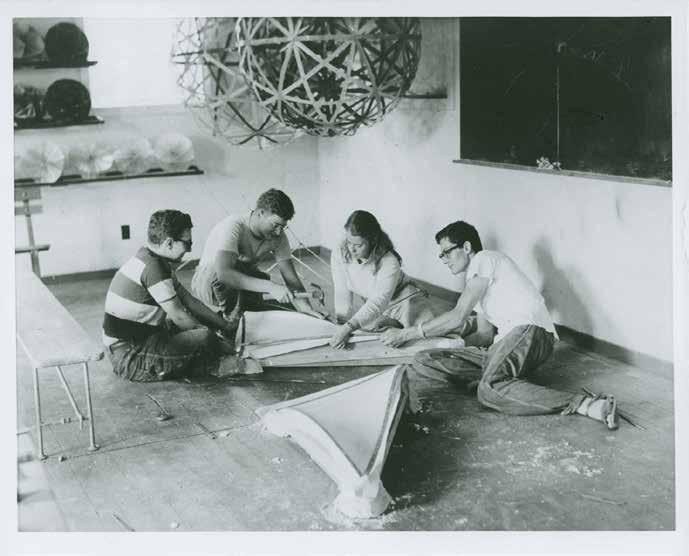
attention to the fact that North Carolina, second only to Los Angeles or possibly Chicago, was a center of modern design in the 1950s and ’60s.”
Durham architect Ellen Cassilly echoed the praise.
“George is a force of nature. He’s a jovial, likable guy, and people like to be around him,” said Cassilly. “He has created a wonderful community.”
Modernist architecture might not get the Hollywood treatment that Catalano’s home did 70 years ago, but Smart’s archival work proves there’s still plenty around the state to celebrate. NCModernist also advocates for contemporary designs, dodging an irony inherent to modernist preservation—that a design style conceived as a rejection of nostalgia is now the object of nostalgia. To that point, the 2020 book Triangle Modern Architecture, which includes an epilogue by Smart, indexes just as many contemporary designs as it does those of the past, highlighting spaces for the people, like the Raleigh Convention Center and the Durham County Main Library.
Smart’s own modernist home, after all, was built in 2010. And he points to Cassilhaus, the Chapel Hill home designed by
Cassilly and her husband, Frank Konhaus, in 2008, as a regional lodestar.
“This house is what you call the realization of a vision, because Ellen and Frank see themselves as curators,” Smart said. “So they built a house. It’s also a museum.”
Built seven years after Catalano’s home was demolished, Cassilhaus’s elegant trapezoidal structure seems to almost hang off the Duke Forest hillside. Its clean lines and interplay between inside and outside are classic modernist features, but as a hybrid home and community arts space, its most definitive quality is that its form truly does follow function. It’s the kind of house people fall in love with.
Several times a year, Cassily and Konhaus welcome visitors for an open house; recent exhibitions include one on African American quilting traditions, another on Malian artist Malick Sidibé. Guests take in lectures and mingle as the family cats cavort around the space. Modernist architecture may not have always succeeded at its big-swing ideals, but this home is a testament to what those ideals can look and feel like.
“I think people are interested in modern houses,” said Harmon, “because they see it as a better way to live.”
WED 2/11
MUSIC
Carmen Suite Feb. 5-22, various times, Martin Marietta Center for the Performing Arts, Raleigh.
Diana Krall 8 p.m. DPAC, Durham.
Langhorne Slim: The Dreamin’ Kind Tour 8 p.m. Cat’s Cradle, Carrboro.
Mean Habit, Hex Files, Salt Man 8 p.m. The Pinhook, Durham.
THUR 2/12
MUSIC
Be My Angel: WXYC Valentine’s Dance 10 p.m. Cat’s Cradle Back Room, Carrboro.
High June, The Band Fudge & Pilot Light 8 p.m. Lincoln Theatre, Raleigh.
Mat Kerekes 8 p.m. Motorco Music Hall, Durham.
Sister Wife Sex Strike , Clover-Lynn, Frog Legs 7:30 p.m. The Pinhook, Durham.
FRI 2/13
MUSIC
Blue Cactus, Skylar Gudasz
8 p.m. Cat’s Cradle Back Room, Carrboro.
Bravo Broadway Feb. 13-14, various times, Meymandi Concert Hall, Raleigh.
The Connells 8 p.m. Cat’s Cradle, Carrboro.
Margo Price: Wild At Heart Tour 8 p.m. Haw River Ballroom, Saxapahaw.
Marissa Nadler, Maria BC 8 p.m. The Pinhook, Durham.
Music For The Masses: Anti-Valentine Party 9 p.m. Motorco Music Hall, Durham.
Solas 7:30 p.m. Martin Marietta Center for the Performing Arts, Raleigh.
SAT 2/14
26th Annual Bob Marley Bash 8:30 p.m. Cat’s Cradle, Carrboro.
Amelia Day, Maia Kamil 8 p.m. Cat’s Cradle Back Room, Carrboro.
Cleveland Celtic Ensemble 7:30 p.m. NCMA, Raleigh.
Dropkick Murphys 6 p.m. The Ritz, Raleigh.
Mdou Moctar (Solo) 8 p.m. Motorco Music Hall, Durham.
NEEDTOBREATHE: The Barely Elegant Acoustic Tour 7:30 p.m. DPAC, Durham.
Notes on View: The Gregg Gelb Jazz Group 2 p.m. NCMA, Raleigh.
OnlyFriends: A queer platonic love dance party 9 p.m. The Pinhook, Durham.
R&B Rewind with Donell Jones, Carl Thomas, and Keke Wyatt 8 p.m. Raleigh Memorial Auditorium, Raleigh.
SUN 2/15
MUSIC
7th Annual Cupid’s Jam: Benefit Concert for TABLE 12 p.m. Cat’s Cradle Back Room, Carrboro.
Common Woman Cabaret 6 p.m. Motorco Music Hall, Durham.
Knock on Wood – A Stax Records Tribute 2 p.m. Cat’s Cradle, Carrboro.
Runo Plum, Lutalo (solo) 8 p.m. The Pinhook, Durham.
PAGE
Rebecca Kelliher: Just Pills 5 p.m. Flyleaf Books, Chapel Hill.
STAGE
Trey Kennedy: The Relatable Tour 7 p.m. DPAC, Durham.

FIND
MON 2/16
MUSIC
Alesana 8 p.m. Motorco Music Hall, Durham.
Thelma and the Sleaze, Meltdown Rodeo 7:30 p.m. The Pinhook, Durham.
TUES 2/17
MUSIC
Durham Mardi Gras 2026! 6 p.m. Motorco Music Hall, Durham.
Queer Country Night 8 p.m. The Pinhook, Durham.
Sandy Ewen with Greg Sheriff + Silk Moth + Between Bodies 8 p.m. Shadowbox Studios, Durham.
PAGE
Sadeqa Johnson: Keeper of Lost Children 6:30 p.m. Quail Ridge Books, Raleigh.
STAGE
Hell’s Kitchen Feb. 1722, various times, DPAC, Durham.
WED 2/18
MUSIC
Railroad Earth 7:30 p.m. Lincoln Theatre, Raleigh.
Temptation, Titties, and Trombones: Franny Starlight and the Brass Boudoir 7:30 p.m. The Pinhook, Durham.
PAGE
Spring Council: Southern Roots 6:30 p.m. Quail Ridge Books, Raleigh.
STAGE
Pissed-off poets 7 p.m. Shadowbox Studios, Durham.

THUR 2/19
MUSIC
The Asheville Mountain Boys, Sonya Badigian, Tatiana Hargreaves 7 p.m. The Pinhook, Durham.
The Jack Wharff Band 8 p.m. Cat’s Cradle Back Room, Carrboro.
Matteo Mancuso 8 p.m. Motorco Music Hall, Durham.
PAGE
Virginia Pye: Marriage and other Monuments 6 p.m. Flyleaf Books, Chapel Hill.
FRI 2/20
MUSIC
Andrea Bocelli, Romanza: 30th Anniversary World Tour 8 p.m. PNC Arena, Raleigh.
Chris Chism EP Release 7:30 p.m. Cat’s Cradle Back Room, Carrboro.
Hardgroove Faster Faster with DJNar and Lithic 10 p.m. The Fruit, Durham.
The Hour Glass Kids, Sugar Snap Peas, Emmerson Bruno and the undercurrents 7:30 p.m. The Pinhook, Durham.
INZO: Mirrorverse Tour 7:30 p.m. The Ritz, Raleigh.
Stop Light Observations, Mellow Swells 8 p.m. Lincoln Theatre, Raleigh.
Temptation Takeover 10 p.m. Rubies on Five Points, Durham.
Tchaikovsky 1812 & Violin Concerto Feb. 20-21, various times, Meymandi Concert Hall, Raleigh.
Vincent Neil Emerson 8 p.m. Motorco Music Hall, Durham.
SAT 2/21
MUSIC
Dunums, RIBS, Little Chair 7 p.m. The Pinhook, Durham.
House of BLK 10:30 p.m. The Pinhook, Durham.
Jupiter Coyote, Barefoot Manner, Old Habits 7:30 p.m. Lincoln Theatre, Raleigh.
The Runarounds 7:00 p.m. The Ritz, Raleigh.
SUN 2/22
MUSIC
G-Clef’s Graduation Celebration, Film Screening 3 p.m. The Pinhook, Durham.
STAGE Selections and Scenes from Darius Milhaud’s Esther de Carpentras 1 p.m. NCMA, Raleigh.
MON 2/23
MUSIC
Makaya McCraven 7:30 p.m. and 10 p.m. The Pinhook, Durham.
PAGE
Spring Council: Southern Roots 6 p.m. Chapel Hill Public Library.
TUES 2/24
MUSIC
Laundry Day 8 p.m. Motorco Music Hall, Durham.
STAGE
An Evening to Shine: Cohosted by Durham Public Schools and the DPS Foundation 7 p.m. DPAC, Durham.

RELEASE DATE—Sunday, February 8, 2026
To download a pdf of this puzzle or view its solution, visit indyweek.com/puzzles-page
Edited by Patti Varol
BUSINESS” BY
GARY LARSON &
ACROSS
1 Screenwriter’s
“Madame Web”
20 “Gotcha”
21 Excalibur, notably 22 Resolve

Difficulty level: MEDIUM
There is really only one rule to Sudoku: Fill in the game board so that the numbers 1 through 9 occur exactly once in each row, column, and 3x3 box. The numbers can appear in any order and diagonals are not considered. Your initial game board will consist of several numbers that are already placed. Those numbers cannot be changed. Your goal is to fill in the empty squares following the simple rule above.

If you’re stumped, find the answer keys for these puzzles and archives of previous puzzles (and their solutions) at indyweek.com/puzzles-page or scan this QR code for a link. Best of luck, and have fun!
23 Job for an elephant caretaker? Hot pepper “Double-quick!”
27 Eggs easy
28 Sugar source 29 Mountain 30 Dangerous biters Job for a department store model?
38 Show contempt for
41 Carrot, e.g.
42 Ring bearer, perhaps?
43 Alter, in a way 44 Coastline feature 45 “__ Fideles”
47 Kibble maker
51 Job for a tailor? 54 Onetime Nissan make
56 Galoot 57 Cartesian conclusion
58 Needle holder 59 “C’est la vie” 60 Saint fire 62 Brook fish 64 Casual attire
65 Job for a nanny?
70 Cry of realization 73 Roos in pouches 74 1990s cardio workout system 75 Third-longest river in Europe
79 Summers on “Gilligan’s Island” 81 Las Vegas drama 82 Brand for competitive divers 84 Entice 85 Job for a cheesemonger?
90 Ran off with 91 Bounces back 92 Bounce house filler
93 Ginger 94 Uni ref. work 97 Microbe 98 Record player
100 Job for an interior designer?
106 Whirlybird 107 Feel poorly 108 __ Goose vodka
109 Cedar Point state 111 Wall alternative 115 More clear, as a photo
117 Job for a corporate VIP?
122 Small
123 Back, on a boat
124 Completely committed 125 Rubs with oil 126 Affixes in a scrapbook
127 Subatomic particles
DOWN
1 Breaks down in tears
2 Online help option
3 Pop singer Ora 4 Heavily panned 1987 Beatty/ Hoffman comedy
5 Rock & Roll Hall of Fame architect
6 Mark of perfection, at times 7 Sketch show that once starred John Candy, for short 8 Animals that can run up to 50 mph 9 Appropriate, as power
10 Pewter metal 11 Tats 12 Discouraging words 13 Puerto 14 Anaheim’s county 15 “Star Wars: The Force Awakens” actor John 16 Compass reading 17 Repetitive musical composition
18 Properly pitched 19 Hearty dishes 24 Show up solo 28 Mentions in a footnote 31 Ribbon of fabric
32 “Common Sense” pamphleteer 34 Assayers’ stuff
35 “The Joy of Painting” host Bob
36 Carry
37 Take the floor
38 Kingdom in what is now Yemen
39 “On the Beach” author Shute 40 Alpha’s opposite 45 Friend of d’Artagnan 46 Evil fiend
48 Exam with an Argumentative Writing section
49 100%
50 “Put your wallet away”
52 Poet Ogden
53 Humdinger 54 Pederson who coached the Eagles to their first Super Bowl win 55 Penny-__
58 Tuna tartare cut
60 Locale in a Steinbeck title
61 Certain NCO
62 Core argument 63 1990s Israeli prime minister
66 Open a bit 67 __ the wiser 68 Secret store
69 Sought damages
70 Part of a Latin 101 conjugation 71 __ Top Creamery
72 “The Good Dinosaur” dinosaur
76 Lear daughter 77 “Easy on Me” singer 78 Last one to cross the finish line
80 Klondike Gold Rush site
82 Run off with 83 Risk
85 “Mad Men” role for Elisabeth Moss 86 “Happy Birthday” writer 87 “Comin’ the Rye” 88 Singer Perry
89 Fuel guzzler 95 Omelet maker 96 Work behind the camera 99 Wanderers 100 Brutus co-conspirator 101 Casual lead-in to “I’m home” 102 Memorable Texas mission 103 “Botheration” 104 “Haystacks” painter 105 English county 110 Quaint hotels 112 Black-and-white treat 113 Arabian port 114 Cough syrup amts. 116 Upstate NY school 117 50 Cent piece? 118 Letters on Megan Rapinoe’s jersey 119 Some Windows systems 120 Chest protector 121 “Painting To Be Stepped On” artist Yoko

App Delivery Mgr
App Delivery Mgr; Labcorp Central Laboratory Services LP. (Hybrid - 3x/wk Durham, NC.; remote in US 2x/wk). 2 nat’l trips/yr. Lead endto-end delivery of software projects, ensuring scope, budget, timeline & quality objectives are met. Must have at least bach degree or equiv in CompSci or rltd & 10 yrs progrssve exp as a Softwre Delivery, Prjct/Progm Mgmt or rlt role. Must have 5 yrs exp w/: delivering complex software projects in Agile & hybrid environments; cloud platforms (AWS/Azure/GCP), CI/CD pipelines & modern delivery frameworks. Must have 3 yrs exp: in leadership role /in software delivery/project/prgrm mgmt; proposing solutions, creating proposals & contributing to tech roadmaps. Resume to resumes@labcorp.com & reference Job Code KP012026.
Database Administrator
Database Administrator; Lbrty Corp of Amrca Hldngs. Durham, NC. Partcpt in app dvlpmnt projcts for databse archictre & dsgn. Must have at least bach degree or equiv in CompSci, InfoTech or rltd & 7 yrs progrssve exp as Team Lead, Consltnt, Databse Admin or rlt role. Must have 5 yrs exp w/:PostgreSQL. Must have demonstrtve exp w/:mid-large scale IT data projects; replication to/ frm PostgreSQL or other rltnl databses; pgAdmin; Vacuum, Reindexing, Archiving & Connection Pooling tools; data modng; & database dsgn & dev. Resume to resumes@labcorp.com & reference Job Code NA012026.
SAS Institute Inc. seeks a Tech Consultant in Cary, NC to provide consult svcs at cust worksites. Reqs: BS in Comp Sci, Software Eng, Actuarial Sci or rel + 5 yrs or MS in Comp Sci, Software Eng, Actuarial Sci or rel + 2 yrs. Remote role per SAS’ Flexible Work Program. For full reqs & to apply visit sas.com/careers & reference Job #2026-41187.
Syntegon Technology Services seeks a Field Service Technician (FST-MGO) in Raleigh, NC. Participate in internal, external & vendor training to maintain & further dvlp level of technical expertise & proficiency. Travel up to 80% domestically & internationally. Telecommuting permitted must live in geographic area near an international airport. Req Associates + 3 yrs rltd exp. Will accept a degree equiv based on a combo of edu and/or exp as determined by a prof eval service. Send resume to USTalent.Acquisition@syntegon.com. Must ref job title & code in the subj line.
Principal Scientist, Strategic Scientific Projects; Lab Corp of Amrca Hldngs. Hybrid role, 3 dys/ wk in Durham NC office & remote w/in US 2 dys/ wk. Idntfy new assctns, disease prgrssn mrkrs, new scntfc & med undrstndng frm data & results frm cncpt thrgh exctn. Must have at least masters or equiv in CompSci, Epidemiology, Quant Methds, Biostats, Data Anlytcs or rltd & 10 yrs progrssve exp as Clinical Computatnal Scntst or rlt role. Must have 8 yrs exp w/:medcl knwldg anlyzng & intrprtng data & mking recs for new diagnstc tests; idntiyng new assctns & disease prgrssn markrs to persnlizd medcn; dsignng & running studies to verfy potntl assctns & disease prgrssns; 3 yrs exp revwing data, lab reslts & lit re undrlyng diseases & idntfyng early signs of disease. Resume to resumes@labcorp.com & reference Job Code DV012026.
Engineer
Siemens Industry, Inc. seeks a System Engineer in Wendell, NC. Lead development of standard solutions to incl protection, automation & control products. Reqs Bach degree in Elec Eng or rel fld & 4 yrs rel exp. Up to 25% dom & intl travel is req. To apply, go to: https://jobs.siemens.com/en_US/ externaljobs/JobDetail/493503




Winning INDY's "Best of the Triangle" Readersʼ Poll has been a coveted honor for the past 25 years. The contest is organized in rounds throughout the year by region: Orange & Chatham Counties, Wake County, then Durham County. At the end of the year, the winners of each region go head-to-head to claim the title of “Best of the Best of the Triangle”.
The ballot for Orange & Chatham Counties is open now! This is your chance to vote for the best Orange or Chatham County bar, veterinarian, bookshop, museum, or other neighborhood treasure.
Voting is only open until February 28th so scan the QR code below or vote.indyweek.com today to make sure your vote is counted!