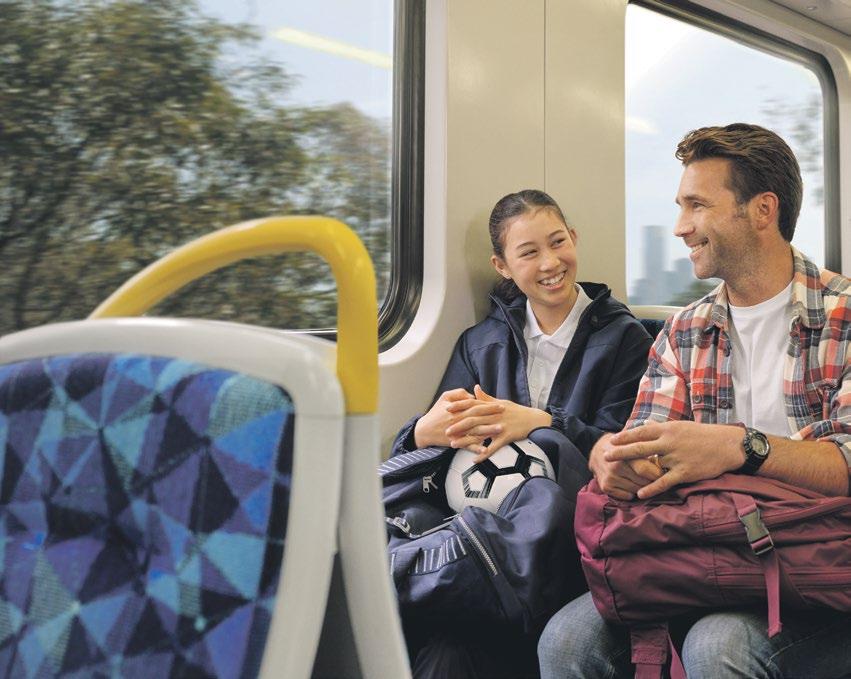
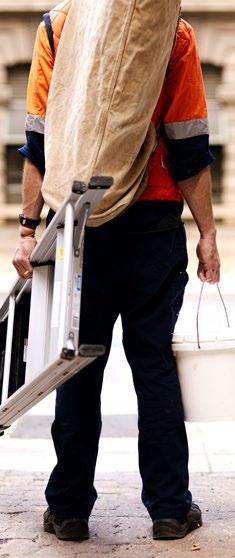
The Victorian Government is delivering real help, right now with over 90 different savings benefits. Like saving you up to $400 from January with boosted school camps, sports and excursion payments for eligible students. Families can also enjoy Get Active Kids Vouchers, saving up to $200 per eligible student. Plus, free public transport for everyone under 18 with a Youth myki from January.
Find out what you’re eligible for on the Service Victoria Savings Finder today.
Authorised by the Victorian Government, 1 Treasury Place, Melbourne
Indian Link is a monthly newspaper published in English. No material, including advertisements designed by Indian Link, may be reproduced in part or in whole without the written consent of the editor. Opinions carried in Indian Link are those of the writers and not necessarily endorsed by Indian Link. All correspondence should be addressed to:
INDIAN LINK MEDIA GROUP
Level 25 / 259 George St, Sydney 2000 GPO Box 108, Sydney 2001 Ph: 02 9279-2004
Email: info@indianlink.com.au
A seat at the table
What 2025 revealed about Indian-Australians
IBY PAWAN LUTHRA
n 2025, the Indian-Australian community reached a pivotal moment. As our reporting over the past year shows, this is no longer a small migrant cohort quietly shaping its future. It is now one of Australia’s fastest-growing and most visible communities, and that visibility brings both confidence and challenge.
New ABS figures underscored the scale of this shift: the Indian-born population has risen to almost one million, more than doubling in a decade. This demographic surge reflects a community increasingly woven into Australia’s cultural and economic life, visible in suburbs, schools, workplaces, and civic spaces across the country. IndianAustralians are no longer newcomers on the periphery; they are firmly part of the national fabric.
Political engagement reflected this growing presence. Indian Link’s Federal Election Survey revealed a diaspora far more politically diverse than commonly assumed. While a modest tilt towards Labor was evident, respondents prioritised a broad range of issues: cost-of-living pressures, healthcare access, education, and climate
policy. Migration concerns remain important, but they are no longer the defining feature of political identity. We are engaging in national debates with the same nuance as any other community.
Representation on the ballot also expanded. Nearly fifty Indian-origin candidates contested seats in the 2025 election, cutting across major parties and independents. Their backgrounds mirrored the variety within the community itself - small-business owners, medical and IT professionals, community advocates, and second-generation Australians. The contest in Holt, where all three major parties fielded South Asian women, signalled the normalisation of diversity in Australian politics. Indian Australians are no longer simply voters; they are becoming decisionmakers.
However, the year also exposed significant vulnerabilities. Indian-Australians found themselves unexpectedly in the spotlight during recent anti-immigration protests, many feeling targeted, unsettled, and frustrated, yet determined to assert their place, dignity, and contributions in Australian society.
More recently, a violent racist attack on an Indian-origin man in Parramatta sent shockwaves through the community, reigniting concerns around safety and belonging. Our coverage offered practical
guidance and emotional support, particularly for seniors and newly arrived migrants. The incident was a sobering reminder that visibility does not guarantee acceptance.
Structural barriers added to these anxieties. Indian Link’s reporting on Australia’s outdated overseas-qualification recognition system drew attention to the long-standing frustration of skilled migrants unable to work in their fields. Doctors, engineers, teachers, and IT specialists, all professionals actively recruited by Australia, continue to face lengthy delays, high costs, and duplicative retraining. The call for reform has grown clearer and more urgent.
Community initiatives provided a counterbalance. The launch of the Aunties Fund, for example supporting South Asian survivors of domestic violence, highlighted the strength of grassroots leadership. Cultural festivals, arts programs, and language initiatives continued to anchor identity and connection, reinforcing the community’s resilience in the face of challenges.
Taken together, the developments of 2025 reveal a community entering a new stage in its Australian journey: more confident, more vocal, and increasingly unwilling to accept outdated stereotypes or systemic neglect. If this year proved anything, it is this: the Indian-Australian community is no longer waiting to be invited to the table - it is already pulling up its own chair.
New Housing Models Emerge Amid Australia’s Affordability Crisis
It’s no secret that Australia is experiencing an unprecedented housing crunch. Affordability, adaptability and availability are under pressure, and the market is forcing industry experts and everyday Australians to turn their minds to more innovative solutions to meet the needs of an everchanging Australia.
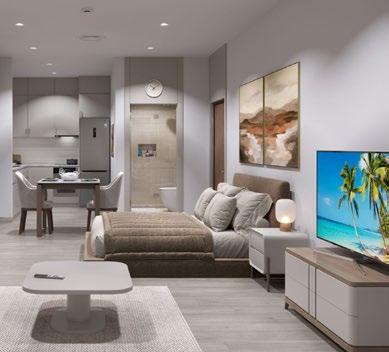
One model gaining ground is community living: professionally designed homes with private studios, shared spaces, and built-in social connection. It’s a model that LavaKusha Homes has placed at the centre of its mission.
With decades of APAC sales leadership under his belt – including launching HTC Mobiles in Australia and advising global tech firms – Prem Krithivasan began to notice a gap that became impossible to ignore. Businesses were bringing interstate and overseas talent on short and long term projects, yet when push came to shove - the accommodation provided to these workers rarely met the realities of their roles or lifestyles.
“It’s a known problem – accommodation is an afterthought,” he explains. “Employees end up living in expensive short-stays or share houses that aren’t, frankly, fit for purpose.
“It’s inefficient, costly, and just adds more pressure to an already tight rental market.” Professionals often find themselves facing social disconnection, while businesses are left with high temporary housing costs and declining productivity. Partners who relocate with employees frequently struggle with boredom, loneliness and the difficulty of building new support networks.
Community living offers a more human-centred model - private studios as personal sanctuaries, shared lounges and work zones that foster collaboration, and an instantly accessible community that makes relocation feel far less isolating. It
gives companies a more affordable, stable accommodation option while giving staff and their families a sense of belonging and continuity.
“Initiatives such as this would go a long way towards providing safe, high-quality and community-focused accommodation for employees coming from India to join large corporates in Sydney” says Consul General of India Dr. S.Janakiraman.
“I encourage Indian tech companies to explore the suitability of such
accommodation options.Employees will feel valued and connected, which in turn strengthens businesses.”
At the same time, Krithivasan observed another gap. Many subcontinent seniors are faced with the challenge of reduced mobility while wanting to retain their independence. While traditional aged care facilities are appropriate for some, they often don’t meet the needs of many.
“Seniors want independence, but not isolation,” Krithivasan notes. “They want
to live near their families, stay active, connect with people like them, but still enjoy the privacy and dignity of their own home.”
Stephen Bali MP, Member for Blacktown, said “that specialised developments like this can make a significant contribution towards addressing the broader housing crisis.
“Blacktown is one of Australia’s fastestgrowing cities both in population and economic growth.”
“To prepare our city for this growth, we need to harness creative and forwardthinking approaches. Attracting projects like LavaKusha Homes is essential to meeting the housing needs of both businesses and seniors.”
LavaKusha Homes sits at the intersection of these needs. With two side-by-side developments with shared living spaces like a patio, games room and living room, its approach resonates with both younger mobile professionals and older migrants seeking a supportive environment.
“We’re all empowered to challenge the traditional idea of what a home should look like,” Krithivasan says.
“Community living is part of Australia’s next chapter.”
Parvathi Murli
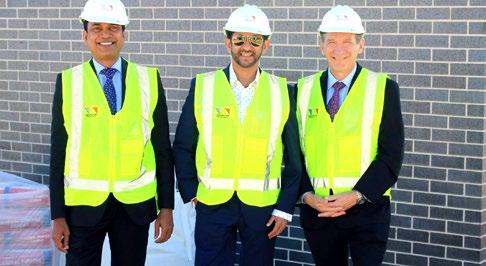
Dr S Janakiraman (Consul General of India, Sydney), Prem Krithivasan (LavaKusha Homes Founder / Developer), Stephen Bali (MP, Member for Blacktown), on site.
YOUR SAY
DILJIT DOSANJH’S MELBOURNE SHOW: MORE STYLE THAN SUBSTANCE?
Long-time fan ANUBHUTI MADAN SINGH flew in from Brisbane, but left somewhat disappointed. Akhil Jhingran wrote: Totally agree with the views expressed by Anubhuti in the article. The waiting for the show to start on time then more than half an hour unannounced break was annoying. Why couldn't they fill the gap with some local artists or some support acts. The show itself was electric but the delays were very frustrating and annoying which spoiled the fun. Sukhjiwan Grewal wrote: Undoubtedly, Diljit is an excellent performer, and I will always attend his shows, as he promotes and supports Punjabi and Punjabiyat. I enjoyed last year's show more than this one for the reasons listed in the article. Not whinging, but starting 90 minutes late was a major letdown for me. You have to respect people's time. Additionally, I found that the sound system was not suitable for the venue. The instruments sometimes subdued the vocals. Especially, 'Main Hoon Punjab' was very cacophonous for some reason. Regardless, love and respect for Diljit Dosanjh. Dr Amit Vohra wrote: In my view, whatever time Diljit gave us was genuinely enjoyable. Bringing kids up on stage — that’s classic Diljit, and it shows how grounded he is compared to many other performers. And honestly, at least 29,999 people had a great time. You can’t please everyone, and there will always be those who focus on the negatives. I’m sorry you felt the way you did, and that the experience didn’t land for you. If sharing your thoughts helps you feel heard, then keep writing - your voice matters too. And who knows, maybe if you’d brought your kids along and dressed them up, they might have been invited on stage. That would’ve been a beautiful memory. Anyway, that’s just my perspective - we all have our own.
Rhythm Sidana wrote: It was never Diljit - the issue came from people trying to move into other floor sections for a better view. This happens at every major show; it’s not just our community, it’s universal. The real takeaway for his team is that they’ll need clearer barricades and better-defined floor zones next time, so everyone stays in their section.
Natasha Fonseca Arora wrote: If the show required darkness to begin, the local crew should’ve been aware that Melbourne observes daylight saving and it doesn’t get dark until 8–8:30 pm. In that case, the start time shouldn’t have been advertised as 7 pm, leaving the audience waiting for over an hour.
Aradhana Bakshi wrote: Enjoyed the show but would agree on the start time delays and unwarranted breaks.
Roop Marwaha wrote: We were there, and we loved it. Where is this news coming from.
Aman Sharma wrote: I would not go again. Diljit’s voice may have been amazing, but I couldn’t even see the stage. People also were standing on chairs. Disappointing.
Guru Dha wrote: Sydney’s event was next level - truly international standard. Yes, it started a bit late and wrapped up a little early, but it still gave us memories for a lifetime. Melbourne is… well, Melbourne: unpredictable weather, a bit of chaos, and some people who just don’t know how to relax and enjoy the moment. I feel for you, Anubhuti. Shanti Balakrishnan wrote: I agree with what the writer has said mostly... but one fact should be corrected. AAMI Park stadium capacity is only about
30k pax, please.
Kay Gupta wrote: The show was halted for everyone’s safety as people were pushing each other. This was a great show. Thank you for your opinion. Vishi Sahota Leech wrote: Clearly, you’ve missed a major detail: why did he disappear? He didn’t just walk off for no reason. He was asked to leave the stage because of the crowd. People were standing on chairs, pushing against the barricades – it was a serious safety issue. This wasn’t the performer’s fault, or even the crowd’s, really. It was a failure of the venue and security. We were on the ground, had paid for expensive tickets, and it still took us almost halfway through the show to even find our seats. It was chaos. And you can’t say you didn’t know why he left. There were multiple announcements asking people to return to their allocated seats, get off the chairs, and clearly stating the show would restart once everyone had settled down. Diljit himself requested people to go back to their seats. Also, another incorrect point in your article: you mentioned seating of 65k. Even Marvel doesn’t have that capacity. AAMI Park holds around 30k. Abhi Bassi wrote: Only thing wrong in this article is the capacity, it’s not a 65,000 seater stadium it’s 30,000. Deep Aulakh wrote: We had a blast at the concert! It was a fantastic vibe, and we enjoyed every moment. The show was paused temporarily due to crowd control issues, but it restarted after an announcement. To each their own, but we thought it was well worth the cost.
Frankie Gerard wrote: As a journalist covering the event, I must admit I was quite disappointed. The show began with an unexpected delay of over 90 minutes - a major letdown, especially considering the standards expected from international artists who usually value time management. What was even more concerning, however, was the lack of proper security and crowd control inside the venue. I witnessed people leaving their seats and rushing towards the stage, creating chaos and discomfort. Several young attendees I spoke with expressed their disappointment, saying they felt unsafe and disheartened. Events of this scale need better organisation and respect for both time and audience experience. That said, I won’t comment on Diljit Dosanjh’s performance - he’s simply the very best. Even though I don’t understand much of the language, what I’ve heard about him, and now seen on stage, proves he’s truly one of the finest performers India has produced.
Ray Bhatt wrote: I agree - it was similar in Sydney. After seeing other international concerts, this one definitely felt under-managed. There were no openers to fill the delay or break, the sound quality wasn’t the best, and the constant stream of people going on stage felt odd. It’s fine once or twice, but when it keeps happening throughout the concert, it does start to feel out of place.
Harp Gill wrote: Same feeling here. Unorganised show. Suraj Kumar wrote: Unnecessary priced tickets.
DR SONU BHASKAR: BRIDGING LAB SCIENCE WITH GLOBAL HEALTH EQUITY
PRUTHA CHAKRABORTY spoke with Dr Sonu Bhaskar, recognised with the top award for his leadership and innovation in global health.
Natasha Jha Bhaskar wrote: Brilliant as always!! So proud.
Dipen Rughani wrote: Such a well-deserved award
and recognition. Congratulations, Dr Sonu Bhaskar! Sheba Nandkeolyar wrote: Congratulations Dr Sonu Bhaskar. Your contributions are a huge gain for Australia. Dr Jim Taggart wrote: So proud of you, Dr. You are an inspiration and so humble in conversation. Blessed to know you and thank you for what you do for people and communities.
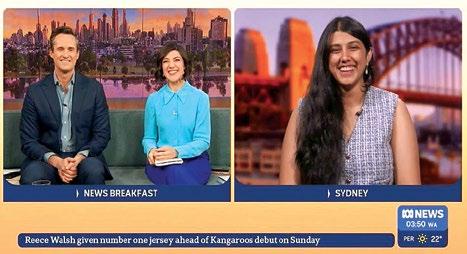
Shantha Vishwanathan wrote: Congrats to Dr Sonu Bhasker. What an inspiring journey! Just heard him on ABC morning news. He totally nailed it!
Hema Lakshmanan wrote: You are a legend!
Hari Narayanan, Sonu Nayyar, Poornima Menon, Ranjit Sinha and Jack Ace all wrote congratulatory notes.
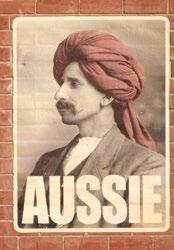
WHAT DOES IT MEAN TO BE AUSSIE?
SRUTHI SAJEEV sat down with Adelaide artist Peter Drew to talk about the next chapter of his iconic poster series - and the philosophy that drives his art. Madhu Chaudhari wrote: You are definitely doing some powerful and impactful on this subject, Peter. Well done, Indian Link.
Subhratosh K. wrote: Being Aussie is respecting Indigenous heritage, acknowledging the British foundation and embracing the immigrant character of this freaking great country.
Cody Prizeman wrote: If everyone is an Aussie, then why do different ethnic groups fly their country’s flags? Practice their country’s traditions? Embrace their country’s culture?...It doesn’t take a genius to understand that there are differences between us all… The only consequence of your actions is that you dilute the Australian identity, culture and national pride. As long as there is multiculturalism in Australia, there will never be complete unity, so stop attempting to force it into fruition.
A MAMDANI MOMENT IN AUSTRALIA?
KHUSHAAL VYAS on whether Mamdani’s magic can ever be replicated in our own cities.
Sriraman Annaswamy wrote: Australia, thankfully, will NEVER EVER have a Mamdani moment as Australia has:
1. compulsory voting that removes the necessity to rally the base
2. preferential voting that ensures consensus rank order outcomes
3. long history of the debilitating impact of socialism including some that continue to this day.
Bottom-line: Rabble rousing socialist identity politicians will be consigned to the fringes if not the landfill.
Harish Rao wrote: Sriraman Annawamy, whilst we may not want a Mandani moment, the preferential system of voting in Australia allows too much manipulation of the voting system.
Geethe Geeganage wrote: Own your identity, not identity politics: Mamdani didn’t run on being the first Muslim mayor of New York City. But he used his background, heritage and story to authentically connect with voters, wherever they came from, on the key local issues of feeling unheard, disconnected and priced out of the city in which they lived. Well said, Khush!
Raja Gopalan wrote: Although the topic of the article is ostensibly about the nature of the campaign, the
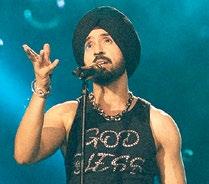
Diljit Dosanjh
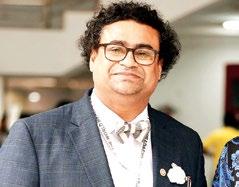
Dr Sonu Bhaskar
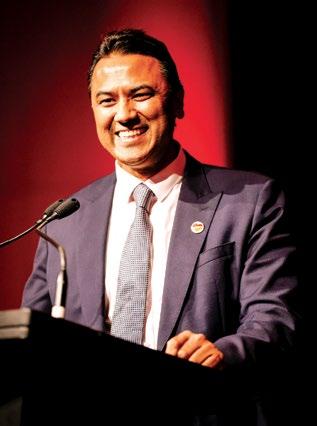
Sangeeta Mulchandani
Peter Drew
reality is that it has too much adulation, not enough facts. As a New Yorker, I say: be careful what you wish for, Australia. You certainly don't want Hanson (who is equally adept at getting attention), but the other extreme is not a solution either.
Nandini Oza wrote: Important analysis.
Paul Swain wrote: Very interesting. I listened to a podcast that analysed this really well. Had been otherwise unaware of him. I think his early tenure will be very interesting to watch.
INNOVATION AND ENTREPRENEURSHIP AT ASIANAUSTRALIAN LEADERSHIP AWARDS
KHUSHEE GUPTA caught up with Sangeeta Mulchandani, honoured for her work in pushing diversity forward in the world of business.
Mitu Bhowmick Lange AM wrote: What a remarkable and inspiring story.
Anil Advaney wrote: So nice to see you featured in Indian Link. Congratulations Sangeeta. Shankar Raman wrote: Huge congratulations Sangeeta. I am truly proud of your achievements. You believed in and stayed true to your convictions and deserve every success that comes your way.
Ankit Pandya, Senthilkumar Rajappan, Isaac Jeffries, Lana Kersanava, Puneet Mulchandani, Bernard Ernest, Anna Ngoc Le, Penelope Barr, Binod Atreya, Dr Raj Khillan, Sachin Verma, Arun Kumar, Radhika Kishore, Jack Hemnani, Poornima Menon, and Abhijit Nayak all wrote congratulatory notes.
REMEMBERING SAMANVITHA DHARESHWAR
KHUSHEE GUPTA spoke to the loved ones of the victim of the Hornsby car accident that shook the community.
Anu Shivaram wrote: Sadly, we can't take away their pain but if we can help in any way, we would love to. Mr Vineet, please know the community is mourning with you.
Nick Chris wrote: So sad. How can the family overcome such a tragedy? May the mum and baby rest in peace. Sincere condolences to the family.
Siddharth Maitrak wrote: Samanvitha's family is in my thoughts and prayers.
Nisha Kataria wrote: Praying that her family finds strength and healing during this unimaginable loss. May she and the precious unborn soul rest in heavenly peace.
Jayanthi Rajendran wrote: Heartfelt condolences to the entire family. It’s a very tragic and unimaginable loss. Om Shanti.
CELEBRATING INDIAN CUISINE
Enter Via Laundry’s Chef Helly Raichura caught up with PAWAN LUTHRA for a candid chat on what’s cookingand what’s not - in India’s food scene right now. Neeru Saluja wrote: Well said on infusing creativity to keep our cuisine culture alive.
Kushma Chand wrote: We need to start promoting native food. I love your (way of thinking) - a change has to come.
Mahernaz J Bengalli wrote: I completely agree with
Helly! Cultural cooking is very dear to my heart and India has such beautiful culture with their own unique cuisine and that should be the highlight of the street food!
Alka Girdhar wrote: Absolutely true. People are charmed by western or other exotic cuisines. If we could somehow popularsie our lost dishes like konkoda, parwal, gowaar phali etc in western countries, then our resident Indians too would value these native foods more.
Chaitali Thakkar wrote: You are so right on how things have changed in India. I live in Australia now and miss all the seasonal vegetables I grew up on. Visiting my family in Mumbai I would ask Mum to cook all the traditional foods…I do miss the chaniya bor and white desi makai that I used to eat as a kid in the ‘80s. I don't think you get them anymore. Perhaps because the exotic yellow American corn crops took over. I admire that you are using Native Australian produce to make Indian food, Helly, and that you put khandvi on Australian MasterChef!
VALE NEENA BADHWAR
RAJNI ANAND LUTHRA’s reflection on the journalist and community builder whose legacy inspired so many.
Anu Shivaram wrote: Neenaji was an institution in herself. A deep thinker, she connected well with the community and nurtured talent. She will be fondly missed.
Shanti Raman wrote: Beautiful...a meaningful life well lived. Om Shanti.
Ash Aashish wrote: May her soul attain sadgati.
Om shanti
Dinsha Palkhiwala wrote: A wonderful person I am privileged to have known for many years. May her soul rest in peace.
Bhat Mum wrote: Om Shanti Neenaji – simple, direct charming personality.
Manish Gupta wrote: Neenaji was a compassionate soul and one of the early journalists in print media who dedicated her work to issues close to the Indian Australian community. Her impactful contributions enriched the multicultural landscape in Australia. May her soul rest in eternal peace. Om Shanti
Shoba Sharma wrote: Neena's loss will be felt deeply by us.
Sheba Nandkeolyar wrote: A trail blazer in every sense of the word. Neena Badhwar was a gentle warrior. She spearheaded the reason for existence of community media. She will be very missed. Her dignity, humility and intelligence was a standout.
Mala Mehta OAM wrote: A great tribute to dearest Neena who has touched the lives of everyone. Your legacy will live on through the countless lives you've touched and the stories you've inspired.
Dr Shan Ruprai wrote: A special human being who served the community without any boundaries. I recall holding Bhangra rehearsals for the children in her house, when Indian culture was little known in Australia. Diamond Lady that started first Indian newspaper in Australia to bring the community together and communicated vital issues.
Rimmika Shankar wrote: She was a wonderful Hindi teacher and I was grateful to learn from her. She will be deeply missed, her impact and legacy will live on!
Amit Dasgupta AM wrote: This is so very sad! A kind, thoughtful, and soft-spoken person with a great sense
of humility and an unflinching commitment to what she did. May she rest in eternal peace. Om Shanti! Vivek Trivedi wrote: A very humble soul. We will miss her.
Dr Amrit Versha wrote: Neena’s passing is not just sad, it’s a big loss to the community. A real leader, no agenda for herself, just a giver. She was a great soul and a genuine supporter of women. I remember her when she ran the paper and would come to Auburn MRC to meet with new arrived Tamil refugee women and write about their small businesses with food, which they had started from their homes. Her stories would publicise their businesses and encouraged the women to keep going. Amazing ethical journalist so knowledgeable and yet so humble. RIP.
Nalika Padmasena OAM wrote: It is indeed a very sad news to hear the passing of Neena. I remember first meeting her at an event several years ago which ended up in a very long conversation. A great loss to the community. May her Soul Rest in Peace!
Vimla Chand wrote: Neena's sudden passing is a huge loss to the community. She served selflessly through her newspaper and personally. Extremely compassionate and considerate person, she will be missed by one and all. Om Shanti; may your atmah get satgati.
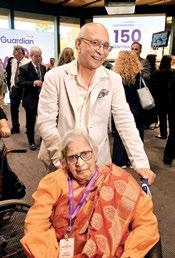
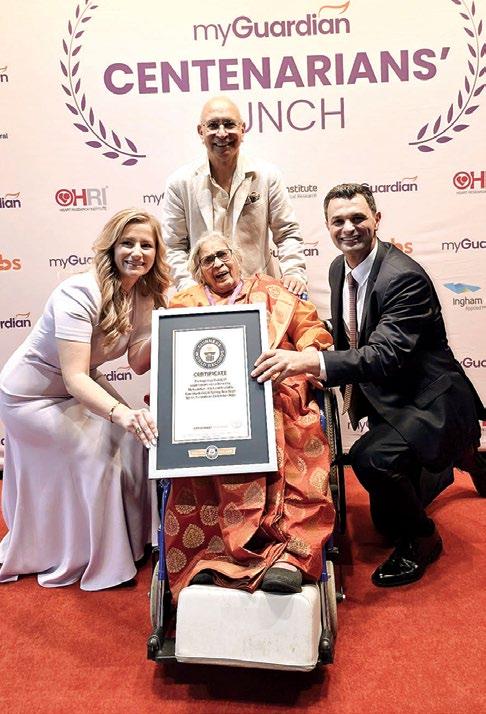
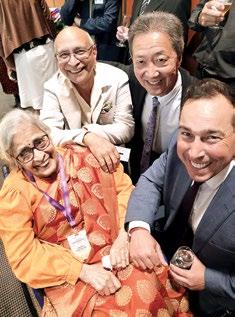
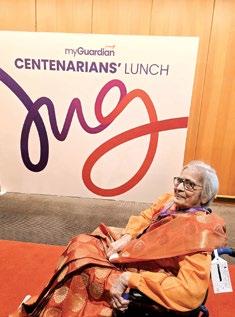
STILL SLAYING AT HUNDRED AND ONE RAJNI ANAND LUTHRA connected with Kailash Bhatnagar, one of 150 attendees who set a Guiness World Record for the largest gathering of centenarians.
Ambika Girglani wrote: Have met with Kailashji and family once. Love her and the energy she holds. Lots of love and congratulations.
Aruna Chandrala wrote: Congratulations Kailash Bhatnagar Auntyji, from Chandrala family. We feel blessed to be part of your life journey.
Kiran Malhotra wrote: We love you and wish you the best always - from all of us here.
Bhat Mum wrote: Congratulations to Kailash Aunty and the Bhatnagar family. Aunty is an inspirational personality.
Suman Mathur wrote: Beautiful, gracious and intelligent lady - an inspiration to many!
Des A Mihael wrote: Beautiful! Congratulations.
Mala Mehta wrote: She is an inspiration to many!
Mahesh Ila Trivedi wrote: Congratulations Kailash Bhatnagar Auntyji.
Jack Mhanna wrote: Thank you Indian Link Media Group. It was a pleasure to have Kailash Bhatnagar among the 150 attendees who set a Guinness World Record for the largest gathering of centenarians this month!
Jad Haber wrote: Congratulations to Kailash Bhatnagar and Indian Link Media Group for being part of such a remarkable, record-setting event at My Guardian - Aged & Disability Care Centenarian Lunch. To celebrate her 101 years of life, especially as the only Indian-born centenarian present, is incredible. Her lifetime of experience as an educator, writer, and poet is something special!
Jyoti Dogra, Sudhir Sibal, Indra Bengali Babu Halder Dilip Girglani and Maryjiljil Ucan wrote congratulatory notes.
Zohran Mamdani
Helly Raichura
Mrs Kailash Bhatnagar
Neena Badhwar
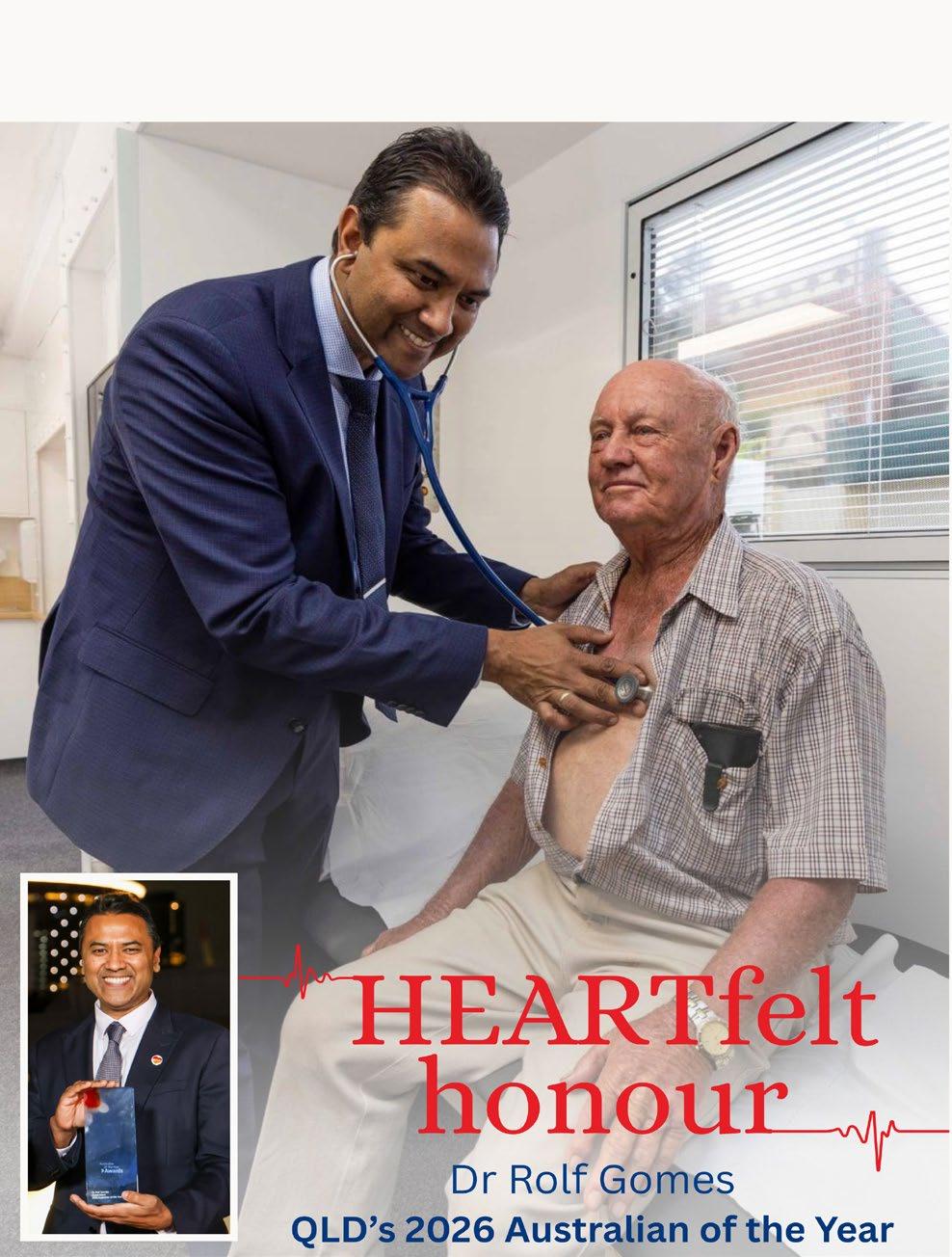
HEARTfelt honour
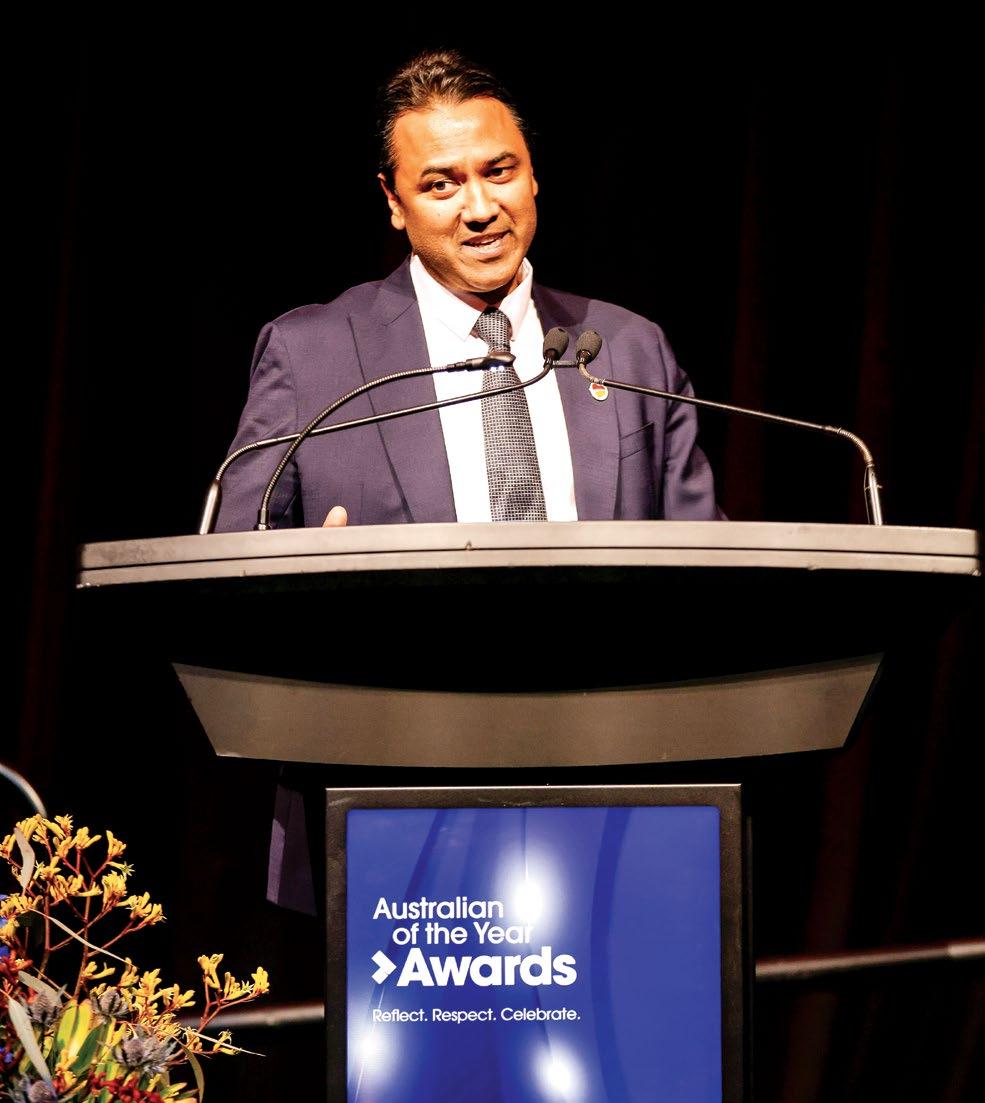
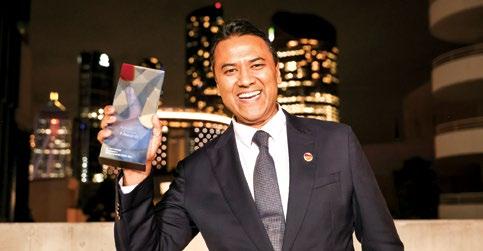
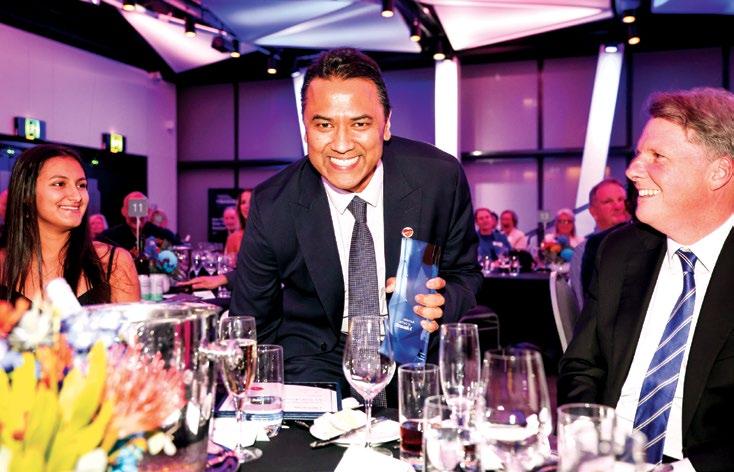
Dr Rolf Gomes, engineer-turnedcardiologist whose innovative Heart Trucks have served over 20,000 patients, is QLD’s 2026 Australian of the Year
DBY LAKSHMI GANAPATHY
r Rolf Gomes still remembers the sliding doors moment that set him off on his career as a cardiologist, an almost three-decade long journey that would lead to his recognition as Queensland’s 2026 Australian of the Year.
Working for a petrochemical company in Melbourne in the ‘90s, he remembers his heart not quite being in the engineering field.
“When I looked back on my high school [days], what I really loved the most was just chatting to people all day. I love people more than computers; I thought, if I'm going to make a decision, I better make it now,” Dr Gomes recounted.
“I left my job, applied for the GAMSAT to get into medicine, and I guess the rest is history!”
His sensitivity to people’s wellbeing meant he quickly spotted a major gap in frontline healthcare accessibility while working as a junior doctor in regional Queensland.
“Where I ended up, you are at the coalface. Having just come from the Royal Brisbane Hospital Emergency Department, it is chalk and cheese in terms of what you have at your fingertips to diagnose and treat your patients,” Dr Gomes described.
“Stress testing’s the bread and butter of what cardiologists do, trying to diagnose people with chest pain - these were things which had existed for decades, but were essentially non-existent in regional areas in Queensland.”
But what was most frustrating was the lack of action to deliver equitable healthcare services. And so in 2014, this one-time Kolkata lad took matters into his own hands, finding an innovative solution combining his engineering expertise with his desire to help people.
“I was left with this question - if you have someone 1000 kilometres out of the city talking to you about pain in their chest and they need a stress testing service, how do you give that person that opportunity?” he recounted.
“It required finding a way to bring the specialist as well as the entire toolbox with them out into these communities. The things I was interested in, treadmills, ultrasound machines, you can't fit any of those in a suitcase on a plane - so why not the back of a truck?”
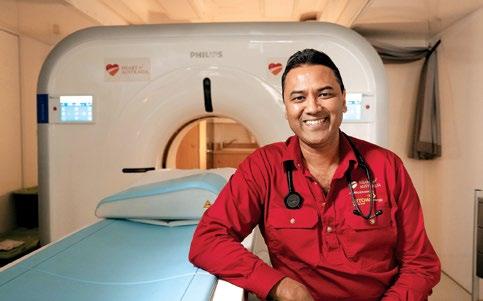
Dr Gomes’ idea of a state-of-the-art clinic on wheels, these days known as the Heart of Australia Heart Trucks, was simple in theory,
but took years of graft; he even remortgaged his house at one point.
“I was newly married, two kids, one on the way, just starting a fledgling private practice and then borrowing a lot of money, basically… It's not for everyone. You do need to have an appetite for risk and a bit of courage. But I thought it was a calculated guess,” he revealed.
Ten years in, the Heart of Australia fleet has grown to six trucks, and is preparing to expand nationally, partnering with the Federal Government to deliver their National Lung Cancer Screening Program, and pioneering the world’s first battery powered CT scanner.
Having seen over 20,000 patients, the Heart of Australia trucks have proven to be a viable model for regional towns to access specialist services.
“I remember I was in Winton and a fellow walked up and he said, ‘this is just fantastic. I just live 170 kilometres down the road,’ which is an interesting comment you don't hear in your city practice - but that's the difference it made,” Dr Gomes recalled.
“Even travelling 170 kilometres each way was better than what they would face otherwise, which would be a couple of days away from their work and families, the cost of accommodation, flights, etc - if you're 85 years old and walking with the frame, you're just not going to make the trip.”
By far the biggest impression has been on
the thousands of everyday Australians who finally felt noticed.
“A lady I saw in Hughenden - around the time when Western Queensland was in a terrible drought, the suicide rates were high, it was quite a sad, desperate situation - told me everything which was going on with their family and the economic struggles,” Dr Rolf narrated.“But she began by saying this comment: I thought I could tell you because you're obviously someone who cares…I always found that touching, because I think a lot of people out in these areas feel like they are forgotten. Here's someone who has gone to a bit of effort to do something specifically for country patients, to give them an equal chance at a long and healthy life, and they feel like someone out there does give a damn. It makes people feel uplifted and like they're not alone. When these trucks roll into town, I always think it's a reminder that there's a connection there, whatever their struggles are out in the regions.”
Dr Gomes admitted the ‘tyranny of distance’ still persists these days when it comes to accessing frontline healthcare services, and our healthcare system needs to embrace private partnerships.
“Where Heart of Australia visits, we're not a choice of public or private service. We are the only local service,” he stressed. “If we really believe in equity in access to healthcare, we have to be able to facilitate
that and not be limited in our mindset that this is a private offering as opposed to a public offering.”
He hopes Heart of Australia can evolve into a flagship program like The Royal Flying Doctors Service, as a sustainable framework for all forms of specialists to extend to the regions.
“What the program’s done is, it’s shifted the conversation from whether you're willing to commit and go live in one of these areas, to whether you can contribute to the answer,” Dr Gomes said of the clinicians on board Heart of Australia trucks who help out on the routes whilst having their own city practices.
“This is a conversation I would like to see some of the professional colleges get behind, and really start making it an exercise where we look in the mirror and say, at the end of the day, we have an issue with a lack of specialists in these areas.”
Dr Gomes is proud of the journey he’s had, and for following his instincts all those years ago.
“My existence on a day-to-day basis is very fulfilling. People say you must work long hours. If that means I'm working on this, I don't see that as an issue,” he shared.
“I've just been very fortunate to have followed my curiosity down this path. I've encouraged my kids to do the same… listen to yourself and find something which consumes you basically.”
Accessible med tech: Reinventing healthcare
Perth’s Dr. NIKHILESH BAPPOO
SCIENCE AWARDS
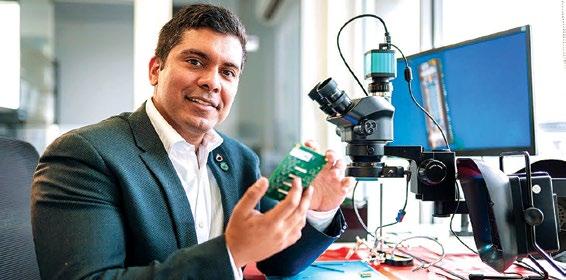
Why has no one made it easier to find a vein? When an emergency physician posed this simple but powerful question, Dr Nikhilesh Bappoo was intrigued.
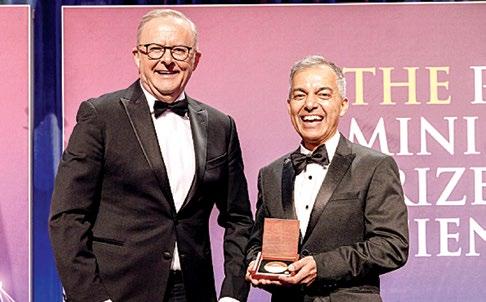
Having just finished a degree in mechanical engineering, he became aware that much of what he had learned - designing pipes, pumps and valvesmirrors the workings of the human body, from blood vessels to the heart and arteries. It was this curiosity that led him to be named the 2025 recipient of the Prime Minister’s Prize for New Innovators.
The Prime Minister’s Prizes for Science are Australia’s most prestigious awards for scientific achievement, celebrating researchers and innovators who are shaping the nation’s future through discovery and invention. The Prize for New Innovators specifically recognises early-career scientists whose work is already delivering tangible benefits to society.
Dr Nikhilesh Bappoo received the honour for his development of novel and accessible medical technologies that are transforming two of healthcare’s most fundamental challenges - safe vein access and heart health monitoring.
“For me personally, it’s a recognition of my vision of a world where no lives are lost because healthcare was too complex, too late, or out of reach,” Dr Bappoo told Indian Link. “It’s also a recognition of my family and everything that’s led to this point in my journey.”
Dr Bappoo’s path to medical innovation began far from Australia’s laboratories and hospitals, on the island of Mauritius, a multicultural nation in the Indian Ocean. “I moved to Perth with the goal of finishing school but also pursuing higher education at the University of Western Australia,” he recounted. At university, his love for maths and physics led him to study mechanical engineering, but it was his desire to make a meaningful impact in healthcare that steered him toward medical technology.
“I realised that a lot of what we learned in mechanical engineering - designing pipes, pumps and valves - could actually be applied to the human body, with blood vessels, the heart, valves and arteries,” he explained. This realisation sparked his research career. He went on to complete a PhD in bioengineering at the University of Western Australia, where he began bridging engineering and medicine and discovered his passion for entrepreneurship.
During his PhD, Dr Bappoo joined Perth BioDesign, a program connecting engineers and clinicians to solve unmet medical needs. It was there he met Dr Catherine Aaronson, who asked the question about making it easier to find patients’ veins.
Together, they co-founded VeinTech, which developed a handheld ultrasound device that helps healthcare workers accurately locate veins for procedures like cannulation - inserting a small tube into a vein to deliver fluids or medications.
“Everyone has their own stories of needles going into veins,” Dr Bappoo said. “Failure rates for those procedures tend to be quite high, mainly due to the inability to see or feel a vein.”
Traditional ultrasound systems are bulky and require extensive training but VeinTech’s innovation simplifies the process by producing clear, easy-toread data on vein location and quality, making the procedure quicker, safer, and less painful. Following successful clinical trials in Perth hospitals, VeinTech is now finalising its design for regulatory approval. “Our clinicians absolutely see the value of this,” Dr Bappoo said. “It’s easy to use, requires very little training, and can be adopted anywhere - from major hospitals to small clinics.”
Dr Nikhilesh Bappoo's second company, Lubdub, was inspired by a deeply personal experience. “My dad had a heart attack and luckily he was able to get to hospital and receive a stent within an hour,” he recalled. “But I often wonder what would have happened if we were in Mauritius, where access to care can be limited. That experience drives my commitment to improving access to heart care everywhere.”
At Lubdub, Dr Bappoo and his co-founders have developed ‘Heart Health in a Box’ - an integrated system that combines three powerful tools:
• A wearable electrocardiogram (ECG) patch to monitor heart rhythm,
• A saliva-based biosensor that detects cardiac biomarkers within minutes, and
• A wearable ultrasound device for real-time imaging of the heart.
This portable solution allows patients to receive heart health assessments without the need for specialist visits or travel, particularly vital for those in rural or remote communities. “It’s all about access and equity of access,” Dr Bappoo noted. “We hope to make an impact in communities where connectivity and access to healthcare are limited. Everyone deserves a healthy heart.”
Beyond his scientific and entrepreneurial success, Dr Bappoo is passionate about nurturing emerging medtech talent. “It’s now become my passion to inspire the next generation of engineers and scientists to consider medical technology as an area where they can make an impact,” he said.
When asked for the advice he’d give to young professionals, he simply said, “Be deliberately ambitious and don’t be afraid to think outside the box.”
As he looks to the future, Dr Nikhilesh Bappoo remains focused on developing simple technologies with big impacts, innovations that empower healthcare workers, reduce costs, and make care accessible for all.
“It really starts with the simple things,” he noted. “By improving everyday procedures, we can make the whole healthcare system stronger.”
Khushee Gupta
Restoring the living soil
Sydney’s Prof. BRAJESH SINGH
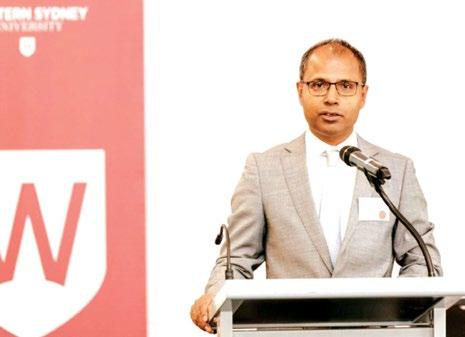
Distinguished Professor Brajesh Singh of Western Sydney University has been named the winner of the 2025 NSW Premier’s Prize for Science and Engineering for Excellence in Biological Sciences for his work in soil ecology. Deeply interested in the ways that soil biodiversity can impact entire ecosystems, his work has been central to shaping global policies, shifting preconceptions about the very soil we walk on and has had a practical impact on the agricultural industry.
After years of working in the field, Prof. Singh has published about 300 papers on the subject
of soil biodiversity.
Describing his research, Prof. Singh told Indian Link, “If you remove microbes from our planet, nothing survives. Microbes are the key regulators of sustainability, yet they are somewhat of a black box.”
He went on, “So, there are two fundamental questions I’ve been looking to answer. One is, what happens when we lose soil biodiversity? I don’t simply mean if everything is wiped out, I mean one hundred species or so… my research has shown that the entire ecosystem’s functioning reduces proportionately. The second question is, how do we predict the distribution and behaviour of microbes, bacteria and fungi if we can’t see these things?”
Answering these questions could help in the fight against climate change and lead to
innovations which significantly change the agricultural industry - from encouraging plants to grow even in drought conditions to creating fertilisers which emit fewer greenhouse gasses.
His dedication has propelled his work to the global stage, where he’s chaired several international organisations such as the Food and Agriculture Organisation’s International Network on Soil Biodiversity, and the International Technical Panel on Soils. It was in these same roles that he realised the challenges to ensuring greater soil biodiversity internationally.
“A number of countries simply do not have the capacity, either due to insufficient infrastructure or limited expertise to even do basic measurements [of their country’s biodiversity],” he noted when citing the reasons for the inconsistent adoption of the
Quantum security for a safer tech-driven future
Canberra’s Dr. VIKRAM SHARMA
I“t’s almost a pinch me moment, well beyond anything I could have imagined,” says Dr Vikram Sharma, winner of the 2025 Prime Minister’s Science Prize for Innovation.
The founder and CEO of Quintessence Labs, Dr Vikram Sharma’s award-winning work involves ‘translating’ quantum computer science research into cybersecurity solutions to protect sensitive data across a broad range of industries.
Describing his work, Dr Sharma told Indian Link, “What we do is develop a suite of technology and solutions that help organisations, people, and society at large, remain secure in the face of a quantumenabled adversary.”
By applying the principles of quantum mechanics to computer science, quantum computing allows us to solve complex problems in ways never done by traditional computing.
“Quantum computers at scale will have the ability to break much of the encryption used to securely protect information on our digital infrastructure, whether it’s banking, your health records, or anything you might be doing with the government,” Dr Sharma explained.
Putting Australia at the forefront of quantum cybersecurity
As a child, Dr Sharma’s family moved from country to country, before settling in Canberra when his father was posted as High Commissioner of India in the early 1980s.
“The encouragement of my parents to fuel that curiosity perhaps led to ultimately where my career has taken me today,” he reflected.
Dr Sharma’s journey into quantum computing began right at the emergence of this technology, when he was completing his Masters degrees as part of the Stanford
University Sloan program.
“Being a bit of a crackpot entrepreneur, I wanted to do a start-up, but it was too early at that time,” he recalled. “Much to my surprise, while I was sitting in Silicon Valley, back at my doorstep at ANU, they were about to embark in some cutting-edge research at the intersection of quantum and cybersecurity. Long story short, I joined that group. It was an incredible group of people. We had some world-first [scientific breakthroughs], and then from that wound up founding Quintessence Labs in 2008.”
At Quintessence Labs, the focus is on bringing quantum computing research beyond the theoretical level and into the real world, something which has taken over a decade to perfect.
“To actually build that [research] into products solving real world problems, is quite a process of translation; you’re making it repeatable, manufacturable - because what you have in the lab, clearly you can’t deploy into a data centre in an organisation,” Dr Sharma said.
“That whole process, especially for deep science, is a multi-year journey. So, we’ve been in existence 15-odd years now as a company – about half of that was just this translation and innovation process.”
Dr Sharma’s technology has ensured Australia remains a world leader in
quantum cybersecurity, with Quintessence Labs’ technology utilised in over 20 countries across the globe.
“We [Australia] punch well above our weight in terms of the quantum sector, if you measure it in terms of patents, number of publications, even funding received by quantum startups. That long-term investment that the government’s made is really delivering results,” he said.
“[The Prime Minister’s Science Prize] is a recognition for our entire team at Quintessence Labs, and more broadly, the researchers, the policy makers, and the entrepreneurs in the quantum sector in Australia, whose enduring dedication has positioned Australia as a leader in this very important technology.”
Building trust in our digital systems
As the world becomes more reliant on technology, quantum cybersecurity is becoming an ever-pressing national security necessity.
“We’re already seeing that in a number of conflicts that are playing out around the world, cyber operations play a really important part,” Dr Sharma says.
“So much of our daily lives are governed by digital infrastructure, which underlies many of the things we take for granted,
Kunming-Montreal Global Biodiversity Framework (a framework first introduced in 2022 to halt and reverse the loss of biodiversity by 2050).
He and his team are now steadily working to ensure all nations are able to adopt this agreement.
“We’ve created three tiers of reporting. The first tier accommodates the challenges faced by developing countries, the second is somewhat similar and the third level of reporting is something we hope to help developing countries achieve in the near future.”
With characteristic humility, he claims his recent recognition is a credit to all those he’s worked with, especially his team of researchers at the University’s Hawkesbury Institute for the Environment.
“The type of research we do, which addresses problems on a global scale, cannot be completed by just one person,” he reflected. “It’s inherently collaborative… I always accept awards like this
whether it’s transport systems or electricity grids… those need to be very well protected, because a big risk in the event of conflict is that these systems could be compromised, and affect our societies in very material ways.”
But rather than raising alarm, Dr Sharma says quantum cybersecurity offers a unique opportunity to not only safeguard our data but build trust in our digital infrastructure.
“The good news there is that while the risk is there, if we move in a timely manner and a planned fashion, we already have the technologies to mitigate against these risks,” he said.
“At the core of what [Quintessence Labs] does is ensuring that society at large continues to have trust in the digital systems, platforms and infrastructure that underwrite the correct functioning of our society today and into the future.”
He believes access to high quality STEM education is vital for the next generation’s stability in our technologically driven world, with Australia poised to deliver 1.2 million tech workers by 2030.
“Geopolitical and economic advantage will accrue to those groups, those countries that can harness some of these technologies that are going to define our next decades – quantum certainly is one of those technologies,” Dr Sharma said.
“The only way you can achieve that is by having brilliant minds that can drive innovation in these sectors…teaching children right from the school level basic skills around critical thinking and analysis from the STEM disciplines is critical.”
Regardless of whether our population is STEM-conversant, Dr Vikram Sharma says quantum cybersecurity will grow to be a regular part of our lives.
“You actually don’t need to know the nuts and bolts of how it works; not that many people actually know how a combustion engine or electric motor works, but can use a car very successfully. I think perhaps we’ll be in a similar position with quantum technologies where they become part and parcel of what we do every day.”
Lakshmi Ganapathy
on behalf of the whole team.”
Despite the multiplicity of challenges he’s faced within both science and policy work, he claims his greatest achievement is teaching and inspiring the youngsters in his lab, which over the past 15 years, includes 30 postdocs and more than 30 PhD students.
To him, the award carries significance for its potential to encourage young scientists to continue working towards their goals.
“Science is a career that can be very rewarding. It may not be the same industry it was years ago; we are constantly on edge nowadays because you need money to do research, then you have to publish papers, impact policy, and teach. It is a multidimensional job that requires multiple skills,” Prof. Singh said.“But it’s been the most rewarding journey of my life.”
Sruthi Sajeev
Don’t use your phone while driving.
Accessories & Parts Business For Sale
in Carrum Downs, Melbourne, Victoria
South East Suburbs
Extremely
This business has been operating for some 50 years and due to one of the partners retiring, this amazing opportunity is here to put your stamp on this thriving and growing business.
Extremely
ASIAN-AUSTRALIAN LEADERSHIP AWARDS
From student to startup spotlight
Melbourne’s SANGEETA MULCHANDANI
When Sangeeta Mulchandani learned she had won the Innovation & Entrepreneurship Award at this year’s Asian-Australian Leadership Awards, she described the moment as “surreal.”
Seventeen years ago, she arrived in Melbourne as an international student with a single suitcase, $2000 in her bank account, and only one friend in the city. Winning a national award celebrating innovation across the Asia-Pacific was nowhere on her radar.
“If you told me I was going to win this award, I would’ve just laughed,” Mulchandani told Indian Link. “Reflecting on that journey and on so many people I’ve worked with, makes me realise how much growth is possible. Australia truly is the land of opportunities.”
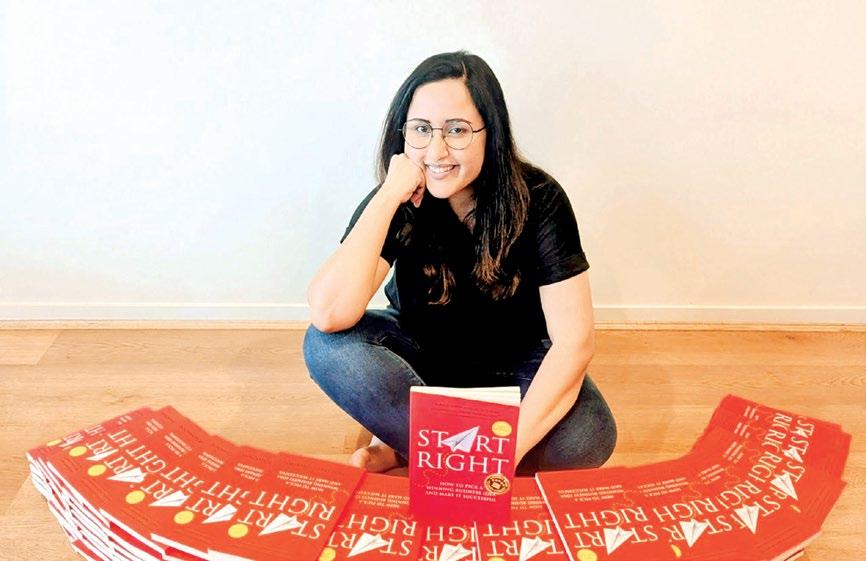
Today, Mulchandani stands as a prominent advocate for entrepreneurship, diversity, and Australia-Asia collaboration. She is the founder of Jumpstart Studio (a consultancy designing innovation programs for governments, corporates, and universities), and Press Play (a venture supporting women entering the startup ecosystem). Her work has already supported more than 600 early-stage founders, including over 250 women, across Australia and Asia.
Sangeeta Mulchandani’s pathway to entrepreneurship was both inherited and intentional. She hails from a family of entrepreneurs, her parents and grandparents having founded their own ventures; she always felt she would eventually follow the same path.
But first, she built a high-achieving corporate
career in banking and consulting in Australia.
“I climbed the corporate ladder really quickly,” Mulchandani reflected. “But I reached a point where I felt unchallenged. I knew I had more potential, but I didn’t know how to build a business in Australia.”
She took a year-long career break to study entrepreneurship - “the safe way,” she laughed. If it didn’t work out, she reasoned, she could return to corporate life with an additional degree. Instead, that year became the catalyst for launching multiple ventures and becoming a key voice in the national innovation community.
Mulchandani is a vocal believer in the transformative potential of the Australia–Asia relationship, particularly when it comes to innovation and startup growth. She sees Australia as uniquely positioned, both geographically and demographically, to deepen ties with Asia’s rapidly expanding markets.
“Australia has a massive opportunity,” she explained. “The many migrants who bring knowledge, entrepreneurial spirit, and the inherent risk-taking mindset are exactly what innovation demands.”
“Asia, India, the UAE, Africa are the next 20 years’ growth markets. The projected growth rates will outpace anything we see in the West [and] Australian founders need to shift their gaze. Instead of always looking to the US or UK for scaling, they need to start looking at this side of the world.”
Her new initiative, the Australia Innovation Corridor, aims to embed that shift. The project focuses on connecting early-stage startup ecosystems in Australia and India, groups often left out of traditional bilateral trade initiatives.
“These young founders are the future of innovation,” she says. “If we connect them early, in ten years India becomes a natural partner, not an afterthought.”
For Mulchandani, innovation is a mindset that has to “start internally.” It involves “thinking about better ways of doing things, moving from where you are today to a better future. It’s a mindset before it’s ever a product.”
This philosophy also underpins her teaching at the University of Melbourne, where she lectures on “intrapreneurship” which refers to entrepreneurial thinking within organisations.
Through Press Play, Mulchandani has worked with almost 150 women founders in just two years, and she clearly understands the barriers they face. Some are ecosystem-wide challenges: limited technical infrastructure, a small domestic market, and funding difficulties. But for women, the hurdles often begin far earlier.
“The startup system we have today is built on a Silicon Valley model, designed largely by men, for men,” she explained. “We can’t expect women to simply enter and thrive without redesigning the system.”
“Women don’t play one role at a time,” Mulchandani observed. “They’re mothers, daughters, sisters, career women, entrepreneurs often all at once. And they want to keep those roles. The ecosystem needs to create pathways that allow women to be their whole selves, rather than forcing them into a narrow mould of what a ‘high-growth entrepreneur’ looks like.”
Khushee Gupta
Long before he became one of Australia’s most influential Asian leaders, Dr Sonu Bhaskar’s world was lit up by a kerosene lamp in a quiet corner of India. It was in that small circle of light, reading second-hand books and drawing invisible maps for a future he couldn’t yet name, that his journey truly began.
This month, that boy - who once dreamed by the stubborn glow of a wick - was named the ‘Overall Winner’ of the Asian Australian Leadership Awards. It's a recognition he describes as “a message sent back through time”.
“This honour is profoundly humbling,” the physician-scientist told Indian Link. “It affirms a simple truth: that great journeys don't need a grand stage to begin. They start with a single, stubborn light and the courage to read by it.”
It is an award he sees not only as his, but as belonging to migrants, to neurodivergent children like him, and to families who sacrifice quietly for the next generation.
“It signifies that the Australian story is actively being rewritten to be more inclusive,” he said, smiling.
When silence becomes strength
Dr Sonu Bhaskar’s story began in a schoolyard where he felt unseen. “The truth is that my greatest challenge was also my greatest teacher: growing up as a neurodivergent child in a place that didn't have a name for it,” the acclaimed neurologist recounted.
“I remember the hot shame of fumbling with my shoelaces while other kids ran past, and the crushing weight of words stuck in my throat. But in that silence, I learned to listen. I learned to watch.”
What began as a coping mechanism eventually became the foundation of his scientific vision: noticing patterns others overlooked, asking questions no one
thought to ask.
Trailblazer for health equity
Sydney’s Dr SONU BHASKAR
“That ‘outsider’s lens’ I developed just to survive became my most powerful tool. It taught me that innovation isn't about following the crowd; it's about having the courage to build a new path when the old one doesn't work for you.”
That lens sharpened when he saw inequity up close - first in his own community, and later across rural India, Asia-Pacific, and Africa.
“I held the hands of patients who had travelled for days to receive treatment that should be a universal right,” he shared. “In that moment, ‘health equity’ transformed from an abstract ideal into a burning, moral conviction.” It is a conviction that has guided every step of his career.
Breaking the bamboo ceiling
So when Dr Sonu Bhaskar felt he was repeatedly coming up against the “bamboo ceiling” (barriers keeping qualified Asians from attaining leadership positions), he did not react with frustration but with creation.
“I learned you can't just ask for a seat at a table that wasn't built for you. You have to build a new one,” he smiled.
From that philosophy emerged the NSW Brain Clot Bank, the Global Health Neurology Lab, and the global consortia he has lednew structures designed not only to advance science, but to expand access and inclusion.
The NSW Brain Clot Bank, the first of its kind in the world, collects and analyses blood
clots removed during stroke procedures to uncover their hidden biological clues. The Global Health Neurology Lab takes these discoveries further, transforming them into policies, prevention strategies, and scalable solutions for communities from Sydney to rural India. Together with international consortia, Dr Bhaskar has built collaborative platforms that bridge laboratory science with global health equity - ensuring innovation reaches those who need it most.
Looking back, Dr Bhaskar’s scientific journey began extraordinarily: when he held a removed brain clot in 2015 and saw something no one else did.
“They were born from a critical gap… I held one of these clots and realised it held the secrets to why the stroke happened; yet it was routinely discarded as medical waste.”
From this came a world-first: converting surgical “waste” into a diagnostic revolution.
“Our most significant contribution has been a fundamental shift in perspective: pioneering the concept of the ‘brain clot as a diagnostic tool.’”
This shift has unlocked new insight into stroke, dementia, Alzheimer’s, Parkinson’s, and the lifelong health of the brain’s vascular system.
Tap your superpower
Dr Sonu Bhaskar is the recipient of prestigious awards, including the EU Marie Curie Fellowship, the Spanish Ministry of Health Fellowship, the Dutch Ministry Top Talent
Award in Biomedical Sciences and Medical Innovation, and the Prof. AR Rao Young Scientist Award. He is the two-time winner of the 2019 European Academy of Neurology (EAN) Investigator Award, the 2020 Rotary Vocational Excellence Award, the 2021 Paul Harris Fellow recognition, the 2022 Top 40 under 40 Most Influential Asian Australian Leadership Award, the 2022 Australian Global Talent Award and the 2023 IABCA Science, Research and Development Award. His journey is proof that breakthroughs often begin with questions asked from the margins.
His message to young Asian Australian researchers is not just advice - it is a lifeline.
“Your unique perspective is not a weakness; it is your superpower. You belong. Now go build the table you deserve a seat at.” Where others might end with achievements, Dr Sonu Bhaskar ends with hope.
“I hope my legacy is not a single discovery, but a shift in mindset. The ultimate legacy would be a future where a child, regardless of where they are born, their heritage, or how their brain is wired, can see themselves as a scientist, a doctor, a leader, and an ‘architect of belonging’.”
This year’s Asian-Australian Leadership Awards were announced at a gala dinner in Melbourne on 19 November. Now in its seventh year, the awards are an initiative of Asialink at the University of Melbourne and Executive Search firm Johnson Partners. Prutha Chakraborty
Australia needs to overhaul its overseas skills recognition system
Almost 40 years after this writer’s parents migrated, Australia’s skills system still fails to recognise migrant talent. Meet the Desi migrants it’s ignoring.
IBY TIARA DE SILVA
n 1987, my parents migrated to Australia, part of a generation that saw this country as a place where skill, education and effort would be rewarded. They arrived with qualifications, professional experience and a belief that their expertise would be valued in a nation built on opportunity.
But almost immediately they discovered a painful contradiction – their qualifications, respected abroad, carried little weight here. My Ammi, a teacher in Sri Lanka, took work that barely reflected her ability. My Thatti, who worked in management, retrained from the ground up and until the day he passed away, helped other new migrants navigate their way through settlement.
For many of us, the system is not simply a facet of the Australian migrant story but one of our biggest hurdles. And the individual stories reflect a deeper truth that persists: Australia’s overseas skills recognition
system needs a major overhaul.
A system that sidelines skill
Today, I work on the very issue that defined my family’s early years here. As Advocacy Lead for the Activate Australia’s Skills campaign at Settlement Services International (SSI), every day I see how that same system continues to fail talented South Asian migrants.
SSI’s research with Deloitte Access Economics found that 44% of permanent migrants are working below their qualification level. If these migrants were employed in roles that matched their skills at the same rate as Australian-born workers, it would add $9 billion to Australia’s economy per annum. Behind those numbers are people like Sobia and Abisha whose stories embody both the persistence of migrants and the systemic barriers that hold them back.
Sobia migrated to Australia from Lahore with a law degree and experience. But when she arrived, she found herself navigating an endless web of assessments and fees while working jobs she was severely overqualified for. After battling the system for years, she
“It’s not that I don’t want to do it,” she said. “It just feels like there is always something (else) to do.”
These are just two out of thousands of stories that illustrate how structural inefficiencies – not a lack of ability – keep skilled Desi migrants from contributing fully to the workforce.
A national inefficiency hiding in plain sight
Australia’s overseas skills recognition system is fragmented, inconsistent and costly, with each profession and state having its own rules. The Australian migration system is completely disconnected from the overseas skills recognition process with applicants often required to duplicate tests, resubmit documents or travel interstate for assessments. At the same time, industries like healthcare, education, construction and technology are facing critical labour shortages. Australia continues to import new workers through skilled migration programs while tens of thousands of qualified migrants already living here are locked out of their professions.
Reforms that would change everything
The Activate Australia’s Skills campaign, backed by more than 120 organisations across business, education and community sectors, is pushing for practical reform.
Our blueprint calls for:
1. National governance of the skills recognition system, including a commissioner or ombudsman to oversee it and make the process fast, fair and affordable.
2. A streamlined national process, aligning migration, licensing and employment recognition so migrants don’t have to start from zero on arrival.
3. Transparent and affordable pathways through a single online portal with all the information migrants need to get their skills recognised and access financial supports.
4. Local employment hubs with navigators who can guide migrants through the skills recognition process and connect them to employers.
These are not ambitious proposals – they are pragmatic fixes to a decades-old problem that costs us billions in lost productivity and human potential.
reluctantly chose to repeat her studies entirely.
Disappointingly, this story is not rare – it’s a very high cost just to prove what you already know.
Sobia recalls the struggle of starting over: “In our own country, we have identity … but here we are nothing.”
Abisha moved from India in 2022, with bachelors and masters degrees in psychology. She was practicing before migrating but when she arrived, she found her degrees weren’t sufficient for registration with the Australian Health Practitioner Regulation Agency (AHPRA).
The process of becoming a registered Australian psychologist involves not just documentation and verification but costly supervision and bridging programs. Unable to afford that immediately, Abisha took unrelated administrative roles and eventually established herself as a counsellor to stay connected to her field.
She described the decision as “the quicker route”, a temporary compromise to build financial stability before trying again. Four years later, she’s still gathering the paperwork and saving for registration.
Almost forty years on
When I think back to my parents’ arrival in 1987, I think of everything they were navigating – a new country, my newborn sister, unfamiliar systems with limited support – and I realise not only my privilege, but how much of their story is still being lived today. The names and professions have changed but the struggle has not.
Their journey, and the journeys of women like Sobia and Abisha, remind me that this isn’t just an economic issue. It’s about dignity, recognition and fairness. Australia has always seen itself as a nation of opportunity, but opportunity means little if it ends at the point of arrival.
Almost forty years after my parents migrated, it is time for a system that values what migrants bring, not one that asks them to start all over again. Because when we recognise their skills, we don’t just unlock billions in productivity. We unlock the country true to its national anthem –advance Australia fair.
Learn more about Activate Australia’s Skills at: activateaustralia.org.au
Photo: Instagram/Alexandre
What to do if you face racial abuse
Racial abuse causes deep harm, but you have options. Know how to stay safe, report it, seek help and stay supported by your community.
WBY TORRSHA SEN
hen a 63-year-old Indian-origin man was attacked by a 22-year-old woman at Westfield Parramatta recently, it left the community shaken. It was the latest in a spate of verbal and physical attacks, incidence of which have increased dramatically in recent months. For many migrants, this incident hit close to home - because it taps into a quiet fear we rarely articulate: that racism can erupt anywhere, at any moment, even in the everyday spaces where we live, work and shop.
Incidents like this remind us that while Australia prides itself on fairness and respect, racism still surfaces in painful ways. When it happens to you, shock can leave you feeling frozen, unsure how to respond. But knowing your options empowers you. Here’s what you can do - for your own safety, wellbeing, and peace of mind.
1. Prioritise your safety above all The recommendation is simple and universal - your immediate safety is paramount.
• Move away from the situation if you can.
• Seek out a public or secure space.
• If needed, ask bystanders for help – or security guards, shop staff, or anyone nearby.
Walking away is not weakness; it’s wisdom. Your wellbeing comes first.
2. Choose whether to respond Not every unpleasant comment needs to be confronted. For some people, saying “That’s not okay” or “Please don’t speak to me like that” can feel empowering. For others, silence and distance feel safer. Both responses are valid.
If you do choose to speak up, the goal is not argument but clarity. A simple, steady statement can assert your boundaries without escalating tension.
3. If the attack is serious, report it
While most interactions in melting pot cities like Sydney and Melbourne are positive, occasionally situations may require formal reporting.
In such cases, note down what you remember. Even short notes typed on your phone help preserve the facts during the shock.
Evidence strengthens your case if you choose to report the incident, but only
consequences long after the moment passes.
Talk to:
• your family or trusted friends
• your GP
• a counsellor (many GPs can bulk-bill mental-health support plans)
• community organisations supporting migrants
For many, racial abuse brings up old memories - early experiences of exclusion, cultural pressures, or the exhaustion of constantly proving oneself. Naming this pain is the first step towards healing.
5. If you witness racism, step in safely
Our safety grows when we protect one another.
If you witness racial abuse:
• Speak up only if safe: “Please stop, this is not okay.”
• Stand beside the victim: “Are you alright? I’m here with you.”
• Seek help from staff or security
• Record the incident
• Offer to be a witness if they choose to report it
Sometimes, the quiet presence of a bystander is all it takes to break the spell of intimidation.
6. Know your rights - they protect you
In Australia, racist abuse or discrimination is unlawful under the Racial Discrimination Act 1975, and various state anti-vilification laws.
These laws protect you from racist insults, threats, harassment, discrimination in work, education, housing or services
Knowing your rights shifts the power back where it belongs - with you.
7. A moment to reflect, not retreat
The recent attack, while distressing, has also revealed something quietly reassuring: the widespread concern expressed across communities. People of varied backgrounds have spoken up, not to divide, but to reinforce the belief that everyone deserves to feel safe.
For the Indian-Australian community, this moment is an opportunity to:
attempt this if you are safe.
Useful evidence includes:
• Photos or videos of the person or incident
• Screenshots of online abuse
• Notes about the time, location and what was said
• Details of witnesses
• CCTV availability (shopping centres often have it)
Contact authorities or community support services. You can report to:
• State Police (000 in emergencies, 131 444 for non-urgent cases)
• Crime Stoppers (1800 333 000)
• Australian Human Rights Commission (AHRC) - if discrimination occurred at work, school, housing, or services
If the abuse occurs in a workplace or educational institution, inform HR, your manager, or the student support office. Workplaces and universities have legal obligations to protect you. Remember, racism thrives in silence. Reporting it is not about fuelling division or “making trouble” - it is protecting yourself and your community.
4. Seek support: You don’t have to carry it alone
Racial abuse can have emotional
• Continue contributing openly to Australia’s social and cultural life
• Connect with cultural groups – yours and others’. Celebrate your heritage, and join in celebrations of others’ heritage too
• Support each other through difficult moments
• Raise your voice where it matters. Racial abuse can shake your sense of belonging. But moments of hate do not define who you are, or the role you play in this country.
8. Understand the moment, without internalising it
When distressing events occur, it’s natural to feel shaken or uncertain. But one quiet truth needs stating: an incident like the one in Parramatta says far more about the perpetrator’s state of mind than about the cultural identity of the victim.
Australia is built on migration - on people like you, who contribute skills, culture, work ethic and heart. When someone abuses you, it is they who are out of step with the country’s values, not you.
Rather than framing the incidents of hate as “us versus them” moments, it is more useful - and ultimately more healing - to consider how communities can respond with calm, clarity and connection.
What does it really mean to be Aussie?
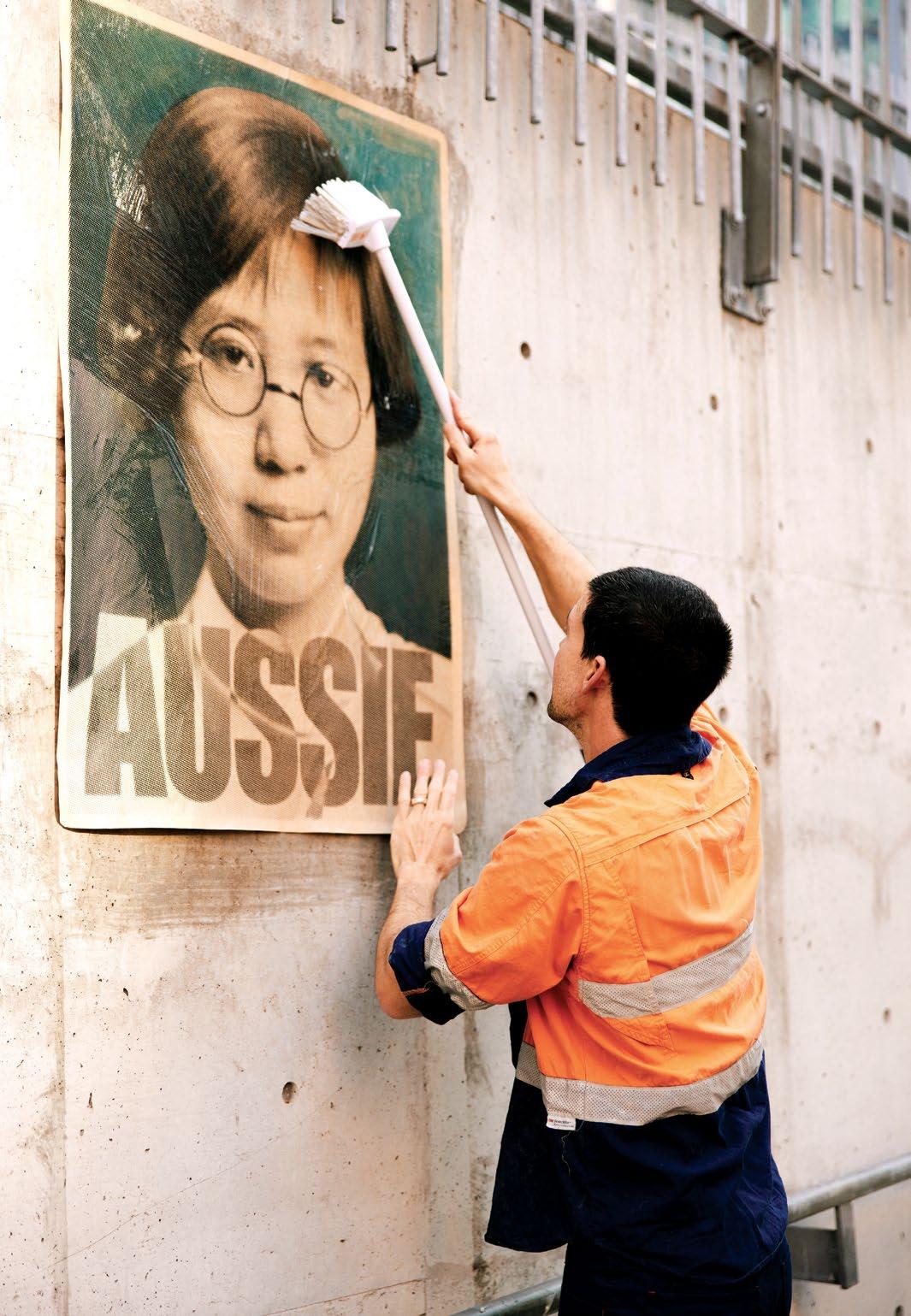
This photograph of Nellie Chin was taken in 1929 for her exemption from the dictation
Adelaide artist Peter Drew is set to release a new Aussie poster project amidst renewed racial tensions and anti-immigration protests across Australia
PBY SRUTHI SAJEEV
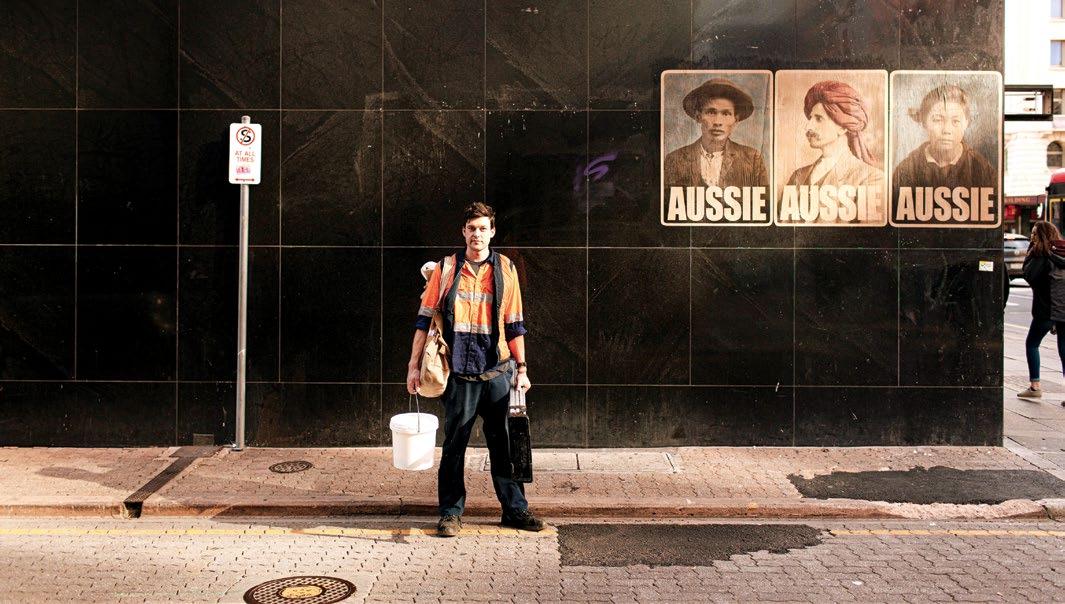
eter Drew’s striking Aussie poster series, now a familiar sight on our streets and alleyways, have breathed new life into Australia’s hidden histories. Featuring archival photographs of immigrants at the time of the White Australia policy, coupled with the word, ‘Aussie,’ the posters aim to pose more questions than answers. Amidst the recent anti-immigration protests and racial tensions, these questions are more relevant than ever.
With the ten-year anniversary of the series fast approaching, Drew has been working steadily in his studio to print 1500 posters by early next year.
His latest series of posters, featuring several new designs, look to broaden the scope of his project. In one of his most recent designs, three men ripping a poster featuring Monga Khan during the “March for Australia,” have become its unwitting stars. This time, the word “Aussie,” is punctuated with a question mark.
“All the Aussie posters have an implied question mark. But I wanted to make the question explicit. It’s up to the audience to then decide whether this behaviour is in fact Aussie,” Drew told Indian Link.
This poster is just one of the many ways in which he is seeking to dive into and further explain the paradox at the centre of the word “Aussie,” a word that is now more hotly contested than ever. This will include for the first time, a picture of a Jewish person, the great grandfather of a politician and a veteran of the Australian armed forces.
“There are two ways of interpreting the Aussie posters. One [interpretation] uses
the word “Aussie” in an aspirational way, highlighting that these individuals are Aussie too,” Drew observed. “But the poster also seeks to show that the word “Aussie” has a complicated history of its own.”
Peter Drew has had a long history of taking his art to the streets, which he views as the ultimate forum for political discussion. His Real Aussies Say Welcome series, a project in response to Australia’s treatment of asylum seekers, became widely popular, inspiring many to make their own versions of the poster. His Aussie series, centred around the now widely beloved Monga Khan, was initially created to question and probe the rise of anti-Islam hate sentiment following the Lindt Cafe siege in 2016.
Other immigrants who have now become familiar faces include Dorothy Sym Choon and Nellie Chin.
“I operate out of a sense of curiosity,” Drew explained. “I wonder what the effect will be. I don’t want to impose any ideas or intend to have a certain effect on the audience. When I make posters, I have a desire to find out the response myself.”
His strict rejection of being an “art activist,” and of “presenting political certainties,” has meant that his relationship with his audience is continually changing. He’s had encounters with people on both sides of the political spectrum, including Nationals member Gurmesh Singh who took to Parliament to say “It’s great to see that history recognised across the streets of not only Sydney, but Melbourne, Brisbane and Adelaide. But it was incredibly distressing to see videos of these same posters getting ripped down at the protests…”
When asked why his posters have had such a deep impact on people regardless of their political ideologies, Drew replied, “I think the posters are gentle enough that they have the power to appeal to people on the other side. It unsettles
their assumptions enough to temper their perspective.”
Perhaps this is why few of his face-to-face interactions have been confronting. Whilst he’s no stranger to receiving vitriol online, he rarely experiences this in the real world. Even when he does, it’s no longer something he fears.
“It’s an oddly intimate thing when you see someone clearly upset. It becomes very hard not to empathise with the person, and you can then de-escalate the situation quite quickly. That’s something that’s very hard to do online,” he explained.
Early next year, he’ll be hitting the streets solo once again in his hi-vis jacket and with a can of glue to put out 1000 posters across Australia. To see Drew post up the posters is a spectacle in itself - and a reminder of what just one man can achieve.
“The main reason why I prefer to do it alone is, if I had a little team of people, it creates an in-group and an out-group. But if I’m alone, then no one feels excluded and everyone can identify with what I’m doing,” he said.
Regardless of the response next year, it’s guaranteed that Peter Drew’s work will introduce more faces and names into our collective memory. These heroes will prompt us to ask ourselves what it really means to belong, to live in a multicultural society, and importantly, what we mean, when we proclaim to be Aussie.
“The reason why I prefer to do this alone is, if I had a little team of people, it creates an in-group and an out-group. But if I’m alone, then no one feels excluded and everyone can identify with what I’m doing.”
One India Run
Two brothers, one hope
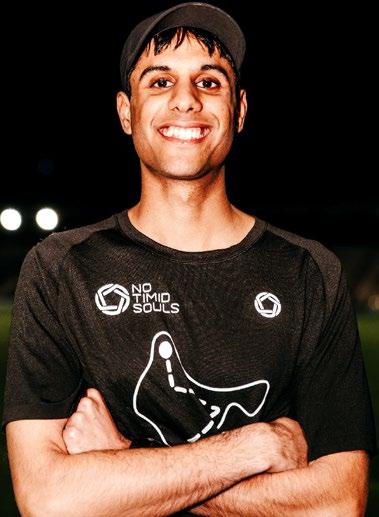
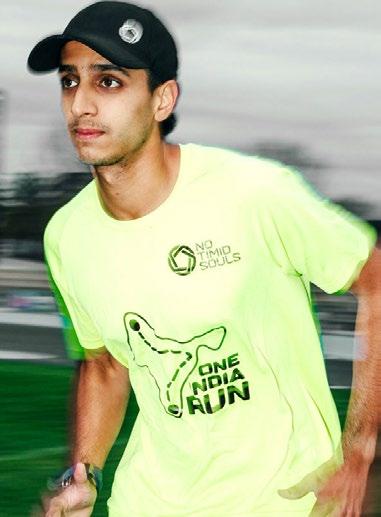
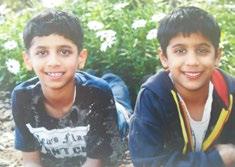
Melbourne brothers Om and Rajas Satija are running from Kashmir to Kanyakumari to raise funds for children affected by leprosy.
ABY LAKSHMI GANAPATHY
s far as brotherly bonding activities go, running the length of India is probably not top of most siblings’ lists – that is, unless you are Om and Rajas Satija.
“We’ll probably wake up some days hating each other, but I think that’s the beauty of it,” Om Satija says. “That’s where the bonds are created and I think we’ll grow together.”
What began as a playful idea to become the first brothers to run across India has coalesced over 18 months into the One
India Run, which will see 22-year-old Om, supported by his brother 21-yearold Rajas, attempt to go from Kashmir to Kanyakumari in 100 days.
Weeks away from the January 26 start date, Om is still coming to terms with the
trying to fight for attention – I would work twice as hard to get noticed when I played a sport,” Om reflects. “You could say it’s a chip on the shoulder, but I think that’s the beginning of a lot of what I’ve tried to do in life.”
Hope is the thing… that runs
“There was something within me which called me to try and do something crazy, like run across a place like India and see if I could believe in myself,” Om says.
That ‘something’ of which Om speaks is not just an outlandish personal quest to realise his inner strength, but the desire to empower others. Aged 10, on a holiday in Rishikesh, he distinctly remembers seeing leprosy afflicted beggars go ignored, and has felt empowered to fight the stigma surrounding the condition since.
Though a curable ailment, families affected by leprosy continue to face stigma and rejection from society, leading to poverty. The One India Run will raise funds for Udayan, a Kolkata-based NGO providing education to leprosy affected children which Rajas and Om have developed a close relationship with.
“I met a gentleman called Swapan, he was in the first batch of Udayan kids in 1974; he became a paramedic and has spent his whole life coming for Udayan kids,” Rajas remembers. “He’s in his mid-50s now – I look at him as testament to the power of hope and education.”
“We’re just so inspired and want to give hope to those kids. Udayan has a 100% vocational placement rate. What they are doing to bring these kids out of poverty is just remarkable.”
Equally, the brothers feel a deep sense of pride and connection with their Indian heritage and hope to represent the younger generation of Indians on the global stage.
mammoth task that awaits them.
“I think naivety is a weird superpower,” Om says of the run’s genesis. “We genuinely thought, kilometre to kilometre, it’s a cool run. It’d be amazing to see India. A lot of times when you think of such things, the idea is a lot more appealing than the reality.”
“We’re not even taking a conventional route – there’s a National Highway 44 that runs down the middle…we’re going down the east coast. No one’s done this and it’s arguably a lot more stupid and ridiculous to try it!”
But slaying Goliath is familiar territory for the self-described ‘small skinny kid’ who grew up playing AFL and cricket and was captivated by triathlon runners.
“I always saw myself as this underdog
Part of that generational experience, it seems, is enduring the concerns and doubts of their parents.
“I cannot tell you the number of fights to this day that we’ve had with our parents,” Rajas recounts. “Mum said, ‘I’ll do anything for you guys to just run across Australia, I’ll sponsor the whole thing from our own pocket. Don’t do India.’”
“They obviously look at us like we are coconuts – I mean, Om and I were born here – we’ve been back to India quite a few times, but running across India is a whole different beast.”
But having grown up with yoga and meditation, Om sees the journey as a ‘pilgrimage’ and says they aren’t afraid of facing the challenges of the 5000 km journey head on.
Continued on Pg 24
Rajas Satija (left) and Om Satija
Rajas (R) and Om (L) were born and brought up in Australia
Sharing a meal with the leprosy colony children
Keeping his head in the game
“A space of our own”
Player turned commentator Isha Singhal launches Australia's first dedicated newsletter for Women's Football
WBY KHUSHEE GUPTA
hen Isha Singhal first laced up a pair of football boots at 13, she didn’t imagine she would one day become a leading voice in Australia’s women’s football community. Back then, she was just a kid in love with the game – its pace, its energy, the way it gathered strangers onto the same patch of grass and made them feel like teammates. But years later, after diving deeper into the sport as both a player and spectator, she found herself increasingly frustrated.
“I just felt really disappointed,” she reflects. “There was limited coverage, and when I wanted to learn more about players, I had to dig so hard to find anything. And sometimes the way people spoke about women players, especially from different backgrounds, wasn’t always the most delicate.”
From that frustration came an idea. Not just to fill a gap, but to reshape the tone of women’s football media in Australia. In her words, “I wanted to provide something different because I’m really passionate about this, and I wanted to highlight the female athletes who put in so much effort to make this sport so enjoyable for all of us.”
Singhal first tested the waters on social
media. It started casually with TikToks here and there, thoughts about matches, and commentary on stories she felt deserved attention.
“My TikToks really blew up,” she laughs. “I hit one million views in my first six months or something, and it made me realise people actually wanted more. They wanted to talk about it. I had people messaging saying, ‘I didn’t know this game was on. I want to watch it.’ That kind of thing made me feel like, wow, this is a space people are craving.”
From there, she wanted “a space that wasn’t just reliant on social media… something I had full control over. And I also wanted to reach different demographics, because social media reaches one type of audience, but not always everyone.”
And so, this year, she launched Australia’s first dedicated women’s football newsletter, Womens Football Weekly. From the beginning, Isha Singhal was clear her newsletter was, “for anyone who cares.”
“There are so many people who love this space, but they need nuance, they need conversations that aren’t already happening.”
Her audience ranges from dedicated fans to casual observers, full-time workers who can’t watch every game, and young girls who want to see themselves reflected in their sporting heroes. She also hopes to engage men, people of colour, and community members from all backgrounds.
that grassroots women’s football gets more attention. That’s where our next Matildas come from.”
Women’s football media, compared to men’s sport, is still young but Singhal sees that as an opportunity, not an obstacle. “I watch men’s football too, and that’s part of why I focused my platform on women’s football. There are already so many voices covering the men’s game, but not enough covering the women’s.” So instead of competing, she has found a community. “I honestly don’t think the women’s football media market is saturated at all. There’s space for everyone. And the people in it are so supportive. We all learn and grow from each other. The more voices, the better.”
Despite being just four weeks old, Singhal’s newsletter is already gaining traction. “Within the first few hours, I hit 100 subscribers,” she shares. “Now I’m at about 150. The feedback has been so lovely. Someone emailed saying they don’t always have time to watch the games because they work full-time, but they love being in the know. Another person said the newsletter was really thoughtful and wellcrafted.”
One of her early cover stories, about issues facing the women’s national team, deeply resonated with readers.“Someone told me they would’ve never known about it if I hadn’t covered it. That meant a lot.”
“You don’t have to look any particular way or be any particular type to enjoy sport,” she says. “I want something that caters to people from all walks of life.”
But she also notes the importance of giving space to those starting out. “That’s where our future is made,” she says. “It’s so important
In a landscape where women in media, especially women of colour – are still severely underrepresented, Isha Singhal’s work is helping shape the tone of sports media in Australia. As she puts it: “Sport is magical. It brings people together. And I want women’s football at all levels to have the light it deserves.”
It’s a world record for Kailash Bhatnagar, 101!
Mrs Bhatnagar was among the 150 attendees who set a Guinness World Record for the largest gathering of centenarians
“There are probably going to be days where I’m going to wake up and my whole body wants to quit,” Om muses.
“I think as extreme and painful as that might be, the ability to transcend the limitations of what your body and mind might say and power on and find who you really are and what you’re really capable of – that to me is a kind of pilgrimage.”
Just keep running, says Pat Farmer
As part of their preparations, the brothers reached out to ultramarathon runner Pat Farmer, who previously completed a ‘Spirit of
GBY RAJNI ANAND LUTHRA
etting ready for a lunch event at NSW Parliament House, Mrs Kailash Bhatnagar took time to pick out her sari.
She finally settled on a traditional number in orange and gold.
“I wanted to embrace my cultural roots for the special occasion,” she told Indian Link.
Mrs. Bhatnagar was part of the Centenarians Lunch at which 150 people from across the state got together to set a Guinness World Record – for the largest gathering of centenarians in one spot.
The lunch took place on Grandparents Day, organised by aged and disability care provider My Guardian, in collaboration with the NSW Government.
A former teacher and principal, and now a writer and poet, Mrs Bhatnagar was joined by other educators, veterans, holocaust survivors, entrepreneurs, and pioneering migrants. Together, they made it a room of “10,000 years of lived experience,” as one speaker noted.
“I was thrilled to be part of this Guinness World Record event, and to share my experiences with fellow attendees,” said Mrs Bhatnagar, her face lit with smiles through the afternoon.
Her son Vivek who accompanied her, recounted, “Mum’s excitement grew even more when she discovered she was the only Indian-born centenarian present – a moment that filled her with immense pride and joy.”
My Guardian founder and CEO Jad Haber said, while honouring the centenarians, “They’ve lived through the most extraordinary century in human history – witnessing everything from the Great Depression to the digital revolution. Today is more than a record; it’s a call to action for all Australians to recognise and celebrate our elders as the living pillars of our nation.”
NSW Minister for Seniors Jodie Harrison, also among the attendees, said, “Today’s gathering is a powerful reminder of the strength, resilience, and wisdom of our oldest Australians, many of whom have shaped the very fabric of our communities,” she said. “NSW Parliament is proud to honour those who have given so much across generations. I commend everyone involved in creating this extraordinary moment of recognition and unity, and for championing the dignity and rights of older people across NSW.”
The Centenarians’ Lunch came just weeks before Mrs Bhatnagar marked her 101st birthday, and as she celebrated the birth of her fifth great grandchild, the newest member of her 21-strong family.
“The secret to my long life is simplicity, saatvic (vegetarian) food, and my religion Hinduism,” Mrs Bhatnagar had told Indian Link on her 100th birthday last year. “But mostly, my secret strength is keeping my family close to me. I did this as a young girl, and again as a married woman, again as I built my own family, and again when I moved to this country as a retired person to be close to my children who live here.”
Being part of this remarkable world record event – marking longevity and joy –is a moment she and the Bhatnagar family will never forget.
India’ Kashmir to Kanyakumari run in 2016.
“[Pat] said, ‘the running will be the least of your problems – it’s organising all your sponsorship and your PR and everything else’,” Om remembers. “At the time I was so naïve. I had no idea about any of those things. I thought I just had to find a place to stay and run every day!”
The brothers have made many sacrifices – Rajas is taking time off university to support his brother, and Om has put his cricket aspirations, saxophone gigs and physiotherapy studies on hold to get himself to a place where he can average 50km a day.
“Every time we start feeling sorry for ourselves, we’re like, ‘this is our choice’. There are a lot of people in the world who don’t have the ability to do anything like this,” Rajas says.
They regard Pat Farmer as the ‘catalyst’ for this journey and have taken to heart his no-nonsense advice.
“Before Pat’s North to South Pole run, his million-dollar sponsor pulled out, so he sold his house to make it happen. He said no matter what path you’re on, even if you have to crawl to Kanyakumari, finish what you started,” Rajas recalls.
“[We thought] let’s go balls to the wall.
Let’s throw everything at it.”
With Rajas currently in India scouting out the route’s safety, Om is learning to sit with the uncertainty.
“When you run, you get a lot of time to your thoughts, and this came to my mind: courage is not trying to deny that fear exists – I’m s**t scared,” says Om.
“I think [courage] is the opposite – you acknowledge the fears are there. You look it in the eyes, and you just take it head on; you embrace it.”
Find out more, and donate to the One India Run on the website www. oneindiarun.com
Raja Ravi Varma’s gods grace Brisbane
QAGOMA hosts an exhibition of oleographs by Raja Ravi Varma, the painter who gave the gods their faces
IBY PRUTHA CHAKRABORTY
n a quiet conservation studio in Brisbane, the gods are being reborn. Layers of time and varnish are being carefully lifted from the luminous faces of Lakshmi, Saraswati, Krishna and Ram – their garments gleaming once again with zardozi (metal thread embroidery), vibrant garlands and sequined halos.
It’s not a temple, but the Queensland Art Gallery | Gallery of Modern Art (QAGOMA), where a groundbreaking Indo-Australian project is bringing new life to the art of one of India’s most revered painters: Raja Ravi Varma.
Leading this effort is Tarun Nagesh, QAGOMA’s Curatorial Manager of Asian and Pacific Art, whose connection to Ravi Varma’s imagery began decades before this conservation project.
“I regularly visited family in Mysore as a child,” Nagesh recalls. “Ravi Varma’s paintings were everywhere – in homes, in shops – and even then, I knew how deeply woven his
images were into Indian life.”
That childhood familiarity found professional purpose when QAGOMA acquired a remarkable set of 48 embroidered oleographs – prints that had once adorned homes and temples across India.
“Seeing such a large collection with known provenance and all similarly embellished seemed like such a rare opportunity,” says Nagesh. “It allowed us to capture a whole range of stories about Ravi Varma while considering his works in a contemporary context.”
QAGOMA is collaborating with the Museum of Art & Photography (MAP), Bengaluru, whose team of paper conservation specialists is providing critical expertise
in restoring and preserving Ravi Varma’s delicate works. The project, supported by the Australian Government’s Maitri Cultural Partnerships initiative, is on display at the Queensland Art Gallery until October 2026, and is aptly titled ‘The God of Small Things: Faith and Popular Culture’.
Speaking to Indian Link, Nagesh observes, “While we knew Ravi Varma’s oleographs would have such resonance for the Indian diaspora, it became very quickly apparent people were fascinated with them even if they were completely unfamiliar with the artist.”
Restoring the gods
The condition of the works, some dating back over a century, posed unusual challenges.
Many had been lovingly – if not expertly –preserved in domestic spaces, like homes or businesses for worship.
“The condition was consistent with works kept in Indian homes,” Nagesh explains. “They featured elaborate embellishments with textiles, beads, silver threads – all mounted differently.” Because oleographs sit somewhere between print and painting, their restoration required a multidisciplinary team. Paper conservators worked alongside textile and sculpture specialists, addressing issues from varnish yellowing to frayed embroidery.
“Our framing and mounting specialists even studied the types of frames once used in India,” Nagesh adds, “to restore them authentically.”
The oleographs in question are not grand oil paintings destined for royal palaces, but printed devotional images – artworks of the people. This mix of reverence and embellishment gives each print a distinct personality. Garlands stitched from cloth, sari borders of gold thread, even beads and sequins transform these prints into living cultural artefacts.
“It’s this hybrid identity that makes them so fascinating,” Nagesh notes. “They sit between popular culture and fine art.”
Resonance among diaspora and beyond
For QAGOMA, the project has been a way to connect with the Indian diaspora in Australia – and to introduce new audiences to a cornerstone of Indian visual history. “Ravi Varma is one of the few Indian artists so widely known, and we knew his images would instantly resonate,” Nagesh says. “For others, seeing them for the first time has been just as exciting.”
The ongoing Brisbane exhibition explores spirituality and everyday devotion – but with a contemporary twist, examining how artists reinterpret faith, divinity, and popular culture in the spirit of Raja Ravi Varma’s legacy.
“While curating this exhibition, we wanted to investigate what these works meant today, and the ideas they could raise when brought into conversation with other artworks. But, we were particularly interested to explore how artists in different contexts create their own forms of the gods, how religion features in popular culture, and how objects of worship are present in the everyday – all ideas relevant to the history of Ravi Varma’s legacy, but expressed by other artists in a diversity of ways.”
The conservation work, which is ongoing and will continue simultaneously as the oleographs are displayed at the exhibition in two chapters, revealed all kinds of fascinating discoveries for the team.
“Under the mounts, we often found the bands of text showing where and when the works were printed,” Nagesh shares. “Some even had old newspaper strips on the back from previous framings – little clues to their journeys.”
Cleaning the surfaces, he adds, “brought so much colour and life back to the images – they look completely transformed, yet still bear the beauty of their age.”
Beyond the exhibition, Nagesh hopes this is just the beginning of long-term collaboration between Indian and Australian institutions. “This has been such a deep research and conservation effort,” he reflects. “We’re planning to publish and share our findings widely in conservation and museum forums. And I can already see more opportunities on the horizon – this project has opened so many doors.”
Photos: QAGOMA
Garud Wahan Vishnu (c.1895–99, printed c.1930), before and after treatment
Raja Ravi Varma
QAGOMA’s Tarun Nagesh Treatment in progress
Laxmi (1894, printed c.1910–20) Sheshnarayan (early 20th century, printed c.1910–20) Vasantasena (early 20th century, printed c.1910–20)
Bala Skandha (early 20th century, printed c.1930s)
The BUZZ
What we’re obsessed with this month
By SRUTHI SAJEEV
Books
Meet Vir Das, a self-described fool, outsider and, according to his latest memoir, misfit. After several successful stand-up comedy specials, the comedian has turned to a new craft: memoir writing. His book The Outsider: A Memoir for Misfits follows the struggles he experienced during his rise to fame. A powerful story of resilience, this book will be relatable to those who feel out of place yet choose to stay true to themselves.
Beats Binge Bites
If you’re tapped into the Indian music scene then you’ll know rapper Reble AKA Daia Lamare is one to watch. Her recent single “New Riot” is emblematic of her oeuvre thus far, one which pushes against the boundaries of mainstream music and is anchored by her unique voice. The single is an attempt to, as she describes, “embrace” and acknowledge “the universe’s chaos.” With an EP on the horizon, this artist is just getting started.
MELBOURNE MECCA X NGV WOMEN IN DESIGN COMMISSION: NIPA DOSHI
28 Nov - 1 Apr, National Gallery of Victoria
Snigdha Kapoor’s “Holy Curse,” begins with a teenager’s temper tantrum. However, the main character Radha’s meltdown isn’t merely an act of rebellion, but one of self-preservation as she fights a family determined to repress her queerness. Within the span of 15 minutes, Kapoor explores familial power dynamics and repressive traditions, showcasing how even small acts of rebellion can have an impact. Accessible via YouTube, this film is a reminder of the power of the short film.
It’s barbeque season (already?!) and you’re probably looking to make something different this year. Opting for tacos is a unique move in itself, but why not go further by replacing that taco shell with the humble fenugreek thepla? To try it out first, look no further than the thepla chicken tacos made in Sydney’s Madam Ji restaurant. Refreshing and easy to make, it’s fusion food the type of which will appeal to even the most hardline traditionalists.
A Room of My Own is awardwinning designer Nipa Doshi’s literal shrine to all the women who have inspired and looked after her. This hand-crafted cabinet which doubles as a dressing table, prompts reflection on all who we ought to worship in our daily lives.
After Rohan Joshi emerged from his existential crisis, he became determined to be a better comedian. The bad news is, he wants his audience to hear all the details (he promises it’ll be funny). If you’re craving relatable, witty humour then this is the show for you.
for an excuse to get out and party?
your chance to let loose.
THE GOD OF SMALL THINGS: FAITH AND POPULAR CULTURE
Revisit Raja Ravi Varma’s iconic paintings at QAGOMA’s latest exhibition. The gallery’s collection of embellished oleographs explores and reveals the divine in the mundane and the intersection between classical and pop culture. It’s a rare opportunity to delve deeper into Varma’s world.
Looking
Panipaali 4.0, featuring music composer and DJ Ribin Richards, brings South Indian culture to the dance floor. Whether you’re into hip-hop, RnB or EDM, this is
ROHAN JOSHI 5 Dec, Air Nightclub, James Street, Perth
with Lakshmi Ganapathy
DINESH PALIPANA OAM is a senior resident doctor at Gold Coast University Hospital, a lawyer, and co-founder of Doctors With Disabilities Australia. The first quadriplegic doctor to graduate from medical school in QLD, he was the state’s Australian of the Year in 2021.
What are some of the beliefs you had about disability before your car accident, and how have they changed since?
It's something that didn't cross my mind. I mean, I would have seen someone who might be using a wheelchair or who had a disability, but I never thought much more about it after looking at them. Every now and again, I remember thinking, okay, life using a wheelchair could be tough, but that was really the extent of my thought to it.
The accident happened so suddenly; one day I was walking and the next second I wasn't. It's been eye-opening because it's not just the things we see… sometimes it's things that I didn't imagine or think about - my fingers are affected as well, the skin doesn't work anymore to control the body temperature, the bladder, all that stuff. I think the other thing to highlight is the social challenges that come with it. What about getting out into the community? What about employment? What about education? So it's such a broad thing.
Why do you think ableism is so entrenched within the medical profession? It's ironic, isn't it, because I think this is the one area of work that should be totally open-minded and inclusive.
doors…But those things can be done and are relatively easy.
What I have learned is people will always forgive a kind and open attitude, even if the physical environment was not accessible. Let me give you an example - I went bungee jumping earlier this year and there were like 190 stairs to go up. These guys were like, don't worry, we're just going to carry you up the stairs. It was one of the most difficult places to access, but because there was a helpful, open-minded attitude, we could make it happen.
school, you want to finish your degree, and when you finish your degree, you want a job. Then you want your promotion and your house and your marriage and your car. I think you get to a point where you're like, what does all this actually mean?
I wonder if it's because of the conservative professions that have been the foundations of medicine...if it's some of those attitudes and a disconnect between us and the community that we serve that has caused this. We need to start building better relationships with our communities and our patients. I think there's been a breakdown in [trust], and that's why we saw during COVID there was a bit of mistrust in health, probably because we don't reflect the community that we serve.
How do we make hospitals more accessible?
I think there are a lot of physical ways that we can change things. It might be a flatter surface, automatic
So I think sometimes, even in times of physical inaccessibility, with the right attitude, we can open [up] places - attitude matters a lot.
The subtitle of your book ‘Stronger’ is ‘how losing everything set me free’. Can you tell me what you mean by this? From childhood, we aspire to the next
In my life, I held on to all these things that I thought were important, like material things, thoughts about social status, whatever else. But I realised when I had the car accident, how quickly all that is lost. We've seen this in society - people go broke, people get sick, people fall into hard times, then suddenly they have nothing and no one, which is very sad.
When I had the accident, it was hard to let go of the stuff that I had, but then I realised, man, I'm actually free. All these things have been ripped away from me, but now I'm free to start again and build a simpler, purer life.
What's something that you're currently listening to/ reading/playing/watching?
I think life is about getting marginally better every single day, so I make it a point every night to read at least five pages of a book and five pages of a medical book so I'm learning something new.
At the moment, I'm reading a book called Wisdom Takes Work by Ryan Holiday - Ryan has written a series of books on stoicism and I've read all of them. This is the most recent one, it's about how you cultivate wisdom and experience and mentors and all of that.
What’s a word that you like in a South Asian language, and what does it mean?
I think Amma or Ammi; my mum's been a really important part of my life. All across the South Asian languages, Ammi is probably very similar. We're all a result of our mothers. I think our bonds with our mums are so strong in South Asian cultures - the motherland too.
And finally: Soan Papdi or Papdi Chaat?
Soan Papdi; I have been known to eat dessert first.
“Fantastic”: Amrish Puri would now have more choices than Black Dog
A spirited evolution: How India went from prohibition to pinot
WBY CHARMAINE O’BRIEN
hile I may be largely fashioned from Irish and Scottish DNA, my love of whisky has nothing to do with our shared origins: I developed it in India. In 1997 I experienced my first ‘Delhi dinner’, a novel experience for me then. Nobody arrived before 8.30pm – and these were the ‘early’ guests – what might have been one pre-dinner drink at home in Australia, was usually two, or more, hours of tipples and snacks prior to the meal being served. I enjoyed the conviviality of this but being unused to dining post 10.30 pm, I ate too generously of the titbits and by the time the meal arrived I had little appetite for it. I was impressed though that the arrival of dinner seemed an understood signal that the night was over. When everyone was done eating, they chit-chatted a little and then left. No need to yawn and drop hints to try and politely encourage lingering loquacious guests to leave.
Where wine whispers, but whisky roars
My consumption of small eats at Delhi dinners was matched by my drinks intake. I preferred wine but as there wasn’t much of that available in India at that time, I went with the flow, and what was flowing was whisky: and with that my penchant for it came about. When I tell Australian friends my partiality for whisky developed in India, and that the country has a wine industry and produces indigenous and artisan liquors,
they often express surprise saying: ‘I thought Indians didn’t drink’. When I ask why they think this, they will say: ‘Because their religion does not allow it’ or ‘I did not think it was part of their culture’. Bemusing ideas considering India has a very long history with alcohol, albeit a complicated one.
Of spirits past
The people of the Indus Valley were fermenting and distilling alcoholic beverages 5000 years ago. The Vedic scripts, great epics and ancient Tamil literature all mention the production and consumption of liquor for everyday and ceremonial use, with its existence equally condoned and condemned across the eons. Buddhist and Jain texts recommend abstinence from any intoxicants. Despite Islamic prohibition of alcohol, when India was under Muslim rule it remained part of court life – Aurangzeb unsuccessfully tried to prohibit it. When the British arrived in India in the seventeenth century, potations made from grains, palm saps, flowers and sugar cane were made across the subcontinent at
small scale. They diminished these as ‘country liquors’ and set up large scale production of European beverages, such as whisky, creating the commercial alcohol industry in India. In the early 20th century, Indian nationalists campaigned, unsuccessfully, for the prohibition of alcohol because the British controlled its industrial production and retailing. PostIndependence the new Constitution included Article 47 with the directive to the States to bring about the prohibition of alcohol, and attitudes to drinking varied. It was considered a pretension of the upperclass and the coarse habit of labourers and tribals; the middle classes abjured it, at least in theory; and it was especially taboo for women.
Pouring into the mainstream
In my post-liberalisation experience, bars, except in upmarket hotels, were seedy places with blacked out windows; liquor vends were caged and emanated a sordid vibe. I sometimes attended social functions with female friends who sipped soft drink rather
than be seen consuming alcohol in public, even though they drank it at home. That alcohol can be problematic is indisputable, still socially accepted use of alcohol in India has evolved significantly over the past two decades. Metros now boast many cosmopolitan bars and fashionable cafes with wine lists; there are regional wineries to visit; ‘country liquors’ have been elevated, and contemporary Indian spirits are winning international awards. Social stigma around women and alcohol is dissipating, even kitty parties are being held in licenced public venues. Nonetheless complications persist.
Sobering challenges
While Article 47 directs moving to alcohol prohibition, each state is allowed to determine how liquor is treated within its boundaries. The result, India’s changing drinking culture – a bewildering complexity of varying taxes and regulations regarding how alcohol can be produced, sold and consumed, or not, around the country. Goa has become a centre of artisan distilleries and microbreweries, including local feni, because the taxes on alcohol are lower and socio-cultural attitudes more relaxed. Yet, it is hard to buy commercial feni outside the state, partly due to small production, but regulations on transporting alcohol across state lines hamper its availability too. Indian wine often costs more than a bottle of whisky because of taxes. Gurgaon has many sophisticated liquor stores, whereas across the border in Delhi all the fancy private liquor retailers were abruptly shut down in 2022 and lacklustre government run caged stores reinstated – the one I shop at typically requires me to jostle through a scrum of men to get to the good Indian
whisky at the back of the store.
Nashik’s cool climate and volcanic soils are quietly shaping some of India’s most promising wines
Pic:
The contrast between old wine shops and swanky new outlets shows India’s changing drinking culture
An Aussie cricketer much-loved in India takes his wine brand there
JOYALUKKAS: A GLOBAL LEGACY OF TRUST NOW IN AUSTRALIA
Jewellery brand Joyalukkas proudly announces its grand entry into Australia, establishing its first showrooms in Sydney and Melbourne. This landmark expansion extends the brand's footprint to 12 countries, solidifying its position as the ‘world's favouritejeweller’.
The brand's legacy began in 1956 in Kerala, India and expanded internationally in 1987 with its first UAE showroom in Abu Dhabi. From these origins, JoyalukkasJewellery has grown into a global operation with over 190 showrooms worldwide, trusted by millions of customers.
For its Australian debut, Joyalukkas will offer an exceptional shopping experience featuring jewellery sourced from over 20 countries. The showrooms will showcase exclusive collections like Pride, Eleganza, Veda, Sita Kalyanam and Krishna Leela, alongside lightweight collections such as Bella, Spring and Yuva.
Every Joyalukkas purchase is backed by comprehensive customer assurances
including jewellery exchange within 15 days without any loss, a fair price policy and a cash buyback guarantee on gold and diamonds. The brand offers 100% exchange value on IGI certified diamonds and is committed to responsibly sourced products.
Dr. Joy Alukkas, Chairman of the Joyalukkas Group, stated, “Our expansion into Australia reflects our deep commitment to bringing worldclass jewellery closer to the Indian diaspora and multicultural communities. We are building a new home for luxury, where trust, quality and unwavering dedication to customer service form our foundation. We envision becoming an integral part of Australia's celebratory moments and are optimistic about the future growth and lasting relationships we will build here.”
The Australian launch represents Joyalukkas's commitment to extending its legacy of trust and excellence to new markets, offering both exceptional jewellery collections and unparalleled customer service guarantees.
Where heritage meets high-rises
“BY SANDIP HOR
Do you know this Indian man?” asked tour guide
Peter in Luxembourg City while drawing my attention to a large wayside hoarding displaying a photo of steel king Lakshmi Mittal.
“He has made our country the richest nation in the world,” he said.
Peter was not wrong.
Not many know that Luxembourg, one of Europe’s lesser-known destinations, is currently the planet’s richest country. Lakshmi Mittal who originated from India’s bustling city Kolkata now lives in Luxembourg and owns ArcelorMittal, the world's second-largest steelmaking company, which significantly contributes to the wealth of the small country.
As a Kolkata lad myself, Peter’s words stirred both nostalgia and pride - for the country of my birth, whose sons and daughters, like Mittal, are leaving their mark on the global economy.
Luxembourg rarely makes the tourist radar, but a Belgian friend’s praise - “a hidden gem of history, architecture, and nature” - convinced me otherwise. When I travelled to Europe this year, I happily added it to my itinerary.
Snuggled between Belgium, France, and Germany in northwestern Europe, every part of this small country is steeped in history. It began its journey as a county within the Holy Roman Empire, later evolving into the County of Luxembourg in the 11th century, and
eventually becoming a duchy and a principality.
The territory was governed by various European dynasties, including the Habsburgs, Bourbons, Burgundians and Prussians, until it achieved independence in 1867. The rich tapestry of their legacies makes Luxembourg a paradise for lovers of history and culture.
Fast forward several centuries, Luxembourg now exists as the world’s only Grand Duchy, where history mingles with modernity.
Post World War II, it has achieved notable milestones, including being a founding member of the European Union (EU) and the North Atlantic Treaty Organisation (NATO), hosting the signing of the groundbreaking Schengen Agreements that facilitate visa-free travel among EU nations, and winning the Eurovision Song Contest twice. As stated earlier, it’s
currently the world’s richest country, thanks to its thriving steel manufacturing and banking sectors, and it is the only nation in the world that provides free public transportation to both residents and visitors.
Luxembourg City is the nation’s capital as well as the capital of the EU and the entry point for travelers arriving by air, though rail and road connections are available from neighbouring countries to reach the capital conveniently.
History became my companion as I joined Peter into the UNESCO World Heritagedesignated Old Town, located at the confluence of the Alzette and Pétrusse Rivers, and based around two squares - Place Guillaume II, dominated by the equestrian statue of Duke William II from the 19th century, who established the nation’s first parliamentary
Postcard vibes: A panoramic view of Luxembourg
Clean, pastel façades and steep slate roofs
Guillame II Square
high-rises
TRAVEL NOTEBOOK
From cobbled alleys to glass towers, Luxembourg blends medieval charm with modern ambition - a city that wears its history and progress side by side.
Getting There: Fly Qantas (www.qantas.com) via London to Luxembourg City
Stay: Moxy Hotel Luxembourg Airport (www.marriott.com)
Tours: Nature & Castles Tour (www.sightseeing.lu)
constitution, and Place d’Armes, often referred to as the 'City’s Living Room.' Both the areas are filled with numerous historical buildings and monuments, the most distinguished being the Grand Ducal Palace, the official residence of the royal family; the Hotel de Ville, or the City Hall, and the Notre-Dame de Luxembourg Cathedral.
Luxembourg City is constructed on two levels, and the finest view of the lower town can be enjoyed from the Corniche, a picturesque promenade described by Luxembourg writer Batty Weber as the 'most beautiful balcony of Europe.' This pedestrian walkway, which
hugs the edge of a cliff, meanders along the remnants of the 17th-century city ramparts and provides breathtaking views of the fortification leftovers, bridges, and viaducts that connect the older part of the city to the newer areas and the enchanting suburb of Grund.
In stark contrast to the medieval quarters, the Kirchberg Plateau welcomes visitors with an ultramodern cityscape - sleek high-rises, chic cafés, and contemporary restaurants lining wide boulevards that have replaced cobblestone lanes, Gothic façades, and old-world taverns.
This district was developed to serve as the hub of the EU, and many of the buildings there accommodate key EU institutions, such as the European Court of Justice and the European Investment Bank.
While exploring this area, I noticed people from various nations, their presence contributing to Luxembourg's status as a leading multicultural destination. An Indian gentleman at a café informed me that residents from 160 different nationalities live in Luxembourg for EU and other related employment.
In the 19th century, Luxembourg drew a host of artistic luminaries, including Ernest Hemingway, Johann Wolfgang von Goethe, and Victor Hugo - each inspired, in their own way, by its charm and character.
In 1871, when Hugo was ousted from Belgium for offering political asylum to members of the Paris Commune, he was unable to return to France due to his opposition to Napoleon III. So he took refuge in Luxembourg at a picturesque town called Vianden and lived there for several months. The highlight of this small hamlet is a hilltop 11th-century castle, said to be Europe’s oldest and most beautiful. Falling deeply in love with the place, Hugo wrote, "Nestled in a breathtaking landscape, Vianden will eventually attract tourists from all over Europe, drawn by both its ominous yet splendid ruins and its joyful and friendly inhabitants." He was indeed correct. Over time, Vianden has become one of the primary tourist attractions in the Grand Duchy.
I signed up for a tour called Nature and Castles. It took us through the stunning Müllerthal Region, known for its rugged hills and the ruins of the 11th-century Beaumont Castle. We also stopped at the postcard-perfect village of Vianden - and yes, its grand stone castle is every bit the star attraction.
The house where Hugo once lived still stands, now preserved as a museum - its front yard graced by a bust of the writer, sculpted by Auguste Rodin.
Beaumont Castle
Inside Norte Dame Cathedral
Norte Dame Cathedral
Medieval abbey
Mystic Vianden Castle
Ponte Adolphe
Old church
cineTALK
From high-energy spectacles to feel-good tales, here’s what EKTA SHARMA will be watching this December
AKHANDA 2 (In cinemas)
The long-awaited sequel to the Telugu hit Akhanda, the film reunites Nandamuri Balakrishna with director Boyapati Sreenu. With a legacy to honour, it promises high-octane action, larger-than-life visuals, and grand mass-appeal, especially with a 3D/theatrical spectacle offering for fans. Will be released in Telugu, Hindi, Tamil, Kannada and Malayalam.
Releasing 5 Dec 2025
DHURANDHAR (In cinemas)
Directed by Aditya Dhar, Dhurandhar is a sharp, fast-paced spy thriller about a RAW agent who goes undercover to stop a major threat to the nation. It’s inspired by real secret missions from the ‘70s and ‘80s. With Ranveer Singh in the lead, the excitement is even higher. He’s known for completely owning every role he takes on. Whether intense, emotional, or high-energy, looks like another powerful performance from him, adding one more standout character to his already impressive lineup.
Releasing 5 Dec
MATRIMONIALS
SEEKING GROOM
Seeking professionally qualified match for a 38-year-old South Indian Hindu Brahmin girl. Born in Australia, non-vegetarian and never married. Holds a post-graduate degree and pursuing CA qualification. Working in Accounting sector. Family well-settled in Australia for five decades. Please reply with details to aust7578@gmail.com
Indian-origin, professionally qualified, issueless match (working professional, not self-employed), from Australia for ’88-born 5’3” Hindu Punjabi girl (divorced, issueless), working with a government organisation in Sydney. Must have Aus PR and be a nonsmoker and preferably teetotaller. Email: matrimonial.ml@gmail.com
KIS KISKO PYAAR KAROON 2
(In cinemas)
Get ready for laughter and mayhem as Kis Kisko Pyaar Karoon 2 gears up for its December release. Kapil Sharma leads the cast in this new chapter, joined by Ayesha Khan, Manjot Singh, Parul Gulati, and more. The trailer offered hilarious glimpses into the film’s crazy situations and colourful characters, setting the stage for a riotous comedy ride.
Releasing 12 Dec
IKKIS (In cinemas)
Ikkis will mark the last screen appearance of the legendary movie star, Dharmendra, who passed away on November 24, 2025. The actor has played the role of the father of India’s youngest Param Vir Chakra awardee. The film is a war-drama based on the true story of Arun Khetarpal, the youngest recipient of India’s Param Vir Chakra for his bravery in the 1971 Indo-Pak war. Directed by Sriram Raghavan, the film stars Agastya Nanda in his first major role after Archies
Releasing 25 Dec
MERE RAHO (In cinemas)
Produced by Aamir Khan Productions and featuring Sai Pallavi and Junaid Khan, this is the story of two strangers whose lives are forever changed over the course of a single, unforgettable day. Set against the picturesque landscapes of Sapporo, Japan, the film blends breathtaking visuals with an intimate, heartfelt romance. For Junaid Khan, this project is a major career milestone, marking one of his first bigscreen ventures and offering him a chance to shine alongside a celebrated performer like Sai Pallavi.
Releasing 12 Dec
AVATAR: FIRE AND ASH (In cinemas)
James Cameron’s Avatar: Fire and Ash continues the epic saga of Pandora. The film follows Jake Sully, Neytiri, and their family as they face a new threat from the fierce Ash People, introducing fresh cultures like the sky-travelling Wind Traders. Directed by Cameron, the movie brings back fan favourites like Sigourney Weaver and Stephen Lang, along with new characters, expanding Pandora’s world. Shot with groundbreaking visuals, it will release in English, Hindi, Tamil and Telugu, reaching a wide audience in India.
Releasing 12 Dec
TU MERI MAIN TERA MAIN TERA TU MERI (In cinemas)
The title may be a tongue-twister, but it’s clear this film will be a fun ride. This romantic-comedy from Dharma Productions stars Kartik Aaryan and Ananya Panday, with veteran actors Jackie Shroff and Neena Gupta in supporting roles. Shot across stunning locales like Croatia, Rajasthan, and Mumbai, the film blends humour, heart, and festive charm. Looks like a feel-good love story, a perfect holiday treat for audiences looking for laughter, romance, and colourful visuals.
Releasing 25 Dec
SINGLE PAPA (Netflix)
In this comedy-drama starring Kunal Kemmu and Prajakta Koli, life takes an unexpected twist when GG (Kunal’s character) impulsively decides to adopt a baby, turning his traditionally structured family upside down. The series explores the hilarious chaos, tender moments, and emotional rollercoasters of single fatherhood. Looks like it’s packed with laughter, confusion, and heartwarming surprises.
Releasing 12 Dec
MRS DESHPANDE (JioHotstar)
Madhuri Dixit stars in a thrilling new series called Mrs. Deshpande, inspired by the French show La Mante. The story is about a regular housewife who has a dark secret - she used to be a serial killer. Now, a new killer appears, copying her old crimes. The police have no choice but to ask her for help to catch this copycat before the next murder happens. Releasing 19 Dec
KARMAANYA (In cinemas)
This could well be your New Year’s Eve watch. It is a fantasy adventure set in the mystical forest of Aranyam, blending Indian folklore with rich visuals and epic world-building. Directed by Mehul A. Thakkar, the film marks Prateek Jain’s Bollywood debut, alongside Arjun Punj, Rahul Roy, and Sharat Saxena. With its mix of mythology, mystery, and high-scale VFX, the film promises a grand cinematic experience.
Releasing 31 Dec
SINGLE SALMA (Netflix)
Huma Qureshi’s Single Salma released on 31 Oct in theatres. It tells the story of Salma Rizvi, a 33-year-old urban planner whose dreams often take a backseat to family duties. Pressured to marry, she agrees to wed the dependable Sikandar Khan (Shreyas Talpade). But a business trip to London introduces her to the charming Meet Singh (Sunny Singh), who quickly wins her heart.
Releasing 26 Dec
The poster surely gave us DDLJ feels! This one’s a fun, heartwarming comedy about a widower whose son decides it’s time for him to find love again. The son sets out to find a suitable bride, leading to a series of funny, chaotic, and touching situations. Starring Sanjay Mishra as Durlabh Prasad and Mahima Chaudhry as the prospective bride, the film explores second chances.
Releasing 19 Dec
DURLABH PRASAD KI DOOSRI SHAADI (In cinemas)
DECEMBER 2025 BY MINAL KHONA
Minal Khona has been reading tarot cards for the last two decades. She uses her intuition and connect with the cards mostly to help people.
TAURUS
TAROT
An outcome you are seeking may not materialise. Even if you feel disconnected, make an effort to step out and socialise. At work, a past project could be revived, involving paperwork. Expect extra stress with colleagues but keep a low profile to minimise it. Some of you may feel your spouse is not making as much of an effort as you are. Take a much-needed break to relax. Singles will attract someone new. You will manifest your desires soon.
Things will soon change for the better and it will be in the practical side of things. You get a chance to promote your business through media but learn to ignore the ups and downs while at it. If in love, that is all you will be thinking of this month. Discord with family members is predicted. Avoid withholding what you want to say, it can affect your health. Financial hurdles will soon end. Expect multiple rewards for your efforts.
The justice card indicates legal matters, a reunion and good news regarding money, even if you are facing a financial crunch right now. Some of you may sell your home and move to a new location. The actions of colleagues might trigger your insecurities. A cycle of destiny ends, and a new one begins. A family member might be going through a divorce. Change is coming, but the feeling of lack leaves a tinge of sadness. Tomorrow is another day.
A new job offer, a financial gift and even a new friendship could come your way. The self-employed will need to promote themselves a bit more. Singles who refuse to settle for less are making the right decision. Avoid binge-drinking. Your finances improve much to your surprise. Ignore any negative statements about your future. Work on yourself and your weak points for best results in every aspect of your life. A connection with someone will soon end.
As the year ends, it is time for Leos to plan their next move in their careers and personal lives. There may be more than one option presenting itself. Redirect your energies towards productive activities. Singles should be careful – they could meet someone who is lonely but might be married. An estranged friend or ex may come back to make up. Eat heathier, highenergy foods. Profits increase for the selfemployed. Your work will be appreciated, paving the way for a promotion.
Unexpected problems and arguments could cause stress. You will have to deal with internal dilemmas once you make an important decision. Conflicts at work can be infuriating. Disappointment in a relationship will lead to grief. A chronic health problem keeps recurring. Though finances are stable, you might go through bouts of insecurity about money. Circumstances will force you to rely on no one. Think positive, and while you win in some, there may be loss in other areas of your life.
Singles will miss the presence of a sweetheart and might just meet someone. Lucky financial breaks might come along. If concerned about a property, it will get sold. A rocky marriage teeters along due to a karmic connection. A new business opportunity brings much joy. A check up will lead to the root of a health issue you are facing. Be true to yourself and stand your ground, especially if married. Spiritual guidance will help improve your problematic situation.
Singles will meet someone special or will have many admirers, going forward. Public appreciation for your talents or social work will come your way. A good job done in the past reaps financial rewards now and new projects keep you excited. A difficult relationship will raise questions whether this is reality or are you fooling yourself? It is time to leave the comfort zone in multiple areas of your life. Seek knowledge from those wiser than you to change circumstances.
There could be delays and setbacks, and possible emotional exhaustion. Those in a relationship will no longer settle for token gestures and will seek depth. Women could experience disappointment from a significant male in their lives. At work, a feeling of being burnt out can force you to take a break. Negotiate with confidence and assertion in money matters. Spiritual healing can replace the hollowness within you. Wait for clarity before you make any decision. Be grateful for unexpected support you receive.
In a rocky relationship, the worst is over but doubts persist. Look within and accept your flaws, those of your spouse and your current reality. The actions of others will force you to change your responses or move away. Colleagues can make life difficult for you at work and you might even lose your job, but it will lead to something better. Some of you may end a relationship. Exercise more for better health. Finances improve through an unexpected source of income.
A good month as you decide to eat healthy, save more and find opportunities at work. Seek help tactfully from difficult co-workers if a project is stuck. Take a break from work when you can. Watch what you eat and beware of accidents around the home. Someone may offer financial help, or, what is owed to you will be paid. An estranged couple may reunite but it won’t resolve the problems. Have patience and don’t seek a quick fix path to happiness.
Feelings dominate Pisceans at the end of the year as they focus on relationships, want to erase estrangement and seek clarity before commitment. People in power will extend support which can lead to monetary gains. At work, some of you might seek expansion. Family disputes get resolved. Health concerns you; get your checks done. A long-standing money problem gets resolved satisfactorily. Voice your desires to the universe, let go and see how they come true. A new friend provides much-needed support.
Swipe left, go straight to jahanum
ASSALAM WALEIKUM AUNTYJI
I’ve just had an argument with my fua (aunt) and I really need your perspective.
I’m a 23-year-old teacher, and my parents have been hinting that it’s time I “settle down.” I’m not opposed to finding someone, so I’ve been on a few dating apps lately. Last week my fua, who’s 50 and generally a badass, came over. Over chai, my mum told her that I’d been “meeting boys online” - and that I’d matched with 11 potential candidates.
I pulled out my phone to show fua the profiles. As I scrolled through, I swiped left on most of them and told her that none of the guys really appealed to me. She asked me more about the men, but I explained that the first step was simply seeing who caught my eye, then I could decide whether to chat or meet them.
Fua looked utterly shocked. She said only a shallow or uneducated person would judge someone by
their photos. I tried to explain that attraction matters - if I’m going to share a life with someone, I should at least want to look at his face every morning! She called me judgmental; I called it having standards. It got heated, and I feel awful about it now, but I still think I’m right.
Auntyji, am I missing something here? I really do want to find love - but surely there’s no harm in wanting to start with a spark?
ASK AUNTYJI
Do you have a question for Auntyji? Email it to info@indianlink.com.au
AUNTYJI SAYS
Walekum as salaam, my little Iblis ke nani. You are truly shaitaan ki mami if this is your ignorant, budtameez view of life. Haven’t I written about this before, you kamini? Were you not paying attention?
Islam advises us not to judge people by appearance - yet here you are, judging away, the same way you will be judged in jahanum! Our Christian brethren tell us we are made in God’s image - so when you reject someone based on their looks, you’re essentially rejecting God’s handiwork.
And if you had read even a few verses beyond your social media feed, you’d know that the Ashtavakra Gita teaches us that outer appearances are illusion - maya! Don’t even get me started on what Judaism tells us, because that wisdom would simply fry your feeble mind. Kalankini! How dare you judge God’s creatures by their faces? What makes you think a handsome husband will treat you with kindness or respect? Learn to see the man behind the photo - because even Bollywood, in its infinite wisdom, tells us: “Dil ko dekho, chehra na dekho, chehre ne laakhon ko loota, dil sucha aur chehera jhoota.”
You didn’t even have the courtesy to understand the person behind the profile. You’re choosing based on pixels and filters, my little churail. Your fua is right - and you are 100% wrong. You will be judged harshly in jahanum for this, my little kaali billi, and whatever punishment you get, you’ll have earned it. Tauba tauba! Now excuse me while I go pray for redemption, for merely associating with a jaahil like you. Look what you made me do.