The classical scene
Smrithya Balasubramanian’s bharatanatya arangetram was held on February 25 at the George Wood Performing Arts Centre. She is the 56th graduate of Smt Shanthy Rajendran’s Nrithakshetra School of Dance.
Smrithya began with a Pushpanjali, alarippu, and an invocation to Lord Ganesha. Sri Ramachandra Krupalu, a Tulsidas bhajan was next, and was rendered with feeling - bringing tears to many eyes in the audience. Smrithya’s sancharis included Sita Swayamvaram, Tataka vadam and the abduction of Sita by Ravana. For a debutante, Smrithya’s “natya” was superb: she was the demure Sita one minute and the valorous Rama the next, enacting each episode with apt expressions and demeanour.
The varnam, a Madurai Muralidharan composition on Meenakshi, Smrithya’s sancharis included the portrayal of the yagnya by the Pandyan King Malayadwaja and the appearance of the baby girl Meenakshi, her years growing up like a man-
warrior, until her eventual meeting with the Lord of Kailash, Shiva in the form of Sundareshwara.
In the first keertanam after the intermission, Shankara Sri Giri, a composition of Swati Tirunal in Hamsanandi, Smrithya outdid herself with a wonderful portrayal of Shiva’s dance incorporating some really tough adavus, statuesque poses and energetic sequences. Mrs Rajendran’s choreography was variegated and imaginative, and Smrithya delivered it with the right balance of energy and grace.
The musicians, most of who were from India, consisted of Nandakumar Unnikrishnan on vocals, whose sonorous voice captivated the audience and Suresh Babu on the violin, Thiagarajan Ramani on the flute and Balasri Rasiah on the mrudangam –all providing able support. Smt Shanthy Rajendran held the orchestra together with her dextrous nattuvangam, as always.
The Academy of Indian Music started the year with a bang –with a gala concert at the Kel Watson Theatre on February 11. The evening began with a solo violin recital by a visiting artiste from Canada, Smt Thanathevy Mithradeva, a senior disciple of Sangeeta Kalanidhis, Prof T N Krishnan and Prof M S Anandaraman.


Smt Thanathevy’s short and sweet concert was enjoyed by one and all as she presented popular ragas and kritis; by far her Karaharapriya was soulful and most enjoyable. Smt Narmatha Ravichandhira’s vocal recital came up next, and her mastery of Carnatic music was evident.
Lisa Young followed on Konnakkol – onomatopoeic imitation of the percussion – and provided a lively finale. Lisa is a former student of the Academy of Indian Music and graduated from the Victorian College of the Arts. The evening was also a celebration of Ravichandhira’s recent award, that of the Order of Australia, and Vasan Srinivasan, President of FIMDAV, spoke on the occasion.
Chitra Sudarshan
Iyer sisters live up to expectations
Melbourne’s cultural scene has an embarrassment of riches, especially if one’s tastes tend towards the classical South Indian forms of music and dance. From among the cornucopia on offer, there was one event that was especially looked forward to; the veena arangetram of Nisha and Mahita Iyer, daughters of Sri Gopinath and Ramnath Iyer, acclaimed principals of the Pichumani School of Carnatic Music on February 18, supported by the renowned percussion maestros from India, Shri Tanjavur Kumar on the mrdangam and Vaikom Gopalakrishnan on the ghatam.
There’s a scene from the epochal Telugu movie Shankarabharanam where the young pupil, on crossing the musician Shankara Shastri’s threshold, imagines the rich strum of the tambura. The aural symbology of that scene underlined for the viewer the protagonist’s rich musical heritage. One imagines that the homes of the guru-shreshta Iyer brothers would ring just as deeply to the divine amalgam of the seven notes.
Raised in such a verdant environment, the expectations
were high for Nisha and Mahita to deliver an event of unsurpassed quality.
They did not disappoint. Indeed, the standard of the full length concert was high enough for someone as accomplished and experienced as the ghatam maestro Sri Vaikom Gopalakrishnan who accompanied the young ladies, to say they performed “...not like in an arangetram but like fully practised artists”.
The medium of expression was from a spectrum of composers in the Carnatic pantheon including among others, Tyagaraja, Muthuswami Dikshitar, Swati Tirunal and Arunachala Kavi.
The knowledgeable audience, well-schooled in the idiom of a Carnatic music concert heard a high quality concert fully in keeping with the Himalayan standards one has come to expect from the Pichumani school. The fact that several well-known but exacting pieces beginning with Vanajaakshi in Kalyaaani, Mahaganapatim in Naatai, Siva Siva Siva enaraadha in Pantuvaraali and the piéce de résistance ragam-tanam-pallavi in a sparkling Dharmavati were delivered with gravitas and grace to the knowledgeable audience,
stead.
For this listener, several things stayed in memory. The sharp counterpoint of the ghatam by Sri Vaikom Gopalakrishnan to the sober and measured gait of the veenas in the Ritigowlai piece ‘Nannu vidachi’
KaNden, kaNden, Arunachala Kavi’s composition in Vasanta is Hanuman’s report on having sighted Sita in captivity and given her Sri Rama’s signet ring (the kanai-aazhi). One could sense the excitement combined with sobriety that Hanuman would have had on delivering this longawaited news to Sri Rama.
The alapanai, and the call and response for ‘Sri Subramanyaya
Sri Tanjavur Kumar and Sri Gopalakrishnan, who were synchronicity personified.
A lot more can be written about, for instance, the kalpanaswaram in Mahaganapathim or the pace of the Revati piece Venkatagiri Naada, or indeed the gruelling effort behind such an event. Mention though, must be made of chief guest Tara Rajkumar, OAM’s address regarding these ‘exceptionally talented young ladies’ music being food for the soul.
Here, one has to quote the Tamil social thinker-poet Subramanya Bharati from his ‘Sentamizh Naadenum Podhinile’
“Idhu uNmai, verum pugazhcchi illai”
arangetram to the act of crossing a temple’s threshold. The journey to the centre but begins here with a lot of metaphorical distance to be covered.
Which then reminds us of America’s poet-laureate Walt Whitman’s lines: But where is what I started for so long ago? And why is it yet unfound?
The answer would lie in the nature of an ongoing quest, with the journey being its own reward. Having gained a rapturous commencement to that journey, here’s wishing Nisha and Mahita, the torchbearers of the future, a musical journey replete with wonderment and discovery.
Soundarajan
Iyer
10 MARCH 2012 s TAGE
Photo: Lyrical Sky Studio
Smrithya Balasubramanian
www.indianlink.com.au
Nisha and Mahita
King Momo decrees Goans to party on!
 BY FRANKEY GERARD FERNANDES
The Konkanni Cultural & Heritage Inc (KCHI) in Melbourne enjoyed festive celebrations at The Royal Red and Black Carnival Dance cum exhibition of Goan cartoons by renowned cartoonist Alexyz Fernandes, chief guest for the event.

Goans living in Victoria came together to experience the Goan carnival and share the spirit of their fair state back in India with their families and other Australian friends.
“The Goan Carnival is one of the biggest events in Goa and each year, the Konkanni Cultural & Heritage Inc brings in the spirit of the carnival to all who are away from their homeland,” stated Mario Carvalho, chief organiser of the event.
Chief Guest Goan cartoonist Alexyz Fernandes was all praise

for the Goan community and the efforts made to promote Goa down under.
The carnival is a tradition and celebration of merry making and feasting before the beginning of Lent, which is a time of sacrifice and prayer.
At the carnival, five decorated floats with a variety of participants of various age groups all dressed in vibrant, colourful costumes depicted Goa’s culture and its themes.
Each float was unique and boasted of a specific theme such as Goan cuisine, tourists to Goa, past and present Goan music, among others. The floats were very impressive and exuded sheer grandeur and a spirit of celebration that is truly Goan.
Members and their guests danced to the music of Coda Mix, a renowned AngloIndian band based in Australia.

Earlier, chief coordinator Mario Carvalho welcomed the gathering and listed the highlights of the KCHI, assuring the gathering that there would be many such events to promote Indian and Goan culture. Jude and Saroj D’Sa provided the mouthwatering snacks and meal, while
Royden and Lidia Rodrigues, Vernon and Corryne Da Gama, Simon and Nancy Mendonsa and Ursula Fernandes along with Chinky Carvalho, coordinated the floats parade.
The event was hosted by Titus
Fernandes. The traditional King Momo accompanied by his Queen made their presence felt with the King reading out his decree to carry on the party during the carnival period and enjoy life like a true Goan now settled in Australia.
MARCH 2012 11 INDIAN LINK cO mmun ITys c E n E
Do you want to start your own Home Loans Business ? We are an established and successful Mortgage Broking firm based in Sydney and looking for mobile lenders in Melbourne, excellent income prospect, little investment. All training, marketing and support will be provided, for a quick chat call on 0452 121 189 Call Ashish Chawla on 0468 389 272 for all your advertising queries OR email on clients@indianlink.com.au Meet our local Sales Manager in Melbourne SHARMA’S INDIAN SWEETS, CURRY & CHAT BHANDAR Indian Cuisine B.Y.O Also visit us for Indo-Chinese food, North Indian & Tandoori food - 7 Days A LL PUNJABI AND BENGALI SWEETS OPEN 7 Days 11am - 10.30 P m• s h OP 4/350 TaylO rs rD, D E lah E y T RY o UR M oTICH oo R L AD oo S B EST IN To WN G UARANTEED! S PECIAL B REAKFAST o N S ATURDAY & S UNDAY E NJ o Y F RESH J ALEBI S ! W E WILL MAKE F o R Y o U IN 30 MINS ! Ph: 9356 4400 WE C aTE r FO r all OCC as ION s • h O m E DE l IVE ry aVa I la B l E
Goan cartoonist Alexyz Fernandes displays his cartoons


India-Victoria nano-biotechnology research centre opened
A new world-class India-Victoria project focused on cutting edge technology to tackle critical issues of global importance was opened recently in India by Victorian Minister for Innovation, Services and Small Business, Louise Asher.
The TERIDeakin
University Nano-Biotechnology Research Centre is a joint venture between The Energy and Resources Institute of India (TERI) and Deakin University.
Ms Asher joined Nobel Laureate and TERI Director Dr R. K. Pachauri to inaugurate the New Delhi facility during the Victorian Government’s Super Trade Mission to India. The Centre will address issues including food security in changing climates, environmental remediation using natural products, better health through novel molecules and better life quality in developing communities.
Around 70 researchers, including up to 50 PhD students from Deakin, are expected to be using the facility within five years. Students will be cosupervised by both Deakin and TERI staff, further strengthening education ties between Victoria and India.
ICT
A new partnership between Victoria’s La Trobe University and India’s HCL Technologies, a major Indian IT company, will deliver high-caliber research and industry benefits to both countries.
A MoU was signed in New Delhi to collaborate in research, development and commercialisation activities, and was witnessed by Mr Baillieu and Minister for Technology Gordon Rich-Phillips.
“ICT in Victoria is dynamic, globally-focused and competitive, generating around $29 billion in revenue and $2.45 billion in exports annually,” Mr RichPhillips said.
La Trobe University ViceChancellor and President, Professor John Dewar, said as well as recognising La Trobe’s key role in leading-edge ICT research, HCL Technologies would also provide opportunities for La Trobe University students to undertake internships on community and government ICT projects.
Ravi Bhatia, ChairmanCustomer Advisory Board HCL Australia, said HCL was delighted to have signed the partnership with La Trobe University.
“We look forward to continuing our conversation on how HCL can extend its expertise to some of Victoria’s finest young minds, which in turn will play an important role in improving Victoria’s transport infrastructure,” he said.
The collaboration between La Trobe University and HCL Technologies will focus on research and development for Intelligent Transport Systems. Using innovative ICT, the project will look at problems associated with traffic management, infrastructure management and security, enhanced driver safety and logistics support for transport operations.
Expected outcomes of the project include improved traffic flow for commuters, better transport information for city planners, increased productivity of businesses, reductions in fuel consumption and CO2 emissions, and better quality of life for citizens.
Aviation and aerospace
A MoU between Aviation Aerospace Australia (AAA) and
the Society of Indian Aerospace and Technologies Industries (SIATI) was also signed at the trade mission, formalising a long-standing agreement between Victoria and India to work together co-operatively to grow their aviation and aerospace industries.
Victorian Minister Responsible for the Aviation Industry Gordon Rich-Phillips said this signalled a new level of co-operation and exchange between Victoria and India in aviation and aerospace. The agreement will make it easier for their respective organisations to share knowledge, develop expertise and transfer skills, while tapping into new opportunities in India.

Around 20 of Victoria’s leading aviation and aerospace companies were a part of the trade mission.
Software engineering
Another announcement was the establishment of a new Australia-India Research Centre for Automation Software Engineering (AICAUSE) at RMIT University. Premier Baillieu announced that up to 300 highly skilled software engineering jobs will be generated in Victoria as a result of this new partnership between RMIT, ABB Australia, ABB Corporate Research Centre (CRC) and Global Industries and Services in India.
The new facility is set to become Australia’s centre of excellence in automation and robotics, which will not just significantly boost employment in Victoria but also strengthen the state’s global reputation as a leader in ICT and R&D. It will support ABB Australia and other
businesses in sectors including advanced manufacturing, energy generation and distribution, utilities, building automation, and mining and natural resources. Academia and researchers will together develop solutions that tackle issues core to industry, such as improving energy efficiency, raising productivity and addressing climate change.
ABB India CEO Bazmi Husain commented on the benefits of this alliance in its ability to draw on the global expertise of a company that invests more than US$1 billion a year in R&D globally - much of it directed at ABB’s seven Corporate Research Centres.

Banking products
Victorian company GRG International Limited (which supplies and distributes GRG Banking ATMs and management software and additional banking products and services) signed a MoU with the Madhya Pradesh Consultancy Organisation (MPCON) to supply ATMs and cash dispensers for eligible recipients to access payments using transaction cards that will also be issued by GRG.
One of the key outcomes will be a distribution system for payments made under India’s National Rural Employment Guarantee Act (MGNREGA), which will substantially improve the efficiencies of government welfare.
The agreement will create 50 new jobs in Victoria and another $500 million in Victorian exports over the next 10 years.
Subject to final contracts GRG expects to deliver 5,000 ATMs, 25,000 point-of-sale terminals and four million cards, to be deployed over three years under a 10-year agreement.
Defence and aerospace
A major Indo-Victorian joint venture in Bangalore was also launched diring the premier’s trip.

Vyoneesh Rosebank Technologies (VRT), will manufacture, maintain and provide product support for components and equipment used by India’s defence and aerospace industry.
The Victorian partner, Rosebank Engineering, is a leading supplier of defence, commercial aerospace and land systems products and services, with customers including the defence forces of Australia, USA and Malaysia.
Mr Baillieu unveiled a plaque to mark the start of construction on a new facility for VRT in Bangalore, that will operate stateof-the-art design, manufacturing and engineering technology.
“Rosebank Engineering will be responsible for training VRT staff, and provide its great expertise and skills to help ensure VRT becomes an Indian leader in defence and aerospace services,” Mr Baillieu said.
This project will deliver approximately 10 new jobs in Victoria in the near future.
Clean technology vehicles
Another MoU was signed with Indian automotive pioneer Mahindra Reva Electric Vehicles to support a feasibility study exploring the potential for research, supply chain development, and manufacturing of clean technology vehicles in Victoria.

Mr Baillieu said Victoria was a driver of the Australian automotive industry and offered companies such as Mahindra Reva a comprehensive suite of capabilities, from initial concept and design right through to manufacture and assembly.
Mahindra Reva is a pioneer of electric vehicle technologies and was one of the first companies to introduce electric vehicles worldwide.
Mr Baillieu also welcomed new partnerships between Mahindra Reva and three distinguished Victorian research institutions: the Victorian-based Automotive Cooperative Research Centre, Latrobe University, and Swinburne University.
Mahindra Reva has entered into an MoU with the AutoCRC to establish an operational framework for an Applied Research Program. The two-year MoU will facilitate
the sharing of relevant confidential information and enable the two parties to establish specific project agreements under the Applied Research Program.
The company has also entered into a three year MoU with La Trobe to facilitate collaborative research and development for new energy management technologies. The research program will develop new concepts and techniques for high-efficiency building design, electric vehicles, and vehicle-to-grid technologies. Energy management systems for commercial buildings would encourage employees to use electric vehicles, which could in turn serve as a source of energy for the workplace or help to stabilise renewable energy sources.
Mr Chetan Maini, “the man behind Reva”, will become Swinburne University’s first Entrepreneur in Residence, and will be engaged in the excellent work being undertaken by the Swinburne Electric Vehicle Group.
Victoria’s automotive excellence showcased
The Future Technology Trends in the Automotive Sector Conference held during the Victorian Government’s trade mission to India showcased the state’s technological prowess in the automotive sector. 17 leading Victorian automotive companies and research organisations with world-leading capabilities were a
part of the delegation who met with leading Indian automotive operations to discuss new opportunities for industry and research partnerships.
Mr Richard Dalla-Riva (Minister for Manufacturing, Exports and Trade) said Victorian ideas, technologies and components were found in hundreds of automotive models worldwide.
“Our home-grown innovations such as the ute and variable ratio rack and pinion steering have had a significant and lasting impact on the industry around the world,” he said.
“Our local automotive industry has also been quick to participate in the global trend towards low and no-emissions vehicles. It has developed unique skills to produce multiple model variants on a single production line and innovative products that are profitable at niche volumes”.
“Today Victoria is one of only 13 locations in the world with the capability to take a vehicle through the entire production process – from concept, design and engineering through to manufacture and delivery to the showroom floor.
“One of our recent successes in the global market was the Ford Figo, India’s own 2011 International Car of the Year and the most awarded car ever - designed and engineered in Victoria” Mr Dalla-Riva noted.
14 MARCH 2012 www.indianlink.com.au
Premier Baillieu and High Commissioner Peter Varghese visit India Gate
Vidya Balan is announced as Ambassador of the Melb Indian Film Festival
$500,000 support is announced for Melbourne’s
Urban design and clean technology
Premier Ted Baillieu highlighted Victoria’s skills and expertise in urban design and clean technology while speaking at the Building Sustainable and Liveable Cities of the Future forum held in partnership with the Confederation of Indian Industry, the India Green Building Council and the Victorian Government in New Delhi.
He stated that with its wealth of knowledge and experience in urban design and related technologies, Victoria is wellplaced to assist India in meeting the challenges of sustainable urban development.
During the visit, Victoria’s award-winning urban design business LAB Architects announced that it would be establishing its first office in India.

The ‘Victorian Connection’
As part of a new Trade Engagement Program, the ‘Victorian Connection’ was launched as a new initiative to develop investment and trade opportunities in global markets. The program will help Victorian expatriates and people who have lived or studied in Victoria and who now live and work overseas stay connected with each other and everything Victorian. It will support them in forming professional and personal
Bhatia
Australia oversees the signing of a partnership between his company and La Trobe University
networks that can provide market intelligence and identify and develop new investment, trade and joint venture opportunities between Victoria in their respective regions.
Members will be encouraged to become ambassadors for Victoria, helping to raise the State’s profile and awareness of what it can offer in global markets.
Following the launch in India, the Middle East and North Africa, The Victorian Connection will be launched in other markets identified by the Victorian Government as priority areas.
The program will also be extended through The Victorian Connection Business Insight Series, an annual event in key international markets, with one event per year held in up to ten countries and will position Victoria at the forefront of innovation and cutting-edge knowledge through exclusive functions for Victorian alumni with leading thinkers from industry and/or academia as speakers.
Films
A Bollywood biopic on one of one of India’s greatest sporting heroes will have key scenes shot in Melbourne, announced Premier of Victoria and Minister for the Arts Ted Baillieu, during the trade mission to India. Bhaag Milkha Bhaag (Run Milkha Run) will tell the story of the legendary Indian runner Milkha Singh, known as
the ‘Flying Sikh’, who won 77 of the international footraces out of the 80 that he entered.
Milkha Singh first represented India at the 1956 Melbourne Olympics which introduced him to the world stage and launched his international running career.
Bhaag Milkha Bhaag will be directed by one of India’s most celebrated filmmakers, Rakeysh Mehra, and will feature two of India’s biggest film stars - the multi-talented Farhaan Akhtar and style icon Sonam Kapoor.
The shoot in Melbourne will take between two and three weeks, and generate more than $1 million in local economic activity.
“As with other Indian films shot in Melbourne, Bhaag Milkha Bhaag will raise our profile in India and showcase Victoria as a great tourism destination,” Mr Baillieu said. “Tourism Victoria will leverage the release of the movie through a marketing campaign in India featuring the key locations from the film.”
Mr Baillieu said that as part of the Victorian Government’s Trade Engagement Program - India, screen industry ties were being strengthened between Victoria and India.
“We have committed $500,000 to deliver an Indian Film Festival in Melbourne in 2012, 2013 and 2014; we are establishing fellowships for young Victorian directors and producers to travel to India, and we will appoint
a well-known Indian Film Ambassador,” Mr Baillieu said.
“We have signed a VictoriaIndia Co-production initiative which will see 10 Victorians travel to India’s FICCI Frames in Mumbai and support up to three Victorian screen companies in joint ventures with Indian production entities,” he added.
Mr Baillieu said Milkha Singh’s story was an inspirational one, and its strong ties to Melbourne were an excellent opportunity to expand Victoria’s relationship with India in the realm of the arts.
Also present at the announcement were the film’s director Rakeysh Om Prakash Mehra, Vikram Malhotra, COO - Viacom18 Motion Pictures, and Mitu Bhowmick, Director of Mind Blowing Films, the Victorian line producer.
And a bit of cricket
Mr Baillieu joined in an informal game of cricket with children on his tour, with cricket legends like former Indian captain Kapil Dev, Victorian cricket star Dean Jones and Cricket Victoria CEO Tony Dodemaide also participating.
Afterwards he revealed, “In May this year, up to 20 Indian students will take part in an upcoming pilot program in Melbourne run by Cricket Victoria’s ongoing Sports Business Program, where I am certain they will receive a warm welcome and gain valuable skills and experience”.
Ten PhD scholarships are announced for Indian researchers to work in Victorian universities

Each PhD scholarship is worth $90,000 over three years for doctoral research.
An additional ten scholarships were announced for the year 2013.
The program is an initiative where participants develop skills in a range of sports-related fields, including administration and training, marketing and major events management.
Mr Baillieu also announced on the occasion that the Victorian Government will be working hard to secure the 2015 ICC World Cup final for the Melbourne Cricket Ground (MCG). He said that Melbourne is the sporting and cultural capital of Australia and has been voted both the World’s Most Liveable City and the Ultimate Sports City on numerous occasions.
The ICC World Cup is the fourth-largest international sporting event, with 14 nations participating and an estimated television audience of 953 million people.
MARCH 2012 15 INDIAN LINK
Ravi
of HCL
annual Indian Film Festival led by Mitu Bhowmick Lange’s Mind Blowing Films
cO mmun ITysc E n E
Southern Rocks carry off AMBA crown
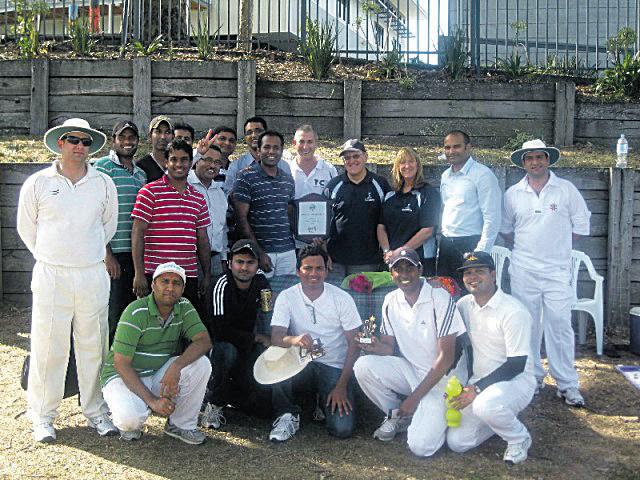
After months of captivating action, the MPCL Amba Bazaar tournament hit a crescendo with the finals played on February 26 at Glen Waverley with Southern Rocks emerging winners in what was a successful tournament in its inaugural year. Rocks triumphed over their recent stuttering form on the big day to go past the inform Jai Hind CC in dominant style, as their opponents failed to cash in on the opportunities that came their way during the match. Senthil won the man-of-the-match honours for his brilliant all-round performance on the day.
Put in to bat first, Rocks got off to a blistering start with Parag (35 runs) and Senthil (31 runs) combining to make up a fluent 61-run partnership for the second wicket. Both batsmen took the attack to the bowlers with hits all over the park as Jai Hind wilted under pressure in the field by the onslaught. However, against the run of play, a mix-up between the two batsmen resulted in Parag getting run out and from a position of strength, 77/1 in 10 overs, Rocks stumbled to 94/4 in 15 overs, thanks to some inspired bowling by Satish and
Mukund. At this point, it seemed like Jai Hind were gaining control of the match but cometh the hour, cometh the man and out walked the unflappable Captain Shafi who played yet another gem of an innings (37 runs not out) under pressure. Mukul and Mastan provided useful support to Shafi who paced his knock to perfection unleashing a flurry of big hits towards the end of the innings; Rocks eventually posted a challenging total of 171/8 in 25 overs. Understandably, at the halfway stage, Rocks looked the more confident side with an eagerness to step out onto the field.
Jai Hind has been one of the most professional and consistent sides in the competition with the bat but on the big day, their big guns, Jay, Arun, Tushar and Ulhas surprisingly failed collectively to stamp their authority when it mattered most. However, the lower order showed some mettle in combat as Shantanu (27 runs), Tejas (10 runs) and Mukund (13 runs) frustrated their opponents playing out the entire 25 overs to settle for a respectable 147/9. Rocks were brilliant in the field with Subbu and Senthil doing
most of the damage with the ball. The jubilant Rocks were elated with the win and it’s the character, talent and the camaraderie shared between the players that have helped Rocks combine effectively as a team throughout the competition. And, with an inspirational leader like Shafi at the helm of affairs, Southern Rocks have unquestionably reached the summit in gobsmacking fashion.
With the excitement of the end result yet to kick in on the day, the focus then shifted to the presentation ceremony which was well orchestrated by the organizers Nitin and Madan. The occasion was graced by the presence of Mr Phil Cox, President of City of Moorabbin Cricket Association (CMCA), Ms Jenni Ashkar, Executive Officer CMCA, Mr Jim Ahon, Topline
Cricket and Mr Vamsi Budige, Amba Bazaar. Genuine wickettaker Subbu (Southern Rocks) won the award for the best bowler of the competition, Ulhas (Jai Hind) was voted best batsman for his string of consistent big scores and Vignesh (Melbourne Tuskers) was chosen as the player of the series for his brilliant all-round performances.
 Sujith Krishnan
Enthusiastic turnout for Surya Namaskara

Fitness and health have become mandatory subjects of discussion on the social circuit today and while there are numerous fitness regimens to choose from, none can conjure up the magical vigour of yoga. Rajendra Yenkannamoole, the founder of Vasudeva Kriya Yoga, a trained professional who has been practising his craft successfully in Melbourne since 2004, organized the Surya Namaskara (Salute to the Sun) at Brighton beach on February 26. Having organized various seminars on sustainable living in the past in Melbourne, Rajendra is no stranger to such events but since he believes he has a task at hand to make yoga a way of life in the community, his excitement prior to the event was easily comprehensible. Rajendra was ecstatic with the response, as the event turned out to be a major success with people from all age groups flocking to the beach before sunrise to show their support and be part of this invigorating routine. Nearly a hundred people attended the event which began at 5:30am and concluded at 8am.
We are aware that yoga is extremely beneficial, but what
does one gain by doing the Surya Namaskara? According to Rajendra, “Physically it helps strengthen the leg muscles, the sciatica nerves, the lower back, neck muscles, loosens the shoulder muscles and opens up the lungs. Apart from adding a sense of calm to the mind, it invokes the blessings of the Lord. Moreover, there is a rise in energy levels, improved vision and the internal organs profit from the practice as well.” Rajendra believes that even an intense workout in a gym cannot restore the benefits that come from performing the Surya Namaskara on a regular basis.
Just to substantiate the fact that yoga is for everybody, irrespective of age and gender, Rajendra asserts, “Some have a misconception that yoga is a workout and that it is an inferior type of sadhana (a daily spiritual practice). Yoga, infact, helps establish the harmony of body, mind and soul. Performing the Surya Namaskara is like tapas (discipline) as it energises all the five Koshas or consciousnessAnnamaya Kosha (body), pranamaya kosha (energy), manomaya kosha (emotion), vijnanamaya kosha (wisdom) and anandamaya kosha (bliss)”.
Saluting the sun
Attendees to the event included a large number of Indian-origin people, while other nationalities like Australians and Chinese also took part in this invigorating ritual. Said Latha of Rowville, “I was really proud and satisfied to see the disc of the sun as it rose in front of me along with 108 times and the final pradhatshana namaskaram gave a beautiful touch to the conclusion.”
Maria who attended the event
was thrilled with the experience saying, “We started our meditation under the stars and then by the time we reached our final meditation the sun was beaming on us it was just beautiful and very rewarding.” For Bannir and Rani too, it was a special feeling.
“The unique experience was very impactful and memorable: the choice of venue, serene surroundings, ambience and time
of the day was simply divine and the experience Bannir and I had was nothing short of spiritual,” said Rani.
Though content with the turnout and response for the event, Rajendra’s mission is to conduct the Surya Namaskara at different locations in the city on a regular basis in the near future. We wish him the very best.
Sujith Krishnan
16 MARCH 2012 www.indianlink.com.au
Winning team Southern Rocks



MARCH 2012 17 INDIAN LINK online www.indianlink.com.au at home / in car Subscribe to Indian Link Radio for $9.95 each month * Conditions apply: Minimum 12 months subscription, $ 50 refundable deposite call us 1800 015 847 24/7 masti Talkback News

18 MARCH 2012 www.indianlink.com.au
Power to the
BY TIM BLIGHT

India’s lively political scene has always appealed to my inner journalist. Say what you want about Indian politics – the Indian people do not take their democratic privileges for granted. In fact, I often wonder if India’s bureaucracy, regardless of its (many) faults, constitutes a more democratic system than that of many western nations. Let’s not forget that democracy might be undermined, but is not abrogated by corruption; democracy is fundamentally ‘the rule of the people’ in all its manifestations, beautiful and ugly. The Indian people do, to a large degree, dictate the direction of their nation.
This makes for a clear contrast with Australia, where political apathy has become a national epidemic. The huge crowds drawn in by anti-corruption activist Anna Hazare’s campaign are testament to the Indian populace’s political engagement. Even the media gets on board – all of this is a far cry from many Western democracies where a moral obligation would fail to garner such widespread support. Take the American invasion of Iraq; while many took to the streets, it wasn’t enough to sway governments who had the mainstream media wrapped around their fingers. In many countries celebrities and activists, all potential spokespeople, were nowhere to be seen.

It’s yet to be seen if people power can (or will ever) cure India of its corruption problem, but it certainly feels like a fight which the people want. After all, modern India was founded on a public movement of civil disobedience and protest. The very face of social activism is to be seen on every ten rupees I handle, regardless of how grubby the note is. Perhaps we will have to wait until the newer, more globally aware and more financially mobile generation comes of age until we see a significant change in India’s politics; it has always baffled me that India’s very young population (according to some estimates, up to 50% are under 25 years of age), are ruled by an ancient group of elite survivors.

One place where the power definitely isn’t, however, is in Chennai’s electricity grid. As the subcontinent heats up, the


people!
regular power cuts, known as ‘loadshedding’, become ever more frequent. I don’t have the pathological hatred of loadshedding that most Indians possess – I actually find the unscheduled silence that graces the neighbourhood to be a rather calming experience. The frustration felt by many Indians is understandable though, because the lack of electricity is indicative of a much deeper problem. As one Chennaiker so eloquently stated; “Why should we go without electricity every time Jayalalithaa rolls over? There’s no shortage of power lines lying around the shoddily constructed footpaths!”. This anger is palpable in many conversations. The answer, perhaps, is to be found in the number of Indians who talk but don’t act. In other words, how many people complain about corruption but still pay bribes to evade traffic fines?
If corruption is as rampant as we are led to believe, and the anticorruption movement enjoys as much support as we are told, then there must be some overlap.
Conversely, there is something to be said for the corrupt justice I recently saw meted out to a neighbourhood thief. My neighbour caught the pilferer and tightened a chain around his neck. I thought he was going to lynch him, but the chain was used to restrain while an uncle threw punches and yelled obscenities. When police arrived they pulled him away from the thief, and then the policeman stepped forward and took his turn at beating up the criminal while the house owner watched on. Wrong, I agree – but I wonder if many Indian victims of crime would be satisfied with a more westernized ‘rehabilitation’ process for criminals? I doubt it – so whether it’s right or wrong, maybe Indian democracy really is more representative of the people’s will than we assume.
At the end of the day, the idea of ‘India’ always seems to prevail – the idea that everyone gets a say, that the nation is somehow, if not obviously, cohesive, and that the Indian people are free. In the battle of the rising superpowers, it’s easy to compare India’s progress with that of China. “Look at how well they’re progressing” I hear many Indians say. Suggest to these people however that they should be limited to having one child, that they should be highly taxed (or taxed at all, in many cases!), or that they should be subject to rigorous
media control and a cry of protest arises. That cry is exactly why India can’t be China – and nor should it try to be.
A common stereotype of Indians is that they talk too much – and as with most stereotypes, there is an element of truth there. But this is what makes India great – let’s tackle corruption, but let’s not forget that many countries got to where they are by shutting people up. I hope the Indian people never stop talking, because without dialogue, what else could hold 1.2 billion Indians together? I love that in India I can express my views in a public forum and protest if I want, with the distinct hope that I might just change something. I can even type whatever I like on the internet, and watch whatever I want on the TV news. Except for when there’s loadshedding, of course.
MARCH 2012 19 INDIAN LINK I n DO ph ILE
There’s a reason why India is hailed as the world’s greatest democracy, which is apparent in every aspect of the daily lives of its citizens
Power lines (below) and politics (above) are two facts of life in modern India
Gandhi’s benevolent face adorns the bank notes
Gandhi’s benevolent face adorns the bank notes
Modern-day activist Anna Hazare spearheaded the fight against corruption

2 MARCH 2012 www.indianlink.com.au
Now AP GURUSWAMY captures beautiful moments in Melbourne’s Indian community!
In his 40-year career experience as a professional photographer in India Guruswamy covered news, corporate events, large scale events and celebrities.
For stunning images of your next big event, call Guruswamy on 0406 820 413.

Rooms for Rent
We are a professional Indian family with 2 kids (8 years and 6 years). We have up to two bedrooms available in our luxurious house for rent / boarding for a suitable single (male or female).
•Room is furnished upstairs bedroom with bed, mattress, desk, chair, dresser
•Room has attached private toilet / shower / washbasin
•Room has attached spacious walk-in-wardrobe and storage area
•We will allow shared use of kitchen, fridge, washing machine, TV, DVD
•House is close to park, shopping centre, bus stop
•Room has heating and cooling
•Food (vegetarian and non-vegetarian) will be provided
•Rent $750 per month including food and reasonable use of electricity, gas, water
If interested, call or leave message on: 0423 001 508.


Fantastic indian RestauRant FoR sale

Great opportunity to run your business. Fully booked most nights, inner city location and great local reputation.
Full Liquor license with 60 seats and upstairs function area. Fully equipped commercial kitchen and currently run 100% by staff. Been operating for 3 years.
Please contact 0488 911 111.
20 MARCH 2012
He captured the magic of Aishwarya Rai when she got back home after winning the Miss World crown in 1994.
Mention














MARCH 2012 21 INDIAN LINK MARCH (1) NATIONAL EDITION Indian Link The team at Indian Link Saroja Srinivasan Noel G de Souza Shafeen Mushtaq Dinesh Ramanan Jyoti Shankar Sandip Hor Sunil Ranadive Hasnain Zaheer Malavika Santhebennur Roy Lange Akriti Goel LP Ayer Tanveer Ahmed Malli Iyer Vidya muthanna Minnal Khona Azal Khan Avijit Sarkar Noopur Singhal Ruchi Lamba Sanjiv Dubey Preeti Jabbal Pallavi Singhal Sreedhevi Iyer Komal Utsav Jagad Uzma Beg Rajni Anand Luthra Vivek Trivedi Priyanka Tater George Thakur Mark Sharma Gerard Fernandes Farzana Shakir Usha R Arvind Raka Mitra Anusha Menon Tanmayi Chari Nancy Sood Geeta Khurana Drishti Nanwani Uttam Mukherjee Darshak Mehta Talia Kaur Tim Blight Arveen Sharma Petra o’Neill Sukrit Sabhlok Dilip Jadeja Sai Narayan Shraddha Arjun Rani Jhala Sujith Krishnan Shivangi Ambani-Gandhi Neelam Vasudevan Gaurav Surati Priyanka Rao Sheryl Dixit Auntyji Nitika Sondhi Danielle Cairis Sanam Sharma Deepa Gopinath Ritam Mitra Sydney Srinivas Sudha Natrajan Thomas E King Chitra Sudarshan ashita Vadher WespendourtimeTELLINGYOUR sTORIEs Pawan Luthra Farrha Khan
Panic as 4.9 tremor shakes
Delhi, adjoining areas
A 4.9-magnitude tremor shook the Indian capital and its adjoining areas recently, startling people in offices and homes as the ground shook and windowpanes rattled. The quake, centred near Bahadurgarh town close to the Haryana-Delhi border, did not lead to any casualties.
The epicentre was just 35 km from New Delhi, the India Meteorological Department (IMD) said.
“The Delhi and National Capital Region (NCR) felt slight intensity tremors, which measured 4.9 on the Richter Scale. The epicentre was in the Haryana and Delhi region,” R.S Dattatryam, director, Seismology Division, India Meteorological Department (IMD) said, when contacted. According to the IMD, the tremor was felt at 1.11 p.m.
As the ground swayed, many residents and office-goers in Delhi, Gurgaon and Noida ran out of their buildings into the open.
Sources in Rohtak said the boundary wall of a school in Mayna village of Rohtak district collapsed. The district authorities, however, could not confirm the incident.
Some people working and living in highrise buildings in Gurgaon, which has the offices of several MNCs and leading Indian

companies located there, were asked to vacate the buildings as the tremors were felt for over 10 seconds.
“Sitting in an office on the 12th floor in Nehru Place, I felt it very strongly like somebody shaking my chair. There was a general air of panic. Luckily there was no repeat tremor,” Mahi Singh, a MNC employer said.
“I was in bed recovering from surgery when I was shaken awake by the quake. I tried to rush outside, limping,” Ramkant Mahant from east Delhi said.
“All the small objects on tables started shaking, I felt it for over five seconds, followed by a rumbling noise,” said Rumu Banerjee of Chittaranjan Park in south Delhi.
Throughout the city, people called up relatives and friends, and asked after their well-being.
The IMD official asked the public not to panic as it was a slight intensity tremor.
“It is a slight intensity tremor, which was felt in the Delhi and NCR areas. No infrastructural damage is expected from the tremor of such low magnitude. At most, there may be some plaster falling off in weak buildings,” Dattatryam said.
“The possibility of aftershocks are very minimal for such a low intensity quake,” he added.
However, the quake did not seem to have affected the concentration of students appearing for their board exams. Many, however, complained they were not given extra time to finish their papers disrupted by the 10-second tremor.
“We did not have the time to react as the main concern was finishing the Physics paper which was lengthy. We were left wondering what was the noise, and realised it was a quake,” said Mrinalini Mahajan who was writing her Physics paper in St Mary’s School in Dwarka area.
Smridhi Gupta was upset over not being allowed extra-time to revise her answers.

“We all were taken aback with the tremor. The windowpanes of the classroom were rattling. Though the tremor lasted only for ten seconds, it took us almost ten minutes to get back to writing. I wish we were given extra time,” Gupta said.
Another student who appeared for her board exam in Shri Ram School in Gurgaon said: “There was a bit of panic but we were done with the paper.”
Tremors were also felt in Indonesia and Argentina.
“They were two separate quakes that shook Indonesia and Argentina at 12.25 p.m. and 1.16 p.m., respectively. They are not linked,” stated Dattatryam.
“The epicentre in Indonesia was
Northern Sumatra, while it was Santiago Del Estero in Argentina,” he added. The intensity of Northern Sumatra quake and Argentina quake was 5.1 and 6 on the Richter scale, respectively.
SpiceJet foresees tough times
Budget carrier SpiceJet’s chief executive Neil Mills feels the aviation sector, marred by high fuel and interest cost in the coming fiscal, will continue to face “tough operating conditions”.
“I think the tough conditions will continue for a while in the coming fiscal. Our futures are pegged with oil prices and they are very high right now,” Mills said in an interview.
“There are some decisions on new policy like direct import of fuel and foreign direct investment. We are evaluating them and will do what is best for us.”
According to Mills, the low cost carrier (LCC) was in touch with fuel suppliers for logistical support to allow airlines to directly import jet fuel.
“We are evaluating the impact of the decision whenever it comes. We are in touch with them (fuel suppliers), but I cannot comment on how much savings would emerge out of this. But it will be substantial.”
Mills’ views come as the government had on Feb 22 notified direct import of jet fuel and called upon interested carriers to apply for licences.
This came after the Feb 7 decision by a group of ministers (GoM) headed by Finance Minister Pranab Mukherjee to roll out a plan to help domestic carriers, allowing them to directly import aviation fuel.
The move will enable airlines to cut operating costs by about 10-15 percent, saving on sales tax, which ranges between three percent and 35 percent and is levied by state governments.
Jet fuel now constitutes about 50 percent of the total operating cost of airlines in India. Domestic airlines are estimated to have lost around Rs.3,000 crore in the first six months of this fiscal.
On the issue of foreign capital by foreign airlines in domestic passenger carriers, Mills said the airline was not looking for a foreign partner but was evaluating the proposal.
Mills’ confidence is evident as the airline’s promoter Kalanidhi Maran decided March 2 to infuse Rs.100 crore into the carrier in lieu of five percent equity or additional 42.9 million shares.
Sant Mat is a practical spiritual path based on meditation on the inner Light and Sound, ethical values, service to others and love for all creation. Its goal is to enable the soul to return and merge into its source; the purpose of human life described by mystics of all traditions. Focus and sincerity are essential, as is the help of the living spiritual Master. Know Thyself as Soul Foundation is a non-profit incorporated association. It offers its services free of charge.

22 MARCH 2012 www.indianlink.com.au
urgently required for agency work - Registered nurses, Enrolled nurses and community/Disability support Workers Pl. call Akhil on 0421 088 351 or email your details on akhil@qualitycarenursing.com.au
NSW Premier Barry O’Farrell presents Indian cricket legend Sachin Tendulkar with honorary life membership of the Sydney Cricket Ground – the first overseas player to receive much an honour.
Must have appropriate qualificatioms, experience and a current police clearance.
KNOW THYSELF AS SOUL
1800 462 193 or
www.santmat.net.au
For further information call
visit
“This decision shows the confidence of the promoters in the company and its viability. The board has taken this decision and will allot 42.9 million preferential shares to the promoters,” Mills said.
“This is the second time in eight months when the promoters have infused equity. Last September, we received Rs.130 crore and five percent of the equity shares were allotted to the promoters.”
Fresh funds should come as a relief to the airline, as the whole sector is facing tough operating conditions like high interest and fuel costs.
“This (fund) will go into the normal working capital and for general growth. Our debts are affordable, we are paying the oil companies, salaries and we are not behind any schedule. We will get through these tough times,” Mills said.
The budget carrier had Feb 6 reported a net loss of Rs.39.26 crore for the quarter ended Dec 31 from a net profit of Rs.94.44 crore in the like period of 2010-11.
The company’s auditors in a review report said that accumulated losses have eroded the net worth of the company.
“As of Dec, 31, 2011, the company’s accumulated losses of Rs.107,781.3 lakh has substantially eroded the net worth of the company, indicating the existence of a material uncertainty that may cast doubts about the company’s ability to continue as a going concern,” the auditors said.
Now, cabbies, maids can learn while they earn
A couple of years down the line, Mumbai residents may be dealing with cabbies and auto-drivers who are full-fledged graduates. Thanks to an open university, deprived sections of the city’s huge workforce will get a chance to enhance their skills.
The Nashik-based Yeshwantrao Chavan Maharashtra Open University (YCMOU) has designed special short-term and longterm courses for working classes like cab and auto drivers, private drivers and even maids to enable them to compete better in the job and money markets.
The special preparatory and degree courses shall be inaugurated Tuesday in Mumbai’s All India Institute of Local Self Government at Andheri by eminent Bollywood actor Kader Khan, according to a YCMOU official.
“Given our social objectives, the courses shall be extremely simple but equip the ‘students’ to handle them without disturbing their crucial work schedules as most are the sole bread-winners of their families,” said Shrinivas Belsare, YCMOU head of corporate communications.
There are an estimated 400,000 cabbies in the city. According to Belsare, around 200,000 cabbies from Mumbai, besides a potential 1.5 million elsewhere in Maharashtra, are expected to benefit from the new course, enrolment for which starts in June 2012.
YCMOU’s format for the experimental course would be unique, using CDs, FM radio programmes and a few books to enable the cabbies to learn while on the go - driving.
It is expected to similarly help housemaids, who number around 800,000 in the city.
Besides, the courses would not burn a hole in the pockets of the ‘students’, considering they are at the bottom rung

of the people contributing to the national economy, Belsare said.
“The preparatory course will cost Rs.600, with a 50 percent discount for the target category of cabbies and it is equivalent of HSC. This will be followed by a diploma course, advanced diploma and a degree, each costing Rs.1,500, and recognized everywhere,” Belsare explained.
“Accordingly, if a person completes one year, that is, two modules, he gets a diploma, after two years an advanced diploma and a full-fledged, recognised degree after completing the full three-year course. It means a win-win situation for all, even those who drop out after a year or two,” he added.
The new courses are expected to be a boon for the next generation of cabbies as the state government plans to soon make HSC-level education compulsory before issuing new permits for autos and taxis.
Kader Khan, who himself played a cabby in several movies like Aa Ab Laut Chalen and Naseeb, was impressed with YCMOU’s new course and readily agreed to inaugurate it, Belsare said.
A graduate, the 65-year-old Khan, after taking a break from his acting-writing career, is now engrossed in designing a new syllabus from nursery to post-graduation in Islamic studies for the benefit of students in thousands of ‘madrassas’ in India.
Given the large, semi-literate migrant population in Mumbai, YCMOU will offer its new course in Hindi, Marathi and English for the cabbies, with the approval of the powerful Bombay Taximen’s Union. Its existing BA degree course in Urdu have got over 2,000 students on the rolls and proved beneficial to migrants, mostly school dropouts, coming here in search of employment opportunities.
YCMOU has around 400,000 students on its rolls in the state, including 50 percent women, who would otherwise have had no opportunity to educate themselves, he said.
The course modules are comprehensive and wide-ranging including soft skills, road safety, tourism, health, first aid, civic discipline, transport rules, insurance, traffic scenario, networking with courier companies and basic banking.
“This will enable them to get a proper perspective of life and help them consider other lucrative professional options rather than spending their lives driving cabs,” Belsare pointed out.
The YCMOU course is billed as the first of its kind among the 14 open universities around the country which have been silently spurring literacy levels among the most unfortunate sections of Indian society.
Playing with a splash of safety this Holi
Amid the riot of powdered hues and watery splashes that Holi brings, experts say people should not ignore safety issues as toxic chemical colours could bring on severe skin infections, eye injuries and other problems.
The festival of colours was celebrated on March 8 this year.
“The use of synthetic colours during Holi can cause severe irritation, dermatitis, burning, redness and also in some cases blister formation. It can also lead to irreversible pigmentation,” said Amit Bangia, consultant dermatologist at the Asian Institute of Medical Sciences.
“Besides, many water colours have an
upcoming film about Osama bin Laden in Chandigarh, India, March 2, 2012. Right-winged Hindu nationalist group Vishwa Hindu Parishad have protested against the hoisting of Pakistani flags during the filming. Bigelow and cast are in India shooting at various locations over the next few weeks, local media reports.
alkaline base capable of causing temporary blindness and severe injuries. Colours in the form of pastes sometimes have toxic compounds mixed in a base of engine oil or other inferior quality oil,” Bangia added.
Chemical colours have been in vogue for a long time, and the cost-effectiveness and easy availability make them more preferred than natural colours, say experts. But often people are not aware of their harmful effects.
But one can prepare organic colours at home.
“Turmeric can be used for yellow colour. Henna can act as a green colour and dried rose petals can be substituted for red,” Bangia said.
The dangers lie not just in colours. Throwing water-filled balloons can also cause injury if targeted at the eyes or ears.
“The balloons used by children during Holi are most dangerous and can cause blunt eye injury. An injury can lead to the loss of vision or loss of the eye. These are all eye emergencies and should be taken care of as early as possible,” said Nikhil Seth, consultant opthalmologist at the Asian Institute of Medical Sciences.
“Eyes are extremely susceptible during Holi because of their strategic place in the body and also because the use of harmful chemicals is known to cause eye irritation,” added Seth.
While the best precaution remained use of natural colours, people were also advised to reduce their hours of playing Holi or
take breaks when playing it at a stretch.
“If it is played for six to seven hours at a stretch, he/she is vulnerable to acquiring irritants such as burns, blisters or contract allergy, mild discolouration (which is reversible) and acne. It’s best advised to take a break in between,” Bangia said.
Another set of precautions was to use a protective barrier between skin and colour. A layer of sun screen could help prevent direct contact of chemicals with the skin. After playing with colours, use of lukewarm water to clean your body was recommended.
“People must realise that the colours have been added to Holi to make the festival more joyous and enjoyable and not to cause inconvenience to others. So, the next time you play with colours, use good quality or natural colours and play according to the convenience of others,” suggested Seth.
North Delhi resident Moti Lal Ganju, 45, said he has always played the festival with natural colours. But with synthetic colours flooding the markets, it is best to make the colours at home.
“These days, Holi colours are sold loosely on the roadside by small traders who often do not know the source. Sometimes, the colours come in boxes that specifically say ‘For industrial use only’,” Lal said.
“We should make sure our family celebrates the festival with organic colours. Let us not allow hard colours to spoil the charm of gujiyas and music,” Lal quipped.
MARCH 2012 23 INDIAN LINK I n DIA n n EWs
Photo: AP
IANS
Smithsonian to chronicle the story of Indian Americans
The Smithsonian Institution, the world’s largest museum and research complex, is putting together an exhibition chronicling the story of immigrants from India and their descendants in America.
“HomeSpun: Smithsonian Indian American Heritage Project”, the first Smithsonian initiative focused on the Indian American experience, will convey the history, contributions and challenges of nearly three million Indian Americans and signal their place in America.
The initial goal is to raise $2 million dollars for the project so that the exhibition can open this year and travel within the US for three years.
The Smithsonian is looking for an additional endowment of at least $1 million to generate interest needed to continue Smithsonian projects focusing on Indian Americans in perpetuity.
At a presentation briefing on the project, the Indian ambassador Nirupama Rao highlighted the ‘people centric’ dimension of the India-US partnership and how it has, over the years, particularly strengthened the ‘mutually beneficial’ character of cooperation between India and the US.
“India takes pride in achievements of the three million strong India-origin community in the United States”, she said.
Rao described “HomeSpun” as a celebration of the accomplishments and success of the Indian-origin community in the US and expressed confidence that it would be an effective public demonstration of the potential and capabilities of Indian Americans in contributing to the American society and economy and also to the IndiaUS partnership.
Curated by Dr. Pawan Dhingra, HomeSpun sets out to answer questions like how did this community come to such prominence yet in other respects remains
story reveal America’s unique history of immigration and how can learning about Indian Americans inform the experiences of other groups and the nation (and India) overall.
HomeSpun will consist of exhibits, public programmes, a middle school curriculum, and a cutting-edge website. As such it will establish a permanent presence - through research, collections, and public programmes - within the Smithsonian complex.
HomeSpun also will be visible in key cities as the exhibition travels the country and public programmes are held in various venues in cooperation with local communities.
obama campaign reaches
out
to Indian Americans President Barack Obama, whose administration has by far the largest number of Indian-Americans, has turned to three prominent members of this growing and influential community to help his re-election campaign reach out to some three million Indian-origin voters.
The three, actor Kalpen Modi (aka Kal Penn), California’s first female Attorney General, Kamala Harris and Sai Iyer, who served as a White House intern in 2001, figure among 35 state, local and community leaders named as national co-chairs, or “ambassadors” for the president, who will play a high-profile role in defending his record and mobilising voters for November.
“The president’s national co-chairs will be tremendous assets on the ground as we build the biggest grassroots campaign in history,” Obama’s campaign manager, Jim Messina said in a statement.
“They each share the president’s vision for a future where every American can have a fair shot at success, where hard work pays off and responsibility is rewarded,” Messina said.
Democratic members of Congress, governors and mayors, as well as business and labor leaders, members of clergy and a few local campaign organizers, a nod to the value Obama places on his grassroots volunteers.
Kamala Harris, daughter of a Tamil mother and a Jamaican American father and Sai Iyer, a student at the Virginia Commonwealth University and OFA (Obama For America) volunteer leader from Virginia will play key roles with former White House chiefs of staff Bill Daley and Rahm Emanuel.
Actor Kalpen Modi, who served as White House Associate Director for the Office of Public Engagement, is expected to lead outreach to younger voters, while actress Eva Longoria will spearhead efforts to reach women and Hispanics.
Although some Indian Americans like Obama’s information technology chief, Aneesh Chopra, his tech guru Vivek Kundra, who streamlined the federal government’s massive IT infrastructure and Obama’s export czar, Suresh Kumar have left in recent days, his administration still has more people of Indian origin than ever before.
Among them USAID administrator Rajiv Shah, by far the highest ranking IndianAmerican in any presidential administration, Obama appointee Preet Bharara, US attorney for New York, nicknamed the “sheriff of Wall Street, who recently made it to the cover of the Time magazine and Preeta D. Bansal, who serves on an advisory council promoting improvements in government procedures.
Indian-origin British hotelier sued by parents
Parents of a 60-year-old Indian-origin hotelier, reportedly one of Britain’s wealthiest men, are sueing him for 100
claiming their son took the family business for himself.
Jasminder Singh, chairman of the Radisson Edwardian Hotels, is accused of renouncing the Sikh tradition of sharing family wealth and barring his parents from their multi-million pound business, the Daily Express reported.
His 84-year-old father, Bal Mohinder Singh, stands to take a third of the family fortune if he wins the high court battle against his son.
The family fortune is reportedly worth an estimated 415 million pounds.
In a statement to the court in London, Bal Mohinder Singh said he and his wife Satwant were “deeply ashamed that Jasminder should publicly renounce his cultural heritage”.

The system of joint family ownership of all assets is based on religious teaching and widely practiced by Sikh and Hindu communities around the world, he said.
“For Jasminder to deny that and claim all the credit and ownership for himself will be shocking to wide sections of those communities. That is why his mother and I are so ashamed,” he said.
“The hotelier’s name was on the family’s assets purely because he was a chartered accountant and the Singhs’ representative,” the court heard.
Singh also accused his son of trying to force his parents out of the 10-millionpound house they share near Ascot racecourse in Berkshire.
Jasminder Singh denies ever having been told by his parents they were a “joint Hindu family” and that property acquired by any of them was “joint family property”.
He also denied having a particularly religious upbringing.
24 MARCH 2012 www.indianlink.com.au DIA sp ORA
IANS
Photo: IANS
Protesters at a rally in front of the Gandhi statue in Union Square, New York on March 3 remember the victims of the 2002 anti-Muslim Gujarat riots

MARCH 2012 25 INDIAN LINK
On your marks...
Nosh Mistry continues his exploits at the velodrome
BY USHA RAMANUJAM ARVIND

Indian Australian cycling ace Nosh Mistry has won a bronze medal at the 2012 Cycling Australia Masters National Championships. The prestigious annual event was held at the Dunc Gray Velodrome in Bankstown recently.


Representing the St George Cycling Club in the Masters 2 age category (35-39 yrs), Mistry competed in the 3000m Individual Pursuit as well as 10 km Scratch Race, winning bronze for the former.
The CA Nationals are the highlight of the Masters racing calendar in Australia and will be followed up by Masters World Championships at Manchester in October.
“It feels good to have reached a level where I am able to compete with peers of very high calibre in a very intensive sport”, Mistry told Indian Link. “It also feels good to be able to set an aim and achieve it”.
“Of course, I have gone faster before, however given the conditions, it was my best effort on that day,” he added. “You learn from every race you ride and adjust certain things in training and testing which hopefully translate into better and better times. In a sense you are always racing against yourself, trying to go better than the last time”.
According to Mistry, the 3000m pursuit, which takes place with 2 riders on opposite ends of the track, “looks deceptively simple, in that all it seems like is you get on a bike and pedal as hard as you can for the specified distance”.
However, the training, the preparation, the diet, the mental aspects, the actual race, the lap timing splits, the aerodynamics, the body positioning, the bicycle, the attention to detail - all need to be dealt with. It tests the contestant’s mental and physical endurance. Usually the results go to the people who have put in the required time to address all the criteria, he stated. In contrast, the scratch or mass start race involves 24 people, who ride at the one time, with the fastest person over the line winning.
These races are a bit of a lottery as it is not necessary that the strongest rider wins, observed Mistry who finished overall fourth
in the category. Positioning in the race, tactics and the final sprint determine the winner. This is not a timed event either. However the average speed over the 10 km was about 55 kmph, so it was still a quick race, he noted.
The professional cyclist has a grueling training schedule, clocking an average of 60-80 km daily. Typically his training year is broken down into specific phases of endurance, strength and speed building.
In the endurance phase his daily weekday sessions generally include 2 - 2.5 hours of riding, while weekend races cover approximately 150 km, he indicated.
The strength phase involves a similar session on hilly terrains to build up stamina. Finally, the speed phase, which is normally six weeks prior to an event focuses on target racing at a velodrome.
Mistry’s competition year is split into A, B and C category races with A of course being the most important races where he strives to be at his peak.
Thanks to a well-coordinated schedule from Cycling NSW and Cycling Australia, this is possible. And of course all this needs to fit around work and family commitments and very soon it become an exercise in time management, he quipped. Mistry’s wife and daughter are not only very supportive of his rigorous schedule but also accompany him to most interstate and overseas events, enjoying a working holiday in the process.
As well the St George Club, of which he has been a member since his arrival in Australia over a decade ago, has been very supportive.
The club has been a great source of inspiration, particularly several members who are current and past world and Olympic champions, he acknowledged.
“Their candor and willingness to share what they know and a genuine attitude to help is not something you get access to everyday” he revealed. “This has helped me learn a lot and apply it to my racing and training. Even though I live far from the club, I am still an active member”.
Nosh participates in around 75 races annually, his flagship events being individual pursuit and the road time trial. These events, he explained, require a similar physiology and training regimen and are classed as endurance events. This includes weekly races at the club, competing against Olympics level riders as well as
state and national championships. The avid cyclist’s tryst with the sport goes back three decades when Nosh got his first bike from his uncle as a preschooler. “He still follows my career closely, offering pointers. Since then, I have been attracted to high tech bicycles,” Mistry confessed.
As an adolescent he took up competitive cycling, winning his first national medal in India. Ironically, this was five weeks after a bad training accident involving a learner driver, he remembers.
Having dabbled in a number of sports, cycling, Nosh discovered, was a perfect fit. Swimming and long distance running followed and Nosh went on to win state championships in both. He thus took up the triathlon and was soon named the national champion. This led to a job with the Indian Railways, representing them in numerous national events, while pursuing his MBA.
“It was good to be paid to do a sport I loved and also continue my studies,” he admitted. In that sense it was both a passion and profession for a while.
His only regret about competitive cycling back home, is the total lack of calendar management and information coordination.
“In India, I wouldn’t know when state or national events are until a fortnight before the race. So there was no chance to be at your peak. This unfortunately continues to this day, preventing Indian competitors to perform their best at global levels”, he lamented. However, when you love doing something, it is not very hard to keep yourself going. When it brings results, which are recognised at a high level like the nationals, that is a bonus, he indicated.
On a philosophical level though, it is just the simplicity of the activity of cycling and being completely absorbed in the moment that keeps him going. This motto gives Nosh a complete sense of purpose and involvement with life in general.
So what drives the keen sportsman to sustain the momentum?
Pursuing any activity to the highest levels requires tremendous physical and mental stamina. There are days when things will seem harder, however as with anything, persistence is the key. If you have discovered you have a talent for something, never ever, ever give up, he emphasised.
Mistry is already setting his sights on the next event.
After “two easy weeks”, he hopes to get back into the endurancetraining phase and build up the volume of training and aim for a better outcome next time he competes in the same event. An action packed sporting calendar notwithstanding, Mistry also juggles a full time career in event photography.
Meanwhile, if his performance targets are on track, a shot at World Masters in Manchester could well be in the offing.
Nosh took up competitive cycling as an adolescent, winning his first national medal in India.
26 MARCH 2012 www.indianlink.com.au sp ORT
Nosh Mistry takes the bronze in the 3000m Individual Pursuit event in the 2012 Cycling Australia Masters National Championships. Adam Simonelli wins gold and Rob Carlisle, silver.

MARCH 2012 27 INDIAN LINK
The majestic Himalayas have always attracted me with its range of snow-clad peaks, deep gorges, green valleys, and the fast and furious rivers carving out their course over varied terrain since thousands of years. I have travelled to both, the Indian and Nepal side of the Himalayas by motorbike and car in the past, so I yielded easily to my brother’s invitation to join him and Vandana on a trek to the Markha Valley. Anita worked out all my logistics, and Apoorva volunteered to take care of herself, Casper and our home.
Soon I was watching the Kullu valley zooming up quickly as we began our descent in the turbo prop plane.
We went on an acclimatization trek to the Solang Valley, to get our legs and lungs into shape for the change in altitude. The climb was steep and we had a few hairraising moments crossing a raging stream over a log of wood which served as a foot-bridge.
We crossed Rohtang by road and faced a big setback at the base


was dry with sparse vegetation in the valleys and highly prone to landslides and rockfalls. The days were hot and the nights, windy and cold. We followed the trail and camped at Rumbak, the base camp of GandaLa, Shingo base camp, Skyu, Sara, Markha, Thochuntse, Nimaling and Chukmaro. On an average we trekked for about 4-5 hours each day, and some days were unbearably hot as the canyons turned in to heat radiators at noon. We climbed two mountain passes at GandaLa (5100 mts) and GongmaruLa (5300 mts). Fortunately, acclimatization happened without any dramas.
“See that shirt hanging from the branch over there?” asked our knowledgeable guide, Gyan pointing. “It was from the photographer who was shooting here when the floods swept him away last year.” We quickly moved to higher grounds!
I felt claustrophobic in the sleeping bag and on some nights, I crept out of the tent to gaze at the sky with a million stars till the cold winds forced me back to the relative comfort of the tent. I came across mountain goats walking fearlessly and nimbly over steep ledges where even the thought of being that high made me feel faint. I came face-to-face with a chameleon who let me
In the heart of the

camp as it snowed heavily in the night, and the way to Chandrataal became unpassable. So we moved to plan B, and drove to Leh by road, a distance of approximately 300 kms through treacherous mountain roads, crossing two passes at BaralachaLa and TanglangLa, which is the second highest motorable pass at 17,600 ft. We camped at Tsokar (4400 mts); snowfall followed us here, and was the cause of a photographer’s nightmare –that of a bleak, whitewashed landscape.
A few quick steps and fast movements caused me breathing difficulty, as I had not yet acclimatized to the change. It was a strange feeling to breathe, but not get the O2. We finally reached Leh and started off on the Markha valley trek from Zingchen. We continuously followed riverbanks and climbed hills in the high arid mountains of the Himalayas. The landscape
crawl within a foot to catch a nice portrait! Other wildlife included the Himalayan fox, wild ass, marmot, king vulture and many colourful butterflies.

There were many spectacular moments each day, such as hundreds of sheep trying to cross a rickety foot-bridge in the evening light at Nimaling. The last day of the trek came quite quickly, and we left the mountains with heavy hearts.
The next day we drove to KhardungLa pass (18,380 ft) which is the highest motorable road in the world. It was a strange feeling, and soon a slow snowfall began, forcing us indoors for lemon tea at the highest café in the world.
I have returned tired and boneweary, but with many cherished memories from the most magical mountains in the world. And I will be back!

28 MARCH 2012 I n DIA DIARy
PRAKASH SUBBARAO
Trekking through these majestic mountains is an intensely fulfilling experience for the soul and senses
Himalayas


INDIAN LINK
PUBLISHER
Carr Canberra elevation
is good news for India
Jabbal
CONTRIBUTORS
George Thakur, Sujith Krishnan, Priyanka Tater, Usha Ramanujam Arvind, Chitra Sudarshan, Soundarajan Iyer, Franky Gerald Fernandes, Tim Blight, Prakash Closepet, Noel G DeSouza, Shailendra Bedarkar, Talia Kaur, Geeta Khurana, Minal Khona, Thomas E King, Elizabeth Gaete, Nancy Jade Althea, Uzma Beg
ADVERTISING MANAGER
Ashish Chawla 0468 389 272

ADVERTISING ASSISTANT
Nitika Sondhi 02 9279 2004
DESIGN
Danielle Cairis
Indian Link is a fortnightly newspaper published in English. No material, including advertisements designed by Indian Link, maybe reproduced in part or in whole without the written consent of the editor. Opinions carried in Indian Link are those of the writers and not necessarily endorsed by Indian Link. All correspondence should be addressed to Indian Link Level 24/44 Market St, Sydney 2000 or GPO Box 108, Sydney 2001 Ph: 02 9279-2004 Fax: 02 9279-2005
Email: info@indianlink.com.au
www.indianlink.com.au
The new Foreign Minister of Australia, Bob Carr had this to say in his blog of 15 Feb. 2012 “The Federal Government has expanded uranium mining and opened exports to India. South Australia boasts what will become the world’s largest uranium mine. The ban for NSW reflected the anti-nuclear sentiment of the 1980s and it is irrelevant today when to beat global warming we urgently need every available source of carbon-free energy.”
His appointment would have pleased many in the Indian government, none more so than the former Consul General of India (Sydney) M. Ganapathi. Gana, as he was popularly known, is now Secretary (West) in the Ministry of External Affairs in India. Many a time, both the then Premier of NSW Bob Carr and the Indian Consul General were seen enjoying a cup of coffee in a coffee shop at Sydney’s Bligh Street.
Both vociferous readers, they enjoyed
stimulating debates about historical and contemporary issues. Carr was always keen to understand more about India and who better than one of India’s finest diplomats to enlighten him on this aspect.
Bob Carr has often expressed his admiration for the democratic traditions of India. In a conversation, he expressed his amazement at the peacefulness of the 2004 elections in which over 670 million voted, the incumbent BJP lost and handed the keys of the country to the Opposition Congress party without any bloodshed. He marvelled at the maturity of the system. His admiration of the local Indian ethic of hard work and desire for higher learning was a mantra he often repeated at Indian community events. It was during his tenure as premier that the NSW Parliament was introduced to Diwali celebrations, now such a highlight of our community’s annual social calendar.
Bob Carr travelled to India a few times, both before and after becoming Premier. He is known for his love of bush walking and lists his time on the foothills of the Himalayas as one of his fondest memories. His wife Helena also has her Indian links, with an Indian father, Lourdes, and Chinese mother, Regina,
who both met in Malaysia.
So how will India feature in Australia’s pages now that Carr is in charge of Foreign Affairs?
While PM Julia Gillard was able to push through the sale of uranium to India at the recent Labor party conference, it had evoked a strong reaction from the then Foreign Minister Kevin Rudd. Whether it was a reaction to the snub which was directed at him as the PM had not consulted him prior to this change of Labor policy, or whether he believed that India did not deserve to be sold uranium, Rudd’s post conference comments indicated quite clearly that the actual journey of transition from policy to sale could be arduous for India. Due diligence and monitoring aspects with India will have to be agreed upon, but with Carr at the helm, there would be a balance in this direction.
Foreign Minister Carr needs also to visit India sooner rather than later. The mood towards Australia is quite friendly at the moment after months of bad press. The students’ issue has largely died down and uranium sales are on the way forward.
It is time to engage once again and forge deeper friendships.
MARCH 2012 3 INDIAN LINK EDITORIAL
Luthra
Dixit
Pawan Luthra EDITOR Rajni Anand
ASSISTANT EDITOR Sheryl
MELBOURNE Preeti
PAWAN LUTHRA

30 MARCH 2012 www.indianlink.com.au
Epics retold!
India’s great literary heritage extends itself to modern young readers through the efforts of three highly talented writers
BY CHITRA SUDARSHAN
India’s two greatest epics, the Ramayana and the Mahabharata have struck such deep roots in the country’s moral and cultural consciousness that they infringe into every aspect of Indian culture. For generations they were not only the favourite bedtime stories of Indian children, but they also captured the attention of great philosophers and theologians who have written extensive commentaries on them. A few new translations of these timeless epics by two very talented women have brought these tales to a yet newer audience.
Arshia Sattar, a Sanskrit scholar, translated the Valmiki Ramayana into English to much critical acclaim a few years ago (1996). This, and her abridged translations of the Sanskrit Kathasaritsagara had been published earlier by Penguin Books. Her new book Lost Loves: Exploring Rama’s Anguish, is a series of essays on Rama’s love for Sita, also published by Penguin recently in 2011.


The other is a rendering of the Mahabharata by the very accomplished writer and novelist, Namita Gokhale. Unlike the Ramayana, the Mahabharata is a more complex and multilayered epic, with narratives inside narratives inside narratives.....
I have a few of the classic renditions on my bookshelf, by R K Narayan, C Rajagopalachari, CV Narasimhan, William Buck and many more. Gokhale’s Puffin Mahabharata has been written expressly for young people and is beautifully illustrated by the well-known artist and animator Suddhasattwa Basu. His lusciously beautiful drawings are a visual treat for the young – as well as the not so young.
Gokhale has retold this great epic for young readers without reducing the complexities to a simple choice of black and white; she points out, for instance, that Bhima’s bullying of Duryodana and Dusshasana contributed, to some extent, to their animosity towards the Pandavas. Neither

does she ignore Yudhishthira’s weakness for gambling that precipitated a disastrous chain of events; nor does she skirt around unpleasant incidents such as the disrobing of Draupadi. The heavier philosophical sections of the epic as such as the Bhagavad Gita and the Shanti Parva are explained in a lucid style. Arjuna and Karna emerge as the heroes in this author’s version.
Gokhale discusses these - and several other moral dilemmas and ambiguities inherent in this epic, with disarming ease and simplicity. She begins with the background, explaining the cycles of times and the various ways in which the epic has been told and retold, before delving into the story of King Shantanu and the river goddess Ganga, and the chain of events that lead to the great Kurukshetra war. Every young reader must have a copy.
Arshia Sattar’s translation of Valmiki’s Ramayana first published in 1996, was an abridged version which successfully adapted this ancient classic and made it accessible to the presentday English reader. An added attraction was her superb introduction which provided new insights and background information for both the general reader and scholar alike. In her translation, Sattar had taken care not to use the archaic language preferred by the Sanskrit scholars of the 19th century, but a very contemporary rendering which focuses on the narrative, rather than on the text. For instance, the author points out how ‘gaja gamini’ (a phrase used to describe Sita) is better translated as ‘she walked liked the swaying gait of an elephant’ rather than the literal ‘she walked like an elephant’, for few people today can imagine and understand the graceful gait of an elephant.
There have been several other English translations of this epic including the abridged version by RK Narayan, the concise one by C Rajagopalachari, and more recently, the multi-volume version by Ashok Banker as well as the brilliant translation of the Tamil Kamba Ramayana by Sundaram – to name a few; but Sattar’s translation is informed
by her great scholarly grasp of Sanskrit. Her new Ramayana, Lost Loves is a little different and unusual for it attempts to explore the psychological mindset of Rama. As a Sanskrit scholar and translator who studied Rama in all the different versions and renditions, she is singularly equipped to undertake this task. In this collection of essays, Arshia’s Rama is ridden with angst and torn between love and duty, divinity and humanity. Wendy Doniger reminds us that this book makes us see how conflicted Rama really was, and therefore how he is such a good role model for us lowly mortals in the twenty-first century.

Sattar has a PhD in South Asian Languages and Civilisations from the University of Chicago. Her areas of interest are Indian epics, mythology and the story traditions of the subcontinent. Her articles appear in various national newspapers and magazines. Her book reviews and articles have appeared regularly in various newspapers and journals. She has also worked with documentary film and theatre, and taught Indian Studies at the Mahindra United World College of India in Pune for five years. She currently works as a freelance writer and researcher
Finally, a tribute to GK Anantharam who was the brains behind the creation of the Amar Chitra Katha (ACK) illustrated and dramatised popular books on Indian epics, puranas, biographies and histories – which shaped and influenced a few generations of children’s reading in English in India. Although the public equates the ACK phenomenon with Ananth Pai and his Mumbai creation in 1967, it was really GK Anantharam who produced the first version in Kannada – not English – in 1965, in Bangalore. Moved by the idea that it was about time Indian children were exposed, in popular writings, to their own history and mythology, he began in a small office in the Bangalore office of the India Book House. He was also influenced by the stirrings of Kannada literary renaissance at that time, and he wanted to see children reading more books in
the local language. After repeated nagging of his IBH boss GL Mirchandani, Anantharam was allowed to publish books in Kannada. Finally, he managed to goad his boss to shell out Rs
10,000 for his new baby - which turned out, after some ups and downs, to be a popular comic series, named Amar Chitra Katha by Ananthram himself. The rest is history.
In her translation, Sattar had taken care not to use the archaic language preferred by the Sanskrit scholars of the 19th century, but a very contemporary rendering which focuses on the narrative, rather than on the text.
Neither does (Gokhale) ignore Yudhishthira’s weakness for gambling that precipitated a disastrous chain of events; nor does she skirt around unpleasant incidents such as the disrobing of Draupadi.
MARCH 2012 31 INDIAN LINK BOOK s
Arshia Sattar
Namita Gokhale


32 MARCH 2012 www.indianlink.com.au
The games are truly afoot!
BY NOEL G DE SOUZA
Along time ago India realised the value of games as aids for mental development. The Mahabharata story of Nala and Damayanti revolves around the casting of dice and the science of mathematics. Nala wins a crucial contest only after mastering the science of numbers.

The Mahabharata refers to a game called Chaturanga which was then said to be played between two sets of rival cousins (the Pandavas and the Kauravas). Anga refers to the four wings of the army. In India this game (now known as chess) was played on a board of eight-by-eight squares with four sets of pieces which are elephants, horses (cavalry), chariots (chariotry) and foot soldiers (infantry). These pieces are replaced in the modern version by bishops, knights, rooks and pawns respectively.
Chaturanga quickly spread to the Middle East where it was first referred to in Persia as ‘Chatrang’ and later as ‘Shatranj’. From thence it spread to Europe through the Arab world. Significantly, the Spanish named chess ‘Ajedrez’ which is a translation of the Arabic ‘Al shatranj’. In recent times, chess has become computerised and it is now possible to play the game with a machine.
a cheap outsourcing hub. It needs local producers to supply games for both the local and global markets. And that is beginning to happen.
Sony’s Playstation consoles are very powerful devices which become even more potent by being linked to the internet. One can then play a game with someone who is far away. If anyone spends a lot of time in such a virtual world, there exists the risk of becoming isolated from the real world.
Computer based programming has gone far ahead of what the designers have achieved in games of less than a decade ago. A new virtual world has been fashioned in which participants create their own fantasy world. A good example is Second Life. This very popular program has created a virtual world for its “residents”. It is no child’s play. One needs a credit card to enrol. Once permitted to enter, one needs to learn the rules of this virtual world. Whole manuals have been published (such as Second Life for Dummies) about how to operate in the Second Life world.
Numerous computer games based on that revered sleuth are available, albeit of varying quality; hopefully these can instil in young minds a love for the science of deduction.

One of the favourite topics of computer games are newly concocted stories of Sherlock Holmes which fascinate the young, particularly young males. Numerous computer games based on that revered sleuth are available, albeit of varying quality; hopefully these can instil in young minds a love for the science of deduction. As the time-revered sleuth Sherlock Holmes would have said: “The games are truly afoot!”
The exploits of the righteous warrior is a favourite theme in computer games. Hanuman was one such Indian mythical warrior. Aurona Technologies (Hyderabad) developed Hanuman: Boy Warrior for Sony’s Playstation2 console. Based on Indian mythology, the story concerns Hanuman freeing lifeforms which have been turned into stone by the forces of evil. That gives the game a universal appeal. The game can also be played in its Hindi version.
India has abundant talent for developing computer games. Sony has turned to Indian game developers to produce input for its prestigious Playstation consoles. This is another example of developed countries using Indian outsourcing. But India’s talent cannot be satisfied by merely becoming
One of the most interesting Second Life ventures is to create an image of oneself, the term being used for such a fantasy is rightly called an avatar. Such avatars can be enhanced or altered as time goes by.
This avatar concept is reminiscent of the last three steps of the meditative process of Patanjali’s Yoga sutras. These include focusing on a desired creation through dharana (meticulous building up of an image), dhyana (getting absorbed into that image) and samadhi (identifying with the created image). The process of creating the image can be helpful for enhancing visualisation. However, the stage of totally identifying oneself with the created image could be fraught with difficulties because one might lose a realistic image of oneself and of one’s real world.

Computer games are here to stay. This multi-billion dollar industry needs both regulation and moderation. Violent games can be banned just like violent movies and TV programs. Many justifiably believe that too many violent programs slip past the censors and self-regulators. A University of Missouri study found that those who play violent video games get desensitised to violence, and that they even experience an increase in aggressiveness.
Video games are a powerful medium. A study conducted by East Carolina University found that non-violent video games like Bejeweled, Peggle and Bookworm actually reduce depression. The emphasis is on nonviolence. Others note that addictive playing with video games can create depression and irritability.
Computer games are too powerful to be left to self-regulation.
MARCH 2012 33 INDIAN LINK
While computer games test skills, their content can promote violence and create an unwanted addiction
opinion

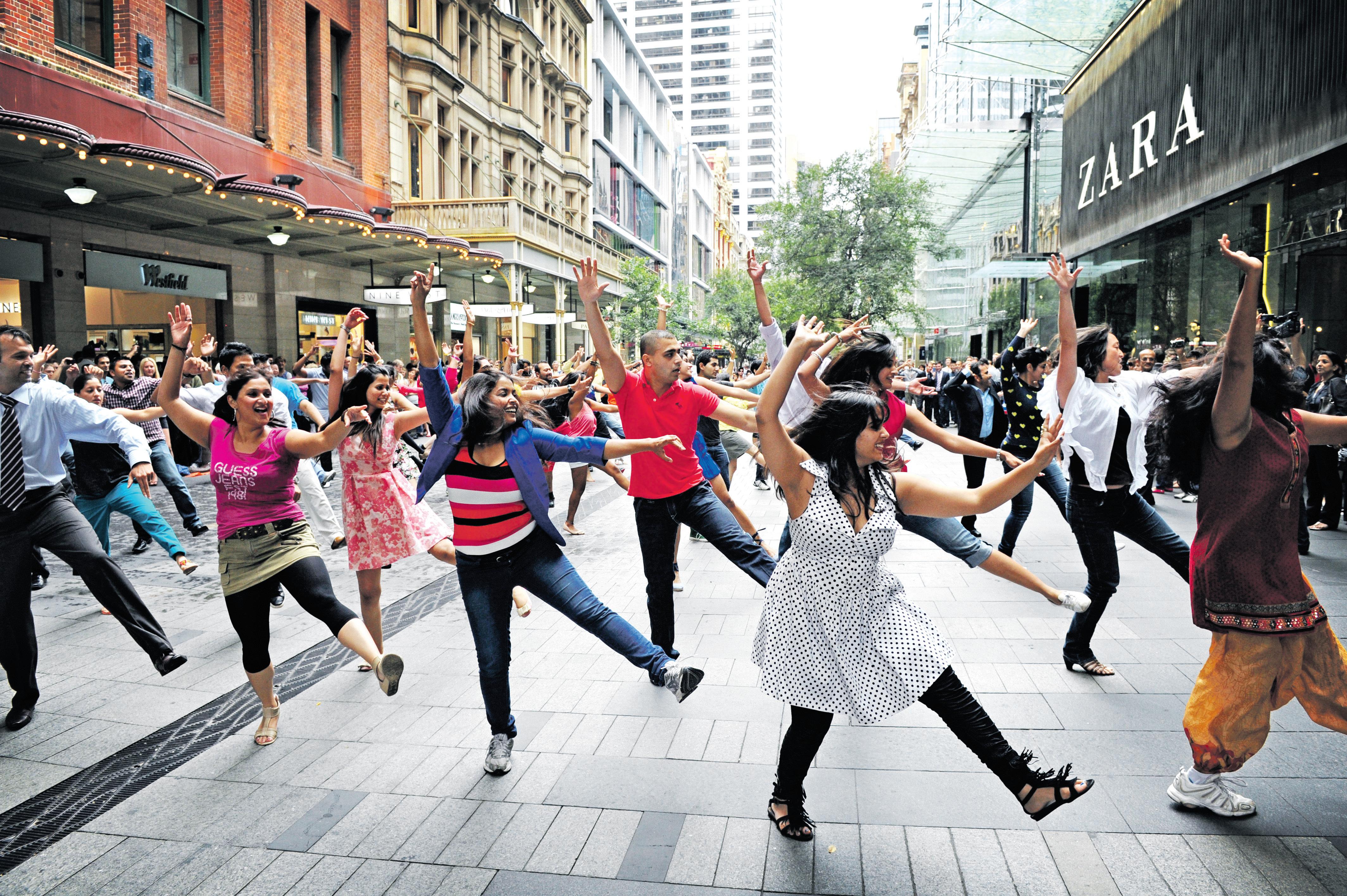


BY SHAILENDRA BEDARKAR
A rough cut video version of the song which was released on YouTube became such a hit that it was put down as the final version. The simple lyrics, the broken English, the dumped-boy angst, all somehow contributed to its popularity. In no time, the entire nation was singing it, and applying versions of it to Sachin Tendulkar’s missed milestone century, politicians’ antics, and anything and everything else they could think of.
Use the search words Sydney Kolaveri in YouTube to check out the Pitt St flash mob


MARCH 2012 37 INDIAN LINK
Oversize is all the rage!
Make a statement this season with bright, dramatic, bold jewellery


 BY TALIA KAUR
This season, jewellery has been super-sized. It seems necklaces should completely cover your chest, headpieces should dazzle and empower, earrings should be the size of miniature chandeliers and chunky bracelets should be stacked up high. Bigger is definitely better when it comes to this season’s trend of oversized statement jewellery and as the name suggests, these bold, bling and beautiful pieces are designed to be attention-grabbers.
Statement jewellery first came into fashion couture as a strong trend in the spring/summer of 2009, but is making a comeback and was recently seen in Chanel’s pre-autumn/winter 2012-13 ParisBombay collection. It featured countless Indian inspired statement necklaces, bracelets and headpieces which were made of gems, studs, diamonds and pearls.
Despite Indians having worn this trend for centuries, Chanel’s modern interpretation has led the way for other designers to experiment with
Buying a new piece of jewellery is a simple and effective way of updating an old look or dressing up a casual look, and is a clever way of protecting your personality and individual style. Also, when purchasing from stores like Lovisa, Colette, Sportsgirl, Witchery or PeepToe, it doesn’t put pressure on your wallet. So how do you wear this over-the-top jewellery? And what kind of clothes do they effectively team up with? Well, I have a few suggestions. But remember, the key is figuring out how to make statement pieces work for you, instead of feeling overwhelmed by them.

a headband. By wearing the one piece, it becomes the focus of your outfit and won’t have to compete with any other jewellery. Be sure to also keep the rest of your styling, such as hair, makeup and clothes, relatively simple. If you don’t feel your outfit is complete with only one item of jewellery, try not to wear statement pieces too close to each other. For instance, avoid showy earrings with a dramatic necklace. Instead, wear the earrings with a matching cuff bracelet, or wear the necklace with small and simple studs.
2 When it comes to elaborate pieces, try teaming up with casual clothes. This acts as a blank backdrop for more complicated jewellery. When teaming a multicoloured, chain or bib-style necklace with a pair of your favourite skinny jeans, t-shirt and boots, it keeps the outfit casual and allows the necklace to really ‘pop’. Too casual for you? Try pairing it with a plain silk shirt and neutral tailored shorts or pants instead. Make sure you pay attention to necklines on your outfit. Halters and really high necklines compete with big necklaces, so it’s best to go for large earrings or an armful of bracelets instead.
3 If you feel confident wearing several bold pieces at once, try wearing different textures and sizes together on only one part of the body at a time. Pair thin bracelets with chain styles, studs or cuffs, and layer pearls, chains, or colourful beaded necklaces together. This instantly creates an eye-catching and fashionable look. However, try not to mix too many colours in either the jewellery or clothes, and if you do break the rules a little and wear more than one statement piece, make sure they complement each other.
with colourful accessories and even nail polish can add a fun and playful mood, which screams summer.
4

1
Start by easing your way in. Choose one key piece: a necklace, earrings, bracelet or even
Lastly, it’s important to realise that a single statement piece of jewellery worn can emphasise or de-emphasise parts of your body. For example, if you feel self-conscious about your bottom or mid-section, wear a striking necklace or an elaborate pair of earrings, and this will ensure that all the attention is focused up top. Wear a statement bracelet or anklet to draw attention to your waistline or below. Just remember, whichever way you chose to wear your statement pieces this season, wear it with confidence and you’ll look and feel like a million dollars!


38 MARCH 2012 FA sh IO n
Equip
amantha Wills double navaho gold bracelets
Diva feather necklace $20
Asos black statement headband $49


MARCH 2012 39
Meet the Presidents
GEORGE THAKUR
Liladhar Jeraj

President, Fiji Indian Senior Citizens Association (FISCA)
Liladhar, endearingly called ‘Jerry’, was born in Fiji, attended Brisbane Grammar School and worked at Price-Waterhouse & Co. After completing Accountancy, he became a member and is now Fellow of the Institute of Chartered Accountants in Australia.
Jerry met Kamla, a nursing sister in Brisbane, married her in 1965, returned to Fiji and was a partner in Coopers & Lybrand (now Price-Waterhouse-Coopers). They immigrated to Australia in 1996, but doctors diagnosed that Jerry might never overcome his ailments. A decade ago, however, he partially recovered and in 1995 became President of Fiji Indian Senior Citizens Association (FISCA). Since then he is proud to have changed the course of the organisation by determining that FISCA would celebrate festivals of all major faiths with equal gusto. While speakers are carefully selected to present insight into their faiths to FISCA members, topics of a controversial nature are also allowed free discussion. Jerry initiated weekly exercise classes that are conducted by qualified trainers, and there are at least two bus trips a year to country Victoria for members to enjoy.


In 2007, Jerry registered the charitable Lalita Jeraj Trust in Fiji, and named it after his mother. The Trust engages itself in granting scholarships to underprivileged, but promising children. The Trust has helped a number of students to complete their degrees and gain employment. In 2012 alone, fourteen students were the recipients of scholarships in the field of Accounting. In addition, the Trust supports at least 10 students in Form 7 each year.
Jerry plays golf at least twice a week and firmly believes that had it not been for Kamla, a tower of strength for him in good times and bad, he would be nowhere. Jerry may be contacted at ljeraj@optusnet.com.au

Sri Krishen Auplish, since an early age, has been involved in social work. In 1964, he formed a Residents Welfare Association in New Delhi, which resulted in the change of name from Alexandra Place to Ashok Place. From 1969 – 81, Auplish helped develop Swasthya Vihar, a colony in New Delhi with 375 houses and 64 flats, and was closely associated with the government of India’s Thrift & Credit Society Ltd.; the very first Co-op Society of India with 5000 plus members, established in 1903, and presided by President Fakharuddin Ali Ahmed. Auplish had the privilege of participating in the celebration of Society’s Golden, Diamond and Platinum Jubilees.
Auplish migrated to Australia in 1993, served under FIAV from 1995-2000, helped launch Indian Senior Citizens Association and was one of its founder members. In 2000, he moved to Sydney and
Prem Phakey
President of Indian Senior Citizens Association (ISCA)
Academician Dr. Prem Phakey taught Physics to students of Science, Engineering and Medicine at Monash University from 1964 to 1994. During this period, he supervised various PhD, MSc., and BSc. (Honours) students, and was instrumental in gaining Monash grants from various sources. Retired as Reader in Physics and as Honorary Lecturer for Gemmology
was involved in the establishment of Indian Retirement Homes, started Indian Senior Citizens Forum as an initiative of Sewa International and two Seniors Centres, and hosted Indian Seniors Associations from Canberra and Brisbane.
Returning to Melbourne in 2005, he started Indian Seniors Forum that functions in Camberwell and in Dandenong. As Auplish’s endeavour has consistently been to serve the cause of Indian seniors without charge, the Forum’s monthly meetings arrange information sessions on topics that directly concern seniors, entertainment, outings and other activities, with emphasis on performances by seniors for seniors. Sri Krishen and his wife Nirmal Kanta Auplish volunteer at the Community Volunteer Scheme, New Hope Foundation, they visit various Aged Care Homes and socialise with disabled Indian residents.
Sri Krishen may be contacted on usha.kisca@yahoo.com.au
Association of Australia, Victorian Division from 1973-2002, Prem’s speciality lies in the fields of crystallography, microscopy and optics, together with special interests in minerals, gemstones and diamonds.
Prem is the founder President of Indian Senior Citizens Association (ISCA) and is now in the role again. “I was there when ISCA was born,” so stipulates Prem, “and I am still here for ISCA!” He has an extensive wishlist for the welfare of ISCA saying, “I would like ISCA in the hands of those who are as passionate as I am about the welfare, progress, and long term survival of ISCA for the benefit of future members. In this manner I serve my Mother India.”
Prem’s wife Usha is a retired teacher.
Prem may be contacted on prem.phakey@bigpond.com
Santhosh Kumar
President and life member, Northern Region Indian Seniors Association (NRISA)

Mathematician Dr. Santosh
Kumar arrived in Melbourne in 1970, joined the Royal Melbourne Institute of Technology University, and is Honorary Associate at University of Melbourne. Santosh obtained his doctorate from University of Delhi and has been associated with various universities in Australia and overseas. He has worked for various community organisations such as Australia India Society of Victoria (AISV), India Club, Hindi Niketan, Indian Music Association, etc., and is an Executive Committee Member of the Federation of Indian Associations of Victoria, and
Chairman of its Publications sub-committee.
As founder President and life member of Northern Region Indian Seniors Association (NRISA), Santhosh’s community and academic work has resulted in several awards such as the Ren Potts Award of the Australian Society for Operations Research in 2009; Victorian Multicultural Commission’s Community Service Award in 2009, and Award of Recognition for his contributions to Science and the Profession of Operations Research by the Operations Research Society of South Africa in 2011. One societal impediment that concerns him is the limited transportation that restricts the large Indian community spread over distant suburbs from attending meetings at a handful of association venues, when compared to other communities with senior associations.
Santhosh’s wife Bala Kumar owned an Indian restaurant and was involved in various businesses. Santosh may be contacted on Santosh.Kumarau@gmail.com

a number of Hindi programmes on radio.
Usha Sharma
President, Kingston Indian Senior Citizens Association (KISCA)

Born in Fiji and having lived in India, Usha, her late husband from Kolkata, and their two children immigrated to Australia in 1985. Since then, Usha has played a number of exciting and diverse roles in her life. As Multicultural Commissioner for the Indian community, Usha received the Centenary Medal in 2003, in recognition of services for the welfare of young people. Her name is inscribed on the Shilling Wall of the Queen Victoria Women Centre in recognition of her work with women in the wider community. Today, amongst other things, she works with disabled children and teenagers, is involved with various charitable institutions, and presents
As Kingston Indian Senior Citizens Association (KISCA) president, Usha’s aim is to maintain an atmosphere where all may let their hair down, socialise with each other, share in breaking bread and have fun in their twilight years. Aging for Usha does not mean that her members stop living; it means that they enjoy two-way friendships, performances of various artists in monthly meetings, spend time together playing bingo or antakshri, etc., visit the Victorian countryside and be there for one another in times of need or otherwise.
“As Master of Ceremonies at the AR Rehman show at the Rod Laver Arena, Sonu Nigam concert, Johnny Lever, Pupinder Mintu shows and Ghulam Ali’s concert, I believe I have served my country India, through these events,” says Usha.
Mario Rodrigues, Usha’s partner, works for the government of Victoria. He attends as many Indian functions as he can, speaks a bit of Hindi, enjoys Indian cuisine and is very popular thanks to his friendly nature.
Usha may be contacted on usha. kisca@yahoo.com.au
4 MARCH 2012 s E n IOR s
Introducing the prolific heroes who bring together the community’s seniors via their organisations, and ensure that they are nurtured and cared for
Sri Krishen Auplish Founder, Indian Seniors Forum (ISF)
The white Foods
Foods white in colour can provide you with minerals, vitamins and all-round health benefits
 BY GEETA KHURANA
In previous issues we have discussed the health benefits of eating black and red coloured foods. Now let us discuss the important nutrients in white coloured foods, and how they help to improve or maintain our health.
White foods have earned a bad name and have been labelled as a culprit for obesity, as well as increasing our blood sugar levels and cholesterol, but does that mean we should eliminate foods that are white in colour? Some white foods such as sugar or refined carbohydrates like white bread, pasta may not be as good for us as the high fibre wholegrain ones, but there are certain white foods that are too healthy to be ignored.
W HITE F ISH
Most white fish such as cod, bass, sole, perch and haddock are very low in fat. It is recommended to have fish at least 2-3 times a week. Even though white fish is very low in fat, the calorie and fat content will increase if you decide to cook the fish in an unhealthy way such as by deep-frying. The second way to pile on the calories is by serving fish with a fattening sauce that contains butter or cream, for example.
While oily fish contain higher quantities of vitamins A, D and E, they are also rich in a number of B vitamins such as niacin (B3) needed to promote healthy cells and to help eliminate toxins from the body, and pyridoxine (B6) which keeps the skin, nervous system and red blood cells healthy. White fish is also rich in several essential minerals such as iron, phosphorous, selenium, and iodine.
BBananas are rich in potassium, an essential mineral for maintaining normal blood pressure and heart function. In addition to these cardiovascular benefits, the potassium found in bananas may also help to promote bone health. Bananas contain pectin, a soluble fibre (called a hydrocolloid) that can help normalize movement through the digestive tract and ease constipation.

G ARLIC
Garlic has always been considered good for health, but in recent years it has become a food for study for researchers. Garlic contains the powerful anti-oxidant allicin that also gives garlic its aroma and flavour. It is rich in sulphur-containing molecules called polysulphides that help in improving blood pressure. Garlic still helps to protect against heart disease by reducing the risk of abnormal platelet clumping that can lead to a heart attack. It also has anti-bacterial and anti-viral effects, which may help to ward off colds and other minor infections.
W HITE M EAT
There is always controversy about which is the healthier meat: white meat like rabbit and chicken, or red meat like mutton and beef, which come from the flesh of big mammals. Lean red meat is an excellent source of iron and protein, but we have to be careful with the portion sizes since it is high in fat too, whereas white meat is lower in fat. The bottom line is that no matter which meat you eat, you can guard yourself against health problems if you eat in moderation.
T URNIPS
Turnips are usually white in colour from the bottom until halfway up and become light purple, red, or green according to the sunlight that has fallen on them, until the top. Turnips are a good source of C and B vitamins. They also contain manganese which helps metabolize fat and carbohydrates and keeps your brain functioning properly.
W HITE B EANS
White beans also known as navy beans have many health benefits. These are low GI and loaded with trace mineral molybdenum. These are also a good source of magnesium. Being low in GI, white beans avoid triggering high blood sugar levels and thus help improve blood sugar levels. White beans are said to produce alpha-amylase inhibitors which help regulate fat storage in the body. The magnesium in the beans helps you to handle stress levels better and is also good for healthy bones.
Garlic is rich in sulphur-containing molecules called polysulphides that help in improving blood pressure.


C AULIFLOWER
Cauliflower is a non-starchy cruciferous vegetable containing sulphur-rich compounds called glucosinolates, which activate the body’s detoxification system. These may play a role in preventing various types of cancers. Cauliflower contains the second highest amount of glucosinolates, after broccoli. Cauliflower is also a good source of vitamin C and potassium.

though white fish is very low in fat, the calorie and fat content will increase if you decide to cook the fish in an unhealthy way such as by deepfrying.


W HITE ONIONS
White onions have sulphur compounds that give them not only their strong odour, but some excellent health benefits as well. Sulphur compounds help to reduce abnormal blood clotting and also help to reduce blood cholesterol and blood pressure. White onions contain flavonoid quercetin, known for its anti-inflammatory properties and cardiovascular health benefits. These are good for the digestive tract and also have anti-inflammatory and anti-oxidant effects.
M USHROOMS
Mushrooms are loaded with nutrients. They have high levels of anti-oxidants and are low in calories, fat and sodium, yet provide important nutrients like selenium, potassium, riboflavin, niacin, vitamin D and more. Antioxidants like selenium protect body cells from damage that might lead to chronic diseases and also help to strengthen the immune system. Mushrooms also provide ergothioneine, a naturally occurring anti-oxidant that may help protect body cells. Mushrooms are also a good source of vitamin D. Antioxidants like selenium, protect body cells from damage that might lead to chronic diseases. They help to strengthen the immune system, as well.
40 MARCH 2012 www.indianlink.com.au WELL n E ss
Even

MARCH 2012 41 INDIAN LINK
THE WORLD SUPER FAMOUS Ma BABA
2


42 MARCH 2012 www.indianlink.com.au
may try the truth of our knowledge to day and achieve whatsoever you want All your wishes will come true in 3 dAys guArAnteed Hate will be cHanged in love No life without problems No problem without solution I can bring happiness into your life with 100% guarantee Love relationship, any husband and wife’s domestic problems If you are trying to get back, with your loved ones Are you worried about any Immigration Matters? PleAse rememBer!!! no one hAs Been desPerAte And helPless AFter consulting mA BABA NO BODY CAN BEAT MA BABA
me if any Guru or Spiritual Healer left your work incomplete or unsuccessful I will solve your problems Satisfaction within 3 days with 100% guarantee
s TA n
n TAc T:
to City, Casino and Beach
High Visibility Location
Licensed
You
Contact
pAKI
cO
0011-92-332-2550520, 0011-92-300-9273891 90+ seater • Close
Well Established •
Fully
Kitchens
canopies
with
2 Dining areas with separate entries Can be converted to shopfront/ multiple cuisine
Easily accessible by Public transport • Ample Parking Health and family reasons • Walk-In-Walk-Out
Genuine buyers only
Restaurant
Sale
Please contact 0413 112 328
for
The right facial
Which one is right?
facial is not just a beauty treatment; it is a time for women to get away from their busy, multi-tasking lives and indulge in some ‘me’ time. These days men too are getting facials done, but we will discuss their options another time.
Let’s examine the right kind of facial for different skin types.
It is the era of specialization so with every aspect of our lifestyle having multiple choices, why should beauty treatments be any different? Think about the choices in moisturizers or shampoos and conditioners –you can easily spend half a day choosing the product that is right for you. So take your time in choosing the right treatment.
Firstly, if you have the patience for a full-fledged beauty treatment every month, then by all means go for it. But if you are short on time and have fewer options, go in for a facial. A facial, if done well, can be a destress mechanism and can make the skin glow.
Why have a facial?
No matter how much we do the cleansing-toning-moisturising routine, getting the same thing done by a professional with products that are sometimes more concentrated than the ones available off the shelf, can produce better results.
Besides, the girls at the salons are professionally trained and they know the right way to massage and tone the skin, and the muscles of the face, neck and shoulder relax with the brisk rub they get.
A facial improves skin tone, gets rid of dead skin, blackheads and whiteheads, leaving the skin feeling fresh and rejuvenated. It also improves blood circulation and the skin’s elasticity.
A few salons will include an acupressure-like treatment as part of the facial where they apply pressure to certain points on the face. This can help flush out toxins and detox the skin.
And it goes without saying that a facial can be an effective anti-ageing tool to keep lines and wrinkles at bay.

Now that we have established the importance of a regular facial, how does one know which one to go for? There are several facials on offer using all kinds of ingredients. Fruit, vegetables, aloe vera, gemstones, gold, AHAs, flowers – they are all part of facials on offer at various salons. The trick is to know which one works for you and stick with that. If you wish to experiment, I would suggest you go with products that are natural and hypoallergenic so you don’t break out into a rash or have unnecessary chemicals absorbed by your skin.
A classic or regular facial offered at most salons will include cleansing, toning and moisturizing, and a mask. The cleansing process includes exposing the skin to steam to open up the pores and remove blackheads. An ice pack is then used to close the pores.
The facial massage is done in clockwise or anti-clockwise directions and any product application extends to the neck area, as well as all over the face.
The mask is usually meant to provide the skin some extra nourishment or tighten the skin. Most salons will also extend the moisturising treatment to the back of the neck and the shoulders to relax the muscles.
Facial for dry skin
If you have dry skin, ensure that the facial you get uses creams and moisturizers that will nourish the skin with extra moisture. If you have a choice, go for a deep nourishment face pack for a mask. Some face packs that use clay or Fuller’s earth (multani mitti) can leave the skin feeling drier than before. Always, always, ask for moisturising ones.

The exfoliation process usually involves using a scrub of some sort but opt for a mild one or one that has a semi-liquid base so your skin doesn’t feel too dry. The serum that is used after the face pack is taken off should also be one that provides moisture to the deepest levels of your skin.
Facial for oily skin
Most salons will use generic products for all kinds of skin at the exfoliation and toning stages. But when it comes to moisturising, one has to be careful as oily skin does not need
much massaging or moisture-rich creams. If massage is involved, make sure they use products suited to oily skin and keep the duration of the massage to a minimum.
Oily skins can opt for face masks that tighten the skin, shrink the pores and reduce excess oil on the skin’s surface. If you have pimples, get rid of them first with effective anti-acne treatments and then going in for a facial.
Facial for normal skin
People with this skin type are lucky as they need everything in the right proportions. They don’t need to have extra moisturising or extra anything, for that matter. The balanced pH levels of their skin means they need to maintain and protect their skin. What people with normal skin need to keep in mind is that their facial should exfoliate and nourish, more than anything else.
Facial for combination skin
This is a tricky one as people with combination skin have oily skin – usually on their foreheads and chin, and dry skin along the cheeks or vice versa. After cleansing, the dry parts of the skin need to be massaged with a moisturising cream and the oily parts need toning. Opt for a face mask that nourishes the skin, rather than one that provides moisture or tones the skin. The same goes for the serum that is applied after the face pack comes off. Opt for a safe, nourishment or anti-wrinkle serum to reduce any after effects of the facial.
Facts about facials
• You don’t really need a facial if you are under 25. While in your late 20s you can start having a facial done, but not even once every month. Once in three months is just fine.
• If you are over 30, it is advisable to have a facial done every month. If you don’t have the time, opt for a clean-up at the very least.
• A good facial should last for at least an hour. If your beautician finishes your facial in half an hour to 45 minutes, it is a rush job. It takes time for the face mask to dry and during the massage, the skin absorbs creams or lotions only for a certain amount of time. Most beauticians are aware of these
facts and give a facial accordingly, and it usually adds up to an hour or so.
• The neck area too should be given the same treatments as the face, from exfoliation to serum stages.
• Some women opt for bleach treatments along with a facial in the hope that it will lighten their skin tone. A bleach is the worst chemical you can apply on your face. It usually leads to pigmentation when you step out in the sun after a treatment. Combining bleach with a facial exposes your newly exfoliated skin to a harsher dose of chemicals which can damage the skin instead of repairing it.
• If the beautician is pulling at your skin a bit too hard, feel free to insist she should be gentle because all that tugging and pulling during the massage is meant to be gentle. It should not stress the skin.
• If any product applied causes a burning or tingling sensation, let the beautician know immediately. It could be that you are allergic to some ingredient in the product.
• Avoid strong smelling or very fragrant products and let your beautician know that you would prefer mildly fragranced or fragrance-free products that are hypoallergenic.
So, if you have the time and are in the mood for some TLC, go get a facial. It is a great way to relax and have some quiet time.
MARCH 2012 43 INDIAN LINK BEAuTy
No matter how much we do the cleansing-toningmoisturising routine, getting the same thing done by a professional with products that are sometimes more concentrated than the ones available off the shelf, can produce better results.
When you’re in the mood to de-stress and enjoy a bit of personal pampering, spoil yourself with a relaxing facial
MINNAL KHONA
BY THOMAS E KING

Encompassing the great cultural diversity, historic differences and scenic variety of Asia in a just a few words is not an easy task. Even for someone like me who has spent much of his life tiptoeing across mountain highs and waltzing along valley lows, it’s still a mind-daunting undertaking. After much deliberation I can only say that Asia is truly a place of infinite mystique where visitors can indulge all of their senses. Just as difficult as defining Asia, is illustrating my fascination for the continent. These few snippets with Indian links, however, may provide intriguing clues.


Pokhara Pictures


It’s early morning in the Pokhara Valley, 200 km west of Kathmandu. Even though the first rays of the sun are yet to leap over the hills, Hindu pilgrims are preparing for puja at the most sacred temple in the serene vale. Set on a wooded islet in the middle of a picture perfect lake, the Barahi Temple also provides an unobstructed vantage point for an incredible vista of water and mountain.

The mighty Himalayan Mountains span some 2560 km from northern Pakistan and India into China. The 8854-metre high Mt Everest can’t be seen from Pokhara but eight colossal peaks are often visible from selected locations in and around Nepal’s largest second largest city. Stretching from east to west, the 140 km long panorama of
ASIA: All
the Annapurna Range seen in Pokhara includes Annapurna I to IV and Annapurna South. Though it’s not the tallest, the sharp triangular peak of Machhapuchhre stands out distinctly from the pack of mountains. Some of the other peaks are higher, but being farther away they are dwarfed by its fishtailed pinnacle.
The magnificent massif of Machhapuchhre has not been conquered. Consequently, the pyramidal façade of this 6993-metre mountain marvel can only be admired, and that’s what tens of thousands of domestic and foreign visitors do each year.
It’s doubtful that there is any place other than Pokhara where so many great Himalayan peaks can be seen from such a close position. Annapurna I is just 50 km away, while Machhapuchhre is 30 km down the road. A sense of awe swept over me as I stood at the lakeside vantage point 900 metres above sea level gazing at an icy summit nearly 7 km high.
It was mid March and the rhododendrons were in full bloom, adding splashes of red to the white of mountain snow and the blue of the sky. March and April are ideal times to visit Pokhara as the winter chill has gone. The only disadvantage is that afternoons can be cloudy with occasional thunderstorms.
Though colder, midOctober to December is the other optimum period.
Autumn is the season when Nature wields a colourful brush of transition over the landscape. Oranges, reds and yellows and patches of pure gold enliven the scene.
I’ve visited Pokhara in both seasons and prefer spring as it’s warm and sunny. It’s comfortable to sit and leisurely gaze at mountains reflected in the glassy waters of Phewa Lake, a 2½ km long body of pure

44 MARCH 2012
There is a charm and serenity about Asia that
TRAVEL
All Senses in Action
sanctuary that encircles the fabled mountain are 88 km from the city. A wide highway puts the abundant flora and less visible fauna of the 754 sq km Kinabalu National Park within an hour’s drive. Many day trippers from ‘KK’ as it’s commonly called, come for these attractions with the added inducement of being able to spend a few calm hours strolling in cool mountain air.
Wild orchids, lovely bluebells, daffodils, rhododendron and the giant Rafflesia with a flower measuring up to a metre across are found along walking tracks. It’s not very likely you’ll spot
Clockwise: Konarak’s incredible Sun Temple is an outstanding backdrop for an annual dance festival.
This ‘tribal’ maiden is a talented artisan performing during cultural evenings near Mt Kinabalu.
Central Vietnam’s splendid river and mountains unfold a few km outside imperial Hue.
The ‘fish tail’ of Machhapuchhre is best seen at sunrise from a lakeside vantage point in Pokhara.
The rice god of the Philippines watches over the awesome world heritage listed terraces.
Quaint French traditions remain in Yanam where there are ‘jumbo’ ambitions to develop tourism.
glacier scarred summit is followed, but the climb is very tiring and tourists must be in good shape to complete the two to three day trip. Several huts with basic cooking and accommodation facilities strategically located along the way have been established to make the journey more comfortable. The driest and sunniest part of the year is from February to May but even then stout shoes, a warm hat, gloves and warm clothes are needed plus food for the entire journey. A sleeping bag can be rented at the huts. Climbers must utilise the services of an authorised guide and porters can be hired.
Visitors who simply want to slow down for a few days and not test their endurance will enjoy the serenity of the area and the variety of pleasant options available. My wife and I, for instance, traipsed along the path winding through the park’s extensive botanical garden, went golfing at a picturesque course located on the mountain slope, and spent hours at our heritage resort sitting opposite an amazingly cloudless peak and watching the last rays of the day cast a pink hue over this geologic wonder.
Hue: No hurry
Located roughly midway between the unbridled frenzy of Ho Chi Minh City - more commonly called Saigon - to the south and the more conservative Hanoi, the
commentary on 400,000-strong Hue. We chatted while the aluminium craft cut through the water and then coasted to a rustic riverbank jetty where scores of other dragon boats were temporarily moored.
Rising beyond several brilliant Flame of the Forest trees lining the river bank, was an octagonal tower. Hue is a metropolis of pagodas with more than 300 sacred Buddhist buildings gracing the city. Built in 1844, the seven tiered Thap Phuoc Duyen Tower was constructed on the grounds of the older Thien Mu (Heavenly Lady) Pagoda.
Buddhism came from India and then spread throughout Vietnam. Today 90 per cent of the population profess the gentle faith. Several dozen adherents currently live at the monastery beyond the tower. It’s a place of peaceful contemplation once tourist hordes leave. The sweeping scene of river boats and the purple hue of the Troung Son Mountain Range beyond was enticing, but another major point of interest was only a few kilometres upstream.
Also set above the river, the Tomb of Minh Mang is the most typical and best preserved of all the royal mausoleums in Hue. Said to be modelled after the Ming Tombs in Beijing, the 18 ha. complex is filled with statues, temples, terraces and stone bridges. In the middle of it all is a
of the Perfume River. In 1802, after nearly 40 years of conflict, Vietnam was united for the first time by a Saigon lord, Nguyen Phuc Anh. He proclaimed himself Emperor Gia Long as the first Nguyen ruler, and began rebuilding the Phu Xuan Citadel into an impregnable stronghold, the first fortified city in Asia modelled on European military design.
‘Fortified’ is the operative word because the 10 km in circumference Citadel has an 8 metre high, 21 metre thick outer wall. Inside this 520 ha stronghold where subjects lived, worked and tended fields was another moatenclosed space, the Inner City or Dai Noi. Accessible through four entrances, access through the Ngo Mon Gate was once reserved solely for the emperor.
I walked unhindered through this passageway, across the stonebuilt Golden Water Bridge which spans a fish-filled lotus pond, and into a still splendid palace where emperors would confer with advisors, meet other nobles and issue royal decrees. The elevated red and gold throne where this occurred takes centre stage in the Thai Hoa (Supreme Peace) Palace, a spacious hall with an ornate roof supported by 80 carved, gold inlaid and lacquered columns. I briefly paused before this grand spectacle sensing that what lay beyond would also be a feast for the senses.
MARCH 2012 45
(Photos: Thomas E. King)
Afternoon tea time
Feeding your hungry brood when they return from school isn’t such a chore with these easy and delicious recipes
BY ELIZABETH GAETE
It’s 3.30 in the afternoon. The kids fly in through the front door, dump their school bag wherever they see fit and before mum even gets a chance to close the door behind her, she hears those predictable statements: “I’m starving mum!”, “What’s to eat?”
It’s easy to grab packets of processed food from the pantry, but by putting in a little effort and a bit of forward planning, handling your child’s 3.30-itis doesn’t have to be a big chore.

Here are a list of recipes that are easy to make, delicious to eat and are sure to fill those hungry tummies until dinner-time.
Pikelets
This recipe is so easy to remember, you will soon be able to do it blindfolded.
1 cup self raising flour
1 cup milk
1 egg
Pinch of salt
Cooking oil spray
Sift flour into bowl, add salt. Make a well in the centre. Add milk and whisked egg. Stir until combined. Spray a frying pan with cooking oil spray. Once the pan is hot place about three separate spoonfuls of the mixture into the pan. Once bubbles appear on the top of the pikelets, flip them over for about another minute or so, until golden brown.
Top the pikelet with fresh fruit i.e. bananas, strawberries, add a dollop of yoghurt and a drizzle of honey.
The pikelet mixture itself is not sweet, so be creative with your toppings!
For a savoury option, spread with cream cheese and top with sliced tomato or cucumber.
TIP: Put milk in microwave prior to adding to flour, until it’s lukewarm. This gives the mixture a better consistency and helps speed up the cooking time.
Pizza muffins
The base to these pizzas can be changed depending on what you have in your pantry. This recipe uses English muffins, but Lebanese bread or tortillas can also be used.
2 English muffins cut in half Tomato paste or
pizza sauce
Grated cheddar cheese
Spread tomato paste onto cut English muffin, top with a favourite topping combination i.e. ham and pineapple or a vegetarian mixture of capsicum, sliced tomato and thinly cut mushroom. Cover with grated cheese and place under the griller of your oven until the cheese has melted well.
Pita pockets can also be used and filled with the kids’ favourite pizza topping and cheese. Place in the oven and bake until cheese has melted.
Fruit kebab sticks
The kids will always be on hand to help make this snack!
Kebab sticks or bamboo skewers
Fruit of choice: strawberries, blueberries, watermelon, rockmelon, sliced peach, sliced nectarine, apple, banana, grapes. Use whatever fruit is in season.
Cut fruit such as watermelon or rockmelon into bite-sized squares of about 3cm in length and width. If using apples or peaches make sure slices are thick enough, at least 2cm wide, so they can be pushed onto the skewer stick. Use fruit like strawberries and blueberries whole.
Thread fruit onto the skewer sticks. It can be served plain or with the kids’ favourite yoghurt as a dipping sauce.

Bread pillows
Simple and delicious, these are a winner for hungry tummies
6 slices of wholemeal, white or wholegrain bread
Butter or margarine spread
Small can of corn
Small can baked beans
Grated cheddar cheese
12 cake cupcake tray
Cooking oil spray
Spread margarine or butter onto bread. Cut crusts off bread and cut each piece of bread in half. Lightly spray cupcake tray with cooking oil. Push the half piece of bread into each cupcake hole. Place in preheated oven, and bake until bread is slightly crispy.
Take cupcake tray out of oven. In six bread halves, place 2 spoonfuls of corn, top with grated cheese on top of the baked
Banana smoothie
This can also be called a banana milkshake for those children who are “allergic” to anything healthy. It’s quick, easy and a nutritious snack the kids will really enjoy.

2 cups of milk
1 banana roughly chopped
½ cup of yoghurt
1 tablespoon of honey
Place all ingredients into a blender. Blend well until smooth. Place into 2 glasses with a straw. If your child likes cinnamon, this can be lightly sprinkled on top.
bread. In the other six place 2 spoonfuls of baked beans onto the bread, and top with grated cheese. The baked beans should
be placed in a bowl and heated in microwave until warmed through beforehand. This will help speed up the cooking process. Place back
into the oven until cheese has melted. Cool slightly before serving.
46 MARCH 2012 www.indianlink.com.au FOOD


MARCH 2012 47 INDIAN LINK $872 $1068 $960 $1074 $929
27th Feb
opening for travel sales consultants
of 6 months travel experice
email your resume on rumneet@flyjet.com.au
* Taxes as on
2012 and are subject to change. Fares can change or be withdrawn without notice. Job
minimum
required
TAROT


ARIES March 21 - April 19
This month the cards indicate a time for communications with everyone, so you will be busy and also very popular. There are many different plans to travel and this month you are going to be really busy. There is a combination of cards showing that you need to be careful with family members and misunderstandings, as you have been feeling very unhappy with certain family members lately. You may be looking at starting something new and prospects are looking good.
TAURUS April 20 - May 20
The cards show here that your financial situation is getting better, and there is no shortage of money flow. However, you have to be careful about being too generous with your money, as you have a problem and cannot say no. Romantically you will be feeling good and also thinking about a particular person with whom you want to make things permanent. Be careful of spilling the beans with secrets you may be holding about someone - hold your tongue.
GEMINI May 21 - June 20
The cards show that your sex appeal is oozing and you will be like a magnet attracting the opposite sex, but without any problems. You also have some thoughts about changing your car. You are currently putting a lot of effort into work and will also be gaining recognition and rewards this month. You will be thinking of taking on a new health regime. There is an indication that you need to look at your diet. Take an allergy test.
CANCER June 21 - June 20
You have been working quite hard lately and the cards indicate a need to take it easy. Take some time out and just relax. Be careful and don’t keep taking what your boss may be expecting from you. You need to learn to stand up for yourself, otherwise you will be working 24 hours a day. There may be a romantic liaison at work, so watch out as it could end in upsets. Also, be careful of arguments with people.
LEO July 23 - Aug 22
The cards indicate that you have some jealousy around you in regards to your love life or its progress. Be patient, as you are feeling the pressure in work and life. Be clear in your mind as to what you would like to do, as you are being urged to make some firm choices. There are some work issues that need to be addressed. You should take time to eat well and do not indulge in alcohol or nicotine.
VIRGO Aug 23 - Sep22
The cards indicate that you will be concentrating on your career. You will be praised a lot at work but you need to decide what you want to do, as you have itchy feet to change jobs. You will be thinking of going to another city or state. You have some paperwork to deal with, things you have been putting off for some time. You will be making some investments and looking at ways to make your money go further.
preDictiONS FOr MARCH 2012
By NANCy JADE ALTHEA www.nancysood.com
LIBRA Sep 23 - Oct 22
The cards indicate that you will be looking at choosing a holiday destination this month. You have plans to travel and have some ‘me’ time. Things are looking good, if you are waiting for news of a promotion. Your love life needs a spring clean and to make things interesting, you need to start communicating more with each other. There may be a minor operation for one of your friends or a partner this month, but all will be well.
SCORPIO Oct 23 - Nov 21
You are like a ball of energy with lots of plans and thoughts this month. You are worried about a loved one who has been showing signs of being distant and not very open with you. You are feeling left out and need to talk to each other. There may be awaited news, about a job in another city. You are looking at a way to start a new life. This month is going to be full of many changes.
SAGITTARIUS Nov 22 - Dec 21
The cards show that this month your relationship will go through ups and downs. Both of you seem to have some minor misunderstandings: you need to look at what is causing this. You might have to re-evaluate your behaviour to keep things flowing smoothly. If you are strong you will keep things together; if not you will break up. Money is coming in but you have some expenses to deal with. Health is okay, but take care of your back.



CAPRICORN Dec 22 - Jan 19
The cards indicate new opportunities around work with new plans and more challenges knocking on your door. You need to be able to communicate what you want to your superiors. A long-term relationship is in trouble, and you need patience and a clear mind to work through these problems. There will be some major revelations after the 24th. The health of an older member of the family will also be a concern. However, try to keep your stress levels down.
AqUARIUS Jan 20 - Feb 18
The cards indicate that your love life will be going through a whirlwind this month. Sit down with your lover and ask some serious questions about what they want. There seems to be a feeling of instability around work, as you are not getting what you deserve. There are plans to take up a hobby, you are looking for some excitement and fun, but need to relax. Time to start meeting up with friends and getting your social life active again.
PISCES Feb 19 - March 20
The cards indicate a time for refurbishing your house or flat. You will be thinking of home improvement projects. Your job needs attention as you are not in the mood to work lately, and you could have major problems with your boss and colleagues. You have lost interest in your current role. Take time out to decide where you want to be. Life is not great with your lover as you are getting mixed signals. Talk and clear the air.

STARS FORETELL
The ‘over’ never ends
With a new debut begins a new understanding and the promise of a better future, once again
you in the stand.” Her first words had the same effect as a bucket of iced water.
“My love survived many games Jay, it was just not able to survive the doosra,” she responded.
BY RANI JHALA
The fence creaked as he leaned forward and put his weight on it. He was a spectator now, having long retired from the game.
He had a seat in the members’ stand, but a group of friends had come to watch and he had chosen to sit with them. The excitement grew in the stands. The toss had decided which country would bat first, and his son was going to make his ‘debut’ as an international cricketer. His son, not yet nineteen, was already showing the signs of becoming a world champion. Yes, it was a proud moment - a father seeing his son stepping into his footsteps and already doing a better job.
He turned towards the pavilion as a movement caught his eye. His son had just stepped onto the ground. He knew how his son would be feeling. The heart would be racing. The anticipation would be at its highest, and the hope of success would be all pervading. The walk to the pitch was a walk towards personal victories and it was always welcomed. It was the walk back that everyone dreaded, for it brought with it the ending to that day’s dream.
Suddenly his son stopped and looked directly at him; then he raised his bat in the air and lowered it in front of his dad. Misty-eyed, he returned the salute. Whatever happened, as far as he was concerned, his son had already won!
The opposition was already strategically placed around the ground. His son moved to stand in front of the wicket. It was a sign that the game would shortly begin. He moved back and took a seat. It was then that he saw her. Standing behind a column with her back to him, she stood looking towards the pitch. No, not the ground! She was watching his son. He saw red. How dare she come to ruin the most important day in his son’s life! Did she not realise the damage she had already done?
He got up and began a slow walk towards the lady. As each step brought him closer to the woman, he began to debate about the wisdom of a meeting but just as he was about to turn back, the lady seemed to sense his presence and looked at him. Both stilled. Ten years seemed to fly away. The hurt and the ache seemed to bury itself. All he now felt was the pain of watching his wife in tears.
“Go back Jay, he will look for
Instead of complying with her request, Jay moved closer. “For the next over, his eyes will be on the ball and I only need that much time to ask you a question.”
“Where have I been? Is that what you wish to have answered?” she asked.
“No. I just want to know why you have returned,” he said.
“I never left, Jay,” she answered.
“Never left? Ten years ago, you walked away. You left your home, your husband and your child. You gave no reasons and you left no contact numbers. Is that not leaving?” he cut in.
The over had ended and the wicket keeper was changing ends. Jay looked toward the crease just as his wife hid herself behind the column. He would have to wait until his son faced the other way before he could continue the conversation.
“So why did you?” he asked.
“Because another, had become more important,” she replied.
“No woman has ever been more important than you. You and my son were everything to me,” he barked.
“Yes, there was us, and then there was your cricket.”

“CRICKET! You left because of my game?” he questioned her in disbelief.
“Jay, maybe the fault was mine to have underestimated your commitment to the game or to have expected more than what you were willing to give. When we married, I saw only the glamour and fame that came with your success,” she said, adding, “I even enjoyed it. But no wife should be expected to give up so much of herself to make her husband whole. I watched you take part in ‘those bonding sessions’ when you and the team would lock yourselves away before each game. I silently waited at home while you spent months away on tours. I held our baby night after night as he burned with temperature, only to see your photo splashed across the morning paper with a woman’s arm around your neck. I saw your name linked time after time, with woman after woman. I cried lonely tears while you boasted to the press, of your love for cricket. I took calls from strangers who spoke of familiarity. I shared your worry at selection time and I hurt when success walked away at intervals. I heard you moan when the game went badly. I rejoiced when your team won. And I did it all for love but not once did…”
“A love that did not make it past the first inning,” he cut in bitterly.
“Why did you not speak up earlier? I thought this was what we both wanted,” he now spoke in a gentler tone.
“Would you have given up cricket?” she questioned.
“Have I played since you left?” he queried in return and then watched as his wife broke down and cried. His arms automatically reached out to comfort her, surprising even him.
“Six!” someone shouted. Jay and his wife looked up to see their son lift his bat in acknowledgement to the cheering.
“What now?” he asked fearfully.
“Now? It is time for me to give in to this sport,” she smiled back.
“I have always loved you,” he whispered.
“But I have always loved you more,” she replied.
“How can you say that?” he asked in surprise, for wasn’t it she who had left him? Him and their child!
“I left you your son, and I silently watched as you made him into a cricketer.”
S EEKING G R oo MS
m ARTI m O n IAL s
Well-settled professional alliance invited from Australia/ India for 40/165 unmarried charming Punjabi Khatri girl, family oriented and responsible, IT professional, working in Sydney. Australian citizen. Early marriage. Can relocate. Serious proposals only. Email profile with recent photo: sydgirl09@gmail.com

Seeking suitable match from Australia preferably PR/ citizen, student can be considered as well, for Hindu / Punjabi Khatri girl pharmacist, B.SC medical, 5’5”, ‘84 born, slim and fair, living and working in India (Punjab). Brother well-settled in Melbourne. Parents in India. Contact Abhishek Seth on 0433 322 666 or email seth.abhishek@yahoo.com
Well-settled Hindu family in Sydney seeks a mature, well settled, good natured, professional boy from a cultured family for our charming daughter, ‘79 born, 5’2”, IT professional (Masters IT). Caste no bar. Please respond with photo and particulars to sssvjp@hotmail.com
Seeking qualified Gujarati match for sister, 5’1”, 28 years, vegetarian, B.E. (Electronics & Communication), working with Tata Consultancy Services (TCS) at Vadodara, Gujarat. Email profile with recent photos on kunalshah@y7mail.com or call 0433 255 228. Serious proposals only. Well cultured and well to do family.
Seeking well-qualified match for very fair, young looking Hindu lady, 54, veg, divorced, daughter living with her. He must be aged 49-55, non smoker with strong moral values. Contact lifepartner@hotmail.com.au or call 0404 043 904.
Suitable well-settled, professional match for Punjabi Arora girl, beautiful, never married, 38/165, qualified IT professional. GSOH with good family values. Brought up in India. Working in MNC Sydney. Australian citizen. Early marriage. Serious enquiries only. Email details with photo: ausgirl101@gmail.com
Seeking suitable Punjabi Brahmin match for 1972 born (looks younger), divorced, issueless registered nurse currently in India. Groom preferably between the age of 35-40, Hindu vegetarian, non smoker, non drinker. Only serious persons contact on nitishsharma_18@yahoo.com
S EEKING BRIDES
Seeking Hindu girl, preferably Gujarati, good family values, for my son, dob: 7/8/75, divorced, no children, fair, 5’8”, vegetarian, down to earth, genuine, well-built, non-smoker, light drinker, Australian citizen, tax consultant, lives with parents. Contact 0423 328 800 or sydau714@hotmail.com
Compatible match for 1975 born, clean shaven Sikh Khatri boy, 5’ 9”, two Post-Graduate degrees from India and recently finished Masters in IT from Australia. Currently on temporary resident visa (with full work rights) and doing 3 months Internship at Optus Sydney. Living with elder brother (Australian citizen) and parents, who are on a 1-year visitor visa. Girl should be tall, well educated with pleasing personality and must be from Sikh background. Early marriage and serious proposals please.
Contact 02 9476 4570 email: jas_ghai01@hotmail.com
Seeking a suitable match with Indian values for 27-year-old, 5’6”, Punjabi Khatri boy, Permanent Resident, permanent job, parents in Australia for visit. Please email sunaina_aqua1@yahoo.com or call 0421 959 861.
Seeking Hindu/Buddhist girl from Bali, Fiji, India, Nepal ,Sri Lanka or anywhere else for 29-year-old, 6 ft., handsome Hindu boy, working in Health Services. Looking for educated working girl, with strong family and cultural values. Teacher, health service worker preferable but not necessary. Serious proposals only with a view to marriage and building a family. Please send photos and correspondence to P.O.CP Box 343, Condell Park, NSW, 2200.
MARCH 2012 49 INDIAN LINK FI c TIO n
The power of colour
A first-time film-maker makes it to the finals at this year’s Tropfest
BY SUJITH KRISHNAN
Kalias Prasannan has loved M&Ms since he was a kid. By habit however, he eats them one colour at a time…
Now you might think this is eccentric, but it has opened up a whole new world for this young engineering student.
What if we could see only one colour at a time, the thought occurred to him one day. He turned that thought into a film, which was picked as a finalist in Australia’s most popular short film festival Tropfest.
Tropfest, ‘the largest short film festival in the world’ and one of Australia’s many symbolic cultural events, presents a unique platform to aspiring filmmakers in the country. What makes Tropfest distinctive is that the films created are wholly for the festival and include a different Tropfest Signature Item (TSI) every year. For instance, the TSI for 2012 was ‘Light Bulb’. (For 2013 it is ‘Balloon’). 16 finalists are selected from an average of 700 entries
RGB (Red, Blue & Green).

Having watched the film, I can vouch that it’s a work of art and is sure to transport you to a completely different world.
This short film, just five minutes in duration, encompasses a very interesting concept in that it is about a young man suffering from total colour-blindness who can see three colours - red, blue and green, but only one at a time. Who would have thought a weird fondness for M&Ms would be the starting point for a criticallyacclaimed short film!
Kailas notes, “We take colour for granted…we all must take a moment in our busy lives to pause and admire everything around us”.
According to Kailas, advancement in technology was another decisive factor in making the film. He explains, “I stumbled upon software that could highlight just a single colour from an image and I then incorporated this into a story of a person being able to see only one colour at a time”.
What makes his story even more intriguing is that he has
ultimately came in handy. He was driven purely by confidence, passion and desire to make RGB a reality.
However, as a beginner, he’s had his share of challenges during the entire film-making process and is very thankful to his team, Jason Palmer (cinematographer), Rob LaTerra (actor) and Abin Thomas (production assistant) for standing by him through tough times – he admits he thought of abandoning the entire project, not once but twice.

RGB was made on a shoestring budget of $600. Kailas purchased the audio rights for the film for just $80 online and the film was shot during weekends in Melbourne. It took four months to complete. To explain an idea in five minutes is no easy task as Kailas agrees, “Conveying the story in a few minutes while trying to maintain a good pace was indeed a challenge and moreover, I found it hard to stay constantly motivated”.
The multi-talented Kailas is a professional Fire & Safety Engineer who hopes to complete his Masters degree in Engineering by the end of this year but doesn’t
rule out the possibility of making the switch to show business. “If the opportunity does come along to be a filmmaker, I’ll definitely take it up. I have a few ideas but need to be smart to accomplish them one at a time. The ultimate goal would be being a part of feature film productions”.
Looking ahead, Kailas has several upcoming ventures which are in their early stages at the moment. He claims, “My next project would be a short film with a touch of horror. In regards to Tropfest 2013, I have an idea which Rob is currently helping me with and I hope to produce another short film this year. Tropfest has boosted my confidence as a budding filmmaker and although we as a team lack technical expertise, we know that we can still achieve what we want. RGB’s success has motivated us to attempt more short films”.
Many congratulations to Kailas on his stupendous run at Tropfest 2012. He is inspiration-personified as he has shown us that we can achieve our goals if we work towards them with ceaseless enthusiasm irrespective of where we are and what we do. You can follow http://www.facebook. com/ManjadiEntertainment for updates.
“We take colour for granted… we must take a moment in our busy lives to pause and admire everything around us”
Kailas Prasannan
Kailas has had no background in film-making: his only technical knowledge came from editing home videos and pictures in the past
MARCH 2012 5 INDIAN LINK
I love the warm, gooey, melting chocolate feeling the endings give me, and I love swooning over the handsome, yet sweet and sensitive heroes.
the Buzz


50 MARCH 2012


MARCH 2012 51 INDIAN LINK
SHEKHAR SUMAN
ANUPAM KHER
NATHALIA KAUR
Cine Talk
Making and breaking jodis
Just when you think you’ve seen them all, from the hit jodis to the split jodis comes Jodi Breakers. A jodi-daar pair, Madhavan and Bipasha Basu set up a business of splitting couples…until they end up splitting the wrong couple. That’s when all hell breaks loose.
Interestingly the wronged couple is played by two modelturned-actors Milind Soman and Dipannati Sharma who are a class act, together and apart. Dipannati specially, whom we saw some time ago in a chic avatar in Ladies versus Ricky Behl, makes you wonder why some ladies get left behind in the rat race.
or why any man would be stupid enough to leave a wife like Ms. Sharma. That’s the thought which holds the shaky screenplay of Jodi Breakers together - that we often end up giving ourselves a wrong deal in the bid for love.
The concept of a pair falling in love as they go about breaking couples is interesting enough to hold a two-hour long romcom together. Lamentably, the episodes showing a pile-up of desperately-estranged couples seeking to find an escape from marriage are hardly as amusing as one would expect them to be, given the situation.
At various places, the screenplay simply slithers to a standstill waiting for the writer’s next brainwave.
Until then, there’s always the song break. The music is all of the safe variety, expansive ballads, a sexy item song… download-able waste.
Madhavan and Bipasha Basu’s screen presence goes a long way in covering up the film’s frail passages. They seem to vibe well together and bring a kind of shared empathy to the proceedings that seem to suggest there’s much more going on here than meets the eye. Madhavan in two dramatic key sequences holds the camera like a lover. Rest is brat-boy-funtime stuff.
This could have been the perfect rom-com about an imperfect couple trying to make money out of brokendown relationships. Sadly, director Ashwini Choudhary fails to go the whole hog. Somewhere down the line the characters stop thinking and begin shrinking. They go through motions that are written for them.

And not very convincing motions at that.
If the film works at all it’s because Madhavan and Bipasha make a cute couple and try to extract the maximum enjoyment from their under-written smarton-top-shaky-at-the-bottom characters. Besides them you really won’t find too many sidesplitting moments in this film about jodi-splittng.
FILM: Jodi Breakers

CAST: R. Madhavan, Bipasha Basu, Dipannati Sharma, Milind Soman, Helen
DIRECTOR: Ashwini Chowdhary
www.indianlink.com.au
ENTERTAINMENT
Subhash K. Jha
Palpable but understated chemistry
Some love stories are just so sweet, more so, when real life couples romance on reel. Tere Naal Love Ho Gaya is one of those. No extraordinary story, no unique formula, no major histrionics, yet, this romantic-comedy entertains and touches your heart.
Mini (Genelia D’Souza) is an educated, fun-loving daughter of businessman, Bhatti (Tinnu Anand), who wants to marry her off to a rich jaat, Sunny, who in turn wants the permit Mini holds as his entry into “Caneda” aka Canada.
But the feisty Mini, who loves life and adventure, will have none of that.
Viren (Riteish Deshmukh), who drives Bhatti’s rickshaw, is a simpleton with dreams of starting a travel agency with a fleet of cars for which he is painstakingly saving money.
Bhatti sells off all his rickshaws one day with Viren’s savings of Rs.60,000 in it. Egged on by his friends to drown his sorrows, Viren guzzles a few drinks and in a drunken stupor lands up at Bhatti’s doorstep demanding his money back, while Mini’s engagement is in progress.
An argument ensues and Viren lays his hands on a pistol. In the commotion, Mini seizes the opportunity and forces Viren to kidnap her and makes him drive them off in the waiting vehicle.
The spunky Mini makes a deal with Viren that he will follow her instructions and will demand a ransom of Rs.10 lakh from her father. He can then have his Rs.60,000 and she will keep the rest as she does not want to go back home and marry.
While the ransom letter goes to Mini’s father, the couple enter into someone’s home and try to make ends meet. In the process,

they fall in love and are happy being with each other.
The story takes a twist when Mini’s fiance along with her father comes to pay the ransom amount but actually fools them and starts firing, hoping to take Mini back.
Suddenly, Mini and Viren are kidnapped by another person and taken away to the Chowdhary’s haveli.
Chowdhary (Om Puri) is a notorious kidnapping kingpin, who makes a living out of demanding ransom. Just when you think Puri is a villain of sorts and some never-ending torture drama a la 1980s Hindi films, will unfold, we discover that Viren alias “Chotu” is Om Puri and Smita Jayakar’s son.
Disapproving of his father’s ways, Viren has left home six years ago to work in Patiala as a rickshaw driver.
Follow your heart and not your head when you watch this comedy directed by debutant Mandeep Kumar.
The sincere effort to make a light hearted, fun, love story shines through.
Genelia as the spirited Mini is adorable and delivers an energetic performance. She looks fresh, gorgeous and does full justice to Mini’s insanities and pranks. Riteish plays Viren to the hilt. He is earnest, restrained, but you have seen him do this before.
The duo lights up the screen with their palpable, but understated chemistry. Tinnu Anand and Om Puri expectedly deliver good performances.
Sachin Jigar’s music compliments the film. Main vaari janwa tugs at your heart strings. The title song Tere naal also brings out the flavour of the film.
However, Veena Malik’s item number - Fan ban gayi - fails to elicit whistles or fans.
Cinematographer Chirantan Das impresses by beautifully capturing wonderful locales in rural Punjab and scenic Himachal Pradesh.
Enjoy watching a sweet love story with the now Mr and Mrs Deshmukh as the lead pair. Trust me, it is entertaining enough.
 Troy Ribeiro
A rare cinematic treat
Paan Singh Tomar
just witnessed in the past 190 minutes of taut playing-time is not just film. It’s a treatise on what destiny has in store for people who do not conform to sociallyacceptable definitions of success.
Indeed Irrfan Khan as Paan Singh Tomar typifies that criminal neglect of all athletes in our country barring cricketers who, as we all know by now, are grossly overrated. Tomar was a steeplechase runner. Not that it made any difference to his destiny. In the army for the long innings Tomar, we are told, took voluntary retirement to look after his family and land in his native village.
This is where Dhulia’s riveting screenplay, where not a moment is squandered in self-indulgent editing, gets truly astounding. Abandoning the manageable hurdles of the steeplechase Tomar took to the gun to avenge the wrong done to his family.
There are hurdles, and hurdles - some impossible to overcome.
The two lives of Paan Singh Tomar, in the army as a celebrated sportsperson and as an outlaw on the run in the Chambal valley are brought together in a stirring blend of the brilliant and the haunting. While Dhulia’s earlier works suffered for the lack of a suitable budget Paan Singh Tomar is technically a polished piece of

Aseem Mishra with an intriguing blend of a bleeding authenticity and a poetic resplendence. Indeed, Tigmanshu Dhulia’s training as a racounteur of a tale of social injustice and damnifying outlawry, harks back to the director’s association with Shekhar Kapoor’s Bandit Queen.
In portraying Paan Singh’s leap from celebrated athlete to wanted bandit, Dhulia avoids the ostentatious brutality of the circumstances that made Phoolan Devi a social outcast. Paan Singh Tomar has very little on-screen violence. It’s the heart that bleeds profusely and invisibly in almost every frame.
The unspoken question, why do we treat our athletes so shabbily, trails the narrative, as does the other larger question of social inequality and the subversion of law.
Unlike other films with a strong social message Paan Singh Tomar never stops being a truly liberating cinematic experience. Of course much of the credit for the film’s sledgehammer effect goes to Irrfan Khan’s central performance. As Paan Singh Irrfan is in one word, flawless. There is not a single shot in the film that he gets wrong. He follows his character’s destiny with an intuitive alertness that leaves no room for ambiguity in the interpretation of the character’s complex life. And it’s not just about getting the character’s spoken
Irrfan goes way beyond. Would the other grossly overrated Khans of our cinema kindly watch Irrfan’s performance?
The beauty of watching Irrfan transform into Tomar is the seamless leap the actor takes into the character. Irrfan is blessed with first-rate supporting actors, many of whom we haven’t seen much on screen before. They add to the film’s high level of authenticity by just not looking like and speaking their lines like actors.
The scenes showing Irrfan running with other actors are beautifully captured as moments of metaphorical significance.
Somewhere down the line the scenes showing Tomar jumping over hurdles on the race track merge into the larger picture to tell us, life on field and life outside the race track have one thing in common. You have to keep running, no matter what the odds.
Paan Singh Tomar is a terrific edge-ofthe-seat entertainer. The synthesis of two
FILM: Paan Singh Tomar
STARRING: Irrfan Khan, Mahie Gill, Tinnu Anand, Smita Jaykar
DIRECTED By: Tigmanshu Dhulia
genres - the sports film and the dacoit drama - is done with such confident ingenuity that we hardly realize when one ends, the other begins.
“No one gave a damn about me when I won medals for the country. Today when I’m a (rebel) everyone wants to know about Paan Singh Tomar,” Irrrfan says caustically.
Hopefully after this film we’d learn to care for our unsung heroes a bit more.
Oh yes, a word on the stunning soundtrack. From snatches of old Lata Mangeshkar melodies to radio announcements on Nargis Dutt’s demise, time passages are achieved through incidental snatches of voices caught in mid-air.
Life’s life that. You never know what you will experience in that raga we call existence until a snatch of a line hits you from a distance.
Subhash K. Jha
Fuel Frenzy
Don’t know if it’s a subcontinental thing or the case with women everywhere... or just an Uzma thing... but there are some things we girls can do and others that just don’t seem to come naturally. Men seem to be naturally wired to do certain things, while women do others to perfection. No offence to any of the sexes but there seems to be a bit of “his” and “hers” going on in daily life. The whole hunter/gatherer mumbo-jumbo makes a lot of sense sometimes!
I have a million and a half such “his” and “her” moments in my life which, if nothing else, provide some comic relief later when the frustrating part is over!
Coming from a reasonably wellto-do family in Pakistan, I had led a very sheltered life. When I arrived here I had never seen the face of a bill and wouldn’t have known what to do if one hit me in the face. I had never cooked or cleaned, never parked my own car or filled fuel in it (what are drivers for?), never washed a dish or used a dishwasher. I was a blissfully ignorant laundry and fuel-filling virgin!
The laundry part sorted itself out soon after my arrival, but despite my husband teaching me how to, I had never filled fuel in the car...well, not until recently anyway.

It was a regular morning, the usual mad dash to school, breaking my neck to get my daughter there on time! I drove off in a frenzy, breathing only when I stopped at the first traffic light. I looked down and saw the fuel gauge light blinking frantically at me. I looked again...could it really be? There was no fuel in the car? And then it all came rushing back to me like a bad allergy – my hubby had said that there was no fuel in the car the day before when we were driving around with the fuel gauge light on all day. He’d said he’d fill it up, could he really have forgotten? A feeling of panic engulfed me and I had to find out what was going on. I called him as soon as I hit the second traffic light. I was so hysterical he thought I’d run someone over!
Complete hysteria took over when I found out that he’d actually forgotten to put fuel in the car the night before. My daughter’s school is about a 30-minute drive
from my house, I wasn’t even halfway to there and we’d already been driving around on an empty tank for a whole day – which meant there was probably nothing left in the reserve tank either!
I drove the entire way sitting at the edge of my seat waiting for the car to stop at any minute. Throughout the miserable journey I kept trying to figure out my “plan B” in case the car stopped. There wasn’t a minute to spare; I was already going to beat the school bell by the skin of my teeth and there was no way I could take a diversion to get fuel. “Get fuel...oh Lord, who’s going to get fuel for me?!” was all I kept thinking as I flew us to school.
I managed to get my daughter there on time and made another hysterical “How could you do this to me” call to my husband.
I arrived at the fuel pump looking like a ghost! Hell, in Pakistan even the men don’t fill up their own cars, the fuel pump attendants do! I remembered my hubby mentioning in passing once that our car takes diesel only - so I went to the pump that had diesel. I stopped the car and stumbled out clumsily, feeling completely out of place and very conscious that normal people might be staring at me.
I went around to where the nozzle is and realized that I had parked too far ahead of the pump, and the nozzle wouldn’t stretch to the car. So I unlocked the car, got back into it and reversed. Got out to find I had reversed too much and the nozzle still wouldn’t reach he car! So back in I went and drove it forward just a wee bit. I got out a third time and discovered my hard work had paid off. My car was finally in place!
I tried to yank the nozzle out of the pump but it seemed to be stuck, so I yanked and yanked till it finally came free. With the nozzle in one hand I tried to open the fuel tank inlet, but it had no lever with which to pull it open. I pushed it, tapped it, even tried knocking to see if it would respond but… nothing! I then proceeded to return the nozzle to the pump and went back into the car to investigate how to open the fuel tank! I felt around for a good 15 minutes! I looked under the steering wheel, around the gear box, near the drivers seat, under the driver’s seat,
on the steering wheel, near the dashboard, but for the life of me I couldn’t find anything that would open the fuel tank. I opened a few other things in the process, but definitely not the fuel tank. I was actually at my wits’ end when I spotted a small lever on the car door. I pulled it in desperation and heard a popping sound! I rushed outside and to my utter joy, I saw the little fuel tank window open! I quickly locked the car for the fourth time and went back to my business.
The nozzle seemed to be stuck again because I yanked for ages but it wouldn’t come out of the pump. I finally thought that it had been “locked” by the “fuel pump people” so I went inside to ask why they had locked the pump’s nozzle and how on earth was I supposed to fill diesel in my car without a nozzle? A very pretty Indian looking lady informed me that she didn’t know what the hell I was talking about! I ran back to the car in frustration and yanked again and again and again and after what seemed like the hundredth yank, the nozzle finally dislodged and fuel sprouted out of it, flying all over my car, myself amd basically everywhere but inside the fuel tank. I felt like Mr. Bean!
Once I’d got the nozzle in the tank I filled away very confused as to how much I needed to fill
and how I would know when to stop, all the while cursing my poor hubby for putting me in this ridiculous situation.
When it was all over I asked the guy behind me who was tearing his eyes out in frustration to take a photograph of me so that I could capture my triumph to prove to all and sundry that “I did it”! I think that might have been the only time I smiled in the entire hour that I was there...for the photo. I may have ended up with permanent frown lines from this gruelling process!
I hope no one lit a match around that area after I left because there was a lot of fuel everywhere, not to mention myself as I arrived home an hour later, stinking of diesel. I found a parking spot right outside my house and bumped right into my neighbour’s car. When I heard the thud I pulled out of that spot and parked somewhere else. Shaking and sick of my adventures I checked my neighbour’s car to make sure I hadn’t damaged it... relief swept over me when I saw that it was fine!
I rang the doorbell to my house and almost exploded when my husband said, “Where have you been and why did you take so long?”
My response to that is too delicate for the eyes of our refined readers!
I had never cooked or cleaned, never parked my own car or filled fuel in it (what are drivers for?), never washed a dish or used a dishwasher.
54 MARCH 2012 BAc Kch AT
When it was all over I asked the guy behind me who was tearing his eyes out in frustration to take a photograph of me so that I could capture my triumph to prove to all and sundry that “I did it”!
Female emergency situations are dauntingly different when you step into a predominantly male domain, UZMA BEG discovers

MARCH 2012 55 INDIAN LINK

Dil bole UP, UP, UP!
A new ad for 7UP – made right here in Sydney
 BY PRIYANKA TATER
Acatchy tune, Bollywood star Sharman Joshi dancing to it, and to top it off, making a penguin shake a leg too in a dance-off…
This is the latest 7UP commercial from PepsiCo. So, big deal, you say! Well, for me it is, as I harbour some fond memories attached with this commercial. The ad was filmed right here in Sydney not so long ago, directed by renowned Australian director Damien Toogood. No, I wasn’t one of those bystanders trying to catch a glimpse of the shoot… I was actually a part of the shoot! Here, I suggest, you log on to YouTube and see the ad for yourselves.
That pretty young lady (oops! I seem to have shed off my modesty already!) in pink standing with her ‘screen’ family, inquisitively staring at the penguin, is moi! And now having trumpeted my presence in the television commercial, I owe you a share of my wonderful experience.
The Dil Bole I Feel UP ad for 7UP was shot over a two-day period in Sydney on the same location where the Channel Ten show The Renovators was filmed. Apart from the brand ambassador (Sharman in this case), the casting required an Indian family (husband, wife and son), a young college girl, a Japanese couple and yes, ‘The Penguin’.
With the exception of the first and last characters, all of us were auditioned and once selected, we were asked to go in for the dress rehearsal a day before the shoot. While the director approved all the other costumes and looks at once, my character (the Indian mom) proved to be a problem child. Beige, pink or lavender… what kurti should the Indian mom be wearing? Denims, capris or cotton pants…what should be the bottoms? After some creative brainstorming, beige and denim were given the nod of approval. But alas, this was not going to be so easy!
Day 1, call time 7.30am
After a quick brekkie, the crew was busy setting up the equipment and looking into all the necessary detailing that a film shoot requires, while the cast got caked up. I was already feeling like a star with all the debate and creative exchanges revolving around my dress, yet again! ‘What should the Indian mom wear?’ This time the agency wanted a bright colour, while the director had earlier zeroed in on the beige. So here I was in and out of the dressing room, sashaying to all the possible permutations and combinations of various colours and tops and bottoms. Finally, finally - the pink kurti and beige trousers were the chosen ones!
This was not the only attention coming my way. I was the only Indian on set aware of the status of Bollywood star Sharman Joshi and his resume, and had plenty to keep myself busy as I courted a rally of questions from my fellow cast members. How big a star is he? What movies has he done? Is he a good actor? Is he very famous
in India? Is he as big as Shah Rukh Khan? (Idiots, I said to them… you know, 3 Idiots, the Aamir Khan movie – Sharman was the guy that jumped, to protect his mates). For someone who’s been literally living off Bollywood for the past few years (as an entertainment journalist in India), I regurgitated all my Bollywood gyaan and loaded them with facts and figures.
But the answer to one question remained even beyond my understanding - is he flying down from India only for a day to shoot this ad, that too indoors? I confess that question had been on my mind as well. But now having seen the final version on-air with the latest in CGI (computer generated imagery) and motion capture technology, who’s complaining or rather questioning!
Soon our ‘Bollywood star’ arrived. Unassuming, calm and composed, Sharman acknowledged our presence with a gentle smile and walked straight to the set; he meant business. Yes, he knew he had only a day and lots and lots of dancing to do. So here we sat watching Sharman perfect his dance moves. Have to give credit to our Bollywood training, it makes dancing a piece of cake for our desi actors…. Sharman was no different. With no ‘starry’ breaks, the actor was truly a treat to watch as he tried to perfect every move and every expression. Matching steps with the famous Hollywood choreographer Simon Lind of Happy Feet 2 fame ain’t easy, but our desi boy Sharman did it with ease and élan.
So when finally it was the turn of the rest of the cast to come into the frame, we felt the excitement running through our veins. While
Sharman’s dance-off with the (imaginary) Penguin continued, we did bit of acting. Day 1 ended with the last shot in the ad, the ‘claps’ (deservedly so for our star performer!)
Day 2, call time 7:30am
Having had a sumptuous breakfast, Day 2 was sans Sharman as he had done his bit and flown back to India. So we continued shooting our parts to perfection. It was a comparatively shorter day for us as we wrapped up post-lunch. However the crew was still working on the CGI and all the technical detailing. What professionalism!
Just two days and we had already become like family, chatting, having fun and working hard too. So now that it was time to say goodbye, the heart felt some weight. With hugs and kisses and lots of wishes, we parted ways with the hope of meeting someday, somewhere, maybe for yet another
shoot. Till then, when I look back at the experience, all I can say is, “Dil Bole I Feel UP!”

Meanwhile, the 32-year-old Joshi said in a statement about the ad, “The 7UP philosophy of Dil Bole I Feel UP reflects the mood of our country at the moment, and how we always manage to stay positive”. Cheers to that…. 7UP anyone? While the director approved all the other costumes and looks at once, my character (the Indian mom) proved to be a problem child.

6 MARCH 2012 F IR s T p ER s O n
Bollywood star Sharman Joshi in the latest ad for 7UP
Attention all International Students! MARCH MADNESS is HERE Success Stories starts here . . . . . . .
Check if you are eligible to receive up to $1500* as a study grant towards your studies if you enroll in this Month at IIPD.
IIPD offers the following Courses:

• Cert III in Hospitality (Commercial Cookery) 52 Weeks Fee $ 7999.00
• Cert III in Horticulture (Landscape) 52 weeks Fee $ 7999.00
• Diploma of Hospitality 2 yrs. Fee $ 13999.00

• Diploma of Horticulture 2 yrs. Fee $ 13999.00
• Diploma of IT (Networking) 1 yrs. Fee $7999.00
We offer weekly intakes for our all our courses. All students get quality education and with our experienced and friendly staff, Workplace assistance provided, reaching your potential is a dream come true!
Attention Domestic Students: All courses are government funded Under Skills Victoria funding.
LIMITED ACADEMIC SCHOLARSHIPS ARE AVIALABLE
Speak to our Admissions department by Telephone 03 9077 6074 or email: info@iipd.edu.au
Applications closing for 9th April 2012
Seluna Pty Ltd T/A International Institute for Professional Development Suite 1 – 6, 79 Paisley Street Footscray Vic 3011

MARCH 2012 7 INDIAN LINK
Hair could hold the key
Unlocking cancer codes with human hair is the specialty area of a young Macquarie Uni researcher
 BY USHA RAMANUJAM ARVIND
Alock of hair could quite literally hold the key! A significant discovery by Indian origin researcher Dharmica Mistry has led to a novel approach in the war against breast cancer.
Affecting women of all ages, the dreaded killer is the second most common cause of cancer-related deaths among women, with one in eleven at risk of developing the disease.
Currently doctors use what is known as the “triple test” to identify potential breast cancer patients. Based on family history, it could typically include physical examination, mammogram, ultrasound or MRI and biopsy.
In the future, Mistry’s exciting new findings could well provide a safe and viable alternative to these painful tests – one that is suitable for women of all ages.
The PhD student at Macquarie University’s Australian School of Advanced Medicine has identified that women with breast cancer have higher levels of phospholipids (fat derivatives) in their bloodstream that can be detected in their hair.
“The theory behind this biology,” Dharmica told Indian Link, “is that the cancer secretes lipids into the bloodstream which are taken up by the hair follicle and incorporated into the patient’s hair. Lipids are found in hair cell membranes as well as on the exterior of the hair shaft (a result of sebum and hair products).”
According to Mistry, the particular lipids of interest are the internal ones. “Even though lipids are found in hair cells, what we are looking for is an increase in breast cancer-associated lipids,” she clarified.
Although the correlation between breast cancer and change in hair structure was first noted by Veronica James in 1999, Mistry has finally identified the actual molecules that cause this change.
“Initially we assumed it was a protein change in the hair that is associated with breast cancer,” she stated. “However in 2009, we discovered that it was actually a lipid that was giving rise to the changed x-ray diffraction pattern.”
This discovery, in fact, was quite
accidental. Naturally inquisitive, Mistry analysed samples of her own hair to find telltale rings quite similar to diseased ones, even though she is cancer-free.
“It all came to light from using my hair as a normal control for the x-ray diffraction studies. My hair exhibited the change we see in a cancer patient’s hair, and I had been using olive oil as a conditioner. Olive oil is a lipid, and when I stopped applying it to my hair, the pattern reverted to a normal one,” she explained.
“This triggered further investigation and we were able to convincingly demonstrate that one or more lipids were responsible for the breast cancer feature in the diffraction pattern,” continued Mistry.
Based on her hypothesis, a group of researchers have now developed a test to identify altered cell structures in women with breast cancer.
“To develop a screening test for breast cancer, we cut a sample of the patient’s hair, close to the scalp, and extract the lipids from the hair.
We then use a technique called mass spectrometry to analyse the samples,” she explained.
Supervised by Macquarie University’s Dr Peter French and Professor Mark Connor, the work
is being funded by SBC Research Limited, a private company set up in 2010 to explore the use of both x-ray diffraction and mass spectrometry of hair to eventually develop the test for breast cancer.
Mistry, who has been researching this specific area since 2008, believes that the technology could definitely be used as a supplement to mammography and has the potential to replace mammography, if ascertaining the specific lipids involved increased the accuracy.
SBC is currently in the midst of a clinical trial to firstly, identify the lipids involved and then to determine the accuracy of a test based on those lipids.
“To this end, we have been collecting hair from clinics in Sydney and have been using the mass spectrometry facilities of Metabolomics Australia in Melbourne,” said Mistry.
Currently her team is also working on finding the association between the tumour stage and the level of lipid found in hair.
As yet, commercialisation is still a couple of years away, she admitted. “We still need to conduct extensive studies to confirm the accuracy of using this technology to detect breast cancer. However, if we are successful, the
potential is enormous”.
The current standard screening system (mammography) is not routinely available for women under the age of 50 for a range of reasons. “However, once we have developed a sensitive, specific and non-invasive test using hair, it is possible that this will become a universal screening test for women of all ages,” she added hopefully.
Human biology and all its diverse aspects, particularly the way the brain functions, fascinate the young researcher. “It is extremely compelling and constantly challenging,” says the UK born Mistry who has a degree in Microbiology. “In all honesty, I wasn’t sure what research was about until my fourth year at Sydney University,” she admitted candidly.
“Studying strange bacteria that live in eucalypt trees, I found they could infect humans too. I learnt so much that year and found that real science is all about thinking outside the square and pushing the boundaries - and all that is possible in research”.
A positive outcome of SBC’s clinical trials could provide a highly sensitive and painless test for breast cancer, with the potential to significantly reduce the probability of death.
The PhD student has identified that women with breast cancer have higher levels of phospholipids (fat derivatives) in their bloodstream that can be detected in their hair.
A positive outcome of SBC’s clinical trials could provide a highly sensitive and painless test for breast cancer, with the potential to significantly reduce the probability of death.
8 MARCH 2012 www.indianlink.com.au s c IE nc E
Dharmica Mistry
Salvation of the cat species
A ground-breaking discovery by an Indian researcher could mean saving the wildcat family from extinction
BY USHA RAMANUJAM ARVIND

As top predators, wild cats may be at the pinnacle of the food chain; sadly they are kings of the jungle no more. Human monopoly, poaching and indiscriminate commercialisation have invaded their territory, pushing the big cats to near extinction.
But Homo sapiens could well have a chance to atone for past mistakes and re-establish a more sustainable planet, where all creatures great and small co-exist.
Making a significant breakthrough in the battle to save the endangered species, a new finding by an Indian researcher at Melbourne’s Monash University has opened the door to conservation and regeneration.
32 year old Rajneesh Verma has successfully produced “embryonic stem-like cells” from the tissue of an adult snow leopard.
Ear tissue samples were collected from a snow leopard at New South Wales’ Mogo Zoo and then manipulated to behave like embryonic stem cells. These cells can now help scientists understand the developmental biology of the creature.

While this technique has been previously effective with mice and white rhinos, this is the first time it is being employed for the cat family.
Verma’s findings are the culmination of a two-year research project at Monash Institute of Medical Research (MIMR). The Indian PhD student, who was supervised by Dr Paul Verma, worked in conjunction with Associate Professor Peter Temple-Smith of Monash University’s Department of Obstetrics and Gynaecology, as well as Professor Michael Holland of the University of Queensland.
The path-breaking results were recently published in Theriogenology, an internationally acclaimed journal for animal reproductive biologists.
“Otherwise known as induced pluripotent stem cells (iPSC), the technique can create any cell in the body, including reproductive cells or gametes,” an upbeat Verma told Indian Link
His breakthrough is particularly significant due to the difficulty of obtaining gametes, even from animals in captivity. Previously, the only way to harvest cells was to take embryonic stem cells from snow leopard embryos. For conservationists, captive breeding and in vitrio-fertilisation are currently the only options; but besides being costly and painfully invasive, they are plagued by problems such as inbreeding and low fertility.
“Once embryonic stem-like cells are created, they can be used as a donor cell to increase the efficiency of cloning or can be matured into eggs or sperm – making them essential building blocks for assisted reproductive technologies,” he further explained.
“The greatest advantage of this technology is that it is noninvasive. I know there is a lot of opposition to cloning and manipulating the environment. But if science can save some species from extinction, why not use it in a positive way,” Verma added.
According to Verma, this exciting new research on what has been dubbed as “potential test tube cubs” could also be extended to other threatened species. Verma is already working to replicate his success with other wild cats including the Bengal tiger, serval and jaguar.
The Lucknow lad’s obsession with wild cats goes a long way. “As a child growing up in India, I was always fascinated by these exotic species. I enjoyed going to the zoo and watching them, hoping to one day work with them,” he reminisced. And the fact that their numbers were rapidly dwindling, spurred him to act.
His only professional regret is the fact that his research specimens are normally sedated. “I enjoy patting them. Unfortunately, I can’t play with them like one would with cats or dogs,” he laments.
When his family migrated to Australia after his HSC, Verma opted to pursue a degree in biotechnology. In 2003, he joined Monash University working on bovine cloning. Over the years, he has diversified in all the veterinary reproductive techniques, including IVF, stem cells and cloning.
“To me, science is about always taking risks and entering uncharted territories with the aim of finding answers and cutting edge technologies,” said Verma.
As a PhD student, Verma therefore was keen to start research on the wildcat project even before the funding came through. “For me, this project was an opportunity to do something for the wild cats, but something for India as well, because tigers
are such an integral part of Indian ethos,” he stated.
“Fortunately, with the support of Professor Bryan Williams, Director of Monash Institute of Medical Research, I received an institute scholarship to conduct this exciting work and things fell into place,” he continued.
Prompted by his recent breakthrough, Verma is already in talks with Indian conservation experts and forestry department officials, and hopes to one day establish a research centre for the conservation of India’s national animal.

“My research holds great potential for the Bengal tiger, to save the species from declining in numbers. Hopefully some fruitful collaboration could work out soon,” he added.
“By generating stem cells we’ve taken the first step in creating reproductive cells from adult tissues of an endangered animal. In the future, we aim to harness the potential of the iPS cells and create offspring. This would help save species from extinction,” he concluded.
However, as the double edged sword of funding and ethics hangs over the issue, Verma admitted that the dream of breeding endangered species in labs using artificial embryonic stem cells could still be years away.
sc IE nc E
For conservationists, captive breeding and in vitriofertilisation are currently the only options; but besides being costly and painfully invasive, they are plagued by problems such as inbreeding and low fertility.
Rajneesh Verma
