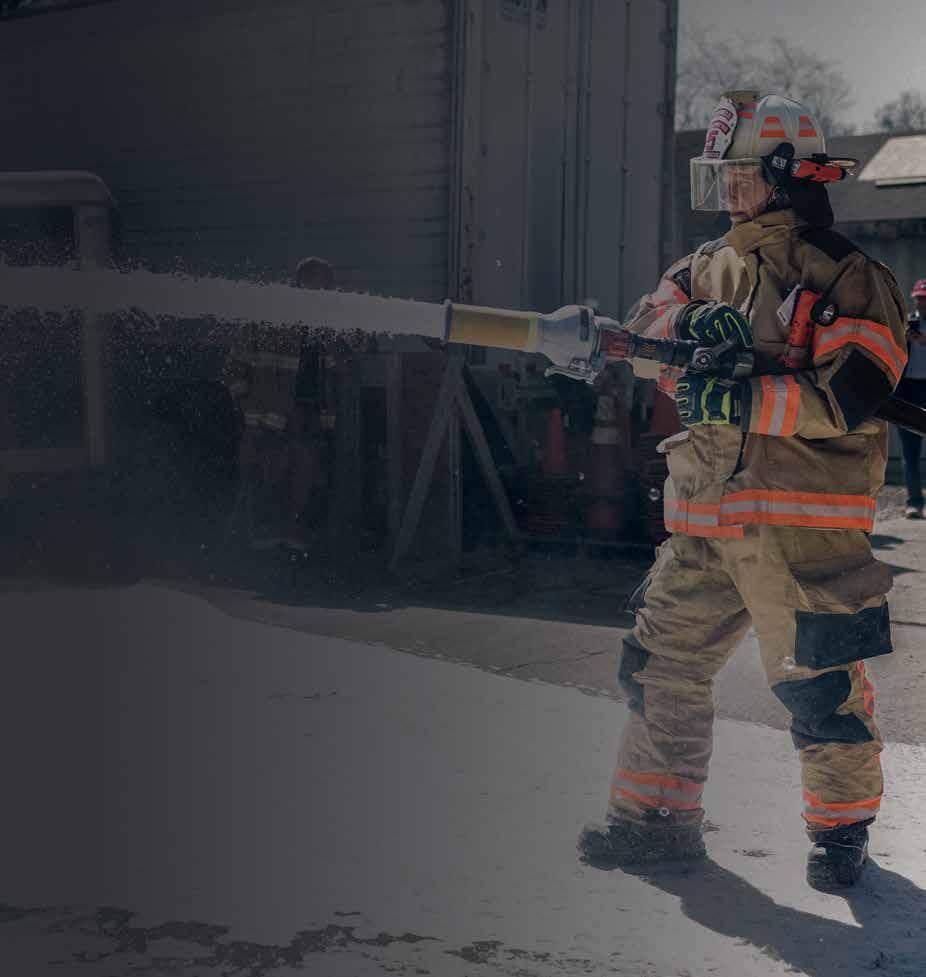
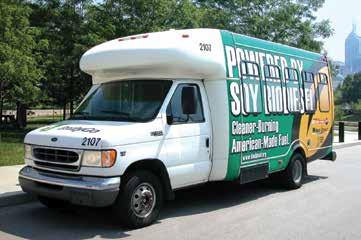
The more we discover about soybeans, the more valuable they become. One innovative product, SoyFoam™, creates a new, sustainable use for your crop that protects firefighters and the planet. See how your Soy Checkoff is unlocking new markets for soybeans at unitedsoybean.org
NOVEMBER-DECEMBER 2025 | VOL. 19, NO. 1
USDA Secretary Rollins visits Indiana farm to talk trade
Indiana agriculture took center stage on Oct. 30 as USDA Secretary Brooke Rollins visited Tyler Everett’s farm in Lebanon before her speech at the National FFA Convention.
16
Indiana farmers host Vietnamese chefs
at cooking contest
From the farm fields of Indiana, soybeans grown by Hoosier farmers took the spotlight of the largest food competition during this year’s World Food Championships.
22
From Indiana fields to dinner plates in Japan and Korea
When planning dinner tonight, tofu, natto, soy sauce and soy milk probably aren’t on the menu. But for many in Japan and Korea, these soy-based foods are daily staples.
30
Indianapolis Transportation Club joins B20 Club of Indiana
The B20 Club of Indiana welcomes the Indianapolis Transportation Club as its newest Affiliate Member bringing an influential voice to promote local, clean fleet solutions.
40 About the cover:
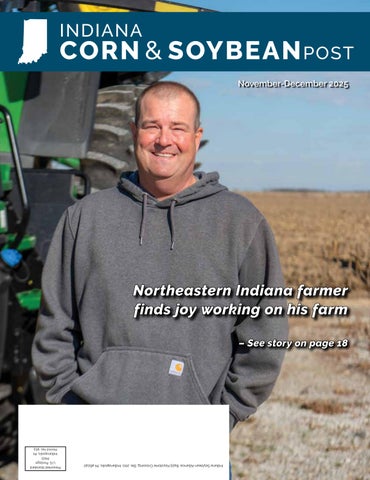
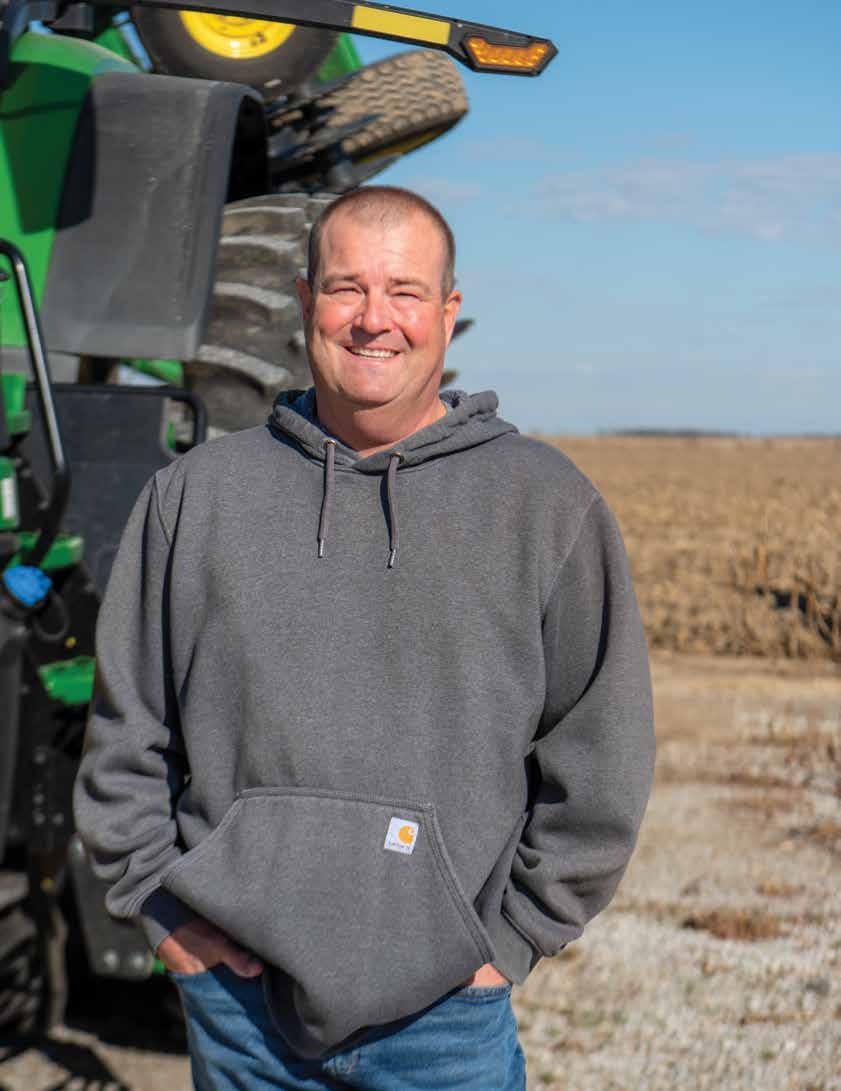
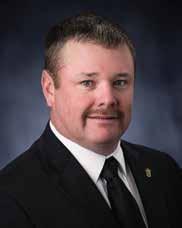
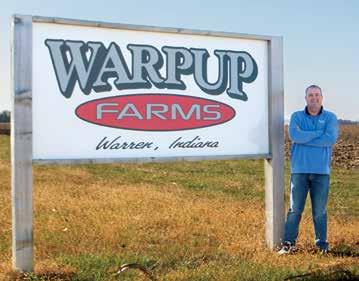
Brian Warpup, a farmer from Warren, Ind., enjoys his work more than most folks. In addition to growing soybeans and corn on his farm in rural Huntington County, Warpup is a board member for the Indiana Soybean Alliance, and he is the chair of ISA’s Membership and Policy Committee. For more, see story on page 18. (Amy Kelley photo)
Chair
ISA Membership & Policy Committee
Brian Warpup, Warren / D2
Dylan Christopher, Brookston / D1
Joe Stoller, Bremen / D1
Allen Buchanan, Fowler / D1
Kevin Kelley, Brookston / D1
John Peters, Monticello / D1
Denise Scarborough, LaCrosse / D1
C.J. Chalfant, Hartford City / D2
Carey McKibben, LaGrange / D2
Steve Phares, Albion / D2
Jenna Scott, Muncie / D2
Brian Warpup, Warren / D2
Mark Wenning, Cambridge City / D2
Vice Chair
David Hardin, Avon / D4
Directors
Philip Springstun, Boonville / D3
Mark Legan, Coatesville / D3
Derika Lynam-Spaetti, Richland / D3
Gary McDaniel, Boonville / D3
Jason Misiniec, Bicknell / D3
Larry Rusch, Vincennes / D3
Andrew McDaniel, Noblesville / D4
Kevin Burbrink, Seymour / D4
Chris Eck, Boggstown / D4
Mike Koehne, Greensburg / D4
Roger Wenning, Greensburg / D4
President
Secretary
Chris Cherry, New Palestine / D6 J.R. Roesner, Ferdinand / D8
Vice President
Treasurer
Alan Dunn, Michigantown / D4 Tyler Everett, Lebanon / D7
Tom Murphy, Chesterton / D1
Joe Tuholski, LaPorte / D2
Phil Zicht, Winchester / D3
Staff Credits
Editor / Dave Blower Jr. dblower@indianasoybean.com
Indiana Corn & Soybean Post® is published six times per year by the Indiana Soybean Alliance and the Indiana Corn Growers Association.
For address corrections contact: Indiana Corn & Soybean Post® 8425 Keystone Crossing, Suite 200 Indianapolis, IN 46240
Phone: 317-614-0376
Email: cornandsoybeanpost@ indianasoybean.com
Directors
Scott Smith, Windfall / D5
Tyler Pottschmidt, Crothersville / D9
For advertising information in the Indiana Corn & Soybean Post®, contact Dave Blower Jr. at 317-347-3620 or dblower@indianasoybean.com. Comments and statewide news articles should be sent to the above address. Advertising space reservations must be made by the first day of the month preceding publication. In consideration of the acceptance of the advertisement, the agency and the advertiser must, in respect of the contents of the advertisement, indemnify and save the publisher harmless against any expense arising from claims or actions against the publisher because of the publication of the content of the advertisement.
Protecting Indiana’s soybean checkoff program a key goal in 2026 Assembly
WBrian Warpup Chair ISA Membership and Policy Committee
hen I was 10 years old, I attended my first Chicago Cubs baseball game at Wrigley Field. Being in elementary school, nothing could seem to top this moment. I can still remember walking in, going through the concourse and taking in the view of the field from my seat near the third base line.
The next year I was able to go back and watch another game, but this time my seat was on the other side and up in the second deck. The sights were completely different than what I remembered. The players seemed further away, but I could see the entire field and the view of Wrigley was majestic.
I was at the same place, but the game seemed different simply from a change in … perspective.
As I look back on this year as chair of the Indiana Soybean Alliance’s Membership and Policy Committee (M&P), I have several new perspectives. Does legislation help or hinder farmers in Indiana?
My view of what happens in Indianapolis or Washington, D.C., always seemed too far away or out of my control. What I have learned is that if many of us have a common goal on protecting our interests and we can get in contact with the right people, positive outcomes can happen within the agricultural industry.
Simply paying attention to potential bills or laws and knowing the direction to go can help all of us move forward. In the next session of the Indiana General Assembly, which begins in January, M&P will work to provide a safety net for Indiana soybean growers.
As a board member of the Indiana Soybean Alliance (ISA), our state’s soybean checkoff program, I have seen firsthand what the checkoff does and how this meaningful approach works to attain our goals and
influences our agricultural landscape. The checkoff is a great way to pull resources together for the common good for Indiana farmers.
All soybean farmers pay into the checkoff. Half of those funds remain in Indiana and are controlled by the farmer leaders of the ISA board. The other half goes to the United Soybean Board (USB), the national soybean checkoff program. Farmer leaders from across America direct USB funds. A federal soybean checkoff law requires Indiana to collect these funds for ISA and USB. However, that law is subject to congressional action that could eliminate those funds and the work they do.
What would Indiana farmers do if this was taken away? How would Indiana farmers maintain the programs that help move our product around the world?
Most other soybean-growing states have adopted state laws that allow state soybean checkoff programs to continue collecting those funds without requiring them to share the funds with a national program. Indiana is the largest soybean-growing state without this type of law.
We, at M&P, want to see the state’s soybean checkoff program continue its efforts to find new export markets, to create new products, to research new growing techniques and to promote soybean uses to consumers around the world.
M&P will support creating this safety net for the state checkoff during the next General Assembly. This safety net will only go into action if the national checkoff program is ever eliminated. The bill does not ask Indiana farmers to pay more into the checkoff program.
Having this safety net for state checkoff efforts is crucial. This law would change our perspective in our efforts but keep a seat in the game.
To Become A Member
In past two years, ICGA has achieved many goals, but more work is ahead
TChris Cherry President Indiana Corn Growers Association
hanksgiving is right around the corner as I sit down to write this final column as President of the Indiana Corn Growers Association. It has been a privilege to lead this organization during the past two years. While we did not accomplish every goal we set, the association achieved several significant wins that will benefit Indiana’s corn farmers for years to come.
I want to thank my fellow board members for their commitment to serving Indiana’s agricultural community. We are fortunate to have an exceptional staff, and I am deeply appreciative of their hard work, professionalism and dedication.
Finally, I would like to thank our state and federal legislators for their continued efforts to work with our organizations on behalf of Indiana’s farmers. I look forward to continuing to support and collaborate with Indiana’s farmer leaders in the years ahead.
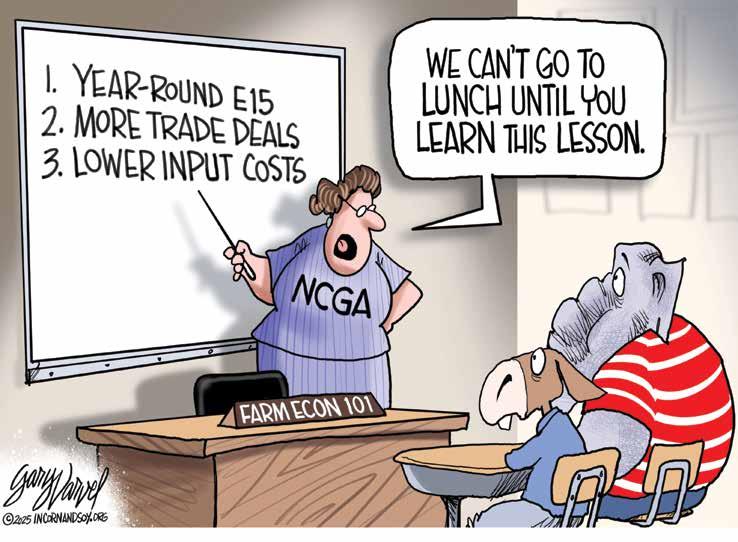
Our priorities continue no matter who is leading ICGA. One of our biggest campaigns is to get yearround sales of E15 approved in Congress. Removing any barriers to increasing access to higher gasoline blends of ethanol is the quickest way to use more corn and improve bushel prices. Besides that, higher ethanol blends are better for the environment and lower gas prices. ICGA will continue that push.
I am not leaving the board, but I am happy to hand the gavel over to new leadership in 2026.
The ICGA board advocates for Hoosier corn farmers at the local, state and federal levels. ICGA’s governing districts match the nine Congressional districts across
the state. This year, ICGA will fill seats in Districts 1, 4 and 7.
To be eligible, candidates must be an ICGA member in good standing; own, manage or operate a farm that produces corn; reside in the district they represent; and is current on ICGA membership dues. The following districts will have elections in 2026:
• District 1, which includes Lake, Porter and the northwest corner of LaPorte counties
• District 4, which includes Benton, Boone, Carroll, Clinton, Hendricks, Jasper, Montgomery, Morgan, Newton, Putnam, Tippecanoe, White, Warren and parts of Cass, Fountain and Howard counties
• District 7, which includes most of Marion County Election applications are due to the ICGA office by Jan 30, 2026. Ballots will be mailed to members in May and must be returned by June 30. Winners will start serving on the board in December 2026. Go to www. incornandsoy.org/ICGAelections for more details, to find a district map or download an application. Submit all completed materials to Amber Myers, amyers@ incorn.org.
Participation is crucial at every level of the political process. From county zoning boards to the state legislature to the USDA and EPA, we need to keep our eyes and ears open for rules and regulations that may impact how we farm.
If farmers do not participate in the process that creates new policies and rules for Indiana agriculture, then people who don’t understand farming will write those laws. I encourage anyone with a passion for these issues to join us on the ICGA board.
MADE IN INDIANA BIOFUELS & BIOPRODUCTS
At POET, we’re rooted in rural America. For almost 40 years, we’ve been turning locally grown corn into homegrown bioproducts that fuel our economy and support the family farms that make our communities strong. By adding value to every bushel, we help ensure that rural families can continue to do what they love for generations to come.
POET purchases corn from local farmers to produce biofuels and bioproducts. There are five POET Bioprocessing facilities across Indiana: Alexandria, North Manchester, Portland, Shelbyville, and Cloverdale. | poet.com/grain
Giving thanks for NCGA’s grassroots advocates during the holiday season
BY LESLY McNITT, NCGA Vice President of Public Policy
As we often do in November, I am reflecting a lot this month about all the things that make me thankful, and I’d have to say NCGA’s grower leaders and our grassroots advocates are at the top of my gratitude list. If not for them, we would not be able to score big policy wins for our growers.
To give readers a little flavor of the inner workings of our grassroots efforts, I decided to sit down with Sadie Knight, the director of the National Corn Growers Association’s grassroots and political strategy. Since Sadie has served in her current role, she has taken our advocacy efforts to new heights. Here’s what she wants you to know about her work…
Q: Sadie, first tell us about your experience and what led you to the corn world.
A: I’m a farm kid who was never really a farm kid. Growing up, I got my hands dirty every chance I could, rose through the ranks in the National FFA Organization and judged livestock through my college career – but I never made it to the farm. Turns out, I was never meant to sit in the cab of a tractor.
God gave me the gift of gab, and like many, that gift led me to D.C. I took a tour as a public servant both at the USDA and on Capitol Hill, but I wanted to work closer with farmers and be connected to the countryside. I believe in rural America and the folks who call it home, and when the chance to join NCGA opened, I jumped on it.
Corn has a powerful presence in D.C., and even though I am from the South, I know corn is king and is a commodity that connects all the industry. Corn is America’s Crop, and I’m dang proud to
work with the folks who grow it.
Q: I have always admired how NCGA cultivates well-rounded leaders. Tell us about NCGA’s leadership programs and why our leaders are important to corn grower advocacy.
A: NCGA is committed to keeping the leader and advocate pipeline strong, and we accomplish this mission through dynamic leadership and advocacy trainings. Let’s take a deeper look at NCGA’s Leadership Academy as an example. This program is designed for growers who are already leaders in their states but want to take their service to the next level.
The first session is focused on excellence in leadership and the second is centered around advocacy. In January, we will bring the current class to Washington, D.C., to dive into policy issues, pick up tricks of the trade and meet with elected officials. Our goal is to instill confidence in these leaders and equip them with the knowledge and tools to most effectively take action.
Advocacy training is woven into each of our leadership programs, because it is central to how NCGA impacts change. Leaders must be willing to share their stories and make a case for their cause. If you want to know more about our leadership and advocacy trainings, visit www.ncga.com/leadership-programs
Q: NCGA’s grassroots engagement has been on an upward trajectory. Can you tell us more about why that matters?
A: Our membership is composed of thousands of corn growers with thousands of stories, filled with lessons and wisdom that policymakers in D.C. need to hear. Our team is dedicated to bringing the stories, concerns and challenges of America’s corn growers to the center of policymaking and politics.
For more on NCGA
Sadie Knight
But we can’t talk about what we don’t know about. That’s why grassroots advocacy is so important: While our grassroots network is educating and influencing lawmakers, it is also arming the NCGA team with facts and stories to carry our collective message further.
Every time an advocate acts on an online campaign, posts on social media or meets with elected officials, he or she is adding to our advocacy numbers and numbers talk in D.C. Good policy is built on strong coalitions, and nothing beats a coalition of constituents.
Q: Can you give us an example of a campaign that has had impressive outcomes?
A: The effort to unlock year-round, unrestricted sales of E15 has been a long-fought battle, and every opportunity to push the needle forward on this issue is an important one. Earlier this year, NCGA’s advocacy team sensed an inflection point and activated our grassroots network to sign a letter to congressional leadership directing them to address this issue.
Nearly 9,000 advocates signed this letter, which grabbed the attention of congressional champions like Rep. Adrian Smith. The congressman, joined by a bipartisan group of
policymakers, seized the opportunity and hosted a press conference outside of the Capitol to bring attention to this ongoing issue. From there the Nationwide Consumer and Fuel Retailer Choice Act has continued to pick up steam and Congressional co-sponsors.
Final passage is our top priority, and we thank all of the farmers who continue to weigh in on this issue.
Q: What issues are on the horizon for you?
A: The administration will begin its reconsideration of the United States-Mexico-Canada Agreement next year. Its renewal will be critical to allowing farmers to continue to access top export markets, and we will be calling on the administration to protect agricultural trade during this process.
Expect to see a dynamic grassroots push on trade and the USMCA next year; We will need everyone engaged on this issue.
If you are inspired by these advocacy efforts and want to take part, sign up for our advocacy alerts at ncga.com/ action-center/take-action
We need your voice to be a part of the chorus that makes a difference in Washington for America’s corn growers.
Navigating trade uncertainty, shifting federal policy, rising production costs
BY BLAIR SHIPP, American Soybean Association
Indiana soybean producers are navigating a challenging mix of global trade uncertainty, shifting federal policy, and steep production costs. ASA and Indiana grower leaders are working across these fronts to protect market access, strengthen domestic demand, and ensure producers have the support needed to support stable operations.
From major developments in U.S.–China trade to ongoing work in the biofuels sector, this fall’s policy landscape will have direct implications across the state.
On Oct. 30, President Donald Trump met with Chinese President Xi Jinping in South Korea and announced a new set of soybean purchase commitments intended to restore stability between the two countries. China agreed to minimum purchases of 12 million metric tons of U.S. soybeans for the rest of 2025 and 25 million metric tons annually through 2028.
While details are still being finalized, ASA is tracking implementation closely to ensure these commitments translate into actual shipments and a meaningful boost for U.S. soybean demand.
For Indiana, the announcement signals a potential return to more predictable export channels. China is the world’s largest soybean buyer and, in stable years, imports 25 to 30 million metric tons of U.S. soybeans. A move back toward those historical volumes would support stronger prices and bring more consistency to the global markets that influence the state’s agricultural economy.
Significant challenges remain, however. A 10 percent baseline tariff continues to make U.S. soybeans less price competitive than Brazilian supplies, even with retaliatory tariffs suspended. ASA is working with federal officials to push for improved market access, tariff reductions and expanded opportunities for U.S. agriculture.
ASA also supports trade frameworks with Japan, Vietnam, Thailand, Cambodia and Malaysia. These negotiations aim to reduce tariffs, improve transparency and create consistent openings for U.S. soybean exports — opportunities that help stabilize local markets and basis levels throughout the Midwest.
Even with progress on trade, producers across Indiana continue to face economic pressures from high input costs, market volatility and recent disruptions in export demand. ASA is pressing for targeted assistance that helps growers bridge these challenges, including programs to offset trade-related losses, disaster aid for weather impacts, and policies that lower the cost of production. These efforts are intended to support farm operations until longer-term market stability and trade certainty are restored.
Biofuels and domestic demand
Biofuels remain a key demand driver for soybean oil, with about half of all processed oil used in biomassbased diesel. This market is especially important in states like Indiana, where soybean processing and biofuels production play a significant regional economic role.
ASA and the National Oilseed Processors Association recently sent a joint letter to President Trump urging action on several federal biofuel policies. Their priorities include finalizing EPA’s proposed Renewable Fuel Standard volumes for 2026 and 2027, limiting RIN credit generation from foreign feedstocks, discouraging imports of used cooking oil and beef tallow that displace domestic soybean oil, reallocating waived volumes associated with small refinery exemptions, and issuing timely Treasury guidance for the 45Z Clean Fuel Production Credit to ensure domestic agricultural feedstocks remain central to program eligibility.
ASA CEO Stephen Censky emphasized that these actions will directly affect grower profitability and crush
Learn more about ASA
investments. Clear, consistent policy could increase domestic biofuel production, strengthen demand for soybean oil, and encourage continued construction and expansion of processing capacity — developments that benefit the state’s rural communities and soy value chain.
EPA recently addressed a backlog of small refinery exemption petitions for compliance years 2021-24, granting a mix of full and partial exemptions and returning related RINs for potential reallocation.
ASA continues to advocate for full reallocation of these RINs for 2023-24 to maintain the integrity of the RFS and support robust domestic demand. Combined with final RVOs for 2026-27 and updated 45Z guidance, these actions will help provide greater certainty to the biofuels market.
Input costs and farm operations
Rising input costs remain a major concern for soybean production across Indiana. ASA President Caleb Ragland recently testified before Congress about the financial pressures growers face nationwide. Expenses for seed, fertilizer, pesticides, fuel and capital have risen significantly over the past five years.
Fertilizer costs, in particular, have climbed faster than general inflation, and phosphate and potash — key nutrients for soybean production — have now been designated as critical minerals by the U.S. Geological Survey.
This designation underscores the need for a more reliable and affordable domestic supply. ASA is urging policymakers to reduce tariffs on imported inputs, improve competition in concentrated input markets, and provide targeted federal support during periods of extreme price volatility.
The organization continues working with USDA, the Department of Justice and Congress to ensure producers can access necessary inputs at fair prices.
Government funding and farm assistance
Following a partial federal government shutdown, funding was restored on Nov. 12 when the House passed a spending measure and President Trump signed it into law.
The legislation funds USDA, extends key farm bill provisions, maintains the U.S. Grain Standards Act, and keeps federal operations running through the end of January.
“The restoration of funding ensures farmers regain access to essential government services,” Ragland said in a recent ASA release. “Now that the government is open, growers need support for farmer assistance programs, finalization of biofuel regulations, and policies that help expand trade opportunities for U.S. soy.”
From property taxes at the Statehouse to the Farm Bill on Capitol Hill, the Indiana Ag Policy Podcast will share the latest from the biggest names in ag policy. Scan below to listen now!
Shreve: Restoring access to China will help stabilize prices, incomes
BY U.S. REP. JEFFERSON SHREVE, (R-District 6)
I recently joined USDA Secretary Brooke Rollins at the Everett family farm in Boone County. That visit was a reminder that the backbone of Indiana’s economy still runs through our fields and farm families.
Having studied agribusiness at Purdue, I know just how much risk and resilience it takes to keep an operation running. Indiana’s farmers feed and fuel not just our state but the world. From soybeans and corn to livestock and ethanol, agriculture remains the foundation of our economy and our rural communities.
That’s why the recent trade breakthrough with China — reopening large-scale purchases of U.S. soybeans, including those grown here in Indiana — is welcome news. Our farmers have endured years of uncertainty caused by disrupted export markets they didn’t create. Restoring access to China will help stabilize prices and strengthen income across the Midwest.
But we can’t build our future on dependence alone. Nearly a third of America’s soybean exports go to China. When that market slows, Indiana farmers feel it immediately. We need to diversify — expanding trade with partners in Southeast Asia, Latin America and Europe, while growing more value-added processing here at home.
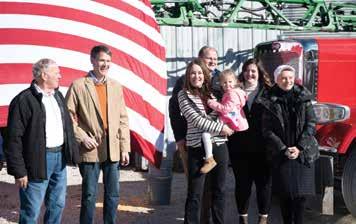
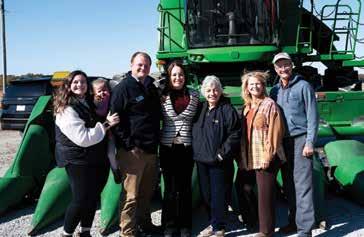
U.S. Rep. Jefferson Shreve, second from left, stands next to U.S. Rep. Jim Baird (R-Dist. 4) during USDA Secretary Brooke Rollins’ visit to the Everett Farm near Lebanon, Ind., recently. Tyler Everett is a director on the Indiana Corn Growers Association board. Rollins, at center, is holding Everett’s daughter, Charlee. Everett is standing behind Rollins and next to his wife, Brittney. At right is U.S. Rep. Victoria Spartz (R-Dist. 5).
A broader customer base means more stability for the family farms that keep our communities alive.
During Secretary Rollins’ visit, we talked about how innovation and conservation can go hand in hand. Hoosier farmers are already leading the way with precision technology, cover crops and smarter resource management. Federal policy should follow their lead — empowering, not constraining, the people who actually work the land.
In Congress, I approach these issues the same way I ran my business: with a focus on efficiency, accountability and long-term results. That means passing a bipartisan farm bill that strengthens crop insurance, invests in rural broadband, expands market access, and safeguards American farmland from foreign adversaries.
Farming isn’t just an industry here. It’s a way of life — one built on faith, hard work and common sense. Every time I visit a farm like the Everetts, I’m reminded who I work for: the men and women who rise before dawn to keep America fed and moving forward.
They don’t need Washington to tell them how to farm. They need Washington to listen — and to deliver policies that make sense.
That’s Hoosier pragmatism at work.
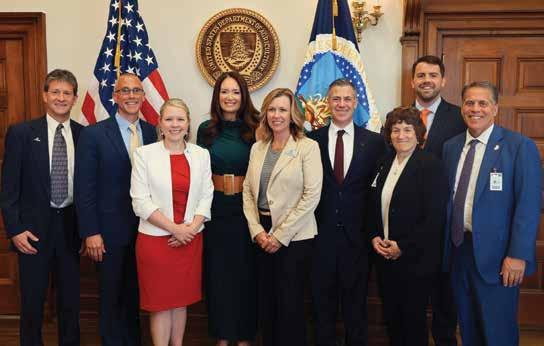
American Soybean Association board members Phil Ramsey, a farmer from Shelbyville, Ind., at right, and Mike Koehne, a farmer from Greensburg, Ind., at left, visit U.S. Rep. Jefferson Shreve’s office in Washington, D.C., to discuss ag policy.
Banks: Serving Indiana means robust commitment to agricultural economy
BY U.S. SEN. JIM BANKS, (R-Indiana)
Washington works best when it is close to the people it serves. Serving the people of Indiana means that we must pledge a strong commitment to agriculture and the economic growth it drives across our state.
Earlier this year, I led a group of Indiana stakeholders to meet with Secretary of Agriculture Brooke Rollins to make the case for locating a new USDA regional hub in our state. We presented a clear argument: Indiana has the resources, expertise and infrastructure to support a more efficient and responsive U.S. Department of Agriculture.
A month later, Secretary Rollins announced that the USDA will move a significant portion of its operations out of Washington and establish five regional hubs across the country, including one in Indianapolis.
This move represents a major step forward for Indiana. It will bring new investment and job opportunities while ensuring that federal decisions affecting agriculture and rural development are made closer to the people and communities they impact. It also reflects a more efficient use of taxpayer dollars by reducing unnecessary layers of bureaucracy and aligning the department’s structure with its core mission.
While some USDA staff will remain in Washington, many will now work directly in the regions where their programs take effect. That proximity will
lead to better communication, quicker responses, and a stronger partnership between federal agencies and the states they serve.
Indiana is a natural home for enhanced collaboration and partnership with the U.S. Department of Agriculture. Agriculture bioscience is a $72 billion industry in Indiana. We are home to more than 54,000 farms and the overwhelmingly majority of them — some 94 percent — are farmer owned.
Purdue University ranks in the top 10 best colleges for agricultural sciences in America. And Indianapolis is one of the only metropolitan cities in the nation that is home to industry leaders in plant science, animal health, and medicine.
Indiana earned this opportunity through years of steady leadership and a proven track record of producing results. I am proud of the role my office played in securing this new USDA hub for Hoosiers and confident that it will strengthen our position as a national leader in agricultural innovation and economic growth.
U.S. Sen. Jim Banks (R-Ind.) met with a delegation of agricultural industry stakeholders at his office in Washington, D.C. earlier this year. Banks worked to bring a USDA hub to Indianapolis.
Take action to help Hoosier farmers
Become a lifetime member of Indiana’s corn and soybean policy groups
The Indiana Corn Growers Association (ICGA) and the Indiana Soybean Alliance’s Membership & Policy Committee (M&P) represent our state’s farmers in the legislative halls in Indianapolis and Washington, D.C. These organizations need your membership to influence federal and state lawmakers.
Indiana soybean and corn growers can now save money and eliminate the hassle of annual renewals by purchasing a LIFETIME MEMBERSHIP to both ICGA and M&P. For only $1,700, you can be a member of both ICGA and M&P for life!
Anyone interested in buying this membership, should contact Industry Affairs Outreach Manager Khyla Goodman by phone at 317-614-0377 or by email at kgoodman@indianasoybean.com. Or, you can go to our website, incornandsoy.org/membership, to join!
Lifetime Members
Phil Ramsey
Courtney Kingery
Matthew Lucas
Tyler Everett
David Gottbrath
Mike Sprinkle
Jeff Troike
Jim Douglas
Michael Steinbarger
Sam Caldwell
Mark Nigh
Alan Dunn
Mason Gick
Aaron Johnson
Nathan Luallen
Sam Mehringer
David Wenning
Mark Wenning
Creed Gunn
Andrew Fansler
Kent Burton
Russell Anderson
Troy Hattery
Mark Bacon
Ronald Sutherlin
Jordan Caldwell
Mike Shuter
John Baugh
Janice Peterson
Cullen Page
Don Wyss
John Peters
Bruce Herr
Lauren Tolle
Luke Roush
James Wood
Allen Buchanan
Matt Hart
Ron Hudson
Mark Tolle
Carl Kissel
Chris Eck
James Wenning
JR Roesner
William Roesner
Sarah Delbecq
Jim Geller Jr.
C.J. Chalfant
William Gerard
Carey McKibben
Neal Smith
Matthew Chapman
Jim Flanders
Chris Cherry
Luke Mullet
Tom Murphy
Matt Hayden
Kevin Kelley
Douglas Matthys
Randall Matthys
Brian Warpup
Tom Weaver
Larry Rusch
Chad Chism
Troy Furrer
Brent Bible
Jeremy Mullins
Joe Stoller
Chris Cherry, New Palestine, Ind.
“I am a lifetime member of the Indiana Corn Growers Association and the Indiana Soybean Alliance because it is important for us to advocate on behalf of Indiana farmers. We can’t expect other people to step up for us. It is our time to be that voice for Indiana agriculture. As a member, one of the issues near and dear to my heart is biofuels. It’s critical to support soy-based biodiesel and corn-based ethanol, and we continue to work to get year-round access to E15. It’s a nobrainer to make higher blends of ethanol more readily available.”
Get to know new NCGA President Jed Bower
Ohio farmer Jed Bower began his term as board president for the National Corn Growers Association in October. Like all presidents, Bower will serve a one-year term as NCGA’s leader. This story is intended to introduce Bower to U.S. farmers.
Jed, tell us about yourself and your farm.
I am a fifth-generation corn and soybean farmer from Washington Court House, Ohio, where I farm with my wife, Emily, and children Ethan and Emma. I am an Army veteran, who was deployed to the Balkans in the 1990s. I retired from the military and came back to run the family farm in 2005 after my father’s untimely death.
Tell us about your experience in leadership.
Well, I have decades of leadership experience going back to my time in the Army. But in the interest of time, I’ll talk briefly about my work in agricultural advocacy. I served the last year as the vice president of NCGA’s board while contributing as a member to several key NCGA committees, including the finance committee. I have also served as a board member for the Ohio Corn Marketing Program, and I am a former president of the Ohio Corn & Wheat Growers Association.
Q A Q A Q A Q A Q A
will be important to forward progress, and if we are successful, farmers will feel the benefits. We also must figure out why input costs are climbing. To that end, NCGA has initiated an input task force to investigate this matter and identify solutions to bring costs more in line with today’s commodity prices.
What are your thoughts on the turmoil in Washington?
It will be difficult but certainly not impossible to get our legislative priorities across the finish line. And there is ample opportunity to continue to build our coalition. Take ethanol, for example. It’s a biofuel that has something for everyone. Want to lower fuel prices? Expand access to ethanol. Want to bring down greenhouse gas emissions? Turn to ethanol. Want energy security? Ethanol. You get the picture. We will continue to make this case. I also think that farmers have a way of garnering support from a lot of different policymakers, which will certainly work to our advantage. It’s also important to remember that we have some major legislative champions in Congress.
What are your policy priorities over the next year?
Farmers are facing hard economic times. Corn prices are at a five-year low while input costs are climbing. I would say in many ways this is an existential moment for farmers who could soon lose their family farms. We need new markets to help alleviate this economic crisis. That’s why NCGA will continue to press Congress to act immediately to pass legislation that expands consumer access to higher blends of ethanol year-round and urge the Trump Administration to move quickly to develop new foreign markets. Will these actions completely solve our problems? No, but they
How can readers help with our advocacy work?
NCGA’s grassroots membership is its greatest advocacy asset, and we seek to create different types of opportunities to engage. Your readers are important and could help us win our advocacy fights. I would encourage growers to make sure that they join their state corn groups. I would also encourage them to sign up for NCGA’s advocacy alerts, which will allow them to weigh in with policymakers on issues of importance to corn growers.
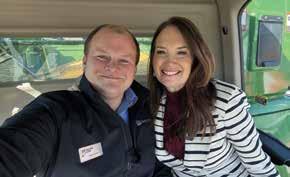
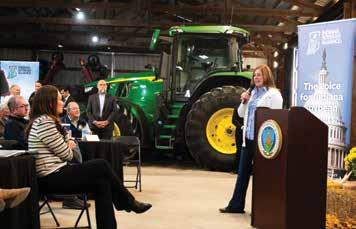
ICGA Board Treasurer Tyler Everett hosted USDA Secretary Brooke Rollins on his farm near Lebanon, Ind., on Oct. 30.
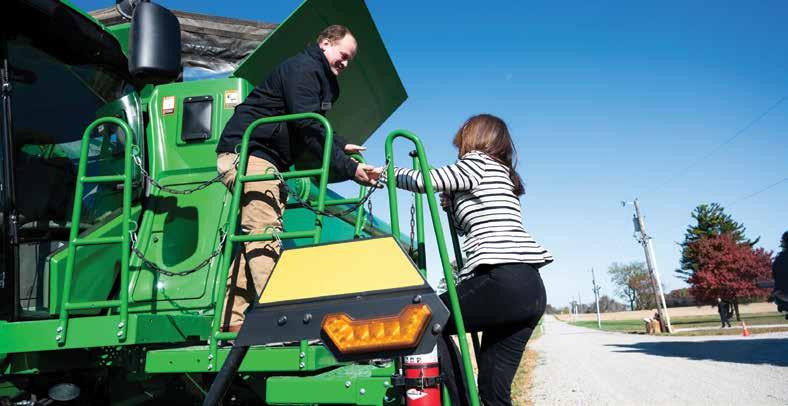
After taking a selfie, Everett allowed Rollins to harvest a few rows of a cornfield in his combine. (Amber Myers photo)
USDA Secretary Rollins visits Indiana farm to discuss trade wins and listen to growers
BY HANNAH VORSILAK
Indiana agriculture took center stage on Oct. 30 as USDA
Secretary Brooke Rollins visited Everett Farms and Seed LLC in Lebanon ahead of her keynote address to the 98th National FFA Convention & Expo in Indianapolis.
The visit, hosted by U.S. Rep. Jim Baird (R-Dist. 4), State Rep. Beau Baird (R-Greencastle), the Indiana Soybean Alliance (ISA) and the Indiana Corn Growers Association (ICGA), highlighted how trade and biofuels policy shape the success of Indiana’s farm economy.
Tyler Everett, ICGA Board treasurer and owner of Everett Farms and Seed, along with his family, welcomed Rollins to his multigenerational family farm and shared the importance of market consistency for corn growers.
“With over 43 percent of Indiana’s corn going into ethanol, what happens in the biofuels space directly impacts not only my farm and my neighbor’s farm, but our entire state’s economy,” Everett said. “We encourage USDA to continue working with EPA to finalize nationwide, year-
round E15 sales and ensure the program has the regulatory clarity it needs.”
During the visit, Rollins toured the farm, harvested a few rows of a cornfield in Everett’s combine, and participated in a roundtable discussion with Indiana farmers and agricultural leaders. The conversation focused on the role of trade in keeping rural economies strong and the impact of new international agreements.
Recent trade news
Rollins shared breaking news of a recent trade development with China that includes significant soybean purchase commitments.
“Until this week, China had purchased zero, which was devastating to our soybean farmers, especially when we rely on them for 62 percent of our market,” Rollins said.
“The agreement includes 12 million metric tons of soybean purchases over the next two months and at least 25 million
tons annually in the coming years, plus commitments on sorghum, hardwood and the removal of retaliatory tariffs on U.S. ag products.”
Rollins said China’s first purchase of U.S. soybeans in the current marketing year is the first of many wins for U.S. farmers. “Just in this week alone, we’ve had deals with Malaysia, Cambodia, and Thailand,” she reported. “The deals keep coming. This is part of the President’s vision of realigning the entire world economy around American products. No one wins more than American agriculture.”
Denise Scarborough, chair of ISA and a farmer from LaCrosse, emphasized how global trade directly impacts local farm profitability.
“We’re like a well-oiled machine as long as global markets are open and stable,” Scarborough said. “But uncertainty, whether from tariffs, politics or shifting regulations, hits our farms fast. We want free trade, not aid. Open markets are what keep our rural economies thriving.”
Scarborough, who also represents Indiana on the American Soybean Association Board and works as an agricultural lender, added that farmers are facing tight margins and increased volatility.
“Whether it’s a good plan or a bad plan, we just need a plan so we can move forward with confidence,” she said.
USDA hub for Indianapolis
Rollins is pleased that Indianapolis will be the home of one of five new USDA regional hubs. The other four hubs will be in Kansas City, Mo.; Raleigh, N.C.; Salt Lake City, Utah and Fort Collins, Colo.
“We serve our farmers and the ag community,” she said. “We’re very excited for the U.S. Department of Agriculture to really lean in on this reorganization as we continue to build out all of the great things we’re working on.”
Rollins commended Indiana ag officials for being proactive in recruiting a USDA hub to the state. Shortly after the announcement in June that USDA would be moving many employees and services out of Washington,
D.C., a group of Hoosier ag leaders visited Rollins’ office to campaign for an office in Indianapolis. Indiana State Agriculture Department (ISDA) Director Don Lamb was among those ag leaders.
“I want to give a big ‘shout-out’ to Don Lamb, who was part of a contingency that came to talk to me a couple of months ago about this, and made an extremely compelling case about how important Indianapolis is, and a Mecca of research and industry and talent and intellect and farming that is here in this part of the country,” Rollins said. “So, it became a pretty easy decision for us, and we’re excited to get USDA to Indianapolis.”
She added that Indianapolis offered several nearby benefits to USDA including Purdue University, many major farm companies and a central location for many corn and soybean farmers.
Many lawmakers attend
In addition to Rollins, the event drew participation from Indiana’s farm, state and federal leadership including ISDA Director Lamb.
Other attendees included U.S. Rep. Baird and members of Indiana’s congressional delegation such as U.S. Rep. Rudy Yakym (R-Dist. 2), U.S. Sen. Jim Banks (R-Ind.); U.S. Rep. Victoria Spartz (R-Dist. 5), U.S. Rep. Mark Messmer (R-Dist. 8) and U.S. Rep. Jefferson Shreve (R-Dist. 6). Other notable attendees were Dr. Scott Hutchins, USDA undersecretary for research, education and economics and retired District 8 U.S. Rep. Larry Bucshon.
Rollins’ visit also attracted representatives from the Indiana General Assembly and major farm organizations including ISA, ICGA, the Indiana Corn Marketing Council, Indiana Farm Bureau, Indiana Pork, Indiana Poultry Association and Beck’s Hybrids.
The visit showcased Indiana’s leadership in agriculture and reinforced the importance of continued federal engagement on trade and energy policy to sustain farm profitability.
USDA Secretary Brooke Rollins recently visited Everett Farms and Seed LLC in Boone County. (Amber Myers photo)
Indiana Soybean Alliance Chair Denise Scarborough spoke about trade and the need for certainty during a roundtable discussion with Indiana farmers and agricultural leaders.
Northeastern Indiana farmer works to give back to the life that he loves
BY DAVE BLOWER JR.
Brian Warpup, a farmer from Warren, Ind., loves Mondays.
He is the fourth generation to work his family’s farm in rural Huntington County. Warpup and his wife, Nicole, have raised a son and two daughters on the farm. He is a board member of the Indiana Soybean Alliance (ISA), the state’s soybean checkoff program, and for the past year he has served as the chair of ISA’s Membership and Policy Committee. But as much as anything, Warpup enjoys working his fields and the process of producing a crop.
Sometimes, that can irritate his family.
“This was a few years ago as we were returning from a family vacation in Florida. We landed at the airport in Indianapolis, and we were starting to drive home,” said Warpup, setting the scene. “My wife is a schoolteacher,
and she had to go back to work on Monday, and the kids had to go back to school. They were just dreading it. But I’m sitting there kind of smiling, and my wife says, ‘You’re the only person I know excited to get back to work on Monday morning.’ What can I say? Monday mornings are my joy! I know that kind of sounds strange, but when you love what you’re doing, it’s not work.”
In full disclosure, Warpup hasn’t always felt that way. When he left for college at Ball State University in the early 1990s, the plan didn’t include farm work. Now, he admits he was a little immature at that time.
“I grew up just like any farm kid. I worked for my dad and my grandpa and all my relatives,” Warpup explained. “We all did the weekend work and the evening work, and I did not want that as my life. I went to college, graduated, got a job in Indianapolis
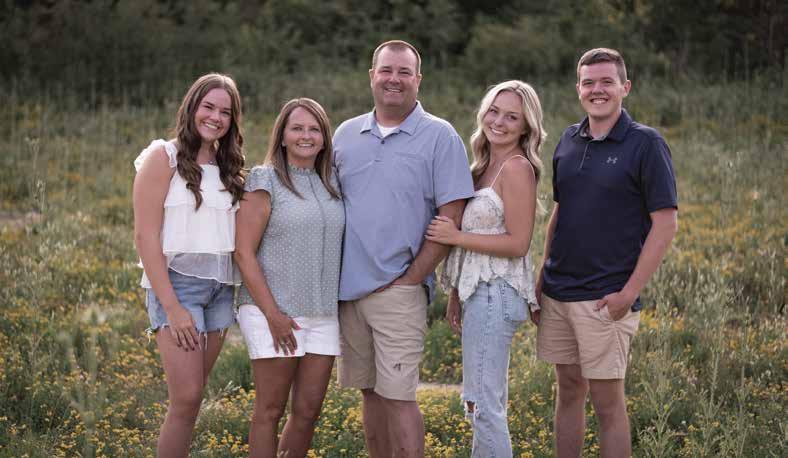
Warren, Ind., farmer Brian Warpup, at center, poses with his family. From left are his youngest daughter Maleah, his wife Nicole, his older daughter Hannah and his son Ben.
with a publishing company and soon realized that the publishing world wasn’t all that it was cracked up to be. So, within five years, there were a couple opportunities from retiring neighbors that would allow me to come back to the farm. It would allow the farm to get a little bit bigger and sustain a couple more people, family, on the farm. That’s when I came back, and it was the best decision I’ve ever made.”
Although the decision to return may have surprised Warpup, his father and grandfather were not.
“They weren’t surprised, at all,” he said. “I think the reason why I didn’t want it wasn’t that I didn’t love the farm. I loved the farm. When I went to college, I never realized how mature my dad was, and that I could work for him. After being an adult for a while, I could see my dad, not as a boss, but as a partner. We were able to get along that way instead of me being a subordinate.”
Giving back to agriculture
In recent years, the farm has endured many changes. Both Warpup’s father, Jim, and his grandfather, Harmon, passed away. Warpup now operates the farm with a cousin, Darren Goeglein. Through it all, Warpup has not lost his passion for agriculture.
“I’m a fourth-generation farmer,” he said. “I was fortunate to be able to work alongside my grandpa for 46 years. Looking back, that was a joy. We farmed 750 acres. Once I came back, it was kind of go time. I think me coming back at such a younger age put a lot of energy back in the farm to continue growing.”
A desire to give back to his community and a curiosity about the state’s soybean checkoff program eventually led Warpup to seek a position on the Indiana Soybean Alliance Board of Directors.
“Since college, I’ve believed in contributing to something,” he said. “I’ve worked on a couple local boards here in my county. I’ve been on the school board. I’m on county council, currently. At the time, I knew I was going to come off the school board, so I needed something else.
“And my kids were older, and so I could get out a little broader geographically to Indianapolis and beyond. So, I’ve never understood what the checkoff was. I’ve always had questions. I always said, if you want to find out – just jump in. That’s exactly what I did.”
What did he find out?
“I have learned that it takes a lot of people and energy to globally sell or trade our products,” Warpup said. “It’s not as simple as picking up a phone and saying, ‘Hey, I’ve got something to sell. Can you buy it?’ It takes partners and organization. From (the USA Poultry and Egg Export Council) USAPEEC to (the U.S. Soybean Export Council) USSEC, it takes relationship building and coordination to export soybeans or to find new ways to sell our product. That’s probably the biggest thing I’ve learned.”
Chair of ISA’s Membership and Policy Committee, Brian Warpup has advocated for pro-farm policies at the federal and state level. Here, Warpup, at left, poses with Indiana Gov. Mike Braun, Indiana Corn Growers Association President Chris Cherry and Courtney Kingery, CEO of ISA, ICMC and ICGA.
Brian Warpup, an ISA board director, is the fourth generation to work his family’s farm in Huntington County, Ind. Warpup said he was blessed to work with his father and grandfather for many years. (Amy Kelley photo)
A desire to give back to his community and a curiosity about the state’s soybean checkoff program eventually led Brian Warpup to seek a position on the Indiana Soybean Alliance Board of Directors. (Amy Kelley photo)
The checkoff does more than market development work. ISA also encourages farmers to adopt more sustainable farming practices; it develops new soybased products and educates consumers and farmers about new research. Among his other board duties, Warpup serves on ISA’s Sustainability and Value Creation Committee. He admits there were other committees that he would have preferred in the beginning.
“I’ve been on it for four years now; and next year, I want to be on sustainability again,” Warpup said. “I’ve learned so much personally. Being on a board, I think there’s a little bit of selfishness, too, because I learn just as much as I give. We are adopting new sustainability practices on our farm. I want the next generation to have all the opportunities that I have, that my dad
Brian Warpup now operates the farm with a cousin, Darren Goeglein. Through it all, he has not lost his passion for agriculture. (Amy Kelley photo)
gave me, that his dad gave him. If we abuse what we have, then the future generations will not have what I have. We all drink from a well that we didn’t dig. I have incorporated sustainability practices on my farm that I never thought I would do.”
Ag policy advocacy
Perhaps Warpup’s biggest role on the ISA board in 2025 has been as Chair of the Membership and Policy Committee. This group works with federal and state lawmakers to advocate for government policies and regulations that benefit Indiana farmers. This year has been full of political drama for farmers.
“In 2025, trade has been the big focal point,” Warpup said. “I know we’ve talked about it to death, but on the soybean side, half of our soybeans are shipped outside
“Many government agencies cast all of us farmers into one big category. They may see me as a row-crop farmer,” Warpup said. “What they don’t realize is that somebody who farms 500 acres is completely different from somebody who farms 5,000 acres.”
of the United States in some fashion. When politicians in Washington or Indianapolis make decisions on our behalf, it’s important that we have spokespeople from the agricultural sector to represent what we’re doing out here.”
“Trade is our No. 1 concern, but we also keep an eye on regulations. We have government agencies, like USDA or EPA, that regulate farmers. When policymakers try to add more regulations or stricter rules that will inhibit how we do things, that will impact our farms financially. I think it’s important to, again, to have some say in these discussions from people who are in the day-to-day business of farming.”
Warpup firmly believes that farmers should have a say in the programs they work with and the regulations they follow. He added that legislators far removed from agriculture should not write generic rules that apply to all farms in all states.
Brian Warpup firmly believes that farmers should have a say in the programs they work with and the regulations they follow. He added that legislators far removed from agriculture should not write generic rules that apply to all farms in all states. (Amy Kelley photo)
“Many government agencies cast all of us farmers into one big category. They may see me as a rowcrop farmer,” Warpup said. “What they don’t realize is that somebody who farms 500 acres is completely different from somebody who farms 5,000 acres. Even on my own farm, I have 35 fields. I do not treat all 35 fields the same. They are taken care of separately because they all have different needs to help them reach their potential. I think farmers are the same. My neighbor has different needs than I do. The neighbor next to him has different needs. We are all looking for full potential for growing a crop.”
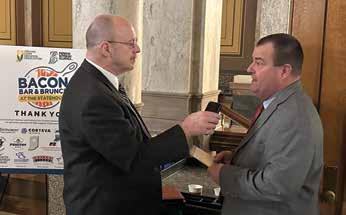
During the Bacon Bar and Brunch at the Indiana Statehouse in February, Brian Warpup was interviewed by several media outlets discussing farm policy priorities for farmers. In this photo, he is answering questions from Rob Winters, farm director for WOWO radio in Fort Wayne, Ind.
A family farm
Regardless of advocating farm policy issues or promoting export opportunities or applying conservation techniques, family is at the heart of it all.
“My dad and my grandpa and all my grandparents are gone,” he said. “Now, it’s my mom, Javonda, and my aunt, Jane. And then it’s my cousin, Darren. Me and my cousin are the ones, the caretakers, I guess, the owner-operators of what’s going on here on the farm.”
Warpup and his wife, Nicole, have three grown children – the youngest is a student at Butler University. The oldest is their son, Ben, then followed by daughters Hannah and Maleah. There is no pressure on any of them to come back and work on the farm. But he is happy to have had the opportunity to raise them on a farm.
“I thought raising all three kids in the country and having to self-sustain and do chores was very important,” Warpup said. “We were very active in 4-H. Having those responsibilities and farm chores really helped mature my kids into the adults that they are today. I think all three of my children have a strong work ethic. They’ve always had jobs or were doing something. I think that’s because they see what a farmer does. It’s work. I mean, you just work. I think that’s where they get it.”
Indiana soybean farmers host Vietnamese chefs for 2025 World Food Championships
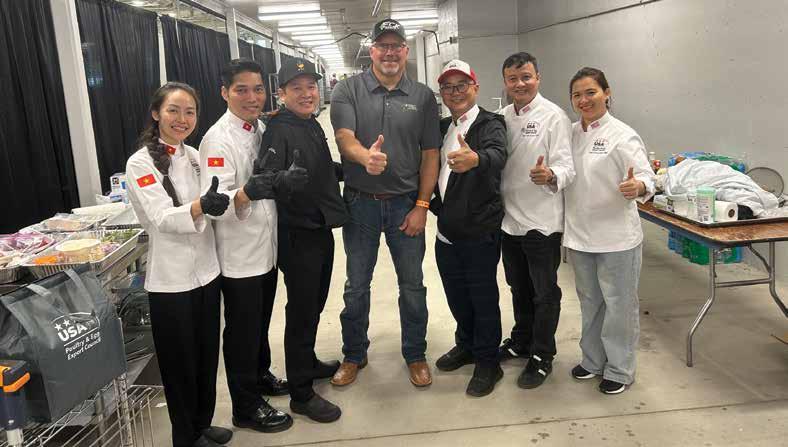
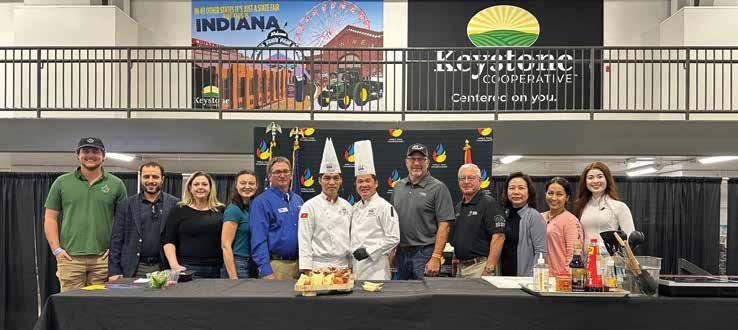
From the farm fields of Indiana, soybeans grown by Hoosier farmers took the spotlight of the largest food competition during this year’s World Food Championships (WFC), Oct. 16-17, at the Indiana State Fairgrounds and Event Center. The Indiana Soybean Alliance (ISA), the state’s soybean checkoff program, hosted several top chefs from Vietnam to showcase how Indiana soybeans, especially high oleic varieties, contribute to healthier and better-tasting food.
Working in tandem with the USA Poultry and Egg Export Council (USAPEEC), ISA hosted chefs and culinary influencers from Vietnam who had previously competed in the ISA-sponsored Best Poultry Challenge – Season 3. This program, held in September, was a cooking competition in Danang that highlighted U.S. chicken and duck in Vietnamese Cuisine.
The chefs traveled to Indiana in October to take part in this year’s WFC, visit Indiana farms and learn more about high oleic soybean oil. For the second consecutive year, high oleic soybean oil was provided to WFC competitors through a partnership with the event.
High oleic soybean oil served as the “official cooking oil” for the WFC and was made available to all contestants via the event’s Kitchen Arena pantry.
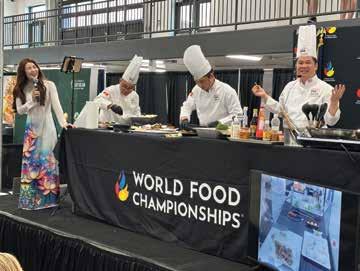
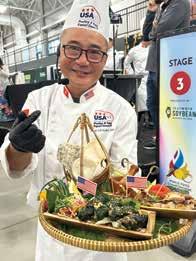
The chefs from Vietnam performed cooking demonstrations featuring Indiana-grown poultry products prepared in high oleic soybean oil during the WFC. Among the chefs was Doan Van Tuan, the executive chef of the Furama Resort and Ariyana Convention Center in Danang.
“It was an amazing experience preparing U.S. duck in high oleic soybean oil from Indiana farmers through a Vietnamese dish,” Doan said. “The customers love food prepared in the high oleic soybean oil. It’s a good color and quality.”
The Furama Resort and Ariyana Convention Center was the host of this year’s Best Poultry Challenge in Vietnam. ISA Board Director David Hardin, a farmer from Avon, Ind., attended the Challenge in Vietnam, then he hosted the chefs for a tour on his farm following the WFC. He said most of world’s population is outside of Indiana and the United States. Events like the Best
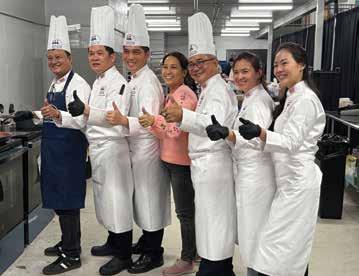
Indian soybean farmer and ISA board member Chris Eck visits Vietnamese chefs preparing Maple Leaf turkey in high oleic soybean oil for the World Food Championships.
Poultry Challenge and the WFC allow farmers to showcase soybean-based products to a wider market.
“While in Vietnam in September, I learned it is a very dynamic market with a young population that is growing in its purchasing power,” Hardin explained. “They are the type of consumers we are looking for. We have been working with different influencers in the food space over there attempting to get U.S. products and Indiana products into their restaurants. We hope that it’s going to trickle down to the average consumer in Vietnam to eat more U.S. poultry that has been grown with Indiana soybeans.”
Influencing consumers
Chon Hoa “Crystal” Nguyen is one of those foodspace, social media personalities that ISA and USAPEEC has worked with to promote the Best Poultry Challenge in Vietnam. Crystal also attended the WFC and toured Indiana farms.
“This is my first time in the U.S. and in Indiana,” she said. “It’s a pleasure and an honor to work with Indiana farmers and the Indiana Soybean Alliance through programming they support highlighting the quality of their products.”
Crystal added that it was a great opportunity for the Vietnamese chefs to showcase their talents for American consumers, too.
“We are so happy and honored to represent Vietnam in these demonstrations,” she said. “With the help of USAPEEC and ISA, we are promoting Vietnamese cuisine using U.S. chicken and duck. It was exciting to show the different ways we use these products. The chef team visited Indiana farms, and it was exciting to see how big the machinery is and how the crop is managed
sustainably while working on a large scale. It was great to see the corn and soybeans in the field. We trust the quality of the corn and soybeans that make U.S. chicken and duck healthy. Our chefs recognize the consistent quality.”
Along with Hardin, the group from Vietnam also toured the farm of ISA Director Chris Eck, who has also grown high oleic soybeans on his Shelby County farm for several years. Eck attended the Best Poultry Challenge with Hardin earlier this fall.
Hardin explained that improving trade relations with countries like Vietnam opens opportunities for Hoosier farmers. He said soybean meal is a primary feed source for poultry.
Five years ago, prior to the Best Poultry Challenge, Vietnam imported nearly zero U.S. poultry products. Today, Vietnam is the seventh-largest importer of U.S. poultry.
So, soybeans helped grow the poultry that was cooked, and high oleic soybean oil was in the pans that cooked the poultry. Hardin was pleased to hear the chefs’ compliments about high oleic soybean oil, but he wasn’t surprised.
“I’ve been growing high oleic soybeans for six years now, and we see their benefit,” he said. “They are just like regular soybeans, and they fit into our crop rotation well. They work well with the cover crops we use on our farm. From the consumer’s standpoint, we talk to chefs all the time who just rave about how they can use high oleic oil for a longer time in their fryers. The food they’re frying doesn’t seem to absorb the oil or have a greasy feel or taste. The fact that high oleic oil is obviously much more heart healthy is just another added benefit.”
Vietnamese chefs preparing Maple Leaf turkey in high oleic soybean oil for the World Food Championships.
Vietnamese chefs during a cooking demonstration during the competition preparing Maple Leaf turkey in high oleic soybean oil.
World Food Championships
The 2025 World Food Championships, known as “Indy’s Most Delicious Event,” featured more than 400 teams battling for their share of $450,000 in prize money and the coveted title of World Champion. The event also included the 58th annual World Championship Chili Cook-off along with unique ticketed attractions including the Taste of WFC Premium Experience.
Partners and fans of fine cuisine can relive WFC events by going to worldfoodchampionships.com.
The World Food Championships bills itself as the premier food sport competition. This multi-day, live culinary event showcases some of the world’s best cooks competing for food, fame and fortune across multiple categories. Each year, thousands of teams vie for a coveted “Golden Ticket” at official qualifying events to earn a spot at the WFC. Since its debut in 2012, the WFC has attracted participants from nearly 40 countries and every U.S. state.
High oleic soybean oil delivers enhanced functional benefits within food service operations such as superior high heat stability. Exclusively a U.S. product, it extends product shelf life and offers the longest fry life of any edible oil. High oleic soybean oil lasts longer than standard vegetable oils in high-temperature and extended-use applications because of its heat and oxidative stability. In addition, the oil’s neutral flavor profile allows it to blend well in a variety of foods and lets the true and natural flavors of the ingredients stand out.
Many venues around Indiana are already using high oleic soybean oil including the Indianapolis Colts’ Lucas Oil Stadium, the Indiana Pacers’ Gainbridge Fieldhouse, Purdue University’s RossAde Stadium and Mackey Arena, and the Indianapolis Zoo – among others.
“We are thrilled to welcome back the Indiana Soybean Alliance,” said Mike McCloud, Founder and CEO of the WFC. “Their continued support not only highlights the versatility of soy but also helps us connect consumers, chefs and farmers in meaningful ways inside the Kitchen Arena and beyond.”
Vietnamese chef presenting duck dish prepared in high oleic soybean oil made from local Indiana soybeans at the World Food Championships.
“Indiana’s soybean farmers are very proud to have 100 percent high oleic soybean oil on center stage during the World Food Championships, because we know this is one more step toward building demand for our soybeans,” said ISA Chair Denise Scarborough, a farmer from LaCrosse, Ind. “In many venues around Indiana, high oleic soybean oil has showcased its clean taste, longer fryer durability, and health benefits. We’re happy to partner with the World Food Championships to share this product with food enthusiasts from around the world.”
Group photo of Indiana soybean farmers, partners at USAPECC and Maple Leaf, and Vietnamese chefs after cooking demo presentation
U.S. Soy now plays a crucial role in emerging global health trends
BY WILL MCNAIR, USSEC Director of Soy Foods and Oil
C ounting steps. Monitoring sleep. Choosing probiotics. Consumer wellness trends constantly evolve. Today, soy plays a crucial role in key current and emerging global health trends.
The rise in the use of GLP-1 drugs for weight loss and diabetes control has led consumers to seek specific foods that meet their nutritional needs. Those using GLP-1 typically eat less, so they need nutrient-dense, smaller, but satisfying meals and snacks.
As consumers demand the scientific support backing health claims, Indiana farmers are providing answers – including how U.S. Soy naturally fits into the solutions these trends create – through partnerships with the U.S. Soybean Export Council (USSEC).
The power of protein
Attendees at USSEC’s 2025 Soy Connext learned that the top positioning message for new soy-based food and beverage products is high protein content. As a platinum sponsor of the event, the Indiana Soybean Alliance (ISA) helped USSEC feature industry experts who highlighted the role of soy in proteinfocused wellness trends.
Globally, protein continues to be the most sought-after macronutrient in foods. According to global research from Innova Market Insights, 58 percent of global consumers actively seek it in their diets. That percentage increases to 70 percent for U.S. consumers, according to Danone North America research.
That makes soy, with its rich protein content, versatility and availability, a go-to ingredient for product innovation. Many of those new products appear in sports nutrition, the fastest-growing category for soy ingredients globally. Research has proven soy protein’s ability to support muscle building.
Some food manufacturers looking to market foods as GLP-1 friendly use soy protein to boost the protein content of new products. This strategy appeals to condition-specific nutrition trends by leveraging the protein quality of soy.
Because soy is a complete plant-based protein, it is ideal for GLP-1 users who need nutrient-dense foods in smaller portions.
Eating for beauty
During the past year, one in five global consumers purchased food, beverages or supplements to support physical appearance or beauty, according to Innova
Indiana Soybean Alliance director Chris Eck shared the farmer perspective of growing soybeans alongside Ohio Soybean Council director Carl Krueger and dietician Charlotte Martin who shared soy-focused skin health research with Allure Korea magazine.
Market Insights research. That industry research reports that categories positioning products for skin health and hair support are growing annually at 29 percent and 27 percent, respectively.
The isoflavone content of soy can provide skin health benefits. A Soy Connext speaker noted this as a marketing opportunity – skin care aligns beautifully with the prevention mindset of younger generations.
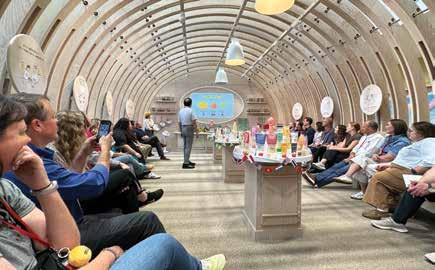
USSEC capitalized on this trend in Seoul, South Korea, creating the U.S. Soy Campaign House, a fullbuilding takeover on one of the city’s busiest streets. Again, support from the Indiana Soybean Alliance helped make this possible, alongside USDA Regional Agricultural Promotion Program (RAPP) funding.
For two weeks, the experience showcased the impact of U.S. Soy on global nutrition and skin health, as well as culinary innovation and sustainable food systems.
Registered dietician Charlotte Martin participated in the U.S. Soy Campaign House, presenting insights from emerging research on the role of soy isoflavones in skin health and aging to Korean health and beauty influencers. She also discussed findings in-depth with Allure Korea, a national beauty magazine.
“Research suggests the consumption of 25 grams or more of soy protein a day can help support skin hydration, boost collagen production, reduce hyper pigmentation, and improve elasticity, particularly in postmenopausal women,” Martin reported.
“The takeaway? Small, consistent dietary changes can lead to meaningful improvements in skin health.”
Aging well
Soy serves as a notable part of the solution to staying healthy and vibrant with age.
Younger consumers are increasingly focused on aging well, seeking ways to prevent problems early and prioritize not just a longer life, but one filled with energy and quality of living.
“One food I’ve come to deeply appreciate for its role in healthy longevity is soy,” said Lea Wetzell, a licensed nutritionist and Certified Nutrition Specialist based in Minnesota. “From muscle maintenance and heart health to hormone balance and cognitive support, the benefits of soy foods are supported by clinical research and echoed in my real-world practice.”
Indiana Soybean Alliance director Chris Eck was on hand in Seoul, South Korea, to support the U.S. Soy Campaign House, a full-building takeover on one of the city’s busiest streets to showcase the impact of U.S. Soy on global nutrition and skin health, as well as culinary innovation and sustainable food systems.
Sustainability
Consumer wellness trends include the sustainability of the solutions they promote. Between 2018 and 2023, new food and beverage product launches featuring ethical or environmental claims increased by 13.8 percent, found Innova Market Insights research. A Soy Connext speaker pointed out that consumers don’t know how to evaluate the sustainability of the products they buy.
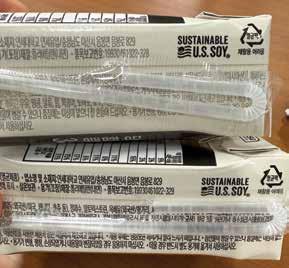
Sustainability certifications, like the Sustainable U.S. Soy label, can help brands demonstrate commitment to sustainability and build trust with consumers. To display this label, a product must use a high percentage of soy verified as sustainable through the U.S. Soy Sustainability Assurance Protocol (SSAP). Both foodgrade and commodity soybeans raised in Indiana get exported with this verification.
U.S. Soy delivers a sustainable source of high-quality protein that delivers solutions for global consumer health, beauty and nutrition trends.
More than 1,000 products like this soybean paste carrying the Sustainable U.S. Soy label can be found on store shelves around the world.
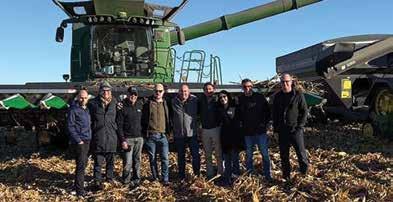
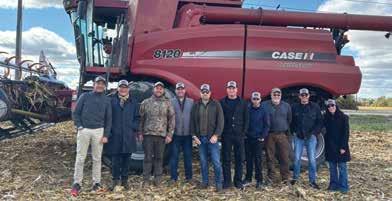
In October, following the Global Ethanol Summit, government professionals and industry stakeholders from the European Union (E.U.), the United Kingdom (U.K.) and Canada visited Indiana to learn more about the U.S. bioethanol value chain. Above left, the E.U., U.K. and Canadian trade team visits farmer Scott Smith at his farm, Triple S Smith Farm, in Windfall, Ind., to see the corn harvest process. Above right, the E.U., U.K. and Canadian trade team visits grower C.J. Chalfant at his farm, Double Ridge Farms, in Hartford City, Ind., to see the corn harvest and drying processes.
USGBC hosts E.U., U.K. and Canadian trade team at Indiana farms after the Global Ethanol Summit
BY EMMA DOSTAL
The U.S. Grains & BioProducts Council (USGBC) sent 12 trade teams to corn-growing and ethanolproducing states to visit the U.S. ethanol value chain as part of Global Ethanol Summit 2025 (GES).
Trade teams offer opportunities for attendees to see the quality of U.S. agricultural products, connect with farmers and ask questions to address potential concerns while building new business relationships. Delegates apply this information to future business practices upon return to their countries while often serving as advocates for U.S. agricultural practices and products.
USGBC invited a trade team from the EU, U.K. and Canada to visit Indiana. The participants represented key markets for U.S. ethanol exports including high-level representatives from government agencies, ethanol associations and private sector organizations.
“This initiative sought to facilitate an in-depth technical dialogue and strategic engagement to support the stabilization and expansion of ethanol in these markets,” said Stephanie Larson, USGBC Regional Ethanol Manager for the E.U., U.K. and Canada.
“Participants had the opportunity to explore cost and octane value economics, technical and operational blending practices and logistical considerations critical to scaling ethanol use. The post-tour strengthened participants’ understanding of the U.S. ethanol industry’s infrastructure, along with the economic, environmental and health benefits resulting from the use of higher blends.”
The trade team began with a visit to the Triple S Smith farm in Windfall, Ind., where attendees learned about production, watched the corn harvest process and rode in the combine.
The delegation’s next stop was the POET ethanol plant in Alexandria. The visit featured a presentation on ethanol production, adherence to sustainability practices and the plant’s plans for further lowering carbon intensity scores. The delegates toured the facilities and observed trailers delivering product.
The team then met with corn growers at Double Ridge Farms in Hartford City, Ind., where they got another look at corn harvest – this time in a field located a few miles away from the Triple S Farm but with higher levels of corn moisture. The different conditions were helpful for the trade team delegates to observe as part of the process for corn storage and drying for ethanol.
The first day ended with a visit to a Family Express retail store to discuss E10 and E15 policies in the U.S. and how ethanol is distributed. This location featured E85, and delegates compared prices between E85, E15, E10 and gasoline.
The final day of the trade team began with a visit to the U.S. Energy blending terminal where attendees learned about the blending process. Attendees toured the terminal and observed real-world implementation of flexible blending options at the rack with trucks arriving to pick up orders of E10, E15 and E85.
The team concluded with a visit to the Indianapolis Motor Speedway Museum where delegates learned about the role of ethanol in racing cars and viewed a variety of models throughout the newly renovated museum. The tour concluded with a trip to the racetrack.
Trade teams strengthen ties between U.S. agriculture and the global market – building long-lasting relationships that help the Council achieve its mission of developing markets, enabling trade and improving lives.
USMEF continues touting variety meats through cantinas in Mexico
The Indiana Soybean Alliance and the Indiana Corn Marketing Council invest checkoff funds in the U.S. Meat Export Federation because corn and soybeans are a primary feed source for U.S. livestock. By promoting the export of U.S. pork, cattle and lamb, demand for soybeans and corn also increase.
Variety meat exports are critical for U.S. pork and beef producers as they enhance carcass value, and Mexico is a leading destination for these products. U.S. Meat Export Federation (USMEF) staff in Mexico are promoting pork and beef variety meat items in bars and casual restaurants as an affordable appetizer and snack option that will appeal to their customers.
The campaign has been tagged Cantina Vibes and is made possible through funding support from USDA, the National Pork Board and the Beef Checkoff Program.
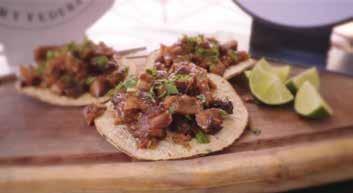
Consumers in the central part of Mexico are well familiar with variety meats, according to USMEF-Mexico Trade Manager Rigoberto Treviño, so they began in this region, with tacos, sopes and tostadas made with pork jowl, snouts, ears and brains as well as beef intestine, liver and sweetbread.
“It is very affordable for those cantinas and their customers,” Treviño explained. “If you want to go to a cantina, maybe you can have a free appetizer to go with your drinks, because the intestines, pork stomach or pork snout are very affordable. Or maybe you can have a pork
Consumers in the central part of Mexico are well familiar with variety meats like this pork snout tostada. USMEF began marketing variety meats in this region, with tacos, sopes and tostadas made with pork jowl, snouts, ears and brains as well as beef intestine, liver and sweetbread.
jowl taco or a pork jowl sope with guacamole, for about a dollar. So, it’s very affordable, and it’s very important for those kinds of restaurants and casual dining establishment to drive more customer traffic.”
Because of the success of Cantina Vibes in Central Mexico, the promotion was expanded north to regions where consumers are less familiar with variety meat dishes. The promotion was attractive to bars, casual restaurants and consumers alike because it brought the familiar taste and quality of U.S. beef and pork to casual, convenient appetizers and dishes at an affordable price point.
Mexico is the leading volume destination for U.S. beef variety meat exports, totaling 124,000 metric tons last year, worth $338 million. It is second only to China for pork variety meat exports, with shipments in 2024 topping 160,000 metric tons, at a value of $288 million.
The push to grow consumption of variety meats in Mexico comes at a key time for U.S. producers. China, a key buyer of U.S. variety meats has reduced pork purchases this year amid tariff tensions between the two countries and has essentially blocked all beef purchases from the United States by refusing to renew certifications for U.S. beef processing and cold storage facilities. USMEF staff members around the globe have been working to find and develop new destinations for U.S. red meat products that would typically be headed to China.
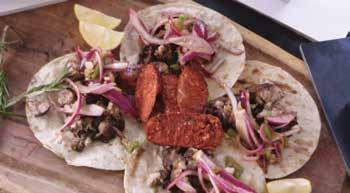
Variety meats are used in foods such as this sweetbread taco in Mexico. This USMEF campaign has been tagged Cantina Vibes and is made possible through funding support from USDA, the National Pork Board and the Beef Checkoff Program.
Checkoff success story: From Indiana fields to dinner plates in Korea, Japan
BY HANNAH VORSILAK
When planning tonight’s dinner, tofu, natto, soy sauce and soy milk probably aren’t on the menu. But for many in Japan and Korea, these soybased foods are daily staples. And all start with one thing: soybeans.
U.S. farmers have supplied Japan for 70 years and Korea for 45, providing food for millions overseas and creating important economic opportunities back home. Today, the United States provides 70 percent of Japan’s whole soybean market. For South Korea, the United States has 50 percent of the whole soybean market and 70 percent of the food-soybean market share.
Overall, the United States is in a great position for supplying whole beans, soybean meal, soybean oil and high-value identity-preserved (IP) soybeans for food production to these key markets. In both countries, demand for health-conscious, high-protein, nutritious foods is strong, and U.S. soy meets that need.
“I’ve been growing food grade soybeans for around 11 years. These beans get cleaned, bagged and loaded into a container to be shipped to Japan,” explained ISA Board Member Mike Koehne, a farmer from Greensburg, Ind. “These are high quality beans to be used in food products
that earn a premium. It is great to know that I grow a premium product that is used as a good nutrition source for the Asian market.”
Once these soybeans leave Indiana, they’re shipped directly in containers, kept separate through the identity-preserved process, and used to make tofu, soy-based snacks, oils and other foods for consumers overseas.
The U.S. Soybean Export Council (USSEC) has used checkoff dollars for many years to create a preference for U.S.-grown soybeans in these markets. They do this through creative marketing to consumers and discussions with executives and buyers at food companies, crushers and major trading companies.
Talking directly to buyers
During a recent learning mission to Tokyo, Japan, and Seoul, Korea, Andrew McDaniel and Mark Wenning, both Indiana Soybean Alliance board members, were able to hear directly from those buyers. Many buyers expressed appreciation for the quality and sustainability of U.S. soy. For example, Fuji Oil, Japan’s leading soy protein company, uses U.S. soy for oils, textured soy protein, and fermented foods like tofu. Fuji Oil imports 100 percent of its soybean meal and soybeans from U.S. farmers.
A key factor in this trust is the U.S. Soy Sustainability Assurance Protocol (SSAP). The soybean checkoff (through the United Soybean Board and in partnership with state soybean checkoffs) helped fund and support the creation of SSAP in 2013. SSAP is a promise that U.S. soy is grown in a sustainable, responsible way.
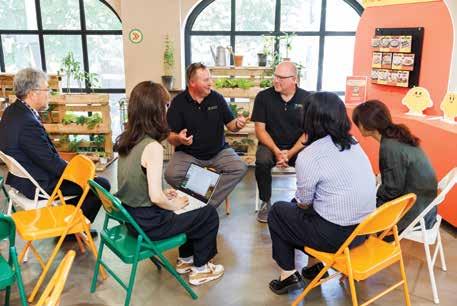
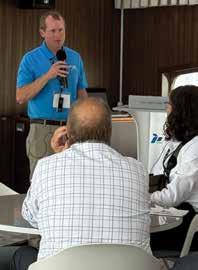
From right, Mark Wenning, Chris Weldon and Andrew McDaniel of ISA engage in conversations about U.S. soy during a trading house rountable in Japan.
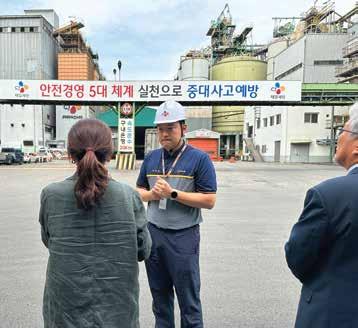
Mark Wenning gives opening welcome remarks during a tour of Incheon Port in Korea.
Think of SSAP as a “report card” for U.S. soybeans – a way to show international buyers that U.S. soy is grown responsibly without adding new rules or paperwork for farmers. SSAP uses existing laws and conservation programs, like the farm bill, soil conservation and waterquality protections, while independent auditors verify compliance. This gives global buyers confidence that U.S. soy is both reliable and sustainable, keeping demand strong even as competitors like Brazil enter the market.
Value of SSAP label
The Sustainable U.S Soy label, which requires products to contain at least 60 percent SSAP-verified U.S soy, is used on more than 300 consumer food products in Japan and 29 in South Korea.
“Like many farmers, when I pay into the checkoff, I hope it’s doing good things for our markets, but you don’t always know exactly how,” McDaniel said. “Seeing firsthand how our beans get from Indiana fields to other countries and witnessing the tireless effort of USSEC and state checkoff committees was incredible. Without these markets, we could be facing sub-$8 soybeans. In reality, we’ve stayed fairly stable even without Chinese demand.”
U.S. soybeans are consistent, reliable and in high demand by these countries.
While in Japan, the farmers also heard from Jeanne Bailey, Japan’s Agriculture Minister Counselor from the U.S. Embassy, and she praised them for being there to engage in these important conversations.
“Farmers are the best ambassadors for their crops,” Bailey stated. “The Japanese have taken excellence to the forefront and appreciate in return that U.S. farmers are on the cutting edge of technology and sustainability back home.”
ISA officials toured the CJ Cheiljedang Crushing plant during a trade mission to Korea. The plant uses U.S. soybeans.
The Kewpie Mayo Co. in Japan hosted a meeting in a room that looked like the inside of a mayonnaise jar.
The Sustainable U.S Soy label is used on more than 300 consumer food products in Japan and 29 in South Korea
These soybean oil bottles were displayed at the CJ Cheiljedang Crushing plant in Korea.
Proper 4R nutrient management can help control costs with tight margins
BY BEN WICKER, Executive Director, Indiana Agriculture Nutrients Alliance
When harvest wraps, planning for 2026 begins. Margins are tight, and the most expensive input on most grain farms is fertilizer, especially for corn acres.
Proper 4R nutrient management, using the Right Source, Right Rate, Right Time and Right Place, becomes increasingly important. Knowing your baseline, managing for utilization, and scouting for concerns can ensure a healthy harvest and return on investment.
Knowing what nutrients your soil currently holds is key to deciding how much fertilizer to apply. Plan to soil test on a rotating basis, aiming for a test to be taken every two to four years. Between soil tests, we can use resources like the Tri-State Fertilizer Recommendations, plant tissue testing, or corn stalk nitrate testing to estimate the removal of nutrients.
However, the foundation of these estimates falls back on the original soil test. The results of the tests can be used to save money, particularly for soil pH and accurately applying phosphorus or potassium.
that nutrient exists at each stage is both an art and a science, as precipitation also affects availability of many of our nutrients.
Overapplication may build the soil bank of a nutrient, but it also may affect water quality coming off the field or contribute to such levels to create a toxic level of a nutrient. Fall application of nutrients needs a stabilizer or cover crop to ensure those nutrients can hold through the winter and benefit the crop months from now.
Spring applied nutrients have to benefit the crop through September or even October maturity. Planning the timing of nutrient application, coupled with the right rate, source, and placement, can allow more efficient use of your fertilizer dollars.
Knowing what nutrients your soil currently holds is key to deciding how much fertilizer to apply. Plan to soil test on a rotating basis, aiming for a test to be taken every two to four years.
Use a Certified Crop Advisor or trained agronomist to help with soil test interpretation and recommendations. Timing of soil testing is important for the long-term. Soil nutrient characteristics are different when testing in the spring or in the fall. Once the timing has been established, one should remain with the same timing for all other all future tests.
Manage for utilization
Crops need a different amount of given nutrients at different stages in their life cycle. Ensuring enough of
Scout for concerns
Windshield scouting is a great way to see problem areas in very young corn and soybean fields, but nutrient deficiencies tend to be more prominent in older plants. Field health maps may be able to point out problem areas in fields after the canopy has closed and bare soil no longer factors into the maps.
Drone technology is a labor-effective way to put eyes on the upper canopy and locate problem plants. Plants will send mobile nutrients like nitrogen, potassium and sulfur to the upper leaves and sacrifice lower leaves in times of deficiency, leaving boots on the ground as the best scouting option.
The Indiana Agriculture Nutrient Alliance is committed to serving farmers through education and technical support in our mission of viable farms, healthy soil and clean water. For more information, go online to inagnutrients.org.
Harvest moved forward at furious speed this season with few breaks
BY SCOTT GABBARD, Senior Administrator, Purdue On The Farm
Harvest has moved forward this year at a furious pace, at least from my perspective and the results of windshieldsurvey miles. When rain delays did occur, they came as a welcomed relief for most farm families to which we’ve spoken. These breaks provided a chance to make necessary minor repairs and catch up on other chores.
Purdue Plant and Pest Diagnostic Lab (PPDL) for analysis remained relatively unchanged compared to last year, but corn sample submissions increased nearly threefold. Now that sample submission is finished, we can highlight this chapter of the 2025 crop season in more detail.
Our data is still coming in; some of it is finished, but there remains end-of-year survey work to be completed. We are asking farmers and educators to provide assessments of how we performed, how they performed, and what we can do together next season to improve — it’s an ongoing process.
One set of data that we’ll be discussing this winter pertains to the crop diseases that appeared during summer. As recently reported in Indiana Prairie Farmer, the number of soybean samples submitted to the
Southern rust was confirmed in 10 subsamples. The first two confirmed Southern rust samples were delivered to PPDL just one day apart — from Knox and Starke counties on July 29-30, respectively.
In addition to the samples covered by checkoff dollars from farm operations statewide, Purdue On The Farm submitted 49 composite samples from 16 unique counties throughout Indiana. Due to the nature of our sample collections, these turned into 112 samples for analysis.
How does 49 turn into 112? When scouting fields, we collect samples — usually leaves, though sometimes entire plants — with multiple issues for analysis. We may also send a composite consisting of multiple tissue samples from a scouted field.
Of those 112 subsamples, 85 were confirmed cases of disease or insect damage (including Southern corn rust, thrip damage and Rhizoctonia root rot). Twenty-five were suspected issues, such as nutritional deficiencies, genetic disorders, chemical injury or sunscald. One was undetermined, and another was undetected.
Southern rust was confirmed in 10 subsamples. Many readers undoubtedly had to manage this disease during the season. Our first two confirmed Southern rust samples were delivered to PPDL just one day apart — from Knox and Starke counties on July 29-30, respectively. Corn tar spot, affected by our sampling schedule and this year’s growing conditions, showed up in six subsamples. The usual culprits — Northern corn leaf blight and corn gray leaf spot — were also observed.
While red crown rot did not show up in our surveyed fields this year, submitted samples indicated that the educators and staff were looking for it. Fusarium root and crown rot (2 times), Pythium crown rot, and soybean stem canker (3 times) were all confirmed.
So, another year makes it from the bag to the bin, but the data crunching has just begun. May your harvest come safely to close so that your family can enjoy your presence this holiday season.
Grain test weight is used as grain quality measurement in corn crop
BY DAN QUINN, Purdue Extension Corn Specialist
First, we will begin with a question: What is test weight?
Although yield is always at the forefront of many corn farmers’ and agronomists’ minds during harvest, another important discussion topic each fall is that of grain test weight. Although grain test weight is often discussed – or debated – when determining how well someone’s corn did, this number can often be confusing when understanding its importance, especially in relation to corn grain yield.
Grain test weight is used as a grain quality measurement and is identified as the volumetric weight of grain (pounds per bushel). Test weight is based on the official volumetric bushel measurement of 1.244 cubic feet. In addition, the USDA defines the minimum allowable test weight as 56 pounds per bushel and 54 pounds per bushel for No. 1 yellow corn and No. 2 yellow corn, respectively.
Corn grain in the United States is marketed specific to a 56-pound bushel regardless of test weight. Furthermore, since test weight is dependent on grain moisture, grain buyers will pay based on “dry” bushels (15-15.5 percent grain moisture).
Corn farmers are often concerned with low test weight because that means local grain buyers may have to discount the market grain prices paid. In addition, if you were to deliver a semi-load of low test weight grain (such as 52 pounds per bushel) then this specific load would contain less “56-pound bushels” and you would be paid less for the load on a per volume basis. Whereas, if you were to deliver a semi-load of high test weight grain (such as 58 pounds per bushel) then that load would contain more “56-pound bushels” and
you would be paid more for the load on a per volume basis.
This concern among farmers regarding test weight often drives the question of “if my corn yielded well, shouldn’t I also have high test weight?” And the short answer to that question is no, not always, as there is very little evidence that high corn yield equates to high test weight.
Does high test weight equal high corn yield?
Examples of the lack of relationship between grain test weight and corn yield are presented in Figure 1 and Figure 2. The data was collected from multiple corn research trials from Purdue University in West Lafayette, Ind., and Wanatah, Ind., in 2024.
In Figure 1, there seems to be a slight positive relationship between grain test weight and yield for Trial 1 and a slight negative relationship between test weight and yield for Trial 2. In Figure 2, there seems to be a negative positive relationship between grain test weight and yield. In addition, both graphs produce trend lines with low R2 values (0.06, 0.02, and 0.07, respectively), which indicates that the trend line does not do a good job in explaining the variability of the data.
In other words, both graphs highlight both the variability and overall lack of relationship between grain test weight and yield. In addition, the test weight data pulled was from trials containing large differences in nitrogen fertilizer rates and different hybrids. Therefore, this data showcases that similar test weight values can exist across a wide range of hybrid genetics, fertility levels and locations.
In addition, low yielding corn with smaller kernels can sometimes result in a higher test weight than higher yielding corn with larger kernels (smaller kernels can result in more kernels “fitting” within the volumetric
For more on Purdue corn research
Figure 1: This chart shows corn grain test weight (pounds per bushel) in comparison to corn grain yield (bushels per acre). The data was obtained from Purdue University corn research trials in West Lafayette, Ind., in 2024.
measurement of a bushel). Therefore, just because your corn may have yielded poorly, does not necessarily mean that test weight is also low.
Factors affecting test weight
Specific factors that can influence grain test weight in corn include hybrid type, kernel physical characteristics, grain moisture and stress incurred during the grain fill period. First and foremost, an important factor to remember is that corn grain test weight and grain moisture are inversely related. Therefore, the higher the grain moisture, the lower the test weight at that specific point in time. As grain begins to dry, test weight is increased due to kernel volume shrinkage and increased grain “slickness,” thus allowing a greater number of kernels to occupy
2: This chart shows corn grain test weight (pounds per bushel) in comparison to corn grain yield (bushels per acre). The data was obtained from Purdue University corn research trials in Wanatah, Ind., in 2024.
a volume bushel. In addition, other factors that can impact final test weight include plant stresses such as plant foliar disease, insect damage, nutrient deficiencies and environmental conditions (such as early frost, hail damage or drought).
Plant stresses that can cause significant reductions in plant photosynthetic processes or even premature plant death may result in premature plant maturation (such as black layer), thus resulting in sub-optimal starch deposition into the kernels resulting in low test weight.
Overall, when asking “is test weight important?” The answer is yes, especially from an economic standpoint. However, it is important to understand that high test weight does not always mean high grain yield and vice versa.
Figure
While enjoying the holiday season, let’s play Would You Rather? Soybean edition
BY SHAUN N. CASTEEL, Purdue Extension Soybean Specialist
Tis the holiday season. We finished the parade of costumes during the last few days of October as kids raked in the candy. November is upon us with Christmas close behind. Traditions are rooted in many of our holidays whether they are intentional or not.
Growing up in my family, we gathered at a relative’s farmhouse in Illinois for Thanksgiving. We would have anywhere from 60 to 100 people in that farmhouse — eating, laughing, watching football, playing ping pong, singing, running around outside and maybe even napping. It was a family tradition that I looked forward to every year, especially the homemade noodles on top of mashed potatoes (yes, I grew up in Illinois), Mom’s crescent rolls and pumpkin pie. I am a purist.
Many family traditions remain while others sunset and new ones emerge. My family and I now drive 8 hours to meet up in the middle of Missouri at an Airbnb farmhouse (yet some things don’t change). At the same time, our
Texas relatives drive 8 hours to meet us. Cousin time commences and the chickens and cats need to watch out. Along this 8-hour drive, my kids have various books to read, puzzles to solve, pictures to color and toys to play with — stuffed animals to dolls to monster trucks.
The kids make up games and one of our favorites is the question game, Would You Rather?. We have a few books that serve as prompts, and we certainly come up with our own silly and crazy questions. The premise of the game is to ask questions with only two options, and you must choose one answer. It is a fun game to find out what you like and sometimes what you really hate. Some of the questions are extreme, and you are forced to choose the lesser of two evils. The answers can be easy and obvious for one person, but they can be a nightmare for the other. Examples:
• Would you rather eat worms or crickets?
• Would you rather skydive or snorkel? (This could be dicey one for some people)
• Would you rather vacation in the mountains or the beach?
Now, we will play the soybean edition of Would You
Read more from Shaun Casteel
Rather?. I will list pairings for you to consider. While I answer some of these pairings knowing full well that my answers may not match your answers or your field situations. Please give me some grace and latitude with these pairings as we are “forced” to answer them with brevity.
Would You Rather? [Soybean Edition]
Plant soybeans first or corn first?
Soybeans. The yield advantage of planting soybean timely is remarkable.
Drive a Ford, Chevy or Dodge truck?
Ford F-150. I am tall and fit inside it better.
Plant 15-inch rows: split corn rows or plant at an angle?
Split the corn rows provided you are aligned with auto-guidance and can handle the residue (such as row cleaners, sharp seed openers, active down pressure). Otherwise, plant at a slight angle to prevent poor stand establishment over heavy corn residue and corn root balls.
Plant soybeans with green, red or blue planter?
Hmmm.
Treat soybean seed or not?
Fungicide seed treatments for those early to timely planted fields. Be sure the fungicide selection addresses your field concerns (Phytophthora, Pythium, Rhizoctonia). No need for insecticide. Late plantings could be completely untreated.
Plant 15-inch or 30-inch rows?
15-inch rows in most cases will have a 5-10 percent yield advantage.
Plant early maturity or full maturity variety first?
Plant early variety first to take advantage of the timely planting (node development, reproductive branches, reproductive duration), potentially catch old market price, and start harvest earlier. Then, plant fuller season variety to spread growing season risk and pace out harvest schedule.
Start the day with cup of coffee or energy drink?
Black coffee.
Apply routine phosphorus and potassium fertilizers or skip it?
Real opportunity to use the soil test levels that you have built up and potentially skip until fertilizer price and market price improve. Check those soil fertility levels.
When planting 30-inch soybean rows: vertical till or row cleaners?
Row cleaners that can move residue with the same pass.
Chase soil moisture at planting or keep static seed depth?
Target seed depth of 1.5 inches plus or minus 0.25 inches. I’d be hard pressed to go much deeper.
Other questions without answers
Seed at 125,000 vs. 140,000 with 15-inch planter? What are field conditions? Seed treatment?
Spray fungicide with ground rig or drone? Is fungicide needed?
Diversify by adding livestock or specialty soybean? Where is the market?
Partner with neighbor for planting or harvesting soybeans? What is the most limiting factor for your farm?
Tillage transition: no-till or vertical till? What is the goal (reduce fuel consumption, build organic matter, time, others)?
I hope this was a fun taste of options that we choose based on our situations, preferences, and maybe even traditions. As we wrap up 2025 season and look to future seasons, we certainly will be faced with decisions that affect our livelihood and bottom line.
My hope is that some of these pairings help make us consider our decisions that are based on traditions and preferences, which certainly have their place. Perhaps, there is one or two tweaks that can help our farms to be more efficient, profitable, or productive. I think of those that started down the no-till path in the 1980s to manage fuel costs and conserve soil. Necessity is the mother of invention.
I wish you the best this holiday season with your family, friends and farms. Here’s one last question.
Would you rather have pumpkin pie or sugar cream pie?
Pumpkin pie!
SwarmFarm Robitics: Designed by farmers for farmers
BY ANITA SHARKEY
When it comes to innovation in agriculture,
SwarmFarm Robotics stands out as a story of practical ingenuity. Founded by Australian farmers Andrew and Joice Bate on their farm along Australia’s east coast, the husband-and-wife team is redefining what automation means in the field.
Their story shows how curiosity, hands-on experience, and a drive to solve real challenges can transform the future of farming.
SwarmFarm began in 2010 with a simple but powerful idea. Farming does not need to get bigger to get better. Andrew, who came from an agronomy background, and Joice, who grew up on a sheep and cattle farm, were frustrated by the rising cost and scale of modern machinery. “If farming just keeps getting bigger, we will ultimately damage soil and drive up costs. It is not feasible,” Andrew explained. “The next step cannot be just adding more horsepower. We needed a smarter solution, not a bigger machine.” Big machines will always be essential, but these smaller robots can take on specific jobs more gently, helping reduce compaction and improve efficiency.
Their solution is SwarmFarm Robotics, a suite of lightweight, low-cost, autonomous robots designed to perform a variety of tasks including spraying, mowing, weeding, and orchard work. Designed to complement traditional equipment, these robots operate with a lighter footprint, helping reduce soil compaction while improving overall efficiency. Each machine is rugged and practical,
allowing farmers to fix problems in the field without relying on dealers or expensive service calls. “We built these robots to solve problems for the 3 a.m. breakdowns when a farmer does not have time to wait,” Andrew said. “They are designed by farmers, for farmers.”
SwarmFarm fleet technology allows for precise applications that improve crop yields, alter plant growth where necessary, and maximize overall efficiency. Over time, these smarter practices have the potential to lead to better soil health, more consistent crop quality, and reduced input costs. With thousands of operating hours logged across farms in Australia, the results speak for themselves. A single Swarm robot can operate for more hours than a traditional tractor, providing greater flexibility during critical periods such as planting, weeding, and harvesting.
The company’s SwarmConnect platform allows other technology developers, including See & Spray, to integrate seamlessly with their robots, giving farmers customizable options and access to a growing ecosystem of tools. With four different robot models available, farmers can select the technology that best fits their operations, whether it is for vineyards, orchards, or broad-acre crops.
SwarmFarm is now expanding to the United States, and Indiana is part of that story. The first Swarm robot in the country operated at Beck’s, where it was featured during Becknology Days this past August as part of the field tours at Beck’s Hybrids headquarters in Atlanta, IN. Visitors saw
SwarmFarm Robotics team showcasing their autonomous robots during a field day for farmers this year.
One of SwarmFarm’s mower robots shown here in action moving through a field.
firsthand how the robot handled spraying in the field. The robot scans the field every few days and sprays any active weeds. Guests also had the chance to ride behind a selfdriving robot during the tours.
SwarmFarm’s philosophy feels right at home with Indiana farmers. The Indiana Soybean Alliance and Indiana Corn Marketing Council are excited to see technology like SwarmFarm’s taking root. These robots represent more than progress in automation, they reflect the spirit of Indiana agriculture: innovation built on experience and change guided by those who know the land best.
These lightweight, autonomous robots were built to handle tasks such as spraying, mowing, weeding and orchard work.
This is one of SwarmFarm’s robots on display during a field day.
Indiana’s Turkey Farmers Illustrate Hoosier Ag Success
Farmers Working Together
Agriculture powers Indiana’s economy, and turkey farmers are part of that success. As the 4th largest producer of turkey nationally, we depend on high quality feed from our fellow Indiana corn and soybean farmers, so that we can bring our nutritious protein to the Thanksgiving table and throughout the year. As responsible stewards of the environment, we share Indiana corn and soybean farmers’ commitment to sustainable production. Our partnership continues to make Indiana a land of opportunity.
• Turning Grain to Gain: There is great synergy between Indiana’s grain farmers and turkey farmers. High quality grain is essential for turkey farmers to achieve an exceptional feed conversion rate of 100 pounds of feed to 50 pounds of turkey produced.
• Turkey Production Creates Jobs: More than 4,000 people in Indiana are directly employed as part of turkey farming with an extra 9,700 jobs in supplier and related industries such as product distribution and equipment manufacturing.
• Monthly Turkey Recipe Inspiration: Discover your new favorite turkey recipe by subscribing to our Indiana Turkey Newsletter! Scan the QR code or visit www.IndianaTurkey.com to sign up today.
Indianapolis Transportation Club joins B20 Club of Indiana as a new member
The B20 Club of Indiana is pleased to welcome the Indianapolis Transportation Club (ITC) as its newest Affiliate Member. As a long-standing organization dedicated to fostering networking, education and empowerment across the transportation, logistics and supply chain industries, ITC brings a valuable perspective and influential voice to the B20 Club’s mission of promoting local clean fleet solutions.
Established in the heart of Indiana, ITC supports individuals and businesses throughout the central Indiana region who are committed to advancing professional excellence in transportation and related fields. By joining the B20 Club of Indiana, ITC underscores its commitment to promoting efficient transportation solutions — including the use of cleaner fuels like biodiesel and renewable diesel made in Indiana.
“The Indianapolis Transportation Club recognizes the importance of connecting our industry’s future with domestically produced clean transportation solutions,” said Matthew Gaddis, president of ITC and operations manager for B20 Club member Al Warren Oil. “By partnering with the B20 Club of Indiana, ITC aims to amplify the role of clean fuels in achieving both environmental and economic benefits for fleets and businesses across our state.”
The American Lung Association founded the B20 Club of Indiana with the Indiana Soybean Alliance (ISA), the state’s soybean checkoff program. Bailey Arnold, director of healthy air solutions with the American Lung Association, praised the new affiliation. “We’re excited to welcome ITC to the B20 Club of Indiana,” he said. “Their engagement within the transportation
sector and dedication to educational outreach and scholarships perfectly align with our goals to expand the adoption of clean fuels and reduce transportation emissions across Indiana.”
Biodiesel and renewable diesel are cleanerburning, renewable fuel options made from domestic renewable feedstocks, like soybean oil and animal fats, that reduce emissions, promote energy security and protect public health. Since 2020, the B20 Club of Indiana members have helped reduce CO2 emissions by 27,950 tons and air particulates by 13,422 pounds, resulting in a $7.5 million estimated health benefit.
Use of biodiesel strengthens Indiana’s agricultural economy by boosting the value of soybeans and creating jobs, with biodiesel production supporting approximately 4,500 full-time equivalent positions in Indiana and more than 107,000 jobs nationwide.
“The B20 Club of Indiana is another checkoff success story,” said ISA Chair Denise Scarborough, a farmer from LaCrosse, Ind. “The Club’s efforts not only improve air quality in our state, but it also encourages the use and production of biodiesel, which also benefits Indiana soybean farmers.”
The B20 Club of Indiana is a collaboration between the American Lung Association and the Indiana Soybean Alliance. It recognizes and supports Indiana fleets committed to using B20 and higher levels of biodiesel.
The B20 Club of Indiana recognizes and supports fleets and organizations that demonstrate a commitment to biobased fuels and products. As a leading resource for clean fleet operations, the B20 Club of Indiana helps operators take advantage of the many benefits of biobased fuels and products, while sharing their success stories with others.
For more about the B20 Club of Indiana or how to become a member, visit b20clubindiana.org.
Bailey Arnold
NCGA honors three winners steering invention in Consider Corn Challenge
The National Corn Growers Association (NCGA) announced the winners of the Consider Corn Challenge V and the $300,000 prize pool during the Bio Innovations Midwest Event in Omaha, Neb., in September. Three winners were chosen, each with a unique way to improve a product or process using corn to produce biobased materials.
“The Consider Corn Challenge fosters innovative collaborations between corn farmers and both the public and private sectors, which paves the way for new products, chemicals and applications. This year’s winners have continued to demonstrate corn’s adaptability,” said Director of Research & Market Development Sarah McKay.
innovative, market-driven solutions.”
The total prize pool for the fourth iteration of the contest was U.S. $300,000. Each of the three winners received $100,000 to utilize to get their technologies and products closer to commercialization. Learn more by visiting ncga.com/ConsiderCorn.
Renewable air filters
“Corn’s versatile applications as an industrial feedstock can be witnessed in the diverse approaches and applications of each of the three winners. This contest continues to highlight the fact that U.S. corn is an extremely flexible feedstock suited for biobased products and crucial to advancing the biobased economy.”
Consider Corn Challenge V winners pose alongside past winners, corn growers from across the United States, state staff, national staff and contest judges in front of the NCGA and Consider Corn Challenge booth at the Bioinnovations Midwest in Omaha in September.
Aerterra is redefining indoor air quality with the first bio-based, renewable air filters made from U.S.-grown corn. Engineered to replace petroleum-based filters, Aerterra delivers highperformance filtration with a fraction of the environmental impact. By turning a traditionally disposable product into a sustainable solution, Aerterra helps homes, businesses, and communities improve air quality while reducing their carbon footprint. Aerterra’s mission — Clean Air, Healthy Planet — guides every step.
The three winners for the Consider Corn Challenge V are Aerterra, Terragia and Arizona State University.
“Finding new uses for corn and additional market demand is a key priority for NCGA,” said Kansas farmer and Research and New Uses Action Team Chair Chad Epler. “The Consider Corn Challenge provides a unique opportunity to harness the potential of corn as a versatile, sustainable feedstock. It not only showcases the ingenuity of participants but also fosters vital collaborations between industry and corn producers, paving the way for
Aerterra is more than a product company; it is a bridge to the bioeconomy, proving how renewable feedstocks can replace fossil-based materials in everyday life. This innovation opens a new market for air filtration, aligning consumer health, climate action, and economic growth. Through a subscription model built for “conscientious convenience,” Aerterra ensures customers never compromise between performance, sustainability, and ease. Positioned at the intersection of climate innovation and consumer health, Aerterra demonstrates the power of corn-based materials to reduce waste and accelerate a circular economy—showcasing how the products we rely on every day can help build a healthier planet.
Cellulosic biomass conversion
Terragia is developing technology to enable costeffective biological conversion of cellulosic biomass to fuels and products – with great potential for value creation for corn farmers across the United States. The first application of this technology is fermentation of stillage from corn ethanol production.
For ethanol producers, that means potential for a 10 percent increase in ethanol production, higher-protein DDGS, more corn oil, and $80 million in added annual revenue for a 105 MGY plant.
Building on groundbreaking research from the Thayer School of Engineering at Dartmouth College and with the support of the DOE’s Center for Bioenergy Innovation (CBI), USDA, NSF, and private investors, Terragia uses distinctive biotechnological capability to engineer thermophilic anaerobic bacteria for one-step consolidated bioprocessing (CBP) of cellulosic biomass. Terragia’s thermophilic anaerobes excel at breaking down biomass, unlocking the energy in feedstocks such as corn fiber and corn stover—without costly pretreatment or added enzymes.
Terragia’s near-term business model is to partner with producers and the agricultural community to co-locate projects at existing facilities.
Corrosion mitigation
Arizona State University’s winning technology is a corrosion mitigation for crude oil pipelines that employs corn-derived inhibitors. About 25 percent of all crude oil pipeline accidents reported in the year 2024 were due to corrosion, according to the Pipeline and Hazardous Materials Safety Administration statistics. The United States has a quarter-million-mile-long crude oil pipeline network and produced 13.5 million barrels of crude oil per day in May of 2025.
ASU’s technology is a new corn-derived corrosion inhibitor suitable for use in crude oil pipelines to mitigate internal corrosion. Based on current results, the product adsorbs on the internal surface of the pipeline, forming a film that blocks access to corrosive substances in the pipeline. The product is non-toxic, environmentally friendly, and like other commercial products, it should be added to the crude oil in low dosages at regular intervals to be effective.
Building on the preliminary results and past experiences with developing corn-derived products, ASU will perform a range of electrochemical tests on the new Corn-derived inhibitor to quantify its performance and elucidate its working mechanism. This product has the potential to create a new market for corn producing farmers and contribute positively to the U.S. pipeline infrastructure resilience.
BLACK FRIDAY SALE! 70% OFF ALL FILTERS
National Corn Growers Association Corn Challenge winners, Aerterra is proud to help showcase the power of corn innovation in everyday life. Our mission is simple - to turn America’s most renewable crop into plant-based air filters that deliver cleaner air and a cleaner planet.
This Black Friday, Aerterra is offering 70% off all filters for a limited time at . The promotion is open to everyone, but we wanted you to be among
Thank you for supporting the growth of new, sustainable markets for U.S. corn – from the farm to the home.
— The Aerterra Team
There is a relentless spirit that unites us all in agriculture - a conviction we can dream big and that together, we become unstoppable.
As iron sharpens iron, so one person sharpens another.