Protecting our ecosystems - Our projects and initiatives in 2024
Destroying PFAS in a sustainable, effective and large-scale way Indaver is determined to help tackle the PFAS problem and to act as a crucial link in the chain. In Antwerp (Belgium), for example, we remove 668,000 kg of PFAS from society every year. This is something we do with the utmost care for the environment.
“Because we do not produce PFAS ourselves and do not use any during our activities, but do destroy huge volumes of PFAS-containing waste, Indaver is currently an indispensable link for a clean circular economy.” Andres Van Brecht, Manager Waste Legislation
HOME
The PFAS problem in a nutshell:
How harmful are PFAS?
What are PFAS?
PFAS pose a risk to humans and to the environment because they are difficult to degrade and enrich in case of prolonged exposure. Health risks include disruptions of the hormone balance, liver function and the immune system. Please note: some PFAS are more harmful than others.
PFAS is the collective name for more than 6,000 substances that, due to their chemical properties, are resistant to moisture, heat and stains, among other things. As a result, we find PFAS in many consumer products and industrial applications.
What is being done about the problem? The number of carbon atoms determines whether it is a long, short or ultra-short PFAS. The long compounds, such as PFOA and PFOS, can build up in bodies of animals and humans. Short and ultra-short compounds, such as PFBA, TFA and PFPrA, do so to a lesser extent. Why are PFAS also called ‘forever chemicals’?
To effectively curb the spread of PFAS, an integrated chain approach is needed (production, distribution, use and processing). After all, we cannot completely drain the bath as long as the tap is running. That is why a ban on the production of PFAS is currently on the European negotiating table.
Many PFAS are not or hardly biodegradable. As a result, they remain in the environment for a very long time and can end up in our water and food, for example.
Until then, it is mainly the PFAS processors, such as Indaver, who put their experience and expertise at the service of society, who are creating solutions for this problem.
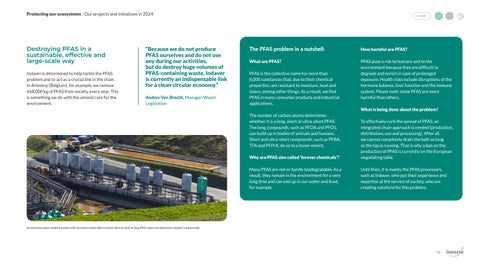
An extensive water treatment plant with activated carbon filters ensures that no short or long PFAS chains are detected in Indaver’s wastewater.
76 -