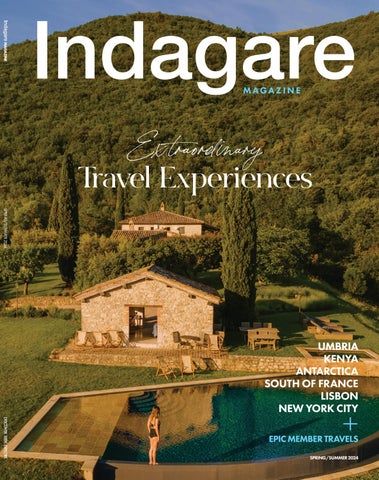
Travel Experiences
How you travel matters.
At Indagare, our mission is to inspire and empower people to change their lives—and the world—through travel. We are proud to operate as a 100 percent carbon-neutral company (all member and staff travels are offset), and donate a percentage of our annual revenue to vetted initiatives. Together, we ensure that Indagare trips help protect and sustain the destinations we love.
Let us help you make the most of your next trip. | 212-988-2611| membership@Indagare.com
Contributors
Sean Gibson
Under the Safari Sky, p. 68
Sean Gibson is a self-taught photographer based in Cape Town, with a background in fine art and music reportage—and an endless love for the ocean, nature and the outdoors.
Extraordinary Travel Experience to Remember:
“On assignment in the desert of Namibia’s Damaraland, where the light at sunset has this incredible quality (because of moisture from the coast above the dry desert). To stand in that vast wilderness and watch the dance of light—I’ve never seen anything like it.”
@seangibsonphotography
Simone Girner
Wild Child, p. 50
German-born Simone Girner wrote for Vogue, Departures and Town & Country Travel before joining Indagare as one of the founding editors in 2007.
Extraordinary Travel Experience to Remember:
“The landlocked German in me will never get over the expanses of the American West. I love to explore these landscapes that feel precious and miraculous, from the spun-sugar arches of Moab and the silence of Bryce Canyon to the red rocks of Sedona and the wild and undisciplined Joshua trees of California.” @monefoto
Elizabeth Harvey
Under the Safari Sky, p. 68
A New York City native obsessed with boutique hotels and great restaurants, Elizabeth Harvey is the Senior Editor at Indagare and has been with the team since 2017.
Extraordinary Travel Experience to Remember:
“When I visited Australia and went for a run just before sunset. In this golden hour, I jumped into the ocean with all my clothes on, completely electrified by awe and gratitude at how far away I’d managed to venture and the wonders of this amazing planet we get to call home.” @eharvsm
Mary Lussiana
Upon Arrival: Lisbon, p. 34
Lussiana is a British journalist who lives in Lisbon. She writes for Condé Nast Traveller, the Telegraph, the Times of London, the Evening Standard and Air Mail.
Extraordinary Travel Experience to Remember:
“On my first trip outside Europe when I was still a child, I remember waking up at dawn in Jerusalem and hearing the haunting sound of the muezzin calling the faithful to prayer. It was exotic and evocative, magical and mysterious. Things like that still entice me across borders and oceans today.” @unicorn_trails
INDAGARE MAGAZINE:
FOUNDER & CEO: MELISSA BIGGS BRADLEY
CHIEF OPERATING OFFICER: ELIZA SCOTT HARRIS
CREATIVE DIRECTOR: SIMONE GIRNER
EDITORIAL DIRECTOR: ANNIE FITZSIMMONS
SENIOR CONTENT & BRAND STRATEGY DIRECTOR: JEN BARR
MAGAZINE TEAM: ADAM BOOKBINDER (DESIGN). PETER SCHLESINGER, ELIZABETH HARVEY, TREY ROSS, ABBY SANDMAN, LYN HORST, SYDNEY LAPIN. THIS ISSUE’S CONTRIBUTING PHOTOGRAPHERS: JULIAN BASSERMANN, MELISSA BIGGS BRADLEY, ELIZABETH HARVEY, COLIN HEINRICH, KATHRYN NATHANSON
On
My Mind
OF EXTRAORDINARY JOURNEYS
LATELY, I HAVE BEEN hearing a kind of wistful nostalgia for travel days of the past. It seems that in the thrill of being able to explore after lockdown, we were all so excited to cross borders and thresholds again that we momentarily forgot to yearn for better travel days. But that appreciative pause appears to have ended, and pining for a more glorious past is again common, with complaints ranging from Capri having been ruined by overtourism to the disappearance of any kind of elegance in air travel. The implication: for some, travel is in danger of losing its Allure.
But, as it turns out, these complaints are not new. A few years ago, a small museum opened honoring one of the great early explorers and travel writers, Ibn Battuta, in his native city of Tangier. In the 14th century, Ibn Battuta made epic voyages east, covering more than 75,000 miles by ship, donkey and foot. His first epic journey took him along the Mediterranean to Mecca, but he eventually went all through
Get the Perks
Members who book through Indagare receive preferential rates and special amenities at 2,000-plus hotels, resorts and lodges that are part of the Indagare-Plus Program
Anatolia, Iraq and Iran and India and on to China. He traveled as far north as Astrakhan above the Caspian Sea, as far south as Zanzibar and as far east as Beijing.
The exhibitions following his journeys include writings from his chronicles, and when I read his musings on arriving in Baghdad in 1327—“Her outward lineaments have departed and nothing remains of her but the name”—I realized that places rising and falling in favor has been occurring, not just for decades, but for centuries.
Recently, I interviewed the Chilean author Francisca Mattéoli, who wrote the book Extraordinary Journeys: Louis Vuitton, for my podcast Passport to Everywhere, and we discussed what catapults a trip into the pantheon of extraordinary. We agreed that what we consider the “golden age of travel” seemed to embody both adventure and glamour. My love for both of these things may be why I’m so often drawn to safari in Africa but also why I love returning to Paris. In both places, there is a simultaneous sense of discovery as well as an immersion in history. One of the reasons that legendary hotels like the Beverly Hills Hotel, the
Cipriani or the Copacabana Palace cast such a spell over us is because, even as we make new memories, we are conscious of the stylish ghosts who have graced their halls before us.
“As we looked back on some of our most extraordinary travel memories, we both reflected on how much they revolved around taking the time to have deep conversations, even with total strangers.”
But glamour and adventure also spring from the mindset of the traveler. Francisca pointed out that slowing down was also a hallmark of that long-gone era. “People took time to enjoy the moment, to enjoy their travels. For me, that is glamorous.” Another thing that slowing down on a journey allows for is meaningful connections. As Francisca and I looked back on some of our most extraordinary travel memories, we both reflected on how much they revolved around taking the time to have real conversations, even with total strangers.
“Sometimes that makes it even more exciting, because you know that you’re never going to meet those people again,” Francisca said. “When you are in Alaska or Australia or the middle of the bush, maybe that makes the conversation even more fascinating, because you really want to absorb and learn everything you can from the people you meet.”
I, for one, am grateful to know that there are still so many amazing journeys—and travelers—out
there. I hear about them regularly from our members. One of our members who traveled to Morocco in December with her family told me, “It was a long trek to get to Dar Ahlam and the desert camp, but our Trip Designer insisted it would be worth it. One evening sitting at our camp in the desert with no electricity or Internet, I had the best conversation with my son that we’ve had in years. Neither one of us will ever forget anything about it.”
She told me this on one of our Insider Journeys to Egypt, which is an extraordinary trip for anyone privileged enough to experience it. We have gathered many such journeys in this issue: the cultural richness of Umbria; the transformational power of Kenya and Antarctica; an epic birthday celebration in Egypt. The defined meaning of “extraordinary” is remarkable, but also unusual; something that is not habitual or regular. While all travel takes us out of our daily routines and lives, certain trips can feel above and beyond—I hope this issue inspires dreams of your next ones.
MELISSA BIGGS BRADLEY INDAGARE CEO @INDAGAREFOUNDER & @INDAGARETRAVEL
Past Is Present
Indagare is a members-only boutique travel-planning company. We offer curated content, customized trip-planning and group trips around personal passions. Indagare Magazine is published twice annually exclusively for Indagare members. © 2024 Indagare. All Rights Reserved. See the magazine online at indagare.com. Reproduction in whole or in part without written permission is prohibited. Trip inquiries and change of address requests can be made by phone or by emailing info@indagare.com
Indagare
Membership Office: 212-988-2611
1177 Avenue of the Americas
New York, NY 10036 Follow
WHAT WE’RE LOVING NOW
PEOPLE • PLACES • THINGS
First Look: Singita Milele
It is not uncommon for guests to arrive at Sasakwa Lodge, proudly set on a hill within Singita’s 350,000-acre Grumeti Reserve in Tanzania, then gaze at the endless view across the savanna (often with elephants marching below) and feel speechless. “I just felt so overcome with emotion seeing that view,” one guest said around the campfire after a recent visit. Singita will open its long-awaited new villa here, Milele, in May, adding to the other Grumeti options, which include the opulent Sasakwa, the luxurious Sabora Tented Camp, the chic mid-century Faru Faru and the bright and beautiful Serengeti House.
And the view from Milele—which means “forever” in Swahili—is as stunning as from Sasakwa Hill. The five-suite property, accommodating up to 10 guests, takes full advantage of the view, from the bedrooms and living spaces to the deck, which will be used for everything from yoga to cocktail parties. There are two master suites; both have hot tubs with that unforgettable view; one even has two bathrooms—the secret to a long-lasting partnership? Each suite’s name is inspired by a group of animals (that you may have just seen on a game drive that day) such as The Pride (for lions), The Dazzle (for zebra) and The Crash (for rhinos). Among the other highlights: an expansive infinity pool overlooking the landscape, a pizza oven, a 10-person cinema, a large bar, outdoor showers and the fountains outside.
—ANNIE FITZSIMMONS
A savanna view at Singita Milele (courtesy Singita Milele) in Tanzania.
Foodie Discovery
The Alpine hamlet of Zug, which consists of a small church and maybe 20 houses, is also home to one of the finest dining experiences in Austria, possibly in all of Europe: Rote Wand Chef’s Table. Reached by underground tunnel, it’s in a former schoolhouse originally built in the 18th century, where restaurant owner Joschi Walch took classes as a boy. Baby-faced 29-year-old chef Julian Stieger—previously at Copenhagen’s Geranium, New York’s Eleven Madison Park and Vienna’s Steirereck—is the evening’s host, welcoming 14 guests to his 19-course dinners around a U-shaped counter. A series of inventive amuse-bouches gives way to larger dishes, each prepared and served with reverent choreography. When I had my first bite of Stieger’s take on Peking duck, the hallelujah choir of my taste buds erupted.
—MELISSA BIGGS BRADLEY
Helsinki Newcomer: Hotel Maria
Finland is a seriously underrated destination—and its capital city Helsinki has recently welcomed a new property changing the landscape. The 117-room Hotel Maria, opened in December 2023, is located in the city’s historic Kruununhaka district, near Senate Square, with two restaurants helmed by Noma alum Ville Rainio, a state-of-the-art spa and a boutique showcasing Finnish designers. The hotel comprises four listed buildings dating back to 1885, and the atmosphere delicately blends these antique bones with modern Finnish aesthetics.
The Mane Event
Whether the horses call for an experienced rider at the reins or are more beginner-friendly, these are the equine experiences around the world that the Indagare community can’t stop talking about.
ZEBRAS & SUNSETS
“Cuixmala on Mexico’s Pacific Coast is one of my top five hotels, and one of the highlights of my trip was our leisurely horseback ride through what feels like a land of zebras to reach the beach at sunset.” —Sarah Minges, Associate Director, Industry Partnerships
KENYAN HORSE SAFARI
“I’ve been riding since the first grade and can say Ol Donyo Lodge was hands down the coolest place I’ve ever experienced. It’s set in the Amboseli region looking out to the Chyulu Hills and Mount Kilimanjaro—totally
spectacular landscapes and the opposite of a standard trail ride. You can have a wonderful day out riding, then return to incredible luxe accommodations. Truly the best of both worlds.” —Paige Gordon, Trip Designer
SUMBANESE SOUL
“At NIHI Sumba in Indonesia, we galloped down the shoreline on our Sumba ponies during sunset. Getting to experience their gait while chasing the sun down the wide Nihiwatu Beach after a day of adventure is forever seared into my favorite memories of Indonesia. The horses feel like the soul
SHINTA MANI MUSTANG IN NEPAL
of Sumba, and the equine experiences offer horse lovers that soulful connection.” —Katie Barbatsuly, Indagare Ambassador
RIDING AT RESCHIO
“A standout at the Umbria-based property Reschio (see page 58) is the horseback-riding program. The stables and equestrian center offer discerning and advanced riders the opportunity to ride purebred Spanish horses both in the center and on the property. We sent a group of lifelong riders and horse owners here who were blown away.”
—Charlotte Clayson, Trip Designer
“I’m still finding the words to describe the joy in my heart after this trip,” said Indagare’s Sarah Minges after visiting Shinta Mani Mustang, which opened last March. The region feels untouched and undiscovered. While there are caveats (without gradual acclimatization, the high elevation could affect some people), for adventurous travelers who want to go somewhere that almost no one has been, this is one of the most rewarding trips imaginable.” Read the full review
WHAT TO WEAR WHERE
Romance by River and Rail
This season it’s all about slow-travel journeys, and few brands capture the nostalgic glamour of that bygone era like Belmond. Get the news of the overnight trains and bateaux—with style inspiration from our partners at Mytheresa, so you can dress (or dream) for the occasion.
By Elizabeth HarveyINTO THE WILD: EASTERN & ORIENTAL EXPRESS, A BELMOND TRAIN
In February, the Eastern & Orien tal Express returned to the rails of Southeast Asia for the first time in four years, with eight sleeping carriages, two restaurants, a piano bar and an open-air observation car. Two new journeys, both departing from Singapore, will bring travelers through Malaysia, introducing a locally inspired dining program by celebrated chef André Chiang (the beverage concept emphasizes botani cal-themed and vintage cocktails, as well as artisanal Malaysian coffees). In May, a limited-edi tion Tiger Express itinerary will immerse guests in the world of the endangered Malayan tigers, within Malaysia’s Taman Negara National Park—and offer the opportunity to contribute to anti-poaching initiatives and conservation efforts to protect this precious rainforest.
PLUS In May, The Royal Scotsman, A Belmond Train in Scotland, will launch two grand suites designed by Tristan Auer—and Belmond’s British Pullman train will host a new immersive cabaret dinner series called “The Carriage Club” (the first cabaret on rails), as well as the return of the beloved murder mystery-themed journeys.
ESSENCE OF SUMMER: VENICE SIMPLON-ORIENT-EXPRESS, A BELMOND TRAIN
In June, the grande dame of train travel takes off on a brand-new itinerary that will begin in Paris and the French countryside and end on the Ligurian coast, in the alluring seaside town of Portofino. Finish off the journey with two nights at the newly renovated Splendido Mare resort, which will unveil a redesign by Martin Brudnizki when it reopens for the summer season—with a final gala dinner by the train’s chef, Jean Imbert.
POP THE BUBBLY: COQUELICOT, A BELMOND BOAT
In April, Belmond debuted a new addition to its fleet of boats, Coquelicot, for a refined exploration of France’s Champagne region along the Marne River. Designed by French architects Humbert & Poye and available to book for weeklong private charters, the vessel has three lavishly appointed cabins and an open-air top deck. After a day of touring, sip in style on board in the salon or Champagne Bar, or enjoy one of the culinary experiences crafted in partnership with Maison Ruinart, the world’s oldest Champagne house. The exclusive Grand Champagne Voyage also includes visits to all of the Moët Hennessy producers.
GET PACKING: Mytheresa x Indagare
Indagare members have exclusive complimentary access to Mytheresa’s Personal Shopping service for individual styling and packing edits, making traveling in style easy. Scan the QR code to shop the looks in this article and more. To get connected with a stylist, just email myindagare@mytheresa.com to get started.
Postcard from Peru
“In the minds of many, Peru is Machu Picchu and Machu Picchu is Peru,” explains Indagare’s Hunter Clark. “But I learned from Mark Adams’s Turn Right at Machu Picchu that Earth has 34 types of climatic zones, and Peru has 20 of them. So if you minimize this rich and varied country to this one site, you are doing yourself a huge disservice.”
Clark spent the last month of 2023 discovering Peru’s history, culture and cuisine from the mountains and lakes to the cities and the countryside. “I took a nap during
a car ride and felt like I woke up in another country,” she remembers. “The landscape changed drastically before my eyes during the course of a meal on a train.”
While exploring the Land of the Incas, Hunter stayed at belovedby-Indagare properties like Cirqa and Titilaka, along with scouting newer experiences like Puqio, a luxury tented camp, and the opulent Andean Explorer, A Belmond Train. “I covered hundreds of miles in Peru, yet I still feel like I only scratched the surface,” says Clark.
FREEDOM, CELEBRATED
In a forested area along the banks of the Alabama River, Montgomery’s new Freedom Monument Sculpture Park uses art to explore the tragedy of slavery and to honor the lives of enslaved people. Installations by U.S. and international artists include lifelike sculptures and abstract works along with historic artifacts (plantation dwellings, a whipping post). The centerpiece: a 43-foot-tall, 150-foot-long monument inscribed with the 20,000 surnames that four million formerly enslaved Americans—previously known only by their first names—claimed as their own in the 1870 census. —PETER SCHLESINGER
MILAN, MY WAY
An Insider’s Mini Guide with Bea Bongiasca
One part whimsy, one part wild—wearing a stack of Bea Bongiasca’s Baby Vine rings feels like candy for your fingers. The Milan-based jewelry designer is known for her funky enamel designs and glittering semiprecious stones; her collections are beloved by celebrities and fashionistas around the globe. “My inspiration stems from my passion for pop culture, contemporary art and design, conflated with my love for everything colorful,” Bongiasca explains. “I would say mine is a spirited and nontraditional take on jewelry that does not compromise on uniqueness or on quality.”
In a city synonymous with style, our insiders keep us in sync with what’s trendy now: two of Bea’s top dinner spots include Bentoteca, for Italian-Japanese fusion, and Trattoria del Pescatore, a Sardinian fish restaurant with delectable appetizers and “huge portions” of lobster pasta.
More Milan Favorites
FOR BREAKFAST OR COFFEE
“My favorite place for breakfast is Loste Café—and unlike most places in Milan, it has oat milk for your coffee.”
FAVORITE NEIGHBORHOOD TO WANDER
“Chinatown, centered around Via Paolo Sarpi, because it has karaoke rooms, wine bars and dim sum spots. It’s also a pedestrian street making it buzzy during weekends and in evenings for aperitivos.”
FAVORITE WELLNESS RITUAL IN THE
CITY
“My favorite spa—because that is really the only ritual you can find in a city—is the Armani Hotel. It is very beautiful; it is on the top floor of the building, and has 360-degree views of the city with great natural lighting.” Read the full article at indagare.com.
Sensei Porcupine Creek
Larry Ellison, the Oracle billionaire, may have moved out, but he’s left the keys to his former home and golf course in Southern California.
A REMARKABLE DESERT mountain oasis with 22 luxurious accommodations, Larry Ellison’s retreat Sensei Porcupine Creek—with its verdant golf course, wellness sherpas and spectacular plantings— is a draw for guests seeking Eastern-inspired indulgence. From the minute the great wood entrance gates swing open in the hills above Rancho Mirage, serenity reigns; think an irrigated Eden of palms, barrel cacti and desert plantings.
Experiences center around science-based wellness programs with activities emphasizing individual physiology. Prior to arrival, a dynamic questionnaire uncovers the guest’s
background and aspirations, helping the team shape a bespoke itinerary.
Unlike many wellness-focused properties, Sensei does not constrain guests to a strict diet. Instead, when you need a break, Nobu operates a small restaurant overlooking a waterfall and a 16-seat sushi bar open only for guests. You are more than welcome to however many lychee martinis seem reasonable each evening, and even some dessert. It’s spectacular—those who are loud in taste or in conversation, go elsewhere.
—ANDREW NELSON
Read the review at indagare.com.
Experience of a Lifetime: Dragon Encounters in Komodo
National Park
One of the most extraordinary wildlife encounters is to see the storied Komodo dragon in its natural habitat, the eponymous Komodo National Park in Indonesia. A UNESCO World Heritage site, the archipelagic park comprises 29 islands, though only two, Komodo and Rinca, have resident dragons. A day spent with the largest lizards on earth may headline your trip, but it won’t be the only highlight. With rich marine biodiversity (more than 1,000 species of fish and 260 types of coral thrive here), the park has been hailed as one of the world’s top dive sites. Hop aboard one of the stunning five-cabin Rascal Voyages phinisi boats to experience all that Komodo has to offer in the most luxurious way.
—BRIDGET MCELROY
SANTA MONICA REVIVAL THE GEORGIAN
Why the Buzz
The Santa Monica icon from the 1930s reopened as the ultimate Art Deco fantasy by the beach.
Indagare Loves
The vibe that’s glam, whimsical and fun, especially in the buzzy lobby bar.
Room with a View
The First Lady Suite on the eighth floor with spot-on sunset views and on-call buttons for “Champagne,” “Dessert” or “Book Club.”
Know
Before You Go
The speakeasy-style Georgian Room is currently one of L.A.’s hottest reservations to get—plan ahead.
Look For
Novels and nonfiction by forever Cali cool-girl Joan Didion in every room. –SIMONE GIRNER
LA CÔTE D’AZUR
Travel trends come and go, but the Côte d’Azur remains an inexorably attractive destination for its limpid turquoise waters, festive beach clubs, arty cultural venues and superb regional cuisine. Here are our top picks to help you find the right place under the dazzling Riviera sun.
FOR THE DESIGN AFICIONADO
The Maybourne Riviera
Best For: Couples who cherish sleek modernist-inspired design, haute gastronomy, suites with private pools and a mesmerizing cliff-top panoramic view of the coast.
Vibe: Chic, polished, ultra-stylish
Where to Eat: Headed by Michelin three-star chef Mauro Colagreco, the top-floor panoramic restaurant Ceto features exquisite, innovative seafood; the Riviera Restaurant serves a range of regional dishes from the Riviera, Corsica and Liguria; the more casual poolside eatery offers chef Jean-Georges Vongerichten’s healthy menu.
Top Tips: Book a signature Flying Cloud massage or Augustinus Bader facial in the holistic spa; take the shuttle down to the small private beach club by the rocks; reserve a visit to Eileen Gray’s nearby modernist masterpiece Villa E-1027 alongside Le Corbusier’s beach hut.
FOR THE EXCLUSIVE SCENE SEEKER
Hôtel du Cap-Eden-Roc
Best For: Couples or families with older children who cherish this storied glitzy seaside palace for its sheer beauty—vast manicured gardens, windswept pines and the iconic rock pool where you’re likely to be doing laps alongside a major movie star.
Vibe: Über-glamorous, sophisticated, private
Where to Eat: Elegant Mediterranean cuisine at the Restaurant Louroc, helmed by Michelin-star chef Sébastien Broda, open for dinner; breakfast and Mediterranean-style lunches are served on the sunny terrace of the Restaurant Eden-Roc; for all-day service, the Grill Eden-Roc offers a range of salads, pasta and fish. The recently added casual Italian eatery, Giovanni’s (for guests only), is hidden away in the pine forest. Add to that numerous spots for cocktails, from the Eden-Roc Lounge to the Bar Bellini.
Top Tips: Book one of the redesigned contemporary sea-facing junior suites at Eden-Roc. And the recently opened Dior Spa, housed in a jewel-box pavilion, offers exclusive body and facial rejuvenating treatments, also available in the privacy of a specially outfitted Dior seaside bungalow.
FOR THE CITY SLICKER La Pérouse
Best For: Couples, families and groups who enjoy exploring the spirited neighborhoods of Nice’s Old Town and the antique-shop district near the port, but who want a berth near the beach.
Vibe: Stylish urban oasis, relaxed
Where to Eat: The hotel’s charming indoor/outdoor Le Patio, surrounded by lemon trees, serves excellent Mediterranean-style specialties. Across the street at the water’s edge, try the recently opened and elegant seafood haunt, Les Bains du Castel.
Top Tips: Take advantage of Nice’s effervescent art scene and plan a visit to the Chagall Museum and the Matisse Museum. Pick up olive oil, soap, dried herbs and hip streetwear in the labyrinthic alleyways of Vieux Nice, then head to the city’s Golden Triangle, a short stroll away, for serious brand-name shopping.
FOR THE TRADITIONALIST
Grand-Hôtel du CapFerrat, A Four Seasons Hotel
Best For: Couples and families with children who appreciate a quiet pocket of elegant seaside splendor, lush gardens, a stunning Olympic-size seawater pool and contemporary Pierre-Yves Rochon–designed rooms.
Vibe: Belle Époque grandeur meets clean-line modernity
Where to Eat: Choices abound for every mood: a gastronomic feast at the intimate Le Cap; Mediterranean fare under the pines at La Véranda or at recently spruced-up Club Dauphin; romantic dinners à deux in a vegetable garden tucked away on a bluff in the neighboring heights, La Table du Potager, all headed by Michelin two-star chef Yoric Tièche.
Top Tips: For special occasions, book the newly restored five-bedroom private hideaway Villa Beauchamp surrounded by lush landscaped gardens where you can lounge in a seaside cabana with a killer coastal view. For kids, there is everything from tennis to swimming, plus pastry classes, mocktail concocting and specially designed spa treatments for children.
FOR THE UNDERSTATED
ELEGANCE ENTHUSIAST
La Réserve de Ramatuelle
Best For: Couples and families looking for a relaxing retreat atop a wooded bluff with colossal-sized suites or private villas, only a 15-minute drive from buzzy St. Tropez. Highpoints include a serious wellness and fitness boot camp program, a sprawling state-of-the-art spa and outdoor pools.
Vibe: Stylish, unfussy, serene, upscale
Where to Eat: The two Michelin-starred restaurant La Voile helmed by chef Eric Canino features superb Mediterranean-inspired tasting menus; the sea-facing La Brasserie offers a variety of dishes from seafood to grilled meats; a third dining spot, Les Terrasses la Muña, excels in refined Japanese dishes.
Top Tips: Star attraction: the Pampelonne outpost, La Réserve à la Plage, the hotel’s private beach club with shuttle service. Expect a Starck-designed restaurant with a thatched wood roof and marble bathrooms and an upbeat boho chic vibe that attracts both families and the overspill crowd from Club 55.
FOR THE ON-THE-BEACH LOVER
Château de Théoule
Best For: Couples and families with children looking for a base in an artfully restored castle. Swim, relax, enjoy the spa and also explore the wild hiking trails of red rock Estérel.
Vibe: Romantic, intimate, serene
Where to Eat: The beach restaurant, La Plage Blanche, located on a curve of sand, features delicious local cuisine and freshly caught platters of fish. The convivial sea-facing bistro offers fine Italian cuisine and a variety of Mediterranean dishes.
Top Tips: Take a spin on the winding coastal road with its heart-stopping views of turquoise creeks; visit the nearby Château de la Napoule for its gardens and eclectic art by Henry Clews Jr.; indulge in a shopping spree in Cannes, only eight miles away.
News to Know
The summer opening of the groundbreaking 88room five-star Hôtel du Couvent—a 17th-century former convent hidden on a hill in Vieux Nice—is bound to put France’s fifth-largest city on the luxury traveler’s map. With three restaurants and three pools including a restored Roman bath, plus a spa, extensive gardens, a bakery, a bookstore and colossal suites, this neo-resort is also just minutes away from the Promenade des Anglais and the beachfront.
Be prepared for sassy stripes, bold colors and retro glamour at the newly opened AREV St. Tropez, a 43-room boutique hotel tucked away on a private landscaped property near the
Place des Lices and village shops. Highlights include a dreamy pool, a paddle court, a spa with a beauty line of Mediterranean salts and herbs, plus a reinvented dining haunt of the Strand Restaurant and Lounge, the oldest eatery in St. Tropez.
In Ramatuelle, the members-only, on-the-beach bungalow enclave Épi 1959 (left) is now offering daily, monthly or seasonal membership for access to their acclaimed spa, tennis courts and other sports activities, as well as two lovely pools and a clubhouse restaurant.
Visit indagare.com for our guide to the French Riviera with Where to Eat and Shop, plus 36 hotel reviews, bookable online.
FASHION FORWARD
Indagare founder Melissa Biggs Bradley explains why Indagare Fashion Trips are not actually about shopping.
OVER THE PAST SEVEN YEARS, I have led multiple fashion-focused trips in partnership with Vogue to Paris, Milan and Rome, and what I—and those who attend—love about them is that they are far more than shopping trips (though they will certainly increase your appreciation of what it takes to create fine things). They offer insight and immersion into the social history and economic life of the locations while celebrating a daily ritual that too often can be taken for granted: clothing ourselves. Just as we must eat, so we must dress ourselves every day, and in both of these exercises one can either go through the motions with minimal effort or elevate one’s appreciation of the ritual. How? By embracing creative expression and modern innovation and gaining a deeper understanding of the origins, craftsmanship and context of, for instance, the stiletto, the Bar Jacket or the miniskirt.
“What you wear is how you present yourself to the world, especially today, as human contacts are so quick,” Italian designer Miuccia Prada once said. “Fashion is instant language.” And as a language, fashion also tells the story of a time and place, which is why our Indagare fashion trips to Paris and Milan are not “shopping trips,” though purchases often happen along the way.
Rather, they are deep dives into the psyches of the destinations as well as occasions to dress up and to find inspiration for daily life and, even, for healing. “In the hospital, I had an ad for the trip pinned up by my bed. I have always wanted to work in fashion, and this Paris trip was my dream,” explained a young California woman traveling with her mother on the first night of our most recent Paris fashion trip. She had suffered a sports injury
a year before and, at one point, thought she might lose her foot. “Her rehab was brutal, but coming on this trip became part of the recovery goal,” her mother explained.
On our Paris trips, we often begin with a visit to the former home of Louis Vuitton, on the outskirts of Paris. Sitting in one of the best-preserved examples of an Art Nouveau interior, we hear the story of a teenager—Louis Vuitton—who walked to Paris in search of work, arriving in 1837, and ultimately revolutionized the art of packing with technical innovations like an unpickable lock and the flat-topped, stackable trunk.
The Sun King, Louis XIV, may have planted the seeds to establish France as the ultimate trendsetter of global luxury when the fashions of his court spread around Europe in the 18th century. But it was Louis Vuitton’s innovations in the 19th century, and those of his son, Georges, who furthered France’s export of its reputation for excellence when he emblazoned the trunks of the era’s elite with his father’s initials and opened international boutiques. With visits to archives, museums and private fashion shows, we toggled back and forth between the past and the present, meeting with designers like Inès de la Fressange, Andrew Gn, Bruno Frisoni and Rabih Kayrouz, and noticed the threads that connect them all. At the oldest surviving fashion house, we traveled back in time with a rare visit to the office of designer Jeanne Lanvin. Like her competitors Coco Chanel and Elsa Schiaparelli, Lanvin wasn’t just influencing the way women dressed in the 20th century but how they lived. As early female entrepreneurs, all three were pioneers in fashion, business and independent living. Both Lanvin
Scenes from our style-focused Indagare Journeys to Paris, Milan and Rome, this page and opposite (top left and bottom).
all of the top luxury brands, from Hermès to Dior, have their silks made in Como, as we saw firsthand on our most recent Milan trip when we visited the factory and saw next year’s designs in production. And textile innovation has continued with cashmere kings like Loro Piana and knitwear engineers like Missoni; the latter’s headquarters thrum with looms spinning out the brand’s unmissable multicolored checks, waves and stripes. Ottavio Missoni Jr., one of the grandsons of the founder, toured us through HQ, where designers and seamstresses finished the latest resort collection. The interplay between fashion and the arts is an element shared in both France and Italy, as is the role of enterprise to give back to the community. Such important cultural contributions to the cities of Paris and Milan as the Louis Vuitton Foundation and the Prada Foundation are obvious demonstrations. Others like Diego Della Valle’s support of the restoration of the Colosseum in Rome, or Dolce & Gabbana’s support of Milan’s La Scala, may not be as well known.
and Schiaparelli divorced their first husbands and raised their daughters as working mothers. Their flowy skirts, sport collections and daring culottes allowed women to escape corsets, but their personal lives also signaled a freer form of thinking.
If French fashion illustrates the country’s obsession with heritage, excellence and artistry, Italian fashion celebrates global influences, homegrown ingenuity and family. In the 15th century, the Duke of Milan, Ludovico Sforza, began planting mulberry trees in the marshlands around Lake Como and established the first hub of silk production outside of China, thanks to silkworms that had been smuggled back to Italy. Still today,
In this same spirit, we always hold our farewell dinner in Milan at the Villa Necchi, the extraordinary villa designed by Italian architect Piero Portaluppi that has played important roles as a symbol of Milanese elegance in films like I Am Love and The House of Gucci. Built for the Necchi family, the villa was inhabited by the patriarch’s two daughters their whole lives, before it was donated to FAI, a nonprofit that protects historic Italian properties. In the candlelit dining room where fashionable spirits of the past hover still, some raved about special moments like meeting designers in their ateliers or touring the silk archives in Como, but the consistent theme was the joy of sharing these moments with a newfound group of friends bonded by curiosity and enchantment. I thought of the moment in Paris when we gathered with former model and designer Inès de la Fressange, brand ambassador of Roger Vivier. She shared stories of Vivier, father of the stiletto, and of Karl Lagerfeld, longtime designer of Chanel. As mesmerizing as Inès was, though, the night’s highlight was when the young California girl slipped on a pair of Vivier heels. We, especially those of us who knew that she had been afraid she might lose her foot after her injury, all shared in a moment of Cinderella-like triumph as she stepped gingerly around the store, reminded that fashion is a language, but it is also the foundation of dreams and new inspiration.
JOIN INDAGARE IN PARIS
Melissa Biggs Bradley returns to the City of Light, November 1116, 2024, for a behind-the-scenes exploration of the world’s fashion capital, its heritage and history. Connect with designers and influencers during private receptions at the ateliers of legendary French fashion houses—along with chic dinners, history-focused tours and cultural activities. Learn more at indagare.com/journeys
FOUR WAYS
ANTARCTICA FOUR WAYS
Five members, including COO discuss the different journeyed to White Continent—along with their favorite moments, itinerary
Five Indagare staff members, including founder Melissa Biggs Bradley and COO Eliza Harris, discuss the different ways they journeyed to the White Continent—along with their favorite moments, itinerary insights and what type of traveler this intrepid adventure is right for.
IT’S TREACHEROUS, BEAUTIFUL, POWERFUL
IT’S TREACHEROUS, BEAUTIFUL,
travelers. “It is not a destination that bends to your
, and I think the only way to feel more humbled by nature would be if you were in outer space looking back,” says Indagare founder Melissa Biggs Bradley of her journey to Antarctica, the frontier that captivated the minds of sea captains, explorers and theologians even before they could prove its existence. In the last century, the continent has become an object of study for scientists and climate change warriors— and it certainly has not escaped the attention of nature-loving traveler. “It is not a destination that bends to your whims,” says Indagare’s Lexi Polster, who traveled there in early 2022. “You have to be comfortable challenging your comfort level. Anyone who needs flexibility, an itinerary, a set number of nights… it’s just not a good fit.” And for those boundary-pushing explorers, five members of the Indagare team have taken to the seas (or the skies) to explore the White Continent.
Here are four ways to plan a trip and what to know about each experience.
Quark Expeditions
Ultramarine or World Explorer
Length: 8-14 days
everything you see has been created by Mother Nature and left untouched by man. There’s literally no trace of civilization, and witnessing that beauty changes you.
In my mind, I made no qualms about the fact that it was a bit of a wasteland; gale force winds, snow everywhere, not a lot to see. What surprised me the most is that it is a vibrant ecosystem. There are tons of birds around, penguins, terns, six different kinds of whales… you really do feel like you’re not just in an untouched world, but in an untouched ice jungle.”
~ Melissa Biggs Bradley, Indagare Founder
Indagare Founder
What is the one-night camping experience?
“After dinner, everybody boarded the Zodiacs, went to this little island. And at this point, it was around 9:00 p.m.—still bright as day, I should say. And we basically dug into the snow, laid down some sleeping bags and crawled inside. The sleeping bags were beautiful and warm, and I lay awake probably until 4:oo a.m., just listening to the sounds of glaciers calving next to us and penguins bobbing and squawking.” ~ Colin Heinrich, Director of Global Impact
~ Colin
Getting There: Fly to Ushuaia, Argentina and board the ship Drake Passage: One way or both ways
Favorite moment?
Ushuaia, Argentina and board the ship
“The helicopter flyover of Antarctica... we woke up one morning and it was a beautiful blue sky day and we were able to fly over the crevasses and icebergs. The mountains of snow stretching to the horizon added another dimension to the humbling experience of the trip.”
How did Antarctica surprise you?
“You cannot anticipate being on a continent where
Length: Five-day minimum (or a day trip)
Getting There: Private flight from Cape Town
Drake Passage: No Camping in the interior with White Desert
Director of Global Impact quite
What is camping with White Desert like?
“I would compare it a little bit to being at an African safari tented camp. You’re in these heated pods (including bed, bathroom set-up, table and chair), and they’re quite toasty… Then every morning you get completely kitted out in all your gear, and you go into breakfast, and at breakfast they tell you ‘this is the excursion that we’re going to do today.’ Because of
Antarctic adventures, clockwise from top left: World Explorer in Neko Bay; ice hiking; White Desert pod; emperor penguins.
the winds, you have to be really flexible and the excursions are going to be what they are going to be.”
Amazing activity?
“We spent three hours with the emperor penguins—we saw the fluffy babies and the parents going out to fish on the icebergs. And they’d come flopping back on their bellies to feed the babies beak to beak, and we just watched this all unfold… There’s nobody who sees that other than the people who stay at White Desert and scientists.”
~ Eliza Harris, COO
Length: 6-12 days
Getting There: Fly from Santiago, Chile to either Punta Arenas or Puerto William Drake Passage: On10- and 12-day itineraries
Why sail the Silver Endeavor?
“I definitely had anxiety about traveling to Antarctica, and as soon as I stepped foot on this boat, a lot of that went away just because I felt that I was on a vessel where hospitality and comfort level were definitely a priority… This boat also has the highest Zodiac to guest ratio of all the boat offerings in Antarctica. So you don’t have to miss any of the experiences.”
What are the cons?
“Some people are going to Antarctica with more of this explorer mindset where they want to be on a boat that matches the sort of experience they’re going to have. On the
Silver Endeavor, you have to be okay with coming back from a landing where you are in a very wild setting and walking past people getting their nails done at the salon.”
~ Caroline Hansen, Trip Designer
Express Route: Antarctica 21 Magellan Explorer
Length: 5-7 nights
Getting There: Fly from Punta Arenas to King George Island and board the boat
Drake Passage:$ No
What is the ship like?
“The Magellan Explorer is currently the smallest luxury ship available in Antarctica. It’s just 73 passengers. I would say there are some trade-offs with a smaller ship, namely that you don’t have as many amenities… and then on the upside, with so few passengers, they’re able to get everyone off of the ship for each landing.”
Favorite activity?
“The snowshoeing was so much fun. We got really lucky with our bluebird day, and it was one of the most special hikes that I’ve ever done, even though it was one of the shortest.”
~ Lexi Polster, Trip Desinger
To learn more about travel to Antarctica on all four routes, listen to Indagare founder Melissa Biggs Bradley’s podcast Passport to Everywhere, Episode 22: Know Before You Go: Antarctica. Go to indagare.com/ passport-to-everywhere.
TRIP TIPS
You should consider Antarctica if you’re a nature lover and would consider yourself an explorer. It’s not a destination that bends to your whims—it will probably challenge your comfort level. Anyone who needs flexibility, an itinerary, a set number of nights and wants to have control over what they see and do, it’s not a good fit.”
—LEXI POLSTER, TRIP DESIGNER
“Leave a time buffer on either side of your trip because weather can really delay things.”
—MBB
“When we were going through the Drake Passage, we would have multiple lectures each day and I would encourage people to actually go to those and really listen in, because that’s actually for me where I felt like I learned the most… from conservation elements to the history.”—Caroline Hansen
“It is so easy, especially with the midnight sun, to be tempted to just stay up all night… but it is so important to try to get as much sleep as possible. The cold when you’re there just saps your energy.” —Colin Heinrich
“I would say relish the silence and the stillness. The most profound moments are really just sitting back on your balcony… and it feels like there’s no one else there but you.”—LP
“There’s two excursions a day normally, and I always recommend bringing a camera for one and leaving it at home for the second. In such a unique environment, it’s easy just to record; instead, be present.”—Colin Heinrich
City Scene
WHAT’S NEW IN NEW YORK
The Empire City is looking forward to a season filled with exciting new hotel and restaurant openings and thrilling exhibitions and cultural events—proof that New York never stops. Elizabeth Harvey reports.
WHERE
TO REST & REVIVE The Hotel Scene
Orchard,
WHERE TO TASTE & IMBIBE
New
Restaurants to Know
One of Manhattan’s underdog neighborhoods, Midtown, is claiming a renewed place in the culinary lexicon. Chef Michael White (who created Marea, Osteria Morini and Ai Fiori) will open a new Italian restaurant at 520 Madison Avenue—while just a few blocks away, Jean-Georges Vongerichten has launched Four Twenty Five on Park Avenue. Occupying 14,000 square feet over the bottom two levels of an office building, the restaurant was designed by Pritzker Prize-winning architect Sir Norman Foster, with a show kitchen, cocktail lounge and specially commissioned artwork.
Simon Kim (of the Michelin-starred Korean mainstay Cote) will open another multilevel dining space at 550 Madison Avenue after launching Coqodaq, a Flatiron restaurant dedicated to fried chicken and Champagne. Iron Chef star David Burke also recently debuted an all-day modern-American brasserie, Park Ave Kitchen, on 47th.
Hotel, The Warren Street Hotel, opened in February; already the bright cerulean exterior has become a fixture of the neighborhood. Of the 69 rooms and suites, the best ones are equipped with private garden terraces, with layered, textured interiors, lovingly (and playfully) curated by Kit Kemp (standout details include Pierre Frey wallpaper and a global selection of artworks). There’s also a buzzy restaurant, bar and lounge. Later this year, The Twenty Two—a hotel, restaurant and members’ club that made a splash in London’s Mayfair when it launched last spring—is
Buenos Aires
The development boom that began in 2021 and brought over a dozen spectacular new luxury hotels to the city (among them the Aman, Nine Orchard, the Fifth Avenue Hotel, Hôtel Fouquet’s New York and the Ritz-Carlton NoMad) continues this spring. The new Tribeca sister property to The Whitby and Crosby Street Hotel, The Warren Street Hotel, opened in February; already the bright cerulean exterior has become a fixture of the neighborhood. Of the 57 rooms, the best ones are equipped with private garden terraces, with layered, textured interiors, lovingly (and playfully) curated by Kit Kemp (standout details include Pierre Frey wallpaper and a global selection of artworks). There’s also a buzzy restaurant, bar and lounge. Later this year, The Twenty Two—a hotel, restaurant and members’ club that made a splash in London’s Mayfair when it launched last spring—is expected to arrive in Manhattan with the same bold design and insider atmosphere. By the end of 2024, in a lofty perch above the High Line (in the XI Towers by Bjarke Ingels), Faena will open its fourth property—expanding beyond Buenos Aires and Miami—with 120 rooms and suites designed by Gilles & Boissier and river views. Locals should keep an eye on the area (between Chelsea and Meatpacking), as the hotel is expected to host a variety of entertainment, nightlife, arts and retail outlets, including a 5,000-square-foot restaurant and a 17,000-square-foot spa. Uptown, the historic Surrey hotel will be reborn as a Corinthia property by the end of the summer. First established in 1926 on Madison Avenue (and frequented by the likes of John F. Kennedy and Bette Davis), the new Corinthia New York will have 70 guest rooms, 34 suites and 14 residences.
The interest in private clubs and clublike restaurants continues, with the creation of Frog Club in the West Village from chef Liz Johnson (behind Horses in Los Angeles). Calling itself the New Yorkiest Room in New York, the restaurant even has a list of rules (including “no photos”) and decidedly quirky, frogthemed décor. Within a two-floor private members’ club in Hudson Yards designed by Ken Fulk, Major Food Group’s ZZ’s Club and Carbone Privato were unveiled just before the end of last year. And London nightlife magnate Robin Birley is opening a private dining club, Maxime’s, in the former Westbury Hotel at 828 Madison Avenue.
Hotel
Meanwhile, several beloved brands are launching new projects, like San Sabino, an Italian pasta and seafood restaurant in the West Village, from the owners of Don Angie. Also in the West Village, chef Quang Nguyen, formerly of Wildair, has opened Demo, a wine bar with a serious culinary focus, on Carmine—while chef Fidel Caballero, formerly of Contra, has created Corima, in Chinatown, exploring the relationship between northern Mexican and
The bar-lounge at The Warren Street Hotel in Tribeca, New York City.
Japanese cuisine. The creators of Crown Shy and Saga are starting a new concept on Park Avenue South at 26th Street, with a seafood-focused menu (and a bakery during the day). From over-the-top omakase restaurant Sushi Noz, Chez Fifi opens this spring on the Upper East Side, serving French cuisine in a vintage-styled town house. Actor Michael Imperioli (of The White Lotus and The Sopranos) has returned to the bar world with a new Art Deco lounge on the Upper West Side, Scarlet, which evokes the speakeasies of the Prohibition era. Alexandra Shapiro has revived her father’s 1980s Upper East Side restaurant, Hoexters, as a “neighborhood brasserie” (the double smash burger is a must-try).
A new Thai restaurant called Sappe, from the team behind Soothr, debuted in Chelsea, with neon lights and inventive cocktails. The minds behind top Indian restaurants Dhamaka and Semma have launched a Filipino tasting menu at Naks The chef of the Parcelle wine bar opened a Chinese restaurant on Canal Street, Tolo. Plus: alums of Copenhagen’s Noma are taking the city by storm. Cofounder Mads Refslund established Ilis in Greenpoint this past fall, and Empirical Spirits, a liquor brand from Lars Williams and Mark Emil Hermansen, is expected to open soon with a tasting room and distillery in Bushwick.
WHERE TO WANDER & WONDER
Arts & Culture
On May 6, the Met Gala opens the spring season—this year, themed around “The Garden of Time.” The accompanying Costume Institute exhibition, “Sleeping Beauties: Reawakening Fashion,” will feature a display of over 200 rare (and even centuries-old) pieces from the permanent collection, including designs by Schiaparelli, Givenchy and Dior. The 2024 Whitney Biennial, “Even Better Than the Real Thing,” began on March 20, featuring 71 artists and collectives; it is the longest-running showcase of American art. On May 18, the New York Botanical Garden shows off its new rebrand with “Wonderland: Curious Nature,” which brings the fantasy of Alice in Wonderland to life with a transformation of the garden’s 250 acres. Look for an exhibition on the history and botany of Lewis Carroll’s tale.
At the Brooklyn Museum, “Giants” presents the first major exhibition of the private art collection of Alicia Keys and Swizz Beats, featuring pieces from such artists as Jean-Michel Basquiat, Kehinde Wiley and Gordon Parks (through July 7). Also, earlier in April, “Hiroshige’s 100 Famous Views of Edo (Featuring Takashi Murakami)” went on display, marking the first time in over two decades that Utagawa Hiroshige’s complete set of prints capturing 19th-century Tokyo has been shown, and starting May 3, “Paul McCartney Photographs 1963–64: Eyes of the Storm” gathers more than 250 photos taken by the legend at the peak of Beatlemania (the photos were recently rediscovered in McCartney’s archives). History lovers may also enjoy “New York Before New York: The Castello Plan of New Amsterdam” at the New-York Historical Society, a celebration of the 400-year anniversary of the founding of Manhattan by Dutch settlers (through July 14). Later this year, the Frick Collection reopens after a $160 million renovation. An expansion includes the mansion’s second floor (where a gallery of decorative panels by François Boucher is reinstalled to their original location when Henry Clay Frick lived there).
Midtown, one of Manhattan’s underdog neighborhoods, is claiming a renewed place in the culinary lexicon this spring.”
ON THE STAGE
Theater, Dance and Music
After selling out its season at The Public Theater, the musical Hell’s Kitchen, featuring the music and lyrics of Alicia Keys and a script by Pulitzer finalist Kristoffer Diaz, moves to the Shubert Theater on March 28 (through September).
A headlining revival of Cabaret will fill seats at the August Wilson Theatre, with Eddie Redmayne starring as the Master of Ceremonies and introducing Gayle Rankin as Sally Bowles opened April 21).
The traveling circus of the best-selling novel Water for Eletakes the stage at the Imperial Theatre, starring Grant Gustin and Isabelle McCalla (opened March 21).
In another novel adaptation, S.E. Hinton’s coming-of-age story The Outsiders brings Ponyboy and Johnny to Broadway, with Angelina Jolie as a producer (through September 8).
A revival of the 1970s Tony Award–winning gospel-and-rock musical The Wiz comes to Broadway, with choreography by the creator of Beyoncé’s “Single Ladies” and “Formation” routines, JaQuel Knight, and set design by Hannah Beachler, who worked on Black Panther (opened April 17).
Steve Carell makes his Broadway debut at the Lincoln Center Theater in Uncle Vanya alongside Alfred Molina. The Anton Chekhov drama, set in the Russian countryside, digs into unrequited love and resentment (opened April 24).
At the New York City Ballet, the spring season presents new performances from choreographers Justin Peck and Amy Hall Garner alongside masterworks by George Balanchine and Jerome Robbins, as well as recent crowd-pleasers by Kyle Abraham and Gianna Reisen. And at the Joyce Theater, more than 20 companies will take up residence by the end of the year, including a next generation of dancers with American Ballet Theatre’s Studio Company (May 1-5) and Ballet Tech’s Kids Dance (May 30-June 2).
The New York Philharmonic is getting settled into its new state-of-the-art home at the renovated David Geffen Hall, with upgrades including a Grand Promenade on Broadway for public performances and an in-the-works “patrons lounge.”
At the Metropolitan Opera, the centenary of Puccini’s death is celebrated with La Rondine, Turandot and Madama Butterfly New productions include Carmen by Georges Bizet (through May 25) and El Niño by John Adams (through May 17). There is also a revival of the acclaimed 2021 production of Terence Blanchard’s Fire Shut Up in My Bones (through May 2).
SCOUTING COURCHEVEL & PARIS
THE PALACES DE FRANCE designation is a symbol of French excellence in hospitality, a distinction currently awarded to just 31 hotels. To put it simply, it differentiates the great from the exceptional. Indagare has partnered with Palaces de France to examine just what makes a Palace hotel a Palace. Eric Boonstoppel, the Head of Operations for Cheval Blanc, described the distinction by likening a Palace hotel to a three-Michelin-starred restaurant—as he explains, “a Palace is worth the trip.” This year, Melissa Biggs Bradley and Kathryn Nathanson will visit all 31 hotels for a five-part video series exploring what makes these hotels so special. To start, they visited the five Palace hotels of Courchevel and visited seven out of the 13 Palaces of Paris. Here are just a few of their discoveries—many more can be found on indagare.com
Courchevel
Once a quaint French ski resort, Courchevel has morphed into a place that—at least on the surface—is all about extravagance and the scene. Courchevel is part of Les Trois Vallées, or “the three valleys,” the largest connected ski area in the world; seven resorts are linked across the three valleys. In Courchevel, there are multiple different villages, each with a unique atmosphere. Courchevel 1850 is the highest of the
RESTAURANT FINDS
Le Sarkara for a two-Michelin-starred gastronomic (i.e. savory) pastry experience by 2024’s World’s Best Pastry Chef, Sébastien Vauxion.
Le Bottleneck for cheese (fondue!) and grilled meats. The escargot is also a standout.
La Terrasse de Cheval Blanc for the slopeside scene and live music.
Le Chalet de Pierres for the perfect mountain lunch.
Le Cap Horn and La Folie Douce for the best party scenes on the mountain.
A terrace view from Hôtel de Crillon, Paris. Clockwise from below: courtyard dining at the Crillon; Chef Sébastien Vauxion at Le Sarkara in Courchevel; a room at L’Apogée; a L’Apogée view.
villages, at 1,850 meters (roughly 6,000 feet), and it is by far the most glamorous, while the other villages are considerably more laid-back. Its high altitude means that 1850 has more reliable snow through the winter and, no surprise, it is also home to the area’s most luxurious hotels. Five of the Palace hotels are in Courchevel; Melissa and I scouted Le K2 Palace, Oetker Collection’s L’Apogée, Cheval Blanc Courchevel, Les Airelles and Barrière les Neiges.
Paris
The city has been primping for its global prime time for years; the Summer Olympics will run from July 24 through August 11. There are 13 Palaces de France hotels in Paris, including our favorites the Plaza Athénée, Hôtel de Crillon and Le Meurice. Plus, here are a few of Melissa’s picks from her recent scouting trip.
EAT
In Paris, you can still dine in incredible temples of gastronomy like Epicure and Arpège, where a vegetarian fine-dining experience can be rhapsodic, but you can also find seriously great burgers at new places like Dinand, the Ferdi outpost. For a casual but very French lunch or dinner, a new favorite brasserie is Alfred, in the 1st arrondissement, which serves comfort-food classics. I also like Shirvan on Avenue Georges V or, for Lebanese cuisine, try Liza.
SHOP
It is great fun to hunt down the smaller independent shops, which are scattered all over the city. A favorite new find in the Marais: Le Nom, which opened last fall and offers personalization of bags–from small leather pouches to round bucket bags. You can customize color, shape and size as well as the color and font for your name, phrase or word that is painted on your item (ooh la la and Mon Amour are some popular choices).
Read Melissa’s full Spring Dispatch from Paris as well as one of our most popular stories, Shopping with a Teen in Paris, at indagare.com
Salons Elie Top meanwhile is an under-the-radar brand that is popular with super stylish women who trust their own taste and don’t care about big brands. Catherine Deneuve, Kristin Scott Thomas, Naomi Campbell and Inès de la Fressange are all fans of the designs of Elie, who began his career at 19, working with Yves Saint Laurent and Loulou de la Falaise before becoming the head of couture jewelry for Lanvin under Alber Elbaz. In an apartment space tucked into a courtyard off the Rue St. Honoré, his upstairs atelier feels like a cross between an artist’s office and a chic sitting room.
Coming Soon: “A Legacy of Excellence,” a five-part video series on the Palaces de France, produced by Indagare.
LISBON Upon Arrival
Mary Lussiana shares her latest intel on the highly acclaimed Palácio Príncipe Real, while hearing from its owner, Gail Curley, on where to eat, shop and drink, and what to see, in her insider take on Lisbon.
THERE ARE FEW BETTER PLACES to base oneself at in Lisbon than Palácio Príncipe Real. Firstly, it puts you within reach of the capital’s main sites, best restaurants and most interesting concept stores, but the large and leafy garden offers a welcome respite from the cars, crowds and steep cobbled streets beyond its walls. And, under the purple jacaranda tree, there is a sleek pool which, quite often, is exactly where you want to be on a hot Lisbon afternoon.
And, where
Inside the 25-room palace, there are fresh flowers on every surface. There are rooms whose doors open wide onto a terrace overlooking the greenery. And there is a room—called the Romeo and Juliet Suite by British owners Gail and Miles Curley—with a twisting staircase that takes you down from its French window to the foot of the scarlet bougainvillea that flaunts itself unashamedly along one garden wall. Breakfast can be enjoyed in the garden, accompanied by the resident blackbirds in full song. Lunch under the pink umbrellas could include
for a glass of crisp Portuguese white sun
the healthy black rice and mango salad; or, go straight to the chocolate, ginger and lavender tart. Settle into a chair for a glass of crisp, Portuguese white as the sun goes down or dine on beetroot risotto. Every room here is different, but a sense of place looms large. There are old blue-and-white tiles in what used to be the palace kitchen and a ceiling of intricate stuccowork which nods at the Moorish wonders in Cordoba. Coffee and tea, white wine and port, chocolate and energy balls are replaced in your room each day.
Gail and Miles Curley fell in love with this 19th-century palace on a visit to Lisbon and decided to become accidental hoteliers after Miles retired from his life as a lawyer. Restored with love by Gail, this has been a decade-long passion project. Having combed the capital’s streets and beyond to fill the Palácio with the best of Portugal and to test recommendations for her guests, she lets us in on some of her favorite places—and ways to explore the city.
A room at Palácio Príncipe Real, Lisbon; below, the pool and grounds. Opposite: A sunset cruise on the Tagus river.
CAFFEINATE
“Bettina Corallo at the top of our street roasts coffee beans from their own plantation in São Tomé and Principe and the aroma is wonderful as they prepare your coffee.”
BREAKFAST AND BRUNCH
“I love to have breakfast in the garden, as the sun comes up behind our palace. Miles has an olive farm in Spain dating back to our life in Madrid, and my go-to breakfast is sourdough with avocado, tomato and roasted seeds, topped with a very generous drizzle of his organic olive oil.”
PERFECT LUNCH
“A few minutes’ walk from here is Tapisco, a restaurant by Portuguese chef, Henrique Sá Pessoa. It is a blend of the best Spanish tapas and petiscos from Portugal. It’s all about sharing in a fun atmosphere. On a sunny day, Miles and I sometimes escape and head to the beach in Caparica, about 25 minutes from here, where we eat freshly caught barbecued fish and local clams ‘ameijoas a Bulhao Pato’ at Borda d’Agua.”
SHOP
“I often walk down to Traces of Me, an ethical designer brand from Portugal with eclectic silk scarves that I love. Skinlife is a wonderful store for luxury scents and skincare, with new brands arriving all the time and a good place to find old favorites like Diptyque. Next Memory is their sister shop in a former apothecary just off the main Avenida, where I buy their own brand of candles and room scents, always beautifully packaged and wonderful for presents. For my shoes, I choose Lachoix, an exciting range of comfortable and stylish shoes, perfect for Lisbon’s cobblestones.”
RESTORE
“I take a yoga mat (all guest rooms have one) out to our garden and find a quiet corner to practice some sun salutations—and breathe.”
CULTURE MOMENT
“The Gulbenkian Museum houses one of the world’s most important private art collections. It is an absolute treasure trove spanning centuries, and a fascinating introduction to the amazing history of our adopted country.”
THE BEST TOUR
“Seeing Lisbon from the river. A sunset cruise is the perfect way to end a day of sightseeing.”
IMBIBE
“A fun place to go for a drink is JNcQUOI. It is great for people-watching, has an excellent wine list, friendly sommeliers and the added advantage of a wonderful collection of Assouline books to browse (or buy!) on the way out.”
DATE NIGHT
“Our current favorite for a real treat is Kabuki Lisboa It is relatively new but has already won a Michelin star and the food is seriously good. It is a meeting of Japanese culture and Mediterranean flavors. We both love it, especially the spicy tuna.”
BOOK IT!
Contact Indagare or your Trip Designer for assistance planning a trip to Lisbon. Our team can match you with the hotels that are right for you, as well as advise on all our favorite activities and must-see sites.
EUROPE SUMMER NEWS
From the shores of the Cyclades to the fields of the Balearic Islands, the Mediterranean’s most beautiful destinations are preparing for a new season. Whatever your vision of coastal Europe may be—a rambling hike to a secluded spot, breezing down ancient streets or sipping ice-cold wine and eating fish straight from the sea—here’s what to know and where to be this summer. By Elizabeth Harvey
Greece
Greece—and especially its lesser-known islands—is poised to return to the spotlight this season with a host of new properties, and central to that siren call of stone, sea and sky is a striking new resort called Gundari, opening mid-May. Set on 80 untouched acres among the cliffs of Folegandros, an island wedged between Santorini and Milos, Gundari enjoys spectacular views over the Aegean, with a focus on wellness, gastronomy, sustainability and cultural authenticity. The design will be serene and nature-inspired, emphasizing the colors and materials of the surrounding landscape, like marble and olive wood. Each of the 25 suites and the three- and four-bedroom villas will have a private pool overlooking the sea. The dining program has been crafted by Lefteris Lazarou, the first Greek chef ever to earn a Michelin star. Off-property diversions include visits to the Bathers Beach House, scuba-diving, hiking, touring by EV Mini Moke or vintage electric bikes and exploring the picturesque Chora village.
Also opening in May, a new resort from One&Only will introduce travelers to Kéa Island in the Cyclades, just south of Athens (joining One&Only Aesthesis on the Athenian Riviera, which opened in November). On a 160-acre stretch of beautiful beachfront, One&Only Kéa Island will be an all-villa property—and each of the 63 one- and two-bedroom buildings will be equipped with its own infinity pool and fireplace, with views of the Aegean. There will be multiple dining outlets—including the Èpicora wine bar, which will also host pop-ups with chefs, and the Bond Beach Club, where resident DJs will bring the party from day into night. An expansive spa and fitness center will also offer indoor and outdoor activity and treatment spaces, a sea-view yoga studio, padel and tennis, and there are trails for hiking and biking—or take a stroll through the old town of Ioulida.
The little-known island of Tínos—a pilgrimage site just a 20-minute boat ride from Mykonos—gets its first luxury hotel in May in the form of the boutique property Odera, with 77 limewashed accommodations (some with private pools), a small spa, four dining outlets by chef Dimitris Skarmoutsos and access to a private beach. The true highlight will be the opportunity to explore Tínos’s off-the-beaten path charms and artistic heritage; the island is particularly celebrated for its white marble.
SPA
MBY THE SEA
ykonos’s Kalesma—a passion project that combines soulful Greek hospitality with an elevated sense of style—expands its offerings this season with the addition of a holistic spa, featuring a sauna, hammam and cold plunge, a fitness studio with personal trainers, two treatment rooms and an exclusive Dr. Barbara Sturm skincare menu. And an hour’s drive from the coast, the ancient-meets-contemporary Euphoria Retreat sits on a hillside just above the village of Mystras, in the southeast Peloponnese, against a pine forest once inhabited by female priestesses (according to legend). Highlights include a series of hot and cold water circuits, reiki, acupuncture and meditation therapies, assessments by medical doctors and custom diet programs—but for a transformative experience, join one of the retreats led by founder Marina Efraimoglou. Visit indagare.com for more and to book a stay.
A pool suite at Kalesma in Mykonos (courtesy Kalesma)
Travel Spotlight
Italy
On the Italian island of Sardinia, new development will transform the historically glamorous Costa Smeralda this spring, starting with the reopening of the historic Romazzino hotel (founded by the Aga Khan IV in 1964) after a renovation by Belmond. On the opposite side of the island, Le Dune Piscinas will welcome guests to the Costa Verde after a three-year renovation, for those who want an unadulterated taste of Sardinia. In contrast to the jet-set vibe of Smeralda, the terrain here is more wild, with ancient groves of strawberry and juniper trees giving way to sand dunes and rocky coastlines—and the surfing is particularly good—but a dining experience by chef Fabio Ciervo, who earned a Michelin star during his tenure at the Hotel Eden in Rome, promises a taste of indulgence.
In 2025, Rocco Forte will open a Patricia Urquiola-designed resort on the bay of Liscia di Vacca in Porto Cervo, amid a lush setting of palm trees and flower gardens. Mandarin Oriental will also establish a resort nearby, hidden within a forested hillside overlooking the Gulf of Pevero, with a trail providing access down to a private beach. In 2026, the Hotel Pitrizza will be unveiled as a Cheval Blanc property, the portfolio’s first in Italy.
Portugal & Spain
There’s a dazzle of new boutique hotels for the sophisticated Portugal traveler to choose from—and The Largo is the next exclusive, design-forward property to know. Situated in Porto,
CIAO, CAPRI: TOP TABLES
Southern Italy’s most tantalizing island is home to some iconic places to eat. L’Olivo, Da Paolino, Le Grottelle and Lo Scoglio da Tommaso remain favorites. But the long-awaited reopening last June of Hotel La Palma, the island’s first and oldest hotel, has already made its mark on the scene. Led by chef Gennaro Esposito, with spaces by Francis Sultana, the culinary program includes a flagship restaurant inspired by 1950s Capri, a terrace for all-day outdoor dining and the Da Gioia beach club, in an enviable spot on Marina Piccola—but the true highlight is Bianca, the new rooftop restaurant and bar. With breathtaking views over town to the sea and a lively atmosphere fueled by an open kitchen, saxophonists and aperitivo trolleys, it’s now one of Capri’s most coveted reservations (next door to Taverna Anema e Core, a nightclub institution beloved by celebrities and locals alike). For Indagare’s in-depth Destination Guide to Capri, visit indagare.com.
A Romazzino hotel view in Sardinia. Clockwise from far right: A Prestige room terrace at Le Dune Piscinas; Romazzino grounds; Le Dune Piscinas; shrimp at Gennaro’s at Hotel La Palma.
this 18-suite hotel is hyper-customized and über-private, with a focus on local immersion and under-the-radar elegance. The unmarked entrance is easy to miss, on purpose, and the hotel keeps its online presence to a minimum. The guests-only rooftop restaurant and open kitchen led by chef Nuno Mendes are the heart of the property, and visitors are encouraged to socialize here before heading out for tailored experiences that show off the “real” Porto. Says Trip Designer Grace Park: “The Largo feels a bit like an urban Aman meets La Réserve (in Paris). Don’t miss a day out on the hotel’s Riva yacht, sailing along the Douro.” Plus: later in the fall, the Viceroy at Ombria Algarve will provide a fresh perspective on Portugal’s southernmost region, in a peaceful hillside location set back from the coast, with an 18-hole golf course by Jorge Santana da Silva.
If your sights are set on a holiday in Spain, venture north to the Basque Country for modern and contemporary art and design, a surplus of Michelin stars and atmospheric old towns rich in pintxo bars, boutiques and good times. An itinerary that includes day trips to less crowded towns, like Getaria or Bermeo, will offset the popularity of Bilbao and San Sebastián. And in San Sebastián, travelers can now find serenity—and privacy—at the new Nobu hotel, just west of the heart of the city. Within a restored 1912 mansion, the property is a 17-room haven that
blends Belle Époque Basque heritage and Japanese aesthetics. Each of the rooms and suites is slightly different, but all are airy and light-filled. The terrace rooms take full advantage of views over Playa de la Concha—inviting guests to lounge for an hour or several—while the specialty suites welcome families. The signature Nobu restaurant provides a worth-it moment of variety to an itinerary heavy in Basque cuisine.
On the tiny island of Formentera, a sister property to Mallorca stunner Cap Rocat will arrive in May: a 45-room boutique hotel on the white-sand beach of Migjorn named Dunas de Formentera. (The portfolio also includes Gecko, one of the island’s top beach clubs.) Antonio Obrador, who designed Cap Rocat, has created a boho-chic refuge swathed in local textures and natural light. There will also be a seaside restaurant serving open-fire Mediterranean cooking, with a pool lounge.
Visit indagare.com for more summer news across Europe, including France, Finland, Sweden and beyond.
Contact your Trip Designer or email bookings@indagare. com to start planning a summer trip to Europe. Our team can provide expert travel advice and assist with custom itinerary planning, hotel recommendations and more.
Melissa’s Travels: MALLORCA’S MASTERS
Indagare founder Melissa Biggs Bradley is just back from scouting in Mallorca, a centuries-old haven for artisans and artists. Below, she shares a few favorite finds:
Artesania Tèxtil Bujosa: “Founded in 1949, this textile company is now run by the third generation of the family and specializes in natural fibers and handmade colors. The nondescript storefront contains cushions, tablecloths and bags, but most people come to buy meters of fabric in linen, cotton or silk. You can go into the courtyard where the yarn is dyed and see where they operate 100-year-old looms.”
Gordiola: “Founded in 1719, Gordiola is an innovator in the art of handblown glass. The shop in Palma sells the collection, from chandeliers to bowls, but the better experience is traveling to the factory, where you can see the glassworks as well as the museum, which displays pieces from ancient Egypt up to modern times. Custom orders can be placed, and they ship worldwide.”
Mimbrería Vidal: “This father-and-son weaving studio in the heart of Palma is literally stacked floor to ceiling with baskets of all shapes and sizes. Whether you want bread baskets, picnic baskets, shopping baskets or even rattan animal carriers—or bull or elephant heads made of straw—you will find them all here.”
WHERE TO STAY
Melissa checked out Finca Serena, a historic farm and vineyard with stylish guest cottages and modern amenities; Valldemossa, a romantic retreat with a fabulous on-site restaurant; and boutique Hotel Cappuccino, from celebrated French designer Jacques Grange. Last summer’s headline openings—Son Bunyola, Richard Branson’s 810-acre mountain estate, and Grand Hotel Son Net, with its museum-worthy art collection—remain Mallorca’s most buzzed-about properties, while La Residencia, A Belmond Hotel, and Cap Rocat are long-standing favorites among the Indagare community. Raved one member last summer: “We loved La Residencia and didn’t want to leave.”
Visit indagare.com for the full Destination Guide on Mallorca and neighboring islands.
We’ve seen so many requests for trips to Portugal, which presents a nice alternative to the typical Spain, Italy or France itineraries. Portugal is also a little easier to get to from the U.S., and you still have robust culture offerings and beautiful beaches, as well as top wineries.”
— JENNY SCHRODER, TRIP DESIGNERTHE BOUVIERS GOT IT. So did Jack Kerouac. Inveterate travelers, they understood that the secret to turning an ordinary trip into an epic journey lies in its experiences. Before she was Princess Radziwill, 18-year-old Lee B. and sister Jackie (yes, that one) gallivanted around Europe one special summer, sneaking into dances and meeting all the right people. Kerouac ignored directions as easily as he did conventions; he tossed his road maps, crisscrossed America and wrote the wandering classic On the Road about it. Experience is muse and wonder. It’s the incandescent heart of travel.
THE BOUVIERS GOT IT. So did Jack Kerouac. Inveterate travelers, they understood that the secret to turning an ordinary trip into an epic journey lies in its experiences. Before she was Princess Radziwill, 18-year-old Lee B. and sister Jackie (yes, that one) gallivanted around Europe one special summer, sneaking into dances and meeting all the right people. Kerouac ignored directions as easily as he did conventions; he tossed his road maps, crisscrossed America and wrote the wandering classic On the Road about it. Experience is muse and wonder. It’s the incandescent heart of travel.
An Indagare trip takes you behind-the-scenes to
EXTRAORDINARY
Travel
Travel
EXTRAORDINARY EXPERIENCES
Indagare members share some of their most extraordinary travel moments
Indagare members share some of their most memorable travel moments.
EXPERIENCES
offer one-of-a-kind experiences. Our members do what others only dream of doing: Explore Windsor Castle on a private tour; make new friends over old-fashioneds aboard the Venice Simplon-Orient-Express; speed a Porsche along the fjords; or contemplate time’s passing standing at the foot of the Sphinx. And when wandering Bucharest, Botswana or the Cape of Good Hope, Indagare’s guides and experts are the best in their fields. They provide answers, context and the richer meanings behind all you’ll be seeing and doing. Keep reading to discover more of the extraordinary experiences that mean so much to our members.—Andrew Nelson
Wizards, Royals & Megaliths:
A Mother-Daughter U.K.
Adventure
Catherine Makk, Indagare Member since 2017
MEANINGFUL MOMENT: STONEHENGE
“Stonehenge was a surprise and delight. Our guide was super knowledgeable about geology, the region and the theories that surround Stonehenge’s origins and purpose. He was also able to put it into context among the other ancient sites like the Pyramids. The site itself is also so impressive, with the visitor center and the reproductions of the dwellings working in tandem with the setting—we loved it! Windsor Castle was also such a surprise! I didn’t realize how old it is, how much art there is and what a role it has played in English history. We really enjoyed it, especially the porcelain collection. My friend, who is a pastry chef, was drooling over the dessert sets!”
HARRY POTTER WONDER
“The Harry Potter tour was wonderful. For anyone who has enjoyed the movies (and books), it is a must. The sets are incredible, and you could spend hours learning about design and effects. For someone like me, who would normally balk at something themed like Harry Potter, it is not at all Disney gross. While there are ample retail opportunities, it isn’t a hideous consumerist vortex.”
A NEW FAVORITE HOTEL
“I would recommend Heckfield Place to anyone who wants to take a recharge without having to go far from London to do it. It is my new favorite hotel—expensive but well worth it, with so much to do or nothing to do, whatever you’d like.”
This page, clockwise from far left: A Hogwarts model at Harry Potter Studio; a detail of Dumbledore’s office; a Heckfield Place signature room. Opposite, from top: The Queen’s drawing room at Windsor Castle; Stonehenge in Wiltshire, England.
The Land of Ra: A Multigen 60th Birthday in Egypt
Ana Thomson, Indagare Member since 2017AN EPIC CELEBRATION
“My husband asked me,’What would you like for your 60th birthday?’I answered, ‘A family trip, that includes my sons, daughter and daughter-in-law, your two sons and their wives, and my mother.’ Part of the gift to myself was taking my family to a place they had never been before, where we could be together, learn together, explore together and have good meals. And there are not enough words: epic, fascinating, unbelievable surprises, incredible organization. Our guide made our trip an amazing experience and left everyone wanting to go back and continue learning and exploring Egypt with him.”
MEANINGFUL MOMENTS
“When we visited the Valley of the Kings and Queens, we did not know beforehand that it was being opened just for us. After entering, our guide saw Bahaa Abd el-Gaber Badawy, director of the West Bank of Luxor, and introduced him to us. He had the guards open up another tomb for us to visit on top of those Indagare had already arranged for us to see privately.
One Indagare-planning detail that we’ll never forget: after the visit to the Pyramids and the Sphinx—early in the morning—we went directly to the airport for our flight to Luxor. Our Indagare representative in Egypt had shawarmas specially delivered to us because we were hungryby then. Everybody loved them—they were delicious.”
A SPHINX VIEW
“What impressed all of us was being at the foot (yes, exactly at the foot) of the Sphinx, which was opened just for us. The Sphinx is monumental and has a special kind of magic and power. Another turning point in our trip was visiting the Saqqara tombs, which aren’t yet opened to the public. To top it off, Indagare had arranged to have Dr. Mostafa Waziry, famed archaeologist and Egyptologist who appears in the documentary Secrets of the Saqqara Tomb (which we all watched in preparation for the trip), be the one opening the tombs for us and explaining them—what could be better?”
The World of Agatha
Christie:
25th Anniversary on the Venice SimplonOrient-Express
Maggie & Amor Towles, Indagare Members since 2016
ULTIMATE GLAMOUR
“This trip was a big bucket list item for us, particularly for Amor, who grew up reading all the Agatha Christie novels on repeat. We couldn’t believe how glamorous the train was. The restoration back to its 1920s grandeur was exquisitely done; the marquetry, the Lalique crystal and the fabrics were all gorgeous. Dinner every night was black tie. It felt so elegant and otherworldly.”
MEANINGFUL MOMENT
“One big highlight for us was the bar car with its beautiful bar and grand piano—but more importantly, we loved the camaraderie it brought with other passengers. Clearly these were like-minded adventurers, and we made some lifelong friends. Equally important, and a very different experience, was lounging and reading in our cabin; there is nothing like the contemplation one can experience while watching beautiful scenery go by.”
TOP TRAIN TIPS
1. “Go for as long a trip as you can. The longer trips offer one-night stays and touring in various cities. On our five-day trip from Istanbul to Paris, we spent one night each in Bucharest and Budapest.”
2. “Say ‘yes’ to being invited to sit at another guest’s table for dinner.”
3. “Bring a good book. In the end you will wish you had more time to read, but that’s more about feeling the trip was too short.”
4. “Don’t miss the bar car.”
Third Time’s the Charm:
Botswana Safari, Cape Town & The Winelands
Mark A.,
Indagare Member since 2018
In his six years as an Indagare member, Mark A. has embarked on three safaris: one in Tanzania, one in South Africa and his latest, in Botswana, which he combined with some time in Cape Town and the South African Winelands. (His fourth safari will be to Zimbabwe later this year.) Indagare’s Abby Sandman sat down to chat with him about his most recent trip, where he shared his best animal stories, top safari tips, don’t-miss meals and activities in South Africa and more—and all with infectious enthusiasm.
FAVORITE CAMP?
“Wilderness DumaTau is a fabulous five-star lodge that happens to be in the middle of Botswana in this stunning landscape, but even if it was plopped in upstate New York you’d be happy. The people were absolutely lovely; the guests were lovely; and even when you’re just lounging in the pool, you’re watching elephants swim by.”
TOP SIGHTINGS?
“At Wilderness DumaTau, we saw over 100 elephants swim a river a quarter-mile wide. We saw them from our rooms and up close and personal from boats. When was the last time you saw an elephant swim? Never! And then to see herd after herd swimming was incredible.
There were four lionesses and five cubs who were off on a little island in DumaTau eating a hippo. They needed to traverse 15 feet of water to get back to land. We saw them walking back, their tails swishing above the grass, talking back to their cubs—
and then they noticed someone was missing—one cub was still on the island. He didn’t want to swim. So his mother had to swim back over, corral him and bring him back. We sat there at close range and watched this over what must have been half an hour. We also found a Pel’s fishing owl, which is very hard to find and it’s just a magnificently beautiful bird. We also managed to see a Verreaux’s eagle owl out on a lone branch. They are huge.”
WHAT WAS YOUR DON’T-MISS ACTIVITY IN SOUTH AFRICA?
“The Winelands. I am so glad that we went to Stellenbosch and Franschhoek. I could have spent two or three nights there. What we did at Delaire Graff was amazing. They have a big tasting room—it’s more like Napa than France—and we were on these nice sofas with the fire in the background. We tasted all these wines and then went for lunch at a Relais & Châteaux restaurant. I loved the Cape Peninsula tour. Then, when we were leaving the Cape of Good Hope, we just happened to see a mother and baby caracal, the lynx-type cat that is so elusive.”
WHAT WAS YOUR BEST MEAL OF THE TRIP, SAFARI INCLUDED?
“The best meal overall was at La Residence in Franschhoek, South Africa. You’re sitting in the great room with all the rococo décor around you. The meal was excellent and the sommelier was brilliant.”
WHY DO YOU KEEP COMING BACK ON SAFARI?
“Whenever we go somewhere else, I’m the tour guide, the planner, the docent in the museums. I order the Champagne and pick the restaurant. Here, I get on a plane and I don’t have to think about anything until I get home. Everything is done and it’s all done perfectly, and that’s fantastic.”
Poolside at DumaTau in Botswana. Clockwise from below: A pride river crossing at DumaTau; La Residence dining room in Franschhoek, South Africa; safari sightings at DumaTau.
OTHER CHOICES, OTHER VROOMS
By Andrew NelsonExperiential travel innovator 62ºNORD offers to put a fjord in your future with novel adventures along Norway’s spectacular sea coast. Highlights include a six days of careening behind the wheel of a Porsche Taycan Cross Turismo hairpinning the Trollstigen (Troll’s Road) and navigating the Atlantic Ocean Road just like Daniel Craig’s 007. The trip includes stays at a luxe-rustic hotel overlooking a lake and a recently renovated historic property with cozy digs since 1891, or on a remote island off the west coast. Want winter? There is a six-day set itinerary for adventure skiers, featuring access to Scandinavia’s finest ski-touring terrain, in western Norway. Guests can also spend a night in the mountains or travel back via helicopter to Ålesund, a fishing town rebuilt in the Art Nouveau style with plenty of shopping and dining opportunities as well as wildlife sea safaris and kayaking—plus, a charming hotel.
Clearly, Mr. Bond, no time to die.
Not yet, when you can swap snowflakes for botanicals at NIHI Sumba, a 36-villa resort on the island of Sumba 250 miles east of Bali. The Indonesian property is launching Wild Wellness, a series of innovative retreats, treatments and experiences amidst the jungle. Curated by luxury spa consultant Melissa Mettler and pharmacognosist Dr. Simon Jackson, NIHI’s retreats promise some holistic natural encounters, including underwater seabed rock running, equine therapy and a detox program utilizing the local flora.
Two other island escapes to consider: Necker Island, Richard Branson’s 75-acre private rock in the British Virgin Islands, surrounded by coral reefs and exclusivity. The 20-key paradise offers individual bookings, but if you’ve 40 friends why not book the entire place for yourselves? The Jean-Michel Gathydesigned Cheval Blanc Randheli in the Maldives is a collection of 45 overwater and private villas and 50 nearby diving spots. Go fish.
Wild Child
A two-hour drive from Rome, gorgeous Umbria has a host of cultural and culinary riches, but the piccolo region has never quite become part of the travel mainstream. Indagare’s Simone Girner explores why.
The fantastic Tenuta di Murlo estate is larger than Manhattan; the atmospheric farmsteads are now luxury villas with some of Umbria’s most incredible views. Pictured: Villa Penna (courtesy Tenuta di Murlo).
The bells start at noon. At first distant in the valley, but then gathering momentum from Spoleto toward Assisi; ringing through the corridor partly responsible for Umbria’s nickname: “the green heart of Italy.”
The olive grove where I’m standing basks in the midday sun, an unexpected warm spell this late in the year, which has made the harvest more urgent. The longer the olives remain on the trees in these conditions, the juicier they will get, but also the less concentrated the sharply nutty oil this region famously produces will become.
The trip to Umbria had been my friend Jordan’s idea. She and I have been studying Italian together in New York City for more than a decade, kindred spirits with an inexplicable love for a language of maddening grammar and searing beauty (why give someone a hug when it could be un abbraccio?) Frustrated by a perceived stagnation in our conversational abilities, Jordan concocted the ultimate Italian lesson: a week in Umbria helping the Perugian family of our teacher, Marco Bertellini, with their olive harvest. Imagine, she’d said, how much we will learn.
Now, standing a few trees over, Jordan looks as transfixed as I am. When the last bells have dissipated, she remains still, holding the end of an olive branch like the hand of an old friend. After a while, she looks over and smiles.
“Le campane,” she calls. It’s a word we already knew (bells) but now, I think, it will forever be linked with this moment: standing in an Umbrian olive grove, listening to the valley’s medieval keepers of time, feeling keenly in the here and now.
To call Umbria, nearly equidistant between Rome and Florence, “undiscovered” would certainly be disingenuous. After all, this is where pilgrims (of the religious and cultural sort) flock to Assisi; where foodies worship the bold reds of Montefalco and the black truffles of Norcia; and where the popularity of renting rambling villas has expats jokingly
adding the word “shire” to select townships (“Oh, they’re renting a place in Todishire”).
But it’s also true that the region has never quite found its way into the travel mainstream. Often, it’s described in contrast to Tuscany, less than an hour’s drive west of the regional capital, Perugia. The comparison is a bit wonky: the glitzier cousin is nearly three times the size and draws many more visitors annually. But before my trip, I received a host of opinions on how one holds up to the other. “There’s no Florence,” an acquaintance said, alarmed when she found out I was in Umbria for more than 10 days. “But you’ll have a car,” she said. “You can take day trips.”
As it turns out, Umbria has zero ambitions of becoming a mini Tuscany, and prefers instead to remain a little wild and unpredictable. Yes, there’s a trio of must-see towns: Assisi, Orvieto and Spoleto. But even though they’re not-to-be-missed for a first-time visitor (see sidebar), Umbria is not about gorging on art to the point of overwhelm. Its rewards are subtler, requiring patience and, sometimes, a little sleuthing.
Take Bevagna, a sleepy place whose central piazza comes vividly to life in the early evening when everyone gathers for crimson-colored aperitifs and kids chase across cobblestones while old men sit silent vigil in the shade of a church. Once a bustling place of trade thanks to a choice location at the meeting of three rivers, Bevagna harbors some excellent Roman treasures, in particular a mosaics-studded bathhouse. Or so I’m told, because both times I try to visit the frigidarium, I find it locked despite the fact that the posted hours insist it’s open.
tell
When I tell Jennifer McIlvaine, the owner of Le Barbatelle wine bar, about this, she laughs. “Anywhere else, those mosaics would be the tourist attraction,” she says, “but here, you need a strategy to get in.” A Seattle native, McIlvaine came to Italy to work at a winery in Tuscany but was so turned off by its Disneyfication that she fled across the border. Having raised her children and lived in Umbria for more than 17 years, she agrees that the region doesn’t deliver experiences on a platter, and points out that this is a good thing. “Umbria takes time,” she says. “Checking off a to-do list is not how you see this place.”
strategy to get in.” A Philadelphia native, McIlvaine came to Italy to work at an agriturismo in Tuscany but was so turned off by the area’s Disneyfication that she fled across the border. Having raised her children and lived in Umbria for more than 17 years, she agrees that the region doesn’t deliver experiences on a platter, and points out that this is a good thing. “Umbria takes time,” she says. “Checking off a to-do list is not how you see this place.”
The word “authentic” gets slapped on a lot of travel experiences these days, which makes sense. In our increasingly filtered, virtual worlds, we are all slowly starving to death for the real thing: moments that make us feel connected to the present, to another human, to a place. But when you stop and think about it, what does “authentic” really mean? And who is to say that my definition of it doesn’t look a whole lot different from yours? In our pursuit of “authentic travel” are we actually giving the places we visit a chance to reveal themselves on their own terms? These questions trail me across Umbria, from the sunbaked valleys of the west to the dense forests of bordering Le Marche, becoming especially noisy in eastern Norcia, a village famous for black truffles and cured meats but also for a devastating earthquake that nearly leveled it in 2016. Incredibly, due to horrendous bureaucracy and sluggish funds, the town is still in various stages of rebuilding, and to unprepared visitors, the initial visuals come as a shock.
who to different
The Palm Court at Castello di Reschio, a castle-turned-luxury hotel that is also one family’s phenomenal passion project. Opposite: Lunch at Vocabolo Moscatelli is as delicious as it is beautiful.
In our increasingly filtered, virtual worlds, we are all slowly starving to death for the real thing: moments that make us feel connected to the present, to another human, to a place.”
You wanted authentic, I keep reminding myself on my first evening there, walking past towering cranes and piles of rubble. But quickly Norcia becomes a favorite, thanks to the fact that behind the buttressed scenes, it teems with life and residents who welcome visitors with open arms. (If chatting with Italians is a goal, add Norcia to your itinerary.)
“The town is obviously not yet perfect again, if it ever was,” says Vincenzo Bianconi, the fifth-generation manager of the supremely elegant, family-owned Palazzo Seneca, Norcia’s most luxurious hotel, whose Michelin-starred restaurant alone is reason for a detour. “But we have a strong mind and character, and we will get there. It’s a destination for real travelers, for explorers.”
One of the first things to tell such explorers—whether of the outdoorsy or culture-driven variety—is that Umbria’s diminutive size is deceiving. Yes, you can drive from one end to the other in roughly two hours, but the attractions are spread out and the roads largely of a meandering-country variety, so packing an itinerary into a couple of days is not advisable. The upside of this is that the crowds, too, have a way of dispersing. In Spello, the so-called “city of flowers,” I find myself alone in the Cappella Baglioni, surrounded by frescoes by Pinturicchio, the famous native son who in the early 1500s was wooed away by Rome (a little project called the Sistine Chapel, to be exact). Even Assisi, Umbria’s top attraction, can be toured against the flow if you know that the busloads from Tuscany arrive in the morning and leave by early afternoon.
But then, much of what makes this place special isn’t found in museums or cathedrals at all. “Every morning, no matter what season, I step outside and take a deep breath,” says Carlotta Carabba Tettamanti of Tenuta di Murlo, a luxury villa-hotel north of Perugia. “The beauty of this nature is simply astounding.” Like Sedona, Maui or Bali—destinations crackling with transcendence—in Umbria you immediately feel the land. (There’s a reason so many mystics hail from this part of the world, including Saint Francis, patron of animals and still Italy’s most beloved saint.)
Nature is certainly at the heart of Tenuta di Murlo, which at 18,000 acres is larger than Manhattan. A medieval estate (it shows up on a historic map in the Vatican Museums), Murlo has been in the family of Carlotta’s husband, Alessio, for more than 700 years. The couple, who have five children and split their time between Rome and Umbria, have been converting the original stone farmsteads into sumptuous villas. And while many castle-turned-hotel properties succumb to the temptation
of manicuring for an international clientele, Murlo boldly moves in the opposite direction. Of course, the villas are gorgeous, with all imaginable creature comforts, but the estate itself has been left largely au naturel.
“It’s so personal,” says Carlotta, who plans on adding more guest rooms to the estate to open it up to even more travelers. “This place is not just a hotel project… it’s home.”
The question of home—what it is, how much to open it to foreigners—is also a topic in the olive grove among the men helping Marco with the harvest. There are four, all septuagenarians born and raised within miles of where we are sitting. Initial bewilderment about two American women flown in to pick olives (“Yes, but why?” one keeps asking during the first day) has turned into a gentle courtesy. Over lunch, they shove delicious food our way, insist we have more, especially more wine that is homemade by a man named Mario and that could easily hold its own in any New York City restaurant. The topic of belonging has come up because our Italian teacher chooses to live abroad. How can he bear to be far from his roots, in America of all places, they ask with faces like the wine has soured. They’ve each had work stints “abroad,” meaning in Italy but away from Umbria. Milan, they agreed, was the worst, more terrible than Rome.
But now, one says, his children might not have a choice. There are not enough jobs and real estate prices have skyrocketed, in part because—apologetic glance in our direction—foreigners are snatching up the land.
The
of
town square Bevagna, one of Umbria’s medieval villages where time seems to have stopped and visitors are welcomed into a wonderful local scene.
Mario, who has the eyes of a poet and the hands of someone who has spent his life planting, fixing, building, has been quietly sipping his wine. Now he motions toward the olive grove that is waiting for us to resume our labor.
But a lot of kids, he says, don’t want this anymore. His tone is flat, matter-of-fact, but the way his gaze catches on the gnarled trees makes it clear that to him, the loss of this land, this way of life, is an unmitigated catastrophe.
And then, during my last days, I meet two “kids” who do want this—all of this.
Frederik Kubierschky and his partner Catharina Lütjens, the young creatives behind Umbria’s newest hotel, Vocabolo Moscatelli, are not originally from Italy, even though the German-born Kubierschky moved to Venice with his family when he was 11. But they had long been dreaming of a hotel of their own there, and when they saw Moscatelli, it was love at first sight. Or rather “potential at first sight,” since turning the 12th-century monastery into a chic hideaway took more than four years.
The property opened in 2023 and quickly became a buzzed-about newcomer. With just 12 supremely comfortable rooms, a groovy restaurant with all-day breakfast and mid-century-inspired interiors, it manages to be both high-design and rooted in this place. A host of regional excursions can be organized (as a former top concierge, Kubierschky loves to connect people), but many guests find leaving the premises difficult. The hotel was conceived as a place to recharge, as evidenced in such flourishes as egg-shaped al fresco bathtubs and tongue-in-cheek details like the name of the Wi-Fi network (“remember to unplug”), but there seems to be something deeper at work here, as if subtle reminders of how precious time is have been planted in the very soil.
On my last evening, a small group gathers around the firepit behind the stone house. Besides me, there are two Israeli artists staying here. They had already been in Italy on October 7, and are debating whether to go back now that the war has started. They are relieved to be far away, and also devastated. For long stretches they fall silent, stare into the darkening sky.
Earlier in the day, I had asked Kubierschky and Lütjens about the hotel’s name. Moscatelli was a made-up moniker they’d inherited, they said, and vocabolo was an old word for “hamlet.” Now, as the fire heats our faces, Kubierschky returns to the conversation. Besides “hamlet,” he explains, vocabolo also means exactly what it sounds like: vocabulary, words. And the etymology behind Umbria itself is interesting—it might derive from terra d’ombra (referencing the pigment-rich soil) but also from the Latin umbra, meaning shadow.
When you think about it, he says, that second possibility is so beautiful. During those days, Umbria was a land in shadows, pitch-black at night, so the hamlets would have been literal vocabolos—places where vocabularies were invented by voices in the dark, the act of speaking creating a connection, communities.
Like us now, I think, just as Lütjens says those very words out loud. Because that’s the thing with the authentic: sometimes it comes crashing out of left field and straight into your heart, forging a memory that is tiny and personal, fleeting and utterly perfect.
INSIDER TRAVEL GUIDE TO UMBRIA
4 TO KNOW: Where to Eat
Big Night Out: Vespasia
A duo of chefs (one Umbrian, one visiting) head this Michelin-starred restaurant in Norcia’s Palazzo Seneca that serves gorgeous gourmet food with inspired inclusions of such local specialties as Norcia lentils and lamb from the nearby Sibillini Mountains.
Local Find: Antiche Sere
This casual spot near one of Bevagna’s medieval gates serves seasonal fare prepared in a tiny open kitchen. Go for the dish of the day. Pre-dinner, stop by Le Barbatelle, a wine bar run by an expat with a passion for Umbrian vintages (see Insider Q&A).
Wine List: Alchimista
Staying in (Umbrian)
The Soulful Beauty: Tenuta di Murlo
Personal, original and unquestionably Umbrian, Tenuta di Murlo sits high above the valleys between Assisi and Spoleto, with easy access to the region’s must-visit villages and experiences. Each of its nine villas is unique in layout and style (one occupies a former fortification tower, another has a hot tub with 360-degree views), and on-property activities include truffle hunting, cooking classes and honey tastings with locals passionate to share their knowledge.
The Drama Queen: Castello di Reschio
Groomed to perfection for a stylish clientele (Gwyneth Paltrow posted from the iconic pool in 2022), this castle hotel, with 36 guest rooms and eight rental villas, effectively put Umbria on the high-end traveler’s map. Everything, from the low-lit spa in the former wine cellars to the dress-to-impress restaurant was designed to be the ultimate Italian fantasy.
The Newcomer: Vocabolo Moscatelli
Overscheduled travelers looking for a serene spot to relax at the end of a busy itinerary will love this boutique property (a member of Design Hotels) near the Tuscan border. There
Style
are just 12 rooms, a restaurant that serves breakfast all day (but also delicious dinners) and a12th-century chapel that doubles as an events and learning space (don’t miss a ceramics class with the owner of Endiadi Ceramic).
The Comeback Kid: Palazzo Seneca
Hikers, adventurers and photographers planning to explore Monte Siblini National Park should book one of the 24 rooms in this historic palazzo, owned by the local Bianconi family whose passion for hospitality is apparent in ev ery corner. Best of all: you’ll find one of only six Michelin-starred restaurants in Umbria here.
The House Party: Aethos Saragano
Younger, more budget-conscious travelers will love this experiential boutique hotel that occupies a 13th-century hilltop village and has a supremely romantic dining terrace.
Members who book through Indagare receive preferential rates and special amenities at 2,000-plus hotels, resorts and lodges that are part of the Indagare-Plus program.
Considering the Montefalco location, surrounded by Umbria’s best vineyards, it makes sense that this restaurant has one of the area’s best wine lists. There’s a lovely dining terrace.
Foodie Favorite: Osteria a Priori
An often-changing Umbrian menu featuring ingredients from small artisanal productions, as well as a passionate team eager to help select food and wine, Priori is an absolute must (as are reservations) when touring in Perugia.
First-Time Musts
Renaissance
art, including frescoes by the young Giotto. Bevagna: For a lovely medieval square that’s fun for a drink and dinner. Gubbio: For its dramatic hilltop setting and expansive views from Piazza Grande in front of the imposing Palazzodei Consoli. Orvieto: For its massive cathedral studded with mosaics and ceiling frescoes by Fra Angelico. Perugia: For a young scene (it’s a university town), cultural gems like the National Gallery and views from the Giardini Carducci (don’t miss a stop at Nardi’s, the Perugino version of Rome’s Sant’Eustachio Caffè). Spoleto: For its annual summer festival featuring music and dance, as well its cathedral with frescoes by Filippo Lippi. Spello: For a climb through narrow streets (so photogenic) and a collection of shops for local treasures, including olive oil, wine, truffle and linen.
Assisi: For the Basilica di San Francesco and its abundance of Renaissance art, including frescoes by the young Giotto. Bevagna: For a lovely medieval square that’s fun for a drink and dinner. Gubbio: For its dramatic hilltop setting and expansive views from Piazza Grande in front of the imposing Palazzodei Consoli. Orvieto: For its massive cathedral studded with mosaics and ceiling frescoes by Fra Angelico. Perugia: For a young scene (it’s a university town), cultural gems like the National Gallery and views from the Giardini Carducci (don’t miss a stop at Nardi’s, the Perugino version of Rome’s Sant’Eustachio Caffè). Spoleto: For its annual summer festival featuring music and dance, as well as its cathedral with frescoes by Filippo Lippi. Spello: For a climb through narrow streets (so photogenic) and a collection of shops for local treasures, including olive oil, wine, truffle and
Special Experiences
As in many spots in Italy’s countryside, the activities in Umbria are a mix of touring (medieval towns, cathedrals, national parks etc.) and relaxing at a beautiful hotel. There are unique experiences on offer, too. Contact our team to book and learn more.
cathedrals,
•Cashmere: The region has a history of cashmere production (Brunello Cucinelli was born not far from here), and a behind-the-scenes tour at Tasselli, a renowned family-owned atelier, can be arranged.
offer, too. Contact our here), and a behind-the-scenes tour at Tasselli, a renowned family-owned atelier, can be arranged.
•Ceramics: Deruta is known for its iconic Umbrian ceramics; and an
ceramics; and an
even more interesting visit is Endiadi Ceramic, outside Perugia, whose owner has taken the historic design and put her own beautifully modern spin on them.
outside Perugia, whose owner has taken the historic design and put her own beautifully modern spin on them.
•Truffle Hunting: Umbria’s capital of black truffle is Norcia, so going on a hunt there is particularly special.
Closer to Perugia, Tenuto di Murlo, Castello di Reschio and Vocabolo Moscatelli all can arrange excursions.
•Truffle Hunting: Umbria’s capital of black truffle is Norcia, so going on a truffle hunt there is particularly special. Closer to Perugia, Tenuto di Murlo, Castello di Reschio and Vocabolo Moscatelli all can arrange excursions.
•Horses: The riding program at Castello di Reschio is highly acclaimed (see page 9), and Tenuta di Murlo offers riding across the extensive estate
•Horses: The riding program at Castello di Reschio is highly acclaimed (see page 9), and Tenuta di Murlo offers riding across the extensive estate for all levels of equestrians.
make it artisanal olive oil, especially stamp of excellence (one level at some of the communal
Indagare Tip: excellent olive oil, produced at the be ordered online: shop.murlo.com
If you only bring back one thing from Umbria, make it artisanal olive oil, especially the “liquid gold” produced in the fertile valley between Assisi and Spoleto. An EU certification of Protected Designation of Origin (DOP) ensures a stamp of excellence (one level higher is BIO DOP). The main towns all have gourmet shops that sell olive oil (as well as other gourmet goodies), but you can also buy directly at some of the communal olive presses, including the conveniently located Frantoio Di Spello (check hours before going). Indagare Tip: Tenuta di Murlo’s excellent olive oil, produced at the estate, can be ordered online: shop.murlo.com.
The owner of Bevagna’s Le Barbatelle wine bar shares her regional favorites.
Bevagna’s Le Barbatelle wine bar
•Favorite location for a dose of nature?
Lake Trasimeno in northern Umbria, and the Valnerina area, which has forests, higher mountains and rivers.
Umbria, and Valnerina area, which forests, higher mountains and rivers.
•Favorite restaurants?
Too many to name! But on the outskirts of Perugia, I like Stella and La Risulta; and in Spello, Osteria de Dadà and VinoSofia.
Perugia, I Risulta; and in Spello, La Cantina and VinoSofia.
•What about vineyards?
Terre Margaritelli in Torgiano; Dionigi in Bevagna; Bellafonte in Bevagna; Fongoli in Montefalco; and Barberani in Orvieto.
•What’s not-to-be-missed for first-time visitors?
Torgiano; Dionigi in Bevagna; Bellafonte in Bevagna; Fongoli in Montefalco; and for visitors?
Take a tour with a local guide and learn about the history through Etruscan, Roman and Medieval times. It will open up Umbria’s closed walled villages.
Etruscan, Roman and Medieval closed villages.
Read reviews more and activities, as articles on when go, getting around and plan
New Orleans
Food Cities USA
Curious about where to find America’s most exciting culinary scenes right now?
Jen Murphy reports from coast to coast.
Move over, New York and Los Angeles: America’s food landscape has never been more delicious and diverse. Fine-dining spots and kitchens helmed by celebrity chefs are not the only mark of a great food city. Yes, there are tasting-menu restaurants that require reservations months in advance, but you’ll also find eclectic food halls, outrageously good food carts, artisanal pizzerias, pretension-free cocktail bars and immigrant chefs wowing our palates with the dishes they grew up eating. As big-city chefs have moved for cheaper rents and better quality of life, they’ve helped elevate the dining scenes around the country, rewriting the definition of the ultimate food town. Here are five of the most compelling U.S. cities to eat and drink in right now.
ADenver COLORADO
N EXPLOSION OF EXCITING ethnic concepts has transformed this former steak-house city. “Denver’s food scene is more culturally diverse than ever before,” says Ni Nguyen, chef of Sap Sua, a beloved Vietnamese pop-up that moved into a brick-and-mortar home last year. Nguyen puts a modern spin on dishes from his childhood, like bap cai luoc (charred cabbage, anchovy breadcrumbs, egg yolk), and hopes his food inspires guests to seek out traditional Vietnamese dishes in the mom-and-pop shops on Federal Boulevard. At Le French, Parisian bistro fare is infused with the flavors of Senegal. And newcomer Nana’s Dim Sum & Dumplings serves stellar Chinese
dishes like bao buns and Peking duck. Every great food city needs a great bakery, and Denver’s cult carb spot, the Funky Flame, sells addictive FunkBread (aka sourdough) and hosts Friday-night pizza parties. Last year, Colorado became one of only eight Michelin guide destinations in North America, with 26 Denver restaurants earning recognition from the prestigious culinary review. “Denver has changed more in the last 10 years than in the last 100 years,” says master sommelier Bobby Stuckey. A cofounder of Frasca Hospitality Group, he has introduced impressive wine programs to this beer-obsessed city with his restaurants Tavernetta and Sunday Vinyl. The former brings la dolce vita to Denver with seasonal Italian dishes like sweet pea risotto studded with peekytoe crab, Calabrian chili, and preserved lemon and a wine list that’s updated weekly with interesting bottles like the 2019 Cupano, Rosso di Montalcino, Tuscany. The latter is just 12 feet away in Union Station and feels more like an intimate dinner party, with vinyl records spinning and wine flights showcasing both classic Old World and New World producers. The cocktail situation is also hotter than ever, thanks to new openings like Traveling Mercies, a jewel box of a bar from Caroline Glover, the James Beard Award–winning chef behind Annette, specializing in aperitivos and rums (don’t miss the signature daiquiri).
BNew Orleans LOUISIANA
ETWEEN DECADES-OLD establishments, like lunch-only institution Li’l Dizzy’s Café, and newer, diverse offerings like Ethiopian restaurant Addis NOLA and Plume Algiers, a restaurant devoted to regional Indian cuisine, the New Orleans food scene is utterly unique and delicious. Part of what makes it so special is that it’s constantly evolving, says Archie Casbarian, co-owner of Arnaud’s, one of the city’s Creole cuisine stalwarts, operating since 1918. “Creole cooking has always been America’s original melting pot with its African, French and Spanish roots, but we are now seeing the influences of Central American, Indian and Vietnamese cuisines moving our cuisine forward,” he says. “In the last five years, more minorities have dared to go out on their own and celebrate the food of their heritage,” says Melissa Araujo, the chef and co-owner of Alma Café Her 75-seat Honduran restaurant started out serving breakfast and lunch (the baleadas, a traditional dish of eggs, refried beans, homemade crema, queso duro and avocado served on a flour tortilla, are so good she’s fielded 300 orders in a single
day) and recently added dinner to complement its ambitious cocktail program. At Dakar NOLA, a 30-seat tasting-menu restaurant on Magazine Street, chef Serigne Mbaye has earned accolades for his inventive West African–Creole fusion dishes like Akara fritters with Gulf shrimp, Kaluga caviar, parsley oil and tomato sauce. Seafood has always played a starring role in Cajun and Creole dishes, be they gumbo or po’boys, and Porgy’s, a new sustainable-seafood market from four NOLA restaurant veterans, aims to connect consumers directly to the region’s multigenerational fishing and shrimping families and puts an emphasis on bycatch (lesser known, less coveted species). And America’s cocktail capital isn’t resting on its laurels. Jewel of the South, a reimagined New Orleans tavern that crafts bespoke drinks and classics like the Brandy Crusta, recently earned a spot on the World’s 50 Best Bars list.
PPortland MAINE
LUMP, MAYO-DRESSED lobster meat stuffed into a toasted, buttered bun and wild blueberries baked into a pie are what visitors crave when they arrive in Portland. They quickly discover the seaside city offers excellent versions of both, and so much more. “Those classic favorites have evolved to include hyperlocal produce, exotic mushrooms, sea vegetables and bycatch,” says Valerie Goldman, chef de cuisine at the Honey Paw, a pan-Asian noodle bar known for its
smoked lamb khao soi, a dish that combines North Star Sheep Farm lamb and silky egg noodles in a savory coconut broth. “Over the past five to 10 years Maine, specifically Portland, has attracted chefs from across the country drawn to the bounty of the ocean, the proximity to quality foraging and the farms that work directly with restaurants,” says Jared Leaman-Farley of Eventide Oyster Co., a restaurant that breaks tradition by serving its lobster roll in a Chinese-style bao bun. “These chefs bring their differing experience and passions, which creates an ever-evolving and exciting food scene.” The husband-and-wife duo behind Italian-inspired, pasta-centric Leeward, for example, are Portland, Oregon, transplants. The city also boasts mini culinary kingdoms. Fore Street , specializing in wood-fired cooking, opened in 1996 and has spawned siblings, including the seafood-focused Scales and Street & Co. as well as famed bakery Standard Baking Co. The baking talent in Portland is exceptional. Other notable spots loyal to heirloom grains and made-from-scratch goods include ZU Bakery, a micro-boulangerie that produces a perfect rustic wheat loaf, and Night Moves, which partners with farms and mills in Maine to craft artisanal loaves like sesame spelt and maple oatmeal.
RMinneapolis MINNESOTA
OBB JONES RECALLS A TIME when a Moscow mule was the most creative cocktail you could find on a drink list in Minneapolis. “Getting people to try a negroni was a wild idea,” recalls the Minnesota native. At Meteor, his James Beard Award–nominated dive bar, you can still find cheap beer on the menu, but there’s also perfectly executed cocktails like the Wild Tiger, a mix of mezcal, passion fruit, chili and salt. “For so long we were considered a fly-over food desert,” says Jones, who trained with mixologist master Toby Maloney of Chicago’s Violet Hour. “The Midwestern hospitality has always been here and now we have the food and drinks to match.” The city’s melting pot of cultures has finally come to the forefront. Laotian chef Ann Ahmed’s newest spot, Khâluna , serves delicious renditions of Southeast Asian dishes—particularly those of her home country, like whole fried snapper with mango slaw—and features a shop stocked with artisanal goods from Laos, Thailand and beyond. At Oro by Nixta , heirloom corn gets glorified in regional Mexican dishes like chochoyotes (potato masa dumplings) and molotes (sweet potato-hibiscus masa pastries). Owners Gustavo and Kate Romero also recently added a mezcal-focused bar. Porzana, the newest concept from prolific chef Daniel del Prado,
All-American fare, clockwise from top left: Meal prep at Tavernetta in Denver; cocktails at Khâluna in Minneapolis; appetizers at Arnaud’s in New Orleans; Baked Alaska at Arnaud’s. Opposite: NOLA’s Jewel of the South.
America ’sfoodlandscape has never been more delicious and diverse. You’ll find eclectic foodhalls, pretension-freecocktailbars and immigrant chefs wowing palates with dishes theygrewupeating.
Where to Stay
FIVE HOTELS TO KNOW
DENVER, CO
Crawford Hotel
A trendy property with beautiful views of the Rocky Mountains and located in the city’s sceney downtown.
PORTLAND, OR
The Nines
A luxurious property in the heart of Portland and the city’s most contemporary, design-minded hotel with a lauded rooftop restaurant.
NEW ORLEANS, LA
Soniat House
An unassuming oasis tucked away on a quiet street in the back of the city’s French Quarter.
PORTLAND, ME
The Press Hotel
This 110-room classic takes its name (and design inspiration) from its past life as the former HQ of the Portland Press Herald. It’s also home to farm-to-table restaurant Union.
MINNEAPOLIS, MN
Four Seasons Minneapolis
Set on the upper floors of a 36-story skyscraper, the hotel (open since 2022) has inspiring city views, a wonderful urban spa and indoor/outdoor pools.
is an Argentinian wood-fire steak house with over two dozen prime cuts on the menu. And the tasting menu at James Beard Award–winning Owamn introduces diners to modern Indigenous food like sweet potato and cassava flour doughnuts.
TPortland OREGON
HE OTHER PORTLAND’S food and drink scene is fueled by a reverence for quality and craftsmanship. “We are a strong community of farm-loving makers who create magic from scraps,” says James Beard Award–winning chef Gregory Gourdet, of live-fire Haitian restaurant Kann and pan-Caribbean bar Sousòl. “From pop-ups, food carts and fun fine dining, ‘do it ourselves’ is and always will be our ethos.” Everything from the coffee roasters to the food carts (500-plus options with dishes from Filipino spaghetti to shrimp dumplings) is approached with a hyperlocal, artisanal eye. Olympia Provisions, the first USDA-approved salumeria in Oregon, opened in 2009 and continues to raise the bar with its commitment to sourcing 100 percent humanely raised pork from the Pacific Northwest. The family-run charcuterie business has turned into a mini empire of European-inspired restaurants, including Bar Casa Vale, a Spanish-influenced tapas bar, and most recently Alpenrausch, which transports diners to the Alps with fondue, schnitzel and natural wines. Thai chef Akkapong “Earl” Ninsom uses the flavors of home and products of the Pacific Northwest as muses for his growing network of Portland restaurants, which include tasting-menu destination Langbaan; fried-chicken spot Hat Yai; Thai barbecue joint Eem; Phuket Café, known for wild creations like peanut-brittle-topped ceviche; and the latest, Yaowarat, a Thai Chinese restaurant that channels the food of Bangkok’s Chinatown (think garlic-slathered grilled squid and bean curd dumplings). The city’s talent runs deep. Some, like Jin Caldwell and Kyurim Lee, the Korean-born duo serving pink lemonade bonbons and flaky almond croissants at newcomer JinJu Patisserie, cut their teeth at Michelin-star restaurants. Others, like acclaimed pizzaiola Sarah Minnick, are self-taught. The sourdough pies she turns out at Lovely’s Fifty Fifty are like love letters to the Pacific Northwest, made with Camas Country Mill flours and topped with ingredients sourced from local farmers and foragers.
KENYA KENYA
Senior editor Elizabeth Harvey reflects on extraordinary moments from a recent scouting trip to Kenya, featuring photography by Sean Gibson. Plus, get the ultimate Indagare Itinerary for this East African icon.
KENYA KENYA UNDER the SAFARI
SKY
I’VE NEVER FELT MORE out of place in New York than when I returned from my first safari in Africa. Those initial days back, looking out my window, I realized how accustomed
I’d become to having the sky as my constant companion. For two weeks, its changing colors had governed my every move and mood—and it was the first thing to greet me in the morning, as it lightened from midnight ink to a gentle blue-gray, with shocks of gold and orange. To be suddenly separated from it by brick buildings, shades and scaffolding was alarmingly unnatural.
I’d long heard tales of the transformative power of the bush—and there is perhaps nowhere to safari that is more staggering than Kenya. My heart exploded at the sound of lion cubs chirping to their mothers, as they searched for them in the long Mara grasses. I stopped breathing when an elephant emerged from the Amboseli marsh, passing so close to our vehicle that I could have touched her. I swelled with the power of the divine feminine when we came upon a just-born giraffe, unsteady on toothpick legs and diligently shielded by mama, whose blood still stained her haunches. I crackled with the teenage adrenaline that comes
from dancing on the edge of danger as we freewheeled our way across the savanna, swigged Tusker beers on a cliff in Laikipia, helicoptered over charging rhinos with Tina Turner blasting on the radio and galloped on horseback through the green hills of Chyulu into a dazzle of zebras. I glowed in the warmth of my safari companions’ laughter, late into the night, and in the embrace of our exceptional Kenyan hosts. Over those days, we became a travel tribe—and I was reminded of the way we were meant to live: interconnected and in sync, with each other and the world around us. We bundle up when it rains and tell stories by the fire. We ask each other—“Are you afraid?” We surrender ourselves completely to the turnings of the planet. Maybe we’ll see a leopard, and maybe we won’t? We go to bed when it’s dark and we rise with the light.
The best trips are the ones where we find a part of ourselves that was missing. I suspect I was reunited with my most complete self in Kenya. I now know that I can find her there, waiting under the safari sky.
Lionesses prepare for a hunt on the reserve at Segera in Kenya. Opposite, from left: An oxpecker hitches a ride on a giraffe; Matthew, a Maasai warrior guide at Finch Hattons Camp.
Clockwise from top left: Getting the lay of the land at Ol Donyo; elephant sighting at Angama Amboseli; lunch at Finch Hattons; searching for game in the Mara; riding through the Chyulu Hills; meeting rescued orphans at Reteti Elephant Sanctuary; Segera dining room; Alice, an Angama Amboseli senior guide; arriving at Reteti Elephant Sanctuary; the king of the savanna.
Indagare Itinerary: Ultimate Kenya Safari
Did you know “safari” means “journey” in Swahili? Ours started in the Maasai Mara Reserve and ended in Amboseli National Park. Your trip designer will tailor your itinerary to match your specific goals and preferences—but for the ultimate Kenya safari, we recommend:
OPTIONAL PRE-TRIP IN NAIROBI
Depending on your arrival time, and especially if you do not charter a private flight transfer onward to the Mara directly from the airport, you may need to spend the night in Nairobi (we recommend Hemingways Nairobi or Hemingways Eden Residence). Adventurous and culture-focused travelers may wish to extend their time here to explore charming, artsy Karen (and tour the former home of Out of Africa author Karen Blixen, for whom the suburb is named); stay at Giraffe Manor; or visit the Sheldrick Wildlife Trust nursery, an orphaned elephant and rhino sanctuary.
MAASAI MARA RESERVE
The vast plains of the Maasai Mara will fulfill your visions of the iconic safari, with the highest density of big game in the world, including the most cheetahs and spectacular birdlife. Days here will focus on action-packed game drives (note this is also where you are most likely to see other vehicles—though some Mara locations are more private). Favorite lodges in this region include Ishara Mara, Mara Plains Camp, Cottar’s 1920s Camp and Angama Mara.
LAIKIPIA
Continue on to Segera, an impeccable passion project that’s one of the top properties in Kenya—and on the African continent. This 50,000-acre retreat combines thrilling wildlife viewing with contemporary style and design, farm-to-table cuisine and the artistic eye of owner Jochen Zeitz, the founder of Cape Town’s Zeitz MOCAA museum. Meeting East Africa’s first all-female class of rangers—who are part of the reserve’s anti-poaching unit—is also a highlight. (For an estate takeover in Laikipia, Ol Jogi and Arijiju are also rich in both authenticity and aesthetics.)
CHYULU HILLS
Arriving in the Chyulu Hills—the green hills of Africa that so inspired Ernest Hemingway—will bring a change in topography as well as scenery: here, you can gaze upon Mount Kilimanjaro (when the weather cooperates). At the Indagare-adored lodge Ol Donyo—a member of the Jouberts’ Great Plains Conservation portfolio—enjoy unique activities like horseback riding, biking and walking in the bush; taking day trips to Amboseli National Park; and learning about the efforts of the Big Life Foundation to protect the rare Super Tusker elephants that roam this area.
TSAVO NATIONAL PARK
The heart of Kenya beats strong at the nostalgic Finch Hattons camp, which provides access to Tsavo, Kenya’s largest wildlife reserve (and one of its oldest). Founded in 1993, Finch Hattons marries Old World elegance and creature comforts with family-friendly warmth and local soulfulness. It’s a great place to slow down and soak in the safari experience: the sounds of birds and hippos fill the air here, and the design of the property keeps guests fully immersed in nature, while also inviting relaxation—thanks to a wonderful pool, a yoga pavilion and spa, a stargazing setup and delicious meals.
OPTIONAL POST-TRIP EXTENSION
Kenya offers some very special, over-the-top properties for private stays—and we recommend Sirai Beach, overlooking the ocean in Kilifi, for a taste of coastal Kenya. Travelers seeking a fresh, nuanced perspective on the bush lodge, with a Brutalist, contemporary vibe and a special focus on elephants, may also enjoy the brand-new Angama lodge in the Kimana Sanctuary, with a view of Mount Kilimanjaro, at Angama Amboseli
A mother cheetah and her two sons on the hunt on the reserve at Segera in Laikipia.
Check out our Indagare Safari Packing List:
What to Know
When to Go
Kenya can be a year-round destination, though the most popular time to visit is between June and October—the dry season, which also sees the arrival of the Great Migration in the Maasai Mara. November and December mark the season of short rains, while April and May have long rains; while the weather during this time can be more unpredictable (and wet), travelers will be rewarded with lush greenery and fewer vehicles in the reserves. January to March sees the hottest temperatures (up to the low 90s in Fahrenheit); it’s the country’s summertime.
Getting There
Currently, the only direct flight from the U.S. to Nairobi operates through New York City, on Kenya Airways,
with a flight time of 13.5 hours. It is also possible to fly to Nairobi via a connecting stop in Europe—like Istanbul or Amsterdam—or the Middle East, via Doha or Dubai (total flight times range from approximately 17 to 21 hours). As of January 2024, travelers no longer need a visa to enter Kenya; instead, there is now a simple electronic registration process for travel authorization prior to departure. Vaccinations for typhoid and yellow fever, as well as malaria prevention pills, are recommended.
How to Pack
Get our team’s advice on packing for safari—including what to bring, how to navigate weight limits and our favorite brands and strategies for safari style— by scanning the QR code above.
Contact your trip designer or email bookings@indagare.com to start planning the ultimate safari. Indagare’s team can provide expert advice, from the initial destination to itinerary matchmaking, including the best guides and lodges.
Plus: When you book your safari through Indagare, you will be sent our premium Safari Kit, which includes a soft-sided wheeled duffel (that is international carry-on safe and the perfect size for the flights between lodges); Safari Style: Exceptional African Camps and Lodges (Vendome), written by Melissa Biggs Bradley; and other items that you’ll need in the bush, whether it’s your first or 15th time.
The main lodge at Segera. Opposite: Sundowners at Ol Donyo.
Why is it you can never hope to describe the emotion Africa creates? You are lifted. Out of whatever pit, unbound from whatever tie, released from whatever fear. You are lifted and you see it all from above.”
—FRANCESCA MARCIANO
A Year of Inspiring Journeys Ahead
For more than a decade on Indagare Journeys, our community has been exploring destinations together in small groups, pursuing personal passions—from art and design, history and culture, to food and wine, outdoor adventures and more. These journeys are group trips for like-minded travelers who don’t typically like group trips. They offer extraordinary behind-thescenes access and immersive experiences you won’t find anywhere else. Wherever we go (and we go pretty much everywhere), our specialist hosts open doors that are usually closed to introduce our band of curious explorers to influential and inspiring tastemakers, designers and thought leaders in their fields. Each trip offers equal parts culture, context, connection and community wherever (and whenever) we go, together.
Traveling with Indagare is incredibly special because it goes way beyond the amazing destinations and well-scouted hotels and guides. It’s the relationship with the trip designers, the hosts, the guides, the special surprises and gifts…. Then it’s getting to know and share the world with the wonderful community of Indagare travelers—that to me is the cherry on top.”
2025 Calendar Highlights and community on
—INDAGARE MEMBER WENDY SMITH
Next year, we are creating our most varied roster of trips ever, with many of our most popular journeys (Dolomites, India, Morocco, Egypt) as well as brand-new destinations and classics in the works.
In 2025, discover a destination for the Peru; and Fogo Island Kilimanjaro, the Galápagos,
In 2025, discover a destination for the first time with a group of like-minded travelers on one-of-a-kind journeys to Sri Lanka; Indonesia with Aqua Blu; Zimbabwe with Dereck and Beverly Joubert; Patagonia; and Fogo Island. We’ll also be returning to Sedona for our Mii amo retreat, as well as to New Zealand, Japan, Rwanda, Sicily, along with Bhutan, Mount Kilimanjaro, the Galápagos, Uzbekistan and many more.
Trailblazer Trips
Since 2007, travelers on some of our most memorable Indagare Journeys, all led by Indagare founder and CEO Melissa Biggs Bradley, have experienced destinations during rare moments of unprecedented social and political change. These journeys have offered windows into places that are ever evolving (Saudi Arabia, Cuba) and some that are now off-limits, including Iran, Russia, Myanmar and Nicaragua.
W here to Next
In 2024 and 2025, Sri Lanka, Saudi Arabia, Oman and Romania are just a few of the destinations we’re planning to visit. To learn more about all our upcoming trips or to inquire about privatizing a trip, go to indagare.com/journeys.
“As our trailblazing leader, Melissa brought a level of expertise that surpassed our expectations…. Indagare is like a network of trusted friends. I will treasure this journey. My eyes were opened to the cultural differences and the common thread we share with the Saudi people…. Isn’t that our fondest wish: to break down barriers and create understanding between others in this world?”
—LISA MOSSY, INDAGARE MEMBER AND PARTICIPANT ON OUR JOURNEY TO SAUDI ARABIAEpic Adventures
Indagare Journey travelers have also ventured on expeditions amid icebergs, leopard seals and emperor penguins in Antarctica; to the red desert sands of Namibia; to the steppes of Mongolia and Bhutan; to the villages along the Camino de Santiago; and to the summit of Mount Kilimanjaro. Led by expert guides, they’ve challenged themselves physically and spiritually, experiencing unforgettable (and varied) landscapes on these transformative journeys.
W here to Next
Our Fall 2024 Hiking & Adventure Trips
We’re launching brand-new trips for 2025 soon, but if you’re looking to join us before then, we still have some spaces left on adventures in Europe and across Asia. Let our expert hosts be your guide.
Slovenia & Croatia
Experience two up-and-coming destinations with an itinerary that balances historical touring, a fascinating food and wine scene and Alpine adventures. September 21–27, 2024
Peru
This ultimate Peru itinerary includes stops in Lima, The Sacred Valley, Machu Picchu, Cusco and Lake Titicaca and travel on two Belmond trains, the Hiram Bingham and the Andean Explorer. October 31–November 8,2024
Bhutan
Visit the last Buddhist kingdom and discover its spiritual culture, architecture and history as you hike your way from Thimphu to Gangtey, Punakha and Paro and enjoy visits with locals. December 6–16,2024
PLUS: JOIN US IN 2025
West Papua, Indonesia
Step aboard the luxurious yacht, Aqua Blu, to experience the azure waters and rich cultural heritage of West Papua on this exclusive itinerary curated just for Indagare—the only departure of its kind for the year. September 2–12, 2025
Kilimanjaro
Summit Africa’s highest peak on this once-in-a-lifetime journey with expert expedition support, VIP camp services and top guides on the Machame route. September 20-28, 2025
The trip was more than I could have ever imagined. Our host, Fizz, was on top of every detail. She made sure each individual’s needs were taken care of. Always the last to tuck us all in, bringing up the rear on the trail… keeping a watchful eye on everyone.”
Art, History & FashionForward Trips
Travelers on our design- and fashion-focused trips have enjoyed behind-the-scenes immersions in such cities as Paris, Milan and Rome, as well as itineraries in and around Florence, celebrating cultural traditions past and present with ultimate insider Laudomia Pucci. They were among the first to see Villa Oasis on our trip with in Marrakech and had a private tour and lunch in the garden with designer Madison Cox. They also explored the art of Spain, with entrance into the country’s most significant palaces, UNESCO sites and museums, guided by art historian host Page Knox, among others.
Paris, Milan and Rome, as well as itineraries in and Florence, celebrating cultural traditions past and
Spain, with entrance into the country’s most palaces, UNESCO sites and museums, Knox, among others.
W here to Next
EUROPE
Chanel, Louis Vuitton, Lanvin, Roger Vivier and Dolce galleries, Plus, we’ve added an art history
Knox in Vienna, a city of ideas, history and traditions that is ever, and Budapest; and a trip to see the Larue, among other one-of-a-kind experiences.
We’ll be returning to Paris and Florence for extraordinary behind-the-scenes experiences with designers at flagship ateliers of top fashion houses (past visits have included Chanel, Louis Vuitton, Lanvin, Roger Vivier and Dolce & Gabbana) along with visits to cutting-edge galleries, palazzos and museums. Plus, we’ve added an art history deep-dive into the heritage of the Habsburgs with Page Knox in Vienna, a city of ideas, history and traditions that is more modern than ever, and Budapest, and a trip to see the gardens and castles of the Loire Valley with horticulturalist Amy Kupec Larue, among other one-of-a-kind experiences.
Extraordinary Access
Indagare’s expert and our on-the-ground
This trip showed us a side of Paris that we could never have dreamed of seeing. Melissa created a once-in-a-lifetime, life-changing experience. We not only left with new friends but we left with new creative contacts.”
Indagare’s expert hosts and our extensive on-the-ground network have enabled exclusive and unprecedented experiences with tastemakers and locals. Ranging from private dinners with chefs Massimo Bottura in Modena and Ryan Hardy in Puglia to shopping tours in Delhi, Udaipur and Jaipur (with Love India’s Fiona Caufield as your guide) and private wine tastings with the legendary Harlan family at their Napa estate, the diversity of offerings on our Indagare Journeys and the insider experiences are unmatched. In 2024–2025, each trip has been designed to offer memorable experiences you can’t create on your own.
Udaipur and Jaipur Love ’s Fiona Caufield as your guide) and estate, the each can’t create on your own.
Our Mission
Indagare inspires and empowers people to change their lives—and the world— through travel.
–Anita Desai