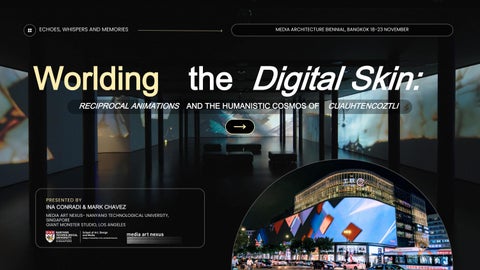
Abstract { This presentation explores worlding as both ontological process and artistic practice—an encounter where humans, technologies, and environments co-create reality. Drawing from Heidegger’s concept of Dasein—being-in-the-world as the site where meaning unfolds (Heidegger, 1962)—and Cuauhtencoztli’s poetic cosmology, where existence is sustained through flower and song (in xochitl in cuicatl) as reciprocal acts of renewal (León-Portilla, 1963), the paper proposes a model of reciprocal animation: humans and cosmos continually world each other through word, ritual, and art.
Within the framework of Media Art Nexus (Singapore) and the City Digital Skin Art Festival (CDSA), monumental LED façades are reimagined as membranes of relation rather than instruments of display. These architectures of light act as biocultural worldings—spaces where Indigenous cosmologies, ecological systems, and computational media converge. This reading aligns with Haraway’s (2016) and Spivak’s (1999) use of “worlding” as a deco