PATHWAYS
Your monthly guide to better health and peak performance.
AUGUST 2018 /
ISSUE 03
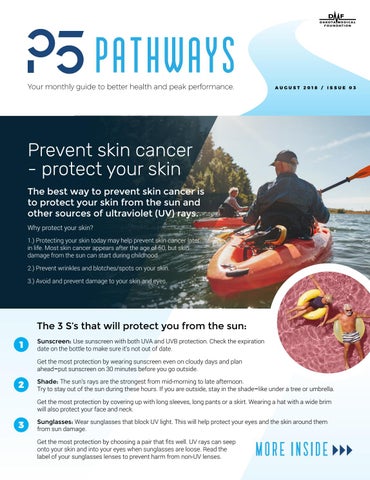
Prevent skin cancer - protect your skin The best way to prevent skin cancer is to protect your skin from the sun and other sources of ultraviolet (UV) rays. Why protect your skin? 1.) Protecting your skin today may help prevent skin cancer later in life. Most skin cancer appears after the age of 50, but skin damage from the sun can start during childhood. 2.) Prevent wrinkles and blotches/spots on your skin. 3.) Avoid and prevent damage to your skin and eyes.
The 3 S’s that will protect you from the sun: 1
Sunscreen: Use sunscreen with both UVA and UVB protection. Check the expiration date on the bottle to make sure it’s not out of date. Get the most protection by wearing sunscreen even on cloudy days and plan ahead–put sunscreen on 30 minutes before you go outside.
2
Shade: The sun’s rays are the strongest from mid-morning to late afternoon. Try to stay out of the sun during these hours. If you are outside, stay in the shade–like under a tree or umbrella. Get the most protection by covering up with long sleeves, long pants or a skirt. Wearing a hat with a wide brim will also protect your face and neck.
3
Sunglasses: Wear sunglasses that block UV light. This will help protect your eyes and the skin around them from sun damage. Get the most protection by choosing a pair that fits well. UV rays can seep onto your skin and into your eyes when sunglasses are loose. Read the label of your sunglasses lenses to prevent harm from non-UV lenses.
MORE INSIDE
Fine-tuning your skin care regime by Dr. Susan Mathison
Everyone’s skin is different but a couple of basic skin care tips apply to almost everyone.
Keep wearing sunscreen. Sunscreen isn’t just for summer! You should wear sunscreen all year-round, especially
on your face, since your face is exposed to the elements nearly all of the time. Don’t forget your hands, neck, and chest, too.
Moisturize and hydrate. I recommend using a non-alcohol baser toner/hydration spray to spritz on your face.
Then apply a nice moisturizer every morning and evening, right after you wash your face. Hydrate, hydrate, hydrate! Aim for eight to ten glasses of water every day.
Get some professional TLC. Even if you’re wearing sunscreen daily, the summer months can still be very rough on your skin. Professional care can help you find solutions for unwanted dark spots, red spots, patchiness, wrinkles, and even broken blood vessels.
Greek Yogurt Pancakes Pancake Ingredients • • • •
• •
2 cups flour 1 Tbsp and 1 tsp baking soda 4 eggs 3 1/3 cups plain Greek yogurt (try experimenting with different flavors!) 1 tsp vanilla extract ½ tsp salt
Syrup Ingredients • • • • •
2 cups blackberries ½ cups honey ¼ cups water 1 tsp salt Zest of one lemon
Pancake Instructions •
•
•
•
•
•
Begin by heating your griddle or a non-stick pan to a medium-high setting. In a large mixing bowl, add the dry ingredients (flour, salt, baking soda) and combine evenly. In a separate bowl, combine wet ingredients (eggs, vanilla, yogurt), and beat to combine. Make a well in the middle of your flour mix and pour the wet ingredients in. Whisk to combine at first, but then switch to a rubber spatula to mix in the sides. Spray the griddle or pan with pan spray and pour a ½ cup of batter onto the griddle (or more, your preference!). Cook for about 2 minutes, then flip. Cook for another 2 minutes.
Syrup Instructions •
•
•
Combine all ingredients in a saucepan and place on medium heat. Cook until the berries have begun to break down. Then turn syrup down to low heat and simmer until thickened (about 15 minutes). Pour over your healthy pancakes!
Greek Yogurt Pancakes Recipe created by Ryan Shearer, Executive Chef of the Hotel Donaldson.
Tired of the same old pancakes? Lighten up your breakfast with these fluffy Greek yogurt pancakes! Greek yogurt is a great substitute for milk or buttermilk. It adds protein, probiotics, calcium, and potassium to balance out sodium. For even more goodness, add this blackberry honey syrup or your favorite pancake topper to a new version of pancakes! Prep time: 10 minutes (+15 for syrup) Serves: 2 – 4
Processed foods – What you need to know for your next trip to the grocery store
Processed foods are defined by the U.S. Food and Drug Administration as any foods other than raw agricultural commodities and include any raw agricultural commodity that has been subject to processing, such as canning, freezing, cooking, dehydration, or milling. More than three-quarters of our calories come from highly processed (61%) and moderately processed (61%) food and drinks, according to a study by The American Journal of Clinical Nutrition. Some of those foods include refined bread, grain-based desserts like cookies, sugary sodas, juice, and some sports and energy drinks. However, it’s important to note, that there are varying levels of processed foods, from minimally processed—products with hardly any alteration, such as packaged salad, frozen meat, and eggs—to highly processed foods which are formulated mixtures of multiple ingredients. Highly processed foods are typically manufactured to be ready-toeat with no preparation required. Processed foods contain higher amounts of sugar, sodium, additives, and preservatives. High sugar and sodium can lead to health problems like high blood pressure, diabetes, and heart diseases.
Tips for grocery shopping: •
•
•
•
Processed foods at the grocery store generally have a Nutrition Facts label on the package. Frozen meals, snack foods like chips and cookies, and most beverages typically fall in the moderate to highly-processed categories. Not all processed foods are bad for your health. Foods like frozen vegetables are often minimally processed. When possible, shop at farmer’s markets to purchase whole, unprocessed foods!
3-2-1 Move! You can improve your health if you move more and eat better, but that’s not the only reason to be active and make healthy food choices.
Being active can also help you: • Charge up your body for work, hobbies, and family time • Feel better about yourself and manage stress better • Look better in your clothes • Set a good example for your children and your friends • Tone your body You don’t have to go to a gym to move. Do you have some shopping to do or errands to run? Parking in the back of
parking lots and walking around your favorite shops are two easy ways to starting moving more. Are you planning on spending time with your kids? Head outside to play catch, shoot hoops, hula-hoop, or do something fun that requires movement. If it’s cold, see if your community has an indoor basketball court, a place to jump on trampolines, or go bowling! Do you plan to get some downtime by watching TV? Get up and move around your house when the commercials are on. You can get your laundry down, sweep your floors, or just stand up and stretch.
Communication skills are a high priority READ ON TO FIND OUT WHY! Effective communication helps build strong relationships with your friends, family, and colleagues! They are some of the most important workplace skills to build.
Why? Because 73% of business leaders feel soft-skills, i.e., communication skills, are more important than job-related skills. In addition, 86% of managers are looking for teamwork skills, which communication is critical for. Good communication skills are important in workplaces because they help reduce barriers, global business challenges, and teamwork. Verbal and nonverbal communications are equally important. Some 45% of workers say it is extremely important that they have good communication skills to do their job, and a close 44% say it’s very important. When you’re able to communicate effectively, you are building trust between yourself and your team members.
Improve your communications skills by: • Being an engaged listener • Being aware of your nonverbal communication, such as your movements, facial expressions, and eye contact. • Being assertive in an open, honest, and respectful way. This does NOT mean being hostile, aggressive, or demanding. • Ask for feedback from your peers and management. They can help you discover areas of improvement.
Maintain your oral health to prevent diseases Oral health is important at every stage of life. It becomes even more important as you age. Taking care of your teeth, gums, and mouth can help prevent diseases. Tooth decay is more prevalent in children, but it doesn’t stop in adulthood. 28% (1 in 7) of Americans 34 to 44 years old have untreated tooth decay. In some areas, the occurrence is much higher. The worrying part about the lack of oral care in adulthood is that there are more than 125 health-related conditions that may affect or be affected by oral health, including cardiovascular disease, human papillomavirus (HPV) infections, HIV/AIDS, osteoporosis, obesity, and autoimmune disorders like rheumatoid arthritis.
Maintain dental health through prevention Preventing expensive trips to the dentist for things like filling cavities, root canals, or extracting teeth, are relatively inexpensive when compared. Basic self-care dental care will help your teeth last a lifetime as they are meant to and keep unnecessary costs of dental work lower.
Your daily dental care habits should include • Brushing twice a day with fluoride toothpaste • Daily flossing • Drinking lots of water • Eating a healthy diet Ensuring you are seeing your dentist regularly will also help keep your smile at its best!
“Most smiles are started by another smile.”
Do you have financial courage? Everyone, and we mean everyone, experiences financial worries. Financial difficulties can occur regardless of your income level. An interesting finding from a co-hosted survey between Virgin Pulse and Mercer found that someone’s level of financial knowledge isn’t a predictor of their financial wellness. Rather, it boils down to confidence over knowledge. People who believe they are knowledgable about managing finances are more likely to better manage their money, according to the survey. One way to increase your financial courage is becoming familiar with money management language and resources.
Financial terms to review and remember: Asset: A personal financial asset is something you own and includes cash, savings accounts, and personal property. In a balance sheet, assets such as the value of your home are offset by liabilities, such as your current mortgage.
Compound interest: Compound interest is interest that is earned on the interest that was earned in prior periods. For
credit cards or other loans, compound interest is interest charged on the interest that was charged in prior periods.
Gross income: Gross income is the total amount of money that you make before subtracting expenses and taxes. Liability: A personal liability is an amount that you owe. For example, many households have are home loan, car loans, credit card bills, and student loans, which are liabilities. Net income: Net income is your earnings after subtracting expenses (for self-employed individuals) and taxes. Net worth: Your net worth is the difference between your financial assets and your financial liabilities. If you are in debt, your net worth is likely to be negative.
Teaser rate: A teaser rate is an introductory interest rate offered by credit card companies. When the introductory period is over, the rate typically increases dramatically. Information is reviewed by a prestigious Medical Advisory Board comprised of physicians and healthcare professionals and is intended to help you make smart health decisions for yourself and your family. Although editorial content is based on sound medical information, we ask that you consult a healthcare professional for all matters of concern. We also encourage you to keep your copies to build a convenient home-medical reference or recycle issues to friends and family. 2017 P5 Performance™, 4141 28th Ave S, Fargo, ND 58018; phone 701.271.0263; visit our Web site at www.p5performance.org. All rights reserved. Executive Editor: David Hunnicutt, PhD; Executive Director: J. Patrick Traynor; Contributing Editor: Amanda McDonald. Information may not be reproduced, copied, cited, or circulated in any format.