Illinois Tech Magazine Fall 2025

Page 1


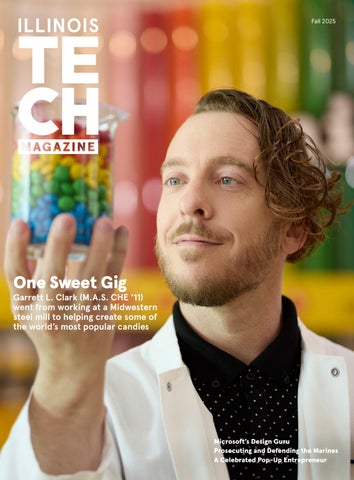
One Sweet Gig

Garrett L. Clark (M.A.S. CHE ’11) went from working at a Midwestern steel mill to helping create some of the world’s most popular candies

A Letter from Raj Echambadi

Greetings! I am pleased to share that this year, we have welcomed an extraordinary class of new students— a validation of our continuing efforts to broaden access for all learners and to reach them where they are.

This effort not only includes the expansion of our online offerings, but also encompasses remarkable new developments in our drive for global outreach.

I’m excited to say that we have now laid the groundwork for Illinois Tech to become the first American university authorized to establish a degree-granting campus in India. With this year’s formal approval from India’s University Grants Commission, we are on track to open Illinois Tech Mumbai in fall 2026, when we will begin to offer undergraduate and graduate degrees in high-demand fields such as computer science, engineering, and business.

Our new campus in India represents a profound opportunity to bring Illinois Tech’s rigorous, immersive, and experiential learning pedagogy to new learners and to help global leaders navigate the complexities of today’s world.

But navigating those complexities takes more than technological innovation. It also requires a strong emphasis on interdisciplinary collaboration as well.

Along those lines, I am so honored to welcome our new provost, Elizabeth Hudson, who has spent her impressive academic career integrating STEM with the varied fields across the academy. To give just one example of many: Elizabeth created groundbreaking interdisciplinary programs as dean of Northeastern University’s College of Arts, Media, and Design, including joint programs with its College of Engineering such as music and engineering, architecture and engineering, and

FROM THE PRESIDENT

design and engineering. She also increased graduate enrollment at the college by 60 percent, expanded its research output sevenfold, and secured the college’s financial stability.

Here, Elizabeth is working to broaden interdisciplinary collaboration across academics and research, to diversify our academic programs, and to explore new ways to further the university’s emphasis on access and excellence.

Many of the alumni we are highlighting in this issue also reflect an integration of STEM with other disciplines.

Jon Friedman (MDes ’03) worked hard to successfully integrate design into the tech-heavy culture of Microsoft—and is now the highest-level design executive the company has ever had. Garrett L. Clark (M.A.S. CHE ’11) went from being a steel process engineer to working with a collaborative team at Mars Inc. to create some of the best-known candies in the world. During the COVID-19 pandemic, Jessica “Jaye” Fong (B.ARCH. ’12) started a pop-up restaurant that went on to win its category in the Chicago Tribune’s 2022 Readers’ Choice Food Awards. Lieutenant Colonel Candace White (LAW ’09), a United States Marine, is now the lead prosecutor in all serious felony cases involving Marines for half the country. And Keith Black (Ph.D. MSC ’10) has now written his eighth book on finance and investing—this time tackling the timely topic of cryptocurrencies.

As always, I continue to be impressed and inspired by the accomplishments of our alumni community. I look forward to reading about more of them.

Sincerely,

Vice President for Enrollment Management and Student Affairs

Mallik Sundharam

Associate Vice President for Marketing and Communications

Chelsea Kalberloh Jackson

Content Director

Andrew Wyder

Managing Editor

Tad Vezner

Editorial Contributors

Lauren Brennan

Howard J. Lee

Tom Linder

Simon Morrow

Art Direction and Design

Scott Benbrook

Photography

Jamie Ceaser

Sergeant Patrick King

Tim Klein

Bonnie Robinson

Illinois Tech Magazine is published twice a year by the Office of Marketing and Communications. © 2025

Illinois Tech Magazine is printed on FSC-certified recycled paper. Read it, share it, recycle it.

Send letters to Illinois Tech Magazine

Office of Marketing and Communications

10 West 35th Street, 13th Floor Chicago, IL 60616

or email illinoistechmagazine@illinoistech.edu

Send alumni news to alumni@illinoistech.edu

Illinois Institute of Technology, also known as Illinois Tech, is a private, technology-focused research university. Based in the global metropolis of Chicago, Illinois Tech is the only university of its kind in the city. It offers undergraduate and graduate degrees in engineering, science, architecture, business, design, human sciences, applied technology, and law.

One of 22 institutions that comprise the Association of Independent Technological Universities (AITU), Illinois Tech provides an exceptional education centered on active learning, and its graduates lead the state and much of the nation in economic prosperity. At Illinois Tech students are empowered to discover, create, and solve, and thus uniquely prepared to succeed in professions that require technological sophistication, an innovative mindset, and an entrepreneurial spirit.

Mission Statement

To provide distinctive and relevant education in an environment of scientific, technological, and professional knowledge creation and innovation

Armour College of Engineering

Chicago-Kent College of Law

College of Architecture

College of Computing

Institute of Design

Lewis College of Science and Letters

Stuart School of Business

ADA Statement

Illinois Institute of Technology provides qualified individuals with disabilities reasonable accommodations to participate in university activities, programs, and services. Such individuals with disabilities requiring an accommodation should call the activity, program, or service director. For further information about Illinois Tech’s resources, contact the Illinois Tech Center for Disability Resources at disabilities@iit.edu.

8

COVER STORY

Garrett L. Clark (M.A.S. CHE ’11) went from being a steel mill engineer to helping to create some of the best-known candies in the world.

10

Growing up, Jessica “Jaye” Fong (B.ARCH. ’12) wasn’t allowed in the kitchen of her family restaurant. With the help of her mom, her Chicago pop-up restaurant is now winning awards and is the subject of a short documentary.

12

Lieutenant Colonel Candace White (LAW ’09) quit family law to join the United States Marines. Today, she is the lead prosecutor for all serious felony cases involving Marines for half the country.

14

Keith Black (Ph.D. MSC ’10) has worked in the financial world for decades, focusing on “alternative” investments. His recently published eighth book taps into that same expertise, looking at the viability of cryptocurrencies.

16

When Jon Friedman (MDes ’03) started as a designer at Microsoft, he was told to just make things pretty. Now, he is the highest-level design executive the company has ever had.

Marrying STEM to the Humanities

Nearly 10 years ago, Elizabeth Hudson had her “a-ha” moment.

Just months into her appointment as the dean of Northeastern University’s College of Arts, Media, and Design, Hudson attended an invitation-only symposium hosted by the National Academies of Sciences, Engineering, and Medicine.

The topic: the integration of arts and humanities with STEM.

“For the first time, this was the people in STEM—it was the engineers, the computer scientists—saying we, all of our fields in higher education, are in trouble if we don’t figure out how to bring the knowledge fields of the arts and humanities into STEM education,” says Hudson, who began her new role as provost, senior vice president of academic affairs, and chief academic officer at Illinois Tech in August 2025.

Despite STEM leaders clamoring for more integration, “[After the symposium] I actually discovered that we had only one STEM-certified graduate program in [the College of Arts, Media, and Design], a games program. Not even architecture was STEM certified,” Hudson adds.

That discovery helped Hudson drive change at Northeastern—and eventually led her to Illinois Tech, where she joins the university at a moment of inflection in higher education, one driven by the rapid growth of technologies such as artificial intelligence, by economic shifts, and by new global dynamics.

Hudson, a nineteenth-century music historian by training who has spent the last two decades of her more than 30 years in higher education as a highly accomplished global administrator and leader, is at Illinois Tech, in part, because of her belief that President Raj Echambadi has uniquely positioned Illinois Tech to meet that moment.

And Hudson is uniquely positioned to help. At Northeastern, she took the insight gained at the National Academies symposium and created new interdisciplinary programs, including, for the first time, creating joint programs and faculty positions with its College of Engineering. She also increased both undergraduate and graduate enrollment at the college dramatically, expanded its externally funded research output sevenfold, and secured the college’s financial stability.

It was not the first time she had collaborated with her peers in STEM. As chair of the McIntire Department of Music at the University of Virginia, she enabled engineering students to double major in music, which they were previously unable to do—an academic track some engineers told her that they saw as vital to their professional development and opportunities.

And as inaugural director and CEO of the New Zealand School of Music, where Hudson led an academic and operational merger between two universities, she created and personally oversaw a Ph.D. in music and engineering focused on musical robotics.

As she begins her appointment at Illinois Tech, Hudson says that her mission is to marry the technical and the human by working toward three main goals:

■ Broadening interdisciplinary collaboration across academics and research, with a particular emphasis on understanding and exploring AI applications across all fields

■ Diversifying academic programs through engaging in a range of partnerships, both locally and domestically, online and globally

■ Exploring new ways to build structures that support and sustain the synergy rooted in the university’s emphasis on access and excellence

PHOTO: BONNIE ROBINSON

Education on a Global Stage

Illinois Tech received formal approval in May 2025 from India’s University Grants Commission to open a new campus in Mumbai—making it the first American university authorized to establish a degree-granting campus in India.

The formal approval, achieved after two years of planning, allows Illinois Tech Mumbai to welcome students in fall 2026. The campus will offer undergraduate and graduate degrees in high-demand fields such as computer science, engineering, and business.

“Illinois Tech has always operated at the intersection of innovation, opportunity, and global industry demand,” says Illinois Tech President Raj Echambadi. “This initiative is a bold and forward-looking investment in the future of American competitiveness—one that strengthens our mission, expands access to high-impact education, and connects U.S. and global employers to a broader, globally educated pipeline of industryready STEM talent.”

Illinois Tech officials highlight that many of today’s most successful global business leaders were educated in both India and the United States, including CEOs of companies such as Google, Microsoft, IBM, Adobe, and Mastercard. The new Illinois Tech campus will capitalize on that successful formula by offering a top-tier technology and business education directly to Indian students from all backgrounds.

The Mumbai campus represents a continuation of the university’s commitment to providing an education that is tailored to the needs of the learner, wherever they are in their educational or career journey. It marks the evolution of the global education landscape, one where Illinois Tech also is creating additional online and global offerings.

“By establishing a presence in Mumbai, Illinois Tech is embracing the opportunity to meet learners in their local contexts while maintaining the high standards that define our institution,” says Mallik Sundharam, Illinois Tech vice president for enrollment management and student affairs. “Illinois Tech has always been closely aligned with employers and career outcomes that directly serve industry demands. With the growth of U.S. companies expanding in India, we are meeting learners where they are—so we can serve employers where they are.”

Sundharam also notes that in the past five years the university has seen a more than 73 percent increase in graduate students from India.

“India has been closely tied to Illinois Tech’s journey since the establishment of its official entity in the country in 1998,” Sundharam says. “Our renowned faculty would record classroom lectures on video cassettes and have them couriered to India....

This early innovation reflected our deep commitment to making world-class education accessible globally—a legacy we proudly continue today with our new campus in Mumbai.”

Courses will be taught by globally recruited faculty, including professors from Illinois Tech’s Chicago campus. The Mumbai campus will also support cross-campus study options and research collaborations, as well as the same experiential, industry-aligned curriculum that defines Illinois Tech’s Chicago education, including the university’s signature Elevate initiative. —Tad Vezner

Headliners

“Innovation cannot thrive without regulation, and the persistent lack of regulatory clarity is stifling innovation. Entrepreneurs are left guessing which rules apply and which regulator might show up at their door, while consumers are more vulnerable to fraudulent activity by bad actors overseas.”

—James B. Finkl Endowed Professor and Associate Professor of Finance Benjamin E. Van Vliet in the Chicago Tribune on why the United States and Illinois need regulation clarity on crypto

“Every home is an absolute unicorn.”

—Arthur W. Hill Endowed Chair in Sustainability Brent Stephens discussing air purifiers and the other ways homeowners can make the air inside their home safer in Time

Envisioning a Campus Prairie

As part of Illinois Tech’s landscape architecture master plan, faculty and staff started seeding a new, on-campus prairie in fall 2025 with the help of Pizzo Habitat Restoration. The 1.2-acre stretch of open grassland on either side of 33rd Street, south of Hermann Hall and north of Paul V. Galvin Library, will serve as a new living landscape that will drive research, community, and biodiversity forward.

Site cleared of vegetation and seeded with perennial native plants (completed October 2025).

Year 1

Year 2

Year 3‑5

“The message the Supreme Court seems to be sending is any time you rule against the Trump Administration, we are likely to stay your order. Is that the message the court wants to send?”

—Professor of Law Carolyn Shapiro on NBC News, explaining the impact of the U.S. Supreme Court frequently ruling in favor of the Trump Administration

By year three, native grasses and wildflowers will flourish, with a controlled burn by Pizzo supporting the prairie’s long-term renewal.

Signs of growth. By late spring 2026, young plant shoots should appear.
Native plants become established.
Site Prep

TScarlet Hawks Siblings Star on the Pitch

here is at least one big advantage to having a sibling who, like you, is also a member of an Illinois Tech soccer team.

“It’s really convenient since I’m a forward and he’s a goalkeeper,” says Kayla Thomas (ME, M.S. BME 4th Year) who, like her brother, arrived from Sweden to play at Illinois Tech. “We were actually practicing a lot this past summer. He got a lot of goalie reps, and I got a lot of shooting reps, so it’s perfect.”

Kayla and her brother, Colin Thomas (ME, M.S. 3rd Year) share another similarity: they are both studying to be engineers and participating in the university’s Accelerated Master’s Program.

The siblings spent their middle- and high-school years in Helsingborg, Sweden, playing soccer for regional professional clubs. Colin played for the Eskilsminne IF club before he came to Illinois Tech in 2023 as a member of the ROTC program. He is a goalkeeper for the men’s soccer team.

Kayla played for a club formerly known as Division 1, now called Ettan Fotboll. She transferred to Illinois Tech in 2024 from the Colorado School of Mines, and she is a winger/outside forward on the women’s soccer team.

The siblings, who are one and a half years apart in age, were both born in Sweden. They moved to the United States for nine years at a young age before returning to Sweden.

“We were always competitive with each other,” says Colin. “Competitive about stupid stuff, such as walking around the neighborhood and racing to see who was fastest. Since she was older, she’d win and I would end up getting angry.”

“To be fair, when I said I was going to transfer [to Illinois Tech] my brother was like, ‘Don’t sit next to me,’ but he ended up sitting next to me,” Kayla adds with a laugh. “We’ve struck a good balance between seeing each other enough and keeping our distance.”

The two grew up in an athletic family, with their father, a U.S. native, playing football, basketball, and baseball and their mother running track and field.

“The culture within soccer, when you’re playing [in the U.S.], is different. Here, on the sidelines, people are standing. Back [in Sweden], people are usually sitting on a bench watching,” Colin says.

Both Kayla and Colin have helped their respective Scarlet Hawks teams to success during their time at Illinois Tech.

Kayla helped the women’s soccer team to Northern Athletics Collegiate Conference regular season and tournament titles in 2024 and 2025. The 2025 NACC tournament title earned the team its second straight berth into the NCAA Division III national tournament. Heading into the start of the 2025 NCAA tournament, Kayla—who earned Second Team All-NACC in 2025—has amassed seven goals, three assists, and 17 points in 31 career games.

Colin, meanwhile, has started 22 of his 27 career games played across three seasons for the men’s soccer team. He has a 13-6-4 overall record as the starting goalkeeper, with three shutouts, a 1.73 goals against average, and a .685 save percentage. —Tad Vezner

Kayla Thomas
Colin Thomas

ILLUSTRATION:

SOCIAL SCIENCES

Ashes into Action

When Illinois Tech Professor of Social Sciences Yuri Mansury was awarded a Fulbright Scholar Award to study how to transform agricultural practices in his native Indonesia, the project he envisioned was more than just academic—it was deeply personal.

“I’m ethnically Indonesian. I was born and raised in Indonesia,” says Mansury. “I decided what I wanted to do is find solutions to help solve the poverty problem among my countrypeople.”

Most studies investigating deforestation in Indonesia have focused on its outer islands such as Borneo, Sumatra, and others. Java—the most populated island in the world and home to more than half of Indonesia’s more than 280 million people—was often ignored.

While venturing to some of the most rural areas of Java, Mansury sought to get answers to two questions. First of all, why do Javanese farmers still practice slash-and-burn agriculture, which involves cutting down and burning existing trees, brush, and foliage to clear land? And secondly, what can be done to change the mindset of Javanese farmers to shift to more sustainable practices?

With those questions in hand, Mansury conducted a pilot study in summer 2023 to test his approach and build connections. During his pilot study, the scope of poverty in rural Java became apparent.

“Half of the population in that area still live below the poverty line,” says Mansury. “We know that poverty contributes in important ways to deforestation. People don’t have a

choice except to go into the forest and do the best they can.”

Mansury returned to rural Java in 2024 for the main portion of his research, conducting surveys and interviews in 10 villages. Yet there were multiple towns that he was unable to reach due to nearly impassible roads, alluding to the challenges that rural Indonesian farmers face if they want to transition to more sustainable farming practices.

Because rural farmers make only about $1 per day, slash-and-burn methods that are quick, cheap, and require no special skills are often the most obvious option, Mansury says.

Sustainable alternatives such as growing organic fruits and vegetables demand upfront investment, knowledge, and access to bigger but more distant markets such as Jakarta.

For Mansury, other barriers—including cultural ones— also emerged, making his fieldwork tougher. Because the region in Java that he was studying was very conservative, many women were not comfortable interviewing with Mansury; nearly 80 percent of his respondents were men. Access to villages also remained a consistent issue, and the barriers that made Mansury’s fieldwork difficult are the very same ones that often keep farmers locked into cycles of poverty and relying on predatory loans.

Mansury aims to publish a paper about his Fulbright fieldwork within the next year. By sharing his findings, he hopes to find people who can help these forest communities make the transformations necessary to shift to more sustainable practices. —Tom Linder

Cyber‑Shielding the Grid

Illinois Tech is establishing the Midwest Center for Microgrid Cybersecurity (2MC) through funding from the United States Department of Energy.

The project aims to develop state-ofthe-art cybersecurity software that is designed to protect the power grid, which has become increasingly vulnerable to cyberattacks as digitization and wireless technologies have created more entry points to electric power systems. Interruptions to electricity services due to cyberattacks happen globally on a regular basis, impacting everything from streetlights, trains, and elevators to hospitals and airports.

“Electricity is a very critical component of developed countries and societies, so we need to do everything that we can to protect it,” says Robert W. Galvin Electricity Innovation Endowed Chair Mohammad Shahidehpour, who is leading the 2MC project. Shahidehpour also serves as director of Illinois Tech’s Robert W. Galvin Center for Electricity Innovation and associate director of Wanger Institute for Sustainable Energy Research (WISER).

He will use his expertise in microgrid technology to explore ways to identify sections of the grid that are being attacked by cyber intrusion and apply methods such as watermarking, which allow microgrid operators to introduce pertinent mitigation strategies, meaning that even if an attacker gains entrance to one area, they will have limited ability to make the virus spread in the broader electric power systems.

Potential entry points to the grid are now ubiquitous; even a streetlight with a wireless sensor could be hacked.

“Basically, if you can control it wirelessly, an attacker can potentially access it, too,” says Shahidehpour.

The work done through 2MC will aim to create boundaries or virtual fences around sections of the grid, represented by microgrids, making it easier to control

what goes in and comes out. The team, which includes Illinois Tech Professor Ren Wang (serving as the co-principal investigator of 2MC) and other power grid and cybersecurity experts from the Galvin Center at Illinois Tech, University of Illinois Chicago, and Commonwealth Edison Company, will be developing software and solution strategies that can be used at both the device level and microgrid level to achieve this security.

The 2MC project also includes an advisory board representing 30 cybersecurity experts from national laboratories and midwestern universities and industries. The advisory board guides the mission of 2MC to develop strategies that will minimize cyber intrusions at the microgrid level.

Shahidehpour has already created an existing sophisticated simulation of Illinois Tech’s campus microgrid, and the team will be utilizing it to test the software that it develops.

Firewalls are already in use, preventing many attempted attacks, but Shahidehpour says it’s critical to continue development as cyber attackers get “smarter and smarter and smarter,” in constant search of vulnerabilities in electric power systems.

The team will also develop training for grid operators and other educational materials, including courses that will be implemented in Illinois Tech’s Department of Electrical and Computer Engineering.

Simon Morrow

During the “Great Recession,” Garrett L. Clark

(M.A.S. CHE ’11) was asked to step down from his engineering role at an Indiana steel mill and become a line manager instead. Instead of settling, he opted for a slightly different career path—one in which he now creates candies for millions of people around the world.

Clark is now a research and development process engineer for Mars Inc., utilizing the talent he once used to refine steel to soften gum, texturize gummies, and tantalize healthier taffy.

Catering to taste is Clark’s trade, and it requires keeping up with fickle trends and complex processes that can shift in just a matter of months.

Take the current hot trend of textured gummy candy.

“They’ve shaken up the industry with how successful they’ve been,” Clark says. “And it’s relatively easy with a gummy to make iterations: add sour sanding or attach other candies. All those things are relatively inexpensive, from my view as a process engineer, as opposed to making caramel M&M’s.”

The inherent complexities of caramel M&M manufacturing are what keep process engineers such as Clark up at night. You have to keep the caramel hard enough to attach it to a candy shell, yet firm enough to hold its structure—but not so firm that it’s unchewable.

And then that process has to be repeated over and over— millions of times, consistently—while hopefully adhering to the right side of a profit margin.

“Tastes in candy vary by region and by target audience— young adults or older [people]. It’s very difficult to come up with something truly different that fits a need that isn’t being filled by what we have,” says Amy DeJong, a senior process engineer at Mars. “And once you have that idea, it still has to be realistic. That’s where Garrett’s role comes in: finding out if it’s possible, with the right equipment and ingredients.”

Clark must cater to the diverse—and often divergent—tastes of the world. White chocolate is hugely popular in some countries and disliked in others. Gum sold in China is incorporated with tiny bits of tea leaves, which is not as hot a seller in the United States.

There are also contradictory trends. The “better for you” trend is popular now, Clark says, such as adding whey protein to Snickers bars, or adding fiber and vitamins to mitigate any guilt.

“But the opposite is also true,” he says. “Every time there’s a recession in the economy, people want an indulgent treat, a moment of escape.”

It’s Clark’s job to deliver both. But he says that’s the fun of it.

“The thing I love about the candy industry is we associate

candy with so many great emotions—happiness, joy, escape. What can we make to make people feel those good emotions?” he says, noting that he works in a lab with a mini production line to crank out test treats, and his team has “a lot of fun.”

“Garrett is really collaborative,” says DeJong. “He’s good at working with different types of people with different roles and goals and things that are important to them. That’s important when working on a complex problem.”

One of Clark’s biggest accomplishments was the creation of Starburst Goodies in 2024. A part of the “better for you” trend, the Starburst gummie had fiber, 70 percent less sugar than a regular Starburst candy, and contained no gelatin or artificial colors or flavors.

“It was a really challenging product, to be able to do 70 percent reduced sugar and still have it taste good,” Clark says, “and no gelatin and still have it have bouncy texture.”

Another accomplishment early in Clark’s time at Mars was making Extra Refreshers gum, a sugar-free gum that he succeeded in making much softer to chew. He received his most treasured praise for that one: his denture-wearing grandmother told him it was the only product she could chew.

“That one really brought it home for me,” Clark says.

Born and raised in Gahanna, Ohio, Clark received his bachelor’s in chemical engineering from Johns Hopkins University and immediately took a job as a steel process engineer at ArcelorMittal, a steel mill in northwest Indiana.

But after the 2010 recession caused a downturn in the steel industry, Clark chose to seek out a new path. He left his job at the steel mill to make Argo Corn Starch at that company’s Illinois factory while pursuing his degree at Illinois Tech. After graduation, he worked at Blommer Chocolate Company, a family owned company whose rooftop cocoa bean roaster has been known to send a chocolatey aroma wafting across all of downtown Chicago.

Mars recruited him in 2014, and he’s been working there since. Clark, who is gay but was not always open about it in the workplace, helped to start the first LGBTQIA associate resource group at Mars. He says he was heartened by its reception from coworkers.

“There are not a lot of queer engineers. I was always very careful about pronouns,” Clark says. “It took me a while in my career before being fully comfortable coming out. In food processing, I feel they’re more diverse and inclusive.”

He adds, of what’s next, “It’s dangerous to have a dream job this young in my career. As long as the challenge is there, I’m pretty happy. And whenever it gets stressful, we always say, ‘Hey, we’re just making candy!’” ●

“Whenever it gets stressful, we always say,‘Hey, we’re just making candy!’”
—-GarrettL.Clark (M.A.S.CHE ’11)
Photo by Tim Klein

Creating Harmony with Cuisine

Photos by Tim Klein

Growing up working as a hostess at her family’s restaurant, Jessica “Jaye” Fong (B.ARCH. ’12) was never allowed in the kitchen.

“It was absolutely forbidden,” Fong says. “The children were not allowed in the kitchen; they would be underfoot, and there were sharp and dangerous things. I think my parents were concerned that we might actually show interest and passion and skill in the kitchen, and they actively did not want to foster that, because they knew how difficult of a life it was to run a restaurant.”

But when the COVID-19 pandemic hit, Fong—who had quit her job as a designer and been furloughed from her job at a hotel—spent her time during quarantine “cooking and baking the things I was missing.”

“I researched and baked things I wished I knew how to do and wanted to eat myself. The things I was never taught—all of the Chinese bakery items, specifically, because we weren’t able to get those,” Fong says. “It’s one of those situations where you’d have to go to an auntie or grandma, and not a lot are passing on that knowledge.”

Following the death of George Floyd, Fong put on a socially distanced Black Lives Matter fundraiser via her Instagram in which she sold her desserts and donated the proceeds to a local nonprofit, Black Girls Break Bread. In doing so, she connected with another pair of pop-up entrepreneurs, and she was surprised to get a call from one of them later that week.

The pop-up entrepreneur didn’t serve desserts. They asked: would Fong let them sell some of hers?

“It was terrifying, but I knew in my heart that when you’re raised in hospitality and your restaurant is basically a third parent, it’s very hard not to have it in your blood.” —-Jessica “Jaye” Fong (B.ARCH.’12)

“I didn’t expect to have such a positive response from people, that they liked what I made. Like a lot of pop-ups, it was very underground to start,” Fong says. Large-scale events were forbidden during the pandemic, and chefs were searching for new sources of income.

After a few more events and building more connections within the pandemic-born pop-up community, Fong launched her pop-up, called Maa Maa Dei. It soon thrived, winning Best Pop-Up/Virtual Restaurant in the Chicago Tribune’s 2022 Readers’ Choice Food Awards.

Fong focuses on desserts that bring forth feelings of unity and family, often centering on holidays such as the Lunar New Year and China’s Dragon Boat Festival. Crowd favorites include her salted egg yolk shortbread cookies, Taiwanese pineapple cake, and rainbow taro mooncakes.

“She has so much pride in what she does, and you see and you feel it and you taste it in her food,” says Cat Pham, another pop-up entrepreneur who found Fong on Instagram and reached out to include her in events. “I’ve had the honor of being able to watch Jaye work. I see her technical background shining through; she’s incredible at precision and does a lot of research and development. She takes notes during every single run she does, down to the precise gram of it.”

Pham adds, “It’s not like a cold technical science; it’s a science of love and warmth and soul. Her food is beautiful, and her story is beautiful.”

But there is tragedy in Fong’s story as well, going back to her time at Illinois Tech.

After emigrating from Hong Kong and working for decades as the owner and head chef of multiple strip-mall restaurants in Bloomington, Illinois, her father, Simon Fong, died of cancer in 2010. Fong’s family was already somewhat estranged, with most of her siblings having moved away. The death fractured them even more.

“It was really up to me to be the mediator,” Fong says.

Fong rushed to complete her degree and moved back to Bloomington. The family’s restaurant at the time, Orient Gourmet, closed down following her father’s death.

Fong and her mother also suffered from a strained relationship. Her parents had always worked “24-7.”

“If you wanted to have any time with them, it was at the restaurant,” Fong says.

She tried to patch things up between her family members as best she could, then took an internship where she needed to commute to Chicago. She later took a job at Sargent & Lundy as a designer but quit after two years, realizing architecture was just not for her.

“It was terrifying, but I knew in my heart that when you’re raised in hospitality and your restaurant is basically a third parent, it’s very hard not to have it in your blood. I needed to be in that,” Fong says.

But when she started her pop-up, Fong says, something strange happened. Her mother began making frequent trips to the city to help.

“I didn’t really ask her to help; I think she just decided to be a part of it. And it was such a positive force that I was surprised at how well we worked together,” Fong says. “I do honestly believe the grief we went through with my father helped heal the relationship.”

In early 2025, Three Top Productions released a documentary film on Fong, titled What I Am Today: Maa Maa Dei.

At one moment in the documentary, taking a break in the kitchen, Fong says, “Part of this journey is about me teaching myself a lot of the things I wish I would’ve been taught. A lot of things that I do now come from a place of longing. I wish that there were things that [my father] would’ve been able to taste or try that I currently make. I hope that there are things that I make that he would’ve enjoyed.”

The message seems to have struck a chord with others in the Asian pop-up community, Pham and Fong say.

“One person came up to me and said, ‘This story gives other people hope, other children of immigrants hope that they, too, can find healing in their relationship with their parents,’” says Fong.

Adds Pham, “Jaye’s food tells so many generations of stories. It’s all in this beautiful piece of art that I get to eat.” ●

Jaye Fong adds final touches to her handmade confections at Maa Maa Dei.

Semper Legalis

As a judge advocate in the United States Marine Corps—the Marine equivalent of a JAG officer— Candace White (LAW ’09) spent her first tour of duty prosecuting Marines and sailors for a wide variety of criminal offenses. But after spending years as a prosecutor on the country’s east coast, she was ordered to switch sides in two ways: to argue for the side of the defense, and to do it on the other side of the world.

White had been screened and selected for a special assignment—something that only the top 10 percent of Marine captains get approved for: to get an advanced degree. Upon receiving her specialized Master of Laws (LL.M.) degree, she was then given a highly prominent posting as the regional complex defense counsel in Okinawa, Japan.

In effect, she was the public defender for all “complex cases”—serious felonies such as murder, sexual and domestic

assaults, and child abuse—in the entire Pacific region of the globe that includes southeast Asia, Hawaii, and Alaska.

“I didn’t want to go to Japan, and after so many years as a prosecutor I didn’t necessarily want to do defense,” White says. “But there’s a phrase in the Marine Corps: ‘Bloom where you’re planted.’ You’ve got to be open to new experiences and changing your viewpoints. It’s easy to get your blinders on, not just in your legal field, but in society in general.”

As part of her role, White traveled between numerous countries defending Marines.

“I think every prosecutor should do a stint as a public defender. You see a whole other side of the law,” White says. “I learned how to distinguish between your client who allegedly committed a criminal act and a Marine in front of you who is your brother or sister in uniform who you can relate to and empathize with.”

The high-ranking posting in Japan—as well as a learned tolerance for constant adaption—prepared her for a brand-new format of military justice mandated by the U.S. Congress, one in which she would be assigned a role to oversee a huge portion of the country.

A New Kind of Counsel

In 2022, as part of that year’s National Defense Authorization Act, otherwise known as the annual U.S. Department of Defense budget, Congress created an Office of the Special Trial Counsel for each branch of the military to tackle major, or “complex,” crimes in the military.

And the offices were placed under direct civilian control. In other words, the offices would operate impartially outside the military command structure, while providing “expert, specialized, independent, and ethical representation of the United States” when prosecuting military personnel.

It was a sea change within the military code of justice.

“I personally think we were doing a good job, but Congress wanted a more standardized measure of prosecutorial experience, as well as heightened independence, for those litigating serious and complex offenses,” White says.

But there was one part of the change White was ecstatic about: for the first time, prosecutors would have discretion over whether to bring a case.

“I had no prosecutorial discretion in my entire career [up] to

“There’s a phrase in the Marine Corps: ‘Bloom where you’re planted.’ You’ve got to be open to new experiences and changing your viewpoints.” —-Candace White (LAW ’09)

that point,” White says. “Before, commanders decided if a case would be prosecuted at court-martial or not. Now every allegation and every case involving a complex offense is evaluated by multiple highly trained attorneys. Now I can screen and evaluate based on the merits and evidence and evaluate if criminal prosecution is the appropriate forum given the nature of the offense. These changes are all really good for the military justice system.”

In July, after getting a master’s degree in military studies from Marine Corps University at Quantico Base, Virginia, White was appointed regional special trial counsel-west becoming the lead prosecutor for all complex cases west of the Mississippi River involving Marines. She oversees three teams of Marine attorneys under the auspices of the U.S. Secretary of the Navy, a civilian.

White is only the second person to hold the position.

“Candace is definitely a benefit to our community. Wherever she goes, she makes her mark,” says Lieutenant Colonel Shannon Hesser, a Marine Corps judge advocate for 23 years who operates as a command legal adviser and has known White since they graduated from the same LL.M. program. “She’s on my speed dial for [Office of Special Trial Counsel] issues, and she helps me understand litigation. She’s very passionate, extremely intelligent, and she really likes what she does.”

After graduating from law school, White tried out family law for a few years, in both Illinois and California, but she didn’t enjoy it. Then she saw an ad posting for military judge advocate officers, and she cold called a recruiter.

“Something in the back of my head had always interested me in military law. Public service is very important, volunteer work and civic responsibilities,” White says, adding, “I pretty much let those recruiters relax for a while. Lawyers are very hard for them to get, especially those that are already certified and can meet the physical standards.”

As for why she chose the Marines: “If you’re going to do something, why not be the best?” she says. She was commissioned in 2011.

But there was a catch: Marine lawyers were different from those in other branches of the military. They don’t just go to officer training school; they also have to train to become provisional rifle platoon commanders.

They’re trained not just in the law, but also in combat tactics, weapons systems, basic field medicine, land navigation without GPS systems; they learn everything they would need to command a platoon in case of a conflict. Officer candidate school has a high attrition rate, with male and female candidates evaluated on the same scale in both mental and physical fitness. Of the 72 women who entered White’s course, she says, only 36 completed it.

“As Marine Corps officers, we’ve gone through the same training as other Marines. It’s very important to us. It carries a lot of credibility,” says Hesser. “Being an officer in the military, you must have integrity, especially as a lawyer. Candace has an incredible amount of integrity, and it’s very natural.” ●

Photo by Sergeant Patrick King

The Trend Finder

Keith Black (Ph.D. MSC ’10) has spent decades working in the financial industry as everything from a floor trader and an equity analyst to the director and curriculum writer for a major analyst credentialing organization. He’s now written his eighth book about investment strategies and risks—this time tackling the timely topic of when and how to invest in cryptocurrencies.

Investing in Cryptocurrencies and Digital Assets: A Guide to Understanding Technologies, Business Models, Due Diligence, and Valuation, published in 2025 by John Wiley & Sons, is about “how to do your homework to decide if a digital asset is a wise investment,” Black says, adding, “Most people should invest less than 5 percent of money in crypto. There’s definitely risks here, and I try to point out where the risks are and where the limits should be.”

Black points out that “alternative investments”—meaning assets other than stocks and bonds—now make up $20 trillion globally, compared to more than $200 trillion for the global stock and bond markets. Such alternative investments include real estate and hedge funds, as well as a growing interest in cryptocurrencies, which now comprise $4 trillion in assets.

“Sophisticated investors have been increasing allocations to alternative investments for more than twenty years,” Black says.

Josh Kernan, who was head of alternative investments at Charles Schwab for 15 years before co-founding the San Francisco-based investment management firm Permian Capital Management, says of Black, “He’s the guy who wrote the materials I was studying....I actually think it’s incredible the amount of content he’s been able to put out there.”

Adds Kernan, “He’s someone who knows all the different alternative investments at a master level, but Keith is unique because he’s someone who has a teaching-level knowledge of crypto and he’s used his background in tech and business to get there. He’s far more advanced than his peers because of that.”

Black notes that there are now 18,000 different kinds of cryptocurrencies, “some of which are worth something and most of which are not.”

Technology often operates on the idea of winner-take-all, Black says.

“Don’t buy meme coins, don’t invest more than you can afford to lose, and do your homework.”
—-Keith Black (Ph.D. MSC ’10)

In most industries, the dominant market share rests in the top two to five players. Bitcoin is still king, making up $2.7 trillion in assets; Ethereum is a distant second at half a trillion dollars. Black says that perhaps 100 of today’s digital assets will have long-term value; as for the rest, buyer beware.

He points to one of the biggest victims of the dot-come crash as a useful case study.

“Just like in 1999 with pets.com, more than 90 percent of today’s cryptos are worthless—but there are some real businesses in the crypto space,” Black says. “The lesson of my book is: don’t buy meme coins, don’t invest more than you can afford to lose, and do your homework.”

For instance, Black points to one business that allows people to borrow or lend money by using their crypto holdings as collateral. That business now commands $40 billion in crypto borrowing and lending, and may have long-term value similar to a medium- to large-sized bank.

When it comes to crypto as a whole, “People like the scarcity of the asset, that it’s not beholden to any government. If you live in Ukraine or Venezuela or Zimbabwe, you could be concerned about your home country’s currency or banking system,” Black says. “This idea of a non-governmental stored value asset is very appealing, especially in countries with problems with property rights or unstable banking systems.”

On a deeper level, many see crypto as a component of the newest potential version of the internet known as “Web3.” Where “Web1” was the early internet with basic read-only, static text and dialup capability, “Web2” is the modern social media era, where users can interact with content.

“Web3” is a decentralized version of the web that allows users to take ownership and monetize their own assets outside social media ecosystems.

From a financial standpoint, “People who built the internet didn’t make any money for making it. They built hypertext and all this plumbing, but never commercialized the plumbing so it doesn’t cost you a fraction of a cent to send email,” Black says. “Because it’s free, companies such as Google or Facebook can monetize it. You don’t own your own data.”

“The idea of crypto or Web3 is [that] you own your content. It’s your personal asset, you can choose to monetize it or not—up to you,” Black says.

Back in 1990 Black began his career as a commodities trader at First National Bank of Chicago. He traded options on the floor of the Chicago Board Options Exchange before moving upstairs to build quantitative equity models, forecasting the value and growth of stocks in various sectors.

Black then spent a large portion of his career as both the managing director and curriculum director of the Chartered Alternative Investment Analyst Association, a professional trade organization with 14,000 members worldwide. While there, he co-authored six books that served as the organization’s credentialing curriculum.

Black now works as the managing director of education for RIA Channel, which offers white papers, courses, webcasts, and video content on financial and investment trends. ●

Keith
Black’s new book examines the risks and realities of investing in digital assets.

BETTER THAN PRETTY

Jon Friedman (MDes ’03) had been interning as a designer at Microsoft for many months before being pulled into a so-called “interview loop,” a process where he would undergo interview after interview to determine whether the company would hire him full-time.

The interviews were going well, until the last one. A senior engineer offered him a whiteboard and a test: design software for a theoretical call center.

“I can’t start designing it until I go to the call center to see the problems with the software they currently have,” Friedman remembers replying.

“Yeah, yeah, just imagine you did,” he remembers the engineer telling him.

“No, that’s the point, dude. I can’t imagine that I did. I have to actually go see it because I don’t know what the problems are. I could make up problems, but then I’m just making up problems, and what’s the point?” Friedman says he replied.

The discussion escalated into a heated argument. The two parted.

The next day, Friedman received a job offer.

“I was surprised,” Friedman says. “I’m not someone who argues, but he was running over the idea of human-centered design—the thing I was passionate about....It was a culture shock for me and probably for Microsoft to have me there.”

That shock has propelled Friedman on an upward trajectory ever since. He built and led the design team that transformed Microsoft’s Outlook web application into a modern product serving hundreds of millions of active users, as well as becoming the foundation of what is now the company’s premier cloud suite service, M365. Now, as Microsoft’s corporate vice president of design and research, Friedman is the highest-level design executive the company has ever had.

When he started at the company more than 20 years ago after graduating from Illinois Tech’s Institute of Design, “there were industries where design was very respected and well-formed: architecture and furniture design. But not in software,” Friedman says.

Friedman took it upon himself to nurture the massive tech company’s almost nonexistent design culture—a task the company had once assigned to product managers.

“[Those PMs] are the ones who realized that we need someone to draw this stuff,” Friedman says. “They said, ‘The software doesn’t look right. Let’s get someone to draw it and pick the colors.’”

“Make it look pretty,” Friedman says he was sometimes told. Beyond that, many added: stay in your lane.

“They were over-functioning as designers because they didn’t understand what a designer could do,” Friedman says.

Photos by Tim Klein

Success from Failure

Ironically, it took a product that was widely seen as a failure for Friedman’s message—that designers could do more than make apps “look pretty”—to finally hit home.

Friedman was pulled onto a project to create the Microsoft Kin: a mobile phone the company was working on around the same time that the iPhone came out. Friedman was the first designer assigned to the project and was able to secure a design team to tackle hardware, software, and branding.

“It was not, ‘Make this look pretty.’ I got super excited because I got to think holistically about a product—from packaging to industrial design to software,” says Friedman, who spent his childhood in Skokie, Illinois, sketching and designing, even doodling designs in the margins of the Talmud during a short stint at a religious boarding school.

In the past, tensions often arose between designers and engineers who just wanted a pleasing package for some product’s function. But designers could help with function, too, he argued. Were those functions even solving anything that needed solving?

It’s true that when the Kin was released, it was pulled from shelves after six weeks. The failure was attributed, Friedman says, to a variety of factors from product market fit to costs.

But the multidisciplinary process utilized in making it allowed engineers— for the first time on a big project that Friedman saw during his time at the company—to see design in a different light.

“The product design work was awesome, and the culture of product building was the thing that ended up having a lasting effect on my career... propelling me. A lot of learning and failure, and a lot of mistakes made,” Friedman says.

A Better Fit

A short time after the Kin project, former Microsoft Corporate Vice President Harv Bhela was put in charge of a project wherein a fledgling web application called Outlook—used almost solely by information technology workers to remotely access from their home computers—was targeted for expansion. The company wanted to transform Outlook into a mainstream email app used by everyone.

But it wasn’t designed for everyone.

“The bigger change was that the web

“They said, ‘Make it look pretty.’ But they didn’t understand what a designer could do.”
—-Jon Friedman (MDes’03)

was becoming important, mobile was becoming important—not just desktop. It changes a design problem in a very big way,” Bhela says.

Design still wasn’t part of the mainstream company culture yet—there were maybe four or five design leaders in all. Bhela asked around about who he should have to help design it, and Friedman’s name kept coming up. He invited Friedman to talk to his team.

“And I thought that was going to be easy!” Friedman laughs. “I mean...these people thought I was a nutbag. It was like I was from a different planet.”

Friedman worked on the product for months, which turned into years. And the small penetration he’d made with Kin finally pierced the cultural divide.

Adds Bhela, “Engineering is always very suspicious of everyone else. When you’re trying to change the culture, it’s

important to collaborate well with other functions—functions that haven’t worked with design before.

“Jon has that in spades.”

Now, under Friedman’s years of leadership, design has become a pivotal part of the product development process at Microsoft. Friedman has taken an “editorin-chief” role in Microsoft 365 Copilot, continuously tweaking it to make it more accessible for the average, everyday user.

In the age of artificial intelligence, Friedman says, “I think for the first time ever, computing can go from being a tool to being something that truly adapts to you. Something that you no longer have to adapt to, but understands you and your motivations, and gets out of the way at the right moment to help you accomplish your goals.

“That is no longer you having to learn systems, that is systems learning you.” ●

Class Notes

1960s

BILL DORNER (EE ’69), St. Louis, retired after 55 years of engineering and managing in industrial inkjet printing. He was one of the original engineers who worked on inkjet printing at Videojet Systems International in 1972. Dorner says, “It has been a rewarding occupation, thanks to my roots at Illinois Tech.”

BOB JOHNSON (CE ’69, M.S. ’71), Buffalo Grove, Ill., was interviewed by the president of the Structural Engineers Association of Illinois on a webinar titled “Strength in Service: Lifelong Volunteer ” to discuss his 35-plus years of experience volunteering with children and students who are engaged in a host of STEM programs, events, and competitions.

1970s

TOM DEMETRIO (LAW ’73), Chicago, was named a 2025 Notable Litigator and Trial Attorney by Crain’s Chicago Business

ELAINE THOMOPOULOS (Ph.D. PSYC ’74), Burr Ridge, Ill., is a historian, writer, and editor of the book Greek American Pioneer Women of Illinois, which was exhibited at the Indian Prairie Public Library in Darien, Illinois, last May.

MARK ROOD (Engineering Sciences ’78) Champaign, Ill., is enjoying semi-retirement after working as a professor at the University of Illinois at Urbana-Champaign for more than 32 years. Rood is now the Ivan Racheff Emeritus Professor of Environmental Engineering.

JEFFREY SHERWIN (LAW ’78), Northlake, Ill., was elected to his eighth term as mayor of the City of Northlake. His newest term began on May 1, 2025.

DAVID LOURIE (CE ’79, M.S. ’81), Metairie, La., was interviewed on the podcast GeoHeroes, where he discussed his career in geotechnical engineering. Lourie is the CEO of Lourie Consultants in New Orleans, a company that he founded in 1992.

EGOR SHULMAN (CS ’79, M.S. ’83), Saint George, Utah, received the Rotary Foundation’s Citation for Meritorious Service for the 2024–25 Rotary Year. He has been a Rotarian for 25 years, serving as both the USA-Russia Inter-Country committee president and Rotary District Foundation chair.

1980s

JEFF JENDRYK (ME ’80), Wheaton, Ill., has a son by the same name who won a bronze medal for the United States in men’s volleyball during the Paris Summer Olympics in 2024. Jendryk was the Scarlet Hawk mascot from 1976–79, president of the student engineering council, president of the American Society of Mechanical Engineers student section, and the Stryker Award winner in 1978 and 1979.

AMY SEGAMI (ME ’80, M.S. ’83), Chicago, was inducted into the Million Dollar Consulting Hall of Fame. She is one of three consultants worldwide to receive this distinction this year.

CHRIS WINSTON (ME ’82), Cincinnati, was elected president of the Board of Directors of the GOMaximo Oil and Gas User Group. Due to his contributions to the IBM Maximo community, Winston also achieved IBM

Champion status for the second consecutive year.

ED TILLINGHAST III (LAW ’83), New York, co-wrote an op-ed in Sports Business Journal titled “Sailing at the Paralympics: A Missed Opportunity for Inclusiveness,” which advocates for the inclusion of sailing in the paralympics. He is a partner at Sheppard Mullin and a competitive sailor.

PRASAD KODUKULA (Ph.D. ENVE ’84), Chicago, was recognized for his outstanding contributions and leadership in project controls by receiving the 2025 Project Controls Excellence Award from the Project Control Academy.

TIM CAVANAGH (LAW ’87), Chicago, was installed as the 72nd president of the Illinois Trial Lawyers Association in June. He was named a 2025 Notable Litigator and Trial Attorney by Crain’s Chicago Business.

DAVID SCHLAIFER (LAW ’88), Saint Petersburg, Fla., is founder, president, and CEO of DAS Health Ventures, which

announced a majority sale to Coalesce Capital this spring. DAS Health is a provider of health care information technology and business solutions to independent and enterprise physician groups and health care systems across North America.

1990s

J.J. TANG (M.ARCH. ’93), Palm Coast, Fla., shared his thoughts on federal architecture design in the recent issue of Construction Business Review in an opinion piece titled “Aligning Federal Projects with Smart Design and Mission-Driven Solutions.”

BOB DELANEY (LAW ’94), Chicago, is now of counsel at the firm Nyhan, Bambrick, Kinzie, & Lowry, P.C. after previously retiring. Delaney focuses his practice in workers’ compensation defense.

ALICE KOKODIS (LAW ’95), Wellesley, Mass., was elevated to shareholder in Littler’s Boston office. Littler is the world’s largest employment and labor law practice representing management.

GREGORY ROOKS (EE ’95), New Lenox, Ill., retired from Accenture after 30 years delivering information technology consulting services to customers around the globe.

CHERYL HYMAN (CS ’96), Newcastle, Wash., joined the Gates Foundation as the director of pathways strategy this past spring.

Deep Roots

WHEN OTHER mayors ask Jeffrey Sherwin (LAW ’78) how he’s been elected to office for eight terms—and has run unopposed in the town of Northlake, Illinois, for the last seven— he says the answer is simple.

“I just tell people: don’t do anything stupid! Don’t hire any relatives. Drive your own car—I don’t want a city car in my driveway anyway,” Sherwin says. “Treat people how you’d want to be treated. A lot of times people get big heads when they’re elected and think they’re hot stuff. You can’t do that. You have to relate to people one on one.”

He adds, “And always take the call. At least if you listen to people—even if you can’t do what they want—at least they feel respected and heard.”

It helps that Sherwin was born and raised in Northlake and has never thought about leaving. His parents first moved there in the 1950s to lay down roots.

When Sherwin was a kid, he says, even back then he saw things that needed fixing. When he walked to his local high school, he remembers one side of the street didn’t have sidewalks, forcing kids to sometimes walk through mud.

“I told myself, ‘If I ever get to be mayor, I’m going to put sidewalks here.’ The year I got in, we put in sidewalks,” Sherwin says.

An even bigger accomplishment— one that he now looks back on as one of his best—was the restoration of 1.5 miles of wetlands along a creek that was once dammed-up by a now-defunct golf course to create water hazards. As a kid, he was warned to stay away from the green space due to contamination.

As mayor, the restoration of Addison Creek became a multi-year project that now has resulted in a clean, correctly sloped area that attracts birds and local bikers.

“ A lot of times people get big heads when they’re elected and think they’re hot stuff. You can’t do that. You have to relate to people one on one.”
—Jeffrey Sherwin (LAW ’78)

“That one will have the most lasting impact,” Sherwin says. “It’s really improved water quality, and it’s a place to come and see.”

After graduating from law school, Sherwin returned to Northlake and entered private practice as a neighborhood lawyer. He handled mostly transactional cases, including real estate, bankruptcy, divorce, wills, and a few personal injury cases. Over time, he built so many relationships that many urged him to run for office.

He ran for the local library board in 1983 and the Northlake Fire Protection District in 1985, winning both on his first try. He remained on both bodies

until running for mayor in 1997 as the head of the bipartisan Northlake Independence Party and beating a two-term incumbent.

In addition to the creek, Sherwin is proud of helping to bring in three subsidized senior citizen buildings and a market rate condo building, adding 250 new housing units to the town of roughly 13,000 people located just south of Chicago O’Hare International Airport. He also helped to bring a trio of large data centers to the town.

“Retail politics is dealing with people. A lot of politicians get elected and lay low. People see me and tap me on the shoulder,” Sherwin says. “I’ve learned with social media, people there don’t even live in town. I don’t even read those—I pay attention to who shows up at city council meetings and who I meet in the grocery store.

“I feel if people greet me in the grocery store with a smile, then things are going right.” —Tad Vezner

Jeffrey Sherwin (LAW ’78)

Sarah Marshall (CHE’14) 2000s

KAVIN AMMIGAN (ME ’04, M.S. MAE ’07, Ph.D. ’12), Naperville, Ill., received the Presidential Early Career Award for Scientists and Engineers from former President Joe Biden on January 14, 2025, after being nominated by the United States Department of Energy.

MATT RICH (LAW ’04), Chicago, joined the national business law firm Howard & Howard in its Chicago office. Rich concentrates his practice on transactional real estate matters, advising his clients on all facets of residential and commercial real estate transactions.

MARGARET BATTERSBY BLACK (LAW ’08), Elmhurst, Ill., and SULEMA MEDRANO NOVAK (LAW ’09), Arlington Heights, Ill., were both named among the 2025 Notable Litigator and Trial Attorneys by Crain’s Chicago Business

2010s

STEVEN MROCZKOWSKI (LAW ’10), Loda, Ill., joined the Chicago office of Buchalter law firm as shareholder in the firm’s litigation and construction practice groups. In this role, he represents clients across the construction contract chain on both transactional matters and disputes.

SUNG JOON CHAE (M.ARCH. ’12), Seoul, South Korea, was appointed to the Board of Directors of Yoshiharu Global Co., a restaurant operator specializing in authentic Japanese ramen and rolls.

RYAN CONNERY (LAW ’13), Clearwater Beach, Fla., joined Fox Rothschild as counsel in the taxation and ealth planning department.

SARAH MARSHALL (CHE ’14), Indianapolis, graduated from Indiana University’s Robert H. McKinney School of Law with a focus in corporate/commercial and environmental/natural resources law. She and her family plan to relocate to northern Idaho, where she will practice law.

Your Illinois Tech Story

Every Illinois Tech graduate has a story—of a professor who encouraged a new idea, of a scholarship that made college possible, or of a friendship that lasted a lifetime. Planned giving is your opportunity to ensure that future students can create their own Illinois Tech stories. It’s a way to honor your past while shaping the university’s future.

Simple Ways to Leave Your Legacy

Include Illinois Tech in your will or trust: Add a simple directive to your estate plan to create a gift of any size, while maintaining full control of your assets during your lifetime.

Name Illinois Tech as a beneficiary of your IRA or retirement plan: Complete a basic form from your plan provider to direct retirement assets to support Illinois Tech students while taking advantage of significant tax benefits.

Designate Illinois Tech as a beneficiary of a life insurance policy: Update your policy’s beneficiary designation form to include Illinois Tech. It’s a simple way to transform an existing policy into lasting support for future students.

Your Illinois Tech story began with you, and it can continue with the next generation. By including Illinois Tech in your plans, you ensure that future students will have the same opportunities to learn, grow, and succeed, while creating their own Illinois Tech story.

MONIKA TRUJILLO (LAW ’14), Oak Park, Ill., and SEAN FITZGERALD (LAW ’19), Chicago, were each promoted to partner at Schouest, Bamdas, Soshea, BenMaier & Eastham PLLC. They work on cases arising under the Defense Base Act and matters before the United States Department of Labor.

GERENA GREGORY (LAW ’16), Chicago, joined Foster Garvey as an associate in its business and corporate finance practice, which is based in New York. Gregory works with startups, venture-backed companies, and investors across a range of industries, including technology, food and beverage, digital media, and consumer products.

TANNER (ME ’16) and TAYLOR (B.ARCH. ’16) GRIEVE, Omaha, Neb., welcomed a baby girl, Daphne Rae Grieve, this past January.

BEN GRIMMER (CS, M.S. ’16), Baltimore, discussed optimization methods and machine learning in an article featured in Quanta Magazine titled, “Risky Giant Steps Can Solve Optimization Problems Faster.” Grimmer is an applied mathematician at Johns Hopkins University.

SEAN HAHN (CE ’17, M.ENG. STE ’17), Tinley Park, Ill., was elected to the International Institute of Building Enclosure Consultants-Chicago Board of Directors.

MIKE DEANDA (Ph.D. THUM ’19), Chicago, designed the game And the Crops Withered, a solo role-playing experience inspired by Greek folklore. The game uses tarot cards to generate story prompts from the game manual to weave your tale of Demeter and Persephone.

2020s

ALEX DAMARJIAN (Ph.D. THUM ’22), Chicago, created PDI Check, a low-cost health care tool that uses eye-tracking technology to test visual acuity, depth perception, and color blindness in young children. This project began as his thesis project at Illinois Tech.

AUTUMN BARDWELL-BAEZ (M.A.S ITM ’23), St. Charles, Ill., was appointed as the vice president of HRIS at CommuniCare, a renowned health care organization headquartered in Blue Ash, Ohio. In this role, she leads the development and execution of HR technology strategies.

KARL HALLSBY (CPE, M.S. ’23), Batavia, Ill., was recognized as a fall 2024 Peter and Adrienne Barris Outstanding Teaching Assistant by Northwestern University’s computer science department for demonstrating excellence in mentoring and teaching. Hallsby is a third-year Ph.D. candidate in Northwestern’s Department of Electrical and Computer Engineering.

JENNIFER DICKEY (LAW ’24), Chicago, was named to the Best Lawyers’ “Ones to Watch” list for data privacy and

security law. Dickey practices law at Dykema and serves as vice chair of the Chicago Bar Association’s Cyber Law and Data Privacy Committee.

GABRIEL KOKOSZKA (LAW ’24), Austin, Texas, joined Schaumburg, Illinois-based firm Lavelle Law as an associate. He primarily works on matters related to estate administration and probate.

THÉO LOPEZ (M.ENG. CM ’24), New York, qualified for the world championships in a strength sport called StreetLifting after representing Team USA at the South American Championships. Lopez became the U.S. national champion in his weight category in 2024. He is currently working as a construction project manager at Boris Prime Renovation in New York.

We want to hear from you. Send us your class note by visiting illinoistechconnect.iit.edu/page/ submit your class note

Submissions may be edited for style and brevity.

We at Illinois Tech Magazine are hoping to highlight alumni who are accomplishing interesting, exciting, and innovative things. Do you know of an alum who would be a great subject for a feature article? If so, please send a suggestion to Illinois Tech Magazine’s editorial team at illinoistechmagazine@illinoistech.edu.

An Architect’s Road Less Traveled

AFTER WORKING as an architect for several years, Leticia Arzuaga (B.ARCH. ’13) attended a team building exercise in which she was asked, “What’s your dream?”

Coming up with an answer turned out to be harder than she thought it would be. Her dream had been to become an architect, and she’d achieved it. But she yearned for something more.

Her thoughts drifted to her childhood in Brazil, where she would take impromptu, day-long road trips with her family to see Iguaza Falls in Argentina.

“Traveling and community and family, those were big things for me growing up. I love architecture and problem solving, but I also love people,” she says, “and travel was always in me.”

She remained an architect for a couple more years, but when a friend with 34 years in the travel industry lost her job during the COVID-19 pandemic, the two began brainstorming a startup business idea. It turned out to be the career switch Arzuaga felt she needed.

The company Arzuaga co-founded in 2024, Contenta360, offers a travel service that she says she hasn’t seen anywhere else.

The company doesn’t book trips or secure tickets. Instead, it offers potential travelers who are keen on visiting a specific area to connect with a local, licensed, and experienced tour guide and then talk online for an hour about potential destinations and insider tips.

Clients don’t have to hire the guide when they go; they only pay for the advice.

“Instead of browsing 50 websites, you video chat with a local tour guide and plan your trip. And then if you like them and want to book a custom

tour you can,” Arzuaga says. “What my partner found after 34 years in the travel industry is there’s two things missing in travel: human connection and custom tours. This is a new way to travel plan instead of doing it by yourself.”

The service is geared toward frequent or “premium” travelers who are daunted by doing 50 hours of research before visiting a new country. Often, people who are on business trips are only in a country for a few hours and just want to get some local tips about quick dining or sightseeing.

“Not everyone wants to take a tour, but everyone wants local info. You’re speaking to a local that speaks your language about your specific needs,” Arzuaga says, noting that she once had a tour guide in Ireland who advised one of her 70-year-old clients about specific waterfalls that they could feasibly walk up to.

The guides benefit because it allows them to work year-round, including in their offseason or into retirement, Arzuaga says. “We’re kind of in the midst of this information overload: we have TikTok, Google, and you spend a

lot of time filtering what’s real or not. We wanted to address this,” she says.

While the company is still in its growth stages, Arzuaga says she’s starting to receive calls from travel agents referring clints to the company. Contenta360 includes its own platform for connecting, such as a calendar and built-in video chat, and it now has 44 vetted tour guides in 22 countries.

While the startup is a big change from her time as an architect—she worked at ZGA Architects and Planners and Babcock Design Group in Boise, Idaho, and JMA Architecture Inc. in Perry, Georgia—Arzuaga says the problem-solving element is still the same. She now also tackles the business side, including accounting and finance, and manages Contenta360’s website, as well as a staff of five.

“Doing technical drawings was fine, but I really do like talking to people and communicating more than reading code for three days in a row,” she laughs. “We stay in touch with some clients. To hear the stories of traveling takes me back to my childhood and how transformative traveling can be.”

—Tad Vezner

Leticia Arzuaga (B.ARCH. ’13)

Edward “Ed” L. Kaplan (ME ’65, Hon. Ph.D. ENG ’23)

From Barcodes to Breakthroughs: Honoring Ed Kaplan’s Lasting Legacy

EDWARD “ED” L. KAPLAN (ME ’65, Hon. Ph.D. ENG ’23) built his life on bold ideas. As co-founder of Zebra Technologies, he pioneered barcode and logistics technology that forever revolutionized global commerce. As a longtime trustee and one of Illinois Tech’s most influential alumni, he infused that same inventive spirit into his alma mater— empowering generations of students to turn ideas into impact.

Kaplan passed away in July 2025 at age 82, leaving behind a legacy of innovation and philanthropy that continues to shape the university.

“Ed’s generosity and vision have left an indelible mark on Illinois Tech,” says Sean Campbell, Illinois Tech’s vice president for advancement. “His commitment to innovation has strengthened our community for decades, and his impact will be felt for generations.”

BUILDING A LAUNCHPAD FOR INNOVATORS

Kaplan’s most transformative act of philanthropy was the creation of the Ed Kaplan Family Institute for Innovation

and Tech Entrepreneurship, which opened on Mies Campus in 2018.

The 70,000-square-foot, state-of-theart hub for innovation embodies Kaplan’s belief that students learn best by doing. Its cutting-edge labs and collaborative spaces spark bold ideas and ignite an entrepreneurial mindset, while his transformational gift for the Kaplan Student Fabrication Center reinforced his enduring dedication to hands-on discovery, skills development, and preparing the workforce of the future.

“Through the Kaplan Institute, Illinois Tech students, faculty, and alumni will have all the resources they need to turn their concepts, ideas, and problems into real solutions,” Kaplan said at its dedication.

For today’s students, Kaplan’s vision is a launchpad. Programs such as the reimagined Interprofessional Projects (IPRO) Program and Startup Studio help students shape business ideas with support from alumni and industry mentors. One recent venture, S3cura, developed artificial intelligence-powered video surveillance that detects incidents

“Ed believed that every idea had the potential to change the world if given the right chance. He would be so proud to know that his vision is living on through the creativity and determination of his beloved Illinois Tech students. Nothing meant more to him than helping the next generation dream bigger than he ever could.”

in under 30 seconds—and was one of six finalists that recently advanced to the international Hult Prize finals to compete for a $1 million award.

“Ed was a mentor and dear friend whose impact is everywhere,” says Maryam Saleh, executive director of the Kaplan Institute. “The first thermal transfer barcode printer he invented at Zebra Technologies truly revolutionized product tracking logistics, but his true legacy is the mindset he instilled—inspiring those at Illinois Tech and beyond not just to invent, but also to invest in people and create lasting value. We will miss him.”

SCHOLARSHIPS, LEADERSHIP, AND ENDURING IMPACT

Beyond the institute, Kaplan and his family invested deeply in students and faculty. Through the Kaplan Foundation Endowed Scholarship Fund, the Kaplan family has opened doors to life-changing opportunities, while the Carol and Ed Kaplan Armour College Dean of Engineering Endowed Chair has strengthened academic leadership and advanced innovation in engineering education. His commitment to experiential learning also will live on through the Kaplan Student Fabrication Center, which will give students the space and resources to experiment, build, and bring ideas to life.

From barcodes to breakthroughs yet to be imagined, Kaplan’s influence extends far beyond his remarkable career. Through physical spaces, scholarships, and endowments, his vision continues to shape Illinois Tech and inspire tomorrow’s innovators. His legacy lives on in every student daring to dream, invent, and make an impact—just as he did. —Howard J. Lee

Each new year begins with a clear truth: when students are given the right opportunities, they can achieve more than they ever imagined. For so many of us, our time at Illinois Tech was that kind of turning point—a place where we discovered new talents, pursued dreams we hadn’t dared to explore, and stepped into futures that might otherwise have felt out of reach.

Our university has always been a place where talent, determination, and hard work matter more than background, and where doors to opportunity are opened for students from all walks of life. When I connect with fellow graduates, I hear stories of persistence, first-generation success, balancing family and work, or overcoming obstacles to achieve a degree. Those stories reflect a common thread: determination and resilience. They also highlight why our alumni network matters.

I see the same spark that carried each of us forward in today’s students—their curiosity, drive, and a commitment to make a difference. From leading sustainability projects to creating breakthrough innovations, every Scarlet Hawk is reimagining the world around us. Their achievements are a powerful reminder of why the Illinois Tech Alumni Association’s work—and the engagement of our entire alumni community—is so essential in amplifying their potential. By supporting one another and today’s students, we extend the same spirit of access and opportunity that shaped our own journeys.

We are committed to providing ways in which you can connect with students and with fellow alumni—through mentoring, career networking, regional gatherings, and events

Letter from the Alumni Board Chair Bob Hoel (BE ’70)

that celebrate and showcase the impact of our community. Every conversation, every shared experience, and every gesture of support helps ensure that the promise of a high-quality, tech-focused education continues for the next generation.

I encourage you to take part in this work and give back in ways that fit your life and passions. Reconnect with classmates, attend an event, or lend your expertise to a student who is just beginning their journey. Together, we not only honor the values that shaped our own education but also strengthen the pathway for Illinois Tech’s aspiring innovators, leaders, and problem-solvers.

In conclusion, I ask that you look back on the impact that your education at Illinois Tech has had on your life, career, and overall success. Your pride and dedication to making the world a better place will help ensure that Illinois Tech remains a place where opportunity is real and where every student is prepared to turn bold ideas into breakthroughs. The university is deeply committed to meeting every learner where they are and equipping them with the resources to reach their full potential—an important job in which you play a vital role.

Thank you!

Sincerly,

Ed Kaplan (ME ’65, Hon Ph.D. ENG ’23)

Longtime Illinois Tech Board of Trustees member Ed Kaplan, the driving force behind the creation of the Ed Kaplan Family Institute for Innovation and Tech Entrepreneurship on Mies Campus, passed away in July 2025. Kaplan’s accomplishments include his entrepreneurial success as a pioneer of barcode technology and co-founder of Zebra Technologies, which has brought great distinction to the field and to Illinois Tech. The creation of the Kaplan Institute in 2018 was due in large part to Kaplan’s vision to ensure that each Illinois Tech student had access to a world-class facility where they could develop their own innovation mindset and one day launch their own business. He remained committed to the Kaplan Institute and its initiatives as a member of the Kaplan Institute Board of Advisors and by establishing the Kaplan Student Fabrication Center. Over the years, Illinois Tech has been distinctly honored to recognize Kaplan with the university’s Award of Merit in 2000, the Alumni Medal in 2011, and an honorary doctorate in 2023, and to nominate him for the national Tau Beta Pi Distinguished Alumnus Award in 2021.

Arlington “Art” Carter Jr. (EE ’61)

Arlington Carter Jr., the first African American to join Boeing’s executive team, leading to a lengthy career that culminated in him serving as vice president of Boeing Aerospace and deputy manager of the defense systems division, died on May 28, 2025, at age 92. A United States Air Force veteran of the Korean War, Carter started working for Boeing in 1961 after graduating from Illinois Tech. He joined Boeing’s executive team in 1978; was selected to head all space-defense-system programs in 1985; and retired as corporate vice president of facilities, capital investments, and continuous quality improvement at the company. In 1990, he was named Black Engineer of the Year—an honor presented by the deans of Historically Black Colleges and Universities with accredited engineering programs and key leaders from Fortune 500 companies, including the chief executive officer of Mobil Oil. In 1998, Carter became the first African American to become a member of Illinois Tech’s Philip Danforth Armour Society and later also received the university’s Alumni Medal for his accomplishments. In Seattle, Carter established and managed a nonprofit organization that built and refurbished housing for low- and moderate-income families and volunteered with the Seattle Chapter of the NAACP for many years.

Robert Arzbaecher

Robert Arzbaecher, the founding director of the Pritzker Institute of Medical Engineering at Illinois Tech, died in summer 2025. Arzbaecher, who taught at numerous universities throughout his career before coming to Illinois Tech in 1982, was a prolific and renowned academic who wrote more than 100 articles in cardiology and medical engineering. His knowledge of electrocardiology led him into the world of entrepreneurship, where he successfully launched several products and business ventures.

Alumni

Robert Anschicks (CE ’45)

Eugene “Gene” Tubbs (ME ’46)

Harold “Hal” Bergen (EE ’50)

Leslie “Les” Hardison (ME ’50)

Austin Karnuth (ARCH ’50)

Richard Bukacek (M.S. CHE, M.A.S. Ph.D. GT ’51)

Max Grimshaw (MET ’51)

Jerome “Jerry” Kasper (EE ’51)

Thomas Katsahnias (CHE ’51)

Roy Kupsche (IE ’51)

Henry Setton (EE ’51)

Robert Sherman (CHEM ’51)

Herbert Lindberg (ME ’52)

Edward Nelson (CHE ’52)

Paul Simms (ME ’52)

Leonard Stensland (EE ’52, M.S. ’56)

Donald Adolphson (MET ’53)

Sherman Kanne (ARCH ’53)

Lewis Scheer (MET ’53)

Charles Knop (EE ’54, M.S. ’60, Ph.D. ’63)

Theodore Pankow (BE ’54)

Denis Taillon (FPE ’54)

San Utsunomiya (ARCH ’54)

Burton Fine (Ph.D. CHEM ’55)

Robert Hansen (BE ’55)

James Mientus (DSGN ’55)

Rudolph Pahl (ME ’55)

William Palmquist (ME ’55, M.S. ’61)

Anthony Roback (CE ’55)

Walter Anderson (EE ’56)

June Leaf (DSGN ’56)

Stanley Macek (CHE ’56)

Wade Malhas (CHE ’56)

Simona Mola (ME ’56)

Kanji Sahara (EE ’56)

William Wallace (CHE ’56)

James Cookingham (CE ’57)

Geraldine “Gerry” Horton (BIOL ’57)

Albert Kobayashi (Ph.D. ME ’58)

Salvatore Mazzocca (PHYS ’58)

Wallace Schlauder (CHE ’58)

H. Paul Shields (ARCH ’58)

Andrew Strelec (CE ’58)

Graydon “Don” Fox (IE ’59)

Fred Gould (EE ’59)

Paul Meyer (CHEM ’59)

Edward Kennedy (BE ’60)

Roger Peterson (BE ’60)

Meyer Belovicz (IE ’61)

Arlington “Art” Carter Jr. (EE ’61)

Michael Graham (PHYS ’61)

Sherwin Katz (ME ’61)

Martin Keane (EE ’61)

John Simich (IE ’61)

Arnold Arnam (DSGN ’62)

Ann Fathy (CRP ’62)

James “Jim” Solon (BE ’62)

Victor Stotland (PHYS ’62)

Thomas Sullivan (CE ’62)

Robert Yoerg (FPSE ’62)

Robert Kobetsky (ME ’63, MATH ’68)

Christos “Chris” Natsis (CHE ’63)

Paul Roseland (ME ’63)

William “Bill” Saric (ME ’63, Ph.D. Mechanics ’68)

Gerald Lahann (MED ’64)

John Synowiec (MATH ’64)

Philip Carvey (EE ’65)

Ralph Harris (MED ’65)

James Hollensteiner (LAW ’65)

Edward “Ed” Kaplan (ME ’65, Ph.D. ENG ’23)

Allen Michels (MATH ’65)

Philip Grise Jr. (EE ’66)

Anatol “Andy” Longinow (M.S. CE ’66, Ph.D. ’88 )

Lewis “Doug” Piggott (IE ’66)

Elmer Washington Sr. (CHEM ’66)

Norbert Wierzbicki (EE ’66)

Janis Church (IE ’67)

Robert Kamm Jr. (PHYS ’67)

Michael Kuzel (LAW ’67)

Richard Kuznitsky (ARCH ’67)

Donald Owen (EE ’67)

John Ritter (PHYS ’67)

Raymond Serway (PHYS ’67)

Robert Stoll Jr. (MAE ’67)

Bhupendra Surana (EE ’67)

David Wendtland (ARCH ’67, M.S. CRP ’68)

Roman Zajac (CE ’67)

Pijus Bielskus (MAE ’68)

George Heck (ENVE ’68)

Raymond Olson (SOC ’68)

Thomas Reed (PHYS ’68)

Paul Richardson (CHE ’68)

James Baumbich (BE ’69)

Jack Boccarossa (MAE ’69)

Ronald Faulstich (SE ’69)

Karl Peery (ARCH ’69)

Theodore “Theo” Proud Jr. (LAW ’69)

Carl Susong (EE ’69)

Gursarn Uppal (MAE ’69)

Prakash Dange (IE ’70)

Gideon Shavit (MAE ’70)

Egon Durban (BIOL ’71)

Richard Fisher (EE ’71)

Alvin Freedman (Counseling ’71, Ph.D. PSYC ’75)

David Knoebber (DSGN ’71)

Theodis Lewis (MATH ’71)

Raymond Riley (EE ’71)

David Bryenton (EGC ’72)

Jack Oberhart Jr. (ENGL ’72)

James Stoynoff (PHYS ’72)

George Burrier Jr. (LAW ’73)

Jack Logan (EE ’73, M.S. CS ’78, Ph.D. ’92)

Gilbert Elenbogen (ENVE ’74)

Robert “Bob” Stephens (LAW ’74)

Paul Durand (ENVE ’75)

Fritz Michaelis (DSGN ’75)

Brian Kocsis (PA ’76)

Gilbert Novak (EE ’76 )

Thomas McGing (ARCH ’77)

Bruce Schmiedl (ARCH ’77)

Michael Brierton (DSGN ’78)

Timothy McDunn (MGT ’81)

P Powers (LAW ’81)

Nancy Ammons (LAW ’82)

Ken-Shiang Kuo (CE ’82)

Vance Richards (CHEM ’82)

Walter Williams (MAE ’83)

Dale Erickson (MET ’84)

Kenneth Neal (CHE ’84)

Damji Shah (BA ’84)

Romuald Shaparis (CHE ’84)

Raymond Daly (BA ’85)

Salvatore “Sal” Spaccaferro (LAW ’85)

Nile Gossett (BA ’87)

Jill Hanson (LAW ’87)

Tim Scale (CS ’87)

Jonas Astrauskas (PA ’88)

Warren Guthrie (EE ’88)

Jeffrey “Jeff” Frishman (LAW ’90)

Robert Becker (FIN ’91)

Dale Helmers (BA ’92)

Lenita Hunt (ARCH ’92)

Hsiu-Shin “Susan” Logan (CS ’92)

Mark Siewert (PHYS ’92)

Helen Ho (CS ’93)

David Lombardo (EE ’93)

David “Dave” Ben-Dov (LAW ’98)

Carl Mueller (CS ’98, Ph.D. ’03)

Keith Buchanan (DSGN ’02)

Claudette Soto (ARCH ’02, M.A.S STE ’06)

Jeffrey Young (LAW ’02)

David Callan (CM ’03)

Matthew Keys (B.ARCH., M.ARCH. ’07)

Bryan Nguyen (CS ’25)

Logan Maclean (ARCE ’31)

Faculty and Staff

Robert Arzbaecher

Friends

Sylvia Babbin

Lalit Bahl

Janet Beaucaire

Marilyn Betz

Carolyn “Kay” Bucksbaum

Dwight Childress

James “Jim” Darrah

Joyce Dobrzanski

Thomas Dykstra

Sally Fenlon

Carol “Noel” Flint

Frederick Ford

Terri Geistert

Merrill Goldsmith

Carol Heck

Robert Irving

E Jehn

Eileene Jensen

Margaret “Margie” Korshak

Howard Krane

Carol Kummert

Georgia Leach Gough

Patricia Leydig

Carol Lukes

Robert McDermott

Tom Murnighan

Janet Muto

Muriel Nerad

John Notz

Joanne Peppiatt-Combes

Susan Perez

Marian “Cindy” Pritzker

Elsie Riedl

Doreen Sartor

Suzanne “Sue” Schoen

Mary Schulte

William “Bill” Sick

Thomas Sonneborn

Lois Steans

Mark Ubelhart

Harvey Walner

Roland Winston

Ara Yeretsian

Barbara Zucker

Take Five

Assistant Professor of Physics Emily Leiner is the director of Illinois Tech’s astrophysics program and has spearheaded the university’s recent partnerships with important astrophysical research institutions such as the Legacy Survey of Space and Time (LSST) Discovery Alliance and the SkAI Institute for AI in Astronomy. Her research focuses on the properties of binary star systems and how the multiple stars within such systems can potentially interact.

Recently, Illinois Tech joined the Legacy Survey of Space and Time Discovery Alliance. Why is it important?

The Rubin Observatory in Chile is doing a 10-year sky survey called the Legacy Survey of Space and Time. We’re going to be getting a ton of data from this survey, and universities such as ours will provide people and resources to analyze that data. That’s the alliance. LSST is a time-domain survey: the telescope revisits the same part of the sky every few days, looking for things that change—explosions in space that could be a supernova going off, or new asteroids that we didn’t know existed. It will capture terabytes of new data every night.

Q:

Illinois Tech also recently joined the SkAI Institute for AI in Astronomy. What makes this organization important?

Big astronomical surveys such as LSST are generating huge amounts of data every night. We don’t have enough people to look at all those images, for example, to find explosions. Some types of explosions are very quick, and we want to identify them immediately, to figure out if it’s something new that we haven’t detected before. It’s a huge data-processing challenge, just enormous. For that reason, there’s a huge amount of interest in artificial intelligence, and we need effective methods to look at it all and interpret it all. SkAI is a collaboration of computer scientists and astrophysicists who want to tackle these data challenges through AI applications.

Why are those supernova explosions important to detect?

We know that the universe is not only expanding, but it’s expanding faster and faster. But we don’t know why. That’s the basis for the concept of dark energy: something that’s causing the universe to expand, even though we don’t know what it is. Those explosions are an important distance measurement tool that can help us calculate and better understand that expansion.

Q:

Why are physicists so interested in the universe’s expansion?

Because theoretically, the opposite should be happening. Mass has gravity, and that makes matter collapse. If matter was the only thing in our universe, the expansion should be slowing. Since it’s expanding faster, that means something exists that is driving the universe apart. We call that dark energy. It’s a longstanding mystery. We really don’t know what it is.

Q:

How does your research into binary star systems relate to LSST science?

Binary star systems—systems with two stars orbiting each other—can often interact. The two stars can transfer material between each other, alter each other’s rotation rates, or even merge into one star. These interactions can result in supernovae or other explosions. My work is trying to understand these binary interactions better.

Philosophically there’s something wonderful about looking out into the universe and trying to understand it, and our place in it. Understanding what makes up the universe in general has very profound implications for us.

Before You Go

Illinois Tech Assistant Professor of Biology

Matthew Smith installs bee hives in the university’s on-campus, student-run urban farm, UFarm, during the summer.

Smith’s research is exploring how the bees interact with the environment around them by sampling the nectar and pollen from the flowers that they bring back to the hive, allowing him to better understand how the bees react to the stressors around them.

Take Your Career to the Nex t Level

In a global economy where advances in technology are moving at an ever-accelerating pace, professionals in all fields need to ensure that their skill sets evolve with the innovation that is changing workplaces across industries.

Now is the perfect time to pursue an education that will help you take the next step in your journey.

As an alum, you know the power of an Illinois Tech credential. Take your career to the next level with a master’s degree, certificate, or additional coursework from your alma mater. Programs span a wide variety of disciplines, including online programs in cybersecurity, M.B.A., finance, project management, data science, and more.

In-person • online • hybrid programs

Turn static files into dynamic content formats.

Create a flipbook
Issuu converts static files into: digital portfolios, online yearbooks, online catalogs, digital photo albums and more. Sign up and create your flipbook.