
10 XII December 2022 https://doi.org/10.22214/ijraset.2022.48007
ISSN: 2321-9653; IC Value: 45.98; SJ Impact Factor: 7.538 Volume 10 Issue XII Dec 2022- Available at www.ijraset.com


ISSN: 2321-9653; IC Value: 45.98; SJ Impact Factor: 7.538 Volume 10 Issue XII Dec 2022- Available at www.ijraset.com
Abstract: In addition to providing a thorough definition of jigs and fixtures, this study also outlined the multiple advantages of use of jigs and fixtures and its impact on production of PCB layouts. These benefits include increased productivity , reduced cost of machining and various other costs involved , interchangeability and high accuracy of parts, reduced need for inspection and quality control expenses, reduction of accident due to improved safety, automation of machine tool to a significant extent, and ease of machining of complex shapes. Different industries need different types of fixtures depending on their use. Manual labour is used to put up the fixture for the component. For the longer cycle time that is needed to load and unload the material . In the presented work ,the designing of a press tool and its manufacuring is done where the output is a circular PCB and the press machine used is of mechanical type .
Keywords: Components, PCB layout, Work-Holding, Die Designing , Manufacturing, Production
Fixtures are used to locate and immobilise workpieces for machining, inspection, assembly, and other processes. A set of clamps and locators make up a fixture. A work piece's position and orientation are determined by locators, while the work piece is firmly clamped against locators by clamps, which apply clamping forces. Clamping must be carefully planned throughout the machining fixture design phase. A fixture's design is a very intricate and intuitive procedure. Fixture design is critical stage during setup planning in order to increase product quality in terms of accuracy, surface finish, and precision of the machined parts. In the current design, fixture setup is done manually. The manufacturer can customise holding forces and optimise design for both machine and process functionality using hydraulic fixtures. A fixture is a unique instrument used to hold a work item in the appropriate position throughout a manufacturing process. Device is offered for supporting and clamping the work item. Fixtures decrease the need for frequent inspection, positioning, individual labelling, and inconsistent quality throughout the production process. This increases output and shortens operational times. Because of its advantages and qualities, the fixture is widely utilised in industrial practical production
K. Kishor Kumar et. al.[] states that before turning raw materials into completed goods, we need a precise product design as well as the data needed for manufacturing. Small errors in product design can render a produced good unusable, which is why extra time must be spent on the creation of new products if the design is not exact.
Jai Hindus S et. al.[] In order to prevent tool failure brought on by the press tool's dynamic activities in the press, he works with the designer for the die designing to create press tool dies for online repair in the press itself.
Gasper Gantar et.al.[] explains that the choice of the most suitable design and technology approaches to create a specific mould should take into account technical performance, economic concerns, and also the environmental circumstances that occur during the mould life cycle
Samadhan D. Bhosale et.al.[] His goal is to use quality techniques to identify the underlying reasons of quality issues in mechanical seal production. Direct observation of the production line is utilised to analyse the types of problems, and statistical tools like check sheets, histograms, Pareto analyses, cause and effect diagrams, etc. which are used to improve the process through ongoing monitoring of samples.
Subramanyam Pavuluri et.al. [] claims that press tools are used for manufacturing of products in bulk quantities. The tool is named depending on the operation it is used to perform .In addition to the manufacturing industry, press tools are utilised in many other areas of the food processing, automotive, textile, and other industries.
Jayesh Kumbhar et.al. [] outlines in depth about jigs and fixtures and how they affect productivity and cost-cutting. Additionally, the use of jigs and fixtures leads to strong interchangeability, which reduces the requirement for quality inspections .
ISSN: 2321-9653; IC Value: 45.98; SJ Impact Factor: 7.538 Volume 10 Issue XII Dec 2022- Available at www.ijraset.com
The problem faced is during the manufacturing of custom shaped PCB boards. It takes a significant amount of time and also the cost of machine is high. So to solve thefollowing issue we are presenting a solution of using a "Press Machine" by designing a suitable and sustainable tool.
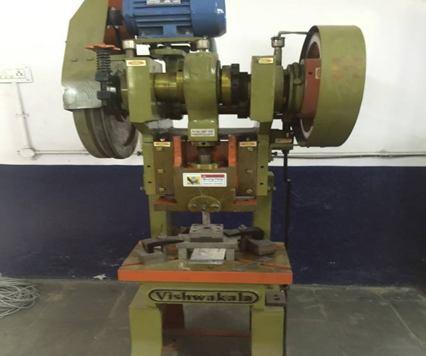
Fig. 1 Press Machine (Mechanical Type)
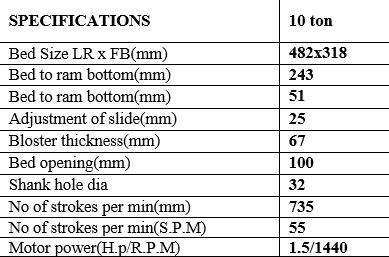
Fig. 2 Specifications of 10 ton Press Machine
The material used for the whole fixture Ie. The upper thrust plate, bottom punch support and etc are made from high chromium high steel (D2) High chromium High steel(D2) is chosen as it has a high wear resistance, hardness, and good toughness, which make it an excellent choice for Stamping,Forming Dies or Punches. D2 steel is an air hardened tool steel containing high carbon and high chromium Due to high precentages of Chromium and Carbon , D2 steel offers high wear resistance and high abrasion resistance D2 steel can be heat treated and it offers a hardness in the range of 55-62 HRC It is also machinable in the annealed condition. Typical Composition of Metals of AISI standard D2 SteelC Cr Si Mo V 1.55% 12% 0.30% 0.80% 0.90%
ISSN: 2321-9653; IC Value: 45.98; SJ Impact Factor: 7.538 Volume 10 Issue XII Dec 2022- Available at www.ijraset.com
Properties Metric Imperial Density 7.7 x 1000 kg/m^3 0.279 lb/in^3
Melting Point 1420°C 2590°F
Mechanical Properties Metric Imperial Hardness, Knoop (converted from Rockwell C hardness)
770 770 Hardness, Rockwell C
63 63 Hardness, Vickers 751 751 Izod Impact Unnotched 78.0 J 57.8 ft-lb Poisson's Ratio 0.26-0.30 0.26-0.30 Elastic Modulus 190-210 GPa 27557-30457 ksi
Condition(T (°C)
Thermal Expansion 10.4 x 10⁻⁶/ºC 20-100
Preheating of D2 steels is done at a relatively slow rate, up to 815°C (1500°F). The temperature is raised to 1010°C (1850°F) after preheating. It is then maintained at 1010°C (1850°F) for 20 to 45 minutes before being cooled with air (air quenched).
D2 steels can be forged between 1065°C (1950°F) and 954°C (1750°F) in temperature. The minimum forging temperature is 926 °C (1700 °F).
D2 steels are annealed between 871°C and 898°C (1600 and 1650°F). After then, the furnace cools gradually at a pace of about 4.4°C (40°F) per hour or less than that recommended for use
The preferred temperature for tempering D2 steels is 204°C (400°F), which yields an HRC (Rockwell Hardness C) value of 63, and 537°C (1000°F), which yields an HRC (Rockwell Hardness C) value of 54.
ISSN: 2321-9653; IC Value: 45.98; SJ Impact Factor: 7.538 Volume 10 Issue XII Dec 2022- Available at www.ijraset.com
The following design of Press Tool , done in Fusion 360 shows the design and components of the press tool .
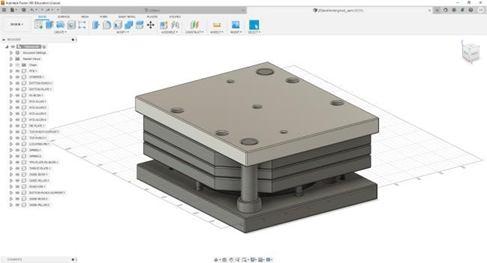
Components and its uses :
1) Stripper Plate - Used to strip off the component from punches
2) Bottom Punch & Top Punch - It is the male part of a die used for making holes fixedeither with the top or bottom plate.
3) Thrust Plate (Top Plate) - Used to hold top half of the press tool with press slide
4) Bottom Plate - The bottom plate provides required damping effect to thedie
5) Bushing - A usually removable cylindrical lining for an opening used to limit the size of the opening, resist abrasion, orserve as a guide.
6) Locating Pins - Locating pins can be used to locate a work piece on afixture, or to align two pieces of a fixture.
7) Guide Pillar and Guide Bush - The guide pillar and guide bush are utilised for the aligning function of the moveable halves of the tool . Additionally, they preserve the geometric tolerances of the stationary and moving mould halves during each cycle.
8) Pin Punches – Pin Punchesare used to drive or remove the pins, after theyhave beenloosened bya taper punch.
ISSN: 2321-9653; IC Value: 45.98; SJ Impact Factor: 7.538 Volume 10 Issue XII Dec 2022- Available at www.ijraset.com
The designed fixture and press tool can be used on Automatic Press Machine by adjusting the design according to the machine requirements . This will result in increased productivity and reduce in man power required. Futher by changing the press tool design various outcomes can be achieved easily .
As the Press tool Machine’s cost of production and time taken is less than that of the conventionally used Routing machines or Laser Cutting machines ,the whole process of PCB manufacturing has become more cost efficient and time saving. Also , it resulted in improve in production rate and reduce in cost of quality control which is achieved by high accuracy and uniformity of the product .
Many people have aided me in doing this job effectively. I want to express my gratitude to everyone involved in this project. I would first like to thank my mentor Prof. Pramod Kale, who taught me lot about this research. His recommendations and guidance were helpful in getting this project finished. Last but not least , I want to thank and express my gratitude to my parents and also my friends for their invaluable advice and support throughout the course of this endeavor.
[1] K.Kishore Kumar, Dr. A.Srinath, M.Naveen, R.D.pavan kumar, "Design of progressive dies", International Journal of Engineering Research and Applications (IJERA), ISSN: 2248-9622, Volume 2, Issue 3, May-Jun 2012, pp.2971-2973
[2] Gasper Gantar, Andrej Glojek, Mitja Mori-BlazNardin, MihaelSekavcnik, "Resource Efficient Injection Moulding with Low Environmental Impacts", Strojniski Vestnik-Journal of Mechanical Engineering, 59(2013)3,copy right 2013,Journal of Mechanical Engineering, All rights reserved.DOI:10.5545/svjme.2012.661 pp:193-200.
[3] Samadhan D. Bhosale, S.C.Shilwant, S.R. Patil ," Quality improvement in manufacturing processes using SQC tools" International Journal of Engineering Research and Applications (IJERA), ISSN: 2248-9622 Vol. 3, Issue 3, May-Jun 2013, pp.832-837.
[4] Jai hindus S."Design and development of stamping dies for online maintenance" Vol. 9, No. 4, APRIL 2014, ISSN 1819-6608,ARPN Journal of Engineering and Applied Sciences,©2006-2014, Asian Research Publishing Network (ARPN), All rights reserved.
[5] Subramanyam Pavuluri “Process of Press Tool Design and its manufacturing for Blanking Operation”Vol. 5 , Issue 5 , May 2016 , International Journal of Innovative Research in Science , Enginnering and Technology(IJIRSET) , ISSN : 2319-8753 .
[6] Dr. Taylan Altan, Selection of die materials and surface treatments for increasing die life in hot and warm forging" Paper no 644-FIA Tech Conference, April 2011.
[7] Hairulliza Mohamad Judi, Ruzzakiah Jenal and Devendran Genasan "Quality Control Implementation in Manufacturing Companies Motivating Factors and Challenges" ISBN: 978-953-307-236-4, (2011).
[8] Jayesh Kumbhar, Harshwardhan Pandit“A Review Article on Jigs and Fixture” International Journal of Science and Research (IJSR) ISSN (Online): 2319-7064 Index Copernicus Value (2015): 78.96 |Impact Factor (2015): 6.391