The Public Catalyst is produced by IESE: www.iese.org.uk enquiries@iese.org.uk @ IESE CIC
Editorial by Nicola Quinn
Artwork by SMK Design (Aldershot)
Views expressed within are those of the IESE editorial team. The Public Catalyst is distributed to companies and individuals with an interest in reviewing, remodelling and reinventing public services.
The Public Catalyst: Stirring Ideas, Sparking Action
As Chief Executive of IESE, I am delighted to introduce the refreshed face of our publication - a magazine designed not just to inform, but to inspire and empower everyone working across local government. This is more than a facelift; it reflects the transformation that we have undergone as an organisation over the past year and the renewed energy driving our mission.
AtIESE, we exist to help councils and public sector partners build a future of lasting positive change for the communities they serve. Over the last twelve months, we have reimagined how we work internally. Strengthening our team, refining our strategy, and embracing innovation, so that we can better support the sector in delivering services that are compassionate, effective, and sustainable.
This magazine is a key part of that vision. It is a knowledge-sharing platform and a catalyst for change, bringing together ideas, solutions, and practical examples from across the sector. Each issue will explore themes that matter most to local government: People & Communities, Safe & Resilient Services, Innovation & Transformation, and Global & Strategic Outlook. Through these lenses, we will showcase stories that put people at the heart of change, highlight
creative approaches, and share lessons that can help you navigate challenges and seize opportunities.
Our goal is simple: to provide content that is professional yet approachable, insightful yet actionable. Whether you are looking for case studies, leadership perspectives, or practical tools, this magazine is here to support you in shaping services that enrich lives and strengthen communities.
Thank you for joining us on this journey. Together, we can build a sector that works better for everyone.
Annabelle Atkin, Chief Executive of IESE www.linkedin.com/in/ annabelle-atkin-128973101/
People & Communities
The Unsustainable landscape of SEND - Individuality as a Key Factor of Progression
Reports throughout 2025 have not shined the most positive light on SEND, with hard budgets in place, increasing needs and spending local authorities struggle to keep funding balanced for SEND. Meanwhile children still struggle in school and parents are continually worrying about the outlook for their children.
Current projections released early October 2025 show that it is likely there will be an additional 220,000 children and young people with education, health and care plans by 2029 according to IFS (institute of Fiscal Studies).
The General Secretary of the association of School and College Leaders stated, “The truly shocking this is that despite the increase in spending we are still left with a system failing to cope with the needs of these children and young people”. Rising demand and therefore, rising costs of SEND in the UK is driving unsustainable financial strain on local authorities who fund the support outlined in EHCP’s (Education, Health and Care Plans).
With the landscape of SEND so fractious, a reform is on the horizon, but the effectiveness of hopes to have more SEND children in mainstream education will only apply pressure to schools that are already struggling to meet the needs of the SEND population currently present.
IESE spoke with Lynne Duffy, Head Teacher and CEO of Gloverspiece Minifarm, a care farm and school that caters to many SEND children. Upon asking Lynne what her views were on reforming the sector for real improvements for all parties, she highlighted that the time it takes is a big part of the problem being faced. With diagnosis times taking up to two years for conditions such as ASD and ADHD and others like dyslexia taking less time but with an average wait time of over a month, children are left waiting for too long before diagnosis. After this long wait, parents and children also have a long wait for EHCP processing, which can take up to 20 weeks.
These long waits hold back the child from having optimal education for what can be 52 months (2 years, 4 months), in worst case scenarios, creating anxiety and frustration for parent and child. Lynne also pointed out the drastic lack of spaces available for SEND children in special schools and mainstream units, so where this is necessary, a child may be waiting for a space to open up for them, all the while not receiving adequate education, or in some cases, any education.
Lynne noted that a problem with delays like this is it can hold back the education and
development of the child and use more longterm issues.
“They will get angry, and they can’t communicate, can’t speak, and no one is helping them. They are the ones who get uneducated through the whole system and by the time they enter a special school at age 7, they’re too far gone”
She went on to say how earlier integration into a suitable education setting for these children could be game changing. “If you can help then at 4, get speech and language involved, put the right provision in place, give them that extra time in a nursery type base, then you stand a chance with them.”
IESE’s discussion with Lynne highlighted a cause of the increasing demand may simply be late introduction of adequate education. This highlights the importance of speeding up diagnosis and EHCP development to ensure children get into the necessary education as soon as possible to give them the best chance. Provided with the most suitable early years education format for SEND children may prevent more severe challenges for the children into their young adult years and reduce strain on the sector.
Early years development for children is extremely important, and an unsuitable environment in education or home could hold them back unnecessarily. Gloverspiece has informed IESE of their taking on nursery age SEND children, and both Lynne Duffy and IESE are excited to see the developmental difference for these children being provided with the suitable SEND learning opportunities from such a young age in comparison to the typical age of 7 where this education style is introduced. Current theory would suggest that early intervention for these children will enable them to develop faster, communicate more effectively and build self-confidence. However, the effects are yet to be seen and IESE will stay in touch with the care farm to find out more about how introducing a SEND suitable education from nursery age will help the development of these children.
The fantastic work being carried out at Gloverspiece is a testament to putting needsfirst on an individual basis to optimise learning outcomes for SEND children. However, this space is also used by many children in mainstream who wish to enjoy the space, rescue animals and nurturing environment to regulate and de-stress. It is also used by looked-after children in care for emotional regulation and as a form of therapy. The work of Lynne and her team highlight that educational success and mental health are intrinsically tied for successful learning and development.
As central and local government looks to reform SEND and implement improvements to reduce strain on budgets and services it is worthwhile considering early years development focuses and mental health practices. Enforcing SEND and therapeutic practices earlier on may release pressure in later education and help children with additional learning needs reach their full potential.
The takeaway from IESE’s discussion with Lynne Duffy is that getting children who have additional needs into settings where their needs are met quicker is the most important step forward to improving the SEND landscape in the UK. With potential to ease strain in later years education and better quality of life for the children and families, speeding up diagnosis and EHCP’s is a critical step forward.
The increasing number of SEND children in social care
Innovation & Transformation
The Age of AI in Business –Do Our Expectations Meet the Reality?
These days it is almost impossible to go online without getting some notification around the growth of AI. However, 2025 has been rumoured to be the ‘year of the AI agent’ with hopes in the business world for AI agents to transform the way that work is done.
However, AI developers and tech experts have mixed feelings about whether we are jumping ahead of ourselves in our expectations of what AI will be able to do.
Hot Topic in AI NewsIs It Stealing Jobs?
There have been plenty of reports and newsletters released throughout 2025, suggesting that there is a growing gap between the reality and expectations of Generative AI. There has been a growth in AI usage in areas such as consulting, tech, media and STEM areas. Entry-level jobs available for graduates have been on the decline, however, it has been said that this is not only an AI issue but a wider economic one too.
Graduates have been noted to be particularly vulnerable in the growth and adoption of AI systems in employment. Many entry-level roles such as basic data entry, and form-filling are considered drudge work that AI systems can do instead. Over the last 2.5 years, these types of positions have decreased by a third and June 2025 saw the toughest job market in the UK for graduates since 2018.
Employees & AI
workers wanted from AI aligned with current AI capabilities. The study discovered that there are areas ripe for research and development after surveying 1,500 workers from 104 occupations to discern where AI agents could benefit work and where they may cause harm.
The biggest concerns found in this survey were around the accuracy and reliability of AI systems at 43% of respondents feeling this was a big issue. Job loss concerns were reported by 23% and the lack of human oversight concerned 16%. However, there was an overarching concern regarding AI systems encroaching on communications with vendors and clients or creative tasks.
The areas in which they felt AI would be most impactful were:
• Automation freeing up time for higher value work, 69.4%.
• Reduction in task repetitiveness, 46.6%.
• Improving work quality, 46.6%.
The most welcomed automations that have been highlighted include, scheduling appointments, rectifying record errors and maintaining information files.
“ New ‘agent’ technology is nothing new and is just orchestration dressed up with a new name. We haven’t even figured out ROI on LLM technology. ”
In a response to the upheaval in the job market and trends of AI, Stanford Institute for Human-Centred AI and Digital Economy Lab conducted a study to discover if what
In Local Government, employment is still yet to be determined. As more councils adapt to the use of automation and artificial intelligence, many of the work being conducted this way is in administration. ›
AI researcher and Senior Research Scientist Marina Danilevsky
Innovation & Transformation
Many AI experts highlight the importance of recognising AI as a tool, rather than worker replacement. Most current Local Authority AI usage is tool focused; however, many report a need for training and expertise. The outlook for Local Authority employment going forward may be in training for AI application and AI specific roles. However, this is still a developing area with much potential to grow and to change.
There is also an influx of cybersecurity and protection in AI use to help safeguard data and systems.
The Impact Upon the Job Market
AI automation is going to redefine work whether we like it or not, so being aware of the way employment, business and skills need to align with the AI shift is critical. The Stanford Institute for Human-Centred AI and Digital Economy Lab looked at the value of various skills and how comparable they were with those that are least susceptible to AI replacement.
The analysis from this data would suggest that some jobs considered high-wage and high-skill, such as process monitoring and data analysis may decrease in value. Alternatively, roles that require effective communication, teaching, and organising work may grow in importance as AI evolves.
AI Agents & Expectations
AI agents are the newest and ‘hottest’ AI tool in many industries now- they are software programs capable of autonomous actions to plan, understand and execute tasks. These agents are powered by LLMs (Large Language Models) and are capable of interfacing with other models, tools and aspects of a system to fulfil the goals of the user. This is beyond the typical scope
of AI chatbot functions, or the automated customer experience emails and bots.
AI agents are also different from typical AI assistants which require a prompt every time a response is required. The theory behind these agents is that a user provides a high-level task and the agent figures out how it should be completed. Yet, the offerings on this are still in early stages, and generalisations in technology about 2025 being the year of the AI agent are said to be mostly hype. AI researcher and Senior Research Scientist Marina Danilevsky believes that the new ‘agent’ technology is nothing new and is just orchestration dressed up with a new name. She also stated regarding 2025 being the year of the AI agent, “We haven’t even figured out ROI on LLM technology”.
Danilevsky and other experts on AI technology share the same tone that there may be a disconnect between the reality and our expectations. Considerations around the required effective communication from users to allow for the agent to do what is necessary and interpret the prompts correctly have been voiced. The hype around imagining the agent could think for the user and make decisions then act- which is quite a harrowing concept- has been a notable flaw in expectations.
However, there is still a great deal of hope and promise around the development of AI agents. It has been highlighted that this development should be a tool, not a replacement to human workers.
The future has AI interwoven in it, and while the technological background of economy is changing, perhaps AI training, and integration of automation into education is the forward movement needed to keep pace with ever-changing technology. How effective AI agents will be for businesses is yet to be seen.
Powered by
LLMs
Safe & Resilient Services
Critical Navigation of Increasing Flood - Risks on Community Infrastructure in the UK
In December 2024 the Environment Agency released a paper highlighting the dangers of climate change on the UK. With increasing flooding, the outlook of flood risks by 2050 states that 1 in 4 properties in England would be at risk of flooding, totalling to 8,000,000 properties. This would increase if homes are built on flood plains but can be navigated by improving flood defences.
Atthe time of writing, 6,300,000 properties are at risk from flooding, which is above what was previously anticipated.
The Environmental Agency considers flooding from three primary sources; the sea, rivers and surface water run off during heavy rainfall that can overwhelm drainage systems. This year, in September, 2025, saw a roundabout in Swansea, South Wales flood exponentially, flooding homes, blocking off roads, and drowning vehicles due to heavy rainfall and a collapsed culvert. In 2015, a sinkhole opened on a public road in Manchester following heavy rainfall. This is a story that is becoming more regular as our infrastructure cannot
keep up with the environmental changes to our weather systems.
Why is Flooding on the Rise?
A large quantity of floods occurs due to heavy rainfall oversaturating rivers and overwhelming drainage systems. Rainfall, worldwide, is impacted by two things:
Warmth of the air will impact rainfall, as hotter air can hold more moisture. Cloud formations over the ocean will draw up extra moisture, containing more and larger rain droplets. As the climate warms, heavy rain becomes more common as the air is able to hold more moisture.
Weather movement patterns also impact rainfall. The UKs closest jet stream influences a large part of our climate. Yet, shifts in this can lead to some areas becoming drier and some wetter.
The Environmental Agency has utilised cutting-edge methods to generate a bespoke software that integrates detailed local flood risk models into a national scope. These models show that 2,400,000 properties are in areas that are at a flood risk from rivers and seas alone, and while this is not increasing there is an increase of 88% of properties at highest levels of risk. The reason for this change in risk factor is due to models accounting for frequency of flooding.
Is Rainfall Really Increasing?
Datasets from the Royal Meteorological Society show that there is an increase in rainfall. Measurements taken in Sussex County show an increase of 2.3mm mean average rainfall per day from 1900 to 2020 at a steady rate. Data in 1900 shows rainfall averaged at 4.1mm per day while in 2020 it averaged at 6.4 mm per day. Datasets like this are carried out across the UK, and all tell a similar story about our weather.
This is significant as local authority areas with higher-than-average risks of flooding may need to consider updates to drainage systems from surface and groundwater on top of river and sea related flood defences. Much of the UK’s drainage systems have not been updated to cope with the increase in rainfall and a great quantity of our infrastructure is old, with most combined sewer networks dating back 150 years with some updated since the 1960’s. Schedule 3 of the 2010 Flood Water Management Act has provisions for the approval and adoption of drainage systems. In June 2024 it was announced that Schedule 3 was in process of being enacted in England.
Safe & Resilient Services
recycled is used for flushing toilets and basic washing/sprinklers. Cambridge already had a water problem at the time of this development’s inception, and the water recycling system was an answer to this issue. Their sustainable urban drainage system uses water channelling through blue and green roofs and swales. This water is then collected in newly formed lakes, which helps to reduce localised flooding risks, as well as provide useable water.
Government Plans
Future challenges and opportunities have been highlighted by the central government. Challenges include the following:
• Growing urban populations increase the demand for water supply.
• Increasing flood risk up to 230,000 by 2055, with new developments due to urbanisation increasing the number of properties in areas at high risk of surface flooding. Groundwater flood risks are projected to escalate with rising sea levels, raising the water table level
• Water supply demand is likely to rise, and reports suggest that parts of South England may run out of water within the next 20 years. An anticipated additional 4 billion litres of water per day is anticipated to be needed by 2050.
Meanwhile opportunities include:
• Emerging smart urban water systems to detect leaks and control water pressure to reduce loss.
• Rainwater harvesting opportunities to use for irrigation, toilets and firefighting to improve water security.
• Sustainable drainage systems in urban water management to imitate natural drainage systems. Including retention ponds, permeable paving and geocellular drainage systems.
Eddington in Cambridge managed to implement one of the first comprehensive water harvesting/recycling schemes back in 2014. With the go ahead of the Cambridgeshire local authority body the university started developments on a housing area that would have a storm collection system to reduce flooding possibilities and provide water. The water
Acknowledging the threat of flooding is key in ensuring economical sustainability for the UK. Currently annual losses from flood damage in the UK is around £700 million and innovations to combat this growing issue can prevent rising costs in losses. Between October 2019 and August 2021, Transport for London had 55 incidents of station closures due to flooding. Ground movement from heavy rain and pipe leaks damages infrastructure and usually costs the utility sector £300 to £500 million annually.
Dealing with our environmental challenges in water management and flood risk mitigation would initially drive spending on implementing improvements. A focus on long-term water management projects like Cambridge Universities water recycling, or the use of geocellular drainage systems will place less stress on local authority environmental managem ent budgets.
Local authorities need to think in the long-term about their locations, water supply, and susceptibility to flood risks. At the time of writing, local authorities have the opportunity to appear as leaders in environmental water management innovation and benefit from it with lower flood damage costs going forward. For more information on Critical Navigation of Increasing Flood-Risks on Community Infrastructure in the UK email: enquiries@iese.org.uk
Rainfall amounts vary depending on the season and location. Flash floods occure when rainfall outplaces the ground’s ability to absorb it.
Global & Strategic Outlook
The Implications of a Changing Visa & Immigration System in the UK
It is not new information that the immigration system in the UK is undergoing an intensive overhaul of its processes and regulations. However, immigration law impacts more areas the public sector more than previously thought. Migrants from all countries contribute the UK economy, from the list of jobs applicable for Skilled Worker visa applications, to the high quantity of Health & Social Care workers, and to influxes of overseas students for further education, supporting our universities.
Astensions heat up around the visa and immigration system in the UK, it is important to understand just how changes from the May 2025 immigration white paper will impact the public sector and how we may need to prepare for workforce alterations.
There are 8 quantifiable proposals regarding immigration in the UK, these include:
• A reduction of the list of jobs for which employers can sponsor an overseas worker for a Skilled Worker visa. This means that medium-skilled jobs will no longer be sponsorable unless the Migration Advisory Committee recommends an exemption.
• The end of the existing exemption for social care workers, meaning that employers will no longer be able to recruit social care workers from abroad.
• An exploration on the levy on English university income from international student fees.
• A reduction in the length of graduate visas from 24 to 18 months.
• An increase in the strictness of English language rules. Higher standards will be
required for those who are already taking tests, and for those who are partners of people moving to the UK on work visas, where basic English will be required for a dependant visa.
• An increase in the qualifying period for permanent residence from 5 to 10 years.
• An increase in ease for individuals on certain visas for highly skilled migrants, including High Potential and Global Talent visas.
How Will This Impact the Public Sector?
Health & Social Care Visas
One of the first ways that the new visa and immigration regulations will impact the public sector is care worker restrictions, where care workers and senior care workers will no longer be able to make new visa applications. Until summer 2028, a transition period will be in place, this will allow individuals to extend or switch from other visa routes, after which the routes will be removed. Those who are switching will need to have been legally employed by their sponsor for 3 months minimum before application. Furthermore,
any Certificates of Sponsorship that are issued post April 2025 require a minimum salary of £25,000 per annum, this also applies to the Health and Care visa route.
This change has come into place after the stark increase of Health and Care worker visas since entry requirements were relaxed post-Covid to ease strains on the sector. Between 2009 and 2010, the Home Office issued less than 140,000 work visas to primary applicants each year. However, in 2021 this amount increased to 335,007, with 114,023 of these being Health and Care Worker visas.
While on the surface this is a very high quantity of workers coming from overseas to work in a single sector, the sector is still in need of workers and stricter rules in this route. Removing it could have major consequences for health and social care in the UK. In 2024, in spite of staff being brought into the sector via this route, there were still 131,000 vacancies in social care in England alone.
Earlier this year Prof Martin Green of Care England spoke to the BBC on the future removal of the visa route. He said that ›
‘taking away international recruitment with no warning, funding or alternative isn’t only short-sighted but cruel’. While the Prime Minister stated that this was to reduce immigration significantly, it is debatable whether or not there are the resources within the UK population to fill the hundreds of thousands of vacancies in the sector now.
IESE spoke to a support worker from Derbyshire who has been in the sector for 15 years to ask their take on the sector and its recruitment challenges.
“It’s a lot of work, a lot of responsibility and most of the time it’s just you. They need you. But there’s no incentive, you can get better pay at Amazon or McDonalds and have much less responsibility. I’m here because I love the people I support, but if I wasn’t already here, I wouldn’t choose to be a support worker. If we want to attract people into social work, there needs to be an incentive and right now, there isn’t. It’s a rewarding job to support and care for someone, but you’ve got bills to pay.”
Support worker from Derbyshire
Skilled Workers
Another area that will see drastic changes is the Skilled Worker visa route. There will be an increase in the requirement for the minimum skill level from RQF Level 3 to 6 (equivalent from A-Level to Graduate). This is being implemented to prioritise high-skilled roles and reduce a reliance on lower-skilled work in migration and could see the number of eligible occupations reduced by 180 or so.
Global & Strategic Outlook
Those who are currently sponsored via this route and fall below RQF Level 6 status will be allowed to extend their visas under current occupations and change their employer sponsor. Yet, those who are applying for the first time will be subjected to these changes.
The most impacted sector under the 2025 visas and immigration reform will be the social care sector, which is already facing challenges. This strategic pivot towards high-skill low-volume migration is anticipated to have short-to-medium term impacts on businesses that rely on migrant
workers. Businesses are encouraged to utilise international recruitment, workforce development and training. However, the implications for high-migrant dependant sectors are hard to anticipate and employers should prepare for higher expenditure on visa sponsorship costs and recruitment.
Cyber Resilience
The Cyber Centre of Excellence Brings Cyber Awareness to the Care Sector with New Workshop Series
The Cyber Centre of Excellence is partnering with Care England and Digital Care Hub to deliver a three-part series of free workshops designed to support care providers in bolstering their cyber security practices.
Recognising that all care providers now depend on digital systems to deliver services effectively and efficiently, the Cyber Centre of Excellence (CCoE) is focusing its efforts on building cyber resilience within the care sector.
Joining forces with Care England and Digital Care Hub, the alliance is set to launch a three-part series of educational cyber security workshops designed to prepare all members of the care sector to defend against modern cyber-attacks.
The first workshop in the series, ‘Cyber in Care: How Much Should You Know?’, will take place on Wednesday 12th November, from 12:00 and 1:30PM. The session aims to empower care leaders, managers, and frontline teams from residential and domiciliary care environments with practical, jargon-free advice on how to build digital resilience and protect their organisations from growing cyber threats.
The workshop acts as a crash course of introductory topic areas in cyber, covering password management, virtual private networks (VPNs), recognising AI phishing scams, the risks of ransomware, and implementing Data Security and Protection Toolkits (DSPT) within the care environment.
Following this, there will be two additional workshops in the series; Cyber in Care: The Deep, the Dark and the Hidden Dangers, and Cyber in Care: Resilience, Recovery & Incident Response, slated for January 21st and February 25th, 2026, respectively.
Workshop Two will uncover the hidden underbelly of the internet – the dark web – and explore the risks it poses to all organisations. In this session, what the dark web is, how an organisation’s sensitive data and login credentials can end up there, and how this exposure can create vulnerabilities
that cyber criminals may exploit will be explained.
The Cyber Centre of Excellence will be proudly offering a free dark web scan to care organisations that attended and plan to continue with the series. Using your organisation’s email domain (e.g. @ organisation.org.uk), they will identify any leaked credentials detected on the dark web that could pose a serious security risk and will then provide guidance and support to help remediate these vulnerabilities before the final workshop.
The third and final workshop will focus on practical continuity and recovery planning in the event of a cyber-attack, sharing templates, checklists, and exercises to support immediate action, explore the use of digital twin visualisation for resilience planning, and highlight the value of tabletop exercises in strengthening preparedness.
Kurtis Toy, Chief Executive of the Cyber Centre of Excellence, will be co-hosting the workshop alongside Sam Cattell, Technical Cyber Lead for Digital Care Hub. He commented:
“The growing threat posed to the care sector demands urgent action from staff at every level - not just IT teams. We’re delighted to be working with Digital Care Hub and Care England on this workshop series to empower care providers with the practical guidance needed to strengthen their digital resilience - in turn - protecting both their service operations and the people they support”
“The care sector runs on trust, and trust is exactly what cyber criminals exploit. You don’t need to be a tech expert to understand how to protect your organisation; you just need to know what you’re protecting, and why it matters.
These sessions aren’t about jargon or fear - they’re about building confidence. Once you see the world the way an attacker does, you start to close the doors they depend on. Prepared, not paranoid - that’s the goal.”
The CCoE invites all care providers –from small residential homes to large multisite organisations – to join them in building a safer, more secure future for the care sector.
For more information about joining this webinar series, please contact enquiries@ccoe.org.uk
Cattell added:
IESE Spotlight Series
Babergh & Mid Suffolk 2024 Award Winners: Continual Progression
Council of the Year in the 2024 IESE Awards, Babergh and Mid Suffolk District Councils (B&MS) have been working hard to ‘put sustainability at the heart of everything they do’. By working to build resilient communities and opportunities built into the infrastructure. In autumn 2025, B&MS hosted IESE and representatives from other Local Authorities for a special showcase of the achievements and innovations that secured them the IESE 2024 Award. This event also highlighted the significant progress and further developments made since winning, demonstrating their ongoing commitment to positive change within their communities.
What Are They Doing?
One of the significant actions for Babergh & Mid Suffolk has been addressing the rates of vacancies in one of their high streets. To combat this, they have been working to de-risk and improve the area, investing in a mixed-use future that is less dependent on retail. They have also worked with local businesses, landlords and increasing opportunities for art, culture, and innovation. Alongside this, they built Gateway 14, the largest innovation and business centre in East Anglia, implemented to deliver employment space, financial returns, and deliver quality sustainable development.
Another area of growth is in the delivery of affordable housing and markets. An example has been the repurposing of Mid Suffolk County District’s former HQ for 93 homes and a retail unit. With a high demand for more residential homes, and importantly, affordable housing. B&MS have repurposed these buildings and surrounding land for residential development as a key driver to increase the sustainability for the local population.
Aside from their approach to housing and building regeneration B&MS have developed an economic strategy that encompasses where their strengths lie, considering opportunities and where the barriers to growth are. Their regeneration projects for locations include Sudbury Arts Centre, and a £10.6 million redevelopment for Gainsborough House, which reopened in late 2022.
An economy, as we know, needs support, especially with fast-changing developments and the cost-of-living crisis. B&MS have drawn this into play as well. They have unlocked stalled sites, and enterprise zones, and have collectively seen results with a combined 1,522 people supported with jobsearching, 16 nature projects, and 194 new jobs created and more as reported to IESE in September 2025.
However, one of the most impressive areas of development for B&MS has been the transformation of its housing sector. In 2022, they found poor tenant satisfaction, over 4000 jobs backlogged and health and safety risks. They even self-referred for non-compliance, a difficult thing to do but absolutely worth the outcomes and transformation that came from it. The Local Authority has also prioritised decision-making that is focused on the tenant, bringing tenant feedback into the centre of processes, including tracking recommendations and actions taken. They stated that “it’s all about transparency” and that their care for their people has taken precedence in their transformation.
B&MS are bringing in a focus on sustainable travel and energy, funding innovations such as cycle storage and e-bike charging, support to fund community transport operators for decarbonisation, and development and costing of highways schemes for cycling and walking provisions. They are also adapting their fleet to HVO (Hydro-treated Vegetable Oil) for lower-emission fuel. In energy, they are using PSDF (Public Sector Decarbonisation Funds) to roll out solar PV on corporate roofs and in carports, as well as improving the energy efficiency of leisure centres.
Why Is This Important?
As Council of the Year Award Winner, 2024, B&MS have shown the power of innovation for community improvement across the board. With health schemes, eco-schemes and planning across residential, business and energy transport, this well-rounded approach to innovation allows different areas of their public sector to grow in tandem to bring the whole local authority together.
IESE visited B&MS for a showcase of their growth and success. Annabelle Atkin, IESE CEO, was extremely impressed with the showcase and innovative development shown by the authority.
“At IESE, we champion councils that not only think differently but also deliver tangible results. We’re inspired by Local Authorities that embrace innovation across a range of projects, pushing boundaries to improve services and outcomes for their communities. But innovation alone isn’t enough; we look for clear evidence of impact. Babergh and Mid Suffolk District Councils exemplified this journey - consistently demonstrating progress through previous award wins, which was reflected in their well-deserved 2024 Council of the Year title. We encourage all councils to share their transformation stories through our awards, because every step forward deserves to be recognised.”
Driving Innovation and Change
At IESE, we recognise the pressures that a rapidly changing world places on public services, and we champion innovation to help them stay ahead. Babergh and Mid Suffolk exemplified this commitment, earning the IESE 2024 Council of the Year Award for pioneering initiatives that delivered positive outcomes and transformative developments across both districts.
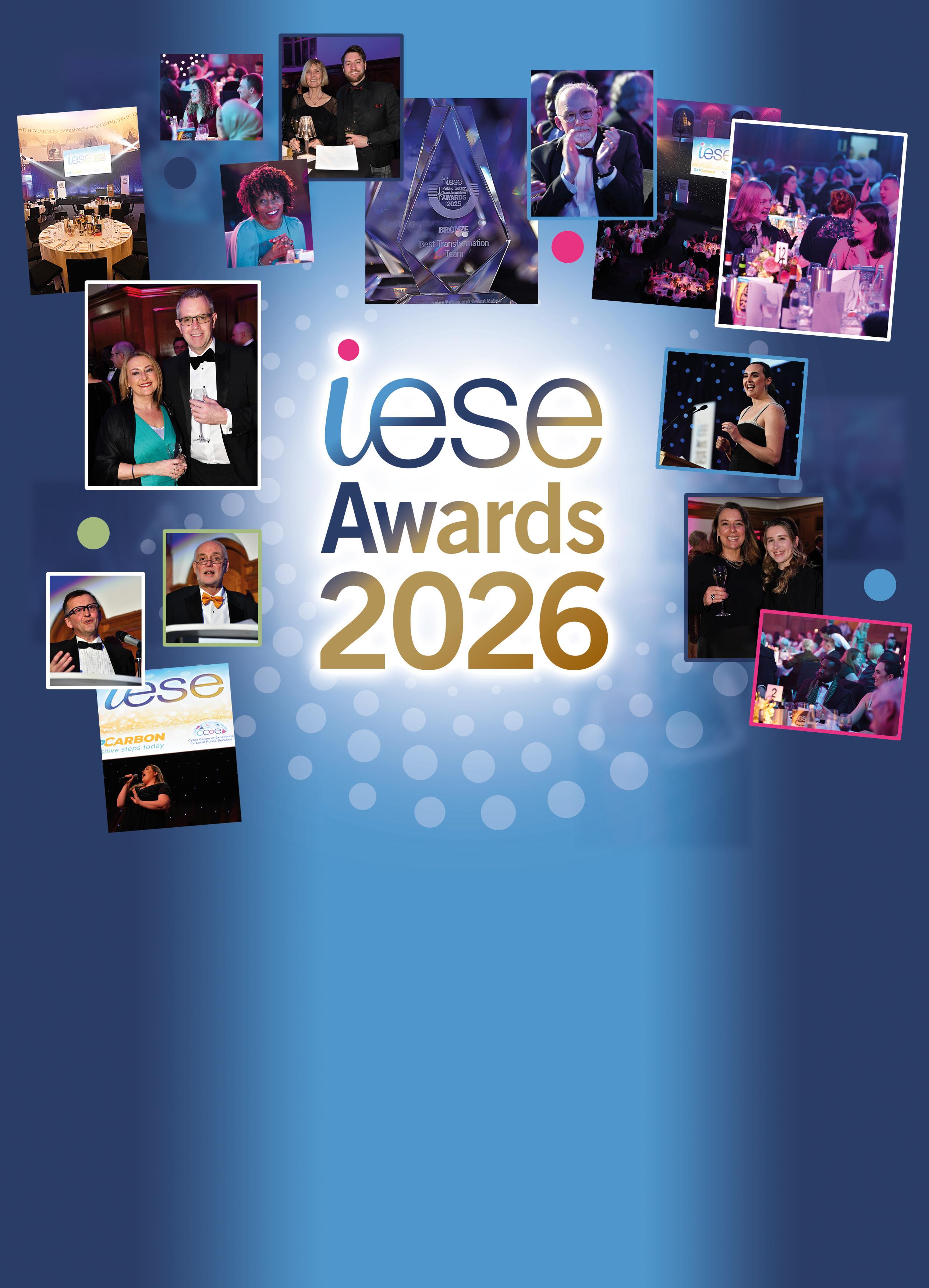
IESE is eager to see how other local authorities instigate changes for their local communities, and what innovations are being employed to combat unique local challenges. If your local authority has implemented strategic innovations to improve its local infrastructure, we encourage you to submit an application for the IESE Awards 2026. IESE wants to know what people are doing across the UK to help our residents thrive.
To apply for the IESE Awards, please visit: www.iese.org.uk/public-sectortransformation-awards-2026
Your vision can change everything.
The IESE Awards 2026 celebrate those who dare to think bigger and deliver lasting change for the residents and communities we serve. Be the vision others follow. Enter our awards now and set the standard for tomorrow.
Scan me
Download the nomination form by scanning the QR code opposite.
Deadline to submit is Friday 9th January 2026.
Please submit your completed nominations to enquiries@iese.org.uk. For more information, please visit: www.iese.org.uk/public-sector-transformation-awards-2026.